The Australian National University
National Institute of the Arts
School of Art
Bachelor of Arts (Visual) Honours
Lauren Hewitt
STUDIO REPORT
PRESENTED IN FULFILMENT OF THE REQUIREMENTS OF THE
Bachelor of Arts (Visual) Honours
Acknowledgments
Supervisor: Martyn Jolly
Title Page:
Abstract 4
Introduction 5
Background/Context 7
Work Process
First Body of Work 1 5 Second Body of Work 2 3
Conclusion 25
Images 27
Bibliography 35
List of Illustrations 36
Reading List 37
Artist Research 39
'Under the Mango Tree' and 'Airmail'
Abstract:
The photograph holds many clues to be interpreted freely by the viewer. My aim here is to use the constructed image to create visual cues and suggestions. By use of construction, I am pushing the boundaries between the real and the imaginary.
I have used this concept to personally interpret the story of Natasha Ryan - the runaway who was thought murdered. By photographing objects and the real world in an ambiguous way, I was attempting to create a narrative derived from both the real story and my imagination.
Informing my first body of work are various areas of research, from false memories and forensic photography to the use of the constructed photograph by other artists such as David Levinthal and James Casebere.
Through the process of exploration and image making in this area, I was later inspired to follow a more personal path in my second body of work. From immersing myself in my imagination and story making, I was drawn to look closer to home in an attempt to communicate my own story.
Introduction
In 1998, the small town of Rockhampton, Queensland was haunted by a serial killer. Leonard John Fraser had been raping and killing young girls in the tropical town since his release from prison the year before. One of these victims was thought to be Natasha Ryan, a troubled teenager who had gone missing while walking home from school one afternoon in September. She was the first from a string of young victims to go missing. Hers was also the only body never to be found, despite the killer having drawn maps for the police to lead them directly to her burial site.
Then in April 2003, during the murder trial of Fraser, Natasha Ryan was found...alive. She had been hiding in a house for the past four years, only minutes away from her family.
She hadn't been kidnapped, she hadn't been murdered and buried underneath the mango tree near the lagoon, she had simply hidden herself away from the world.
My interest in this story stemmed from both my recent areas of research and my curiosity about the surrounding events.
The concepts used in some of my earlier work involved the construction of the photographic image and the creation of illusion. I
had been working with scale models and toys to create representative self-portraits, drawn from childhood toys and imagery. (See fig.1)
This interest in the 'false' image or the 'constructed' photograph led me in the beginning to research similar scientific studies of memory. The occurrence of false memory suggestion within these studies seemed to me to parallel the idea of the constructed image.
False memory suggestion has been a controversial issue in the past, often being related to and blamed for violent and traumatic childhood memories that may never have occurred.
This concept coincided nicely with my ongoing interest in crime scene photography and imagery. Stories of murder and the visual associations that go with them have always sparked my imagination and the possibilities of combining this with the idea of 'false memory suggestion' inspired me to follow a path of investigation that was both new and exciting to me.
The story of Natasha Ryan and the surrounding hype that occurred in early 2003 was hard to ignore. It seemed to encompass all the areas I was interested in - murder, lies, memory, psychological drama. I wanted to get inside the story and try to put to the viewer, through photographs and imagery that I had constructed, visual suggestions and stimuli generated from my fascination with the story.
A second body of work that evolved from this process began to take my interest in the latter half of the year. After immersing myself into a story that dealt largely with the themes of memory, absence and isolation, I intuitively began to explore my own story.
Background/Context
My initial research began with readings into the scientific studies of False Memories. I was interested in how this phenomenon of implanting misleading infonnation into the memories of people related to the idea of a photograph that had been entirely constructed in the studio, out of toys and backdrops, to appear real.
I was also interested in the use of the photograph as a means of suggestion. All images have the inherent ability of suggestion, but I wanted my photographs to bear subtle, obscure hints at narrative and meaning, and to have a familiar quality about them.
In the beginning I was mainly interested in using this concept to visualise childhood memories, hence the use of the dollhouse in making the images (see fig.6 & 7). For me, the dollhouse was a natural choice for the process because dollhouses are interesting toys in that they are used by children, as private little worlds, in which they can act out their fantasies of the real world.
Scientific studies by American psychologist, Elizabeth Loftus, concludes that 'the act of imagination...makes the event seem more familiar and that familiarity is mistakenly related to childhood memories...'^
The photograph is also a popular tool within this kind of research. It appears that memory and the ability to recall an image is effected by whether the photograph is colour or black and white.
"In a series of experiments, subjects were found to remember photographs of colored [sic] natural scenes significantly better than black and white images, regardless
of how long they saw the images. Falsely colored natural scenes were remembered no better than scenes in black and white. If shown the images in color but tested on them in black and white (and vice versa), the images were not remembered as well. It may be that color helps by providing an extra 'tag' on the stored memory code."^
This seemed very appropriate, as I wanted my photographs to give the illusion of reality in order to trigger this sense of familiarity. To do this I would have to use the camera and film in a way that gave me images that were close to reality, in terms of colour and form, yet provoked a sense of memory or imagination.
Further reading into these studies led me to discover that the most frequent and controversial misuse of the ability to influence someone's memory has been to convince patients that they had undergone extremely traumatic childhood events. It was often through the use of suggestion and imagination that patients were 'remembering' these violent memories.
This fascinated me. I thought about how I could translate this into visual imagery. This is how I came to begin looking at crime-scene photographs. My research took off on a bit of a tangent here. The photographs I came across fascinated me and I became absorbed in what is a bit of an undenworld in photographic circles.
The raw, real qualities of some of these photographs found in police archives possess a haunting quality that ignites my Imagination. Stories of murder and especially the kind of Imagery that is associated
^ Wichmann, Felix A.; Sharpe, Lindsay T.; Gegenfurtner, Karl R.
The Contributions of Color to Recognition Memory for Natural Scenes.[Article] Journal of Experimental Psychology: Learning, Memory, & Cognition. 28(3): 509-520, May
with them have always inspired me. Here I saw the possibility of combining this with my earlier research. I wasn't interested in the horror or gore factor of the photos, rather the subtleties contained within them. I was also interested in the use of the genre as an aesthetic style as opposed to its original scientific purpose.
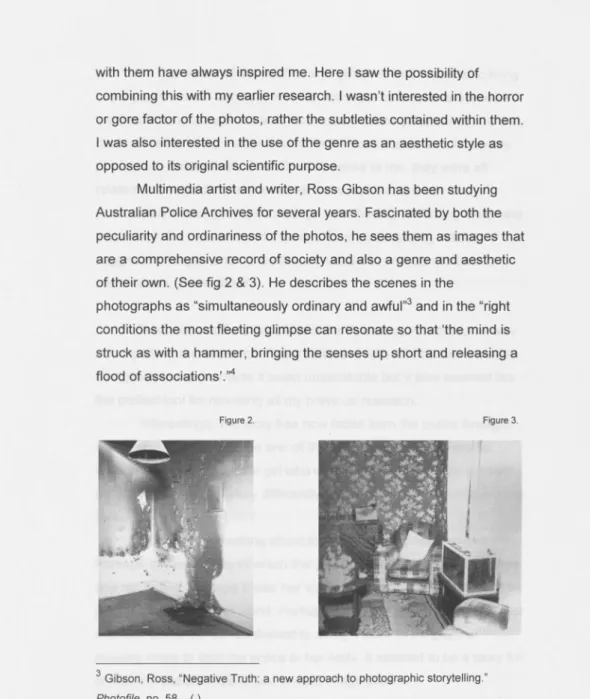
Multimedia artist and writer, Ross Gibson has been studying Australian Police Archives for several years. Fascinated by both the peculiarity and ordinariness of the photos, he sees them as images that are a comprehensive record of society and also a genre and aesthetic of their own. (See fig 2 & 3). He describes the scenes in the
photographs as "simultaneously ordinary and awful"^ and in the "right conditions the most fleeting glimpse can resonate so that 'the mind is struck as with a hammer, bringing the senses up short and releasing a flood of associations'."^
Figure 2. Figure 3.
^ Gibson, Ross, "Negative Truth: a new approach to photographic storytelling."
Photofile, no. 58 ( )
It's this sense of association and glimpses that I wanted to bring into my own work. I began to wonder about the connections between the false memory research and these crime-scene photos and how they could all relate to my earlier interest in the constructed and illusionary photograph. Instinctively they all made sense to me, they were all related and I could make the connections, but theoretically and productively it was getting confusing. I was having conflicting ideas and inspiration. On the one hand I wanted to remain creating subtle, suggestive images and on the other I wanted to entirely recreate a crime scene, in raw detail.
This is where the story of Natasha Ryan began to creep its way into my ideas and research. Being saturated with it in the news media and gossip columns made it seem unavoidable but it also seemed like the perfect tool for resolving all my previous research.
Interestingly, the story has now faded from the public limelight and seems to have become one of those local and national myths. When asked now about the girl who was found in the cupboard, many people remember the story differently and have varying ideas about the facts.
There was something about the story that appealed to me. Perhaps it was the way in which the young girl deceived an entire town and her family. Perhaps it was her vulnerability and quiet will to want to just hide away from the world. Perhaps it was the way in which the killer accused of her murder confessed to doing it even to the point of drawing maps to lead the police to her body. It seemed to be a story full of lies and deceit, falsities and twisted imagination.
attention for long and I knew that people would someday forget this girl's name.
What would I, if I were in this girl's position, feel? How would I cope with the isolation? In my imagery, I wanted to try to explore this, to put myself inside the situation, to recreate a sense of loneliness and contemplation.
It was tempting, at the beginning, to want to translate the story into a literal interpretation, using what I'd learnt from my research into crime-scene photography to try to visually recreate the 'crime', setting it up like a police investigation. As I delved deeper into the nuances of the story though, I came to empathise with her situation and the essence of the story became more important to me than the facts.
Violence and murder are popular in today's culture. On film and television we are overrun with detective and serial killer stories. The newest and most popular television series all seem to be about crime investigation and police.
Unfortunately, most of what we see on the t.v. has become a predictable genre, standardised by certain criteria. All the stories are told from one point of view, usually after the fact, and they usually follow the crusades of the detectives or scientists as they try to solve the crime and catch the killer, all within the space of an hour. We only ever see the crime and the outcome from one side, the side of the 'good guys', and while we often see the main characters try to empathise with the victims, we never seem to see the story as the victim saw it - we see the facts, the evidence, but rarely do we see the emotion, the motives and the inside story.
killing of Anita Cobby seventeen years ago in Sydney. The show was collectively curated by several key people involved in the murder at the time - Anita's parents, police investigators, members of the rape crisis centre and journalists.
In comparison to Natasha's story, this event has remained in public memory and still to this day holds strong emotional meaning to many Australians. This is true because the outcome and circumstances of the Anita Cobby case was much more unfortunate, but I can't help wondering what the response to Natasha's story would be now if she was never found.
Another major exhibition that focused solely on artworks made specifically within this genre was 'Scene of the Crime'. Held in
California, where all the works were sourced, in the late 1990's, Scene of the Crime highlights "artistic practices that suggest links to a forensic approach or address the art object as if it were a kind of evidence."®
The approach to this exhibition differs widely to that of Anita Cobby's which was specifically cathartic for not only those who were directly involved in the case, but also for the local community. Scene of the Crime draws works and inspiration from a much larger geographical area and spans several decades of art practice within California. With no specific focus or central story, the exhibition is a much more general collection of varying styles and approaches within the genre.
I found this publication fascinating. It was full of artworks -primarily installation or sculptural - that, even though constructed, evoked the same emotions I had when looking at the real crime scene photos. Although many of the pieces used objects or photographs in a very evidential way, simulating forensic imagery, I found that they were still powerfully emotional.
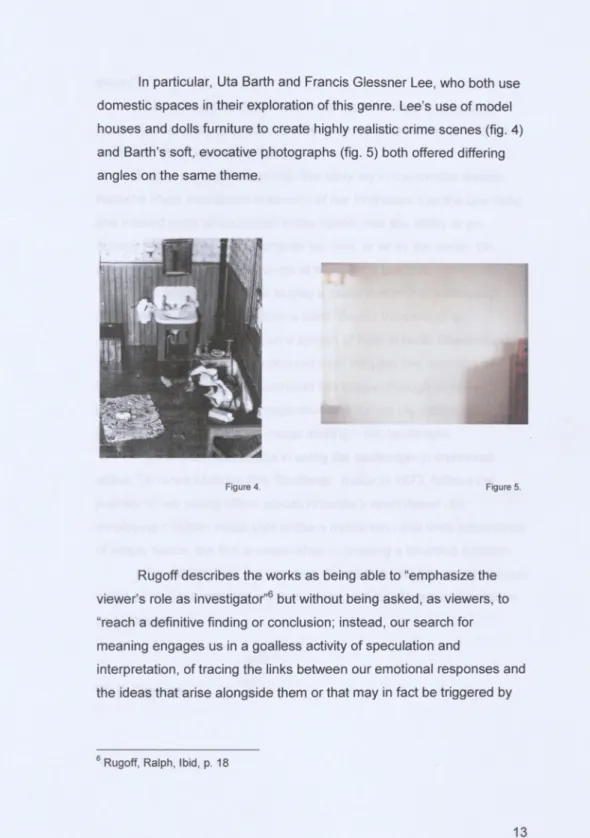
In particular, Uta Barth and Francis Glessner Lee, who both use domestic spaces in their exploration of this genre. Lee's use of model houses and dolls furniture to create highly realistic crime scenes (fig. 4) and Earth's soft, evocative photographs (fig. 5) both offered differing angles on the same theme.
Figure 4. Figure 5.
Rugoff describes the works as being able to "emphasize the viewer's role as investigator"® but without being asked, as viewers, to "reach a definitive finding or conclusion; instead, our search for meaning engages us in a goalless activity of speculation and
interpretation, of tracing the links between our emotional responses and the ideas that arise alongside them or that may in fact be triggered by
them."^
This summed up my ideas about approaching my own work perfectly. It was the gap between those emotional responses and the 'evidence' that I wanted to bridge.
Part of my fascination with this story lay in the smaller details. Natasha Ryan mentioned in several of her interviews that the one thing she missed most when locked in the house, was the ability to go outside and feel the grass beneath her feet, or sit by the water. On several occasions, she snuck out at night to do just that.
The landscape seems to play a major role in many stories of crime and murder. Ross Gibson's book 'Seven Versions of an Australian Badland' focuses on a stretch of road in north Queensland
where several killings have occurred over the past few decades. He visually invokes the harsh Australian landscape through words and phrases, which ignited my imagination and turned my attention to another potential source for image making - the landscape.
Film is often successful in using the landscape to emotional effect. Terrence Malick's film 'Badlands', made in 1973, follows the journey of two young killers across America's open desert. By
employing childlike music (not unlike a music box) and wide panoramas of empty space, the film accomplishes in creating a haunting isolation.
Unavoidable was the common thread that was becoming obvious within all my research and my own image making. Themes of isolation and absence.
Work Process
First Body of Work
The challenge for me to begin making photographs was to somehow make the different areas I had researched come together aesthetically. I was keen to see how the relatively undefined concept of using false memories and construction would work with the scientific documentary style of crime scene photographs. Could the
fake/constructed be used to create the illusion of a real scene? When I began taking my first photographs, I had not yet decided to work with the Natasha Ryan story. While I was aware of the story, as it had just come out in the news, I wasn't using it as inspiration. I began with the thought of using constructions to create my own crime-scene. While I had been looking at real crime-scene photos, I found that my aesthetic and inspiration was focused more on the kind of imagery that was not necessarily a documentation of something, but rather the kind that alluded to a certain atmosphere and feeling, the kind of feeling I got when I looked at the real images.
From looking at the work of other artists who deal with
constructions, I found that most made their own models and a recurring impression that I got from these was that of emptiness and lack of detail.
Figure 6. Figure 7.
Australian artist Ricky Swallow uses boxboard to make small
architectural models and sculptures. While he makes them in order to be viewed as objects rather than photographs, they are still devoid of
much detail and often realism is not an issue.
I started by making my own scale model of a room. I kept it
simple, using boxboard; I made the walls plain, with several windows, no details in the floor or ceiling. I wanted the details to come from the
viewers' imagination. I would attempt to achieve this through the way I photographed the model, through the use of lighting, camera angles and depth of field.
I shot the images in the studio using a simple lighting setup -one main light to the side of the model and a fill light from the front. I
used a close up lens to enable me to get in close enough to the model and I used blue tungsten filters to try to get a blue cast on the images. At first I wasn't very happy with the results. The prints that came
out were too light and I had imagined them to be much bluer and moodier and I was a little unsatisfied with the lack of detail in the model.
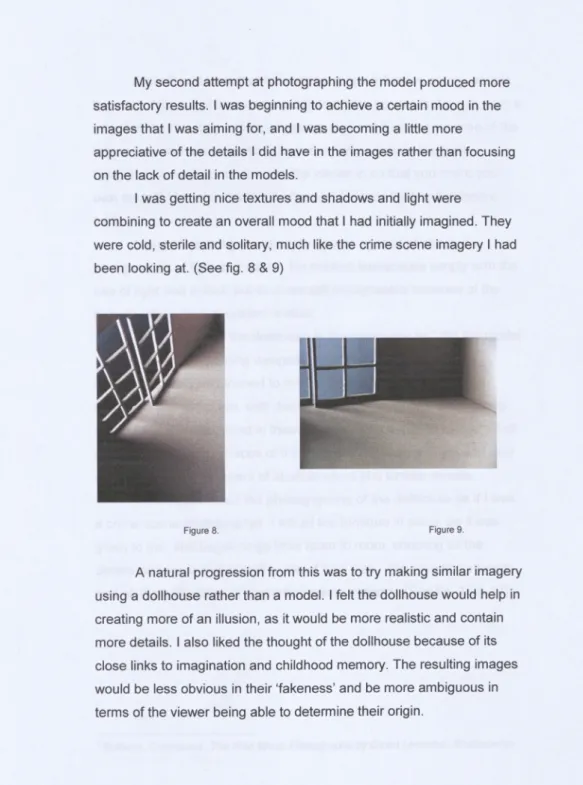
My second attempt at photographing the model produced more satisfactory results. I was beginning to achieve a certain mood in the images that I was aiming for, and I was becoming a little more
appreciative of the details I did have in the images rather than focusing on the lack of detail in the models.
I was getting nice textures and shadows and light were combining to create an overall mood that I had initially imagined. They were cold, sterile and solitary, much like the crime scene imagery I had been looking at. (See fig. 8 & 9)
Figure 8. Figure 9.
Artist David Levinthal has been a major influence on my work in tliis area. His use of toys and models to create scenes is done in such a way that the resulting imagery appears real, yet it retains a sense of the fake. His works are essentially narrative yet he leaves his work
"intentionally ambiguous to draw the viewer in so that you make your own story."® He achieves this by the way he uses light and selective focus.
Many of his images are blurry figures against abstracted backgrounds of light and colour. He creates landscapes simply with the use of light and colour, but they are still recognisable because of the generic, stereotypical subject matter.
I photographed the dollhouse in the same way as I did the model - in the studio with lighting designed to create atmosphere. The
dollhouse I used was loaned to me from a friend. It is fantastically degraded and run-down, with damp patches on the walls and peeling old wallpaper - I delighted in these details. The traces left by the act of play became, for me, traces of the imagination. In my imagination they were traces left after years of abandonment and sinister events.
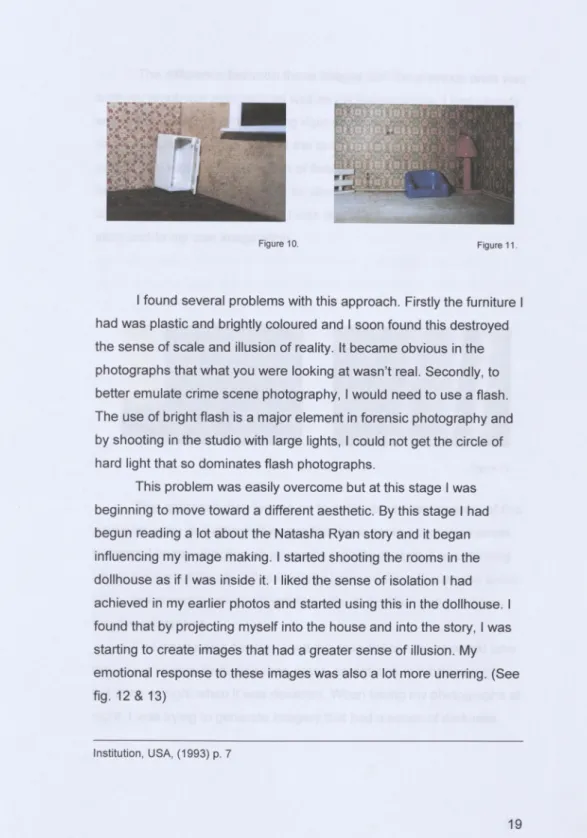
I first approached the photographing of the dollhouse as if I was a crime scene photographer. I left all the furniture in place, as it was given to me, and began to go from room to room, shooting all the details and areas that hinted to me of 'foul play'. The resulting images had all the gritty detail of real crime scene imagery. (See fig. 10 & 11)
Figure 10.
Figure 11.
I found several problems with this approach. Firstly the furniture I
had was plastic and brightly coloured and I soon found this destroyed
the sense of scale and illusion of reality. It became obvious in the
photographs that what you were looking at wasn't real. Secondly, to
better emulate crime scene photography, I would need to use a flash.
The use of bright flash is a major element in forensic photography and
by shooting in the studio with large lights, I could not get the circle of
hard light that so dominates flash photographs.
This problem was easily overcome but at this stage I was
beginning to move toward a different aesthetic. By this stage I had
begun reading a lot about the Natasha Ryan story and it began
influencing my image making. I started shooting the rooms in the
dollhouse as if I was inside it. I liked the sense of isolation I had
achieved in my earlier photos and started using this in the dollhouse. I
found that by projecting myself into the house and into the story, I was
starting to create images that had a greater sense of illusion. My
emotional response to these images was also a lot more unerring. (See
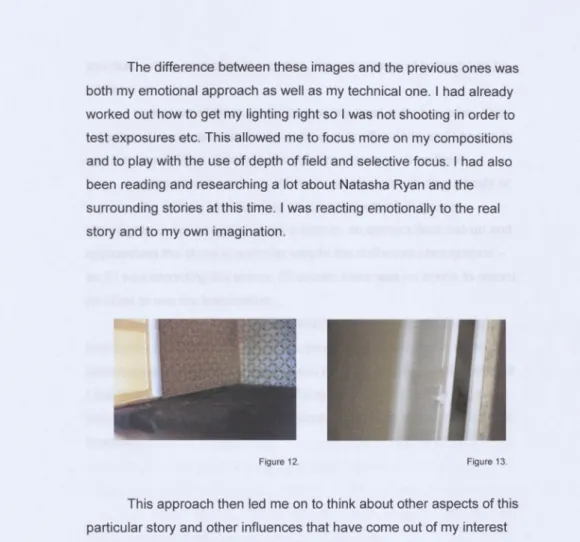
fig. 12&13)
The difference between these images and the previous ones was both my emotional approach as well as my technical one. I had already worked out how to get my lighting right so I was not shooting in order to test exposures etc. This allowed me to focus more on my compositions and to play with the use of depth of field and selective focus. I had also been reading and researching a lot about Natasha Ryan and the surrounding stories at this time. I was reacting emotionally to the real story and to my own imagination.
Figure 12. Figure 13.
This approach then led me on to think about other aspects of this particular story and other influences that have come out of my interest in crime. I began shooting photographs outside at night. I was thinking about the part of the story that involved Leonard John Fraser, the serial killer, and in particular what it would be like to be abducted and taken into the wilderness.
and fear, which recreated in a sense, the experience of being taken by a killer.
I took most of them in and around my local suburban area. The suburban streets can take on an eerie quality after dark, and I began to see the possibilities of being kidnapped in places such as these.
I concentrated on areas where I could imagine finding a body or a crime site. Initially I went out to an area that wasn't lit by any
streetlights or house lights. I took a simple, on camera flash set-up and approached the shoot in a similar way to the dollhouse photographs -as if I w-as recording the scene. Of course there w-as no scene to record, so I had to use my imagination.
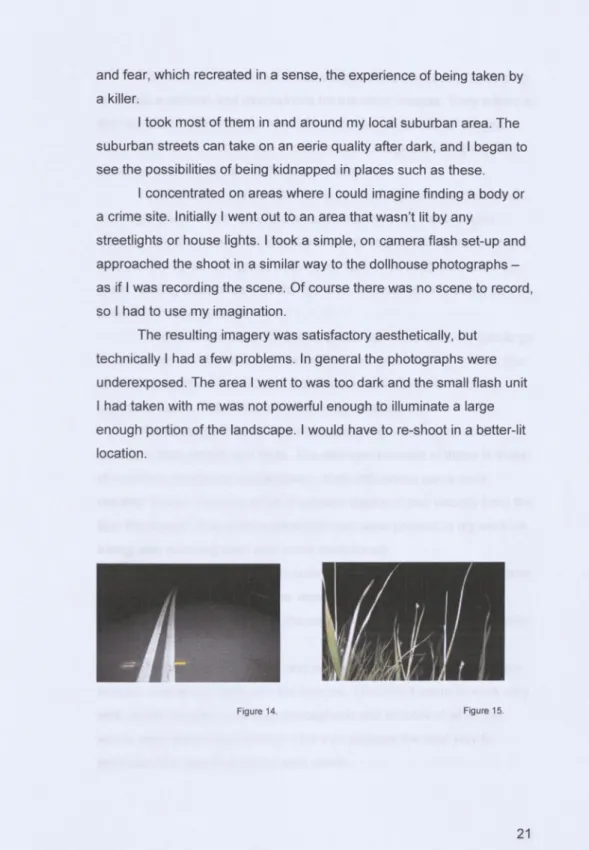
The resulting imagery was satisfactory aesthetically, but technically I had a few problems. In general the photographs were underexposed. The area I went to was too dark and the small flash unit I had taken with me was not powerful enough to illuminate a large enough portion of the landscape. I would have to re-shoot in a better-lit location.
However, I did feel that these images were successful in helping to create a context and atmosphere for the other images. They added to the narrative by providing a kind of punctuation to the other images. (See fig. 14 & 15) I could see the two sets of images working together either as pairs or as part of the same series.
I continued to work on this idea, re-shooting both the dollhouse and night shots with this particular aesthetic in mind. I also began thinking about what it must feel like to never step foot outside, to forget what its like to feel the grass under your feet. One thing that came up while reading the stories was the mention of Natasha only being able to leave the house at night.
On one or two occasions, she snuck out in the dark of night to go to the beach and feel the sand or walk on the grass with no shoes. Her entire perception of the outside world would have been from these nighttime walks. This influenced my image making also.
At this stage, I found I was focussing more on moods and emotions than details and facts. The stronger element of these is those of isolation, loneliness and absence. Main influences came from reading 'Seven Versions of an Australian Badland' and visually from the film 'Badlands'. This undercurrent that had been present in my work all along, was showing itself now more consciously.
The work was starting to come together, but I felt I needed some way to both communicate to the viewer the story and to 'thread' the images together to strengthen the narrative. I began to experiment with text.
My image making was largely based on me projecting myself into the story, so I began writing, just from my imagination, in the first person. I became Natasha Ryan. I wrote as if I were kidnapped and buried, I wrote as if I was isolated, within four walls with no contact from the outside world.
The response I got from this text, from both my colleagues and myself was much more positive. The poetic words seemed to enhance the photographs and give a better sense of the story. Now I would have to find a way to integrate the words with the rest of the series.
At this stage, I had begun work on a second project that involved photographing postcards and letters. The images I was achieving through this process inspired me to photograph the text for this series in a similar way.
Most of my photographs use the mechanisms of shallow depth of field and selective focus to create their aesthetic and I used these techniques when photographing the postcards and subsequently, the text for the earlier body of work. As I had been dealing with and thinking about the walls of the house and what these meant to Natasha Ryan, I decided to write my text on the wall and then photograph it. The resulting images were soft and textural and sat well with the rest of the images in the series.
Second Body of Work
Toward the beginning of the second semester I began working on a second project that involved photographing a collection of postcards and letters I had kept from my Dad.
my childhood, my parents divorced and my father left. He continued travelling and for the latter part of my childhood, our only
communication seemed to be through these postcards.
While he never moved physically very far away (he still lives in Canberra), to me he always seemed a million miles away. Our
relationship is not a very close one, and we don't talk very often so I see the postcards that I had kept over the years as a substitute for the relationship. When I think about my father, either in the past or the present, I tend to think of these postcards.
Although the postcards never really said much I still kept them and the souvenirs he brought back from various countries. I
photographed all the objects I had kept. I treated them as evidence and photographed them as such. I took the images on the copy-stand, under the hot lights. I focused on the small, important details, the ones that would give clues as to the story behind them, documenting the items and words, yet I wanted to retain a sense of the personal importance of the objects.
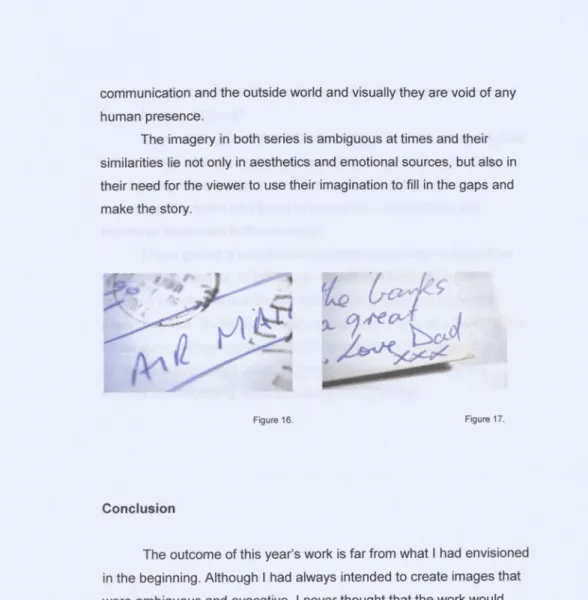
Although I was using a technique that is quite sterile to document them, I tried to employ some of the techniques from my earlier work to give the images a sense of nostalgia. By using shallow depth of field and focusing only on small areas, the 'evidence' now becomes something more. The images are inviting and very intimate. (See fig. 16 & 17) By bringing the viewer closer to my personal experience I feel as though I almost succeeded in bringing myself closer to my father.
communication and the outside world and visually they are void of any human presence.
The imagery in both series is ambiguous at times and their similarities lie not only in aesthetics and emotional sources, but also in their need for the viewer to use their imagination to fill in the gaps and make the story.
Figure 16. Figure 17.
Conclusion
The outcome of this year's work is far from what I had envisioned in the beginning. Although I had always intended to create images that were ambiguous and evocative, I never thought that the work would take on such a personal meaning, and be so highly emotional.
lead me toward such intuitive and personal outcomes as in my second body of work - "Airmail".
It was a struggle at times for me to learn how to trust my intuition and aesthetic while trying to stay dedicated to my initial Ideas. Often I was fighting with the urge to create imagery that reflected a true forensic quality while also trying to satisfy my own aesthetic and emotional responses to the research.
Images
y
^ . 'rs </o I / . o / . oJC
i i . j I
Bibliography
Gibson, Ross, "Negative Truth: a new approach to photographic storytelling." Photofile, no. 58 (1999): 30-32
Loftus, Elizabeth F., "Creating False Memories" Scientific American, vol. 277 no.3(1997): 70-75
Muchnic, Suzanne, "James Casebere", ArtNews, v. 101 no. 9, (October 2002) p. 162
Rugoff, Ralph, Scene of the Crime, MIT Press, USA, (1997) p.17
Smith, Joshua P., The Photography of Invention, MIT Press, Cambridge, USA (1989) p. 11
Sullivan, Constance, The Wild West: Photographs by David Levinthal, Smithsonian Institution, USA, (1993) p. 7
List of Illustrations
Figure 1. - Lauren Hewitt
"Untitled 1 from Horse Series". 2002 Type-C Photograpii, 100 x 150cm
Figure 2. - Ross Gibson
"The scent of smoked eels-The air tastes different here-Elsewhere, rain is tanging pungent on manicured lawns" From: "Negative Truth: a new approach to photographic storytelling.!'P/iotof;/e, no. 58 (1999): p.31
Figure 3. - Ross Gibson "Untitled Photograph"
From: "Where the Darkness Loiters", History of Photography,
V. 24 no. 3 (Autumn 2000): p. 253
Figure 4. - Frances Glessner Lee "Dark Bathroom", c.1940 mixed media miniature diorama From: Scene of the Crime, p. 12
Figure 5. - Uta Barth
"Ground #74", 1996
colour photograph on panel, 18 x 22in From: Scene of the Crime, p. 40
Figure 6. - James Casebere
From: The Photography of Invention, MIT Press, Cambridge, USA (1989)
Figure 7. - James Casebere "Yellow Hallway # 2" 2001
Digital chromogenic print, 60 x 48 in
From: "James Casebere", ArtNews, v. 101 no. 9, (October 2002) p. 162
Figures 8 - 17 - Lauren Hewitt
Untitled works in progress, 2003 Type C photographs
READING LIST:
Baer, Ulrich, Spectral Evidence: The Photography of Trauma, MIT Press, Cambridge USA (2002)
Baudrillard, Jean; Photographs 1985-1998; Hatje Cantz Publishers; Germany; (1999)
Braye, Marah, "Ricky Swallow: The Voyeur Awakes", Art and Australia,
V. 38 no. 4, (2001): 560-567
Burn, Gordon, "Damien Hirst", Parkett, no. 40/41 (1994): 58-69
Ellroy, James, My Dark Places, Century Books, London (1996)
Exiey, Roy; "Traces of Habitation"; Creative Camera] no. 354 (Oct/Nov 1998) 36-37
Foster, Alasdair; Gill, Ken; Shearer, Jackie and Coates, Geraldine; Fotofeis; Fotofeis Ltd; UK; (1993) pp. 38-39, 66-67
Frankel, David, "James Casebere", Artforum International, v. 40 no. 7 (March 2002): 109-113
Gibson, Ross, "Where the Darkness Loiters", History of Photography, v. 24 no. 3 (Autumn 2000): 251 - 254
Gibson, Ross, Seven Versions of an Australian Badland, University of Queensland Press, Australia (2002)
Goodman, Jonathan, "Suspending Belief, Contemporary, issue no. 49, : 40 - 43
Intra, Giovanni, "True Crime: Forensic Aesthetics on Display", Afterimage, vol. 25 (March/April 1998) 12-14
Irmas, Deborah; Sophie Calle: A Sun/ey; Fred Hoffman Gallery Publications; USA; (1989)
Norfleet, Barbara P.; Looking at Death; David R. Godine Publishing Inc.; USA; (1993)
Rugoff, Ralph; "Familiar Haunts: The photography of Anthony Hernandez"; Aiiforum International; vol. 38, no. 5, (Jan 2000) 98-101
Sanders, Noel, The Thallium Enthusiasms and Other Australian Outrages, Local Consumption Publications, Australia (1995)
Sundell, Margaret; "Uta Barth"; Artfomm International; vol.38, no.5; (Jan 2000) 114-115
Tillmans, Wolfgang; Wolfgang Tillmans; Phaidon Press Ltd; London; (2002)
L A U R E N H E W I T T
A R T I S T C . V .
P E R S O N A L DETAILS E D U C A T I O N
Date of Birth; 24 Feb. 1979
Address: 23/29 Popplewell Place, Gordon, ACT 2906 Phone: 02 62847708
2000 - present Canberra School of Art, AND ACT
BA (visual) with honours majoring in Photomedia
1999 Canberra Institute of Technology
1 year of Diploma Visual Art and Craft - major in
photography
ACT
E X P E R I E N C E 2003 - Curation of Tuggeranong Rotary Youth Art Prize exhibition at
the Tuggeranong Art Centre
2003 - Work as Gallery Assistant at Tuggeranong Art Centre
2003 - Work at National Library of Australia in Pictures department
acsessioning negatives
2002 - 10 day internship at Tuggeranong Art Centre
-assisting w/ith Gallery duties, brochure/invitation design,
digital photography, exhibition installation/changeovers
2002 - curation of exhibition ' Working Out' - group project involving the
curation of an exhibition of past CSA graduates in the SOA Foyer
Gallery.
E X H I B I T I O N S
2003 'This is Us' Group exhibition of local artists at
Tuggeranong Art Centre
2002 'NOIR' Group exhibition with Lara Norman. Photospace Gallery, Canberra School of Art
2002 'Breathless' Exchange exhibition with Otago Polytechnic,
2001 'NOISE' Online Gallery www.noise.net.au
2001 MCA online exhibition
'Visual Frequencies' www.noise.net.au/mca
2001 'Red Shoes' Photospace Gallery, Canberra School of Art
C O L L E C T I O N S
MCA Online Collection - 'Visual Frequencies'
Private Collections - Canberra
Tuggeranong Community Art Centre Pemianent Collection
A W A R D S