THIRD MEDIUM-TERM ECONOMIC POLICY FROGRAMME
EUROPEAN COMMUNITY
/THIRD MEDIUM-TERM ECONOMIC POLICY
PROGRAMM~
PROGRA}1HE +)
Having regard to the Treaty establishing the European Economic Community, and more especially the preamble thereto and Articles 6, 105 and· 145,
Having regard to the Council's decision of 15 April 1964 creating a Medium-term Economic Policy Coremittee,1
Having regard to the Commission's draft drawn up on the basis of the preliminary draft prepared by the Medium-term Economic Policy Committee,
Having regard to the Opinion of the Assembly,
Having regard to the Opinion of the Economic and Social Committee,
+)
The present text is a non-official translation of the "Third Medium-Term Economic Policy Programme" published in
-2-Considering that a first and a second Medium-term Economic Policy
Programme were adopted on 11 April 19671 and 12 May 19692 respectively; Considering that the economic policy followed by the Member States should be directed at attaining the objectives set out in Article 104 ·of the Treaty establishing the European Economic Community;
Considering that on the occasion of their conference held at The Hague on 1 and 2 December 1969 the Heads of State or Government decided "that the integration process should result in a community of stability and growth" and agreed to prepare "a plan in stages" "wl.th a view to ti.~.e
creation of an economic and monetary union";
Considering that on the occasion of its 99th meeting on 26 January 1970 the Council stipulated that the Third Medium-term Economic Policy
Programme should contain quantitative guide figures for the period 1971-75 and should lay down the main structural measures that would
have to be taken for the purpose, eithAr at national level or at Community level,
THE COUNCIL OF TnE EUROPEAN COHHUNITIES AND THE GOVERNMENTS OF THE MEHBER STATES ADOPT THE THIRD MEDIUM~TERH ECONOMIC POLICY PROGRAMME AND DECLARE THEIR INTENTION OF ACTING IN ACCORDANCE WITH THE GUIDELINES LAID DOWN IN IT:
1
Journal official No. 79, 25 April 1967, Po 1513/67.
2
CONTENTS
CHAPTER I - TOWARDS A COHERENT STRATEGY FOR THE COMMUNITY
A. Political significance of the third programme
B. Results of economic developments since
1960
c.
Economic policy and social objectivesD. The need for a medium-term strategy
CHAPTER II - THE OVERALL ECONOMIC PROSPECTS AND THEIR COMPATIBILITY.
5
6
9
11
A. Conditions for compatibility of trend
15
B. Prospects of economic development in the Community up to
1975
17
Starting point
17
External situation
18
National projections as starting point for compatible
guide figures
19
Germany 21
France 22
Italy
23
Netherlands 24
Belgium 24
Luxembourg 25
c.
Towards compatible guide figures26
The compatibility of the national projections
26
The compatible guide figures
28
-4-CHAPTER III - GUIDELINES FOR ECONOMIC POLICY A.
B.
Guidelines by country Germany
France Italy
Netherlands Belgium Luxembourg
Guidelines for the Community
39
43
47
50
53
55
56
I. Conditions for effective coordination of demand management
56
(a) Improvement and approximation of the instrumentsof economic policy
56
(b) Concerted preparation of decisions
58
II. The Community's role in the field of structural policy
60
(a) Unity of the internal market
61
Free movement
61'
Adaptation of enterprises to the wider market 63
(b) Promotion of new activities
65
Regional policy
65
Employment policy
67
(c) Conditions for more effective financial intervention
by the Community
68
III. External economic relations 70
General objectives 70
Specific measures under commercial policy
71
IV. Dialogue with the groups participating in economic activity
73
CHAPTER I
TOWARDS A COHERENT STRATEGY FOR THE COMMUNITY A. Political significance of the third programme
1. The present programme is designed to assist the action taken following the Conference of Heads of State or Government at the Hague with a view to the gradual realization of economic and monetary union. While continuing the work embarked on in the first two Medium-term Economic Policy Programmes, it accords with the Council's decision of 26 January
1970:
it contains compatible guide figures for the period1971-75,
lays down the broad lines of economic policy and sets out the main structural measures to be taken, both at national and at Community level.2. The complete realization of economic and monetary union requires that the member countries should be progressively aligning their economic policies achieve a situation that will enable them finally to renounce all protectionist measures within the Community and changes in the ratios bet-we~n their monetary parities. This will give the business world a new basis for its decisions - the whole economic area of the ·Community replacing the economic and monetary territories of the several Member States.
3.
The potential advantages inherent in the common market have not so far been fully exploited for want of sufficient economic cohesionbetween the member countries, as is shown by the manifest disparity between completion of the customs union and the limited progress that has been made in adopting common policies. Interdependence among the member countries has made much more rapid strides than harmonization of their attitudes, aims and policies. Each of them has consequently come up against difficulties in bringing its own development into line with external conditions.
-6-In adopting the present programme, the institutions of the Community and the Governments of the Member States express their desire to adopt a comprehensive strategy supported by public opinion and the various groups active in the economic life of the country. This strategy
should be such that it conforms, by means of coherent objectives and measures, to the economic, social and political ends of European unity and secures a lasting improvement in the well-being of the citizens of the Community.
B. Results of economic developments since
1960
4.
In the last ten years, the rate of economic growth in the member countries of the Community has been satisfactory. The majority of the objectives of economic policy has been achieved. While it is not possible to say just what part in all this has been played by the Community, it is generally accepted that this part has been important, and that all member countries have benefited from integration; furthermore, the disparities between the member countries in average income per head have been consider-ably reduced.AVERAGE ANNUAL GROWTH RATE OF GROSS NATIONAL PRODUCT
Results
1 )
Projections Results1 ) 3)
1960-65'
1965-702)
1965-70 '
Germany
5.0
3.3
4·7
France
5.8
5.4
5.6
;Italy
5.3
5.0
6.1
iN
ether lands5.0
4.8
5.0
~elgium
5.1
4.0
4.4
uuxembourg
3.2
3.0
3.3
~ommuni ty
5-3
4.5
5.3
l) At
1963
prices and current rates of exchange. 2)Projections made in the first programme, revised to take account, on the one hand, of changes introduced in the second programme and, on the other, of the revision of the French national accounts.
The economy of the Community has been able to absorb the growth
in the labour force, which in a number of countries has been considerable, and at the same time to achieve substantial advances in productivity
coupled with a high rate of structural change. The increase in private consumption per head, which is a partial indication of the standard of living, has been appreciable: the average rate of
4.4%
recorded since1960 would mean a doubling of the level in 16 years.
The exchange of goods between the member countries has more than tripled. At the same time the Community's trade with the rest of the world has more than doubled: its foreign trade today represents about
one fifth of total world trade, and it now ranks as the principal
supplier and the principal purchaser in the world. Finally, the member countries have between them considerably increased the total amount of their aid to the developing countries and expanded their commercial and industrial ·establishments in the rest of the world.
5.
Such results have not been achieved, however, without giving rise to economic and social stresses; the consequences of these stresses have not yet been entirely overcome.The pace of expansion and the elimination of internal economic frontiers have led to a pronounced change in the structure of demand; the ri1gidity of the productive apparatus and delays in its adaptation have sometimes resulted in under-utilization of existing capacity and pressure on prices. The problem of disparities between regions has not yet been satisfactorily solved. Under the influence of factors which were not having their origin in all cases outside the Community, an inflationary climate has developed, which has varied in intensity at different times and from one country to another.
6.
Because of differences in behaviour and in priorities, the
-8-Corrective action has been all the more difficult to apply in that the establishment of the common market has deprived the regulatory instruments used in the various countries of some of their effect. Coordination of the various policies has undoubtedly led to a certain amount of progress, but altogether it has still proved insufficient. The recent changes in exchange rates in two of the member countries illustrate the risks of the situation.
7.
Thus, despite the progress made, the incompatibilities that have occurred in the overall economic development of the Community have been an obstacle to complete achievement of the results hoped for when the Community was established:(a) The measures aimed at reducing structural disparities, which would have reinforced the cohesion of the Community, have not been
sufficiently woven into a long-term policy;
(b) The possibilities of regional development offered by the Community as such have not been used to the full;
(c) Managements have not been able to shape their investment decisions sufficiently on the basis of the large internal market, and it has not been possible to make full use of the possibilities of a better division of labour;
(d) Because of intra-Community divergences and the international
environment, the development of monetary and financial flows within the Community has not led to the constitution of a true European capital market;
(e) Because of insufficient coordination of decisions, the role the Community has played in international economic relations has not reflected its true economic weight.
8.
The present inflationary tendencies in all the member countries are a source of anxiety. Should they continue, they would - apart from their effect on external competitive capacity - lead to radical changes init would make it necessary to adopt severe corrective measures which would affect the continuity of structural measures and, in consequence, the possibility of a lasting improvement in the standard of living. Neither the Community as a whole, nor the individual Member States, can allow the massive upward thrust of prices to continue.
The problem of prices is all the more important in that, in relation to economic and monetary union,"price trends within the Member States determine the Community's ability to function, on the basis of fixed exchange rates without changes in parity and without any tendency to disintegrate".1
9.
The importance of these problems is still greater when looked at together with the possible enlargement of the Community. This enlarge-ment, which is desirable among other reasons because of the addition it would ultimately make to the economic potential of an enlarged Community, will in the first few years inevitably raise problems of an economic and social character. Solution of these problems will be facilitated if the cohesion between member countries is ensured by the compatibility of their overall trends.c.
Economic policy and social objectives10. The economic policy of the Community cannot be limited to the twin objectives of growth and stability. Its real value depends on the
contribution it makes to better living conditions: it must both raise the standard of living and improve the quality of life; it must also contribute to a greater community of action in support of the underprivileged.
In pursuing these wider objectives, the greatest importance attaches to the interplay of economic and social developments. Balanced and
sustained economic growth is a necessary condition for social progress; but in turn, satisfactory economic development will be possible only if there is satisfactory social security and progress. Society must find a
-
10-way of reconciling these two aspects.
Though this interplay has always existed, it assumes greater
im-portance today with the emergence of tendencies which, in the most di-verse fields, combine to cast doubts on certain objectives, methods and relationships that are features of society today.
11. The Community is conscious of these requirements; it is also
conscious of the present limits on what it can do. In view of the economic and monetary union that is to come, the general objectives of social
development, which are at the moment still part of aims of national poli-cies, will progressively become those of Community policy. But the following general objectives, which are felt in all member countries to deserve
priority, should be laid down forthwith:
(a) A greater effort to meet public needs, in particular education, health and housing, with a view to ensuring balanced progress and a fair distribution of goods and services. This priority means, for most member countries, that private consumption will expand a little less rapidly than the national product, so as to permit a more rapid increase in community services;
(b) Intensification of the struggle against the harmful effects of growth on the environment (pollution of the atmosphere and of water, noise, and excessive concentration in urban areas). The principle that those responsible for a nuisance must assume responsibility for its prevention or elimination should be applied progressively, due account being taken of the conditions of international competition;
(d) Justice in the distribution of incomes and property should be increased;
(e) Social security should be adapted to the exigencies of the modern world; in particular, there should be greater protection for those who are most seriously affected by structural change and technieal progress, and those who, through no fault of their own, are unable to participate in the productive process.
The present programme cannot set out all the means by which it is possible to further these ambitious but necessary objectives. Its
primary concern is to lay down, for the economic policy of the Community and of the Member States, guidelines which can facilitate their attainment. D. The need for a medium-term strategy
12. Further work on the unification of Europe will be exposed to serious risk, unless it is based on a coherent strategy ensuring that change shall be carried out in orderly fashion. Such a policy must take account of the interplay between the economies of the member countries, between economic and social measures and between internal aspirations and international responsibilities; it must also make due allowance for the differences in economic, social and political structures of the
different countries, in their administrative instruments and institutions and in their scales of values.
The medium-term context is particularly appropriate for forecasting structural change in the economy, for fixing objectives, and for the elaboration of a policy: it provides the necessary scope for embarking on a structural policy that will make it possible to overcome the
obstacles in the way of a balanced expansion and to resolve the apparent conflict between growth and stability.
-
12-(a) Quantitative medium-term guide figures consonant with the requirements of compatibility;
(b) The overall economic and structural policy to be followed for the purpose of ensuring compatible trends.
The present programme represents the first attempt the Community has made to set out in concrete terms the conditions for a more balanced economic development.
14. The guide figures set out in Chapter II indicate the conditions that must be taken into account by the Member States in preparing their economic policies if their overall economic developments are to be mutally
compatible and stability in exchange rates within the Community is to be secured.
These conditions will not suffice in themselves, since compatibility depends on other important factors, in particular on a trend in incomes that is in line with economic possibilities; it is none the less
necessary that they should be achieved, for they reflect the overall
pattern of economic development, and consequently merit special attention. Furthermore, the conditions are given their real meaning only through an economic policy capable of ensuring their realization. Far from
imposing arbitrary restraints on the member countries, they are simply a reflection of the increased economic interdependence that has grown up among them.
15. A balanced medium-term development should be based in particular on the following principles:
(a) Short-term economic policy should be such that it keeps the tensions between supply and demand within tolerable limits and does not
weaken the longer-term expansionary factors;
(b) Structural policy must be related to the size of the Community in order to increase the chances that all available productive resources will be turned to account;
16. In external economic relations, the economic weight of the
countries united in the Community stands out more and more clearly; its importance is particularly marked in the field of trade, where non-member countries have come to look on it as an economic entity entitled to be treated as such in their economic deliberations. Its importance has also been apparent in international monetary relations.
It is therefore fitting that the Community should increasingly work towards unity of action when dealing with the most important
external developments, especially as its external economic responsibilities and problems will be enhanced by its enlargement.
In addition, the Community must contribute actively to the economic progress of the developing countries. The annual amount of the net financial resources put at the disposal of these countries already
exceeds for the Community as a whole 1% of its gross domestic product and may well remain at least at this level in future. But transfers alone will not suffice to solve the grave problems facing these countries: their growth potential will also have to be increased by means of a trade policy which would promote the diversification of their production
structures.
17. The opportunity which the wider economic area offers for raising the level and improving the quality of life cannot be seized without
cooperation from the various groups that participate in economic activity in the member countries and at Community level. Care must moreover be taken to ensure that the necessary development of the industrial or regional structures does not impose on those concerned burdens which go beyond what they can support. Consequently, discussions with the
-
CHAPTER II
THE OVERALL ECONOMIC PROSPECTS AND THEIR COMPATIBILITY
A. Conditions for compatibility of trend
20. To ensure that overall economic trends are compatible within the Community, it is essential to use medium-term guide figures jointly worked out on the basis of quantified projections. These projections make it possible to take account of the various elements of
interdepen-dence inside each country, between member countries and with the rest of the world; in so doing the autonomous objectives of the various countries can be made in accordance with what is actually possible.
The medium-term projections take into account the results expected from a structural policy aimed at growth and from the policy of overall economic guidance which must go with it. They presuppose that overall guidance for the economies of the Community will be based both on
compatible medium-term guide figures and on the economic situation. It has not however yet been possible to find a satisfactory place in it for shorter-term developments during the period covered by the
projections.
It is on this basis that the study group o~ medium-term economic forecas~s has conducted the work on which the arguments used in the presen~ chapter are based. 1
21. Adjustment between national economies that are developing at different rates and from different levels is normally effected by relative movements in domestic prices, by moveoents of capital, by migration of labour and, if the disequilibrium is fundamental, by
changes in monetary parity. In the European Economic Com~unity care should be taken that any such adjustment can be effected without recourse in
intra-Community relations to protectionist measures or changes in parity. The gradual elimination of such methods gives the process of
adjustment in the Com~unity a meaning of its own: the member countries are no longer just adapting the expansion of domestic demand to increased opportunities for employment and growth; from now on each must harmonize the conditions of its development with those of its partners so as to 1
-
16-secure greater uniformity of development of the economies and in particular of prices inside the Community and thereby to limit the factors that can disturb the economies. The success of these measures calls for prior harmonization at Community level of the overall
guide figures.
22. These figures will be determined by reference to the principal indicators that provide a general picture of the results expected from the overall economic policy. These indicators must include:
(a) Economic growth (as shown by the growth rate of the gross national product at constant prices);
(b) The degree of success in achieving full employment (as shown by the unemployment rate);
(c) The trend of the general price level (implicit price index for the gross national product) representing the tension between supply and demand;
(d) The establishment of external equilibrium (as shown by the external ') 1
balance •
The choice of these 1ndices tends to place at the very centre of coordination the problem of achieving a growth consonant with the
requirements of employment and with the need to watch the relationships between the four corners of the magic square. It also brings out,
particularly in the indicators showing the future trends of employment and of prices, the difficulties that must be overcome if a balanced development is to be achieved.
23.
These guide figures determine a line of development for a period of several years. The uncertainties and the complexity of the overall economic trend will generally lead to deviations from this line of development; it will therefore be necessary to make regular checks on results and, if need be, to bring the guide figures up to date. Apart from such adjustments as may result from this procedure, the medium-term guide figures will constitute the essential basis for an economic policy in which compatibility will from now on be an element.1
24.
The action to concert objectives which the Community and themember countries are thus undertaking is in many respects new. The lack of compatibility which was faced by the Community in the recent period of difficulties and which affects the results obtained by national
policies, must not be allowed to continue. Inevitably, such a situation impinges on the choice of strategies and the formulation of plans for the further development, and calls for the gradual adaptation of the Member States' methods and attitudes to the existence of the Communitv.
The endeavour to attain compatibility does not imply the abandonment of national objectives. On the contrary, by accepting
overall Community guide figures, the member countries lay the foundations for a better management of their economies and for a more realistic and more ambitious programming of the desired structural changes. Far from introducing extra constraints, the compatible guide figures are merely the reflection of an interdependence that has in fact already come into being.
B. Prospects of economic development in the Community up to
1975
Starting point
25.
The vigorous economic upswing that began in the Commun~ty at the end of1967
seems to have reached a peak in1969
and1970 -
the base year for the projections. The elimination of the external disequilibria that have appeared in recent years has improved the foundations on which a more stable trend in the balance of payments can be attained. While it was possible to achieve this in1970
without any marked tendency to fall behind the long-term growth rate, there is still cause for serious concern over the immediate future.This concern is closely bound up with the rapid advance of costs and prices in all the member countries, an advance which constitutes one of the major problems facing those responsible for economic policy inthe Community. Since
1969,
rates of inflation in the Community have on the average exceeded those of its principal trading partners. In-
18-terms: 1 thus half the increases in nominal incomes are at present being absorbed by the rise in prices.
26.
Allowing for the foreseeable developments in the factors of production, real growth in the Community as a whole during the period1971-1975
may well be maintained in the neighbourhood of the rates recorded in the past, i.e. at about5%
per annum at constant prices for the gross national product, and4.5%
for productivity throughout the economy. The establishment of a balanced medium-term development in the Community assumes, however, that governments will succeed in mastering the present inflationary pressures without.
inhibiting the expansionary factors.External situation
27. The prospects for medium-term development in each member country are influenced in part by the level of economic activity in the other countries of the Community and in part by the trend of demand and prices in third countries. The forecasts made by the international organizations indicate that the rate of growth in the industrialized countries will be maintained and that it will accelerate slightly in the developing
countries.
It may be expected that the annual growth rate of world trade will be about
7.5%,
or somewhat less than in the recent past(9%
between1965
and
1970).
This vigorous development of world trade will be strongly influenced by the growing importance of trade within the big customs areas (notably the EEC and EFTA).1
28.
It is necessary, moreover, to start with a working hypothesis as regards the trend of prices in the other industrialized countries, especially the United States. To combat the inflationary developments of the last few years, seve-ral o:t· these countries have taken fairly severe monetary and budgetary measures to restrain the increase in demar.d. The hypothesis adopted is that the rise in the general level in prices for the EEC's trading partners will be somewhat smaller than in the recent past,1 and for the years1971
to1975
is likely to work out at an average annual rate of about396.
A steeper rise in these countries cannot, however, be excluded.In face of the serious risk that the world-wide inflationary tendencies may persist, the Com~unity can and must, by reason of its growing weight in international trade, adopt an active and independent policy of stabilization: what might be consiaered inevitable in a
single country dependent on its foreign trade cannot be accepted as inevitable for the Community. In accordance with the Treaty of Rome
and the Summit Conference held at The Hague late in
1969,
the coordination of medium-term economic policies must be related to the endeavour toachieve a "Community of growth and stability". This will enable the Community to make an effective contribution to stabilization of the
international price level and international monetary relations.
29.
In the next few years the countries of the Community together ex-pect to place at the disposal of the developing countries net financial resources of at least 1% of their gross national product. This commitment would represent in1975
about$7 000
million, and for the whole of the period1971-75
about$30 000
million.National projections as starting point for compatible guide figures
30.
The outlook for the main medium-term economic developments in the member countries is given below on the basis of the projections prepared by the member countries. Though for most countries still provisional,German_y 6 Proj. 19 0-70 1970-75 Real gross national product (annual rate of growth) 4-9 4.5 Total labour force (annual rate of growth) 0.4 0 Implicit price index for GNP (annual rate of in-crease) 3.4 2.2 Implicit consumer price index (annual rate of incre~se) 2.8 1.9 Unemployment rate (as % of the labour force), aver~ge for th~ period
o.B
final year (1~75) 0.7 External balance (as%
of GNP), avera~e for the period 1.8 final vear (19~5) 1.7 Balance on current account (as %of -GNP), average for the period 0.6 final year (1975) 0.2 Principal Trends 1960-75 (national figures) France Italy Netherlands Proj. 1960-701970-75 Proj. 1960-70 1970-75 6 Proj. 19 0-70 1970-75 5.8 5.6 5.7 6.0 5.0 4-7 0.8 1.1 -0.6 0.8 l 1.0 0.9 (o.o) 1 (1.2) 4.3 3.0 4.4 2.8 4.8 4.0 4.1 2.8 4.0 2.5 4.2 3.3 1.5 3.3 1.1 1.34 2.7 1.3 0.5 1.3 0.3 0.9 0.5 1.3 -0.7 1.9 0.1 0.1 0.8 o.8 Belgium Luxembourg 1960-70 Proj. 1960-70 Proj. 1970-75 1970-75 4·7 4.8 3.4 3.5 0.8 0.7 0.6 0.4 3.4 4.0 3.5 2.5 3.1 3.7 2.6 2.5 2.1 0 1.5 0 0.3 0.4 0.6 0 0.1 2 -0.1 0 1 Alternative evaluation expressing employment N.B. For the projections the figures indicate orders of magnitude. Sources: Data and projections are derived from documents provided by th~ national departments participating in the Study Group on medium-term economic forecasts. as "full-time equivalent".2 1961-68
for
Belgium.
they already reflect the first results of an intensive attempt at confron-tation which had proved encouraging despite the sometimes marked differences in conception, procedure and method, and even more in the methods used to estimate development procpects outside the Community. 1
Germany
31. The essential macro-economic data for the medium-term projections for
1970-75
are based principally on the normative1969-74
projection adopted by the Government in January1970.
2The quantitative projections are based on the persistence with which key elements are maintained and on the assumption that the longer-term trend of productivity will continue. The employment rate will
continue to decline and the slight decrease in the native labour force will have to be offset by the immigration of foreign workers (who by
1975
will number about 2 million). The unemployment rate for the period will probably average about0.7%
of the labour force, a fact which in itselfreflects a persistent shortage of manpower. As in the recent past, growth will be achieved only if industry is made more capital intensive by a rapid
in-crease in gross fixed capital formation: by the final year
1975,
the rate of investm~nt should be about26%
of the gross national product at current prices. Under these conditions it should be possible to achieve an average annual growth rate of4.5%
in the gross national product at constant prices.1
The work of the Study Group on medium-term economic forecasts has been particularly concerned with the technical conditions required if the mutual exchange of information is to be improved and harmonization to be stepped up. The process of constant adaptation used in preparing the medium-term projections and the data relating to the projections for each Member State are described in a report drawn up by the Study Group and attached to the present programme.
2
-
22-The Federal Government's objective of price stability, which appears ambitious in the light of past developments, of the forecasts made by other countries and of the persistent shortage of manpower, reflects the public's particular sensitivity on this point - a sensitivity that has been evident in certain legislative provisions. 1 For the general level of prices the aim is that the average annual rate of increase should be about 2.2%.
To meet its rising commitments to foreign countries (immigrants' remittances, transfers to Community and international organizations, aid to developing countries and private exports o: capital) without suffering any notable change in the level of the reserves over the period as a whole, the Federal Republic must provide for an external balance of about
1.7%
of the gross national product.France
32. Preparation of the Sixth Plan is proceeding on the basis of the report on the main options presented by the Government and approved by the
French Parliament.
This report counts on an average annual increase of a~ound 1.1% in
the labour force in the period 1970-7: and expects the trend in produ~vi~ per man hou~ to continue growing in view of the faster pace registered since 1968. These factors suggest an annual gro1vth rate of about 5.612, similar to that achieved in the l~st five years.
Greater prica stability is consiiered by the Government to be the basic conditio~ fo~ a rate o: growth that will make modernization of the economy possible. The rise in the general level of prices, which averaged
4.3% per annum between 1960 and 1970, should be brought down to 3% per annum at the most; in this way the price situation resulting from
1
Law on Stability and Growth and Bundesbank Law.
devaluation and, consequently, the competitiveness of the French economy would be maintained. This objective requires a decisive move to be made away from the inflationary attitudes of the past, so as to avoid further damaging interruptions in the structural adaptations necessary for future development.
The external balance in particular should in
19?0-75
be large enough to enable the country to meet its foreign commitments (aid and transfers), and at the same time to allow the currency reserves to be brought back to a normal level early in the period.Italy
33.
In view of the present stage of programming for the second five-year plan and the uncertainties affecting the base year, the first results of the medium-term projections for1970-?5
should be considered as a purely technical starting point. These results are based at present on the proposals submitted in "Progetto80
11 by the Ministry for the Budget andEconomic Programming; they have not yet been discussed by the political authoritieso
The main aim during the period covered by the projections
(1970-75)
is to achieve full employment. Employment is to rise by about1%
per annum, and the average unemployment rate to be reduced from3.5%
of the labour force (the average figure for1965-70)
to about2.7%
in1975.
As productivity is rising in line with the long-term trend(1950-70),
the real GNP could rise by6%
per annum. To achieve this objective the overall rate of investment would have to rise by1975
to around 22% (at current prices).-24-t4.
The Dutchprojections
for
1970-?5are extrapolations
of
the
mediun-term
forecasts
of
the Central
Planning
Bureaufor
the
period
1968-?7;1they
are purely
j-ndicative.
The prospects
than
in
mostof
the abroad.for the
Dutch
economyare
even morestron6ly
influenced
other
EECcountries by the trend of
deniand andprices
Frovided
that
export
demandj-s rnaintained,
the
increase
j-n
real
Srossnational
product should continue
at
about
4.7%per
annum, andthe
growthof productivity
should be
about
7.8:l'oper
annum.The aesunptions
regarding
intcrnal
developncnt&rc baeed.
on
the
probable continuanceof
prcesurc on
thc
labor.rr narkctr
d.cspitea
substantial
incrsasc(
of
almost Iy'o per
annum) it
the
nurnberof
pcrsons enployed.,whilst at
thc
samctine of
fr:rthcr
rcd.uction
in
thc
horrreof
labour
will
bc
carried
out. It is
hoped,furtbcrmorc.,
that in
thc ncxt
fcw years
it
w:tll
be
easier
to
keep abetter
check onthc
rise in
prices
aftcr
the
sharp i-ncrcasesof
thc
last
fewycars
and.to linit
the
i.ncreascin
rages
to
an annual averagcof
about Bf" perpcrson
in
cnployncnt.It
hasncvcrthslcss
bcen assumedthat
there
will
bc a
rclativcly
sharpincrcaee
(ot
a%)in
thc
gencral leve1
of
priccs
andin
consuncrprices
(about 3.3/")I
and.also
someinprovcnent
in
the terns
of
trad.E. Thelatter
item
shouldhclp
towardean
extcrnal
balancc
of
1 .3foof
the
gross
national
prod.uct.BelFiun
tj.
Thebroad guidelj-nes
for the preparation of the third
medium-termeconomic development
plan for
1971-75 havealready
been dj-scussedat
politi.cal level.
Iiavi-ngto
choose betweena real
annual growth
rate of
between4.16
and 4.8')'u,the
Government andthe l{ational Connittee for
Econonj-c Expansion decided
on
t'hehigher figure.
lcentral Flanning
Bureau:
trTheDutcli
Econornyin
1g?1",
Thellague,
197Oo Theseprojections
urere dravrnup
before the recent
wageincrease, the effects of
wfrictr
will
haveto be
taken
into
account
whenpolj-cy is being
formulated.
The
Central
Planning
Bureauts mediun-termproject,ions for the
economyas
€rwhole
are revised at regular int ervals
accord.ingto thc
moving horizonprinciple.
This
growth
rate
assumesthat the
i-ong-termtrend of productj.vity
(a.r,
increase of
about
4it per
arinum)wi].l
be
maintair,"dl
a4d
that the rate of
employrncntwill
kcep onrlsiag at
O."lfoper
annumrso
that
bV L975the rate of
urremployrrent
could
be
reducedfron
2.176(ttre
averaEefor
1965-ZC)to
1.r)t
of the
leibour
force.
Largely
becauseof the introductj-on of the value
addedtax in
1971,
the spontaneousincrease in ttre j-mplicit price
j-ndexfor the gross national
product is liirely to
be
fairly vigorous j,n
1971and 1972; thereafter it
may
vrell fal-l back, giving
an
averageannual
increase of about 4lt over
the ,r,rho1eperiocl
( 1.9':'ifor
consdmcrpriccs).
-^'1ti:ougi:
tiie rel-ationship
betweenthe j-nternal price
-Level i:.nd the fcllej-gr^trade
balarice
is not as
s:arkedin
Belgiumas in obhcr
Connunityccunt,r"iec,
inLerriafion;r1
price
brendsstill
cor.'rtitutc a factor that
should iiot
bc
overloolicC.In vieri of the
clrpcctcd
trcnd in pri.cec both alt
horne arrd a.broad, thereIrtzy
well
be
a
baianced gro'.vthir::-rnports
and
cXi,ortc;of
abouL 9.5)Lper
annum(at 196i ;r:ces).
In 197i,
+..1:cexternal bulance
bhouLdbe about
0.6% otthe gross national
prod.i,rct,.Luxegrbourg
3(.
Theprojectj-ons
Crawnup
for
Luxembourgprovide
a
teclrnica.l
brlsis for
econonric a,nd
financrai
Fro8ramningin that
ccuntry,
wherethe
pri-nci-ple
oi
noving
horizons
is also to
beapplied.
It is
cstinatcd
that
Lurenbourgwill
havc anovcrall
cconomic growthrate
of
3.5y'opcr
annun,a
vGrylow
unenployncntfigr:re
anda rcd.uctlon
in
the
total
nurnbcrof
bourg workcd.("t
annual j.ncreasein
thc
labour
force of
about O.4/" coupled.
with a
red.uctionof
about
If" in
the
hours
of
labour.
The
general
assunptionthat
priccs
will
incrcasc
by
2.5%pe,
annuln talces accountof
certain ertcrnal influcnccs
(particularly fron
Germanv and Bclgir:m); this
assumptionis,
however,very
uncertaln
in
vicw
of
the
pro-poscd.incrcasc
in
the
rate of
value
added,tar.
lTh"
incrcasc
in
thc
prod.uctivity
of
the ind.ustrial
sector
nay
be,4.3f",
and- 26-~. 'Po"trards compe.tible guide figures
37.
"!:'he forecasts presented above are based on the objectives and analyses of the individuc:.l countries. '!'he ~epeated coi!'!:r;arisons that have 1een carried out in order to judge how far they are compatible have made it possible to narrow the gaps considerably. It is necessary nevertheless to point out that the methods utilized in such a new field are not yet perfect; thevarying character of the lndiv:i..dual projections is a further complication. In ceJ'tain cases, moreover, the cou.r.ftries are for the first time establishing projections at current prices which involve the problem of changes in the general price level and so come up against additional difficulties of a technical and political nature.
~he compatibili~ the fiational projections
38. In view of the prospects .for an expansion of world trade and the
economic potential of the individual countries, the national projections seem in geDeral to be realistic in so far as they deal with developments in real tenns and, ln particular, 1-ri th the targets for growth and e-mployment.
Taken lndivid.ual1.Y, the·se projections also seem, by and large, to form
a coherent w~ole. It is nevertheless necessary to note that a marked change has occ:..G·1·ed 1r. the development of certain magni tuC..es (of emplcv ment in certajn countries, of the external balance in others). In such cases the credi~ility of the projections depends essentially on the efficacy of structural policies and the speed with which they can be put into effect. 39. The rates for price ir:.creases shol<Tn in the natior .. al projections call for certain observo.tions. rrhe figures vary in their techr .. ical si.gnificance from one co~nt:-y to anc•t.he:-; in addition, the interpretation of
In
viewof
the close
interd.eper.Cence between Cornnunityco,utri.es
tocla;, suchdifferences
are noncthc less
a :natter
for
co:l,cern.
It is in
fac Ld.ifferences
of this
orderpi.e.
cunulative
Cifferencesof 5 to
LOjitn a
pcriod.of I
yearsr
which marLea
ccnsid.erablecontribution to the
deterioi'at,ic::: inexternal
equilibriun
andto ihe
recent
rnonetary d.isturbances.Comparison
of grice
increasesl(Figures from
the
national projectionsr at
annual rates)B1
Price ind.ex
of
GNP?rice
ind.exof sales
to1g60-70
3.4I97O-75
2.21960-70
2.84.3 3.0
4.I
2.8 4.4 2.8 4.O 2.5 tt? 4.O 4.2 3.3 1ll J. .+4.O 3.1 3.7 rq 2.5 2.6 2.5
privatecc,nsumers f
970-75
I.9
40.
Therisk of
incompatibility
is
further
heightened.by
d.ifferences
in
attitude
and.strategr
amongthe
membe:'countries when
faeedwith
the
trend.s registered.in
the
rest
of
the
world, especially the
trend
of prices.
Forcertain
of
the
countries,
the projections
were preparedwith
an eyc on theobjectil'e
of stability,
ad.opted. and announced.without
referenceto
international
tend.encies;
theyimply a
willingness
to
makea
changein
parity
if this
is
necessaryfor
the
d.efenceof
internal
economicobjectiv€sr
Other countries,howeverr have viewed
their
price objective
in
relation
to
the
cor.mtries against which they competeor
with
whichthey
trad.e,that
is to
se;rrprincipally
fromthe
stand.pointof
conpetition.
Accord.inglyr
the outlook
for
compatible trendswithout
changein
parity
wilI
depend.to
a large
extent
onthe
future
trend.of
international
prices:The
figures
for
1970-75are
to
be consid.ered as ord.ersof
magnitude.For Se1gium the
introduction
of
VATin
1971 rnaywell
produce an autonomous-
28-(a) Should the trend of these prices be more moderate in future, the
differences between the two alternatives considered adaptation or autonomy -will be considerably reduced, and the differences between price trends in the member countries will be more acceptable.
(b) If, on the other hand, the present inflationary tendencies were to persist on the international plane, the differences in behaviour will very prohably
lead to incompatibility between economic developments in the various coun-tries.
41.
The direct comparison of indicators and of strategies, so far as they can be seen at this stage, brings out the risk of incompatibility. This is a risk which cannot be ignored, especially when it is remembered that someof the assQmptions regarding the effects of the policies followed by the various Member States are optimistic. From this point of view, the projections arrived at by the Member States seem to verge on incompatibility- less, it is true, at the beginning of the period covered by the projections (when the effects of parity adjustments are still making themselves felt) than at the end of that period.
Because of the complexity of the economic and monetary relations that determine external equilibrium, it is not possible to say how far and when these differences will lead to actual incompatibility. The emergence of monetary strains can be delayed or accelerated by shifts in the phases of the economic cycle or by extraneous disturbances. lihen the external equilibrium is insecure, a fortuitous occurrence of minor importance may suffice to touch off speculative movements that can often be checked only by measures that hamper the achievement of other objectives.
'The compatible guide figures
figures are intended to throw light on and facilitate the coordination of economic policies, they call for ag~eement on a middle course, with each country taking fuller account of the objectives pursuei by its partners.
These guide figu.res are set out below; they result from a confrontation of the national projections based on the trend of prices and of the external
l
balance, and are to be taken as orders of magnitude.
43.
The g~ide figures submitted by each member country for its balance of foreign transactions have been taken as basic data: they express the net amo:1nt of the liabilities (transfers or capital movements) that the country will ~eet in its dealings ~with other countries a1~d that it must cover by\
drawing on real resources.
The external balance also servec us an overall indicator of the tension produced by the relationship between internal and external economic trends. Consequently its average level over a period of several years reflects both the degree of development of the co~try concerned and the degree of stability of its prices in relation to those of its principal trading partners.
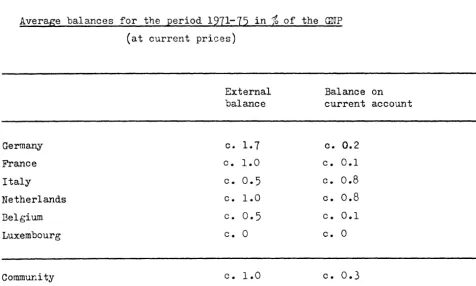
The estimates for the external balance2 and for the balance on current account3 are based on
th~
national projections and are expressed as a percentage of the brass national product (at current prices) for the \..Zhole period:4l
2
3
cf. Memorandum of the Commission of
15
December1969
on Medium-term Guidelines for the Economic Policy of the Community(1971-75),
Part IV, and the report of the Study Grouf on medi~~-term economic forecasts. Balance of goods, services and factor income as defined for international accounting parposes; this item shows the net amount of real resources transferred abroad.~xternal balance plus balance of current transfers to or from abroad; this item shows the net amount of savings transferred abroad.
Th~ frojections of the meober countries contain data for the final year
- 30-GUIDE FIGURES FOR EXTERNAL EQUILIBRIL~1
Average balances for the period 1971-75 in
%
of the mrP (at current prices)External balance
Balance on current account
Germany c. 1.7 c. 0.2
France c. 1.0 c. 0.1
Italy c. 0.5 c. 0.8
Netherlands c. 1.0 c. 0.8
Belgium c. 0.5 c. 0.1
Luxembourg c. 0 c. 0
Conununi ty c. 1.0 c. 0.3
44.
The guide figures relating to prices are fundamental for the elaboration of economic policies intended to be compatible. The price indicator necessarily has a normative character which increases the technical difficulties of fore-casting. But there must in any case be a common figure which is consonant with the objectives and the internal possibilities of the Community. To be accep-table and to guide economic policy effectively, this figure must take into account the diversity of national situations, the inertia that characterizes inflationary behaviour, and the tensions which are found in the situation at the outset and which can only be eliminated by successive steps. [image:32.591.60.536.91.377.2]The Community must pay particular attention to this figure. If the upward trend of international prices should turn out to be higher than the assumption adopted, the Community will defend stoutly the objectives it has adopted so that it may remain an area of stability and growth. As is stated in the Commission's Memorandum on medium-term guidelines, "a coordinated policy intended to moderate prices within the Community would, because of the very significant share of the Six in world trade, exert a considerable influence on the international price trends. In any event, the Community should in future avoid adapting itself passively to inflationary stimuli from outside".
On a longer view, the figure adopted is ~uch thai it should facilitate pro-gress to·wart...s the .nore ambitious oojec... iiive of stabill. -r.y desireQ in all. memoe-t: countries. 8uch an objective must be given QUe consideration whenever the guide figures are revised; its credibility will depend on the progress made towards compatibility during tne first stage of the undertaking.
45·
Harmonization of the national price trends around the common figure must be effected gradually. The figures for individual countries must take account in particular of differences in the size of the structural obstacles to stabill.vy, of the room for manoeuvre offered by the recent parity changes and the outlook for the immediate future.Germany France Italy Netherlands Belgium Luxembourg Community 1
GUIDE FIGURES FOR PRICE TRENDS
Average annual rate of increase for
1971-75
. (in
%)
Index of the generrl price level
2.0 - 2.5 2.5 - 3.0 2.5 - 3.0 2.8 - 3.3 2.8 - 3.3 2.3 - 2.8
2.5 - 3.0
Price index of sales to consume~ d
1.8 - 2.3 2.3 - 2.8
2.3 -
2.8 2.3 - 2.82.6 - 3.1
2.3 - 2.8
2.3 - 2.8
-
32-These figures differ from the national projections taken as a starting point because of the attempt that has been made to bring the extreme positions closer to the Community figure of
2.5
to3%.
It is essentialthat the relationships between the trends shown for the individual countries should be maintained. In this connection the relationship between the trend in France and the trend in Germany will be of special importance: recent events have shown how serious divergent price trends in these two countries can be.
46.
The Community figures for prices should not· have any notable effect on the medium-term prospects for employment and growth. Contrary to what has often been noted in short-term developments, an intentional reduction in the rate ofinflation need .no c result in a weakening of the growth rate nor in an increase ·inthe rate of unemployment, provided that economic policy is aimed not only at the full utilization of productive capacity but also at removal of the bottlenecks and strains that are responsible for inflation and unemployment. Experience shows that the monetary illusion, far from leading to an improvement in growth, simply leads to undesirable redistributions.
In the present state of forecasting techniques, the Community figures for the growth rate of the gross national product in real terms must be based on the expansionary trend of productive capacity, corrected when necessary to allow for fluctuations in the size of the labour force and the hours of labour.
Achievement of the projected rates of overall growth will depend on the progress made in productivity and the creation of new jobs; the struc-tural changes that this implies must be backed up by appropriate supporting policies.
GUIDE FIGURES FDR GRO'V1TH
1
Average annual rates of growth for
1971-75
Real gross For information: natior.al GNP per persol\ prod1.1ct in employment
Germany
4·3 - 0.8
4-3- 4·8
France
5-4
- 5·9
4.6
-
5.1
Italy
5-7
- 6.2
5.0
-
5-5
2
Netherlands
4-5 - 5.0
3.8 - 4.3
Belgium
4-3 - 4.8
3.6 - 4.1
Luxembourg
3.0 - 3.5
2.6 - 3.1
Community
s.o -
5-5
4.5 -
s.o
The rates of expansion projected in the various countries are in most cases in line with the figures sho~~ above; the objectives for Belgium and Luxembourg, however, are close to the upper limit of the relevant range and therefore assume that structural changes will be more rapid than in the past.
47.
Unemployment problems arise in different ways and with varying degrees of severity in the several member countries. Special measures must be trucen, ~ithin the framework provided by the medium-term guide figures, to remove the real causes of unemployment.Among these causes, some are cyclical in character and stem from an inadequate level of general economic activity. It is therefore essential that overall management of the economy should be such that there is the highest possible level of employment consonant with the f~ndamental equilibrium of the economy.
1
2
*
The ranges indicated for the growth rates result from uncertainty concerning both the trend of productivity and that of employment. The long-term trend of productivity (GNP per person in employment) is shown for information; the trends forecast for employment are shown in the table on page 20.
This high rate is largely due to the rapid ad"la.nce of prod1.1Ctivi ty in
agriculture caused by the massive exodus of persons employed ir. this sector.
-
34-Unemployment in the Comm-.. mi ty m.ay ~o~·;Gver stc:n largely f:-o:n strJ_c tural factors: their importance seems, morc·J;;·(;:r·, to ·r,,~ ir .. ~r:)c.:,si.nt; 11i th ~h::; Sl)ecd. of the structural changes \vhich groHth is i:npo::ing on our economic::::. The
stimulation of overall demand 'dould be no re~edy in such a si tuatior.: it wo::tld only serve to mask the problem temporarily. Such factors call rather for greater recourse to structural measures intended to improve skills and to eace the
clearing of vacancies and demands for jobs in given regions and given industries. The employment indicators shown below must not therefore be considered either as objectives or as threshold .. values. They show the level of employ-ment that corresponds to a satisfactory level of economic activity, having regard to the probable chances of adapting manpower reserves to the
struc-tures of production. In the medium term, the level of the employment indi-cator is affected far less by fluctuations in the rates of growth of GNP
or by the ·pace of price rises than by the conditions in which this adaptation occurs. It is these conditions that will have to be improved if more accep-table employment levels are to be attained.
1
U}~PLOYMENT
AS%
OF THE LABOUR FORCE1(average rates for
1971-75)
Germany
0.8
France
1.5
Italy
3
Netherlands
1.3
Belgium
1.7
Luxembourg negligible
The definition of unemployment used here differs from that used in Germany and the Netherlands. In those two countries the rate of unemployment is normally shown as a percentage of wage and salary earners plus the
Thes,.:
fig';rcs
should-be interpreted.
in
the
f.i;}:t rf
the
';ile?r+"a1:tyfuture
measures andtheir effects.
Furtherrncrerthe
complexit;r'lr il:' :i
onthe
labour
market andthe
d.ifferences
betweennational
statistics
na'r:edifficult to
obtain satisfactory
compariscns betweencountries.
i1'!rfr ?r
+. Jlrut , -, t: J*J', ^,h ir
It is
nonethe }ess true
that
they
reflect
the
d.lfferences
in
theemployment
situations
of
the
several
mernbercountries.
fhey also
highlight
the
inportance
to
be attached
to
emplo;ment problemsin the
Communityin
thenext
fewyears,
thus
provid.inga
strong
incentive
to intensifyr
both at
national
and Commr:nitylevel,
the pursuit
of
approprj-ate struc+;ura}polici.es.
Since
the
results
to
be
expectedfrom these
policies
cannotbe
immed.i-ater
theyshould. be ad.opted
without
delay.D.
Conclusions48.
Theprineipal
problemto
be
facedis
constituted.
by
the
trend
of
prices.
ob j ec
tive in all
the
rnember countries t ona
numberof
factors.
in
pursuing
the objective
of
compatibility
Whrle
price stabtllty
l-s an
important
the
possiblLitres
of
attaining
it
dependTtre
first of
these
faetors
is
successwith the regulation
of
overall
d.enand. and.
the
measurestaken
to
solve
certain structural
problemsby
pronotingthe
necessaryactjustments.
In
the
med.iunterm,
certain
countries
wilL
haveto
give
priority to
those measures whichwill
makethe greatest contribution
to
elimination
of
the strains
andbottlenecks
which causeinflation
andunenploynent,