This is a repository copy of Evaluation of eLearning outcomes- experience from an online Psychotherapy education programme.
White Rose Research Online URL for this paper: http://eprints.whiterose.ac.uk/10277/
Article:
Blackmore, Chris, Tantam, Digby and van Deurzen, Emmy (2008) Evaluation of eLearning outcomes- experience from an online Psychotherapy education programme. Open
Learning: the journal of Open and Distance Learning, 23 (3). pp. 185-201. ISSN 0268-0513
DOI: 10.1080/02680510802420027
[email protected] https://eprints.whiterose.ac.uk/
Reuse
Unless indicated otherwise, fulltext items are protected by copyright with all rights reserved. The copyright exception in section 29 of the Copyright, Designs and Patents Act 1988 allows the making of a single copy solely for the purpose of non-commercial research or private study within the limits of fair dealing. The publisher or other rights-holder may allow further reproduction and re-use of this version - refer to the White Rose Research Online record for this item. Where records identify the publisher as the copyright holder, users can verify any specific terms of use on the publisher’s website.
Takedown
If you consider content in White Rose Research Online to be in breach of UK law, please notify us by
Evaluation of eLearning outcomes- experience from an online Psychotherapy education programme
CHRIS BLACKMOREa*,DIGBY TANTAMaandEMMY VAN DEURZENa a
University of Sheffield, UK
Abstract
SEPTIMUS is a one-year Europe-wide postgraduate theoretical course for psychotherapists and counselors provided entirely via the internet. It may be used as part of a training course, with face to face elements provided locally, or for continuing professional development. The course was developed at the University of Sheffield in collaboration with psychotherapy training institute partners in seven other European countries. Two studies involving 167 SEPTIMUS students and 60 comparable face-to-face students were undertaken.
Study 1- Drop-out rates for the SEPTIMUS programme were found to be low, and comparison between those dropping out and those completing did not highlight any significant factors linked to distance learning. However, students cited Finance, Distance from training centre, Lack of practical experience, Family commitments and the Intensity of their working weeks as having been barriers to taking face-to-face learning courses in the past.
Study 2- SEPTIMUS students (eLearners) were compared with students taking comparable attending (face-to-face) theoretical courses also being provided by partners in the project to psychotherapy trainees. Significant differences were found in Distance from training institute and Ability to visit training institute. SEPTIMUS students had higher levels of Computer ownership, Frequency of internet use and IT skills than attenders; these factors when examined in study 1 did not have an impact on the drop-out rate of eLearners.
eLearning can overcome barriers to traditional learning in psychotherapy, particularly distance from a training centre, without loss of student satisfaction or student performance. Factors sometimes thought to be obstacles to eLearning, such as IT skills, were not found to be significant barriers, although may have affected recruitment. Certain aspects of eLearning, such as the tendency to facilitate self-disclosure, were found to be very beneficial particularly in the context of psychotherapy programmes.
Keywords: eLearning, Face-to-face learning, Drop-out rate, Barriers to learning,
Self-disclosure
_____________________
*Corresponding author- Email: [email protected]
Introduction
Whilst electronic approaches to theoretical learning (“eLearning”) have been rapidly expanding in the last decade, they have so far had little impact on the field of psychotherapy education perhaps because of the perception that the internet is not suitable for psychotherapy training, and that only face-to-face training methods are acceptable. Indeed, whilst there have been a growing number of empirical reports on the practice of online therapy, with every one of these empirical studies showing significant improvements for those accessing online therapy (Griffiths and Cooper, 2003), there are very few studies examining the role which eLearning might play in psychotherapy training. Our previous research (Blackmore et al, 2005; Tantam et al, 2006) suggests that eLearning fares very well compared to traditional face-to-face methods of teaching psychotherapy theory in terms of student satisfaction and performance. This finding accords with the majority of comparisons between online and attendance courses which conclude that there is “no significant difference” in terms of performance between the two modalities (Russell, 1999; Bernard et al, 2004; Ruiz et al, 2006). Comparative studies also suggest that students are at least as satisfied with eLearning courses (Gibbons and Fairweather, 2000; Chumley-Jones et al, 2002; Suanpang et al, 2003), and that retention and completion rates in online courses are not significantly different (Knight, 2007) or even better (Clark, 2002) than in attendance courses.
This paper is an investigation of two linked hypotheses: 1. can distance learning overcome any of the barriers to traditional learning experienced by potential psychotherapy students? (study 1); and 2. Does distance learning mean accepting a poorer quality alternative to traditional face-to-face learning (study 2) in an area of education where interpersonal factors are likely to be particularly important? The paper discusses the barriers for eLearning in the area of psychotherapy education, focusing on factors preventing accessibility to training programmes and contributing to drop-out rates, and presents a comparison of eLearner and face-to-face students in terms of both satisfaction levels and performance on their respective courses.
The SEPTIMUS course
A survey of European Psychotherapy training (Tantam et al, 2001a, 2001b) has shown that access to psychotherapy for those who are in most need is restricted in many European countries by distance from training centre, childcare responsibilities (which affected almost 1 in 5 of female respondents) and educational background (which affected men more than women). SEPTIMUS is a one year programme in psychotherapy theory available purely by eLearning methods. It was designed to widen accessibility to psychotherapy by increasing access to theoretical education for learners and stimulating flexible arrangements for supervision and personal therapy, which might include block or intensive face-to-face sessions, or supplementation of face to face supervision by telephone or internet based sessions. In particular, SEPTIMUS was designed to increase access for those who:
lived in geographically isolated areas
had family/work commitments
had a disability
used various models for integrating the SEPTIMUS eLearning programme into their existing programmes, but this paper concentrates on drop-out rates and comparisons of only the eLearning components.
The course consists of 6 units (each of 10 weeks of study) in the following topics: health and well-being, existential and human issues, conflict management, overview of different methods of psychotherapy and personal change, ethics & culture in psychotherapy & counselling and development through the life cycle. In any given week, learners are required to read through the course material, post messages onto the discussion forum in response to prompts in the box at the bottom of each page, and attend a one hour chatroom with fellow learners and tutors to discuss that week‟s topic. Students are assessed on the following:
discussion forum and chatroom contributions
online multiple choice questions
end of unit essay (3,000 words)
The emphasis in assessment of forum and chatroom contributions is on the student‟s engagement with the theoretical materials, and the extent to which they have collaborated with others in generating a productive dialogue. Entry to the course is via http://www.septimus.info/
The course material was presented in English, although the learning taking place via discussion forum and chatroom was in the language of tutors‟ and students‟ choosing (usually their own national language). Worldwide, an estimate 375 million people speak English as a first language (Curtis, 2006), while up to 1 billion speak it as a second language (Wikipedia_"English_language"_entry 2008). English is the “lingua franca” of psychotherapy, and much of the published research and many of the seminal texts are in English. In addition, the fact that tutoring occurred in each country‟s language of choice does help to widen accessibility somewhat to those whose English is not as good as it might be.
Study 1- The acceptability and outcomes of an eLearning course
Method
Results
A total of 167 eLearners provided data, although not all students responded to every item. Analysis of the data showed that eLearners had significant other commitments on top of their coursework- over 40% of students had children living with them or other family responsibilities, and over 85% of students were working 20 hours per week or above. Data gathered on factors preventing learners from applying for psychotherapy education before (table 1) show that over 50% of eLearners had been previously prevented from accessing psychotherapy education, the most common factors being distance from training centre, finance, lack of practical experience, childcare responsibilities or lack of qualifications.
Factors that have prevented you from applying for Psychotherapy training before
childcare distance from training centre lack of practical experience lack of qualific-ations
finance other (detail)
none
Frequency 11 33 19 11 30 8 48
% 19.3 57.9 33.3 19.3 52.6 14.0 45.7
Table 1- Factors preventing eLearners from applying for face-to-face Psychotherapy education
When comparing drop-outs and completers, there was no significant difference between the groups in gender, age, frequency with which training institute could be visited, distance from training institute, disability, English language skills, IT skills, domestic responsibilities, or current working time per week (see Table 2). For both groups, the proportion of students prevented from accessing psychotherapy education previously was similar, and the most common barrier was “distance from the training centre”.
Withdrawing Completing Significance Number (%) of learners 40 (24.0%) 127 (76.1%) NS Ratio of women : men (%
women)
29:11 (72.5%) 85:42 (66.9%) NS
Average age (standard deviation) 36 years 10 months 34 years 5 months NS Estimated frequency with which
training institute could be visited per week by most learners
Every two weeks Every month NS
Estimated distance (Km) from nearest suitable training centre for
most learners
Less than 49 Less than 49 NS
Number (%) with self-declared disability
1 (4%) 6 (5.6%) NS
Number (%) reporting poor or basic English
7 (29.3%) 25 (24.3%) NS
Number (%) reporting poor or basic IT skills
6(28.6%) 28 (27.2%) NS
Number (%) with childcare responsibilities
8 (32.0%) 29 (25.9%) NS
Estimated hours of main employment per week for most
learners
Table 2- Difference between completing and drop-out eLearners
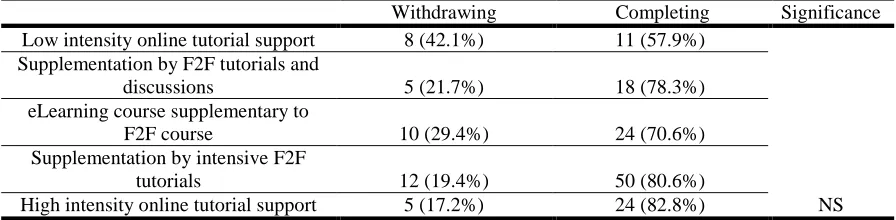
The 8 participating countries used differing learning models, and these were grouped into 5 categories- Low intensity online tutorial support, Supplementation by F2F tutorials and discussions, eLearning course supplementary to F2F course, Supplementation by intensive F2F tutorials and High intensity online tutorial support. Drop-out rates were compared across these 5 categories but differences between them were found to be not significant (see table 3).
Withdrawing Completing Significance Low intensity online tutorial support 8 (42.1%) 11 (57.9%)
NS Supplementation by F2F tutorials and
discussions 5 (21.7%) 18 (78.3%) eLearning course supplementary to
F2F course 10 (29.4%) 24 (70.6%) Supplementation by intensive F2F
tutorials 12 (19.4%) 50 (80.6%) High intensity online tutorial support 5 (17.2%) 24 (82.8%)
Table 3- Dropout rate of eLearners using different learning models
Study 2- Comparing eLearners and face-to-face students
Method
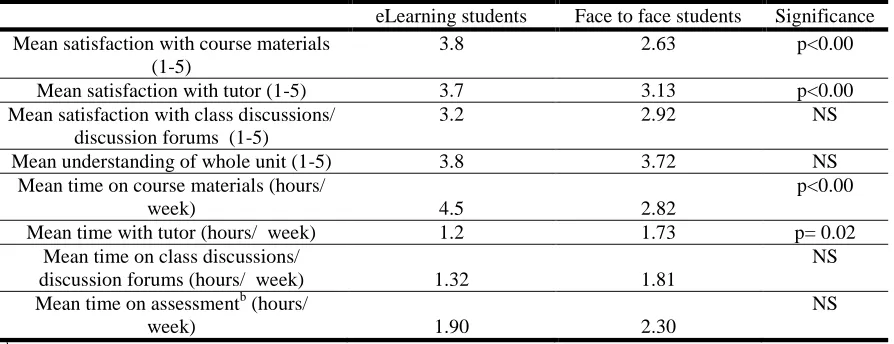
All eight SEPTIMUS partners were asked whether they had access to groups of face-to-face students who were studying or had recently studied a similar unit to any of the online SEPTIMUS ones. It was decided to use the second unit, “Existential and Human Issues”, as this was a topic which all of the partners had found to be central to the course and also containing new perspectives for many of the students. Three countries, Ireland, Romania and the UK, had access to students who had studied an attendance unit which was similar in content to the online unit, and a total of 61 of these students were recruited as a comparison group. The following data were collected from these face-to-face learners: Age, Gender, Nationality, Distance from home to training institute, How often would work and personal commitments enable you to visit your training institute?, Do you have a home computer/laptop? Do you have access to the internet? If "Yes", how often do you use the internet or world-wide web? What is your level of IT skills? This data was combined with the data collected from eLearners‟ application forms (see study 1) and is presented in table 4. Students in both groups were also asked about their Satisfaction with course materials, with tutor and with discussion forums/chatrooms, Understanding of the unit, and Time spent with tutor, on course materials, in forums/chatroom and on Assessment, and this data is presented in table 5.
Results
eLearning students Face to face students Significance Number (%) of learners 167 (73.6%) 60 (26.4%)
Ratio of women to men (% women)
114:53 (68.3%) 50:10 (83.3%) NS
[image:6.612.68.512.648.714.2]training institute could be visited per week by most learners Ratio of those with computer to
those without (% with)
129:5 (96.3%) 58:12 (82.9%) NS
Ratio of those with access to internet to those without (% with)
126:0 (100%) 55:4 (93.2%) NS
Estimated frequency of internet use for most learners
Every day Some day p<0.01
Self-rating of own IT skills by most learnersa
Good Good p<0.05
[image:7.612.69.516.254.426.2]aAlthough the category “Good” was the highest ranked for both eLearners and face-to-face students, there was a significant difference in spread between the two groups
Table 4. Barriers to learning in SEPTIMUS and face-to-face learners
eLearning students Face to face students Significance Mean satisfaction with course materials
(1-5)
3.8 2.63 p<0.00
Mean satisfaction with tutor (1-5) 3.7 3.13 p<0.00 Mean satisfaction with class discussions/
discussion forums (1-5)
3.2 2.92 NS
Mean understanding of whole unit (1-5) 3.8 3.72 NS Mean time on course materials (hours/
week) 4.5 2.82
p<0.00
Mean time with tutor (hours/ week) 1.2 1.73 p= 0.02 Mean time on class discussions/
discussion forums (hours/ week) 1.32 1.81
NS
Mean time on assessmentb (hours/
week) 1.90 2.30
NS
b“time spent on assessment” comprises time spent answering weekly MCQs and preparing for end of term essay
Table 5 Outcomes in SEPTIMUS students and face-to-face students
We can conclude that at the time of starting their studies, eLearners could visit their training institutes less often than face-to-face students, were more likely to own a computer, used the internet more frequently and rated their IT skills higher. eLearners reported higher satisfaction with the course material and tutors than face-to-face learners; eLearners spent more time on the course materials than face-to-face learners, but less time with tutors. Other differences noted between the two groups were not statistically significant.
Discussion
those who dropped out, which suggests that having IT skills was not a significant factor in the success or otherwise of students who were accepted on to the course. Students (and some tutors) did report difficulties in getting used to the technology at first, but none cited this is a reason for leaving the course. We had anticipated this problem and designed the layout of the pages, including the overall concept of „islands‟ corresponding to modules, and locations corresponding to individual weeks of the unit, so as to increase usability. Before the course began we had also developed a week of training material about the technology which students worked through before beginning the course proper. We also arranged training for tutors, and both learners and tutors had access to an online manual about the use of the technology. Tutors responded to technical or navigational difficulties in the forums and the chatrooms, and the core team also used chatrooms with tutors to deal with problems that they were having. Finally, one of us (CMB) was available to deal with any residual student or tutor problems that arose, and could call on a technical consultant to deal with any unexpected glitches in html or php scripting.
We compared eLearners and face-to-face attendees- the advantage of doing this is that it provides direct evidence of whether we have succeeded in making psychotherapy education more accessible, and whether or not we have done so at the cost of satisfaction with learning. However it was difficult to establish exact equivalence of the eLearning and attendance courses, so we cannot be sure what other factors- course content and lecturer experience, for example- may be influencing the differences between them.
Retention of students
The literature is not conclusive on the issue of whether eLearning courses have high drop-out rates. An eLearning Guild publication confidently states, “You‟ve probably heard that people drop out of e-Learning at very high rates and that nobody knows what to do about it” (Martinez 2003). However, O‟Connor and Sceiford cite a drop out rate for e-learning of approximately 26%, whilst other estimates range from 20-50% (Frankola 2001), and from 30-75% (McVay-Lynch 2002), although “there have been few credible and systematic studies investigating actual non-completion rates and factors that affect these dropout rates” (O'Connor and Sceiford 2003, p. ii). McVay-Lynch identify technology, the student experience, lack of tutor feedback and online miscommunication as contributing to withdrawal.
based on a realistic assessment of competing demands rather than a failure by the learner or education provider. Gibbs went further, suggesting that for eLearners in higher education, this non-progression is “a normal part of life rather than a stressful life-changing event” (Gibbs, 2003, p. 46). As Gaskell (2006, p. 97) suggests, the flexibility and openness of eLearning programmes “allow[s] students more opportunities to engage over longer periods at times to suit themselves.” The slightly lower retention rates may be the price that eLearning programmes pay for their greater flexibility.
The SEPTIMUS course was a new venture, with tutors who, although very experienced psychotherapy trainers, were very inexperienced in delivering material via computer-mediated communication. In addition, tutors were spread across 8 different countries, and their students were spread across many more. One might have expected these factors to contribute to a significant number of drop-outs. In fact, the drop-out rate on the SEPTIMUS course (24.0%) is at the lower end of the normal range quoted above. There were no significant differences between those students who completed their studies and those who dropped out on any of the data collected on application. Notably, the two groups were well-matched for gender and age.
One reason for the good retention rate of students may be that in many countries, additional face-to-face components were delivered alongside the eLearning components of the programme- a “blended learning” model was used. In some countries, students also had face-to-face contact with one another and/or with tutors on other parts of their programme in addition to their eLearning contact; and some countries arranged occasional face-to-face seminars, tutorials, focus groups and residential weekends for students to attend. In other countries, the programme was delivered purely by electronic means, with differing levels of online support from tutors. Whilst the data presented in table 3 does not show significant differences between learning models employed, it is notable that the highest drop-out rate was for those students where there was no face-to-face contact with tutors, and only low intensity online support; the lowest drop-out rate was for those with high intensity online tutorial support, which was even more effective in retaining students than where eLearning was supplemented by intensive face-to-face tutorials. The nature and frequency of tutor engagement with learners is a crucial factor in the success of eLearning programmes (Blackmore et al, 2006), and without high levels of input and support, the dropout rate would probably have been higher.
An important related factor is the ability of students to provide support to one another and to form a learning community- a group of people in an educational context who are actively engaged in learning together and learning from one another. Because many of the students are practicing counselors or psychotherapists, they are experienced in community building and have expertise in human relations. They are therefore able to support one another in a way which other student groups may not, demonstrating empathy, sensitivity and understanding of the issues they are facing.
Where drop-outs did occur in the SEPTIMUS programme, they tended to be in the early stages of study. This is in keeping with Simpson‟s finding that 35% or more of eLearners at the UK Open University withdraw before submitting their first assignment (Simpson, 2004, p. 83). Tyler-Smith (2006) suggests that “the multiple learning curves that confront a learner at the start of any course of online study” contribute to a “cognitive overload”; this can cause learners to drop out early from an eLearning course, depending upon the complexity of the learning tasks that confront a learner engaging with eLearning, especially for the first time. Our own experience supports this theory, and students do report a period at the start of the programme, lasting for several weeks, where everything is new, unfamiliar and potentially overwhelming. A number of students who experienced problems using the online resources would have dropped out were it not for diligent tutor input. This also appears to be a period where students are becoming accustomed to having an “online identity”, and to interacting with other people who are physically not present. We have used increased tutorial support to help them through this period, along with Salmon‟s (2000) suggestion of limiting content specific activity in the early stages to concentrate on activities that allow eLearners to get to know one another and to assist in the development of an online identity. We also limit navigation options in the first week or two, suggesting that students concentrate on posting introductions to the discussion forum.
Barriers to eLearning
There are still considerable barriers to the dissemination and uptake of online learning programmes. Mangania (2003) identifies seven types of barriers: (1) personal or dispositional, (2) learning style (3) instructional, (4) situational, (5) organizational, (6) content suitability, and (7) technological barriers.” Mangania cites situational barriers as the most prevalent, and personal barriers as the least common, with four key factors being significant predictors of e-learning barriers: (1) organization, (2) self-efficacy, (3) computer competence, and (4) computer training. Age, gender, ethnicity, marital status, level of education, prior experiences with computers and e-learning, computer ownership, location of study, and job position are not statistically significant predictors of barriers.
possibilities for use of CMC in supervision, suggest that training courses for eTherapists may not be far away, and it is likely that such training programmes will have high, if not complete, levels of online interaction and training. This paper, along with other dissemination activities coming out of the research project (Blackmore et al, 2005; Blackmore et al, 2006; Blackmore& Tantam, 2006; van Deurzen et al, 2006; Tantam et al, 2006; Blackmore et al, 2007), is an attempt to demonstrate the great potential that the internet offers for psychotherapy and psychotherapists, whilst also examining potential difficulties which the internet presents for trainers.
Comparing SEPTIMUS eLearners with face-to-face learners, there were large differences between the groups in many of the factors measured. Firstly, eLearners were able to visit their training institute much less often. Secondly, there was a gender imbalance with nearly double the amount of men on the eLearning course compared to the attendance course. This may reflect the greater confidence which men generally have in using computer-mediated communication and in taking up places on distance learning courses. Weiser comments, “in comparison to women, males use the Internet more, they are more comfortable with it, and their reasons for using it are more extensive” (Weiser, 2000, p.169). There were other differences found relating to technology- eLearners had better access to computers and used their computers much more often. Men have, in general, been earlier adopters of IT than woman and it may be that the excess of male applicants is explained by the greater proportion of men than women with IT skills. There did not appear to be any differences in terms of disability- the rate of 5% of eLearners who reported a disability or mobility problem is lower than the rate for Europe- in 2002, 15.7% of the EU-15's population of 16 to 64 year-olds had a long-term disability or health problem (InfoBASE, 2006). It is not clear whether this low application rate is because there are not so many people with a disability who wish to pursue psychotherapy education, or that people with disabilities do not feel as though they can apply or be accepted. The finding that there is no significance in the difference between drop-out rates for those with or without a disability confirms that this is not a barrier to successful completion of eLearning courses.
Over the last 10 years, more and more people have become familiar with the internet, mainly through shopping, and this trend will increase as increasing numbers of people take up these new ways of interacting. Although eLearning has been used here to overcome barriers and widen accessibility, it is not an approach entirely without barriers of its own. However, it was notable that prior to starting the course, around a quarter of eLearners (n=34) rated their IT skills as only basic, and that there were some users (n=5) who used the internet only rarely or never; nevertheless, these users quickly grew in ability and confidence and were able to complete the course. The data on IT skills and drop-out rates confirms that those with little or no prior experience in using the internet can become successful eLearners given the right support and encouragement.
Potential for psychotherapy
As well as improving access to psychotherapy education and showing good retention rates, eLearning has some unexpected benefits for psychotherapy. Recent research (van Deurzen et al, 2006) has shown the ways in which online relationships between students, and between tutors and students, are quite different to those in face-to-face education situations. Relationships and interactions are in some ways more distant and aloof- since no direct face-to-face contact is possible- which might seem to be a barrier to the type of genuine connection necessary for the growth of an online community where self-development can occur. However, what appears initially to be the inaccessibility of fellow eLearners can, with some facilitation from tutors, be a learning opportunity- students are encouraged to reflect on their interpersonal processes and to find new ways of establishing contact with one another.
i. Self-disclosure
One particularly effective way of harnessing the potential of eLearning for psychotherapy is to facilitate online self-disclosure- the examination of sensitive or painful issues, in combination with learning about psychotherapy theory, is a vital component of any psychotherapy training programme. Both experimental and anecdotal evidence suggests that “CMC and general Internet-based behaviour can be characterised as containing high levels of self-disclosure” (Joinson, 2001, p. 178), and indeed, consistently high levels of self-disclosure have been observed in the SEPTIMUS programme (van Deurzen et al, 2006). Such self-disclosure comes about, at least in part, as a result of disinhibition which is known to be a characteristic of web-users (Suler, 2004). Web-users may display increases in their “willingness to post aggressive („flames‟), offensive or sexually explicit messages in chatrooms, discussion groups, and elsewhere on the web” and to gamble or visit pornographic sites (Tantam, 2006). Online learners such as the SEPTIMUS students, who are not linked via webcams, are not subject to “the look” of the other, which induces self-consciousness and therefore the possibility of shame (Morris, 2003).
ii. Tutor facilitation
facilitate self-reflection and self-disclosure, tutors need to be aware of what constitutes healthy disclosure, and how and when to respond to it.
iii. “Psychological mindedness”
Online courses can also facilitate reflection, and there are links between this and self-disclosure- Joinson states that “one well-established outcome of heightened private self-awareness is increased self disclosure” (2001, p. 180). In a study on undergraduate level “Health and social care” education, Morgan et al (2006) report that learners developed more extensive reflective accounts than they did previously when reflecting in traditional face-to-face environments; eLearners reflected more deeply, spent longer reflecting, self-managed their reflective learning and recognised significant learning achievements through reflection, although varying levels of engagement in the online reflective process were observed, with not all learners achieving “a deep level of critical analysis”. Therefore eLearning in psychotherapy education may be particularly appropriate for students who would otherwise find it difficult to disclose certain feelings and experiences and who in this mode of relating find an outlet for otherwise suppressed experiences, reactions and reflections. Students do, however, need to be “psychologically minded”, i.e. students need to have access to their own motivations, to have some ability to think about these in psychological terms and to have an awareness of the intrinsic value of self-reflection and self-disclosure. Where students have not had such abilities, or have had low levels of awareness, they have tended to find it difficult to engage in genuine self-disclosure and its accompanying self-development; students who do have these qualities seem to revel in the opportunities for self-development, both personally and for the whole learning community.
iv. Transformative learning
v. Group learning
Emotional cues from
the other are harder
to access/ assess
Uncertainty about what other
thinks of you
Insecure attachment
Work hard to establish rapport
+ make self understood
Over-secure attachment, disinhibition
Openness- self-disclosure, humour, public
reappraisal High
attunement Welcome
Secure attachment
Reciprocation of self-disclosure
Low
attunement Unwelcome
Conflict Rejection from group
Deep learning in isolation Deep learning
unlikely
[image:15.612.44.537.50.749.2]Deep learning likely
Figure 1. The impact of disembodiment on “deep learning”
Resolves well
vi .Dialogue
SEPTIMUS students, through previous experience and maturity, tend to be highly psychologically minded, and place a high value on transformative learning. They are more likely to have an interest in dialogue- finding the common ground that might underlie apparent difference- and therefore to be more tolerant of diverse opinions, perspectives, or attitudes. They are consequently more likely to be willing to take such risks- so long as they perceive that appropriate boundaries are in place- and their self-disclosures are more likely to be appropriate to the setting and welcomed by the group.
The increased levels of self-disclosure and self-reflection reported by students on the SEPTIMUS programme was an important benefit of the online experience and facilitated an intimacy and directness rarely equalled in face-to-face education. Where such openness is highly “attuned” to the group, self-disclosures are usually welcome, are often reciprocated, and will potentially go on to facilitate transformative learning. Where self-disclosure is not well attuned to the group, it will be unwelcome and will increase the likelihood of conflict occurring online. If this conflict is based upon miscommunication, as can easily happen online, it may be relatively straightforward to resolve, and this tends to make transformative learning more likely than if no conflict had occurred at all. Where conflict is based on a difference in underlying values, it is much harder to resolve, and indeed the online context may exacerbate this, even to the point of making resolution impossible. Unresolved conflict makes it more likely that a student will be rejected from the group and eventually drop out, and is a real barrier to transformative learning for the whole learning community. There is a clear need for online tutors to know how and when to intervene in conflict when it emerges.
Conclusion
We have shown that eLearning itself does not seem to create demands which result in high drop-out rates when compared to rates found in the research literature. Our results also show that accessibility to education was widened by the SEPTIMUS course, with many students who had previously been denied access to education being able to complete this programme. Most students reported the factors Distance from training centre and Finance as the obstacles preventing them from accessing education in the past. eLearning has been found to be suitable for people in full or part-time employment as it allows them to study whilst maintaining their careers. eLearning is particularly attractive to mature learners, who enjoy the flexibility of fitting studies around other commitments, are better able to handle the competing demands of studying and work/home commitments and more motivated to complete the course for their own self-development. eLearning has some particular benefits for psychotherapy programmes in that, with appropriate tutor facilitation, it can promote self-disclosure and transformative learning.
the SEPTIMUS programme. For the reasons outlined above, electronic elements of psychotherapy education can be an excellent complement to face-to-face training and if carefully delivered will achieve some aspects of learning that face-to-face education alone would not achieve. The best educational approach in psychotherapy education is likely to be a combination or “blend” of eLearning and face-to-face learning.
Acknowledgements
We would like to acknowledge the funding and support of the Leonardo da Vinci fund of the EU for providing funding for the SEPTIMUS project. We would also like to thank all of the staff and students who participated in the SEPTIMUS programme. In particular, we would like to thank the following Partners and tutors- Alfred Pritz and Elisabeth Vykoukal (Austria), Zbynek Vybiral and David Skorunka (Czech Republic), Ed McHale and Tessa Norman (Ireland), Riccardo Zerbetto and Antonio Iannazzo (Italy), Jerzy Aleksandrowicz (Poland), Telmo Mourinho Baptista and Joaoa Andrade (Portugal) and Ileana Botezat (Romania). We would also like to acknowledge staff at the following training institutes:
Austria Österreichischer Arbeitskreis für Gruppentherapie und Gruppendynamik Czech Republic Prazska vysoka skola psychosocialnich studii
Prazsky psychoterapeuticky institute
Ireland Clanwilliam Institute
Institute of Creative Counselling and Psychotherapy
Italy Scuola di Psicoterapia Comparata-SPC
Associazione per lo Sviluppo Psicologico dell'Individuo e della Comunita-ASPIC
CSTG
Poland Department of Psychotherapy, Jagiellonian University Medical College Institute of Psychiatry and Neurology, Warsaw
Portugal Associação Portuguesa de Terapias Comportamental e Cognitiva Lisboa Sociedade Portuguesa de Psicoterapia Centrada Lisboa
Romania Romanian Federation of Psychotherapy
Department of Psychology, Babes-Bolyai University
UK University of Sheffield
New School of Psychotherapy & Counselling, London
References
Ashby, C. M. (2002). Distance education: Growth in distance education programs and
implications for federal education policy (GAO Report GAO-02-1125T). Washington, DC: United States General Accounting Office.
Bernard, R., Abrami, P.L., Lou, Y. & Borokhovski, E. (2004) How does distance education compare with classroom instruction? a meta-analysis of the empirical literature. Review of Educational Research, 74, pp. 379–439.
Biner, P. M., Dean, R. S., and Mellinger, A. E. (1994). Factors underlying distance learner satisfaction with televised college-level courses. The American Journal of Distance Education, 8(1), pp. 60-71.
Blackmore, C., van Deurzen, E. & Tantam, D. (2005) A comparative evaluation of eLearning versus traditional "face-to-face" teaching methods in a psychotherapy training programme, in: S. Dasgupta (Ed) Encyclopedia of Virtual Communities and Technologies (George
Washington University, USA), pp. 174- 178.
Blackmore, C., Tantam, D., & van Deurzen, E. (2006) The role of the eTutor- Evaluating tutor input in a virtual learning community for psychotherapists and psychologists across Europe. International Journal of Psychotherapy, special edition, 10(2), pp. 35-46.
Blackmore, C., van Deurzen, E. & Tantam, D. (2007) Therapy training online- using the internet to widen access to training in mental health issues. In: T. Stickley and T. Basset (Eds)
Teaching and learning about mental health (Wiley). 337-352.
Blackmore, C. & Tantam, D. (2006) Editorial introduction. International Journal of Psychotherapy, special edition, 10(2), pp. 3-6.
Broudo, M. & White, M. (1997). The Effectiveness of Interactive Multimedia as an Instructional Aid for Learning Basic Clinical Skills and Knowledge, in: A. J. J. A. Scherpbier, C. P. M.van der Vleuten, J. J. Rethans (Eds) Advances in Medical Education (New York: Kluwer
Academic Press) pp. 321–326.
Chisholm, L., Larson, A. & Mossoux A-F (2004). Lifelong learning: citizens' views in close-up. Findings from a dedicated Eurobarometer survey Luxembourg: Office for Official
Publications of the European Communities.
Chumley-Jones, H.S., Dobbie, A. & Alford, C.L. (2002) Web-based learning: sound educational method or hype? A review of the evaluation literature. Academic Medicine, 77 (10
suppl):S86- S93.
Clark, D. (2002) Psychological myths in e-learning. Medical Teacher, 24, pp. 598–604. Curtis, A. & Romney, M. (2006) Color, Race, And English Language Teaching: Shades of
Meaning (Routledge). p. 192.
van Deurzen, E., Blackmore, C., & Tantam, D. (2006) Distance and Intimacy in Internet Psychotherapy Training. International Journal of Psychotherapy, special edition, 10(2), pp. 15-34.
Diaz, D.P. (2002). Online drop rates revisited. The Technology Source. (May/June) Retrieved August 2nd 2007, from http://technologysource.org/article/online_drop_rates_revisited/ Europa (2005) Europa.eu Press Release. Retrieved August 2nd 2007,
Flood, J. (2002) Read all about it: online learning facing 80% attrition rates, Turkish Online Journal of Distance Education, 3(2) Retrieved August 2nd 2007, from
http://tojde.anadolu.edu.tr/tojde6/articles/jim2.htm
Frankola, K. (2001) Why online learners dropout. Workforce, 10, pp. 53-63.
Gaskell, A. (2006) Rethinking access, success and student retention in Open and Distance Learning, Open Learning, 21(2), pp. 95 – 98.
Gibbs, G. (2003) The future of student retention in Open and Distance Learning, in: A. Gaskell & A. Tait (Eds) The future of Open and Distance Learning, collected conference papers from the 10th Cambridge International Conference on Open and Distance Learning (Cambridge, The Open University), 37–48.
Gibbons, A. & Fairweather, P. (2000) Computer-based instruction, in: S. Tobias and J. Fletcher (Eds) Training & Retraining: A Handbook for Business, Industry, Government, and the Military (New York: Macmillan Reference USA), 410–42.
Griffiths, M. & Cooper, G. (2003) Online therapy: implications for problem gamblers and clinicians. British Journal of Guidance & Counselling, 31(1), pp. 113-135.
HEA Engineering Subject Centre (2007) Deep and Surface Approaches to Learning Retrieved August 12th 2007, from http://www.engsc.ac.uk/er/theory/learning.asp
Johnson, S. D., Aragon, S. R. Shaik, N. & Palma-Rivas, N.(2000) Comparative Analysis of Learner Satisfaction and Learning Outcomes in Online and Face-to-Face Learning Environments, Journal of Interactive Learning Research 11(1), pp. 29-49.
Joinson, A. (2001) Self-disclosure in computer-mediated communication: The role of self-awareness and visual anonymity, European Journal of Social Psychology, 31. pp. 177-192. Kang, S. (2007) Disembodiment in Online Social Interaction: Impact of Online Chat on Social
Support and Psychosocial Well-Being. CyberPsychology & Behavior 10:3, 475-477. Kember, D. (1989) A Longitudinal-Process Model of Drop-Out from Distance Education,
Journal of Higher Education, 60(3), pp. 278-301.
Knight, P. (2007) Promoting retention and successful completion on Masters courses in
education: a study comparing e-tuition using asynchronous conferencing software with face-to-face tuition, Open Learning, 22(1), pp. 87 – 96.
Knowles, M. (1984) The Adult Learner: A Neglected Species, 3rd Ed, (Houston, TX: Gulf Publishing).
McVay-Lynch, M. (2002). The Online Educator – A Guide to creating the Virtual Classroom (Routledge, London).
Marton, F. & Säljö, R. (1976) On Qualitative Differences in Learning: Outcomes and Process, British Journal of Educational Psychology, 46, pp. 4-11.
Martinez, M. (2003) High attrition rates in e-learning: Challenges, predictors, and solutions, The eLearning Developers’ Journal (July).
Mezirow, J. (1975) Education for perspective transformation: women's reentry programs in community colleges (New York: Center for Adult Education Teachers College, Columbia University).
Mezirow, J. (1978). Perspective Transformation. Adult Education, pp. 100-110.
Morgan, J., Rawlinson, M. & Weaver, M. (2006) Facilitating online reflective learning for health and social care professionals, Open Learning, 21(2), pp. 167–176.
Mungania, P. (2003). The seven e-learning barriers facing employees, Retrieved August 2nd 2007, from http://www.masie.com/researchgrants/2003/Mungania_Exec_Summary.pdf O'Connor, C. & Sceiford, E. (2003) Departure, Abandonment, and Dropout of E-learning:
Dilemma and Solutions, MASIE E-learning Consortium (James Madison University). O'Sullivan, E. (2003) Bringing a perspective of transformative learning to globalized
consumption. International Journal of Consumer Studies, 27 (4), pp. 326–330.
Rovai, A. P., Ponton, M. K., Wighting, M. J. & Baker, J. D. (2007) A Comparative Analysis of Student Motivation in Traditional Classroom and E-Learning Courses, International Journal on ELearning, 6(3): pp. 413-432.
Ruiz, J.G., Mintzer, M. J. & Leipzig, R.M. (2006) The Impact of E-Learning in Medical Education, Academic Medicine, 81 (3), pp. 207-212.
Russell, T. L. (1999). The no significant difference phenomenon: as reported in 355 research reports, summaries, and papers (Raleigh: North Carolina State University).
Salmon G. (2000) E-moderating: a guide to tutoring and mentoring on line (London: Kogan Page).
Schutte, J. G. (1997) Virtual teaching in higher education: The new intellectual superhighway or just another traffic jam, Retrieved August 2nd 2007, from
http://english.ttu.edu/kairos/3.2/features/rodrigues/comparison.htm
Suanpang, P., Petocz, P. & Kalceff, W. (2003) Student Attitudes to Learning Business Statistics Online vs. Traditional Methods, Learning for unknown future, New Zealand, HERSA, 6–9 July 2003.
Suler, J. (2004). The online disinhibition effect, Cyberpsychology & Behaviour, 7, pp. 321-326. Takiya, S., Archbold, J. & Berge, Z. (2005) Flexible Training‟s Intrusion On Work/Life Balance.
Turkish Online Journal Of Distance Education, 6 (2), pp. 87-94. Retrieved August 2nd 2007, from http://tojde.anadolu.edu.tr/tojde18/pdf/article_5.pdf
Tantam, D, van Deurzen, E., McHale, E, Pritz, A., Szafran, W., Zerbetto, R., & Osterloh, K. (2001a) The Survey of European Psychotherapy Training. 1. Information provided in the National Reports, International Journal of Psychotherapy, 6, pp. 142-144.
Tantam, D, van Deurzen, E., McHale, E, Pritz,,A., Szafran, W., Zerbetto, R., & Osterloh, K. (2001b) The Survey of European Psychotherapy Training 2: questionnaire data, European Journal of Psychotherapy, Counselling & Health, 4(3), pp. 379-395.
Tantam, D. (2006) Opportunities and risks in e-therapy, Advances in Psychiatric Treatment, 12, pp. 368–374.
Tantam, D., Blackmore, C. & van Deurzen, E. (2006) eLearning and traditional “face-to-face” teaching- a comparative evaluation of methods in a psychotherapy training programme, International Journal of Psychotherapy, special edition, 10(2), pp. 7-14.
Thalheimer, W. (2004) Elearning's burden on work-life balance. What should we do? Retrieved August 2nd 2007, from www.work-learning.com/catalog/
Weiser, E. B. (2000). "Gender Differences in Internet Use Patterns and Internet Application Preferences: A Two-Sample Comparison, Cyberpsychology & Behaviour, 3(2), pp. 167-178. Whittington, D. & McLean, A. (2001) Vocational Learning outside Institutions: online pedagogy
and deschooling, Studies in Continuing Education, 23(2), pp. 153-158. Wikipedia_"English_language"_entry (2007)" Retrieved March 26th 2008, from