APPeICATIOM OF PLASTICITY THEOKY TO SOIL BERAVIORr
A NEW SAHD MODEL
In P a r t i a l Falf i l l m a n t sf t h e Reqeirement s f o r the Degree of Doctor of P h i l o s o p h y
C a l i f o r n i a I n s t i t u t e sf Technology
Pasadena, C a l i f o r n i a
A m e s p a r e n t s
-iii-
ABSTRACT
The r e p r e s e n t a t i o n of r h e o l o g i c a l s o i l b e h a v i o r by c o n s t i t u t i v e e q u a t i o n s i s a new branch of s o i l mechanics which h a s been expanding f o r
axisymmetric l o a d i n g s , i s g e n e r a l i z e d i n t h e six-dimensional s t r e s s
s t a t e w i t h the assumption o f i s o t r o p y and a p a r t i c u l a r
ode's
a n g l ec o n t r i b u t i o n . T h i s new model i s ready t o be used i n f i n i t e element
I would l i k e t o e x p r e s s my s i n c e r e a p p r e c i a t i o n t o my a d v i s o r , P r o f e s s o r R.F. S c o t t , f o r h i s p a t i e n c e , guidance and f i n a n c i a l s u p p o r t d u r i n g my s t u d i e s and r e s e a r c h e s a t t h e C a l i f o r n i a I n s t i t u t e of Tech- nology. I am p a r t i c u l a r l y indebted t o him f o r l e t t i n g me t e a c h a term of h i s g r a d u a t e s o i l mechanics course.
-v i-
TABLE OF CONTENTS
PAGE
ABSTRACT
. . .
iiiCHAPTER
11: THE MATERIAL SOIL AS A CONTINUUM. . .
102.1. APPLICATION OF CONTINUUM MECHANICS
TO
ASSEMBLY OF DISCRETE PARTICLES. . .
10.
. . .
2 2 DESCRIPTION OF KINEMATICS 17 CHAPTER 111: CLASSICAL PLASTICITY THEORY. . .
21. . . .
3.1FUNDAMENTAL
PLASTICITY CONCEPTS F'ROM UNIAXIAL TESTS 2 1. . .
3.2 GENERALIZATIONTOSIX-DIMENSIONAL STRESS.SPACE 26 3.2.1 Existence of Unrecoverable S t r a i n : Yield C r i t e r i o n. . .
29. . .
3.2.2 D i r e c t i o n of P l a s t i c Flow : Flow Rule 39. . . .
3.2.3 Amplitude of P l a s t i c F l o w : HardeningRules 43 3.3 FORMULATION OF ELASTIC-PLASTIC RELATIONS FOR AXISYMMETBIC LOADING. . .
503.4 ISOTBOPIC ELASTIC-PLASTIC CONSTITUTIVE EQUATIONS
. . .
533.4.1 I s o t r o p i c E l a s t i c - P l a s t i c Models
. . .
543.4.2 I s o t r o p i c Models i n t h e p-q Space
. . .
583
.
5 A CRITICAL REVIEW OF CONVENTIONAL PLASTICITYTHEORY
. . .
APPLICABLE TO SOILS 60
. . .
3.5.1 Existence of Yield Surface 61
. . .
3.5.2 Y i e l d s u r f a c e s h a p e 63
. . .
3.5.3 Existence of a P l a s t i c P o t e n t i a l Surface 65. . .
3.5.4 S h a p e o f P l a s t i c P o t e n t i a l Surface 66
. . .
3.5.5 HardeningRules 68
. . .
. . .
CHAPTER IV:
BOUNDING SURFACE PLASTICITY 7 1. . .
4.1 BOUNDING SURFACE IDEAS FROM UNIAXIAL TESTS 7 2
4.2 GENERALIZATIONTOSIX-DIMENSIONAL STRESSSPACE
. . .
7 44.3 ADVANTAGES OF BOUNDING SURFAC% PLASTICITY OVER
. . .
CONVENTIONAL PLASTICITY 7 8
4.4 FORMULATION OF BOUNDING SURFACE TBEORY I N p-q SPACE
. . .
CHAF!CER V : APPLICATION OF BOUNDING SURFACE PLASTICITY TO
SOILS: A NEX SAND MODEL
. . .
. . .
5 . 1 INTRODUCTION
. . .
5.2 PLASTIC CONTRIBUTION
. . . .
5.2.1 P r e l i m i n a r y Remarks on E l a s t i c Sand Models
. . .
5.2.2 Choice of an E l a s t i c Model
. . .
5.2.3 C a l c u l a t i o n of E l a s t i o M a t e r i a l Constants 5.2.4 General Remarks and Suggestions f o r Future
. . .
E l a s t i o Models
. . .
5 . 3 . 1 C r i t i c a l S t a t e
5.3.2 C h a r a c t e r i s t i c S t a t e
. . .
. . .
5.3.3 S t r e s r d i l a t a n c y T h e o r i e s
5.3.3.a Rowets S t r e s s - d i l a t a n c y Theory
. . .
. . .
5.3.3
.
b Nova's Theory. . .
5.3.4 D e f i n i t i o n of t h e New Bounding Surface
5.4 BOUNDING SURFACE MOTION
. . .
. . .
5.4.1 Choice of I n t e r n a l V a r i a b l e s
. . .
5.4.2 Motion of t h e Bounding Surface
. . .
5.5 A M P L I ~ D E OF PLASTIC
n
o
w
5.5
.
1 P l a s t i c Modulus on Bounding Surf ace. . .
5
5.5.2 R e l a t i o n Between l a s t i c Moduli H and
#
. . .
a n d D i s t a n c e 6
. . .
5.6 MODEL CONSTANTS 136
. . .
CHAPrER I
INTRODUcr I O N
independence and t o be recognized a s a p a r t i c u l a r l y important d i s c i p l i n e i n C i v i l Engineering. Since t h a t time, sub-discipl i n e s have emerged i n S o i l M e c h a n i ~ a .
From about 1955. a new branch i n s o i l mechanics h a s been s t e a d i l y i n c r e a s i n g : t h e c o n s t i t u t i v e modeling of s o i l behavior. By d e f i n i t i o n , i t d e s c r i b e s t h e s o i l behavior w i t h c o n s t i t u t i v e e q u a t i o n s using t h e framework of continuum mechanics. R e l a t i o n s between s t r a i n and s t r e s s a r e used e v e n t u a l l y i n f i n i t e element programs t o s o l v e e n g i n e e r i n g problems formulated a s boundary-value problems. The s o i l i s t r e a t e d a s a n e n g i n e e r i n g m a t e r i a l i n t h e same way a s s t e e l , c o n c r e t e o r polymers.
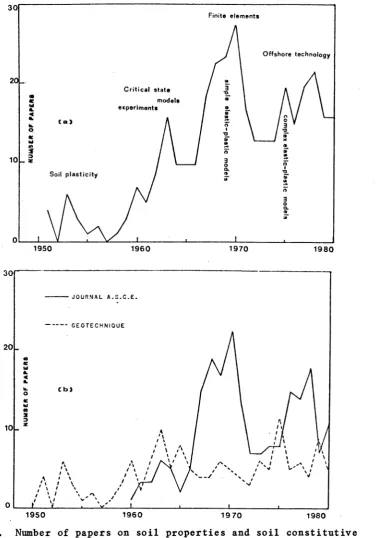
The development of t h i s new branch may be a p p r e c i a t e d i n Fig. 1 . l a by t h e number of p u b l i c a t i o n s i n two s o i l s mechanics j o u r n a l s : a B r i t i s h J o u r n a l , "Geotechnique," and a n American one, " t h e Geotechnical Engi- n e e r i n g D i v i s i o n J o u r n a l of t h e American S o c i e t y of C i v i l Engineers
."
These two j o u r n a l s of s t e a d y p o p u l a r i t y f o r many y e a r s i n s o i l mechanics c a p t u r e t h e i n c r e a s i n g i n t e r e s t i n t h i s new f i e l d . However, t h e y g r e a t l y u n d e r e s t i m a t e t h e t o t a l p r o d u c t i o n of p a p e r s s i n c e t h e r e c e n t c r e a t i o n of s p e c i a l i z e d magazines such a s t h e " I n t e r n a t i o n a l J o u r n a l f o r Numerical and A n a l y t i c a l Methods i n Geomechanics," "Mechanics of Materi- a l s , ' * "Numerical J o u r n a l f o r Gemechanics," e t c .30-
Finite elements
Offshore technology
20,
C r i t i c a l state m
a U
L
<
..
t e ,0
a
1
10- 2
Soil plasticity
3
(Z
0 , I
Fig. 1.1. Number of papers on soil properties and soil constitutive
equations published in two journals of steady popularity in soil mechanics: a British journal, "Geote~hniqae,'~ and an American one, "The Geotechnical Engineering Division Journal of the American Society of Civil Engineers,
"
[image:11.552.98.475.57.596.2]1868 by Tresca and S a i n t Venant was o n l y a p p l i e d t o m e t a l . L a t e r , about 1945, s o i l p l a s t i c i t y a t i t s b e g i n n i n g was s t r i c t l y d e r i v e d from m e t a l p l a s t i c i t y . But s o i l , compared t o m e t a l , h a s a d i f f e r e n t r h e o l o g i c a l b e h a v i o r , which depends m a i n l y on mean p r e s s u r e and d e n s i t y . The f i r s t s o i l models d e r i v e d from metal p l a s t i c i t y c o u l d n o t d e s c r i b e t h e d i f f e r - ence and were n o t s u c c e s s f u l n s o i l mechanics. I n 1955, Drucker, Gibson and Henkel
[1.111
compensated f o r t h i s d e f i c i e n c y and proposed t h e f i r s t o r i g i n a l s o i l model which d i s a s s o c i a t e d s o i l from metal p l a s t i c i t y . I n 1956 a n i m p o r t a n t s e r i e s of e x p e r i m e n t a l d a t a on c l a y s was produced by P a r r y E1.191 i n G r e a t B r i t a i n . A few y e a r s l a t e r , t h i s abundant c o l l e c t i o n of t e s t s , d r a i n e d and u n d r a i n e d a t d i f f e r e n t confin-i n g p r e s s u r e s , were i n t e r p r e t e d by Roscoe, S c h o f i e l d and Wroth 11.241. These r e s e a r c h e r s i n t r o d u c e d t h e concept of " c r i t i c a l s t a t e " i n t o t h e p l a s t i c i t y t h e o r y t o c r e a t e a c l a y model, s a t i s f a c t o r y o v e r a wide range of t e s t s and o v e r c o n s o l i d a t i o n r a t i o s .
a n a l y t i c a l o r g r a p h i c a l methods. About 1965, t h e development of com- p u t e r f a c i l i t i e s and numerical methods was a t u r n i n g p o i n t i n s o i l model ing. Most p r a c t i c a l and complex g e o t e c h n i c a l problems, which had been approached u n t i l t h e n w i t h e m p i r i c a l methods, could be solved a s boundary value problems w i t h t h e h e l p of a c c u r a t e and r i g o r o u s numerical
t e c h n i q u e s . F i n i t e element and f i n i t e d i f f e r e n c e methods o f f e r e d t h e s o l u t i o n t o n o n l i n e a r p a r t i a l d i f f e r e n t i a l e q u a t i o n s w i t h complex boundary c o n d i t i o n s and geometries. Simple s o i l models s t a r t e d t o be used i n f i n i t e element codes, mostly d e r i v e d from n o n l i n e a r e l a s t i c i t y o r m e t a l - p l a s t i c i t y . They attempted t o d e s c r i b e t h e n o n l i n e a r and n o n r e v e r s i b l e s o i l b e h a v i o r a s simply a s p o s s i b l e w i t h a minimum number of parameters. Simultaneously, w i t h t h e t h e o r e t i c a l development of s o i l models, t h e t e s t i n g t e c h n i q u e evolved. The s t a n d a r d t r i a x i a l t e s t became more r e f i n e d . Although o r i g i n a t e d i n 1936 by Kjellman [1.141, t h e t r u e t r i a x i a l t e s t s were a p p l i e d t o c u b i c a l s o i l samples i n o r d e r t o i n v e s t i g a t e t h e i n f l u e n c e of t h e i n t e r m e d i a t e p r i n c i p a l s t r e s s (e.g., KO
and S c o t t [1.151). I n 1975, s o i l modeling was reanimated, mainly due t o t h e growth of o f f s h o r e o i l p r o d u c t i o n technology. The main c h a l l e n g e i n t h i s a r e a i s t o d e s c r i b e i n e l a s t i c c y c l i c s o i l behavior o c c u r r i n g around f o u n d a t i o n s o r p i l e s d u r i n g p e r i o d i c wave o r earthquake l o a d i n g . The s o i l models a r e founded n o t only on p l a s t i c i t y t h e o r y , but a l s o on d i f f e r e n t c o n s t i t u t i v e t h e o r i e s such a s r a t e - t y p e e q u a t i o n s . T h e i r f o r m u l a t i o n becomes v e r y t h e o r e t i c a l and i n v o l v e s more and more m a t e r i a l
X-ray p i c t u r e s a r e t a k e n t o measure t h e d i s p l a c e m e n t of l e a d s h o t s l o c a t e d w i t h i n t h e sample. The t e s t i n g e f f o r t i s now o r i e n t e d towards t h e e f f e c t of r o t a t i o n of p r i n c i p a l s t r e s s e s e i t h e r w i t h t h e hollow c y l i n d e r a p p a r a t u s (e.g. Symes e t a l . 11.2711 o r w i t h t r i a x i a l a p p a r a t u s (e.g. A r t h u r e t a l . 11.31).
R e c e n t l y , a s a r e s p o n s e t o t h i s i n c r e a s e i n t h e nmnber of models and t o demands from i n d u s t r y , i n t e r n a t i o n a l c o n f e r e n c e s have t a k e n p l a c e a l l over t h e world: Montreal (19801, D e l f t ( 1 9 8 1 ) , Z u r i c h (19821, Grenoble (19821, and Tucson (1983) a r e examples. I n t h e s e forums of m a t e r i a l modeling, s o many d i f f e r e n t and c o n t r a d i c t o r y o p i n i o n s have been f o r m u l a t e d c o n c e r n i n g t h e r e 1 i a b i l i t y and c a p a b i l i t y of e x i s t i n g models t h a t a n a t t e m p t a t a u n i f y i n g approach becomes n e c e s s a r y .
A s a supplement t o Fig. l . l a , Fig. l . l b i l l u s t r a t e s t h e d i f f e r e n c e of a c t i v i t y between Europe and t h e U n i t e d S t a t e s . The B r i t i s h p u b l i c a - t i o n s a r e s t e a d i l y i n c r e a s i n g w h i l e t h e American o n e s f o l l o w t h e r u l e of t h e f r e e market: demand and supply.
E l a s t i c i t y
P l a s t i c i t y ( s i n g l e y i e l d s u r f a c e ) P l a s t i c i t y ( m u l t i p l e y i e l d s u r f a c e s ) P l a s t i c i t y (bounding s u r f ace
Endochroni c Rate- type
Nonlinear incremental E m p i r i c a l model
T h e o r i e s such a s t h e above have been a p p l i e d t o a l l k i n d s of m a t e r i a l s . I n t h i s r e s p e c t , s o i l h a s become a n e n g i n e e r i n g m a t e r i a l such a s s t e e l o r c o n c r e t e .
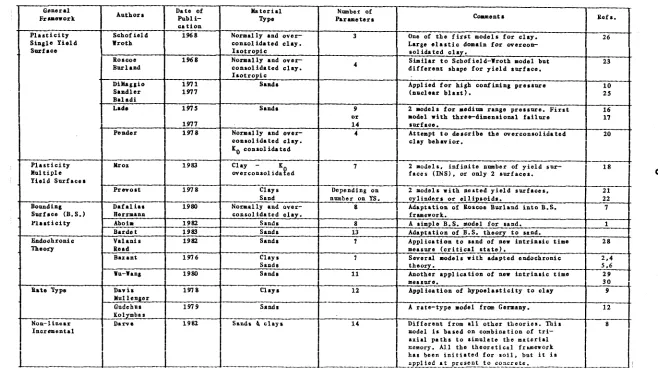
For each c l a s s of t h e o r y , a few examples a r e given i n T a b l e 1.1.
No a t t e m p t a t a n e x h a u s t i v e p r e s e n t a t i o n h a s been made; o n l y models b e l i e v e d t o be mostly s i g n i f i c a n t a r e p r e s e n t . From t h i s t a b l e d i f f e r e n t i n f o r m a t i o n may be e x t r a c t e d :
m
Age of t h e modelType of s o i l i t i s b e s t q u a l i f i e d t o d e s c r i b e , e . g , , normally c o n s o l i d a t e d c l a y s , sand, e t c .
TABLE 1.1 PRINCIPAL MODELS IN SOIL HECBAh'ICS
Fr*rework
P l a s t i c i t y S i n g l e Y i e l d Surf ace
P l a s t i c i t y M u l t i p l e Y i e l d S u r f a c e s
Boundin8 S u r f a c e (B.S.) P 1 a a t i c i t y
Endochronic Theory
Bate Type
N o r l i n e a r Incremental
Authors Data of h b l M a t e r i a l Number of
i- %PO P a r m e t e r s
I
Coament aI c a t i o n 1 I
Schof i e l d 1968 Normally and o v e r 3
Wroth c o n s o l i d a t e d c l a y .
1
* ~ s o t r o p i o1
One of t h e f i r s t models f o r clay. Large e l a s t i c domain f o r overcon-
s o l i d s t e d c l a y .
S i m i l a r t o Scbof ield-Wroth model but d i f f e r e n t shape f o r y i e l d s u r f a c e .
Roscoe 1968
Burland
B a l a d i Lade
I s o t r o p i c I I -
Sands Applied f o r high c o n f i n i n g p r e s s u r e Normally and over-
c o n s o l i d a t e d c l a y . 4
1975
1977
I 1 ( n u c l e a r b l a s t ) . - -
Pander
1
1978I
P r o v o s t 1978
I
-
Daf a 1 i a a 1 1980
Bead
1
Bazant 1 1976
I
Sands 9
I o r
I
-
C l a y - K
I
7w a r c o n s o l ida?ed Normally and o v e r consol ida t e d c l a y . KO c o n s o l i d a t e d
1 4 4
c o n s o l i d a t e d c l a y .
1
Sands 1 8
Sands 13
Sands
I
7Clays Sand Normal 1s and over-
2 models f o r medium range p r e s s u r e . F i r s t model w i t & three-dimensional f a i l u r e
Depending on number on YS.
8
s u r f ace.
Attempt t o d e s c r i b e t h e a v e r c o n s o l i d a t e d c l a y b e h a v i o r .
2 models, i n f i n i t s number of y i e l d a n r f a c e s ( I N S ) , o r only 2 s n r f a c e s .
2 models w i t h n e s t e d y i e l d s u r f a c e s . c y l i n d e r s o r e l l i p s o i d r .
A d a p t a t i o n of Roscoe Burland i n t o B.S. framework.
A simple B.S. model f o r sand. A d a p t a t i o n of B.S. t h e o r y t o sand. A p p l i c a t i o n t o sand of new i n t r i n s i c time measure ( c r i t i c a l s t a t e ) .
S e v e r a l models w i t h adapted endochronic
Sands
I
I
theory.Sanda 11 I Another a p p l i c a t i o n of new i n t r i n s i c t i m e
i I i 1 measure.
D a v i s I 1978 Clays 1 2 1 A p p l i c a t i o n of h y p o e l a s t i c i t y t o c l a y Mu1 l e n g e r
Gudehns Kolymbss
Darva Sands b c l a y s
-1
l 4A r a t e - t y p e model from Germany.
D i f f e r e n t from a11 o t h e r t h c o r i o s . T h i s model i s based on combination of t r i - a x i a l p a t h s t o s i m u l a t e t h e m a t e r i a l memory. A l l t h e t h e o r e t i c a l framework h a s been i n i t i a t e d f o r s o i l , but i t i s a p p l i e d a t p r e s e n t t o c o n c r e t e .
[image:16.751.34.692.112.481.2]t h e o r e t i c a l notions, but a1 so i n the experimental processes
required t o e s t a b l i s h the constants f o r a particular theory or
CHAPTER I1
THE MATERIAL SOIL AS A
CONTINUUM
2.1 APPLICATION
OF
CONTINUUM MECHANICSTO
ASSEMJ3LYOF
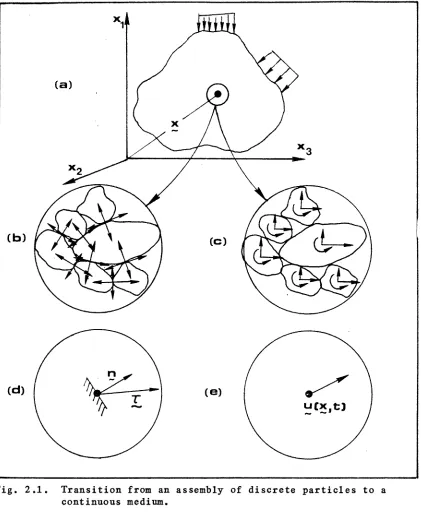
DISCRETE PARTICLESWhen e x t e r n a l l o a d i n g s , composed of p r e s c r i b e d d i s p l a c e m e n t a n d / o r f o r c e s , a r e a p p l i e d t o a g r a n u l a r mass a s shown i n Fig. 2 . l a , r e d i s t r i b u t i o n of f o r c e s and d i s p l a c e m e n t o c c u r s i n s i d e t h e m a t e r i a l volume. Looking c l o s e l y i n t h e neighborhood of a g i v e n p a r t i c l e , neighbor p a r t i c l e s form c o n t a c t s a s shown i n Fig. 2 . l b . Each c o n t a c t a c t i o n , which i s d i s t r i b u t e d o v e r a small a r e a of a g r a i n , may be r e p r e s e n t e d by a r e s u l t a n t f o r c e and a t o r q u e , l o c a t e d a t t h e c o n t a c t p o s i t i o n . I n most m i c r o s c o p i c s t u d i e s , t h i s t o r q u e i s n e g l e c t e d a c c o r d i n g t o t h e s m a l l s i z e of c o n t a c t a r e a . The p o s i t i o n s of c o n t a c t f o r c e s change d u r i n g a p p l i c a t i o n of l o a d i n g ; e v e n t u a l l y t h e c o n t a c t s may be d e l e t e d , o r r e l o c a t e d . Each g r a i n , which i s g e n e r a l l y r e p r e s e n t e d by a r i g i d body, h a s a d i s p l a c e m e n t which i s c h a r a c t e r i z e d by t h e t r a n s l a - t i o n and t h e r o t a t i o n of t h e c e n t r o i d . The g l o b a l mass d e f o r m a t i o n r e s u l t s from r e l a t i v e p a r t i c l e motions, s l i p p a g e of c o n t a c t s and r e o r g a n i z a t i o n of l o c a l s t r u c t u r e , i . e . , from m i c r o s c o p i c changes i n f o r c e s and d i s p l a c e m e n t s .
Although i t c o r r e s p o n d s t o r e a l i t y , t h i s d e s c r i p t i o n of t h e p h y s i c s o f a g r a n u l a r m a t e r i a l cannot be a p p l i e d t o s o l v e e n g i n e e r i n g problems p r a c t i c a l l y f o r v a r i o u s r e a s o n s : It i s i m p o s s i b l e t o d e f i n e e x a c t l y t h e geometry of each g r a i n , c o r n e r , edge, e t c . , f o r t h e volume of m a t e r i a l c o n s i d e r e d i n a g e o t e c h n i c a l problem. But even f o r w e l l - d e f i n e d g r a i n geometry such a s a r e g u l a r assembly of uniform s p h e r e s , t h e number of unknowns c o n s t i t u t e s a b a r r i e r t o any a n a l y s i s . For i l l u s t r a t i o n
9 9
Fig. 2.1. Transition from an assembly of discrete particles to a continuous medium.
(a) Volume of granular material subjected along its boundary to prescribed forces andlor displacements.
(b) Normal and tangential forces acting o n grain contacts at a microscopic level.
(c) Translation and rotation of each grain at a microscopic 1 eve1
.
(dl Approximation of the discrete system of contact forces in (b) by a continuous distribution of traction vector. (e) Representation of displacement of each grain in (c) by a
[image:20.552.52.473.39.554.2]1 mm i n r a d i u s , depending on whether t h e y a r e o r g a n i z e d i n uniform sim- p l e c u b i c o r c l o s e d hexagonal packing ( a f t e r Deresiewicz E2.81). Since each s p h e r e and each c o n t a c t ( f o r c e - p o s i t i o n ) p o s s e s s e s 6 d e g r e e s of freedom, t h e t o t a l number of unknown q u a n t i t i e s may r e a c h 4 . 1 0 ~ ~ which i s s t i l l a p r o h i b i t i v e number f o r a l l p r e s e n t a n a l y s e s , t h e o r e t i c a l , e x p e r i m e n t a l o r numerical.
A . a l t e r n a t i v e way t o s o l v e t h e problem of Fig. 2 . l a i s t o assume t h a t t h e d i s c r e t e d i s t r i b u t i o n of f o r c e s and d i s p l a c e m e n t i n t h e g r a n u l a r mass may be r e p r e s e n t e d by c o n t i n u o u s q u a n t i t i e s . The d i s - placement of p a r t i c l e s i n t h e neighborhood of a p a r t i c l e , a t i n i t i a l p o s i t i o n x t i l d e i n a r e f e r e n c e frame, i s smoothed by a c o n t i n u o u s d i s - placement f i e l d denoted u t i l d e ( x t i l d e , t ) depending on i n i t i a l p o s i t i o n x t i l d e and time t ( F i g . 2 . l e ) . I n a s i m i l a r way, t h e c o n t a c t f o r c e s a r e averaged by a c o n t i n u o u s d i s t r i b u t i o n of s t r e s s v e c t o r s , sometimes c a l l e d t r a c t i o n v e c t o r s ( F i g . 2 . l d ) . Each v e c t o r depends o n l y on t h e p o s i t i o n a t time t of a p a r t i c l e i n i t i a l l y a t p o s i t i o n 5 , and o n t h e u n i t v e c t o r g t o some u n i t a r e a s u r f a c e on which i t i s a c t i n g . The s t r e s s v e c t o r i s denoted t a u t i l d e . It i s assumed t o depend o n l y on t h e d i r e c t i o n of t h e c o n t a c t s u r f a c e where i t a c t s , n o t on i t s c u r v a t u r e .
such a s t h e d i s p l a c e m e n t of i n d i v i d u a l p a r t i c l e s and f o r c e s a t t h e c o n t a c t s c a n be measured on some s i m p l e r p h y s i c a l m a t e r i a l model. Exam- p l e s a r e a s s e m b l i e s of o p t i c a l l y s e n s i t i v e d i s k s . F o r c e s a t c o n t a c t s a r e o b t a i n e d from p h o t o e l a s t i c i t y e f f e c t s ; d i s p l a c e m e n t s a r e found by comparison of photographs made a t v a r i o u s s t a g e s of t h e experiment. T h i s method was used by Dantu C2.61, De J o s s e l i n de Jong and V e r r u i j t
C2.71, and Van d e r Kogel C2.181. I n a r e c e n t e x p e r i m e n t , Luong 12.111 used i n f r a r e d thermography t o d e t e c t l o c a l i z a t i o n of energy d i s s i p a t i o n by f r i c t i o n i n r e a l sand samples.
Complementing t h e e x p e r i m e n t a l approach on simp1 i f i e d m a t e r i a l Cundall and S t r a c k C2.31 and S c o t t and C r a i g C2.161 propose t o use com- p u t e r s t o s i m u l a t e two-dimensional m a t e r i a l b e h a v i o r . Numerical and r e a l e x p e r i m e n t s o n i d e a l i z e d m a t e r i a l c o n s i s t i n g of two-dimensional assembly of d i s k s were compared by Cundall e t a l . 12.51.
The t h i r d approach i n v o l v e d g e n e r a l t h e o r e t i c a l work, s t a r t i n g from m i c r o s c o p i c b e h a v i o r t o o b t a i n macroscopic r e s p o n s e . Such a t tempts have g i v e n some u s e f u l r e s u l t s i n t e r m s of p h y s i c s of m a t e r i a l b e h a v i o r such a s t h e s t r e s s - d i l a t a n c y t h e o r y , which was o r i g i n a l l y f o r m u l a t e d i n 1962 by Rowe C2.151 and m a t h e m a t i c a l l y founded i n 1965 by Horne 12.91 f o r s p h e r e s . The s t r e s s - d i l a t a n c y t h e o r y was a b l e t o e x p l a i n q u a l i t a t i v e l y and q u a n t i t a t i v e l y how sands d i l a t e when s u b j e c t e d t o s h e a r i n g s t r e s s e s .
m a t e r i a l modeling, and i s e s p e c i a l l y j u s t i f i e d i n view of t h e i n c r e a s i n g complexity of c o n s t i t u t i v e e q u a t i o n s f o r s o i l s .
A 1 1 t h e above approaches, e x p e r i m e n t a l , numerical o r t h e o r e t i c a l , g i v e r e s u l t s on d i s c r e t e q u a n t i t i e s . Since t h e y a r e founded o n r e a l p h y s i c s of m a t e r i a l s , t h e i r outcome, may be i n t e r p r e t e d s i g n i f i c a n t l y i n terms of c o n t i n u o u s q u a n t i t i e s . A l l t r a n s i t i o n s from d i s c r e t e t o c o n t i n u o u s i n v o l v e a v e r a g i n g p r o c e s s e s , g e n e r a l l y performed on some f i n i t e m a t e r i a l volume. For i l l u s t r a t i o n , Cundall e t a l . t2.51 d e f i n e s t h e d e f o r m a t i o n g r a d i e n t (which c h a r a c t e r i z e s u l t i m a t e l y t h e s t r a i n s ) , i n a n assembly of d i s c r e t e d i s k s , i n t h e f o l l o w i n g way: F i r s t , t h e e q u i v a l e n t c o n t i n u o u s d i s p l a c e m e n t f i e l d , a t any p o i n t x t i l d e of t h e continuum, i s d e f i n e d e i t h e r by t h e r e a l d i s p l a c e m e n t of a d i s k p a r t i c l e o r by t h e imaginary c o n t i n u o u s d i s p l a c e m e n t which e x t r a p o l a t e s t h e m o t i o n of p a r t i c l e s s u r r o u n d i n g t h e i n s t e r s t i t i a l space; t h i s c h o i c e depends on whether o r n o t t h e p o i n t x t i l d e l i e s on a d i s k .
The a v e r a g e d i s p l a c e m e n t g r a d i e n t t e n s o r w i t h C a r t e s i a n component
-
u may be d e f i n e d a s i, j
where u i s t h e ith component of t h e e q u i v a l e n t continuous displacement i
aui
m a t e r i a l volume s e l e c t e d l a r g e enough t o y i e l d s i g n i f i c a n t c o n t i n u o u s r e s u l t s .
It i s n o t c e r t a i n t h a t a l l d i s c r e t e q u a n t i t i e s may be averaged w i t h o u t l o s i n g some s i g n i f i c a n t p h y s i c s of t h e m a t e r i a l b e h a v i o r . For i n s t a n c e , t h e a v e r a g i n g p r o c e s s f o r t h e d e f o r m a t i o n g r a d i e n t may h i d e d i s c o n t i n u i t i e s i n t h e d i s p l a c e m e n t f i e l d , such a s l o c a l i z e d s h e a r band. Such d i s c o n t i n u i t i e s , n o t always e a s y t o c h a r a c t e r i z e w i t h i n a d i s c r e t e system, make m e a n i n g l e s s t h e t r a n s i t i o n from d i s c r e t e t o c o n t i n u o u s . It w i l l be i n t e r e s t i n g t o e s t a b l i s h c r i t e r i a f o r such t r a n s i t i o n s ; t h e y c o u l d y i e l d i n s t r u c t i v e d a t a on how d i s c o n t i n u i t i e s emerge and s t r e s s - l o c a l i z a t i o n a p p e a r s . I n a continuum mechanics c o n t e x t , t h e s e r e s u l t s would be u s e f u l w i t h b i f u r c a t i o n methods a p p l i e d t o boundary v a l u e problems.
Once t h e c o n t i n u i t y assumption h a s been s e l e c t e d t o d e s c r i b e a s o i l , a l l continuum mechanics r e s u l t s may be a p p l i e d . The f i r s t s t e p i s t o d e f i n e t h e k i n e m a t i c s of t h e m a t e r i a l , i . e . , t h e motion w i t h i n i t i n t e r m s of d i s p l a c e m e n t , v e l o c i t y and a c c e l e r a t i o n and t h e k i n e t i c s a c t i n g , i . e . , t h e f o r c e s developed c o m p a t i b l e w i t h t h e motion.
2.2 DESCRIPTION OF KINEMATICS
Only t h e n e c e s s a r y c o n c e p t s f o r t h i s p r e s e n t a t i o n a r e d e f i n e d . A
more g e n e r a l d e s c r i p t i o n of t h e k i n e m a t i c s i n a continuum may be found i n v a r i o u s t e x t b o o k s on continuum mechanics ( e . g . , Malvern [2.121
,
T r u e s d e l l and Toupin E2.171).
I n a c o n v e n t i o n a l way, f o r s i m p l i c i t y , o n l y s m a l l d i s p l a c e m e n t s a r e c o n s i d e r e d . The d e f o r m a t i o n s a r e c h a r a c t e r i z e d by t h e i n f i n i t e s i m a l symmetric s t r a i n t e n s o r e p s i l o n t w i t h C a r t e s i a n components e i j such t h a t
where u i ( x t i l d e , t ) a r e t h e C a r t e s i a n components of t h e d i s p l a c e m e n t a u i f i e l d a t time t of a m a t e r i a l p o i n t i n i t i a l l y a t p o s i t i o n x t i l d e and
-
ax
j
a r e p a r t i a l d e r i v a t i v e s of t h e ith d i s p l a c e m e n t f i e l d c o o r d i n a t e w i t h r e s p e c t t o t h e j th p o s i t i o n c o o r d i n a t e .
t o r e p r e s e n t changes about t h i s s t a t e . Between time t and i n f i n i t e l y c l o s e time t + d t i n c r e m e n t s of s t r a i n s a r e d e f i n e d by s u b s t i t u t i n g t h e i n c r e m e n t a l d i s p l a c e m e n t f i e l d between time t and time t + d t i n r e l a t i o n ( 2 . 2 ) . Another approach, commonly used i n s o l i d mechanics, i s t o employ r a t e i n s t e a d of increment. Within our p r e s e n t a t i o n b o t h d e s c r i p t i o n s a r e e q u i v a l e n t , s i n c e any increment ( d i s p l a c e m e n t o r o t h e r ) i s a r a t e m u l t i p l i e d by an increment of time d t . I n c r e m e n t s a r e used h e r e s i n c e we a r e o n l y concerned w i t h r a t e - i n d e p e n d e n t m a t e r i a l .
The p r i n c i p a l v a l u e s of t h e s t r a i n t e n s o r a r e denoted E ~ , ~ ~ , ~ ~ .
For t h e s p e c i a l axisymmetric c o n d i t i o n s , d e f i n e d by:
E
i j = 0 when i P j ( i * j = 1 , 2 , 3 ) (2.3b)
two new c o o r d i n a t e s a r e i n t r o d u c e d s and aq; t h e y a r e r e l a t e d t o v
p r i n c i p a l components i n t h e f o l l o w i n g way:
These l a s t d e f i n i t i o n s have been commonly used i n s o i l mechanics f o r axisymmetric s t a t e s s i n c e t h e e a r l y s o i l models were developed i n 1960.
t a k e n p o s i t i v e , and t e n s i l e s t r a i n s n e g a t i v e , i . e . , t h e y have t h e o p p o s i t e s i g n t o t h e u s u a l s o l i d mechanics convention.
2.3 DESCRIPTION OF KImTICS
The f o r c e s i n s i d e a m a t e r i a l a r e r e p r e s e n t e d by t h e Cauchy s t r e s s t e n s o r sigmat w i t h C a r t e s i a n c o o r d i n a t e s o i j a t p o s i t i o n = t i l d e and time
t . The increment of s t r e s s between t i m e t and t + d t i s d e s c r i b e d by t h e i n c r e m e n t a l s t r e s s t e n s o r dsigmat w i t h components doij
.
The p r i n c i p a l v a l u e s of t h e s t r e s s t e n s o r a r e denoted ol,a2,a3. For a x i symme t r i c 1 oading
,
i. e.,
o
i j = 0 , when ifij ( i , j = 1 , 2 , 3 )
o n l y two s t r e s s components a r e n e c e s s a r y : p and q d e f i n e d a s :
As f o r s t r a i n s , a l l compressive s t r e s s e s a r e p o s i t i v e , t e n s i l e s t r e s s e s 2
n e g a t i v e . Now, t h e c o e f f i c i e n t e n t e r i n g t h e d e f i n i t i o n of E i n r e l a -
Q
dW = b i j d e i j (sum on i , j = 1 , 2 , 3 ) ( 2 . 7 a )
By c a l c u l a t i o n , u s i n g t h e axisymmetric c o n d i t i o n s p e c i f i e d i n r e l a -
t i o n s (2.5) and ( 2 . 3 )
I t should be kept i n mind t h a t t h i s r e p r e s e n t a t i o n of s t r e s s e s and s t r a i n s w i t h p, q, e
v s E q i s r e s t r i c t e d t o axisymmetric l o a d i n g ; i t s
convenience i n s t u d y i n g s o i l b e h a v i o r i n t h e s t a n d a r d t r i a x i a l a p p a r a t u s
CHAPTER I11
CLASSICAL PLASTICITY THEORY
The p l a s t i c i t y t h e o r y s t a r t e d i n 1868 when Tresca p r e s e n t e d two
n o t e s d e a l i n g w i t h t h e flow of m e t a l s under g r e a t p r e s s u r e s t o t h e
French Academy. Saint-Venant (1797-1886)
,
who had t o p r e p a r e a r e p o r ton t h a t work a s member of t h e Academy, became i n t e r e s t e d i n t h i s
s u b j e c t . He was t h e f i r s t t o s e t up t h e fundamental e q u a t i o n s of
p l a s t i c i t y and t o use them i n p r a c t i c a l problems. Around 1950, famous
c o n t r i b u t o r s l i k e H i l l 13.41 completed t h e mathematical s t r u c t u r e of
p l a s t i c i t y .
O r i g i n a l l y concerned w i t h y i e l d i n g of metal, t h i s t h e o r y was o n l y
a p p l i e d t o s o i l around 1960. I t s fundamental b a s i s l i e s i n o b s e r v a t i o n s
made from t h e s i m p l e s t t e s t i n g o n m a t e r i a l : t h e u n i a x i a l t e s t . A l l t h e
p h y s i c a l o b s e r v a t i o n s , o b t a i n e d f o r t h e simple nnidimensional s t a t e ,
have been g e n e r a l i z e d t o t h e combined s t a t e of s t r e s s (six-dimensional)
i n a t e n s o r i a l form w i t h t h e h e l p of geometrical c o n s i d e r a t i o n s .
3.1 FUNDAMENTAL PLASTICITY CONCEPTS FROM UNIAXIAL TESTS
A t y p i c a l s t r e s s - s t r a i n curve o b t a i n e d i n a u n i a x i a l t e s t of most
m a t e r i a l ( m e t a l , s o i l , e t c . ) i s shown i n Fig. 3.la. Only t h e a x i a l
component of s t r e s s and s t r a i n i s recorded; b o t h a r e assumed t o be
uniformly d i s t r i b u t e d i n t h e sample. I n t h e p a r t i c u l a r example of Fig.
F i g . 3 . l a . T y p i c a l s t r e s s - s t r a i n curve i n u n i a x i a l t e s t performed o n a r e a l m a t e r i a l .
[image:30.552.48.467.48.652.2]d e s c r i b e d w i t h mathematical terms, t h i s complex n o n l i n e a r and i r r e v e r s i - b l e behavior must be approximated without l o s i n g s i g n i f i c a n t f ea t a r e s . Such a schematic m a t e r i a l response i s shown i n Fig. 3 . l b and may be de s c r i b e d by t h e f 01 lowing remarks :
1. The response i s r e v e r s i b l e around t h e o r i g i n ; it may be r e p r e s e n t e d by an i s o t r o p i c l i n e a r l y e l a s t i c behavior t o a f i r s t approximation.
2 . A t h r e s h o l d f o r r e v e r s i b i l i t y i s reached when t h e s t r e s s exceeds a " y i e l d shear" o r e l a s t i c l i m i t . Beyond t h i s l i m i t ,
denoted 6 , i r r e v e r s i b i l i t y i s c h a r a c t e r i z e d by permanent o r unrecoverable deformation a f t e r a s t r e s s removal ( P i g . 3 .lb).
3 . Following y i e l d i n g , more apparent n o n l i n e a r e f f e c t s m a n i f e s t themselves: t h e s t r e s s - s t r a i n curve bends towards t h e s t r a i n
a x i s .
4. Daring unloading and r e l o a d i n g , t h e response i s almost p a r a l l e l
t o t h e i n i t i a l response about t h e o r i g i n ( i f t h e h y s t e r e t i c phenomenon i s i g n o r e d ) .
5. A t t h e end of a r e l o a d i n g , t h e s t r a i n e i s t h e sum of an anre-
coverable s t r a i n sP and a r e c o v e r a b l e s t r a i n ee (Fig, 3 , l b ) :
t h e s t r e s s s t a t e d u r i n g t h e l o a d i n g h i s t o r y . The m a t e r i a l l o o k s h a r d e r t h a n i t was o r i g i n a l l y ; t h i s phenomenon i s known a s " s t r a i n hardening." T h i s remark a l s o a p p l i e s f o r s u c c e s s i v e unl oading-reloading proce s s e s.
7. The m a t e r i a l e x h i b i t s some memory of i t s p r e v i o u s l o a d i n g h i s - t o r y . T h i s remembrance a b i l i t y may be c a p t u r e d by t h e y i e l d s t r e s s v a l u e . Other v a r i a b l e s c a l l e d ' I i n t e r n a l v a r i a b l e s , " may be d e f i n e d t o c h a r a c t e r i z e t h i s memory. T h i s terminology comes from i r r e v e r s i b l e thermodynamics. I n o r d e r t o f u l l y c h a r a c t e r i z e a n i r r e v e r s i b l e thermodynamic s t a t e , t h e "observed" o r " e x t e r n a l " v a r i a b l e s such a s t e m p e r a t u r e and s t r e s s a r e i n s u f f i c i e n t ; new v a r i a b l e s , c a l l e d "hiddent' o r " i n t e r n a l " must a l s o be d e f i n e d .
8. The m a t e r i a l f a i l s when t h e s t r e s s r e a c h e s a f i n a l f a i l u r e s t r e s s . T h i s f a i l u r e s t r e s s , t h e l i m i t of t h e p o s s i b l e s t r e s s f o r a m a t e r i a l , d i f f e r s from t h e y i e l d s t r e s s which i s t h e t h r e s h o l d f o r i r r e v e r s i b l e s t r a i n .
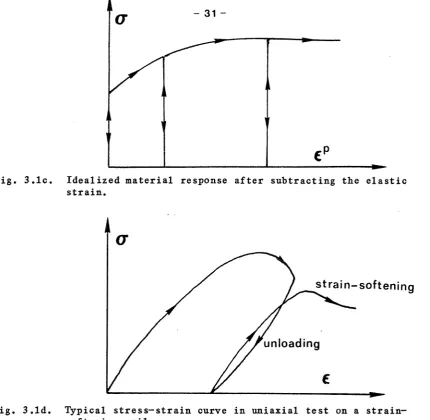
I n a d i f f e r e n t system of c o o r d i n a t e s , s t r e s s - p l a s t i c s t r a i n , ( t h e r e v e r s i b l e s t r a i n i s removed from t h e t o t a l s t r a i n ) t h e m a t e r i a l response of Fig. 3 . l b i s shown i n Fig. 3 . l c .
The incremental s t r a i n de, corresponding t o a s t r e s s increment da, from a s t a t e a , i s equal t o :
a ) o n l y t h e e l a s t i c s t r a i n increment dee, i.e.:
i f t h e s t r e s s s t a t e a i s l e s s t h a n t h e y i e l d s t r e s s a* o r i f t h e s t r e s s increment d a i s n e g a t i v e .
b ) t h e sum of e l a s t i c and p l a s t i c incremental s t r a i n r e s p e c t i v e l y dee and deP, i.e.:
i f t h e s t r e s s s t a t e a i s equal t o t h e y i e l d s t r e s s a* and t h e s t r e s s increment d a i s p o s i t i v e .
I n c o n t r a s t t o most m a t e r i a l s , which strain-harden i n u n i a x i a l t e s t s a s i n d i c a t e d i n Fig. 3 . l a , s o i l s , under some circumstances, p r e s e n t a more complex behavior, known a s "strain-sof t e n i n g , " r e p r e s e n t e d i n Fig. 3 .ld. Obtained w i t h s t r a i n - c o n t r o l l e d t e s t i n g d e v i c e s , t h e s t r e s s i s observed t o decay a s t h e s t r a i n exceeds some value. Although t h e s t r e s s a d e c r e a s e s , t h i s behavior i s d i f f e r e n t from unloading a s shown i n Fig. 3.ld. During unloading b o t h s t r a i n and s t r e s s increments a r e n e g a t i v e , while during s t r a i n - s o f t e n i n g t h e s e increments have o p p o s i t e signs. These two d i f f e r e n t p r o c e s s e s a r e d i s t i n g u i s h e d by t h e s i g n
$
da, whered a i s n e g a t i v e , whereas f o r loading, with o r without s t r a i n - s o f t e n i n g ,
1
5
d a i s p o s i t i v e .3.2 GENERALIZATION TO SIX-DIMENSIONAL STRESS SPACE
A l l fundamental concepts, introduced f o r t h e simple unidimensional
s t a t e of s t r e s s and s t r a i n , need t o be g e n e r a l i z e d f o r every p o s s i b l e
combined s t a t e i n t h e space of t h e symmetric Cauchy s t r e s s t e n s o r and of
t h e i n f i n i t e s i m a l s t r a i n t e n s o r . A conventional s t r e s s f o r m u l a t i o n h a s
been p r e f e r r e d t o a s t r a i n f o r m u l a t i o n (Naghdi and Trapp 13.71, Yoder 13 .I31 1. A l l g e n e r a l i z a t i o n s t o t h e six-dimensional s t r e s s space a r e
performed i n C a r t e s i a n t e n s o r i a l form, with t h e h e l p of Euclidean
geometrical c o n s i d e r a t i o n s . T w o p a r t i c u l a r s i m p l e m o d e l s , one a p p l i e d
t o m e t a l , t h e o t h e r t o s o i l , i l l u s t r a t e s t e p b y - s t e p t h e p r e s e n t a t i o n of
each new p l a s t i c i t y concept.
The s t r e s s s t a t e i s r e p r e s e n t e d by t h e Cauchy s t r e s s t e n s o r Q, with
s i x independent C a r t e s i a n components a . .
,
( i, j = 1 , 2 , 3 ).
The increment1J
of s t r e s s i s d e s c r i b e d by t h e incremental s t r e s s t e n s o r dg with e
components d a . . ( i , j = 1,2,3). The s t r a i n s , corresponding t o e,e ,eP i n
1J
t h e ~ i d i m e n s i o n a l case, a r e r e p r e s e n t e d by t h e following q u a n t i t i e s :
L
( t o t a l ) s t r a i n s t a t e w i t h components s i j,
( i , j=1,2,3)-
27-
gp p l a s t i c s t r a i n s t a t e w i t h components eP
i j * ( i , j=1,2,3)
The increments of s t r a i n s , t o t a l , e l a s t i c o r p l a s t i c a r e denoted by:
d g increment of t o t a l s t r a i n with components de
,
( i s j=1,2,3)i j
dge increment of e l a s t i c s t r a i n w i t h components d e i j
,
( i , j=1,2,3)dgp increment of p l a s t i c s t r a i n w i t h components dep
.
( i , j = 1 , 2 , 3 )i j
The d e s c r i p t i o n of t o t a l s t r a i n i n t o e l a s t i c and p l a s t i c s t r a i n i s s t i l l
assumed t o be v a l i d i n t h e six-dimensional s t r a i n space
o r i n terms of components
For i n c r ements, t h e same a s s m p t i o n holds:
d e . . = dee
+
dePi j i j
1J
The f a c t o r 2 i n f r o n t of t h e shear s t r a i n , deij, where i i s d i f f e r e n t
from j , t a k e s i n t o account t h e symmetry of t h e i n f i n i t e s i m a l s t r a i n t e r r s o r dg. T h i s l a s t d e f i n i t i o n may be c o n t r a c t e d using E i n s t e i n ' s implied
snm n o t a t i o n :
The implied snm convention i s a n a t t r a c t i v e way t o condense e q u a t i o n s
and i s used f r e q u e n t l y i n t h e r e s t of t h i s p r e s e n t a t i o n . The d i r e c t i o n
of d!Z, i s d e f i n e d by t h e u n i t v e c t o r ar with t h e same d i r e c t i o n and t h e
f 01 lowing components :
-
m . .
-
d = i i1J l l d g l l
'
( i n j=1,2,3)The d e f i n i t i o n s (3.6) and (3.7) a p p l y t o any increments, i n p a r t i c -
u l a r t o p l a s t i c and e l a s t i c s t r a i n increments dgp and dlZe. To d e f i n e d g
r e s u l t i n g from an increment of s t r e s s dg a t a s t a t e
a,
dae and dgp needt o be determined. dae i s found by using a n e l a s t i c model, whereas t o
f a l l y c h a r a c t e r i z e dgP, t h r e e p o i n t s remain t o be examined:
1) e x i s t e n c e , 2 ) d i r e c t i o n and 3) amplitude. These a s p e c t s r e f e r i n t a r n t o t h e y i e l d c r i t e r i o n , t h e flow r u l e and t h e hardening r ~ l e s ~
3.2.1 E x i s t e n c e of Unrecoverable S t r a i n ( Y i e l d C r i t e r i o n )
The y i e l d p o i n t a* d e f i n e d i n t h e u n i a x i a l t e s t , i s g e n e r a l i z e d
i n t o a h y p e r s u r f a c e i n t h e six-dimensional s t r e s s space, c a l l e d t h e
"Yield Surface" ( t h e p r e f i x "hyper" i s u s u a l l y o m i t t e d ) . By d e f i n i t i o n ,
t h e y i e l d s u r f a c e e n c l o s e s a domain i n s t r e s s space i n which any
i n f i n i t e s i m a l s t r e s s change produces o n l y r e c o v e r a b l e s t r a i n . T h i s
s u r f a c e i s r e p r e s e n t e d by a g e n e r a l equation:
o r expl i c i t l y
where E o r rl,r2,...,rn r e f e r t o t h e parameters c o n t r o l l i n g t h e s i z e , shape, e t c . , of t h e y i e l d s u r f a c e . Once t h e y i e l d s u r f a c e h a s been
d e f i n e d , t h e presence o r absence of u n r e c o v e r a b l e s t r a i n , a t some s t r e s s
s t a t e , i s c h a r a c t e r i z e d by t h e " y i e l d c r i t e r i o n " .
Y i e l d c r i t e r i o n :
a ) f ( g , x )
<
0, t h e s t r e s s s t a t e a l i e s i n s i d e t h e y i e l d s u r f a c e ; anyincrement of s t r e s s c r e a t e s o n l y incremental e l a s t i c s t r a i n dge,
i.e., dgP = jZ.
o r i e n t e d outwards ( l o a d i n g ) , i r r e v e r s i b l e s t r a i n r e s u l t s , i.e.
d!Ap
#Q;
i f dg p o i n t s inwards (unloading) o r i s t a n g e n t t o t h e y i e l ds u r f a c e , only e l a s t i c s t r a i n develops, i.e. dgp = 6.
c ) The case f ( g , x )
>
0 i s impossible.T h i s i m p o s s i b i l i t y i s j u s t i f ied by invoking t h e following argument: i f a s t a t e of s t r e s s q, i s allowed t o e x i s t o u t s i d e t h e y i e l d s u r f a c e ,
t h e n f o r any increment of s t r e s s from t h i s s t a t e q,, i r r e v e r s i b l e d e f o r
mation would occur. No unloading w i t h r e v e r s i b l e response would be
p o s s i b l e , which i s c o n t r a d i c t o r y t o t h e p r e v i o u s u n i a x i a l concept
d e f i n e d from u n i a x i a l t e s t s shown i n Fig. 3 , l a . T h e r e f o r e t h e y i e l d
s u r f a c e must change i t s p o s i t i o n , o r deform i n o r d e r t o f o l l o w t h e
s t r e s s s t a t e when p l a s t i c flow occurs, so t h a t t h e s t r e s s s t a t e q, l i e s
o n o r w i t h i n t h e y i e l d s u r f a c e . T h i s c o n d i t i o n i s known a s t h e
"consistency condition."
A more p r e c i s e d e f i n i t i o n of l o a d i n g and unloading e n t e r i n g t h e
y i e l d c r i t e r i o n may be g i v e n w i t h t h e h e l p of t h e u n i t v e c t o r normal and
p o i n t i n g outwards from t h e y i e l d s u r f a c e a t Q ( s e e Fig. 3 . 2 ) . Denoted
g , t h i s u n i t v e c t o r h a s i t s components n such t h a t : i j
+
a f ( i , j = l J 2 , 3 )
n ' - (sum on k , f s l J 2 , 3 ) ( 3 09)
a 0
F i g . 3 . 1 ~ . I d e a l i z e d m a t e r i a l r e s p o n s e a f t e r s u b t r a c t i n g t h e e l a s t i c s t r a i n .
F i g . 3 . l d . T y p i c a l s t r e s s - s t r a i n curve i n u n i a x i a l t e s t on a s t r a i n - s o f t e n i n g s o i l .
-
-
9 -plastic potential
[image:39.530.36.467.29.449.2]where
-
a f
i s t h e p a r t i a l d e r i v a t i v e of f ( p , r ) with r e s p e c t t o t h e s t r e s s component a...
A f t e r c h a r a c t e r i z i n g t h e s c a l a r product betweena
1J
and dg i n t h e following way:
t h e l o a d i n g and unloading, which i n d i c a t e i f t h e s t r e s s increment p o i n t s
outwards o r inwards t o t h e y i e l d s u r f ace, may be r e d e f i n e d i n t h e
following way:
1 oading ~ ' d g
>
0n e u t r a l l o a d i n g a'dg = 0
an1 oading a d %
<
0The s i m p l e s t e l a s t i c - p l a s t i c model, a p p l i e d t o metal, i s c e r t a i n l y
t h e von Mises' model. The y i e l d suxface i s a c y l i n d e r i n t h e p r i n c i p a l
s t r e s s space, t h e a x i s of which i s p a r a l l e l t o t h e h y d r o s t a t i c a x i s , a s
r e p r e s e n t e d i n Fig. 3.3. The e q u a t i o n of such a s u r f a c e i s o b t a i n e d by
s t a t i n g t h a t t h e d i s t a n c e t o any p o i n t on t h i s s u r f a c e t o i t s a x i s i s
Fig. 3.3. v o n Mises' yield surface i n principal stress space.
- -
predictedtension
[image:41.533.38.473.62.384.2] [image:41.533.43.472.423.630.2](.. .-pbij-aij) (aij-pbij-aij) = R~ (sum on i, j=1,2,3) (3.12)
1J
where 8 i s t h e Kronecker symbol defined sach a s
i j
and p i s t h e mean p r e s s u r e defined sach chat:
and a. 's a r e components of a p o i n t of t h e y i e l d s u r f a c e a x i s (see Fig.
l j
3 -3) sach t h a t
Introducing t h e d e v i a t o r i c s t r e s s t e n s o r g with C a r t e s i a n components s
i d
such t h a t-
S . .
-
1J 4
-
pbij ( i , j=1,2,3)e q u a t i o n (3.12) becomes
- 1J a j a =
'
R
(sum on i , j = 1 , 2 , 3 )i j ( 3 .17)
where k i s d e f i n e d such a s
(sum on i , j=1,2,3) (3.18)
The v a l u e s of a. ? s and k may be c a l c u l a t e d from t h e u n i a x i a l loading,
4
which was s p e c i f i e d i n (2.5). For t h i s p a r t i c u l a r loading t h e
d e v i a t o r i c s t r e s s components a r e sach t h a t
For convenience, assume t h a t t h e a Is s a t i s f y t h e f o l l o w i n g r e l a t i o n s :
i d
-
a22
-
a33 (3.21a)ai j - 0 , i # j
,
( i , j = 1 , 2 , 3 ) (3.21b)Using r e l a t i o n s (3.1 5)
,
(3.20),
(3.21),
r e l a t i o n (3.18) becomes:I f two d i f f e r e n t u n i a x i a l t e s t s , one i n compression and a n o t h e r i n
t e n s i o n , a r e a v a i l a b l e , two y i e l d s t r e s s e s may be chosen sach a s shown
a r e r e s p e c t i v e l y denoted qc and qt. Since qc and q t s a t i s f y r e l a t i o n
(3.22) f o r d i f f e r e n t signs. all and k a r e such t h a t
A l l o t h e r components a a r e generated from (3.21) and (3 . I S ) . The u n i t
i j
v e c t o r g t o t h e y i e l d s u r f a c e may a l s o be c a l c u l a t e d . From r e l a t i o n (3.18) i s obtained:
a f
7 =
auij 3 ( s i j - a i j ( i , j=1,2,3)
From ( 3 . 9 ) , (3.18) and (3.241, i t i s concluded t h a t
The y i e l d c r i t e r i o n , and s p e c i f i c a l l y r e l a t i o n s 3 . 1 1
,
may bes i m p l i f i e d f o r t h e u n i a x i a l t e s t , such t h a t
nkf 'dukf (sum on k,I=1,2,3) (3.26)
I f q i s g r e a t e r t h a n qt and l e s s t h a n qc, only e l a s t i c s t r a i n i s possi- b l e f o r any s t r e s s increment. I f q i s equal t o qt o r q,, t h e n p l a s t i c
s t r a i n e x i s t s dependent on t h e s i g n of t h e terms i n r e l a t i o n (3.26). I f
only e l a s t i c s t r a i n occurs.
Example 2 :
Lade's f i r s t s o i l model [ 3 . 5 ] follows c l o s e l y t h e concepts of metal
p l a s t i c i t y , but a l s o e x h i b i t s some c h a r a c t e r i s t i c f e a t u r e s of s o i l
behavior. This model i s presented i n p a r a l l e l with von Mises' model.
The y i e l d s u r f a c e h a s f o r equation:
where X i s t h e only parameter which c o n t r o l s t h e y i e l d s u r f a c e shape
( i * e * * X i s equal t o r 1 and I, I3 a r e s t r e s s i n v a r i a n t s defined i n t h e
following way.
I3 = d e t = f ~ ~ ~ + c2 a 1 2 6 2 3 4 1 - r ~ ~ 0 ~[@11c$3+a22~~1+a33@~2] ~ ( 3 . 2 8 b )
Such a surface (Eq. 3 . 2 7 ) i s a cone, centered on t h e h y d r o s t a t i c a x i s ,
with i t s t i p a t t h e o r i g i n of s t r e s s a s shown i n Figs. 3 . 5 . The e l a s t i c
domain, bounded by t h i s surf ace, depends on t h e mean p r e s s u r e p, i. e.
,
on I. Since t h e u n i t v e c t o r E i s lengthy t o work o u t , only t h e p a r t i a lFACE
F i g . 3 . 5 . F a i l u r e s u r f a c e and two s u c c e s s i v e p o s i t i o n s o f y i e l d s u r f a c e o f Lade's modeb.
a ) i n d e v i a t o r i c p l a n e
b) i n p r i n c i p a l s t r e s s space
c ) i n plane o
a13
where a l l components
-
aa.. a r e generated, by permutation of i n d i c e s ,
1J
using t h e following r e l a t i o n s
3.2.2 D i r e c t i o n of P l a s t i c Flow: Flow Rule
Obviously d e f i n e d uniquely i n t h e case of any m i d i m e n s i o n a l
s t a t e , t h e p l a s t i c flow d i r e c t i o n must be c h a r a c t e r i z e d i n a multidimen-
s i o n a l s t r e s s space by a "flow rule." From experimental o b s e r v a t i o n s ,
c o n t r a r y t o what e l a s t i c i t y theory p r e d i c t s ( s e e S e c t i o n 3.5.4)
,
t h ep l a s t i c flow d i r e c t i o n i s r e l a t e d t o t h e t o t a l s t r e s s s t a t e and i s
independent of t h e s t r e s s increment. Analogously t o i r r o t a t i o n a l f l u i d
flow, which i s normal t o t h e p o t e n t i a l l i n e s i n f l u i d mechanics, f o r a l l
t h e s t r e s s s t a t e s and s t r e s s increments c r e a t i n g p l a s t i c s t r a i n ( a s
s p e c i f i e d by t h e y i e l d c r i t e r i o n ) , t h e p l a s t i c flow d i r e c t i o n i s
c o l l i n e a r t o t h e g r a d i e n t of a f u n c t i o n , c a l l e d t h e " p l a s t i c p o t e n t i a l , "
and denoted
~ ( s z , s )
o r e x p l i c i t l y g (51,a22,a33 , Q ~ 8 ~ 3 1 8 ~ 1 u ~ ~ G.
.
, s m) ~ ~The g r a d i e n t d i r e c t i o n i s c h a r a c t e r i z e d by t h e u n i t v e c t o r normal
t o t h e p l a s t i c p o t e n t i a l surface passing through t h e s t r e s s s t a t e , and
p o i n t i n g outwards from t h i s surface. Denoted by 8 , t h e components mij
of t h i s v e c t o r a r e given by an expression s i m i l a r t o (3.91, where g i s
s u b s t i t u t e d f o r f .
The incremental p l a s t i c s t r a i n d$ i s c o l l i n e a r t o g ( F i g . 3.2), which i s expressed i n t h e following way:
da?. = IldePIlmij
,
Z J
where
I
ldaPI1 ,
amplitude of dfGP, i s a p o s i t i v e s c a l a r .For convenience, i t i s o f t e n assumed t h a t t h e p o t e n t i a l surface and
y i e l d s u r f a c e a r e coincident. I n t h i s case t h e flow r u l e i s s a i d t o be
a s s o c i a t i v e ; i f they a r e not c o i n c i d e n t , it i s termed nonassociative.
E x a m ~ l e 1: von Mises' Model
From o b s e r v a t i o n s on metal, an a s s o c i a t i v e r u l e i s s e l e c t e d . The
a n i t v e c t o r g, which r e p r e s e n t s t h e p l a s t i c flow d i r e c t i o n , i s
c o i n c i d e n t w i t h t h e u n i t v e c t o r 2 , which r e p r e s e n t s t h e normal t o t h e
y i e l d surface.
Since t h e v e c t o r % i s given by (3.25) and s i n c e t h e d e v i a t o r i c s t r e s s e s a l s o v e r i f y t h e r e 1 a t i o n (3.15)
,
i t can be shown t h a t t h e plas-t i c v o l u m e t r i c i s z e r o so t h a t von Mises' model p r e d i c t s no p l a s t i c v o l u m e t r i c change.
E x a m ~ l e 2: Lade's Model
Lade's model i s n o n a s s o c i a t i v e ; t h e p l a s t i c p o t e n t i a l surf ace i s
d e f i n e d a s follows:
where t h e s c a l a r
t
i s d e f i n e d s o t h a t t h e p o t e n t i a l s u r f a c e goes throught h e s t r e s s s t a t e and where
K2
i s r e l a t e d t o t h e y i e l d s a r f a c e ( r e l a t i o n3.7) by t h e following expression.
i n which A i s a m a t e r i a l c o n s t a n t .
I n Fig. 3.6 t h e f a i l u r e , y i e l d and p l a s t i c p o t e n t i a l s u r f a c e s have
been compared i n t h e p q space ( S e c t i o n 2.3) f o r a s p e c i a l s t r e s s s t a t e and a p a r t i c u l a r sand (Monterey No. 0 sand).
3.2.3 Amplitude of P l a s t i c Flow, Hardening Rules
The amplitude of t h e p l a s t i c increment i s t h e l a s t p o i n t which
needs t o be s p e c i f i e d ; i t i s c a l c u l a t e d from t h e motion of t h e y i e l d
s u r f a c e by invoking t h e c o n s i s t e n c y c o n d i t i o n . I n o r d e r t o f o l l o w t h e
s t r e s s s t a t e d u r i n g p l a s t i c flow, t h e y i e l d s u r f a c e must be a b l e t o
a l t e r i t s shape, p o s i t i o n , e t c . A l l t h e s e changes a r e accomplished by
modifying t h e p a r a m e t e r s rl,.
..
,r, of Equation ( 3 . 8 ) . A l l t h e parame- t e r s rk (e.g., r a d i u s and c e n t e r p o s i t i o n f o r von Mises' model) them-s e l v e s depend upon some d i f f e r e n t , more fundamental, q u a n t i t i e s ; t h a t
i s , t h e " i n t e r n a l " o r h i d d e n v a r i a b l e s . I f t h e e v o l u t i o n law ( i . e . , t h e
r e l a t i o n between t h e p a r a m e t e r s rk and t h e i n t e r n a l v a r i a b l e s ) i s
s p e c i f i e d , t h e n a l l changes i n y i e l d s u r f a c e a r e d e s c r i b e d . The concept
of i n t e r n a l v a r i a b l e s , formulated r e c e n t l y f o r p l a s t i c i t y by L u b l i n e r
f3.61 i s based on t h e i d e a of s t a t e v a r i a b l e s i n i r r e v e r s i b l e
thermodynamics. Since t h e m a t e r i a l e x h i b i t s a n i r r e v e r s i b l e behavior,
t h e s t a t e of a body i s d e s c r i b e d a t each m a t e r i a l p o i n t n o t o n l y by t h e
v a l u e s of "observed" o r " e x t e r n a l " v a r i a b l e s (such a s d e f o r m a t i o n o r
s t r e s s ) , but a l s o by v a l w s of "hidden" o r " i n t e r n a l " v a r i a b l e s . These
v a r i a b l e s a r e u s u a l l y t a k e n t o be s c a l a r s o r components of a p r o p e r l y
i n v a r i a n t second o r d e r t e n s o r ; t h e p l a s t i c s t r a i n t e n s o r gp i s u s u a l l y s e l e c t e d a s t h e i n t e r n a l v a r i a b l e , The e x t e r n a l v a r i a b l e s a r e t h e
s t r e s s e s , s i n c e t h e p l a s t i c i t y t h e o r y i s f o r m u l a t e d i n a s t r e s s space, For s t r a i n - p l a s t i c i t y (Naghdi and Trapp [3.71, Yoder [3 .I31 ) t h e s t r a i n s
a r e s e l e c t e d . From t h e c o n s i s t e n c y c o n d i t i o n , a p p l i e d f o r t h e
r e l a t i o n must h o l d :
a
f-
+ -
a
f dei! = 0 (sum on k , f = 1 , 2 , 3 ) (3.35)dakf
a ~ g !
S u b s t i t u t i n g r e l a t i o n (3.31b) i n t o (3.35) and u s i n g (3.91, t h e
amplitude of t h e p l a s t i c s t r a i n i s such t h a t :
(sum on i , j , k , f , p , q = 1 , 2 , 3 )
By d e f i n i t i o n , t h e p l a s t i c modulus, denoted H, is:
a f
.
7
PQ (sum on k, f,p,q=1,2
3)
(3.37)PQ
With ( 3 . 3 1 b ) , (3.36) and (3.37) t h e p l a s t i c s t r a i n increment
becomes
( i , j = l D 2 , 3 )
de?. =
g
mij ( n r s d a r s ) (sum on r , s = 1 , 2 , 3 ) (3.3 8) *Jwhere He i s t h e Heaviside f u n c t i o n . The r e l a t i o n (3.38) may be r e w r i t t e n w i t h a b u i l t - i n y i e l d c r i t e r i o n ,
Daring s t r a i n s o f t e n i n g , H and t h e s c a l a r product godE a r e both negative. Strain-sof t e n i n g a1 t e r s r e l a t i o n (3.40) i n t h e following way:
1 ( i , j=1,2,3)
ds?. = m
<-
n durs>i j H r s (sum on r,s=1,2,3) (3.41) 1 J
~ x a m ~ l e 1: von Mises' Model
Two d i f f e r e n t hardening r u l e s a r e p r e s e n t e d s u c c e s s i v e l y :
i s o t r o p i c and kinematic.
a ) I s o t r o o i c hardening ( F i g . 3.7a)
The y i e l d s u r f a c e expands r a d i a l l y about i t s f i x e d a x i s .
By applying t h e c o n s i s t e n c y c o n d i t i o n t o t h e y i e l d s u r f a c e
d e f i n e d i n (3.18). t h e r e r e s u l t s
3 s - a i j d s i j = 2kdk (sum on i j = 1 , 2 , 3 ) (3.42)
A s a r e s u l t of a s t r e s s change, t h e r a d i u s k i s a l t e r e d such
F i g . 3 . 7 . Four s u c c e s s i v e p o s i t i o n s o f von Mises' y i e l d s u r f a c e i n a d e v i a t o r i c plane w i t h d i f f e r e n t hardening r u l e s , and t h e same l o a d i n g p a t h :
a ) i s o t r o p i c hardening