PERFORMANCE ANALYSIS OF HYBRID MECHANISM TO IMPROVE
RELIABILITY IN WIRELESS SENSOR NETWORK
1
Ms. Ramya R,
2Ms. Lavanya S.
1M.Phil Research Scholar, Department of Computer Science Auxilium College (Autonomous), Vellore, TamilNadu, India. 2Assisant Professor, HOD Department of Computer Science Auxilium College (Autonomous), Vellore, TamilNadu, India.
---
************************
---Abstract:
A wireless sensor network (WSN) is becoming very popular technology. Wireless networking which
is comprised on number of numerous sensors and they are interlinked or connected with each other for
performing the same function collectively or cooperatively for the sake of checking and balancing the
environmental factors. This type of networking is called as Wireless sensor networking. A wireless sensor
network (WSN) consists of a group of self-organizing, lightweight sensor nodes that are used to
cooperatively monitor physical or environmental conditions. Each sensor node in a WSN is equipped with a
radio transmitter, several sensors, a battery unit and a microcontroller.Because of the size and cost
constraints on sensor nodes, they are limited by energy, bandwidth, memory and other resources. Any
protocol design for WSNs needs to consider the limitations of sensor nodes carefully. In UWSNs, turbulent
conditions of the environments where the sensor nodes are deployed can cause the nodes to die. A
contributing effort to explore the reliability issues in multimodal fusion sensor networks. We presented the
system reliability for the case of two types of sensors and three types of sensors. WSNs hold the promise of
many applications in the area of monitoring and control systems. Many properties of the environment can be
observed by the monitoring system with the advent of cheap and tiny sensors. All these applications are
meant for the specific purposes, and therefore maintaining data transport reliability is one of the major
concern and the most important challenge. To address the reliability, we survey the various existing
techniques; each of them has its own unique working to ensure the reliability. Some of the techniques use
retransmission mechanism while others use redundant information for insuring the reliability.In the
proposed process focus on the routing problem that affects the reliability of WSN. Hereby this problem can
be overcome by implementing the Beacon vector routing protocol (BVR) in Hybrid Mechanism. By finding
the alternative node in case of any node failure accrues. By this redundancy of information can be reduced
and the loss of data can be avoided in Wireless Sensor Network.
Keywords
—
wireless sensor network (WSN), UWSNs, lightweight sensor, Beacon vector routing
protocol (BVR), Hybrid Mechanism.
---
************************
---I. INTRODUCTION
A wireless sensor network (WSN) is becoming very popular technology. Wireless networking which is comprised on number of numerous sensors and they are interlinked or connected with each other for performing the same function collectively or cooperatively for the sake of checking and balancing the environmental factors. This type of networking is called as Wireless sensor networking. A wireless sensor network (WSN) consists of a group of self-organizing, lightweight sensor nodes that are used to cooperatively monitor physical or environmental conditions. Commonly monitored parameters include temperature, sound, humidity, vibration, pressure and motion. Each sensor node in a
WSN is equipped with a radio transmitter, several sensors, a battery unit and a microcontroller.
1.1 Motivation
The design of a data transport protocol in wireless sensor networks is focused on providing end-to-end reliability, mitigating congestion, and achieving fairness in bandwidth allocation. The reliability issue in the data transport protocol usually involves loss recovery, congestion control, or both.
Full reliability (100% reliable data delivery) is
provided unless there are unavoidable packet drops due to buffer overflow.
A specified level of robustness can be provided.
The protocol is robust to node failure and route
changes.
Fresh data has higher priority in the network and
is able to be sent as soon as possible.
1.2 Reliability for Wireless Sensor Network
Packet loss in wireless sensor networks is usually due to the quality of the wireless channel, sensor failure, and congestion. Most of the applications need reliable transmission of each packet, and thus packet-level reliability is required. Almost every transport layer protocol for wireless sensor networks offers unidirectional reliable message delivery, but bidirectional reliability is also required in certain applications.
Reliability Levels:
Packet Reliability
Packet reliability refers to the successful delivery of all the packets to the destination. In case of packet reliability, it is required that all the packets from the sensor nodes reach the sink node that can results in wastage of sensors limited energy resources.
Event Reliability
Event reliability refers to the successful event detection. This requires the reliable transfer of event data from each sensing region in a sensor network.
1.3 Reliability Direction
Upstream Reliability
Upstream reliability refers to the communication between the sensor nodes and sink node, which is mostly unicast/converge cast transmission. All the protocols except PSFQ and GARUDA offer upstream reliability.
Downstream Reliability
Downstream reliability refers to the
communication between the sink node and sensor nodes, since there is only a single sender (the sink); the data transmission usually uses broadcasting rather than unicasting. It provides successful delivery of control packets and queries from sink to sources. Only PSFQ and GARUDA offer downstream reliability.
1.4 Reliability
Reliability is the process of sending packets from source to destination without any loss of sensed data. Data or Packet which are sending to the appropriate destination can receives the packet successfully. Reliability is the way of knowing the quality of the data which are sent by the source node. Reliability is the important one in each and everything.
Reliability = the number of packets received by the Sink node / the number of packets sent to the sink node
II. RELATED WORK
1. End-To-End Reliability in Wireless Sensor Networks Survey and Research Challenges
Wireless Sensor Networks (WSN) is highly distributed
self-organized systems.
Sensor nodes collect measurements of interest over
given space, making them available to external systems and networks at special nodes designated sink nodes.
Moving nodes and failing nodes due to battery power
depletion are problems that raise a significant number of routing problems, demanding the use of efficient routing protocols.
If the sensed information is to be used for active
control (e.g. industrial process control) rather than passive monitoring, estimation and detection, the additional design goal of predictable latency appears.
Many control strategies can compensate for
information delay and jitter (delay variations), provided that these can be deterministically bounded or statistically quantified in the design phase.
Disadvantages:
The whole challenge lies in cost-effective
identification and maintenance of these redundant paths in the presence of nodes performing regular sleep periods with coarse time synchronization. Many building blocks are already present in the literature, but to our knowledge no protocol has been proposed that solves the whole problem.
Although DTC was not developed as a solution to the
congestion control problem, it relies on the TCP mechanisms.
Moving nodes and failing nodes due to battery power
depletion are problems that raise a significant number of routing problems, demanding the use of efficient routing protocols.
2. Reliable Transfer on Wireless Sensor Networks
End-to-end retransmission which is used in
Information redundancy like retransmission, erasure code, and thick path are candidates.
If loss is not randomly distributed, those methods
do not work well. For example, when link fails, but routing table is not updated, all packets through that path will be dropped.
Route fix, which tries alternative next hop after
some failure, reduces correlated consecutive drops, so that information redundancy can perform well.
Link-level retransmission is effective in most
combination of options. Route fix is important to make the loss distribution less bursty.
Especially elimination of long series of correlated
consecutive drops makes erasure code very attractive solution.
Disadvantages
It's easy for hackers to hack it as we can’t control
propagation of waves
Comparatively low speed of communication
Gets distracted by various elements like
Blue-tooth Still Costly at large.
III. LINK-LEVEL RETRANSMISSION
According to the definition of discrete mobility pattern the sink changes its location from time to time. A routing protocol that transfers data towards such a sink should perform the following operations that are not needed for traditional WSNs:
1)
Notify a node when it slink with the sink getsbroken due to mobility.
2)
Inform the whole net work of the topologicalchanges incurred by mobility.
3)
Minimize the packet loss during the sink movingperiod.
3.1 Problems in Network
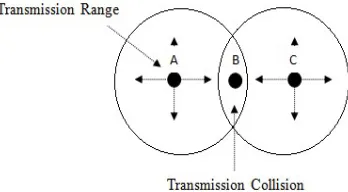
Hop networks and thus must deal with much more complex collision patterns than in cellular type systems. Cellular type systems were based on hop systems. Achieving a dependable one hop transmission in wireless networks is not an easy mission due to the crashes caused by a singularity known as Hidden Terminal Problem.
Fig. 3.1 Hidden Terminal Problem
The transmission range is the range, with respect to the transmitting station, within which a transmitted packet can be successfully received. [8]A typical hidden terminal situation is depicted in figure above. The hidden station problem may persist in networks even with the use of the RTS/CTS handshake.
3.2 Reliability in Network
Reliability = the number of packets received by the sink node / the number of packets sent to the sink node
Merits in Networks
Power Saving due to smaller communication range
Less number of smashes
One-hop source routing, attempts to recover from
path failures by routing indirectly through a small set of randomly chosen intermediaries.
Demerits in Network
Reputation of packets, it is hard to complete in
wireless networks due to the accidents caused by Hidden Terminal Problem.
Too much of Packet loss in Hop Network
Hop network will take long time to reach destination
Collision occurs during packet transmission
3.3 User Datagram Protocol
On the other hand, when we talk about User Datagram Protocol (UDP), then it does not offer any flow control and congestion control mechanisms. In the case of congestions, UDP simply drops the packets without providing any scope for recovering these lost packets.
There is no any flow control and congestion control
mechanisms.
Packets are dropped without providing any scope for
recovering these lost packets.
No ACK available in User Datagram Protocol.
Reliability is lesser than TCP
Too much of Packet Loss while using the User
Datagram Protocol
IV. BEACON VECTOR ROUTING PROTOCOL
4.1 Distributed Hash Table
For some application is it needed to maintain a Distributed Hash Table(DHT). For example Ad-Hoc and sensor-nets needs this kind of structure. The DHT works as follows. Each object in the network has a key and the DHT supports the put and get operations.
4.2 Perimeter know their location
For this approach the paper describes a relaxation procedure for non-perimeter nodes to determine their virtual coordinates The procedure starts with the perimeter knowing their positions and the non-perimeter node starting with a default location, which can be the same or different. In the examples in the paper they use the same default location for all nodes at the beginning of this procedure.
xi=
yi=
4.3 Motivation for BVR
First generation sensor nets applications mainly focused on data collection. This limit the routing options using tree based to many-to-one or one-to-many. One-to-one routing is needed for the new applications for sensor nets. Actually no practical point-to-point implementation exists.
For a one-to-one routing protocol be successful some of the design requirements are that the algorithms should be scalable, robust, energy efficient and minimal algorithm complexity.
4.4 The BVR Algorithm
The BVR algorithm defines a set of coordinates and a distance function. The coordinates are defined as a vector of distances (hops count) to a set of beacon nodes. The algorithm uses a reverse path tree construction method to compute these distances.
ALGORITHM 1 BVR forwarding algorithm
BVR FORWARD (node curr, packet P)
// first update packet header for (i = 1 to k) do
P: imin = min (P: min, i(curr; P:dst))
// try greedy forwarding first for (i = k to 1) do
nextargminx NBR(curr){ i(x, P:dst)}
If ( i(next; P:dst) < P: min ) then
unicast P to next
//greedy failed, use fallback mode
fallback bcn closest beacon to P:dst
if (fallback bcn != curr) then
unicast P to PARENT(fallback bcn)
//fallback failed, do scoped flood
broadcast P with scope P:P(dst)[fallback bcn]
The parameters are r, the total number of beacons, and k< r, the number of beacons that dene a destination's position. Forwarding a message starts with a greedy search for a neighbor that improves the minimum distance we have seen so far.
4.5 Beacon Maintenance
Sensor network nodes are prone to failure and we must provide a mechanism to maintain the set of beacons when they fail. We first note that the algorithm we described can function with fewer than r beacons, and even when there is inconsistency in the beacon sets nodes are aware of, by routing only based on the beacons they have in common. Thus, the beacon maintenance need not be perfect, it only needs to guide the system towards a state where there are r globally recognized beacons. We now sketch such an algorithm. For convenience, we describe the simplest algorithm we've used; we've also experimented with more advanced algorithms but describing them would take us too far afield
ALGORITHM 2 BVR beacon maintenance algorithm
BEACON ELECT MYSELF(r, B)
// invoked periodically; B is the current set of beacons if ( |B| > r ) then
Set timer T = log(myID)/log(maxID(B)) * Tmax + jitter
TIMER T EXPIRES(r, B)
if (|B| < r) then
Announce myself as a beacon BEACON SUPPRESS MYSELF(r, B)
If (myID B)&(|B| > r)&(myID >rth guested(B))
Then
Stop announcing myself as a beacon
4.6 The Distance Function
and always moves toward beacons if the beacons are closer to the destination. The metric is the following:
+k (p,d) = ∑ iϵCk(d) max(pi – di, 0)
− k (p,d) = ∑ iϵCk(d) max(di – pi, 0)
Here Ck (d) is the set of k closest beacons to d. k+
is the sum of the differences for the beacons that are closer to the destination d than to the current routing
node p, while k- measures the sum of the distances to the
farthest beacons. The algorithms chooses the next hop
that minimizes +k and if there is a tie then is broken by
minimizing −k. Actually what they do is to implement k
= A +k + −k for some large constant A.
4.7 BVR Implementation (key issues)
When implementing the algorithms in real nodes, they indentified four key issues that must be addressed: Link estimation, link/neighbor selection, distance estimation and route selection. They come up with the following conclusions for each of these issues. For Link estimation they noticed that the nodes always selects a high quality neighbor, for Routing performance the found out success rate about 97% when the network load is low. In terms of Dynamics BVR sustains high performance under high node failure rate and in Coordinate Stability they noticed this one varies little in magnitude and over time. In other words changes to the overall topology are minimum. The next section gives a high level description of the last paper for this topic, the GLIDER approach.
V. PERFORMANCE EVALUATIONS AND ANALYSIS
5.1 An Introduction to Cygwin
Cygwin is free software that provides a Unix-like environment and software tool set to users of any modern x86 32-bit and 64-bit versions of MS-Windows (XP with SP3/Server 20xx/Vista/7/8) and (using older versions of Cygwin) some obsolete versions (95/98/ME/NT/2000/XP without SP3) as well. Cygwin consists of a Unix system call emulation library, cygwin1.dll. With Cygwin installed, users have access to many standard UNIX utilities. They can be used from one of the provided shells such as bash or from the Windows Command Prompt.
Fig 5.1 : NAM Creation for WSN
Fig 5.2: Collision Identification
Figure 5.3 Multi Hop reliability Model
VI.
PERFORMANCE EVALUATION
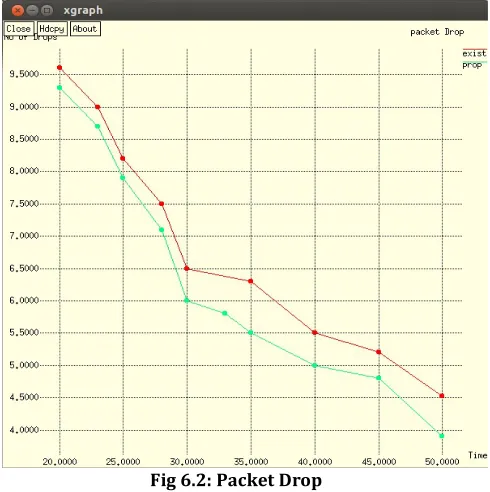
Following Graph will prove that Three-Hops Selection will provide the better performance comparing to the One and Two-Hop models. With the Help of the NS-2 Simulator tool to prove the Metrics like.
Packet Delivery Ratio
Packet Drop
Throughput
6.1 Packet Delivery Ratio
estimated either by counting the number of received hello/data messages in a small period of time, i.e., less than 1 second, or by taking the history of PDR into account.
A Sensor Network consists of multiple detection stations called sensor nodes, each of which is small, lightweight and portable. Every sensor node is equipped with a transducer, microcomputer, transceiver and power source.
Fig 6.1: Packet Delivery Ratio
6.2 Packet Drop
A Wireless Sensor Network (WSN) is a collection of nodes organized into a cooperative network. Each node consists of processing capability which acts as transceiver. Packet dropping is a compromised node which drops all or some of the packets that is supposed to forward. Packet modification is a compromised node which modifies all or some of the packets that is supposed to forward. Packet dropping and modification are common attacks that can be launched by an adversary to disrupt communication in Wireless Sensor Network
Fig 6.2: Packet Drop
6.3 Throughput
Fig 6.3: Throughput
CONCLUSION
In UWSNs, turbulent conditions of the environments where the sensor nodes are deployed can cause the nodes to die. A contributing effort to explore the reliability issues in multimodal fusion sensor networks. We presented the system reliability for the case of two types of sensors and three types of sensors. WSNs hold the promise of many applications in the area of monitoring and control systems. Many properties of the environment can be observed by the monitoring system with the advent of cheap and tiny sensors. All these applications are meant for the specific purposes, and therefore maintaining data transport reliability is one of the major concern and the most important challenge. To address the reliability, we survey the various existing techniques; each of them has its own unique working to ensure the reliability. Some of the techniques use retransmission mechanism while others use redundant information for insuring the reliability. Few of the above objectives may be considered in the future by the researchers.
These objectives may be achieved as under:
By developing a Markov based model with
additional mobile sensors to replace the faulty sensors in case failure occurs.
By developing the efficient mechanism for
clustering the sensor nodes in heterogeneous WSNs to minimize the number of additional sensors required during the deployment based on artificial neural network models.
By developing a model for reliable and quick
packet delivery in WSNs to enhance the performance of the network using appropriate application dependent communication schemes.
By developing a model for reliable and fault
tolerant transmission by introducing biologically inspired sensor nodes which can be trained to memorize the possible events to be observed by the network.
The proposed model will overcome the problems
coming from limited memory and error prone wireless communication medium as the network can recall the lost memory (information of interest) from the biologically inspired sensor nodes based on chain of mental (already memorized system) associations despite of the corrupted signal sensed at the destination.
FUTURE WORK:
Generally, for networks that are multi-hop, hop-by-hop is thought to be superior in regards to reliability. On the other hand, sensor nodes in UWSNs are more likely to die because of energy loss which causes a tremendous number of packets to be lost. Our conclusions have been clarified and supported by simulation results that were achieved using a variety of parameters.
REFERENCES:
1. M. Maroti, \Directed ood-routing framework for
wireless sensor net- works," in Proceedings of the 5th ACM/IFIP/USENIX International Conference on Middleware (Middleware), Toronto, Canada, pp. 99{114, 18-22 October 2004.
2. L. Rizzo, \E_ective erasure codes for reliable
computer communication protocols," ACM Computer Communication Review, vol. 27, no. 02, pp. 24 { 36, 1997.
3. J. Postel, \Transmission Control Protocol," IETF
RFC 793, September 1981.
4. S.-J. Park, R. Sivakumar, I. Akyildiz and R.
Vedantham, \GARUDA: Achieving e
ective reliability for downstream communication in wireless sensor networks," IEEE Transactions on Mobile Computing, vol. 07, no. 02, pp. 214 {230, 2008.
5. G. Clark, Error-Correction Coding for Digital
Communications, Plenum Press, 1981.
6. H. Wen, C. Lin, F. Ren, Y. Yue and X. Huang,
\Retransmission or Redundancy: transmission reliability in wireless sensor networks," in IEEE 4th International Conference on Mobile Adhoc and Sensor Systems (MASS), Pisa, Italy, pp. 1 { 7, 08-11 October 2007.
7. J. C. Bolot, \End-to-end packet delay and loss
behavior in the internet," in Proceedings of the ACM SIGCOMM Conference on Communications Architectures, Protocols and Applications (SIGCOMM), San Francisco, California, USA, pp. 289{298, 13-17 September 2005.
8. S. Ali, A. Fakoorian and H. Taheri, \Optimum
Reed-Solomon erasure coding in fault tolerant sensor networks," in Proceedings of the 4th
International Symposium on Wireless
Communication Systems (ISWCS), Trondheim, Norway, pp. 6{10, 16-19 October 2007.
9. B. Marchi, A. Grilo and M. Nunes, \DTSN:
Distributed transport for sensor networks," in Proceedings of the 12th IEEE Symposium on Computers and Communications (ISCC), Aveiro, Portugal, pp. 165{172, 01-04 July 2007.
10. T. Le, W. Hu, P. Corke and S. Jha, \ERTP:
Energy-efficient and reli- able transport protocol for data streaming in wireless sensor networks," Computer Communications, vol. 32, no. 7-10, pp. 1154 { 1171, 2009.
11. F. Shaikh, A. Khelil, A. Ali and V. Suri, \Trccit:
Tunable reliability with congestion control for information transport in wireless sensor networks," in 5th Annual International ICST
Wireless Internet Conference (WICON),