Background to the topic
Quarries provide the aggregate (crushed rock) used in the
[image:1.595.26.178.240.398.2]construction of our roads. The rock type has to be carefully chosen so that it has suitable properties for the job it has to do. Testing procedures make sure that the aggregate meets the standards. (See reference 3. A guide to aggregates testing)
Figure 1 photograph of Bardon Hill Quarry (photograph P.Williams)
Practical Exercise on the Geology of Roadstones
Cross section through a road surface
A road is made up of a number of different layers, each with a different function.Figure 2 A cross-section through a typical road surface.
Blasts from the past: 3 Geology of Roadstones
Background
“Blasts from the past” is the section of Teaching Earth Sciences where some of the teaching ideas and activities, originally produced for early publications of ESTA and the Association of Teachers of
Geology (the precursor to ESTA), are re-published.
Teaching ideas and activities have been updated and revised before re-publication in the magazine. Copies of earlier publications of ESTA and the Association of Teachers may be accessed in the archive section of the ESTA website, although PDFs of TES 26.3 onwards may be downloaded from the website.
Geology of Roadstones
This activity was produced by Mike Tuke (Tuke, 1985). The original diagrams have been updated and two photographs added. The references have also been revised to reflect present highway construction methods
Distributes the traffic loads on to the road base. Bitumen-bonded aggregate.
40mm
80mm
200mm
Main load-bearing layer. Made of rocks with high crushing strength.
Provides a skid- and wear-resistant surface for the traffic and protects the lower layers. Bitumen-bonded aggregate.
wearing course
base course
road base
[image:1.595.36.527.490.720.2]Most rock types are suitable for the lower two layers providing they have sufficient strength and are packed in such a manner as to be permeable.
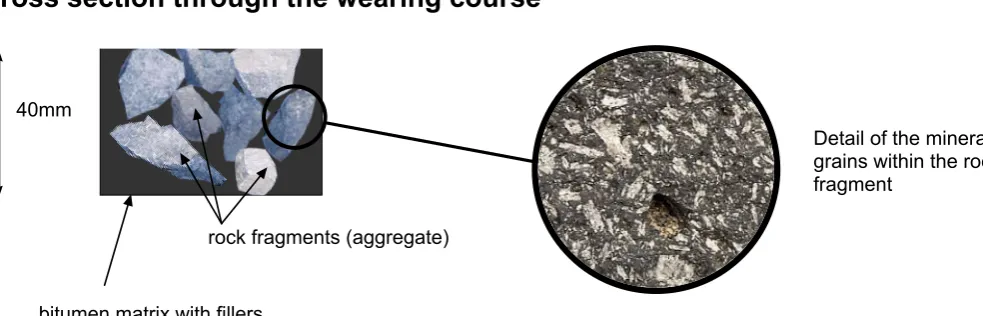
[image:2.595.45.537.142.300.2]The top layer on which the traffic runs, the wearing course, takes much higher pressures and all the wear and tear of the traffic and of the weather. It must provide a durable, skid-resistant surface and must prevent water percolating down to the lower layers. A much higher quality of rock is needed for this layer than for the other layers; only a few rock types are suitable, especially for motorways and other roads carrying much traffic.
Figure 3 Cross section through the wearing layer of a road with a detail of a rock fragment
Cross section through the wearing course
40mm
bitumen matrix with fillers
rock fragments (aggregate)
Detail of the mineral grains within the rock fragment
Good roadstone for making the wearing course of roads must have the following properties:
• The majority of the minerals in the rocks must have a hardness greater than 5 so that the rock is able to resist the abrasion caused by the tyres of the vehicles. The grains must wear in such a way that the exposed surface of the rock fragments (aggregate) does not become polished, otherwise the traffic would skid. This means that the rock must be made of two or more minerals with different hardnesses.
Figure 4 detail of crystal wear in a rock fragment.
When the rock fragments are made of several mineral grains with different
hardnesses, then the crystals in the rock fragments wear to a stepped surface which is skid-resistant.
• The rock needs to be fine-grained so that fragments 0.5cm in diameter contain several mineral grains.
• The individual grains need to be strongly held together so that the aggregate does not crumble under the pressures and stresses exerted by the vehicles. This means the rock must be either well-cemented or made of interlocking crystals.
• The aggregates must have rough surfaces so that the bitumen can adhere to them. Bitumen does not adhere well to glassy surfaces e.g. flint and obsidian, but it does adhere to most other rocks.
Fig.1 Bardon Hill Quarry
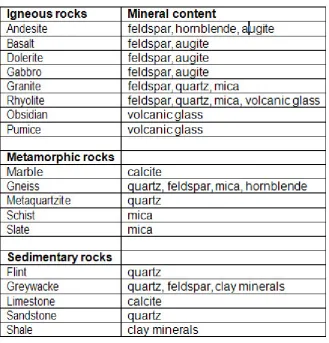
Table 2a: Composition of rocks
Igneous rocks
Andesite feldspar, hornblende, augite Basalt feldspar, augite
Dolerite feldspar, augite Gabbro feldspar, augite Granite feldspar, quartz, mica
Rhyolite feldspar, quartz, mica, volcanic glass Obsidian volcanic glass
Pumice volcanic glass
Metamorphic rocks
Marble calcite
Gneiss quartz, feldspar, mica, hornblende Metaquartzite quartz
Schist mica Slate mica
Sedimentary rocks
Flint quartz
Greywacke quartz, feldspar, clay minerals Limestone calcite
Sandstone quartz Shale clay minerals
Introduction to the practical exercise
In the following practical exercise students are asked to work out which rocks are the most suitable for use as roadstone.
The students must have been given the information above and for some students it is necessary to provide additional information on the mineral composition of the rocks and on the hardness of minerals, (Tables 1&2). The most satisfactory lithologies are basalt and greywacke. However, because of the high cost of transporting aggregate, slightly inferior rocks are often used. Limestone, although not suitable for motorways is extensively used because it is readily available. The composition of greywacke causes problems at all levels.
[image:3.595.49.203.635.751.2]• The majority of the minerals in the rocks must have a hardness greater than 5 so that the rock is able to resist the abrasion caused by the tyres of the vehicles.
• The grains must wear in such a way that the exposed surface of the rock fragments (aggregate) does not become polished, otherwise the traffic would skid. This means that the rock must be made of two or more minerals with different hardnesses.
• The rock needs to be fine-grained so that fragments 0.5cm in diameter contain several mineral grains.
• The individual grains need to be strongly held together so that the aggregate does not crumble under the pressures and stresses exerted by the vehicles. This means the rock must be either well-cemented or made of interlocking crystals.
• The aggregates must have rough surfaces so that the bitumen can adhere to them. Bitumen does not adhere well to glassy surfaces e.g. flint and obsidian, but it does adhere to most other rocks.
• The rock of which the aggregate is made must not be porous otherwise frost would shatter it in winter.
Igneous rocks
minerals
Andesite feldspar, hornblende, augite Basalt feldspar, augite
Dolerite feldspar, augite Gabbro feldspar, augite Granite feldspar, quartz, mica
Rhyolite feldspar, quartz, mica, volcanic glass Obsidian volcanic glass
Pumice volcanic glass
Metamorphic rocks
Marble calcite
Gneiss quartz, feldspar, mica, hornblende Metaquartzite quartz
Schist mica
Slate mica
Sedimentary rocks
Flint quartz
Greywacke quartz, feldspar, clay minerals Limestone calcite
Sandstone quartz
Shale clay minerals
When the rock fragments are made of several different mineral grains with different
hardnesses, then the rock fragments wear to a stepped surface which is skid-resistant
Composition of rocks
Hardness of Minerals and Volcanic glass
Augite 6
Calcite 3
Clay minerals 2.5
Feldspar 6
Hornblende 6
Mica 2.5
Quartz 7
Volcanic glass 6
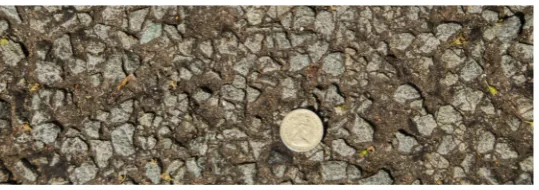
Fig. 5 Worn road surface with aggregate raised above the bitumen matrix. £1 coin for scale.
References
1.http://community.dur.ac.uk/~des0www4/cal/roads/index.html The design and construction of roads.
2.http://www.highwaysmaintenance.com/design.htm An idiot’s guide to road maintenance.
[image:4.595.44.314.150.245.2]3.http://www.northstonematerials.com/filestore/documents/aggregate-tests.pdf A guide to aggregate testing.