Online Network Intrusion Detection System Using
Temporal Logic and Stream Data Processing
Thesis submitted in accordance with the requirements of the University of Liverpool for the degree of Doctor in Philosophy by
Abdulbasit M. Ahmed
Contents
Preface ix
Abstract xi
Acknowledgements xiii
1 Introduction 1
1.1 Motivation . . . 1
1.2 Thesis Contribution . . . 2
1.3 Thesis Scope . . . 3
1.4 Thesis Organization . . . 3
1.5 Summary . . . 5
2 Intrusion Detection Systems 7 2.1 IDS Types . . . 8
2.2 Intruder Detection Methods . . . 9
2.2.1 Techniques of Anomaly Based Intrusion Detection . . . 9
2.2.2 Techniques of Misuse based Intrusion Detection . . . 10
2.3 NIDS Deployment . . . 11
2.4 Popular Network Intrusion Detection Systems . . . 13
2.4.1 Open Sources NIDS . . . 13
2.4.1.1 Snort IDS . . . 14
2.4.1.2 Bro NIDS . . . 15
2.4.1.3 Suricata IDS . . . 16
2.4.2 Commercial NIDS . . . 16
2.5 Summary . . . 17
3 Temporal Logic and Intrusion Detection System 19 3.1 Why Temporal Logic? . . . 19
3.2 Related Work . . . 19
3.2.1 MONID . . . 20
3.2.2 ORCHIDS . . . 22
3.3 Summary . . . 23
4 Stream Data Processing (SDP) 25 4.1 SDP Overview . . . 25
4.2 StreamBase Stream SQL . . . 29
4.3 StreamBase High Performance, scalability, and high availability Features . 32 4.3.1 High Performance Features . . . 33
4.3.2 Scalability and High Availability . . . 36
4.4 Summary . . . 37
5 Temporal Stream Intrusion Detection System (TeStID) 39 5.1 Formal Specification . . . 39
5.1.1 Abstract View of Network Communications . . . 39
5.1.2 MSFOMTL Syntax . . . 43
5.1.2.1 Terms . . . 43
5.1.2.2 Formulae . . . 43
5.1.3 MSFOMTL semantics . . . 44
5.2 Attack Classification . . . 45
5.3 The Proposed System . . . 50
5.3.1 TeStID System Architecture . . . 50
5.3.2 Tools And Software Used . . . 51
5.3.3 The Benefits of the Proposed System . . . 52
5.4 Summary . . . 53
6 Temporal Logic to Stream Queries 55 6.1 Background . . . 55
6.2 The view of Time . . . 57
6.3 Mapping MSFOMTL into SSQL . . . 57
6.4 Correctness . . . 69
6.5 The Translator Development . . . 75
6.6 Summary . . . 85
7 Experiments and Results 87 7.1 Experiments Overview . . . 87
7.1.1 Experiments Aims . . . 87
7.1.2 The Experiment Setup and Approach . . . 88
7.2 Single Packet Attacks With Payload Experiment . . . 89
7.2.1 The Experiment Signatures Preparation . . . 90
7.2.2 Results and Analysis . . . 93
7.2.3 Scalability and Performance . . . 96
7.2.3.1 Implementations of Single Packet Attacks With No Con-currency and Multiplicity . . . 98
7.2.3.2 Implementations of Single Packet Attacks With Concur-rency and Multiplicity . . . 101
7.3 Multiple Packet Attacks Case Studies . . . 103
7.3.1 Results and Analysis of Multiple Packet Attacks Experiments . . . 105
7.4 Summary . . . 108
8 Potential Use of The New System in Anomaly Based IDS 111 8.1 Anomaly Based Network Intrusion Detection Overview . . . 111
8.2 Protocol Anomaly Specifications . . . 113
8.2.1 Single Step Anomalies . . . 114
8.2.2 Multiple Step Anomalies . . . 116
8.2.2.1 Multiple Step Anomalies for Weak Normal Behaviour Requirements . . . 117
8.2.2.2 Multiple Step Anomalies for Strong Normal Behaviour Requirements . . . 118
8.3 Protocol Anomaly Formulae Mapping . . . 124
8.4 Correctness . . . 125
8.5 Summary . . . 126
9 Conclusion 127 9.1 Summary . . . 127
9.2 Contribution . . . 128
9.3 Future Work and Research . . . 128
Bibliography 131 A ANTLR Grammar and String Template Group Files 141 A.1 Description of The Grammar File Structure . . . 141
A.2 TeStID Grammar File . . . 143
A.3 TeStID String Template Group File . . . 160
B Single Packet Attacks With Payload Signatures Files 177 B.1 SNORT Single Packet Signatures File . . . 177
B.2 BRO Single Packet Signatures File . . . 183
B.3 TeStID Single Packet Signatures File . . . 194
Illustrations
List of Figures
2.1 The NIDS Deployment Options . . . 12
2.2 An Example of snort Rule . . . 15
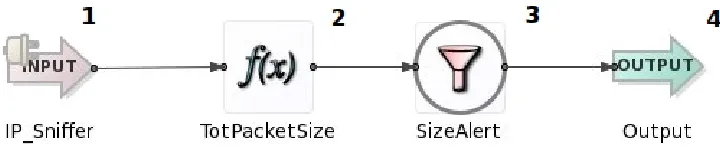
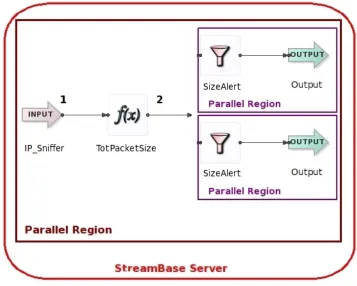
4.1 A Simple Application Running In A Container Inside TheStreamBaseServer 34 4.2 Applying Concurrency only on 4.1 . . . 35
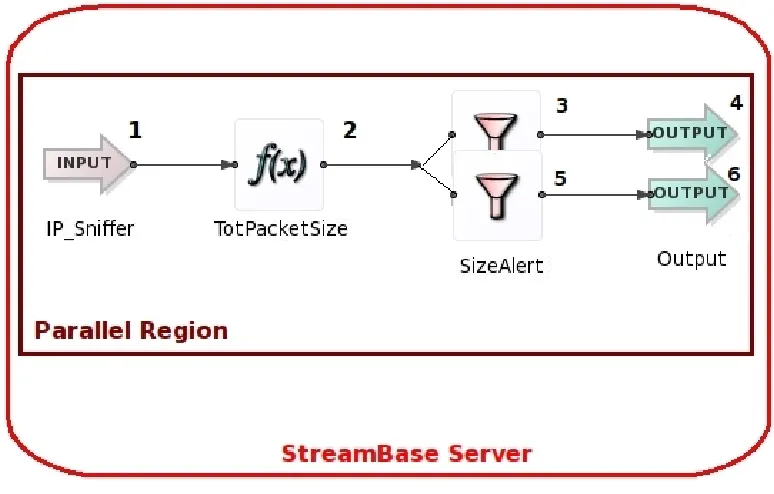
4.3 Applying Multiplicity only on 4.1 . . . 36
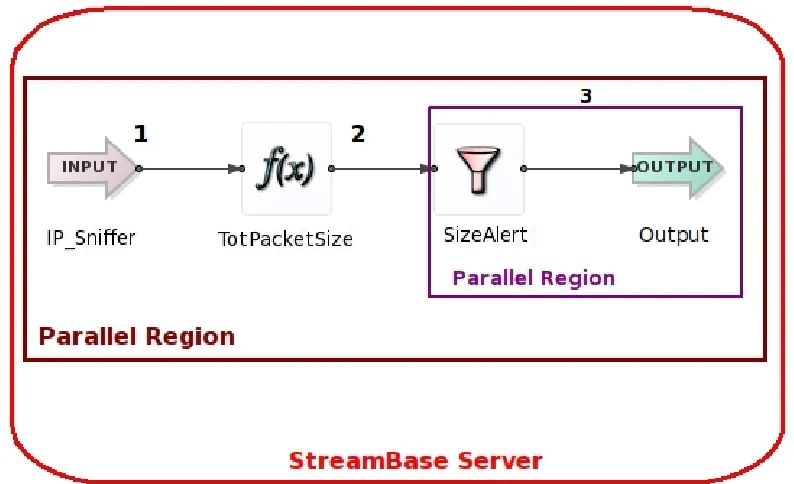
4.4 A main module with a candidate component for using concurrency and mul-tiplicity of 2. . . 37
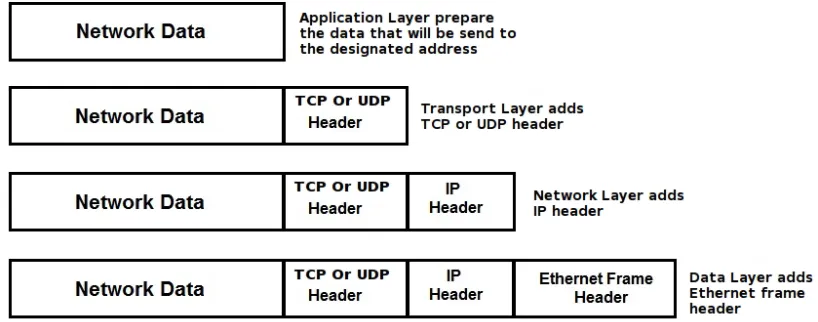
5.1 Packet Encapsulation During Sending . . . 40
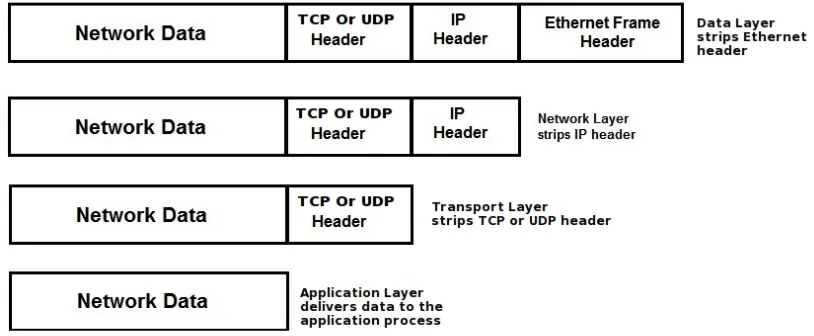
5.2 Packet Deencapsulation During Receiving . . . 41
5.3 TeStID System Architecture . . . 52
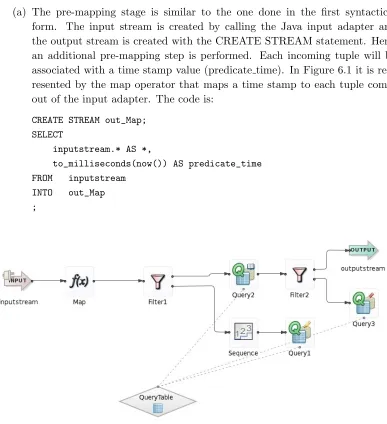
6.1 Reset Scan inStreamBase Studio . . . 65
6.2 Steps of Specification Translation into Stream Queries . . . 69
6.3 TeStID The Translation Process . . . 76
6.4 Parser Rules (1 of 4) For The Misuse Based Detection of TeStID. . . 79
6.5 Parser Rules (2 of 4) For The Misuse Based Detection of TeStID. . . 80
6.6 Parser Rules (3 of 4) For The Misuse Based Detection of TeStID. . . 81
6.7 Parser Rules (4 of 4) For The Misuse Based Detection of TeStID. . . 82
6.8 Calling The String Template Group File During The Parsing . . . 84
7.1 The Testing Environment . . . 89
7.2 bits/sec at 24 X . . . 94
7.3 packets/sec at 24 X . . . 95
7.4 packets/sec at 48 x . . . 96
7.5 bits/sec at 48 x . . . 96
7.6 Graphical representation of the program to capture one single packet attack in theStreamBase studio . . . 97
7.7 Equivalent SSQLcode for the StreamBase application . . . 98
7.8 Three possible implementations to run single packet attack detection on the StreamBase server without using the parallelism features . . . 99
7.9 Single Packet Attack Program Using Module . . . 101
7.10 All Possible Implementations For The Single Packet Attack With Payload . . 102
7.11 CC Input Code and NCC Attack module With/Without Multiplicity . . . . 104
7.12 Maximum packets/seconds for each data test file. Both of the in/out data files of 06/04/1999 were used and they are illustrated in the same graph. . . 106
7.13 Maximum bits/seconds for each data test file . . . 107
7.14 Packets/Sec and Bits/Sec Overlap graph for 05/04/1999 Data File . . . 109
8.1 Network Anomalies . . . 113
8.2 Parser Rules (1 of 3) . . . 120
8.3 Parser Rules (2 of 3) for The Anomaly Based Detection . . . 121
8.4 Parser Rules (3 of 3) for The Anomaly Based Detection . . . 122
8.5 Simultaneous Connection Synchronization (RFC793, September 1981) . . . . 123
List of Tables
7.1 Single Packet Attacks Final Results . . . 937.2 TeStID results without concurrency and multiplicity . . . 100
7.3 Running SNORT,BRO,TeStID without parallel operations . . . 100
7.4 Results of Single Packet Attacks With Concurrency and Multiplicity . . . 103
7.5 Multiple Packets Attacks Results . . . 105
Preface
This thesis is submitted solely to the University of Liverpool in accordance with the requirements of the University of Liverpool for the degree of Doctor in Philosophy. It is my own work and the sources from which material is drawn are identified within. Some parts of this thesis have appeared in the following publications:
[1] A. Ahmed, A. Lisitsa, and C. Dixon. A network intrusion detection system using temporal logic and stream processing. In Proceedings of the 17th Automated Rea-soning Workshop. University of Westminster Harrow, United Kingdom, 2010. URL http://www2.wmin.ac.uk/bolotoa/ARW/arw-2010.html.
[2] A. Ahmed, A. Lisitsa, and C. Dixon. A misuse-based network intrusion detection system using temporal logic and stream processing. In P. Samarati, S. Foresti, J. Hu, and G. Livraga, editors, Proceedings of the 5th International Conference on Network and System Security, pages 18, Milan, Italy, 2011. IEEE. ISBN 978-1-4577-0458-1.
[3] A. Ahmed, A. Lisitsa, and C. Dixon.TeStID: A High Performance Temporal Intru-sion Detection System. (Accepted) to appear in Proceedings of The Eighth International Conference on Internet Monitoring and Protection, Rome, Italy, 2013.
Papers relating to the following are in progress:
[4] A. Ahmed, A. Lisitsa, and C. Dixon. Temporal logic and stream data processing for misuse-based network intrusion detection. Journal paper (in preparation) relating to Chapters 3-7.
[5] A. Ahmed, A. Lisitsa, and C. Dixon. Temporal logic and stream data processing for anomaly-based network intrusion detection. Conference paper relating to Chapters 3, 4, 5, and 8.
Abstract
These days, the world are becoming more interconnected, and the Internet has domi-nated the ways to communicate or to do business. Network security measures must be taken to protect the organization environment. Among these security measures are the intrusion detection systems. These systems aim to detect the actions that attempt to compromise the confidentiality, availability, and integrity of a resource by monitoring the events occurring in computer systems and/or networks. The increasing amounts of data that are transmitted at higher and higher speed networks created a challenging problem for the current intrusion detection systems. Once the traffic exceeds the opera-tional boundaries of these systems, packets are dropped. This means that some attacks will not be detected.
In this thesis, we propose developing an online network based intrusion detection system by the combined use of temporal logic and stream data processing. Temporal Logic formalisms allow us to represent attack patterns or normal behaviour. Stream data processing is a recent database technology applied to flows of data. It is designed with high performance features for data intensive applications processing. In this work we develop a system where temporal logic specifications are automatically translated into stream queries that run on the stream database server and are continuously evaluated against the traffic to detect intrusions.
The experimental results show that this combination was efficient in using the re-sources of the running machines and was able to detect all the attacks in the test data. Additionally, the proposed solution provides a concise and unambiguous way to formally represent attack signatures and it is extensible allowing attacks to be added. Also, it is scalable as the system can benefit from using more CPUs and additional memory on the same machine, or using distributed servers.
Acknowledgements
First and foremost I thank Almighty GOD, the compassionate, the almighty Merciful, who kindly gave me the strength and His showers of blessing to complete the work on this thesis.
I would like to express my deep and sincere gratitude to my primary supervisor Dr. Alexei Lisitsa. Thank you for your guided directions and your highly constructive criticisms and your commitment to making this thesis excellent. I would also like to thank my second supervisor Dr. Clare Dixon. Thank you for your serious commitment to the research, constructive criticisms, and for providing me with positive feedback as well as invaluable advices. I know one thing for sure, my knowledge is not the same as four years ago.
I am proud and feel honoured that I have completed this thesis in the University of Liverpool. I have enjoyed working in the Computer Science Department during my research. I would like to thanks all staff members and colleagues for their prompt help when needed.
I would like to thank the Saudi Ministry of Higher Education for sponsoring me and providing me with all the means to complete my research and for taking care of all my family needs.
I am also sincerely thankful to StreamBase Systems Inc. for giving us the license and permission to use their products in this research.
Last, and by no means least, I am extremely grateful to my mother for her love, prayers, and caring; but I feel sorry for making her worry about me all the time. I am very much thankful to my wife and my daughters for their love, understanding, prayers and relentless support to complete this research work. Actually, their support started when they asked me to step back to education and pursue my PhD degree; it is amazing how things proceeded after that. Also, I would like to thanks all my brothers, sisters, and all my other family members for their love, encouragement, and continuous support.
Chapter 1
Introduction
Intrusion detection is the process of monitoring the events occurring in computer systems and networks and detecting the actions that attempts to compromise confidentiality, availability, and integrity of a resource [90]. Intrusion detection system (IDS) is software that automates this process. When the software takes preventive measures automatically it becomes an intrusion prevention system (IPS). Combining both the functionality of intrusion and prevention gives us what we call the Intrusion Detection and Prevention System or IDPS [82].
This thesis proposes developing an online network based intrusion detection system for high speed networks using temporal logic and stream data processing technology. Temporal logic is a logic with operators that represent change over time. We can use temporal logic as a notation to specify attack patterns or normal behaviour of protocols. The temporal formalisms are translated into stream queries which are executed by a stream data processing (SDP) engine to detect and monitor intrusion attempts. SDP is a recent database technology designed with high performance features for processing intensive flows of data. The results of the case studies and experimental work shows that this approach is a promising solution.
The rest of this chapter is organised as follows. The motivation for the work is presented in Section 1.1. The research contribution is presented in Section 1.2, and the scope of work is presented in Section 1.3. Section 1.4 outlines the thesis structure. Finally, a summary of this chapter is given in 1.5.
1.1
Motivation
The increased speed of today’s networks (typically Gbits/sec) introduces new problems in the area of computer security. One of these problems appears in the intrusion detection capabilities of existing systems running on customary hardware (i.e., generic PCs or servers). Recently, IDSs have been unable to provide an effective security mechanism for defending high speed networks [25, 48]. Existing Networks Intrusion Detection Systems (NIDSs) can barely keep up with bandwidths of few hundred Mbps, whereas nowadays, the network speed on Ethernet can reach 10 Gbps [48]. The performance of the two
Chapter 1. Introduction 2
predominant network based open source NIDSs, Snort [87] and Bro [50] in operational Gbps environments was studied in [25]: Snort quickly consumed all the available CPU, while Bro used all the available memory. The performance tests were conducted on both stateless NIDS (i.e., inspecting a single packet at a time for attacks) and stateful NIDS (i.e., inspecting packets of the same session for attacks). Snort is a stateless NIDS, whereas Bro is a stateful NIDS. For stateless NIDS, the CPU load was the limiting factor which is correlated with the types of analysis (e.g., payload inspection) as well as the traffic characteristics (e.g., bursty traffic). For stateful NIDS, the available memory is consumed because stateful NIDS maintains an in-memory representation of the current state of the network at all times. This state provides the context necessary to evaluate network events. The size of the states increases as the traffic volume increases, and is constrained by the system’s available memory. The results of these studies indicate that it is no longer possible to have a stateful or even stateless analysis of all the packets that are monitored by a NIDS. To solve this problem the following solutions have been considered:
• data reduction techniques (i.e., data based approach) [32, 49];
• load balancing, splitting, or parallel processing of traffic (i.e., distributed/parallel execution based approach) [48];
• efficient algorithms for pattern matching (i.e., algorithm based) [23];
• hardware based approach such as using graphics processing units [105] or field-programmable gate array (FPGA) devices [45].
Some work use combinations of the above [23, 45, 106]. The research area is still active and there is no solution that can keep up with the increase in bandwidth. In our research, we are trying to address the problem of IDS performance in high speed networks. How we can build a more efficient system which is capable of handling the increasing amount of traffic? What are the recent advances and new technologies that we can utilize to address this problem? Also, we address the difficulties and non transparent ways for specification of multiple packet attacks (or normal behaviour).
1.2
Thesis Contribution
Chapter 1. Introduction 3
and accurately in high volume networks?” By “efficiently”, the following sub-question is addressed: “To what extent the proposed system uses its available resources to detect all attacks in high volume networks?” By “accurately”, the following sub-question is addressed: “To what extent is the system successful in detecting all the attacks in the traffic?” Also, this research addresses if the performance and scalability of the proposed system can be extended. The main contributions of this thesis are as follows:
• The combined use of TL and SDP as proposed in this thesis is a novel approach and solution towards the issue of performance of IDS. There are two methods that can be used in devising IDS: misuse based and anomaly based. The misuse based approach is for detecting known attacks and the anomaly based approach is for detecting deviations from normal behaviour as possible attacks. Both of these detection methods are addressed in this thesis.
• Many Sorted First Order Metric Temporal Logic (MSFOMTL) using temporal op-erators annotated with timing constraints is defined allowing us to unambiguously and concisely represent complex, temporal attacks.
• Extensive experiments are conducted for testing and studying the parallel opera-tions effect on the performance.
1.3
Thesis Scope
The scope of this thesis is summarized as follows:
• The proposed system is a network based IDS that will use the IP packets (headers and payloads) as the source of inputs.
• Correlated distributed events attacks are beyond the scope of this thesis. In this type of attacks, attacks are distributed in space as well as time. The events are from many distributed resources such as logs and alerts from firewalls, intrusion detection systems, operating systems, or other software. This category of attacks we see as an issue by itself and as possible further extension to this research.
• TCP/IP protocol is selected in our case studies because it is the internet communi-cation protocol and commonly used for wide area network. The developed system can be viewed as proof of concept and could be extended to other protocols.
1.4
Thesis Organization
The thesis is organised as follows:
Chapter 1. Introduction 4
• Chapter 2 Intrusion Detection Systems: This chapter provides an overview of intrusion detection systems. It includes information about existing IDSs, expla-nations of different types of IDSs, and existing methods for intrusion detection. A brief overview of the techniques used in each method are provided. Also, the basic deployment options in switched and non switched environment are presented and explained. Finally, an overview about popular network IDSs is given.
• Chapter 3 Temporal Logic: This chapter is about temporal logic and its use in formal specification. It presents the basic theoretical background of using temporal logic in intrusion detection systems. Also, the chapter presents the related work.
• Chapter 4 Stream Data Processing: This chapter presents an overview of the stream processing technology. In this thesis, StreamBase is used as the stream data processing engine. The available features and capabilities of StreamBaseis presented and explained. StreamBase uses stream SQL (SSQL) as the query lan-guage, the semantics ofSSQL are given.
• Chapter 5 Temporal Stream Intrusion Detection System (TeStID): This chapter presents the proposed systemTeStID. The formal specifications of attack patterns used inTeStID are presented. The abstract view of network communica-tions, the syntax/semantics of MSFOMTL, and the attack specification and their syntactical forms are given. Also, TeStID proposed system architecture, descrip-tions of the tools and utility used for the development, and benefits are provided.
• Chapter 6 Temporal Logic to Stream Queries: This chapter provides some background of using temporal logic to query databases. The view of time in the proposed system is presented. Also, the mappings of formulae written in MSFOMTL intoSSQLand the correctness of the approach are presented. Finally, the developed translator that parses and maps the syntax of MSFOMTL intoSSQL is presented.
• Chapter 7 Experiments and Results: This chapter provides case studies for single and multiple packets misuse attacks. Experiments are described and the results are presented. A discussion of the results is provided along with a discussion of the scalability and performance aspects of the proposed system.
• Chapter 8 The Potential Use of The New System In Anomaly Based IDS: This chapter presents a basic overview of anomaly based NIDS. Also, it illustrates how temporal logic is used to formally represent the specifications of parts of protocols. The mapping of the formal specifications and the correctness of the approach are also explained in this chapter.
Chapter 1. Introduction 5
1.5
Summary
This chapter has provided an introduction to thesis and described the context of its research. Briefly the research field, intrusion detections, is introduced and the moti-vations for the research is provided. Further more, the contributions and the scope of the research work which are related to the issue of performance of IDSs in high speed network is declared. Finally, an overview of the thesis structure is provided.
Chapter 2
Intrusion Detection Systems
Nowadays, information has become an organization's most precious asset and everything an organization does involves using information in some way or another [74]. The way of conducting business has changed as the world has become more interconnected, and the increase in this connectivity provides access to varied resources of data instantly; more-over, it provides an access path to the data from virtually anywhere in the network-based environment. The internet connectivity is no longer an option for most organizations [90], consequently, securing the business running environment is one of the primary concerns of an IT department that exist in any organization.
In 1980, Anderson's seminal paper [5] introduced the notion of intrusion detection. He proposed the idea that audit trails contain vital information that could be valuable if geared to the function of system security, that is, tracking user unauthorized use of the resources. This work has the following impact:
• It focused attention on the deficit of security in the computer system environments.
• It introduced new notions and definitions (e.g., notion of intrusion, intruder defi-nition and classification).
• It formed the basis for the development of IDS.
• It suggested the need for more research in this field.
During the following 30 years, more research were conducted and intrusion detection systems were developed. Intrusion Detection Systems aim to detect the actions that attempt to compromise the confidentiality, availability, and integrity of a resource by monitoring the events occurring in computer systems and/or networks. These attempts could be from intruders either from inside or outside the organization [76]. According to Price [76] FBI studies have revealed that 80% of intrusions and attacks come from within organizations. Network security approaches include building firewalls to protect the internal systems and networks, using an intrusion detection system to detect an intrusion, having strong authentication approaches, and using encryption to protect sensitive data as they transit the network [56]. Authentication systems or firewalls
Chapter 2. Intrusion Detection Systems (IDS) 8
can not prevent legitimate users from carrying out harmful operations on computers or networks. This functionality is provided by the IDS. Some of the current IDSs can operate in either passive or active mode. In passive mode, the IDS monitors and detects intrusion attempts. In active mode, the IDSs monitors, detects, and takes specified preventive measures automatically. In the latter case, the system is called an intrusion prevention system (IPS). Normally, the function of IPS could be enabled or disabled by security administrators [82].
Section 2.1 presents information about types of IDS. Intruder detection methods are presented in Section 2.2. In Section 2.3, the deployment options for network based intrusion detection system are provided. Section 2.4 presents information about some of the popular open source or commercial Network IDSs. Finally, a summary is given in Section 2.5.
2.1
IDS Types
There are two main types of IDS: Host-based Intrusion Detection System (HIDS) and Network-based Intrusion Detection System (NIDS). HIDS reside on a single host and monitor all events for suspicious activity. Examples of events a host-based IDS might monitor are network traffic (only for that host), event logs, system logs, running pro-cesses, file access and modification, and system and application configuration changes. The role of HIDS is to flag any tampering with a specific host and it can automatically replace altered files when changed to ensure data integrity. These systems vary from vendor to vendor, but they are usually system centric in their analysis. Most host-based systems have agent detection software [82] and can be deployed as standalone or dis-tributed in which each agent monitors the activity on a single host and transmits the data to management servers, which may optionally use database servers for storage. Each agent is typically designed to protect one of the following:
• A server: agents monitor a server’s operating system (OS) and some common applications.
• A client host (desktop or laptop): agents monitor the OS and common client applications such as e-mail clients and Web browsers.
• An application service: agents perform monitoring for a specific application service only, such as a Web server program or a database server program.
The other type is Network-based Intrusion Detection System which resides on the net-work, and it is designed to monitor network traffic for particular network segments or devices and analyses the network and application protocol activity to identify suspicious activity. The NIDS examines the traffic packet by packet in real time, or close to real time, to attempt to detect intrusion patterns.
Chapter 2. Intrusion Detection Systems (IDS) 9
An appliance-based sensor is comprised of specialized hardware and sensor software. The hardware is typically optimized for sensor use, including specialized network interface cards and drivers for efficient capture of packets, and specialized processors for the analysis of traffic. Additionally, parts or all of the IDS software might reside in firmware for increased efficiency. The second sensor format is the software only sensors. This software can be installed onto hosts that meet certain specifications. It might include a customized OS, or it might be installed onto a standard OS just as any other application would [82]. If more than one sensor is used, one or more servers and consoles for management functions are used also in the deployment.
2.2
Intruder Detection Methods
There are two main approaches to devise an intrusion system to detect intruders: anomaly based and misuse based detection systems. In anomaly based detection, in-trusions are identified as unusual behaviour that differs from the normal behaviour of the monitored system. In misuse based detection methods, intrusions are detected by matching the events that occur in the monitored system with a predefined pattern of known attacks.
Each of these two approaches has advantages and disadvantages. The main advan-tage of anomaly based IDSs is their ability of detecting new attacks. In these systems, the intrusive activity generates an alarm because it deviates from normal activity, not because the system is looking for specific traffic. Thus, these deviations could be un-known or new attacks. The main disadvantage of anomaly IDSs is that they tend to be computationally expensive because several metrics are often maintained that need to be updated against every system activity. Another disadvantage is that the anomaly IDSs may be gradually trained incorrectly to recognize an intrusive behaviour as normal in the future due to insufficient data. Furthermore, there is no guarantee that an attack will generate an alarm if the intrusive activity is too close to normal activity. Conse-quently, these factors affect their detection rate to be low and their false alarm rate to be high. On the other hand, misuse based IDSs have the limitation that they look only for known attacks, and may not be of much use in detecting unknown intrusions. On the advantage side the misused IDSs have a very high detection accuracy and very low false alarm rate.
Different methods have been proposed for detecting intrusions based on the anomaly based or the misuse based approach. In the following subsection we will summarize each method and its classification based on the employed techniques.
2.2.1 Techniques of Anomaly Based Intrusion Detection
Chapter 2. Intrusion Detection Systems (IDS) 10
detect deviations from normal behaviour. The techniques found in the literature can be classified as follows:
• Statistical methods in which the user, system, or network behaviour is moni-tored by measuring certain variables over time (e.g., login and logout time of each session). The basic models keep averages of these variables and detect whether thresholds are exceeded based on the standard deviation of the variable [33, 65].
• Rule based systems in which the normal behaviour of users, networks and/or computer systems are summarized by a set of rules and anomalous behaviour are detected as deviations from them. Examples of rule based IDSs include Comput-erWatch [24] and Wisdom & Sense [51].
• Distance basedapproaches attempt to overcome limitations of statistical outlier detection approaches in higher dimensional spaces where it becomes increasingly difficult and inaccurate to estimate the multidimensional distributions of the data points and they detect outliers by computing distances among points [2].
• Model based in which anomalies are detected as deviations for a model that represents the normal behaviour. Very often, researchers have used data mining techniques such as Neural Networks to model the normal behaviour of individual users, to build profiles of software behaviour or to profile network packets and queue statistics [30, 80].
• Profiling methods in which profiles of normal behaviour are built for different types of network traffic, users, programs, etc., and deviations from them are con-sidered as intrusions. Profiling methods vary greatly ranging from different data mining techniques to various heuristic-based approaches. ADAM (Audit Data and Mining) is a hybrid anomaly detector trained on both attack-free traffic and traffic with labelled attacks. The system uses a combination of association rule mining and classification to discover attacks in TCPDUMP data [8].
2.2.2 Techniques of Misuse based Intrusion Detection
The concept behind misuse detection schemes is that there are ways to represent attacks in the form of a pattern or a signature so that even variations of the same attack can be detected [41]. Attacks are encoded as a set of footprints, which are patterns that occur every time an attack takes place. The implementation of such systems usually involves an expert system that performs the matching against the stored rule-base. The misuse detection approaches can be classified into the following four main categories:
Chapter 2. Intrusion Detection Systems (IDS) 11
• Rule-based systems use a set of “If-Then” implication rules to characterize computer attacks [54].
• Transition basedin which state transition analysis requires the construction of a finite state machine, in which states correspond to different IDS states, and transitions characterize certain events that cause IDS states to change. IDS states correspond to different states of the network protocol stacks or to the integrity and validity of current running processes or certain files. Every time the automation reaches a state that is flagged as a security threat, the intrusion is reported as a sign of malicious attacker activity [107].
• Data mining methods in which each instance in a data set is labelled as “nor-mal”or “intrusive”and a learning algorithm is trained over the labelled data. These techniques are able to automatically retrain intrusion detection models on different input data that include new types of attacks, as long as they have been labelled appropriately [22, 61].
In this thesis we propose developing an online NIDS for both misuse and anomaly based intrusion detections. In misuse based intrusion detection, we use signature based de-tection method. We use temporal logic for formal representation of attack signatures that will be checked against the incoming events which form the temporal models. For anomaly based intrusion detection, we use model based detection method. We use tem-poral logic to model the normal protocol behaviour and detect any deviation. MONID [62] andORCHIDS [69] are two NIDSs that use temporal logic for signature based in-trusion detection. Also, MONID uses statistical based method for anomaly intrusion detection. Both of these systems are discussed in Sections 3.2.1 and 3.2.2.
2.3
NIDS Deployment
Network based IDS monitors network traffic destined for all the systems in a network segment. A sensor can be deployed for each network segment. Basic deployment options are explained here along with the commonly used terminology.
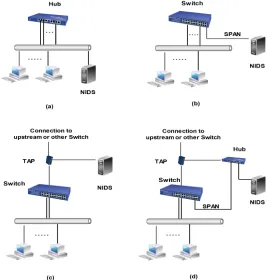
In non switched networks or hub networks, the traffic coming to one port is copied to all other ports. Thus, the network sensor device can be connected to any port on the hub (see Figure 2.1(a)). The sensor device is either a commodity computer or server that runs the intrusion detection software or a high performance device specially manufactured with highly integrated number of CPUs, large amount of memory, many network interfaces, and usually is designed to be high tolerant device and extensible.
Chapter 2. Intrusion Detection Systems (IDS) 12
splitting mechanism installed between the sensor device and the network. Any data pass through the TAP is passed to the sensor as well. Figure 2.1(c) shows this type of deployment where the sensor is monitoring inter-switch traffic or connection to the internet or intranet. As shown in Figure 2.1(d) we can use both TAP and SPAN to deploy NIDS. In this setup, we use one sensor but we could use two: one is connected to the TAP and one is connected to the SPAN port. If we use one sensor to monitor multi network segments then we would use a hub to connect these segments with the sensor.
[image:26.596.144.411.326.606.2]It is worth mentioning that the TAP implementation can not monitor intra-switch traffic. Hence, using the SPAN port for leaf nodes and the TAP for inter-switch trunks is a common practice. Regardless of how the sensor is implemented, it needs to pas-sively listen to all the traffic. This means that the network interface needs to work in promiscuous mode. In promiscuous mode, all the traffic that passes through the net-work interface are passed to the core machine. In non-promiscuous mode only the traffic addressed to the network interface is passed.
Figure 2.1: The NIDS Deployment Options. Figure 2.1(a) shows NIDS in non-switched networks, Figure 2.1(b) shows NIDS in non-switched networks using SPAN port, Figure 2.1(c) shows NIDS deployment using TAP, and Figure 2.1(d) shows NIDS
de-ployed using both SPAN and TAP.
Chapter 2. Intrusion Detection Systems (IDS) 13
the popular NIDSs can operate in this mode and prevent attacks. Later in Chapter 8, we will see how using inline mode is effective as virtual software patch.
In intrusion detection only systems the sensor is deployed in passive mode where no traffic is passed through the sensor, that is, only a copy of the real traffic is monitored. Later in Chapter 7, we will explain the experiment setup and we will see that it is actually equivalent to Figure 2.1(d), that is listening in passive mode to internal and external replayed traffics.
2.4
Popular Network Intrusion Detection Systems
In recent years, network based intrusion detection systems have attracted more attention due to the increasing use of internet. The data centric world needs security protection against cyber attacks. NIDS can provide this security measure as it can monitor network packets exchanged between computer systems. Popular NIDS that exist today can be classified into two categories: open source NIDS and commercial NIDS. The following subsections present detailed information about some of these NIDSs.
2.4.1 Open Sources NIDS
Open source NIDSs have been available for more than a decade ago. Snort [17] and Bro[50] are the oldest and most popular NIDSs known today [103]. In 1998, Snort was developed and released by Martin Roesch [87]. According to the Snort organization site, over 4 million downloads and more than 400,000 registered users show the wide popularity of Snort as a deployed IDS solution. Bro, was developed by Vern Pxson in 1999 [73] primarily as a research platform for intrusion detection and traffic analysis. It is not intended to be an “out of the box” solution. This means that Bro is not readily available to be deployed. It has no subscription service where you can download new attack signatures like what the Snort community provides. Research into Bro is ongoing and Vern Paxson continues to lead the project jointly with a core team of researchers and developers at the International Computer Science Institute in Berkeley, CA.
Another interesting open source NIDS is Suricata developed by the Open Information Security Foundation (OISF) [68]. OISF is a non-profit foundation part of and funded by the Department of U.S Homeland Security’s Directorate for Science and Technology, by the the Navy’s Space and Naval Warfare Systems Command, as well as by members from the industry. The Suricata Engine, as the authors describe, is:
Next Generation Intrusion Detection and Prevention Engine. This engine is not intended to just replace or emulate the existing tools in the industry, but will bring new ideas and technologies to the field.
Chapter 2. Intrusion Detection Systems (IDS) 14
Even though all of these systems are network based intrusion detection, they vary in their approach in monitoring and detecting intrusions, features, and capabilities. In the following sections, we will look into these NIDSs in more detail.
2.4.1.1 Snort IDS
Snort is an open source network intrusion detection and prevention system. It performs a packet level traffic monitoring and analysis. These packets are examined for matching attack signatures and for protocol anomaly. Snort has a powerful signature matching ability and an easy to code and expand signature system. It has a broad community which contributes by adding new rules (Snort refers to signatures as rules) and suggests improvements.
Snort can run in one of three operations mode available:
• Sniffer mode, which simply reads the packets and displays them in a continuous stream on the console.
• Packet Logger mode, which logs the packets to disk.
• Network Intrusion Detection System mode, which allows Snort to analyse network traffic for matching attack signatures or to detect protocol anomalies. If Snort deployed inline with the IDS mode, then prevention actions can be configured to be launched when an attack or an anomaly is detected.
The Snort architecture is modular and consists of a packet decoder, preprocessor, detec-tion engine, and output plug-ins. Snort does not have native sniffer and uses LIBPCAP1
to capture packets from the network interface device. The decoder upon receiving the raw data through LIBPCAP decodes the protocol packet elements at the data link, net-work, and then at the transport layers. These data packets are then stored in a data structure which is ready to be processed by the preprocessor and detection engine. The preprocessor consists of functions that can be called to make sure that packets are nor-mal or as it should be. When Snort is deployed in inline mode the nor-malformed packets can be configured to be dropped. The detection engine is the primary component of Snort. It builds attack signatures by parsing Snort rules. The detection engine matches the attack signatures with the packets it receives from the processor and the outcome or matched signatures are sent to the output plug-ins. There are many plug-ins that can be used for the output such as XML, CSV, or Database.
Another interesting feature of Snort is the Snort rules. Snort uses a simple description language that is easy to learn and use. The rules are divided into two logical sections, the rule header and the rule options. The rule header contains the rule’s action (e.g., alert, log, and drop), protocol, source and destination IP addresses and net masks, and the source and destination ports information. The rule option section contains
1
Chapter 2. Intrusion Detection Systems (IDS) 15
alert messages and information on which parts of the packet should be inspected (e.g., payload, flags, and headers) to determine if the rule action should be taken. Figure 2.2 shows an example with the two logical structures. In the example, the rule is:
alert tcp any any -> any 25 (msg:"SMTP expn root", flags:A+;
content: "expn root"; nocase; classtype:attempted-recon;)
Figure 2.2: An Example of snort Rule
In this example, the action is alert which means an alert will be generated when there is a match, the protocol where this rule applies to is tcp, the source ip is any, the source port is any, “->” is the direction of communication (i.e., from to), the des-tination ip is any, the destination port is 25, the msg is what to be printed when the alert is generated, A+ means the Acknowledgement tcp flag is set and optionally other flags, content specifies the packet payload data to match, and classtype is the internal classification used for this attack in Snort. More about the Snort rule syntax with some examples are given in Section 7.2. A full list of the rule options is in [17, 87].
2.4.1.2 Bro NIDS
Vern Paxson [73] described Bro as a standalone system for detecting network intruders in real time by passively monitoring a network link over which the intruder’s traffic transit. Bro has many interesting features as a NIDS. Like Snort, Bro can work on packet per packet base when detecting attacks. In fact, it has Snort compatibility support that can convert Snort signature into Bro signature. In addition, Bro maintains state information of the communication protocols and store them as a related records of events and can detect attacks over multiple packets.
Chapter 2. Intrusion Detection Systems (IDS) 16
global attempts: table[addr] of int &default=0;
global threshold = 50;
event connection_rejected(c: connection) # Whenever a connection is rejected
{
local source = c$orig_h; # Get source address of the connection
local n = ++attempts[source]; # Increase counter.
if ( n == threshold ) # Check for threshold.
NOTICE(Scanner, source); # If so, report.
}
Two global variables are defined: (attempts) is a table of IP addresses and (thresh-old) is assigned the value 50. The script increments the counter (attempts) whenever a connection rejected event occur. The connection rejected event occurs whenever a server rejects a TCP connection request from a client. When a connection is rejected, the (attempts) counter for that source address (orig h in the connection record (c)) is incremented by one and assigned to the local variable (n). If (n) is equal to 50 (the threshold) then the source will be reported through the NOTICE output facility of Bro. This example is simple and the policy script becomes more complicated when the num-ber of processed events increases. For each multiple packet attack a policy file must be written specifically.
2.4.1.3 Suricata IDS
Suricata is an open source NIDS that was officially released in July, 2010. The primary goal of OISF as they state is to remain at the leading edge of open source IDS/IPS development, community needs, and objectives.
The Suricata NIDS goal is to bring new technology to the IDS. The engine support multithread processing to benefit from the multiple cores and multiple CPUs systems that are becoming ubiquitous these days. Also, to achieve higher performance they use hardware acceleration. NVIDIA, a technology partner of Suricata, developed CUDA which is a parallel computation library that can be called to offload some computation to GPU (Graphic Processing Unit).
In terms of detection Suricata is a misuse based and protocol anomaly based IDS. The Snort rules are supported in Suricata and can be used as they are or they could be modified into Suricata optimized rule sets to take advantages of the Suricata engine. Protocol anomalies are provided with Suricata preprocessors and if it is deployed inline, then prevention functionality could be activated.
2.4.2 Commercial NIDS
Chapter 2. Intrusion Detection Systems (IDS) 17
Sensor from IBM Internet Security Systems is one of the popular NIDS software based system [38]. RealSecure monitors, detects intrusions, and can also prevents intrusions by blocking network packets. IBM also has an appliance based solution which is the IBM Security Network Intrusion Prevention System [36]. Another appliance based NIDS is the CISCO IOS Intrusion Prevention System [15]. This product can be installed on any of the CISCO IPS 4200 series which scales up to meet the business performance requirements. These IBM and CISCO products are signature based NIDSs that can detect known attacks and can prevent protocol anomaly based traffic. A more recent NIDS is Endace [26]. In 2007, Endace launched appliance based NIDS. It uses the Linux-based operating system and the open source Snort inspection engine. Beside its use for intrusion detection, Endace can be used for network forensics. It has analytic application that allows IT security professionals to understand and review what really happened on their networks. Endace appliance has 32 terabytes on board traffic buffer that enables back-in-time contextual analysis of events.
Enterasys Intrusion Prevention System (also known as Dragon IPS) is another NIDS from Enterasys Secure Networks [27]. Enterasys IPS is unique in its ability to be de-ployed as network based or host based IDS. Enterasys’ Distributed Intrusion Prevention (US Patent 7581249) and threat containment can block attackers at the source physi-cal port. Effective threat containment requires the removal of the attacker’s ability to continue the attack or to mount a new attack. The Enterasys Distributed IPS identifies a threat or security event, locates the exact physical source of the event, and mitigates the threat through the use of enforceable bandwidth rate limiting policies, quarantine policies, or other port level controls.
2.5
Summary
This chapter provided an overview of intrusion detection systems. There are two types of IDS: host based and network based. Host based IDS resides on a server or host and protect that host through using the audit files on that host and/or the traffic it receives from other systems. Network based IDS resides on the network and monitor packets for intrusion attempts.
Two main detection methods exist for intrusion detection. The first method is misuse based in which the attack signatures or patterns are known and the IDS system tries to match it. The second method is anomaly based in which the normal behaviour of the system is modelled and any deviation from this normal behaviour is raised as an alarm of possible attack. Both of these detection methods have techniques that have been used to devise IDS. A brief overview of these techniques was provided with some examples.
Chapter 2. Intrusion Detection Systems (IDS) 18
Finally, an overview is given about commonly used NIDS. An overview was given for the popular open source and free NIDSs (Snort, Bro, and Suricata) and some commercial NIDSs.
Chapter 3
Temporal Logic and Intrusion
Detection System
3.1
Why Temporal Logic?
Developing formal methods for specification and automatic verification of concurrent and real-time systems has been an active computer science research area. Verification techniques are concerned with showing that a system satisfies its specification. Some of those verification techniques allow checking whether an execution of a system under scrutiny satisfies or violates a given property.
Logical-based formal methods are commonly used in runtime verification techniques. The reasons are mainly because they provide unambiguous and concise ways to formally represent system specifications and provide the necessary mechanisms to reason about given properties. Temporal logic is the extension of classical logic with operators that deal with time which allows us to formally specify temporal events. In dealing with real-time systems quantitative temporal properties play a dominant role. Koymans [47] introduced the Metric Temporal Logic (MTL). In MTL, the qualitative temporal operators are turned into quantitative or metric temporal operators. This transformation from qualitative into quantitative is done in MTL by constraining the temporal operator with bounded or unbounded intervals. For instance, ♦[0,5]φmeans eventually φ will be
true within 0 to 5 seconds from now. This metric extension to temporal logic is very useful in relating event occurrences in real-time systems.
The next section shows how temporal logic can be used in intrusion detection systems and presents previous work using temporal logic for intrusion detection.
3.2
Related Work
In Chapter 2, two common approaches toward devising IDSs were explained: misuse based and anomaly based. In misuse based systems the attack patterns are monitored in the incoming traffic and an alarm is raised if an attack pattern detected. In anomaly based deviations from normal behaviour is monitored in the incoming traffic and an
Chapter 3. Temporal Logic 20
alarm is raised as a possible attack if a deviation from a specified normal behaviour is detected.
In intrusion detection systems, temporal logic is used to formally represent attack patterns or normal behaviour. The theoretical base of usingTLin misuse based detection can be viewed as checking whether a formula representing the signature of the attack is satisfied in a model M. These temporal models are created from a linear sequence of events (packets). So, typically, the idea in misuse based detection is to check that φ (an attack specification) holds inM (M |=φ). These signatures are the attack patterns that we need to match against network traffic and raise an alarm when detected. For anomaly based detection, normal protocol procedures or network behaviour are formally represented using temporal logic. A propertyφformally representing a normal procedure or a network behaviour is checked against the temporal modelsM that were created from the incoming network traffic. An alarm is raised ifφdoes not hold in M (M 6|=φ).
The following subsections present two related workMONID [62] andORCHIDS [69] that use temporal logic in network intrusion detection.
3.2.1 MONID
MONID [62] is a prototype tool based on Eagle [9]. Eagle is a runtime verification or runtime monitoring system that uses finite traces. The implemented finite trace monitoring logics inEagleinclude future and past time temporal logic, extended regular expressions, real-time logics, interval logics, forms of quantified temporal logics, and so on. Simply, it is an observer which monitors the execution of a program and checks its conformity with a requirements specification, often written in a temporal logic or as a state machine.
The safe behaviour specification of a system is continuously monitored by Eagle in a state-by-state basis, without storing the execution trace. An execution trace σ is a finite sequence of program states σ = s1s2...sn , where |σ| = n is the length of the
trace. A tracesi, wherei >1, satisfies a specification if each monitored formula for that
specification is satisfied from states1 up to statesi.
In Eagle, the specifications are written as rules. These rules are recursively parame-terized by both logical formulae and data values, over a set of three primitive modalities “next-time”, time”, and “concatenation”. The “next-time” and “previous-time” operators can be used for defining future time and past time temporal logic, respectively. The “concatenation” operator can be used to define interval logics and an extended regular expression language.
Chapter 3. Temporal Logic 21
be used to express security attacks with complex temporal event patterns, as well as attacks whose signatures are inherently statistical in nature. The authors also see that MONID can be used for simple type of anomaly based detection, that is, by specifying the normal behaviour of systems or networks as temporal formulae involving statistical predicates, and monitor the system execution to check if it violates these formulae. If the observed execution violates any formula then an alarm is raised. This alarm means that an intrusion has likely occurred.
The framework of MONID consists of three functions: information preprocessing, event monitoring, and reporting. The preprocessing function starts by gathering the information from various sources into a server. Then these gathered information are merged by timestamp to form a single event trace. Subsequently, this timestamped stream of events is monitored by the event monitoring function against a given specifi-cation and an intrusion alarm is raised by the reporting function when the specifispecifi-cation is violated.
The safety formula or monitored formula (M) uses data-values and parameterized recursive equations and it is typically specified in terms of maximal and minimal fixed points of interpretation as follows:
max: F =F∧ (F) min: ♦F =F∨ (♦F) mon: M =(max→min)
( = always,♦= eventually, = next)
One of the given example in [62] is the “cookie-stealing” attack. A cookie is a session-tracking mechanism issued by a web server to a client and store client session information. An attack occurs when a malicious user hijacks a session by reusing an old cookie issued to a different IP address. The formula below asserts that a particular cookie must always be used by the same IP address.
min: SafeUse(string c, int i) = ((name = c)→(ip = i))∧KSafeUse(c, i) mon: CookieSafe = Always(SafeUse(name, ip))
A Cookie-stealing attack is detected whenever the monitored formula CookieSafe is violated. SafeUse is a parametrized rule that corresponds to an event with name (cookie name) and IP address of the client. Notice here also the previous operatorJ
Chapter 3. Temporal Logic 22
defining the named rules and their interpretations as maximal or minimal and defining the monitoring named rule is not straight forward as these rules contains recursive equations. This would be clear if we try to define an attack signature with many steps. The more steps we have, the more complicated these rules become to code and follow.
MONID, as the authors explain, was mostly tested offline to detect attacks and to calculate the overhead of detecting attacks. They found the overhead is low and the authors concluded that this suggests MONID could be used as an online NIDS. No information about the volume of traffic during the experiments was given, and as far as we know the purpose ofMONID was not to detect attacks in high volume networks. Thus, it is hard to compare the experimental results to ours as we use online and multiple speed replays of the data (in Chapter 7).
3.2.2 ORCHIDS
ORCHIDS [69] is another intrusion detection system that uses temporal logic. This research project goal was to design and develop a prototype of an online IDS which is capable of analyzing and correlating events over time. ORCHIDS is specialized in the intrusion detection by scenario or sequence recognition. It provides a new correlation methods based on efficient model checking of temporal logic. Correlation is the process of recognizing event positions in time and the relations among them. ORCHIDS as described in [69] uses misuse based detection approach. Bad behaviour or attacks is specified in temporal logic and alerts are notified whenever a bad behaviour is detected. This is essentially a model checking problem against linear Kripke models which are formed from linear sequences of events.
In ORCHIDS, first order linear time temporal logic is extended with Wolper style LTL [79]. This is done to increase the expressiveness of the logic to describe properties of sequences that cannot be expressed in temporal logic. One example of properties that can not be expressed in classical LTL is event count. Another example is when expressing a given event that has to happen exactly every n steps. In general, Wolper style LTL allows the representation of properties that are expressible in language based on regular expressions.
Chapter 3. Temporal Logic 23
Temporal formulae are typically of the form:
F1∧♦(F2∧♦(F3. . .)∨F
0
2∧♦(F
0
3. . .))
where the temporal operator♦ is “there exist in the future”. The attack signatures are represented with formulae which are described internally in the system as automata. The ORCHIDS online algorithm matches these formulae against the logs and returns enumerated matches. ORCHIDS deals with finite traces and are constrained to only specify eventuality properties (a transition denotes either no time passes at all or “even-tually in the future”♦, and no next). This is because the model-checker needs to work on-line on some finite (and expanding over time) prefix of infinite sequence of events. The model checker is not allowed to make multiple passes over the flow of events. This means a product automaton cannot be rebuild each time a new event is added.
Similar to MONID, ORCHIDS testing was for the proof of concept and not for detecting attacks in high volume networks. The sequence recognition in ORCHIDS is equivalent to the pattern matching using the third syntactical form of the proposed method of specification in this thesis which is presented in Chapter 5. In that chapter, we explain the proposed Many Sorted First Order Metric Temporal Logic (MSFOMTL) syntax and semantics for representing temporal patterns of attacks or normal behaviour. The main differences between the system we described in this thesis as compared withMONID andORCHIDS is that the model checking problem (M |=φ) is reduced to the stream query evaluation, which is subsequently executed by high-performanceSDP engine. Also, in the proposed system, the way of using temporal logic takes advantage of its expressiveness and conciseness to allow the user to express attack signatures or normal specifications transparently and independently from the underlying technical implementations. In addition, using predefined syntactical forms for attacks, give the benefit of producing SSQL code that does not require retesting beyond the testing of the system that were carried following the development of the translator from these syntactical forms.
3.3
Summary
This chapter was about temporal logic and its use in representing attack patterns in IDS. The basic theoretical background of using temporal logic in intrusion detection systems was explained. Also, the use of temporal logic in two related work were presented and explained: ORCHIDS and MONID.
Chapter 4
Stream Data Processing (SDP)
The previous chapter presented information about the background of using temporal logic in intrusion detection system and the related work. In this chapter we present the stream processing technology which we make use of as the execution engine in our proposed solution. Section 4.1 presents an overview of the background, the main features of these systems, and the current systems. StreamBase is one such system which is used to develop the proposed NIDS in this thesis. StreamBase uses Stream SQL as the stream query language. An overview of Stream SQL language and its semantics are provided in Section 4.2. Section 4.3 presents the high performance features, scalability, and high availability of StreamBase. Finally, a summary for this chapter is provided in Section 4.4.
4.1
SDP Overview
Stream Data Processing is referred to in the literature with different names, such as, stream query processing [44], stream database manager [95], data flow database [10], data stream management system [7], complex event processing [92], etc. Regardless of the different names used, all these methods are concerned with handling and processing flows of data. The data stream can be defined as a sequence of events that arrive continuously in real-time. These sequence of events are ordered by their arrival time either implicitly or explicitly by a time stamp [31].
The fundamental difference between traditional database systems and Data Stream Management System (DSMS) is that the data takes the form of continuous data streams rather than finite stored data sets. This difference makes DSMSs suitable for data-intensive applications where the data model is transient data streams and not persistent relations. These applications could be the capital market, network traffic monitoring, telecommunication data management, and others. The difference between the DBMS and the DSMS with respect to time processing is that the DSMS are suitable for ap-plications that require real time processing. This is due to the reason that DSMS can work totally in main memory.
Chapter 4. Stream Data Processing 26
DSMS are designed to handle large volumes of data arriving in rapid, time-varying and continuous streams. They can handle queries that are issued once and then con-tinuously evaluated over the data (continuous queries). For example, “write an alert whenever price of X is less than 200”. Another useful feature is sliding window query processing. This sliding window can be based on an ordered field (e.g., time) or tuple count. With this feature, recently arrived data is maintained, meaning that old data must be removed as time goes on. It is an approximation technique for bounded mem-ory that we can use to extract a finite relation from an infinite stream and to compute online statistics. These features are well suited for applications like network monitoring, network traffic analysis, and intrusion detection. Multiplexing and demultiplexing are features that are provided by DSMSs and it is very useful for stream processing. de-multiplexing is the process of partitioning the stream into substreams based on the data in each record (tuple). Multiplexing is used to recombine substreams with the same data structure. Other useful features are aggregation, pattern matching, merging, and mapping the stream based on a value(s) in the data.
Using stream data processing become a programming paradigm in its own because of the natural requirements of processing ordered sets, that is data streams [44]. According to Parker et al. [44], it is advantageous to generalize the set foundation of relational data model to an ordered set model because ordered data can be processed more effi-ciently than unordered data. Other reasons related to high bandwidth traffic analysis are mentioned by Sullivan and Heybey [96] in their work of building Tribeca which is a database stream management system that deals with network traffic are as follows:
• Fast sequential access to network traffic data is crucial but unlike conventional relational database systems transactional updates, fast access to random records, and concurrency control access are not.
• Traffic data is used few (or once) and the load time is significantly costly.
• The traffic traces contain many small records with few bits size and this noticeably increase the database size.
• As network traffic is a sequence of time stamped protocol headers, processing streams require sequence and temporal DBMSs.
• It is necessary to run batches of queries over single pass over the data and these queries might use each other’s partial results when they run concurrently.
Chapter 4. Stream Data Processing 27
a general purpose model with algebraic operators to query sequence databases. In 1989, Parker et al. [44] developed a system that they named the Tangram. The Tangram was a stream processing system implemented as an extension to Prolog that integrates with the UNIX operating system and database managers. The Tangram Stream Processor (TSP) system is founded as abstraction to stream transducers. A transducer is the basic building blocks in TSP that map one or more input streams into one or more output streams. The transducers are maintained in an extensible library. For example, the selection transducer expression in TSP is defined as:
SELECT(S,T,C)
Where:
S: is a substream of terms.
T: is a template the S must unify (or match) with.
C: is the condition that terms in S must satisfy.
The sliding windows, reasoning about time and pattern matching were among the im-portant functionalities of this system. Between 1996 and 1998 Sullivan and Heybey [95, 96] introduced Tribeca. Tribeca was a special system for analysing network traffic. It only works for sequence data in contrast to SEQ that works for sequence and relational data. The stream processing and data management implemented in the same engine to have a tightly integrated running environment. This is something the authors see as advantageous over the Tangram system that has Prolog as a back end and DBMS as a front end. More recent work is STREAM [7]. STREAM is a prototype general-purpose DSMS supporting a large class of declarative continuous queries over streams and tradi-tional stored data set. The project started in 2002 and it was wound down in January 2006. To handle queries over streams, they developed the Continuous Query Language. Another interesting project was conducted by the Brandeis University, Brown Univer-sity, and Massachusetts Institute of Technology. They developed AURORA which is a general-purpose DSMS in 2003. In 2005, the AURORA project was superseded by the BOREALIS project. BOREALIS is a distributed multi-processor version of AURORA [1].
A recent research presented Reflex which is a programming model facilitating the construction of highly responsive Java applications [89]. Reflex is designed to make it easy to write and integrate simple periodic tasks or complex stream processors. Reflex tasks run in a part of memory free from garbage collection interference. These tasks are organized in a graph and communicate through uni-directional, non-blocking channels. To demonstrate the power and applicability of Reflexes on real world applications, Spring [89] implemented a prototype intrusion detection system.
Chapter 4. Stream Data Processing 28
Java based architectures such as Java Application Servers or Enterprise Service Bus. It can also be used as a standalone container in any existing standalone applications [28]. IEPSE (Intelligent Event Processor Service Engine) is another open source CEP and ESP engine [70] analogous to ESPER.
GIGASCOPE [18] is a proprietary DSMS and was developed by AT&T and it is currently used in many AT&T network sites. All commercial or non open source DSMS are proprietary, that is owned and controlled by a proprietor, but here we mean it is owned and controlled and used privately by the proprietor. GIGASCOPE is special purpose DSMS engine for detailed network applications including traffic analysis, intru-sion detection, router configuration analysis, network research, network monitoring, and performance monitoring and debugging. Johnson et al. [43] from AT&T research lab argued thatGIGASCOPE can serve as the foundation of the next NIDSs because of the functionality and performance. They presented some written examples to detect Denial of Service attacks.
Even though SDP early research started about 30 years ago, several commercial sys-tems only started to appear in the market a decade ago. Some of these syssys-tems started as academic research that have progressed to commercial products. At Cambridge uni-versityAPAMA was developed and then commercialized and was acquired by Progress Software [77]. CORAL8 is another commercial product that based on Stanford research. It has been recently acquired by Sybase Inc. [97]. It has been superseded by Sybase CEP which is a re-branded and updated version of theCORAL8 product. StreamBase was originally research conducted jointly by Brandeis University, Brown University, and Massachusetts Institute of Technology during the early 2000s [92]. Finally, there are also some other SDP products that are offered by large vendors. IBM acquired CEP pioneer AptSoft during 2008, renamed itWebSphere Business Events [37]. Oracle, thanks to its BEA acquisition, offers a product called ORACLE CEP.TIBCO product is a leader in the middleware CEP from TIBCO Software Incorporation. In 2008 they had a market share of 40% [99].
All of these systems provide similar SDP functionalities. Some of them might offer more than others and some might offer less than the others. The naming of functions or operators might differ from a system to another system because there is no standard for the stream SQL language. For instance in [96] the authors refer to partitioning the stream into substreams based on the data demultiplexing, whereas in [92] it is called filtering.