WEB SERVICE ARCHITECTURE FOR MOBILE COMPUTING Sangyoon Oh
Submitted to the faculty of the University Graduate School in partial fulfillment of the requirements
for the degree Doctor of Philosophy
in the Department of Computer Science, Indiana University
Accepted by the Graduate Faculty, Indiana University, in partial fulfillment of the requirements for the degree of Doctor of Philosophy.
Doctoral Committee
________________________________ Dr. Geoffrey C. Fox (Principal Advisor)
________________________________ Dr. Dennis Gannon
________________________________ Dr. Andrew Lumsdaine
________________________________ Dr. Sun Kim
© 2006 Sangyoon Oh
Acknowledgements
First and foremost, I am sincerely grateful to my advisor, Dr. Geoffrey C. Fox for his guidance and encouragement to this dissertation as well as my entire research career at Indiana University. With his keen insight and extensive experience, he helped me to focus on the important details. Working with him has been one of most rewarding experiences.
I am also very thankful to my other committee members. I would like to thank Dr. Andrew Lumsdaine for his valuable feedback and Dr. Sun Kim for his comments and suggestions. I am particularly thankful to Dr. Dennis Gannon for his constructive criticism on my research.
Many others at Bloomington provided much advice and help to my research. In particular, George Fletcher was deeply involved in many aspects of this research. He provided countless hours of discussion and counsel during my graduate student years. I would like to thank Harshawardhan Gadgil for his early comment on this research. I am grateful to others, including Beytullah Yildiz and Kwangmin Choi, who filled my life in Bloomington with the quality times.
I would like to thank staffs of Computer Science department, particularly Sherry Kay who helped me with all the paper work and Lucy Battersby who provided me all necessary information I need to know.
Abstract
The conventional Web Service communication framework does not adequately meet the needs of mobile computing. It is physically constrained and requires an optimized messaging scheme to prevent performance degradations in not only mobile computing, but also conventional computing that is interacting with mobile applications. With our novel architecture called the Handheld Flexible Representation (or HHFR), mobile applications can negotiate characteristics for message stream and representation, and exchange messages in an optimized streaming fashion. By distinguishing between message semantics and syntax, the architecture provides an overall system framework for Web Services applications in mobile computing environment. Despite its important role in distributed computing, mobile computing hasn’t reached its full potential because of the limited availability of high speed wireless connections, such as third generation cellular technology (3G) or Broadband Wireless access. In this dissertation, we show that the messaging scheme of our new architecture significantly speeds up the messaging performance in comparison to a conventional SOAP-based Web Service messaging scheme when the request and response messages are in the same syntax, i.e. the same service is used continuously.
Contents
List of Figures
1. Introduction and Motivation………...
1.1.Introduction: Web Service Technology and Mobile Computing……... 1.2.Motivation: Problems in Integrating Web Services with Mobile
Computing………...
1.3.Thesis Summary………...
1.4.Thesis Contributions………...
1.5.Thesis Roadmap………...
2. Background and Related Work………...
2.1.Lineage of XML Binary Representation………... 2.1.1. XML as a data interchange format………... 2.1.2. XML binary characterization working group………... 2.2.XML Alternatives: Self Contained or Not………... 2.2.1. Self contained approaches………... 2.2.2. Non self contained approaches………... 2.2.3. Processing headers………... 2.3.Compressing XML documents………... 2.4.Binary attachments………... 2.4.1. Binary data as a MIME attachment: MTOM………... 2.4.2. Wrapping binary data: DIME………... 2.4.3. Comparing binary XML with sending binary data over SOAP…...
3. Background on Mobile Devices………... 3.1.Mobile computing environment………...
3.1.1. Limited programming library………... 3.1.2. Network connection………... 3.2.Current Web Service supports in mobile computing………...
3.2.1. Overview………...
3.2.2. Offloading computation using Java Servlet API………... 3.2.3. kSOAP and J2ME Web Services………
4. The Handheld Flexible Representation Architecture……….……….
4.1.Design overview………
4.2.SOAP Infoset based data model and separation of representation………....
4.2.1. XML and SOAP Infoset……….
4.2.2. Binary representation of SOAP Message………
4.2.3. Simple_DFDL……….
4.3.Negotiation of characteristics……… 4.3.1. Supporting alternative representation of SOAP message…………... 4.3.2. Negotiating characteristics of stream……….
4.3.3. Negotiation stage……….
4.4.Message handling………...
4.4.1. Handler for SOAP Header Processing……… 4.4.2. Message Transformation process…….………...
4.4.3. View selection handler………
4.5.Context store………..
5. The Prototype Implementation of the HHFR Architecture……… 5.1.Prototype implementation overview………..
5.1.1. Implementing three key design issues……….... 5.1.2. Utilizing existing efforts: Apache Axis, kSOAP, and Information
Service of CGL (Fault tolerant High Performance Information
Service, FTHPIS)………
5.2.Negotiation Scheme………...
5.3.The Simple_DFDL: The DFDL-style Data Description Language………..
5.3.1. DFDL overview………..
5.3.2. Simple_DFDL ………
5.3.2.1. Structures and types of Simple_DFDL………... 5.3.2.2. Declarations of Simple_DFDL ………... 5.3.2.3. Data processing using Simple_DFDL ……… 5.3.3. Comparisons between Simple_DFDL and DFDL………..
5.4.Data streaming………...
5.4.1. High performance communication channel……… 5.4.2. Queuing in the sender thread………..
6. Prototype Evaluation and Discussion………
6.1.Benchmark applications……….
6.1.1. String concatenation service………... 6.1.2. Floating point number adding service………. 6.2.Performance cost analyze modeling……….. 6.3.Performance evaluation configuration………...
6.3.1. Connection setup……….
6.3.2. Measurement methodology……….
6.4.Observed performance measurements and performance analysis…………. 6.4.1. Observed measurements of the benchmark applications………
6.4.2. Performance analysis………..
6.5.HTTP Persistent connection in mobile computing environment…………...
6.6.Summary………
7. Optimizing Web Service Messaging Using a Context Store for Static Data. 7.1.Overview of WS-Context Service implementation of Community Grids
Lab (CGL)……….. 7.2.WS-Context service as a Context-store of the HHFR and its usage………..
7.3.Performance evaluation………. 7.3.1. Performance evaluation model………... 7.3.2. Evaluation configuration………. 7.3.3. Experiment 1: Context-store access time……… 7.3.4. Experiment 2: Evaluation of performance measurement of full
SOAP message and optimized message with Context-store usage….... 7.3.5. Experiment 3: Scalability of the Context-store………...
7.4.Discussion………...…...
8. Future Work………
8.1.SOAP message compression………..
8.2.Data description language………..
8.3.Filters……….
8.4.Multi-transport protocol supports for high performance channel…...……...
9. Conclusions……..………
Bibliography
121 122 125 125
127 130 131
134
134 136 137 138
139
List of Figures
Figure 2.1 Simple example of Fast Infoset indexing………...……... Figure 2.2 Simple example of XOP-SOAP message………...……... Figure 2.3 DIME fields……….………...……... Figure 2.4 Simple example of DIME message……….……...……... Figure 3.1 J2ME components and organization………...……... Figure 3.2 Computation Offloading scheme using proxy for mobile Web Service.... Figure 4.1 Illustrated overview of HHFR architecture….………...……... Figure 4.2 Possible message exchange between two WS-RM endpoints………... Figure 4.3 Relationship of different forms of SOAP messages and their defining context………..……... Figure 4.4 viewHandler: Selecting filters for optimized representation...……... Figure 4.5 Representation formatting and transforming representation…………... Figure 5.1 Simple overview of prototype implementation…………...……... Figure 5.2 Modified sequence diagram of negotiation stage……...……... Figure 5.3 Abstracted overview of DFDL architecture………...……... Figure 5.4 Simple_DFDL modules in HHFR prototype and their interactions... Figure 5.5 Simplified message writing process using streamer stub...……... Figure 5.6 High performance communication channel layer diagram of TCP
receptor………...……... Figure 6.1 Abstract comparison between the conventional Web Services and the using the HHFR in the benchmark testing………...……... Figure 6.2 Overviews of interactions between Web Services and clients in a SOAP test scenario……….………...……... Figure 6.3 Overviews of corresponding interactions between HHFR participants in a HHFR test scenario………...……... Figure 6.4 Abstract overview of the connection setup between Treo600 and service machine……….………...……... Figure 6.5 Total time to finish streams of the string concatenation application (2 strings per message)……… Figure 6.6 Total time to finish streams of the string concatenation application (4 strings per message)……… Figure 6.7 Total time to finish streams of the string concatenation application (8 strings per message)……… Figure 6.8 Total time to finish streams of the string concatenation application (16 strings per message)………. Figure 6.9 Total time to finish streams of the floats addition application
(2 floats per message)………. Figure 6.10 Total time to finish streams of the floats addition application
(4 floats per message)………. Figure 6.11 Total time to finish streams of the floats addition application
(8 floats per message)……….
Figure 6.12 Total time to finish streams of the floats addition application
(16 floats per message)………... Figure 7.1(a) getContext SOAP request message created using Axis...……... Figure 7.1(b) getContext SOAP request message created using kSOAP for the mobile WS-Context client………...……... Figure 7.2 Mobile and Conventional context service clients………...……... Figure 7.3 System parameters………...……... Figure 7.4 System parameters with time frame………...……... Figure 7.5 Set up for measuring context-store accessing overhead…...……... Figure 7.6 WS-RM message example for Context-store access measurement... Figure 7.7 Scenario for WS-Addressing example………...……... Figure 7.8 Sample SOAP message for WS-Addressing example……...……... Figure 7.9 Round trip time of optimized message exchange through the HHFR high performance channel compared with full message exchange…………... Figure 7.10 Total time to finish Context-store request message processing (i.e., Ttime-in-axis)………...
109 119
119 120 123 123 126 126 128 128
129
Chapter 1.
Introduction and Motivation
potential because of the limited availability of high speed wireless connections, such as third generation cellular technology (3G) or Broadband Wireless access. In this dissertation, we show that the messaging scheme of our new architecture significantly speeds up the messaging performance in comparison to a conventional SOAP-based Web Service messaging scheme when the request and response messages are in the same syntax, i.e. the same service is used continuously. We expect our research to grow in significance as the mobile infrastructure improves.
1
Introduction: Web Services technology and Mobile Computing
Web Services technology profoundly affected distributed computing after it first emerged a few years ago. Like its predecessors, such as the Common Request Broker Architecture (CORBA) [100], Remote Method Invocation (RMI) [101] and Distributed Component Object Model (DCOM) [102], Web Services’ primary goal is to inter-relate distributed functionalities. But unlike its predecessors, it achieves its goal in an elegant and technology-neutral manner; it provides well-defined interfaces for distributed functionalities, which are independent of the hardware platform, the operating system, and the programming language. So distributed functionalities, or services, which may be running on different hardware platforms, may be running in different operating systems, or may be written in different programming languages, can communicate through web Service interfaces.
information between services in heterogeneous computing environments without worrying about conversion problems. Naturally, there are many other Web Service specifications1. Two of them, which are based on XML, are Web Service Description Language (WSDL) [85] and Universal Description, Discovery and Integration (UDDI) [103]. WSDL defines a standard method of describing a Web Service and its capability, and UDDI defines XML-based-rules for publishing Web Service information. Because of its strong interoperability across diverse services in a distributed environment, Web Service-based Service Oriented Architecture (SOA) has become the backbone of Grid computing. The Open Grid Services Architecture (OGSA) [29] defines a standard Web Service environment for Grid computing.
Just as Web Services technology has become an industry standard way of connecting remote and heterogeneous resources, mobile devices have become a vital part of people’s everyday life. People use mobile devices anytime and anywhere, (e.g. cellular phones, PDA devices with either a cellular or a wireless local area network (WLAN) connection based on the IEEE 802.11 specifications [104], and hand held game consoles). In this dissertation, we define mobile devices to be those that are not only small size computing devices, but are also equipped with a wireless connection so that they can participate in some type of distributed computing. The number of cellular service subscribers has increased rapidly in the last 5 years2. As cellular phones become important devices, their usage is not limited to voice communication. People can also check Email and access the Internet with a cellular phone. In fact, cellular phones are so useful that fewer people are
1 We will use both specification and standard interchangeably throughout the dissertation. To be precise, a standard is a specification that has undergone a formal or de facto evaluation process.
wearing a wrist watch these days because they check the time with their cellular phone [138]. New models of cellular phone devices are capable of playing digital audio and video files, and they are also equipped with adequate memory space (e.g., 1GB secure digital memory) to store hundreds of music or video files. The features of the PlayStation Portable (PSP) [108] include ability to play movies3, and/or music, and it is not limited to gaming. PSP also supports IEEE802.11b [105] and IEEE802.11g [106] connections which allow the user to play a game with other players. Because of these improvements, Mark Weiser’s Ubiquitous computing will become viable with the proliferation of mobile devices [50].
Recently, the capability of mobile devices and wireless connection technology has increased dramatically. The performance of the mobile device is significantly enhanced by faster processors, larger installed memory, and enhanced user display. Meanwhile, the connection to a network has become easier through a widely available packet-switched 2.5G or 2.75G network as well as through third generation networks4, which are in an early developmental stage in US.
2
Motivation: Problems in integrating Web Services with Mobile
Computing
Web Services technology recognizes mobile computing as an area to which it should expand. Through integration, Web Services enables pervasive accessibility by allowing for user mobility as it overcomes the physical location constraints of conventional
3 Universal Media Disc (UMD) is used for playing movies, music, and games on PSP.
computing. However, mobile computing also requires a technology that connects mobile systems to a conventional distributed computing environment. Web Services may be the perfect candidate for such connection, since a strong interoperable capability is the key requirement of the technology. This will be important for its success when we consider the fact that the mobile computing environment is much heterogeneous in terms of hardware platform, operating system, and programming language. This, the integration of mobile computing with Web Services technology will give many advantages to both sides.
However, despite the fact that the condition of mobile computing has so much in improved recent years, applying current Web Service communication models to mobile computing may result in unacceptable performance overheads. This potential problem comes from two factors. First, the encoding and decoding of verbose XML-based SOAP messages consumes resources. Therefore Web Service participants, particularly mobile clients, may suffer from poor performance compared to other distributed computing approaches such as HTTP (Representational State Transfer: REST [109]), RMI or DCOM. Second, the performance and quality gap between wireless and wired communication will not close quickly.
3G has a limited deployment and currently does not reach most of the US non-Metropolitan areas 5 . Third, wireless connections using radio waves face more degradation factors like buildings and landmarks than wired connections. Such degradation results: a poor quality of service for wireless connections. Ultimately, both of these factors are decided by battery-life and the rate of power consumption: mobile devices depend on a battery to maintain operations. Since a faster processor and a faster connection usually require more power consumption than slower devices, they will shorten the device’s use time, which will lead not only to usage difficulties but also consumer resistance. This slows the deployment of 3G technology.
The problems created by encoding/decoding and slow wireless connections are the following: First, the message size will increase when data is converted into a textual format, which contains not only data, but also many descriptive tags. The size increase can be as high as an order of magnitudes, if the document structure is especially redundant (e.g., in the case of arrays). Even in a conventional computing environment, it is always good to have a small message. But in mobile computing, it is absolutely required because of the narrow bandwidth connection.
Secondly, encoding data into a SOAP message requires a text-conversion, where the
in-memory representation is converted into a textual format. The decoding process does the reverse work. If the data is non-textual, such as a floating point number, the conversion is very expensive in terms of performance overhead, which is especially significant for relatively low-powered mobile devices.
Finally, even though the Web Service specification is not limited to any specific transport protocol in its architecture, the Hyper Text Transfer Protocol (HTTP) protocol is currently the most popular transport protocol among mobile Web Service implementations. However, particularly in mobile computing it does not perform adequately to be used in some application domains, which need high performance communications. Because it is based on a request/response paradigm, sending a request in HTTP is tied to receiving a response. When the communication channel has a high latency, this request/response paradigm produces performance degradation.
3
Thesis Summary
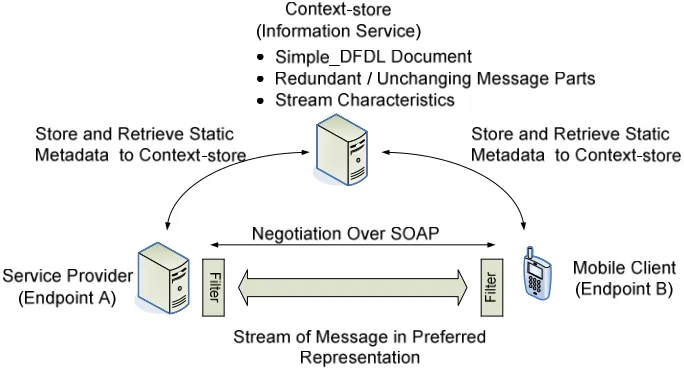
This dissertation proposes a novel architecture called the Handheld Flexible Representation (HHFR) 6 for efficient and optimized Web Service messaging performance in mobile computing. HHFR introduces a negotiation stage in order to set up a high performance communication channel. This distinguishes between message semantics and syntax to allow for a flexible representation of a message. In HHFR, a Web Service participant initiates a stream, which is a series of message exchanges using the same structure and type, by sending a SOAP request message to negotiate the characteristics of the following communicated messages with another participant. If the negotiation is successful, which means that the other participant agrees to use the HHFR scheme, the two participants or endpoints, exchange messages in a preferred representation. The preferred representation is the negotiated format of messages and it is not limited to SOAP-style, but rather supports many optimized formats. The message’s
semantic content is preserved while the syntax used to express the content is agreed upon in the negotiation stage, and the HHFR uses this negotiation to establish a message stream.
There are three key design points of the HHFR architecture, which make the message exchanges in HHFR efficient. Firstly, in the HHFR, applications exchange messages in a streaming style. The HHFR sets up a message stream between the participants based on the characteristics negotiated. The message exchange is then freed from “waiting for response” by adapting an asynchronous messaging style, and it can be implemented through various transport protocols such as the connection-oriented Transmission Control Protocol (TCP), the connectionless User Datagram Protocol (UDP), or HTTP with a persistent connection7.
Secondly, HHFR uses a Data Format Description Language (DFDL)8 [58]-style data description language, named the Simple_DFDL, to represent a message structure and type. The HHFR distinguishes between message semantics and syntax, and the syntax is represented in the Simple_DFDL.
Thirdly, in the HHFR, a Context-store module holds the static (within a particular stream) data of the messages: These include a) the unchanging or redundant SOAP message parts, b) the Simple_DFDL file as a data representation, and c) negotiated characteristics of a stream. By storing the message fragment or meta-data of the stream as context, the application can exchange slimmed down messages that contain only the vital part of the message content without losing the formal ability to be able to produce the
7 HTTP 1.1 specification defines the mechanism to send one or more (usually, between two and five) requests.
conventional SOAP message representation on demand. For the context-store we use the Fault Tolerant High Performance Information Service (FTHPIS) [110], which is WS-Context [95] compliant and was developed by the Community Grid Laboratory at Indiana University. Our architecture represents a novel use of this technology and presents interesting new performance measurements on FTHPIS.
In order to demonstrate the potential of HHFR, we focus on an application domain where two Web Service participant nodes exchange a series of messages. In this dissertation, we define this message series as a stream. For applications using a specific service, messages in the stream have the same structure and the same data type, if the client application links to the same service repeatedly. Applying our new approach to the stream yields many advantages in communication performance, such as the ability to use a flexible representation and to store meta-data in the Context-store. The overhead in setting up our approach is only incurred once per stream and amortized over the many messages potentially contained in a stream.
4
Thesis Contributions
This dissertation investigates significant research problems that emerge with the increasing need for a system level framework integrating Web Services technology and mobile computing with a broad, clean architecture rather than using various ad-hoc approaches. Those research problems include, but are not limited to:
• The verbosity of the XML-based SOAP message format causes performance degradation in Web Service message exchanges in mobile computing. This performance issue involves:
o The size of messages which increase after a SOAP serialization.
o Encoding and decoding includes the conversion between text to/from non-text format conversion
• A conventional Web Services communication channel does not adequately meet the need of mobile computing environments for the following reasons:
o A high latency wireless connection slows down overall message exchanges.
o The conventional Web Service transport, HTTP, ties sending a request message with receiving a response message.
These problems have been investigated by many researchers. As a result, there have been many systems proposed to solve them. However, to the best of our knowledge, none of these proposals or implementations tried to provide a system level solution rather than an ad-hoc solution for part of the problem.
The goal of this dissertation is to design a system-level architecture that can:
• Describe a representation or syntax of the message in a XML-based description language.
• Support a high-performance communication channel.
• Provide a mechanism to negotiate the characteristics of a stream, which is a series of message exchanges.
• Provide an interface to an Information Service to store the meta-data of stream.
In this dissertation, we present our investigations into the problems of Web Services and our design and implementation of the Handheld Flexible Representation (HHFR), which meet goals stated above. Therefore this dissertation makes the following contributions in the area of mobile computing:
The Handheld Flexible Representation Architecture and the prototype
implementation: the main contribution and focus of our dissertation is the HHFR architecture, which offers a system level comprehensive communication framework to Web Services applications in mobile computing environment. The architecture and its prototype implementation include the following contributions:
between two endpoints. We show that our approach can utilize the connection better than conventional methods. Once two endpoints agree on using second channel to exchange messages, they send and receive messages in streaming fashion.
• Defining the Simple_DFDL. The flexible representation can be achieved by separating the semantics of a message and its representation. We present a detailed discussion of the Simple_DFDL, which describes the data format for the HHFR prototype. We also present the structure of the Simple_DFDL, which is similar to that of DFDL: i.e., the Simple_DFDL language describes the data format, the Schema Processor builds the HHFR Data Model, and the stub converts data from and to a preferred representation.
• Proposing the Context-store to store the meta-data of a stream and implementing interfaces to the FTHPIS. We present our approach which saves the meta-data of a stream to reduce the size of the messages in the stream, and implements interfaces to the Information Service. Our empirical experimental results show significant performance savings by using this approach.
thousands of simultaneous streams in our approach to use Information Service as a Context-store.
List of recommendations for an ultimate solution: an additional contribution of this dissertation is our recommendation for an ultimate solution. We present a list of our recommendations uncovered through our studies and investigations.
The HHFR architecture can be used in many areas. For example, a Geographic Information System (GIS) client on a mobile device can benefit from our novel architecture. Assume that the client receives periodical GIS information, such as temperature and pressure, and that the gathered periodic information as a collection will generate a graph. Since conventional Web Service messaging supports only SOAP formats and a high latency and narrow bandwidth wireless connection is not sufficient for big data set, the client should have a framework, by which it can choose among various data format such as ASCII9, Geography Markup Language (GML) [111], and binary and thereby utilize the wireless connection better.
5
Thesis Roadmap
The rest of this dissertation is organized as follows.
In Chapter 2, we present background on the HHFR architecture, presenting previous, and on-going efforts which address the performance limitations of SOAP based Web Services technology. In Chapter 3, we give an overview of mobile computing and the
current status of mobile Web Services. This chapter explores the specific mobile computing problems, which are added to the existing problems of conventional distributed computing, and it also details the current Web Services strategies for mobile computing.
Chapter 4 describes our HHFR architecture in detail. The architecture proposed in Chapter 4 is an idealized solution and we discuss a prototype where practical considerations require some compromises in Chapter 5. The prototype is then subjected to several tests, which are analyzed to help clarify the key features of the full HHFR architecture.
Chapter 2.
Background and Related Work
In this chapter, we present background on the HHFR architecture, presenting previous, and on-going efforts, which address the performance limitations of SOAP based Web Services technology. Some of these efforts do not specifically target mobile computing environments, but they share similar research issues with mobile computing. As explained in the previous chapter, Web Services in a mobile computing environment face problems of performance-degradation similar to the conventional distributed computing environment. So a primary research issue in the mobile Web Service area is the attempt to provide an efficient message processing scheme while preserving XML’s interoperability.
different format (or representation) to XML. The messages in the different representation can be converted to and from the XML format, which is called roundtripping. For example, Fast Infoset (FI) from Sun Microsystems [61] [62] and XBIS [13], [72] by Dennis Sosnoski fall into this category.
On the other hand, the message stream approach optimizes a whole sequence of related messages, which we define as a stream10. This approach includes a certain form of negotiation to define stream characteristics, and optimized message representation in the stream. Examples of this category include Fast schema from Sun Microsystems [60] [141] and our own HHFR architecture [44].
Within this chapter, we will describe other related works as well whose goal is attaching binary data to SOAP message. Examples of this include are Message Transmission Optimization Mechanism (MTOM) [86], XML-binary Optimized Packaging (XOP) [87] and Direct Internet Message Encapsulation (DIME) [63].
We classify the 6 approaches described in Table 2.1.
Table 2.1 Categorized XML Optimization Efforts
Individual Message Approach (Self-Contained Message)
Stream of Messages Approach (Non Self-Contained Message) Fast Infoset of Sun Microsystems
XML Schema-Based Compression (XSBC) XML Infoset Encoding (XBIS)
ExtremeFastWS
Fast Web Service of Sun Microsystems Handheld Flexible Representation
1
Lineage of XML Binary Representation
The self-contained markup syntax of XML makes SOAP messages self-describing. Yet its syntax causes performance limitations (or degradation) in some computing domains. In this section, we describe previous work on Binary Representations for XML and SOAP.
1.1XML As A Data Interchange Format
XML has become a popular data format for interchanging information because it is self-describing and easy to implement. Since each data field11 of an interchanged message12 is individually described by its markup, they are individually understandable and can be modified independently of other data field. An application uses an engine, which is called parser in many cases, to process XML data. The parser can be a separate module and maintained independently. Consequently, applications whose data interchange format is XML can be loosely coupled to each other regardless of what platform they are running and in what programming language they are built.
Yet there are problems with XML in mobile computing. One reason is that the data size is larger after a transformation from binary format to text-based XML. Also XML document requires non-trivial amounts of processing time to parse, transform, and validate text-based markup syntax. Despite the performance degradation that exists when using XML, application developers and users in a conventional distributed computing domain are not very concerned, because their machines are powerful and have
11 i.e. Information Items defined by XML Information Set (Infoset) specification [82]
connections sufficiently fast. But mobile computing and real-time computing are not like conventional distributed computing in that regard. They are sensitive to the performance overhead. The processing overhead of XML and SOAP is amplified in the relatively low-powered and low-bandwidth mobile computing environment. In addition, real-time computing is much more sensitive to transmission latency due to the larger data and increased processing required.
As a result, there has been much discussion of, and effort put into, finding more efficient, but still XML-conformant representations.
1.2XML Binary Characterization Working Group
Binary XML is defined by the XML community as “A format that does not conform to the XML specification yet maintains a well-defined, useful relationship with XML.” [90] In other words, we can also define it as any format that has a filter13 and its inverse to conventional XML. Binary XML is quite common because there are many areas that need the binary XML specification when the verbosity of XML causes performance degradation.
The report of the W3C Workshop [89] on Binary Interchange of XML Information Item Sets (Infoset)14 [82] documents the increasing demands for binary XML. The report incorporates both the conclusions of the workshop, which met in September 2003, and several dozen position papers that were presented at the workshop [60] [64] [1]. The purpose of the workshop was to study methods of compressing XML documents and
transmitting pre-parsed and schema specific objects. The requirements of binary XML Infoset as identified at the workshop are the following:
1) It must maintain universal interoperability.
2) It should provide a generalized solution that is not limited to a specific application domain.
3) Processing time including data binding time should be reduced from original XML documents.
4) There should be a negotiation – if it fails and the receiver cannot understand the binary, it should fall back to the XML/SOAP text format.
The discussion led W3C to form the XML Binary Characterization Working Group (XBC WG) [112] for further research. In March 2005, a series of XBC WG notes were released, providing a formal definition of binary XML [57], its use cases [91], measurement methodologies [93], and properties [92]. The XML Binary Characterization note specifies the W3C recommended property requirements that must by supported by binary XML. The properties are:
• Transport independence: the binary XML format should be independent from the transport service in that it should be error-free and deliver the messages in order, regardless of the message length.
• Human Language Neutral: the format also should not impose more restrictions on one human language than another.
• Platform Neutrality: platform neutrality doesn’t require the format to perform identically on all computer platforms and architectures; rather it requires that binary XML not be defined around any platform specific parameters.
• Content Type Management15: Content Type Management means that the format should define its own media types, encodings, or both. The XML stack consists of validation, transformation, querying, APIs, canonicalization, signatures, encryption, and rendering.
• Integratable into the XML Stack: the format should easily find its place within the existing body of XML-related technologies.
In section 5 of the XBC Characterization note, three additional properties are mentioned that must be supported: Direct Readable and Writable16, Compactness, and Processing Efficiency. A scheme, which otherwise looks to be well composed, could violate one of the required properties, and so cannot be considered as a W3C endorsed binary XML. A popular example is GNU ZIP (GZIP) [76]. It preserves the byte-to-byte integrity of XML and provides a good compactness. Yet, its overall performance is poor when it is applied to a short document with non-redundant vocabulary since its processing time includes compression and decompression time as well as serialization and deserialization. Because of this long processing time, which violates the processing efficiency requirement, GZIP is not considered to be a W3C endorsed binary XML.
The imperative to speed up Web Services for small devices are well summarized in W3C’s “XML Binary Characterization Use Cases [91]” document. This document
describes situations where XML possesses potential overheads and defines these situations where devices have limited memory, limited processing power, and a limited battery life. These are critical factors for Web Services for small devices, and they are even more critical when they are connected to narrow bandwidth and high latency networks. As a result, this computing domain would have considerable benefits from a small packet and streaming processing scheme.
2
XML Alternatives: Self Contained or Not
Some systems or proposals do not satisfy all the requirements of the W3C XML Binary Characterization, but they can still provide good insights into the performance problem of XML and good designs to tackle it. To that end, we will discuss proposals for optimized XML messaging including those inconsistent with the W3C requirement. As discussed, we categorize the research into the optimization of XML message processing into two groups: the individual message approaches and the stream of messages approaches.
2.1 Self Contained Approaches
Most proposals that follow the XML Binary Characterization of the W3C have a goal of producing a self-contained alternative to an individual XML message, optimized for faster processing and smaller packet size.
Table 2.2 Encoding/Decoding Steps
document compression, but it focuses more on processing speed as opposed to reducing document size, which is the main concern of most compression schemes.
Message processing begins when an encoder transforms an XML document into an optimized format, i.e., a message in an optimized representation. In processing, an encoder traverses through an XML document. When it encounters a new string, the encoder adds the string to a table and gives it an index. If the string recurs, the encoder replaces the string with its index. The encoder continues replacing strings with indexes until it reaches the end of the document. Later a decoder transforms the optimized message back into an XML document. The decoder reverses encoding procedure, also using tables and indexes. Decoder adds a string to a table when it encounters the new one17. When it encounters an index, the decoder replaces the index with a corresponding string from the table. Positive integer values are used for indexing because this is a straightforward process and the size of positive integer value is small. Table 2.2 shows transforming steps by encoder and decoder. In addition to replacing strings, the
17 If the new string is accompanied with an index, the index puts into the table together with the string. See
Encoder Decoder
1. Add a newly encountered string to table.
2. Replace the string with index on the next occurrence.
3. Repeat 2 for all string occurrences until the end of the document
1. Add a newly encountered string to table.
2. On encountering an index, look up the corresponding string and substitute it. 3. Repeat 2 for all index occurrences until
compression may be applied to character information items to reduce their size, where an XML specific compression tool, such as XMill [31], can be used.
By preserving XML information items and properties, the individual message optimizing scheme produces a message format that is still self-contained yet can be converted back into the XML document format. This is the primary advantage of this approach; it produces an efficient and lightweight representation. But the conversion of the alternative representation back to the XML document has one significant limitation, the conversion of canonicalized information items. For example, there is no way to distinguish two different forms of empty elements in the inversion process, e.g. <e1/>
and <e1></e1>. It is because both of those empty elements are permitted as well-formed XML elements by the XML specification and yet each of the two elements has the same canonicalized form. So any XML application does not distinguish between those two different representations. So an empty element could easily be converted into representation, different from the original. Again, the normalizing white spaces of start and end tags, the relative and lexicographic order of namespace and attribute axes, and any replaced entity references may not be converted in the original element. The XML Infoset data model is not bound to the specific representation. So the XML Infoset based XML application extracts XML Infoset information from the XML document that is well formed by XML specification, but it would keep them in the preferred canonicalization format, which may differ from the original. The reverse-conversion18 could then produce a different representation from the original.
The encoding and decoding schemes do not need to address the reliability issue. Since an individually optimized message is self-contained, the approach is independent of the transport protocol, and it will not be affected by the characteristics of that protocol. Therefore, each message delivery depends on the transport protocol’s transmission control.
Fast Infoset
We will give a practical example of individual message optimization using the Fast Infoset specification of Sun Microsystems. Fast Infoset (FI) aims to provide an XML alternative in order to provide faster and more efficient Web Services in restricted computing environments. The specification was proposed at the W3C Workshop on Binary Interchange of XML information Item by Sun Microsystems and it was researched at the same company. Later they proposed it as a specification under Abstract Syntax Notation One (ASN.1) [78]. Fast Infoset uses an existing standard to achieve interoperability. The telecommunication industry standard, ASN.1 is a flexible notation that describes a data structure and type of message exchange by providing a set of formal and platform independent rules for describing data. The mapping XML Schema to ASN.1 is defined in the X.694 standard [99].
message processing performance; for instance, the primary feature is to replace redundant vocabularies. It uses predefined tables and references to an external vocabulary called an Initial Vocabulary. This idea exploits common entries in a SOAP envelope, many of which are already known before encoding in many cases. Using an initial vocabulary table allows the transformation process to avoid processing known entries dynamically. This means that processing time is significantly reduced.
FI has several features that contribute to faster processing and smaller message size when it produces a Fast Infoset document. Some of them are:
• Length-prefixing of content
• No end tag
• No escaping of character data
• Embedding of binary content
FI prefixes the context length for a decoder so that it can allocate resources accurately and possibly reject a content that exceeds the size limit. In addition to prefixed content length, FI removes the end tags from the document. The designers of FI claims that escape character checking is time consuming and they remove the step. FI allows binary data embedding in the document so that the conversions from and to base64 can be avoided.
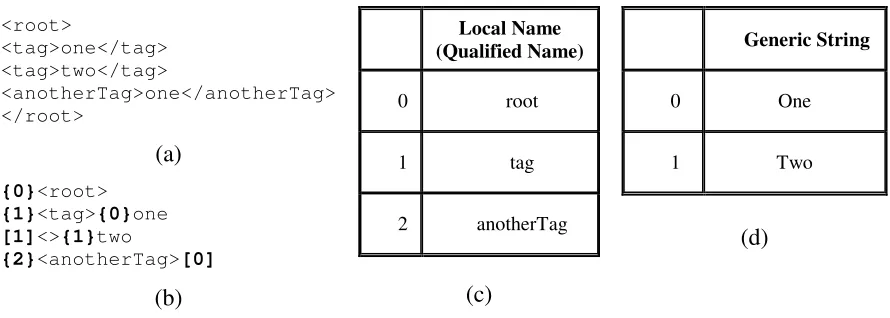
A curly bracket is used for an identifying string, i.e. a new string and a square bracket is used for a replaced string. Thus, “[1]<>{1}two” of 2.1(b) means that the qualified name “tag” is indexed as 1 in the qualified name table and an index of 1 is used for generic string “two”. The Fast Infoset document is encoded using ASN.1.
<root> <tag>one</tag> <tag>two</tag> <anotherTag>one</anotherTag> </root> (a) {0}<root>
{1}<tag>{0}one
[1]<>{1}two
{2}<anotherTag>[0] (b)
Local Name (Qualified Name)
0 root
1 tag
2 anotherTag
(c)
Generic String
0 One
1 Two
[image:39.612.102.547.210.369.2](d)
Figure 2.1. A Simple Example of Fast Infoset Indexing
XBIS and Cross Format Schema Protocol XFSP
Cross Format Schema Protocol (XFSP) [1] is another project that serializes XML documents based on a schema. Initially it was created to provide as a flexible definition of network protocols. It is written in Java and uses the DOM4J [113] model to parse the schema. Combined with XML Schema-based Compression (XSBC) [12], XFSP provides binary serialization and a parsing framework. Eric Serin and Don Brutzman of the Naval Postgraduate School designed and implemented XFSP, and are currently researching streaming X3D [23] documents in the XFSP framework. X3D is a XML-based open standard for three dimensional data.
2.2 Non Self-Contained Approaches
Another approach to improving Web Service performance uses a stream of messages. In this approach, messages are not self-described and are in an alternate representation.
The steps of this type of message processing are simpler than the steps in the individual message optimization approach, which needs to replace repetitive words (e.g. in this type of message processing does not require a data conversion to and from text format). But in order for it to work a customized encoder and decoder are required because the application processes a message that is not a general self-contained XML message, but rather it is an alternative format message. The encoder and the decoder must write and read the schema specific data equivalent to XML information items as it is defined in the XML Schema document. The application is not able to handle a message unless it follows the type and structure in the schema.
• Since an XML Schema document describes a structure and types, the application builds an encoder and decoder by parsing an XML Schema of the message. To use a different format for exchanging messages, the application simply parses a schema document in the new message format and generates the new encoder and decoder dynamically.
• When the schema of messages is fixed for the lifetime of the given application, the encoder and decoder in the application can be generated statically when it is compiled and deployed.
The stream of messages approach has obvious advantages and disadvantages. One of the advantages is the performance gained by avoiding a text conversion. Since the approach does not require text-based XML data format, the application is able to ship binary data directly without conversion. Also, the size of messages can be reduced by not requiring a descriptive markup for XML information items.
One of the disadvantages comes from the same reason: the messages are not self contained. The strength of XML messaging lies in the descriptiveness of the XML documents. In the processing of messages in the series of messages19, processing one message does not affect the processing of other messages. Because it separates data (i.e., semantics of the message) from its XML syntax, the representation of one message must be similar to other messages in the stream. So this approach does not allow any changes in the structure and types of messages in the stream.
Despite the disadvantage presented here, some application domains needing high-performance communication should be able to sacrifice the self-describing characteristic of an XML document.
Extreme! Lab’s Multiprotocol Approach Recommendation (ExtremeFastWS)
Extreme! Lab at Indiana University researches the limits of SOAP performance for scientific computing where large data sets, such as arrays, are common [35] [36]. Their experiments show major improvements by using a) a schema-specific parser mechanism for arrays, b) a persistent connection, and c) a streaming of messages to prevent full-serializing objects from determining length. The most serious overhead when exchanging large scientific data sets is the conversion from in-memory floating point numbers to a textual format. This research suggests that it is more beneficial for scientific applications to use multiple communication protocols including a binary representation and fast protocols other than SOAP. The problems faced here with conventional Web Services are similar to the ones in mobile computing. Both need to overcome the performance limitations of SOAP.
Fast Web Services from Sun Microsystems
Fast Web Services provides fast processing and low bandwidth usage by adopting the ASN.1 standard to XML schema. Additionally, since its data transformation is transparent to the application developer, the Web Service Definition Language (WSDL) and higher layer are unchanged in developing applications. But since the approach needs a tailored encoder and decoder – a stub and a skeleton for the schema specific data – it has a limited expandability.
Example: Data Format Description Language
The Data Format Description Language (DFDL) [58] from the Global Grid Forum (GGF) falls into the stream of messages category in a broad sense. DFDL defines both the structure and type of binary information using an XML Schema style language.
DFDL is a descriptive language that is proposed to describe a binary format file or stream for Grid computing. Like Extensible Scientific Interchange Language (XSIL) [59], it is XML-based and comes with an extensible Java data model. DFDL defines the structure and type of data. For example, it defines whether the data is big-endian or little-endian. It also defines complex data formats such as arrays. DFDL is designed to be processed through a DFDL parser.
2.3 Processing Headers
There are already over a dozen specifications that define SOAP header elements providing message routing, transactional semantics, message security, etc. SOAP 1.2 requires all top-level information item in the header to be namespace qualified. So the SOAP header becomes a consistent place to put messaging metadata that is guaranteed not to conflict with other metadata in the same SOAP message.
Despite the fact that there is no specific guideline in the SOAP specification about what information should be placed in the SOAP headers, the headers usually contain information that assists Web Services to communicate with each other in a secure and robust way. Examples include information for message exchange, security information, routing instructions, etc.
The handlers in the Axis [27] architecture which process the SOAP messages demonstrate how the system processes the headers. The handler is a module, which acts as a message interceptor, as it processes a part of a SOAP message. A target Web Service of the given SOAP message is considered to be one of the handlers, which is located at the end of the handler chain. A simple example of processing a header with handlers involves a WS-Addressing header, which could be encrypted. An addressing handler examines an address header in the SOAP message and then dispatches an appropriate service. If the header is encrypted, a security handler in the chain should be activated.
specifications. The conventional Web Service framework, e.g., Axis or the .NET framework of Microsoft [25], cannot understand the new alternative representation which differs from the SOAP format. For example, a ReliableMessaging handler in the system, which is defined by the WS-Reliable Message specification [96], cannot process a header in the alternative representation, e.g. the representation defined by the WS-Reliablility [114], because it does not recognize it as a SOAP header.
The WS-Security [97] case is more complicated. The WS-Security specification allows Web Service participants to encrypt individual elements rather than the whole SOAP message, and this makes the specification more flexible and efficient. At the same time, encrypting individual elements makes the Security handler hard to implement in an alternative representation other than SOAP because the representation doesn’t have the element syntax of XML specification.
To process the message in the alternative representation, the system, which is a Web Service container or a SOAP engine that understands it, would convert back to a SOAP message format and process the headers in a conventional method. The drawback of this method is the conversion overhead. Since the goal of the alternative representation includes high-performance processing of the message, converting back to the SOAP message format creates a huge redundant overhead to message processing. One way around this redundancy is to place a handler that understands the new alternative representation in the early phase of the handler-chain like a transport handler in the AXIS architecture and processes the header.
model – AXIOM. The AXIOM allows the Axis2 SOAP engine more freedom to process alternative representations flexibly since In-Pipe takes the incoming SOAP message and maps it into AXIOM object, which is XML Infoset based and doesn’t stick to the XML syntax.
3
Compressing XML Documents
The XML document optimizations described in the previous section could be considered compression schemes for XML documents. However, they are not ‘true compression schemes’ because the optimizations reduce the processing overhead as well as reduce the size of the document.
A self-contained and human-readable XML document may often be huge because of its text-encoding and descriptive tags. Due to this fact, extensive research has been done on compressing XML documents. The Results of this research can be applied to Web Services to improve performance in this setting.
many processor cycles, it doesn’t save time in most mobile computations. So while generic text-based compression works well where powerful machines communicate over a slow connection, like a modem connection, it doesn’t give much advantage in mobile computing environment with limited processing power and memory space.
Compared with generic compression, which yields poor performance on small messages, XML-specific compression e.g., XMill [31] and Millau [32] may do much better. XMill is a XML specific compressor based on a grouping strategy. It rearranges document text and groups text items together based on their semantics to achieve a better compression ratio. Start tags are assigned to integer values and end tags are replaced by a ‘/’. Dictionary encoding is used to assign the integers. After the rearrangement, text items in a group will have many similarities. Later, a conventional compression algorithm, such as gzip, is applied to a specific memory window, which includes multiple text groups. This algorithm then exploits the similarities between text items in a group.
Even though the XML specific compression achieves a better ratio between original size and compressed size (the experiment in Ref [31] shows it performs twice or better) and reduces the document size, the additional layer required compressing and decompressing add a significant overhead to the overall processing. Since the compression method saves bandwidth but does not reduce processing time, it can not serve as a full solution to the performance bottleneck in mobile Web Services.
4
Binary Attachments
overheads. Yet it is also important to consider the idea behind efficient binary data processing.
4.1 Binary Data as a MIME Attachment: MTOM
The W3C XML Protocol Working Group has released the draft of Message Transmission Optimization Mechanism (MTOM) [86], XML-binary Optimized Packaging (XOP) [87], and Resource Representation SOAP Header Block (RRSHB) [88]. Together these specifications target two data domains – multimedia data and data that includes digital signatures. Increasingly, multimedia data is exchanged using SOAP. Audio, graphic, and video files already have standardized formats, like JPEG, GIF, and MP3. They may be very large files, but they are efficiently encoded with specific algorithms. Encoding these multimedia files in SOAP would consume many extra processor cycles, which would be intolerable in some application domains. So the attachment of binary data is an important issue if Web Services technology is to be used pervasively in the multimedia data domain.
XOP is an alternative serialization to the W3C recommended XML [81]. XOP is a MIME-based package, allows binary data to be included along with an XML document, and avoids text-conversion overhead, though it still preserves the XML markup structure. MTOM describes how XOP is layered onto the SOAP and the HTTP transport.
The last specification, RRSHB, describes the semantics and serialization of a SOAP header block for carrying resource representations in SOAP messages. The
representation element is an information item that describes the type of Web
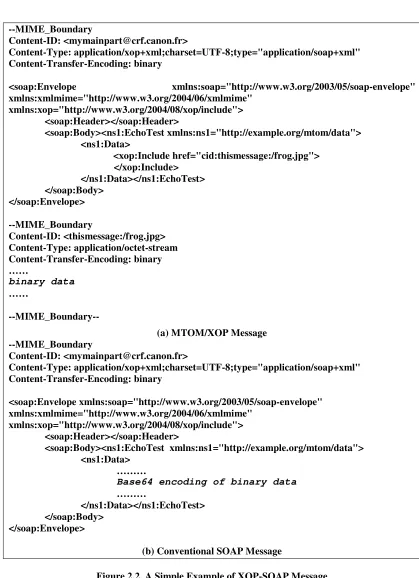
--MIME_Boundary
Content-ID: <[email protected]>
Content-Type: application/xop+xml;charset=UTF-8;type="application/soap+xml" Content-Transfer-Encoding: binary
<soap:Envelope xmlns:soap="http://www.w3.org/2003/05/soap-envelope" xmlns:xmlmime="http://www.w3.org/2004/06/xmlmime" xmlns:xop="http://www.w3.org/2004/08/xop/include"> <soap:Header></soap:Header> <soap:Body><ns1:EchoTest xmlns:ns1="http://example.org/mtom/data"> <ns1:Data> <xop:Include href="cid:thismessage:/frog.jpg"> </xop:Include> </ns1:Data></ns1:EchoTest> </soap:Body> </soap:Envelope> --MIME_Boundary Content-ID: <thismessage:/frog.jpg> Content-Type: application/octet-stream Content-Transfer-Encoding: binary …… binary data …… --MIME_Boundary--
(a) MTOM/XOP Message --MIME_Boundary Content-ID: <[email protected]> Content-Type: application/xop+xml;charset=UTF-8;type="application/soap+xml" Content-Transfer-Encoding: binary <soap:Envelope xmlns:soap="http://www.w3.org/2003/05/soap-envelope" xmlns:xmlmime="http://www.w3.org/2004/06/xmlmime" xmlns:xop="http://www.w3.org/2004/08/xop/include"> <soap:Header></soap:Header>
<soap:Body><ns1:EchoTest xmlns:ns1="http://example.org/mtom/data"> <ns1:Data>
………
Base64 encoding of binary data
………
</ns1:Data></ns1:EchoTest> </soap:Body>
</soap:Envelope>
[image:49.612.112.531.77.655.2](b) Conventional SOAP Message
mandatory child element, data, can have any number of character information items. The resource may be cached in a remote location, and the specification describeshow the SOAP message recipient accesses data that exists not in the SOAP message, but rather as a cached representation of external resources. Figure 2.2 shows a simple example of the MTOM/XOP message.
4.2 Wrapping Binary Data: DIME
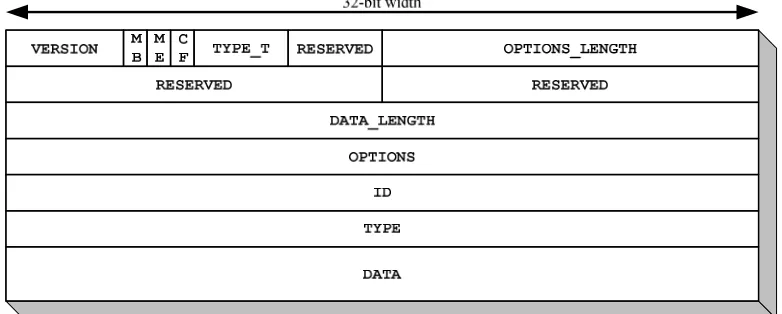
[image:50.612.124.515.524.681.2]Direct Internet Message Encapsulation (DIME) [63] is another approach to attaching binary data to a SOAP message. It has been developed and is supported by Microsoft. A DIME message header is pre-defined in binary (see Figure 2.3 for the fields in the header). A DIME parser needs to parse every message before receiving it and after sending it. It is a very different from attaching binary data to MTOM/XOP, which preserves SOAP encoding and appends MIME parts to the message for binary data. Conversely, DIME wraps a SOAP message with binary data by a predefined rule. An example of a DIME message from an article at Microsoft Developer Network Magazine is shown in Figure 2.4.
Figure 2.4. A Simple Example of DIME Message
4.3 Comparing binary XML with sending binary data over SOAP
Sending binary data with SOAP message, as described in the MTOM/XOP and the DIME approaches, allows sending binary data (so called opaque data) between Web Services without text-conversion. These methods can reduce much of the processing overhead that is caused by a direct text-encoding like base64. Especially, MTOM/XOP has become a popular option to send opaque data efficiently because it is simple to use 00001 1 0 0 0010 00000000000000000000
0000000000000000 0000000000101000 00000000000000000000000110110101 http://schemas.xmlsoap.org/soap/envelope <soap-env:Envelope xmlns:soap-env="http://schemas.xmlsoap.org/soap/envelope/" xmlns:msg="http://example.com/DimeExample/Messages/" xmlns:ref= "http://schemas.xmlsoap.org/ws/2002/04/reference/"> <soap-env:Body> <msg:GetMediaFile> <msg:fileName>myMediaFile.mpg </msg:fileName> <msg:file ref:location= "uuid:F2DA3C9C-74D3-4A46-B925-B150D62D9483" /> </msg:GetMediaFile> </soap-env:Body> </soap-env:Envelope> --- 00001 0 0 1 0001 00000000000000000000
0000000000101001 0000000000001010 00000000000101011010101011100000
uuid:F2DA3C9C-74D3-4A46-B925-B150D62D9483 video/mpeg
<<First 1.42 MB of binary data for myMediaFile.mpg>>
--- 00001 0 1 0 0000 00000000000000000000
0000000000000000 0000000000000000 00000000000010000110110001000000
However if the desired data is not in a fixed format, the above approaches cannot be applied directly. For example, arrays in a binary format or any user defined structure need additional mechanisms so that all participants agree on the structures of data that are exchanged. Accordingly, the HHFR covers the larger data domains rather than the MTOM/XOP and the DIME. The HHFR cover, the more general user defined data structure by negotiating it.
5
Summary
Conventional XML processing imposes a performance overhead, and mobile Web Services are particularly sensitive to this overhead. There have been many attempts to develop a binary representation of XML, and many attempts to build efficient mobile Web Services. In this lineage, XMill provides an efficient way to compress XML documents, while Fast Infoset from Sun Microsystems combines efficient XML processing with mobile Web Services.
Chapter 3.
Background on Mobile Devices
The mobile computing environment adds fundamentally new problems (e.g. intermittent connection, address migration, and low power) to the existing problems of conventional distributed computing. In this chapter, we overview mobile computing and the current status of mobile Web Services.
1
Mobile Computing Environment
constraints on mobile computing including low bandwidth communication and limited processing memory. Therefore, the programming library is typically not as capable as in conventional computing.
1.1 Limited Programming Library
Generally, mobile devices are equipped with small memories. Smart-phones typically have less than 64MB of non-volatile memory. A tiny footprint is still the most important requirement for the programming library and an application program on a mobile device, even though Secure Digital (SD) flash cards could add a gigabyte or more memory space.
Because of this code size issue and the limited instructions of native operating systems in mobile devices, like PalmOS [17], Symbian [18], and WindowsCE [19], the wireless programming environment is not as rich as a typical wired environment. The Java Platform suffers just these from the same limitations. Java for small and wireless devices – Java 2 Platform, Micro Edition (J2ME) [8] – provides far fewer library packages than the Standard Edition (J2SE) [9].
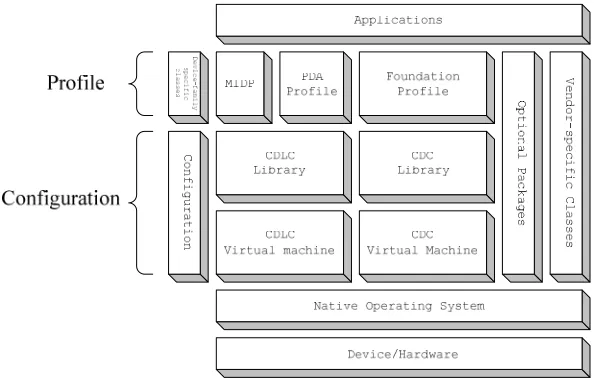
total of 192KB and includes the tiny K Virtual Machine (KVM) instead of a conventional Java virtual machine. The core library of CLDC is a subset of the standard core Java language package. It introduces a javax.microedition.io package to support network access. In the package, a large part of J2SE capabilities is removed from java.io and java.net packages. Above here CDC requires 4.5MB memory and includes many more core J2SE classes. In summary, CDC includes more libraries than CLDC, but requires more memory space than CLDC.
[image:55.612.176.475.74.263.2]The other important feature of J2ME is the profile. It provides classes for specific uses like maintaining and updating persistent data in a local device or providing user and networking interfaces. There are five profile standards in the J2ME. Among them, the Mobile Information Device Profile (MIDP) is the most popular and most deployed profile based on the CLDC. Combined with the CLDC, MIDP supports the smallest and most constrained devices currently available. The combination provides a smaller package than other profile and configuration combinations. For example, it only supports a limited
packages like javax.swing and java.awt are not supported. In addition, other features, like math, input/output, and Java Native Interface (JNI), are not supported with this combination.
Earlier, we describe mobile programming libraries focused on Java technology. Similarly, other languages for mobile platforms, like C# [10] and Visual Basic [11], are also limited compared to conventional desktop computing environment.
1.2 NetworkConnection