International Journal of Innovative Technology and Exploring Engineering (IJITEE) ISSN: 2278-3075, Volume-8 Issue-12, October 2019
Abstract: PetriNet is an imperative and handy language used for modeling and analysis of discrete event system (DES) i.e. a dynamic system that progress according to unexpected occurrence of events at probably unknown, asymmetrical interval of time. This concept provides an interface for analysis of behavioral and structural properties like liveness, boundedness and cover-ability tree of discrete event systems. These properties are not only necessary for proving the correctness of system model but also helpful in checking the deadlock conditions in a system. As a graph Petri Net is used for modeling and mathematically, it can be used for analysis of the system. In this paper, we have first modeled various DES like computation model and communication model using Petri Nets and then analyzed their properties using MATLAB. These DES models have applications in almost every domain of science and engineering.
Keywords: Petri Net, DES, PN Toolbox.
I. INTRODUCTION
A Petri Net (PN) is a weighted, directed, two-part multigraph. It is a graphical and mathematical modeling tool used for defining and analyzing the behavior of a system. Being a graphical tool, it has the capabilities of a flowchart, block diagram while being a mathematical tool it is possible to derive state equations or algebraic equations as required. Petri nets were first introduced for representation of chemical equations in 1962 by Carl Adam Petri in his dissertation [1].
A Discrete Event System (DES) is a dynamic system that progresses according to the unexpected occurrence of events at probably unknown asymmetrical intervals of time. We can have such systems arising in different conditions ranging from operating systems of a computer to the control of complex processes. DES has a large impact on research and was created on an interdisciplinary context. It is connected to several areas of mathematics, among which the most consistent contributions were brought by automata and formal languages, queuing systems, Petri net and algebraic theory of synchronization. Other tools for DES used earlier are Automata and formal language models. Petri Net is efficiently used for deadlock prevention [7] in system and for fault identification in DES [9].
Petri net: A Petri Net i.e. place/transition net or P/T net
Revised Manuscript Received on October 05, 2019.
* Correspondence Author
Sonal Dahiya*, Department of Electronics and Communication Engineering, Amity School of Engineering and Technology, Amity University Haryana, Gurgaon, India. Email: [email protected]
Dr. Sunita Kumavat, Department of Applied Mathematics, Amity School of Applied Sciences, Amity University Haryana, Gurgaon, India. Email: [email protected]
Dr. Priti Singh, Department of Electronics and Communication Engineering, Amity School of Engineering and Technology, Amity University Haryana, Gurgaon, India. Email: [email protected].
consists of places, which represent all possible states of a system and transitions, which represent actions required to change states, and arcs. Arcs run from either a place to a transition or transition to place and never run from place to place or transition to transition. Input places are the places from which an arc goes to a transition while output places are places to which arc runs from a transition.
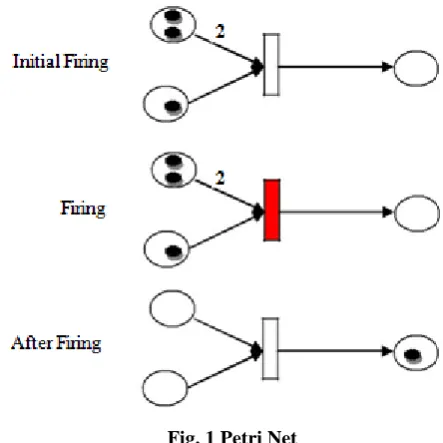
[image:1.595.316.538.442.664.2]In the Petri Net representation of a system, circle denotes a place while box or bar denotes a transition and an arc is denoted by a line with directions. Another significant part of a PN is token. Tokens are allocated to places and are represented by black solid dots and represent change of state with the help of movement from one place to another. Firing of a transition represents occurrence of an event but is dependent upon availability of sufficient tokens at all input places. A transition consumes the tokens from input places equal in number to its associated weights sum of its input arcs and puts the token to the output places equal in number to its associated weights sum of its output arcs. So, tokens initially in places should be grater or equal to its associated output arcs for firing the corresponding output transitions [2]. See Fig. 1 for the process of Petri Net.
Fig. 1 Petri Net Definition 1. A Net is a triple N= (P, T, F) where,
P and T are disjoint finite sets of places and transitions, respectively. F⊂ (P×T) ∪ (T×P) denotes set of arcs i.e. flow relations, either from place to transition or transition to place.
Petri Net Based Modeling and Property Analysis
of Distributed Discrete Event System
Definition 2. A place-transition net (PT-Net) is a 5 tuple PN = (P, T, F, W, M0), where,
P is the set of places; T is the set of transitions; such that, P T and P T = ;
F (P T) (T P) is the set of arcs and W: F {1, 2 ...} is the weight function and M0: P {1, 2, 3…} is initial marking.
We ignore unity weight generally in model representation, See Fig. 1 for model description.
In a PN, an initial marking is a function which decides how to distribute tokens to the places initially. Here M0 (p) is a
non-negative integer number which is associated with place p and it represents the number of tokens in place p at initial marking M0. M0 (p) is <= to the capacity k of the place p,
where capacity of the place is defined as the maximum number of tokens which can be accommodated in place at any reachable marking M from M0. A marking M0 is said to be
reachable to M, if there is a firing sequence σ = {t1, t2,…,tn}
such that M can be obtained from M0 after firing of transitions
t1, t2,…, tn.
The execution of Petri nets cannot be determined until we have a predefined execution policy. Multiple transitions can be enabled at same point of time and any one out of them can fire because tokens can be present at more than one place at the same time so, Petri Nets are suitable for modeling concurrent, synchronous, distributed, parallel and even nondeterministic systems [2, 10].
II. PROPERTIES OF PETRI NETS
A Petri net is model of a system supports the analysis of properties and difficulties related with discrete event systems. The properties which can be studied with the help of PN model of a system are briefly discussed in this section. A. Structural properties
Structural properties of PNs depend only on their topology and are independent of the initial marking. In [1] necessary and sufficient conditions for structural boundedness, conservativeness, repetitiveness and consistency of a PN are provided. A brief overview is presented in this paper.
Boundedness: A Petri Net is said to be k bounded or simply bounded if the number of tokens in each place are not more than k for any marking which is reachable from M0i.e.for initial marking, where k is an integer value. Also,
a PN is structurally bounded if it is bounded for any finite initial marking.
Conservativeness: A Petri net PN is conservative if there exists an-vector of positive Integers y ∈Zn y>0 such that for
every initial marking M0 and for every marking M which is
reachable from M0 the relation
MTy = M0Ty=a constant is true.
In case that equality holds for an n-vector of integers y ∈ Z n, y>≠0, then the net is said to be
partially conservative.
Repetitiveness: A Petri net PN is called repetitive if there is an initial marking M0 and a firing sequence S such that
every transition occurs infinitely often in S. Also, if there is an initial marking M0 and a firing sequence Sin a way, some
transitions (not all) occur infinitely often in S, the Net is said to be partially repetitive.
Consistency: A Petri net PN is considered consistent if there is an initial marking M0 and a firing sequence S fromM0 back to M0 such that every transition occurs at least
once in S. The Net is called partially consistent, if there exists an initial marking M0 and a firing sequence S from M0 back to M0 such that some transitions (not all) occur at least once in S.
B. Behavioral properties
The properties depending upon initial marking are called Behavioral properties.
Reachability : If for a given PN with M0as initial marking
and Mr any other marking then, Mr is known as reachable
from M0 if and only if there exists a firing sequence which
brings the net from M0 to Mr. Thus, reachability set can be
defined as the set of all reachable markings fromM0 and is
represented by R(M0). It is worth mentioning here that reachability set is defined for a particular initial marking and will change with any change in initial marking. The dependency implies that reachability is a behavioral
property. If Mr is reached from M0 by firing a single transition, then Mr is said to be immediately reachable from M0.
Liveness: Mathematically, a PN is called Live with respect to an initial marking M0 if it is possible to fire all the transitions at least once by some firing sequence where every marking belongs to the reachability set [1].
III. MODELLING & ANALYSIS OF DES PN toolbox in MATLAB can be used to model and investigate a large number of systems modeled by PN. The Petri Net Toolbox (PN Toolbox) is a software tool for simulation, analysis and design of discrete event systems, based on Petri net (PN) models. This software is inserted as a toolbox in the MATLAB environment and to use it MATLAB version 6.1 or higher is required.
Although there are many software tools like Great SPN, J Petri Net, Petri.NET Simulator, QPME etc. for analysis and simulation of PN models [3] but PN Toolbox has its own efficacies. PN toolbox can operate with infinite-capacity places, since MATLAB has the built-in function Inf, which returns the IEEE arithmetic representation for positive infinity whereas in other PN software, places are meant for having finite capacity (as the arithmetic representation used by the computational environment). The integration of MATLAB and PN Toolbox has broadened the utilization domain [8].
Untimed, transition timed, place-timed, stochastic and generalized stochastic are five types of PN models which are accepted in current version of the PN Toolbox. Where timed nets can be stochastic or deterministic and the stochastic case allows use of suitable distribution function.
This Toolbox in MATLAB has a user-friendly Graphical User Interface which not only has the ability to draw, save, access all types of drawings but also allows us to simulate, analyze various PN models with the help of computational facilities provided by environment.
A lot of information can be collected by user about the Petri Nets after drawing a PN model. It can do the analysis net topology and can give us the Incidence Matrix for the model. By using information about initial marking, it can automatically draw the cover-ability tree and therefore can easily analyze the behavioral
International Journal of Innovative Technology and Exploring Engineering (IJITEE) ISSN: 2278-3075, Volume-8 Issue-12, October 2019
It can even explore structural properties like, structural boundedness, conservativeness; consistency etc., The P invariants and T invariants of the model can be calculated. Scope and Diary facilities can be used to view simulation results. User can even calculate performance indices like average marking, firing delay etc. A max plus analysis which shows the events in graphical form can also be done. [4]
Although initially intended just for internal usage, numerous improvements have been done to previous models [5, 6] and the current version of the PN Toolbox can be used to model variety of systems as per the facilities. The Toolbox is appropriate for modeling theoretical as well as industrials processes like event driven systems, communication protocols, processors etc.
Various properties and analysis methods for Petri Nets are studied in this paper with the help of two different models.
A. Model 1(Data computation Model)
Consider the expression
[image:3.595.306.550.48.172.2]The Petri net model for this can be constructed as shown Fig. 2.
Fig. 2 PN Model for data computation Model The properties of this model can be studied using PN Toolbox as discussed below.
The incidence matrix can be calculated as given below in Fig. 3. Once we have the incidence matrix, we can use it for further mathematical analysis of the system.
[image:3.595.303.555.225.416.2]Fig. 3 Incidence Matrix for Model in Fig 2 The PN model is live that means every transition is fired at least once and every state is significant in our model as shown in Fig. 4.
Fig. 4 Liveness of Model
The cover-ability tree can also be constructed using PN Toolbox as show below in Fig. 5. Therefore, we can analyze how we move from one state to another.
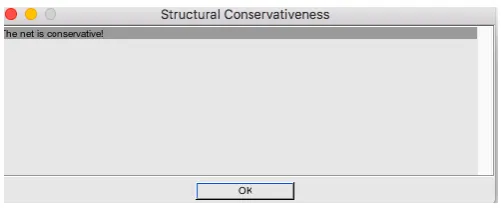
[image:3.595.48.286.266.465.2]Fig. 5 Coverability Tree for model We can see that the model is structurally conservative in respect to number of tokens i.e no tokens are consumed during the process as shown below in Fig. 6.
Fig. 6 Conservativeness of Model
B. Model 2(Distributed sensor network Model)
Consider a distributed sensor network shown in Figure 7. This model represents base station node BS1 as resource place (r11), sensor nodes as location places (PL1, PL2) and
channel between two nodes as channel places (PC1, PC2). Two
types of transitions are used. tS (ts1, ts2) are sending message
transitions while tr (tr1, tr2) are receiving message transitions.
[image:3.595.303.554.477.589.2]Fig. 7 Distributed Sensor Network Model The PN Model for above network can be constructed as shown below in Fig. 8.
Fig. 8 PN Model for Distributed Sensor Network The incidence matrix for further mathematical analyses can be calculated as shown below in Fig. 9.
Fig. 9 Incidence matrix
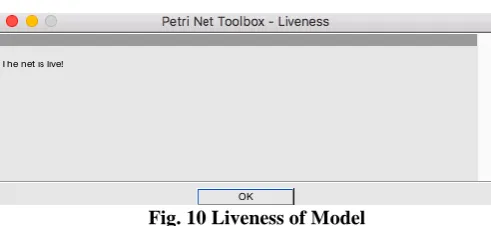
The model is found to be live that means each transition is fired at least once and therefore, each state is significant in this model, as shown in Fig. 10.
Fig. 10 Liveness of Model
[image:4.595.50.289.199.322.2]The cover-ability tree explaining the movement from one state to another can be made in graphic mode using PN Toolbox as shown in Fig. 11.
Fig. 11 Cover-ability Tree for model
As can be seen below in Fig. 12 and 13 the model is not only conservative but also consistent i.e no tokens are consumed during the process.
Fig. 12 Conservativeness of Model
Fig. 13 Consistency of Model
The property analysis of both the systems can be summarized in a tabular form as shown below in Table-I
Table- I: Summary of Property Analysis of Models Properties Data
Computation Model
Distributed Sensor Network Model
Incidence Matrix Constructed Constructed
Coverability Tree Drawn Drawn
Liveness Yes Yes
Consistency Yes Yes
Conservativeness Yes Yes
IV. CONCLUSION
[image:4.595.310.563.309.485.2] [image:4.595.315.540.560.706.2] [image:4.595.47.293.581.694.2]International Journal of Innovative Technology and Exploring Engineering (IJITEE) ISSN: 2278-3075, Volume-8 Issue-12, October 2019
In last decade, the Petri net theory is used very frequently in technical scenarios because of its efficacy in analysis of various systems.
In this paper modeling and property analysis of two DES i.e a data computation system and a distributed sensor network system is represented and standard properties like boundedness, liveness, conservativeness, repetitiveness and consistency are studied which shows that system model is working and there is no deadlock conditions. The cover-ability tree has been drawn and incidence matrix has also formulated for further analysis of the system behavior.
REFERENCES
1. T. Murata, “Petri Nets: Properties, Analysis and Applications”, Proc. Of the IEEE, vol.77, pp541-580, 1982.
2. Sunita Kumawat, “Weighted Directed Graph: A Petri Net based method of extraction of closed weighted directed euler trail” International Journal of Services, Economics and management, vol. 4, Iss. 3, pp252-264, ISSN: 1753-0830, 2013.
3. Thong Weng Jie and Mohamed Ariff bin Ameedeen, “A Survey of Petri Net Tools”, ARPN Journal of Engineering and Applied Sciences, vol.9 Iss.8, pp1209-1214, 2014.
4. Pastravanu, O. M. Matcovschi, C. Mahulea,“Petri Net Toolbox – teaching discrete event systems under Matlab”Advances in Automatic Control, pp.257-270, 2004.
5. C. Mahulea, L. Bârsan and O. Pastravanu, “Matlab Tools for Petri-Net- Based Approaches to Flexible Manufacturing Systems”, 9th IFAC Symposium on Large Scale Systems, Bucharest, Romania, pp. 184-189, 2001.
6. M.H. Matcovschi, C. Mahulea, and O. Pastravanu, “Exploring Structural Properties of Petri Nets in MATLAB”, 7th international Symposium on Automatic Conrol and Computer Science, Iasi, Romani, 2001.
7. Sunita Kumawat, G N Purohit, “Total span of farm work flow using Petri Net with resource sharing”, International journal of business process integration and Management, vol.8Iss.3, pp160-171, 2017
8. K.H. Mortensen, Petri Nets Tools and Software, http://www.daimi.au.dk/PetriNets/tools, 2003.
9. Guanghui Zhu, Zhiwu Li, Naiqiwu, model base fault identification of discrete event systems using partially observed Petri Nets, Automatica, vol96, pp 201-212, 2018.
10. Victor Khomenko, Olivier H Roux, “Application and theory of Petri Net and Concurrency” Proc. Of 39thInernational conference, PETRI NETS 2018, Bratislava, Slovakia, June 24-29, 2018
AUTHORS PROFILE
SONAL DAHIYA (corresponding author) received her BTech. from MDU, Rohtak in 2006 and M.Tech from Banasthali University, Rajasthan in 2018. Currently, she is pursuing P.hD from Amity University Haryana. Her research interests include Wireless Communication, Petri Nets and VLSI. She has contributed 14 research papers in journals and international conferences.
SUNITA KUMAWAT obtained her P.hD in Mathematics from Banasthali University Rajasthan, India, as a Research Fellow under the Center of Mathematical Sciences, governed by Department of Science and Technology (DST), New Delhi. Her work is in the field of discrete mathematics as graphs and Petrinet theory specialism. She has published over 20 research papers in various refereed journals. Currently, she us working on Graph Theory, Petri Net Theory, optimization technique, wireless networking and antenna designing.