International Journal of Innovative Technology and Exploring Engineering (IJITEE) ISSN: 2278-3075, Volume-8 Issue-12, October 2019
Legality of Surrogacy with Special Reference to
Surrogacy Bill 2019
B. Asvini, C. Renuga
Abstract: This research paper deals with the surrogacy (regulation) bill 2019. According to 2(b) of The surrogacy (regulation) bill 2019, “altruistic surrogacy” means the surrogacy in which no charges, expenses, fees, remuneration or monetary incentive of whatever nature, except the medical expenses incurred on surrogate mother and the insurance coverage for the surrogate mother, are given to the surrogate mother or her dependents or her representative. The Surrogacy (Regulation) Bill 2019, which proposes to ban commercial surrogacy, was passed by Lok Sabha on August 5. The Bill was introduced by the Minister of Health and Family Welfare, Harsh Vardhan, in the House on July 15. This bill was to constitute National Surrogacy Board, State Surrogacy Boards and appointment of appropriate authorities for regulation of the practice and process of surrogacy and for matters connected therewith or incidental thereto. The main objective of the bill is to ban the commercial surrogacy. The surrogacy (Regulation) Bill, 2019 contains 8 Chapters and 51 section and this deals about Regulation of surrogacy clinics, Regulation of surrogacy and surrogacy procedures, Registration of surrogacy clinics, Constitution of National Surrogacy Board. The author discussed about the illegal surrogacy, surrogate mother and also who is eligible to be involved in surrogacy. A sample size of 1584 people were taken as samples for the research. The collected data were analysed using SPSS software and the acquired processed data were used for the empirical study. The study’s finding has revealed that there is significant in the Surrogacy process is commercial in nature in India.
keywords :Surrogacy , National Surrogacy Board, Welfare, commercial, altruistic surrogacy
I. INTRODUCTION
The Indian Council of Medical Research (ICMR) made the first attempt at regulating surrogacy in 2005 by drafting the National Guidelines for Accreditation, Supervision and Regulation of ART (Assisted Reproductive Technology) Clinics in India - the clinics that treat infertility, like In-Vitro fertilisation (IVF), and offer surrogacy services. This led to the drafting of the ART Bill in 2008, 2010 and 2014 but was never passed by the Parliament. Then the Law Commission of India took it up in 2009 recognising the need for regulating ART clinics and providing for rights and obligations of parties to surrogacy. It recommended allowing only 'altruistic' surrogacy and a ban on commercial surrogacy. It was examined by the Parliamentary Standing Committee on Health and Family Welfare.
Revised Manuscript Received on October 05, 2019.
B.Asvini, .A.LLB(HONS),5th year, Saveetha School of Law, Saveetha Institute of Medical and Technical Sciences(SIMATS), Chennai, TamilNadu. Email: [email protected].
C.Renuga, B.A,B.L,LL.M., Assistant Professor, Saveetha School of Law, Saveetha Institute of Medical and Technical Sciences(SIMATS), Chennai, TamilNadu. Email: [email protected].
II. OBJECTIVE
To study the overview of Surrogacy bill,2019.
To analyse the commercial Surrogacy.
To asses the other provisions related to Surrogacy.
III. LITERATURE REVIEW
Analysis of surrogacy laws in India by Pranav Rao- This article deals about the surrogacy bill 2016. The author of the paper discussed the commercial surrogacy and also the argument in favour of surrogacy and against surrogacy. This paper gives a clear view of surrogacy in India.(―[No Title]‖ n.d.).Surrogacy (Regulation) Bill 2019 - This article is based on ―How to make the Surrogacy Bill more inclusive?‖ that appeared in The Hindu on 26th July 2019, it talks about the issues in Surrogacy (Regulation) Bill 2019. This article deals with the features of new surrogacy bill and it also discussed about the need for surrogacy regulation. This article discusses various issues related to surrogacy bill 2019.(―Surrogacy (Regulation) Bill 2019‖ n.d.)The Surrogacy (Regulation) Bill, 2019 by PRS legislative research- This article gives an overview of surrogacy bill 2019, this deals about the Purposes for which surrogacy is permitted, Eligibility criteria for intending couple, Registration of surrogacy clinics, National and State Surrogacy Boards, Offences and penalties(―The Surrogacy (Regulation) Bill, 2019‖ 2019). Discounted Life: The Price of Global Surrogacy in India by Sharmila Rudrappa- The author of the book interrogates the creation and maintenance of reproductive labor markets, the function of agencies and surrogacy brokers, and how women become surrogate mothers. Is surrogacy solely a labor contract for which the surrogate mother receives wages, or do its meanings and import exceed the confines of the market?. He argues that this reproductive industry is organized to control and disempower women workers and yet her interviews reveal that, by and large, the surrogate mothers in Bangalore found the experience life affirming. He also explores this tension, and the lived realities of many surrogate mothers whose deepening bodily commodification is paradoxically experienced as a revitalizing life development.(―Discounted Life‖ n.d.). Globalization and Transnational Surrogacy in India: Outsourcing Life by Sayantani DasGupta, Shamita Das Dasgupta- This book explain one specific aspect of the
new assisted reproductive technologies: gestational surrogacy and how its practice is changing the traditional concept of parenthood across the globe. The phenomenon of transnational surrogacy has given rise to a thriving international industry where money is being ‗legally‘ exchanged for babies and ‗reproductive labor‘ has taken on a lucrative commercial tone. Yet, law, research, and activism are barely aware of this experience and are still playing catch-up with rapidly changing on the ground realities. This interdisciplinary collection of essays assuages the dearth of knowledge and addresses significant issues in transnational commercial gestational surrogacy as it takes shape in a peculiar relation between the West (primarily the United States) and India.(―Globalization and Transnational Surrogacy in India‖ n.d.)
IV. METHODOLOGY
The study deals with empirical research. This is a non-doctrinal study. This paper depends on both primary and secondary sources. The data for the present study is collected using random sampling technique. Random sampling is used to collect the primary information from the respondents. A random sample of 1489 samples has been collected from survey analysis from the study area. The secondary data are collected from the various sources like books, journals, articles, e-sources. The researchers has also utilised commentaries, books, articles, notes and other writings to incorporate the various views of the multitude jurists, with the intention of presenting a holistic view. The researcher has made extensive use of case laws in this paper, so as to discern a trend in the judicial pronouncements. The current paper uses SPSS analysis. SPSS is short for Statistical Package for Social Sciences, and it is used by various kinds of researchers for complex statistical data analysis. The SPSS software package was created for the management and statistical analysis of social science data and this research uses such kind of analysis for a proper and appropriate results. The method of collecting data is through in person survey and also online survey method by getting
people's opinions to the questionnaire.
V. RESULT AND DISCUSSION
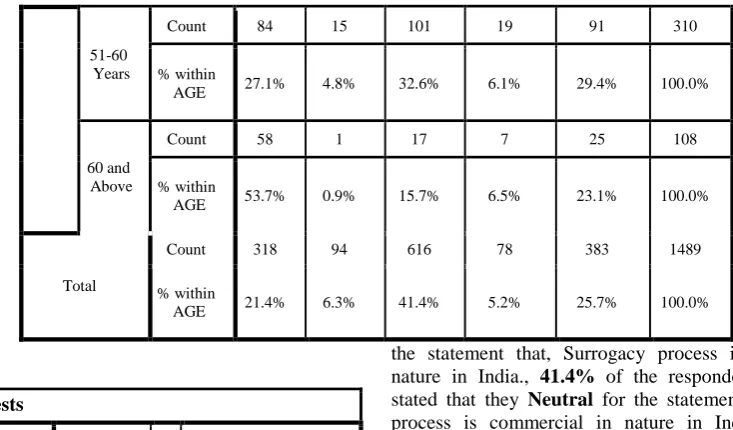
Question: Whether Surrogacy process is commercial in nature in India? Independent Variable:Age
Crosstab
Surrogacy process is commercial in nature in India
Total
Agree Disagree Neutral Strongly
Agree
Strongly Disagree
AGE 18-30
Years
Count 85 6 261 35 96 483
% within
AGE 17.6% 1.2% 54.0% 7.2% 19.9% 100.0%
31-50 Years
Count 91 72 237 17 171 588
% within
International Journal of Innovative Technology and Exploring Engineering (IJITEE) ISSN: 2278-3075, Volume-8 Issue-12, October 2019
51-60 Years
Count 84 15 101 19 91 310
% within
AGE 27.1% 4.8% 32.6% 6.1% 29.4% 100.0%
60 and Above
Count 58 1 17 7 25 108
% within
AGE 53.7% 0.9% 15.7% 6.5% 23.1% 100.0%
Total
Count 318 94 616 78 383 1489
% within
AGE 21.4% 6.3% 41.4% 5.2% 25.7% 100.0%
Chi-Square Tests
Value df Asymp. Sig. (2-sided)
Pearson Chi-Square 192.278a 12 .000
Likelihood Ratio 188.204 12 .000
N of Valid Cases 1489
a. 0 cells (0.0%) have expected count less than 5. The minimum expected count is 5.66.
Discussion:Out of the 1489 Respondents, there were 483 respondents of the age group 18- 30, 588 were respondents of the age group 31-50, 310 of them were respondents of the age group 51-60, 108 were respondents of the age group of 60 and above. From them 21.4% of the respondents have clearly stated that they are agree with the statement that, Surrogacy process is commercial in nature in India, 6.3% of the respondents have clearly stated that they Disagree for
the statement that, Surrogacy process is commercial in nature in India., 41.4% of the respondents have clearly stated that they Neutral for the statement that, Surrogacy process is commercial in nature in India.,5.2% of the respondents have clearly stated that they strongly agree for the statement that, Surrogacy process is commercial in nature in India. 25.3% of the respondents have clearly stated that they strongly disagree for the statement that, Surrogacy process is commercial in nature in India. Moreover the value of Pearson chi- square test is 0.000 which is less than 0.05. In the result null hypothesis is rejected in this table because there is no significant associations between age and The New Bill 2019 relating to Surrogacy will reduce commercial surrogacy. Hence alternative hypothesis is proved in this table because there is a significant association between age and The New Bill 2019 relating to Surrogacy will reduce commercial surrogacy.
Question: The New Bill 2019 relating to surrogacy will reduce commercial Surrogacy. Independent Variable: Age
Crosstab
The New Bill 2019 relating to Surrogacy will reduce commercial
surrogacy
Total
Maybe No Yes
AGE
18-30 Years Count 45 325 113 483
% within AGE 9.3% 67.3% 23.4% 100.0%
31-50 Years
Count 85 355 148 588
% within AGE 14.5% 60.4% 25.2% 100.0%
51-60 Years
Count 37 167 106 310
% within AGE 11.9% 53.9% 34.2% 100.0%
60 and Above
Count 12 51 45 108
% within AGE 11.1% 47.2% 41.7% 100.0%
Total
Count 179 898 412 1489
[image:3.595.109.476.48.263.2]Chi-Square Tests
Value df Asymp. Sig. (2-sided)
Pearson Chi-Square 31.945a 6 .000
Likelihood Ratio 31.052 6 .000
N of Valid Cases 1489
a. 0 cells (0.0%) have expected count less than 5. The minimum expected count is 12.98.
Discussion :
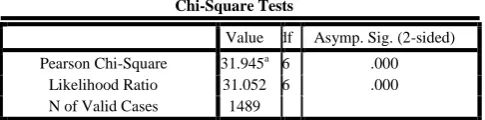
Out of the 1489 Respondents, there were 483 respondents of the age group 18- 30, 588 were respondents of the age group 31-50, 310 of them were respondents of the age group 51-60, 108 were respondents of the age group of 60 and above. From them12.0% of the respondents have clearly stated that they Maybe for the statement that, The New Bill 2019 relating to Surrogacy will reduce commercial surrogacy.,60.3% of the respondents have clearly stated that they No for the statement that, The New Bill 2019 relating to Surrogacy will reduce commercial surrogacy., 27.7% of the respondents have clearly stated that they Yes for the statement that, The New Bill 2019 relating to Surrogacy will reduce commercial surrogacy., Moreover the value of Pearson chi- square test is 0.000 which is less than 0.05. In the result null hypothesis is rejected in this table because there is no significant associations between age and The New Bill 2019 relating to Surrogacy will reduce commercial surrogacy. Hence alternative hypothesis is proved in this table because there is a significant association between age and The New Bill 2019 relating to Surrogacy will reduce commercial surrogacy.
Analyses :
Surrogacy is defined as a practice in which a woman gives birth to a child for a couple, referred to as an ―intending couple‖, with the intention to hand over the child to that couple. Surrogacy can be either altruistic or commercial. In the former, no monetary considerations are involved, except medical expenses and insurance. In the case of commercial surrogacy, the woman who gives birth to a child for the intending couple is rewarded for it in cash or kind.
Surrogate mother
Chapter I of the Bill defines a surrogate mother as, ―a woman bearing a child (who is genetically related to the intending couple) through surrogacy from the implantation of the embryo in her womb…‖(Parry 2018). A married woman between the ages of 25 and 35 who has a child of her own can be a surrogate or can help in surrogacy by donating her egg. The surrogate mother needs to be a close relative of the intending couple and can become a surrogate only once in her lifetime. Additionally, a woman cannot become a surrogate mother by providing her own gametes (unfertilised eggs).(Lamba et al. 2018)
When is surrogacy permitted?
As per the Bill, only altruistic surrogacy will be permitted in India, in cases where either or both members of the couple suffer from infertility, of which the certificate of essentiality is proof. Additionally, a certificate of eligibility is issued to the intending couple and is proof that the couple has been married for at least five years, and are Indian citizens. The wife must be in the age group of 23-50, and the husband in the age group of 26-55(Parry and Ghoshal 2018). The intending couple should not have any surviving biological child, through adoption or through surrogacy. An exception is made if the intending couple has a surviving child who is mentally or physically challenged, or is suffering from a fatal illness with no permanent cure.
Place to carry out surrogacy procedures
Only surrogacy clinics registered under the Surrogacy (Regulation) Act, 2019 will be able to perform procedures related to surrogacy. The Bill defines surrogacy procedures as ―all gynaecological, obstetrical or medical procedures, techniques, tests, practices or services involving the handling of human gametes and the human embryo in surrogacy‖.
Guilty of commercial surrogacy
According to the Bill, if an individual is found advertising or undertaking surrogacy, exploiting the surrogate mother, selling, importing, purchasing or trading human embryos or gametes for surrogacy, conducting sex selection for surrogacy, or has abandoned, exploited or disowned a surrogate child, he/she can be liable for imprisonment of up to 10 years and a fine of up to Rs 10 lakh.
Other provisions
In case abortion of a surrogate foetus is considered, only the consent of the surrogate mother is required, as per the provisions under the Medical Termination of Pregnancy Act, 1971. The intending couple has no say in this decision. On the other hand, after being born, the child is considered to be the biological child of the intending couple.
Parliamentary panel's unaddressed concerns Apart from stressing on the need to first regulate ART clinics, the 2017 Parliamentary panel, attached to the Rajya Sabha, had proposed several significant changes which the 2019 Bill ignores. Therefore, the need to send the Bill again to the same panel is unclear. The changes the panel had recommended included defining 'close relative', redefining 'infertility', removing restrictions on surrogacy to 'altruistic' purpose alone(Guillebaud 1990), reversing the burden of proof on the accused, removing the need for written permission for abortion and specifying review and appeal
procedures etc.
The panel objected to limiting surrogate to a 'close relative' and making it 'altruistic' saying that these would lead to coercion and further exploitation of women due to family pressure, given the social, legal, emotional and ethical dynamics involved.
It said limiting to 'close relative' (which has not been defined) would not only cause acute dearth and unavailability of women but also had no connection with the objective of stopping the exploitation of surrogates and therefore, both related and unrelated women should be permitted. It questioned limiting eligibility for surrogacy in the definition of 'infertility' to those unable to conceive for 'five years', with a provision to add eligibility conditions on some future date, while the WHO and the ART Bill of 2014(Chawla 2015) proposed a period of 'one year'. Such limitation would not only impair chances of parenthood to many, as people get married late these days with their biological clock ticking, but also violate their reproductive rights, the panel said. It proposed a one-year period, which should be waived off for medical reasons. The panel also objected to limiting surrogacy to only legally married couples and requiring them to be certified as infertile. Calling the certification unnecessary, it said restricting it to legally married couple amounted to imposing prohibition on widows, divorced women, live-in partners, which was not fair given the stigma attached to infertile women(Saxena 2015). It
[image:4.595.51.294.53.113.2]International Journal of Innovative Technology and Exploring Engineering (IJITEE) ISSN: 2278-3075, Volume-8 Issue-12, October 2019
compensation to a surrogate mother, who would undergo hardships for nine months and beyond, while doctors, hospitals and lawyers involved in the process would get paid
for theirs.
Besides, it suggested that impoverished women should be allowed for paid surrogacy to provide for her family needs. The panel's other objections and suggestions which have been ignored are: definition of surrogacy should be precise, explicit and descriptive with no scope for misinterpretation, removal of restrictions on donating gamete, removal of written permission for abortion without setting a time limit for it - the rationale for which wasn't clear since the Medical Termination of Pregnancy Act of 1971(Rudrappa 2015b) already provided for it and time was of essence in abortion - and providing safeguards against huge discretionary powers to the District Medical Board for issuing essential certificates.
Views on Medical fraternity:
Dr Sharda Jain, an eminent gynaecologist and IVF specialist who taught at Chandigarh's PGIMER and Delhi's Lady Hardinge Medical College and represents the view of the Indian Medical Association (IMA)(Jacob 2009) - the apex body of the medical fraternity in India - describes the Bill as a good move to end commercial surrogacy. She welcomes the move to ban surrogacy for "single parents" (allowing only Indian married couples to avail this), saying that 90% of those coming from abroad for commercial surrogacy in India were from the gay community(Datar 2016) - not exactly the ones for whom surrogacy is meant, she says. However, she agrees with the Parliamentary panel that ART Bill should have come first and that 'close relative' should have been defined for clarity.
VI. CONCLUSION
The Surrogacy (Regulation) Bill 2019 cements the ban on commercial surrogacy, but it fails to effectively tackle the larger social, physical, psychological, emotional and economic issues that continue to challenge the welfare and safety of both the surrogate mother and the child. Just the removal of the commercial aspects in the current surrogacy arrangements does not remove the chances of exploitation. So the rights of surrogate mother and child born must comprehensively be formulated, along with that ART must be regulated thoroughly.
REFERENCE:
1. Chawla, Raina. 2015. ―Medical Termination of Pregnancy and
Sterilization.‖ Clinical Methods in Obstetrics and Gynecology.
https://doi.org/10.5005/jp/books/12676_59
2. Datar, Nikhil. 2016. ―Medical Termination of Pregnancy Act.‖
Handbook of Obstetrics and Gynecology for Asia and Oceania. https://doi.org/10.5005/jp/books/12747_90.
3. ―Discounted Life.‖ n.d. Google Books. Accessed September 7, 2019.
https://books.google.com/books/about/Discounted_Life.html?id=B-0WCgAAQBAJ.
4. ―Globalization and Transnational Surrogacy in India.‖ n.d. Google
Books. Accessed September 7, 2019.
https://books.google.com/books/about/Globalization_and_Transnatio nal_Surrogac.html?id=eZJFAwAAQBAJ.
5. Guillebaud, J. 1990. ―Medical Termination of Pregnancy.‖ BMJ.
https://doi.org/10.1136/bmj.301.6748.352.
6. ―ICMR Guidelines Regarding Surrogacy in India.‖ 2015. Surrogacy:
Medicolegal Issues. https://doi.org/10.5005/jp/books/12585_7.
7. India, Surrogacy. 2012. ―Surrogacy in India.‖ SciVee.
https://doi.org/10.4016/48411.01.
8. Jacob, Annamma. 2009. ―Medical Termination of Pregnancy (MTP).‖
Manual of Midwifery. https://doi.org/10.5005/jp/books/10473_69.
9. Kotiswaran, Prabha. 2018. ―Law‘s Paradoxes: Governing Surrogacy
in India.‖ Cross-Cultural Comparisons on Surrogacy and Egg
Donation. https://doi.org/10.1007/978-3-319-78670-4_7.
10. Lamba, N., V. Jadva, K. Kadam, and S. Golombok. 2018. ―The
Psychological Well-Being and Prenatal Bonding of Gestational
Surrogates.‖ Human Reproduction , February.
https://doi.org/10.1093/humrep/dey048.
11. Malhotra, Anil, and Ranjit Malhotra. 2016. Surrogacy in India: A
Law in the Making - Revisited.
12. ―[No Title].‖ n.d. Accessed September 4, 2019.
https://www.ijariit.com/manuscripts/v4i5/V4I5-1295.pdf.
13. Pande, Amrita. 2014. Wombs in Labor: Transnational Commercial
Surrogacy in India. Columbia University Press.
14. ———. n.d. ―Cross-Border Reproductive Surrogacy in India.‖
Handbook of Gestational Surrogacy.
https://doi.org/10.1017/cbo9781316282618.020.
15. Parry, Bronwyn. 2018. ―Surrogate Labour: Exceptional for Whom?‖
Economies et Societes 47 (2): 214–33.
16. Parry, Bronwyn, and Rakhi Ghoshal. 2018. ―Regulation of Surrogacy
in India: Whenceforth Now?‖ BMJ Global Health 3 (5): e000986.
17. Rozée, Virginie, Sayeed Unisa, and Elise de La Rochebrochard. 2019.
―Sociodemographic Characteristics of 96 Indian Surrogates: Are They Disadvantaged Compared with the General Population?‖ PloS One 14 (3): e0214097.
18. Rudrappa, Sharmila. 2015a. ―The Many Meanings of Surrogacy.‖
Discounted Life.
https://doi.org/10.18574/nyu/9781479874521.003.0004.
19. ———. 2015b. Discounted Life: The Price of Global Surrogacy in
India. NYU Press.
20. Saxena, Richa. 2015. ―Medical Termination of Pregnancy.‖ Tips and
Tricks in Operative Obstetrics and Gynecology. https://doi.org/10.5005/jp/books/12426_12.
21. Sharma, Radhey Shyam, Richa Saxena, and Rajeev Singh. 2018.
―Infertility & Assisted Reproduction: A Historical & Modern
Scientific Perspective.‖ The Indian Journal of Medical Research 148
(Suppl): S10–14.
22. ―Surrogacy (Regulation) Bill 2019.‖ n.d. Drishti IAS. Accessed
September 7, 2019. https://www.drishtiias.com/daily-updates/daily-news-editorials/surrogacy-regulation-bill-2019.
23. ―The Surrogacy (Regulation) Bill, 2019.‖ 2019. PRSIndia. July 15,
2019.
https://www.prsindia.org/billtrack/surrogacy-regulation-bill-2019.
24. Timms, Olinda. 2018. ―Ending Commercial Surrogacy in India:
Significance of the Surrogacy (Regulation) Bill, 2016.‖ Indian
Journal of Medical Ethics 3 (2): 99–102.
25. Vaishnavi, Gehna. 2015. ―Judicial Complications in Relation to
Surrogacy in India.‖ Surrogacy: Medicolegal Issues.
https://doi.org/10.5005/jp/books/12585_12.
26. ―Wombs in Labor.‖ n.d. Google Books. Accessed September 7, 2019.
https://books.google.com/books/about/Wombs_in_Labor.html?id= VlMZBQAAQBAJ.
AUTHOR PROFILE
B.Asvini, B.A.LLB(HONS),5th year, Saveetha School of Law, Saveetha Institute of Medical and Technical Sciences(SIMATS), Chennai, TamilNadu. Email: [email protected].
C.Renuga, B.A,B.L,LL.M., Assistant Professor, Saveetha School of Law, Saveetha
Institute of Medical and Technical