Framing issues and identities: Aligning the content of group
identity with the meaning of issues to produce normative
influence.
Kerry James O’Brien
BSc (Hons) (Australian National University)
May 2017
Declaration of authorship
I, Kerry James O’Brien,
Declare that this thesis and the work presented in it are my own and has been generated by me as the result of my own original research.
I confirm that:
This work was done wholly or mainly while in candidature for a research degree at the Australian National University;
Where I have consulted with the published work of others, this is always clearly attributed;
Where I have quoted from the work of others, the source is always given. With the exception of such quotations, this thesis is entirely my own work, written in collaboration with my supervisory panel members and paper co-author as stated per chapter;
I have acknowledged all main sources of help;
Where this thesis is based on work done by myself jointly with others, I have made clear exactly what was done by others and what I have contributed myself;
Signed:
………
Date:
Acknowledgements
I am greatly indebted to my primary supervisor, Dr Ken Mavor, whose boundless energy, enthusiasm and intellectual curiosity helped kindle my interest in the ideas explored in this thesis. It was these qualities, along with his patience and positivity that have been critical in sustaining it through to completion.
My thanks also go to the other members of my supervisory panel, Prof Michael Platow and Dr Lindy Edwards, whose input was always generously offered and greatly received. I am also thankful to the many other members of the ANU Psychology faculty, including Emina Subasic, Kate Reynolds, and Boris Bizumic, who were generous with their time, advice and encouragement along the way.
Thanks also to my peers who shared the PhD journey. The personal and intellectual support of the likes of Li Lim, Ben Jones, Daniel Skorich, Andrew Frain, Aurore Chow, Tegan Cruwys and many others made the experience all the more enjoyable and rewarding.
I was fortunate enough to share much more than just office with Lillian Smyth and Marlene Eggert. Their friendship, support and good humour were often a tonic. I learnt more about Prussian history, North Korea and Grizzly Bears than any student of social psychology could have expected.
I would also like to acknowledge the support and tolerance of my colleagues at the Australian Bureau of Statistics who made it possible for me to combine academic and professional pursuits while remaining both sane and solvent.
who were always keen to hear of my progress (such as it was) and ever ready with a word of encouragement.
To my mother and sister, I thank you for nurturing my curiosity and ensuring that my ambitions were never limited. Your faith in my abilities has been matched only by your pride in even my most minor achievements.
Finally, to my partner Kylie who has been a reservoir of love, kindness and affirmation. She has tolerated the countless late nights and boring weekends with (mostly) good grace and forbearance. Many of the ideas explored in this thesis were first conceived, debated and refined in our conversations. Indeed, those ideas may have remained just that had it not been for your support and encouragement.
Abstract
This thesis aims to contribute to our understanding of the social influence processes commonly at play in public debate; to understand how rhetoric about issues and about social groups can influence public opinion. This research draws upon the social identity tradition (Tajfel, 1972; Tajfel & Turner, 1979; Turner, Hogg, Oakes, Reicher & Wetherell, 1987) which suggests that people’s attitudes
and behaviour are influenced by the norms of groups they identify with, and that this influence depends on the extent to which the issue at hand is perceived as relevant to the group (e.g., Smith, Terry, Crosier & Duck, 2005; Mackie, Worth & Asuncion, 1990; Wyer, 2010). The question of which group is relevant to a
particular issue, however, is not always self-evident and those who seek to shape public attitudes will offer interpretations of the nature of groups or issues in order to establish the relevance of a group whose norms are in line with their own agenda.
Chapter 5 reports on two studies investigating the connection between religion and political attitudes. The results indicate that highlighting the relevance of either cultural issues (i.e. abortion, euthanasia and gay rights) or civic issues
(i.e. welfare, climate change, asylum seekers) to participants’ Christian identity
can influence the extent to which group norms influence attitudes towards
different types of issues. Chapter 6 reports on two further studies that examine the effect that framing climate change as a moral, economic or political issue has on the extent to which religious/spiritual group, class group or partisan group norms predict attitudes. The results indicate that different framings of climate change can influence the extent to which different group norms predict attitudes, with
contrasting effects depending on the level of identification with the group. In the final chapter we draw out the implications of these findings with regard to the theoretical background outlined. We identify a number of
Table of Contents
Chapter 1 – Introduction ... 1
Chapter 2 – Social influence as a single, rational process ... 5
Chapter 3 – The strategic use of identity arguments ... 19
Entrepreneurs of identity in practice ... 24
Chapter 4 – Issue frames, party cues, and the meaning of issues and groups ... 31
Overview of current research ... 42
Chapter 5 – Context statement ... 46
Render unto Caesar: Rhetorical construction of religious identity affects the influence of religious group norms on political attitudes. ... 48
Religiosity and political conservatism: is it nature or nurture? ... 51
Group-based social influence ... 54
Render unto Caesar ... 56
The strategic construction of identity ... 59
Overview of the present research ... 60
Study 1 ... 61
Results ... 64
Study 1 Discussion ... 70
Study 2 ... 71
Results and discussion ... 74
General discussion ... 87
Theoretical implications ... 91
Chapter 6 – Context statement ... 99
Framing the climate change debate: The impact of issue frames on the normative influences on attitudes towards climate change ... 102
Social influence in social identity theory ... 104
Issue frames ... 107
The social psychology of climate change ... 109
Overview of the present research ... 111
Study 1 ... 112
Results ... 115
Discussion ... 125
Study 2 ... 127
Results ... 131
Discussion ... 141
General Discussion ... 141
Theoretical implications ... 147
Limitations and future directions ... 152
Conclusion ... 153
Chapter 7 - Conclusion ... 165
Study 1 ... 167
Study 2 ... 169
Study 3 ... 170
Study 4 ... 171
Overall findings ... 172
Group-based social influence ... 173
The impact of frames ... 173
The effect of the frames interacts with participants’ understanding of groups
and issues ... 174
Implications ...176
Group-based social influence ... 176
The strategic construction of identity ... 180
Issue framing ... 181
Applying the social identity perspective to the study of religion ... 182
Applying the social identity perspective to climate change ... 183
Challenging the status quo ... 184
Sociological literature on frame alignment and mobilisation ... 185
Future directions ...188
Mediating processes ... 188
Manipulating both issue and group meaning ... 189
Enhancing external validity ... 189
Conclusion ...191
List of Tables
Chapter No. Title Page
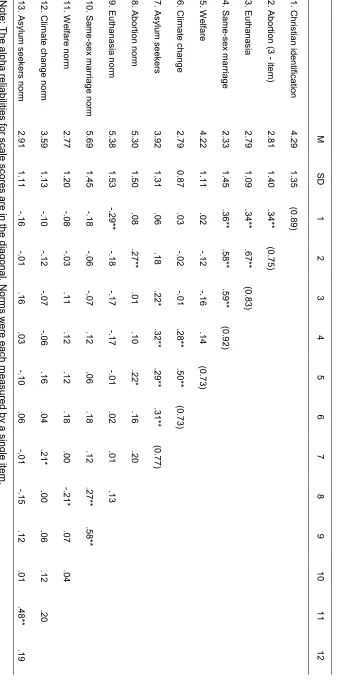
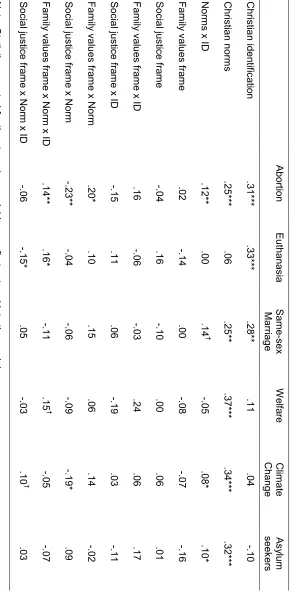
5 1 Descriptive data for measures (means, standard deviations, bivariate correlations and reliabilities)
– Study 1
65
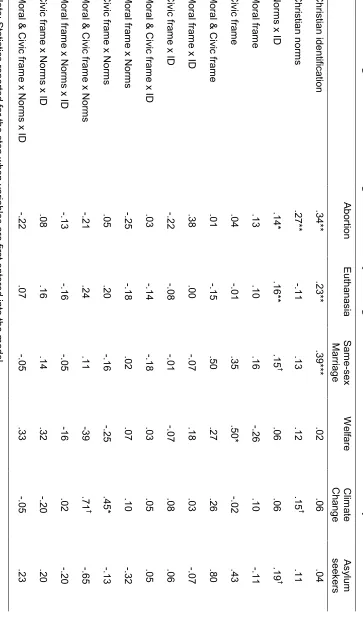
5 2 B weights from hierarchical regression models predicting attitudes for each of the six issues - Study 1
68
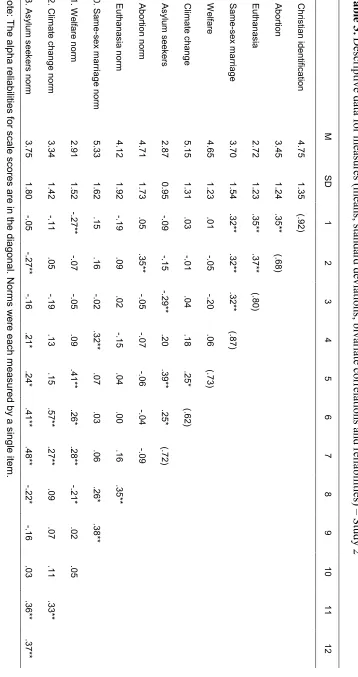
5 3 Descriptive data for measures (means, standard deviations, bivariate correlations and reliabilities)
– Study 2
76
5 4 B weights from hierarchical regression models predicting attitudes for each of the six issues - Study 2
79
6 1 Descriptive data for measures (means, standard deviations, bivariate correlations and reliabilities)
– Study 1
117
6 2 Association between Class identification,
religious and class group norms, Frame condition and Climate change attitudes – Study 1
119
6 3 Descriptive data for measures (means, standard deviations, bivariate correlations and reliabilities)
– Study 2
133
6 4 Association between Religious, Class and Partisan identification, Perceived group norms, Frame condition and Climate change attitudes by level of Political knowledge - Study 2
List of Figures
Chapter No. Title Page
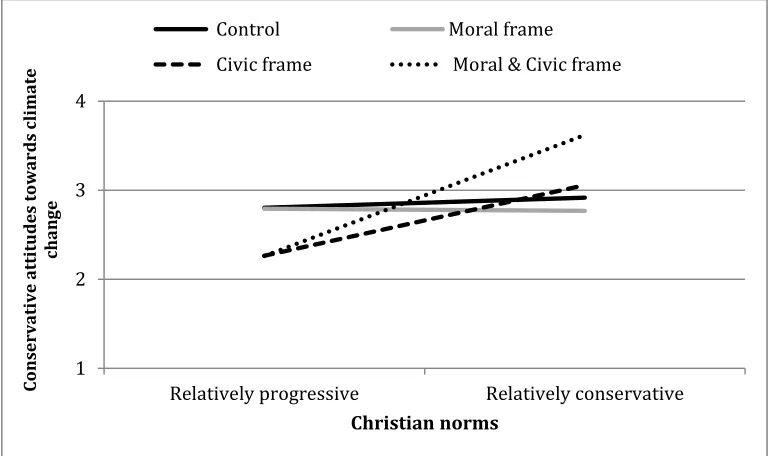
5 1 Interaction of frame condition and Christian norms on attitudes towards Climate change – Study 1
70
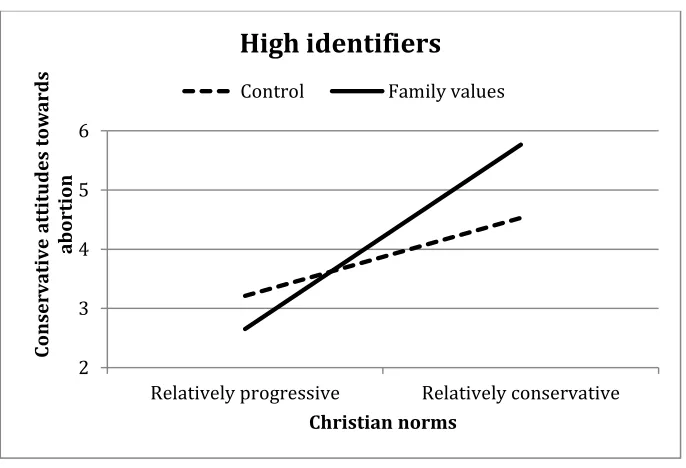
5 2 Interaction of frame condition and Christian norms on
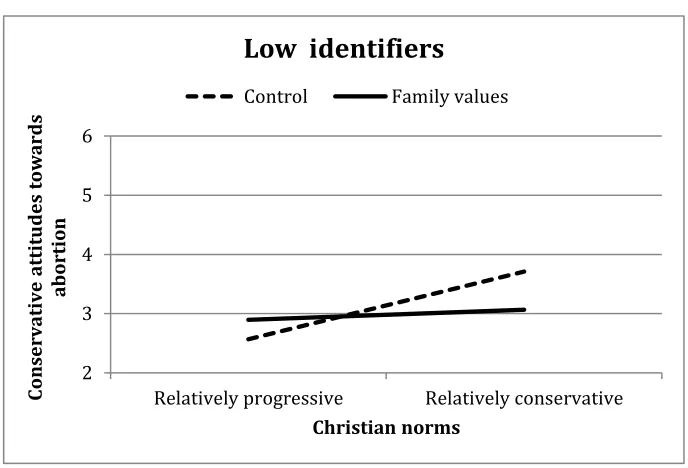
attitudes towards abortion (High identifiers) – Study 2 80 5 3 Interaction of frame condition and Christian norms on
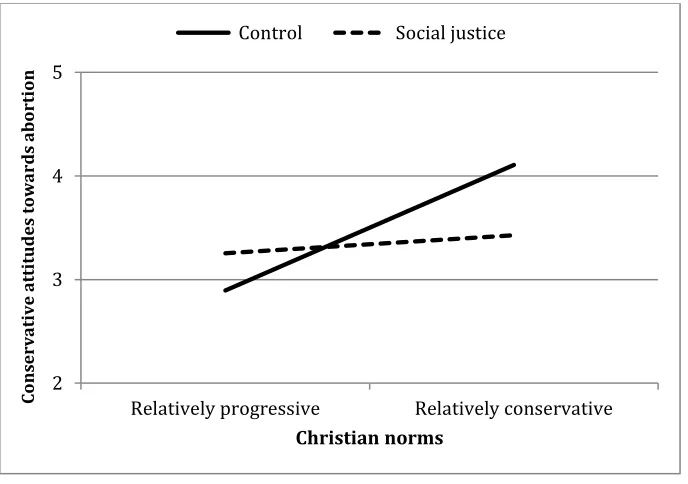
attitudes towards abortion (Low identifiers) – Study 2
81
5 4 Interaction of frame condition and Christian norms on attitudes towards euthanasia (High identifiers) – Study 2
82
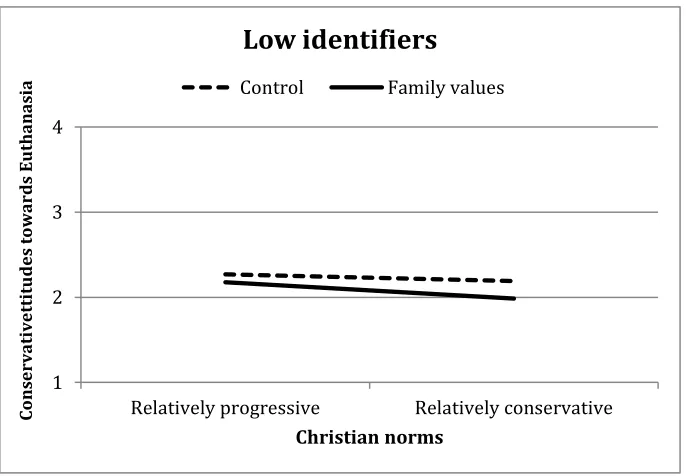
5 5 Interaction of frame condition and Christian norms on attitudes towards euthanasia (Low identifiers) – Study 2
82
5 6 Interaction of frame condition and Christian norms on
attitudes towards welfare (High identifiers) – Study 2 84 5 7 Interaction of frame condition and Christian norms on
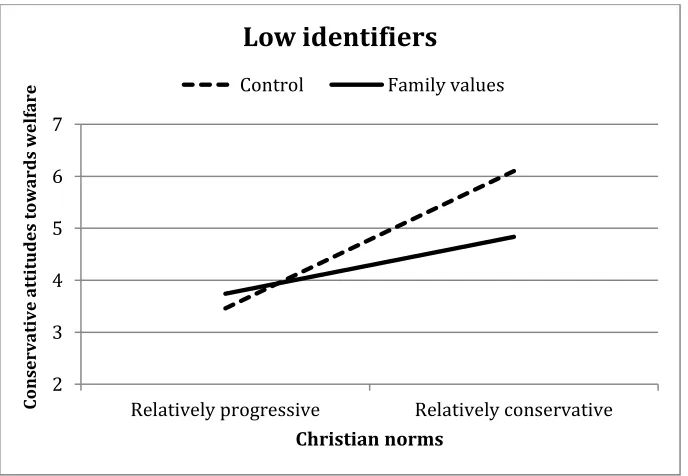
attitudes towards welfare (Low identifiers) – Study 2
84
5 8 Interaction of frame condition and Christian norms on attitudes towards Climate change – Study 2
86
5 9 Interaction of frame condition and Christian norms on attitudes towards climate change (Low identifiers) –
Study 2
87
6 1 Interaction of religious/spiritual identification and perceived norms on climate change attitudes at higher levels of religious/spiritual identification, across control and moral frame condition – Study 1
122
6 2 Interaction of religious/spiritual identification and perceived norms on climate change attitudes at lower levels of religious/spiritual identification, across control and moral frame condition – Study 1
122
6 3 Interaction of class identification and perceived norms on climate change attitudes at higher levels of class identification, across control and economic frame condition – Study 1
124
6 4 Interaction of class identification and perceived norms on climate change attitudes at lower levels of class identification, across control and economic frame condition– Study 1
6 5 Interaction of class identification and perceived norms on climate change attitudes at higher levels of political knowledge and lower levels of class identification, across control and political frame condition – Study 2
138
6 6 Interaction of class identification and perceived norms on climate change attitudes at higher levels of political knowledge and lower levels of class identification, across control and political frame condition – Study 2
138
6 7 Mediation model for the effect of the political frame on climate change attitudes with perceived relevance to class group and perceived class norms as mediators –
Study 2
Chapter 1 – Introduction
“The aide said that ‘guys like me were in what we call the
reality-based community,' which he defined as people who ‘believe that
solutions emerge from your judicious study of discernible reality.’ I nodded and murmured something about enlightenment principles and
empiricism. He cut me off. 'That's not the way the world really works
anymore,' he continued. 'We're an empire now, and when we act, we
create our own reality. And while you're studying that reality -
judiciously, as you will - we'll act again, creating other new realities,
which you can study too, and that's how things will sort out. We're
history's actors . . . and you, all of you, will be left to just study what
we do’.'' (US political correspondent, Ron Suskind, describing an encounter with a senior aide to then US President George W. Bush), (Suskind, 2004).
The aim of this thesis is to contribute to our understanding of the social influence processes that are commonly at play in public debate; to understand how rhetoric about issues and about social groups influences public opinion. This research draws upon the social identity tradition (Tajfel, 1972; Tajfel & Turner, 1979; Turner, Hogg, Oakes, Reicher & Wetherell, 1987), which suggests that
people’s attitudes and behaviour are systematically influenced by the norms of
groups to which they belong, and particularly so for those who are highly
Worth & Asuncion, 1990; Wyer, 2010) shows that influence depends on the extent to which the issue in question is perceived as relevant to the group.
The question of which group or social identity is relevant to a particular issue is not always self-evident. There may be a range of groups that could be perceived as relevant, depending on how the issue and the various groups are construed. Indeed, there is often a degree of ambiguity in people’s understanding
of the nature of issues (what they are about, what interests or values they
implicate) and the nature of groups (what defines them, what interests and values they represent). This can be of some consequence given that the norms of various groups may differ on a given issue, and one’s attitude could vary significantly
depending on which group is deemed to be relevant (Reicher, 2004). As such, those who seek to shape public attitudes may attempt to influence which group is perceived as relevant to a particular issue, offering interpretations of the nature of groups or issues to establish the relevance of a group whose norms are in line with their own agenda. It is this process that I seek to explore in this thesis.
In Chapter 2, I trace the theoretical roots of the contemporary understanding of social influence, exploring the differences between the
In Chapter 3, I explore the implications of these ideas both for the practice of social psychological research, and for the practice of social influence. I detail work by Reicher, Hopkins and colleagues on the strategic construction of identity, and their notion that those who seek to shape public opinion need to become entrepreneurs of identity. I then outline Reicher and Hopkins’ analyses of the social categorical underpinnings of the rhetoric of public figures who seek to persuade and mobilise constituencies to a common cause (Reicher & Hopkins, 1996a, Reicher & Hopkins, 1996b, Reicher, Hopkins & Condor, 1997, Reicher & Hopkins, 2001a, Reicher and Hopkins, 2001b; Haslam, Reicher & Platow, 2010).
In Chapter 4, I review the literature on issue framing that explores how different constructions of an issue can influence attitudes (e.g. Chong &
Druckman, 2007). While much of this research is based on an individualist view of attitudes and attitude change, there are notable exceptions that incorporate an understanding of the role of groups and social context. I then outline findings from political science research demonstrating the extent to which people are guided by party cues in their attitudes towards issues. Here, too, I cite evidence that this is more than simply mindless conformity; that people are only guided by party cues in contexts which suggest that the issue is relevant to the group
(Slothuus & de Vreese, 2010; Druckman, Peterson and Slothuus, 2013). I also outline research by Cohen (2003) that offers valuable insights into the process by which people are guided by group norms. Cohen’s findings suggest that people draw upon their understanding of groups and group norms to make sense of issues. It also suggests that this process depends in part on a degree of ambiguity
in people’s understanding of the group, or the issue, or both. This work represents
Chapter 5 reports on two studies designed to investigate the connection between religion and political attitudes, and whether the way religious identity is framed can influence the connection between religious identification, religious norms and attitudes towards various political issues. More specifically, the studies examine whether highlighting the relevance of either cultural issues (i.e. abortion, euthanasia and gay rights) or civic issues (i.e. welfare, climate change, asylum seekers) to religious identity increases the extent to which religious group norms influence attitudes towards those types of issues, particularly among those who are highly identified with the religious group.
Chapter 6 reports on two further studies that aim to investigate whether the way an issue is framed can affect the perceived relevance of various groups and the extent to which the norms associated with those groups predict attitudes. The studies explore these ideas in the context of attitudes towards climate change, employing the type of frames that are commonly found in the public debate about the issue. Specifically, I examine the effect that framing climate change as a moral, economic or political issue has on the extent to which religious/spiritual group, class group or partisan group norms predict attitudes, particularly for those who are highly identified with those groups. I also investigate whether the effect of these frames is more pronounced among those with high levels of political knowledge, and whether perceived relevance mediates the effect of framing.
Chapter 2 – Social influence as a single, rational process
From the birth of modern social psychology there has been a tension between two perspectives on group-based phenomena: an individualist
perspective and an interactionist perspective. The individualist view, represented by Floyd Allport (1924), Festinger (1950) and others, sees the individual as the sole psychological reality, with all social and group-based phenomena as merely an extension and elaboration of individual psychological processes. The
interactionist view, on the other hand, represented by the likes of Le Bon (1896), Sherif (1936), Levin (1947) and McDougall (1920) contends that there is
something sui generis about group phenomena, something that cannot be explained by or reduced to intra-individual processes. Drawing on principles of Gestalt psychology, they argue that groups have emergent properties; that the individual is fundamentally transformed by participation in the group.
One area where this dispute has played out is in relation to social influence
– the sense in which people’s perceptions, beliefs and attitudes are influenced by those around them. The traditional view is that individuals are motivated to hold accurate and valid beliefs about their world; that people seek what Festinger (1950) termed ‘subjective validity’. According to Festinger there are two means of achieving this subjective validity: physical reality testing and social reality testing. Physical reality testing is where we directly observe the world and rely upon the evidence of our own perceptive and cognitive faculties to achieve an accurate understanding of reality. But when direct perception is either
the fact that direct individual perception and cognition is regarded as sovereign and given primary status. Validation achieved through checking and matching the views of others is accorded a secondary status; it is seen as less valid, less reliable.
To the extent that individuals’ views are influenced by those around them, it is
only as a last resort when they cannot make objective determinations on their own.
This process was demonstrated in Sherif’s (1936) seminal autokineses studies. In these studies, participants sat alone in a darkened room and were asked to focus on a dot of light projected on the wall. Although the dot was stationary, an optical illusion (known as autokinesis) means that the dot of light appears to move and participants were asked to estimate how far it had moved. Participants tended to give varying estimates on the initial trials, but over time would settle on a personal norm. For some participants, this norm was quite large, for others it was quite small – that is, they each established their own reference point. In the next stage of the study participants were again brought into the darkened room and repeated the same procedure, but this time they did so in groups with each participant announcing their estimate out loud. Sherif found that participants’
initial estimates in this second stage were consistent with those they had made in the first, which were often quite different from each other. Over a series of trials, however, their estimates converged on a group norm to the point where they essentially came to agree on how much the dot was moving.
tested alone, suggesting that they had internalized the norm. Later research by Jacobs and Campbell (1961), in which confederates were used to generate an extreme norm, found that this norm persisted even when the confederates were gradually replaced with genuine participants.
While participants in Sherif’s studies ultimately conformed to the group norm, this is not to say that they did so in response to perceived group pressure, or out of mindless compliance. Rather, the dominant interpretation was that this conformity was the result of a rational process where the views of others were used to develop a shared frame of reference that gave meaning and structure to an otherwise ambiguous situation. It follows that people would only rely on the views of others and conform to group norms to the extent that they were
personally uncertain. People would not go along with others when there was no ambiguity.
To test this idea, Asch (1951) devised an experimental paradigm known as
the ‘line judgment studies’. In these studies, participants (who thought they were
taking part in a study of visual discrimination) were asked to look at a line projected on a screen and then call out one by one which of three comparison lines was the same length as the original. The study was conducted in groups of seven to nine, with only one person being a genuine participant - the rest being confederates who were instructed to give the wrong answer on specific trials. The genuine participant always responded second to last so they had heard the
not at all difficult. The results of the actual study, however, were quite different. Asch found that three quarters of participants went along with the incorrect judgement of the confederates in at least one of the 12 trials, and 50 percent went along with the others on at least half the trials. Rather than being immune to influence, the results indicate that many participants conformed to the views of others even when those views were in direct conflict with the evidence of their own senses. Far from reflecting a rational process, the findings suggested a form of social influence based on craven, or, at best, mindless conformity to perceived group pressure.
These findings caused quite a stir in the field of social psychology and led theorists to draw a sharp distinction between two forms of social influence. This distinction has many instantiations, but is perhaps best encapsulated in Deutsch
and Gerard’s (1955) dual process theory of social influence which distinguishes
between informational influence and normative influence. According to the
theory, informational influence, which is akin to Festinger’s social reality testing,
A similar dual-process model is evident in the dominant theories of persuasion such as the Elaboration Likelihood Model (Petty & Cacioppo, 1986; Petty, Cacioppo, Strathman & Priester, 2005) and the Systematic-Heuristic Model (Chaiken, 1980; Chaiken, 1987; Eagly & Chaiken, 1993). Both of these theories distinguish between the genuine, long-lasting attitude change that results from careful processing of persuasive messages, and a more superficial process that produces ephemeral shifts in attitude. At the heart of these theories is a distinction between a thoughtful, rational process of persuasion where people weigh the evidence objectively and are convinced only by strong, valid arguments. This type of persuasion is seen as an asocial process where information is abstracted from
the social context in which it is encountered. Indeed, one’s place in the social
world is thought to have no bearing on the individual’s thinking since information
is evaluated objectively, according to the standards of evidence and logic. This is contrasted with an alternative form of persuasion that is neither rational nor objective. According to these models, when people lack either the requisite motivation or ability to process information carefully, they rely upon peripheral cues or heuristics including the extent to which the message reflects the norm of a valued group, or comes from an ingroup source. According to this view, the extent to which social factors such as group norms and group memberships weigh upon persuasion reflects the absence of careful, rational processing.
These dual-process models, both in the area of social influence and
persuasion, reflect a meta-theroetical view of individual cognition that sees people as cognitive misers (e.g. Fiske & Taylor, 1984). From this perspective, the use of social information, be it in the form of group stereotypes or group norms,
resources. They may enable more efficient thinking, but they inevitably lead to distortions. While this is still the dominant view within social psychology, it is by no means universally accepted. It has been challenged on both theoretical and empirical grounds by those with a more interactionist view of the relationship between the individual and the group, and on group influence. Turner (1985; 1991), for example, rejected the dual process model of social influence and, in particular, the sharp distinction between the rational process of informational influence and the irrational process of normative influence. He argued that the distinction between seeking accurate information about reality, and wanting to understand the views of similar others was a false one; that individual perception and consensual validation are in fact interdependent elements of a single process.
In rejecting the dual-process model, Turner proposed a single-process theory of social influence known as referent informational influence. The theory is based on the notion that we regard people who are similar to ourselves as valid sources of information about reality (or at least about matters relevant to the basis of this similarity). We both expect to agree with similar others and are motivated to do so. From this perspective, being a member of the same group as another person, rather than being a source of coercive pressure, in fact provides the basis for validation of our own perceptions and beliefs. That is, the agreement of similar others lends a sense of objectivity to our subjective judgements. Reicher, Spears and Haslam (2010) describe the referent informational influence approach as follows:
“We can only establish the validity of our collective beliefs in collaboration with others who we categorise as similar to ourselves.
Hence, fellow group members serve as essential reference points for
concern for reality – it is through them that individual views are co-ordinated and transformed into shared values, beliefs and behaviours that have an objective quality” (p. 53).
Essentially, this view suggests that in seeking to establish subjective validity it is only natural for us to look to others with whom we share particular relevant characteristics in order to validate our own judgement. On matters of religion, for example, we might look to people of the same religious
denomination; on matters of politics, to those who support the same political party. The influence that follows is no less real or lasting because it stems from a common group membership. Indeed, to the extent that a particular view is perceived to reflect the consensus position (i.e. the norm) of a relevant reference group, it is likely to be all the more influential. Turner claimed that a single-process model of social influence was necessary given the inherent contradictions
of the prevailing approach. “The difficulty with the dual-process models,” he
argued, “are the implications that social norms have no effect on private attitude
change and that informational influence is non-normative” (1991, p. 147). This theory of group-based social influence is firmly based in the interactionist view of the relationship between the individual and the group. In particular, it grew out of the social identity tradition (Tajfel, 1972; Tajfel & Turner, 1979; Turner et al, 1987) which is based on the notion that we can define ourselves in terms of what makes us unique from other individuals (personal identity), or in terms of our membership in social groups (social identity). One of the key insights of this tradition is that social identity is not a sublimation or
distortion of one’s true identity, rather it is just as valid an expression of selfhood
argued, “social identity is the cognitive mechanism that makes group behaviour possible” (p. 21).
The original social identity theory of intergroup relations (Tajfel & Turner, 1979), as the name suggests, was principally concerned with the relations between groups. Broader questions of how we come to define ourselves in terms of group memberships, and which group membership in particular, were subsequently addressed by self-categorisation theory (Turner, 1985; Turner, et al. 1987), which provides a more cognitive analysis of group processes. According to this theory, the extent to which a particular social identity becomes salient (i.e. perceived as self-defining) at any given time results from the interaction of the individual’s
propensity to assume a particular identity, and the extent to which that identity fits the social context. As Oakes (1987) explains, the concept of fit involves two interrelated factors: comparative fit and normative fit. Comparative fit reflects the extent to which a particular identity minimizes the differences within categories while at the same time maximizing the differences between categories. Normative fit is defined by the degree to which the actual differences between categories (and the similarities within them) accord with normative expectations. In a group discussion, for example, one would be more likely to define themselves and others in terms of gender to the extent that the women among the group tended to be in dispute with the men, while the men and women also tended to agree among themselves (comparative fit). Similarly, gender identity would be salient to the
extent that the women’s views tended towards a pro-feminist position, and the
men’s towards a more anti-feminist position (normative fit).
influenced by aspects of the individual: their prior expectations, their memories, knowledge, habits, as well as their goals, values, and their theories about the way the social world is organised (Turner & Oakes, 1989). That is, salience depends
on an individual perceiver’s readiness to apply a particular categorisation. For
example, a feminist may have a high propensity to perceive and analyse the social world in terms of gender categories. A Marxist, on the other hand, might be more likely to view the world (indeed, potentially the same social contexts) in terms of class differences, while a devout Christian may be inclined to categorise
themselves and others along denominational lines, or in terms of believers and non-believers. Because it derives in part from the social context and the principles of comparative and normative fit, the way individuals define their sense of self is potentially variable and fluid. That is not to say, however, that it is in a constant state of flux. Individuals’ readiness to use particular categories to define
themselves and others places an important constraint on this variability. Indeed, as Haslam (2001) argues, “people organise and construe the world in ways that reflect the groups to which they belong and in this way their social histories lend stability and predictability to experience” (p. 52).
between people is a product of four factors: (1) the degree to which they perceive themselves to be similar in ways relevant to the matter at hand; (2) the degree to which they are perceived to be responding to the same stimulus or situation; (3) the extent of perceived disagreement about the matter at hand (subjective uncertainty); and (4) the degree to which being right on this particular matter is deemed to be important to the group.
dear and is therefore an issue on which it is appropriate, indeed only natural, for Christians to hold differing views.
This understanding of social influence as being driven by the expectation of agreement with similar others and the motivation to reduce subjective
uncertainty in the event of disagreement leads to a re-evaluation of the results of
Asch’s (1951) line judgement studies. Asch interviewed participants after the
study to ascertain why they went along with the obviously incorrect judgements of the group. While some acknowledged that they knew the group consensus was wrong but conformed simply to avoid standing out, many others said that the disagreement of others led them to feel uncertain and to question their own judgement. For these participants, conformity wasn’t the result of a craven tendency to bow to group pressure, but the product of a genuine attempt to understand why their own judgement differed from those of others with whom they expected to agree. Indeed, if one considers the situation facing the
participants, and just how vexing the unanimous disagreement of the rest of the group must have been, it is only natural that they would have at least considered the possibility that they themselves were in error. In the end, in order to make sense of the situation, many sincerely came to suspect that their own perception must have been wrong. Viewed in this light, we see that group influence need not be considered a passive, mindless process of conformity, but can in fact be the result of a considered, rational effort to make sense of the world.
than messages from outgroup sources. Mackie, Worth and Asuncion (1990) ran a study in which participants read a persuasive message on the topic of student exams that was either strong or weak, and attributed to either ingroup or outgroup sources. As noted above, the dominant models in the persuasion literature view the ingroup persuasion effect as the product of peripheral or heuristic processing. According to this view, people don’t actively process ingroup messages, they simply accept them because they like or identify with the source. While Mackie and colleagues did find evidence of the ingroup persuasion effect, with ingroup messages producing more persuasion than outgroup messages, they also found that participants were much more persuaded by strong messages from the ingroup than weak messages. Far from accepting the ingroup message in a mindless, heuristic fashion, this suggested that participants had carefully and systematically evaluated the ingroup messages, and were only persuaded by those independently pretested as being based on strong and valid arguments.
relevant to the group they found that participants were somewhat persuaded by ingroup messages regardless of their strength. There was no evidence that participants were persuaded by outgroup messages regardless of whether they were weak or strong. These results qualify those of the earlier study, indicating that ingroup membership can lead to systematic processing of messages when the issue is deemed relevant to the group. Yet when it is not relevant to the group, ingroup membership can indeed be used as a heuristic cue.
Later research by Wyer (2010) confirmed the critical role that the relevance of the issue to the group plays in the ingroup persuasion effect. In a series of studies, Wyer found evidence of the ingroup persuasion effect only in cases where there was direct relevance of the issue to the group. In addition to measuring attitude change, Wyer also measured participants’ cognitive responses to persuasive messages, finding that positive responses to messages from ingroup members on issues relevant to the group mediated attitude change. This, according to Wyer,
indicated that persuasion was “based on systematic processing of the message
rather than reliance on cues such as the group membership of the message source”
(p. 463).
The impact of relevance has also been demonstrated in research on the consistency between attitudes and behaviour intentions. Following on from research showing that referent group norms are related to behavioural intentions, Smith and colleagues found that ingroup norms have more influence when the issue is seen as relevant to the group. Indeed, they concluded that, “certain norms
people’s perceptions, attitudes, and behaviour, people will not be guided by
ingroup norms on every conceivable issue. The fact that people are more likely to be guided by group norms and influenced by ingroup messages on issues
perceived to be relevant or central to group membership suggests that there is a rational basis to group-based social influence. It also highlights that the notion of
relevance depends upon people’s understanding of the group and of the issue at
hand.
This chapter has outlined some of the theoretical and empirical currents in the study of social influence. It has explored how key studies in the field of social psychology have informed the social identity perspective on social influence. This chapter has reviewed evidence that group-based social influence can follow from a deliberative, rational process and lead to genuine influence, rather than merely public compliance. It has also outlined research to demonstrate the extent to which group-based social influence is dependent upon the issue in question being perceived as relevant to the group, a theme that will be explored further in
Chapter 3 – The strategic use of identity arguments
The fact that each of us has a range of different group or social identities that may be salient at a given time – that may be seen as relevant when
considering a given issue –has dramatic implications for individuals’ attitudes and the way they might be influenced. To the extent that the normative position of these different groups are perceived to differ on a particular issue, we could expect very different attitudes and behaviours depending on how people understand the issue and which group identity they therefore view as relevant. Reicher (2004), for instance, notes that an issue like the influx of migrants into low paid jobs could be construed as a matter of race, of nation, or of class. An
individual’s attitude towards the issue, and indeed towards the migrant group in
question or immigration more generally, could vary markedly depending upon this act of construal.
about whether a particular group is relevant to this or that issue. There is also the dimension of discourse, argumentation and social influence. Indeed, contest over the meaning of groups and issues is often the very stuff of politics.
Reicher and colleagues’ investigation of the centrality of identity and self-category arguments in public debate is firmly grounded in the social identity perspective and the principles of self-categorisation theory in particular. However, there are a few important points of difference where they take issue with the dominant practices or approach of social identity researchers. Firstly, they argue that most research within the social identity tradition has tended to focus on the consequences of categorisation into groups with little or no attention devoted to how those categorisations are arrived at. Reicher and Hopkins (2001) cite the
example of Sherif’s ‘boys camp studies’ in which the experimenters manipulated
the structural relationship between groups of boys in order to study its effect on intergroup conflict (Sherif, 1966; Sherif, Harvey, White, Hood & Sherif, 1961). They refer to one of the lesser known of these studies in which the two groups of boys recognised that the experimenters were conspiring to manufacture conflict between them. As a result, rather than turn on each other, the two groups united in opposition to the experimenters. Sherif abandoned the study at the point that the boys rejected the experimenters’ group categorisation in favour of one that reflected their new understanding of the situation. Reicher and Hopkins suggest
that because Sherif saw the “division into different groups of boys as a non
-negotiable starting point, he ignored the issue of category construction. He ignored any alternative categorical possibilities” (p. 394).
granted, concentrating on the effects of those categorisations rather than
investigating the process that gives rise to them. “The ways in which the divisions come about lie before the starting line and therefore slip from the disciplinary spotlight” (p. 394). While acknowledging the value of investigating the impact of these categorisations, they argue that intergroup research that assumes particular self-categories only tells part of the story. Reicher and Hopkins pay tribute to the important contribution of social identity research to our understanding of racism, for example, but claim that a focus on the consequences of racial prejudice has not been accompanied by an attempt to understand ‘racialization’; of how race came
to be a basis of identification and discrimination.
In line with the social identity perspective, Reicher, Hopkins and colleagues reject the social cognitive view of people as ‘cognitive misers’ who
the complex social world, and the self-categorisation notion that emphasises the flexible nature of categorisation in response to the changing social context. While acknowledging that the social categories available to people at a given moment are to some degree determined, or at least constrained, by the social context, they also stress the role that social categories play in shaping the social context given
that “all self-categories are theories of how the world works and how one can be
in such a world” (2001a, p. 398).
Much of their work in this area has focused on the key role that nationalism and nation-based categorisation has had on the development of nation-states. “… To see oneself in national terms is both to conceive of the world as organised into nations and to occupy a particular place in that world of nations”
(Reicher & Hopkins, 2001a, p. 398). However, the same is true of any other social category. Their main point is that almost invariably, social change to advance the interests of a particular group is predicated on the promulgation of that group as a distinct category in the social world. This accords with work on politicised collective identity (Simon & Klandermans, 2001) which suggests that awareness of shared grievances among a group, and attributing those grievances to a specific
outgroup helps foster the type of ‘us vs them’ frame on which collective political
mobilization to effect social change is based. In other words, social categorisation is a necessary step in the consciousness raising process that leads to real changes in social reality. Reicher and Hopkins (2001a) argue that while this has been acknowledged in theory (e.g. Haslam, 2000) it has rarely been addressed in practice. Subsequent research by Livingstone and Haslam (2008) in the context of intergroup conflict in Northern Ireland, however, demonstrated the critical
relationship between past experiences of intergroup conflict and negative
behavioural intentions towards the outgroup is mediated by the content of ingroup identity. That is, past experience of intergroup conflict only predicts future
conflict to the extent that it leads group members to define ingroup identity in terms of conflict with the outgroup.
Based on this understanding of the interdependent relationship between category boundaries, identity content and social context, Reicher and Hopkins (2001a) argue that the traditional social identity approach has neglected the extent to which people will use group categorisations strategically, not merely to make sense of the social world, but to actively shape it. They claim that, “… a proper
understanding of salience demands that we study the subject as an active
participant in debate and social struggle rather than as simply a passive processor of information” (p. 309). That is, Reicher and Hopkins do not simply see the social context or frame of reference as an objective field from which category salience is deduced. Rather, they stress the agency of individuals and groups in determining how the social context is defined and construed. Precisely because of the potential for social categories to transform social reality, they argue that those who seek to shape public opinion and mobilise groups of people to a common cause need to be adept at manipulating people’s sense of selfhood; they need to be what Reicher calls entrepreneurs of identity.
“Our identities are no longer impressed upon us from an external reality. Identities may better be seen as projects, and those with different projects
will propose different versions of their own identities and that of others…
Those who seek to influence their peers and who aspire to direct the
masses need to become entrepreneurs of identity before they can be
Entrepreneurs of identity in practice
While Reicher and Hopkins offer a compelling theoretical case for the central role identity can play in political movements, they have also sought to demonstrate how entrepreneurs of identity use identity arguments in order to create, persuade and mobilise constituencies. In a series of studies, they have detailed real world examples of how those involved in public debate (a) define the boundaries of a particular category to include all those they want to mobilise; (b) define the content of the category such that their proposals are portrayed as the fulfillment of group norms; and, (c) define themselves as prototypical of the group such that they are uniquely placed to lead and influence the membership. Each of these dimensions is important in understanding how aspects of social identity are used strategically to achieve mass social influence.
In one example, Reicher and Hopkins (1996a) analysed a speech by David Alton, a British MP and anti-abortion campaigner, to a group of medical staff and students at a Scottish hospital. The key to Alton’s pitch was to broaden the frame of reference around the abortion debate beyond the traditional choice vs. pro-life categories. Alton placed the pro-choice position in a broader societal context, linking it to a culture of selfishness and a fixation on individual rights (such as the right to pollute) regardless of the consequences for others. He contrasted this by defining the pro-life position on the basis of “concern for the unborn child” and
linking it with a “concern for the environment, for animal welfare”. On the basis
of this construction, Alton was able to draw upon the normative content of the
medical profession as ‘caring’ to argue that abortion was a violation of those
anti-abortion activists as ‘reactionary cranks’, while also challenging the conception of
the pro-choice position. As Reicher and Hopkins describe it, “if the abortion vs. anti-abortion debate involves those who are selfish/unprincipled vs. those who are caring/principled, then clearly medical staff are in the latter category” (p. 304).
In another example, Reicher and Hopkins (1996b) examined the differing constructions of a single issue (the British miner’s strike of 1984-85) by two opposing politicians: then Conservative Prime Minister of Britain, Margaret Thatcher, and Labour opposition leader Neil Kinnock. As the authors explain, Thatcher, who was seeking to mobilise the public against the strike, defined the issue in the context of a struggle between democracy on one side and violent extremists on the other – there had been an IRA bomb attack on the conference venue in the early hours of the morning of Thatcher’s speech, killing a number of
Kinnock, on the other hand, was seeking to galvanise support for the striking miners and foment opposition to the government. He set the dispute in the context of the negative effects of Thatcher’s policies, including cuts to welfare,
unemployment and civil disorder. Within this context, he defined the striking miners as representative of a broad ingroup who had been afflicted by and were opposed to Thatcherism. Unlike Thatcher, Kinnock didn’t invoke the national category explicitly, nor did he define the categories in class terms. Indeed, he was quite deliberate in his efforts to include within the ingroup exemplars beyond the traditional working class. The authors suggest that Kinnock’s ingroup could be
defined as ‘the people’ in the radical sense as being distinct from the
monopolisers of political representation and power. He characterised this ingroup as valuing liberty, compassion, care and opportunity; as being concerned with the welfare and cohesion of society. In Kinnock’s construction, the outgroup was systematically whittled down to just the personage of Thatcher herself. Even her cabinet colleagues were described as not so much supportive but as simply too meek to resist her. “The category ‘Thatcherism’ is therefore reduced to the will of one person” (p. 367). Indeed, Kinnock went so far as to place Thatcherism outside the bounds of the usual partisan categories such that she was not even
representative of the party or political tradition she led. Her’s was a different form
of Toryism, one that “is exhumed from the past.” Kinnock defined Thatcher, in
contrast to the ingroup, as “coercive and dictatorial, arrogant, vain, prejudiced, out
of touch and contemptuous of ordinary people” (p. 368).
contrasting political causes advanced by the different speakers. Thus, it is not simply that political rhetoric involves arguments about which groups are relevant to an issue and how the groups are defined. These arguments are also internally coherent and serve a strategic purpose in persuading an audience that one
particular course or action is consonant with the interests and values of a common ingroup, while at the same time discrediting alternatives. As Reicher and Hopkins
explain, Thatcher’s frame of ‘democracy against terrorism’, her definition of the
ingroup as British and as defined on the basis of resoluteness and courage presents the strike as anathema to its values; Kinnock’s frame of ‘Thatcherism against
society’ portrays the ingroup as ‘the people’, whose values of care, compassion
and solidarity naturally lead them to support the strike. This demonstrates the
authors’ notion that “category constructs in political rhetoric reflect a speaker’s
project of mobilization” (p. 369).
Reicher and Hopkins have also examined how national identity
(predominantly in the context of Scottish politics) has been used by activists of various stripes to advance very different political agendas. In the context of the debate about Scottish independence from Great Britain, for example, Reicher and Hopkins (2001a) describe how a Scottish National Party (SNP) activist
their position in Great Britain is more a result of their expressive bearing than the fact that they have anything to complain about.
They also describe an instance where two political candidates from opposing parties, Labour and Conservative, both refer to a famous line from Scottish poet Robert Burns –“a man’s a man for a’ that” in discussing the caring
and communal nature of the Scots. However, the apparent similarity disguises the contrasting projects the allusion is being used for. For the Labour politician, the
Scots’ caring and communal nature is used to justify support for the welfare state;
for the Conservative, it is used to justify mutual self-help and personal charity as an alternative to social welfare. They also cite other examples where activists from the same party make very different arguments about the distinction between
Scots and the English: one Labour activist claims that the Scots’ caring nature
distinguishes them from the English, while another argues that the Scots and English are essentially one and the same people (Reicher, Hopkins & Condor, 1997).
The point of these examples is not merely to demonstrate that identity is a prominent feature of political rhetoric, but also to show that identity arguments are used strategically in order to underpin the political project of the speaker. It may be unremarkable that people representing different political traditions will draw upon similar conceptions of national identity, or that people with similar ideals may vary. However, the fact that these differences and similarities appear to vary in line with the political argument the speaker is trying to advance attests to how identity is used for strategic purpose. Indeed, in all of the cases cited above, the unifying factor is that the definition of Scottishness serves to underpin
party’s platform as consonant with the national character. However, as Reicher and Hopkins (1996b) themselves note, it is one thing to demonstrate that category arguments are present in political rhetoric and that differing construction of issues and groups are used in order to achieve mass influence; it is quite another to demonstrate their effect.
Empirical research within the social identity tradition has demonstrated the powerful influence the frame of reference exerts on the way people understand themselves and others. For example, in a demonstration of the principle of comparative fit, Haslam and colleagues showed that expanding the range of groups in the social context had a marked effect on perceptions of group boundaries, with erstwhile outgroup members being redefined as part of a common ingroup (Haslam, Turner, Oakes, McGarty & Hayes, 1992). Likewise, Hopkins, Regan and Abell (1997) demonstrated the relative nature of group definitions, showing that the way the ingroup was defined, including the
dimension of definition, varies depending upon who the salient outgroup is. This was taken a step further by Rabinovich, Morton, Postmes and Verplanken (2012) who demonstrated that changes in the comparative context (i.e. salient outgroup) can influence perceptions of the ingroup norms on a particular issue, and
ultimately influence individuals’ attitudes and behaviour regarding that issue.
While these studies illustrate the influence that can be achieved by manipulating
people’s understanding of the social context, in each case the social context was
groups and of the issue in ways that are plausible and compelling to those they seek to influence.
This chapter has outlined work by Reicher, Hopkins and others on how identity arguments are used to persuade and mobilise groups of people to a
common cause. It explains how this work builds on the social identity perspective on social influence to offer novel insights into rhetorical strategies at play in much public debate. While experimental work in the field of social psychology
compliments Reicher and colleagues’ more qualitative analysis, it is in the
Chapter 4 – Issue frames, party cues, and the meaning of issues and groups
The way in which issues are defined or ‘framed’ in public debate and the
impact this has on people’s attitudes is the subject of considerable interest in the
fields of political science and communication. Research into what is known as
‘issue framing’ is based on the notion that issues can be complex and there is
often ambiguity about what the essence of an issue is. According to Nelson and Kinder (1996), issue frames are more than a single argument or a position on an issue, they provide meaning to an issue and suggest how to understand and think about it. Issue frames are thought to influence attitudes on three levels: by making new beliefs or considerations about an issue available; by making particular available considerations more accessible; or by making certain accessible considerations seem more applicable or more important in determining one’s attitude (Chong & Druckman, 2007). Despite debate over the exact process by which framing effects are mediated, there is general agreement that issue frames change attitudes by altering the underlying considerations people bring to bear in forming their attitudes (see Nelson, Oxley & Clawson, 1997; Nelson & Oxley, 1999; Jacoby, 2000; Druckman, 2001).
This understanding of issue framing is based on an expectancy value model of attitudes (e.g. Azjen & Fishbein, 1980), according to which an
individual’s attitude towards an object or issue can be thought of as the weighted
sum of a series of evaluative beliefs. In the classic example, attitudes about whether a hate group rally should be allowed to proceed might consist of a
positive evaluation based on the principle of free speech and a negative evaluation
relative weight ascribed to each of these components. Two people could share the same range of considerations and evaluations, but attach differing weights to each and thereby arrive at different conclusions. Someone exposed to a frame
emphasising the free speech element might be more likely to see this as the most relevant consideration and conclude that the rally should proceed. Whereas someone who read an article that framed the issue in terms of public safety might be more likely to oppose the rally on the basis of this consideration.
Research on framing effects traditionally rests on an individualistic understanding of attitudes, characterised by Hogg and Smith (2007) as “cognitive
representations that are acquired and possessed by individuals and which, to a
great extent, are a part of human individuality” (p. 91). This has been the accepted
view of attitudes within social psychology as far back as Floyd Allport (1919) and continues to dominate the field (see Eagly & Chaiken, 1993; Maio & Haddock, 2009). While framing research considers the impact of social context on attitudes, as a source of information and communication, the social identity perspective offers a broader understanding of the social context which Hogg and Smith (2007) conceptualise as the wider social environment of group memberships, group norms, social identities, intergroup relations and ideologies. In this sense, much research on framing follows a perspective that fails to take account of the way in which attitudes are grounded in group memberships; that “our sense of ourselves as group members plays a key role in shaping attitudes and attitudinal processes”
(p. 91).
understanding of attitude processes in investigating what they termed the ‘group
centrism’ of public opinion.They argued that people’s attitudes towards social
groups were fundamental to their opinions on a variety of issues, but that the influence of this group-centrism depends on how issues are framed. In studies in the US, they found that support for affirmative action was highly correlated with racial attitudes, and particularly so when the issue was framed in a way that drew attention to African Americans as the intended beneficiaries. While this research
is notable in recognising the key role of groups in shaping individual’s opinions
on specific issues, it goes only part of the way. In focusing on the impact of attitudes towards groups, and particularly the role of racial prejudice, the
emphasis is on how the individual views and responds to ‘others’ in forming their
opinion, rather than on how one defines the ‘self’ in relation to the issue. While
self-categorisation is always relative (Hopkins, et al., 1997), and the self is
defined in relation to the ‘other’, from a social identity perspective the main point
of interest is how people view themselves, who they identify with, and the types of values and norms they come to be guided by.
Price (1989) was the first to explicitly apply social identity principles in attempting to understand the impact of framing on individual’s attitudes. Focusing on the tendency for the media to frame issues in terms of conflict between
opposing sides, Price argued that “the construction of an issue as a matter pitting
defined social groups against one another is not a simple peripheral cue; it
interacts with recipients’ social identities to alter in a fundamental way their
people formulating their opinion on the issue, this type of group conflict frame changes the question from one of ‘where do I stand?’ on the issue, to ‘with whom do I stand?’
In testing these ideas empirically, Price conducted a study in which participants read a mock article from a student newspaper about plans to increase university course requirements. In the group frame condition, the article described the issue in terms of the conflict between Science majors who opposed the move, and Humanities majors who supported it. In the other condition, the article noted that students were divided on the issue without mentioning any specific groups. The personal relevance of the issue was also manipulated by stating that the plan was to be implemented either soon, or in the future. The results indicated that Humanities students were influenced by the frame such that those who read the group conflict version of the article were more likely to support the planned increase in course requirement than those who read the non-group frame. However, this effect was evident only among those Humanities students who were told that the changes were to be implemented soon (i.e. high personal relevance). Science students, on the other hand, were not influenced by the frame regardless of the supposed timing, though Price suggests that this might have been due to constricted range as opposition to the plan was the default position of most students.
Price’s (1989) research demonstrates that when informed of a group norm
on those who believed the issue to be an imminent concern suggests that this might have heightened the sense of relevance of the issue to the group such that they saw their fellow ingroup members as an appropriate reference group.
The matter of relevance has been explored more recently in the field of political science through research looking at the conditions under which individuals will and will not be guided by group (i.e. political party) norms. Slothuus and de Vreese (2010), for example, found that participants were much more inclined to adopt the position advocated by the party they supported (and reject the position of an opposing party) on an issue where there was traditionally partisan conflict (welfare for senior citizens). However, on an issue that was usually characterised by partisan consensus (international trade), the source of the message had little or no impact on whether participants adopted the advocated position. Furthermore, they found that the influence of party source was stronger among those who were more politically aware. These findings confirm, in the realm of political attitudes, that while group memberships and group norms can exert a powerful influence on attitudes, people do not slavishly adhere to group norms in all instances. There are important situational and individual factors that have a bearing on the extent of group influence.
In explaining these results, the authors suggest that message source mattered more on the conflict issue because this is where partisan values are particularly at stake. This is another way of saying that the issue is relevant to
group membership; that one’s stance on the issue is somehow central to what it
this position will reflect the values of that party, which are at odds with one’s
own. As such, people will naturally assume that their own party’s position will
differ, and be motivated to react against the outgroup’s stated position. In contrast, issues where there is usually partisan consensus, do not, almost by definition, implicate partisan values and will therefore not be viewed as relevant to group membership. Given the expectation of consensus across groups, there is no reason
to expect agreement within one’s group. As such, there is little or no motivation to
adhere to the ingroup position or to reject the outgroup position.
These findings run counter to previous issue framing research which has suggested that citizens are likely to be more responsive to framing on issues that they are not particularly invested in, and that framing effects are stronger among those who are less politically aware (Kam, 2005; Mondak, 1993). They are, however, in keeping with the social identity perspective and associated evidence reviewed above that group-based influence is the product of effortful, rational processes. Indeed, Slothuus and de Vreese (2010) argue that “… parties appear to
function as much more than merely facilitating cognitive efficiency – parties are important landmarks in the political landscape that citizens relate to” (p. 643). As
such, it makes sense that it is the most politically aware in the context of politically relevant issues who will have both the motivation and ability to rationalise why they should support the ingroup position, or, for that matter, generate counterarguments to justify rejecting the outgroup position.
much difference between the parties, and differing views within parties),
participants, who were made up of committed Democrats and Republicans, were swayed by the substantive merits of the arguments presented for or against a particular policy rather than by the official position of their party. However, when the political context was described as highly polarised (i.e. large difference between the parties and a high level of agreement within parties), participants conformed to the stated position of their party, regardless of the relative merits of the arguments. As with earlier research, these results raise concerns about the pernicious effects of partisanship on citizen decision-making and the quality of public opinion. While acknowledging these concerns, the authors argue that citizens, particularly those who are committed partisans, generally understand what the political parties stand for and take this into account when determining whether they should be guided by party cues. Indeed, just as in Slothuus and de
Vreese’ (2010) example of the partisan conflict issue, the polarised political
context indicates that the issue implicates the types of values that distinguish the parties, and which are presumably important to committed partisans. So while a participant may have been presented with information about the merits of the policy that point in one direction, they will have to weigh this against the
knowledge that their political party (with whom they share relevant values) holds a different view. In this case, it may be rational to assume that the party’s position
is based on a more thorough understanding of the policy.
people are only influenced by group norms to the extent that they regard the issue in question to be relevant to the group; and (3) being guided by group norms is not simply the result of mindless conformity, but can be the outcome of a thoughtful, rational process.
In considering the nature of this rational process, Asch’s early work on
persuasion offers some useful insights. Drawing on the principles of Gestalt psychology, Asch argued that the characteristics of the source are not simply something we add into the mix when considering a persuasive message; it actually influences the meaning we ascribe to the message. That is to say, it is not a matter of considering the same message from one or other source; they are actually two different messages because the content of the message and the source constitute a meaningful whole: a Gestalt. To illustrate this point, Asch (1952) replicated a study by Lorge (1936) where American students were presented with a message arguing that “a little rebellion now and then is a good thing…” attributed to either Vladimir Lenin or Thomas Jefferson. Not surprisingly there was more agreement with the message among those who thought it came from Jefferson rather than
Lenin. Lorge’s interpretation was that the liking participants felt towards Jefferson
was simply transferred to the message. But Asch also had students describe how they interpreted the term rebellion from the passage, finding that when attributed to Lenin rebellion brought to mind images of revolution, bloodshed and anarchy; whereas when attributed to Jefferson it was associated with debate and
democracy, “gentle winds of change.” This was good evidence of Asch’s notion
that the source affects the meaning of the message; that people’s interpretation of