Rochester Institute of Technology
RIT Scholar Works
Theses
Thesis/Dissertation Collections
2011
Scalable cooperative caching algorithm based on
bloom filters
Nodirjon Siddikov
Follow this and additional works at:
http://scholarworks.rit.edu/theses
This Thesis is brought to you for free and open access by the Thesis/Dissertation Collections at RIT Scholar Works. It has been accepted for inclusion in Theses by an authorized administrator of RIT Scholar Works. For more information, please [email protected].
Recommended Citation
Scalable Cooperative Caching Algorithm based on
Bloom Filters
Nodirjon Siddikov
Email: [email protected]
M.S. in Computer Science
Department of Computer Science
B. Thomas Golisano College of Computing and Information Sciences
Rochester Institute of Technology
Rochester, New York
August, 2011
A Thesis submitted in Partial Fulfillment of the Requirements
for the Degree of Master of Science in Computer Science
COMMITEE MEMBERS:
_____________________________________________________________________________
CHAIR: Hans-Peter Bischof
DATE
Professor, Department of Computer Science
_____________________________________________________________________________
READER: Minseok Kwon
DATE
Associate Professor, Department of Computer Science
_____________________________________________________________________________
Table of Contents
1. Abstract ... 1
2. Introduction ... 1
2.1. Cooperative caching ... 1
2.2. Research problem ... 2
2.3. Proposed solution ... 2
2.4. Motivation ... 3
2.5. Organization of paper ... 4
3. Research process ... 4
3.1. Research questions ... 4
3.2. Hypothesis ... 5
3.3. Research goal ... 5
3.4. Research scope and limitations ... 6
4. Background review ... 6
4.1. Cache memory ... 6
4.2. Elements of cache design ... 8
4.2.1. Cache size ... 8
4.2.2. Mapping function ... 8
4.2.3. Cache replacement policies ... 9
4.2.4. Write policy ... 10
4.2.5. Block size ... 10
4.3. Architecture of cooperative caching system ... 11
5. Existing algorithms ... 13
5.1. N-chance algorithm... 13
5.2. Hint-based algorithm ... 14
6. New algorithm ... 15
6.1. Problems with existing algorithms ... 15
6.2. Cache summary ... 16
6.2.1. Data compression ... 17
6.2.2. Data approximation ... 18
6.3. Bloom filter ... 18
6.3.1. Mathematical description ... 18
6.3.3. Comparison of a bloom filter and a hash table ... 21
6.4. Proposed solution ... 23
6.5. New algorithm ... 26
6.5.1. Algorithm environment ... 26
6.5.2. Algorithm steps ... 28
6.5.3. Algorithm scope and limitations ... 29
7. Evaluation ... 30
7.1. Software simulator ... 30
7.2. Experimental setup ... 31
7.2.1. Assumptions ... 31
7.2.2. Trace file ... 32
7.2.3. Simulator parameters ... 32
7.3. Evaluation metrics ... 33
7.4. Experiment results ... 34
7.4.1. Block access time ... 35
7.4.2. Manager load ... 39
7.4.3. Cache hit/miss rates ... 42
7.4.4. Memory overhead ... 46
7.4.5. Communication overhead ... 49
7.5. User manual ... 51
8. Deliverables ... 52
9. Thesis limitations ... 52
10. Future work ... 53
11. Conclusion ... 54
Table of Figures
Figure 1:A computer memory hierarchy [13]. In one extreme, the cache size is smaller but its
performance is faster, however it is otherwise in another extreme. ... 7
Figure 2:Comparison of mapping functions [21]. ... 9
Figure 3:A centralized cooperative caching system. In this system, a single manager is responsible to maintain the global cache. ... 12
Figure 4:Layers of memory hierarchy used by the cooperative caching algorithm. ... 13
Figure 5: The bloom filter data structure with hash functions. ... 20
Figure 6: The false positive probability p as a function of the number of elements n in the bloom filter and its size m. An optimal number of hash functions have been assumed [19]. ... 21
Figure 7: The probability of false positives. The top curve is produced when four hash functions are used. The bottom curve is generated when an optimum number of hash functions are used [2].... 22
Figure 8:The data structures used in the local and global cache. ... 23
Figure 9:The client’s cache memory composed of local cache and global cache. ... 24
Figure 10:The architecture of the proposed solution. ... 25
Figure 11:The role of the bloom filter in the proposed solution [19]. ... 25
Figure 12:The architecture of a cache block. ... 31
Figure 13: A trace period statistics. Each trace period is generated randomly using Java API 1.6. ... 32
Figure 14:The software simulator parameters. Each parameter is used as a knob to fine-tune the caching algorithm to its optimal performance. ... 33
Figure 15:The average block access time. This figure shows the average block access time for four cooperative caching algorithms. The segments of the bars show the fraction of block access time contributed by the hits of local cache, global cache and server disk.... 35
Figure 16:The sensitivity of the block access time to the variation in the local cache size. ... 36
Figure 17:The variation in the block access time as the number of clients increase. ... 37
Figure 18:The variation in the block access time as network latency increases.... 38
Figure 19:The average load imposed on the manager by each algorithm. The load is defined as number of messages sent and received by the manager. The manager load is broken down to consistency, replacement and lookup messages. ... 39
Figure 20: The variation in the manager load as the number of clients increases. ... 40
Figure 21: The variation in the manager load as the size of the local cache changes. ... 41
Figure 23: The variation of the local cache miss rate as the size of local cache increases. ... 43
Figure 24: The variation in the cache hit rate as the local cache size increases. In this experiment, the cache hit rate is composed of local and global cache hit rates. ... 44
Figure 25: The variation in the cache hit rate as the number of clients increases. In this experiment, the cache hit is calculated as a combination of local and global cache hit rates. ... 45
Figure 26: The memory overhead in the cooperative caching algorithms.... 46
Figure 27: The sensitivity of the memory overhead to the variation in the local cache size. ... 47
Figure 28: The sensitivity of the memory overhead to the change in the number of clients. ... 48
Figure 29: The size of the communication overhead in the algorithms. The communication overhead is calculated by multiplying the message size by the number of messages exchanged between the clients and the manager. ... 49
Figure 30: The variation of the communication overhead as the number of clients increases. ... 50
1. Abstract
This thesis presents the design, implementation and evaluation of a novel cooperative caching algorithm
based on the bloom filter data structure. The new algorithm uses a decentralized approach to resolve the
problems that prevent the existing solutions from being scalable. The problems consist of an overloaded
manager, a communication overhead among clients, and a memory overhead on the global cache. The
new solution reduces the manager load and the communication overhead by distributing the global cache
information among cooperating clients. Thus, the manager no longer maintains the global cache.
Furthermore, the memory overhead is decreased due to a bloom filter data structure. The bloom filter
saves memory space in the global cache and makes the new algorithm scalable. The correctness of the
research hypothesis is verified by running experiments on the caching algorithms. The experiment results
demonstrate that the new caching algorithm maintains a low block access time as existing algorithms. In
addition, the new algorithm decreases the manager load by the factor of nine. Moreover, the
communication overhead is reduced by nearly a factor of six as a result of distributing the global cache to
clients. Finally, the results show a significant reduction in the memory overhead which also contributes to
the scalability of the new algorithm.
2. Introduction
2.1. Cooperative caching
Distributed file systems and content distribution networks (CDN) use a cache to temporarily store the
frequently or recently accessed data, so that future data requests can be served faster. While the
performance of these systems is improved due to caching, their distributed architecture limits the cache
efficiency. The solution to such limitation is to implement a cooperative caching mechanism, so that the
clients can access each other‟s cache in case of a local cache miss. Consequently, the cache efficiency is
improved. The cooperative caching is different from the traditional caching in terms of the number of
caches. The cooperative caching involves using a global cache shared among clients besides the
traditional local cache. The content of the global cache is made up of local caches and it is maintained by
cache. In case of the global cache hit, the clients cooperate with each other to serve the requested block.
Otherwise, the client contacts the server to fetch the block from the disk. In non-cooperative caching
systems, the global cache does not exist, so no cooperation happens among the clients. As a result, the
request for the block skips the cooperation step and it directly goes to the server which may be an
expensive process [1]. The cooperative caching usually utilizes an algorithm to control the local and
global cache contents. Examples of cooperative caching algorithms are N-chance [7] and hint-based
algorithms [8].
2.2. Research problem
The major problem related to existing cooperative caching algorithms is low scalability. These algorithms
are not scalable when the number of clients or the local cache size is increased. One reason for such
behavior is using a centralized approach to manage the global cache. In the centralized approach, the
manager is responsible for looking up the global cache, forwarding the block request to an appropriate
client and maintaining the global cache consistency. Because of so much responsibility, the manager
eventually becomes overloaded when more clients are added to the system. Another reason for low
scalability is the memory overhead on the manager. The manager has to maintain a large cache memory
to store the global cache information. As the number of clients increase, the global cache size also
increases gradually. This results in an increased memory overhead on the manager. The last problem is
related to the communication overhead on existing algorithms. Every time a client updates its local cache,
it has to report the changes to the manager so that it can update the global cache [7]. Therefore, increasing
the number of clients results in an increased communication overhead between the clients and the
manager. For example, the N-chance algorithm uses a single manager to maintain the consistency of the
global cache, thus its performance is reduced as the number of clients increase [7]. On the other hand, the
hint-based algorithm uses a hint that allows a client to make decisions based on local cache information.
However, hints are not accurate most of the time, so this may cause a frequent global cache miss [8].
Hence, the clients still have to contact the manager for facts stored in the global cache. This increases the
communication among the client and the manager which reduces the scalability of the algorithm.
2.3. Proposed solution
In order to address the research problem, this thesis develops a novel cooperative caching algorithm based
less memory for the global cache. Thus, the algorithm maintains its scalability when the number of clients
or the local cache size increases. Moreover, the new algorithm uses the decentralized approach that
distributes the global cache among clients. Consequently, the clients would have their own copy of the
global cache and they no longer contact the manager for global cache lookup. This mechanism reduces
the communication between the clients and the manager. Finally, the improved local cache replacement
policy aims to increase the efficiency of the local and global caches by retaining the valuable blocks in the
memory. The proposed solution is suitable for systems that work under client/server computer
architecture. The specific contributions of the current thesis to the research field include devising a novel
scalable cooperative caching algorithm, improving the local cache replacement policy and comparing the
performances of the existing and proposed caching algorithms by using simulation software.
In order to evaluate the performance of the new algorithm, a trace-driven software simulator has been
developed. The simulator verifies if the decentralized architecture of the new algorithm indeed reduces
the memory and communication overheads. The simulator also examines if an improved cache
replacement policy increases the efficiency of the local and global caches. Moreover, the experiment
results demonstrate the effectiveness and correctness of the new algorithm. According to the results, the
new algorithm performs better compared to the existing solutions when the number of clients or the local
cache size increases. In particular, the bloom filter used the new algorithm contributes to the reduction of
the memory overhead. Also, the communication overhead is decreased by factor of six and the manager
load is reduced by factor of nine. Overall, the experiments results confirm that the new algorithm is more
scalable compared to the existing algorithms.
2.4. Motivation
There are several issues associated with existing cooperative caching algorithms that triggered a
motivation to do the current research. One of the interesting problems is an efficient use of a cache
memory. The idea is to store as many blocks as possible in the cache without increasing its size because
the cache that contains more blocks would have higher hit rate. The existing algorithms reach this
objective at the cost of large global cache memory. However, the more clients are connected to the
cooperative caching system, the more memory space is consumed by the global cache. One way to
resolve this issue may be to distribute the global cache among the clients. But this solution affects the
local cache hit rate of clients because global cache information requires more space in the client‟s cache
memory. This would leave a little space for client‟s local cache information. However, applying data
memory is one of the motivations to design the new caching algorithm. Another interesting problem
associated with the exiting algorithms is their scalability. As the number of clients or local cache size
increases, the manager becomes overloaded and the communication overhead between the clients and the
manager increases. This would potentially reduce the algorithm‟s performance. Thus, this research aims
to develop a scalable algorithm so that its performance and effectiveness is maintained. The final
motivation for research is to explore the relationship between cryptography and caching algorithms. For
example, the bloom filter data structure establishes this relationship because it uses cryptographic hash
functions and can be applied to caching algorithms [2]. Moreover, bloom filters and hash functions are
relatively new in the current research area, thus it is interesting to see how they help solving the
scalability problem in existing algorithms.
2.5. Organization of paper
Before describing the research contributions, the findings of literature review are presented. For example,
there are several background concepts that have to be defined and formalized, such as cryptographic hash
functions, data compression methods and cache replacement policies, before the new algorithm is
introduced. Therefore, the remainder of this report is organized as follows: Section 3 outlines the research
hypothesis. Section 4 describes the required background knowledge and concepts. Section 5 elaborates
more into existing caching algorithms that address the research problem. The new algorithm is introduced
in Section 6 which is followed by Section 7 that describes the experiments and the metrics used to test the
algorithms. Section 8 outlines the list of deliverables in current research. The limitations of this thesis and
the future work in the research field are discussed in Sections 9 and 10, respectively. Finally, Section 11
summarizes the thesis report by presenting the conclusions drawn from the experiment results.
3. Research process
3.1. Research questions
Current research investigates several specific questions: is it possible to make cooperative caching
way of reducing the global cache size is better: using data compression techniques or applying a
probabilistic data structure such as bloom filter? Where else in the cooperative caching system the bloom
filter can be used? For example, the bloom filter can be used in a local cache besides the global cache to
further reduce client‟s cache size. Thus, the question of interest is in which case the bloom filter can save
more memory? The scalability problem being investigated has an implementation in commercial
cooperative caching solutions used by CDN providers such as Akamai. Hence, finding answers to these
practical research questions is valuable for both the academia and industry.
3.2. Hypothesis
The scalability of cooperative caching algorithms can be improved by reducing the memory and
communication overheads, and also by decentralizing the global cache management. The memory
overhead can be reduced by replacing an accurate state of the global cache by an approximate state using
probabilistic data structures. A probabilistic data structure, such as bloom filter, can be used for global
cache information because it is faster, more compact and consumes less memory than deterministic data
structures. Also, the manager‟s load can be reduced by distributing its responsibility to clients, so that the
manager can handle more clients in the system.
3.3. Research goal
The goal of this research is to verify the correctness of the proposed hypothesis by using several
supporting evidences such as formal analysis, modeling and experiments. For example, the formal
analysis of the bloom filter demonstrates its efficiency and advantage over hash table data structure.
Besides analysis, the detailed architecture of new cooperative caching algorithm explains the reasoning
behind its design and components. On the other hand, the mathematical model of the bloom filter
elaborates more about its internal structure. For example, the mathematical model shows that combination
of an array and cryptographic hash function can produce an acceptable solution for the research problem.
Finally, the experiments aim to push the boundaries of the research hypothesis and find any
counterexamples that disprove it. The expected phenomenonthat should be observed in the case of a valid
hypothesis is a trend: as more clients join the cooperative caching system, the communication and
memory overheads grow linearly but not exponentially. Therefore, such expected behavior confirms the
3.4. Research scope and limitations
This research focuses on important cache management policies such as cache organization and lookup,
block removal and relocation. Particular attention is paid to the application of a probabilistic data
structure, such as a bloom filter, in cooperative caching to produce a scalable algorithm. The research on
bloom filters unveiled that they consume less memory than traditional data structures such as hash tables
or arrays [19]. For example, it takes less memory if the global cache information is store in a bloom filter
rather than in a hash table. However, the convenience of using the probabilistic data structure comes with
a cost: a bloom filter only stores an approximate state of the global cache. Moreover, the approximate
state produces false positive and negative hits. Consequently, the global cache hit ratio may be reduced
which contributes to the increased block access time. Also, an improper construction of bloom filter also
produces an unstable data structure that increases the false cache hit and miss rates. Thus, one of the
challenges in designing the new algorithm is to ensure that the bloom filter is constructed with parameters
that use optimal values. As long as the bloom filter uses optimal values for its parameters, it produces less
false positive and negative hits. Another limitation of the research is using a block based granularity in the
new algorithm. A block based granularity is much finer than file based granularity because a file is
usually composed of one or more blocks. Such finer granularity makes it easier for the new algorithm to
perform operations such as cache lookup. However, in real world applications, a file based granularity is
used. Therefore, the new algorithm does not reflect the true nature of a file based system. Finally, the
experiments used synthetic traces to evaluate the performance of algorithms. However, these traces do not
replicate the real world user generated block access pattern. Using traces obtained from distributed file
systems or CDNs would produce more accurate and reliable experiment results.
4. Background review
4.1. Cache memory
A cache memory plays an important role in computer engineering because it transparently stores the data
so that future data requests can be served faster [12]. The data stored in the cache may either be a
previously computed value or the block that has been requested before. The cache memory also improves
recently accessed blocks. For example, on most computer systems, accessing the disk is relatively slow
compared to the speed of the main memory. Therefore, to accelerate the repeated access to the blocks, the
recently or frequently used blocks are cached in the main memory or some other sort of faster memory
[17]. In a client/server environment, caching is used to reduce the request latency, service time (i.e. round
trip time) and the network traffic.
The cache memory is a part of the computer memory hierarchy ordered from the fastest memory at the
top to the slowest one at the bottom (Figure 1). The main role of the cache is to filter out the access to
slower layers of the memory hierarchy. Thus, a block request that hits the cache avoids accessing the
slower memory. For example, if the requested block is in the cache (i.e. a cache hit), it is served directly
from the cache memory, which is relatively faster. Otherwise (i.e. a cache miss), the block has to be
fetched from the slower memory layer such as a disk. Therefore, the performance of the system will be
improved if more blocks are read from the cache [12]. The cache size is usually kept small to make the
cache cost efficient. Moreover, the cache also demonstrates an access pattern also known as locality of
reference. According to this concept, only a small number of blocks are accessed at any given point in
time. The cache usually exhibits two types of locality: temporal and spatial. Temporal locality states that
if a particular block is referenced, then it is likely that same block will be referenced again in the near
future. Spatial locality dictates that if a particular block is referenced at a particular time, then it is likely
that nearby blocks will be referenced soon [15]. Most cooperative caching algorithms discussed in this
[image:13.612.129.491.455.690.2]research utilize the locality of reference concept.
Figure 1: A computer memory hierarchy [13]. In one extreme, the cache size is smaller but its
4.2. Elements of cache design
When designing a new cooperative caching algorithm, the following elements are used to increase its
effectiveness: the cache size, a mapping function, a cache replacement policy, a write policy and the
block size [21].
4.2.1. Cache size
The cache size determines the capacity of cache memory. Increasing the cache size decreases the cache
miss rate. For example, the larger is the capacity of the cache, the more blocks it can accommodate;
consequently, the cache hit rate will be increased. However, the benefit of increasing the cache size is
limited up to a certain threshold. If the cache size passes this threshold, no more improvement is seen in
the efficiency of the cache. The large cache size causes no block request to be forwarded to the server.
Moreover, the large cache involves using more gates to access the block. Thus, the size of cache has to be
kept small to maintain its efficiency. The cache size is also limited due to a space available in hardware
chip. However, there is no optimal size for the cache capacity, because the workload over cache memory
is different in various applications [21]. In this research, the cache size varied from small to large during
experiments to measure the new algorithm‟s scalability.
4.2.2. Mapping function
The mapping function defines which file block is hosted by which cache block. Caching algorithms
usually use two types of mapping functions: direct and associative.
Direct: this function maps one file block into one available cache block. Because the number of file
blocks is more than the number of cache blocks, many file blocks can be mapped into the same cache
block. Even though this approach is the simplest, it has a major disadvantage: the disk block is always
mapped into the same cache block and this mapping remains permanently. For example, if two file blocks
are mapped into the same cache block and they are accessed continuously, these two file blocks will
constantly be swapped. This would cause a cache miss and increase the block access time [20].
Associative: this function overcomes the limitation of the direct mapping function and allows any file
block to be mapped into any cache block. In this case, the cache block maintains a special tag to represent
for a specific file block involves visiting all cache blocks in order to find one that is mapped into the
requested file block [20].
Mapping function Hit ratio Search performance
Direct good best
[image:15.612.163.452.120.179.2]Associative best moderate
Figure 2: Comparison of mapping functions [21].
Figure 2 shows the comparison of the mapping functions. The new algorithm presented in this research
implements the associative mapping function because of its better hit ratio.
4.2.3. Cache replacement policies
A block lifetime is an important factor in designing a cache replacement policy. Once the lifetime ends,
the block becomes expired or the least valuable. Due to the limited physical size of the cache, the expired
or the least valuable block is removed and replaced with new one. A cache usually implements a
replacement policy to deal with expired blocks. According to this policy, an expired block remains in the
cache if there is enough space; otherwise it is removed immediately. In case of direct mapping, there is
only one possible cache block for any file block [21]. Thus, no replacement policy has to be enforced.
However, the new algorithm uses associative mapping for local and global caches; therefore, all file
blocks are candidates for replacement.
Cache replacement policies are usually grouped into online and offline policies. An online policy uses the
sequence of block requests as an input and this sequence is not known ahead of time. On the other hand,
an offline policy has the information about future block request and it retains the blocks in the cache to
increase the hit rate. Therefore, offline policies usually have better cache hit rate compared to online
policies. However, offline policies are not implemented in practice, but instead they are used as
theoretical best case in the experiments. Examples of online cache replacement policies are LRU (least
recently used), LFU (least frequently used) and FIFO (first in first out). Belady‟s algorithm is an example
of an offline cache replacement policy. Most of the cooperative caching algorithms use a specific cache
replacement policy in local and global caches.
FIFO: it is a very simple cache replacement policy. In this policy, the blocks are added to the cache in the
order they are accessed. All cached blocks are stored in a queue data structure and their order is not
added. This policy can be implemented very easily and it works fast. In a simplified case, it only takes an
array with an index to implement it. However, this simplicity comes with a price: FIFO policy is not
smart and it removes blocks regardless of their access frequency [17].
LRU: like FIFO, this policy caches the blocks in the order they are accessed. But unlike FIFO, when the
cache becomes full, the policy discards the least recently used block to make space for the new one. The
LRU policy keeps track of each block‟s access time to determine the least recently accessed block. This
policy can be implemented using a linked list so that the most recently accessed block is moved to the
head of the list. On the other hand, the least recently accessed block ends up being at the tail of the list
from where it is removed. This policy is simple and fast. It has an advantage over FIFO on adapting to the
access pattern by keeping recently used blocks in cache for a longer time [17]. The proposed cooperative
caching algorithm uses LRU to manage the local cache content.
LFU: this policy retains the most frequently accessed blocks in the cache. Access frequency is maintained
by attaching a counter to each block. Every time the block is accessed, the counter is incremented. When
the cache becomes full, the block with the lowest access frequency is removed. If there is a tie between
counters of two blocks, LRU algorithm breaks the tie. Due to the bookkeeping of block access frequency,
LFU experiences extra overhead. Moreover, LFU does not adapt quickly to the block access patterns and
it takes time until these access patterns are recognized [17].
4.2.4. Write policy
Write policy ensures that if the cached block‟s content is modified, the update is reflected in the server.
Two main writing policy methods are “write-through” and “write-back” [21]. The scope of the current
research excludes the consideration of the writing policy; therefore, it is not discussed further in the paper.
However, the write policy is considered as a possible extension to the new algorithm and it is included as
a future work.
4.2.5. Block size
The block size is an important factor when designing the new caching algorithm. Typically, when the
block is fetched from the server and placed into the cache, the neighbor blocks in close proximity are also
cached. At first, this approach may result in higher hit ratio due to a spatial locality. However, if the block
more space in the cache, so the cache can accommodate less blocks. Consequently, the cache hit rate may
be reduced over time [21]. This thesis assumes that the cache block size is the sum of tag size and file
block size. Moreover, the cache block can host only one file block.
4.3. Architecture of cooperative caching system
A typical cooperative caching system usually implements the central global cache which is made up of
client local caches. The global cache is a layer in the computer memory hierarchy and it is positioned
between a local cache and the disk [8]. Some global cache implementations store merely the information
about local caches rather than the actual cache content. The cache replacement policy used in the global
cache is usually different from that of traditional cache. The content of the global cache is managed by a
cooperative caching algorithm which is quite complicated. For example, the client cannot simply remove
its least valuable block, but instead the block has to be compared against all other expired blocks in the
cooperative caching system. Once the least valuable block among all local caches is found, the block
becomes a candidate for removal from the global cache [8].
The architecture of cooperative caching system usually involves a manager, the clients and a server. The
manager maintains the global cache; the clients receive block read requests from the users and the server
hosts the blocks. When the clients access the block in the server disk, the manager usually coordinates
this process. The coordination provided by the manager may also include global cache lookup and block
relocation operations. The extent of coordination is different among cooperative caching algorithms and it
is considered a major distinction between them [8]. Moreover, the clients have to cooperate with each
other when serving a block to the user. Cooperation entails clients to access each other‟s local cache in
case of cache miss.
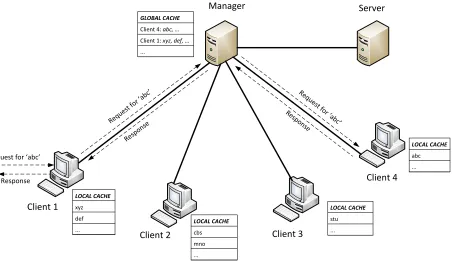
Cooperative caching systems are usually designed using a centralized approach. In this approach, if a
client receives a read request for a block but experiences cache miss, the request is forwarded to the
manager to lookup the global cache. The manager obviously knows which client„s cache has the block. If
there is a global cache hit, the manager redirects the request to the appropriate client. Otherwise, the
manager fetches the block from the server which may be a slow and a very expensive process. Figure 3
illustrates the clients that cooperate with each other to serve the block. According to the figure, the client
1 receives a request for block „abc‟ but it experiences the local cache miss. So, it looks up the global cache at the manager. The lookup operation reveals that client 4 has the block „abc‟. Then, the client 1 contacts the client 4 through manager asking for block „abc‟. Eventually, the „abc‟ block is served from
Client 1
Client 2 Client 3
Client 4
Manager Server
Requ est f
or ‘a bc’
LOCAL CACHE
xyz def ... Request for ‘abc’
LOCAL CACHE cbs mno ... LOCAL CACHE stu ... GLOBAL CACHE
Client 4: abc, ...
Client 1: xyz, def, ...
...
Req uest fo
[image:18.612.88.540.73.334.2]r ‘a bc’ LOCAL CACHE abc ... Respon se Resp onse Response
Figure 3: A centralized cooperative caching system. In this system, a single manager is responsible to
maintain the global cache.
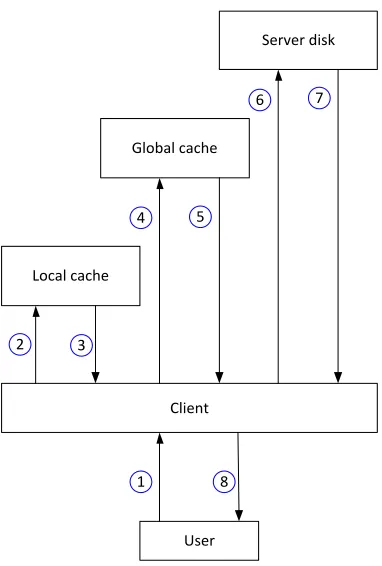
Figure 4 shows the layers of memory hierarchy used by the cooperative caching algorithm:
- Step 1: the client receives a block read request from a user;
- Step 2: the client looks up its local cache for a block;
- Step 3: if there is a cache hit, the client reads the block from its local cache;
- Step 4: if there is a cache miss, the client contacts the manager to look up the global cache;
- Step 5: if there is a global cache hit, the block is fetched from appropriate client‟s local cache;
- Step 6: otherwise (a global cache miss), the request is forwarded to the server;
- Step 7: the block is fetched from server and returned to the client;
- Step 8: the client saves the copy of block in its local cache and returns the original block to the
Local cache
Global cache
Server disk
Client
User 2
1 3
4 5
6 7
[image:19.612.211.402.68.351.2]8
Figure 4: Layers of memory hierarchy used by the cooperative caching algorithm.
5. Existing algorithms
5.1. N-chance algorithm
The N-chance algorithm is one of the pioneers in the field of cooperative caching. It uses a centralized
management approach to maintain its global cache. In this algorithm, the clients are responsible for
maintaining their local cache; the global cache is maintained by the manager. Moreover, the global cache
is shared among clients so that they can cooperate with each other when serving the blocks to the user. A
local cache is managed by a simple LRU cache replacement policy, but the global cache is coordinated
using a more sophisticated policy. In this policy, the clients either discard or forward the least favorable
block based on the number of copies of the block in the system. If the cooperative caching system
contains only one copy of a specific block, that block is called a singlet, otherwise it is considered as a
non-singlet. If the least valuable block is a singlet, that block is forwarded to a randomly selected client to
recirculation count N such that every time the block is forwarded, the count is decremented. Therefore,
the disk block is given N-chance to stay in the cooperative caching system. When the count reaches zero,
the block is discarded regardless of its singlet status [7].
The central manager component plays an important role in the N-chance algorithm. The manager is
responsible for global cache maintenance and lookup, and forwarding the block requests to the clients and
the server. Every time client caches or removes a block, it reports these changes to the manager. The
manager uses the information about changes to maintain the consistency of the global cache [7]. While
the N-chance is a decent cooperative caching algorithm, its scalability is reduced as the number of clients
or local cache size increases. For example, increasing the number of clients results in a sharp increase in
the communication overhead among the clients. Moreover, the N-chance algorithm consumes more
memory space for global cache when the number of clients increases.
5.2. Hint-based algorithm
In N-chance algorithm, the central manager is solely responsible for the maintenance of the global cache
that keeps the facts about the local cache contents. While these facts maintain the accurate state of the
global cache, keeping them up-to-date increases overhead on the manager. In order to address this
problem, the hint-based cooperative caching algorithm aims to relax the centralized control of global
cache. In particular, the algorithm distributes the portions of the global cache information among clients
as hints, so that clients can make local caching decisions such as forwarding the block requests and
relocating the blocks. On the other hand, the manager retains the control of the global cache, but it incurs
much less overhead from clients. Therefore, in the hint-based algorithm, the global cache is maintained by
both clients and the manager [8].
The hint-based algorithm uses the global cache to maintain the information about the location of a master
block. The master block locations are stored as facts or hints. The facts are stored in the manager and the
hints are stored in the client. When the block is fetched from the server for the first time and cached by a
client, it is designated as a master block [8]. The copy of the master block is called non-master block. The
hints reduce the client‟s dependence on the manager when performing such operations as request
forwarding or block relocation. However, the information provided by the hints is not accurate at all
times. The reason is that the hints are local to the client and they do not reflect the changes taking place in
the caches of other clients. For example, if a hint tells the client about the location of a particular master
block, it is not guaranteed that the block is present at the remote client‟s cache. The chances are that the
information about this change might not have been reflected in the client‟s hint. Thus, the hint gives client
only a clue about the probable location of a block in the cooperative caching system. On the other hand, a
hint prevents the client from frequently contacting the manager [8].
The cooperative caching operation in the hint-based algorithm is slightly different than in the N-chance
algorithm. In hint-based algorithm, if a client experiences a cache miss as a result of an inaccurate hint, it
contacts the manager for a fact. Once the client obtains the fact, it updates its appropriate hint with new
master block location information. Moreover, when the remote client discards or relocates the master
block, it updates the manager‟s global cache with a new location of the master block. On the other hand,
hints improve the performance of the caching algorithm and make it slightly scalable. This slight
scalability is contributed by the clients that partially share the responsibility of global cache maintenance.
Consequently, sharing of management among the clients reduces the overhead on the manager. Moreover,
managing hints in each client is less costly than managing facts, because the accuracy of hints needs not
to be maintained at all times [8]. While the hint-based algorithm promises better global cache
management, it introduces some problems that prevent the algorithm from being fully scalable. For
example, the block removal process may replace the master block with a useless non-master block.
Consequently, the local hints in other clients become obsolete and they will be required to contact the
manager to obtain the fact. This results in an increased communication overhead as the number of clients
increases. Also, it may take a while until hints are updated, thus a client is likely to make an inaccurate
local decision based on the obsolete hint. Such operation is unfavorable since inaccurate decisions
increase the cache miss rate [11].
6. New algorithm
6.1. Problems with existing algorithms
There are several problems associated with existing cooperative caching algorithms. The first problem is
related to the scalability of the algorithms. Current algorithms do not scale well when more clients are
connected to the cooperative caching system. As the number of clients increase, the number of messages
exchanged among clients grows exponentially and the manager becomes overloaded. For example, in the
N-chance algorithm, the singlet block is relocated to the remote client through the manager. When the
number of clients increases, such block relocation procedures happen more often. Consequently, the
The second problem is associated with a memory overhead on the global cache. Existing algorithms
consume large memory space for the global cache. As more clients are added to the system, the manager
has to allocate more memory space for the global cache. While some of the existing algorithms distribute
the global cache information among the clients, they still suffer from non-scalability. In such distribution
approach, the clients are responsible for maintaining the ever growing global cache information which
occupies a substantial space in the local cache. Leaving less space for the locally cached blocks increases
the client‟s cache miss rate. Overall, the communication and memory overheads make the existing
algorithms unworkable when the number of clients or local cache size increases.
The current thesis aims to develop the scalable cooperative caching algorithm that addresses the problems
related to the existing solutions. One of the goals of the new algorithm is to offer a scalable solution by
reducing the global cache size for two reasons. First, the global cache occupies the large fraction of
client‟s local cache and this reduces the cache hit rate. Second, the global cache is not used as often as a
local cache. The global cache is contacted only if a client experiences a local cache miss. Thus, the global
cache does not have to be kept up-to-date at all times. Besides offering a scalable solution, the new
algorithm also resolves the inefficient LRU policy used in the clients‟ local cache. For example, during
the block removal process, the LRU does not take into account the value of the block. Consequently, the
valuable master block or the singlet may be removed from the cache. As a result, a local cache may
become occupied with the less valuable non-master or non-singlet block. So, the new algorithm
implements custom local cache replacement policy that retains the most valuable blocks in the cache for a
longer time to increase the cache hit rate.
6.2. Cache summary
In order to reduce the global cache size, this research uses a cache summary. The cache summary
represents the list of the blocks cached in the memory, but the contents of the blocks are not included in
the summary. Therefore, the size of the cache summary is usually less than the actual cache. Applying the
cache summary concept into the global cache may help the existing algorithms to be scalable. Moreover,
the manager would have an ample free space in its global cache to store more local cache information.
The cache summary is also used in decentralizing the global cache management. In this case, the global
cache content is stored as a cache summary in each client. The cache summary does not have to be
accurate or up-to-date at all times. For example, it does not have to be updated every time the new block
is cached, but instead the updates can happen at regular time intervals [2]. Therefore, using the cache
A decentralized algorithm that uses cache summary resolves the communication overhead problem
incurred by the exiting solutions [2]. In typical client/server architecture, the communication overhead is a
set of messages exchanged among the clients and the server. In case of decentralized algorithm, the
overhead is calculated as the frequency of global cache update and block relocation operations. The
frequency of updates is reduced either by delaying the update or by running the update in regular time
intervals. The first method entails the delaying of the global cache update until the amount of newly
cached blocks reaches a certain threshold. The second method simply updates the global cache on a
regular time interval [2]. The current research applies the second method to the new algorithm because
the content of the global cache tends to change frequently.
The cache summary is usually stored in a primary memory rather than a disk for two reasons. First, the
primary memory is much faster than the disk. Second, the disk arm creates input/output (I/O) bottleneck
when reading or writing the data to the disk. However, this bottleneck can be avoided by using a recent
secondary storage technology such as a flash memory or a solid state drive [10]. In order to store the
cache summary in the primary memory, it first needs to be created. There are two popular methods used
to create a cache summary: data compression and data approximation.
6.2.1. Data compression
The data compression method compresses each block in order to reduce the overall cache size. However,
block‟s ID is left uncompressed because it will be used as an index in the cache lookup operations. The rest of the block‟s attributes, such as its size and last access timestamp, are compressed. The data
compression operation can be performed efficiently by using third-party software libraries. These libraries
simplify the implementation of the new caching algorithm [10]. However, there are several problems
associated with data compression. First, the compression operation may not be effective for small size
blocks. The small size blocks do not use much memory, so it may not be necessary to compress them at
all. Second, the compressed blocks have to store metadata information in order to be decompressed. The
experiments conducted over zlib software library shows that compressing the small sized block actually
increases its final size due to its metadata overhead [10]. This problem can be resolved by compressing a
group of blocks together. However, if one of the blocks needs to be accessed in the group, the entire
group of blocks has to be decompressed. Alternatively, a special compression algorithm may need to be
developed that works efficiently with small size blocks. Third, the compression/decompression operations
are computation intensive. This places an additional computational overhead to each block read request
6.2.2. Data approximation
The data approximation method entails keeping an approximate state of the cache. One way to
approximate the cache content is to use a probabilistic data structure called a bloom filter. The bloom
filter is an array that only requires a block‟s ID to insert the block into the cache [18]. It also determines
the presence of the block in the cache with high probability. However, this probabilistic data structure
may cause the following types of errors: false caches miss (i.e. false negative) and false cache hit (i.e.
false positive). The false cache miss happens when the particular block is stored in the cache, but the
bloom filter says otherwise. In this case, the block request is not sent to the remote client that actually
possesses the block. On the other hand, the false cache hit occurs when the block is not stored in the
client‟s cache, but the bloom filter says otherwise. Consequently, the request is redirected to the remote
client, but no block is received in return. Even though these errors affect the cache hit ratio, using a bloom
filter does not influence to the correct operation of the new caching algorithm. For example, a false cache
hit does not result in a wrong block being served [2]. The chance of getting false positives and negatives
depends on the values of the parameters used to create a bloom filter. There are several advantages using
bloom filter in the global cache. One of them is that the size of the bloom filter is fixed so that it does not
use too much memory space. Also, the probability of getting false positives and negatives can be
controlled by proper choice of values for bloom filter parameters. On the other hand, the bloom filter can
only be used for cache lookup operation, and it cannot be used directly to store the block‟s other attributes
such as its size [10]. Moreover, data approximation method has a tradeoff between the memory space and
the data accuracy. For example, if the size of the cache memory reduces, the level of data approximation
increases.
6.3. Bloom filter
6.3.1. Mathematical description
A bloom filter is a probabilistic data structure that uses cryptographic hash functions. From a
mathematical perspective, the bloom filter is a way of representing a set A = {a1, a2… an} of n elements
using an m-bit array and a set of cryptographic hash functions H = {h1, h2… hk}. Initially, all values in the
array are set to zero. Then, each of the hash functions, h1, h2… hk, receives an element as an input and
produces a result within range {1, 2… m}. When inserting an element a into a set A, the values at the
positions h1(a), h2(a), … , hk(a) of an array are set to one. A deletion operation resets the values at the
same positions back to zero. In order to check if an element is in the set (i.e. a ∊A), the same procedure as
values. If any of value is zero, then a ∉A. Otherwise, it is speculated that a ∊A with certain probability.
For example, a particular bit might be set to one multiple times because of inserting a different element
into the same bloom filter. Thus, the bloom filter may claim that a ∊ A, but it may not be the case with
certain probability [2].
The bloom filter is usually created using the three important parameters: the bit-array size, the number of
expected elements and the number of hash functions. The bit-array size, designated as m, defines the
capacity of the array used in the bloom filter. Once the array is created, its size is not changed throughout
the life of the bloom filter. The number of expected elements in the array, designated as n, defines the
maximum number of blocks to be inserted into the bloom filter. Finally, the number of hash functions,
denoted as k, defines the quantity of the functions to be applied for each of the elements. Improper
construction of the bloom filter may result in conditions known as a false positive and a false negative.
For example, two elements a and b are inserted into the bloom filter using hash functions hi(a) and hj(b).
If these hash functions have the same output, the elements a and b are mapped into the same bit position
in the array [16]. When the element a is removed from the bloom filter, the value at bit position hi(a) is
reset to zero. This creates a potential false positive condition because the bloom filter now claims that the
element b still exists. However, removing the element a also flipped the value at bit-position hj(b) to zero
causing the element b not to be in the bloom filter. Another example is that if n > m, the bloom filter may
become unstable and produce more false positives and negatives. Therefore, the values of the parameters
m, n and k should be chosen carefully when creating a bloom filter so that the probability of false
positives and negatives are acceptable [16]. The idea behind the bloom filter is presented in Figure 5.
6.3.2. Tradeoff between bloom filter parameters
There is a tradeoff between a bloom filter parameters m and n, and its probability of false positives. In
order to measure this tradeoff, an equation between the parameters m, n and k has to be derived. The
probability that a certain bit in the bloom filter is not set to one by a hash function while inserting an
element is . The probability that the bit is not set to one by any of the hash functions is ( ) . If
n elements were inserted, the probability that a certain bit is still zero is ( ) ; therefore, the
probability that the same bit is one is ( )
[19]. Now, let us assume that each of the k array
positions are equal to one, or a particular element is in the set (i.e. a false positive), would be (
( ) ) ( ) .
1
0
1
0
1
0
0
1
0
0
0
0
1
0
m bits
Element a
h1(a) = 3
h2(a) = 13
h3(a) = 5
h4(a) = 8
Vector
[image:26.612.213.370.145.379.2]h5(a) = 1
Figure 5: The bloom filter data structure with hash functions [2].
The right hand side of the equation is simplified to which becomes as ( )
and it is simplified to the expression . This expression shows the
correlation between the three important bloom filter variables m, n and k. Calculating an optimal value of
k and substituting it in the above formula gives the formula ( ( ) )
( )
which can be
simplified to . Solving the equation by m results in the following equation [19]:
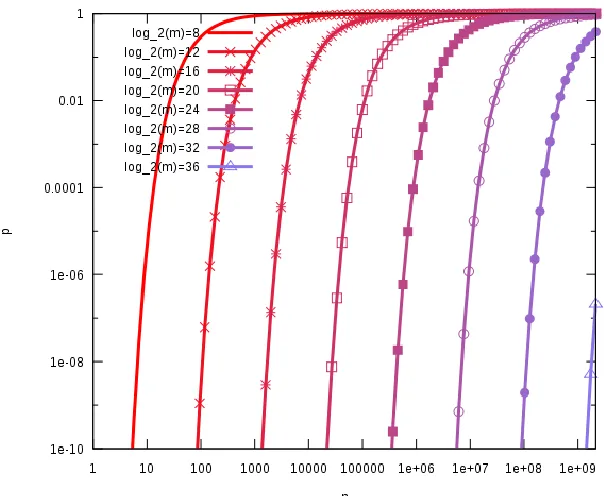
Plotting the above equation into a coordinate plane gives insight into the relationship between the bloom
filter parameters m and n, and its false positive probability (Figure 6). The plotted graph reveals that in
order to keep the value of a false positive probability fixed, m (the length of an array) and n (the expected
Figure 6: The false positive probability p as a function of the number of elements n in the bloom filter and its size m. An optimal number of hash functions have been assumed [19].
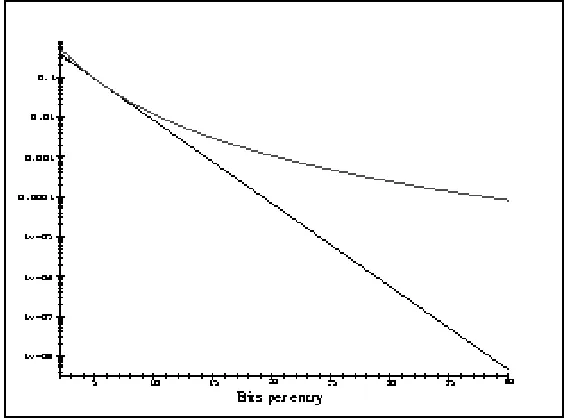
Figure 7 shows the probability of a false positive as a function of the number of bits allocated for each
element (i.e. m/n). The upper curve is produced in case of four hash functions. The lower curve produced
in case of the optimum number of hash functions. It can be concluded from Figure 7 that the bloom filter
consumes a little space per element with a slight risk of a false positive. For example, for an array ten
times larger than the number of cached blocks, the probability of a false positive is 1.2% with four hash
functions, and 0.9% for the optimum case of five hash functions. The probability of false positives can be
easily decreased by allocating more memory [2]. In other words, to maintain a fixed false positive
probability, m (the length of an array) has to grow linearly along with n (the expected number of elements
to be inserted into a bloom filter).
6.3.3. Comparison of a bloom filter and a hash table
This section compares the two data structures: a hash table and a bloom filter. The hash table is often used
in caching algorithms where each block is stored as an entry in the table. One of the problems associated
with the hash table is its tradeoff between the memory usage and the hash collision. In order to reduce the
likelihood of the hash collision, more memory space needs to be allocated in the hash table. For example,
the rate of hash collision can be reduced by using a load factor value or a self-balancing tree. The value of
located from each other, there is less chance of hash collision. However, the load factor value has to be
selected carefully because when this value is close to zero, the amount of unused entries in the hash table
increases [14]. Thus, the memory is wasted due to using the empty entries in the hash table. The other
method involves using a self-balancing tree for collision resolution. Even though the self-balancing tree
reduces the time complexity of common hash table operations, such as insertion, deletion and lookup,
from O(n) to O(log n), it still consumes significantly more memory. Thus, the collision resolution
strategies, such as a load factor value and a self-balancing tree, increases memory waste in the hash table
[image:28.612.164.448.234.444.2][14].
Figure 7: The probability of false positives. The top curve is produced when four hash functions are used.
The bottom curve is generated when an optimum number of hash functions are used [2].
There are several advantages of using a bloom filter over a hash table in the caching algorithms. First,
unlike the hash table, the bloom filter can store the entire universe of elements. Second, inserting an
element to the bloom filter never fails because the filter never becomes full. However, the probability of
false positives increases as more elements are added to the bloom filter [19]. While risking with the false
positives, a bloom filter gains a space advantage over a hash table. For example, the hash table stores the
contents of the block that can occupy an arbitrary amount of space depending on the block size. However,
the bloom filter only stores the IDs of the blocks and their contents are not included in the filter. This data
structure saves a significant amount of memory compared to the hash table. The bloom filter also has a
time advantage over insert and lookup operations. Time complexity of these operations are O(k) no matter
how many items are in the filter. Moreover, the performance of the bloom filter can be increased
significantly if it is implemented in the hardware. The reason is that the hardware allows parallelizing the
6.4. Proposed solution
The proposed solution entails the development of a decentralized cooperative caching algorithm using a
bloom filter. The architecture of the new solution would be different from that of previous solutions. In
particular, each client would have local and global cache components. Moreover, the local cache stores
the accurate state of the block including its content. However, the global cache stores approximate
information about the block. Due to the data approximation used in the global cache, there is a chance of
getting false positives and negatives. On the other hand, in the typical caching environment, the local
cache is accessed more frequently than the global cache. Therefore, the rate of occasional false positives
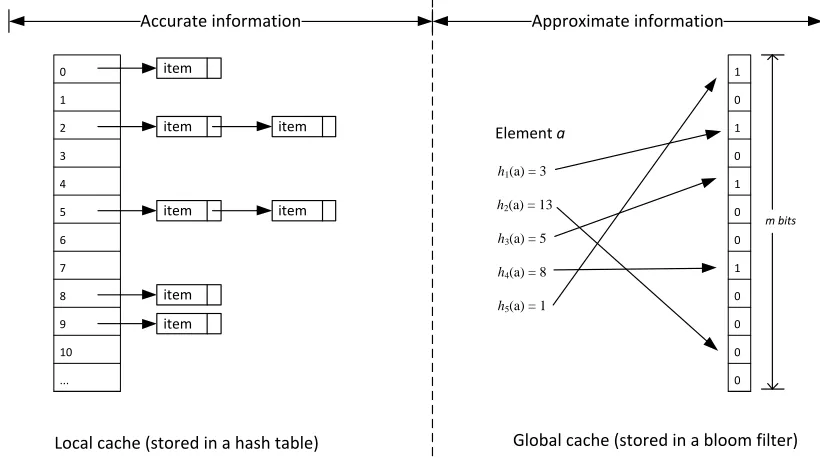
and negatives on the global cache is tolerable. Figure 8 illustrates the data structures used in the local and
global cache.
Accurate information
Local cache (stored in a hash table)
Approximate information
Global cache (stored in a bloom filter)
0 1 2 3 4 5 6 7 8 9 10 ... item item item item item item item 1 0 1 0 1 0 0 1 0 0 0 0
Element a
h1(a) = 3
h2(a) = 13
h3(a) = 5
h4(a) = 8
h5(a) = 1
[image:29.612.92.502.289.518.2]m bits
Figure 8: The data structures used in the local and global cache.
The proposed cooperative caching solution removes the global cache from the manager and distributes it
among the clients. Thus, each client maintains its own copy of the global cache. Moreover, the client has
to make sure that its copy of the global cache is up-to-date. Updating the global cache involves two-way
communication among the clients. First, the client has to calculate the fresh bloom filter from its local
cache and broadcast it among the other clients. The content of the global cache changes frequently,
therefore the bloom filter has to be calculated and broadcasted periodically. Second, the client
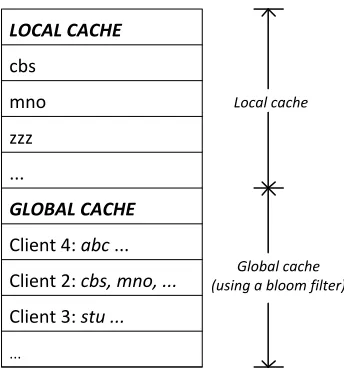
appropriate entry in its global cache. The role of the bloom filter in the proposed solution is depicted in
Figure 9.
LOCAL CACHE
cbs
mno
zzz
...
GLOBAL CACHE
Client 4: abc ...
Client 2: cbs, mno, ...
Client 3: stu ...
...
Local cache
Global cache (using a bloom filter)
Figure 9: The client’s cache memory composed of local cache and global cache.
The architecture of the new cooperative caching algorithm is similar to that of existing algorithms. As in
the existing algorithms, the client receives a block read request from the user. If there is a local cache hit,
the client serves the block from its local cache. Otherwise, the client does not contact the manager for the
global cache, because the manager no longer maintains the global cache. Instead, in the new algorithm,
the client looks up its copy of the global cache and makes a local decision. If there is a global cache hit,
the client contacts to an appropriate remote client for the block. Otherwise, the request is redirected to the
manager that fetches the block from the server‟s disk. Figure 10 shows the overall architecture of the
proposed solution. In this figure, the client 1 receives a request for the block. First, the client 1 searches
its local cache for the block, but the client cannot find the block. Then, the client looks up its copy of the
global cache without contacting the manager. It turns out that the client 4 has the required block, thus the
client 1 directly contacts the client 4 to read the block from its local cache.
The bloom filter plays an important role in the proposed cooperative caching algorithm. In the new
algorithm, each entry in the local cache is organized as a key/value pair. The key represents the block‟s
ID and the value denotes the block‟s content. However, the global cache uses a bloom filter which is only
concerned with storing the keys. Thus, when the bloom filter performs a cache lookup operation, the
response time is significantly faster. On the other hand, the values are stored in the local cache of remote
clients. Consequently, the time to access these values becomes large because of the network latency. The
remote client is contacted only if the bloom filter‟s lookup operation returns a positive result [1]. Figure
Client 1
Client 2 Client 3
Client 4
Manager Server
Request for ‘abc’
Requests for ‘abc’, ‘cbs’,’www’ Response Response LOCAL CACHE xyz GLOBAL CACHE
Client 4: abc ...
Client 2: cbs, mno
…
LOCAL CACHE
cbs mno GLOBAL CACHE
Client 4: abc ...
Client 2: cbs, mno
…
LOCAL CACHE
stu GLOBAL CACHE
Client 4: abc ...
Client 2: cbs, mno
…
LOCAL CACHE
abc GLOBAL CACHE
Client 3: zzz ...
Client 2: cbs, mno
…
Req uest for
‘cbs’ Resp
onse
Requ est f
or ‘w ww’
Resp onse
Request for ‘www’
[image:31.612.83.543.71.396.2]Response
Figure 10:The architecture of the proposed solution.
Bloom filter
Filter: NO
Do you have “key1”?
NO
Do you have “key2”?
Filter: YES
Remote client’s cache
Cache: NO
Cache: YES
Necessary cache access
YES. Here is value for “key2"
Do you have “key3”?
NO
Filter: YES
False positive Unnecessary cache access NO
Cache: NO
YES. Here is value for “key2"
[image:31.612.151.453.474.695.2]6.5. New algorithm
The results of the experiments on the new cooperative caching algorithm show that it meets the expected
performance mark claimed by the hypothesis. The new algorithm performs the caching operations – cache
lookup, block removal and relocation, cache consistency – using less computer resources as measured by
the complexity analysis. Moreover, unlike the existing algorithms, the new algorithm uses less memory
for the global cache information. Also reduced was a communication overhead among the clients which
make the new algorithm scalable. The experiments are used to validate the correctness and advantages of
the new algorithm.
6.5.1. Algorithm environment
The environment of the new algorithm involves input data, output data and internal data structures on
which the algorithm operates. The input to the algorithm is a list of numbers of an int data type. The list of numbers represents the ID of the blocks. The algorithm returns the object of type DiskBlock, which represents the returned block, as an output. Moreover, each client maintains a local cache memory of size
M. The cache memory can contain several cache blocks of size m. The
![Figure 1: A computer memory hierarchy [13]. In one extreme, the cache size is smaller but its performance is faster, however it is otherwise in another extreme](https://thumb-us.123doks.com/thumbv2/123dok_us/51877.4738/13.612.129.491.455.690/figure-computer-memory-hierarchy-extreme-smaller-performance-extreme.webp)
![Figure 2: Comparison of mapping functions [21].](https://thumb-us.123doks.com/thumbv2/123dok_us/51877.4738/15.612.163.452.120.179/figure-comparison-of-mapping-functions.webp)
![Figure 5: The bloom filter data structure with hash functions [2].](https://thumb-us.123doks.com/thumbv2/123dok_us/51877.4738/26.612.213.370.145.379/figure-bloom-filter-data-structure-hash-functions.webp)