Glesk, I. and Andonovic, I. and Michie, C. (2010) Increasing transmission efficiency with advanced
signal processing. In: International Conference on Renewable Energies and Power Quality
(ICREPQ’10), 23-25 March, 2010, Granada, Spain.
http://
strathprints
.strath.ac.uk/16687/
Strathprints is designed to allow users to access the research output of the University
of Strathclyde. Copyright © and Moral Rights for the papers on this site are retained
by the individual authors and/or other copyright owners. You may not engage in
further distribution of the material for any profitmaking activities or any commercial
gain. You may freely distribute both the url (
http://
strathprints
.strath.ac.uk
) and the
content of this paper for research or study, educational, or not-for-profit purposes
without prior permission or charge. You may freely distribute the url
(
http://
strathprints
.strath.ac.uk
) of the Strathprints website.
European Association for the Development of Renewable Energies, Environment and Power Quality (EA4EPQ)
International Conference on Renewable Energies and Power Quality (ICREPQ’10)
Granada (Spain), 23rd to 25th March, 2010
Increasing transmission efficiency with advanced signal processing
I. Glesk, I. Andonovic, C. Michie
Department of Electronic and Electrical Engineering University of Strathclyde
204 George St, Glasgow G1 1XW, UK
Phone/Fax number: +44 141 5482529/ +44 141 552 4968, e-mail address: [email protected], [email protected], [email protected]
Abstract.
Optical CDMA is an advanced and flexiblecommunication technology with a potential to offer very energy efficient and highly scalable networking. In addition it can also deliver increased physical layer privacy and on-demand bandwidth sharing management. We have developed, extensively investigated, and experimentally demonstrated highly scalable approach to incoherent OCDMA which can very efficiently increase the number of simultaneous users. In addition, the introduction of an advanced photonic signal processing results in an overall system power budget improvement by nearly 3dB. Error-free operation with the BER less than 10-12 was achieved. We have also shown that with demonstrated approach we can dramatically improve number of simultaneous network users (up to ten times) while keeping the related hardware count unchanged. By comparing this results to DWDM concept, this substantial increase in number of simultaneous users did not require to add any additional wavelength laser sources and was achieved by employing just three communication wavelengths.
Key words
Optical CDMA, DWDM, network scalability, all-optical signal processing, energy efficiency.
1.
Introduction
Today widely used Dense Wavelength Division Multiple Access (DWDM) in data and telecom networks offers many advantages. However, in DWDM systems the number of network users is govern by the number of wavelength channels available and therefore must be supported by the equal number of wavelength sources. The effect is called hard limit on the number of simultaneous users.
Code Division Multiple Access (CDMA) is another approach to data transmission which is widely used in the mobile networks world wide, including the USA. Its optical version Optical CDMA (OCDMA) has been intensively studied since the mid-1980s. Until recently, the interest into practical application of Optical CDMA has been limited primarily due to the unavailability of cheep complex photonic components and a lack of adequate optical technologies. However, recent
improvements in fiber optic and photonic technologies substantially helped to advance the OCDMA practicality. In our incoherent approach to OCDMA we have developed advanced and highly flexible scheme which offers superior scalability, suppresses Multi Access Interference (MAI) while at the same time improves the overall system power budget and therefore is more energy efficient. We demonstrated by simulations and experimentally that introduction of advanced photonic signal processing in conjunction with a proper OCDMA code selection will dramatically improve overall system performance, will help to increase number of simultaneous users while on other hand keeps the original hardware count unchanged, thus delivering energy more efficient approach to data transmission. OCDMA soft blocking capabilities also offer several advantages over traditional approaches - for example used by DWDM or OTDM - which they both suffer from hard blocking limitations.
2.
Improving Coding Efficiency
In the search for advanced coding schemes, Tancevski and Andonovic introduced the prime-hop code [1]-[2] having every pulse of every binary code sequence of the original prime code encoded at a distinct wavelength. This resulted in a class of two-dimensional (2-D) optical orthogonal codes with zero autocorrelation side lobes and at most one cross-correlation function. Thus for a given prime number p, p different wavelengths are used
providing a factor of p more code sequences than the
original prime code. However the prime-hop codes cardinality has been still limited and not flexible enough if compared to the family of carrier-hopping prime codes [3].
The performance of an OCDMA system based on the (LxN, w, 0, 1) carrier-hopping prime code (L is the
number of wavelengths, N is the number of chips, and w
is the code weight) can be easily calculated. The probability q to overlap one of the pulses in a signature
matrix x with a pulse in another matrix y can be
matrix and therefore [3]:
q = (1/2) w2 (LN x)-1 (1)
where the factor 1/2 comes from the assumption of equiprobable transmissions of data bit zero or one. The parameter x is equal to a chip width divided by the
bandwidth of the all-optical sampler used by the OCDMA receiver (explain later).
The error probability Pe in such wavelength-time approach to carrier-hopping prime code and additional introduction of hard limiting by the receiver will be then given by the equation:
( )
1 01
1
2
1
− =⎟
⎠
⎞
⎜
⎝
⎛ −
⎟⎟
⎠
⎞
⎜⎜
⎝
⎛
−
=
∑
K Th i i ew
iq
i
w
P
(2)where Th denote the decision threshold of the receiver and K the total number of simultaneous users in the
system, respectively. (For optimal system operation This usually set to be equal to a code weight w).
As the Equation 2 indicates the error probability improves with an increasing number of wavelengths L
and/or with the increasing number of chips N. Because of
code properties, the carrier-hopping prime code through the adjustment of the number of wavelengths, or the number of chips, or both, can deliver the targeted BER for the targeted number of simultaneous users K, thus
provide flexibility and at the same time very robust system performance with much larger cardinality and the also increased number of simultaneous users. It is also note worthy to mentioned that it can also enhance privacy by a random fashion dynamic code allocation. In addition we found because no sidelobes are present, 2-D carrier-hopping time-spreading prime codes are the preferred choice for the use in applications with a time gated OCDMA receiver design. We have proposed and demonstrated such a receiver and used it also to suppress MAI noise. The implementation of this type of receiver delivers further improvements in a system scalability directly leading to additional increase in number of simultaneous users while maintaining the hardware count at the previous unchanged level.
3.
Experimental Results
Based on the above, 2-D (3,11) carrier-hopping time-spreading prime codes (three wavelengths (λ1, λ2, λ3) and
11 chips) were implemented. The number of chips was determined based on a 12.5 GHz photodiode used in the conventional OCDMA receiver. The testbed architecture used was an optical bus running at 1.25Gbit/sec data rate. Wavelengths were obtained by spectral slicing of optical supercontinuum with 200 GHz thin film filters (TFFs) each centered at λ1 = 1550.12 nm, λ2 = 1551.72 nm, λ3 =
1553.33 nm, and λ4 = 1544.06 nm, respectively.
Wavelengths λ1 through λ3 were used by OCDMA
transmitters to generate 2D-OCDMA carrier-hopping time-spreading prime codes. The wavelength λ4 was
dedicated as a control signal needed to enable to
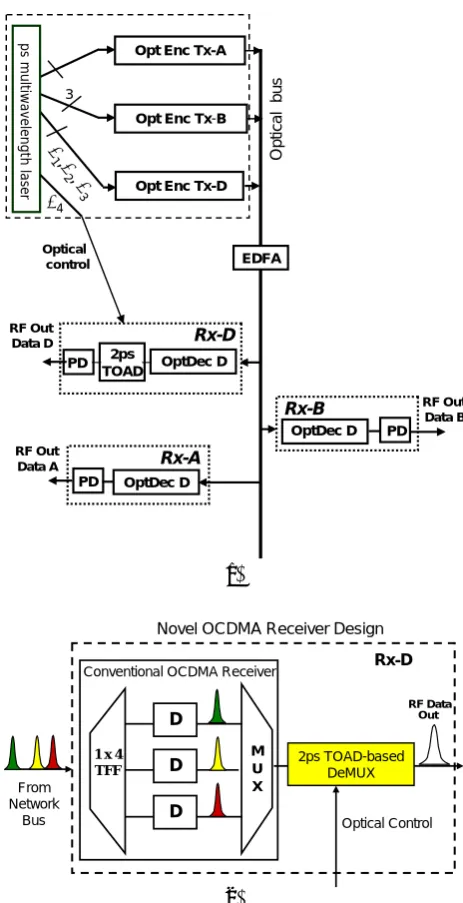
technique [4] which for comparison was used in conjunction with a traditional OCDMA receiver during the later second stages of our investigation. As it is evident from the Fig. 1 such approach was implemented only for the receiver Rx-D. Remaining receivers Rx-A and Rx-B were using a conventional OCDMA detection approach throughout all our investigation.
Opt Enc Tx-A
Opt Enc Tx-B
ps m ultiw av elengt h la ser 3
Opt Enc Tx-D
λ 1,λ
2,λ 3 λ4 Op tic a l b u s RF Out Data A OptDec D Rx-A RF Out Data B PD OptDec D Rx-B Optical control RF Out Data D OptDec D Rx-D 2ps TOAD PD PD EDFA (a) From Network Bus M U X D D D
1 x 4 TFF
2ps TOAD-based DeMUX Conventional OCDMA Receiver Rx-D
Novel OCDMA Receiver Design
Optical Control
RF Data Out
(b)
Fig. 1a). System network architecture; (b) Schematic diagram of the novel OCDMA receiver.
1 x 4 TFF -thin film filters; D-optical tunable delay line; MUX -optical power multiplexer.
[image:3.595.316.548.155.607.2]( a )
( b )
Fig. 2a). Output from receiver Rx-D tuned to transmitter Tx-D. Correlation peak (actual data) are surrounded by MAI noise caused by the presence of other transmitters on the network; b)
Output from Rx-D equipped with 2ps-TOAD-based all-optical DeMUX. Only signal from transmitter Tx-D is present; MAI
noise is effectively suppressed.
present on the network. Later, in the second stage of our investigation, this conventional receiver but now using a 2ps-TOAD-based all-optical DeMUX technique [4] was used to process the same received signal from the transmitter Tx-D (see Fig. 1b) for mare details). This resulted in a complete elimination of MAI noise which can be clearly seen in Fig. 2b) where no MAI is present anymore.
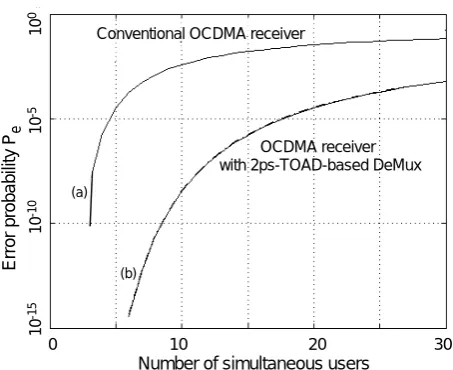
To quantitatively evaluate performance of 1.25Git/s OCDMA system with the conventional or a newly designed receiver deployed, calculations of error probability Pe as a function of number of simultaneous
[image:4.595.318.545.53.238.2]users were performed. Obtained results are shown in Fig. 3. The upper curve (a) is for the conventional OCDMA receiver Rx-D and predicts error-free operation for up to four simultaneous users. In our experiments BER better than 10-12 was measured when using a PRBS
231-1, no error floor was observed. These calculations
also predict, that the error rate will increase with any further increases in number of simultaneous users thus imposing limitations on system scalability.
Curve (b) in Fig. 3 represents calculation results when the same receiver Rx-D but coupled with 2ps-TOAD-based all-optical DeMUX is used. The implementation of such advanced receiver resulted in a significant increase in number of simultaneous users and also delivered quite dramatic BER improvements. The analyses for example indicates:
- If the BER is kept at 10-9, the predicted number of
simultaneous users will nearly triple by growing from four to ten (if compared to case (a)).
- In addition, if a Forward Error Correction technique, FEC is used to improve the raw BER from 10-4 to a
desired level say 10-9, the calculations based on curve (b)
predict that up to thirty simultaneous users could operate on the same network thus delivering a ten tenfold increase in number of simultaneous users. Please note only three wavelengths (compare to thirty needed in a
DWDM approach) are required.
0 10 20 30
10
-15
10
-10
10
-5
10
0
Number of simultaneous users
Er
ror
pr
oba
bi
lit
y
P
e
Conventional OCDMA receiver
OCDMA receiver with 2ps-TOAD-based DeMux
(a)
(b)
Fig. 3. Simulation results showing an error probability as a function of the number of simultaneous users. Top curve: Incoherent OCDMA receiver Rx-D not equipped with the time
gate; bottom curve: Receiver Rx-D with 2ps all-optical time gating capabilities.
The Fig. 4 shows experimental data where, correspondingly, the BER measurements were taken when a conventional OCDMA receiver Rx-D alone was used to process data from transmitter Tx-D (triangles), from Tx-D + Tx-A (squares), and from Tx-D + Tx-A + Tx-B (circles), respectively. The untreated impact of the MAI noise on the receiver performance can be clearly noticed as the power penalty which grows with increasing number of simultaneous users and causes the shift of the BER curve to the right with every additional active user coming on the network. This “forces” transmitter Tx-D to transmit more and more power in order to maintain the same BER performance. This results in power consumption increases and system performance degradation.
Power [dBm]
10-2
10-4
10-6
10-8
10-10
10-12
BER
-28 -26 -24 -22 -20 -18 -1
Tx-D Tx-A & Tx-D
Tx-A,Tx-B,Tx-D
Tx-A,Tx-B,Tx-D no gating
with DeMUX
Fig. 4. BER measurements. Rx-D no time gating: Tx-D only (triangles); Tx-A + Tx-B (squares); Tx-A + Tx-B + Tx-D (circles); Rx-D with 2ps-time gate: Rx-A + Tx-B + Tx-D
(diamonds).
[image:4.595.49.283.63.231.2] [image:4.595.315.547.492.669.2]Tx-confirmed that this new receiver successfully suppresses MAI noise (seen Fig. 2b) and by doing so introduces a
negative power ‘penalty’ of approximately -3dB (note the
left shift of the BER curve (diamonds) in Fig. 4. This resulted in the overall system budget improvement and secondly, contributed to the already discussed increase of a system scalability.
4. Conclusion
The demonstrated 1.25Gbit/s incoherent CDMA system has superior scalability and a significantly improved power budget.
The increase in the system scalability offers significant improvements in number of simultaneous users and was achieved by elimination of MAI noise by using all-optical signal processing in conjunction with traditional OCDMA receiver.
The theoretical performance analyses of the system with implemented two dimensional frequency-hopping time-spreading incoherent coding scheme was carried out. Two cases were examined. First, with data detection done by a conventional OCDMA receiver and the second, when a 2ps-TOAD-based all-optical demultiplexing technique was implemented in conjunction with the conventional OCDMA receiver. Error-free operation with a BER less than 10-12 was demonstrated.
Obtained experimental results show that such an advanced receiver could not only eliminated the MAI noise but at the same time improved overall system power budget by as much as 3dB. The use of this receiver significantly increases number of simultaneous users (by nearly tree times) all without any degradation of BER performance. In addition, if a Forward Error Correction (FEC) technique to improve 10-4 raw BER is
implemented to achieve targeted level of BER say 10-9,
then number of simultaneous user will further increase nearly three times -- from eleven to thirty.
By comparing these results to a DWDM approach, this increase in number of simultaneous users does not
required any additional wavelength laser sources and could be achieved by using only three communication
wavelengths.
References
[1] L. Tancevski and I. Andonovic, “Wavelength hopping time spreading code-division multiple-access systems,” Elect. Lett. 1994, Vol. 30, pp. 1388-1390.
[2] L. Tancevski and I. Andonovic, “Hybrid wavelength hopping/time spreading schemes for use in massive optical networks with increased security,” IEEE J. Lightwave Tech. 1996, Vol. 14, 2636-2647.
[3] G.-C. Yang and W.C. Kwong, Prime Codes with Applications to CDMA Optical and Wireless Networks, Artech House, Norwood (2002).