
This is a repository copy of
On the Security of Large Scale Spectrum Sharing Networks
.
White Rose Research Online URL for this paper:
http://eprints.whiterose.ac.uk/106832/
Version: Accepted Version
Proceedings Paper:
Deng, Y, Wang, L, Zaidi, SAR et al. (2 more authors) (2015) On the Security of Large
Scale Spectrum Sharing Networks. In: 2015 IEEE International Conference on
Communications. 2015 IEEE International Conference on Communications, 08-12 Jun
2015, ExCel London, IK. IEEE , pp. 4877-4882.
(c) 2015 IEEE. Personal use of this material is permitted. Permission from IEEE must be
obtained for all other users, including reprinting/ republishing this material for advertising or
promotional purposes, creating new collective works for resale or redistribution to servers
or lists, or reuse of any copyrighted components of this work in other works.
[email protected] https://eprints.whiterose.ac.uk/ Reuse
Unless indicated otherwise, fulltext items are protected by copyright with all rights reserved. The copyright exception in section 29 of the Copyright, Designs and Patents Act 1988 allows the making of a single copy solely for the purpose of non-commercial research or private study within the limits of fair dealing. The publisher or other rights-holder may allow further reproduction and re-use of this version - refer to the White Rose Research Online record for this item. Where records identify the publisher as the copyright holder, users can verify any specific terms of use on the publisher’s website.
Takedown
If you consider content in White Rose Research Online to be in breach of UK law, please notify us by
On the Security of Large Scale Spectrum Sharing
Networks
Yansha Deng
∗, Lifeng Wang
∗, Syed Ali Raza Zaidi
†, Jinhong Yuan
‡, and Maged Elkashlan
∗ ∗School of Electronic Engineering and Computer Science, Queen Mary University of London, London, UK† School of Electronics and Electrical Engineering, University of Leeds, Leeds, United Kingdom
‡School of Electrical Engineering and Telecommunications, The University of New South Wales, Sydney, Australia
Abstract—We investigate beamforming and artificial noise generation at the secondary transmitters to establish secure transmission in large scale spectrum sharing networks, where multiple non-colluding eavesdroppers attempt to intercept the secondary transmission. We develop a comprehensive analytical framework to accurately assess the secrecy performance under the primary user’s quality of service constraint. Our aim is to characterize the impact of beamforming and artificial noise generation on this complex large scale network. We first derive the exact expressions for the average secrecy rate and the secrecy outage probability. Our results show that there exists an average secrecy rate wall beyond which the primary user’s quality of service is violated. Interestingly, we find that different from the conventional network with fixed nodes where equal power allocation achieves near optimal average secrecy rate, the equal power allocation may not be a good option for large scale spectrum sharing networks.
I. INTRODUCTION
The sky-rocketing growth of multimedia infotainment appli-cations and broadband-hungry mobile devices (smart-phone, tablets, machine-to-machine (M2M) communication devices) exacerbate the stringent demand for high data rate and da-ta service. To cope with this, the Federal Communication Commission (FCC) approved to allow the unlicensed users to transmit on the spectrum reserved for the wireless broadband devices as long as the quality of service (QoS) of the primary network is satisfied [1–3]. This is the so-called cognitive radio networks (CRNs).
Due to the open and dynamic characteristics of cognitive wireless channels, new classes of security threats and chal-lenges are introduced into CRNs (opportunistic utilization of licensed channels). In this paper, we focus on the eavesdrop-ping attacks targeted at the secondary users (SUs), where the eavesdroppers attempt to intercept the transmission between the secondary transceivers [4]. In this case, the eavesdroppers always keep silent without transmitting any signals, and can hardly be detected by the SUs.
Recently, beamforming and artificial noise generation (BF&AN) at the legitimate transmitter has been proposed as a promising technique to confuse the eavesdroppers and enhance the security [5, 6]. In this paper, we study the se-crecy performance of large scale underlay spectrum sharing networks with BF&AN at the SU transmitter. Stochastic geometry and random geometric graphs are used to model the proposed network [7, 8]. Equipping the SU transmitter with multiple antennas capable of transmitting information signal
and artificial noise (AN) simultaneously brings array gains at the legitimate receiver and disrupts the reception at the eavesdropper. This will boost the signal-to-interference ratio (SIR) at the SU receiver while impair the received signals at the eavesdroppers. We concentrate on characterizing the impact of several key system parameters such as the power allocation factor, the number of antennas at the SU transmitter, the densities of PUs, SUs, and eavesdroppers on the secrecy performance. Our contributions are summarized as follows:
1) We quantify the permissive transmit power region where the primary network’s QoS can be guaranteed, as pre-sented in Theorem 1. It is shown that from the PU receiver’s perspective, the permissive transmit power region fluctuates significantly for different densities of SUs and PUs.
2) We derive the exact expressions for the average secrecy rate and the secrecy outage probability of the secondary network with BF&AN at the SU transmitters, as present-ed inTheorems 2and3. It is shown that there exists an average secrecy rate wall beyond which the PU receiv-er’s QoS is violated. It is revealed that the optimal power allocation factor which achieves the maximum average secrecy rate varies for different system parameters, and the equal power allocation may not achieve near optimal average secrecy rate.
II. SYSTEM ANDCHANNELMODEL
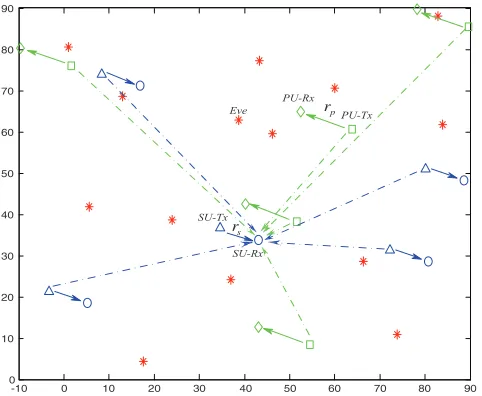
We consider the secure communication in an underlay spec-trum sharing network where the SU transmitters communicate with the corresponding SU receivers under the potential ma-licious attempt of multiple eavesdroppers, as shown in Fig. 1. Each SU transmitter hasNsantennas, and others in this model
are all single-antenna nodes. We have a set of PU transmitters, SU transmitters, and eavesdroppers locations, denoted byΦp,
Φs and Φe, in which Φp, Φs and Φe follow independent
homogeneous Poisson point processes (HPPPs) with densities
λp, λs and λe, respectively. This model is practical and
representative for the decentralized networks where each node has substantial mobility or networks deployed randomly [9]. Following the bipolar network model [10, 11], we assume that each PU/SU transmitter communicates with its unique associated intended PU/SU receiver at distances rp and rs,
PU-Tx PU-Rx
SU-Tx
[image:3.612.55.296.56.254.2]SU-Rx Eve
Fig. 1. A realization of a large scale spectrum sharing network model describing the received signal at a SU receiver. In this network, the green square represents the PU transmitter, the diamond represents the PU receiver, the triangle represents the SU transmitter, the circle represents the SU receiver, and the red star represents the eavesdropper. The blue solid line represents the secondary transmission, the green solid line represents the primary transmission, the blue dashed line represents the interference from the SU transmitter, and the green dashed line presents the interference from the PU transmitter.
The wireless channels are modeled as independent quasi-static Rayleigh fading. The eavesdroppers interpret the sec-ondary transmitter’s signal without trying to modify it. In this complex CRNs, we consider the interference-limited case where the thermal noise is negligible compared with the aggregate interference from other transmitters. Similar as [12, 13], we utilize the SIR to characterize the performance.
We mask the beamformed broadcast information with the AN at the SU transmitters to confuse the eavesdroppers. Each SU transmitter broadcasts the information-bearing sig-nals and artificial noise simultaneously. The AN is transmitted in the null space of the intended SU receiver’s channel, thus imposing no effect on the secondary channel, whereas degrading the eavesdropper’s channel. We denote the intended channel vector between theith SU transmitter(i∈Φs)and the
corresponding SU receiver ashi,si∈ C1×Ns, the channel state
information (CSI) of which is known at theith SU transmitter. An orthonormal basis of CNs×Ns is generated at the ith SU
transmitter as h†
i,si .
khi,sik, Gi,si
Ns×Ns
1
, whereGi,si is
aNs×(Ns−1)matrix. Note that each column ofGi,si and
h†
i,si .
khi,sik are mutually orthogonal. We define bi as the
information-bearing signal, andnA as the artificial noise. The
transmitted beamforming and AN symbol vector is modelled as
xsi =
h†
i,si
khi,sikbi+Gi,sinA, (1)
1†is the conjugate transpose operator.
whereEnbib†i o
=δ2
s, andNs−1 elements ofnA are
inde-pendent and identically distributed (i.i.d) complex Gaussian random variables with zero mean and variance σ2
n. Thus,
the total transmit power per transmission Ps is given by
Ps=PI+PA, where the power allocated to the information
signal is PI = σs2 and the power allocated to the AN is
PA= (Ns−1)σn2. We also defineµas the fraction of power
assigned to the information signal, thus,PI =µPs .
In the primary network, we consider an arbitrary pair of PU transceiver, referred to as the typical PU transmitter and receiver. We assume the typical PU receiver is located at the origin of the coordinate system, and the distance between the PU transmitter and its associated PU receiver isrp. According
to the Slivnyak’s theorem [14], adding a probe point to the HPPP at an arbitrary location does not affect the law of the point process. For each PU receiver, the information-bearing signal and AN generated by the secondary transmitter are regarded as interference, thus the received SIR at the typical PU receiver is given by
γSIRp,AN =
|hp0|
2
rp−α
Ip,p0+P
−1
p Is,p0
, (2)
where Ip,p0 =
P
j∈Φp\{0}|hj,p0|
2
|Xj,p0|
−α
, Is,p0 =
P i∈Φs
h
σ2shi,p0
h†i,si
h†i,si
2
+σ2nhi,p0Gi,si
2i Xi,p0
−α
. In
(2), α is the path-loss exponent, hp0 is the channel fading gain between the typical PU transmitter and the typical PU receiver, hj,p0 and|Xj,p0| are the interfering channel fading gain and distance between the jth PU transmitter and the typical PU receiver, respectively, hi,p0 ∈ C1×Ns and|X
i,p0| are the interfering channel vector and distance between the
ith SU transmitter and the typical PU receiver, respectively, andPp is the transmit power at the PU transmitter.
In the secondary network, we shift the coordinate system to put the typical SU receiver at the origin, and assume
h0,s0 ∈ C1×Ns and r
s to be the channel vector and distance
between the typical SU transmitter and corresponding typical SU receiver. Note that each SU transmitter transmits the signal vector expressed as (1), we obtain the effective signal
at the typical SU receiver as h0,s0xs0 = h0,s0 h
† 0,s0 kh0,s0k
b0+
h0,s0G0,s0nA = kh0,s0kb0. Due to the concurrent
transmis-sion in the underlay spectrum sharing network, the typical SU receiver is subject to the aggregate interference from the PU transmitters and other SU transmitters, thus, the received SIR at the typical SU receiver is given by
γSIRs,AN =
σ2
skh0,s0k
2
rs−α
Is,s0+PpIp,s0
, (3)
where Ip,s0 =
P
j∈Φp|hj,s0|
2
|Xj,s0|
−α
, Is,s0 =
P
i∈Φs\{0} h
σs2 hi,s0
h†i,si
h†i,si
2
+σ2n
hi,s0Gi,si
2i Xi,s0
−α
.
interfering channel vector and distance between the ith SU transmitter and the typical SU receiver, respectively.
In the eavesdropping channel, we consider the most detri-mental eavesdropper that has the highest SIR for a typical SU transmitter [15]. Note that eavesdroppers are only interested in the secondary transmissions, and interpret the primary transmissions as interference. This assumption is practical since the primary networks operate in the Digital Video Broad-casting (DVB) spectrum and broadcast the public service to households, which do not have any confidential messages. We assume h0,ek ∈ C1×Ns to be the channel vector between the
typical SU transmitter and an arbitrary eavesdropper ek ∈Φe.
As such, the SIR at the most detrimental eavesdropper is expressed as
γSIRe,AN = max ek∈Φe
n
γSIRek,AN
o
, (4)
where
γek,ANSIR =
σ2
s h0,ek
h†0,s0
kh†0,s0k
2
|Xek|−α
Is,ek+PpIp,ek+σ2nIs0,ek,an
. (5)
In (5), Ip,ek = Pj∈Φp|hj,ek|
2
|Xj,ek|−α, Is,ek = P
i∈Φs\{0} h
σs2hi,ek
h†i,si
h†i,si
2
+σn2hi,ekGi,si
2i
|Xi,ek|−α,
Is0,ek,an = kh0,ekG0,s0k
2
|Xek|−α. Note that hj,ek and
|Xj,ek| are the channel fading gain and distance between the
jth PU transmitter and the kth eavesdropper, respectively,
hi,ek ∈ C1×Ns and|X
i,ek|are the channel vector and distance
between the ith SU transmitter and the kth eavesdropper, respectively, |Xek| is the distance between the typical SU
transmitter and the kth eavesdropper.
To facilitate the performance analysis, we first present the Laplace transform of the aggregate interference from SU transmitters Is,z =Pi∈ΦsWsi,z|Xi,z|
−α
in (2), (3), and (4) as the following lemma, where z ∈ {p0, d0,ek}. Here, we
define Wsi,z = σs2 hi,z
h†i,si
h†i,si
2
+σ2nhi,zGi,si
2
, where
hi,si is the intended channel, and the BF&AN signal xsi in
(1) transmitted by the ith SU transmitter is received by the non-intended receiverz, rather than theith SU receiver.
Lemma 1. The Laplace transform of the interference from the
SU transmitters with BF&AN to the non-intended receiverIs,z
is derived as
LIs,z(s) =
exp−λsπP 2 α
s Υ1Γ 1−2αs
2 α
µ6= 1
Ns
exp−λsπ(µPs) 2 αΓ N
s+α2
Γ(1−2 α)
Γ(Ns) s
2 α
µ= Ns1 ,
(6)
where
Υ1=
1− (1−µ) (Ns−1)µ
1−Nsh
µα2Γ 1 + 2
α
− 1 µ
(1−µ)
Ns−1
1+
2 αNsX−2
k=0
1− (1−µ) (Ns−1)µ
kΓ k+ 1 + 2 α
Γ (k+ 1)
i
.
(7)
Due to the limited space, detailed derivation is not included.
III. EXACTSECRECYPERFROMANCE
In this section, we first present the SU’s permissive transmit power region, and then examine key secrecy performance, namely the average secrecy rate and the secrecy outage prob-ability, in large scale spectrum sharing network with BF&AN at the SU transmitters.
A. Beamforming and Artificial Noise Generation
1) PUs’ Quality of Service Requirement: According to the
rule of underlay spectrum sharing networks, the concurrent transmission of PUs and SUs occurs under the prerequisite that the QoS requirement of the primary transmission is satisfied. The QoS of primary network is characterized that the outage probability should be no larger than the peak allowable value
ρpout, which is expressed as
Pout{p}=P r
γSIRp,AN < γ
{p}
th < ρ
{p}
out, (8)
whereγth{p} is the desired SIR threshold at the PU receiver. In the following theorem, we present the SU’s permissive transmit power region.
Theorem 1. With BF&AN at the SU transmitter, the permis-sive transmit power region at the SU transmitter is given as
Ps∈(0, Psmax], where
Psmax=
− Θ
Υ1λs
α2
Pp µ6= Ns1
− ΘΓ(Ns)
λsΓ(Ns+2 α)
α2Pp
µ µ=
1
Ns,
(9)
Υ1 is given by(7), and
Θ = ln 1−ρ
{p}
out
πΓ 1−2
α
γth{p}
2 α
rp2
+λpΓ 1 +
2 α
. (10)
2) New Statistics: In order to examine the secrecy
perfor-mance, we derive the CDFs of SIRs at the typical SU receiver and the most detrimental eavesdropper in the following Lem-ma 2andLemma 3, respectively.
Lemma 2. With BF&AN at the SU transmitters, the CDF of SIR at the typical SU receiver is derived as
F{s}
γSIRs,AN γth{s}
= 1−exp −Λl γ
{s}
th
2 α
r2s
−
Ns−1
X
m=1
(rα s)
m
m!(−1)m
X m!
m Q i=1
mi!i!mi
exp −Λl γ
{s}
th
2 α
r2s
m Y
j=1
−Λl γth{s}
2 α
(rs)2−jα j−1
Y
k=0
2
α−k
mj
,
where
Λl=
Λ
2 µ= Ns1
Λ3 µ6= Ns1 . (12)
In (12),Λ2 and Λ3 are given by
Λ2=π
λs
Γ Ns+α2
Γ Ns
+λpΓ 1 +
2 α
µPs
Pp
−2 α
Γ 1− 2 α
,
(13)
Λ3=π
λpΓ 1 +
2 α Ps Pp − 2 α +λ
sΥ1
Γ 1− 2 α
(µ)−2α,
(14)
respectively. Here,
m P i=1
i·mi = m, and Υ1 is given by (7),
and Ps is the maximum permissive transmit power, which is
given in (9).
Based on the SIR at the most detrimental eavesdropper in (4), we derive the CDF for γe,ANSIR in the following lemma.
Lemma 3. With BF&AN at the SU transmitters, the CDF of SIR at the most detrimental eavesdropper is derived as
F{e}
γSIRe,AN γth{e}
=
exp−πλe Λl
γ{the}−
2
α 1−µ
Ns−1µ
γth{e}+ 1
1−Ns
,
(15)
where Λl is given in (12). Note that Ps is the maximum
permissive transmit power, which is given in(9).
We observe from (15) that the CDF ofγe,ANSIR is an increas-ing function ofλs andλp, and a decreasing function of λe.
3) Average Secrecy Rate: The instantaneous secrecy rate is
defined as [15]
Cse= [Csu−CE]+. (16)
where[x]+ = max{x,0}, C
su = log2 1 +γ s,AN SIR
is the ca-pacity of a typical secondary link, andCE= log2 1 +γSIRe,AN
is the capacity of the eavesdropping channel between the typical SU transmitter and the most detrimental eavesdropper. Here, γSIRe,AN = max
ek∈Φe
γSIRek,AN corresponds to the non-colluding eavesdropping case [16].
The average secrecy rate is the average of the instantaneous secrecy rateCseoverγSIRs,AN andγ
e,AN
SIR . As such, the average secrecy rate is given by [17]
¯
Cse=
Z ∞
0
Z ∞
0
Csefγs,AN
SIR (x1)fγ
e,AN
SIR (x2)dx1dx2
= 1 ln 2
Z ∞
0
Fγe,AN
SIR (x2)
1 +x2
1−Fγs,AN
SIR x2
dx2. (17)
0 4 8 10 12 A ve ra ge S ec re cy Ra te (bi ts /s /H z) 6 2 -20 30
-30 -10 0 10 20
Ps
(dB)
Ex. = 2, = 0.4
Simulation N s µ
Ex. = 4, = 0.4N s µ
Ex. = 6, = 0.4N s µ
Ex. = 6, = 0.6N s µ
[image:5.612.323.545.67.265.2]Ex. = 6, = 0.8N s µ
Fig. 2. Average secrecy rate of a large scale spectrum sharing network with the transmit power adaptation scheme. Parameters:λe=λp=λs= 10−4, α= 3,rp= 6,rs= 3,Pp= 15dB, andγ{p}
th = 6dB.
By substituting the CDF of γSIRs,AN in (11) and the CDF of
γSIRe,AN in (15) into (17), we derive the average secrecy rate in the following theorem.
Theorem 2. With BF&AN at the SU transmitters, the average secrecy rate is derived as
¯
Cse,AN =
1 ln 2
Z ∞
0
exp(−πλeΛl x2−
2 α( 1−µ
(Ns−1)µx2+ 1)
1−Ns
) 1 +x2
exp −Λlx2
2 αr2
s h
1 +
Ns−1
X
m=1
(rα s)
m
m! −1m
X
m!
m Y
j=1
((−Λlx2
2
α)(rs)2−jα j−1
Q k=0
(2
α−k)) mj
mj!j!mj
i
dx2,
(18)
whereΛlis given in(12). Here,Psis the maximum permissive
transmit power, which is given in(9).
4) Secrecy Outage Probability: The secrecy outage is
de-clared when the secrecy capacityCseis less than the expected
secrecy rate Rs. As such, the secrecy outage probability is
defined as [17]
Pout(Rs) = Pr (Cse< Rs)
=
Z ∞
0
fγe,AN
SIR (x2)Fγ
s,AN
SIR 2
Rs(1+x
2)−1dx2. (19)
By substituting the probability density function (PDF) of
γSIRe,AN and CDF of γ s,AN
SIR into (19), we derive the secrecy outage probability in the following theorem.
-20 30
-30 -10 0 10 20
P
(dB)
s 0
5 10 15
A
ve
ra
ge
S
e
c
re
c
y Ra
te
(bi
ts
/s
/H
z
)
Ex. λs =10−5, λp =10−4 Ex. λs =10−4, λp =10−4
Ex. 10−4, =
s
λ 10−5
=
p λ
[image:6.612.324.544.65.265.2]Ex. λs =10−3, λp =10−4 Ex. λs =10−4, λ = 5*p 10−5
Fig. 3. Average secrecy rate of a large scale spectrum sharing network with the transmit power adaptation scheme. Parameters:λe = 10−4, Ns = 6, α= 3,rp= 6,rs= 3,µ= 0.4,Pp= 15dB, andγth{p}= 6dB.
outage probability is derived as
Pout,AN(Rs) = Z ∞
0
πλex2−
2 α 2
αx2
−1 1−µ
(Ns−1)µx2+ 1
+ 1
Λl (Ns1−−µ1)µx2+ 1 Ns
exp −πλe Λl
x2−
2
α 1−µ
(Ns−1)µ
x2+ 1
1−Ns h
1−
exp −Λ3 2Rs 1+x2−1
2 α
rs2
1 +
Ns−1
X
m=1
rαsm
m! −1m
X
m!
m Y
j=1
((−Λl(2Rs(1+x2)−1)
2 α)(r
s)2−jα j−1
Q k=0
(2
α−k)) mj
mj!j!mj
i
dx2,
(20)
whereΛlis given in(12). Here,Psis the maximum permissive
transmit power, which is given in(9).
IV. NUMERICALRESULTS
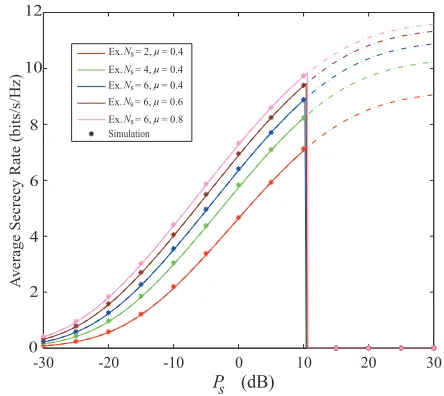
Fig. 2 and Fig. 3 plot the average secrecy rate of large scale underlay spectrum sharing network under the primary network’s QoS constraint ρ{outp}= 0.1 with the transmit power adaptation scheme. From the figures, we see that the exact an-alytical curves are well validated by Monte Carlo simulations. The solid lines represent the operational achievable average secrecy rate where the primary’s QoS constraint is always satisfied, i.e.Poutpri,AN γth{p}
≤0.1. The dashed lines represent the unachievable average secrecy rate where the primary net-work’s QoS constraint is violated, i.e. Poutpri,AN γth{p}
>0.1. We named the solid line as the “average secrecy rate wall”. The
0.3 0.6
0.1 0.2 0.4 0.5
0 0.7 0.8 0.9 1
µ 1
3 5 6
A
ve
ra
ge
S
e
c
re
c
y Ra
te
(bi
ts
/s
/H
z
)
4
2 7
[image:6.612.65.281.65.264.2]Optimal average secrecy rate Ex. λe =10−1 Ex. λe =10−2 Ex. λe =10−3
Fig. 4. Average secrecy rate of a large scale spectrum sharing network. Parameters:λp = 10−4,λs = 10−3, α= 3,rp= 6,rs = 3,Ns = 6, Pp= 15dB, andγth{p}= 0dB.
vertical line of this “average secrecy rate wall” is determined by the maximum permissive transmit power at the SUPmax
s ,
[image:6.612.50.305.352.517.2]which is quantified and evaluated by using (9).
Fig. 2 plots the average secrecy rate versus the SU’s transmit power with various numbers of transmit antennas Ns at the
SU and power allocation factorµ, and we consider the same density for PUs, SUs, and eavesdroppers. The exact analytical curves are obtained from (18). Several observations can be concluded as follows: 1) The width of the “average secrecy rate wall” is weakly dependent on the number of transmit antennas at the SU and the power allocation factor, which can be explained by (9); 2) For the fixed power allocation factor
µ= 0.4, the average secrecy rate increases with increasingNs;
3) For the same Ns, the average secrecy rate improves with
increasingµ, which shows more power should be allocated to the information signal in this scenario.
Fig. 3 plots the average secrecy rate versusPs for various
densities of PUs and SUs. We observe that 1) the “average secrecy rate wall” will be pushed to the left as the PUs and SUs become more dense. This can be predicted from (9) that
Psmax is a decreasing function of λp and λs; 2) With the
identical density of PUs, we see that the average secrecy rate decreases with increasing the density of SUs. This is because the aggregate interference from other SUs increases with increasingλs, which restricts the secrecy performance of
the typical SU; 3) Given the fixed density of SUs, the average secrecy rate decreases with increasingλpdue to the increased
aggregate interference from PUs.
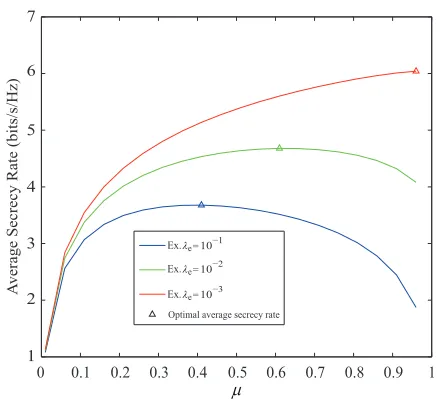
Fig. 4 plots the average secrecy rate versus the power allocation factor µ for various densities of eavesdropper λe.
Simulation
0.3 0.6
0.1 0.2 0.4 0.5
0 0.7 0.8 0.9 1
µ 10−1
S
ec
re
cy O
ut
age
P
roba
bi
li
ty
100
10−2
Ex. = 2, = 4N s α
Ex. = 3, = 4N s α
Ex. = 6, = 4N s α
[image:7.612.51.281.65.266.2]Ex. = 6, = 6N s α
Fig. 5. Secrecy outage probability versusµfor variousNsandα. Parameters: ρ{p}out= 0.1,λe= 10−4,λp= 10−4,λs= 10−3,α= 3,rp= 6, rs= 3, NS= 6, Rs= 1,Pp= 15dB, andγth{p}= 0dB.
set Ps = Psmax and ρ
{p}
out = 0.1. The triangles represent
the maximum achievable average secrecy rate. Interestingly, we find that in Fig. 4 the optimal power allocation factor
µ∗ varies for different λe. It is revealed that less power
should be allocated to the AN for the network with less dense eavesdroppers. More importantly, whenλe= 10−3, the
optimalµfor achieving the maximum average secrecy rate is close to 1. It is shown that the equal power allocation strategy
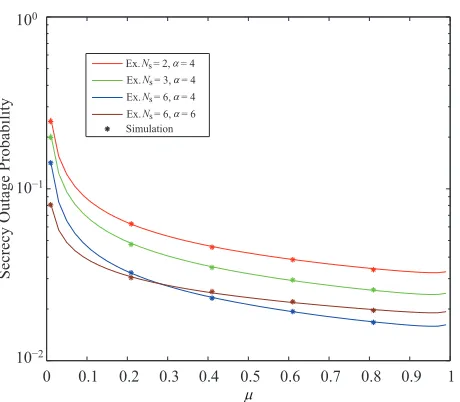
µ= 0.5 may not achieve near optimal average secrecy rate. Fig. 5 plots the secrecy outage probability versus the power allocation factor µ for various numbers of antennas at SU transmitterNs. The exact analytical curves are obtained from
(20), which are well validated by Monte Carlo simulations. We assume Ps = Psmax. We see that the secrecy outage
probability decreases with increasing µ. When µ approaches 1, the lowest secrecy outage probability can be achieved. This is because when we set the density of eavesdroppers to be small compared with the density of SU, the effect of delivering information overtakes the effect of combating the eavesdropping on the secrecy outage probability. As expected, the secrecy outage probability decreases with increasing Ns,
which is due to the array gains brought by additional antennas.
V. CONCLUSION
In this paper, we studied the secure communication in large scale spectrum sharing network in the presence of multiple non-colluding eavesdroppers. We employed the beamforming and artificial noise generation at the SU transmitters to achieve the secure transmission against those malicious eavesdroppers. We obtained the exact expression for the average secrecy rate, through which we observed the average secrecy rate wall. We also derived the exact expression for the secrecy outage probability. The impact of different system parameters on the
average secrecy rate and the secrecy outage probability was demonstrated. It is shown that the optimal power allocation factor that maximizes the average secrecy rate needs not to be the equal power allocation. The results in this paper provide valuable insights for the design of large scale spectrum sharing networks.
REFERENCES
[1] W. El-Hajj, H. Safa, and M. Guizani, “Survey of security issues in cognitive radio networks,”J. Internet Tech., vol. 12, no. 2, pp. 181– 198, 2011.
[2] A. Goldsmith, S. A. Jafar, I. Maric, and S. Srinivasa, “Breaking spectrum gridlock with cognitive radios: An information theoretic perspective,”
Proc. IEEE, vol. 97, no. 5, pp. 894–914, May. 2009.
[3] D. Liu, Y. Chen, K. K. Chai, T. Zhang, and M. Elkashlan, “Oppor-tunistic user association for multi-service hetnets using nash bargaining solution,”IEEE Commun. Lett., vol. 18, no. 3, pp. 463–466, Mar. 2014. [4] Z. Shu, Y. Qian, and S. Ci, “On physical layer security for cognitive
radio networks,”IEEE Netw., vol. 27, no. 3, pp. 28–33, Jun. 2013. [5] S. Shafiee and S. Ulukus, “Achievable rates in gaussian MISO channels
with secrecy constraints,” inProc. IEEE ISIT, Nice, France, Jun. 2007, pp. 2466–2470.
[6] S. Goel and R. Negi, “Guaranteeing secrecy using artificial noise,”IEEE Trans. Wireless Commun., vol. 7, no. 6, pp. 2180–2189, Jun. 2008. [7] P. C. Pinto, J. Barros, and M. Z. Win, “Secure communication in
stochastic wireless networks—part I: Connectivity,” IEEE Trans. Inf. Forensics Security, vol. 7, no. 1, pp. 125–138, Feb. 2012.
[8] G. Geraci, H. S. Dhillon, J. G. Andrews, J. Yuan, and I. B. Collings, “Physical layer security in downlink multi-antenna cellular networks,”
IEEE Trans. Commun., vol. 62, no. 6, pp. 2006–2021, Jun. 2014. [9] S. Weber, J. G. Andrews, and N. Jindal, “An overview of the
trans-mission capacity of wireless networks,”IEEE Trans. Commun., vol. 58, no. 12, pp. 3593–3604, Dec. 2010.
[10] M. Haenggi, J. G. Andrews, F. Baccelli, O. Dousse, and M. Franceschet-ti, “Stochastic geometry and random graphs for the analysis and design of wireless networks,”IEEE J. Sel. Areas Commun., vol. 27, no. 7, pp. 1029–1046, Sep. 2009.
[11] S. A. R. Zaidi, D. C. McLernon, and M. Ghogho, “Breaking the area spectral efficiency wall in cognitive underlay networks,” IEEE J. Sel. Areas Commun., vol. 32, no. 11, pp. 1–17, Feb. 2014.
[12] C. han Lee and M. Haenggi, “Interference and outage in poisson cognitive networks,” IEEE Trans. Wireless Commun., vol. 11, no. 4, pp. 1392–1401, Apr. 2012.
[13] X. Zhang, X. Zhou, and M. R. McKay, “Enhancing secrecy with multi-antenna transmission in wireless ad hoc networks,” IEEE Trans. Inf. Forensics Security, vol. 8, no. 11, pp. 1802–1814, Nov. 2013. [14] D. Stoyan, W. Kendall, and J. Mecke, “Stochastic geometry and its
applications,”Wiley New York, vol. 2, 1987.
[15] L. Dong, Z. Han, A. P. Petropulu, and H. V. Poor, “Improving wireless physical layer security via cooperating relays,” IEEE Trans. Signal Process., vol. 58, no. 3, pp. 1875–1888, Mar. 2010.
[16] X. Zhou and M. R. McKay, “Secure transmission with artificial noise over fading channels: Achievable rate and optimal power allocation,”
IEEE Trans. Veh. Technol., vol. 59, no. 8, pp. 3831–3842, Oct. 2010. [17] L. Wang, N. Yang, M. Elkashlan, P. L. Yeoh, and J. Yuan, “Physical
![Bis[bis(pentamethylcyclopentadienyl)cobalt(III)] tetrachloridocobaltate(II) dichloromethane disolvate](data:image/gif;base64,R0lGODlhAQABAIAAAP///wAAACH5BAEAAAAALAAAAAABAAEAAAICRAEAOw==)