
ROBUST LOCALIZATION OF MULTIPLE SPEAKERS EXPLOITING HEAD MOVEMENTS
AND MULTI-CONDITIONAL TRAINING OF BINAURAL CUES
Tobias May
Technical University of Denmark
Centre for Applied Hearing Research
DK - 2800 Kgs. Lyngby, Denmark
[email protected]
Ning Ma, Guy J. Brown
Speech and Hearing Research Group
Department of Computer Science
The University of Sheffield, UK
{
n.ma, g.j.brown
}
@sheffield.ac.uk
ABSTRACT
This paper addresses the problem of localizing multiple competing speakers in the presence of room reverberation, where sound sources can be positioned at any azimuth on the horizontal plane. To reduce the amount of front-back confusions which can occur due to the sim-ilarity of interaural time differences (ITDs) and interaural level dif-ferences (ILDs) in the front and rear hemifield, a machine hearing system is presented which combines supervised learning of binaural cues using multi-conditional training (MCT) with a head movement strategy. A systematic evaluation showed that this approach substan-tially reduced the amount of front-back confusions in challenging acoustic scenarios. Moreover, the system was able to generalize to a variety of different acoustic conditions not seen during training.
Index Terms— binaural sound source localization, head move-ments, multi-conditional training
1. INTRODUCTION
Human sound source localization performance is very robust, even in the presence of multiple competing sounds and room reverbera-tion [1]. The two main cues that are used by the auditory system to determine the azimuth of a sound source are interaural time differ-ences (ITDs) and interaural level differdiffer-ences (ILDs) [2]. However, these binaural cues are not sufficient to uniquely determine the lo-cation of a sound [3]. In particular, a given ITD value actually cor-responds to a number of possible locations that lie on the so-called
cone of confusion. Hence, if listeners were only to use these binaural cues, thenfront-back confusionswould frequently occur in which a source located in the front hemifield was mistaken for one located in the rear hemifield (or vice versa). In practice, human listeners rarely make front-back confusions because they also use informa-tion gleaned from head movements to resolve ambiguities [4, 3, 5].
The long-term aim of the current study is to incorporate human-like binaural sound localisation in a mobile robot with an anthropo-morphic dummy head. In a recent paper, we described a software ar-chitecture for computational auditory scene analysis (CASA), based on a blackboard system, that incorporates top-down feedback cir-cuits for sensory and motor control [6]. This opens up the possibil-ity of using head movements in a machine hearing system, and the prospect of human-like sound localization performance in challeng-ing acoustic conditions.
This work was supported by EU FET grant TWO!EARS, ICT-618075.
Machine hearing systems typically localize sounds by estimat-ing the ITD and ILD in a number of frequency bands, and then map-ping these values to an azimuth estimate. Even using static micro-phones, such approaches can achieve quite promising localization performance. In order to increase the robustness of computational approaches in adverse acoustic conditions, a multi-conditional train-ing (MCT) can be performed, in which the uncertainty of binau-ral cues in response to multiple sound sources and reverberation is modelled by supervised learning strategies [7, 8, 9]. For example, [9] report gross error rates of less than 5 % for source localization in a variety of reverberant rooms.
Given the good performance of such approaches, the question arises of whether head movements will provide a substantial benefit. However, we note that previous computational approaches have typ-ically been limited to locating sound sources in the frontal hemifield. Hence, although MCT has been shown to provide robust localization performance in the presence of multiple competing sources [7, 8, 9], the learned distribution of binaural cues for sound sources positioned in the front and rear hemifields will be quite similar. It is therefore likely that approaches that use MCT will still suffer from front-back confusions when tested under more demanding conditions. Also, previous work on binaural localization using mobile robots has typ-ically fused information from various positions, but has not used human-like head movements to resolve confusions (e.g., [10]).
The current paper has two aims. First, we describe a machine hearing approach that combines MCT with head movements in or-der to robustly localize sounds without front-back confusion, while considering the full azimuth range of360◦. Avirtual listener is used to verify our approach, in which binaural room impulse re-sponses (BRIRs) are used to spatialise sound sources and simulate head rotation. In our system, a head rotation is requested if the sound source azimuth cannot be unambiguously determined from the esti-mated ITDs and ILDs. A second aim is to determine whether MCT generalises to different conditions, given that our planned robotic platform may be tested in a variety of acoustic environments and might employ different dummy heads. Specifically, we aim to deter-mine whether a MCT-based sound localisation system can generalise to head related impulse responses (HRIRs) and room acoustics that have not been encountered during training.
2. SYSTEM DESCRIPTION
2.1. Binaural feature extraction
frequencies equally spaced on the equivalent rectangular bandwidth (ERB) scale between80and5000 Hz[11]. The envelope in each frequency channel was extracted by half-wave rectification. After-wards, ITDs (based on cross-correlation analysis) and ILDs were es-timated according to [7] independently for each frequency channel using overlapping frames of20 msduration with a shift of10 ms. Both binaural cues were combined in a two-dimensional (2D) fea-ture space~xt,f={itdˆt,f,ildˆt,f}, wheretandfdenote frame num-ber of frequency channel, respectively.
2.2. GMM-based localization
Sound source localization was performed by a Gaussian mixture model (GMM) classifier that was trained to capture the azimuth- and frequency-dependent distribution of the binaural feature space [7, 8]. Given a set ofKsound source directions{ϕ1, . . . , ϕK}, that are modeled by frequency-dependent GMMs{λf,ϕ1, . . . , λf,ϕK}, a 3D
spatial likelihood map can be computed for thekth sound source di-rection being active at time frametand frequency channelf
L(t, f, k) =p(~xt,f|λf,ϕk). (1)
The normalized posterior for each frametwas computed by inte-grating the spatial likelihood map across frequency
P(k|~xt) =
P(k)Q
fL(t, f, k) P
kP(k)
Q
fL(t, f,k)
, (2)
whereP(k)is the prior probability of each source directionk. As-suming no prior knowledge of source positions and equal probabili-ties for all source directions, Eq. 2 becomes
P(k|~xt) =
Q
fL(t, f, k) P
k
Q
fL(t, f,k)
(3)
To obtain a robust estimation of the sound source azimuth, the frame posteriors were averaged across time for each signal chunk consist-ing ofTtime frames to produce a posterior distributionPof sound source activity
P(k) = 1 T
t+T−1
X
t
P(k|~xt). (4)
The most prominent peaks in the posterior distributionPwere assumed to correspond to active source positions. To increase the resolution of the final azimuth estimates, parabolic interpolation was applied to refine the peak positions [12].
2.3. Multi-conditional training
The purpose of MCT is to simulate the uncertainties of binaural cues in response to complex acoustic scenes. This can be achieved by ei-ther simulating reverberant BRIRs [7, 8] or by combining HRIRs with diffuse noise [9]. In this study, binaural mixtures were cre-ated for the training stage by mixing a target source at a speci-fied azimuth with diffuse noise, which consisted of72uncorrelated, white Gaussian noise sources that were placed across the full az-imuth range (360◦) in steps of5◦. The target source was simu-lated by filtering a randomly selected male or female sentence from the TIMIT database [13] with an anechoic HRIR measured with a Knowles Electronic Manikin for Acoustic Research (KEMAR) dummy head [14]. The same HRIR database was also used for the noise sources.
The localization model was trained with a set of20binaural mix-tures for each of the72azimuth directions. For a given mixture,
the target source was corrupted with diffuse noise at three differ-ent signal-to-noise ratios (SNRs) (20,10and0 dBSNR), and the corresponding binaural feature space consisting of ITDs and ILDs was extracted. Only those features were used for training, for which thea prioriSNR between the target and the diffuse noise exceeded −5 dB. This negative SNR criterion ensured that the multi-modal clusters in the binaural feature space at higher frequencies, which are caused by periodic ambiguities in the cross-correlation analysis, were properly captured. In addition, an energy-based voice activity detector (VAD) was used to monitor the activity of the target source. A frame was considered to be silent and excluded from training if the energy level of the target source dropped by more than40 dB be-low the global maximum. The resulting binaural feature space was modeled by a GMM classifier with16Gaussian components and di-agonal covariance matrices for each azimuth and each subband. The corresponding GMM parameters were initialized by15iterations of thek-means clustering algorithm and further refined using5 itera-tions of the expectation-maximization (EM) algorithm.
In addition to the MCT-based model, a localization model based oncleanITDs and ILDs was trained with20binaural mixtures which contained the target source only. The feature distribution of the clean binaural feature space was well captured by a GMM with one Gaus-sian component.
2.4. Head movements
In order to reduce the number of front-back confusions, the local-ization model is equipped with a hypothesis-driven feedback stage which can trigger a head movement in cases where the azimuth can-not be unambiguously estimated.
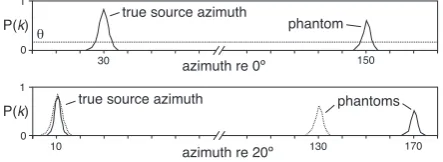
Therefore, the first half of the signal chunk (i.e., frames in the ranget= [1, T /2]) is used to derive an initial posterior distribution of the sound source azimuth. If the number of local peaks in the posterior distribution above a pre-defined thresholdθis larger than the number of required source positions, the azimuth information is assumed to be ambiguous, and consequently, a head movement is performed. In this study, we adopted a head movement strategy in which the head is rotated within the range of[−30◦,30◦]in the horizontal plane by a random azimuth degree. If a head movement is triggered, the second half of the signal chunk is re-computed with the new head orientation, and a second posterior distribution is obtained. Assuming that sources are stationary over the duration of the signal chunk, the initial source azimuth distribution before the head movement can be used to predict the the azimuth distribution after the head movement, given the head rotation azimuth angle. This is done by circular shifting the azimuth indices of the initial azimuth distribution by the amount of the rotation azimuth angle. If a peak in the initial posterior distribution corresponds to a true source
posi-azimuth re 20º
10 130
true source azimuth
phantom
150 30
0 1
P(k) θ
0 1
P(k)
azimuth re 0º
true source azimuth phantoms
170
[image:2.595.320.542.588.669.2]tion, then it should have moved towards the opposite direction of the head rotation and will appear in the second posterior distribution ob-tained for the second half of the signal chunk. On the other hand, if a peak is due to ‘phantom’ sources as a result of front-back confusion, it will not be occur at the same position in the second posterior dis-tribution. By exploiting this relationship, potential phantom source peaks are eliminated from both posterior distributions. Finally, the average of both posterior distributions is taken, giving a final poste-rior distribution for the signal chunk.
3. EVALUATION
3.1. Binaural listening simulation
In this study, binaural audio signals were created by convolving monaural sounds with HRIRs for anechoic conditions or BRIRs for reverberant conditions. Binaural mixtures of multiple simultaneous sources were created by spatialising each source signal separately before adding them together in each of the two binaural channels.
Two different sets of BRIRs were used to investigate the influ-ence of mismatched binaural recording conditions: i) an anechoic HRIR catalog based on the KEMAR dummy head [14]; ii) the Sur-rey database [15]. The anechoic KEMAR HRIRs were also used to train the localization models. The Surrey database was captured using a head and torso simulator (HATS) from Cortex Instruments, and includes an anechoic condition as well as four room conditions with various amount of reverberation. The Surrey anechoic condi-tion and the two rooms with the largestT60(room C:T60= 0.69 s,
DRR = 8.82 dB; room D:T60 = 0.89 s,DRR = 6.12 dB) were
selected.
Head movements were simulated by computing source azimuths relative to the new head orientation after a head rotation, and load-ing correspondload-ing HRIRs or BRIRs for the relative source azimuths. This simulation is valid for the two anechoic conditions, in which a head rotation to one direction is equivalent to rotating sources to the opposite direction of the head rotation. The BRIRs of the two room conditions were measured by moving loudspeakers around a fixed dummy head, and thus the simulation is only approximate for the reverberant spaces.
3.2. Experimental setup
The following four localization models were evaluated: (1) a model trained with clean ITDs only, (2) a model trained with clean ITDs and ILDs, (3) a model based on MCT using ITDs and ILDs, and (4) a model based on MCT using ITDs and ILDs, where the binau-ral feature space consisting of all azimuth angles was normalized to have zero mean and unit variance prior to estimating the GMM pa-rameters. All four localization models were tested with and without the head movement strategy as described in Sect. 2.4. The threshold above which activity in the posterior distribution was considered as source activity was set toθ= 0.01for all localization models.
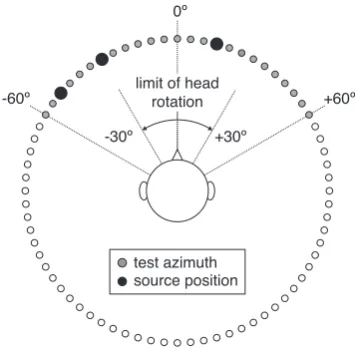
All the localization models were tested using a set of20 one-talker, two-one-talker, and three-talker acoustic mixtures. During test-ing, the sound source azimuth was varied in5◦ steps within the range of[−60◦,60◦], as shown in Fig. 2. Source locations were limited to this range of azimuths because the Surrey BRIR database only includes azimuths in the frontal hemifield. However, the system was not provided with information that the azimuth of the source lay within this range, and was free to report the azimuth within the full range of[−180◦,180◦]. Hence, front-back confusions could occur
-30º +30º
-60º
0º
+60º limit of head
rotation
test azimuth source position
Fig. 2. Schematic diagram of the virtual listener configuration, showing azimuths used for testing (filled circles). Black circles indicate source azimuths in a typical three-talker mixture (in this example, at−50◦, −30◦ and15◦). All azimuths were used for training. During testing, head movements were limited to the range
[−30◦,30◦].
if the system incorrectly reported that a source originated from the rear hemifield.
For the two-talker and three-talker mixtures, the additional az-imuth directions were randomly selected from the same azaz-imuth range while ensuring an angular distance of at least 10◦between all sources in a mixture. Each talker was simulated by randomly selecting a male or female sentence from the TIMIT corpus, which were different from the ones used for training. The individual sen-tences were replicated to match the duration of the longest sentence in a given mixture. Each sentence was normalized according to its root mean square (RMS) value prior to spatialization.
The localization performance was evaluated by comparing the true source azimuth with the estimated azimuth obtained from sig-nal chunks of500 msduration. The number of active speech sources was assumed to be knowna priori. For each binaural mixture, the
gross accuracywas measured for each signal chunk by counting the number of sources for which the azimuth estimate was within a pre-defined grace boundary of±5◦. In order to quantify the number of confusions, the quadrant error rate was computed, which was de-fined as the percentage of azimuth estimates for which the absolute error was greater than90◦.
4. EXPERIMENTAL RESULTS
4.1. Influence of MCT
[image:3.595.338.516.73.251.2]Table 1. Gross accuracy in%for various sets of BRIRs when localizing one, two and three competing speakers.
Head KEMAR [14] HATS [15]
move- Anechoic Anechoic Room C Room D
Method
ment 1 2 3 1 2 3 1 2 3 1 2 3
Mean
No 57.7 22.6 13.5 48.2 22.2 13.6 5.2 3.9 6.2 2.2 1.4 4.9 16.8
Clean ITD only
Yes 63.3 25.1 13.9 60.5 25.6 13.6 21.7 6.7 5.8 20.4 5.6 4.6 22.2
No 91.3 52.2 28.4 65.9 33.9 19.4 26.7 13.0 8.0 13.0 7.6 5.7 30.4
Clean
Yes 99.2 59.3 32.4 69.2 38.8 22.6 64.9 19.7 10.5 64.1 18.9 10.0 42.4
No 100 88.9 72.4 96.6 81.0 64.1 94.3 62.7 49.1 80.2 48.2 40.7 73.2
MCT
Yes 100 90.0 73.9 97.1 83.0 66.1 99.0 70.7 54.5 95.6 60.5 46.5 78.1
No 100 95.5 86.3 100 92.2 82.0 99.7 87.7 76.6 90.6 76.3 68.2 87.9
MCT + Norm
Yes 100 96.4 87.7 100 94.8 84.9 99.8 92.5 82.1 97.5 86.3 74.3 91.3
Nevertheless, performance dropped as soon as a different artificial head was used, either in anechoic or reverberant conditions. When using the MCT approach as described in Sect. 2.3, the system was substantially more robust in multi-talker scenarios and in the pres-ence of room reverberation. Also, in contrast to the localization models trained with clean binaural cues, the localization accuracy in anechoic conditions for a single source was100 %using either the KEMAR or the HATS artificial head, which indicates that the MCT also decreased the sensitivity to mismatches of the receiver. In addition, despite being trained with added white Gaussian noise, the model generalized to recorded BRIRs. This confirms that MCT can account for the distortions of ITDs and ILDs caused by real rever-beration. Finally, it can be seen that the feature space normalization provided a large benefit and increased the overall performance by al-most15 %. The normalization stage equalized the range of both ITD and ILD features, which apparently helped to control the weight of the individual GMM components.
4.2. Contribution of head movements
The head movement strategy as described in Sect. 2.4 improved the performance for all localization models. This benefit was particu-larly pronounced for the single-talker mixtures in the presence of strong reverberation (room C and D), where confusions are likely to occur due to the impact of reflections. Although the model based on clean ITDs and ILDs did not generalize well to the HATS artifi-cial head, the head rotation strategy helped to improve performance
with head movements no head movements
MCT + Norm MCT
Clean Clean ITD only
Per
cen
ta
ge
of
qu
ad
ra
nt
er
ro
rs
(
%
)
0 5 10 15 20 25 30 35 40 45
Fig. 3. Percentage of quadrant errors for the four localization models with and without head movements averaged across rooms and the number of speakers.
in room C and D by more than40 %for the single-talker scenario. Similarly, head movements were beneficial for the best MCT-based localization model, for which performance increased from90.6 %to
97.5 %for the most reverberant single-talker scenario.
To quantify the reduction in front-back confusions, the percent-age of quadrant errors averpercent-aged across all experimental conditions is shown in Fig. 3. It is apparent that the percentage of quadrant errors is systematically reduced, as both ITDs and ILDs are jointly evalu-ated in combination with the MCT strategy. In particular the MCT strategy substantially reduced the amount of front-back confusions. Nevertheless, there was still a considerable amount of confusion of almost11 %, which was reduced to5 %when the MCT-based lo-calization model was combined with the head rotation strategy. This indicates that head rotations provide complementary cues that can be effectively exploited by the localization model to disambiguate sources positioned in the front and in the rear hemifield.
5. DISCUSSION AND CONCLUSION
This paper presented a computational framework that combined the supervised learning of binaural cues with a head rotation strategy, with the aim of robustly estimating the azimuth of multiple speech sources. It was shown that MCT and head movements are com-plementary, and can be combined to effectively reduce the number of front-back confusions in challenging acoustic scenarios, includ-ing multiple competinclud-ing speakers and reverberation. Furthermore, a systematic evaluation revealed that the system was able to general-ize well to unseen acoustic conditions, including a different artificial head that was not used for training.
A simple head movement strategy was considered in the present study, where the rotation angle was randomly chosen and the head orientation was assumed to be stationary across time segments of
250 ms duration. In contrast, humans continuously exploit head movements and also apply different strategies, such as rotating the head towards the source of interest. There is considerable scope for investigating different strategies for head movement in future inves-tigations.
[image:4.595.52.278.539.676.2]6. REFERENCES
[1] M. L. Hawley, R. Y. Litovsky, and H. S. Colburn, “Speech intelligibility and localization in a multi-source environment,”
J. Acoust. Soc. Amer., vol. 105, no. 6, pp. 3436–3448, 1999.
[2] Jens Blauert, Spatial hearing - The psychophysics of human sound localization, The MIT Press, Cambride, MA, USA, 1997.
[3] F. L. Wightman and D. J. Kistler, “Resolution of front–back ambiguity in spatial hearing by listener and source movement,”
J. Acoust. Soc. Amer., vol. 105, no. 5, pp. 2841–2853, 1999.
[4] H. Wallach, “The role of head movements and vestibular and visual cues in sound localization,” Journal of Experimental Psychology, vol. 27, no. 4, pp. 339–368, 1940.
[5] K. I. McAnally and R. L. Martin, “Sound localization with head movements: Implications for 3D audio displays,” Fron-tiers in Neuroscience, vol. 8, pp. 1–6, 2014.
[6] C. Schymura, N. Ma, T. Walther, G. J. Brown, and D. Kolossa, “Binaural sound source localisation using a bayesian-network-based blackboard system and hypothesis-driven feedback,” in
Proc. Forum Acusticum, Krak´ow, Poland, 2014.
[7] T. May, S. van de Par, and A. Kohlrausch, “A probabilis-tic model for robust localization based on a binaural auditory front-end,” IEEE Trans. Audio, Speech, Lang. Process., vol. 19, no. 1, pp. 1–13, 2011.
[8] T. May, S. van de Par, and A. Kohlrausch, “Binaural local-ization and detection of speakers in complex acoustic scenes,” inThe technology of binaural listening, J. Blauert, Ed., chap-ter 15, pp. 397–425. Springer, Berlin–Heidelberg–New York NY, 2013.
[9] J. Woodruff and D. L. Wang, “Binaural localization of multiple sources in reverberant and noisy environments,” IEEE Trans. Audio, Speech, Lang. Process., vol. 20, no. 5, pp. 1503–1512, 2012.
[10] I. Markovic, A. Portello, P. Danes, I. Petrovic, and S. Argen-tieri, “Active speaker localization with circular likelihoods and bootstrap filtering,” inIntelligent Robots and Systems (IROS), 2013 IEEE/RSJ International Conference on, Nov 2013, pp. 2914–2920.
[11] D. L. Wang and G. J. Brown, Eds., Computational Auditory Scene Analysis: Principles, Algorithms and Applications, Wi-ley/IEEE Press, 2006.
[12] G. Jacovitti and G. Scarano, “Discrete time techniques for time delay estimation,”IEEE Trans. Signal Process., vol. 41, no. 2, pp. 525–533, 1993.
[13] J. S. Garofolo, L. F. Lamel, W. M. Fisher, J. G. Fiscus, D. S. Pallett, and N. L. Dahlgren, “DARPA TIMIT Acoustic-phonetic continuous speech corpus CD-ROM,” National Inst. Standards and Technol. (NIST), 1993.
[14] H. Wierstorf, M. Geier, A. Raake, and S. Spors, “A free database of head-related impulse response measurements in the horizontal plane with multiple distances,” inProc. 130th Conv. Audio Eng. Soc., 2011.
[15] C. Hummersone, R. Mason, and T. Brookes, “Dynamic prece-dence effect modeling for source separation in reverberant en-vironments,” IEEE Trans. Audio, Speech, Lang. Process., vol. 18, no. 7, pp. 1867–1871, 2010.
[16] T. May and S. van de Par, “Blind estimation of the number of speech sources in reverberant multisource scenarios based on binaural signals,” inProc. IWAENC, Aachen, Germany, Sep. 2012.
[17] T. May and T. Dau, “Environment-aware ideal binary mask estimation using monaural cues,” inProc. WASPAA, 2013, pp. 1–4.
![Table 1. Gross accuracy in % for various sets of BRIRs when localizing one, two and three competing speakers.HeadKEMAR [14]HATS [15]](https://thumb-us.123doks.com/thumbv2/123dok_us/7895180.186989/4.595.52.278.539.676/table-gross-accuracy-various-localizing-competing-speakers-headkemar.webp)
