COMMISSION OF THE EUROPEAN COMMUNITIES
Brussels, 18.03.1998 COM(l998) 168 final 98/0117 (CNS}
COMPREHENSIVE REPORT ON THE FUNCTIONING OF
THE GUARANTEE FUND
Proposal for a
COUNCIL REGULATION (EC, EURATOM)
Amending Council Regulation (EC, Euratom) No 2728/94 Establishing a Guarantee Fund for external actions
-2-TABLE -OF CONTENTS
EXECUTIVE SUMMARY
1. INTRODUCTION~ ... ~ .•. : ... ; ... ; ... 5
2~ THE FUNC1JONING OF THE GUARANTEE FUND .... ; ... : ... ~ .... 6
- . . .' . ' . . . i.l. THE AIMS OF THE GUARANTEE FUND MECHANISM ... , ... ; ... ~ ... 6
2.2. PERFORMANCE OF THE GUARANTEE FUND OVER THE PERIOD 1994-97 ... : ... :.: ... 6
22.1. Protection given by the Fund against unforeseen demands on budget appropriations in the . event of default ... , ... ,. ... : ... , ... : ... : ... : .... :: ... 6
2.2.2. Budgetary discipline ... ." ... , ... : ... 8
2.3. CONCLUSIONS ON THE FUNCTIONING OF l'HE GUARANTEE FliND :··· ... : ...•...•. 9
. 3. THE GUARANTEE FUND IN THE FINANCIAL PERSPECTIVE 2000-2006 THE COMMISSION'S PROPOSALS FOR REFORM .... : ... ; ... ; ... ~ ... 10
3.1. THE TARGET AMOUNT ... · ..•...•...•... ;· ...•.•.. .' 10
~:2
...
THE PROVISIONING RATE ... : ...•... : ... 113.3. THE LEVEL OF THE RESERVE AND TilE FUND'S CAPACITY FOR GUARANTEED LENDING ...•....• 13
3.4. REVIEW OF THE PERFORMANCE ()F TIIE,fUN0 ...•.. ~ ... : ... , ... : .•. :: .•.. : ... 16
3.5. TRANSFER OF THE FUND'S FINANCIAL MANAGEMENT TO THE COMMISSION.: ... 16
3:6.. 1M PLICA TIONS OF THE PROPOSALS FOR THE FUND'S REGULATION ...•... : ...•... 17
4. . IMP,:_ICA TIONS OF MAINTAINING THE PROVISIONING RA T.E ·To THE END OF THE CURRENT FINANCIAL PERSPECTIVE AND SUGGESTIONS FOR REFORM ... l7 ANNEXES
ANNEX 1 :, SIMULATIONS SHOWING THE POSSIBLE DEVELOPMENT OF THE GUARANTEE FUND OVER THE PERIOD 1998-2006 .... ·: ... . . ANNEX 2 : · FINANCIAL DATA ON THE GUARANTEE FUND OVER
THE PERIOD 1994~1997 ... , ... ; ... ; ... ..
·PROPOSAL FOR A COUNCIL REGULATION (EC,EURATOM) No ... ~ .... of, ... .
Amending Council.Regulatio~ (EC, Euratom) No 2728/94
Establishing a Guarantee Fund for external actions
[image:2.597.9.581.15.782.2]3
-COMMISSION REPORT ON THE GUARANTEE FUND EXECUTIVE SUMMARY
This report is presented pursuant to the Regulation which set up the Guarantee Fund for external actions so that the Community's creditors could be reimbursed in the event of any default by the beneficiaries of loans granted or guaranteed by the Community.
This report takes stock of the Fund's operation· since it was set up in 1994. On the basis of the conclusions drawn from this stock-taking the Commission is putting forward proposals for adjustments to certain of the Fund's parameters over the period covered by the next financial perspective.
l. The results ofthe first few years of the Fund's operation indicate that the objectives pursued have been attained within the parameters laid down by the rules governing
the Fund. ·
- As regards. the protection of budget appropriations, the fund's resources have been sufficient to prevent any budgetary impact. Had it not been for the Guarantee Fund, the budget would have had to intervene directly to cover · defaults · totalling ECU 410 million, which would have disrupted the
implementation ofthe budg~t.
- As regards budgetary discipline, the mechanism whereby the Fund is endowed · from the reserve (for which a ceiling is. set over th~ period of the financial perspective) has provided an effective framework for controlling new .decisions·
by the Councilon loans to non-member countries. ·
At the end of 1997 the Fund had reached its target amount, namely 10%, of the Community's outstanding liabilities ansmg from. guaranteed loans, I.e. ECU 862 million.
2. In the light of the above considerations, the Commission is proposing that the Regulation setting up the Guarantee Fund be amended and that the amount of the guarantee reserve for the period of the next .financial perspective be reviewed accordingly.
• Amendments to the Regulation
-
4-the view that this would give 4-the Fund a reas~nable safety margin for protecting the budget.·. It should be stressed that this safety margin is widened by ·the back~up possibility offered by· the budgetary reserve if the guarantees called in exceed the amount available in the Fund.
The provisioning rate should be set at 61%. Now that the Fund is well established, it
should be stabilised at its target amount, which would mean that any changes in the _ Fund should closely reflect the trend in the loans guaranteed. lfthe provisioning rate __
were held at its present level of 14%, the Fund would build up substantial surpluses and the contributions required from the Member States would be excessive. A sharp--. reduction in _the provisioning rate would slow' down the Fund's expansionsharp--. The simulations for the period 2000-2006 (attached to this -report) show that a 6% . provisioning rate' would be sufficient to maintain the Fund at its target. amount.
• RedU:ction in the reserve for guaran'tees entered in the-budget for'the period of the
next financial perspective
-To continue to provide appropriate financial cover for loans to non-member countries . guaranteed by the general budget at their present l_evel of around ECU 2,500 t11i1lion per year, a cut in the provisioning rate to 6% should be accompanied by a proportional decrease in the reserve to ECU 150 million.
Before the end of the period covered by the next financial perspecti':e, the -· Commission proposes a review of the Fund's ·parameters in the light of possible _ _ changes in the risks covered by the Fund ~allowing enlargen1ent.
• Review of the provisioning rate
Article 4 of the Regulation stipulates that the provisioning rate is to be reviewed "when theFundreaches its target amount, and in any case no later than the end of 1999 ". Now that the Fund has reached its target amount, the Commission proposes that the measures aqvocate~ above s}:lould be adopted in advance of that date and apply from 1999 onwards, given the financial advantages tothe Member States. If the Council should decide on this course, certain provisions of the Regulation setting up the Fund will have to be amended as soon as possible; given the impact of these · measures on financial discipline~ the Commission proposes that in 1999 ·the level of
the guarantee reserve· should be reduced to ECU 150 million by interinstitutional
--.
-
5-I. INTRODUCTION
Council Regulation (EC, Euratom) No 2728/94 of 31 October 1994 established a Guarantee Fund for external. actions so that the Community's creditors could be rCimburscd in the event of any default by the beneficiaries of loans granted or guaranteed by the Community. Article 9 . of the Regulation stipulates that "the Commission is to submit, before 3 I December 1998, a comprehensive report on the functioning of the Fund".
This report addresses three topics: ·
- The functioning ofthe Fund
The Commission presents a brief analysis, in the light of the experience gained over the period 1994-97, of the results achieved by the Fund as compared with the objectives set.
- The proposals for reforming the functioning of the Fund
On the basis of its findings, the Commission puts fmward proposals for the reform of the Fund over the period covered by the next financial perspective. ·
- The review of the provisioning rate
Article 4 of the Regulation stipulates that "the provisioning rate is to he reviewed when the Fund reaches its target amount, and in any case no later than the end of 1999 ".
The Guarantee Fund having reached its target amount on 31 December 1997, the Commission recommends that the proposals for the reform of the Fund should be applied abead oftheir formal adoption.
The annexes to this report set out financial data relating to the Fund's results over the period 1994-97 and present simulations on the development of the Fund over·the period
1998-2006.
The Commission attaches a proposal for the amendment of Council Regulation (EC, Euratom) No 2728/94 ~f 31 October 1994 establishing the Guarantee Fund.
-6-2. THE FUNCTIONING OF THE GUARANTEE FUND 2.1. The aims ofthe Guarantee Fund mechanism
Set up at a time when the guarantees on loans granted to non-member countries were · growing rapidly, the Guarantee Fund and the Reserve for Guarantees were intended:
- to provide the Community with an instrument to protect against the budgetary impact of Community guarantees being called in;
- to create an instrument of budgetary discipline by laying down a financial rramewmk for the development of the Community policy on lending/borrowing and guarantees for EIB loans to non-member countries.
2.2. PerforJllaace of the Guarantee Fund over the period 1994-97
2.2.1. Protection given by the Fund .against unforeseen demands on budget appropriations in the event of default
The Guarantee Fund has prevented any substantial disruption of budget implementation which would have inevitably occurred as a result of the defaults on payments to the Community since 1994 (such defaults totalled ECU 410 million). Chart I shows how the Fund has succeeded in absorbing the impact of guarantee costs despite its fragile position during the start-up. phase.
294,2
1195
Source: Commi'i.'iion .'iervice.'i
(;bm1.l
Cover of defaults by Fund resources
(ECU •iNion, •t lt,q-yM.#y IIWrwr/s)
300,8
2195 1196 2196 1197
l,ocalls
on Fund Ill Fund resourcesI·
-7-Had it not been for the Guarantee Fund (on which forty calls have been made since its establishment), the Community would repeatedly have had to use budgetary resources to provide the necessary guarantees
and
this would have required redeployment of appropriations in the course of budget implementation.The tables in Annex 2 provide details of the financial movements which have affected the Fund and resulted in it reaching its target am~>Unt (Hl"A. of guaranteed liabilities)by · the end of 1997. Several factors have contributed to the Fund's rapid growth:
Substantial payments from the reserve: between 1994 and 1997, aggregate payments into the Fund from the reserve totalled ECU 1,066 million, as compared with ECU 7,405 million in new loans guaranteed, i.e. an average provisioni11g rate of
14.4% (see Annex 2). The resources generated by the investment of Fund resources also made a significant contribJJtion to the growth ofthe Fund By the end of 1997 these new resources totalled ECU 78.35 million, or 1% of liabilities;
-.·Defaults covered by the Frmd since 1995: as is shown by Table l below, the level of disbursements from the Fund (aggregate disbursements,
net
of reimbursements) has never exceeded 5% of liabilities for guarantees. The highest percentage (4.8% in June 1996} was the result of defaults on the food aid loanio
the CIS ReRublics .. That loan could be classified· as an extreme risk, however, given its short-term natureand
the relative insolvency of certain beneficiaries.
Table 1
ECUmiJiion
Disbursements from the Fund as a percentage of total loan liabilities
-
~
-
-
-
~
-
-
-
~
-
-1995 1995 1995 1995 1996 1996 1996 1996 1997 1997 1997 1997
unpaid interest due. as 'denned iri Article 3 of the Regulation
period 1995-97 was 2.7% of liabilities for loans (disbursements
1997.
Source: Commission services
The stability of guarantee disbursements from the Fund: disbursements from the Fund have remained stable since December 1995, ranging from ECU 264 million to ECU 291 million. These figures do not reveal the financial flows
in
the opposite direction: of the ECU 410 million disbursed in guarantee cover, ECU 136 million was recovered by way of late reimbursements (see Annex 2); '- The total risks covered by the Fund have increased only slightly since 1994: guarantee liabilities rose from ECU 7,600 million in 1994 to ECU 7,%0 million at the end of 1997, i:e. an increase of 4.5%. Over the same period the Fund itself grew at an average annual rate of 47%. These different rates of increase explain why the Fund eJ«:eeded its target amount (!0% of liabilities on loans) within three
years.
Yetr
i.
8
-there has been no decrease in lending activities since 1994; indeed, the volume of new guaranteed operations ~pproved by the Council has . increa~ed by ECU 7,405 million (disbursements for these operations 'are spread over several years). Over the same. period, however, ·the amounts reimbursecl. on earlier guarantees have amounted to ECU 3,100 'million.
2.2.2.. Budgetary discipline
- --,
The mechanism whereby resources are transferred to the Fund at a specific provisioning rate, from a reserve set at ECU 300 million (1992 prices) for the duration of the financial perspectiv~, necessarily places limits ·on the annual capacity for guaranteeing. new operations. Given the level of the reserve entered in the 1997 budget, this annual limit was ECU 2,350 million in:l997.1
The discipline imposed by the Fund mechanism showed its effectiveness when the Council came to discuss the medium-term programming of the new EIB lending envelopes. In its conclusions of ~ December
i
996 the _Council emphasised that the volume of external lending would have to be in line with the financial perspective and with Community budgetary discipline. The hew EIB mandates and the overall limits for Euratom loans and financial assistance were fixed for a three-year period subject to the ·an~ual ceilings resulting 'from the mechanism.2 This constraint ·has nevertheless been·
compatible with the Union's political ambitions as· defined at the Essen, Cannes and Madrid European Co.uncils, namely to increase Community support for non-member countries in the form of EIB loaps (the new EIB. mandate represents
a
30% rate of increas.e).The level of the reserve is fixed for the duration of the current -financial perspective, so that any reduction in the provisioning rate ~ould have· the effect of casing the original constraint. __..Since the Regulation establishing the Fun9 required the provisioning rate to · be reviewed once the Fund had reached its target amount, the Cotmcil. expressed the . hope that-the provisioning rates could be kcp( at their present !eve'! untir1999 in order to' .
maintainbudgetary discipline)
2
3
Calculated on the basis of a reserve of ECU 329 million and a provisioning rate of 14%.
.----·
Conclusions of _the Council of 27 January 1997: ''The .E/8 lending envelopes covered by a Community guarantee are consistent with a prpvision of ECU 1,050 million for macro-finimcial assistance (MFA) assuming that ECU 750 million is needed for Euratom lending. The rriaximumfor MFA will be increased to ECU /,200 million if Euratom lending in the period of consideration does
not exceed ECU 600 million. " . ·
I
According .to the Council's conclusions of 2 December 1996, the prov1s1oning ·rates for the Guarantee Fund were to remain at their present levelS until 1999. According to the Council's conclusions of 27 January 1997, "each payment to the loan guarantee fund- will be based on the
-
9-2.3. Conclusions on the functioning of the Guarantee Fund
. i
·~·
...
; ..
' ·t··
!;
- Jo.·-
. ' .: ' .· ~. 3. l_'IIE . GUARAN.TI•:E FlJNI> IN
Till~.
, FINANCIAL PERSPI<:CHVE 2000-2:006 ., THE COMMISSION'S PROPOSALS FOR RI<:FORM
Over the next Financial Perspectiyc. the Guarantee Fund ought
.to,
-. first, have adequate but- not excessive resources. at its disposal in order to -be financially viable in the event of unforeseen large calfs. to support defaults ory - guaranteed loans; and· - •
[image:10.598.19.579.11.833.2]secondly, it ought not make excessive calls on the Mctnber
St~tes
in. the financing uf the Reserve for Guarantees. These considerations must also- he- consistent with the ability of the Fund to support the_ desired level of external financing by the EU in the. future.Table 2
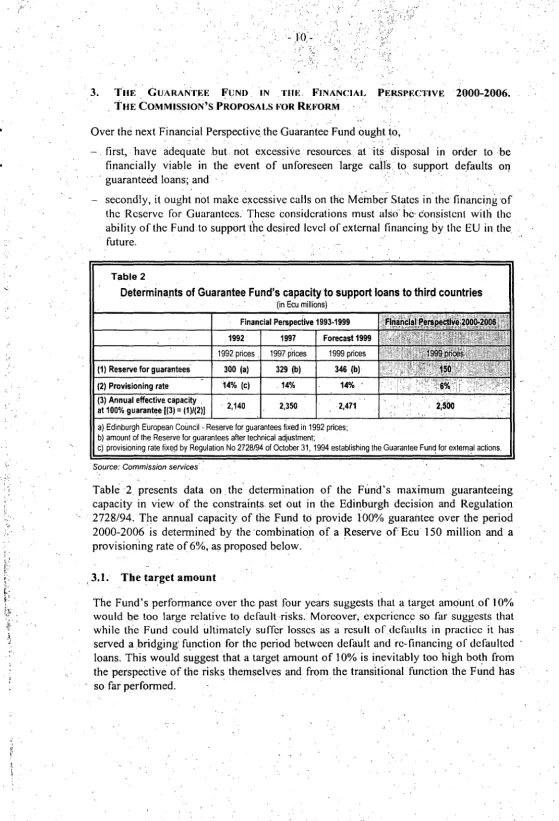
Determina_nts of Guarantee Fund's capacity to support loans to third countries
(1) Reserve for guarantees (2) Provisioning rate
(3) Annual effective capacity . at 100% guarantee [(3)
=
(1)1(2)]· (in Ecu millions)
-Financial Perspective 1993·1999
. 14% 14% .
. 2,140 2,350 2,471
a) Edinburgh European Council -Reserve for guarantees fixed in 1992 prices; b) amount of the Reserve for guarantees after technical adjustment;
c) provisioning rate fixe_d by Regulation No 2728/94 of October 31, 1994 establishing the Guarantee Fun~ for external actions.
Source: Commission seNices·
Table -2 presents data on. the. determination of the Fund's maximum guaranteeing capacity in view of the constraints set out in the Edi~burgh decision. and Regulation· 2728/94. T~e annual capacity of the Fund to provide 100% guarantee o:ver the period 2000-2006 is determined· by the ·combination of a Reserve ofEcu 150 million and a provisioning rate of6%, as proposed below.
3.1. The ta~get amount
11
-The target amount over the next. Financial Perspective is proposed to he 8% (~{
guaranteed /iahilities. This level, which is significantly higher than the 4.79%1 realized worst calls on the resources of the Fund ofJune 1996 (see Table ;1 ), is both consistent with prudential .considerations and with Fund resources that are not excessively large relative to default risks. The proposed target amount is expected to provide adequate resources to safeguard against risks associated with future macro-financial assistance, and those related to the considerable exposure to countries of notable political and. financial risk (Algeria, Bulgaria, Ukraine). Such risks, and a deterioration of the EIB's portfolio, may al_so arise from an extension of guaranteed credit to Newly Independent
~tates (NIS). Maintaining a target amount-of 8% appears to be an appropriate prudential measure.
It-is essential to provide for events where the Fund's resources exceed or fall short of the target amount. In parallel to the current practice4, it is proposed that resources in excess of8% he transferred to the EU hudget. Should the Fund'sresourcesfctll below 75% of the target amount (6% r~{ outstanding liahilitie.\), it is proposed that the provisioning r«le on new lending increase automatically to 7% until the target amount is achieved. Finally, should resources fall he/ow 50% of the target amount the Commission wlll prepare a report and suggest exceptional measures necessary to replenis_h the
Guarantee Fund.
3.2. The provisioning rate
The provisioning rate of 14% was intended to be transitional, until ~he Fund re.ached the target amount of 10%, and then would also decline to that level. Consistent with the proposal to lower the target amount to 8%, the provisioning rate must also be revised downwards. This revision ought also to take into account the growth in the Fund's non-reserve resources.
Non-Reserve resources consist of interestincome and late-reimbursements of capital and interest. The availability of such resources imply that the provisioning rate can be lower than what would be otherwise required in order to sustain the target amount of the Fund; alternatively,. it will be possible· to maintain the strength of the Fund as in the current Financial Perspective while, at the same time, calling on less resources to finance the Reserve for guarantees.
In 1997 alone, interest income amounted to Ecu 34.5 million or 0.4% of the stock of loans guaranteed while, over the period 1994-1997, cumulative interest income amounted to Ecu 78.4 million; also in 1997, late reimbursements amounted to Ecu 45 million or 0.6% of the stock of guaranteed loans, while the cumulative value· of late reimbursements over the period 1994-1997 was equal to Ecu 136.4 millionS. At the end
4 See Article 3 of Regulation 2728/94 of 31 October 1994.
..
; ..
\-·,.
;.•;
,.
\ ;_;
_ ...
:I
- 12-.
<···
of 1997, therefore; income from these sources was equivalent" to margin~lly over 1% ·of
the stock ofguarantecd loans. ' .· · . ·.. ··
''
l- -·
~,,:.~;,;;.;,.~::.:;,s;=:~~ L~
····
j ·
12r---~---~---~~~--~~~---,
Gross amo!Jnl at 6%
\.
' \
. . ----~""'"-:...
'---
~//-~ ... ,.. ...
7.'
. 19~9-7----19~9-8-.---1~99~9----2-0~00----2-0~01----2-0~0-2----20~0~3--~2~00-4-.--~~~0~5~-.-2~00'6
Gross amount at 14%:
Gross cumulative amount at 6%: Gross amount at 6%:
· Fund resources in year t prior to reimbursement to ·the ·budget in. year t+1;
provisioning rate 14% ; . . ..
Fund resources without reimbursement to the budget; provisioning rate 6% ; Fund resources in year t. prior to reimbursement to the budget in year t+1;
· proll}sioning rate 6%o · · · · ·
Source: Commission services; see Annex 1 for the details of the simulations.
Simulatio'ns show that, in
vie~
of non-Reserve resources, a provisioning rate oj 6% is sufficient to endow the Fund with resources which are consistent with the target amount.\
Key results of the simulations arc presented in Graph ~ the complete results arc presented in Annex 1. The Fund's performance is depicted by three charaCteristics:
-
13-- secondly, under 'the assumption that no transfers to the budget take place, the Fund accwmulates funds in excess of the target amount; under a provisioning rate of 6% this is denoted as "gross cumulative amount at 6%";
- finally, Fund resources net of transfers to the EU budget under. a provisioning rate 6% are denoted as "gross amount at 6%"; the surplus in year t is transferred to the budget in year t+ I and this is shown in the Graph by the marked area: The target amoun( is set at two levels, 10% for. the period 1997-1998 and 8% over the period 1999-2006; a step decline is shown between 10% and 8% in 1999-2000 in the Graph.
The results show that with a provisioning rate of 1 4% the Fund would transfer large surpluses in excess of the mark of 10% to the EU budget over much ofthe whole period (the average amount is estimated to be Ecu 222 million). With the reduction in the provisioning rate to 6% the gross resources of the Fund remain generally above. 9% of liabilities. Finally, the net resources of the Fund decline only temporarily below the 8% mark (to a trough of 7.63% in 2001) but they subsequently recover to the proposed target amount. Note that the surplus transferred to the budget after 2002 increases over time. The decline in the ratio of Fund resources to liabilities 2001 is principally a reflection the rapid increase in the stock of guaranteed loans at the beginning of the new financial envelopes on which the simu_lations have been based6. This increase reflects disbursements related to the renewal of the EIB maildates forthree years 1997:-1999.
The tendency of the Fund's resources to increase relative to guaranteed liabilities is partly a reflection of the provisioning mechanism itself. As long as provisioning-for new loans takes place independently of repayments, the ratio of Fund resources to liabilities will tend to remain constant or increase unless the growth of new loans is greater than the growth in repayment~. Over the horizon to 2006, simulations show that disbursement of new loans will peak in the beginning of next century and from 2003 onwards will decline; on the other hand, repayments are expected to follow an upward trend throughout the post-2002 period-~ see the results in Annex 1.
3.3. The level of the Reserve and the Fund's capacity for guaranteed lending
It was noted previously that a rate of provisioning of 6% would be appropriate for the period covered by the new Financial Perspective. To determine the appropriate level of the Reserve, it is essential to consider the desired volume of new lending which will be subject to guarantee. While difficult to aetermine it ex arite with confidence, it is possible to take guidance from factors likely to play a role in determining developments in guaranteed loans in future years.
Between 1992 and 1999 the Reserve for guarantees7 will have increased in nominal
terms by Ecu 46 million to Ecu 346 million, or on average by 2.2% annually. The
6 See the details in Annex I.
7 The Reserve for guarantees was defined in the Edinburgh European Council of Decembe~ 1992 even though the Guarantee Fund itself w;ts not established until October 1994.
c
'"'
-
[image:14.596.14.587.25.817.2]14-corresponding maximum capacity. for fully .guaranteed loans during this period has advanced by a comparable growth rate. At the same time, over the period 1994-1997 the _ rate of utilization of the Reserve averaged 82.2%, _clearly signalling that Reserve adequacy was not a binding co~straint on guaranteed credit expansion.
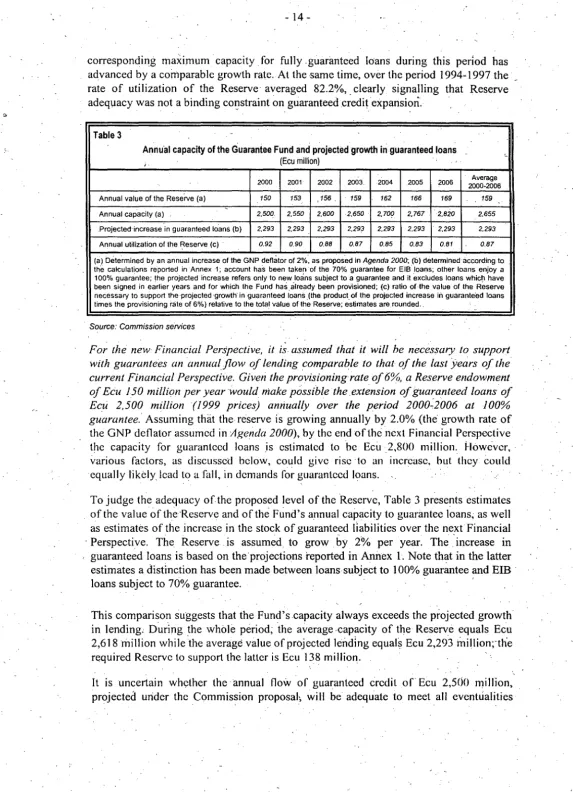
Table 3 ..
Annu·al capacity of the Guarantee Fund and projected growth in guaranteed loans
'-;. (Ecu million)
2000 2001 2002 2003. 2004 2005 2006 2000-2006 Average
Annual value of the Reserve (a) 150 153 156 159 162 166 169 159
-Annual capacity (a) 2,500. 2,550 2,600 2,650 2,709 2,767 2,820 2,655
Projected-increase in guaranteed loans (b) 2,293 2,293 2,293 2,29;3 2,293 2,293 2,293 2,293
Annual utilization of the ~eserve (c) · 0.92 0.90 0.88 0.87 0.85 0.83 0.81 0.87
(a) Dete-rmined by an annual increase of the GNP defiator of 2%, as propos-ed in Agenda 2000; (b) determined according to the calculations reported in Annex 1; account has been taken· of the 70% guarantee for EIB loans; other loans enjoy a 100% guarantee; the projected increase refers only to new loans subject to a guarantee and it excludes loans whicll have been signed in earlier years and for which the Fund has_already been provisioned; (c) ratio of the value of the Reserve necessary to support the-projected ·growth in guaranteed loans.(the productof the projected increase in guaranteed loans times the provisioning rate of 6%) relative to the total value of the Reserve; estimates are rounded .. .•
Source: Commission services
For the new Financial Perspective, it is assumed that it will he necessary to support with guarantees an annualjlow of lending comparable to that of the last years of the current Financial Perspective. Given the provisioningrate of6%, a Reserve endowment of Ecu 150 million per year would make possible the extension of gua~anteed loans of Ecu 2,500 million (1999 prices) annually over the period 2000~2006 at 100% guarantee. Assuming that the reserve is growing annually by 2.0% (the· growth rate of the GNP deflator assumed in AKenda 2000), by the end of the next Financial Perspective the capacity for guaranteed loans .is estimated to be Eci.1 2,800 million. However, -various factors, as discussed below, could give rise to an mcrease, but they could equally likety_lead to a fall, in demands for guaranteed loans.
To judge the adequacy of the proposed level of the Reserve, Table 3 presents estimates ofthe value of the-Reserve and ofthe Fund's annual capacity to guarantee l~ans; as well as estimates of the increase in the stock of guaranteed !labilities over the ne_xtFinancial · Perspective. The. Reserve is assumed to grow by
2%
per year. The . increase in guaranteed loans is based on the·projections reported in Annex 1. Note that in the latter estimates a distinction has been made between loans subject to 100% guarantee and EIB ·loans subject to 70% guarantee. '
This comparison suggests that the Fund's capacity always exceeds the projected growth in lending, During the whole period; the average capacity of the Reserve equals Ecu 2,618 million while ~the average value of projected lending equals Ecu 2,29.3 million;·the required Reserve to support the latter is Ecu 138 million.
It is uncertain wh9ther the annual flow of guaranteed credit of Ecu 2,500 million, projected urider the Commission proposal~ will be adequate to meet all eventualities
15
-over the 'period 2000-2006. At this stage, the projected margin suggested in Table 3 appears to be adequate. The present EIB envelopes will permit a significant amount of lending to CEECs which will complement the pre-accession strategy, and followi·ng enlargement EIB lending will not need to be guaranteed. Moreover, Euratom and _ macrofinancial assistance lending amounting to around Ecu 600 million per year would - appear to be adequate. Changes may occur following enlargement but until then there are no compelling reasons to permit the Fund's capacity to increase significantly above present levels.
Over the next Financial Perspective there may be reasons favoring either a decrease or an increase in guaranteed lending. On the one hand, under the assumption that following enlargement third-country lending will not expand, the need for guaranteed credit, after peaking at the time of the next enlargement, will be reduced.
On the other hand, it is possible that credit in the form of either macro-financial assistance or Euratom loans will increase. Moreover, it is possible that EIB lending to Russia· and other NIS will be initiated. In the area of macro-financial assistance it is possible that it will be necessary to provide increased support to- Ukraine but also to other important EU neighbors s_uch as Turkey; Albania, Bulgaria and the nations of the ex-Yugoslavia. Demands to increase Euratom loans, especiaily in favor of Ukraine but also in favor of Bulgaria, may also become substantial over coming years.
Moreover, demands for EIB lending may increase both in the context of reinforcing the EIB/CEEC envelopes and taking account of the possibilities of enlarging the MED programs, increasing loans in favor of Turkey and extending loans to support energy projects in the Mediterranean.
It is possible, finally, that the risk the Fund's portfolio is bearing may increase. With enlargement, some currently third countries will become Member States. An expansion of guaranteed lending towards a widening group of Eastern European countries, or towards countries of lesser creditworthiness, could raise the risks of default ~ausing a deterioration in the Fund's portfolios.
8 The stock of loans outstanding with to Hungary; Poland, the Czech Republic, Slovakia and Slovenia in 2002 is estimated at Ecu 6,0~0 million. This estimate is based on the assumption that 77% of the envelop decided buy the Council on April 14, 1997 in favor of the CEECs (Ecu 3,520 million) will be · allocated to the five countries. The stock of guaranteed loans to the remaining countries, that is excluding the five candidates, is estimated at Ecu 13,137 million at the end of 2002, and the total stock at that time is estimated at Ecu 19,157 million.
Since accession to the EU reduces the resources the Guarantee Fund needs to hold to meet defaults on these loans by an amount equal to the Fund's target amount, it is clear that at some point following the_ first w~ve of accessions the Guarantee Fund ~ould have to reimburse this amount to the EU budget. On the hypothesis that the new Member States constitute better risks that those still remaining within the framework of pre-accession or those not considered for membership at all, it is clear that the quality of the Fund's risk portfolio will worsen, perhaps significantly.
16
-3.4. ·Review of the performance of the Fund
It is possible that, over the next Financial Respective; the par;uneters of the Guarantee. Fund may need to be modified. In particular, to respond to the possibility that the·risks · to which the Fund is exposed are changing in the years following enlargement it (s ·_necessary to provide for a review of its operation. Accordingly, the Commission i~
proposing that it would be appropriate to review the performance of ilie Guarantee Fund at some point before t,he end-_of the next Financial Perspective. This review should take
the form of a Commission Report to the Council. ··
.3.5. Transfer ofthe Fund's financial management to the Commission
As required by the Regulation establishing the Fund,9the Commission gave the EIB the task of managing the F:und's
~esources
on behalf of the Community.10-Experience has sho.wn that although the Bank has performed this task ~o~t satisfactorily over the past three years, in practice a good deal of assistance, has to be provided by the - services ofth~ Commission.-. It would therefore be in the Commission's interest to take ·
··over tlie management of the Fund.
- With a view. to administrative simplification
*
The Commission makes a substantial contribution to defining ihe principlesgov~ming the manag~ment of the Fund: since the EIB's investment management
must comply with the usual prudential rules for financial activities, the EIB frequently has to consult the Commission on investment strategy!
*
Since the Commission alone has an overview of the guarantees concerned, it has. to send the EIB monthly forecasts on how the Fund will develop. over the 'next twelve months.' The Bank needs this information to gauge the optimum durationfor the .Fund's financial investments; - .
. *
The Commission keeps track of the repayment dates for loans and -borrowings, makes the arrangements for calls on the Fund, and monitors the recovery of sums due and the reimbursement to the Fund of the corresponding amounts. As things stand, all the relevant information has to he made available before the B<irik can act, entailing a pointless duplication of the workload. Apart from the gains in productivity, direct management by the Commission would shorten the timespan needed for the transfer of resources and the dissemination of information.. . ' . .
9 Article 6 of Council Regulation No 2728/94 establishing a Guarantee Fund for external actions stipulates that "the Commission shall entrust th~ financial ~anagement of the Fund to the ETB under
a briefon the Community's behalf'. · - ·
10 . Agreement between the European Community and the European hivt;stment Bank'conccrning the :
-
17-- With a view to .reducing costs
*
The Commission would save. the charges currently paid to the EIB, which amounted to ECU 325,000 in 1997 arid total ECU 710,000 since the Fund was set up in 1995 ..This charge would be bound to increase with the level of capital managed by the Fund as a result of fresh EC or Euratom loans to the countries of Eastern and Central Europe.
The Commission, which has considerable experience in dealing with such matters on behalf of other Community institutions, p~oposes therefore that it itself should manage the investment of the Fund's resources and that Article 6 of the Regulation establishing the Fund should be amended accordingly. ·
3.6. Implications of the proposals for the Fund's ·regulation
Adoption of the Commission'.s proposals will require a corresponding revision of the Regulation ,governing the Guarantee Fund. This will take the form ofa new Regulation based on a revision 'bf)he present Regulation. The text of the proposed amended Regulation is attached separately.
4. IMPLICATIONS OF MAINTAINING THE PROVISIONING RATE TO THE END OF THE CURRENT FINANCIAL PERSPECTIVE AND SUGGESTIONS FOR REFORM
The Ecofin Council has proposed that the provisioni~g rate ought to remain at the level of 14% to 15% until the end of the current financial perspective11 • The implication of this is that, with the Fund having currently attained its target amount, and in view of the non-Reserve resources, which are expected to correspond to over 10% of the Reserve for guarantees and of tot~l new Fund resources in each of the next two years, maintaining the provisioning rate at this level would tend to enrich the Fund considerably without a corresponding increase in risk. Furthermore, according to Article 3 ofRegulation 2728/94, Fund resources at the end of the year in excess of the 10% mark are to be paid back to the EU budget. As a resul~, a situation would arise where the Reserve would be called upon to provision the Fund which would in turn reimburse the budget.
·:·.:··
- 18 -·.
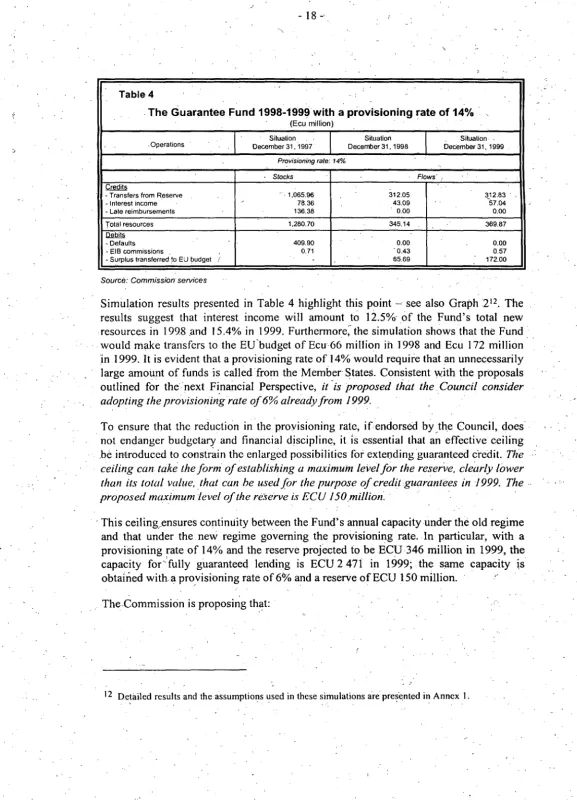
Table 4
-. The Guarantee Fund 1998-1999with a provisioning rate of 14% •,
(Ecu million)
Situation Situation Situation
. Operations December 31, 1997 December31,1998 December 31. 1999
Provisioning rate: 14%
Stocks Flows·,
~
-Transfers from Reserve . 1,065.96 312.05 312.83 .
- Interest income ' 78.36 43.09 .. 57.04
- Late reimbursements 136.38 0.00 0.00
Total resources 1,280.70 345.14 369.87
Q.@j1§
-Defaults 409.90 0.00 O.Oo
- EIB commissions 0.71 '0.43 0.57
-Surplus transferred to EU budget ! 65.69 172.00
Source: Commission services
Simulation results presented in Table 4 highlight this point ~see also Graph 212• The results suggest that interest income will amount to 1i.5%· of the Fund's total new resources in 1998 _and 15.4% in 1999. Furthermore; the simulation shows that the Fund. would m~ke transfers to the EU-budget of Ecu 66 million in 1998 and Ecu 172 million in 1999. It is evident that a provisioning rate of 14% would require that an unnecessarily large amount of funds is called from the Member States. Consistent yv:ith the proposals outlined fbr the next Fipancial Perspective, it -is proposed that the Council consider adopting the provisioning rate of 6% already from 1999.
To ensure that the reduction in the provisioning rate, if endorsed by the Council, does . not endanger
budgeta~
and financial discipline, it is essential thata~
effective ceiling.be introduced to coostrain the enlarged possibilities for extending guaranteed credit. Tke · · ceiling can take the form of establishing a maximum level for the reserve, clearly lower
than its total value. that can he used for the purpose of credit guarantees in 1999. The .. proposed maximum ievel of the reserve is ECU 150.million:
··This ceiling .. ensures continuity between the Fund's annual capacity under the old regime and that under the new regime governing the provisioning rate. In particular, with a provisioning rate of 14% and the reserve projected to be ECU 346 million in 1999, the capacity for''fully guaranteed lending is ECU 2 471 in 1999; the Sf!me capacity
is
obtained with a provisioning rate of 6% and a reserve of ECU 150 million.The Commission is proposing th~t:
12 Detailed results and the assumptions used in these simulations a·re pres.<.<nted in Annex I,
-- -
19-- the provisioning rate for the Fund be set at 6% as soon as possible. · It therefore suggests that all the proposed amendments to the- Regulation of 31 October 1994 · establishing a Guarantee Fund should enter into force on 1 January 1999;
·.1: . t.·
-
20-A:NNEX 1
Simulations showing the evolution of the Guarantee Fund over the period 1998·2006, on the basis of three scenarios: · 1) target amount at 1 0%·, provisioning rate at 14% and repayment to the budget of the Fund's surplus over the target amo~nt (scenario A) 2) provisioning rate at 14% in 1998 and at 6% over the period 1999-2006. No repayment to the budget (scenario B)
3) target amount at 8%, provisioning rate at 14% in 1998 and at.6% over the period 1999;2006. Repayment to .the budget of the Fund's surplus over the target amount
(scenario C) · · · · · ·
Situation at Estimate for ·31.12.97 31.12.98 Guarantee liabilities on the basis of: (a)
1. decisions already adopted by the Council (b) 7,961.00 9,483.00 2. new decisions planned (c) ' . 205.00
3. Total liabilities (3.= 1.+ 2.) '7,961.00 . 9,688.00
...
Scenario A
4. Gross amount of the Fund (d) 861,79. 1,140.81·
5,G~_ss aniouiitrifthe Fund as% of 3. 1o~ij3;f.·~
·.
·11.18 .6. Target amount at 10% (3.*10%) 796.10, ' 968.80
1. Surpluses repaid to the.budget in n+1 (4.-6.) 65.69 172.01 Scenario B
~~~:~~~~t:::
:r::.::J::
:! ::
:~: ~~ off~~~xe.\;::
.. ;
{~i~i.ii¥?}E;~~~l~
. Scenario C· · ·
19·
Gross amount of the Fund (d) , 861,79 1,140.81