White Rose Research Online URL for this paper:
http://eprints.whiterose.ac.uk/128429/
Version: Accepted Version
Article:
Dehghantanha, A., Azmoodeh , A. and Choo, K.-K.R. (2018) Robust Malware Detection for
Internet Of (Battlefield) Things Devices Using Deep Eigenspace Learning. IEEE
Transactions on Sustainable Computing. ISSN 2377-3782
https://doi.org/10.1109/TSUSC.2018.2809665
[email protected] https://eprints.whiterose.ac.uk/
Reuse
Unless indicated otherwise, fulltext items are protected by copyright with all rights reserved. The copyright exception in section 29 of the Copyright, Designs and Patents Act 1988 allows the making of a single copy solely for the purpose of non-commercial research or private study within the limits of fair dealing. The publisher or other rights-holder may allow further reproduction and re-use of this version - refer to the White Rose Research Online record for this item. Where records identify the publisher as the copyright holder, users can verify any specific terms of use on the publisher’s website.
Takedown
If you consider content in White Rose Research Online to be in breach of UK law, please notify us by
Robust Malware Detection for Internet Of
(Battlefield) Things Devices Using Deep
Eigenspace Learning
Amin Azmoodeh, Ali Dehghantanha,
Senior Member, IEEE,
and Kim-Kwang Raymond Choo,
Senior Member, IEEE,
Abstract—Internet of Things (IoT) in military setting generally consists of a diverse range of Internet-connected devices and nodes (e.g. medical devices to wearable combat uniforms), which are a valuable target for cyber criminals, particularly state-sponsored or nation state actors. A common attack vector is the use of malware. In this paper, we present a deep learning based method to detect Internet Of Battlefield Things (IoBT) malware via the device’s Operational Code (OpCode) sequence. We transmute OpCodes into a vector space and apply a deep Eigenspace learning approach to classify malicious and bening application. We also demonstrate the robustness of our proposed approach in malware detection and its sustainability against junk code insertion attacks. Lastly, we make available our malware sample on Github, which hopefully will benefit future research efforts (e.g. for evaluation of proposed malware detection approaches).
Index Terms—Internet of Things Malware, Internet Of Battlefield Things, Malware Detection, Deep Eigenspace Learning, Deep Learning, Machine Learning
F
1
I
NTRODUCTIONA
typical Internet of Things (IoT) deployment includes a wide pervasive network of (smart) Internet-connected devices, Internet-connected vehicles, embedded systems, sensors, etc. that autonomously sense, store, transfer and process collected data [1], [2], [3]. IoT devices in a civilian setting includes health [4], agriculture [5], smart city [6], and energy and transport management systems [7], [8]. Fur-thermore, the IoT and its capabilities causes an increasing interest in leveraging the IoT’s advantages and features to improve combat ability in battlefields and managing war re-sources. Utilizing IoT technology in military operations and defensive applications is referred to Internet Of Battlefield Things(IoBT) [9], [10].There are underpinning security and privacy concerns in such IoT environment [1], [11], [12], [13]. While IoT and IoBT share many of the underpinning cyber security risks (e.g. malware infection [14]), the sensitive nature of IoBT deployment (e.g. military and warfare) makes IoBT architecture and devices more likely to be targeted by cyber criminals. In addition, actors who target IoBT devices and infrastructure are more likely to be state-sponsored, better resourced, and professionally trained.
• Amin Azmoodeh is with the Department of Electrical and Computer
Engineering, Shiraz University, Shiraz, Iran.
• Ali Dehghantanha is with the Department of Computer Science, School
of Computing, Science & Engineering, University of Salford, Greater Manchester, UK
• Kim-Kwang Raymond Choo is with the Department of Information
Systems and Cyber Security, The University of Texas at San Antonio, San Antonio, TX 78249, USA (email: [email protected]) Manuscript received July 28, 2017; revised X, 2017.
Intrusion and malware detection and prevention are active research areas [15], [16], [17], [18], [19], [20], but due to the resource constrained hardware, nature of IoT and IoBT devices and customized operating systems existing solu-tions are unlikely to be suited for real-world deployment. Majority of IoT malware misuse low-level vulnerabilities of compromised device to infect. Thus, it is necessary to answer the need for IoT and IoBT specific malware detection [20].
There has been recent interest in utilizing machine learn-ing and deep learnlearn-ing techniques in malware detection (e.g. distinguishing between malware and benign applications), due to their potential for increased accuracy and robustness [15], [21], [22], [23]. Typically, the following criteria are used to evaluate the utility of machine learning and deep learning techniques in malware detection:
• True Positive (TP): indicates that a malware is cor-rectly identified as a malicious application.
• True Negative (TN): indicates that a benign is
de-tected as a non-malicious application correctly.
• False Positive (FP): indicates that a benign is falsely
detected as a malicious application.
• False Negative (FN): indicates that a malware is not detected and labeled as a non-malicious application.
Based on the above criteria, the following metrics will then be used to quantify a given system:
Accuracy is the number of samples that a classifier
correctly detects, divided by the number of all malware and goodware applications:
Accuracy= T P +T N
correctly labeled a malware, and is defined as follows:
P recision= T P
T P +F P (2)
Recallor detection rate is the ratio of malware samples that are correctly predicted, and is defined as follows:
Recall= T P
T P +F N (3)
F-Measureis the harmonic mean of precision and recall, and is defined as follows:
F−M easure= 2∗T P
2∗T P +F P +F N (4)
Cross-validation is a fundamental technique in machine learning to assess the extent that the findings of an experi-ment can be generalized into an independent dataset. While there are many cross validation techniques (e.g. Leave-P-Out, K-fold and Repeated Random Sub-sampling), when the size of a dataset is limited K-fold validation techniques (e.g. 10-fold) are generally used. K-Fold validation techniques are also commonly used to validate the fitness of a model to a hypothetical validation set in the absence of an independent validation set [24], [25].
Due to the fast pace of malware development and the significant increase in the number of malware samples, using deep learning techniques for malware detection is gaining prominence. For example, Yuan et al. [26] used Deep Belief Network on a combination of static and dynamic features of Android APKs and reportedly achieved 96.76% of overall accuracy and 95.77% and 97.84% of precision and recall respectively in malware detection. Saxe and Berlin [27] presented a detection method using deep feed-forward neural network using a set of Windows program features including Byte/Entropy histogram, portable executable (PE) data and metadata and printable character sequence and reportedly achieved detection and false positive rates of 95% and 0.1% respectively.
Bilar [28] introduced Operational Codes (OpCodes) as a suitable and reliable feature for malware identification using machine learning techniques. Moskovitch et al. [29] applied different text mining techniques to detect candidate features of Windows malware sample OpCode for classification us-ing algorithms such as Neural Network and Decision Tree and reportedly attained 94.43% accuracy. Santos et al. [30] leveraged the frequency of a specific OpCode appearance in benign and malicious Windows applications as a feature for Decision Tree, Support Vector Machine, Bayesian Networks and K-Nearest Neighbors algorithms and achieved 95.90% accuracy in malware detection. Hashemi et al [31] extracted OpCodes of Windows benign and malware executable files and then form a graph for each sample and turned the generated graph into a vector using Power Iteration proce-dure to train classifiers such as Support Vector Machine and Adaboost. They achieved an accuracy and a F-measure of 96.09% and 95.98% respectively. Siddiqui et al. [32] utilized occurrence frequency and principle component analysis on a dataset of Windows malware and goodware application OpCodes and obtained 93.1% detection rate using Random Forest as the classifier.
basis for a robust and sustainable deep learning based IoT and IoBT malware detection system. This is a challenge that has not been addressed in the literature. Specifically, in this paper, we extract OpCode sequence of 1078 benignware and 128 malware (all ARM compatible IoT applications). We uti-lize Class-Wise Information Gain technique for class aware feature selection [33]. Then, the selected features (OpCodes) of each sample are converted into a graph in which Op-Codes are represented by the graph’s nodes while the graph edges represent the nodes’ affinity in disassembled file of each sample. Finally, generated graphs of malicious and benign samples are used for classification of IoT and IoBT malware and goodware applications using Eigenspace and deep convolutional networks techniques. We achieve 99.68% accuracy in detecting malware samples, with precision and recall rates of 98.59% and 98.37% respectively.
To the best of our knowledge, this is the first OpCode-based deep learning method for IoT and IoBT malware detection. We then demonstrate the robustness of our pro-posed approach, against existing OpCode based malware detection systems in [30], [31]. We also demonstrate the sustainability of our proposed approach against junk-code insertion attacks. Specifically, our proposed approach em-ploys a class-wise feature selection technique to overrule less important OpCodes in order to resist junk-code in-sertion attacks. Furthermore, we leverage all the elements of Eigenspace to increase detection rate and sustainability. Finally, as a secondary contribution, we share a normalized dataset of IoT malware and benign applications1, which may be used by fellow researchers to evaluate and bench-mark future malware detection approaches. On the other hand, since the proposed method belongs to OpCode based detection category, it could be adaptable for non-IoT plat-forms.
In the next section, we briefly review related work. Sec-tion 3 describes our collecSec-tion, preprocessing and evaluaSec-tion methodology. Section 4 presents our proposed approach, followed by its evaluation in Section 5. Section 6 concludes this paper and suggests several future research agenda.
2
R
ELATEDL
ITERATUREMalware detection methods can be broadly categorized into static and dynamic analysis [34]. In dynamic malware detection approaches, the program is executed in a con-trolled environment (e.g. a virtual machine or a sandbox) to collect its behavioral attributes such as required resources, execution path, and requested privilege, in order to classify a program as malware or benign [35], [36], [37]. Static approaches (e.g. signature-based detection, byte-sequence n-gram analysis, opcode sequence identification and control flow graph traversal) statically inspect a program code to detect suspicious applications.
David et al [38] proposed a framework, Deepsign, to automatically detect malware using a signature generation method. The latter creates a dataset based on behaviour logs of API calls, registry entries, web searches, port accesses, etc,
in a sandbox and then converts logs to a binary vector. They used deep belief network for classification and reportedly achieved 98.6% accuracy. In another study, Pascanu et al. [39] proposed a method to model malware execution using natural language modeling. They extracted relevant features using recurrent neural network to predict the next API calls. Then, both logistic regression and multi-layer perceptrons were applied as the classification module on next API call prediction and using history of past events as features. It was reported that 98.3% true positive rate and 0.1% false positive rate were achieved.
Demme et al. [40] examined the feasibility of building a malware detector in IoT nodes’ hardware using perfor-mance counters as a learning feature and K-Nearest Neigh-bor, Decision Tree and Random Forest as classifiers. The reported accuracy rate for different malware family ranges from 25% to 100%. Alam et al. [41] applied Random For-est on a dataset of Internet-connected smartphone devices to recognize malicious codes. They executed APKs in an Android emulator and recorded different features such as memory information, permission and network for classifica-tion and evaluated their approach using different tree sizes. Their findings showed that the optimal classifier contains 40 trees, and 0.0171 of mean square root was attained.
In order to detect crypto-ransomware on Android de-vices as management nodes of an IoT networks, Azmoodeh et al. [42] recorded the power usage of running processes and identified distinguishable local energy consumption patterns for benign and ransomware. They broke down the power usage pattern into sub-samples and classified them, as well as aggregating sub-samples’ labels to determine final label. The proposed approach reportedly achieved 92.75% accuracy. Securing IoT backbone against malware attacks motivated Haddad Pajouh et al. [43] to propose a two-layer dimension reduction and two-tier classification module to detect malicious activities. Specifically, the authors used Principle Component Analysis and Linear Discrimination Analysis to reduce the dataset and then used Na¨ıve Bayes and K-Nearest Neighbor to classify samples. They achieved detection and false alarm rates of 84.86% and 4.86%, respec-tively.
While OpCodes are considered an efficient feature for malware detection, there does not appear to have been any attempt to use OpCodes for IoT and IoBT malware detec-tion. In addition, using deep learning for robust malware detection in IoT networks appears to be another understud-ied topic. Thus, in this paper, we seek to contribute to this gap by exploring the potential of using OpCodes as features for malware detection with deep Eigenspace learning.
3
D
ATASETC
REATION ANDF
EATURES
ELECTION We created a dataset of 1078 benign and 128 malware samples for ARM-based IoT applications [44]. All malware samples were collected using VirusTotal2Threat Intelligence platform between February 2015 and January 2017. All goodware were collected from a variety of official IoT App stores such as Pi Store3.2. http://www.virustotal.com
3. https://thepihut.com/collections/raspberry-pi-store
IoT and IoBT application are likely to consist of a long se-quence of OpCodes, which are instructions to be performed on device processing unit. In order to disassemble samples, we utilized Objdump (GNU binutils version 2.27.90) as a disassembler to extract the OpCodes. Creating n-gram Op-Code sequence is a common approach to classify malware based on their disassembled codes [45], [46]. The number of rudimentary features for length N is CN, where C is
the size of instruction set. It is clear that a large increase in N will result in feature explosion. In addition, decreasing the size of feature increases robustness and effectiveness of detection because ineffective features reduce performance of machine learning approach. Therefore, there is a tendency to first apply a feature selection algorithm and find the best features [47] in order to reduce the feature set to avoid fea-ture explosion. Information retrieval techniques are widely used for feature selection [48]. Information Gain (IG) is an information-theoretic approach to select global features by ranking them based on the amount of information content available in a classification problem. IG applies statisti-cal tools to choose global features and does not consider class information. In some situations such as imbalanced datasets, global feature selection methods neglect minor class-specified features which may reduce system efficiency. Class-Wise Information Gain (CIG) [33] is proposed to overcome global feature selection imperfection and aims to recognize more useful features based on available class information. To understand how CIG is calculated for an arbitrary two-class problem, we refer the reader to Equation 5, whereP(vf = 1, Ci)denotes the probability of feature
f appearing inCi, andP(vf = 0, Cj)is the probability of
featuref being absent fromCj.CB andCM denote benign
program and malicious applications, respectively.
CIG(f, CB) =P(vf = 1, CB)∗log
P(vf = 1, CB)
P(vf = 1)P(CB)
+P(vf = 0, CM)∗log
P(vf = 0, CM)
P(vf = 0)P(CM)
CIG(f, CM) =P(vf = 1, CM)∗log
P(vf = 1, CM)
P(vf = 1)P(CM)
+P(vf = 0, CB)∗log
P(vf = 0, CB)
P(vf = 0)P(CB)
(5)
In this study, 4,543 1-gram and 610,109 2-gram distinct OpCode sequences were extracted and CIG(f, CB) and
CIG(f, CM)were calculated. The top 82 features
(approx-imately 0.01% of all features) {f1, ..., f82} were selected,
where fi belongs to either the 1-gram or 2-gram category.
Size of selected feature set is limited toj= 82because there was a significant gap between fj<=82’s andfj>=83’s CIG
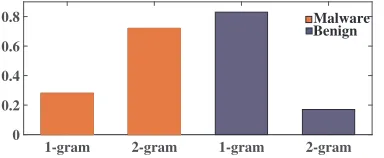
values. Due to the high computational resource consump-tions, all k-gram(k >= 2) features were ignored. Features were selected from the 1-gram and 2-gram sequences based on theirCIG(f, CB)andCIG(f, CM)values. As shown in
1-gram 2-gram 1-gram 2-gram 0
0.2 0.4 0.6
[image:5.612.80.272.49.128.2]Benign
Fig. 1. 1-Gram and 2-Gram Feature Distribution For Benign and Malware Samples
4
P
ROPOSEDA
PPROACH [image:5.612.46.301.266.343.2]Our proposed method is illustrated in Fig.2, and consists of two phases, namely: OpCode-Sequence Graph Generation phase and Deep Eigensapce Learning phase. Also, feature selection phase is included in Fig.2.
Fig. 2. Proposed Approach
4.1 Opcode-Sequence Graph Generation
Control Flow Graph (CFG) is a data structure that represents the order of OpCodes in an executable file. A graph,G =
hV, Ei, has two sets:V andE.V denotes the graph’s vertices and Ei,j shows the relation between Vi and Vj. Previous
research has shown the usefulness of this representation in malware detection [30], [31], [49]. Viǫ{fj|j = 1, ...,82} are
vertices and the edges’ values represent the relation between vertices (features).
In order to construct the OpCodes’ graph, edge values should be computed. The general approach for calculat-ing Ei,j value is to increment Ei,j by 1 when Vi occurs
immediately after Vj in the sample’s OpCode sequence.
Utilizing this procedure would lead to generation of an adjacency matrix for each sample application within our dataset. Furthermore, normalization of matrix rows would turnEi,j values into probability of occurrence ofVi. Then,
all Vj andEi,js values are normalized to a value between
0 and 1. Considering the situations in which Vi and Vj
are placed exactly together neglect the longer distance of OpCodes’ neighborhood. In other words, merely observing a specific order of OpCodes leads to a crisp representation of OpCode sequence in a graph.
However, the Crisp approach for computing Ei,j has
its own drawbacks. Applying feature selection and then incrementingEi,jby 1 for exact OpCode’s occupants result
in a sparse adjacency matrix, which may poorly represent a sample file that is not suitable for a classification task. In addition, malware developers may inject some useless junk
vent/deceive OpCode’s neighborhood calculation method. Therefore, we propose a heuristic criteria shown in Formulation(6) to calculate the graph edge values. Fun-damental elements of Formulation(6) is the distance be-tween OpCodes. A longer distance increases the divisor exponentially and consequently produces a smallerEi,j. To
improve Formulation(6) by spotting distance mitigates the drawbacks of calculating edges by immediate occurrence and highlights the effect of OpCodes distance.αis a tuning parameter to adjust the impact of OpCode’s distance. In this study, we let α = 1to have Ei,j = 1for exactly adjacent
OpCodes similar to Hashemi et al. [31] approach. Also,α can control the effect of OpCodes’ distance in detection rate. Formulation(6) would produce a graph of 82 vertices for each given malware and benign sample as the learning ma-terial for Deep Eigensapce Learning phase of our method. Figure 3 illustrates the output of Opcode-Sequence Graph Generation phase for a sample. For instance, the edge’s value betweenOpCodei =callandOpCodej =submeans
that sum of allEi,js calculated by Formulation(6) is 0.2.
Ei,j = X
sǫS
2
1 +α∗emin(|s−t−1|)
S={index of all appearance of OpCodeVi
in sample′s OpCode sequence} tǫ{index of all appearance of OpCodeVj
in sample′s OpCode sequence} (6)
Fig. 3. A schematic view of the sample’s generated graph
4.2 Deep Eigenspace Learning
4.2.1 Eigenspace
Graphs as a complex data structure for representing rela-tions between vertices are a prevalent data type in machine learning. There are very few data mining and deep learning algorithms [50] that accept a graph as an input [51]. There-fore, a possible alternative is to embed a graph into a vector
4. No Operation
[image:5.612.364.522.380.567.2]space [52]. Indeed, graph embedding is a bridge between statistical pattern recognition and graph mining.
Eigenvectors and eigenvalue are two characteristic ele-ments in the graph’s spectrum [53], which could linearly transform a graph’s adjacency matrix into a vector space (see Equation 7).v,λandAdenote eigenvectors, eigenval-ues and a graph’s adjacency or an affinity matrix respec-tively. In this paper, we employ a subset ofvandλfor the learning phase.
Av=λv (7)
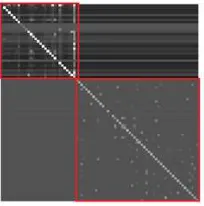
[image:6.612.318.555.46.116.2]To obtain a tangible knowledge of the generated CGFs’ structure, a graph that illustrates the cumulative of all sam-ples in our dataset is created (see Figure 4). Figure 4 consists of two major diagonal building blocks (marked with red borders), which indicates that two main data distributions exist in the given samples. Based on the graph’s spectrum theory, in this condition, there should be an explicit eigen-gap in the matrix’s eigenvalues [54], and Figure 5 depicts the existence of a gap between λ2 andλk(k > 2). Hence,
Fig. 4. An Overview of Samples’ Cumulation Affinity Matrix
two first eigenvectors of sample’s matrix(v1andv2) include
much more information about the matrix compared to the remaining eigenvectors, and could represent the whole ma-trix appropriately.
0 10 20 30 40 50 60 70 80 90
Eigenvalue Index 0
2000 4000 6000 8000
Eigenvalue
Fig. 5. Sample’s Cumulation (Figure 4) Eigenvalues
Moreover, in the learning phase, due to different data distribution of eigenvalues for malware and benign sam-ples,λ1 andλ2 are utilized alongsidev1 andv2to detect a
sample label and increase our method performance. Figures 6 and 7 illustrate the difference between malware and be-nign eigenvalues’ (λ1,2) data distribution and indicate
suit-ability of employingλ1andλ2as features for a classification
task.
4.2.2 Deep Learning
Deep Learning (DL) [55], [56] or deep structured learning is an evolved version of Neural Networks (NN) [57]. A
-0.2 -0.15 -0.1 -0.05 0 0.05 0.1 0.15 0.2 0.25 0.3
First Eigenvalue 0
.05 .1 .15
Probability Density Function
[image:6.612.314.556.153.227.2]Benign Malware
Fig. 6. First Eigenvalue (λ1) Distribution
-10 -5 0 5 10 15
Second Eigenvalue
0 0.1 0.2 0.3 0.4 0.5
Probability Density Function
[image:6.612.125.227.280.383.2]Benign Malware
Fig. 7. Second Eigenvalue (λ2) Distribution
standard NN includes few or many simple, inter-connected nodes called neurons. NN’s neurons are organized in a few layers, namely: an input layer, several hidden layers and an output layer. DL as an “upgraded” trend of NN, focuses on deeper data structure learning by concentrating on the hid-den layer’s abilities and functionalities. Deep learning has recently been successfully deployed to address challenges in a variety of applications, such as speech recognition and machine vision [58], [59]. There are different variations of DL such as Convolutional Networks, Restricted Boltzmann Machines, and Sparse Coding [60].
In this paper, a Convolutional Network is used as the deep learning module of our proposed approach because of its potential for accurate classification in the presence of complex and non-linear data patterns [61]. The first two eigenvectors (v1andv2) and eigenvalues (λ1andλ2) of the
samples are used as input values for classification.
5
F
INDINGSIn this section, we evaluate the accuracy, precision, re-call and F-measure of our proposed approach, in order to demonstrate its robustness in detecting IoT and IoBT malware. Moreover, we demonstrate the sustainability of our proposed approach against junk code insertion attacks.
5.1 Robustness
[image:6.612.56.282.476.580.2]eigenspace.
Accuracy is a general criteria for evaluating performance of an algorithm for both malware and benign class identi-fication. The proposed approach achieves a high accuracy of 99.68%, while the approaches of Hashemi et al. [31] and Santos et al. [30] achieve 98.59% and 95.91% accuracy respectively. Recall or detection rate is an important criteria and the proposed approach achieves 98.37%, in comparison to 81.55% and 77.70% for the other two approaches.
Our proposed approach also outperforms the ap-proaches of Hashemi et al. [31] and Santos et al. [30] in terms of precision rate and F-Measure. Utilizing class-wise feature selection aids beneficial features of minor class to be more effective during classification phase. Also, using Formulation(6) to calculate OpCode’s distance leads to rep-resent more OpCode sequence patterns in sample’s graph. Moreover, employing deep neural networks for classifica-tion leads to superior classifier.
Accuracy Precision Recall F-Measure Proposed Method 99.68% 98.59% 98.37% 98.48% Hashemi et al. [31] 96.87% 91.09% 81.55% 86.05% Santos et al. [30] 95.91% 86.25% 77.70% 81.75%
TABLE 1
Performance Evaluation Of Detection Methods on Our Dataset
5.2 Sustainability Against Junk Code Insertion Attacks
Junk code injection attack is a malware anti-forensic tech-nique against OpCode inspection. Junk code insertion may include addition of benign OpCode sequences, which never run in a malware or inclusion of instructions (e.g. NOP) that do not actually make any difference in malware activities. Junk code insertion technique would obfuscate malicious OpCode sequences and reduce the balance of malicious OpCodes in a malware [63].
In our proposed approach, we use an affinity based crite-ria to evade junk OpCode injection anti-forensics technique. Our feature selection method eliminates less instructive OpCodes to mitigate the effects of injecting junk OpCodes.
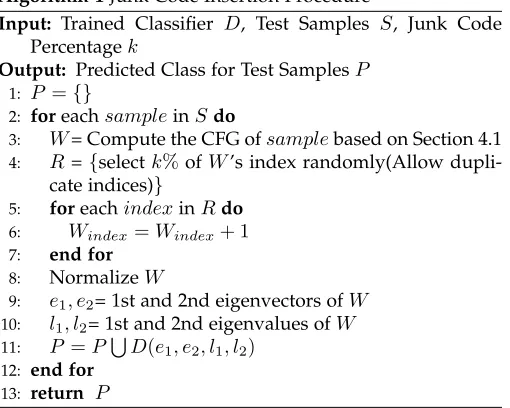
To demonstrate sustainability of our proposed approach against code insertion attack, in an iterative manner, a specified proportion({5%, 10%, 15%, 20%, 25%, 30%}) of all elements in each sample’s generated graph were selected randomly and their value incremented by one. For example, in the 4th iteration of the evaluations, 20% of the indices in each sample’s graph were chosen to increment their value by one. In addition, in our evaluations the possibility of a repetitive element selection was included to simulate injecting an OpCode more than once. Incrementing Ei,j
in the sample’s generated graph is equivalent to injecting OpCodej next to the OpCodei in a sample’s instruction
sequence to mislead detection algorithm. Algorithm 1 de-scribes an iteration of junk code insertion during experi-ments and it is necessary to mention this procedure should repeat for each iteration of k-fold validation.
Input: Trained Classifier D, Test Samples S, Junk Code
Percentagek
Output: Predicted Class for Test SamplesP
1: P ={}
2: foreachsampleinSdo
3: W= Compute the CFG ofsamplebased on Section 4.1 4: R ={selectk%ofW’s index randomly(Allow
dupli-cate indices)}
5: foreachindexinRdo
6: Windex=Windex+ 1
7: end for
8: NormalizeW
9: e1, e2= 1st and 2nd eigenvectors ofW
10: l1, l2= 1st and 2nd eigenvalues ofW
11: P =PSD(e1, e2, l1, l2)
12: end for
[image:7.612.313.568.49.253.2]13: return P
Figure 8 reports on the performance of the proposed approach over the stated condition. It is clear that our proposed approach achieves an acceptable performance in the face of an junk code insertion attack. A steady trend for Accuracy indicates that truly classified samples significantly outnumber false positive and negative samples – see Equa-tion 1. Furthermore, comparing Precision and Recall results imply that false positive rate or false alarm rate is greater than the false negative rate based on Equations 2 and 3 and taking into account Recall’s stable graph, the proposed approach is robust against junk code insertion.
0 5% 10% 15% 20% 25% 30%
Junk OpCode Injectin Percentage
92 93 94 95 96 97 98 99 100
Metric Value(%)
Accuracy Precision Recall F-Measure
Fig. 8. Evaluation of Proposed Method Robustness Over Junk Code Insertion
6
C
ONCLUDINGR
EMARKSIoT, particularly IoBT, will be increasingly important in the foreseeable future. While no malware detection solution is foolproof and there will always be a constant race between cyber attackers and cyber defenders, it is important that we maintain persistent pressure on threat actors [64].
[image:7.612.318.560.405.510.2]In the future, we plan to evaluate our approach against larger and broader datasets and implementing a prototype of the proposed approach in a real-world IoT and IoBT system for evaluation and refinement.
A
CKNOWLEDGMENTSWe thank VirusTotal for providing us a private API key to access their data for constructing our dataset. This work is partially supported by the European Council International Incoming Fellowship (FP7-PEOPLE-2013-IIF) grant.
R
EFERENCES[1] E. Bertino, K.-K. R. Choo, D. Georgakopolous, and S. Nepal, “Internet of things (iot): Smart and secure service delivery,”ACM
Transactions on Internet Technology, vol. 16, no. 4, p. Article No. 22,
2016.
[2] X. Li, J. Niu, S. Kumari, F. Wu, A. K. Sangaiah, and K.-K. R. Choo, “A three-factor anonymous authentication scheme for wireless sensor networks in internet of things environments,” Journal of
Network and Computer Applications, 2017.
[3] J. Gubbi, R. Buyya, S. Marusic, and M. Palaniswami, “Internet of things (iot): A vision, architectural elements, and future direc-tions,”Future generation computer systems, vol. 29, no. 7, pp. 1645– 1660, 2013.
[4] F. Leu, C. Ko, I. You, K.-K. R. Choo, and C.-L. Ho, “A smartphone-based wearable sensors for monitoring real-time physiological data,”Computers & Electrical Engineering, 2017.
[5] M. Roopaei, P. Rad, and K.-K. R. Choo, “Cloud of things in smart agriculture: Intelligent irrigation monitoring by thermal imaging,”
IEEE Cloud Computing, vol. 4, no. 1, pp. 10–15, 2017.
[6] X. Li, J. Niu, S. Kumari, F. Wu, and K.-K. R. Choo, “A robust biometrics based three-factor authentication scheme for global mo-bility networks in smart city,”Future Generation Computer Systems, 2017.
[7] L. Atzori, A. Iera, and G. Morabito, “The internet of things: A survey,”Computer networks, vol. 54, no. 15, pp. 2787–2805, 2010. [8] D. Miorandi, S. Sicari, F. De Pellegrini, and I. Chlamtac, “Internet
of things: Vision, applications and research challenges,”Ad Hoc
Networks, vol. 10, no. 7, pp. 1497–1516, 2012.
[9] A. Kott, A. Swami, and B. J. West, “The internet of battle things,”
Computer, vol. 49, no. 12, pp. 70–75, 2016.
[10] M. J. Farooq and Q. Zhu, “Secure and reconfigurable network design for critical information dissemination in the internet of battlefield things (iobt),”arXiv preprint arXiv:1703.01224, 2017. [11] C. Tankard, “The security issues of the internet of things,”
Com-puter Fraud & Security, vol. 2015, no. 9, pp. 11 – 14, 2015.
[12] C. J. DOrazio, K. K. R. Choo, and L. T. Yang, “Data exfiltration from internet of things devices: ios devices as case studies,”IEEE
Internet of Things Journal, vol. 4, no. 2, pp. 524–535, April 2017.
[13] S. Watson and A. Dehghantanha, “Digital forensics: the missing piece of the internet of things promise,”Computer Fraud & Security, vol. 2016, no. 6, pp. 5–8, 2016.
[14] E. Bertino and N. Islam, “Botnets and internet of things security,”
Computer, vol. 50, no. 2, pp. 76–79, Feb 2017.
[15] J. Gardiner and S. Nagaraja, “On the security of machine learning in malware c&c detection: A survey,” ACM Computing Surveys, vol. 49, no. 3, p. Article No. 59, 2016.
[16] J. Peng, K.-K. R. Choo, and H. Ashman, “User profiling in in-trusion detection: A review,” Journal of Network and Computer
Applications, vol. 72, pp. 14–27, 2016.
[17] E. M. Rudd, A. Rozsa, M. Gnther, and T. E. Boult, “A survey of stealth malware attacks, mitigation measures, and steps toward autonomous open world solutions,”IEEE Communications Surveys
& Tutorials, vol. 19, no. 2, pp. 1145–1172, 2016.
[18] S. Iqbal, M. L. M. Kiah, B. Dhaghighi, M. Hussain, S. Khan, M. K. Khan, and K.-K. R. Choo, “On cloud security attacks: A taxonomy and intrusion detection and prevention as a service,”Journal of
Network and Computer Applications, vol. 77, pp. 98–120, 2016.
[19] Y. Ye, T. Li, D. Adjeroh, and S. S. Iyengar, “A survey on malware detection using data mining techniques,”ACM Computing Surveys, vol. 50, no. 3, p. Article No. 41, 2017.
[20] Z. K. Zhang, M. C. Y. Cho, C. W. Wang, C. W. Hsu, C. K. Chen, and S. Shieh, “Iot security: Ongoing challenges and research opportunities,” in2014 IEEE 7th International Conference on
Service-Oriented Computing and Applications, Nov 2014, pp. 230–234.
[21] P. Faruki, A. Bharmal, V. Laxmi, V. Ganmoor, M. S. Gaur, M. Conti, and M. Rajarajan, “Android security: A survey of issues, malware penetration, and defenses,”IEEE Communications Surveys &
Tuto-rials, vol. 17, no. 2, pp. 998–1022, Secondquarter 2015.
[22] Z. Fadlullah, F. Tang, B. Mao, N. Kato, O. Akashi, T. Inoue, and K. Mizutani, “State-of-the-art deep learning: Evolving machine intelligence toward tomorrows intelligent network traffic control systems,”IEEE Communications Surveys & Tutorials, 2017. [23] N. Milosevic, A. Dehghantanha, and K.-K. R. Choo, “Machine
learning aided android malware classification,”Computers &
Elec-trical Engineering, 2017.
[24] R. Kohaviet al., “A study of cross-validation and bootstrap for accuracy estimation and model selection,” in Ijcai, vol. 14(2). Stanford, CA, 1995, pp. 1137–1145.
[25] Y. Bengio and Y. Grandvalet, “No unbiased estimator of the variance of k-fold cross-validation,” Journal of machine learning
research, vol. 5, no. Sep, pp. 1089–1105, 2004.
[26] Z. Yuan, Y. Lu, and Y. Xue, “Droiddetector: android malware char-acterization and detection using deep learning,”Tsinghua Science
and Technology, vol. 21, no. 1, pp. 114–123, Feb 2016.
[27] J. Saxe and K. Berlin, “Deep neural network based malware detection using two dimensional binary program features,” in Ma-licious and Unwanted Software (MALWARE), 2015 10th International
Conference on, 2015, pp. 11–20.
[28] D. Bilar, “Opcodes as predictor for malware,”Int. J. Electron. Secur.
Digit. Forensic, vol. 1, no. 2, pp. 156–168, Jan. 2007.
[29] R. Moskovitch, C. Feher, N. Tzachar, E. Berger, M. Gitelman, S. Dolev, and Y. Elovici, “Unknown malcode detection using opcode representation,” Intelligence and Security Informatics, pp. 204–215, 2008.
[30] I. Santos, F. Brezo, X. Ugarte-Pedrero, and P. G. Bringas, “Opcode sequences as representation of executables for data-mining-based unknown malware detection,”Information Sciences, vol. 231, pp. 64–82, 2013.
[31] H. Hashemi, A. Azmoodeh, A. Hamzeh, and S. Hashemi, “Graph embedding as a new approach for unknown malware detection,”
Journal of Computer Virology and Hacking Techniques, 2016.
[32] M. Siddiqui, M. C. Wang, and J. Lee, “Data mining methods for malware detection using instruction sequences,” inProceedings of the 26th IASTED International Conference on Artificial Intelligence and
Applications, ser. AIA ’08. Anaheim, CA, USA: ACTA Press, 2008,
pp. 358–363.
[33] Y. Tan,Class-Wise Information Gain. John Wiley & Sons, Inc., 2016, ch. 11, pp. 150–172.
[34] K. Shaerpour, A. Dehghantanha, and R. Mahmod, “Trends in an-droid malware detection,”The Journal of Digital Forensics, Security
and Law: JDFSL, vol. 8, no. 3, p. 21, 2013.
[35] N. Idika and A. P. Mathur, “A survey of malware detection techniques,”Purdue University, vol. 48, 2007.
[36] P. Vinod, R. Jaipur, V. Laxmi, and M. Gaur, “Survey on malware detection methods,” inProceedings of the 3rd Hackers Workshop on
computer and internet security (IITKHACK09), 2009, pp. 74–79.
[37] Z. Bazrafshan, H. Hashemi, S. M. H. Fard, and A. Hamzeh, “A survey on heuristic malware detection techniques,” inInformation
and Knowledge Technology (IKT), 2013 5th Conference on. IEEE, 2013,
pp. 113–120.
[38] O. E. David and N. S. Netanyahu, “Deepsign: Deep learning for automatic malware signature generation and classification,”
inNeural Networks (IJCNN), 2015 International Joint Conference on.
IEEE, 2015, pp. 1–8.
[39] R. Pascanu, J. W. Stokes, H. Sanossian, M. Marinescu, and A. Thomas, “Malware classification with recurrent networks,”
in Acoustics, Speech and Signal Processing (ICASSP), 2015 IEEE
International Conference on. IEEE, 2015, pp. 1916–1920.
[40] J. Demme, M. Maycock, J. Schmitz, A. Tang, A. Waksman, S. Sethu-madhavan, and S. Stolfo, “On the feasibility of online malware de-tection with performance counters,” inACM SIGARCH Computer
Architecture News, vol. 41, no. 3. ACM, 2013, pp. 559–570.
[41] M. S. Alam and S. T. Vuong, “Random forest classification for detecting android malware,” in2013 IEEE International Conference on Green Computing and Communications and IEEE Internet of Things
and IEEE Cyber, Physical and Social Computing, Aug 2013, pp. 663–
“Detecting crypto-ransomware in iot networks based on energy consumption footprint,”Journal of Ambient Intelligence and
Human-ized Computing, 2017.
[43] H. H. Pajouh, R. Javidan, R. Khayami, D. Ali, and K. K. R. Choo, “A two-layer dimension reduction and two-tier classifica-tion model for anomaly-based intrusion detecclassifica-tion in iot backbone networks,” IEEE Transactions on Emerging Topics in Computing, vol. PP, no. 99, pp. 1–1, 2016.
[44] D. Brash, “Recent additions to the armv7-a architecture,” in2010
IEEE International Conference on Computer Design, Oct 2010, pp.
XIX–XIX.
[45] D. K. S. Reddy and A. K. Pujari, “N-gram analysis for computer virus detection,”Journal in Computer Virology, vol. 2, no. 3, pp. 231–239, 2006.
[46] A. Shabtai, R. Moskovitch, C. Feher, S. Dolev, and Y. Elovici, “Detecting unknown malicious code by applying classification techniques on opcode patterns,”Security Informatics, vol. 1, no. 1, p. 1, 2012.
[47] A. Feizollah, N. B. Anuar, R. Salleh, and A. W. A. Wahab, “A review on feature selection in mobile malware detection,”Digit.
Investig., vol. 13, no. C, pp. 22–37, Jun. 2015.
[48] G. Forman, “An extensive empirical study of feature selection metrics for text classification,”Journal of machine learning research, vol. 3, no. Mar, pp. 1289–1305, 2003.
[49] B. Anderson, D. Quist, J. Neil, C. Storlie, and T. Lane, “Graph-based malware detection using dynamic analysis,”Journal in
Com-puter Virology, vol. 7, no. 4, pp. 247–258, 2011.
[50] D. J. Cook and L. B. Holder,Mining graph data. John Wiley & Sons, 2006.
[51] R. O. Duda, P. E. Hart, and D. G. Stork,Pattern classification. John Wiley & Sons, 2012.
[52] K. Riesen and H. Bunke,Graph classification and clustering based on
vector space embedding. World Scientific, 2010, vol. 77.
[53] F. R. Chung,Spectral graph theory. American Mathematical Soc., 1997, no. 92.
[54] M. Newman, “mathematics of networks,” in The New Palgrave
Dictionary of Economics, S. N. Durlauf and L. E. Blume, Eds.
Basingstoke: Palgrave Macmillan, 2008.
[55] J. Schmidhuber, “Deep learning in neural networks: An overview,”
Neural networks, vol. 61, pp. 85–117, 2015.
[56] Y. LeCun, Y. Bengio, and G. Hinton, “Deep learning,”Nature, vol. 521, no. 7553, pp. 436–444, 2015.
[57] S. S. Haykin, S. S. Haykin, S. S. Haykin, and S. S. Haykin,Neural
networks and learning machines. Pearson Upper Saddle River, NJ,
USA:, 2009, vol. 3.
[58] I. Goodfellow, Y. Bengio, and A. Courville,Deep Learning. MIT Press, 2016, http://www.deeplearningbook.org.
[59] L. Deng, D. Yuet al., “Deep learning: methods and applications,”
Foundations and TrendsR in Signal Processing, vol. 7, no. 3–4, pp.
197–387, 2014.
[60] P. Druzhkov and V. Kustikova, “A survey of deep learning methods and software tools for image classification and object detection,”Pattern Recognition and Image Analysis, vol. 26, no. 1, p. 9, 2016.
[61] S. Mallat, “Understanding deep convolutional networks,” Phil.
Trans. R. Soc. A, vol. 374, no. 2065, p. 20150203, 2016.
[62] Y. Freund and R. E. Schapire, “A desicion-theoretic generalization of on-line learning and an application to boosting,” inEuropean
conference on computational learning theory. Springer, 1995, pp. 23–
37.
[63] A. Walenstein and A. Lakhotia, “The software similarity problem in malware analysis,” inDagstuhl Seminar Proceedings. Schloss Dagstuhl-Leibniz-Zentrum f ¨ur Informatik, 2007.
[64] K.-K. R. Choo,A Conceptual Interdisciplinary Plug-and-Play Cyber
Security Framework. Boston, MA: Springer US, 2014, pp. 81–99.
Computer Engineering and M.Sc. degree in Ar-tificial Intelligence from Shiraz University. His main research interests are theory of Machine Learning and Artificial Intelligence and its ap-plications especially in cybersecurity and digi-tal forensics. He has several years’ experience in analyzing and implementing security mecha-nism in Enterprise Resource Planning software.
Ali Dehghantanha (SM17) is a Marie-Curie International Incoming Fellow in Cyber Foren-sics and a fellow of the UK Higher Education Academy (HEA). He has served for many years in a variety of research and industrial positions. Other than Ph.D. in Cyber Security he holds many professional certificates such as GXPN, GREM, CISM, CISSP, and CCFP. He has served as an expert witness, cyber forensics analysts and malware researcher with leading players in Cyber-Security and E-Commerce.