RESEARCH
Risk assessment of malaria in land
border regions of China in the context
of malaria elimination
Qian Zhang
1†, Junling Sun
1†, Zike Zhang
1,2†, Qibin Geng
1,3, Shengjie Lai
1, Wenbiao Hu
4, Archie C. A. Clements
5and Zhongjie Li
1*Abstract
Background: Cross-border malaria transmission poses a challenge for countries to achieve and maintain malaria elimination. Because of a dramatic increase of cross-border population movement between China and 14 neighbour-ing countries, the malaria epidemic risk in China’s land border regions needs to be understood.
Methods: In this study, individual case-based epidemiological data on malaria in the 136 counties of China with international land borders, from 2011 to 2014, were extracted from the National Infectious Disease Information System. The Plasmodium species, seasonality, spatiotemporal distribution and changing features of imported and indigenous cases were analysed using descriptive spatial and temporal methods.
Results: A total of 1948 malaria cases were reported, with 1406 (72.2%) imported cases and 542 (27.8%) indigenous
cases. Plasmodium vivax is the predominant species, with 1536 malaria cases occurrence (78.9%), following by
Plas-modium falciparum (361 cases, 18.5%), and the others (51 cases, 2.6%). The magnitude and geographic distribution of malaria in land border counties shrunk sharply during the elimination period. Imported malaria cases were with a peak of 546 cases in 2011, decreasing yearly in the following years. The number of counties with imported cases decreased from 28 counties in 2011 to 26 counties in 2014. Indigenous malaria cases presented a markedly decreas-ing trend, with 319 indigenous cases in 2011 reducdecreas-ing to only 33 indigenous cases in 2014. The number of counties with indigenous cases reduced from 26 counties in 2011 to 10 counties in 2014. However, several bordering counties of Yunnan province adjacent to Myanmar reported indigenous malaria cases in the four consecutive years from 2011 to 2014.
Conclusions: The scale and extent of malaria occurrence in the international land border counties of China decreased dramatically during the elimination period. However, several high-risk counties, especially along the China–Myanmar border, still face a persistent risk of malaria introduction and transmission. The study emphasizes the importance and urgency of cross-border cooperation between neighbouring countries to jointly face malaria threats to elimination goals.
Keywords: Malaria, Border, Epidemiology, Elimination, China
© The Author(s) 2016. This article is distributed under the terms of the Creative Commons Attribution 4.0 International License (http://creativecommons.org/licenses/by/4.0/), which permits unrestricted use, distribution, and reproduction in any medium, provided you give appropriate credit to the original author(s) and the source, provide a link to the Creative Commons license, and indicate if changes were made. The Creative Commons Public Domain Dedication waiver (http://creativecommons.org/ publicdomain/zero/1.0/) applies to the data made available in this article, unless otherwise stated.
Background
Malaria is one of the most important parasitic infections in human beings. The condition is caused by infection by one or more of five Plasmodium species via the bite of infected female Anopheles mosquitoes [1, 2]. According to the World Health Organization (WHO) estimates, in 2015, 3.2 billion people were at risk of being infected with malaria and developing the disease, and 214 million cases
Open Access
*Correspondence: [email protected]
†Qian Zhang, Junling Sun and Zike Zhang contributted equally to this
work
1 Division of Infectious Disease, Key Laboratory of Surveillance
and Early-warning on Infectious Disease, Chinese Center for Disease Control and Prevention, 155 Changbai Rd, Changping District, Beijing 102206, China
of malaria and 438,000 deaths occurred globally [3]. As a result of efforts and progress made by the international community, global malaria incidence decreased dramati-cally between 2000 and 2010 [4]. In 2015, the WHO set the ambitious new target of reducing the global malaria burden by 90% by 2030, and it encouraged member states to fulfill the goal of malaria elimination [5]. However, many countries face challenges in achieving the elimi-nation goal because of the threat of malaria importation and re-introduction [6], especially in border areas adja-cent to high malaria endemic countries. In South Korea, for example, there had been no indigenous malaria cases after 1984, until the re-emergence of P. vivax in the demilitarized zone showed that malaria transmission along the border of North Korea would continue to be a challenge [7].
China has had remarkable success in controlling locally transmitted malaria through several initiatives facilitated by increased funding, including: effective vector control, strengthening of health systems, improving case man-agement with more effective treatment regimens, and enhanced case reporting and surveillance [8]. Since 2010, annual numbers of reported malaria cases have fallen to unprecedentedly low levels, with only hundreds of autochthonous malaria cases now occurring in limited areas [9–11]. In 2010, the Chinese government launched the national malaria elimination programme with the goal of eliminating malaria nationwide by 2020 [12]. However, China shares more than 22,000 km of land bor-der with 14 neighbouring countries, six of which are still malaria-endemic [3, 13, 14]. Malaria from these coun-tries, especially Myanmar poses a major threat to the achievement and maintenance of national malaria elimi-nation [15]. Although there were checks in interelimi-national land borders, population movement between China and other malaria-endemic countries becoming even more frequent was still a high risk of malaria infection. The epi-demiological situation in these high-risk areas needs to be further investigated. In this study, the changing risk of malaria occurrence in all counties with international land borders was explored following the initiation of the Chi-nese malaria elimination programme in 2010, in order to identify remaining high-risk areas, formulate response measures and allocate resources for malaria elimination.
Methods
National Malaria Surveillance Programme
Malaria cases are diagnosed according to the unified diag-nostic criteria issued by the Chinese Ministry of Health, including clinically diagnosed and laboratory confirmed cases. All probable or laboratory confirmed cases are reported to the Chinese Center for Disease Control and Prevention (China CDC) in Beijing. The dataset used in
this study consists of individual malaria cases reported by doctors within 24 h of diagnosis through the web-based National Notifiable Infectious Disease Reporting Infor-mation System at the China CDC from 2011 to 2014 [16, 17]. Health workers in both the public and private medi-cal sectors were required to report malaria cases. The individual data include gender, age, address, nationality, date of illness onset, type of diagnosis, imported or indig-enous status and laboratory test result. All the data used in this study were anonymized such that the identity of any individual case could not be ascertained.
Case definition
Malaria cases are classified as probable or confirmed based on whether they are clinically diagnosed or labora-tory confirmed. Clinically diagnosed cases are defined as a patient with malaria-like symptoms who has lived in or recently travelled to areas with known malaria transmis-sion. Laboratory-confirmed cases are defined as clinically diagnosed cases with any positive result from the follow-ing laboratory tests related to malaria: malaria parasites confirmed by microscopy, rapid diagnostic tests (RDTs) or polymerase chain reaction test [16]. Physicians in both the public and private medical sectors were required to report malaria cases. Both clinically diagnosed and labo-ratory-confirmed cases were included in this study.
In China, an imported case of malaria is defined as a malaria case occurring when the patient has trav-elled to a malaria-endemic country within the previous month. Otherwise, a malaria case is considered to be an indigenous case. Each malaria case was categorized as imported or indigenous by local public health institutes following epidemiological investigation after the case was diagnosed and reported by local physicians [18].
Study settings
Seasonal feature analysis
A seasonal index was used to understand seasonal pat-terns of malaria incidence. The index for a given month was calculated by the average number of cases for that month during the 4 years of the study, divided by the monthly mean number of cases for all months during the 4 years. No obvious seasonal pattern was expected if the seasonal index of each month was close to 1.0 [21].
Geographic distribution of disease and spatial analysis
The geographic distribution of cumulative numbers of malaria cases by county during the study period were presented. Furthermore, annual indigenous and imported malaria cases were mapped by county in Yunnan prov-ince, separately for each year. The software ArcGIS ver-sion 10.2 was used to describe the spatial distribution of malaria using a county-level polygon map.
Results
Overall epidemic features
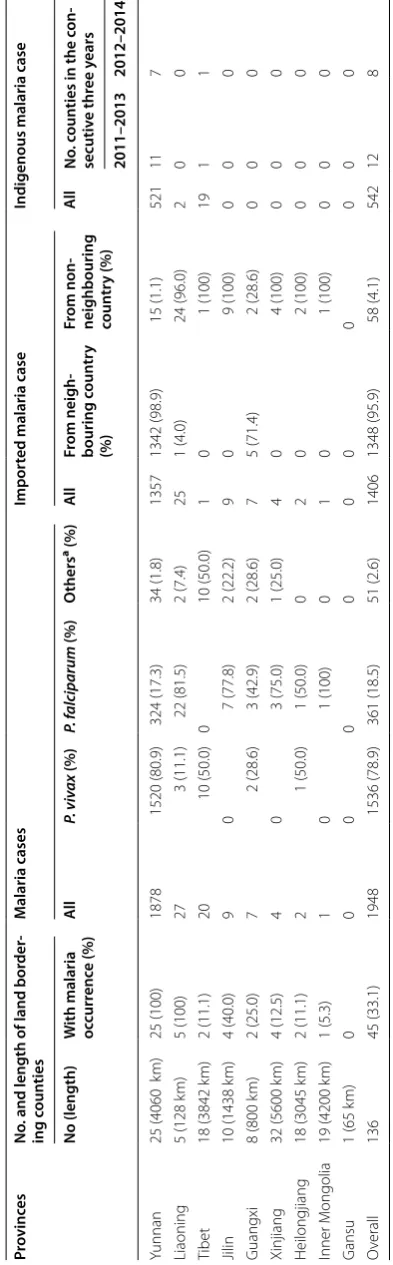
From 2011 to 2014, a total of 1948 malaria cases were reported in 45/136 counties of China sharing interna-tional land borders, consisting of 1536 (78.9%) cases of P. vivax malaria, 361 (18.5%) cases of P. falciparum malaria and 51 (2.6%) other cases, including five (0.25%) cases of Plasmodium malariae malaria, three (0.15%) mixed infections and 43 (2.2%) untyped cases. There were 1406 imported cases, 1348 (96%) coming from neighbouring countries and 58 (4%) coming from non-neighbouring countries (Table 1). The proportion of imported cases in P. vivax and P. falciparum was 78.7 and 21.3%. A total of 542 indigenous cases were identi-fied, occurring in Yunnan (521 cases), Tibet (19 cases) and Liaoning (two cases) provinces. The age distribu-tion showed that the median age of imported cases was 33.0 years and that of indigenous cases was 32.0 years. The cumulative malaria cases by county ranged from 0 to 703. During 2011–14, 88.4% of reported cases were parasitologically confirmed cases and 11.6% were clinically-diagnosed.
In the three consecutive years from 2012 to 2014 and in the four consecutive years from 2011 to 2014, indig-enous malaria cases continued to occur in seven coun-ties of Yunnan province and in Motuo county of the Tibet autonomous region.
Among the counties in the north and west of China, most had no malaria cases, with only a small number of sporadic cases. By contrast, in the counties of the south of China, there were eight counties with more than 50 cumulative cases, all of which were located in Yun-nan province and adjacent to Myanmar, which is at the malaria control stage (Fig. 1).
Imported malaria cases were reported each year from 2011 to 2014, with a peak of 546 cases in 2011, decreas-ing yearly in the followdecreas-ing years. The proportion of imported cases in P. vivax and P. falciparum was 78.7 and 21.3%. The number of imported cases caused by P. vivax decreased by 43.0% in 2012 (from 419 cases in 2011 to 239 cases in 2012) and was stable during the follow-ing years (216 cases in 2014). Imported cases caused by P. falciparum decreased from 121 cases in 2011 to 38 cases in 2014 (Fig. 2). The number of counties with imported cases slightly decreased from 28 counties in 2011 to 26 counties in 2014. The number of counties affected by P. vivax decreased from 21 in 2011 to 17 in 2014, and the number affected by P. falciparum decreased from 18 in 2011 to 15 in 2014.
Indigenous malaria cases presented a markedly decreasing trend during the period from 2011 to 2014, with 319 indigenous cases in 2011 reducing to only 33 indigenous cases in 2014. Indigenous cases caused by P. vivax decreased from 253 cases in 2011 to 28 cases in 2014, and indigenous cases caused by P. falciparum decreased from 40 cases in 2011 to five cases in 2014. The number of counties with indigenous cases reduced from 26 counties in 2011 to 10 counties in 2014. The number of counties with indigenous cases of by P. vivax decreased from 25 in 2011 to 10 in 2014, and the number of coun-ties affected by P. falciparum decreased from 13 in 2011 to two in 2014 (Fig. 3).
Seasonality
Malaria cases in the border counties presented obvious seasonal characteristics during the study period. In these counties, 51.0% of imported cases were reported between April and June, with a peak in May. The seasonal index was the highest (2.5) in May. Indigenous cases occurred most frequently between May and July, when 46.2% of cases were reported. The peak of indigenous case occur-rence was in June, and the seasonal index was 2.7, with a lag of 1 month from that of imported cases (Fig. 4).
The border areas in Yunnan province
Table
1
I
mp
or
ted and indigenous malaria c
ases b
y pr
ovinc
e in the land b
or
der r
egions of C
hina, 2011–14
a O
thers c on tained P. malariae , mix ed inf ec
tion cases and un
typed cases
Pr
ovinc
es
No
. and length of land bor
der -ing c oun ties M alaria cases Impor
ted malaria case
Indigenous malaria case
No (length) W ith malaria oc curr enc e (%) Al l P. viv ax (%) P. f alcipa rum (%) O thers
a (%)
Al l Fr om neigh -bouring c oun tr y (%) Fr om
non-neighbouring coun
tr y (%) Al l No . c oun
ties in the c
[image:5.595.196.393.93.727.2]in 2011 to 28 cases in 2014. The counties with indig-enous cases also decreased substantially from 24 coun-ties in 2011 to 9 councoun-ties in 2014. In the border councoun-ties adjacent to Laos and Vietnam, malaria cases declined markedly from 73 cases in 2011 to seven cases in 2014. Indigenous cases were not reported in these counties in 2014, and there were only a few imported cases. All seven bordering counties of Yunnan province where indigenous malaria cases occurred constantly in the three consecu-tive years from 2012 to 2014 were adjacent to Myanmar (Fig. 5).
Discussion
This study found that the magnitude and geographic distribution of malaria in the international land border counties of China decreased dramatically since the ini-tiation of the malaria elimination programme in 2010. There has been a lot more imported malaria than indig-enous malaria in these regions.
Regional diversity affects the epidemiological charac-teristics of malaria in the land border regions in northern, western and southern China. In northern and western China, including Inner Mongolia, Xinjiang, Gansu, Hei-longjiang and Jilin provinces, low population density and climate are not conducive to the transmission of malaria. Therefore, few local malaria cases were confirmed in these provinces. Moreover, the neighbouring countries of these provinces are generally low-transmission settings. The WHO categorizes Mongolia, Russia and Kazakhstan as malaria-free countries, and they present almost no risk of introducing malaria into China [22].
Nevertheless, in Liaoning province, indigenous malaria recently emerged in Dandong city. Dandong city is close to the border with North Korea, with frequent movement of people and goods across the border, and mosquito vec-tors capable of malaria transmission [23–26]. Currently, the risk of malaria spreading from North Korea to China is hard to estimate, because the epidemic situation in North Korea is uncertain [3].
In Motuo county of Tibet, the local humid and sub-tropical monsoon climate is suitable for mosquitoes breeding. Because it is a remote area, healthcare ser-vices have difficulty reaching the local population [27]. In order to achieve the nationwide elimination goal, malaria prevention and treatment should be prioritized in such hard-to-reach areas.
There were most reported malaria cases in Yunnan province, and the adjacent countries of Yunnan were in the controlling malaria stage. Hence, Yunnan prov-ince was further focused on. Several counties in Yun-nan with persistent indigenous malaria cases, especially along the border with Myanmar, pose the greatest threat to achieving national malaria elimination [28]. However,
Fig. 2 The cases of imported and indigenous malaria in the land border areas of China, 2011–2014
Fig. 3 Change in the number of counties affected by imported and indigenous malaria by year in the land border areas of China, 2011–2014
[image:6.595.56.293.87.256.2] [image:6.595.56.290.311.474.2] [image:6.595.57.291.556.699.2]it is encouraging that malaria in the land border regions of Yunnan province was effectively controlled in recent years by joint and cross-border prevention and control strategies. Indigenous transmission of malaria has been interrupted in many regions. The strategies used include timely detection, diagnosis and appropriate treatment for malaria cases; finding the source of infection promptly in all land border counties; setting up malaria preven-tion stapreven-tions in the border points; and active screening in exported labour to reduce the spread of malaria out of China [29–31].
Nevertheless, indigenous malaria cases still consist-ently occurred in several land border counties dur-ing this study. The border of Yunnan province is nearly 4060 km, with 18 border ports and 643 border pathways. Because Yunnan province has the highest border region population density, frequent cross-border travel and
difficulty managing the migrant population, prevention and control of malaria a more complex [32, 33]. The key Challenges of elimination by 2020 are mainly related to cross-border and imported malaria. Therefore, more sensitive and quicker responses for case identification are necessary. Village-level capacity for malaria diagno-sis, treatment and county-level surveillance and man-agement of exported labour should be strengthened to prevent local secondary malaria case occurrence [34]. International collaborations as the Asia Pacific Malaria Elimination Network, the Asia Pacific Leaders Malaria Alliance and China’s Belt and Road Initiative need to be further enhanced for the control of imported malaria.
This study only focused on malaria risk in land border regions, because China has long land borders and some neighbouring countries are highly-endemic for malaria. However, in today’s world, malaria can be imported
[image:7.595.60.535.86.479.2]through air and sea transportation, and this could also potentially reintroduce local transmission in areas in the interior with conditions conducive to malaria transmis-sion. For example, a large outbreak of imported malaria occurred in 2013 in Shanglin county, the inner county of Guangxi autonomous regions, which arose from Chinese gold miners returning from overseas (30). Further study of malaria importation and reintroduction should occur in regions with concentrated air and sea transportation and high levels of tourism.
Conclusions
The scale and extent of malaria occurrence in the inter-national border counties of China have decreased sharply during implementation of the national malaria elimi-nation programme. However, areas along the China– Myanmar border are still facing a high risk of malaria introduction and local transmission. Malaria infection in these hotspots is the main threat to achieving and main-taining malaria elimination in China. Surveillance and elimination strategies should be adjusted to account for these changes, and further research should explore the features of these areas to achieve the goal of national malaria elimination by 2020.
Authors’ contributions
QZ and ZL conceived, designed and supervised the study. QZ, JS and ZZ car-ried out the study, finalized and interpreted the analysis, and wrote the drafts of the manuscript. QG assisted in data collection and analysis. SL, WH and ACC participated in the results interpretation and manuscript revision. All authors read and approved the final manuscript.
Authors’ information
Qian Zhang is an epidemiologist at the Chinese Center for Disease Control and Prevention. Her research interests include the epidemiology of parasitic disease and emerging infectious disease.
Author details
1 Division of Infectious Disease, Key Laboratory of Surveillance and
Early-warn-ing on Infectious Disease, Chinese Center for Disease Control and Prevention, 155 Changbai Rd, Changping District, Beijing 102206, China. 2 Center of
Clini-cal Laboratory, the First Affiliated Hospital, College of Medicine, Zhejiang Uni-versity, Hangzhou, China. 3 State Key Laboratory of Virology and College of Life
Sciences, Wuhan University, Wuhan, China. 4 School of Public Health and Social
Work, Queensland University of Technology, Brisbane, Australia. 5 Research
School of Population Health, College of Medicine, Biology and Environment, The Australian National University, Canberra, Australia.
Acknowledgements
We acknowledge the hospitals and local health departments for assistance in coordinating data collection. We also thank the local Centers for Disease Control and Prevention for their valuable assistance during the course of our research.
Competing interests
The authors declare that they have no competing interests.
Availability of data and materials
All data are presented in the manuscript.
Ethics approval and consent to participate
As the study was a statistical analysis of data from malaria surveillance pro-grammes, human subjects’ consent to participate was not indicated because
the surveillance data utilized was existing, aggregate and without personal identifiers. The Ethical Review Committee of Chinese Center for Disease Control and Preventive reviewed the analysis protocol and deemed that it did not require ethical approval.
Consent for publication
All authors of the manuscript have read and agreed to publish this manu-script. They are accountable for all aspects of the accuracy and integrity of the manuscript in accordance with ICMJE criteria.
Funding
This study was supported by grants from the Ministry of Science and Technol-ogy of China (2012ZX10004-201, 2012ZX10004-220, 2014BAI13B05) and the Ministry of Health of China (No. 201202006). The funding bodies had no role in the study design, data collection and analysis, preparation of the manuscript, or decision to publish.
Received: 10 August 2016 Accepted: 28 October 2016
References
1. White NJ. The treatment of malaria. N Engl J Med. 1996;335:800–6. 2. White NJ, Pukrittayakamee S, Hien TT, Faiz MA, Mokuolu OA, Dondorp
AM. Malaria. Lancet. 2014;383:723–35.
3. WHO. World Malaria Report: 2015. Geneva: World Health Organization; 2015. 4. Chiyaka C, Tatem AJ, Cohen JM, Gething PW, Johnston G, Gosling
R. Infectious disease. The stability of malaria elimination. Science. 2013;339:909–10.
5. WHO. Global technical strategy for malaria 2016–2030. Geneva: World Health Organization; 2015.
6. Wangdi K, Gatton ML, Kelly GC, Clements AC. Cross-border malaria: a major obstacle for malaria elimination. Adv Parasitol. 2015;89:79–107.
7. Chai JY. Re-emerging Plasmodium vivax malaria in the Republic of Korea. Korean J Parasitol. 1999;37:129–43.
8. Tang LH. Malaria in China: from control to elimination(in Chinese). Int J Med Parasit Dis. 2009;36:258–65.
9. Feng J, Xiao HH, Xia ZG, Zhang L, Xiao N. Analysis of malaria epidemio-logical characteristics in the People’s Republic of China, 2004–2013. Am J Trop Med Hyg. 2015;93:293–9.
10. Zhang Q, Lai S, Zheng C, Zhang H, Zhou S, Hu W, et al. The epide-miology of Plasmodium vivax and Plasmodium falciparum malaria in China, 2004–2012: from intensified control to elimination. Malar J. 2014;13:419.
11. Wang SQ, Li YC, Zhang ZM, Wang GZ, Hu XM, Whitney AQ. Prevention measures and socio-economic development result in a decrease in malaria in Hainan. China. Malar J. 2014;13:362.
12. National Health And Family Planning Commission. Action Plan of China Malaria Elimination (2010–2020). http://www.gov.cn/zwgk/2010-05/26/ content_1614176.htm. Accessed 10 Oct 2015.
13. Richards AK, Smith L, Mullany LC, Lee CI, Whichard E, Banek K, et al. Preva-lence of Plasmodium falciparum in active conflict areas of eastern Burma: a summary of cross-sectional data. Conflict Health. 2007;1:9.
14. Zhou G, Sirichaisinthop J, Sattabongkot J, Jones J, Bjornstad ON, Yan G, et al. Spatio-temporal distribution of Plasmodium falciparum and P. vivax malaria in Thailand. Am J Trop Med Hyg. 2005;72:256–62.
15. Wang RB, Zhang J, Zhang QF. Malaria baseline survey in four special regions of northern Myanmar near China: a cross-sectional study. Malar J. 2014;13:302.
16. Ministry of Health of the People’s Republic of China. [Diagnostic criteria for malaria (WS259–2006)])(in Chinese). Beijing: People’s Medical Publish-ing House. 2006:1–10.
17. Wang L, Wang Y, Jin S, Wu Z, Chin DP, Koplan JP, et al. Emergence and control of infectious diseases in China. Lancet. 2008;372:1598–605. 18. Chinese Center for Disease Control and Prevention. Chinese technical
• We accept pre-submission inquiries
• Our selector tool helps you to find the most relevant journal
• We provide round the clock customer support • Convenient online submission
• Thorough peer review
• Inclusion in PubMed and all major indexing services
• Maximum visibility for your research
Submit your manuscript at www.biomedcentral.com/submit
Submit your next manuscript to BioMed Central
and we will help you at every step:
19. The Central People’s Government of the People’s Republic of China. [The list of land border counties of China](in Chinese). http://www.gov.cn/ test/2006-07/14/content_335831.htm. Accessed 11 Oct 2015. 20. Cotter C, Sturrock HJ, Hsiang MS, Liu J, Phillips AA, Hwang J, et al. The
changing epidemiology of malaria elimination: new strategies for new challenges. Lancet. 2013;382:900–11.
21. Xiao D, Long Y, Wang S, Wu K, Xu D, Li H, et al. Epidemic distribution and variation of Plasmodium falciparum and Plasmodium vivax malaria in Hainan, China during 1995–2008. Am J Trop Med Hyg. 2012;87:646–54. 22. Feachem RG, Phillips AA, Hwang J, Cotter C, Wielgosz B, Greenwood
BM, et al. Shrinking the malaria map: progress and prospects. Lancet. 2010;376:1566–78.
23. Teng C, Lei L, Sun YW, Tian J. [Prevalence of malaria in Liaoning Province, 2008 to 2013](in Chinese). Chin J Schisto Control. 2014;26:200–2. 24. Yu DM, Liu Y, Ren CR. Epidemiology trend analysis on malaria in Dandong
City of Liaoning Province, 2005–2010 (in Chinese). Nat Med J China. 2011;91:1654–6.
25. Qin D, Shao YZ, Sun M. Epidemiology trend analysis on malaria in Dandong City of Liaoning Province, 1999–2003 (in Chinese). Dis Surveill. 2004;19:388–9.
26. Teng C, Sun YW, Tian J. [Intervention effect of health education on malaria in rural residents of Dandong City, Liaoning province](in Chinese). Int J Med Parasit Dis. 2014;41:159–62.
27. Zhang ZX, Zhou HN, Zhao XT, Chang FX, Wang HJ, Li XJ, et al. Epidemio-logical survey on malaria situation in Motuo County of Tibet, China (in Chinese). Chin J Parasitol Parasit Dis. 2008;26:343–8.
28. Liu H, Xu JW, Yang HL, Li M, Sun CD, Yin YJ, et al. Investigation and control of a Plasmodium falciparum malaria outbreak in Shan Special Region II of Myanmar along the China-Myanmar Border from June to December 2014. Infect Dis Poverty. 2016;5:32.
29. Wang DQ, Li SG, Cheng ZB, Xiao N, Chris C, Jimee H, et al. Transmission risk from imported Plasmodium vivax malaria in the China-Myanmar border region. Emerg Infect Dis. 2015;21:1861–4.
30. Li ZJ, Yang YC, Xiao N, Zhou S, Lin KM, Wang DQ, et al. Malaria Imported from Ghana by Returning Gold Miners, China, 2013. Emerg Infect Dis. 2015;21:864–7.
31. Xu JW, Liu H. Border malaria in Yunnan, China. Southeast Asian J Trop Med Public Health. 1997;28:456–9.
32. Zhou GF, Sun L, Xia RJ, Duan YZ, Xu JW, Yang HL, et al. Clinical Malaria along the China-Myanmar Border, Yunnan Province, China, January 2011– August 2012. Emerg Infect Dis. 2014;20:675–8.
33. Bi Y, Hu WB, Yang HL, Zhou XN, Yu WW, Guo YM, et al. Spatial patterns of malaria reported deaths in Yunnan Province. China. Am J Trop Med Hyg. 2013;87:526–35.