R E S E A R C H
Open Access
The M50I polymorphic substitution in association
with the R263K mutation in HIV-1 subtype B
integrase increases drug resistance but does not
restore viral replicative fitness
Melissa Wares
1,2, Thibault Mesplède
1, Peter K Quashie
1,3, Nathan Osman
1,2, Yingshan Han
1and Mark A Wainberg
1,2,3*Abstract
Background:First-generation integrase strand-transfer inhibitors (INSTIs), such as raltegravir (RAL) and elvitegravir (EVG), have been clinically proven to be effective antiretrovirals for the treatment of HIV-positive patients. However, their relatively low genetic barrier for resistance makes them susceptible to the emergence of drug resistance mutations. In contrast, dolutegravir (DTG) is a newer INSTI that appears to have a high genetic barrier to resistance
in vivo. However, the emergence of the resistance mutation R263K followed by the polymorphic substitution M50I has been observed in cell culture. The M50I polymorphism is also observed in 10-25% of INSTI-naïve patients and has been reported in combination with R263K in a patient failing treatment with RAL.
Results:Using biochemical cell-free strand-transfer assays and resistance assays in TZM-bl cells, we demonstrate that the M50I polymorphism in combination with R263K increases resistance to DTG in tissue culture and in biochemical assays but does not restore the viral fitness cost associated with the R263K mutation.
Conclusions:Since the combination of the R263K mutation and the M50I polymorphism results in a virus with decreased viral fitness and limited cross-resistance, the R263K resistance pathway may represent an evolutionary dead-end. Although this hypothesis has not yet been proven, it may be more advantageous to treat HIV-positive individuals with DTG in first-line than in second or third-line therapy.
Keywords:HIV integrase, Subtype B, Antiretrovirals, R263K, Resistance mutation, M50I, Polymorphism, INSTI-naïve
Background
The development of effective antiretrovirals against HIV has led to significant improvements in longevity and qual-ity of life for HIV-infected patients. Despite the progress made in the past 30 years, however, significant issues with HIV treatment remain including those related to drug re-sistance, tolerability, ease of dosing, and adherence to ther-apy [1]. Consequently, new targets for HIV are required to overcome problems associated with current antiretroviral
(ARV) drug classes. The most recently developed drug class is integrase-strand transfer inhibitors (INSTIs) that inhibit the previously untargeted HIV-1 integrase enzyme [2,3]. HIV-1 integrase (IN) is a protein comprising 288 amino acids structured into three domains, i.e. the N-terminal domain, the catalytic core domain and the C-terminal domain [4]. These domains are critical for the proper function of HIV-1 integrase, which is to catalyze the insertion of the proviral DNA into the host chromo-some. This process is achieved by two reactions. The first reaction, referred to as 3′ processing, is defined as the cleavage of a GT dinucleotide at the 3′ ends of the viral DNA resulting in the exposure of reactive hydroxyl groups [5]. These 3′hydroxyl groups then serve to covalently link the processed viral DNA and the host DNA in a reaction * Correspondence:[email protected]
1
Lady Davis Institute for Medical Research, McGill University AIDS Centre, Jewish General Hospital, Montreal, Quebec, Canada
2
Department of Microbiology and Immunology, Faculty of Medicine, McGill University, Montreal, Quebec, Canada
Full list of author information is available at the end of the article
referred to as strand-transfer [5]. This latter step is com-petitively inhibited by INSTIs.
[image:2.595.305.539.343.675.2]INSTIs that are currently available include raltegravir (RAL), elvitegravir (EVG), and dolutegravir (DTG). These antiretrovirals are considered effective, minimally toxic, and tolerable and are now recommended for the treat-ment of newly diagnosed individuals living with HIV by the U.S. Department of Health and Human Services. All of these drugs have demonstrated non-inferiority to efavir-enz (EFV)-based regimens with respect to viral suppres-sion [6-10]. In addition, the SAILING study demonstrated that DTG was superior to RAL at week 48 in patients in-fected with viruses resistant to two or more non-INSTI antiretroviral drug classes [11], suggesting a possible use for DTG in INSTI-naïve treatment-experienced individ-uals. RAL and EVG possess a modest genetic barrier to re-sistance which threatens the long-term use and efficacy of these INSTIs in patients with poor adherence to therapy. In particular, mutational pathways associated with muta-tions at posimuta-tions Y143, N155, and Q148 are associated with resistance to both RAL and EVG [12,13]. Mutations at position Q148 also reduce HIV susceptibility to the more recent INSTI DTG when Q148 substitutions are associated with several secondary mutations [14,15]. This newly approved INSTI [16] possesses a greater barrier to resistance and no major resistance mutation has yet been identified in treatment-naïve patients treated with DTG [10,15,17]. However, the R263K mutation has been found in INSTI-naïve ART-experienced patients receiving DTG treatment who have failed therapy with this drug [18]. As such, tissue culture selection studies with this drug have revealed the emergence of the R263K mutation in the integrase of HIV subtypes B and circulating recombinant form CRF02_A/G viruses [19]. R263K has been shown to confer low levels of resistance to DTG while decreasing viral fitness [19]. The same selection study also revealed multiple secondary mutations including the M50I poly-morphism in subtype B integrase [19].
In previous studies, the M50I polymorphism has been found in 10-25% of INSTI-naïve patients [20]. In addition, this polymorphism has been observed in combination with R263K in a patient who subsequently failed treatment with RAL [21]. As a result, it is reasonable to speculate that the presence of M50I could compromise DTG ac-tivity in INSTI-naïve patients as well as contribute to cross-resistance in treatment-experienced patients. Here, we present the biochemical characterization of the M50I substitution alone and in combination with the primary resistance mutation R263K in subtype B integrase. We in-vestigated the effect of these mutations on strand-transfer activity, viral fitness and resistance to INSTIs DTG, RAL, and EVG. Our results demonstrate that the M50I polymorphism does not restore the loss in HIV-1 in-fectivity associated with R263K and confers moderate
resistance to DTG when combined with the latter re-sistance mutation.
Results
Occurrence of the M50I polymorphism in treatment-naïve individuals living with HIV-1 subtype B
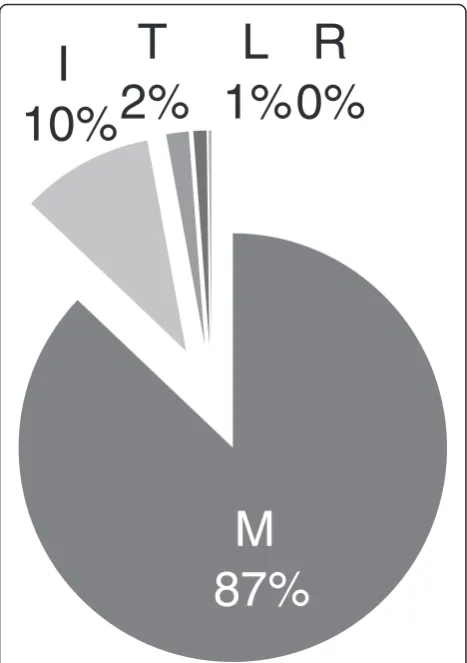
The M50I polymorphism was selected in culture as a sec-ondary mutation to R263K [19] as well as sequenced from a patient failing treatment with RAL [21]. As a result, we wanted to determine the frequency with which the M50I polymorphism occurs in the INSTI-naïve patient popula-tion. Analysis of clinical isolates of INSTI-naïve patients from the Stanford HIV Drug Resistance Database revealed that the M50I polymorphism was present at a frequency of 10% in subtype B integrase (Figure 1). The wild-type M50 was the most common genotype with a frequency of 87% suggesting that integrase subtype B is not highly vari-able at this position.
M
87%
I
10%
T
2%
L
1%
R
0%
Addition of M50I to R263K does not increase integrase strand-transfer activity
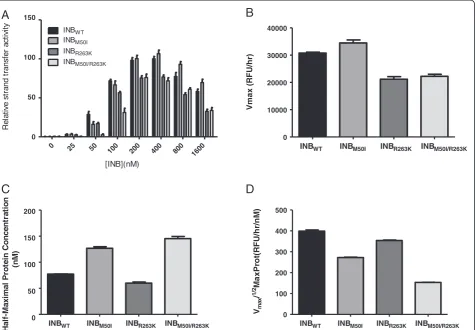
Previous studies have demonstrated that the primary resist-ance mutation R263K decreases integrase activity in cell-free assays [19]. Here, with the use of wild-type and mutant integrase proteins, we show that M50I does not compen-sate for the decrease in enzymatic activity associated with R263K. When varying the concentration of the INBWT,
INBM50I, INBR263K, and INBM50I/R263Kproteins (Figure 2A),
the activity of the M50I mutant initially appeared to be greater than that of the WT enzyme (Figure 2B). However, further investigation revealed that the Vmax/1/2MaxProt
values of the M50I and R263K enzymes were decreased compared to WT (Figures 2C-D). The addition of M50I to R263K did not compensate for the decreasedVmax/1/2
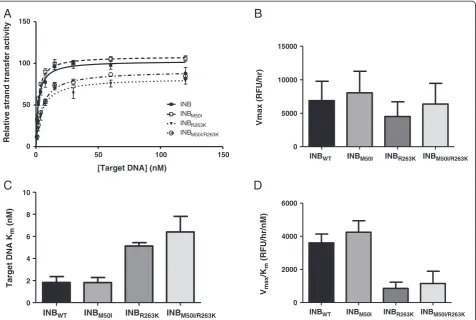
Max-Prot of the R263K enzyme (Figure 2D). The results were similar when we varied the concentration of target DNA (Figure 3). In these experiments, both theVmaxandKmof
the M50I enzyme were comparable to those of the WT en-zyme whereas R263K resulted in a decreasedVmaxand
in-creasedKm(Figures 3B-D). The addition of M50I to R263K
slightly increased integrase Vmax but further increased the
Km, resulting in a non-significant increase in enzyme
effi-ciency (Figure 3D). Overall, the addition of M50I to R263K did not compensate for the decrease in enzymatic efficiency associated with the R263K mutant.
The effect of M50I with R263K on susceptibility to INSTIs The integrase coding region of HIV-1 contains similar levels of natural variation as that seen in protease [22]. Fur-thermore, the pre-existing polymorphism L63P which emerges during treatment with PIs has been shown to be compensatory when combined with a primary resistance mutation [22]. We therefore wanted to determine if the addition of M50I, a natural polymorphism in integrase, to R263K affected susceptibility to DTG, RAL, and EVG in strand-transfer assays. Analysis with the competitive inhib-ition model was used to generate values of relative Vmax
andKiexpressed in fold-change (FC) (Table 1). The R263K
mutation did not greatly affect DTG activity (FC = 2.6) and the addition of M50I did not have a significant effect on the level of resistance observed (FC = 2.8). In contrast, the addition of M50I to R263K decreased susceptibility to EVG (FC = 6.4 for M50I/R263K compared to 3.0 for
A
B
C
D
0 25 50
100 200 400 800 1600
0 50 100 150
INBW T
INBR263K INBM50I/R263K INBM50I
[INB](nM)
R
e
la
ti
v
e
s
tr
and t
ra
n
sf
e
r act
ivi
ty
INBWT INBM50I INBR263K INBM50I/R263K
0 10000 20000 30000 40000
V
max (
R
F
U
/h
r)
INBWT INBM50I INBR263K INBM50I/R263K 0
50 100 150 200
Hal
f-M
a
x
im
al
Pr
ot
ei
n Co
nce
n
tr
at
io
n
(n
M
)
INBWT INBM50I INBR263K INBM50I/R263K 0
100 200 300 400 500
Vma
x
/
1/
2M
a
x
P
ro
t(
RF
U/
h
r/
n
M
[image:3.595.63.540.363.693.2])
Figure 2Addition of M50I to R263K does not increase integrase strand-transfer activity.Strand-transfer activity andVmax/1/2MaxProt of
wild-type and mutant enzymes.A)Relative strand-transfer activity when varying protein concentration.B)Vmaxvalues.C)1/2MaxProt values.
R263K alone) and RAL (FC 5.4 compared to 4.2). The M50I mutant enzyme was associated with low-level resist-ance to all INSTIs tested (FC ~ 2.5) in these cell-free assays. Using TZM-bl assays with pNL4.3 M50I and R263K vi-ruses, we also showed that the combination of M50I and R263K increased resistance to DTG (FC = 15.6 fold) com-pared to R263K alone (FC = 8.5 fold) (Table 2). When these experiments were repeated with EVG, the R263K mutation alone conferred moderate-level resistance (FC = 21.4 fold) and, when combined with M50I, resistance to EVG was further increased (FC = 34.4 fold). In contrast, the M50I/R263K double mutant conferred only low-level resistance to RAL (FC = 3.6 fold). M50I alone did not
confer resistance to DTG or RAL but did confer low-level resistance to EVG (FC = 5.4 fold).
M50I does not compensate for the reduction in HIV replication associated with R263K
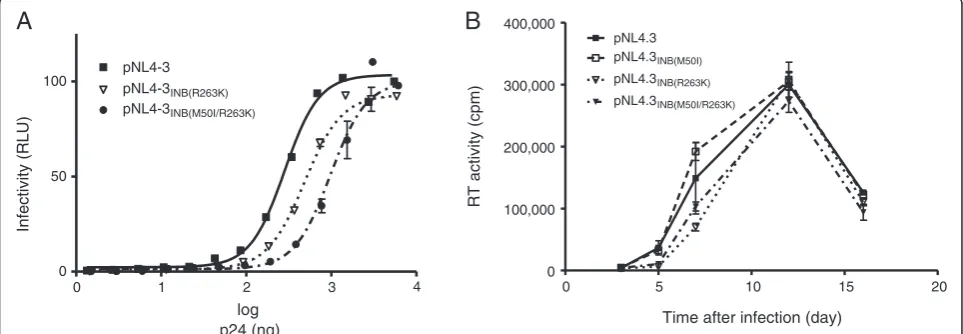
To determine whether M50I might impact viral replica-tion capacity, we performed TZM-bl infecreplica-tion assays with varying amounts of wild-type pNL4.3, pNL4.3INB
(R263K), and pNL4.3INB(M50I/R263K) viruses (Figure 4). As
previously demonstrated [19,23] and confirmed here, the R263K single mutation modestly diminished HIV infect-ivity whilst the addition of M50I to R263K further in-creased this deficit (Figure 4A). Long-term infection
0 50 100 150
0 50 100 150
INB INBM50I
INBR263K
[image:4.595.62.539.89.409.2] [image:4.595.67.539.635.733.2]INBM50I/R263K
[Target DNA] (nM)
Relative strand transfer activity
A
B
INBWT INBM50I INBR263K INBM50I/R263K 0
5000 10000 15000
Vmax (RFU/hr)
INBWT INBM50I INBR263K INBM50I/R263K
0 2 4 6 8 10
Target DNA K
m
(nM)
INBWT INBM50I INBR263K INBM50I/R263K
0 2000 4000 6000
Vmax
/K
m
(RFU/hr/nM)
C
D
Figure 3The effect of M50I with R263K on enzyme activity.Strand-transfer activity and enzyme efficiency of wild-type and mutant enzymes.
A)Relative strand-transfer activity when varying the concentration of biotinylated target DNA.B)Vmaxvalues.C)Kmvalues.D)Enzyme efficiency
as determined by the division ofVmaxbyKm. Error bars represent the standard errors of the means (SEM).
Table 1 Effects of the M50I and R263K mutations on DTG, RAL, and EVG inhibitory constants (Ki)
DTG RAL EVG
INB Relative Fold Relative Fold Relative Fold
Vmax Change (Ki) Vmax Change (Ki) Vmax Change (Ki)
WT 100 1 100 1 100 1
M50I 109 2.085 118 2.467 108 2.2
R263K 105 2.627 106 5.404 117 6.4
studies confirmed these results although the R263K rep-lication deficit was mostly observed early in the infection course (Figure 4B). The M50I mutant alone did not negatively impact HIV replication capacity; however, the addition of M50I to R263K further decreased viral fit-ness. Combined with our biochemical results, these data indicate that the M50I mutation does not compensate for the loss in replication fitness conferred by R263K.
Discussion
M50I is an accessory mutation that was selected in tissue culture subsequent to the emergence of R263K under DTG pressure [23]. Furthermore, this natural polymorph-ism has been detected in clinical isolates [21] and can be found in 10-25% of INSTI treatment-naïve patients [20]. Primary mutations, such as R263K, can often negatively impact integrase enzymatic activity and lower viral replica-tion capacity [24]. Secondary mutareplica-tions therefore compen-sate for this by increasing levels of drug resistance while simultaneously restoring viral fitness [24]. Here, we pro-vide epro-vidence that M50I alone does not negatively impact integrase strand-transfer activity and HIV replication cap-acity, an observation that explains the existence of this polymorphic substitution in untreated patients.
In addition to M50I, other secondary mutations have emerged in the presence of R263K in tissue culture expe-riments with DTG, i.e. E138K and H51Y [19]. This latter
mutation has previously been characterized [23]. Compar-able to H51Y, the addition of M50I to R263K increased resistance against DTG (15.6-fold for M50I/R263K versus 16.5-fold for H51Y/R263K). Furthermore, both of the H51Y and M50I mutations were innocuous when tested in the absence of R263K. In contrast, the addition of H51Y to R263K was very detrimental to integrase strand-transfer activity [23]. Although the combination of M50I/R263K did not restore enzyme efficiency (Figure 3D), the M50I polymorphism partially restored integrase maximal activ-ity to 92% of the WTVmaxfor M50I/R263K (Figure 3B),
as compared to approximately 20% for H51Y/R263K [21]. Since the M50I/R263K double mutant decreased integrase affinity for DNA compared to R263K alone (Figure 3C), an effect also observed with H51Y [23], this combination of mutations did not restore integration. In agreement with these results, the addition of M50I to R263K did not restore viral infectivity and replication capacity, similar to what has been reported for H51Y/R263K [23]. These re-sults are in accordance with previous rere-sults regarding polymorphisms and their role in conferring drug resist-ance, i.e. patient-derived viruses with polymorphisms do not demonstrate a decrease in susceptibility to INSTIs un-less a primary resistance mutation is also present [22,25].
[image:5.595.58.539.102.182.2]Although innocuous for RAL and DTG, the presence of M50I may slightly decrease HIV-1 susceptibility to EVG. The clinical relevance of this finding will require
Table 2 Effects of the M50I and R263K mutations on IC50s for DTG, RAL, and EVG
DTG RAL EVG Backbone Genotype IC50 (nM) FC IC50 (nM) FC IC50 (nM) FC
pNL4.3 WT 0.3113 - 0.1023 - 1.082
-M50I 0.6053 1.94 0.04851 0.47 5.9 5.45
R263K 2.662 8.55 0.1898 1.85 23.16 21.4
M50I/R263K 4.854 15.59 0.3643 3.56 37.26 34.44
A
B
0 1 2 3 4
0 50
100 pNL4-3 pNL4-3INB(R263K)
pNL4-3INB(M50I/R263K)
log p24 (ng)
Infectivity (RLU)
0 5 10 15 20
0 100,000 200,000 300,000 400,000
pNL4.3 pNL4.3INB(M50I)
pNL4.3INB(R263K)
pNL4.3INB(M50I/R263K)
Time after infection (day)
RT activity (cpm)
Figure 4M50I does not compensate for the reduction in HIV replication associated with R263K.Effects of the M50I and R263K mutations
[image:5.595.57.539.535.702.2]further investigation. In particular, it should be investi-gated whether M50I is over-represented in patients who have failed EVG-based therapy in clinical trials [8,26-28]. Overall, M50I by itself is unlikely to lead to treatment failure. Besides its effect on susceptibility to EVG, the biochemical characterization of the M50I integrase en-zyme demonstrates that this polymorphism alone does not affect strand-transfer activity. This observation is in agreement with the natural prevalence of this substitu-tion since integrasubstitu-tion is essential to HIV-1 infectivity. When associated with the R263K mutation, M50I dem-onstrates a tendency toward improving maximal strand-transfer activity while decreasing integrase affinity for target DNA, as measured by Vmax and Km values,
re-spectively (Figure 3). This strongly suggests that M50I is unable to compensate for the R263K defect in DNA binding that has been previously reported [19].
Conclusion
The addition of M50I to R263K fails to restore the def-icit in HIV replication capacity conferred by R263K. This observation is in agreement with the hypothesis that the R263K resistance pathway may represent an evolutionary dead-end for HIV-1; however this hypothesis requires further evaluation and remains to be proven. These re-sults also help to explain the absence of de novo resist-ance mutations in treatment-naïve patients who have been treated with DTG in clinical trials.
Methods
Cells and antiviral compounds
Infectivity experiments were performed using TZM-bl cells and 293T cells for purposes of transfection with replication-competent wild-type or mutant HIV-1. TZM-bl cells were obtained from the NIH AIDS Research Re-agent Program. The 293T cell line was obtained from the American Type Culture Collection (CRL-11268). Both cell lines were subcultured every 3–4 days in Dulbecco’s min-imal essential medium (DMEM) and kept at 37°C under 5% CO2. DTG, RAL, and EVG were provided by
GlaxoS-mithKline/ViiV Healthcare, Merck Inc, and Gilead Sci-ences, respectively.
Protein expression and purification
Wild-type and mutant subtype B integrase proteins were expressed usingEscherichia coliBL21 (DE3) Gold cells, F_ ompT hsdSB(rB_ mB_)dcm gal_(DE3)(Stratagene). Bacter-ial cultures were grown at 37°C in 500 ml Luria-Bertani (LB) broth supplemented with 100 μg/ml ampicillin until they reached an optical density of 0.4-0.6 at 600 nm. Protein expression was induced with 1 mM isopropyl-b-D-thiogalactopyranoside (IPTG) for 3 hr at 37°C, 200 rpm. The cultures were then centrifuged at 7,000 rpm for 10 min. The cell pellets were stored at−80°C. The purification of
integrase recombinant proteins was performed as previ-ously described for His-tagged integrase [19,29].
Integrase strand-transfer activity
The strand-transfer activity of the wild-type, M50I, R263K, and M50I/R263K integrase subtype B proteins were mea-sured using a microtiter plate assay as previously described [19]. Briefly, equimolar amounts of donor DNA LTR sense,
5′AmMC12ACCCTTTTAGTCAGTGTGGAAAATCTC
TAGCAGT-3′, and antisense, 5′-ACTGCTAGAGATTTT CCACACTGACTAAAAG-3′, were annealed by heating for 10 min at 95°C. Once cooled, the DNA LTR functional duplexes were covalently linked to Costar DNA-Bind 96-well plates (Corning) and stored at 4°C. After 48 hr, the plates were blocked and washed as previously described [19]. The wild-type and mutant integrase proteins were di-luted to a final concentration of 400 nM and incubated on the plates at room temperature for 30 min. Next, the indi-cated concentrations of INSTIs were either added or not, followed by the addition of the biotinylated target DNA du-plex (sense 5′-TGACCAAGGGCTAATTCACT-3Bio, and antisense (D), 5′-AGTGAATTAGCCCTTGGTCA-3Bio). Following incubation for 1 hr at 37°C, the plates were washed twice and quantified with Eu-labelled Streptavidin (PerkinElmer) as previously described [19].
Generation of replication-competent HIV-1
The pNL4.3INB(R263K) plasmid has been described
previ-ously [19]. The pNL4.3INB(M50I) and pNL4.3INB(M50I/R263K)
replication-competent HIV-1 plasmids were generated using the QuickChange II XL Site-Directed mutagenesis kit. The primers used for the M50I mutation were: sense,
5′-CTAAAAGGGGAAGCCATACATGGACAAGTAGAC
TG-3′ and antisense, 5′-CAGTCTACTTGTCCATGTAT GGCTTCCCCTTTTAG-3′. Following mutagenesis, the plasmids were digested with Dpn1 for 4 hr at 37°C and transformed usingEscherichia colistrain XL10-Gold ultra-competent cells, Tetr _(mcrA)183 _(mcrCB-hsdSMR-mrr) 173endA1 supE44 thi-1 recA1 gyrA96 relA1 lac Hte [F = proAB lacIqZ_M15Tn10 (Tetr) Amy Camr] (Stratagene). The QIAprep MiniPrep Kit (QIAGEN) was used for plas-mid purification and the plasplas-mids were quantified with NanoDrop. Presence of the mutations was confirmed by sequencing. Genetically homogenous HIV-1 viruses were produced by transfecting 12.5 μg of wild-type or mutant pNL4.3 plasmids into 293T cells as previously described [19]. An enzyme-linked immunosorbent assay (ELISA) (ABL, Inc.) was used to measure levels of p24 in culture. Reverse Transcriptase (RT) activity was measured as previ-ously described [30].
Resistance assays in TZM-bl cells
cells as previously described [19]. Briefly, 30,000 cells per well were infected with the WT, M50I, R263K, or M50I/ R263K viruses in the presence of serial dilutions of DTG, RAL, or EVG in 96-well plates (Corning). The amount of virus added to each well was normalized using results from RT activity. After incubation for 48 hr at 37°C and 5% CO2,luciferase activity was measured using the
lucifer-ase assay system (Promega) and a Micro-Beta2 lumin-ometer (PerkinElmer).
HIV infectivity and replication capacity
Non-competitive short-term infectivity assays in TZM-bl cells were used to evaluate HIV infectivity as previously described [19]. Long-term infection assays were used to determine HIV replication capacity in PM1 cells by quan-tifying RT activity (cpm) as previously described [23,30].
Data analysis
Unless otherwise indicated, all experiments consisted of at least 2 sets of experiments performed in triplicates, yielding 6 independent values for each data point. For each experi-ment, strand-transfer values in the absence of drug were arbitrarily determined as 100%. When varying concentra-tions of target DNA and protein were employed, strand-transfer results were fit to the Michaelis-Menten equation with the use of GraphPad Prism 5.0 software to generate values forVmax,KmandKi.The half-maximal protein
con-centration, defined as ½ of the calculated concentration at which maximal activity is reached, was determined at vary-ing INB concentrations. Enzyme performance was deter-mined by dividingVmaxbyKmas previously described [31].
The strand-transfer activity of the wild-type and mutant enzymes in the presence of INSTIs was determined using the competitive inhibition model and by constraining to Km values based on the delta target DNA results. TheKm
values for the INBWT, INBM50I, INBR263K, INBM50I/R263K
enzymes were 3.745, 8.997, 11.40 and 9.660, respectively. Using replication capacity experiments in TZM-bl cells in the presence of DTG, RAL or EVG, fifty percent inhibitory concentrations (IC50s) were determined for the wild-type
and mutant viruses using the sigmoid dose–response func-tion of the same software.
Competing interests
The authors declare no competing financial interests.
Authors’contributions
MW designed and performed experiments, analysed data and wrote the manuscript; TM designed and performed experiments, analysed data and revised the manuscript; NO, PKQ, and YH performed experiments; and MAW supervised the project and revised the manuscript. All authors read and approved the final manuscript.
Acknowledgments
This project was supported by the Canadian Institutes for Health Research (CIHR), the Canadian Foundation for AIDS Research (CANFAR) and ISTP Canada. PKQ is the recipient of a CIHR doctoral fellowship.
Author details
1
Lady Davis Institute for Medical Research, McGill University AIDS Centre, Jewish General Hospital, Montreal, Quebec, Canada.2Department of
Microbiology and Immunology, Faculty of Medicine, McGill University, Montreal, Quebec, Canada.3Division of Experimental Medicine, Faculty of
Medicine, McGill University, Montreal, Quebec, Canada.
Received: 13 December 2013 Accepted: 11 January 2014 Published: 17 January 2014
References
1. Hightower KE, Wang R, DeAnda F, Johns BA, Weaver K, Shen Y, Tomberlin
GH, Carter HL, Broderick T, Sigethy S:Dolutegravir (S/GSK1349572) exhibits
significantly slower dissociation than raltegravir and elvitegravir from wild-type and integrase inhibitor-resistant HIV-1 integrase-DNA complexes.Antimicrob Agents Chemother2011,55:4552–4559.
2. Wainberg MA, Mesplède T, Quashie PK:The development of novel HIV
integrase inhibitors and the problem of drug resistance.Current Opinion in Virology2012,2656:662.
3. Quashie PK, Mesplède T, Wainberg MA:HIV drug resistance and the
advent of integrase inhibitors.Curr Infect Dis Rep2013,15:85–100.
4. Dyda F, Hickman AB, Jenkins TM, Engelman A, Craigie R, Davies DR:Crystal
structure of the catalytic domain of HIV-1 integrase: similarity to other polynucleotidyl transferases.Science1994,266:1981–1986.
5. Craigie R:HIV integrase, a brief overview from chemistry to therapeutics.
J Biol Chem2001,276:23213–23216.
6. Lennox JL, DeJesus E, Lazzarin A, Pollard RB, Madruga JVR, Berger DS, Zhao
J, Xu X, Williams-Diaz A, Rodgers AJ:Safety and efficacy of
raltegravir-based versus efavirenz-raltegravir-based combination therapy in treatment-naive patients with HIV-1 infection: a multicentre, double-blind randomised controlled trial.Lancet2009,374:796–806.
7. Lennox JL, DeJesus E, Berger DS, Lazzarin A, Pollard RB, Madruga JVR, Zhao
J, Wan H, Gilbert CL, Teppler H:Raltegravir versus efavirenz regimens in
treatment-naive HIV-1-infected patients: 96-week efficacy, durability, subgroup, safety, and metabolic analyses.JAIDS Journal of Acquired Immune Deficiency Syndromes2010,55:39–48.
8. Sax PE, DeJesus E, Mills A, Zolopa A, Cohen C, Wohl D, Gallant JE, Liu HC,
Zhong L, Yale K:Co-formulated elvitegravir, cobicistat, emtricitabine, and
tenofovir versus co-formulated efavirenz, emtricitabine, and tenofovir for initial treatment of HIV-1 infection: a randomised, double-blind, phase 3 trial, analysis of results after 48 weeks.Lancet2012,379:2439–2448.
9. Zolopa A, Sax PE, DeJesus E, Mills A, Cohen C, Wohl D, Gallant JE, Liu HC,
Plummer A, White KL:A randomized double-blind comparison of coformulated
elvitegravir/cobicistat/emtricitabine/tenofovir disoproxil fumarate versus efavirenz/emtricitabine/tenofovir disoproxil fumarate for initial treatment of HIV-1 infection: analysis of week 96 results.JAIDS Journal of Acquired Immune Deficiency Syndromes2013,63:96–100.
10. van Lunzen J, Maggiolo F, Arribas JR, Rakhmanova A, Yeni P, Young B,
Rockstroh JK, Almond S, Song I, Brothers C:Once daily dolutegravir
(S/GSK1349572) in combination therapy in antiretroviral-naive adults with HIV: planned interim 48 week results from SPRING-1, a dose-ranging, randomised, phase 2b trial.The Lancet infectious diseases2012,12:111–118.
11. Marcelin A-G, Delaugerre C, Beaudoux C, Descamps D, Morand-Joubert L,
Amiel C, Schneider V, Ferre V, Izopet J, Si-Mohamed A:A cohort study of
treatment-experienced HIV-1-infected patients treated with raltegravir: factors associated with virological response and mutations selected at failure.Int J Antimicrob Agents2013,42:42–47.
12. Mouscadet J-F, Delelis O, Marcelin A-G, Tchertanov L:Resistance to HIV-1
integrase inhibitors: a structural perspective.Drug Resist Updat2010, 13:139–150.
13. Huang W, Frantzell A, Fransen S, Petropoulos CJ:Multiple genetic
pathways involving amino acid position 143 of HIV-1 integrase are preferentially associated with specific secondary amino acid substitutions and confer resistance to raltegravir and cross-resistance to elvitegravir. Antimicrob Agents Chemother2013,57:4105–4113.
14. Kobayashi M, Yoshinaga T, Seki T, Wakasa-Morimoto C, Brown KW, Ferris R,
Foster SA, Hazen RJ, Miki S, Suyama-Kagitani A:In vitro antiretroviral
properties of S/GSK1349572, a next-generation HIV integrase inhibitor. Antimicrob Agents Chemother2011,55:813–821.
15. Mesplède T, Quashie PK, Wainberg MA:Resistance to HIV integrase
16. Ballantyne AD, Perry CM:Dolutegravir: first global approval.Drugs2013,
73:1627–1637.
17. Katlama C, Murphy R:Dolutegravir for the treatment of HIV.Expert Opin
Investig Drugs2012,21:523–530.
18. Cahn P, Pozniak AL, Mingrone H, Shuldyakov A, Brites C, Andrade-Villanueva JF,
Richmond G, Buendia CB, Fourie J, Ramgopal M:Dolutegravir versus raltegravir
in antiretroviral-experienced, integrase-inhibitor-naive adults with HIV: week 48 results from the randomised, double-blind, non-inferiority SAILING study. Lancet2013,382:700–708.
19. Quashie PK, Mesplède T, Han Y-S, Oliveira M, Singhroy DN, Fujiwara T, Underwood
MR, Wainberg MA:Characterization of the R263K mutation in HIV-1 integrase
that confers low-level resistance to the second-generation integrase strand transfer inhibitor dolutegravir.J Virol2012,86:2696–2705.
20. Ceccherini-Silberstein F, Malet I, D’Arrigo R, Antinori A, Marcelin A-G, Perno
C-F:Characterization and structural analysis of HIV-1 integrase conservation. AIDS Rev2009,11:17–29.
21. Garrido C, Villacian J, Zahonero N, Pattery T, Garcia F, Gutierrez F, Caballero
E, Van Houtte M, Soriano V, de Mendoza C:Broad phenotypic
cross-resistance to elvitegravir in HIV-infected patients failing on raltegravir-containing regimens.Antimicrob Agents Chemother2012,56:2873–2878.
22. Low A, Prada N, Topper M, Vaida F, Castor D, Mohri H, Hazuda D, Muesing
M, Markowitz M:Natural polymorphisms of human immunodeficiency
virus type 1 integrase and inherent susceptibilities to a panel of integrase inhibitors.Antimicrob Agents Chemother2009,53:4275–4282.
23. Mesplède T, Quashie PK, Osman N, Han Y, Singhroy DN, Lie Y, Petropoulos
CJ, Huang W, Wainberg MA:Viral fitness cost prevents HIV-1 from evading
dolutegravir drug pressure.Retrovirology2013,10:22.
24. Mbisa JL, Martin SA, Cane PA:Patterns of resistance development with
integrase inhibitors in HIV.Infection and Drug Resistance2011,4:65.
25. Ceccherini-Silberstein F, Van Baelen K, Armenia D, Trignetti M, Rondelez E,
Fabeni L, Scopelliti F, Pollicita M, Van Wesenbeeck L, Van Eygen V: Secondary integrase resistance mutations found in HIV-1 minority quasispecies in integrase therapy-naive patients have little or no effect on susceptibility to integrase inhibitors.Antimicrob Agents Chemother
2010,54:3938–3948.
26. Rockstroh JK, DeJesus E, Lennox JL, Yazdanpanah Y, Saag MS, Wan H, Rodgers
AJ, Walker ML, Miller M, DiNubile MJ:Durable efficacy and safety of raltegravir
versus efavirenz when combined with tenofovir/emtricitabine in treatment-naive HIV-1–infected patients: final 5-year results from STARTMRK.JAIDS Journal of Acquired Immune Deficiency Syndromes2013,63:77–85.
27. Molina J-M, LaMarca A, Andrade-Villanueva J, Clotet B, Clumeck N, Liu Y-P, Zhong
L, Margot N, Cheng AK, Chuck SL:Efficacy and safety of once daily elvitegravir
versus twice daily raltegravir in treatment-experienced patients with HIV-1 receiving a ritonavir-boosted protease inhibitor: randomised, double-blind, phase 3, non-inferiority study.The Lancet infectious diseases2012,12:27–35.
28. DeJesus E, Rockstroh JK, Henry K, Molina J-M, Gathe J, Ramanathan S, Wei X,
Yale K, Szwarcberg J, White K:Co-formulated elvitegravir, cobicistat,
emtricitabine, and tenofovir disoproxil fumarate versus ritonavir-boosted atazanavir plus co-formulated emtricitabine and tenofovir disoproxil fumarate for initial treatment of HIV-1 infection: a randomised, double-blind, phase 3, non-inferiority trial.Lancet2012,379:2429–2438.
29. Bar-Magen T, Donahue DA, McDonough EI, Kuhl BD, Faltenbacher VH, Xu H,
Michaud V, Sloan RD, Wainberg MA:HIV-1 subtype B and C integrase
enzymes exhibit differential patterns of resistance to integrase inhibitors in biochemical assays.AIDS2010,24:2171–2179.
30. Xu H-T, Asahchop EL, Oliveira M, Quashie PK, Quan Y, Brenner BG, Wainberg
MA:Compensation by the E138K mutation in HIV-1 reverse transcriptase for deficits in viral replication capacity and enzyme processivity associated with the M184I/V mutations.J Virol2011,85:11300–11308.
31. Quashie PK, Mesplède T, Han Y-S, Veres T, Osman N, Hassounah S, Sloan RD,
Xu H-T, Wainberg MA:Biochemical analysis of the role of G118R-linked
dolutegravir drug resistance substitutions in HIV-1 integrase.Antimicrob Agents Chemother2013,57:6223–6235.
doi:10.1186/1742-4690-11-7
Cite this article as:Wareset al.:The M50I polymorphic substitution in association with the R263K mutation in HIV-1 subtype B integrase increases drug resistance but does not restore viral replicative fitness.
Retrovirology201411:7.
Submit your next manuscript to BioMed Central and take full advantage of:
• Convenient online submission
• Thorough peer review
• No space constraints or color figure charges
• Immediate publication on acceptance
• Inclusion in PubMed, CAS, Scopus and Google Scholar
• Research which is freely available for redistribution