R E S E A R C H A R T I C L E
Open Access
Development of a training programme for
home health care workers to promote
preventive activities focused on a healthy
lifestyle: an intervention mapping approach
Maaike E. Walters
1*, Arie Dijkstra
2, Andrea F. de Winter
1and Sijmen A. Reijneveld
1Abstract
Background:Lifestyle is an important aspect in maintaining good health in older adults, and home health care (HHC) workers can play an important role in promoting a healthy lifestyle. However, there is limited evidence in the literature regarding how to develop an effective training programme to improve the physical activity level and fruit and vegetable consumption of older adults within a HHC setting. The aim of this paper is to describe how Intervention Mapping (IM) was used to develop a training programme to promote preventive activities of HHC workers relating to the physical activity and fruit and vegetable intake of older adults living at home.
Methods:IM, a systematic theory and evidence-based approach was used to develop, implement and evaluate
the training programme. This entailed a literature search, a survey, semi-structured interviews and consultation with HHC workers and various field experts, and a pilot training session.
Results:The determinants associated with the provision of preventive activities were identified, and an overview was created of those objectives, matching methods and practical applications that could influence these determinants. The performance objectives for the HHC workers were early detection and monitoring, promoting a healthy lifestyle, informing colleagues, continuing allocated preventive activities and referring to other experts and facilities. Findings were translated into a comprehensive training programme for HHC workers focused on motivating older adults to adopt and maintain a healthier lifestyle.
Conclusions:IM was a useful tool in the development of a theory-based training programme to promote preventive activities by HHC workers relating to fruit and vegetable intake and physical activity of older adults.
Keywords:Healthy eating, Home health care, Intervention mapping, Lifestyle, Nurse, Older adults, Physical activity, Prevention, Training programme
Background
Lifestyle is a key factor in good health; this is also true for older adults [24]. Sufficient physical activity and fruit and vegetable intake can have a beneficial effect on the maintenance of good physical and mental health [25, 38, 40, 42, 49]. Furthermore, physical activity and nutrition programmes can result in, respectively, increased physical
activity and positive nutrition-related outcomes [3, 45]. The promotion of physical activity and fruit and vegetable intake is an important aspect of enhancing the health of older adults, however, research shows that the fruit and vegetable intake and physical activity pattern of many older European adults could be improved [13, 14, 22, 47].
Home health care (HHC) could prove an important setting for interventions here. HHC in the Netherlands is a form of nursing care provided at home, comparable to nursing practices at home in e.g. France and Germany. This care can be given, for example, to clients with chronic illnesses, clients with a handicap or to older adults * Correspondence:[email protected]
1Division of Community & Occupational Medicine, Department of Health Sciences, University Medical Center Groningen, P.O. Box 1969700 AD Groningen, The Netherlands
Full list of author information is available at the end of the article
to support ADL. Nurses conduct more simple care tasks, e.g., washing clients, or more complex medical nursing tasks, e.g., setting insulin dosages, depending on their level of nursing education. HHC workers are a valuable channel for providing preventive activities because they are in fre-quent contact with their clients and can therefore observe changes and developments in the clients’ behaviour, but evidence on the effectiveness of these activities lacks. An-other advantage is that they observe their clients in an en-vironment that is safe for the clients: their own homes. Furthermore, a relationship of trust often forms between HHC worker and client, which makes it easier for the HHC worker to raise the subject of lifestyle.
Interventions in the HHC context show promising re-sults, for example positively affect health and functional status for a diversity of interventions provided at home [29–31, 43] and the topics studied include prevention of malnutrition, prevention of falls and prevention of pres-sure ulcers [8, 29, 34, 36]. Although prevention in the area of lifestyle entails quite different interventions and requires different behaviour from the HHC worker than other areas of prevention, these results support the hy-pothesis that HHC workers could also play an important role in providing prevention to promote physical activity and healthy eating.
The provision of preventive activities by HHC workers is low and could therefore be improved (unpublished manuscript submitted for publication). In order to achieve this, it is first necessary to describe the different preventive activities that HHC workers can execute to promote physical activity and healthy eating. These ac-tivities can be divided into six areas: early detection and monitoring, informing, promoting, continuation, refer-ring and recording. Early detection and monitorefer-ring means detecting health risks such as inactivity or the risk of obesity. Informing means discussing the advan-tages of healthy and disadvanadvan-tages of unhealthy behav-iour with the client. Promoting entails motivating the client to be more physically active and to eat more healthily. Continuation means continuing to provide the activities that colleagues have been providing or to fol-low up with new activities. Referring entails informing clients about opportunities in the area if extra help is needed to change their behaviour. The last area, record-ing, means registering the health of clients in their health records. All these preventive activities are exe-cuted in the context of the individual client, meaning that the HHC worker always is sensitive to the individual needs of the client and inquires what the client can and cannot do by himself. For example, when it concerns dietary habits, the clients’needs and wishes are mapped, as well as who is doing the shopping and who prepares the meals. As HHC workers have not previously per-ceived lifestyle prevention to be among their duties, they
consequently do not provide it. Intervention is therefore necessary to encourage them to provide such preventive activities.
There is limited evidence in the literature regarding how to develop an effective training programme, specific within a HHC setting, to improve the physical activity level and fruit and vegetable consumption of older adults. Intervention Mapping (IM) was therefore used for the process of developing a training programme [5, 6]. As IM has not previously been used in the HHC context, the pur-pose of this article is to describe how it was used to de-velop a training programme to promote preventive activities by HHC workers relating to the physical activity and fruit and vegetable intake of older adults living at home. This is the first study describing the development of such a program within the HHC context focused on physical activity and fruit and vegetable consumption.
Intervention mapping
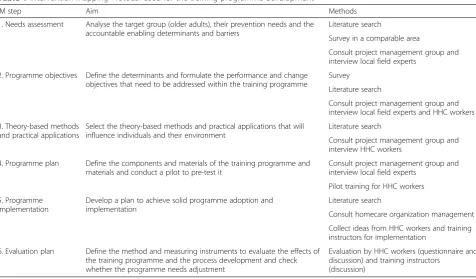
IM was used to develop this training programme [5, 6]. It consists of six consecutive steps that help identify needs and find solutions by integrating theory and taking into account empirical findings from relevant literature and information collected from the target population, see Table 1 [7]. Since 1998, IM has been widely used by several researchers who found it to be a fitting, useful, systematic and practical framework [20, 26, 33].
Below we first describe the most important groups of that are involved: The HHC clients as the target group, and the HHC workers as the channel. In the subsequent steps of Intervention Mapping, information needs to be gathered systematically from different types of sources, using different methods. These methods (e.g. literature search; survey; interviews) are next described below. The Medical Ethical Committee of the University Medical Center Groningen evaluated the study protocol and con-sidered it was not necessary to file it for ethical approval.
Setting, target group and HHC workers
Setting and target group
HHC workers
The HHC workers with whom and for whom the train-ing will be developed worked in the selected areas and included nursing aides and registered nurses who pro-vide care at home for the clients the most. These HHC workers provide their clients with basic and medical and nursing care. Their common task also includes preven-tion, which can mean detecting emerging problems such as pressure ulcers, malnutrition, obesity, falling, problems with medication use, depression and incontinence [41].
Methods
Literature search
A first means of gathering information to develop the training programme is a literature search. This was con-ducted in EBSCOhost and ScienceDirect to find relevant information from other studies that could be integrated into the training. Various combinations of the keywords lifestyle, physical activity, exercise, fruit, vegetables, diet, preventive care, preventive activities, prevention, health promotion, psychosocial determinant, nurse, homecare, elderly, older adults, intervention, programme and train-ing were used. The search began in 2011, and updates were carried out until June of that year. Only articles written in English were taken into account.
Furthermore, while following IM, suitable theoretical methods and practical applications were chosen that could influence the relevant determinants. A
theory-based method is a technique or process used to influ-ence the determinants of behaviour. Applications are techniques that use theory-based methods in a way that suit the intervention population and context [5, 6]. In an early stage of the development of the intervention, a training was chosen as the channel to change the behav-iour of the HHC workers. The reason for this was the complex nature of the specific behaviour to be influ-enced and the need for the HHC workers to practise the preventive activities.
Survey
[image:3.595.59.536.96.375.2]Second, a survey was conducted in one of the work areas of the HHC workers to generate an overview of the enabling determinants and barriers that might be as-sociated with the provision of preventive activities. The analyses of this survey showed that social support, social pressure, role modelling and knowledge were associated with the performance of preventive activities. These po-tentially modifiable factors have been taken into account when developing the training programme. Forty-six HHC workers, not included in this study, response 40 %, used a self-report questionnaire to rate whether they conducted twenty-eight types of preventive activities re-lating to physical activity and healthy eating. They were also asked about what motivated them to provide these preventive activities. More information can be found in Table 1Intervention Mapping Protocol used for the training programme development
IM step Aim Methods
1. Needs assessment Analyse the target group (older adults), their prevention needs and the accountable enabling determinants and barriers
Literature search
Survey in a comparable area
Consult project management group and interview local field experts
2. Programme objectives Define the determinants and formulate the performance and change objectives that need to be addressed within the training programme
Survey
Literature search
Consult project management group and interview local field experts and HHC workers
3. Theory-based methods and practical applications
Select the theory-based methods and practical applications that will influence individuals and their environment
Literature search
Consult project management group and interview HHC workers
4. Programme plan Define the components and materials of the training programme and materials and conduct a pilot to pre-test it
Consult project management group and interview local field experts
Pilot training for HHC workers
5. Programme implementation
Develop a plan to achieve solid programme adoption and implementation
Literature search
Consult homecare organization management
Collect ideas from HHC workers and training instructors for implementation
6. Evaluation plan Define the method and measuring instruments to evaluate the effects of the training programme and the process development and check whether the programme needs adjustment
Evaluation by HHC workers (questionnaire and discussion) and training instructors
(discussion)
the study of Walters, Dijkstra, de Winter and Reijneveld (unpublished manuscript submitted for publication).
Interviews and consultation with HHC workers and field experts
Third and prior to the development of the training, semi-structured interviews and meetings were held with local field experts to gather information about which tasks undertaken by the HHC workers related to preven-tion together with the possible determinants that could influence them. These experts were district managers of the HHC organization, a medical officer, a senior staff member of the community, a sports consultant, a man-ager of a social work foundation and a general practi-tioner. In addition, five semi-structured interviews were conducted with HHC workers to discover what moti-vated them to engage in preventive activities and what could be possible barriers for them not to perform these activities. This information was used to further tailor the training programme to the HHC workers. Verbal con-sent was obtained for all interviews.
Pilot training
A final way for input for the training development was a pilot study. A pilot training was set up to pre-test several aspects of it. This pilot training was evaluated and minor modifications were made to the training protocol.
Theoretical model
Integrated model of change (I-change model)
The I-change model [17] explains motivational and be-havioural change, and it was applied to identify possible determinants of conducting preventive activities by HHC workers. The I-Change Model describes that hid-den and apparent behaviours are determined by a per-son’s intention or motivation to perform a specific type of behaviour. It is an integrated model that combines several theories [18], such as the ASE model originating from the Theory of Reasoned Action [23, 37], the Trans-theoretical Model [37], the Social Cognitive Theory [4] and the Precaution Adoption Model [48]. The key con-cepts are that it ensures that potential influenceable de-terminants related to the target problem are taken into account and that the best applicable theoretical methods and applications are used to address these determinants. Several possible determinants, according to the model, were taken into account in developing the training, such as awareness, knowledge, self-efficacy, attitude, skills and social support.
Results
In this paragraph, the results of the six steps of Intervention Mapping are presented.
Step 1: Needs assessment
The purpose of this step was to analyse the problem faced by the target group, older adults. The problem of an unhealthy lifestyle accounts for our target group, older adults living in a rural part of the Netherlands, the region of Groningen. Approximately 60 % of older adults (65+) in the province of Groningen are overweight and 37 % do not meet the Dutch physical activity recom-mendation (30 min of physical activity at least 5 days a week). In addition, approximately 67 % do not meet the recommended intake of vegetables (200 g a day) and 50 % do not meet the recommended two pieces of fruit a day [10]. These numbers are comparable for older adults in other parts of the Netherlands. A low socioeco-nomic position (SEP) seems to explain much of the un-healthy lifestyle of older adults in this area. A high rate of 80 % of adults between 50 and 64 years of age with a low SEP are overweight, but for older adults with a high SEP this is much lower, namely 50 %. Of those adults with a low SEP who are 65 years old and over, 62 % are overweight, whereas the rate for those in this age group with a high SEP is 46 % [10]. Thus, this aspect should be taken into account when developing the training programme.
Action is therefore needed to change the unhealthy behaviour patterns of these older adults in region of Groningen and encourage them to adopt a healthier lifestyle. The study focused on the HHC workers pro-viding preventive activities to promote a healthy life-style. It seems that, despite their potential influence, the HHC workers do not make full use of this opportun-ity. The literature tells us that only half of all nurse practi-tioners provide preventive counselling on physical activity on most days of the week, and only a third of physicians discuss nutrition or diet with their patients [12, 15]. Fur-thermore, Walters, De Winter, Reijneveld and Dijkstra (unpublished manuscript submitted for publication) found that HHC workers only engage in a limited number of preventive activities relating to physical activity and healthy eating.
There could be several explanations for the behaviour of the HHC workers. Psychosocial factors, such as level of knowledge, could have an effect on their behaviour, and work-related factors, such as the work culture within the organization and facilities such as a reporting tool, could also be associated with the provision of pre-ventive activities. These factors will be further elucidated in step 2.
Step 2: Formulating programme objectives
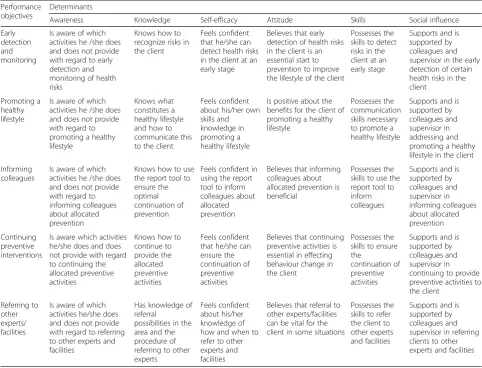
and translated into change objectives based on the needs assessment, literature search, survey and interviews with HHC workers and experts in the field (see Table 2). In Table 2, change objectives are stated how to change the be-haviour of the HHC workers to stimulate HHC clients to engage in more physical activity and healthier eating behav-iour. These performance objectives describe what the HHC workers need to do to promote the target behaviour, namely provide preventive activities. The change objectives in Table 2 state what needs to be done to accomplish the performance objectives.
The five performance objectives were:
The HHC workers detect and monitor any risks or potential risks, such as obesity, inactivity and decreased autonomy. These activities can be performed on a regular basis.
When the HHC workers are at the clients’home, they communicate the risks to the client and promote a healthier lifestyle. For example, HHC workers ask how older adults in their opinion can
increase their physical activities or promote active participation in household activities.
The HHC workers inform their colleagues about the preventive activities they have provided by recording their preventive activities during each contact.
If behaviour is to change, continuity of care is needed dependent on the degree of behaviour change the client already achieved. The HHC workers therefore continues to provide preventive activities adjusted to the individual client.
If the HHC workers need help with prevention, they should request this from a colleague or supervisor. If they require specific help, they may need to refer clients to another expert. If necessary, the HHC workers can refer clients to facilities with a focus on physical activity or healthy eating.
[image:5.595.56.539.366.734.2]In order to meet these five objectives, some insight into the determinants of the behavioural objectives and psycho-logical causes would be needed and is provided by the fol-lowing literature search. The literature revealed that the
Table 2Overview of performance and change objectives for the various determinants Performance
objectives
Determinants
Awareness Knowledge Self-efficacy Attitude Skills Social influence
Early detection and monitoring
Is aware of which activities he /she does and does not provide with regard to early detection and monitoring of health risks
Knows how to recognize risks in the client
Feels confident that he/she can detect health risks in the client at an early stage
Believes that early detection of health risks in the client is an essential start to prevention to improve the lifestyle of the client
Possesses the skills to detect risks in the client at an early stage
Supports and is supported by colleagues and supervisor in the early detection of certain health risks in the client
Promoting a healthy lifestyle
Is aware of which activities he /she does and does not provide with regard to promoting a healthy lifestyle
Knows what constitutes a healthy lifestyle and how to communicate this to the client
Feels confident about his/her own skills and knowledge in promoting a healthy lifestyle
Is positive about the benefits for the client of promoting a healthy lifestyle
Possesses the communication skills necessary to promote a healthy lifestyle
Supports and is supported by colleagues and supervisor in addressing and promoting a healthy lifestyle in the client
Informing colleagues
Is aware of which activities he /she does and does not provide with regard to informing colleagues about allocated prevention
Knows how to use the report tool to ensure the optimal continuation of prevention
Feels confident in using the report tool to inform colleagues about allocated prevention
Believes that informing colleagues about allocated prevention is beneficial
Possesses the skills to use the report tool to inform colleagues
Supports and is supported by colleagues and supervisor in informing colleagues about allocated prevention Continuing preventive interventions
Is aware which activities he/she does and does not provide with regard to continuing the allocated preventive activities
Knows how to continue to provide the allocated preventive activities Feels confident that he/she can ensure the continuation of preventive activities
Believes that continuing preventive activities is essential in effecting behaviour change in the client
Possesses the skills to ensure the
continuation of preventive activities
Supports and is supported by colleagues and supervisor in continuing to provide preventive activities to the client
Referring to other experts/ facilities
Is aware of which activities he/she does and does not provide with regard to referring to other experts and facilities
Has knowledge of referral
possibilities in the area and the procedure of referring to other experts
Feels confident about his/her knowledge of how and when to refer to other experts and facilities
Believes that referral to other experts/facilities can be vital for the client in some situations
Possesses the skills to refer the client to other experts and facilities
health behaviour of the HHC workers themselves affects whether they engage in certain preventive activities: for example, McDowell, McKenna and Naylor [32] found that HHC workers who were physically active regularly were more likely to promote physical activity them-selves. Another possible determinant was that HHC workers have not considered the provision of prevent-ive activities relating to physical activity and healthy eating to be one of their duties. Other studies have re-vealed various barriers to providing preventive activ-ities, namely lack of client interest and lack of time during a client visit [11, 16, 27, 44], lack of guidelines and educational materials [21, 28], and lack of specific training for health care workers on how to advise cli-ents [21, 27]. The studies also provided examples of fa-cilitating factors for the specific preventive activity of counselling: client motivation, family support and relation-ship with the client [27]. The attitude and self-efficacy of the HHC workers also seemed to be associated with comparable activities such as counselling [1, 9], and it was possible that their skill level was also of influence, which meant that the determinant skills also needed to be taken into account.
The various field experts (see methods) believed that the following were important determinants for the provision of preventive activities: the HHC worker’s level of know-ledge, the quality of the relationship between the HHC worker and the client, the HHC worker having only a lim-ited focus on health and a limlim-ited focus on health within the area. An important determinant that arose in the in-terviews with the HHC workers and was also found in the literature was a lack of client interest in changing their be-haviour [11, 27]. The interviewees also believed that the following preconditioning factors would facilitate the provision of preventive activities: integrating time for pre-vention into their working hours and standardizing working methods to promote communication between colleagues.
In addition, the survey showed that the determinants social support, social pressure and modelling were as-sociated with whether HHC workers provide preventive activities relating to physical activity and healthy eating. This accounted for the total provision of preventive ac-tivities but also for specific acac-tivities such as informing the client, promoting a healthy lifestyle and continu-ation and recording of activities.
Once the above performance objectives and relevant determinants had been defined the following psycho-social determinants were selected that could be influenced or considered a preconditioning factor. Additional de-terminants from the I-change model that might influ-ence whether the HHC worker provides prevention activities, such as attitude, self-efficacy and awareness, were also included. This yielded the following determi-nants that could be influenced (see Table 2):
awareness
knowledge
self-efficacy
attitude
skills
social influence.
Step 3: Theory-based methods and practical applications In order to realize the performance objectives specified in step 2, suitable theoretical methods and practical ap-plications were chosen that could influence the relevant determinants. Various methods were derived from the literature and selected to reinforce the provision of pre-ventive activities [1, 2, 4], namely:
self-reflection: reflecting on one’s own thoughts
persuasive communication: using new argumentation and removing false notions
positive reinforcement: giving positive reinforcement to reward desired behaviour
feedback: receiving and giving personal feedback on behaviour
information delivery and processing
support from work organization: social support from colleagues and supervisors
instruction: issuing clear instructions about the desired behaviour
guided practice: practising good communication skills
modelling: demonstrating desired behaviour so the HHC worker can model this
goal-setting: setting clear goals for behaviour change
tailoring: tailoring all of the above methods to the individual HHC worker.
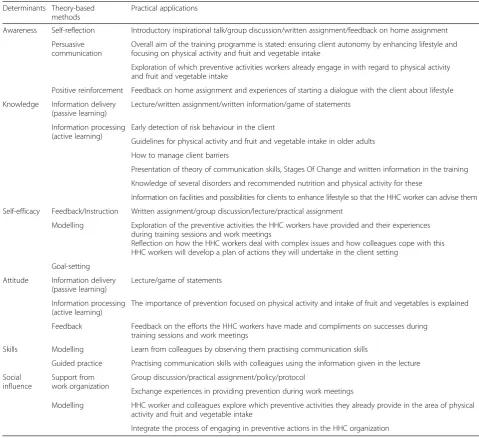
These theory-based methods were the basis for a train-ing programme for HHC workers. The aims and content of the training programme are listed in Table 3 together with the details of the practical applications. The precondi-tioning factors for the HHC workers to succeed in provid-ing preventive activities were assured by creatprovid-ing a supportive culture throughout the entire HHC organization and embedding regular team meetings. This implementa-tion plan is described in step 5.
Step 4: Programme plan
Training
The training was developed in close cooperation with the HHC workers, the project management group and training instructors. Various parts of the training were pre-tested in a pilot training session. The training consisted of three ses-sions and was carried out over a timespan of 6 months. This number of sessions and the time span were chosen for two reasons. Firstly, the training was tailored to the HHC workers level of prior knowledge: All HHC workers have professional education and the present training was devel-oped to be grounded in their prior knowledge and skills. Secondly, in the context of the HHC work organisation this was feasible concerning the available resources.
We took into account the various barriers which were discovered in earlier studies, namely lack of client interest
[image:7.595.54.534.99.537.2]and lack of time during a client visit, lack of guidelines and educational materials, and lack of specific training for health care workers on how to advise clients. To address the clients lack of interest, motivational interviewing was added to the training programme, making the HHC worker capable of informing the client of the import-ance of the health benefits that can be obtained by be-havioural change and motivating the client to adjust his behaviour. The training programme aimed at acquiring skills to perform preventive activities within the time the HHC worker has with a client. The preventive ac-tivities can partly be performed during other usual HHC tasks. The lack of guidelines, educational mate-rials and specific training was addressed by developing this training programme and corresponding tools. Table 3Determinants, methods and practical applications of the traininga
Determinants Theory-based methods
Practical applications
Awareness Self-reflection Introductory inspirational talk/group discussion/written assignment/feedback on home assignment
Persuasive communication
Overall aim of the training programme is stated: ensuring client autonomy by enhancing lifestyle and focusing on physical activity and fruit and vegetable intake
Exploration of which preventive activities workers already engage in with regard to physical activity and fruit and vegetable intake
Positive reinforcement Feedback on home assignment and experiences of starting a dialogue with the client about lifestyle
Knowledge Information delivery (passive learning)
Lecture/written assignment/written information/game of statements
Information processing (active learning)
Early detection of risk behaviour in the client
Guidelines for physical activity and fruit and vegetable intake in older adults
How to manage client barriers
Presentation of theory of communication skills, Stages Of Change and written information in the training
Knowledge of several disorders and recommended nutrition and physical activity for these
Information on facilities and possibilities for clients to enhance lifestyle so that the HHC worker can advise them
Self-efficacy Feedback/Instruction Written assignment/group discussion/lecture/practical assignment
Modelling Exploration of the preventive activities the HHC workers have provided and their experiences during training sessions and work meetings
Reflection on how the HHC workers deal with complex issues and how colleagues cope with this HHC workers will develop a plan of actions they will undertake in the client setting
Goal-setting
Attitude Information delivery (passive learning)
Lecture/game of statements
Information processing (active learning)
The importance of prevention focused on physical activity and intake of fruit and vegetables is explained
Feedback Feedback on the efforts the HHC workers have made and compliments on successes during training sessions and work meetings
Skills Modelling Learn from colleagues by observing them practising communication skills
Guided practice Practising communication skills with colleagues using the information given in the lecture
Social influence
Support from work organization
Group discussion/practical assignment/policy/protocol
Exchange experiences in providing prevention during work meetings
Modelling HHC worker and colleagues explore which preventive activities they already provide in the area of physical activity and fruit and vegetable intake
Integrate the process of engaging in preventive actions in the HHC organization
a
The aim of the first training session was to help the HHC workers gain insight into the preventive activities they already provided and where there was room for im-provement. They were also provided with early detection and monitoring tools, a health-related behaviour check-list and a registration tool, in order to enhance their knowledge of this topic. These tools were developed in the earlier survey study done by Walters et al. (unpub-lished manuscript submitted for publication). The health-related behaviour-checklist and registration tool were developed to support the HHC worker in providing preventive activities. The checklist concerns a list of various preventive activities the HHC worker can per-form, whereas the registration tool is used as a monitor-ing tool for the HHC worker to register the agreements reached with the HHC client. In addition, various situa-tions in which client behaviour seemed difficult to change were discussed. It was important that the HHC workers learned how to determine the clients’ personal goals in order to motivate them to change their behaviour.
The second training session was about practising mo-tivating the client to adopt a healthier lifestyle. During this training session their experiences, both successes and failures, were discussed and were taken into account to further develop their knowledge and skills. The HHC workers were trained in how to converse with clients about their lifestyle and how to do this in a supportive way using motivational interviewing and persuasive communication. They also learned how to determine which stage of change the client was in and therefore adapt the motivational preventive activities to this spe-cific stage.
The third training session focused on motivating the client to continue with a healthier lifestyle, even after a relapse. The HHC workers also learned how to give and receive feedback to and from colleagues and supervisors so that preventive activities can be discussed in work meetings. The HHC workers also discussed how to con-tinue providing preventive activities and how to deal with barriers to this. See Table 3 for further details on the various training sessions.
The materials developed for the three training sessions consisted of a lifestyle checklist, registration tool and training booklet. The HHC workers can use the lifestyle checklist as a communication tool for addressing lifestyle with the client, and the registration tool to ensure con-tinuity and as an aid in monitoring the preventive activ-ities they have allocated. These tools are added to the client’s health file. The training booklet contains prac-tical assignments that the HHC workers carry out during the training as well as the theory on communication with clients and how to overcome barriers clients may encounter when attempting to change their lifestyle.
Work meetings
In addition to the training programme, the HHC workers and their supervisors attended work meetings every 6 weeks. The topic of prevention was on the agenda at these meetings, and the HHC workers could discuss the preventive activities they provided and ad-dress any barriers they faced. Their colleagues and supervisor could offer any advice or share any experi-ences. These meetings also meant that the HHC workers received feedback and thus felt supported in the provision of preventive activities, which encouraged them to keep up the good work.
Step 5: Programme adoption and implementation The adoption and implementation of this training programme was kept in mind to ensure that it could be applied to the field of study and in future to a dif-ferent field or community adoption of the program is crucial for example for the creation of support and ownership of the workers for the training. According to Rogers [39], the rate of adoption of an innovation (the intervention) depends on several characteristics: relative advantage, compatibility, complexity, trialabil-ity and observabiltrialabil-ity. If the innovation has a higher relative advantage, compatibility, trialability and ob-servability, and is low in complexity, it will be adopted more quickly than other innovations [39].
During the training programme, several important as-pects became apparent that need to be taken into con-sideration. For example, it was important to involve the HHC workers in the programme adoption and imple-mentation phase. This was achieved by discussing any ideas and recommendations that the HHC workers might have during the training sessions and taking them into account when developing the adoption and imple-mentation plan. For example, the HHC workers indi-cated the way how they wanted to register the provided preventive activities and thus gave input for the registra-tion tool. This ensured that the training programme was optimally tailored to the HHC workers and based on their own input. Moreover, involving the HHC workers in this process seemed to motivate them more to make a contribution and start providing prevention activities themselves. To ensure the full involvement and commit-ment of the HHC organization and allegiance of the intervention implementation, meetings were held with the management staff of the organization about the provision of prevention and the training. To further reinforce the implementation, supervisors discuss the provision of prevention with the HHC workers.
supervisor of the HHC workers pays regular attention to the programme and the topic of lifestyle. This together with the assurance of continuity can be a standard item on the agenda of work meetings.
Step 6: Evaluation plan
For the evaluation of the training programme, a longitu-dinal study with a quasi-experimental design will be car-ried out that will measure any changes in the behaviour of the HHC workers and their clients. The training de-velopment process will also be evaluated. This will show us how effective the training programme has been, and whether changes need to be made or the programme discontinued should the effects prove counterproductive. In this longitudinal study we aim to include two hun-dred HHC workers and three hunhun-dred HHC clients. A comparison will be made between two groups, a trained HHC worker group, and their HHC clients, and an un-trained HHC worker group, and their HHC clients. Intermediate and final outcomes will be measured both at the level of the HHC workers and of their clients. The HHC workers will evaluate the programme at the end of each training session, both in a discussion and on an evaluation form. In addition, the training instructors, su-pervisors of the HHC workers, the management team of the home health care organization and the project man-agement group will evaluate the training at evaluation meetings, in which they consider the value of each part of the training. This information can be used to adjust the training during and after the implementation of the programme.
The HHC workers and their clients will also evaluate the effect of the training programme at three time points in time: before the programme begins (baseline) and 6 and 12 months after the baseline measurement. The HHC workers and clients will fill in a questionnaire that asks them about the preventive activities they have pro-vided or received. In addition, the level of physical activ-ity and dietary pattern of the clients and satisfaction of the received preventive activities will be measured by questionnaire at these three points in order to determine changes in behaviour and satisfaction with the received training. The information obtained will be used to evalu-ate the training programme and decide whether changes need to be made and whether the programme as a whole should be continued. A control group will be added to the study to create a quasi-experimental design.
Discussion
The aim of this article was to describe the use of IM to develop a training programme to promote preventive ac-tivities by HHC workers relating to the physical activity and fruit and vegetable intake of older adults living at home. We presented the methods used and the results
of Intervention Mapping steps and how information was gathered to build the program. IM was chosen because it has been widely used by several researchers, although not used in a HHC setting and community-living older adults, who found it to be a fitting, useful, systematic and practical framework [20, 26, 33]. The training programme consisted of three sessions and aimed to en-hance the provision of preventive activities by HHC workers by influencing the determinants awareness, knowledge, self-efficacy, attitude, skills and social influ-ence. In short, the training programme was about mak-ing the HHC workers more aware of which preventive activities they already provided and where there was room for improvement, practising how to motivate and guide the clients in adopting a healthier lifestyle and en-couraging them to continue with this healthier lifestyle. In addition to this training, the HHC workers could dis-cuss which preventive activities they provided and ad-dress the barriers they faced at work meetings, because the topic of prevention had become a fixed item on the agenda.
IM proved to be a helpful tool in developing a training programme tailored to the needs of the target popula-tion, in this case HHC workers. The training programme was based on theory, matching methods and practical applications. IM facilitated the identification of those de-terminants that needed to be influenced to ensure be-havioural change. The use of IM during the process of intervention development also created the opportunity to adjust the training programme during the implemen-tation phase. Using IM in the development of a training programme meant that it was systematically developed, theory-driven and based on the available evidence. Inter-ventions developed on the basis of the theory are often more effective when they target determinants of behav-iour and behavbehav-iour change [35]. In the case of this study this meant conducting a survey and a thorough literature search beforehand, which provided an understanding of the facilitating determinants, barriers and preconditioning factors that influence the preventive activities. In addition, the training programme was culturally appropriate and tailored to the needs of the participants because the HHC workers were involved in its development. The training programme and its effect will also be evaluated by the HHC workers and their clients, which means that infor-mation will be obtained from various viewpoints. A fur-ther strength of IM is that it has already been successfully applied in many different settings within the field of health promotion as well as to various behaviours and popula-tions [5, 6].
training course to teach insurance physicians how to apply guidelines for the treatment of depression, and IM proved to be a useful tool here. Van Rijssen, Schellart, Anema, De Boer and van der Beek [46] developed a communication skills training course for physicians, and found the IM protocol to be beneficial, despite the amount of time needed to develop an intervention. An-other study found IM to be a valuable tool because it re-sulted in a training programme that matched the needs of the HHC workers and could be adapted to any changes [19]. Detaille, van der Gulden, Engels, Heerkens and van Dijk [20] used IM to tailor an existing training programme to employees with a chronic somatic disease. Although they did not take the perspective of the em-ployer into account and did not evaluate whether the training programme met their needs, they still found IM to be a helpful tool, this time in tailoring an existing training programme, because using IM to develop a new intervention was too time-consuming [20].
Although IM is a valuable tool, it nevertheless has cer-tain constraints that should be mentioned here. As IM is so broad and thorough, it makes training development a long and time-consuming process. While defining the multiple IM steps, constraints such as lack of informa-tion became apparent, for example informainforma-tion about the intensity and frequency of a training programme and how to implement and adopt it. In addition, the programme addressed a selection of risk behaviours, physical activity and dietary pattern, instead of multiple risk behaviours such as smoking or alcohol misuse. It is not yet clear which strategy works best. IM was se-lected for the development of the training programme, but there are other frameworks for developing behav-ioural interventions. It is therefore recommended that more extensive studies be conducted that take into ac-count the aforementioned points.
This study has several strengths. Multiple methods were used, such as a survey of HHC workers, interviews with field experts and a pilot training session in the de-velopment of the training programme. This was to make sure that sufficient information was available at the start of the programme development. As the stakeholders were involved, the training programme could be tailored to the HHC workers and thus ensure relatively smooth implementation in the organization.
In addition to the strengths, it is important to note some limitations to the training development. One of the tools used was a survey to specify which determi-nants needed to be influenced. This survey had a rela-tively low response rate (40 %), which could have biased the outcome of certain determinants associated with the provision of preventive activities. In order to limit the risk of bias, a wide range of methods were used to iden-tify which determinants needed to be influenced, and
the I-change model, which also takes into account the particular determinants, was applied. A further limita-tion was the lack of a pilot for the second training ses-sion and therefore the lack of feedback on this sesses-sion. Nevertheless, each session was evaluated so that the upcoming sessions could be improved.
Future studies should focus on specifying which deter-minants should be influenced by the intervention. This is one of the most important steps of IM because it serves as a main hook for the intervention. It is therefore essential to use multiple sources to reveal which deter-minants need to be addressed in order to influence the behaviour. The training programme should be suffi-ciently generalizable for HHC workers within another HHC context, given that this involves similar duties and a similar rural area. Organizations are consequently en-couraged to adjust this training programme to their specific setting before implementing it. However, the next step is to implement and evaluate this training programme. The benefits of providing the training and meetings for HHC workers are inherent to the expectation that it will contribute to lowering the problems among HHC clients. Further research is necessary to determine whether this training programme can also be applied to other roles in the care sector, to other contexts, at home or abroad. Sufficient financial resources are needed to implement a comprehensive programme, and those resources are not always available. Further studies are also needed to enhance the provision of preventive activities by HHC workers so that they are actively in-volved in promoting physical activity and healthy eat-ing. Finally, HHC organizations should further review how to maintain the knowledge and skills of HHC workers, for example in a refresher course as well as the implemental aspects within the organization.
Conclusions
Although extensive and time-consuming, we found IM to be a useful tool in the development of a theory-based training programme to stimulate HHC workers to pro-vide preventive activities relating to the fruit and vege-table intake and physical activity of older adults with a low social economic position. Our next step is to evalu-ate the effectiveness of the training in a longitudinal study with a quasi-experimental design.
Abbreviations
HHC:Home health care; IM: Intervention Mapping; SEP: Socioeconomic position; I-change model: Integrated model of change.
Competing interests
The authors declare that they have no competing interests.
Authors’contributions
training session and AW revised it. MW drafted the manuscript, and AD, AW and SR revised it. AD, SA and AW obtained the funding. All authors read and approved the final manuscript.
Acknowledgments
Funding
We gratefully acknowledge the financial support of the Netherlands Organisation for Health Research and Development (ZonMw), grant number 87400006.
Author details
1
Division of Community & Occupational Medicine, Department of Health Sciences, University Medical Center Groningen, P.O. Box 1969700 AD Groningen, The Netherlands.2Department of Social Psychology, University of Groningen, Grote Kruisstraat 2/1, 9712 TS Groningen, The Netherlands.
Received: 1 April 2014 Accepted: 29 June 2015
References
1. Abraham C, Michie S. A taxonomy of behavior change techniques used in interventions. Health Psychol. 2008;27(3):379–87.
2. Ajzen I. The theory of planned behavior. Organ Behav Hum Decis Process. 1991;50(2):179–211.
3. Bandayrel K, Wong S. Systematic literature review of randomized control trials assessing the effectiveness of nutrition interventions in community-dwelling older adults. J Nutr Educ Behav. 2011;43(4):251–62.
4. Bandura A. Social Foundations of Thought and Action: Englewood Cliffs. NJ: Prentice-Hall; 1986.
5. Bartholomew LK, Parcel GS, Kok G, Gottlieb NH, Fernández ME. Planning Health Promotion Programs - An Intervention Mapping Approach. 3rd ed. San Francisco: CA: Jossey-Bass; 2011.
6. Bartholomew LK, Parcel GS, Kok G, Gottlieb NH. Planning Health Promotion Programs - An Intervention Mapping Approach. 2nd ed. San Francisco: CA: Jossey-Bass; 2006.
7. Bartholomew LK, Parcel GS, Kok G. Intervention mapping: a process for developing theory- and evidence-based health education programs. Health Educ Behav. 1998;25(5):545–63.
8. Bergquist S. The quality of pressure ulcer prediction and prevention in home health care. Appl Nurs Res. 2005;18(3):148–54.
9. Borrelli B, Hecht JP, Papandonatos GD, Emmons KM, Tatewosian LR, Abrams DB. Smoking-cessation counseling in the home. Attitudes, beliefs, and behaviors of home healthcare nurses. Am J Prev Med. 2001;21(4):272–7. 10. Broer J, Kuipers J, Spijkers E. Health Profile Groningen 2010
[Gezondheidsprofiel Groningen 2010]. Groningen: GGD Groningen; 2011. 11. Buchholz SW, Purath J. Physical activity and physical fitness counseling
patterns of adult nurse practitioners. J Am Acad Nurse Pract. 2007;19(2):86–92. 12. Burns KJ, Camaione DN, Chatterton CT. Prescription of physical activity by
adult nurse practitioners: a national survey. Nurs Outlook. 2000;48(1):28–33. 13. Centers for Disease Control and Prevention. Fruit and vegetable
consumption among adults—United States, 2005. MMWR Morb Mortal Wkly Rep. 2005;56(12):213–7.
14. Centers for Disease Control and Prevention. Prevalence of regular physical activity among adults—United States, 2001 and 2005. MMWR Morb Mortal Wkly Rep. 2005;56(46):1209–12.
15. Coombs JB, Barrocas A, White JV. Nutrition Care of older adults with chronic disease: attitudes and practices of physicians and patients. South Med J. 2004;97(6):560–5.
16. Cornuz J, Ghali WA, Di Carlantonio D, Pecoud A, Paccaud F. Physicians’ attitudes towards prevention: importance of intervention-specific barriers and physicians’health habits. Fam Pract. 2000;17(6):535–40.
17. de Vries H, Mesters IH, Honing C. The general public’s information needs and perceptions regarding hereditary cancer: an application of the Integrated Change Model. Patient Educ Couns. 2005;56(2):154–65. 18. de Vries H, Mudde A, Leijs I, Charlton A, Vartiainen E, Buijs G, et al. The
European Smoking Prevention Framework Approach (EFSA): an example of integral prevention. Health Educ Res. 2003;18(5):611–26.
19. Dera-de Bie E, Gerver WJ, Jansen M. Training program for overweight prevention in the child’s first year: Compilation and results. Nurs Health Sci. 2013;15(3):387–97.
20. Detaille SI, van der Gulden JWJ, Engels JA, Heerkens YF, van Dijk FJH. Using intervention mapping (IM) to develop a self-management programme for employees with a chronic disease in the Netherlands. BMC Public Health. 2010;10:353–64.
21. Douglas F, van Teijlingen E, Torrance N, Fearn P, Kerr A, Meloni S. Promoting physical activity in primary care settings: health visitors’and practice nurses’views and experiences. J Adv Nurs. 2006;55(2):159–68. 22. European Commission. Sports and physical activity: special Eurobarometer
334: wave 72.3. Brussel: TNS Opinion & Social; 2010.
23. Fishbein M, Ajzen I. Belief, Attitude, Intention, and Behavior: An Introduction to Theory and Research. Reading: MA: Addison-Wesley; 1975.
24. Ford J, Spallek M, Dobson A. Self-rated health and a healthy lifestyle are the most important predictors of survival in elderly women. Age Ageing. 2008;37(2):194–200.
25. King AC, Pruitt LA, Phillips W, Oka R, Rodenburg A, Haskell WL. Comparative effects of two physical activity programs on measured and perceived physical functioning and other health-related quality of life outcomes in older adults. J Gerontol A Biol Sci Med Sci. 2000;55A(2):M74–83. 26. Kok G, Schaalma H, Ruiter RAC, van Empelen P, Brug J. Intervention
Mapping: A protocol for applying health psychology theory to prevention programmes. J Health Psychol. 2004;9(1):85–98.
27. Kushner RF. Barriers to providing nutrition counseling by physicians: a survey of primary care practitioners. Prev Med. 1995;24(6):546–52. 28. Lambe B, Connolly C, McEvoy R. The determinants of lifestyle counselling
among practice nurses in Ireland. Int J Health Promot Educ. 2008;46(3):94–9. 29. Markle-Reid M, Browne G, Gafni A, Roberts J, Weir R, Thabane L, et al. The
effects and costs of a multifactorial and interdisciplinary team approach to falls prevention for older home care clients‘at risk’for falling: a randomized controlled trial. Can J Aging. 2010;29(1):139–61.
30. Markle-Reid M, Browne G, Weir R, Gafni A, Roberts J, Henderson S. The effectiveness and efficiency of home-based nursing health promotion for older people: a review of the literature. Med Care Res Rev. 2006;63(5):531–69. 31. Markle-Reid M, Browne G, Gafni A. Nurse-led health promotion
interven-tions improve quality oflife in frail older home care clients: lessons learned from three randomized trials in Ontario, Canada. J Eval Clin Pract.
2013;19(1):118–31.
32. McDowell N, McKenna J, Naylor P. Factors that influence practice nurses to promote physical activity. Br J Sports Med. 1997;31(4):308–13.
33. McEachan RRC, Lawton RJ, Jackson C, Conner M, Lunt J. Evidence, theory and context: using intervention mapping to develop a worksite physical activity intervention. BMC Public Health. 2008;8:326.
34. Meijers J, Halfens R, Schueren M, Dassen T, Schols J. Malnutrition in Dutch health care: prevalence, prevention, treatment, and quality indicators. Nutrition. 2009;25(5):512–9.
35. Michie S, Johnston M, Francis J, Hardeman W, Eccles M. From theory to intervention: mapping theoretically derived behavioural determinants to behaviour change techniques. Appl Psychol. 2008;57(4):660–80.
36. Paquay L, Wouters R, Defloor T, Buntinx F, Debaillie R, Geys L. Adherence to pressure ulcer prevention guidelines in home care: a survey of current practice. J Clin Nurs. 2008;17(5):627–36.
37. Prochaska JO, DiClemente CC. Stages and processes of self-change of smoking: toward an Integrative model of change. J Consult Clin Psychol. 1983;51(3):390–5.
38. Rejeski WJ, Mihalko SL. Physical activity and quality of life in older adults. J Gerontol A Biol Sci Med Sci. 2001;56A:23–35.
39. Rogers EM. Diffusion of preventive innovations. Addict Behav. 2002;27(6):989–93. 40. Schechtman KB, Ory MG. The effects of exercise on the quality of life of frail
older adults. A preplanned meta-analysis of the FICSIT trials. Ann Behav Med. 2000;23(3):186.
41. Sector Nursing. Care and Home Care [Sector Verpleging, Verzorging en Zorg Thuis]. Quality Framework Health Care [Kwaliteitskader Verantwoorde Zorg]. Sector Nursing, Care and Home Care [Sector Verpleging, Verzorging en Zorg Thuis]. The Hague: Vijfkeerblauw; 2010.
42. Steptoe A, Perkins-Porras L, Hilton S, Rink E, Cappuccio FP. Quality of life and self-rated health in relation to changes in fruit and vegetable intake and in plasma vitamins C and E in a randomised trial of behavioural and nutritional education counselling. Br J Nutr. 2004;92(1):177–84. 43. Symes L, Mastel-Smith B, Hersch G, Binder B, Malecha A, McFarlane J. The
44. Tompkins TH, Belza B, Brown M. Nurse practitioner practice patterns for exercise counseling. J Am Acad Nurse Pract. 2009;21(2):79–86.
45. van der Bij AK, Laurant MGH, Wensing M. Effectiveness of physical activity interventions for older adults: a review. Am J Prev Med. 2002;22(2):120. 46. van Rijssen HJ, Schellart AJM, Anema JR, de Boer WEL, van der Beek AJ.
Systematic development of a communication skills training course for physicians performing work disability assessments: from evidence to practice. BMC Med Educ. 2011;11:28.
47. Volkert D. Nutrition and lifestyle of the elderly in Europe. J Public Health. 2005;13(2):56–61.
48. Weinstein ND. The precaution adoption process. Health Psychol. 1988;7(4):355–86.
49. Young DR, Coughlin J, Jerome GJ, Myers V, Soo EC, Brantley PJ. Effects of the PREMIER Interventions on Health-Related Quality of Life. Ann Behav Med. 2010;40(3):302–12.
50. Zwerver F, Schellart AJM, Anema JR, Rammeloo KC, van der Beek AJ. Intervention mapping for the development of a strategy to implement the insurance medicine guidelines for depression. BMC Public Health. 2011;11(1):1–12.
Submit your next manuscript to BioMed Central and take full advantage of:
• Convenient online submission
• Thorough peer review
• No space constraints or color figure charges
• Immediate publication on acceptance
• Inclusion in PubMed, CAS, Scopus and Google Scholar
• Research which is freely available for redistribution