SURFACE PROPERTIES OF METALS
■k k -k
by
R A K E S H M E H R O T R A
* * *
A thesis submitted for the degree of Doctor of Philosophy
of the
Australian National University
•k k k
P R E F A C E
Excluding Chapter 1, which deals with the elementary concepts involved in this thesis, most of the material presented here is my original contribution to the subject. While doing the calculations and writing the thesis, I have closely inter acted with my supervisor, Dr J. Mahanty, who has encouraged me to work on the problems discussed here. The reference to other workers is given wherever it is necessary.
L
JCloA C K N O W L E D G E M E N T S
It gives me a great pleasure to express my gratitude and gratefulness to my supervisor, Dr J. Mahanty, for his invaluable advice and suggestions during the course of this work. Many useful discussions with him have clarified my ideas and developed my interest in the subject. I am thankful to Dr P. Jewsbury for carefully reading the entire manuscript and for several illuminating discussions. My thanks are also due to Mr P. Summerside and Dr J.T. Duniec for helpful conversations. I wish to thank Mrs S.M. Love for typing the thesis within a
very short period.
I am indebted to Professor K.J. Le Couteur for providing me with all m e necessary facilities to do research in the
A B S T R A C T
The application of Bloch's hydrodynamic formalism to the electronic properties of a metal surface has been of
considerable interest in recent years. This thesis embodies
the results of a study of some of the bulk and surface properties of metals using the same formalism.
The basic hydrodynamic equations for an electron gas are obtained from the action principle. As an illustration of the use of these equations the dielectric response function and the bulk plasmon dispersion for a homogeneous electron gas are calculated. The limitations of the model are mentioned.
The charge response of a metal surface to an external oscillating charge source is calculated. It is used to find the effective polarizability of an ad-atom, and also the effect of mediation of the metal surface on the interaction between ad-ions. The screening action of the electron gas near the surface is
studied.
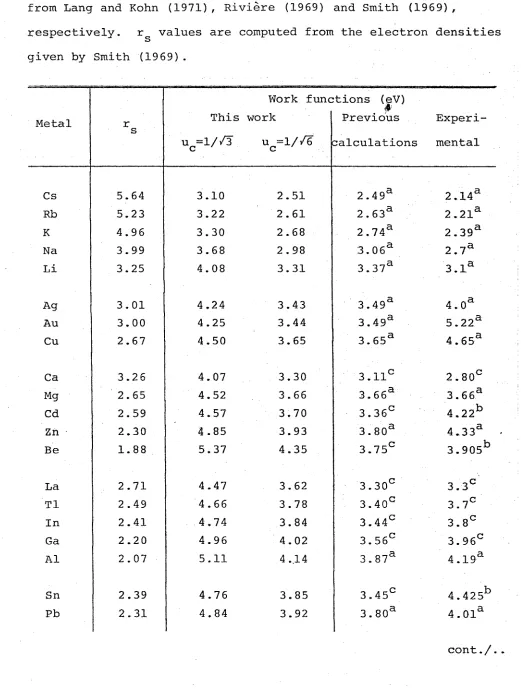
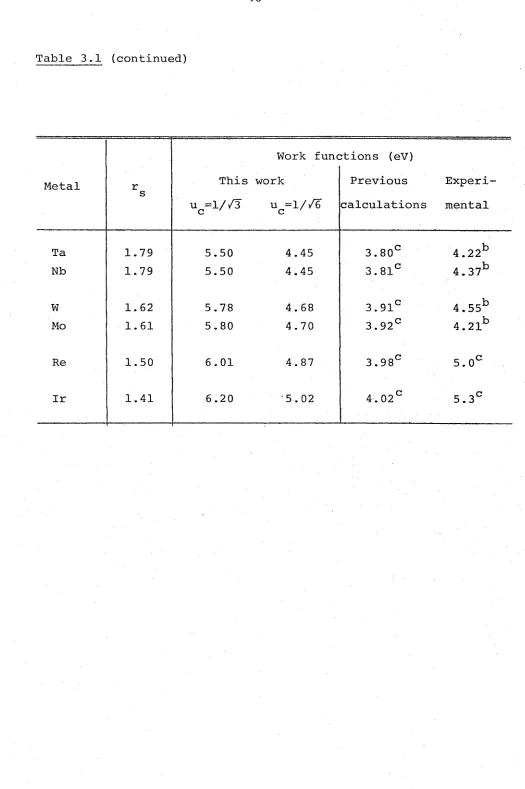
The free electron contribution to the work function of metals is estimated. It is shown to be inversely proportional
to /r . The numerical values obtained for various metals show s
reasonable agreement with experimental results, as also with
previous theoretical calculations based on the density-functional approach, despite the simplicity of the model adopted here.
geometries of the surface. The results are obtained from the charge response of the metal surface mentioned earlier. The dispersion formulae for plasma oscillations follow as a direct consequence of the analysis. The cases for a metallic sphere and a metal having a spherical void are described separately.
The above analysis is extended for a bimetallic
junction, and the dynamic response of electrons to an oscillating charge source near the junction is calculated. The analytical expressions for the induced potentials are given for planar as well as spherical junctions, and are employed to evaluate the van der Waals interaction of a molecule with the interface. The dispersion formulae for interface plasma oscillations are dis cussed for both planar and spherical geometries.
The calculations referred to earlier deal with a sharp interface. The effect of diffuseness of a planar bimetallic interface is also studied using a simple iterative method, which is applicable when the electron densities of the two constituent metals differ only slightly. It is shown that the dispersion
C O N T E N T S
A C K N O W L E D G E M E N T S (iii)
A B S T R A C T (iv)
CHAPTER 1. HYDRODYNAMIC MODEL OF COLLECTIVE RESPONSE
1.1 Introductory Remarks 1
1.2 Equations of Motion 4
1.3 Homogeneous Electron Gas 9
1.3.1 Dielectric Response Function 10 1.3.2 Bulk Plasma Oscillations 12
1.4 Limitations of the Model 14
CHAPTER 2. RESPONSE OF A METAL SURFACE
2.1 Introduction 16
2.2 Interaction with a Charge Source 20 2.3 Screening near a Metal Surface 25 2.4 Effective Polarizability of an Ad-atom 27 2.5 Mutual Interaction between Ad-ions 30
CHAPTER 3. THE WORK FUNCTION OF METALS
3.1 Introduction 32
3.2 Thomas-Fermi Theory 35
3.3 Density-Functional Formalism 37
3.4 Charge Response Theory 40
3.5 Conclusion 46
CHAPTER 4. PHYSISORPTION ON METAL SURFACES
4.1 General Considerations 49
4.2 Mathematical Formulation 54
4.3 Interaction with a Flat Surface 58 4.3.1 Surface Plasma Oscillations 59 4.4 Response of a Metallic Sphere 63
4.4.1 Plasmon Frequencies 65
4.4.2 Interaction Energy 68
4.5 Interaction involving a Void 70
CHAPTER 5. INTERACTION NEAR BIMETALLIC JUNCTIONS
5.2 General Formalism 79 5.3 Response of a Planar Interface 81 5.4 Spherical Interface between Metals 85
5.5 Conclusion 89
CHAPTER 6. DIFFUSE INTERFACE AND FORCE FIELDS
6.1 Introduction 91
6.2 Formulation 93
6.3 Planar Interface 95
6.4 Spherical Interface 98
6.5 Conclusion 99
R E F E R E N C E S 101
APPENDIX
A NOTE ON BOUNDARY CONDITIONS
CHAPTER 1
HYDRODYNAMIC MODEL OF COLLECTIVE RESPONSE
1.1 Introductory Remarks
The hydrodynamic theory of the collective response of an electron gas was advanced some forty years ago by Bloch
(1933,1934) in connection with atomic problems. The formalism has also been proved useful in nuclear and solid state physics. Bloch (1933) has employed his theory, with considerable success, to the problem of slowing down of fast moving ions in a
scattering medium. Ball et al (1973) have solved Bloch’s hydrodynamic equations for the charge oscillations of a
neutral Thomas-Fermi atom and used the solutions to calculate the atomic photoabsorption cross-section successfully. More recently, Monaghan (1973) has considered the collective
oscillations in many electron atoms using Bloch's (1933) model. He has calculated the classical oscillator strengths and the polarizability for both ions and atoms. The formalism has also been applied to study the slowing down of fast charged particles by their interaction with many electron atoms
(Monaghan 1974). The compressible oscillations of heavy nuclei have been studied using the statistical model and the hydrodynamic approximation (Ishidzu and Kawarada 1964).
hydrodynamic model of the electron gas in a solid (Heinrichs 1973 a,b,c,d, 1975 a,b; Boardman et al 1975, Eguiluz and Quinn 197 6) , as microscopic theories prove to be extremely complicated in such situations (Feibelman et al 1972). A draw back of the hydrodynamic formulation is that it is semi-
classical and it over-simplifies the excitation spectrum
neglecting many details. Recently, Mukhopadhyay and Lundqvist (1975) have formulated the problem of the electron density response in inhomogeneous systems using linear response theory in such a way that the terms which depend on the detailed nature of the excitation spectrum of the electrons appear separately from the classical hydrodynamic terms. This separation makes it easier to see the relative contribution of the classical
density oscillations and the single-particle excitation spectrum in a given problem. A general theoretical framework has also been developed by March and Tosi (1972) which yields results
similar to those of the hydrodynamic rnndel in the long wavelength and low frequency limit.
Given the difficulty of applying many-body techniques to highly inhomogeneous systems, the hydrodynamic appraoch offers a workable approximate alternative treatment. Owing to its
directness and simplicity, Bloch's theory is very appealing in dealing with homogeneous as well as inhomogeneous systems. This is the main motivation for several recent papers using the
(i) It accounts for the current experimental results on the surface plasmon dispersion as is discussed in Chapter 4.
(ii) It yields good results for the interactions involving metal surfaces, which can be easily visualised physically. Its
importance in the calculation of the response of metal surfaces to perturbing charge distribution is discussed in Chapter 2. Its application to calculate the free electron contribution to the work function of metals is described in Chapter 3 (Mehrotra and Mahanty 1978b). Its relevance to bimetallic junctions is studied in Chapters 5 and 6 (Mehrotra and Mahanty 1978c,a).
(iii) It can be used under more complex situations, such as in the presence of an external magnetic field. Nakamura and Paranjape (1975) have used it to calculate the dispersion relation for surface plasmons in an external magnetic field parallel to the surface, when the wave propagates perpendicular to the magnetic field.
The theoretical problems concerned with metal surfaces become especially intricate when one allows for spatial dis persion in the dielectric response function of the electron gas
(Zaremba and Kohn 1976). This property of spatial dispersion can easily be accommodated within the framework of the hydro- dynamic model by the introduction of a finite particle pressure
(Boardman et al 1976). The effect of spatial dispersion on the van der Waals interaction between two metal surfaces is to
remove the divergence, as obtained by Lifshitz (1956) in the local approximation, when their separation goes to zero
The specific effects of spatial dispersion on some surface phenomena are studied in the present thesis by assuming that the metal surface forms an infinite-barrier, from which the electrons are reflected specularly. The advantages and the shortcomings of the infinite-barrier model are discussed in
Sections 5.1 and 6.1.
The present Chapter is constructed as follows. Section 1.2 defines the hydrodynamic model and sets up its basic equations of motion. Section 1.3 deals with the simple applications of the model to a homogeneous electron gas. The limitations of the model are discussed in Section 1.4.
1.2 Equations of Motion
The basic hydrodynamic equations for an electron gas can be derived by following Bloch's (1933) pioneering approach. The electron gas is regarded as a fluid which is characterized by a space-time dependent density n(r,t) and a drift velocity v(r,t). The motion of the fluid is assumed to be irrotational so that v = -V\p, t|> being the velocity potential. The electrons are supposed to move in a smeared out positive background so as to ensure charge neutrality of the system. In order to describe the dynamics of the electron gas in a systematic way, the
Y i n g (1974) has prop o s e d an e x t ension of the o r i g i n a l
Bloch's (1933) model, starting w i t h the H o h e n b e r g - K o h n (1964)
d e n s i t y - f u n c t i o n a l approach. In this approach, the g r o u n d - s t a t e
energy of an inhomogeneous e l ectron gas can be w r i t t e n as a
unique functional of the density. The idea has b e e n p r o v e d
v ery useful in dealing w i t h the static p r o p e r t i e s of an i n h o m o
geneous e l e c t r o n gas (Lang 1973). By doing a q u a s i - s t a t i c
g e n e r a l i z a t i o n of the grou n d - s t a t e d e n s i t y - f u n c t i o n a l in the
h y d r o d y n a m i c approximation, the total energy, H, of the e l e c t r o n
gas can be exp r e s s e d as:
m
f
n ( r ,t ) v 2d 3r - e
2 f n(r ,t)n(r ' ,t)
r-r 1
f n + (r) n (r ' ,t)
Ir-r1 I
d 3r d 3r' +
d 3r d 3r' + G[n(r,t)] (1 .1)
w h ere -e and m are, respectively, the ch a r g e and m a s s of
the elec t r o n and n (r) is the c harge d e n s i t y of the p o s i t i v e
background. G[n(r,t)] is the uni v e r s a l e nergy f u n c t i o n a l
w h i c h includes the kinetic, exchange, and c o r r e l a t i o n e n e r g i e s
of the i n h o m ogeneous elec t r o n system. The use of the full
energy functional provides, in principle, a b e t t e r t r e a t m e n t
of the p r e s s u r e due to the ele c t r o n gas (Mukhopadhyay and
L u n d q v i s t 1975). The first term in e q u a t i o n (1.1) r e p r e s e n t s
the m a c r o s c o p i c kinetic energy w h i c h should not be c o n f u s e d
w i t h the internal k i n etic energy included in G[n].
The equations of m o t i o n for the d e n s i t y f l u c t u a t i o n s
in the e l e c t r o n gas can be obt a i n e d from the a c t i o n principle,
L
n ff d3r - H
(1-2)and t r e a t i n g n and m ip as the g e n e r a l i z e d c o o r d i n a t e s
(Goldstein 1964) . The Lagrange equa t i o n for the v a r i a b l e n
gives
m n dv
dt - e n E (1.3)
whe r e E is the e l ectric field w h i c h is given by P o i s s o n ' s
e quation
V . E = 4tt (n - en) . (1.4)
E q u a t i o n (1.3) is known as the E u l e r ' s equation. H e r e the
f
5g'q u a n t i t y n V takes the role of the g r adient of the
pres s u r e for a classical fluid and p r ovides a c o n s t i t u t i v e
r e l a t i o n b e t w e e n the p r e s s u r e due to the e l e c t r o n gas and the
d e n s i t y fluctuations. This rela t i o n is of central i m p o r t a n c e
in the h y d r o d y n a m i c mod e l and is norm a l l y t r e a t e d in a p h e n o
m e n o l o g i c a l m a n n e r (Bennett 1970). The Lag r a n g e e q u a t i o n for
the v a r i a b l e m^ yields the e q u a t i o n of co n t i n u i t y
9n
3t + V . (nv) 0 . (1.5)
Equ a t i o n s (1.3) - (1.5) form the basis of the h y d r o d y n a m i c
model. These equations can easily be l i nearized for small
deviat i o n s from the e q u i l i b r i u m state. The l i n e a r i z e d
3 v
m n 0 = en0V$ - n 0V (1? (nQ) ni)
V 2<*> = 4-rren x (1.6)
dn1
-~?r + V . (n0v) = 0
where nj is the departure from the equilibrium electron density n 0, $ is the potential arising out of the density
deviation n^, and the drift velocity v is taken to be of the first-order. The system carries no current in the equilibrium. If the density functional G[n] , introduced in equation (1.1), contains only the kinetic and exchange energies of the electron gas, then the particular form of P(no) used in the first of equations (1.6) is given by (Jensen 1937) :
P(n„) = (10/9)xkn^l/3 - (4/9)xAn‘2/3 (1.7) where
X k = (3h2/10m) (3tt2 ) 2/3 ; xA = (3e2/4) ( 3/ir ) 1 / 3. (l.o)
An alternative way to obtain the linearized Bloch's equations (1.6) is to work with the Lagrangian
L
If d3r
- (H-H0) (1.9)where H Q is the equilibrium energy functional of the electron gas. By treating nj_ and mi|j as the generalized coordinates, the linearized Euler's equation and the equation of continuity may be obtained. The linearized equations (1.6) can be used to
The time-dependent response of the electron gas to a weak charge source of strength q and frequency w , located
at a point r 0 , can be studied by modifying equations (1.6) as :
(-iu)mn0v = en0V$ - n 0V(P(n0)n1)
V2$ = 4-rren! - 47rq5(r-r0) (1.10)
(-iw)ni + V .(n0v) = 0
where the explicit time-dependence of the form exp(-iwt) is omitted from all oscillating quantities. Equation (1.10) can also be generalized to find the response of the electron gas to a prescribed density of perturbing charge. If the system is homogeneous, then in the linear response theory followed here, a Fourier decomposition of the perturbing charge density can >^e made, and the response to each Fourier component can be calculated separately. In the presence of boundaries the solutions of coupled equations (1.10) are to be determined by using appropriate boundary conditions.
For simplicity and in order to understand the physical concepts involved, it may be assumed that the pressure term nov (P(no)ni), in the first of equations (1.6) or (1.10) has the form:
n 0 V (P (n0) rii) = m32Vni (1.11)
the electron density at the surface, and will be used, here only in these cases.
In the original Bloch's (1933) theory, which starts with the Thomas-Fermi model, the second terra in the expression
for P(n0) , given in equation (1.7), is dropped, and thus, using equation (1.11), for a homogeneous system ß2 = (l/3)v2 ,
F v being the Fermi velocity. However, it will be shown in Section 1.3.2 that this value of ß2 does not lead to the RPA result for the bulk plasmon dispersion to the order k 2 , k being the wave vector, and hence needs to be modified approp riately at high frequencies. This is a trouble with the
Bloch's theory which is correct in order of magnitude, but gets ß2 wrong by about a factor of 2, when applied to calculate the plasmon dispersion in a homogeneous electron gas (March 1974).
1.3 Homogeneous Electron Gas
The idea of a gas of free electrons embedded in a
uniform positive background has been found useful to account for many properties of metals which are characteristics of valence electrons. The picture may be refined by introducing the
periodic potential due to the lattice, but this will not be considered here. In this Section we illustrate the application of basic hydrodynamic equations (1.10) and (1.11) to calculate the dielectric response function and bulk plasmon dispersion for a homogeneous electron gas. The former describes the screening action of the electron gas and is useful in an elementary theory of metals (Kittel 1967, Harrison 1970), whereas the latter is of both experimental and theoretical interest (Pines 1963,
response function leads directly to the bulk plasmon dispersion.
1.3.1 Dielectric Response Function
We consider the time-dependent response of a homogeneous
electron gas to a weak external charge source of strength q
and frequency w , located at a point r 0 . This is a typical
case of a perturbing field in a metal due to a charge impurity.
Although the impurity represents a static source, here, for
generality, it will be regarded as an oscillating charge. The
effect of the impurity on the electron gas can be easily studied
by using the hydrodynamic equations (1.10). For a homogeneous
electron gas, equations (1.10) and (1.11) can be combined to
give
where
(v2- x 2)ni 6
X2 = (o)p - üo2 ) / 3 2 ; Op = 47rnoe2/ m .
(1.12)
(1.13)
Using the Fourier transform of the perturbing charge density,
the solution of equation (1.12) for nj can be found. On
substituting this in the second of equations (1.10), the
potential, $ , due to the charge source can be expressed as
$ +
q w2 exp(-x|r-r0 |)
(1.14)
Equation (1.14) describes the screening of an oscillating point
charge by the electron gas. In the static limit of w = 0 , the
first term in equation (1.14) drops out, whereas the second
A Q 1 = ß/w , obtainable from the value of A, given in equation
(1.13) , by setting oj= 0. This is the usual Thomas-Fermi
screening length (Ziman 1965) provided the value of 32 = (1/3)v 2 , F
given in Section 1.2, is used.
We have seen that the effective potential due to an
oscillating charge source in a homogeneous electron gas is
modified because of the screening action of the electron gas.
If $ ext is Four^-er transform of the applied potential,
then the effective potential $ (r,t) can be written as
ö (r,t)
(k/w)
---T-- r— exp (i (k . r-cot) ) d 3k dw
e (k, o) — — (1.15)
where e(k,oj) is a function of the wave vector k and frequency
to , and is known as the dielectric response function of the
system. By taking the applied potential to be due to a point
charge and considering only a single frequency to , it can be
shown that
tO2
e(k,w) = 1 --- 2— (1.16)
to2- 3 2k 2
which is the well-known result (Heinrichs 1 9 75a). There is no
loss of generality in deriving equation (1.16) by taking the
perturbing potential to be due to a point charge as the above
analysis is linear, and is carried out in terms of the Fourier
components. The large value of e(k,to) for to=0 indicates that
a low frequency charge distribution is strongly screened. For
to=0, equation (1.16) reduces to the Thomas-Fermi result for the
dielectric function (Ziman 1965). It is clear from equation
pressure gradient, leads to spatial dispersion in the dielectric response function e(k,u). An improvement over the hydrodynamic
form of e(k,(jo) has been carried out by Lindhard (1954) .
Recently Taylor (1978) has suggested a simple, useful analytical form of the static dielectric function.
1.3.2 Bulk Plasma Oscillations
The interacting electron gas in metals is capable of collective oscillations which resemble classical plasma (Pines 1963). A typical difference is that in metals rather high densities and low temperatures are involved, and hence quantum statistics for the electrons is to be employed. The restoring force in the plasma oscillations is governed by the force field of many other particles. In the random phase approximation
(RPA), which includes microscopic details, the dispersion
relation for plasma oscillations in metals, to the order k2 , is given by (Pines and Bohm 1952, Pines 1963)
a)2 = a)2 + (3/5)v?,k2 (1.17)
p £
where w P (1.13) .
is the bulk plasma frequency, defined in equation
w2 = w2 + 32k 2 . (1.18) P
To the order k 2 , the dispersion formula, given in equation (1.18), is qualitatively the same as equation (1.17). However, for 3 2 = (1/3)v 2 , given in Section 1.2, Bloch's theory brings
r
an error of roughly a factor of two in the coefficient of k 2. The difficulty may be avoided by parametrizing the quantity 32 as
32 = (1/3)v 2 low frequencies
r
(1.19) = (3/5)v 2 high frequencies.
r
The low frequency value of 32 leads to the Thomas-Fermi result for the dielectric response function, as is found in Section 1.3.1, while the high frequency value gives the RPA result for the bulk plasmon dispersion to the order k 2 . The parametriza- tion, given in equation (1.19)/ is well known (Heinrichs 1975a).
The definition of e(k,ou) , given in equation (1.15) , shows that the zeros of e(k,w) correspond to the self-
sustaining collective oscillations in the system. Using
equation (1.16) , it can be seen that the vanishing of e(k,uO leads to equation (1.18) for the bulk plasmon dispersion.
A review article by Raether (1965) gives an account of experimental determination of the bulk plasmon dispersion by energy loss measurements using fast electrons. Recently
Krane (1978) has measured dispersion of the bulk plasmons for aluminium and indium. The experimental results are in agreement with equation (1.17). The propagation of plasmons in periodic
1.4 Limitations of the Model
The hydrodynamic approach, although gives many useful and instructive results concerning the collective properties of an electron gas, represents an abstraction. The major limita tions of the model arise due to the following reasons:
(i) It leads to an uncertainty in the value of 3 which arises due to the parametrization given in equation (1.19).
(ii) It considers only long-wave collective oscillations of the electron gas and neglects particle-hole excitations
(Mukhopadhyay and Lundqvist 1975). This limitation is, however, not always very serious. For instance, it has been found that the collective excitations dominate the van der Waals interaction energy between two coupled metal films, and that the single
particle excitations give rise to a relatively small correction (Harris and Griffin 1975).
(iii) A cut-off wave vector for the collective oscillations is to be introduced in a somewhat arbitrary manner, as is
discussed in Section 3.4. The cut-off may occur at a point where the plasmons become degenerate with the single-particle
excitations (Heinrichs 1973b). This effectively means that
beyond the cut-off wave vector the plasmons are unstable against decay into the particle-hole pairs. More realistic treatments
include the full excitation spectrum (Harris and Griffin 1975).
the damping effects can be introduced in a phenomenological manner by means of an effective collision time and associated viscous force in Euler's equation, but the use of the hydro- dynamic formulation means that the electron-hole pairs are left out, and hence a genuine damping, which arises due to the decay of collective excitations into single-particle excitations cannot be introduced here (Eguiluz and Quinn 1976).
The answer to these objections is, as usual, that the model will find its ultimate usefulness if it is able to account
for the results obtained from more reliable theories, and
CHAPTER 2
RESPONSE OF A M E T A L SURFACE
2.1 I n t r o d u c t i o n
In Chapter 1 we have obta i n e d the basic h y d r o d y n a m i c
e q u a tions (1.10) to calculate the response of an i n h o m o g e n e o u s
e l e c t r o n gas to a p e r t u r b i n g charge. Here we use t h ese e q u a t i o n s
to des c r i b e the r esponse of a met a l surface. The p r o b l e m of
finding the response of a met a l surface to some p e r t u r b i n g charge
d i s t r i b u t i o n has been of c o n s i d e r a b l e interest (Newns 1970,
H e i n r i c h s 1973d). The i n t e raction energy b e t w e e n an ion a short
d i s t a n c e outside the surface and the induced charge d e n s i t y is
i m p o rtant in ionic chemisorption, and is also u seful for an
u n d e r s t a n d i n g of field e v a p o r a t i o n and d e s o r p t i o n (Newns 1970,
H e i n r i c h s 1 9 7 3 d ) . It wil? be seen in S e c tion 4.2 that the
induced pot e n t i a l due to an o s c i l l a t i n g charge s ource is of
interest in the van der W a a l s i nteraction of a m o l e c u l e w i t h the
surface. The m u t u a l i n t e raction b e t w e e n ad-atoms can also be
studied (Mahanty and M a r c h 1976, Duniec et al 1977).
Some of the earlier methods, w h i c h have b e e n u sed to
study the response of a m e t a l surface to a p e r t u r b i n g charge
density, can be b r o adly cl a s s i f i e d into following c a t e gories:
(i) Cla s s i c a l image theory
(ii) T h o m a s - F e r m i a p p r o x i m a t i o n
(iii) H a r tree a p p r o x i m a t i o n
(iv) D i e l e c t r i c a p p r o a c h
(vi) Self-consistent and variational calculations (vii) Surface plasmon field and the hydrodynamic model.
This classification is not complete as other methods are also available (Inkson 1971). However, here we briefly discuss in succession some of the applications of the above techniques.
The image theory of classical electrostatics (Jackson 1962) has been widely used to study the interactions involving metal surfaces (Lennard-Jones 1932, Remy 1970, Mahanty and March 197 6) . An application of the theory has been made by
Kohn and Lau (1976) to find that the interaction energy between two dipoles on a metal surface is twice the classical interaction energy between the parallel dipoles in the same configuration in vacuum. Antoniewicz (1974) has considered the instantaneous potential due to the image charges to show that an atom adsorbed on a metal surface acquires an induced dipole moment.
The classical image theory is a poor approximation as it ignores many details concerning the metal surface. The linearized Thomas-Fermi approximation, which allows for the
finite screening in the metal, provides a better way to study the response of a metal surface (Newns 1969, Antoniewicz 1972,
surface to an external point dipole and used the result to find the effective polarizability of an atom near the surface. This
is discussed in detail in Section 2.4.
The Thomas-Fermi method discussed above refers to the static limit. Newns (1970) has employed the Hartree approxi mation to calculate the time-dependent response of a metal with two plane parallel surfaces, and a semi-infinite metal to a perturbing source. He has introduced a ’surface dielectric function’ which generalizes the classical image law.
The dielectric approach has been used by Heinrichs (1973d) to study the response of a metal surface to an
oscillating point charge. The advantage of this treatment is that all quantities of interest are expressed in terms of the wave number and frequency dependent bulk dielectric function of
the metal.
A quantum mechanical calculation of the response of a metal to an external charge distribution has been carried out by Beck and Celli (1970) . Using the RPA, they have obtained
approximate expressions for the induced potential and the
electric field outside the metal. The surface is assumed to be perfectly reflecting in their analysis. The formalism has also been used by Beck et al (1970) to study the response of a metal to a charged impurity embedded near the surface. They have
presented graphs for the potential and the electric field at the surface for several values of the distance of the impurity from the surface.
infinite-barrier model of the metal surface, which by its
nature is not self-consistent. Ying et al (1972) have presented a self-consistent treatment of the screening charge induced in an inhomogeneous electron gas by a small perturbing charge. They have also extended this analysis to present a density- functional theory of chemisorption (Ying et al 1975) . The
restriction arising due to the artificial nature of the surface, having a step-function density profile, has been partially
removed by Appelbaum and Hamann (1972), who have performed a variational calculation of the image potential near a metal
surface for a static point charge. A similar calculation has also been carried out by Lang and Kohn (1973) in a self-
consistent manner. The response of a metal surface to an external perturbing dipole has recently been studied self- consistently by Meixner and Antoniewicz (1976) using the density-functional formalism. The results have been used to yield the effective polarizability of an atom or a molecule adsorbed on a metal surface.
The importance of surface plasmons in dealing with the interaction of a point charge with a metal surface has been
pointed out by Ritchie (1972). He has suggested that a classical point charge at a fixed distance from a metal surface produces the surface plasmon field which in turn gives rise to the
classical image potential. The hydrodynamic theory has been
employed by Ying (1974) to study the response of an inhomogeneous metallic system to a perturbing potential in a formal way.
In this Chapter we study the response of a metal
bas e d on the assum p t i o n that the e q u i l i b r i u m e l e c t r o n d e n s i t y
at the m e t a l surface forms a step-function. The a s s u m p t i o n is
e q u i v a l e n t to the i n f i n i t e - b a r r i e r mod e l of the surface, and
is d i s c u s s e d in detail in Sections 5.1 and 6.1. The s p e c u l a r
b o u n d a r y condition, w h i c h corresponds to the v a n i s h i n g of the
n ormal c o m p o n e n t of the dri f t v e l o c i t y at the surface, is used.
It is f o u n d that the m o del gives m a n y i n t e resting r e s u l t s in a
di r e c t an d simple manner.
The Chapter is arr a n g e d as follows. In S e c t i o n 2.2
the i n t e r a c t i o n of a m e t a l surface w i t h an e xternal c h a r g e s o u r c e
is discus s e d . The cons e q u e n c e of the surface on the s c r e e n i n g
act i o n of the e l ectron gas is de s c r i b e d in S e c t i o n 2.3. The
e f f e c t i v e p o l a r i z a b i l i t y of an a d - a t o m is c a l c u l a t e d in
S e c t i o n 2.4, and the m utual i n t e raction b e t w e e n a d - i o n s is
c o n s i d e r e d in S e c tion 2.5.
2.2 I n t e r a c t i o n w i t h a C h a r g e Source
W e consider a s e m i - i n f i n i t e m e t a l o c c u p y i n g the h a l f
space Z < 0 and assume t hat the ha l f - s p a c e Z > 0 is u n o c c u p i e d .
An o s c i l l a t i n g charge source of s t rength q and f r e q u e n c y w ,
loca t e d at a point r Q outside the metal, induces d e n s i t y
f l u c t u a t i o n n } (r,t) w h i c h is s u perposed on the e q u i l i b r i u m
e l e c t r o n d e n sity n Q (r) of the metal. If n Q is a c o n s t a n t
u pto the m e t a l surface then, using equations (1.10) a n d (1.11),
the e q u a t i o n s a t i sfied by n 1 in the m e t a l l i c r e g i o n in the
t i m e - i n d e p e n d e n t form becomes
where X2 is defined in equation (1.13). In the vacuum n 1
is taken as zero. The solution of equation (2.1) can be put in
the form
1—
1 2
2tr V
C(K)exp(iK.R + yZ)d2K, Z < 0 (2.2)
where
K 2 + X (2.3)
R and Z are the components of r along and perpendicular to the
surface respectively, and K is a two-dimensional wave vector
parallel to the surface. The coefficient C(K) is to be
determined with the help of the condition for specular
reflection. This is a natural boundary condition in the hydro-
dynamic model, and corresponds to the vanishing of the normal
component of the drift velocity at the surface (Mahanty and
Paranjape 1977, Forstmann and Stenschke 1978) . The condition
can be expressed as
= 0 (2.4)
0
where we have used the first of equations (1.10) in conjunction
with equation (1.11).
The potential, $ , due to the oscillating charge source
can be determined in terms of the coefficient C(K) by using
the second of equations (1.10), and the boundary conditions that
§ and its normal derivative across the surface are continuous
(Heinrichs 1973d). The use of equations (2.2) and (2.4) then
gives
A£
J0 (K|R-R0 I ) exp(-K(Z + Z n) ) -qw
ß2y (y+K) - oj2
dK +
r-r Z > 0
q w J n (KIR-Rn I)exp(-KZ n) { (y+K)exp(KZ)-2Kexp(yZ) }
ß2y - w2/(y+K)
+
£"£o Z < 0
(2.5)
where J n is the Bessel function of zero order, and w is
0 s
r\ A
the surface plasmon frequency, defined as ^ = w /2. Equation
s p
(2.5) is a generalization of the corresponding static result
obtained by Newns (1969) in the linearized Thomas-Fermi a pproxi
mation .
The use of the image theory of classical electrostatics
for a non dispersive medium leads to the familiar result
(Jackson 1962)
f z£ 0 -L - l l
q + q
I -1 + c w
1 r _ r n | r-r o |
/
V !
— — u . 1
i m
2q 1
eo+1 lE“£o
Z > 0
Z < 0
(2.6)
where r Q = (R0 , - Z 0), and e Q is a dielectric constant of
im
the medium. By taking £ Q to be the local dielectric response
function of the medium, obtainable from equation (1.16) by
setting 3 = 0 , equation (2.6) may be recovered from equation
(2.5) by expanding the algebraic parts of the integrands in
powers of K and retaining only the leading order terms.
£ ( K , w ) , to write e q uation (2.5) for Z > 0 as
$ -q
e (K , to) -1
/ - fr,..-).,., J 0 (K|R-R0 |)exp(-K(Z + Z 0 ))dK + (2.7)
The surface dielec t r i c function, d e f i n e d in e quation (2.7),
e s t a blishes a close similarity betw e e n the F o u r i e r co m p o n e n t s
in e q u a t i o n (2.7) and the re d u c t i o n factor ( e Q- 1 ) / ( e Q+l) of
the classical image result, given in equa t i o n (2.6). E q u a t i o n
(2.7) w h e n comp a r e d w i t h e q uation (2.5) gives the k n o w n r e s u l t
(Heinrichs 1973d)
e (K, to) = --- E _ . (2.8) S to 2 - Kco 2/y
P
The induced potential, due to the charge source
may be o b t a i n e d from e q u a t i o n (2.5) for Z > 0 by d r o p p i n g the
last t erm as it r e presents the direct contribution. In the
linear response theory followed here, the i n t e r a c t i o n energy, W ,
of the charge source w i t h the m e t a l surface is thus given by
(Newns 1969)
W =
q 2 Co2 ^ s
2
e x p ( - 2 K Z ) d K 3 2Y (Y+K) -to2
(2.9)
In the static limit of co=0 , e q u a t i o n (2.9) coincides w ith the
c o r r e s p o n d i n g r esult o b t a i n e d by Newns (1969) in the linear i z e d
T h o m a s - F e r m i approximation. The classical image result for the
inte r a c t i o n energy may be o b t a i n e d from e q u a t i o n (2.6) , and
w
(2.1 0)By expanding the algebraic part of the integrand in equation (2.9) for u)=0 in powers of K, it is found that the classical image
result, given in equation (2.10), can be a good approximation to the interaction energy at large distances from the surface, provided the effective surface is recessed by the Thomas-Fermi screening length, Xg1, defined in Section 1.3.1. A similar conclusion has also been drawn by Newns (1969), and Beck and Celli (1970) who have regarded the metal surface as an
infinite-barrier in their treatments. However, in the self- consistent calculations, the effective surface has been found to be outside the discontinuity in the positive background
(Appelbaum and Hamann 1972 , Lang and Kohn 1973) .
The correction to the image result for W arises due to the inclusion of spatial dispersion through the parameter 3 . The divergence in the classical interaction energy for Z -*■ 0 is removed, when equation (2.9) for W is used. The cut-off in the K-integration is disregarded here. It will be seen in
Section 3.4 that the cut-off plays an important role in estimat ing the work function of metals.
The external charge source and the induced charge
constitute a dipole, p , which is oriented normal to the surface, and is given by
(2.1 1)
the w o r k function of metals due to an a dsorbed layer of ions
(Heinrichs 1 9 7 3 d ) .
2.3 Scr e e n i n g near a Metal Surface
W h e n a charged p article is embe d d e d near a met a l
surface, the screening w h i c h occurs is d i f f e r e n t from w h e n it
is in the bulk. The screening a ction of a h o m o g e n e o u s e l e c t r o n
gas is e x amined in Section 1.3.1. Here we study the r e s p o n s e
of a se m i - i n f i n i t e metal to a c h a rged impurity e m b e d d e d near
the surface. The impurity affects bind i n g of the s u r f a c e atoms
w h i c h m a y be detec t a b l e in field ion m i c r o s c o p y e x p e r i m e n t s
(Beck et al 1970).
The for m a l i s m is b a sed on the basic h y d r o d y n a m i c
equations (1.10) and (1.11). For a sem i - i n f i n i t e m e t a l c o n f i n e d
in the h a l f - s p a c e Z < 0, the e q u a t i o n sat i s f i e d by the d e n s i t y
f luctuation n , induced by an e m b e d d e d charge so u r c e of
strength q and frequency w located at a p o i n t r Q inside
the metal, becomes
(V 2-} 2) rij
q
e
rbi ^2
Z < 0 (2 .1 2 )
where X 2 is d e f i n e d in e q u a t i o n (1.13). For Z > 0, n^ is
taken as zero. E q u a t i o n (2.12) can easily be solved to give
n
l
q w 2 e x p (-X Ir-r |) D ( K ) e x p ( i K . R + y Z ) d 2K + --- ^--- -—
4 ne 3 2 Ir—r I
Z < 0
(2.13)
whe r e y is given by e q u a t i o n (2.3), and D(K) is an a r b i t r a r y
c o n j u n c t i o n w i t h the second of equations (1.10).
The potential, $ , due to the charge source can be
c a l c u l a t e d w i t h the help of P o i s son's equation, giv e n in
equations (1.10). In the m e t a l l i c region, a part of the
p o t e n t i a l arises because of the screening of the charge source
by the homogeneous electron gas, and resembles e q u a t i o n (1.14).
If we drop this p art then, for Z < 0, the induced potential, ,
w h i c h is a cons e q u e n c e of the pres e n c e of the surface can be
e x p r e s s e d as
q w J 0 <K !
I
) |_ (e2Y-co|/(y+K)) 1 exp {yZ)j
2 2
to a )
-e x p ( K Z 0) +
r
- 1 ß2y (y-K)e x p ( y Z n) t +
(y-k)
3 2 A 2y exp(KZ+yZ 0 ) (2.14)
If the e f fect of spatial d i s p e r s i o n is ignored by s e t t i n g 3 = 0 ,
then e q uation (2.14) becomes
l
f
1 - c0 1+e 1 r
0
V. J 1 — im
(2.15)
w h e r e r 0 and e are d e f i n e d in c o nnection w i t h e quation
~° im 0
(2.6). E q u a t i o n (2.15) can also be o b t a i n e d using the image
t h eory of classical e l e c t r o s t a t i c s p r o v i d e d is treated as
a d i e l e c t r i c cons t a n t of the m e d i u m (Jackson 1962) .
The i n t e raction energy, W , of the charge source w ith
the metal surface, d e f i n e d in the first line of e q u a t i o n (2.9) ,
we get
W (y0-K)2 exp(-2y0 IZI)dK (2.16)
where A and y Q are the static values of A and y , defined in equations (1.13) and (2.3) respectively. For large |z| the algebraic part of the integrand in equation (2.16) can be
expanded in powers of K and various integrals can be evaluated term by term to give
q 2 - 1 - f - 1
% + __ -__ 4 | z |
L
UoPiJ
x o !z 1
exp(-2X.IZI) (2.17) which shows that the interaction energy is localized, and
vanishes when the effect of spatial dispersion is disregarded. Equations (2.16) and (2.17) are known results (Heinrichs 1973d).
2.4 Effective Polarizability of an Ad-atom
In Section 2.2 we have studied the response of a metal surface to an external charge source. When the charge
source is replaced by an oscillating dipole, some modifications occur in the response. Here we analyse this problem using the hydrodynamic model of the electron gas, when the dipole is
oriented normal to the surface, and use the results to find the effective polarizability of an adsorbed atom.
For a charge source external to the metal surface, the potential in the vacuum region is given by equation (2.5) for Z > 0. In order to find the potential due to a dipole, oriented normal to the surface, we place another charge of
cIZq-^O such that the product qdZQ remains finite, the two
charges constitute a dipole of moment p = qdZQ . By superposing the potentials due to these charges using equation (2.5), the induced potential, , due to the dipole for Z > 0 can be
written as
$ d
KJ0 (K|R-R
I
)exp(-K(Z+Z ))---1--- dK , 32y (y+K) - a)2
Z > 0 (2.18)
where we have dropped the direct contribution from the dipole. The induced electric field, , due to the induced charges is normal to the surface, and is given by the negative derivative of with respect to Z .
The above analysis can be used to calculate the
effective polarizability of a polarizable atom in the vicinity of a metal surface. The effective polarizability, ae , is the apparent polarizability of an atom near the surface, and is found to be appreciably different from the free atomic
polarizability, a (Antoniewicz 1972, Heinrichs 1973d, Meixner and Antoniewicz 1976). In order to calculate ag , we consider a nonpolar atom near a metal surface. On applying a small
spatially uniform electric field E Qexp(-iu)t) normal to the surface, a small dipole moment can be induced on the atom, which in the time-independent form is p = aEQ. This dipole induces a charge density deviation in the metal which gives rise to an additional electric field, E^. In the linear response theory
a (En +
V
r=r - - o
(2.19)
The effective polarizability, a , at frequency oj can be
calculated from the relation p = aeE Q , and is found to be
Ge = --- 2--- (2.20)
1 - W s aS (Z)
w 2- w 2 4Z 3 s
where
S (Z) = 4 (a)2 - w 2) Z 3
Equation (2.20) shows a strong dependence of the effective
polarizability on the distance from the surface. The factor
S (Z ) in equation (2.20) is because of spatial dispersion, and
becomes equal to one when the effect of spatial dispersion is
neglected. The dispersion less expression for a Q can also be
derived from the classical image result for the induced electric
field E^ , obtainable from equation (2.6) for Z > 0. Equation
(2.20) is a generalization of the static result obtained by
Antoniewicz (1972) in the linearized Thomas-Fermi approximation.
A detailed self-consistent analysis of the effective
polarizability, using the density-functional formalism of the
electron gas, has recently been made by Meixner and Antoniewicz
(1976) . The effective polarizability has also been obtained
experimentally by Palmberg (1971) for xenon atom adsorbed on
palladium surface from variations in the work function with K zexp(-2KZ)dK
32y (y+K) - w 2
(2.2 1)
2.5 Mutual Interaction between Ad-ions
When two charged particles are brought near a metal surface, besides the direct interaction between them an
indirect interaction mediated by the metal surface also appears. This mediation arises due to the induced charge density in the metal and weakens the original direct interaction between the
charged particles. A similar phenomenon has also been found when two atoms are in the proximity of a metal surface (Mahanty and Ninham 1973b, Mahanty and March 1976, Duniec et al 1977, Schmeits and Lucas 1978). Here we briefly discuss the mechanism of how a metal surface mediates in the interaction between two charged particles.
Let there be two charged particles q]i and q 2 located outside a metal surface at the points rj and r 2, respectively. The induced potential in the vacuum region due to these charges are denoted by § and $ respectively, and may be obtained
q 1 <12
from equation (2.5) for Z > 0 by dropping the last term. The interaction energy of the charge q^ alone with the metal surface can be found from equation (2.9). When the charge q 2 is also brought near the surface, the interaction energy, W , of both the charges with the metal surface is given by
+ o q2$
r=r i H2
+ q 2 $
r=r <5l
_____dK
3 2 y (y+K) - o 2
q 2 exp (-2KZ l ) +q2?' exp (-2KZ )
where the direct interaction between the charges q x and q 2 is ignored. For ri = r 2 , the two charged particles coincide, and thus equation (2.22) becomes the same as equation (2.9). The first two terms in equation (2.22) represent the direct interaction of the external charges with the metal surface, whereas the last term is the indirect interaction between the two charges and arises due to the mediation of the metal surface. The interaction energy, , between the two charges, as
mediated by the metal surface, can thus be written in the static limit as
J 0 (K|R,-R,I)exp(-K(Z,+Z ))
--- i-- --- dK (2.23)
(K+y0) 2
where A and y are defined earlier in connection with
0 o
equation (2.16). The interaction energy, given in equation
(2.23), is negative of the product q 1q 2 ' and thus the mediation nf the metal surface clearly weakens the interaction between the charged particles.
w = - q i q o i ?
CHAPTER 3
THE WORK FUNCTION OF METALS
3.1 Introduction
In Chapter 2 we have seen that the hydrodynamic theory of the electron gas provides a good basis to study the response of a metal surface to a perturbing charge density. Several interesting results are derived there and it is found that in the static limit they reduce to the well-known results of the linearized Thomas-Fermi approximation. The cut-off in the
K-integrations is disregarded, and thus it is implicitly assumed that the distances involved are rather large. Here we explicitly introduce the cut-off, and use the hydrodynamic formalism to
estimate the work function of metals.
The concept of the work function is somewhat old and it is rather difficult to pinpoint its origin. The early research on the work function has been carried out mainly due to the following two reasons:
1. The need for more efficient cathodes for the rapidly expanding electronic tube industry.
2. The realization that the work function is a fundamental feature of the then new electronic theories of metals.
There are several methods available for the experimental determination of the work function of a particular material and thus a huge quantity of data is available in literature.
handbook which also contains the theoretically calculated values. On the basis of this information, the recommended
experimental values of the work function for most of the chemical elements in the periodic table are listed. In making a choice of the recommended values, some consideration is given to the
experimental procedure, the systematic nature of the measurements, and the purity of the materials. Riviere (1969) has also dis cussed the measurement of work function by various methods and has given the results that have been obtained until 1966.
The work function is related to both the surface and bulk properties of the material (Seitz 1949). To a large extent, the work function is determined by the top few layers of atoms, and not by the material as a whole (Bardeen 1936) . For instance, the work function can be altered appreciably if the surface is oxidised or there is a deposition of atoms of another material. Changes in the work function due to adsorption of alkali atoms by a metallic substrate are studied by Lang (1971) who has used a jellium model of the substrate-adsorbate system. On completion of one full layer, the work function has been found to be very nearly equal to that of the corresponding bulk sample of the adsorbate. The effect of deposition of carbon monoxide on the work function of titanium and erbium has recently been reported by Surplice and Brearley (1978). They have found that the work
function is sensitive to the doses of CO.
The work function may be defined as the difference in energy between a lattice with an equal number of ions and
function of sodium by treating the ions as a continuous
distribution of charges. To determine the work function, he has solved Fock's equations in an approximately self-consistent way. The approach is an extension of the analysis presented by Wigner and Bardeen (1935) for the calculation of the work func tion of monovalent metals where they have omitted the effect due to the electric double layer at the surface and still
obtained reasonably good results. This suggests that the double layer of these metals are probably small. The inner contribution to the work function of metals has also been calculated by
Schneider (1969).
Smith (1969) has presented a formalism to calculate the work function of metals from first-principles without considering
the grain orientation effects. The analysis is not fully self- consistent and starts with an expression for the total energy as a functional of the electron number density. The actual com putation has Deen done for those metals which may be amenable to the free-electron picture and thus the characteristics of the metals enter only through the electron density. The theoretical
results for the work function are found to increase with the increase in the electron density and show a reasonably good agreement with the experimental values recommended by Fomenko
(1966). This approach is discussed briefly in Section 3.3.
A self-consistent calculation of the work function of simple and noble metals has been performed by Lang and Kohn
discrete nature of the ions has been found to be of the order of 10% of the average work function, and so is the anisotropy among different faces. The agreement of their final results with the experimental data is good (5-10%) for simple metals, but
for noble metals the calculated values are 15-30% too low. This is to be expected because noble metals are not amenable to the perturbation theory approximation.
Here we discuss an application of the hydrodynamic model to estimate the free electron contribution to the work
function of metals. The approach has recently been developed by Mehrotra and Mahanty (1978b) and is based on the charge
response properties of a metal surface. Before describing this method in Section 3.4, we first show in Section 3.2 that the work function of any physical system is zero in the simple Thomas-Fermi theory. A concise discussion of the density-
functional formalism, which has been employed by Smith (1969) to calculate the work function is given in Section 3.3.
3.2 Thomas-Fermi Theory
The Thomas-Fermi method has been found to be useful for a simple description of inhomogeneous systems (March 1957) . However, here we show that the method is inadequate for a
quantitative estimate of the work function of metals. We
consider a model of a metal surface in which the positive ions are replaced by a uniform positive charge background filling the half-space Z ^ O . The electron density, n Q (r) , at the metal surface is assumed to be a slowly varying function of the
as
E f
p|(r)
2m
e%
= | i ( 3 ^ n o (r))2/ 3 - e5»o (r) (3.1)
w h e r e p^(r) is the Fermi momentum, and E^ is the Fermi
energy m e a s u r e d w i t h respect to the zero of energy o u t side the
metal. In the second line of equa t i o n (3.1) we have used a local
r e l a t i o n s h i p b e w t e e n Fermi m o m e n t u m and elec t r o n density. The
Fer m i energy, E^ , m u s t be a constant, for o t h e r w i s e the
electrons can r e - a djust themse l v e s to lower the e n e r g y
E q u a t i o n (3.1) forms the basis of the T h o m a s - F e r m i a p p r o x i m a t i o n
and, w h e n s u p p l e m e n t e d w i t h P o i s son's equation, m a y be u s e d to
c a l c u l a t e the electron d e n sity d i s t r i b u t i o n at the m e t a l surface.
The w o r k function, if; , may be d e f ined as the s mallest
a m o u n t of energy w h i c h is r e q u i r e d to liberate an e l e c t r o n from
a metal. Q u a l i t a t i v e co n s i d e r a t i o n s suggest that
ve - e ( Qo (co) - $ o( -oo) )
2
2m (3.2)
w h e r e p^ is the v a lue of p^(r) deep inside the metal.
L o o k i n g at equa t i o n (3.1) in the v a c u u m at a large d i s t a n c e
f rom the metal, w h e r e both n (r) and p^(r) vanish, and also
in the asympt o t i c region inside the met a l we get
2
P f
- e $ 0 (oo) = 2m " e $ 0 (-«>) (3.3)
w h i c h w h e n s u b s t i t u t e d in e q uation (3.2) gives ij> = 0. Thus the
a p p r o x i m a t i o n vanishes (Smith 1969, Lang and K ohn 1970).
The limitations of the T h o m a s - F e r m i theory are (Pines
and N o z i e r e s 1966):
(i) It is justified only w h e n the inhomoge n e i t i e s in the
s y stem co r r e s p o n d to distances w h i c h are long c o m p a r e d to the
i n t e r p a r t i c l e spacing; o t h e r w i s e the a s s u m p t i o n of a local
r e l a t i o n s h i p be t w e e n Fermi m o m e n t u m and e l ectron d e n s i t y is not
v a l i d .
(ii) The r e lation w h i c h connects Fermi energy to e l e c t r o n
d e n sity is a p p r opriate for non i n t e racting electrons.
The r efinements to the T h o m a s - F e r m i m e t h o d have b een
carried out by H o h e n b e r g and K ohn (1964) w h o have p r e s e n t e d a
m o r e general f o r malism of an i n h o mogeneous e l e c t r o n gas, and
we discuss it in the next S e c t i o n to cal c u l a t e the w o r k function.
3.3 D e n s i t y - F u n c t i o n a l F o r m a l i s m
It has been shown by H o h e n b e r g and K o h n (1964) t hat
the g r o u n d state energy, H , of. an i nhomogeneous e l e c t r o n gas
can be w r i t t e n as a unique functional of the density. For an
ele c t r o n gas of slowly varying density, n (r) , this f u nctional
m a y be e x p r e s s e d as (Smith 1969)
H = -e
f
n Q (r)n+ (r')Ir-r' I d 3r d 3r' +
f n Q (r)nQ (r *)
r-r * d 3rd 3r ’ + xn
5/3 , 5
n„ d ^r
n 4/ 3d 3r - 0 . 0 5 6 e 2
4/3
0.0 7 9 + a Qn 0
3 h 2
173 d r + 7 2 S
f
(Vn ) 2 d 3rwhere a Q is the Bohr radius, n (r) is the c harge d e n s i t y
of the p o sitive background, and x-rr and x* are d e f i n e d in
equa t i o n (1.8). The first two terms in e q u a t i o n (3.4) are due
to the e l e c t r o s t a t i c interaction, w h e r e a s the next three terms
represent, respectively, the kinetic, e x c h a n g e and c o r r e l a t i o n
energies of a h o m o geneous elec t r o n gas of d e n s i t y n Q . The
last t e r m is an i n h o m o g e n e i t y term.
The w o r k function, , of a m e t a l may be d e f i n e d as
(Bardeen 1936 , Smith 1969)
ip
■ e
3H 3N
N= N +
(3.5)
whe r e N and N + are the total number of e l e c t r o n s and ions
in the metal, respectively. In order to cal c u l a t e \ft usi n g
equations (3.4) and (3.5), we apply e q uation (3.4) to a m o d e l
of a m e t a l surface in w h i c h p o s i t i v e ions are r e p l a c e d by a
u n i f o r m b a c k g r o u n d of positive charges w h o s e d e n s i t y has a
constant value n_^ on the nega t i v e side of the XY plane and
is zero elsewhere. The e l e c t r o n density d i s t r i b u t i o n at the
m e t a l surface is to be d e t e r m i n e d s e l f - c o n s i s t e n t l y . A little
m a n i p u l a t i o n gives
e$ (_oo) - 1 x n 2/ 3 + — X n 1//3
J 3 K 0 3 A O
2 1/3 1 / 3
+
e zn Q/ (0.0059 + 0 . O 5 6 a 0n 0 )
(0.079 + a 0n j / 3 ) 2
where
f
n , ( r ') - en. (r')V
e
>
+ d 3rr-r
(3.6)
and n is the electron density deep inside the metal. 0
$ ( - c o ) represents the value which $Q(r) approaches asymptoti
cally inside the metal, and $ (r) is set equal to zero at
large distances from the metal. The first term in equation (3.6) gives the surface contribution to the work function, while the remaining terms arise due to the bulk properties of the metal. Equation (3.6) has been employed by Smith (1969) to calculate the work function of those metals which may be amenable to the free electron model. The agreement with the experimental data has been found to be reasonably good. In order to determine the work function using equation (3.6), it is necessary to know the electron density distribution at the metal surface. Smith (1969) has obtained it in an approximately self-consistent manner by assuming a parametrized form for n^(r) and minimizing the energy functional, H , given in equation (3.4), subject to the
condition that the total number of electrons remain fixed. The calculation has been refined by Lang and Kohn (1971) who have employed an improved form of the energy functional, H , and determined the electron density in a self-consistent way (Lang and Kohn 1970) . They have also incorporated the discrete nature of the positive ions in their analysis.
The density-functional formalism, discussed above for a calculation of the work function, has also been found very useful in calculating surface energy (Smith 1969, Lang and Kohn