
Rochester Institute of Technology
RIT Scholar Works
Theses
7-2018
Exploring the Application of Homomorphic
Encryption for a Cross Domain Solution
Cody W. Tinker
Follow this and additional works at:https://scholarworks.rit.edu/theses
This Thesis is brought to you for free and open access by RIT Scholar Works. It has been accepted for inclusion in Theses by an authorized administrator of RIT Scholar Works. For more information, please [email protected].
Recommended Citation
Exploring the Application of Homomorphic
Encryption for a Cross Domain Solution
Cody W. Tinker July 2018
A Thesis Submitted in Partial Fulfillment of the Requirements for the Degree of Master of Science
in Computer Engineering
Exploring the Application of Homomorphic
Encryption for a Cross Domain Solution
Cody W. Tinker
Committee Approval:
Dr. Marcin Lukowiak Advisor Date
RIT, Department of Computer Engineering
Dr. Michael Kurdziel Date
Harris Corperation
Dr. Andres Kwasinski Date
RIT, Department of Computer Engineering
Dr. Stanis law Radziszowski Date
Acknowledgments
There are a number of people I would like to acknowledge and thank for their influence
and support in my pursuit to obtain my Master’s degree.
I would like to thank my family. My Aunt Pegge and late Uncle Bill, who have
always supported my passions and pushing me to succeed. My siblings, Sean, Travis,
Conner, and Kaleigh, who I will always share a special sibling bond with.
I would like to thank all my friends. Saaim Valiani, for being someone who I can
always place my trust in and feel comfortable to share anything. Luke Boudreau, for
being someone who shares similar passions and for introducing me to new hobbies.
And to all my friends, who always supported me when school or thesis work became
stressful and daunting.
I would like to thank all my colleagues I worked with in the Applied Cryptography
and Information Security (ACIS) lab: Michael Foster, Daniel Stafford, Prathibha
Rama, Kevin Millar, Stephanie Soldavani, and Andrew Ramsey.
I would like to thank my advisors and committee members. Dr. Kurdziel, for
always brightening the mood with your contagious positivity. Dr. Radziszowski, for
sharing your passion for mathematics and cryptography with me. Dr. Kwasinski,
for providing your knowledge of network systems. And thank you, Dr. Lukowiak,
for taking under your guidance and introducing me to cryptography and igniting my
Abstract
A cross domain solution is a means of information assurance that provides the ability
to access or transfer digital data between varying security domains. Most acceptable
cross domain solutions focus mainly on risk management policies that rely on using
protected or trusted parties to handle the information in order to solve this problem;
thus, a cross domain solution that is able to function in the presence of untrusted
parties is an open problem.
Homomorphic encryption is a type of encryption that allows its party members
to operate and evaluate encrypted data without the need to decrypt it. Practical
homomorphic encryption is an emerging technology that may propose a solution to
the unsolved problem of cross domain routing without leaking information as well
as many other unique scenarios. However, despite much advancement in research,
current homomorphic schemes still challenge to achieve high performance. Thus, the
plausibility of its implementation relies on the requirements of the tailored application.
We apply the concepts of homomorphic encryption to explore a new solution
in the context of a cross domain problem. We built a practical software case study
application using the YASHE fully homomorphic scheme around the specific challenge
of evaluating the gateway bypass condition on encrypted data. Next, we assess the
plausibility of such an application through memory and performance profiling in order
to find an optimal parameter selection that ensures proper homomorphic evaluation.
The correctness of the application was assured for a 64-bit security parameter selection
of YASHE resulting in high latency performance. However, literature has shown
that the high latency performance can be heavily mitigated through use of hardware
accelerators. Other configurations that include reducing number of SIMON rounds
or avoiding the homomorphic SIMON evaluation completely were explored that show
more promising performance results but either at the cost of security or network
Contents
Signature Sheet i
Acknowledgments ii
Abstract iii
Table of Contents iv
List of Figures vii
List of Tables 1
1 Introduction 2
1.1 Problem and Motivation . . . 2
1.2 Homomorphic Encryption . . . 3
1.3 This Work . . . 4
2 Background 6 2.1 Cross Domain Solutions . . . 6
2.2 A Basic Scheme . . . 7
2.2.1 Parameters . . . 8
2.2.2 Encryption . . . 8
2.2.3 Decryption . . . 8
2.2.4 Addition . . . 9
2.2.5 Multiplication . . . 9
2.2.6 Summary . . . 10
2.3 Types of Homomorphic Encryption . . . 10
2.3.1 Partially Homomorphic Encryption . . . 10
2.3.2 Somewhat Homomorphic Encryption . . . 11
2.3.3 Fully Homomorphic Encryption . . . 11
2.4 Gentry’s Breakthrough . . . 12
2.4.1 Squashing . . . 12
CONTENTS
3 Mathematical Constructs and Hard Problems 14
3.1 Ring Theory . . . 14
3.2 Lattices . . . 16
3.3 Shortest Vector Problem . . . 18
3.4 Closest Vector Problem . . . 18
3.5 Learning with Errors . . . 18
3.6 Ring Learning with Errors . . . 19
4 Fully Homomorphic Encryption Schemes 21 4.1 Preliminaries and Notation . . . 21
4.2 Brakerski-Gentry-Vaikuntanathan Scheme . . . 22
4.3 Brakerski/Fan-Verauteren Scheme . . . 24
4.4 YASHE . . . 26
4.5 YASHE Toy Example . . . 27
4.5.1 Preliminaries . . . 27
4.5.2 Key Generation . . . 28
4.5.3 Encryption . . . 29
4.5.4 Decryption . . . 29
4.5.5 Homomorphic Addition . . . 31
4.5.6 Homomorphic Multiplication . . . 31
5 Parameter Selection 35 5.1 Security . . . 35
5.2 Ciphertext Size . . . 38
5.3 Plaintext Space . . . 38
5.4 Performance . . . 40
5.5 Circuit Depth . . . 40
5.6 Anticipated Issues . . . 42
6 Case Study 45 6.1 Implemented Scheme . . . 45
6.2 SIMON . . . 46
6.3 Case Study Scenario . . . 47
6.4 The Application . . . 49
6.4.1 Encrypted Payload . . . 51
6.4.2 Payload Attribute Data . . . 51
CONTENTS
6.4.4 Untrusted Gateway . . . 54
6.4.5 Semi-Trusted Router . . . 55
6.4.6 Dataflow . . . 55
6.4.7 Software Implementation . . . 57
7 Profiling Results 59 7.1 Results . . . 59
7.2 Noise Growth . . . 61
7.2.1 Full Evaluation . . . 61
7.2.2 Comparison Only Evaluation . . . 64
7.3 Varying Radix-w . . . 65
7.4 Varying Rounds for SIMON . . . 66
7.5 Final Parameter Selection Choices . . . 68
8 Conclusions and Future Work 72
List of Figures
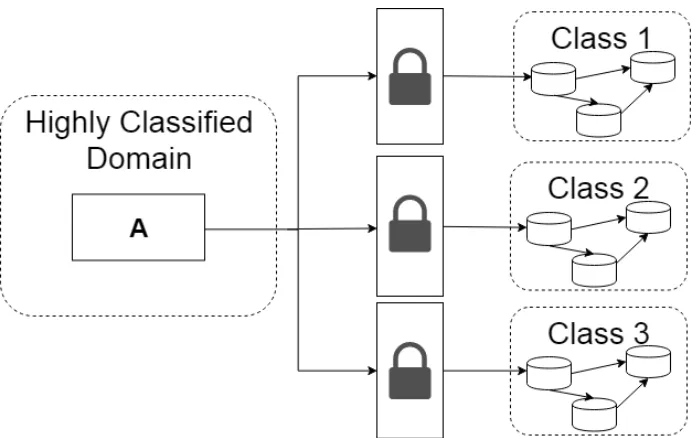
2.1 The Cross Domain Network Problem . . . 7
3.1 Example of a 2-dimensional Lattice [1] . . . 17
6.1 SIMON Block Cipher Round Function Block Diagram [2] . . . 47
6.2 SIMON Block Cipher Key Schedule Function Block Diagram [2] . . . 47
6.3 The Cross Domain Network Case Study . . . 49
6.4 Server Data Flow for Homomorphically Evaluating Metadata . . . 53
6.5 Top Level Application Design . . . 56
6.6 Gateway Process Flow . . . 57
6.7 Bitwise Compare Circuit . . . 58
7.1 Ciphertext Noise Growth for SIMON and Compare Evaluation Circuits with 128-bit Security Parameters . . . 62
7.2 Ciphertext Noise Growth for SIMON and Compare Evaluation Circuits with with 80-bit Security Parameters . . . 62
7.3 Ciphertext Noise Growth for SIMON and Compare Evaluation Circuits with 64-bit Security Parameters . . . 63
7.4 Noise Growth Comparison for Varying Bit Security Parameters with n=16384 . . . 64
7.5 Ciphertext Noise Growth for Only the Comparison Evaluation with 128-bit Security Parameters . . . 65
7.6 Ciphertext Noise Growth for Only the Comparison Evaluation with 80-bit Security Parameters . . . 66
7.7 Ciphertext Noise Growth for Only the Comparison Evaluation with 64-bit Security Parameters . . . 67
List of Tables
4.1 Iterative Evaluation for a YASHE Evaluation Key . . . 30
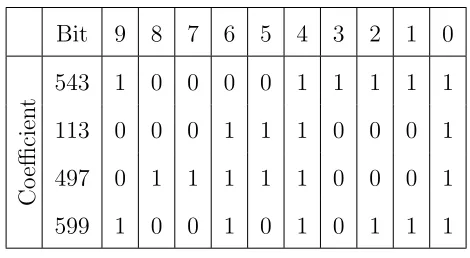
4.2 Bit Decomposition of ecmult coefficients . . . 32
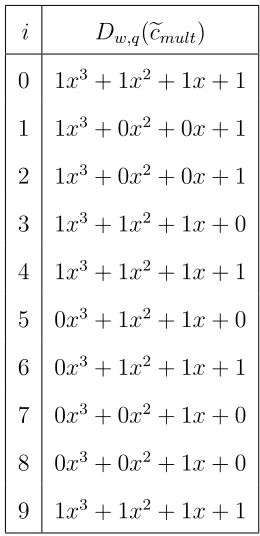
4.3 Iterative Evaluation for ecmult Word Decomposition . . . 33
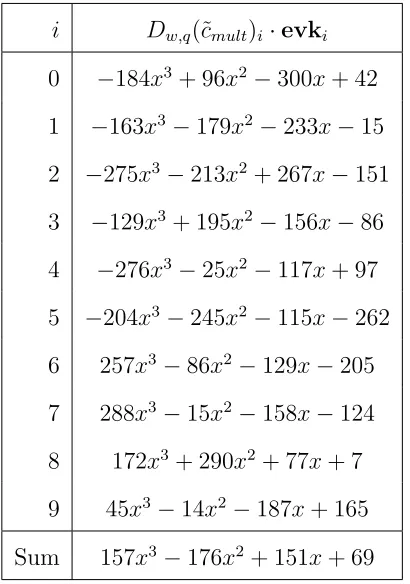
4.4 Cross Product Evaluation forhDw,q(˜cmult),evki . . . 34
5.1 R-LWE Based FHE Parameters for Varying Security Levels . . . 37
5.2 Ciphertext Ring Element Sizes of Varying Parameters . . . 39
5.3 Expected Multiplication Evaluation Depth of Varying Parameters . . 42
5.4 Homomorphic AES Performance . . . 44
6.1 Assigned Metadata Classificaion Values . . . 52
7.1 Memory Profile Results of CDS Application with 128-bit Security Pa-rameters . . . 60
7.2 Average Performance Profile Results of CDS Application with 128-bit Security Parameters . . . 60
7.3 Bit Noise After Varying Rounds of SIMON . . . 67
7.4 Memory Profile Results of CDS Application . . . 69
Chapter 1
Introduction
1.1
Problem and Motivation
The purpose of cryptography is to protect data in the presence of an adversary with
concerns regarding the following: authentication, confidentiality, integrity, and
non-repudiation. A growing aspect in industry is to offload large data storage and
expen-sive computation to third party services. Although traditional cryptographic systems
are good at keeping data confidential and intact during transfer, the security then
falls onto the third party service provider once the data is decrypted for operational
use. As soon as the data is decrypted, the confidentiality aspect of the data is lost as
the data is now available in plain sight to the servicer.
The cross domain problem is concerned with transferring information from
differ-ent security domains while keeping the information secure. An application is said to
be a cross domain solution (CDS) if it solves this problem. Most current solutions are
based on a system of risk management that usually relies on protected party
mem-bers. However, there still exists an unsolved problem of how to create an autonomous
system that routes highly classified data through a lower or untrusted classified
net-work without revealing any information about the data to the intermediate parties.
The reason this problem is still open is because of a lack of solutions that allow an
CHAPTER 1. INTRODUCTION
routing endpoint without decrypting the data first.
Homomorphic Encryption (HE) schemes pose a potential solution to the cross
domain problem. HE is a type of encryption that allows a party to perform
com-putations on encrypted data without the need to decrypt it. These comcom-putations
result in ciphertext that matches a ciphertext as if the evaluation result with the
original plaintexts was encrypted. The concept of a homomorphic encryption scheme
has been cited for the first time by Rivest, Adleman, and Dertouzous in 1978 [3];
however, the first construction of a plausible fully homomorphic encryption system
was not proposed until 2009 in Craig Gentry’s PhD dissertation [4]. Although
impli-cations of such a scheme that is able to perform arbitrary operations on data is huge,
the current schemes have glaring limitations, primarily performance, that remain an
open problem.
1.2
Homomorphic Encryption
Homomorphic Encryption is a type of encryption that allows a party to compute
operations on encrypted data without the need to know the underlying plaintext
data. Homomorphism is an algebraic term that comes from the greek words homos,
meaning ”same”, andmorphe, meaning ”form” [5]. It is a term that is used to define a
map between two algebraic structures that preserves the operations of the structures.
In other words, given two algebraic structures with their own respective operations,
both denoted by (A,∗) and (B,◦), and a map f, denoted f :A 7→ B, the map f is said to be homomorphic if the following holds:
f(x∗y) = f(x)◦f(y);x, y ∈A
It follows to say that an encryption scheme that exhibits homomorphism is one whose
mapping function, namely the encryption function, preserves the operations between
CHAPTER 1. INTRODUCTION
will result in a similar operation being performed on the underlying plaintext. The
homomorphism property, as it applies to encryption, is a powerful feature as it allows
untrusted parties to operate on data without the need to decrypt it and compromise
the privacy of the users. This feature is highly sought after for applications where
most of the computation is handed off to third parties for large scale operations but
it is desired to keep the information secret from such party members. For example,
the applications of handling large medical records or sensitive data handling in the
cloud computing environment could benefit from the privacy feature of homomorphic
encryption.
1.3
This Work
The objective of this thesis is to explore and assess the viability of using homomorphic
encryption to create a solution to the cross domain problem. The results shed light on
the practicality of using a fully homomorphic encryption scheme as well as a potential
solution to the cross domain problem. The Yet Another Somewhat Homomorphic
Encryption Scheme (YASHE) [6] is used as an encryption scheme basis for building
a proof-of-concept application that determines routing endpoints for several pieces of
encrypted data based on a hierarchy of data attributes. The application was profiled
and analyzed to evaluate any potential problems that come with using homomorphic
encryption as a solution basis, as well as revealed methods to improve upon these
issues.
Despite the advancements in research related to current Homomorphic Encryption
schemes, there still exists several challenges that prevent them from being practically
implemented in a useful application. The largest one that is still being addressed by
research is the computational cost of all the homomorphic schemes. Due to the
com-plex mathematical structures utilized by current Homomorphic Encryption schemes
CHAPTER 1. INTRODUCTION
the computational cost required to satisfy a system that holds both confidentiality
and integrity of the data handled is expensive. In particular, the ciphertext
expan-sion of the evaluation data is quite large and also exhibits a large execution time to
completely evaluate.
Work first began with investigating the Brakerski-Gentry-Vaikuntanathan (BGV),
Brakerski/Fan-Verauteren (B/FV), and YASHE FHE schemes and related
mathe-matical structures to ensure familiarity with the schemes. In particular, the YASHE
scheme was chosen for implementation after being heavily investigated. YASHE was
chosen over the other two schemes for its simplicity and its performance benefits for
small scale applications. Familiarity was reinforced with toy examples to
demon-strate proof-of-concept and correctness of the scheme. A design of the application
was constructed that meets the needs of a cross domain solution. A proof-of-concept
application of the design was implemented using the YASHE scheme using the open
source work from [7] as a base. The application was then subjected to memory and
performance profiling using different scheme parameters to produce an assessment of
Chapter 2
Background
2.1
Cross Domain Solutions
A cross domain solution (CDS) is a form of controlled interface that provides the
ability to access, either manually or automatically, or transfer information between
varying security domains [8]. It is a means of information assurance that aims to
achieve data confidentiality, integrity, and availability through a network. The
sce-nario, as described in Fig. 2.1, generally follows that a user would like to provide
access or transfer varying degrees of classified data to endpoint networks. This may
be in the form of an encrypted payload with an encrypted metadata tag. The
end-point networks should not obtain data whose classification does not match their own.
The difficult problem is that no party on the network except those whose
classifica-tion domain match the data should be able to recognize the type of data or how it
is would be routed. In other words, the data must be kept completely secure until
it reaches the proper endpoint. The National Institute of Standards and Technology
(NIST) provides a large catalog of security frameworks which includes a number of
non-mutually exclusive scenarios for cross domain solutions, primarily under the
in-formation flow enforcement section, from which an organization can select to fulfill
their requirements [9]; however, the methods and policies used are primarily
CHAPTER 2. BACKGROUND
Figure 2.1: The Cross Domain Network Problem
on security policy and risk management using protected domains with authorized
human personal to manually evaluate and control the flow of information.
There-fore, a system that is able to deploy a scheme to automatically use information while
maintaining security inside an untrusted domain is an open problem. The use of
homomorphic encryption as a means to achieve this remains a mostly unexplored
territory and proposes a potentially interesting solution.
2.2
A Basic Scheme
A basic scheme is presented to demonstrate the homomorphism properties as it
ap-plies to an encryption scheme. The scheme is heavily borrowed from Van Dijk’s FHE
scheme over integers [10]. The encryption methods demonstrate how a message is
transformed into a ciphertext and the decryption method demonstrates how the
mes-sage can be retrieved. The addition and multiplication operations demonstrate the
CHAPTER 2. BACKGROUND
2.2.1 Parameters
The scheme only requires a prime value p. This value is the secret key. The scheme has a message spacem ∈ {0,1}.
2.2.2 Encryption
Generate two values, e and q, randomly from some distribution such as a uniform or normal distribution. The message m is encrypted to obtain ciphertextc by:
c=E(m) = m+ 2e+pq (2.1)
Many homomorphic encryption schemes follow a similar format for encryption. The
idea is that a message can be encrypted by masking it with a product of two element,
in this case p and q, plus a small ”noise” term, in this case 2e.
2.2.3 Decryption
The ciphertextc is decrypted to obtain the message m by:
m=D(m) = (cmodp) mod 2 (2.2)
The proof of correctness is as follows:
m = (cmodp) mod 2
m= (m+ 2e+pqmodp) mod 2
m= (m+ 2e) mod 2
m =m
CHAPTER 2. BACKGROUND
When m+ 2e = p, it is easy to deduce that the message is lost after the modulo p
operation as
(m+ 2e) mod p≡p modp≡0
and is only a true results ifm is zero which does not make for a complete case. When
m+2e > p, then the parity of the message can be altered after the modulopoperation which will result in the incorrect message after the modulo 2 operation.
2.2.4 Addition
Two ciphertexts, c1 and c2, that encrypt two messages, m1 and m2, can be added to obtain a new ciphertext, c3. Decrypting c3 results in a plaintext whose value equals the evaluation ofm1 +m2. The proof of homomorphism of the scheme over addition is as follows:
c3 =c1+c2
c3 =m1+ 2e1+pq1+m2+ 2e2+pq2
c3 = (m1+m2) + 2(e1+e2) +p(q1+q2)
c3 = (m1+m2) + 2e3+pq3
It can be seen that the resulting ciphertext retains an encryption structure of the sum
of messagesm1 and m2.
2.2.5 Multiplication
Two ciphertexts,c1 andc2, that encrypt two messages, m1 andm2, can be multiplied to obtain a new ciphertext, c3. Decrypting c3 results in a plaintext whose value equals the evaluation of m1m2. The proof of homomorphism of the scheme over multiplication is as follows:
CHAPTER 2. BACKGROUND
c3 = (m1+ 2e1+pq1)(m2+ 2e2+pq2)
c3 = (m1m2) + 2(m1r2+m2r1+ 2e1e2) +kp
Note that the value k is simply the sum of product terms with the value p from the multiplication of the two ciphertexts. It can be seen that the resulting ciphertext
retains an encryption structure of the product of messages m1 and m2.
2.2.6 Summary
It can be seen that the scheme presented is indeed homomorphic. It should be noted
that in order for the scheme is defined to only operate on binary data. This ensures
that a user can evaluate any abstract operation by constructing a binary circuit using
the homomorphic operations. A binary addition operation results in an operation
that matches a binary XOR-gate and a binary multiplication operation results in an
operation that matches a binary AND-gate. A construction using these gates can
perform any operation as these two binary operations form a functionally complete
set. Other FHE schemes follow similar constructions.
2.3
Types of Homomorphic Encryption
Homomorphic encryption refers to the type of encryption that allows a user to
op-erate on encrypted data; however, there are actually different HE schemes that fall
within the definition of three different types: Partially Homomorphic, Somewhat
Ho-momorphic, and Fully Homomorphic. The main distinction lies with what operations,
primarily among addition and multiplication, a user can perform with the data and
how the operations are restricted by the scheme.
2.3.1 Partially Homomorphic Encryption
A Partially Homomorphic Encryption (PHE) scheme is one that allows an unbounded
CHAPTER 2. BACKGROUND
single operation. Although PHE schemes can be useful, the applications of which
they are applicable is limited due to their limited operation set. There exists a
couple of applications where such schemes are used including e-voting [11] and private
information retrieval (PIR) [12].
2.3.2 Somewhat Homomorphic Encryption
A Somewhat Homomorphic Encryption (SWHE) scheme is one that allows a set of
operations, normally both addition and multiplication, but with a bound on either one
or both operations. Normally, these schemes allow one operation, usually addition,
to be performed an unlimited amount of times while the other operation, usually
multiplication, can be performed a limited number of times. SWHE schemes are
applicable to applications where the complexity and depth of the functions involved
are known beforehand but fall short for applications that desire arbitrary computation
on data. In addition, data can only be operated on to a certain extent before the
decrypt function will stop evaluating the ciphertext correctly, limiting the types of
applications that can be implemented using such a scheme.
2.3.3 Fully Homomorphic Encryption
A Fully Homomorphic Encryption (FHE) scheme is one that allows an arbitrary set of
operations to be evaluated on encrypted data an unlimited number of times. Despite
the usefulness of the prior two types of schemes, this type of scheme is the most
promising as it offers nearly no limitations on the type of computation one can execute
with encrypted data. However, despite much research effort, it has proved difficult to
construct a scheme that achieves practical full and unbounded homomorphism. No
such schemes were devised until Craig Gentry’s breakthrough in 2009 [4]. Since then,
several FHE schemes have been published and much improvement has been seen in
CHAPTER 2. BACKGROUND
before these schemes will realistically see use in industry. It should also be noted that
aleveled fully homomorphic encryption scheme is one that can evaluate any circuit of
multiplicative depthL as an auxiliary input. In this sense, it is somewhat analogous
to say that such a scheme sits somewhere between SWHE and FHE, but for all
intents and purposes, it is grouped under FHE as all circuits can be fully evaluated
if the multiplicative depth L of the evaluation circuits are known beforehand and parameters are chosen to accommodate for such evaluation.
2.4
Gentry’s Breakthrough
In 2009, Craig Gentry presented in his PhD dissertation [4] the first achievable FHE
scheme. This was a huge milestone for the long term problem of finding a FHE
scheme; arguably, the more valuable information that came from his dissertation was
the general blueprint that he outlines for achieving FHE schemes that has paved the
way for researchers. Before Gentry, research focused mainly on maximizing the circuit
complexity that an HE scheme can evaluate. Gentry shows that one can obtain a FHE
scheme using a SWHE scheme as a basis using two techniques he calls ”squashing”
and ”bootstrapping”. Gentry’s ingenious, yet conceptually simple, idea is if a SWHE
scheme is bootstrappable, a ciphertext can be ”refreshed” or ”re-encrypted” with
an elaborate scheme of encrypting and decrypting a ciphertext homomorphically to
produce a clean ciphertext (i.e. one with little noise). Therefore, Gentry’s approach
is to instead focus on minimizing the decryption circuit of an HE scheme in order to
create a bootstrappable scheme.
2.4.1 Squashing
A SWHE scheme is said to bebootstrappable if it is able to evaluate its own decryption
circuit. However, as it turns out, a decryption circuit usually involves a circuit of
CHAPTER 2. BACKGROUND
depth. The squashing technique involves finding a set whose sum of elements equals
the inverse of the secret key and then multiplying a ciphertext by each of the set
elements. This reduces the decryption circuit to one with depth small enough for the
SWHE scheme to evaluate.
2.4.2 Bootstrapping
The bootstrapping technique is a method to create a ”fresh” ciphertext from a noisy
ciphertext that will decrypt to the same plaintext. The bootstrapping method
as-sumes there are two sets of public and secret key pairs and a ciphertext that is
encrypted with the first key pair. First, squashing is applied to a ciphertext to make
it bootstrappable. The technique basically involves decrypting the ciphertext
homo-morphically using an encryption of the first secret key and then applying encryption
using the second public key. The resulting ciphertext is a ciphertext with ”fresh”
noise but encrypted under a new key pair. This technique allows a SWHE scheme to
act as a FHE scheme by refreshing a ciphertext after any operations have been
eval-uated. However, it should be noted that this particular method is computationally
Chapter 3
Mathematical Constructs and Hard Problems
3.1
Ring Theory
A ring is one of the fundamental algebraic structures of abstract algebra. It consists
of a set of elements, often denoted R, and is equipped with two binary operations,
often denoted + and ·, that satisfy the ring axioms [13]. The ring axioms are as
follows:
1. R is an abelian group under addition:
• (a+b) +c=a+ (b+c) for all a, b, c∈R.
• a+b =b+a for all a, b∈R.
• There exists an additive identity element 0∈R such that a+ 0 =a for for
alla∈R.
• There exists an additive inverse element−a∈R such thata+−a= 0 for
alla∈R.
2. R is a monoid under multiplication:
• (a·b)·c=a·(b·c) for all a, b, c∈R.
• There exists a multiplicative identity element 1∈Rsuch thata·1 = 1·a=
CHAPTER 3. MATHEMATICAL CONSTRUCTS AND HARD PROBLEMS
3. R is distributive under multiplication:
• a·(b+c) = (a·b) + (a·c) for all a, b, c∈R.
• (b+c)·a= (b·a) + (c·a) for all a, b, c∈R.
The primary type of rings of interest are generalized quotient ring of polynomial rings.
A polynomial ring is that is formed from the set of polynomials with one or more
indeterminates with coefficients of elements from another ring or field. A polynomial
ring, represented asK[x], over the indeterminatexwith coefficient in the ring or field
K, has the form of
∞
P i=0
aixi
where the coefficients ai are elements of K. The quotient ring, K[x]/(f(x)), where
f(x) ∈ K[x], is set of elements in K[x] mod f(x). A d-th cyclotomic polynomial is the unique irreducible polynomial with integer coefficients which divides xd−1 but does not divide xk−1 for all values k < d [14, 13]. If f(x) is the d-th cyclotomic polynomial, φd(x), then the ring can be uniquely represented by all the polynomials in K[x] with degree less than that of n = ϕ(d), where ϕ is Euler’s totient function [14]. Any addition and multiplication operations involving two elements from the ring
follow the same form of addition and multiplication of polynomials but the result is
reduced modulo φd(x).
As such, polynomial ring elements as described before can be expressed as
polyno-mials with normal addition and multiplication operations. For example, let φd(x) =
x4−1 and elementsa = x3 +x+ 1, and b =x2+x+ 1 where x, y ∈ Z/φd(x). The addition of x and y follow polynomial component wise addition:
a+b= (x3+x+ 1) + (x2+x+ 1) =x3+x2+ 2x+ 2.
CHAPTER 3. MATHEMATICAL CONSTRUCTS AND HARD PROBLEMS
a·b= ((x3+x+ 1)·(x2+x+ 1)) modx4 −1
a·b = (x5+x4+ 2x3 + 2x2+ 2x+ 1) mod x4−1
a·b= 2x3+ 2x2+ 3x+ 2.
Note that, traditionally, modular reduction can be efficiently performed using the
Extended Euclidean method [15].
3.2
Lattices
The algebraic construct of the lattice has had an increasing presence in cryptography
primarily for hardness problems that rely on its underlying structure that is shown
to be resistant to currently known quantum computer algorithms [1]. Gentry uses
lattices, albeit primarily to take advantage of the shallow depth of the decryption
circuit of lattice-based cryptography schemes, as part of his strategy for formulating
a FHE scheme.
Let Rm be an m-dimensional vector of real numbers. A lattice in
Rm is the set
L=L(b1, ..., bn) =
n
P i=1
xibi :xi ∈Z
of all combinations ofn linearly independent vectorsb1, ...,bn, wherebi ∈Rn[1, 14]. The integern is called the rank of the lattice and the integerm is called the dimension
of the lattice. It is common to work with lattices that are full-rank, or in other words,
where m = n. The sequence of bi is called the basis of the lattice and is usually represented as matrix
B= [b1, ...,bn]∈Rmxn.
with the basis vectors as columns. Any given lattice has an infinite number of bases.
CHAPTER 3. MATHEMATICAL CONSTRUCTS AND HARD PROBLEMS
||z||p = n
P i=1
|xi|p)1/p
.
In other words, ||z||p defines the length or size of the vector z.
Geometrically speaking, a lattice can be represented as a set of infinite points of
an n-dimensional grid. For example, a 2-dimensional lattice can be represented as in
Fig. 3.1 [1]. The the basis of lattice in Fig. 3.1 is
B=
1 1
2 −1
where any point is the result of a linear combination of integer coefficients of the basis
vectors
b1 =
1
2
, b2 =
1
−1
[image:26.612.153.491.312.641.2] .
CHAPTER 3. MATHEMATICAL CONSTRUCTS AND HARD PROBLEMS
3.3
Shortest Vector Problem
The Shortest Vector Problem (SVP) is one of the most well-known hard problems on
lattices. Letλ(L) be the length of the shortest vector in the latticeLwith dimension
n defined by basis matrix B. The SVP is formally defined as
minimizex∈Zn,x6=0||Bx||p
and return x[16]. The problem essentially asks to find the shortest vector in L with length λ(L).
An approximate version of the problem, denoted SVPγ(n), asks to find a non-zero vector whose length is at mostγ(n)·λ(L). The approximation version of the problem essentially asks to find a vector who is relatively short.
3.4
Closest Vector Problem
The Closest Vector Problem (CVP) is another hard problem on lattices. Let L be a lattice with dimension n defined by basis matrix B and t ∈Rm be vector that does not necessarily lie on the lattice. The CVP is formally defined as
minimizex∈Zn||Bx−t||p
and returnx [16]. The problem essentially asks to find a vector inL that lies closest to the given vector t.
3.5
Learning with Errors
The Learning With Errors (LWE) problem is a hard problem that was first proposed
by Oded Regev [17]. The problem is defined formally as follows. Fix a size parameter
CHAPTER 3. MATHEMATICAL CONSTRUCTS AND HARD PROBLEMS
ei ∈Zq according toχ. The LWE problem claims that it is difficult to retrieve swith high probability provided a sequence of tuples in the form of (ai,haisi+ei) [17, 18]. The problem has been shown to be reduced to worst-case lattice problems [17, 18, 19].
For example, say for n= 3 andq = 17, let
12s1+ 3s2+ 7s3 ≈11 mod 17 3s1+ 1s2+ 3s3 ≈1 mod 17 4s1+ 8s2+ 9s3 ≈6 mod 17
be the linear combinations obtained from the calculating the cross products of vectors
ai and s where
a1 = 12 3 4
,a2 = 3 1 8
,a3 = 7 3 9 s= s1 s2 s3
and adding a small noise term sampled uniformly from -1 and 1 to each result. LWE
claims that it is difficult to find vector s. The solution is
s= 1 2 4 .
3.6
Ring Learning with Errors
The Ring-Learning With Errors (R-LWE) problem is a special case of LWE that
instead handles with algebraic ring structures [18]. The R-LWE problem is defined
as follows. Fix a dimension parameter n ≥ 1 where n is a power of 2 and a prime modulus q ≥ 2 satisfying q = 1 mod 2n. Rq is a ring defined by Zq[x]/hxn+ 1i and letχbe some distribution over Rq. Set a secret element s∈Rq. Sample an arbitrary length sequence of elements ai ∈ Rq uniformly at random and ei ∈ Rq according to
CHAPTER 3. MATHEMATICAL CONSTRUCTS AND HARD PROBLEMS
provided a sequence of tuples in the form of (ai,ai·s+ei) [17, 18]. The R-LWE scheme offers increased efficiency over LWE in the context of cryptographic applications. For
example, each (a, b) ∈ Rq ×Rq sample from the R-LWE distribution can replace n samples (a, b)∈ Zn
q ×Zq from the LWE distribution. This exhibits itself in reduced key sizes as well as faster computations. The RLWE problem is also reduced to hard
lattice problems [19].
For example, say for n= 4 andq = 17, let
(3x3+ 5x2+ 7x+ 10)s≈13x3 + 11x2+ 7x+ 11∈R q
(12x3 + 14x2+ 3x+ 6)s≈13x3+ 12x2+ 5x+ 10∈R q
(2x3 + 1x2+ 6x+ 6)s≈12x3+ 5x2+ 14x+ 13∈R q
(3x3+ 9x2+ 12x+ 15)s≈13x3+ 11x2+ 15x+ 1 ∈R q
be the linear combinations obtained from the calculating the products of ring elements
ai and s where
a1 = 3x3+ 5x2+ 7x+ 10 ∈Rq
a2 = 12x3+ 14x2+ 3x+ 6∈Rq
a3 = 2x3+ 1x2+ 6x+ 6∈Rq
a4 = 3x3+ 9x2+ 12x+ 15∈Rq
and adding a small noise term where the coefficients are sampled uniformly from
-1 and 1 to each result. R-LWE claims that it is difficult to find the ring element s.
The solution is
Chapter 4
Fully Homomorphic Encryption Schemes
4.1
Preliminaries and Notation
Both the message space and ciphertext space of the schemes are defined with some
relation to the ring R. The ring R is defined as Z[X]/(φd(X)) for an integer d. The set of elements in R can thus be uniquely represented as all polynomials of degree less than n =ϕ(d) with integer coefficients. These elements may be represented as a vector with elements from the coefficients of the polynomial form. The coefficients of
all ciphertext elements are often reduced by an integer q which is denoted by a map, [·]q, that reduces a given coefficient element by moduloq into the interval (−q/2, q/2]. This mapping extends to a ring element by applying the map to each individual
coefficient of the polynomial. A second coefficient modulus t < q determines the plaintext message space R/tR, or in other words, where messages are in R with coefficients modulot. An integer w is used to represent integers in a radix-w system. Let `w,q = blogw(q)c + 1. The notation Rq is used to denote the ring R whose coefficients are reduced by the modulus q. For a ring or field K, the notation Kn denotes an n-tuple list of elements from the the ring or field K. Elements that are a single element are denoted in lowercase notation such as z and vectors or tuples are denoted in lowercase boldface notationz.
decom-CHAPTER 4. FULLY HOMOMORPHIC ENCRYPTION SCHEMES
position and powers of functions, respectively. The notion of the word decomposition
function follows that since an integer z in the interval (−q/2, q/2] can be written uniquely as P`w,q−1
i=0 ziwi where zi are integers within the bound [0, w], then a ring element x ∈ R can be written as P`w,q−1
i=0 xiwi where xi ∈ R with coefficients in (−w/2, w/2]. The word decomposition function is defined as
Dw,q :R →R`w,q, x7→([x0]w,[x1]w, ...,[x`w,q−1]w).
In other words, the word decomposition function maps a ring element to a vector of
`w,q elements where each vector element is a ring element whose coefficients are the individual word decompositions of the individual original coefficients. The powers of
function is defined as
Pw,q :R →R`w,q, x7→([x]q,[xw]q...,[xw`w,q−1]q).
In other words, the powers of function maps a ring element to a vector of `w,q ele-ments where each vector element is the original ring element scaled with an iteratively
increasing exponential of the radix integer. The Powersof2 function is a special
de-notation of the powers of function for a radix value of 2.
4.2
Brakerski-Gentry-Vaikuntanathan Scheme
The Brakerski-Gentry-Vaikuntanathan (BGV) [20] presented a novel leveled fully
homomorphic scheme with large improvements in performance at the cost of weaker
security assumptions. The scheme still primarily relies on R-LWE problem as a
security basis. The objective of the BGV scheme focuses on improving the
per-gate computation of the homomorphic operations. BGV builds off of the techniques
introduced by the BV scheme such as their method of avoid the squashing method
[21]. A core component of this construction, however, is its effective way for managing
CHAPTER 4. FULLY HOMOMORPHIC ENCRYPTION SCHEMES
BV [21]. BGV uses an iterative approach to the modulus switching technique so that
the noise grows linearly instead of quadratically with homomorphic multiplication
operations at the expense of gradually reducing the homomorphic capacity. With
this technique, it is able to effectively avoid the bootstrapping method to create a
leveled fully homomorphic scheme and evaluate anL-level circuit with ˜O(λ·L3) per-gate computation complexity. However, Brakerski et. al. do propose a follow-up
scheme that uses bootstrapping, somewhat ironically, as an optimization to achieve
˜
O(λ2) per-gate computation complexity that is independent of the circuit depth. All ciphertexts are represented as a pair of ring elements.
The basic leveled BGV scheme based on the R-LWE assumption is stated [20].
Note that another version of the scheme that implements bootstrapping to construct
a completely FHE scheme from BGV is provided by [20].
• ParamsGen(λ,L): Given the security parameterλ, fix a positive integer d that
determines R and a distribution χ on R. For j = L down to 0, generate a decreasing ladder of moduli qi. Output (d, qi,χ).
• KeyGen(d, q, χ): For j = L down to 0, Sample s0i ← χ and set si = (1, s0i). Sample a0i ← Rqi uniformly and an element ei ← χ and set bi = a0is0i + 2ei. Set ai = (bi,−a0i)T. Set s0j =sj ⊗sj ∈R
(2 2)
qj . Set bi =ai+ Powersof2(si) (Add Powersof2(s1)∈R
dlog2(qi)e
qi to thea’s first column). Setτs0
j+1→sj =bi except for
when j = L. Set the secret key sk to a vector of si and the public key pk a vector of ai and a vector of τs0
j+1→sj is a public parameter.
• Encrypt(pk, m): To encrypt a message m ∈R2, setm = (m,0)∈R22. Sample
r←χ and e←χ2 output the ciphertext
c=m+ 2·e+aTL·r∈RqL2 .
• Decrypt(sk, c): Suppose the ciphertext cis encrypted under sj. To decrypt c,
CHAPTER 4. FULLY HOMOMORPHIC ENCRYPTION SCHEMES
m= [[hc,sji]qj]2.
• SwitchKey(τs0
j →sj−1,c, qj): Output the new ciphertext
c1 =BitDecomp(c)T ·bj.
• Refresh(c,τs0
j →sj−1, qj, qj−1): Suppose the ciphertext is encrypted under s
0
j.
Do the following:
1. Switch Keys: Set c1 ← SwitchKey(τs0
j → sj−1, c, qj), a ciphertext under the keysj−1 for modulus qj.
2. Switch Moduli: Set c2 ← Scale(c1, qj, qj−1, 2), a ciphertext under sj−1 for modulusqj−1.
• Add(pk,c1,c2): Takes two ciphertexts encrypted under the samesj (Use Refresh
to make it so if they are not). Set c3 = c1 +c2, a ciphertext encrypted under
s0j. Output the ciphertext
cadd=Refresh(c3, τs0
j →sj−1,qj,qj−1).
• Mult(pk, c1, c2): Takes two ciphertexts encrypted under the same sj (Use
Re-fresh to make it so if they are not). Setc3to the coefficient vector ofLlongc1,c2(x⊗x).
Output the ciphertext
cmult =Refresh(c3,τs0
j→sj−1, qj, qj−1).
4.3
Brakerski/Fan-Verauteren Scheme
The Brakerski/Fan-Verauteren (BFV) [22], also commonly denoted FV, is a port of
the scale-invariant FHE B12 scheme by Brakerski [23] based on the LWE assumption
into one based on the R-LWE assumption. FV also exhibits two methods for
CHAPTER 4. FULLY HOMOMORPHIC ENCRYPTION SCHEMES
the avoidance of the technique in [23], FV introduces modulus switching from [21] as
an optimization just as the BGV scheme for bootstrapping proposes. Like BGV and
a few others, FV avoids the use for the squashing technique. The FV scheme offers
a fully constructed leveled FHE scheme whose noise grows linearly with the depth of
the evaluation circuits due to the scale-invariance techniques adopted from B12. All
ciphertexts are represented as a pair of ring elements.
The leveled FV scheme based on the first variation of the relinearization technique
is stated [22]. Note that another version of the scheme that implements bootstrapping
to construct a completely FHE scheme from FV is provided by [22].
• ParamsGen(λ): Given the security parameter λ, fix a positive integer d that
determines R, moduli q and t with 1 < t < q, and distributions χkey, χerr on
R. Choose an integer radixw. Output (d, q, t, χkey,χerr, w).
• KeyGen(d, q, t, χkey, χerr, w): Sample s ← χkey. Sample a←Rq uniformly at
random, e←χerr, and compute b= [−(as+e)]q. Sample a←R `w,q
q uniformly
at random, e ←χ`w,qerr , and compute γ0 = [Pw,q(s2)−(e+as)]q ∈ R`w,q and set
γ = (γ0,a). Output (pk, sk, evk) = ((b, a),s,γ).
• Encrypt((b, a),m): The message space isR/tR. Sampleu←χkey,e1, e2 ←χerr,
and output the ciphertext
c= ([bqtc[m]t+e1+bu]q,[e2+au]q)∈R2.
• Decrypt(s,c): To decrypt a ciphertext c= (c0, c1), compute
m= [bt
q[c0+c1s]qe]t ∈R.
• Relin(˜cmult, evk): Let (b,a) =evkand ˜cmult = (c0, c1, c2). Output the
cipher-text
˜
CHAPTER 4. FULLY HOMOMORPHIC ENCRYPTION SCHEMES
• Add(c1, c2): Let c1 = (c1,0, c1,1) and c2 = (c2,0, c2,1). Output the ciphertext
cadd = ([c1,0 +c2,0]q,[c1,1+c2,1]q).
• Mult(c1, c2, evk): Output the ciphertext
cmult = Relin(˜cmult, evk), where ˜
cmult = (c0, c1, c2) = ([bqtc1,0c2,0e]q,[bqt(c1,0c2,1+c1,1c2,0)e]q,[bqtc1,1c2,1e]q).
4.4
YASHE
The Yet Another Somewhat Homomorphic Encryption (YASHE) scheme is a leveled
fully homomorphic encryption scheme developed by Bos et. al [6] based on the Stehl´e
and Steinfeld [24] and L´opez-Alt et al. [25] encryption schemes. The scheme’s
se-curity is based on the Ring-Learning With Error (R-LWE) hardness assumption [19]
that has been gaining traction in the cryptographic community due to its promising
performance and security properties. The scheme offers a regularization technique to
perform a key switching operation after multiplication to transform the ciphertext to
one encrypted under the original key and as well as prevent the need to expand the
ciphertext size after each operation. Its ciphertext is representable with a single ring
element and the scheme offers promising performance benefits.
The more practical variant of the YASHE scheme is stated [6].
• ParamsGen(λ): Given the security parameter λ, fix a positive integer d that
determines R, moduli q and t with 1 < t < q, and distributions χkey, χerr on
R. Choose an integer radixw. Output (d, q, t, χkey,χerr, w).
• KeyGen(d, q, t, χkey, χerr, w): Samplef ’, g ←χkey and let f = [tf0+ 1]q. If f
is not invertible modulo q, choose a new f ’. Compute the inverse f−1 ∈ R of f
modulo q and set h = [tgf−1]q. Sample e,s ← χ `w,q
err , compute γ = [Pw,q(f) +
CHAPTER 4. FULLY HOMOMORPHIC ENCRYPTION SCHEMES
• Encrypt(h, m): The message space is R/tR. Sample s, e ← χerr and output
the ciphertext
c= [bqtc[m]t+e+hs]q ∈R.
• Decrypt(f, c): To decrypt a ciphertext c, compute
m= [bt
q[f c]qe]t∈R.
• KeySwitch(˜cmult, evk): Output the ciphertext [hDw,q(˜cmult),evki]q.
• Add(c1, c2): Output the ciphertext
cadd = [c1+c2]q.
• Mult(c1, c2, evk): Output the ciphertext
cmult = KeySwitch(˜cmult, evk), where ˜cmult = [btqc1c2e]q.
4.5
YASHE Toy Example
To better demonstrate the data structures and homomorphic properties of the YASHE
scheme, a toy example is provided. The example demonstrates the encryption,
de-cryption, binary addition, and binary multiplication operations, the intermediate
operations involved, and how the resulting data looks.
4.5.1 Preliminaries
For the purposes of keeping the example small and comprehensible, the security of
the scheme is ignored and instead the parameters are chosen to keep the sizes of the
CHAPTER 4. FULLY HOMOMORPHIC ENCRYPTION SCHEMES
elements of the ring R to polynomials of degree ϕ(8) = 4. The modulus parameter
q is chosen to be 601 which determines the coefficient bounds of the polynomials. The modulus parameter t is chosen to be 2 since no batching will be utilized for the example and only bits of data are handled. The integer radix value wis chosen to be 2 for simplicity. Define `w,q = 10.
The distribution χkey is chosen to be a uniform distribution of the values of -1, 0, and 1. The distribution χerr is chosen to be a bounded normal distribution with bounds of -3 and 3. When the scheme asks calls to sample a polynomial from the one
of the distributions, it is sufficient to think of the sampling as setting every coefficient
of the polynomial to a random sample from the distribution described.
The ring operations for addition and multiplication follow the same rules for
poly-nomial addition and multiplication but all results are implicitly reduced by φ8(x). All examples were computed and evaluated using an implemented Matlab script
that performed all operations utilizing Matlab’s polynomial evaluation functions.
4.5.2 Key Generation
Ring elements f0 and g are sampled from χkey:
f0 =−x2+x g =−x3+x2−x+ 1
The ring element f is computed using f0:
f = [tf0+ 1]q
f = [(2)(−x2+x) + 1] 601
f =−2x2+ 2x+ 1
The ring element f−1 is computed using an inverse method such as the Extended Euclidean algorithm [15]:
CHAPTER 4. FULLY HOMOMORPHIC ENCRYPTION SCHEMES
The ring element h is computed using g and f−1:
h= [tgf−1] q
h= [(2)(−x3+x2−x+ 1)(255x3−148x2+ 280x+ 206)] 601
h=−248x3+ 66x2−57x−25
Values e and s are sampled `w,q times from χerr. The `w,q-element vector of ring elements that composesγis calculated frome,s, andhby calculating [Pw,q(f)+e+hs]q to generate an `w,q number of ring elements. Each iteration of the calculation is represented in Table 4.1.
The public key pk=h, the secret key sk =f, and the evaluation key evk =γ.
4.5.3 Encryption
Let plaintext messages, m1 and m2, be two binary values 0 and 1, respectively. Two ciphertexts, c1 and c2, can be computed for each bit message using the encryption function. The values for e and s are sampled from χerr for each encryption. This function requires the knowledge of the public key:
c1 = [bqtc[m1]t+e1+hs1]q
c1 = [(300)(0) + (−x3+ 2x+ 1) + (−248x3 + 66x2−57x−25)(x2+x+ 1)]601
c1 =−240x3 −16x2+ 168x+ 158
c2 = [bqtc[m2]t+e2+hs2]q
c2 = [(300)(1) + (3x3−1) + (−248x3+ 66x2−57x−25)(−x3−2x2+x)]601
c2 = 208x3−255x2+ 146x+ 21
4.5.4 Decryption
The two ciphertexts, c1 andc2, can be decrypted using the decryption function. This function requires the knowledge of the secret key:
CHAPTER 4. FULLY HOMOMORPHIC ENCRYPTION SCHEMES
m1 = [b6012 [(−2x2+ 2x+ 1)(−240x3−16x2+ 168x+ 158)]601e]2
m1 = [b1.977x3+ 0.013x2+ 0.013x+ 0.017e]2
m1 = [2x3+ 0x2+ 0x+ 0e]2
m1 = 0
m2 = [bqt[f c2]qe]t
m2 = [b6012 [(−2x2+ 2x+ 1)(208x3−255x2+ 146x+ 21)]601e]2
m2 = [b.023x3+ 1.983x2+ 0.010x+ 0.988e]2
m2 = [0x3+ 2x2+ 0x+ 1e]2
m2 = 1
4.5.5 Homomorphic Addition
The two ciphertexts, c1 and c2, can be homomorphically added by performing a ring element addition with both ciphertexts:
c3 = [c1+c2]q
c3 = [(−240x3−16x2+ 168x+ 158) + (208x3−255x2+ 146x+ 21)]601
c3 =−32x3−271x2−287x+ 179
Decrypting the result shows that the two underlying plaintext values were evaluated
under binary addition:
m3 = [bqt[f c3]qe]t
m3 = [b6012 [(−2x2 + 2x+ 1)(−32x3 −271x2−287x+ 179)]601e]2
m3 = [b0x3+ 1.997x2+ 2.329x+ 1.005e]2
m3 = [0x3+ 2x2+ 2x+ 1e]2
m3 = 1 =m1+m2
4.5.6 Homomorphic Multiplication
com-CHAPTER 4. FULLY HOMOMORPHIC ENCRYPTION SCHEMES
puted:
ecmult = [b t qc1c2e]q
e
cmult = [b6012 (−240x3−16x2+ 168x+ 158)(208x3−255x2+ 146x+ 21)e]601
e
cmult =−58x3+ 113x2−104x−2
The ciphertext results in a homomorphic evaluation of the plaintext data under
mul-tiplication, however, due to the quadratic overhead of polynomial mulmul-tiplication, it
is technically encrypted under the square of the secret key. In fact, this data could
be decrypted with such a key. However, since the data is intended to be reused for
further evaluation, a key switching mechanism is used to align the ciphertext to the
original secret key. First, the word decomposition of ecmult is computed using the binary bit decomposition of all the coefficients. The binary representation of each
[image:41.612.204.439.428.557.2]of the coefficients in ecmult is represented in Table 4.2. Note that the elements are expressed in their positive integer form by the modulus 601.
Table 4.2: Bit Decomposition ofecmult coefficients
Bit 9 8 7 6 5 4 3 2 1 0
Co
efficien
t 543 1 0 0 0 0 1 1 1 1 1
113 0 0 0 1 1 1 0 0 0 1
497 0 1 1 1 1 1 0 0 0 1
599 1 0 0 1 0 1 0 1 1 1
The routine Dw,q(ecmult) is used to generate `w,q-element vector of ring elements generated from the bit compositions of each of the coefficients that make up the entire
ring element. Each iteration of the calculation and the resulting ring elements that
CHAPTER 4. FULLY HOMOMORPHIC ENCRYPTION SCHEMES
Table 4.3: Iterative Evaluation for ecmult Word Decomposition
i Dw,q(ecmult) 0 1x3 + 1x2+ 1x+ 1 1 1x3 + 0x2+ 0x+ 1 2 1x3 + 0x2+ 0x+ 1 3 1x3 + 1x2+ 1x+ 0 4 1x3 + 1x2+ 1x+ 1 5 0x3 + 1x2+ 1x+ 0 6 0x3 + 1x2+ 1x+ 1 7 0x3 + 0x2+ 1x+ 0 8 0x3 + 0x2+ 1x+ 0 9 1x3 + 1x2+ 1x+ 1
The final ciphertext,c3, is computed using the key switch routine. The key switch routine calls to compute the cross product between word decomposition ofecmultvector and the evaluation key vector. The results of each individual multiplication element
and then the summation of the components is represented in Table 4.4. All operations
are performed implicitly using the ring multiplication operation with a modulus of
CHAPTER 4. FULLY HOMOMORPHIC ENCRYPTION SCHEMES
Table 4.4: Cross Product Evaluation for hDw,q(˜cmult),evki
i Dw,q(˜cmult)i·evki 0 −184x3+ 96x2−300x+ 42 1 −163x3 −179x2−233x−15 2 −275x3−213x2+ 267x−151 3 −129x3+ 195x2−156x−86 4 −276x3−25x2−117x+ 97 5 −204x3−245x2−115x−262 6 257x3 −86x2−129x−205 7 288x3 −15x2−158x−124 8 172x3+ 290x2+ 77x+ 7 9 45x3−14x2−187x+ 165 Sum 157x3−176x2+ 151x+ 69
The resultant ciphertext,c3, is therefore computed to be 157x3+425x2+151x+69. Decrypting the result shows that the two underlying plaintext values were evaluated
under binary multiplication:
m3 = [bqt[f c3]qe]t
m3 = [b6012 [(−2x2+ 2x+ 1)(157x3+ 425x2+ 151x+ 69)]601e]2
m3 = [b0.346x3+ 1.960x2+ 0.007x+ 0.0131e]2
m3 = [0x3+ 2x2+ 0x+ 0e]2
Chapter 5
Parameter Selection
There are a few concerns regarding the parameter selection of the FHE schemes. The
parameters chosen for the implementation of a scheme have an effect on the several
components of the scheme: security, ciphertext size, performance, circuit evaluation
depth, and the plaintext space. The main difficulty with choosing the ”best”
pa-rameters is that each of the components seem to be heavily intertwined such that
one particular selection of parameters may have a positive effect on one component
but an adverse effect on another. The main parameters that influence each of these
components are the polynomial ring degree, denotedn, and the ciphertext coefficient modulus, denoted q. Other parameters that have an influence, but are not examined as heavily as the other two, are the secret and error distribution parameters,χkey and
χerr.
5.1
Security
The analysis of the security R-LWE based schemes is not very straight forward due to
the influence on the security from the mix of parameters. The security lies primarily
in the masking of the plaintext data with the noise terms that are randomly sampled.
In addition, the number of coefficients of each ring and the size of the coefficients,
CHAPTER 5. PARAMETER SELECTION
analysis of their security [26] in order to provide a recommendation of parameters.
The authors made an security analysis for varying parameters by evaluating the bit
security strength against three known attack algorithms: the unique shortest vector
attack (uSVP) [27], the decoding attack [28, 29], and the dual attack [30]. These three
attacks are based heavily off the usage of the BKZ-2.0 lattice reduction algorithm [31].
The authors based their analysis off of the analysis of Albrecht, Player, and Scott [29]
who provide an open source and online estimator tool. In order to simplify their
analysis, the error distribution is set constant to a Discrete Gaussian distribution
with width γ = 8/√2π and focusing on the effects of choosing a secret distribution from the uniform, error, and ternary (ie. uniformly from -1, 0, 1) distributions. For a
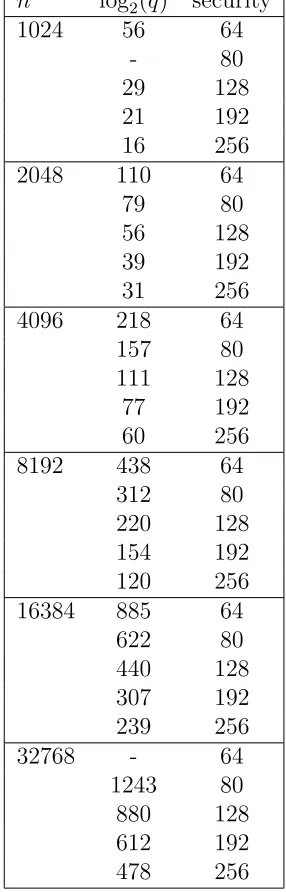
desired bit security parameter, their analysis describes the required upper bound on
coefficient size (in bits) of the coefficient modulus q for varying ring degrees n. We first begin focus on a security level of 128-bits for the interest of this study and then
approach other security levels as needed. Although the authors provide a collection of
results for the three separate secret distributions, it was found that the upper bound
on the coefficient modulus q rarely varied more than a couple bits for a given degree
n value. In the interest of this study, the ternary distribution will be the focus for the secret key distribution. The authors of YASHE provide a summary of similar
parameter that ensure 80-bit security [6]. We utilized the same estimator tool by
Albrecht et. al. [29] to obtain similar parameters that ensure 64-bit security. A
summary of the results of the varying security analysis of the study is represented
in Table 5.1. The upper bound of the coefficient size increases as the degree of the
ring increases, so if any reason asks for it, a larger coefficient can be used as long as
the ring degree is chosen appropriately. It should be noted, however, that the upper
CHAPTER 5. PARAMETER SELECTION
Table 5.1: R-LWE Based FHE Parameters for Varying Security Levels
n log2(q) security
1024 56 64
- 80
29 128
21 192
16 256
2048 110 64
79 80
56 128
39 192
31 256
4096 218 64
157 80
111 128
77 192
60 256
8192 438 64
312 80
220 128
154 192
120 256
16384 885 64
622 80
440 128
307 192
239 256
32768 - 64
1243 80
880 128
612 192
CHAPTER 5. PARAMETER SELECTION
5.2
Ciphertext Size
Ciphertext expansion, or the ratio between a plaintext and ciphertext space, is an
important concern with FHE schemes as it tends to be large. The ciphertexts are
represented with ring elements in the BGV, FV, and YASHE schemes. Therefore, it is
easy to see that the size of the ciphertext would be directly related to the ring degree
and coefficient sizes and no relation to the secret and error distributions chosen. For
each ring element involved in representing a ciphertext, the minimal amount of space
required to represent the ring, not accounting for overhead, would be the ring degree,
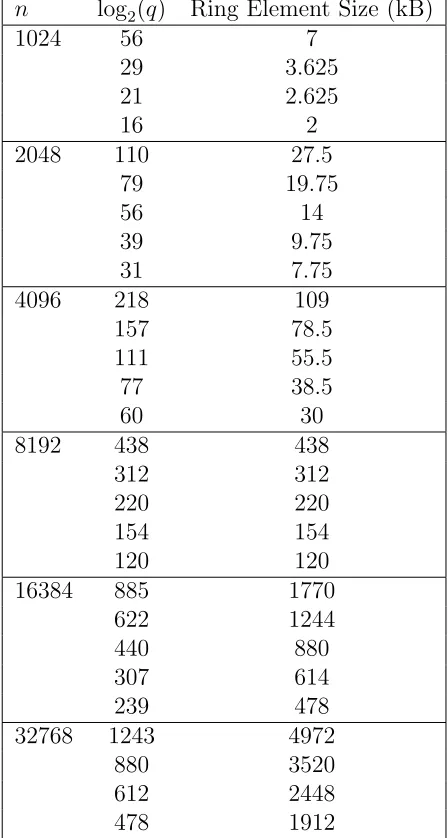
n, times the coefficient size, log2(q). Furthermore, for evaluation purposes, data is encrypted bit-wise, so the ciphertext expansion for anl-bit value would bel·n·log2(q). A table of ring element sizes for a single bit encryption, ignoring the the technique
of batching [32], with similar parameters listed in Table 5.1, is represented in Table
5.2. It is obvious to see that maintaining a small selection of parameters is important
for minimizing the ciphertext expansion because it is large even for relatively small
parameters.
5.3
Plaintext Space
There are two components of the plaintext space as it relates to the parameter n. For a plaintext modulus t, which is normally set to 2, the BGV, FV, and YASHE schemes define a plaintext space Rt as it relates to the ring R defined by ring degree parameter. Normally, a single bit defined by the modulus 2 would be encrypted at
a time as this allows a boolean circuit to be homomorphically evaluated with the
data. However, a user is not technically restricted to do such. A user can indeed
CHAPTER 5. PARAMETER SELECTION
Table 5.2: Ciphertext Ring Element Sizes of Varying Parameters
n log2(q) Ring Element Size (kB)
1024 56 7
29 3.625
21 2.625
16 2
2048 110 27.5
79 19.75
56 14
39 9.75
31 7.75
4096 218 109
157 78.5
111 55.5
77 38.5
60 30
8192 438 438
312 312
220 220
154 154
120 120
16384 885 1770
622 1244
440 880
307 614
239 478
32768 1243 4972
880 3520
612 2448
478 1912
The more important aspect of the influence of napplies to the batching technique optimization. Batching effectively encrypts multiple plaintext blocks into a single
encryption where follow up homomorphic circuits apply separately to each block
but only requires the computation of a single execution [32]. The technique works
through a crafty construction of changing the plaintext modulustto a prime and then performing homomorphic operations on t-mod circuits. Through use of the Chinese Remainder Theorem [15], evaluating a circuit over the plaintext can be thought of
CHAPTER 5. PARAMETER SELECTION
must be selected such that t is a prime and t = 1 mod 2n. A larger degree value
n increases the number of batch slots that the plaintext can support. It should be noted, however, that such a technique induces slightly more noise into ciphertext [20],
however, this is usually outweighed by increased throughput of the system.
5.4
Performance
The main concern with large parameters fornandqis their effect on the homomorphic operation execution time, primarily that of the multiplication operation. Since the
ciphertext elements are synonymous with a polynomial representation, the execution
time of performing such an operation will scale dramatically with n. The operation overhead of the naive approach to polynomial multiplication is at least quadratic
O(n2) [33]. However, there do exist algorithms such as the Karatsuba [34] and Fast Fourier Transform (FFT) [33] with reduced complexities ofO(n1.584) andO(nlog(n)), respectively; however, despite the reduction in computation cost, it can be seen how
large values of n can still have a significant impact on the expected complexity of these algorithms. It should also be noted that although these algorithms do not
normally account for coefficient sizes whereas large coefficients are speculated to have
similar adverse effects on performance. Considering that these operations will likely
be executed many times, it is vital that these parameters be kept as small as possible.
5.5
Circuit Depth
The trend for parameter selection is to keep the parameters n and q as small as possible. The main culprit that prevents such small parameters from being used is
the desired evaluation circuit depth. It should be noted that for YASHE, and for
other schemes in general, that a ciphertext decrypts incorrectly if the norm of the
CHAPTER 5. PARAMETER SELECTION
in the homomorphic operations, the circuit depth L that a scheme can evaluate is limited by how fast the noise will grow with respect toq. Intuitively, if the error that is embedded in a ciphertext is sampled from a small distribution, the noise should grow
slower than that of a ciphertext whose noise is sampled from a wide distribution. In
addition, given an error distribution, the depth of a circuit that YASHE can evaluate
increases with an increasing value for q which conflicts with the notions parameter selection for security and performance. The YASHE scheme defines that the bounds
for L must satisfy
2(1 +1)L−1δ2Lt2L−1BkeyL ((1 +1)tV +L(tBkey +t2 +`w,qwBerr))<(bqtc+ [q]t),
where 1 = 4(δtBkey)−1, δ = n, Berr is the bound of the error distribution, Bkey is the bound of the key distribution, lw,q is the number of w-bits in q, and V =
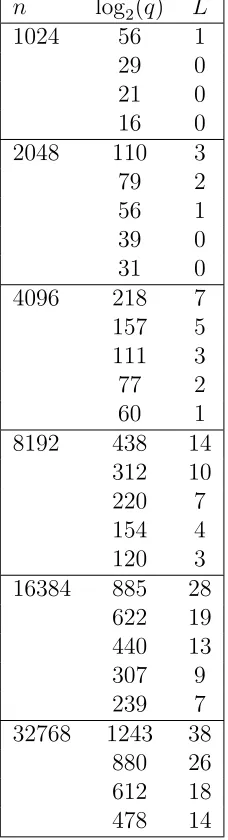
ntBkey(2Berr + [t]q/2) is the amount of inherent noise in a ciphertext [6]. Thus, theoretically, the expected guaranteed depth L that YASHE can evaluate can be calculated using the elaborate equation with assumptions based on the bounds of the
error growth in a ciphertext and others parameters. A python script was written to
determine the maximum value of the evaluation depth L that passes the inequality equation when w = 232, B
key = 1, Berr = 48, and t = 2. The guaranteed evaluation depth L that the YASHE scheme can evaluate with the parameters chosen for the proposed security levels is represented in Table 5.3. It should be noted, however,
that the evaluation depth is slightly deeper as the authors of YASHE note that their
bounds equation is very conservative with regards to the parameters [6] and thus
should be regarded more as a guide than a rule. It should also be noted by the values
presented that YASHE offers a relatively shallow multiplicative depth, especially for
CHAPTER 5. PARAMETER SELECTION
Table 5.3: Expected Multiplication Evaluation Depth of Varying Parameters
n log2(q) L
1024 56 1
29 0
21 0
16 0
2048 110 3
79 2
56 1
39 0
31 0
4096 218 7
157 5
111 3
77 2
60 1
8192 438 14
312 10
220 7
154 4
120 3
16384 885 28
622 19 440 13
307 9
239 7
32768 1243 38 880 26 612 18 478 14
5.6
Anticipated Issues
The primary concerns and focus of this thesis is on the performance and efficiency
of FHE schemes and how it will affect the practicality of applying such schemes to a
cross domain solution. These problems stem from the complexity of the mathematical
structures required to utilize the hardness problems that the FHE schemes rely on.
The main culprit for this is that the data needs to be encrypted bitwise in order to
CHAPTER 5. PARAMETER SELECTION
value needs to be encrypted under the FHE scheme and results in a ciphertext for
each individual bit. This also means that all operations on encrypted data must be
evaluated using a circuit that operates bitwise with a combination of gates from a
functionally complete set of logic gates. Generally, this set happens to include bitwise
addition, which is analogous to a logic XOR-gate, and bitwise multiplication, which
is analogous to a logic AND-gate, where each of these operations are performed under
the homomorphism property. This requirement complicates the evaluation of even
some of the most seemingly easy operations such as addition of two integers as such
circuits are complicated compared to the scale of the individual gate operations.
As the parameter selection investigation shows, there exists a complicated
tan-gling between the scheme parameters and their effects on security, performance, and
circuit evaluation correctness. With this and the consideration described prior, it can
be seen why fully homomorphic evaluation do result in large ciphertexts and poor
per-formance. Performance optimization desires that parameters q and n be kept small to ensure homomorphic operations operate on simple structures. Circuit evaluation
correctness requires that the ciphertext coefficient q parameter be large to ensure the scheme will allow enough homomorphic operations to ensure the utilized circuits
can be evaluated. And security of the homomorphic schemes place upper bounds
on parameter q for given parameter n which directly conflicts with
![Figure 3.1: Example of a 2-dimensional Lattice [1]](https://thumb-us.123doks.com/thumbv2/123dok_us/66817.6307/26.612.153.491.312.641/figure-example-of-a-dimensional-lattice.webp)

![Figure 6.1: SIMON Block Cipher Round Function Block Diagram [2]](https://thumb-us.123doks.com/thumbv2/123dok_us/66817.6307/56.612.210.438.385.525/figure-simon-block-cipher-round-function-block-diagram.webp)
