This is a repository copy of
Investigating collaborative information behaviours in complex
product development work
.
White Rose Research Online URL for this paper:
http://eprints.whiterose.ac.uk/152273/
Version: Accepted Version
Proceedings Paper:
Irnazarow, A, Allen, D and McKay, A orcid.org/0000-0002-8187-4759 (2019) Investigating
collaborative information behaviours in complex product development work. In: 2019
SIG-USE Symposium Paper Presentations. 2019 ASIS&T SIG-USE Symposium:
Re-envisioning the Impact and Engagement of Information Behavior Research, 19 Oct
2019, Melbourne, Australia. SIG-USE .
This is an author produced version of a paper presented at the 2019 ASIS&T SIG-USE
Symposium: Re-envisioning the Impact and Engagement of Information Behavior
Research.
[email protected] https://eprints.whiterose.ac.uk/
Reuse
Items deposited in White Rose Research Online are protected by copyright, with all rights reserved unless indicated otherwise. They may be downloaded and/or printed for private study, or other acts as permitted by national copyright laws. The publisher or other rights holders may allow further reproduction and re-use of the full text version. This is indicated by the licence information on the White Rose Research Online record for the item.
Takedown
If you consider content in White Rose Research Online to be in breach of UK law, please notify us by
Investigating collaborative information behaviours in
complex product development work
Aleksandra Irnazarow
University of Leeds
Leeds, UK
[email protected]
David Allen
University of Leeds
Leeds, UK
[email protected]
Alison McKay
University of Leeds
Leeds, UK
[email protected]
Abstract
Modern engineering projects are increasingly collaborative, often developed over a network of organisations and involving multiple actors and stakeholders. Actors in such projects are dependent on multiple contextual factors which include technologies, processes and procedures. The outcomes of such projects are dependent on how actors interact with these contextual factors. However, this dependency remains poorly understood and, as a result, it is difficult to assess the impact of collaborative aspects of information behaviours on engineering projects. In this paper I outline an activity theory (Engestrom, 1987; Allen et al., 2011) approach to assess the tensions and disruptions affecting collaboration. I apply this approach to the cases of product development in two high value engineering organisations. Through this approach, I reveal that engineers consistently adapt their collaborative information behaviours in response to tensions caused by technologies originally introduced to support their work. As a result, I show that this introduces significant practical
disruptions to complex projects. I propose that these disruptions can be generalised across a range of industries and should be considered as significant factors for professionals seeking to diagnose disruptions to information flows. Identifying these disruptions, through activity theory, provides a first step to more effective design and implementation of information systems, collaborative work processes and workflows.
Collaborative Information Behaviours in Engineering Product Development
Engineering product development is a complex and resource-intensive process in which products are increasingly developed in collaborative environments. Apart from involving multiple actors, these environments often span complex networks of teams and organisations (Vianello and Ahmed-Kristensen, 2012; McKay et al., 2016). As a result, there is increasing demand for new information systems to support interaction and decision making in high-value engineering projects, where challenges in making optimal decisions are considerable. Moreover, failing to overcome these challenges can have severe negative impacts on downstream processes, product quality, cost and delivery time (McKay et al., 2017; Van Oorschot, K.E. et al., 2013). This study sets out to diagnose factors that affect these negative impacts. Specifically, it seeks to directly determine the relation between collaborative information behaviours and the new technologies which are introduced to support engineering work.
information systems should, in-principle aid this collaboration. However, this presupposes that these systems intersect effectively with existing collaborative processes and practices. Furthermore, it remains an open question as to how collaborative aspects of information behaviour adapt to information systems in use (Hertzum and Reddy, 2015; Miettinen and Paavola, 2016).
Theoretical Lens of Activity Theory
This study proposes that the framework based on activity theory (Allen et al., 2011; Allen et al., 2013; Kaptelinin and Nardi, 2017) can be effectively applied to investigate collaborative information behaviours within engineering product development and help assess the impact of information systems on the collaborative practices of engineers.
Activity theory is based on the socio-cultural psychology of Lew Vygotsky (1978). Engestrom (1987; 2000; 2008) demonstrated its utility as a powerful framework capable of analysing and ultimately redesigning work practices within organizations. In this approach, an activity system consists of a
subject, individual or collective, who acts on an ‘object of activity’ through the use of material
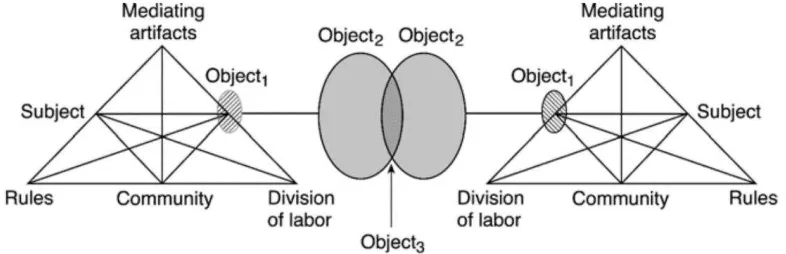
-conceptual tools. An ‘object of activity’ is defined as the focusof a subject’s attention, where the subject’s motivation is to achieve a desired outcome (Kaptelinin, 2005; Nicolini et al., 2012). The tools can be defined as existing procedures and processes, and material and digital artifacts which mediate action (Nardi, 1996; Miettinen and Virkkunen, 2005). Activity takes place in the context of a community or communities with shared rules of interaction and division of labour (Engeström, 1987; Kaptelinin et al., 1995). Engestrom (Engeström, 2001a) further developed activity theory through the introduction of multiple or interlinked activity systems, where several activity systems partially share
[image:3.595.99.492.433.560.2]an ‘object of activity’ (Fig 1.). The concept of interlinked systems makes activity theory particularly well-suited to the analysis of complex collaborative work, for example when diverse teams work on the design of interfacing components of a shared system.
Figure 1. Third generation activity theory with a joint object of activity (Object 3) being partially shared between two interacting activity systems (Engestrom 2001, p. 136).
There are several reasons why activity theory is a potent tool for investigating collaborative work. Firstly, it is versatile and allows for multiple contextual factors to be included in the analysis of collaboration (Wilson, 2006). It also links information behaviour to the ‘object of activity’ which is the common motive for all of the collaborators. Motives arise from information needs, which are dependent on contextual factors (Allen et al., 2011). These factors include project and task
characteristics, personal and professional backgrounds, as well as social, cultural and organizational settings. The resulting multi-layered context makes it possible to characterise collaborative aspects of information needs in detail.
Numerous material, digital and abstract tools mediate interactions between people and information. These tools and their associated work procedures shape information needs through prescribing what, how, when, where and who should be using the information. Employing this notion of mediation provides an insight into how specific procedures and collaborative artifacts shape the way actors interact with information.
Finally, activity systems are in a state of constant dynamic change and adaptation due to external and internal contradictions (Karanasios and Allen, 2014). Such contradictions are manifested as tensions, disruptions and dilemmas experienced by actors in the course of their work. Experiences of tensions and disruptions force actors to modify their behaviour to work around the contradictions or to resolve them. This, in turn, causes the transformation of activity systems. Activity theory can therefore be deployed to analyse change and adaptations in information behaviour over time (Allen et al., 2011).
The PhD research which informed this study applied activity theory to the study of collaborative information behaviours within product development in two high value engineering organisations. The present study focuses specifically on investigating contradictions related to the use of information systems and ICT technologies in two companies and links these contradictions to adaptations in collaborative information behaviours exhibited by engineers in the course of their work.
Study Design, Data Collection and Analysis
The empirical findings reported in this paper are based on data from two case studies conducted in two multinational engineering organisations. The organisational data is anonymised due to
confidentiality and data protection. Company A designs and builds electrical and communication systems for private and public sector customers. Company B is a multinational automotive parts manufacturer. Both companies are business to business (B2B) oriented and work closely with their customers throughout the product development process.
The development of products and services in Company A and Company B involves a diverse range of experts representing multiple engineering disciplines and domains. On average, an engineer involved in product development in companies A and B communicates with between 2-5 people every day, and also interacts weekly with a further 10-20 people through a mix of face-to-face and ICT mediated communication. In both companies, product development projects last on average from 2 to 5 years. Both companies use structured processes to manage their product development work, such as the stage gate product development process model (Cooper, 2008).
The goal of the data collection was to build a rich and complete description of collaborative information behaviours and decision making practices within product development projects in the case study organisations. Data was collected through one to one interviews with professionals engaged in product development in both companies. The interviews followed a semi-structured approach and lasted between 45-90 minutes. Nine interviews were conducted in Company A, and seventeen in Company B. The interviewed engineers represented diverse roles and functions within product development, ranging from very senior strategic roles such as the Head of R&D to more technical roles such as product designer. Participants were experienced in their particular industries with work experience ranging from 5 to 30+ years.
expressions of conflicts and disruptions in work situations (Engeström, 2008). Specifically, the data was searched for evidence of forces presenting participants with a dilemma; pulling him or her in opposite directions in terms of their decision making strategies (Ezzy, 2013; Karanasios and Allen, 2014).
The Two Vignettes
The findings are presented through a discussion of two examples or vignettes from the case studies. These vignettes illustrate two different scenarios whereby digital artifacts mediate interactions between engineers and sources of information. In Vignette 1 the mediating digital artifact is the new communications technology (ICT) which is increasingly used to facilitate collaboration in place of a face to face, in-person interactions (as was the case before spatially distributed work became a popular strategy in companies A and B). In Vignette 2, the digital artifact is the document
management system. Table 2 includes an overview of digital artifacts considered in this study, their role within product development activities in companies A and B, and the contradictions associated with their use.
Product development activities discussed in Vignettes The mediating technological artifact analysed in the Vignette
The contradiction within product development activity system associated with the artifact
Adaptation in collaborative information behaviour of engineers
Vignette 1 Actors
collaborating during design and development of a product
ICT communication technology - mediates communication between actors
ICT mediated
communication makes it harder to build shard understanding and mutual trust, important components of engineering work
Engineers prefer face, in-person communication. They use other strategies (e.g. sending a thank you note) to build trust and relationship in absence of in-person contact
Vignette 2 Actors
accessing information on previous designs and related project documentation
Digital document management and archiving system - mediates the access to design documentation
Document management system cumbersome to use, and knowledge
management is not top priority for engineers when faced with time pressure
[image:5.595.73.523.290.518.2]Reliance on informal communication channels - Engineers use colleagues as information sources, or to direct them to the right information.
Table 1. The two Vignettes, mediating artifacts analysed within product development activities in companies A and B, and the contradictions.
The first vignette focuses on the role of ICT as a tool mediating communication between engineers working on join product development project. Engineers across the two case study companies expressed strong preference for interacting with collaborators through in-person, face-to-face meetings. Existing research confirms a preference for face-to-face and unstructured interactions
among engineers, which enables them to receive contextual information, discover so called ‘unknown unknowns’ and problem solve more effectively (Hertzum and Pejtersen, 2000; Aurisicchio et al., 2010). In both case study companies, face-to-face contact is preferred, as it seen as facilitating networking, building trust and forging relationships, as well as allowing engineers to efficiently and quickly exchange knowledge and align their understandings.
through emails, phones and videoconferencing. In activity theory terms, this tension is an example of an underlying contradiction between the traditional activity and the new version of the activity.
Due to this contradiction, product development professionals are forced to come up with various strategies and workarounds to manage relationship building and alignment process without the everyday face-to-face contact. For example, one of the strategies used by an engineer in A was an
emphasis on showing gratitude and appreciation for collaborators whom he doesn’t see often by
sending a special token of appreciation, such as a ‘thank you’ note. Thus, professionals are forced to use creative strategies to manage tensions between the preferred communication practices, which are based on short and frequent, in-person communication channels, and new ways of working which demand managing long distance working relationships, often with unfamiliar collaborators.
The second vignette illustrates an example where the information system failed to meet the needs of the activity. Here, the mediating tool analysed was a document management system. The document management systems used in companies A and B are based on technological solutions such as digital databases and designated folder catalogues. Engineers from both companies voiced complaints that their existing document management systems were not at all intuitive to use and very labour intensive.
Document management issues experienced by engineers related to problems with the location of information, problems with duplicate files and version confusion. Typically, there were several filing systems in use, and a lack of transparency over how they are used. The practices around existing document management systems were highly individualised, with particular designers and teams using the systems in a specific way. As a result, the engineers often relied on their personal networks to
point them to the ‘right’ information and used informal means to override problems with the formal system. A common problem compounding such inefficiencies was de-prioritization of documentation in the course of daily product development work practices; “We are not very good at constant
documentation” admitted one engineer from B.
From the point of view of activity theory there is evidence of a contradiction between, on one hand, the existing document management tools which seem to be cumbersome to use, the rules of the knowledge management which demand knowledge (design reports etc.) to be captured and kept accessible, and on the other hand the motives of product development professionals. For product development professionals archiving or efficient knowledge management is not a priority as they are faced with many more pressing demands on their time. In effect, the engineers rely on personal knowledge, and on the knowledge of their colleagues, to find the information their need in the document management systems. This contradiction creates a paradoxical situation in which an apparent trade-off exists between sound knowledge management and efficient and timely product development. Such trade-off has been observed in research into knowledge management in product development (Van Oorschot, K. et al., 2018; Müller-Stewens and Möller, 2017).
Conclusion
This research explored how the digital artifacts used to mediate information flows in complex product development influence the collaborative information behaviours of actors. Focussing on two
multinational engineering organisations, two separate vignettes were examined: 1) the ICT communication technology which enables engineers to communicate remotely, and 2) document management systems used in companies A and B for archiving design and project documentation.
Using the theoretical lens of activity theory, the findings illustrated how the use of these tools within product development activity systems are subject to contradictions. Contradictions may stem from the fact that the technological tools are in conflict with the existing configurations of interests and
existing procedures, and relying on informal communication to compensate for deficiencies in existing tools.
Activity theory has shown, in this context, that a considerable aspects of collaborative information behaviour in product development is shaped by technological artifacts. Activity theory also aids the diagnosis of underlying factors leading to disruptions in information flows and analyses how people adapt their collaborative information behaviours in response to disruptions. Thus, activity theory can facilitate impactful research interventions into the design of information systems and communication practices in information intensive, complex work environments. As such, it can inform both the theory and the practice of collaboration and information management.The resulting knowledge gained can be exploited in industry, and contribute to general theories of collaborative information behaviour in organizations.
References
Allen, D., Brown, A., Karanasios, S. and Norman, A. 2013. How Should Technology-Mediated Organizational Change Be Explained? A Comparison of the Contributions of Critical Realism and Activity Theory. Mis Quarterly. 37(3), pp.835-854.
Allen, D., Karanasios, S. and Slavova, M. 2011. Working with activity theory: Context, technology, and information behavior. Journal of the Association for Information Science and Technology. 62(4), pp.776-788.
Aurisicchio, M., Bracewell, R. and Wallace, K. 2010. Understanding how the information requests of aerospace engineering designers influence information-seeking behaviour. Journal of Engineering Design. 21(6), pp.707-730.
Cooper, R.G. 2008. Perspective: The Stage Gate® idea to launch process—Update, what's new, and NexGen systems. Journal of product innovation management. 25(3), pp.213-232.
Engestrom, Y. 2000. Activity theory as a framework for analyzing and redesigning work. Ergonomics. 43(7), pp.960-974.
Engeström, Y. 1987. Learning by expanding. Helsinki: Orienta-Konsultit Oy.
Engeström, Y. 1995. Objects, contradictions and collaboration in medical cognition: an activity-theoretical perspective. Artificial intelligence in medicine. 7(5), pp.395-412.
Engeström, Y. 2001a. Expansive learning at work: Toward an activity theoretical reconceptualization. Journal of education and work. 14(1), pp.133-156.
Engeström, Y. 2001b. Making expansive decisions: An activity-theoretical study of practitioners building collaborative medical care for children. Decision making: Social and creative dimensions. Springer, pp.281-301.
Engeström, Y. 2008. From teams to knots: Activity-theoretical studies of collaboration and learning at work. Cambridge University Press.
Ezzy, D. 2013. Qualitative analysis. Routledge.
Freund, L. 2015. Contextualizing the information seeking behavior of software engineers. Journal of the Association for Information Science and Technology. 66(8), pp.1594-1605.
Groleau, C., Demers, C., Lalancette, M. and Barros, M. 2012. From hand drawings to computer visuals: Confronting situated and institutionalized practices in an architecture firm. Organization Science. 23(3), pp.651-671.
Hertzum, M. 2008. Collaborative information seeking: The combined activity of information seeking and collaborative grounding. Information Processing & Management. 44(2), pp.957-962.
Hertzum, M. and Pejtersen, A.M. 2000. The information-seeking practices of engineers: searching for documents as well as for people. Information Processing & Management. 36(5), pp.761-778.
Kaptelinin, V. 2005. The object of activity: Making sense of the sense-maker. Mind, culture, and activity. 12(1), pp.4-18.
Kaptelinin, V., Kuutti, K. and Bannon, L. 1995. Activity theory: Basic concepts and applications. Human-computer interaction. pp.189-201.
Kaptelinin, V. and Nardi, B. 2017. Activity Theory as a Framework for Human-Technology Interaction Research. Taylor & Francis.
Karanasios, S. 2018. Toward a unified view of technology and activity: the contribution of activity theory to information systems research. Information Technology & People. (just-accepted), pp.00-00.
Karanasios, S. and Allen, D. 2014. Mobile technology in mobile work: contradictions and congruencies in activity systems. European Journal of Information Systems. 23(5), pp.529-542.
Karunakaran, A., Reddy, M.C. and Spence, P.R. 2013. Toward a model of collaborative information behavior in organizations. Journal of the American Society for Information Science and Technology. 64(12), pp.2437-2451.
Leckie, G.J., Pettigrew, K.E. and Sylvain, C. 1996. Modeling the information seeking of professionals: a general model derived from research on engineers, health care professionals, and lawyers. The Library Quarterly. pp.161-193.
McKay, A., Sammonds, G., Ahmed-Kristensn, S., Irnazarow, A. and Robinson, M. 2017. Using Embedded Design Structures To Unravel a Complex Decision In a Pproduct Development System. In: ICED17: 21st Internationl Conference on Engineering Design, Vancouver, Canada.
McKay, A., Stiny, G.N. and de Pennington, A. 2016. Principles for the definition of design structures. International Journal of Computer Integrated Manufacturing. 29(3), pp.237-250.
Miettinen, R. and Paavola, S. 2016. Reconceptualizing object construction: the dynamics of Building Information Modelling in construction design. Information Systems Journal.
Miettinen, R. and Virkkunen, J. 2005. Epistemic objects, artefacts and organizational change. Organization. 12(3), pp.437-456.
Müller-Stewens, B. and Möller, K.J.J.o.M.C. 2017. Performance in new product development: a comprehensive framework, current trends, and research directions. 28(2), pp.157-201.
Nardi, B.A. 1996. Context and consciousness: activity theory and human-computer interaction. mit Press.
Nicolini, D., Mengis, J. and Swan, J. 2012. Understanding the role of objects in cross-disciplinary collaboration. Organization Science. 23(3), pp.612-629.
Paul, S.A. and Reddy, M.C. 2010. Understanding together: sensemaking in collaborative information seeking. In: Proceedings of the 2010 ACM conference on Computer supported cooperative work: ACM, pp.321-330.
Reddy, M.C. and Jansen, B.J. 2008. A model for understanding collaborative information behavior in context: A study of two healthcare teams. Information Processing & Management. 44(1), pp.256-273.
Van Oorschot, K., Eling, K. and Langerak, F. 2018. Measuring the knowns to manage the unknown: How to choose the gate timing strategy in NPD projects. Journal of Product Innovation Management. 35(2), pp.164-183.
Van Oorschot, K.E., Akkermans, H., Sengupta, K. and Van Wassenhove, L.N. 2013. Anatomy of a decision trap in complex new product development projects. Academy of Management Journal. 56(1), pp.285-307.
Vianello, G. and Ahmed-Kristensen, S. 2012. A comparative study of changes across the lifecycle of complex products in a variant and a customised industry. Journal of Engineering design. 23(2), pp.99-117.
Vygotsky, L.S. 1978. Mind in society. Cambridge, MA: Harvard University Press.