
This is a repository copy of
Semantic Mutation Testing for Multi-Agent Systems
.
White Rose Research Online URL for this paper:
http://eprints.whiterose.ac.uk/103115/
Version: Accepted Version
Proceedings Paper:
Huang, Zhan and Alexander, Rob orcid.org/0000-0003-3818-0310 (2015) Semantic
Mutation Testing for Multi-Agent Systems. In: The International Workshop on Engineering
Multi-Agent Systems (EMAS). .
[email protected] https://eprints.whiterose.ac.uk/
Reuse
["licenses_typename_unspecified" not defined]
Takedown
If you consider content in White Rose Research Online to be in breach of UK law, please notify us by
Semantic Mutation Testing for Multi-Agent Systems
Zhan Huang and Rob Alexander
Department of Computer Science, University of York, York, United Kingdom {zhan.huang,robert.alexander}@cs.york.ac.uk
Abstract. This paper introduces semantic mutation testing (SMT) into multi-agent systems. SMT is a test assessment technique that makes changes to the in-terpretation of a program and then examines whether a given test set has the ability to detect each change to the original interpretation. These changes repre-sent possible misunderstandings of how the program is interpreted. SMT is also a technique for assessing the robustness of a program to semantic changes. This paper applies SMT to three rule-based agent programming languages, namely Jason, GOAL and 2APL, provides several contexts in which SMT for these languages is useful, and proposes three sets of semantic mutation operators (i.e., rules to make semantic changes) for these languages respectively, and a set of semantic mutation operator classes for rule-based agent languages. This paper then shows, through preliminary evaluation of our semantic mutation operators for Jason, that SMT has some potential to assess tests and program robustness.
Keywords: Semantic Mutation Testing, Agent Programming Languages, Cog-nitive Agents
1
Introduction
Testing multi-agent systems (MASs) is difficult because MASs may have some prop-erties such as autonomy and non-determinism, and they may be based on models such as BDI which are quite different to ordinary imperative programming. There are many test techniques for MASs, most of which attempt to address these difficulties by adapting existing test techniques to the properties and models of MASs [9, 13]. For instance, SUnit is a unit-testing framework for MASs that extends JUnit [17].
Some test techniques for MASs introduce traditional mutation testing, which is a powerful technique for assessing the adequacy of test sets. In a nutshell, traditional mutation testing makes small changes to a program and then examines whether a given test set has the ability to detect each change to the original program. These changes represent potential small slips. Work on traditional mutation testing for MASs includes [1, 10, 14Ð16].
possible misunderstandings of how the program is interpreted. Therefore, SMT as-sesses a test set by examining whether it has the ability to detect each change to the original interpretation of the program.
SMT can be used not only to assess tests, but also to assess the robustness of a pro-gram to semantic changes: Given a propro-gram, if a change to its interpretation cannot be detected by a trusted test set, the program is considered to be robust to this change.
This paper makes several contributions. First, it applies SMT to three rule-based agent programming languages, namely Jason, GOAL and 2APL. Second, it provides several contexts (scenarios) in which SMT for these languages is useful. Third, it proposes three sets of semantic mutation operators (i.e., rules to make semantic changes) for these languages respectively, and a broader set of semantic mutation operator classes (that serve as a guide to derivation of semantic mutation operators) for rule-based agent languages. Finally, it presents a preliminary evaluation of the semantic mutation operators for Jason, which shows some potential of SMT to assess tests and program robustness.
The remainder of this paper is structured as follows: Section 2 describes two types of mutation testing Ð traditional mutation testing and semantic mutation testing. Sec-tion 3 describes SMT for Jason, GOAL and 2APL by showing several contexts in which it is useful and the source of semantic changes required to apply SMT in each context. Section 4 proposes sets of semantic mutation operators for these languages and a set of semantic mutation operator classes for rule-based agent languages. Sec-tion 5 evaluates the Jason semantic mutaSec-tion operators. SecSec-tion 6 summarizes our work and suggests where this work could go in the future.
2
Mutation Testing
2.1 Traditional Mutation Testing
Traditional mutation testing is a test assessment technique that generates modified versions of a program and then examines whether a given test set has the ability to detect the modifications to the original program. Each modified program is called a
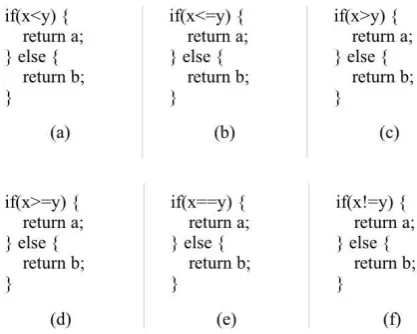
mutant, which represents a realistic small fault in the program. Mutant generation is guided by a set of rules called mutation operators. For instance, Figure 1(a) shows a piece of a program and Figure 1(b) Ð 1(f) show five mutants generated as the result of the application of a single mutation operator called Relational Operator Replacement, which replaces one of the relational operators (<, ≤, >, ≥, =, ≠) with another operator.
behaviour as the original program (i.e., return a). Therefore, the mutant kill rate is 3/5. According to this result we can enhance the test set by adding a test in which the input is x=4, y=4 and another test in which the input is x=4, y=3 in order to kill these two live mutants respectively and get a higher mutant kill rate (the highest kill rate is 1, as this example shows).
Fig. 1. An example of traditional mutation testing
Many studies provide evidence that traditional mutation testing is a powerful test assessment technique, so it is often used to assess other test techniques [2, 12]. How-ever, the mutation operators used to guide mutant generation may lead to a large number of mutants because a single mutation operator has to be applied to each rele-vant point in the program and a single mutant only contains a modification to a single relevant point (as shown in Figure 1). This makes comparing the behaviour of the original program and that of each mutant on each test is computationally expensive.
Another problem is that traditional mutation testing unpredictably produces equivalent mutants Ð alternatives to the original program that are not representative of faulty versions, in that their behaviour is no different from the original in any way that matters for the correctness of the program. Thus, no reasonable test set can detect the modifications they contain. Equivalent mutants must therefore be excluded from test assessment (i.e., the calculation of the mutant kill rate). The exclusion of equivalent mutants requires much extra manual work although this process may be partially au-tomated.
2.2 Semantic Mutation Testing
while SMT generates different interpretations of the same program namely L (L1, L2, É, Lk). For SMT, L1, L2, É, Lk represent semantic mutants, the generation of which is guided by a set of semantic mutation operators. For instance, Figure 2 shows a piece of a program, a semantic mutant (i.e., a different interpretation of this pro-gram) is generated by the application of a single semantic mutation operator that causes the if keyword to be used for mutual exclusion (i.e., when an if is directly fol-lowed by another if, the second if statement is interpreted the same as an else-if state-ment).
Fig. 2. An example of semantic mutation testing
SMT assesses a test set in a similar way as traditional mutation testing Ð comparing the system behaviour each semantic mutant results in with that the original interpreta-tion results in so as to detect the killed mutants. In the example shown in Figure 2, a test set consisting of a single test in which the input is x=2 cannot kill the semantic mutant because on that test the mutant results in the same behavior as the original interpretation (i.e., only do A). Therefore, the mutant kill rate is 0/1 = 0. We can en-hance this test set by adding another test in which the input is x=4 in order to kill the live mutant.
SMT is a useful test assessment technique because it can simulate a different class of faults than traditional mutation testing Ð possible misunderstandings of how the program is interpreted rather than small slips. Although semantic changes can be sim-ulated by changes to the program, SMT often requires higher order (traditional) muta-tion1 to simulate a semantic change, and empirical studies (e.g., [11]) show that some higher order mutants are harder to kill than first-order mutants. In addition, [5] show that SMT has potential to capture some faults that cannot be captured by traditional mutation testing.
SMT can be used not only to assess tests, but also to assess the robustness of a pro-gram to semantic changes. Given a semantic mutant, if it cannot be killed by a trusted
1
test set2, it will be considered as ÒequivalentÓ3, which indicates that the program is robust to the corresponding semantic change, otherwise the program may need to be improved to resist this change. In the example shown in Figure 2, if the program is required to be robust to the semantic change, it can be modified to ensure that only one branch is executed in any case.
SMT has another difference to traditional mutation testing: it generates far fewer mutants because a single semantic mutation operator only leads to a single semantic mutant4, namely a different interpretation of the same program (as shown in Figure 2), while a single traditional mutation operator may lead to many mutants each of which contains a modification to a single relevant point in the program (as shown in Figure 1). This makes SMT less computationally costly.
We know that SMT makes semantic changes for assessing tests or program robust-ness. For a particular language, which semantic changes should be made by SMT are context-dependent. For instance, to assess tests for a program written by a novice programmer, semantic changes to be made can be derived from common novicesÕ misunderstandings. To assess the portability of a program between different versions of the interpreter, semantic changes to be made can be derived from the differences between these versions.
3
Semantic Mutation Testing for Jason, GOAL and 2APL
We investigate semantic mutation testing for MASs by first applying it to three rule-based programming languages for cognitive agents, namely Jason, GOAL and 2APL. These languages have similar semantics Ð an agent deliberates in a cyclic process in which it selects and executes rules according to and affecting its mental states. They also have similar constructs to implement such agents such as beliefs, goals and rules. The details of these languages can be found in [4, 6, 8] and are not provided here.
From Section 2 we know that for a particular language, the semantic changes that can most usefully be made by SMT is context-dependent. In the remainder of this section we provide several contexts in which SMT for the chosen agent languages is useful Ð migration between languages, evolution of languages, common misunder-standings, and ambiguity of informal semantics. We also show the source of semantic changes required to apply SMT in each context.
2
A trusted test set is the one that is considered as Ògood enoughÓ for the requirement. It doesnÕt need to be the full test set that is usually impractical; instead it can choose not to cover some aspects or to tolerate some errors.
3
Here the term ÒequivalentÓ is different to the one used in the context of test assessment, in which a mutant is equivalent only if there exist no tests that can kill this mutant. In the con-text of robustness assessment, a mutant is equivalent if only the trusted test set cannot kill it.
4
3.1 Migration between Languages
When a programmer migrates a program from one language to another, or simply starts to write a new program in a new (to him or her) language, he or she may have misunderstandings that come from the semantic differences between the new lan-guage and the old one(s) he or she ever used. Therefore, in order for SMT to simulate such misunderstandings, we should first find out their source, namely the semantic differences, by comparison between Jason, GOAL and 2APL. Since these languages each have large semantic size and distinctive features, we use the following strategies to guide the derivation of the semantic differences.
¥ Dividing the semantics of each of these languages into five aspects, as shown in Table 1. We do this because first of all, it provides a guide to derivation of seman-tic differences. Second, we focus on examining four aspects of the semanseman-tics, namely deliberation step order, rule selection, rule execution, and mental state que-ry and update, which are important and common to rule-based agent languages. We also roughly examine other aspects of the semantics in order for completeness. Fi-nally, it is reasonable that common aspects of the semantics are more likely to cause misunderstandings than distinctive aspects in the context of migration, be-cause distinctive aspects are usually supported by distinctive constructs that a pro-grammer would normally take time to learn.
¥ Focusing on semantic differences between similar constructs. As [5] suggests, such differences easily cause misunderstandings because when migrating a program a programmer may just copy the same or similar constructs without careful examina-tion of their semantics given by the new language.
¥ Examining both formal and informal semantics of these languages. We start with examining the formal semantics because they can be directly compared. We also verify those that are informally defined through programming and examination of the interpreter source code.
Table 1. The aspects of the semantics of Jason, GOAL and 2APL (those marked with an aster-isk are the ones we focus on)
ID Aspect Description
1 Deliberation step order*
Each deliberation cycle consists of a sequence of steps, e.g., rule selection rule execution is a two-step sub-sequence.
2 Rule selection* Rule selection is an important deliberation step in which one or several rules are chosen to be new execution candidates.
3 Rule execution* Rule execution is an important deliberation step in which one or several execution candidates are executed.
4 Mental state query and update*
Mental states (i.e., beliefs and goals) can be queried in some deliber-ation steps such as rule selection and updated by execution of rules.
5 Other Other aspects of the semantics not listed above.
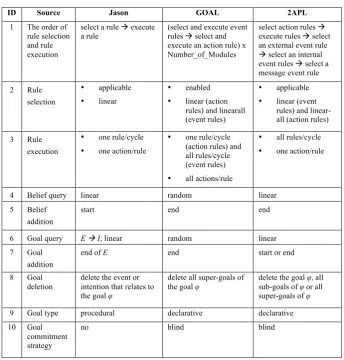
We present in Table 2 the semantic differences we found between Jason, GOAL and 2APL. These form the source of semantic changes required to apply SMT in the context of migration between these languages.
Difference 1 comes from the order of two important deliberation steps, namely rule selection and rule execution. A Jason agent first selects a rule to be a new execution candidate and then executes an execution candidate. A GOAL agent processes its
modules one by one, in each module it first selects and executes event rules and then selects and executes an action rule (both event and action rules are defined in the module being processed). A 2APL agent first selects action rules to be new execution candidates, and then executes all execution candidates, next selects an external event rule, an internal event rule and a message event rule to be new execution candidates.
Difference 2 comes from the rule selection deliberation step. Jason, GOAL and 2APL differ in two aspects of this step, namely the rule selection condition and the default rule selection order. For the rule selection condition, a Jason or 2APL rule can be selected to be a new execution candidate if both its trigger condition and guard condition get satisfied (ÒapplicableÓ), while a GOAL rule can be selected if it is appli-cable and the pre-condition of its first action gets satisfied (ÒenabledÓ). For the default rule selection order, Jason rules are selected in linear order (i.e., rules are examined in the order they appear in the agent description, and the first applicable rule is selected), GOAL action rules are selected in linear order while GOAL event rules are selected in ÒlinearallÓ order (i.e., rules are examined in the order they appear in the agent de-scription, and all enabled rules are selected), 2APL action rules are selected in Òlin-earallÓ order while 2APL event rules of each type (external, internal, message) are selected in linear order.
Difference 3 comes from the rule execution deliberation step. In this step a Jason agent executes a single action in a single execution candidate, a GOAL agent executes all actions in each selected event rule and each selected action rule5, a 2APL agent executes a single action in each execution candidate.
5
Table 2. Semantic differences between Jason, GOAL and 2APL
ID Source Jason GOAL 2APL
1 The order of rule selection and rule execution
select a rule execute a rule
(select and execute event rules select and execute an action rule) x Number_of_Modules
select action rules execute rules select an external event rule select an internal event rules select a message event rule
2 Rule selection
¥ applicable
¥ linear
¥ enabled
¥ linear (action rules) and linearall (event rules)
¥ applicable
¥ linear (event rules) and linear-all (action rules)
3 Rule execution
¥ one rule/cycle
¥ one action/rule
¥ one rule/cycle (action rules) and all rules/cycle (event rules)
¥ all actions/rule
¥ all rules/cycle
¥ one action/rule
4 Belief query linear random linear
5 Belief addition
start end end
6 Goal query E I; linear random linear
7 Goal addition
end of E end start or end
8 Goal deletion
delete the event or intention that relates to the goal φ
delete all super-goals of the goal φ
delete the goal φ, all sub-goals of φ or all super-goals of φ
9 Goal type procedural declarative declarative
10 Goal commitment strategy
no blind blind
Difference 4 comes from the belief query. In a Jason or 2APL agent, beliefs are queried in linear order (i.e., beliefs are examined in the order they are stored in the belief base, and the first matched belief is returned). In a GOAL agent, beliefs are queried in random order (i.e., beliefs are randomly accessed, and the first matched belief is returned).
Difference 5 comes from the belief addition. In a Jason agent, a new belief is added to the start of the belief base. In a GOAL or 2APL agent a new belief is added to the end of the belief base.
each of which it follows linear query order. In a GOAL agent, goals are queried in random order. In a 2APL agent, goals are queried in linear order.
Difference 7 comes from the goal addition. In a Jason or GOAL agent, a new goal is added to the end of the event or goal base. In a 2APL agent, a new goal is added to the start or the end of the goal base according to the relevant agent description (i.e.,
adopta or adoptz).
Difference 8 comes from the goal deletion. Given a goal φ to be deleted, a Jason agent deletes the event or intention that relates to φ, a GOAL agent deletes all goals that have φ as a logical sub-goal, a 2APL agent deletes φ, all goals that are a logical sub-goal of φ, or all goals that have φ as a logical sub-goal according to the relevant agent description (i.e., dropgoal, dropsubgoal or dropsupergoal).
Difference 9 comes from the goal type. Jason adopts procedural goals Ð goals that only serve as triggers of procedures although it supports declarative goal patterns. GOAL and 2APL adopt declarative goals Ð goals that also represent states of affairs to achieve.
Difference 10 comes from the goal commitment strategy. Jason doesnÕt adopt any goal commitment strategy (i.e., a goal is just dropped once its associated intention is removed as the result of completion or failure) although it supports various commit-ment strategy patterns. GOAL and 2APL adopt blind goal commitcommit-ment strategy, which requires a goal is pursued until it is achieved or declaratively dropped.
3.2 Evolution of Languages
[image:10.595.125.474.566.634.2]When a programmer moves a program from a language to its successor, he or she may have misunderstandings that come from the semantic evolution. Another scenar-io is that a programmer may want to examine whether a program written in a lan-guage is compatible with a newer version of this lanlan-guage. To derive semantic chang-es required to apply SMT in thchang-ese scenarios, we should first find out their source, namely the semantic differences between these languages/versions. We take 2APL and 3APL [7] as an example. 2APL is a successor of 3APL that modifies and extends 3APL. Table 3 shows some semantic differences between them. We explain these differences as follows.
Table 3. Semantics differences between 2APL and 3APL
ID Source 2APL 3APL
1 PR-rules plan repair plan revision
2 The order of rule selection
and rule execution see Table 2
select an action rule select a PR-rule execute a rule
3 Action rule selection linearall linear
4 Rule execution all rules/cycle one rule/cycle
Difference 2 comes from the order of rule selection and rule execution deliberation steps. The order adopted by a 2APL agent has been described in Sub-section 3.1. In contrast, a 3APL agent selects an action rule then a PR-rule to be new execution can-didates then executes an execution candidate.
Difference 3 comes from the action rule selection order. As described in Sub-section 3.1, 2APL action rules are selected in ÒlinearallÓ order. In contrast, 3APL action rules are selected in linear order.
Difference 4 comes from the rule execution deliberation step. As described in Sub-section 3.1, a 2APL agent executes all execution candidates in a deliberation cycle. In contrast, a 3APL agent executes a single execution candidate.
3.3 Common Misunderstandings
[image:11.595.127.469.412.479.2]A programmer may have misunderstandings that are common to a particular group of people he or she belongs to. Such misunderstandings can be identified by analysis of these peopleÕs common mistakes or faults. We take GOAL as an example: Table 4 shows some possible misunderstandings of the GOALÕs semantics that are derived from some common faults made by GOAL novice programmers [18]. We explain these misunderstandings as follows.
Table 4. Possible novice programmers' misunderstandings of GOAL
ID Fault Possible Misunderstanding
1 Wrong rule order By default rules are selected in another available order.
2 A single rule including two
user-defined actions A rule can have more than one user-defined action.
3 Using Òif thenÓ instead of Òforall doÓ
Existential quantification can be used for universal quantifica-tion.
Possible misunderstanding 1 comes from the fault of the wrong rule order. If a programmer makes this fault in the GOAL agent description, he or she may have the misunderstanding that rules are selected in another available order6 by default, e.g., action rules are selected in ÒlinearallÓ order rather than linear order.
Possible misunderstanding 2 comes from the fault of a single rule including two user-defined actions. If a programmer makes this fault, he or she may have the mis-understanding that this is allowed like other agent languages.
Possible misunderstanding 3 comes from the fault of using Òif thenÓ instead of Òforall doÓ. If a programmer makes this fault, he or she may have the misunderstand-ing that existential quantification can be used for universal quantification.
6
3.4 Ambiguity of Informal Semantics
[image:12.595.128.470.237.291.2]A programmer may have misunderstandings of the semantics that are not precisely or formally defined. For instance, [3] gives two examples of such misunderstandings of Jason as shown in Table 5. We explain these misunderstandings as follows.
Table 5. Possible misunderstandings due to JasonÕs informal semantics
ID Source Possible Misunderstanding
1 Goal deletion event Òwhen an intention failsÓ Òwhen an intention is re-movedÓ
2 Test goal addition event Òwhen a test goal action failsÓ Òwhen a test goal action is executedÓ
Possible misunderstanding 1 comes from the goal deletion event (-!e or -?e). A goal deletion event is generated when an intention with the corresponding goal achievement event (+!e or +?e) fails. A programmer may have the misunderstanding that this event is generated when this intention is removed as the result of completion or failure.
Possible misunderstanding 2 comes from the test goal addition event (+?e). A test goal addition event is generated when the corresponding test goal action (?e) fails. A programmer may have the misunderstanding that this event is generated when this action is executed, which is similar to the achievement goal addition event (+!e).
3.5 Discussion
SMT for Jason, GOAL and 2APL is of particular interest in the contexts discussed above considering:
¥ These languages are similar. As mentioned above they have similar semantics and constructs. Subtle semantic differences between similar constructs easily cause misunderstandings.
¥ These languages have elements that are allowed to customize. By mutating the semantics to represent different customizations it is possible to explore the robust-ness of a program.
4
Semantic Mutation Operators for Jason, GOAL and 2APL
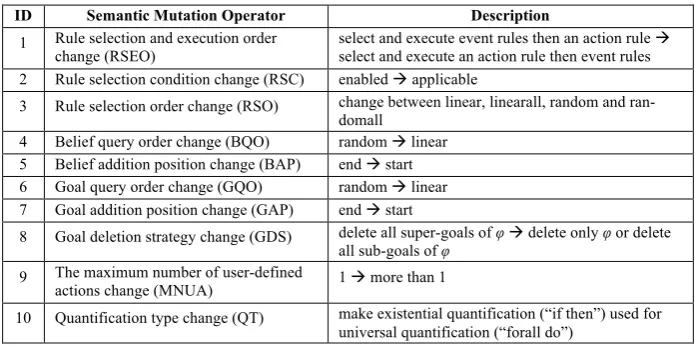
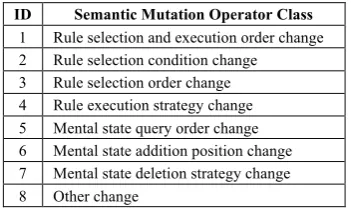
According to our derived sources of semantic changes required to apply SMT in dif-ferent contexts, we derive three respective sets of semantic mutation operators for Jason, GOAL and 2APL as shown in Table 6 Ð 8. Due to space limitations we donÕt explain each semantic mutation operator in details.
classes provide a guide to derivation of semantic mutation operators for these lan-guages.
Table 6. Semantic mutation operators for Jason
ID Semantic Mutation Operator Description
1 Rule selection order change (RSO) linear linearall
2 Rule execution strategy change (RES) one rule/cycle all rules/cycle
3 Rule execution strategy change 2 (RES2) interleaved execution of rules non-interleaved execution of rules
4 Belief query order change (BQO) linear random
5 Belief addition position change (BAP) start end
6 Goal query order change (GQO) linear random
7 Goal addition position change (GAP) end start
8 Goal deletion event semantics change
(GDES) Òwhen a plan failsÓ Òwhen a plan is removedÓ
9 Test goal achievement event semantics change (TGAES)
Òwhen a test goal action failsÓ Òwhen a test goal action is executedÓ
Table 7. Semantic mutation operators for GOAL
ID Semantic Mutation Operator Description
1 Rule selection and execution order change (RSEO)
select and execute event rules then an action rule select and execute an action rule then event rules 2 Rule selection condition change (RSC) enabled applicable
3 Rule selection order change (RSO) change between linear, linearall, random and ran-domall
4 Belief query order change (BQO) random linear 5 Belief addition position change (BAP) end start
6 Goal query order change (GQO) random linear
7 Goal addition position change (GAP) end start
8 Goal deletion strategy change (GDS) delete all super-goals of φ delete only φ or delete all sub-goals of φ
9 The maximum number of user-defined
actions change (MNUA) 1 more than 1
[image:13.595.124.472.383.556.2]Table 8. Semantic mutation operators for 2APL
ID Semantic Mutation Operator Description
1 Rule selection and execution order change (RSEO)
change the original order Òselect action rules execute rules select event rulesÓ to Òselect action rules select event rules execute rulesÓ or Òse-lect event rules seÒse-lect action rules execute rulesÓ
2 Rule selection condition change (RSC) applicable enabled
3 Rule selection order change (RSO) change between linear and linearall 4 Rule execution strategy change (RES) all rules/cycle one rule/cycle 5 Belief query order change (BQO) linear random
6 Belief addition position change (BAP) end start
7 Goal query order change (GQO) linear random
8 PR-rule semantics change (PRRS) plan repair plan revision
Table 9. Semantic mutation operator classes for rule-based agent languages
ID Semantic Mutation Operator Class
1 Rule selection and execution order change 2 Rule selection condition change 3 Rule selection order change 4 Rule execution strategy change 5 Mental state query order change 6 Mental state addition position change 7 Mental state deletion strategy change 8 Other change
5
Evaluation of Semantic Mutation Operators for Jason
We have implemented our derived semantic mutation operators for Jason (as shown in Table 6) by modifying the source code of the Jason interpreter. Here we use two Jason projects in a preliminary evaluation of these operators, in order to assess the potential of SMT to assess tests and program robustness.
The Jason projects we chose are two of the examples released with the Jason inter-preter. The first project is a simple one called Domestic Robot (DR), in which a do-mestic robot gets beer from the fridge and then serves its owner the beer until the owner reaches a certain limit of drinking. The robot will ask a supermarket to deliver beer when the fridge is empty. The second project is a relatively complex one called
Gold Miners (the 2nd version, ÒGM IIÓ), in which two teams of gold-mining agents compete against each other to retrieve as many pieces of gold scatters as possible in a grid-like territory, finding suitable paths to then take the retrieved gold to a depot.
[image:14.595.211.387.341.447.2]We run each Jason project under the original interpreter and each modified version of the interpreter (that implements a semantic mutation operator) against the corre-sponding test set, after which we collect and analyze the SMT results. We present the final results in Table 10.
Table 10. Results of semantic mutation testing
Semantic Mutation Operator Resultant Mutant of DR Resultant Mutant of GM II
RSO NE K
RES E E
RES2 NE K
BQO E E
BAP E NE
GQO N/A E
GAP E E
GDES K K
TGAES K N/A
As is normal for SMT, a semantic mutation operator here leads to a single semantic mutant if the interpretation of the Jason project involves the relevant semantics; oth-erwise the operator is not applicable to the Jason project (N/A). The resultant mutants are either equivalent to the original interpretation (E), non-equivalent and killed by the test set (K), or non-equivalent and not killed by the test set (NE).
Test Assessment
The non-equivalent and unkilled mutants indicate the weaknesses in the test sets. In order to kill such a mutant that the RSO operator leads to, we need a test that can capture the differences in the resultant agent behaviour between selecting all applica-ble plans and selecting only the first applicaapplica-ble plan. These plans must have the same triggering event, the contexts that are not mutually exclusive and the ability to affect the agent behaviour. In the DR project, the only two such plans are the plan to get beer when the fridge is empty (p1) and the plan to get beer when the owner reaches the limit of drinking (p2). Therefore, we can design a test on which the limit of drink-ing is just reached when there is no beer in the fridge by e.g., modifydrink-ing the initial amount of beer in the fridge. This test will cause p2 to be executed twice under the mutated interpreter so that the owner will be advised about drinking twice.
fridge (a few seconds) than to move to the fridge (less than one second) on the origi-nal test set, the agent has a much bigger chance to notify the time at the fridge than on the move although under the original interpreter. Therefore, we can increase the chance to notify the time on the move by e.g., largely increasing the map size (so that the robot will take longer to move), to make it more likely we will kill the mutant.
In order to kill the non-equivalent mutant that the BAP operator leads to, we need a test that can capture the differences in the resultant agent behaviour between different orderings of beliefs. In the GM II project, there is only one description that causes the order of beliefs to matter Ð the actions to announce to other teammates all gold depos-its that the gold miner agent perceived and that have not been handled or announced yet. Under the original interpreter, the gold miner agent will first announce the gold it perceived most recently; under the mutated interpreter, it will first announce the gold it perceived initially. The different orders of gold announcements may cause other teammates to bid for and be allocated different gold. Therefore, we can add a test that can detect this difference. It is worth noting that this difference to the original behav-iour may not be a violation of the correctness requirements; instead it may be just a tiny variation that reflects the non-determinism of multi-agent systems, in which case the mutant is considered as equivalent.
Robustness Assessment
Where our operators produced equivalent mutants, it indicates that the Jason pro-ject is robust to the corresponding semantic changes. From these equivalent mutants we can come up with some ideas of how to resist these changes. For instance, in order to resist the semantic changes caused by the BQO and GQO operators while not af-fecting the agent behaviour under the original interpreter, the agent description has to be improved so that there can be only one matched belief or goal at most for each query. To resist the semantic change caused by the GAP operator, the agent descrip-tion can be improved so that the agent behaviour is independent of the order of the goal type events and intentions.
6
Conclusions
Semantic mutation testing (SMT) is a useful technique for assessing tests and the robustness of a program to semantic changes. In this paper we applied SMT to three agent languages, namely Jason, GOAL and 2APL. We showed that SMT for these languages is useful in several contexts Ð migration between languages, evolution of languages, common misunderstandings, and ambiguity of informal semantics. We derived sets of semantic mutation operators for these languages, and a broader set of semantic mutation operator classes that are applicable to rule-based agent languages. Finally, we used two Jason projects in a preliminary evaluation of the semantic muta-tion operators for Jason. The results suggest that SMT can indicate some weaknesses in test sets and programs.
Our future work will focus on further evaluation of the semantic mutation opera-tors for Jason. To further evaluate the ability of these operaopera-tors to assess tests, we will examine their representativeness in comparison to realistic misunderstandings and their power by looking for more hard-to-kill mutants (as we have done in this paper), as suggested by [8]. To further evaluate the ability of these operators to assess pro-gram robustness, we will apply them to more Jason projects and provide specific rules to change the agent description in order to improve robustness.
References
1. Adra, S.F., McMinn, P.: Mutation operators for agent-based models. In: Proceedings of 5th International Workshop on Mutation Analysis. IEEE Computer Society (2010)
2. Ammann, P., Offutt, J.: Introduction to Software Testing. Cambridge University Press (2008)
3. Bordini, R.H., HŸbner, J.F.: Semantics for the Jason variant of AgentSpeak (plan failure and some internal actions). In: Proceedings of ECAIÕ10, pp. 635Ð640 (2010)
4. Bordini, R.H., HŸbner, J.F., Wooldridge, M.: Programming Multi-Agent Systems in AgentSpeak using Jason. John Wiley & Sons (2007)
5. Clark, J.A., Dan, H., Hierons, R.M.: Semantic Mutation Testing. Science of Computer Programming (2011)
6. Dastani M.: 2APL: A practical agent programming language. Autonomous Agents and Multi-Agent Systems 16(3), 214Ð248 (2008)
7. Dastani, M., van Riemsdijk, M.B., Meyer, J.J.C.: Programming multi-agent systems in 3APL. In: Bordini, R.H., Dastani, M., Dix, J., El Fallah Seghrouchni, A. (eds.) Multi-Agent Programming: Languages, Platforms and Applications, pp. 39Ð67. Springer, Hei-delberg (2005)
8. Hindriks, K.V.: Programming rational agents in GOAL. In: Bordini R.H., Dastani M., Dix J., El Fallah Seghrouchni A. (eds.), Multi-agent programming: Languages, platforms and applications, vol. 2, pp. 3Ð37. Springer, Heidelberg (2009)
9. Houhamdi, Z.: Multi-agent system testing: A survey. International Journal of Advanced Computer Science and Applications (IJACSA) 2(6), 135Ð141 (2011)
11. Jia Y., Harman M.: Higher order mutation testing. J Informat Softw Technol 51(10), pp. 1379Ð1393 (2009)
12. Mathur, A.P.: Foundations of Software Testing. Pearson (2008)
13. Nguyen, C.D., Perini, A., Bernon, C., Pav—n, J., Thangarajah, J.: Testing in multi-agent systems. In: Gleizes, M.-P., Gomez-Sanz, J.J. (eds.) AOSE 2009. LNCS, vol. 6038, pp. 180Ð190. Springer, Heidelberg (2011)
14. Saifan, A.A., Wahsheh, H.A.: Mutation operators for JADE mobile agent systems. In: Pro-ceedings of the 3rd International Conference on Information and Communication Systems, ICICS (2012)
15. Savarimuthu, S., Winikoff, M.: Mutation operators for cognitive agent programs. In: Pro-ceedings of the 2013 International Conference on Autonomous Agents and Multi-Agent Systems (AAMAS 2013), pp. 1137Ð1138 (2013)
16. Savarimuthu, S., Winikoff, M.: Mutation Operators for the GOAL Agent Language. In: Cossentino M., El Fallah Seghrouchni, A., Winikoff, M. (eds.) EMAS 2013. LNCS (LNAI), vol. 8245, pp. 255Ð273. Springer, Heidelberg (2013)
17. Tiryaki A.M., Oztuna S., Dikenelli O., Erdur R.C.: Sunit: A unit testing framework for test driven development of multi-agent systems. In: Agent-Oriented Software Engineering VII. LNCS, vol. 4405, pp. 156Ð173. Springer, Heidelberg (2006)




![Crystal structures of salen type ligands 2 [(1E) ({1 (3 chlorophenyl) 2 [(E) (2 hydroxybenzylidene)amino]propyl}imino)methyl]phenol and 2 [(1E) ({1 (4 chlorophenyl) 2 [(E) (2 hydroxybenzylidene)amino]propyl}imino)methyl]phenol](data:image/gif;base64,R0lGODlhAQABAIAAAP///wAAACH5BAEAAAAALAAAAAABAAEAAAICRAEAOw==)