Efficient Named Entity Annotation through Pre-empting
Leon Derczynski University of Sheffield
S1 4DP, UK
Kalina Bontcheva University of Sheffield
S1 4DP, UK
Abstract
Linguistic annotation is time-consuming and expensive. One common annotation task is to mark entities – such as names of people, places and organisations – in text. In a document, many segments of text often contain no entities at all. We show that these segments are worth skip-ping, and demonstrate a technique for re-ducing the amount of entity-less text ex-amined by annotators, which we call “pre-empting”. This technique is evaluated in a crowdsourcing scenario, where it pro-vides downstream performance improve-ments for the same size corpus.
1 Introduction
Annotating documents is expensive. Given the dominant position of statistical machine learning for many NLP tasks, annotation is unavoidable. It typically requires an expert, but even non-expert annotation work (cf. crowdsourcing) has an as-sociated cost. This makes it important to get the maximum value out of annotation.
However, in entity annotation tasks, annotators sometimes are faced with passage of text which bear no entities. These blank examples are espe-cially common outside of the newswire genre, in e.g. social media text (Hu et al., 2013). While finding good examples to annotate next is a prob-lem that has been tackled before, these systems of-ten require a tight feedback loop and great control over which document is presented next. This is not possible in a crowdsourcing scenario, where large volumes of documents need to be presented for annotation simultaneously in order to leverage crowdsourcing’s scalability advantages. The loos-ened feedback loop, and requirement to issue doc-uments in large batches, differentiate the problem scenario from classical active learning.
We hypothesise that these blank examples are of limited value as training data for statistical entity annotation systems, and that it is preferable to an-notate texts containing entities over texts without them. This proposition can be evaluated directly, in the context of named entity recognition (NER). If correct, it offers a new annotation task: pre-dicting whether an excerpt of text will contain an entity we are interested in annotating.
The goal is to reduce the cost of annotation, or alternatively, to increase the performance of a sys-tem that uses a fixed amount of data. As this pre-annotation task tries to acquire information about entity annotations before they are actually created – specifically, whether or not they exist – we call the task “pre-empting”.
Unlike many modern approaches to optimis-ing annotated data, which focus on how to best leverage annotations (perhaps by making infer-ences over those annotations, or by using unla-belled data), we examine the step before this – selecting what to annotate in order to boost later system performance.
In this paper, we:
• demonstrate that entity-bearing text results in better NER systems;
• introduce an entity pre-empting technique; • examine how pre-empting entities optimises
corpus creation, in a crowdsourcing scenario.
2 Validating The Approach
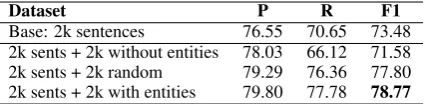
The premise of entity pre-empting is that entity-bearing text is better NER training data than entity-less text. To check this, we compare perfor-mance with entity-bearing vs. entity-less and also unsorted text. Our scenario has a base set of 2 000 sentences annotated for named entities. We add different kinds of sentences to this base set, and see how an NER system performs when trained on them. This mimics the situation where one has a
Dataset P R F1
[image:2.595.76.289.62.114.2]Base: 2k sentences 76.55 70.65 73.48 2k sents + 2k without entities 78.03 66.12 71.58 2k sents + 2k random 79.29 76.36 77.80 2k sents + 2k with entities 79.80 77.78 78.77 Table 1: Adding entity-less vs. entity-bearing data to a 2 000-sentence base training set
Dataset P R F1 ∆F1
Base: All sentences 85.70 84.08 84.88 -- 2k without entities 84.89 84.41 84.65 -0.23 - 2k with entities 85.43 83.17 84.29 -0.59 Table 2: Removing data from our training set
base corpus of quality annotated data and intends to expand this corpus.
2.1 Experimental Setup
For English newswire, we use the CoNLL 2003 dataset (Tjong Kim Sang and Meulder, 2003). The training part of this dataset has 14 040 sentences; of these, 11 131 contain at least one entity and so 2 909 have no entities. We evaluate against the more challengingtestbpart of this corpus, which contains 5 652 entity annotations. We use Finkel et al. (2005)’s statistical machine learning-based NER system.
2.2 Validation Results
Results are shown in Table 1. Adding 2 000 entity-bearing sentences gives the largest improvement in F1, and is better than adding 2 000 randomly chosen sentences – the case without pre-empting. Adding only entity-free text decreases overall per-formance, especially recall.
To double check, we try removing training data instead of adding it. In this case, removing content withoutentities should hurt performance less than removing contentwithentities. From all 14k sen-tences of English training data, we remove either 2 000 entity-beering sentences or 2 000 sentences with no entities. Results are given in Table 2.
Although the performance drop is small with this much training data, the drop from remov-ing entity-bearremov-ing data is over twice the size of that from removing the same amount of entity-free data. So, examples containing entities are often the best ones to add to an initial corpus, and have a larger negative impact on performance when re-moved. Being able to pre-empt entities is valuable, and can improve corpus effectiveness.
3 Pre-empting Entity Presence
Having defined the pre-empting task, we take two approaches to investigate the practicality of pre-empting named entities in English newswire text. The first is discriminative learning. We use maximum entropy and SVM classifiers (Daum´e III, 2004; Joachims, 1999); we experiment with cost-weighted SVM in order to achieve high re-call (Morik et al., 1999). The second is to de-clare sentences containing proper nouns as entity-bearing. We use a random baseline that pre-dicts NE presence based on the prior proportion of entity-bearing to entity-free sentences (≈4.8:1, entity-bearing is the dominant class, for any entity type).
For the machine learning approach, we use the following feature representations: character 1,2,3-grams; compressed word shape 1,2,3 1,2,3-grams;1 and
token 1,2,3 grams.
For the proper noun-based approach, we use the Stanford tagger (Toutanova et al., 2003) to label sentences. This is trained on Wall Street Journal data which does not overlap with the Reuters data in our NER corpus.
As data we use a base set of sentences as training examples, which are a mixture of entity-bearing and entity-free. We experiment with var-ious sizes of base set. Evaluation is performed over a separate 4 000-sentence set, labelled as ei-ther having or not having any entities.
3.1 English Newswire, Any Entity
Intrinsic evaluation of these pre-empting ap-proaches is made in terms of classification accu-racy, precision, recall and F1. Results are given in Table 3. They indicate that our approach to pre-empting over all entity types in English newswire performs well. For SVM, few entity-bearing sen-tences were excluded by not being pre-empted (false negatives), and we achieved high precision. Maximum entropy achieved similar results, with the highest overall F-scores. We obtain close to or-acle performance with little training data – a set of one hundred sentences affords a high overall per-formance. Repeating the experiment on the sepa-rate CoNLL evaluation set (gathered months after the training data, and so over some different entity
Training sents. Accuracy P R F1 Random baseline
68.77 78.90 82.28 80.55 Proper nouns
WSJ 72.43 92.29 92.14 92.22
MaxEnt
10∗ 75 85 83 84
100∗ 83.3 83.9 97.5 90.1
1000 90.38 93.04 94.85 93.94
5000 94.25 96.25 96.44 96.35
10000 95.08 96.56 97.20 96.88
Plain SVM
10∗ 79 79 100 88
100∗ 78.6 78.6 100 88.0
1000 90.58 92.12 96.25 91.34
5000 93.28 96.06 95.36 94.65
10000 94.22 96.46 96.18 95.33
SVM +Cost,j= 5
10∗ 79 79 100 88
100∗ 78.6 78.6 100 88.0
1000 86.33 86.53 97.84 86.43
5000 92.12 92.36 98.09 92.24
10000 94.15 94.25 98.57 94.20
Table 3: Evaluating entity pre-empting on English newswire. ∗We report figures at 2s.f. and 3s.f. for results with 10 and 100 examples respectively, as the training set is small enough to make higher precision inappropriate.
Training data P R F1
500 base + 500 random 74.33 68.56 71.33 500 base + 500 pre-empted 74.80 69.43 72.01 Table 4: Entity recognition performance with ran-dom vs. pre-empted sentences
names) gives similar results; for example the pre-empting SVM trained on 100 examples from the training set performs with 79.81% precision and full recall, and with 1000 examples, 87.92% pre-cision and near-full recall (99.53%). Even though entity-bearing sentences are the dominant class, we can still increase entity presence in a notable proportion of the training corpus.
3.2 Extrinsic Evaluation
It is important to measure the real impact of pre-empting on the resulting NER training data. To this end, we use 500 hand-labelled sentences as base data to train a pre-empting SVM, and add a further 500 sentences to this. We compare NER performance of a system trained on the base 500 + 500 random sentences, to that of one using 500 + 500 pre-empted entity-bearing sentences. As before, evaluation is against the testb set. Ta-ble 4 show results. Performance is better with pre-empted annotations, though so many sentences bear entities that the change in training data – and resultant effect – is small.
Language Accuracy P R F1 Random baseline
Dutch 49.0 46.7 46.4 46.5
Spanish 63.2 76.1 75.4 75.8 Hungarian 57.1 69.3 68.5 68.9
SVM
Dutch 92.9 89.9 98.2 93.9
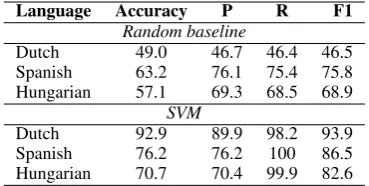
Spanish 76.2 76.2 100 86.5 Hungarian 70.7 70.4 99.9 82.6 Table 5: Pre-empting performance for Dutch, Spanish and Hungarian
Training data P R F1
Dutch, 3 926 entities
100 base + 500 random 63.57 48.80 55.22
100 base + 500 pre-empted 62.46 44.93 52.27 Spanish, 3 551 entities
100 base + 500 random 68.38 61.71 64.90 100 base + 500 pre-empted 73.00 66.91 69.82
Hungarian, 2 432 entities
100 base + 500 random 76.55 67.52 71.75
[image:3.595.75.288.60.296.2]100 base + 500 pre-empted 72.84 61.43 66.65 Table 6: Entity recognition performance with ran-dom vs. pre-empted sentences for Dutch, Spanish and Hungarian
3.3 Other Languages
Pre-empting is not restricted to just English. Sim-ilar NER datasets are available for Dutch, Spanish and Hungarian (Tjong Kim Sang, 2002; Szarvas et al., 2006). Results regarding the effectiveness of an SVM empter for these languages are pre-sented in Table 5. In each case, we train with 1 000 sentences and evaluate against a 4 000-sentence evaluation partition.
Strong above-baseline performance was achieved for each language. For Dutch and Span-ish, this pre-empting approach performs in the same class as for English, with a low error rate. The error rate is markedly higher in Hungarian, a morphologically-rich language. This could be attributed to the use of token n-gram features; one would expect these to be sparser in a language with rich morphology, and therefore being harder to build decision boundaries over.
[image:3.595.324.509.62.155.2]may not hold for every language, or every genre. But as far as we can see, it certainly holds for En-glish, and also for Spanish.
4 Crowdsourced Corpus Annotation As pre-empting entities is useful during corpus creation, in this section we examine how to ap-ply it with an increasingly popular new annota-tion method: crowdsourcing. Crowdsourcing an-notation works by presenting a many microtasks to non-expert workers. They typically make their judgements over short texts, after reading a short set of instructions (Sabou et al., 2014). Such judg-ments are often simpler than those in linguistic an-notation by experts; for example, workers might be asked to annotate only a single class of entity at a time. Through crowdsourcing, quality annota-tions can be gathered quickly and at scale (Aker et al., 2012).
There also tends to be a larger variance in reli-ability over crowd workers than in expert annota-tors (Hovy et al., 2013). For this reason, crowd-sourced annotation microtasks are often all per-formed by at least two different workers. E.g., ev-ery sentence would be examined for each entity type by at least two different non-expert workers.
We investigate entity pre-empting of crowd-sourced corpora for a challenging genre: social media. Newswire corpora are not too hard to come by, especially for English, and the genre is somewhat biased in style, mostly being written or created by working-age middle-class men (Eisen-stein, 2013), and in topic, being related to major events around unique entities that one might re-fer to by a special name. In contrast, social media text has broad stylistic variance (Hu et al., 2013) while also being difficult for existing NER tools to achieve good accuracy on (Derczynski et al., 2013; Derczynski et al., 2015) and having no large NE annotated corpora.
In our setup, we subdivide the annotation task according to entity type. Workers perform best with light cognitive loads, so asking them to an-notate one kind of thing at a time increases their agreement and accuracy (Krug, 2009; Khanna et al., 2010). Person, location and organisa-tion entities are annotated, giving three annota-tion sub-tasks, following Bontcheva et al. (2015). Jobs were created automatically using the GATE crowdsourcing plugin (Bontcheva et al., 2014). An example sub-task is shown in Figure 1. This
Entity type Messages with Messages without
Any 45.95% 54.05%
Location 9.52% 90.48%
Organisation 11.16% 88.84%
Person 32.49% 67.51%
Table 7: Entity distribution over twitter messages
Dataset P R F1
Base: 500 messages 70.39 31.66 43.67 500 msgs + 1k without entities 85.00 25.15 38.81 500 msgs + 1k random 76.14 44.38 56.07 500 msgs + 1k with entities 71.21 54.14 61.51 Table 8: Adding entity-less vs. entity-bearing data to a 500-message base training set
means that we must pre-empt according to en-tity type, instead of just pre-empting whether or not an excerpt contains any entities at all, which has the additional effect of changing entity-bearing/entity-free class distributions.
We use two sources that share entity classi-fication schemas: the UMBC twitter NE anno-tations (Finin et al., 2010), and the MSM2013 twitter annotations (Rowe et al., 2013). We also add the Ritter et al. (2011) dataset, mapping its geo-location and facility classes to location, and company, sports team and band to organisation. Mixing datasets reduces the impact of any sin-gle corpus’ sampling bias on final results. In to-tal, this gives 3 854 twitter messages (tweets). Ta-ble 7 shows the entity distribution over this corpus. From this we separated a 500 tweet training set, used as base NER training data and pre-empting training data, and another set of 500 tweets for evalution. Note that each message can contain more than one type of entity, and that names of people are the most common class of entity.
4.1 Re-validating the Hypothesis
As we now have a new dataset with potentially much greater diversity than newswire, our first step is to re-check our initial hypothesis – that entity-bearing text contributes more to the perfor-mance of a statistical NER system than entity-free or random text. Results are shown in Table 8.
signif-Figure 1: An example crowdsourced entity labelling microtask.
Training sents. Accuracy P R F1 Random baseline
51.6 47.1 48.2 47.6 Proper nouns
From WSJ 54.0 49.8 85.4 62.9 SVM +Cost,j= 5
10 46 46 100 63
100 69.5 63.0 80.3 70.6
200 72.4 66.9 78.4 72.2
500 71.4 64.8 81.7 72.3
[image:5.595.321.510.260.394.2]1000 47.7 68.0 83.6 75.1
Table 9: Evaluating any-entity tweet pre-empting.
icant at p<0.00050, using compute-intensive χ2
testing following Yeh (2000).
4.2 Pre-empting Entities in Social Media
We construct a similar pre-empting classifier to that for newswire (Section 3.1). We continue us-ing the base 500 messages as a source of trainus-ing data, and evaluate pre-empting using the remain-der of the data. The random baseline follows the class distribution in the base set, where 47.2% of messages have at least one entity of any kind.
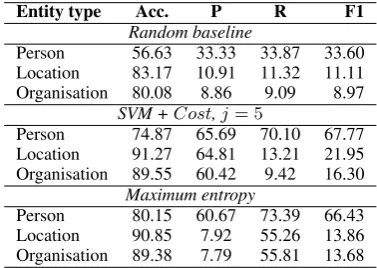
We also evaluate pre-empting performance per entity class. The same training and evaluation sets are used, but a classifier is learned to pre-empt each entity class (person, location and organ-isation), as in Derczynski and Bontcheva (2014). This may greatly impact annotation, due to the one-class-at-a-time nature of the crowdsourced task and low occurrence of individual entity types in the corpus (see Table 7). We took 300 of the base set’s sentences and used these for our train-ing data, with the same evaluation set as before.
4.3 Results
Results for any-entity pre-empting on tweets are given in Table 9. Although performance is lower
Entity type Acc. P R F1 Random baseline
Person 56.63 33.33 33.87 33.60 Location 83.17 10.91 11.32 11.11 Organisation 80.08 8.86 9.09 8.97
SVM +Cost,j= 5
Person 74.87 65.69 70.10 67.77 Location 91.27 64.81 13.21 21.95 Organisation 89.55 60.42 9.42 16.30
Maximum entropy
Person 80.15 60.67 73.39 66.43 Location 90.85 7.92 55.26 13.86 Organisation 89.38 7.79 55.81 13.68 Table 10: Per-entity pre-empting on tweets.
than on newswire, pre-empting is still possible in this genre. Only results for cost-weighted SVM are given.
We were able to learn accurate per-entity classi-fiers despite having a fairly small amount of data. Results are shown in Table 10. A good reduction is achieved over the baseline in all cases, though specifically predicting locations and organisations is hard. However, we do achieve high precision, meaning that a good amount of less-useful entity-free data is rejected. The SVM figures are with a reasonably high weighting in favour of recall. Conversely, while achieving similar F-scores to SVM, the maximum entropy pre-empter scores much better in terms of recall than precision.
[image:5.595.82.280.260.375.2]Removed features Acc. P R Baseline
None 90.58 92.12 96.25
-gram shortening
3-grams 90.50 92.29 95.93 2-grams 90.15 91.62 96.28 1-grams 89.09 90.13 96.69
Removed feature classes
[image:6.595.330.501.62.232.2]Char-grams 87.47 89.46 95.29 Shape-grams 87.20 87.73 97.33 Token-grams 90.33 92.56 95.36 Table 11: Pre-empting feature ablation results.
58% of organisation microtasks where no entities occur – excluding a large amount material in pref-erence for content that will give better NER per-formance later.
5 Analysis
5.1 Feature Ablation
The SVM system we have developed for pre-empting named entities is effective. To investigate further, we performed feature ablation along two dimensions. Firstly, we hid certain feature n-gram lengths (which are 1, 2 or 3 entries long). Sec-ondly, we removed groups of features i.e. word n-grams, character n-grams or compressed word shape n-grams. We experimented using 1 000 training examples, on the newswire all-entities task, evaluating against the same 4 000-sentence evaluation set, with an SVM pre-empter. This makes figures comparable to those in Table 3.
Ablation results are given in Table 11. Shape grams, that is, subsequences of word characters, have the least overall impact on performance. Un-igram features (across all character, shape and to-ken groups) have the second-largest impact. This suggests that morphological information is useful in this task, and that the presence of certain words in a sentence acts as a pre-empting signal.
5.2 Informative Features
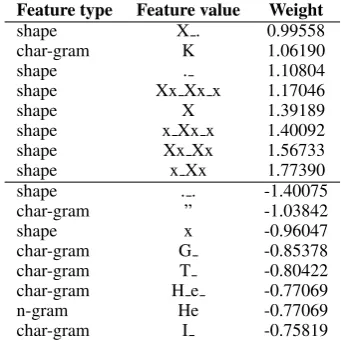
When pre-empting certain features are more help-ful than others. The maximum entropy classifier implementation used allows output of the most informative features. These are reported – for newswire – in Table 12. In this case, the model was trained on 10 000 examples, and is the one for which results were given in Table 3, that achieved an F-score of 96.88.
Word shape features are the strongest indicators of named entity presence, and the strongest indi-cators of entity absence are all character grams.
Feature type Feature value Weight
shape X . 0.99558
char-gram K 1.06190
shape . 1.10804
shape Xx Xx x 1.17046
shape X 1.39189
shape x Xx x 1.40092
shape Xx Xx 1.56733
shape x Xx 1.77390
shape . . -1.40075
char-gram ” -1.03842
shape x -0.96047
char-gram G -0.85378
char-gram T -0.80422
char-gram H e -0.77069
n-gram He -0.77069
[image:6.595.91.272.62.174.2]char-gram I -0.75819
Table 12: Strongest features for pre-empting in English newswire.
Many shapes that indicate entity presence have one or more capitalised words in sequence, or linked to all-lower case words surrounding them. Apparently, sentences containing quote marks are less likely to contain named entities. Also, the characters sequence “He” suggests that a sentence does not contain an entity, perhaps because the tar-get is being referred to pronomially.
5.3 Observations
Our experiments have begun with a base set of annotated sentences, mixing entity-bearing and entity-free. This not only serves a practical pur-pose of providing the pre-empter with training data and negative examples. It is also important to include some entity-free text in the NER train-ing data so that systems based on it can observe that some sentences may have no entities. With-out this observation, there is a risk that they will handle entity-free sentences poorly when labelling previously-unseen data.
It should be noted that segmenting into sen-tences risks the removal of long-range dependen-cies important in NER (Ratinov and Roth, 2009). However, overall performance in newswire – on longer documents – is not harmed by our ap-proach. In the social media context we examined, entity co-reference is rare, due to its short texts.
6 Related Work
demon-strated the impressive construction of a part-of-speech tagger based on just two hours’ annotation. Similar to our work, Shen et al. (2004) proposed active learning for named entity recognition an-notation, reducing annotation load without hurting NER performance, based on three metrics for each text batch and an iterative process. We differ from Shen et al. by giving a one-shot approach which does not need iterative re-training and is simple to implement in an annotation workflow, although we do not reduce annotation load as much. Our simplification means that pre-empting is easy to integrate into an annotation process, especially im-portant for e.g. crowdsourced annotation, which is cheap and effective but gives a lot less control over the annotation process.
Laws et al. (2011) experiment with combining active learning and crowdsourcing. They find that not only does active learning generate better qual-ity than randomly selecting crowd workers, it can be used to filter out miscreant workers. The goal in this work was to improve annotation quality and reduce cost that way. Recent advances in crowd-sourcing technology offer much better quality than at the time of this paper. Rather than focusing on finding good workers, we aim for the extrinsic goal improving system performance by choosing which annotations to perform in the first place.
7 Conclusion
Entity pre-empting makes corpus creation quicker and more cost-effective. Though demonstrated with named entity annotation, it can apply to other annotation tasks, especially when for corpora used in information extraction, for e.g. relation extrac-tion and event recogniextrac-tion.
This paper presents the pre-empting task, shows that it is worthwhile, and demonstrates an exam-ple approach in two application scenarios. We demonstrate that choosing to annotate texts that are rich in target entity mentions is more efficient than annotating randomly selected text. The ex-ample approach is shown to successfully pre-empt entity presencce classic named entity recognition. Applying pre-empting to the social media genre, where annotated corpora are lacking and NER is difficult, also offers improvement – but is harder.
Further analysis of the effect of pre-empting in different languages is also warranted, after the mixed results in Table 6. Larger samples can be used for training social media pre-empting; though
we only outline an approach using 1 000 exam-ples, up to 15 000 have been annotated and made publicly available for some entity types. For fu-ture work, the pre-empting feafu-ture set could be first adapted to morphologically rich languages, and then also to languages that do not necessar-ily compose tokens from individual letters, such as Mi’kmaq or Chinese.
Acknowledgments
This work is part of the uComp project (http://www.ucomp.eu//), which receives the fund-ing support of EPSRC EP/K017896/1, FWF 1097-N23, and ANR-12-CHRI-0003-03, in the frame-work of the CHIST-ERA ERA-NET.
References
A. Aker, M. El-Haj, M.-D. Albakour, and U. Kr-uschwitz. 2012. Assessing crowdsourcing
qual-ity through objective tasks. In Proceedings of the
Conference on Language Resources and Evaluation, pages 1456–1461.
K. Bontcheva, I. Roberts, L. Derczynski, and D. Rout. 2014. The GATE Crowdsourcing Plugin:
Crowd-sourcing Annotated Corpora Made Easy. In
Pro-ceedings of the 14th Conference of the European Chapter of the Association for Computational Lin-guistics (EACL). Association for Computational Linguistics.
K. Bontcheva, L. Derczynski, and I. Roberts. 2015. Crowdsourcing named entity recognition and entity linking corpora. In N. Ide and J. Pustejovsky, edi-tors,The Handbook of Linguistic Annotation (to ap-pear). Springer.
H. Daum´e III. 2004. Notes on CG and
LM-BFGS optimization of logistic regression.
Pa-per available at http://pub.hal3.name#
daume04cg-bfgs, implementation available at
http://hal3.name/megam/, August. L. Derczynski and K. Bontcheva. 2014.
Passive-aggressive sequence labeling with discriminative post-editing for recognising person entities in
tweets. In Proceedings of the 14th Conference of
the European Chapter of the Association for Com-putational Linguistics, volume 2, pages 69–73. L. Derczynski, D. Maynard, N. Aswani, and
K. Bontcheva. 2013. Microblog-Genre Noise and
Impact on Semantic Annotation Accuracy. In
Pro-ceedings of the 24th ACM Conference on Hypertext and Social Media. ACM.
tweets. Information Processing and Management, 51:32–49.
J. Eisenstein. 2013. What to do about bad language
on the internet. In Proceedings of the 2013
Con-ference of the North American Chapter of the Asso-ciation for Computational Linguistics: Human Lan-guage Technologies, pages 359–369. Association for Computational Linguistics.
T. Finin, W. Murnane, A. Karandikar, N. Keller, J. Mar-tineau, and M. Dredze. 2010. Annotating named entities in Twitter data with crowdsourcing. In Pro-ceedings of the NAACL HLT 2010 Workshop on Cre-ating Speech and Language Data with Amazon’s Mechanical Turk, pages 80–88.
J. Finkel, T. Grenager, and C. Manning. 2005. In-corporating non-local information into information
extraction systems by Gibbs sampling. In
Proceed-ings of the 43rd Annual Meeting of the Association for Computational Linguistics, pages 363–370. As-sociation for Computational Linguistics.
D. Garrette and J. Baldridge. 2013. Learning a part-of-speech tagger from two hours of annotation. In
Proceedings of NAACL-HLT, pages 138–147. D. Hovy, T. Berg-Kirkpatrick, A. Vaswani, and
E. Hovy. 2013. Learning Whom to trust with
MACE. In Proceedings of NAACL-HLT, pages
1120–1130.
Y. Hu, K. Talamadupula, S. Kambhampati, et al. 2013. Dude, srsly?: The surprisingly formal nature of
Twitter’s language. Proceedings of ICWSM.
T. Joachims. 1999. Svmlight: Support vector machine.
SVM-Light Support Vector Machine http://svmlight. joachims. org/, University of Dortmund, 19(4). S. Khanna, A. Ratan, J. Davis, and W. Thies. 2010.
Evaluating and improving the usability of
Mechan-ical Turk for low-income workers in India. In
Pro-ceedings of the first ACM symposium on computing for development. ACM.
S. Krug. 2009. Don’t make me think: A common sense
approach to web usability. Pearson Education. F. Laws, C. Scheible, and H. Sch¨utze. 2011. Active
learning with amazon mechanical turk. In
Proceed-ings of the conference on empirical methods in nat-ural language processing, pages 1546–1556. Asso-ciation for Computational Linguistics.
K. Morik, P. Brockhausen, and T. Joachims. 1999. Combining statistical learning with a knowledge-based approach - a case study in intensive care
mon-itoring. In Proceedings of the 16th International
Conference on Machine Learning (ICML-99), pages 268–277, San Francisco.
L. Ratinov and D. Roth. 2009. Design challenges and misconceptions in named entity recognition. In Pro-ceedings of the Thirteenth Conference on Computa-tional Natural Language Learning, pages 147–155. Association for Computational Linguistics.
A. Ritter, S. Clark, Mausam, and O. Etzioni. 2011. Named entity recognition in tweets: An experimen-tal study. InProc. of Empirical Methods for Natural Language Processing (EMNLP), Edinburgh, UK. M. Rowe, M. Stankovic, A. Dadzie, B. Nunes, and
A. Cano. 2013. Making sense of microposts (#msm2013): Big things come in small packages. In
Proceedings of the WWW Conference - Workshops. M. Sabou, K. Bontcheva, L. Derczynski, and A. Scharl.
2014. Corpus annotation through crowdsourcing:
Towards best practice guidelines. In Proceedings
of the 9th international conference on language re-sources and evaluation (LREC14), pages 859–866. D. Shen, J. Zhang, J. Su, G. Zhou, and C.-L. Tan. 2004.
Multi-criteria-based active learning for named entity
recognition. InProceedings of the Annual Meeting
on Association for Computational Linguistics. Asso-ciation for Computational Linguistics.
G. Szarvas, R. Farkas, L. Felf¨oldi, A. Kocsor, and J. Csirik. 2006. A highly accurate named entity
cor-pus for hungarian. InProceedings of International
Conference on Language Resources and Evaluation. E. F. Tjong Kim Sang and F. D. Meulder. 2003. Introduction to the CoNLL-2003 Shared Task: Language-Independent Named Entity Recognition. InProceedings of CoNLL-2003, pages 142–147. Ed-monton, Canada.
E. F. Tjong Kim Sang. 2002. Introduction to the CoNLL-2002 shared task: Language-independent
named entity recognition. In Proceedings of
CoNLL-2002, pages 155–158. Taipei, Taiwan. K. Toutanova, D. Klein, C. D. Manning, and Y. Singer.
2003. Feature-rich part-of-speech tagging with a
cyclic dependency network. InProceedings of the
2003 Conference of the North American Chapter of the Association for Computational Linguistics on Human Language Technology, NAACL ’03, pages 173–180.