This is a repository copy of Effectiveness of pharmacist-led medication review in chronic pain management: systematic review and meta-analysis..
White Rose Research Online URL for this paper: http://eprints.whiterose.ac.uk/93826/
Version: Accepted Version
Article:
Hadi, MA, Alldred, DP, Briggs, M et al. (2 more authors) (2014) Effectiveness of
pharmacist-led medication review in chronic pain management: systematic review and meta-analysis. Clinical Journal of Pain, 30 (11). pp. 1006-1014. ISSN 0749-8047 https://doi.org/10.1097/AJP.0000000000000063
[email protected] https://eprints.whiterose.ac.uk/ Reuse
Unless indicated otherwise, fulltext items are protected by copyright with all rights reserved. The copyright exception in section 29 of the Copyright, Designs and Patents Act 1988 allows the making of a single copy solely for the purpose of non-commercial research or private study within the limits of fair dealing. The publisher or other rights-holder may allow further reproduction and re-use of this version - refer to the White Rose Research Online record for this item. Where records identify the publisher as the copyright holder, users can verify any specific terms of use on the publisher’s website.
Takedown
If you consider content in White Rose Research Online to be in breach of UK law, please notify us by
Effectiveness of Pharmacist-led medication review management: Systematic Review and
Meta-Analysis
Muhammad Abdul Hadi, MPharm (Clinical),*1 David Phillip Alldred, PhD,1 Michelle Briggs,
PhD, 2 Theresa Munyombwe, MSc,3 S. José Closs, PhD,1
1School of Healthcare, University of Leeds, LS2 9JT, Leeds, UK
2Institute of Health and Well Being, Leeds Metropolitan University, LSI 3HE, Leeds, UK
3Center for Epidemiology & Biostatistics, University of Leeds, Leeds, UK
*Corresponding Author:
Muhammad Abdul Hadi, BPharm, MPharm(Clinical)
School of Healthcare,
Baines Wing
University of Leeds,
LS2 9UT Leeds,
United Kingdom
Objective: To evaluate the effectiveness of pharmacist-led medication review in chronic pain
management.
Methods: Six electronic databases (Medline, Embase, PsycInfo, CINHAL, CENTRAL,
International Pharmaceutical Abstracts) reference lists of retrieved articles and relevant websites
were searched for randomised controlled trials (RCTs) published in the English language
involving adults with chronic pain. Studies were included if one of the intervention arms had
received pharmacist-led medication review independently or as part of a multidisciplinary
intervention. Risk of bias was assessed for all the included studies.
Results: The search strategy yielded 583 unique articles with five RCTs included. Compared to
control, meta-analysis showed that participants in the intervention group had: a 0.8 point
reduction in pain intensity on a 0 to 10 numerical rating scale (NRS) at 3-months (95% CI, -1.28
to 0.36) and a 0.7 point reduction (95% CI 1.19 to 0.20) at 6months; a 4.84 point (95% CI,
-7.38 to -2.29) and -3.82 point (95% CI, -6.49 to -1.14) improvement in physical functioning on a
0 to 68 point function subscale of Western Ontario and McMaster Universities Arthritis Index
(WOMAC) at 3-months and 6-months respectively; and a significant improvement in patient
satisfaction equivalent to a ‘small to moderate effect.’
Discussion: Pharmacist-led medication review reduces pain intensity and improves physical
functioning and patient satisfaction. However, the clinical significance of these findings remain
uncertain due to small effect size and nature of reported data within clinical trials which limits
recommendation of wider clinical role of pharmacist in chronic pain management.
Introduction
High prevalence, associated long term morbidity and lack of a permanent cure make chronic pain
one of the most challenging diseases to manage. In the USA, chronic pain affects more than 100
million people and the prevalence is higher than for diabetes, heart diseases and cancer
combined.1 In Europe, one in every five adults suffers from chronic pain of moderate to severe
intensity.2 Both prescription and non-prescription analgesics are extensively used in chronic
pain management but inappropriate and suboptimal use of analgesics has been reported.3 In
2007, almost 12,000 cases of unintentional drug poisoning involving prescription analgesics4
were reported and in 2008, almost 15,000 people died due to overdoses of opioid analgesics in
the USA alone.5 Therefore, the safe and effective use of analgesics is critical to ensure optimum
analgesia, to prevent adverse effects and drug related problems, and to minimise abuse of
analgesics.
Over the past decade, with the increase in the number of nurse and pharmacist prescribers,
researchers have become interested in evaluating the effectiveness of their extended clinical role
in the management of different diseases and settings.6-9 For chronic pain, the limited capacity of
general practioners (GPs) and long waiting times for appointments in secondary care10 present an
opportunity for healthcare professionals other than GPs to take on key aspects of chronic pain
management. Studies evaluating the role of the pharmacist in chronic pain have reported mixed
results.11 A meta-analysis of the effectiveness of pharmacist-led educational interventions for
chronic pain management showed a statistically significant reduction in pain intensity and
adverse effects, and an improvement in patient satisfaction in those receiving interventions.11
However, no benefit was seen in interference from pain on daily life and self-efficacy.
Since no systematic review has yet evaluated the effectiveness of pharmacist-led medication
review for chronic pain management, the aim of this systematic review was to fill this gap. The
systematic review was prospectively registered with PROSPRO (Registration number:
CRD42012001957) and the protocol has been previously published.12
MATERIALS AND METHODS
Study Selection
The following databases were searched between April-June 2012 using a pre-defined search
strategy.
MEDLINE (via Ovid) …….(1946 to June 2012),
EMBASE (via Ovid)…….. (1947 to April 2012)
Cochrane Central Register of Controlled Trials……. (Issue 6 of 12, June 2012)
Cumulative Index to Nursing and Allied Health Literature (CINAHL)
(via EMBSCO)….. (1960 to June 2012),
PsycINFO……….. (1806 to June 2012)
International Pharmaceutical Abstracts (via Ovid)…….. (1970 to June 2012)
We searched for randomized controlled trials (RCTs) and non-randomized studies
(quasi-experimental, controlled before-and-after study) having at least one control group
Non-randomized studies were only to be considered for inclusion if fewer than three RCTs were
eligible for inclusion on searching. Waiting list controls, usual care, attention only and any other
active control were accepted as appropriate controls. Studies were considered for inclusion if one
independently, or as part of complex multidisciplinary interventions, where the pharmacist was
part of the multidisciplinary team. Websites of American, Canadian and Royal (British)
Pharmaceutical societies were also searched together with the reference lists of the retrieved
articles to identify additional eligible studies. Where necessary, the corresponding authors of the
included studies were contacted to obtain additional information and to identify any unpublished
studies. The full search strategy is available from the corresponding author on request.
Studies involving chronic pain patients 18 years and older were included regardless of
participants' gender, type and aetiology of chronic pain. We used The International Association
for the Study of Pain (IASP) definition of chronic pain: “Pain without apparent biological value
that has persisted beyond the normal tissue healing time (usually taken to be 3 months)”.13
Studies involving patients with malignant or cancer pain were excluded to avoid clinical
heterogeneity. Studies published in the English language (full text or abstract) were only
considered. Study titles and abstracts of the studies were screened independently by two authors
(MAH and DPA). Full texts of all studies considered potentially relevant were retrieved. Finally,
MAH and DPA independently selected studies meeting the pre-defined inclusion criteria.
Disagreements were resolved through discussion and if agreement was not reached, a third
review author (MB) was consulted.
Assessment of risk of bias and data extraction
The risk of bias was assessed using the Cochrane Collaborations’ tool for assessing risk
of bias by one reviewer (MAH) and verified by another reviewer (SJC) using a standardized
form.14 This tool is domain-based as opposed to a checklist or scale (see Results for domains).
For cluster randomized controlled trials, risk of bias was assessed across two additional domains
categorised into low risk of bias, high risk of bias or unclear risk of bias based on the
recommendations of Higgins and Green.14 Disagreements were resolved through discussion and
if consensus was not reached a third reviewer (MB) was consulted.
Data were extracted by MAH and verified by MB using a standardized data collection
form. The data collection form was pilot tested. Disagreements were resolved through
discussion, and if no consensus was reached, opinion of a third reviewer (SJC) was requested.
Data synthesis
Review Manager (RevMan 5.1) was used for data analysis. Mean difference (MD) was
calculated for all continuous variables (e.g. pain intensity) when outcomes were measured using
the same scale and when different scales were used, standardized mean difference (SMD) was
calculated with corresponding 95% confidence intervals. Relative risk (RR) with 95%
confidence intervals was calculated for dichotomous variables. The decision to pool data using
meta-analysis was based on the clinical homogeneity in terms of the population, intervention,
outcome measures and timing of outcome measures of all the included studies. Clinical
homogeneity was determined by discussion among the review authors and clinically
heterogeneous trials were not combined statistically. Statistical heterogeneity was determined by
using chi-square ( 2) and I2 statistic. Statistical heterogeneity determined the choice of using a
random- or fixed-effects model for meta-analysis. A 2 P value of greater than 0.1 and an I2 value
of less than 50% was used to indicate statistical homogeneity.14 A random-effects model was
used to combine clinically homogeneous but statistically heterogeneous clinical trials, whereas
RESULTS
Characteristics of Included Study
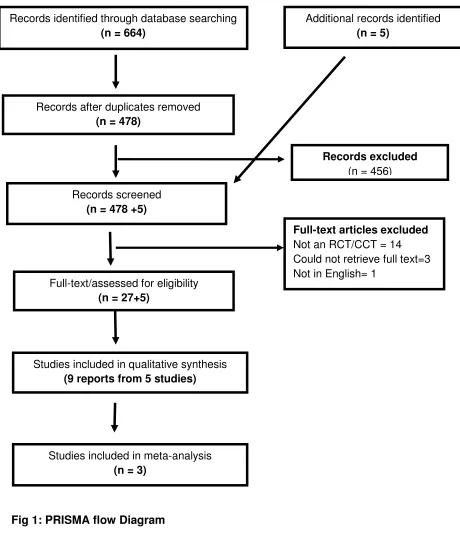
Six hundred and sixty-four articles were retrieved through database searches (578 after
de-duplication). Of these 578, 27 were considered relevant after title and abstract screening. An
additional five articles were found including two each through author contact and reference list
searching, and one through website searching. Of these 32 articles, nine reports of five studies
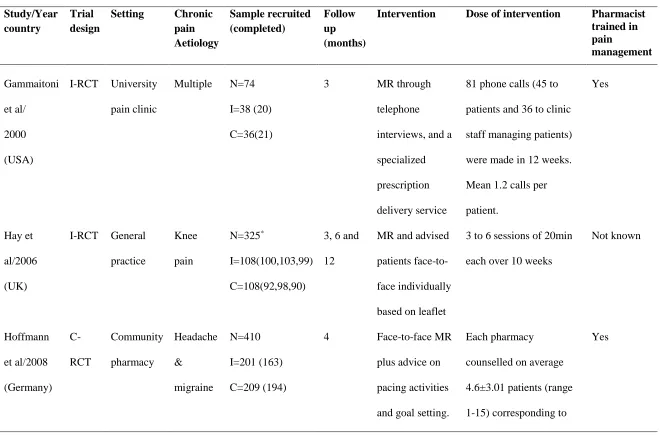
met the inclusion criteria for review.15-23 Figure 1 illustrates the search process and the reasons
for exclusion. Two trials were conducted in the UK19-21 and one each in Canada,22 Germany,18
and the USA.23
The included studies comprised three individually randomized 19,21,23 and two cluster
randomized controlled studies 18,22 randomizing 1035 patients in total. All followed up the
patients for at least 3 months, three for 6 months and one for 12 months. All studies had their
first follow-up at 3-months except for Hoffman et al18 where follow-up was at 4 months. In total,
131 patients (12.7%) were lost to the first follow-up. Two trials included patients with chronic
pain of various aetiologies,21,23 another two involved patients with knee pain associated with
osteoarthritis 19,22 and one involved chronic headache and migraine patients.18 In four trials
where gender was reported, the majority of the participants were females (61.8%).18,19,22,23 The
mean age of participants varied between 62.7 years (S.D.±9.2) in Marra et al study,22 67.9 years
(S.D.±8.2) in the Hay et al.19 study and 42.70 years (S.D.±13) in the Hoffman et al. study.18 The
study by Bruhn et al.16,21 did not report age and participants in the Gammaitoni et al.23 study
Nature and delivery of Intervention
In three trials18,19,21 the intervention was pharmacist-led medication review alone while in
the other two 22-23 the intervention involved medication review as part of a multi-component
intervention (Table 1). In the Marra et al study,22 the intervention also comprised two
components. First was a face-to-face consultation with a pharmacist who educated patients on
aspects of osteoarthritis (OA), conducted medication review to ensure safe use of analgesics,
referred patients to a physiotherapist-guided exercise programme (second component) and
requested patients’ primary care physicians to approve their inclusion in the exercise programme.
Over the 6 months follow-up period, 297 patient-pharmacist consultations generated 255
comments and recommendations, including 49 medication-related recommendations to patients’
primary care physician. The pharmacist also followed the patients’ progress monthly for six
months. The physiotherapist recommended an individualized home exercise programme after a
one-hour consultation with each patient. The participants attended an exercise class twice per
week for six weeks. Participants in the control group received an educational leaflet on knee OA
developed by the Canadian Arthritis Society.
In the Gammaitoni et al trial,23 the intervention had two components. The first was a
specialised prescription service provided by a palliative care pharmacy company (PainRxperts)
which delivered patients’ medication to their home or to the clinic. The aim of the service was to
improve accessibility to pain medicine and reduce the burden of managing medication treatment
for clinical practice. The second component was proactive monitoring of patients’ medication
therapy for any potential or actual drug related problem (DRP) by a palliative care trained
pharmacist to ensure that the drug therapy was achieving an improvement in quality of life. In
patient) and 36 to the clinic staff. Most calls concerned patient monitoring/administration of the
Brief Pain Inventory (BPI) (n=36),24 questions about medication use (n=22) and delivery of
medications (n=11). On average, each patient contact lasted 12 minutes, and 9 minutes for clinic
staff. Fifteen out of 16 recommendations made to the clinic staff were accepted, including:
addition of an adjuvant (n=4), drug change (n=2), dose change (n=3), frequency change (n=2), or
dosing conversion (n=5). The control group received usual care as prior to study with the
exception of filling in questionnaires at baseline and 3 months follow up.
Hay et al,17,19 used two independent intervention groups: pharmacy review group and
community physiotherapy group. Data for the pharmacy review group only was extracted and
presented in this systematic review. Participants in the pharmacy review group received an
enhanced pharmacy review plus an education leaflet from an experienced community pharmacist
in general practice surgeries with access to patients’ medical records. The trial protocol permitted
three to six sessions of approximately 20 minutes each over 10 week period. The pharmacist
used a pre-defined set of questions for initial assessment and optimized/changed drug therapy, if
necessary, based on an algorithm and clinical needs. In total, 335 pharmacist-patient
consultations took place (mean 3.2 per patient; range 2-5). The mean time spent per patient was
around 63 minutes in 3 sessions. Participants in the control group received the same education
leaflet and a telephone call from a rheumatology nurse to reinforce the leaflet advice within
seven days of randomization.
In the Hoffmann et al study,18 the intervention group received an individualized
counselling session by trained community pharmacists with the aim of optimising
pharmacotherapy, promoting self-management, goal setting and pacing activities. Each patient
patients on average (range 1-15). Participants in the control group continued to receive usual
pharmaceutical consultations with pharmacists who were not formally trained in headache/pain
management.
In the Bruhn et al study,16,20,21 there were two independent intervention groups:
pharmacist medication review either with recommendations to the GP or pharmacist prescribing.
Further data on the nature and duration of the intervention were not available. Authors were
contacted but unable to provide data due to funding restrictions.
Risk of bias
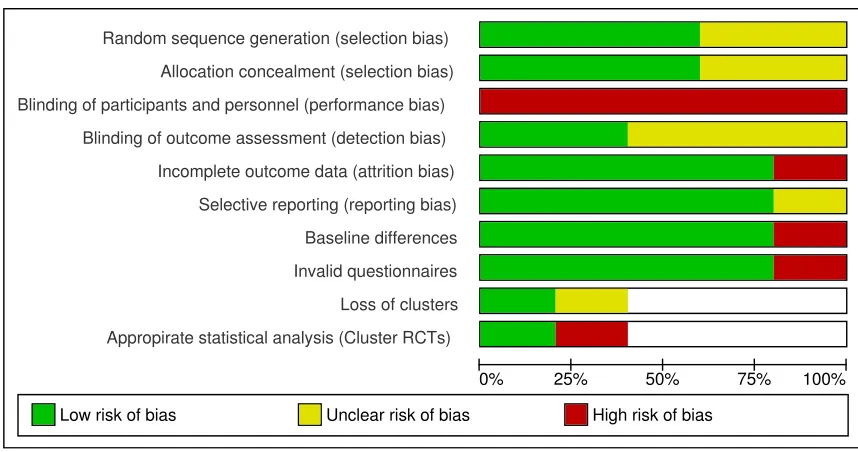
Three trials 19,22,23 described adequate methods for random sequence generation (Figure 2). Hay
et al.19 used a random number generator which allocated to intervention or control groups in
pre-determined sequence blocks of six by general practice. The study statistician generated values
from a uniform (0, 1) distribution in the Marra et al study 22 and a computer programme was
used to randomly assign the names to either the intervention group or the control group in the
Gammaitoni et al trial.23 However, Gammaitoni et al did not describe how the selection of 107
patients from pain clinics was undertaken prior to this random allocation to groups.23 Methods of
random sequence generation were not adequately explained by Bruhn et al 21 and Hoffman et
al.18 Only Hay et al.19 described an adequate method of allocation concealment (sequentially
numbered opaque envelops). Allocation concealment was not possible for the cluster randomized
trials 18,22 and is not considered an issue.14
In all the trials, it was impossible to blind pharmacists delivering the intervention and the
participants receiving it due to nature of intervention. Outcome assessors were blinded in two
telephone interview but it was not made clear whether people who handled and analysed the data
were blinded or not.
All trials 18,19,21,22 except one 23 used the intention to treat principle for analysing their
data, minimizing attrition bias. There was low risk of selective reporting of an outcome across
four trials 18,19,22,23 and unclear risk in one of the trials. Although the study protocol was available
for only one study,22 low risk was assigned to other trials since the authors reported outcomes
with non-significant P-values as well.
There were no baseline differences between intervention and control groups in any of the
trials except one. In the Marra et al trials,22 there were significant differences at baseline in pain
scores measured by the Health Utilities Index-3,25 a generic instrument to measure quality of life,
between intervention and usual care groups but there were no significant differences in pain
scores when measured by the Western Ontario and McMaster Universities Osteoarthritis Index
(WOMAC) pain subscale.26 Furthermore, participants in the intervention group were slightly
more educated (86% reported more than high school education compared to 79%), belonged to
higher socioeconomic class (71% reported an income over $50,000 compared to 59%) and were
of Asian origin (21% compared to 9%) compared with the usual care group.
Only one patient was lost to follow up in each group in the Marra et al. 22 study and the
authors took “clustering” into consideration in sample size calculation and data analysis.
However, in the Hoffmann et al cluster randomized trial,18 the authors did not use appropriate
statistical techniques and did not allow for the clustering effect in sample size calculation and
Outcomes assessment
Pain intensity
Pan intensity was reported in the all the trials using different scales. Gammaitoni et al.23
measured pain intensity on a 0 to 10 numerical rating scale (NRS) where 0 = no pain and 10=
pain as bad as you can imagine and the Health Background Questionnaire-Initial Patient Visit. 27
Hay et al.19 reported pain intensity with the NRS and on a 0 to 20 subscale of WOMAC.26 Bruhn
et al.21 assessed pain intensity using the pain intensity subscale of the chronic pain grade
questionnaire (CPG), a 7-item questionnaire to measure pain intensity, severity and functional
disability.28 Marra et al. 22 measured pain intensity on a 0 to 10 pain subscale of WOMAC while
Hoffman et al. 18 measured it on a 1 to 10 numerical rating scale where 1=no pain and 10=pain as
bad as you can imagine. Although pain intensity was measured using different scales in
Gammaitoni et al, 23 Hay et al 19 and Mara et al,22 all the scales ranged from 0 to 10 where 0 = no
pain and 10 = pain as bad as you can imagine.
Four studies showed a significant reduction in pain scores at follow-up. 18-22 Although,
Hay et al.19 reported a statistically significant reduction in pain scores at 3-month follow up
(p=0.04), they were not significant at 6 (p = 0.3) and 12 months (p=0.5). However, Marra et al.22
reported a statistically significant reduction at both 3 and 6 month follow ups (both p<0.05). In
the study by Hoffmann et al,18 there was a significant reduction in ‘untreated’ pain intensity in
both intervention (p<0.001) and control group (p<0.001); however, reduction in ‘treated’ pain
intensity remained non-significant in both intervention (p=0.52) and control groups (p=0.92) at
Pain scores were pooled using meta-analysis. The study by Hoffmann et al.18 involved
patients with chronic headache and migraine so was clinically heterogeneous and not combined
statistically. The data reported by Bruhn et al.21 was insufficient for meta-analysis. Since pain
intensity was measured on different scales, the standardized mean difference (SMD) and
corresponding standard error were calculated for each of the three studies. For the purpose of
meta-analysis, change in score from baseline rather than final score was used as it is more
efficient and powerful, eliminating between-person variability.14 If the ‘adjusted’ change in
score derived from regression model accounting for baseline measurements was reported, it was
preferred over the crude change in score to calculate SMD, as statistically, adjusted scores are
considered most precise and least biased.14 Meta-analysis was undertaken for 3 and 6 month
follow-ups.
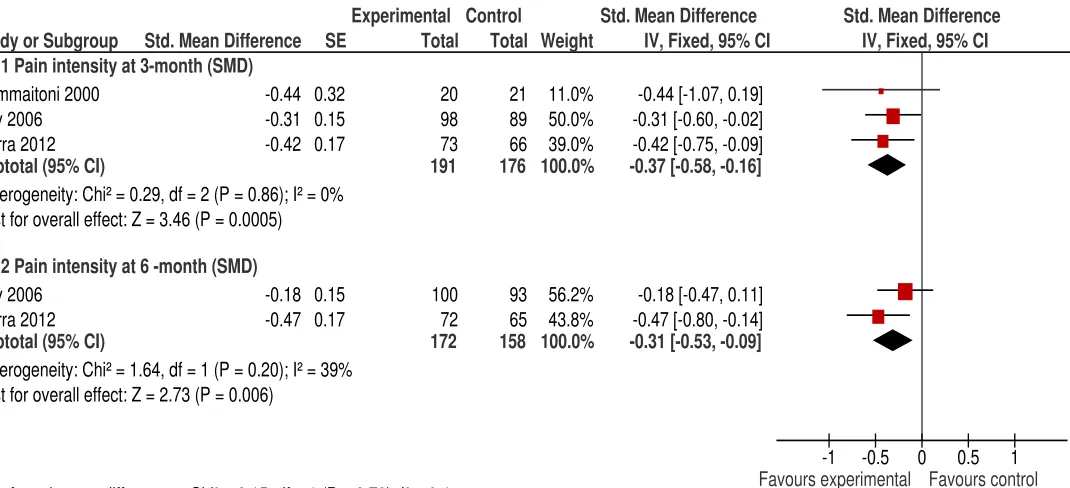
Compared with the control group, there was a significant reduction in pain intensity in
the intervention group with SMD of – 0.37 (95% confidence interval - 0.58, - 0.16) (Figure 3).
This corresponds to a 0.83 point reduction on an 11 point NRS (95% confidence interval -1.28, -
0.36). There was no heterogeneity in the result (I2=0%). Only two studies reported pain intensity
at 6-months.19,22 Meta-analysis showed a significant reduction in pain intensity in the
intervention group compared to the control [SMD – 0.31 (95% CI -0.53, - 0.09)] corresponding
to a 0.7 point reduction on a 0 to 10 numerical rating scale (95% CI -1.19, - 0.20). There was
slight heterogeneity in the result (I2=39%) [Chi2=1.64, df=1, p=0.20] which is considered
Physical functioning
Physical functioning was an outcome measure in all the studies. Marra et al.22 and Hay et
al.19 assessed physical functioning using a 0 to 10 and 0 to 68 physical functioning subscale of
WOMAC respectively.26 Higher scores on the WOMAC subscale represented worse (limited)
physical functioning. Hoffmann et al.18 and Bruhn et al.16 used the physical health subscale of
SF-36 29 and SF-12,30 valid instruments to measure quality of life, respectively to assess
physical functioning. Gammaitoni et al.23 assessed pain interference with various daily activities
(general activity, mood, waking, normal work, relationships, sleep and enjoyment of life) as part
of PhPI, a survey instrument derived from the BPI24 and the Health Background
Questionnaire-Initial Patient Visit.27 But instead of reporting a recommended summary score calculated from
these seven interference items,24 the authors reported each item individually.
Marra et al.22 reported a statistically significant improvement in physical functioning at
3-months [-0.65; 95% CI (-1.20 to -0.10)] and 6-3-months [-0.84; 95% CI (-1.45 to -0.24)] in the
intervention group compared to the control. Hay et al.19 reported a non-significant improvement
in functioning at 3 months [-2.12; 95%CI (-0.5 to 4.8)], 6 months [-0.96; 95% CI (-4.0 to 2.1)]
and 12 months [-0.39; 95% CI (-3.8 to 3.0)] in the intervention group. Compared with the control
group, Gammaitoni et al.23 reported non-significant improvement in pain interference with mood
(p=0.07), general activity (p=0.37), walking (p=0.92), work (p=1.00), relationships (p=0.72),
sleep (p=0.62) and enjoyment of life (p=0.76) at 3-months follow up. Similarly, Hoffmann et
al.18 reported a non-significant improvement in physical health (p=0.85) at the end of the
4-month study period. Bruhn et al.21 also reported a non-significant improvement in physical health
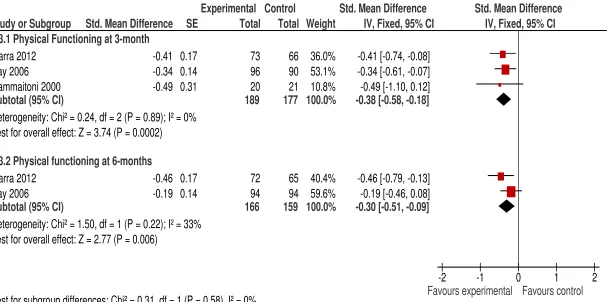
Data were pooled using meta-analysis for three studies excluding Hoffman et al.18 for
clinical heterogeneity and Bruhn et al.16 for insufficient data. Meta-analysis was undertaken at 3
and 6 months follow-up. At 3-months follow up there was a statistically significant
improvement in the intervention group with SMD of -0.38 (95% CI -0.58, -0.18) compared to the
control group (Figure 4). This effect is equivalent to 4.84 points (95% CI -7.38, -2.29) on a 0 to
68 point function subscale of WOMAC.26 There was no heterogeneity in the result (I2=0%). Two
trials reported physical functioning status at 6-months.19,22 Meta-analysis showed a significant
improvement in physical functioning at 6-months follow up as well in the intervention group
compared to the control group with SMD -0.30 (95% CI -0.51,- 0.09) corresponding to -3.82
points (95% CI -6.49, -1.14) on WOMAC 0 to 68 function subscale.26 There was non-significant
heterogeneity in the result (I2=33%).
Patient satisfaction
Three studies reported patient satisfaction as an outcome.16,19,23 Gammaitoni et al23
assessed patient satisfaction with different components of the service using the Treatment
Helpfulness Questionnaire (THQ), a validated measure to assess patient satisfaction with chronic
pain management service.31 It was modified to include measures of satisfaction with the
pharmaceutical care programme, including: access to medication, pharmacy service, delivery of
medication, pharmacist phone calls, time spent obtaining medications, pharmacist medication
counselling and information provided by the pharmacist. Each item was ranked on a 11 point
scale ranging from -5 (extremely harmful) to +5 (extremely helpful). Hay et al19 assessed
satisfaction as a dichotomous outcome (satisfied, not satisfied). For Bruhn et al,16,21 patient
assessed at the end of 3-months using Likert scale ratings of statements about their pain and
pharmacist consultation, and open ended questions about pharmacist consultations.20
In the Gammaitoni et al study,23 patients in the intervention group were significantly
more satisfied with various components of the pharmaceutical care programme including
pharmacy service (p=0.001), delivery of medication (p=0.001), pharmacist phone calls
(p=0.003), time spent in obtaining medications (p<0.001), pharmacist medication counselling
(p=0.003), and information provided by the pharmacist (p=0.013). However, there was no
significant difference in satisfaction with the whole programme domain (p=0.72) of the patient
satisfaction survey. In the control group, patients were only satisfied with psychological
assessment and treatment (p<0.05). It should be noted here that Gammaitoni et al23 only
compared the difference in patient satisfaction from baseline to 3-month study period in both
intervention and control groups independently, but did not compare control with the intervention
group. In the Hay et al study,19 intervention group patients were significantly more satisfied with
treatment at 3-months [-20%; 95% CI (-33 to -6)] and 12-months-[-19%; 95%CI (-32 to -4)]
follow-up but not at 6-months [-14%; 95%CI (-28 to 1)]. Bond et al,20 linked to Bruhn et al,16,21
reported that 85% (38/46) of the patients in the prescribing arm were totally satisfied with the
received treatment. Patient satisfaction rates were not reported for the other intervention
(medication review alone) and control groups.
Data for patient satisfaction were pooled for two studies (Figure 5).19,23 Meta-analysis
showed significantly greater patient satisfaction in the intervention group with SMD -0.39 [95%
CI (-0.68, -0.10)]. Using the universal rule of thumb, this effect size corresponds to ‘small to
3.4.4.4. Quality of Life:
Three studies assessed quality of life (QoL).16,18,22 Hoffmann et al18 used the Medical Outcomes
General Health Survey (SF-36), a 36-item generic tool with demonstrated validity and reliability
to assess QoL.29 Bruhn et al 21 used the SF-12,30 a validated shorter version of SF-36.29 Marra et
al22 assessed QoL using WOMAC (global) and Health Utilities Index-3 (HUI-3), a generic and
preference-scored instrument for measuring health status and health related quality of life.27
Higher scores on HUI-3 indicate better health.27
In the Hoffmann et al trial,18 compared to the control group, there was no significant
difference in the intervention group in the physical health subscale (p=0.85) of SF-36 but a
statistically significant difference was found in the mental health subscale (p=0.02) of SF-36 at
the end of the 4-month study period. Similarly, Bruhn et al 21 reported a significant improvement
in the mental health component of SF-12 (p=0.04) but not on the physical health component
(p=0.75) at 6-months follow-up. Marra et al 22 reported a significant improvement in WOMAC
(Global) at 3-months [-1.99; 95% CI (-3.45, -0.54)] and 6-months [-2.40; 95% CI (-4.10,-0.71)]
in the intervention group compared to the control. However, HUI-3 failed to show significant
differences in QoL between the intervention and control group at 3-months [0.04; 95% CI (-0.03,
0.12)] and 6-months [0.01; 95%CI (- 0.06, 0.10)].
Meta-analysis was not undertaken as clinical heterogeneity ruled out Hoffmann et al18
from meta-analysis and insufficient data ruled out trial by Bruhn et al. 16,21
3.4.4.5. Adverse effects
Surprisingly, none of the studies except Phelan et al,17 linked to the Hay et al trial,19
constipation (10), drowsiness (8), gastro intestinal upset (8) and others (4) from prescribed
analgesics at the initial consultation. During follow-up the side effects were reduced or stopped
in 25 patients by amending their medication. The remaining five patients continued with their
medication unchanged as the medications were effective and the side effects were tolerable.
Discussion:
Main results
The search strategy identified five studies which met the inclusion criteria. The ‘grey
literature’ was not searched and only studies published in the English language were included in
the systematic review. Pharmacists delivered interventions in different settings such as
community pharmacies, 18,22 general practices 19,21 and university pain clinic23 indicating that
the intervention can be potentially delivered in multiple settings. Furthermore, the included trials
involved patients with various chronic pain aetiologies, demonstrating that the pharmacist-led
medication review may be effective for all different types of chronic pain conditions. Two trials
originated from the UK 19,21 and one each from the USA,23 Canada22 and Germany 18 indicating
a growing interest in evaluating the role of pharmacists in chronic pain management in the
developed world. This may be due to the high disease burden of chronic pain and a growing
necessity to involve other healthcare professionals such as pharmacists and nurses actively in
direct patient care to reduce the workload on general practitioners (GPs)/primary care physicians
(PCPs) in these countries.
The risk of bias was assessed for all of the included studies. There was low or unclear
risk of bias across all the domains except for blinding of participants and personnel where there
the pharmacists conducting medication reviews and the patients receiving it as, in most
instances, the medication review was conducted face-to-face. Although the nature of intervention
prevented blinding of participants and personnel, outcome assessors were blinded in two of three
trials used in the meta-analysis, and in the third trial the outcome assessments were carried out
using a standardized computer aided interview, minimising detection bias. The research evidence
suggests that, on average, lack of blinding in RCTs is associated with a 9% increment in the
intervention effect when measured as odds ratio.33 Trials with more subjective outcomes, such
as pain trials, are likely to be affected more than those which measure objective outcomes.34
Concealment of allocation is necessary to limit selection bias but allocation concealment may not
be possible for cluster-randomized controlled trials. Among the included trials, only one study 19
described an adequate method for concealment of allocation (opaque envelopes). However,
treatment allocation was disclosed to study nurses by 15 of 325 participants (4.6%).19
Clinical homogeneity was considered before pooling data statistically. Data from a study
by Hoffmann et al 18 were not considered for meta-analysis as the study involved patients with
chronic headache and migraine, which is a neurological condition and has an episodic nature 35
unlike other chronic pain conditions and requires different treatment. The full report of Bruhn et
al 21 study has not yet been published and the data reported in conference abstracts 16,20,21 was not
enough to be pooled statistically. The corresponding author was contacted to obtain additional
data but had to decline due to restrictions by the funding agency. It would be interesting to
re-analyse the data once the results of Bruhn et al are available. Other trials were relatively similar
in terms of nature of intervention, patient follow-up and patients’ pain scores. Meta-analysis was
conducted at two time points; 3-months and 6-months because the studies included in the
short with long term trials is not recommended as it produces larger treatment effect than
combining longer term trials alone.36 Furthermore, the response to placebo tends to be larger in
longer trials.37 Therefore, meta-analysis was conducted at two time points to limit any bias
arising from combining short-term trials with long-term trials.
Since the trials measured the same outcomes using different scales, data were pooled
using SMD for each outcome. To interpret SMD, in line with the Cochrane’s guidance,14 it was
re-expressed in the units of a specific measurement scale for two of the three outcome measures
that were statistically combined, pain intensity and physical functioning. This was achieved by
multiplying SMDs for pain intensity and physical functioning with the standard deviation of the
numerical rating scale (0 to 10) and physical functioning subscale of WOMAC (0-20)
respectively. Both of the standard deviations were obtained as pooled standard deviations of
baseline scores from the Hay et al study.19 Only the summary measure of effect was
back-transformed to enhance clinical interpretation. For the third outcome measure, patient
satisfaction, SMD was re-expressed using rules of thumbs for effect sizes 14,31 as one of the
trials19 measuring patient satisfaction reported it as dichotomous outcome measure and the other
trial 23 used a modified version of a validated questionnaire, compromising its validity and
reliability .
Meta-analysis showed a statistically significant reduction in pain intensity and significant
improvement in physical functioning in the intervention group compared with the control group.
However, the clinical significance of these findings is arguable and needs careful consideration.
The use of average results of continuous data (e.g. pain intensity) can be misleading 38 as it is
argued that the population distributions of pain scores and/or pain relief are usually ‘U-shaped’
poor pain relief. Pain scores/pain relief should therefore be reported as percentage of patients
responding to the treatment instead of average pain scores, to reflect the actual number improved
or deteriorated. All the trials included in the systematic review reported mean pain score rather
than reporting percentages of patients responding to the treatment. The meta-analysis indicates
potential benefit for patients; however, there is uncertainty around the clinical significance of this
benefit, limiting wider clinical implementation. Furthermore, medication review was conducted
as part of multi-component interventions in three of the five studies so the “active ingredient” of
the intervention is not known. However, the impact of the intervention on other drug-related
outcomes such as: reduction in side effects documented by Phelan et al, 17 in a report linked to
Hay et al;19 the reduction in the use of Non Steroidal Anti Inflammatory Drugs (NSAIDS)
documented in Hay et al; 19 and the high acceptance of pharmacists’ recommendations suggest
that pharmacist-led medication review is an important component in overall pain management
and can improve patient reported outcomes.18,22,23
Implications for pharmacy practice and policy
With the advance of the concept of pharmaceutical care,39 the focus of pharmacist-led
services has shifted from being product-centred to patient-centred. This systematic review has
identified and synthesised data which demonstrates the effectiveness of pharmacist-led
medication review in chronic pain management. Findings have raised two questions which need
to be considered by service commissioners and policy makers before a wider role for pharmacists
in chronic pain management is put into practice. Firstly, certain issues related to delivery of the
intervention such as ‘how much’, how often’, ‘how long’, must be carefully considered as
use of the service may not be cost-effective and may put an additional burden on healthcare
systems. Furthermore, it is still unknown whether the pharmacist-led medication review benefits
all types of chronic pain patients or only certain types of patients. However, it can be argued that
medication review by an expert pharmacist may reduce drug- related problems and adverse
effects in all patients irrespective of the pain aetiology. Secondly,
short-courses/programs/residency-training are needed to provide specialised education and training in
pain management to all the pharmacists in order to achieve maximum clinical benefit. In the
past, the need for specialised training programmes has also been advocated in the literature.40
However, to date, such training programmes are not widely available for pharmacists especially
outside the USA.41,42 Training programmes to produce skilled pharmacy human recourse in pain
management is essential to ensure sustainability and clinical effectiveness of pharmacist-led pain
management service.
The findings of the systematic review may not be transferable to developing countries as
the pharmacy profession is in transition from ‘industry-oriented’ to ‘patient-oriented’. Over the
past decade, changes in undergraduate curriculum have been made together with the
development of clinical oriented postgraduate programs 43 to equip pharmacists with necessary
clinical knowledge to meet growing needs of the patients.44,45 However, there is still a long way
to go before these changes can make significant impact in transforming pharmacy practice and
relevant polices in these countries.
Implications for future research:
The role of pharmacists in chronic pain management is still relatively new and requires
further exploration. The current evidence suggests that pharmacist-led medication review is
functioning. Future research should evaluate the optimum and cost-effective mode/method and
duration of delivery of the intervention to achieve maximum clinical benefit. Standardization of
the intervention may not be possible due to the individualized needs of the patients especially
those taking opioid analgesics may need a more frequent medication review to limit abuse and
ensure safety.
Improved quality of reporting of clinical trials involving chronic pain patients is needed.
In addition to CONSORT guidance on the conduct and reporting of clinical trials,45 the
researchers should also adhere to the Initiative on Methods, Measurement, and Pain Assessment
in Clinical Trials (IMMPACT) guidance in designing, conducting and reporting their
findings.36,47,48 As discussed earlier, the researchers instead of reporting average pain scores only
should always report percentages of patients achieving minimally important, moderately
important and substantial clinical difference.49
Trials involving only non-malignant pain patients were included as cancer pain would
have introduced clinical heterogeneity and complicated clinical interpretation of the findings. It
would be interesting to evaluate the effectiveness of pharmacist-led medication review among
patients with cancer pain as effective management of cancer pain is very important in overall
cancer management, especially in end of life care. Finally, the cost-effectiveness of
pharmacist-led medication review in chronic pain management is yet to be evaluated and this needs
addressing.
The high prevalence of chronic pain and its associated burden on healthcare systems and
societies across the globe calls for high quality research to improve both diagnosis and
in the USA, less than one percent of National Institutes of Health (NIH) budget was given for
pain research.51 Underfunding of pain research is likely to damage initiatives to improve pain
management due to a lack of research evidence.
Limitations
In terms of the design of the systematic review there were two major limitations. Firstly, only
studies reported in English were included, which may have led to language bias.52 Non-English
studies were not included because the review team had no funding for professional translators.
One study 53 was excluded during screening of full-texts of included studies as it was published
in Spanish. However, conflicting results have been reported in the literature examining the extent
of the effect of language bias on the findings of systematic reviews.54,55 Secondly, publication
bias may have been introduced as no attempt was made to locate unpublished trials (grey
literature). The findings of the research evaluating the impact of inclusion or exclusion of ‘grey’
literature in meta-analysis of RCTs are inconsistent.56,57 The major issue with data acquisition is
that only investigators with positive results may be willing to share their results which may
introduce bias in to the systematic review. Finally, the located studies may only be a small part
and ‘unrepresentative’ of all the unpublished studies.14 Systematic review authors in future may
consider including studies not published in English as well as unpublished studies, to overcome
the above mentioned limitations.
Conclusion
Pharmacists can play an important role in improving chronic pain management. They can deliver
interventions independently and as part of multidisciplinary teams in both community and
is effective in reducing pain intensity and improving physical functioning.Furthermore, patients
were generally satisfied with the service provided by the pharmacists. There is also weak
evidence of preventing/stopping adverse effects associated with the use of medicines among
chronic pain patients. The clinical significance of these findings remains to be established.
Future clinical trials evaluating the effectiveness of pharmacist-led interventions in chronic pain
must adhere to IMMPACT guidance 47,48 in designing, conducting and reporting their findings
in addition to CONSORT guidance.46 This will ensure selection of the recommended uniform
outcome domains and measures, and quality reporting of the trial results facilitating not only
clinical interpretation but also data synthesis in future. As the focus of care shifts from hospital
to community, pharmacists especially community pharmacists have the potential to reduce the
chronic pain burden on healthcare system and society by ensuring the safe and effective use of
References:
1. Committee on Advancing Pain Research, Care, and Education, Institute of Medicine.
Relieving pain in America: a blueprint for transforming prevention, care, education and
research. Washington D.C: The National Academies Press 2011.
2. Breivik H, Collett B, Ventafridda V, et al. Survey of chronic pain in Europe: prevalence,
impact on daily life, and treatment. Eur J Pain 2006;10:287-333.
3. Hanlon JT, Fillenbaum GG, Studenski SA, et al. Factors associated with subotimal
analgesic use in community-dwelling elderly. Ann Pharmacother 1996;30:739–44.
4. Centers for Disease Control and Prevention. Unintentional drug poisoning in the United
States. 2010. Available at http://www.cdc.gov/homeandrecreationalsafety/pdf/poison-issue-brief.pdf. Assessed 11 January 2013
5. Centers for Disease Control and Prevention Analysis. Vital Signs: Overdoses of
Prescription Opioid Pain Relievers - United States, 1999-2008. Morbidity and Mortality
Weekly Report (MMWR) [online serial]. 2011;60(43):1487-1492. Available at
http://www.cdc.gov/mmwr/preview/mmwrhtml/mm6043a4.htm. Assessed 11 January 2013
6. Bond C. The MEDMAN study: A randomized controlled trial of community
pharmacy-led medicines management for patients with coronary heart disease. Fam Pract
2007;24:189-200.
7. Casteel C, Blalock SJ, Ferreri S, et al. Implementation of a community pharmacy-based
falls prevention program. Am J Geriatr Pharmacother 2011;9:310-319
8. Briggs M, Closs SJ, Marczewski K, et al. A feasibility study of a combined
9. Sorensen J, Frich L. Home visits by specially trained nurses after discharge from
multi-disciplinary pain care: A cost consequence analysis based on a randomised controlled
trial. Eur J Pain 2008;12:164-71.
10.Stannard C, Johnson M. Chronic pain management--can we do better? An
interview-based survey in primary care. Curr Med Res Opin 2003;19:703-6.
11.Bennett MI, Bgnall AM, Raine G, et al. Educational interventions by pharmacists to
patients with chronic pain: Systematic review and Meta-analysis. Clin J Pain 2011;27:
623-630
12.Hadi MA, Alldred DP, Closs SJ, Briggs M. Effectiveness of pharmacist-led medication
reviews in improving patient outcomes in chronic pain: A systematic review protocol.
Can Pharm J 2012;145:264-6
13.International Association for the Study of Pain. Classification of chronic pain. Pain
1986;Supplement 3:S1-S225
14.Higgins JPT, Green S, editors. Cochrane Handbook for Systematic Reviews of
Interventions Version 5.1.0 [updated March 2011]: The Cochrane Collaboration; 2011.
15.Marra CA, Tsuyuki RT, Soon JA, et al. Design of a randomized trial of a
multidisciplinary intervention for knee osteoarthritis: Pharmacist Initiated Intervention
Tiral in Osteoarthritis (PhIT-OA). Can Pharm J 2008;141:33-8
16.Bruhn H, Bond CM, Elliott A, et al. Pharmacist-led management of chronic pain in
primary care: The PIPPC study. Health Services Research and Pharmacy Practice
Conference; 2011 May 5-6; Norwich, United Kingdom. Int J Pharm Pract 2011
17.Phelan M, Blenkinsopp A, Foster NE, et al. Pharmacist-led medication review for knee
pain in older adults: Content, process and outcomes. Int J Pharm Pract 2008;16:347-55
18.Hoffmann W, Herzog B, Muehlig S, et al. Pharmaceutical Care for Migraine and
Headache Patients: A community-based, randomized intervention. Ann Pharmacother
2008;42:1804-13.
19.Hay EM, Foster NE, Thomas E, et al. Effectiveness of community physiotherapy and
enhanced pharmacy review for knee pain in people aged over 55 presenting to primary
care: Pragmatic randomised trial. BMJ 2006;333:995-8.
20.Bond CM, Bruhn H, Blyth A, et al. Pharmacist-led management of chronic pain in
primary care: The experiences of patients, pharmacists and GPs. Royal Pharmaceutical
Society Conference; 2011 Sep11-12; London, UK. Int J of Pharm Prac 2011;19(supp
2):24-5.
21.Bruhn H, Blyth A, Elliott A, Hannaford P, Holland R, Lee A, et al. Pharmacist-led
management of chronic pain in primary care: The PIPPC study. Journal of Epidemiology
and Community Health. 2011;65(III):A1-A40.
22.Marra CA, Cibere J, Grubisice M, et al. Pharmacist initiated intervention trial in
osteoarthritis (PhIT-OA): a multidisciplinary intervention for knee osteoarthritis. Arthritis
Care Res 2012;64:837-45
23.Gammaitoni AR, Gallagher RM, Welz M, et al. Palliative pharmaceutical care: A
randomized, prospective study of telephone-based prescription and medication and
counseling services for treating chronic pain. Pain Med 2000;1:317-31.
24.Cleeland CS, Ryan KM. Pain assessment: global use of the Brief Pain Inventory. Ann
25.Furlong WJ, Feeny DH, Torrance GW, et al. 2001. The Health Utilities Index (HUI)
system for assessing health-related quality of life in clinical studies. Ann Intern Med
2001;33:375-384
26.Bellamy N. WOMAC osteoarthritis index: a user's guide. Ontario: London Health
Services, McMaster University; 1996.
27.Gallagher RM. The Uniform Outcome Measures Project. Pain Med 2000;15:1-4.
28.Von Korff M, Ormel J, Keefe FJ, et al. Grading the severity of chronic pain. Pain
1992;50:133-49.
29.Ware JE, Sherbourne CD. The MOS 36-item short-form health survey (SF-36).
Conceptual framework and item selection. Med Care 1992;30:473-83.
30.Ware Jr JE, Kosinski M, Keller SD. A 12-item Short Form Health Survey: Construction
of scales and preliminary tests of reliability and validity. Med Care 1996;34:220-33.
31.Chapman SL, Jamison RN, Sanders SH. Treatment helpfulness questionnaire: a measure
of patient satisfaction with treatment modalities provided in chronic pain management
programs. Pain 1996;68:349-61.
32.Cohen J. Statistical Power Analysis in the Behavioral Sciences (2nd edition). Hillsdale,
NJ: Lawrence Erlbaum Associates, Inc.; 1988.
33.Pildal J, Hróbjartsson A, Jørgensen KJ, et al. Impact of allocation concealment on
conclusions drawn from meta-analyses of randomized trials. Int J Epidemiol
2007;36:847-57.
34.Wood L, Egger M, Gluud LL, et al. Empirical evidence of bias in treatment effect
estimates in controlled trials with different interventions and outcomes:
35.National Institite of Neurological Disorders and Stroke. NINDS Migraine information
page. Bethesda: National Institutes of Health; 2012 [cited 2012 10 December]; Available
from: http://www.ninds.nih.gov/disorders/migraine/migraine.htm.
36.Moore RA, Eccleston C, Derry S, et al. "Evidence" in chronic pain-establishing best
practice in the reporting of systematic reviews. Pain 2010;150:386-9.
37.Quessy SN, Rowbotham MC. Placebo resonse in neuropathic pain trials. Pain
2008;138:479-83.
38.McQuay H, Carroll D, Moore A. Variation in the placebo effect in randomised controlled
trials of analgesics: all is as blind as it seems. Pain 1996;64:331-5.
39.Mikeal RL, Brown TR, Lazarus HL, et al. Quality of pharmaceutical care in hospitals.
Am J Hosp Pharm 1975;32:567-74.
40.LaPerriere JA. The need for specialty training for pharmacists in pain management. J
Pain Palliat Care Pharmacother 1994; 2:23-39.
41.Departmant of Pharmacy. Pharmacy Residency Program: Pain Management and
Palliative Care. Baltimore, MD. Available at:
http://www.hopkinsmedicine.org/pharmacy/residents/programs/pain_management.html. Assessed December 10, 2012
42.American Society of Consultant Pharmacists Foundation. Pharmacotherapy traineeship:
Pain management traineeship. Alexandria 2012 [cited 2012 10 December 2012];
Available at:
43.Hadi MA, Long CM, Lee WL, et al. Developing a practice based Master in clinical
pharmacy programme at Universiti Teknologi MARA, Malaysia. Am J Pharm Edu
2010;74(2):32.
44.Hadi MA. PharmD and Needs based education: An alternate view. Am J Pharm Edu
2010;74(7):125.
45.Hadi MA, Awaisu A. Postgraduate programs in clinical pharmacy and pharmacy
practice: Are we heading in the right direction? Am J Pharm Edu 2010;74:72.
46.Moher D, Hopewell S, Schulz KF, et al. CONSORT 2010 Explanation and Elaboration:
updated guidelines for reporting parallel group randomised trials. BMJ 2010;340(c869).
doi: 10.1136/bmj.c869
47.Turk DC, Dworkin RH, Allen RR, et al. Core outcome domains for chronic pain clinical
trials: IMMPACT recommendations. Pain 2003;106:337-45.
48.Dworkin RH, Turk DC, Farrar JT, et al. Core outcome measures for chronic pain clinical
trials: IMMPACT recommendations. Pain 2005;113:9-19
49.Dworkin RH, Turk DC, Wyrwich KW, et al. Interpreting the Clinical Importance of
Treatment Outcomes in Chronic Pain Clinical Trials: IMMPACT Recommendations. J
Pain 2008;9:105-21.
50.The Mayday Fund Special Committee on Pain and the Practice of Medicine. A call to
revolutionize chronic pain care in America: An opportunity in health care reform.
Washington, DC: The Mayday Fund 2009 Available at
51.National Institues of Health. National Institutes of Health’s Research Portfolio Online
Reporting Tool (RePORT). Bethesda, MD: NIH; 2008. Available at:
http://www.report.nih.gov/nihdatabook/. Assessed Decmber 10, 2012
52.Moher D, Fortin P, Jadad AR, et al. Completeness of reporting of trials published in
languages other than English: implications for conduct and reporting of systematic
reviews. Lancet 1996;347:363-6.
53.Marti AM, Olmedo GC, Vera JC, Alaracon MD, Ibanez JD. Effectiveness of a
pharmaceutical care unit for the control of severe chronic pain. Farm Hosp
2005;29:37-45
54.Jünia P, Holensteinb F, Sternea J, et al. Direction and impact of language bias in
meta-analyses of controlled trials: empirical study. Int J Epidemiol 2002;31:115-23.
55.Moher D, Pham B, Lawson ML, et al. The inclusion of reports of randomised trials
published in languages other than English in systematic reviews. Health Technol Assess
2003;7:1-90.
56.Hopewell S, McDonald S, Clarke M, et al. Grey literature in meta-analyses of
randomized trials of health care interventions. Cochrane Database of Syst Rev
2007(2):MR000010.
57.Egger M, Juni P, Bartlett C, et al. How important are comprehensive literature searches
and the assessment of trial quality in systematic reviews? Empirical study. Health
Records identified through database searching (n = 664)
Records after duplicates removed (n = 478)
Records screened (n = 478 +5)
Full-text/assessed for eligibility (n = 27+5)
Studies included in qualitative synthesis (9 reports from 5 studies)
Studies included in meta-analysis (n = 3)
Additional records identified (n = 5)
Records excluded (n = 456)
[image:34.612.76.536.104.637.2]Full-text articles excluded Not an RCT/CCT = 14 Could not retrieve full text=3 Not in English= 1
Figure 2: Risk of bias in included trials across each domain Random sequence generation (selection bias)
Allocation concealment (selection bias) Blinding of participants and personnel (performance bias)
Blinding of outcome assessment (detection bias) Incomplete outcome data (attrition bias)
Selective reporting (reporting bias) Baseline differences Invalid questionnaires Loss of clusters Appropirate statistical analysis (Cluster RCTs)
0% 25% 50% 75% 100%
Study or Subgroup
1.2.1 Pain intensity at 3-month (SMD)
Gammaitoni 2000 Hay 2006 Marra 2012
Subtotal (95% CI)
Heterogeneity: Chi² = 0.29, df = 2 (P = 0.86); I² = 0% Test for overall effect: Z = 3.46 (P = 0.0005)
1.2.2 Pain intensity at 6 -month (SMD)
Hay 2006 Marra 2012
Subtotal (95% CI)
Heterogeneity: Chi² = 1.64, df = 1 (P = 0.20); I² = 39% Test for overall effect: Z = 2.73 (P = 0.006)
Test for subgroup differences: Chi² = 0.15, df = 1 (P = 0.70), I² = 0%
Std. Mean Difference
-0.44 -0.31 -0.42 -0.18 -0.47 SE 0.32 0.15 0.17 0.15 0.17 Total 20 98 73 191 100 72 172 Total 21 89 66 176 93 65 158 Weight 11.0% 50.0% 39.0% 100.0% 56.2% 43.8% 100.0%
IV, Fixed, 95% CI
-0.44 [-1.07, 0.19] -0.31 [-0.60, -0.02] -0.42 [-0.75, -0.09]
-0.37 [-0.58, -0.16]
-0.18 [-0.47, 0.11] -0.47 [-0.80, -0.14]
-0.31 [-0.53, -0.09]
Experimental Control Std. Mean Difference Std. Mean Difference IV, Fixed, 95% CI
-1 -0.5 0 0.5 1
Favours experimental Favours control
Figure 3: Meta-analysis of pain intensity at 3 and 6 month. CI= Confidence Interval, SMD = Standardized mean
[image:36.792.93.628.71.315.2]Study or Subgroup
1.3.1 Physical Functioning at 3-month Marra 2012
Hay 2006 Gammaitoni 2000 Subtotal (95% CI)
Heterogeneity: Chi² = 0.24, df = 2 (P = 0.89); I² = 0% Test for overall effect: Z = 3.74 (P = 0.0002)
1.3.2 Physical functioning at 6-months Marra 2012
Hay 2006
Subtotal (95% CI)
Heterogeneity: Chi² = 1.50, df = 1 (P = 0.22); I² = 33% Test for overall effect: Z = 2.77 (P = 0.006)
Test for subgroup differences: Chi² = 0.31, df = 1 (P = 0.58), I² = 0% Std. Mean Difference
-0.41 -0.34 -0.49 -0.46 -0.19 SE 0.17 0.14 0.31 0.17 0.14 Total 73 96 20 189 72 94 166 Total 66 90 21 177 65 94 159 Weight 36.0% 53.1% 10.8% 100.0% 40.4% 59.6% 100.0%
IV, Fixed, 95% CI
-0.41 [-0.74, -0.08] -0.34 [-0.61, -0.07] -0.49 [-1.10, 0.12] -0.38 [-0.58, -0.18]
-0.46 [-0.79, -0.13] -0.19 [-0.46, 0.08] -0.30 [-0.51, -0.09]
Experimental Control Std. Mean Difference Std. Mean Difference IV, Fixed, 95% CI
-2 -1 0 1 2
Favours experimental Favours control
[image:37.792.90.697.72.374.2]Study or Subgroup
Gammaitoni 2000 Hay 2006
Total (95% CI)
Heterogeneity: Chi² = 0.72, df = 1 (P = 0.40); I² = 0% Test for overall effect: Z = 2.62 (P = 0.009)
Std. Mean Difference
-0.16 -0.46
SE
0.31 0.17
Total
20 96
116
Total
21 88
109
Weight
23.1% 76.9%
100.0%
IV, Fixed, 95% CI
-0.16 [-0.77, 0.45] -0.46 [-0.79, -0.13]
-0.39 [-0.68, -0.10]
Experimental Control Std. Mean Difference Std. Mean Difference IV, Fixed, 95% CI
-2 -1 0 1 2
[image:38.792.94.718.73.179.2]Favours experimental Favours control
Table 1: Characteristics of included studies
Study/Year country
Trial design
Setting Chronic pain Aetiology Sample recruited (completed) Follow up (months)
Intervention Dose of intervention Pharmacist trained in pain management Gammaitoni et al/ 2000 (USA)
I-RCT University
pain clinic
Multiple N=74
I=38 (20)
C=36(21)
3 MR through
telephone
interviews, and a
specialized
prescription
delivery service
81 phone calls (45 to
patients and 36 to clinic
staff managing patients)
were made in 12 weeks.
Mean 1.2 calls per
patient.
Yes
Hay et
al/2006
(UK)
I-RCT General
practice Knee pain N=325* I=108(100,103,99) C=108(92,98,90)
3, 6 and
12
MR and advised
patients
face-to-face individually
based on leaflet
3 to 6 sessions of 20min
each over 10 weeks
Not known Hoffmann et al/2008 (Germany) C-RCT Community pharmacy Headache & migraine N=410 I=201 (163) C=209 (194)
4 Face-to-face MR
plus advice on
pacing activities
and goal setting.
Each pharmacy
counselled on average
4.6±3.01 patients (range
1-15) corresponding to
2hrs/per patient
approximately
Bruhn et
al/2011
(UK)
I-RCT General
practice
Multiple N=196*
I=70(60,58)
I**=63(50, 49)
C=63(54,55)
3 and 6 MR plus
recommendations
to the GP
Data not available Yes
Marra et al/2012 Canada C-RCT Community pharmacy Knee pain N=139 I=73(72) C=66(65)
3 and 6 MR + education+
Physiotherapist
guided exercise
297 pharmacist-patient
follow ups were
performed over 6 months
resulting in 355
recommendations to
patients’ primary care
physicians (4.8
recommendations/patient) Yes
*Two intervention groups in trial. ** The second intervention group also received medication review as part of intervention. Data for
only one intervention group is presented here. I-RCT=Individual Randomized controlled trial, C-RCT= Cluster randomized controlled