Open Access
Research article
A method to determine spatial access to specialized palliative care
services using GIS
Jonathan Cinnamon, Nadine Schuurman* and Valorie A Crooks
Address: Department of Geography, Simon Fraser University, 8888 University Drive, Burnaby, British Columbia, V5A 1S6, Canada
Email: Jonathan Cinnamon - [email protected]; Nadine Schuurman* - [email protected]; Valorie A Crooks - [email protected] * Corresponding author
Abstract
Background: Providing palliative care is a growing priority for health service administrators worldwide as the populations of many nations continue to age rapidly. In many countries, palliative care services are presently inadequate and this problem will be exacerbated in the coming years. The provision of palliative care, moreover, has been piecemeal in many jurisdictions and there is little distinction made at present between levels of service provision. There is a pressing need to determine which populations do not enjoy access to specialized palliative care services in particular.
Methods: Catchments around existing specialized palliative care services in the Canadian province of British Columbia were calculated based on real road travel time. Census block face population counts were linked to postal codes associated with road segments in order to determine the percentage of the total population more than one hour road travel time from specialized palliative care.
Results: Whilst 81% of the province's population resides within one hour from at least one specialized palliative care service, spatial access varies greatly by regional health authority. Based on the definition of specialized palliative care adopted for the study, the Northern Health Authority has, for instance, just two such service locations, and well over half of its population do not have reasonable spatial access to such care.
Conclusion: Strategic location analysis methods must be developed and used to accurately locate future palliative services in order to provide spatial access to the greatest number of people, and to ensure that limited health resources are allocated wisely. Improved spatial access has the potential to reduce travel-times for patients, for palliative care workers making home visits, and for travelling practitioners. These methods are particularly useful for health service planners – and provide a means to rationalize their decision-making. Moreover, they are extendable to a number of health service allocation problems.
Background
Providing palliative care has become a priority for health system administrators worldwide. In many countries, existing palliative care service delivery is inadequate and
challenged by population aging, resulting in strained serv-ices that are increasingly unable to keep up with demand [1-4]. There is also growing realization that the develop-ment of palliative care services in many jurisdictions has Published: 30 June 2008
BMC Health Services Research 2008, 8:140 doi:10.1186/1472-6963-8-140
Received: 8 February 2008 Accepted: 30 June 2008
This article is available from: http://www.biomedcentral.com/1472-6963/8/140
© 2008 Cinnamon et al; licensee BioMed Central Ltd.
been piecemeal, unplanned, and largely unregulated which has ultimately exacerbated disparities in access to receiving care by geographic location and socio-economic status [5-7]. At the same time, it is recognized that initiat-ing palliative care for a patient with a life-limitinitiat-ing illness can reduce the burden placed on health care systems through freeing up space in acute care settings and halting curative treatments when the prognosis becomes terminal [8]. Furthermore, it is recognized that patients should have the right to receive care that is appropriate to their needs [9-11] and not be limited to simply what is availa-ble. As a result of these factors, health systems in Canada and worldwide are starting to recognize the need for improved palliative care delivery [6,10,12,13].
The equitable provision of health care services (i.e., care that is offered in a fair and just manner based on need) in an accessible fashion is a primary concern for health plan-ners; however, 'access' can be defined in many different ways. Access to health services can, for example, refer to: availability in terms of socio-economic status or geo-graphic location, the availability of information, wait-list times, and quality of services offered [4,14,15]. Health systems must therefore take into account various aspects of accessibility when planning service delivery. Recogni-tion that health care services are not equally or equitably accessible by all has started to drive policy making in pal-liative care [16]. In British Columbia (BC), the most west-ern province in Canada, there is increasing recognition of the need for better spatial access to palliative services for all residents. A recent framework for end-of-life care cre-ated by the BC Ministry of Health outlines a commitment to "establishing high quality end-of-life care and support as an integral part of our provincial health system" [17]. The need for palliative services to be accessible to all resi-dents of the province, and as close as possible to their home location is highlighted. Services located near to pal-liative care recipients' home communities will not only improve spatial accessibility for the patient, but will also reduce travel-time for workers making home visits and practitioners that deliver care in multiple communities. The present study examines the spatial accessibility of pal-liative care services for the residents of BC by employing a novel spatial analysis approach using Geographic Infor-mation Systems (GIS). The study focuses on specialized palliative care (SPC) services, but the spatial methodology introduced is relevant to a number of health service allo-cation problems in multiple jurisdictions.
Spatial Accessibility of Palliative Care
The influence of location and distance to health services on health outcomes are well documented [18-21]. Home location has been shown to determine access to and utili-zation of health services, with utiliutili-zation being inversely related to spatial access [14,20,22]. Furthermore, it has
been argued that a person's home location can also be a determinant of his/her overall level of health [23]. Thus, people who reside closer to sites of care delivery are more likely to utilize these services and obtain better health out-comes as a result. Spatial proximity to health care services particularly affects the elderly and younger populations, individuals with physical and mental impairments, and those residing in rural and remote areas through reduced mobility associated with these populations [22,24-26].
Canadian health organizations have expressed the need to research the geographic and demographic factors that influence palliative care delivery and uptake [27,28]. GIS-based analyses can provide robust decision support for health service studies by uncovering the geographic and demographic determinants of service utilization. An increasingly popular use of GIS in this realm is to deter-mine the spatial accessibility of services based on distance or travel-time from residence to site of care. Straight-line and road-network based measures of distance from resi-dence to site of care have been used in the past to measure accessibility. However, these methods are inappropriate for modelling access in large regions like BC because of the geographic diversity characterized by mountain ranges, valleys, meandering coastlines, and a mix of urban centres and rural hinterland. Various methods of measur-ing travel-time have been used in modellmeasur-ing spatial acces-sibility to health care services [see [19,29-33]]. Haynes et al. [34] validated the use of travel-time to measure spatial accessibility by comparing a GIS-based travel-time model with actual driving time to service locations. Results were highly correlated for modelled and actual travel-time to health care service locations.
Specialized Palliative Care
There is no single, universally accepted understanding of what palliative care services or practice entail [12,35]. This has contributed to wide disparities in the resources, capac-ity, and infrastructure devoted to palliative care delivery [1], and poses questions and challenges for palliative care research. As such, diversity is a hallmark of palliative care, evidenced by the range of treatments, sites of delivery, and populations eligible for care. Traditionally palliative care was directed at relieving pain in patients with cancer in the final stage of illness, though increasingly it is becoming available to those who require care for longer periods at end-of-life as well as those with non-cancerous conditions [2,36-38]. The type of palliative care delivered varies from pain management and comfort care to therapies and spir-itual counselling [39]. Counselling, bereavement services, and respite care for patients' families have also entered the palliative care service basket. Palliative care can be deliv-ered by specialized practitioners, general practitioners, allied health professionals, and informal caregivers such as volunteers and family members [25]. The care itself can be delivered in hospice residences, acute care settings, care facilities, and patients' homes [17].
The vagaries associated with palliative care can act as road-blocks to the effective promotion and delivery of quality end-of-life care [40]. What is needed, then, is an inclusive definition. Definitions posited by the World Health Organization (WHO) have been refined several times, mirroring the increased attention on end-of-life issues. The current WHO definition [41] is as follows:
Palliative care is an approach that improves the quality of life of patients and their families facing the prob-lems associated with life-threatening illness, through the prevention and relief of suffering by means of early identification and impeccable assessment and treat-ment of pain and other problems, physical, psychoso-cial and spiritual.
Based on suggestions from the European School of Oncol-ogy, Ahmedzai et al. [42] refined the WHO definition in a way that could help to improve both service delivery and research into palliative care issues. Palliative care can be usefully sub-divided into basic and specialized categories (p. 2194).
Basic palliative care is the standard of palliative care which should be provided by all healthcare profes-sionals, in primary or secondary care, within their nor-mal duties to patients with life-limiting disease.
Specialised palliative care is a higher standard of pallia-tive care provided at the expert level, by a trained multi-professional team, who must continually
update their skills and knowledge, in order to manage persisting and more complex problems and to provide specialised educational and practical resources to other non-specialised members of the primary or sec-ondary care teams. If a patient has difficult symptoms which cannot be controlled by his/her current health-care team, he/she has a right to be referred, and the current healthcare provider has an obligation to refer, to the local palliative care team. [42]
This distinction between basic and specialized care is use-ful to categorize the different types of care and locations of palliative care service delivery. Care that is delivered by general practitioners, some allied health professionals, and informal caregivers in home and acute care settings can be considered basic palliative care. Multi-focal care which is delivered by a multi-disciplinary team with some palliative care specialization in a variety of settings includ-ing the home constitutes SPC. Patients receivinclud-ing SPC often have access to a wider variety of specialist treatments and support, from comfort care to intense pain manage-ment, while their families can access a host of services that can include respite care, counselling and bereavement services. These services are provided by specially trained experts, which helps to ensure the best possible quality of death and dying for patient and support for the family during the palliative stage.
Albeit not definitive, studies have found that SPC is more effective at improving patients' quality of life in their final days than basic palliative care [43-45]. Also, a study by Morita et al. [46] found that bereaved family members of cancer patients who had received SPC were happier with the services provided compared with those who had not. Furthermore, general practitioners have acknowledged the benefits of SPC and favour referring a dying patient to a specialist at the end-of-life if this service is available [47,48]. Ensuring access to SPC for palliative care recipi-ents should be prioritized because it stresses education for all stakeholders and the right to expert care for all as a human right [1]. Reasons for establishing and/or enhanc-ing SPC are well-grounded and the benefits have been demonstrated; however, it is impossible to have palliative experts in all communities, especially in rural and remote areas. According to the SPC model, specialists should deliver palliative care whenever possible, but in commu-nities where SPC is not feasible, local general practitioners and informal and voluntary-sector caregivers should be trained in specialized methods.
distant communities without SPC services are highlighted as potential candidate locations to provide SPC to sur-rounding rural and remote areas. The SPC definition was chosen because it provides a standard of comparison for future spatial analyses of palliative care services in other countries and regions. Furthermore, it provides a frame-work for our future research goals of determining appro-priate locations for siting regional hubs of palliative care to serve the rural and remote regions highlighted by this study. These hubs will boast multi-professional teams to deliver SPC and will have the ability to educate local prac-titioners and caregivers in remote areas to provide good-quality basic palliative care where SPC is not feasible.
Methods
This study calculates the service areas or catchments of existing SPC locations in BC and the populations within those service areas. At the same time, the study identifies and calculates populations outside one hour to SPC. In addition, proportions of the population within and with-out the service catchments are calculated. The locations of current SPC services in the province were collected by directly contacting each of the five regional health author-ities. The locations that adhered to this definition included hospice residences and designated palliative care units within hospitals with a minimum of five beds. Five beds was considered the minimum for a hospital pallia-tive unit because it was expected that this would also mean the unit would have access to a multi-disciplinary team of palliative experts. Some smaller hospitals in BC set aside one or two beds for palliative patients on an as-needed basis, though care for these patients is typically provided by non-specialized volunteers and practitioners, and as such, do not meet the criteria for SPC. Thus, the number of beds was used as a proxy indicator for the pres-ence of an on-site multi-disciplinary team of palliative care specialists and not an indicator of palliative care sup-ply.
Locations of SPC services in each of the five BC health authorities were geocoded and mapped using ArcGIS 9.2 [49]. To create the service areas for each location, network-based travel-time catchments were created using the Net-work Analyst extension in ArcGIS, based on a proven travel-time catchment method [32]. Such an approach is part of an established literature on the use of travel-time to measure spatial accessibility [see [29-31,50]]. The Road Atlas of BC dataset from GIS Innovations was used to pro-vide travel-time measurement along road networks. This extensive road dataset includes travel impact variables such as speed limits, road surfaces, and stop signs for each road segment which allows for an accurate prediction of travel-time between any two points in the province that are connected by the road network. Catchments were cre-ated based on a travel-time of one hour to service
loca-tion. One hour travel-time was chosen as it reflects a reasonable daily commute to and from sites of care for palliative care workers and informal caregivers, because permanent relocation to urban areas is inconsistent with the wishes of those with a life-limiting illness or their fam-ilies[51].
To determine the population within each catchment, a spatial query method was employed using census block-level population data [52], the finest-scale at which popu-lation data is available in Canada. The total popupopu-lation of all individual Census Block geographic units within a maximum distance of 2500 metres from the catchments were summed to determine the total population that is within one hour drive to service locations. Schuurman et al. [32] describe the catchment creation and population linking procedures in greater detail in a study of access to hospitals in BC. Communities outside of the one-hour service areas were highlighted using a spatial query that selected all census-defined urban areas (communities with at least 1000 residents, with a population density of at least 400 people per km2) that had centroids within 2500 metres of the catchments.
Results
According to our working definition at the time of the analysis there were 29 locations where SPC was delivered in BC and three new locations slated to open in the near future. The sites of delivery included hospice residences and palliative care units in hospitals, each with varying capacities. Figure 1 shows the communities where SPC services are delivered in BC. One-hour travel time catch-ments for SPC services are shown in Figure 2. Catchcatch-ments were created for all 29 existing and three future service locations.
All of the Urban Areas greater than one-hour from SPC services are highlighted in Figure 3. IHA had the greatest number of urban areas (25) outside the one-hour catch-ments. The VCHA had four, VIHA had six, and NHA had 15 Urban Areas that were greater than one hour from SPC.
All of the urban areas in the FHA were within one hour travel-time to SPC.
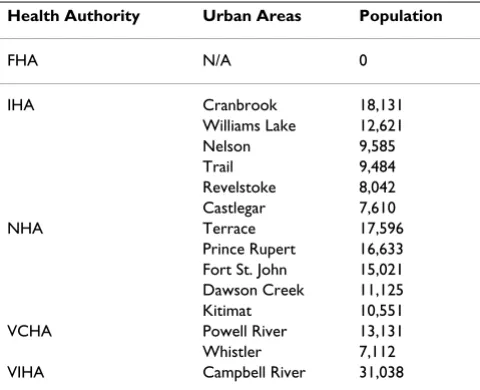
[image:5.612.95.523.100.472.2]Several larger regional centres are without access to SPC. Table 2 lists the largest communities in each health
Map of British Columbia showing locations where SPC is delivered
Figure 1
Map of British Columbia showing locations where SPC is delivered. Currently 29 locations in BC offer SPC. Three new locations are scheduled to open in 2008–09.
Table 1: Palliative Care Locations and Population within Catchment Areas for each Health Authority
Health Authority Locations Total Pop. Pop. In Catchment % in Catchment
FHA 8 (+2) 1,387,010 1,326,967 95.67
IHA 5 683,863 411,150 60.12
NHA 1 (+1) 297,415 107,150 36.03
VCHA 10 1,016,380 909,121 89.45
VIHA 5 693,779 582,100 83.90
Total 29 (+3) 4,078,447 3,336,500 81.81
[image:5.612.55.557.625.719.2]authority outside of the one-hour catchments. In the NHA, Terrace, Prince Rupert, and Fort St. John each have a population greater than 15,000 and are well outside of the SPC service areas. In the IHA, residents of Revelstoke, Williams Lake, and several larger communities in the Kootenay region are without reasonable spatial access to SPC services, including Nelson, Trail, Castlegar, and Cran-brook. Whistler and Powell River are the largest commu-nities in the VCHA region that do not have access to SPC. Campbell River, with a population of over 31,000 in the VIHA, sits just outside the existing SPC catchments. Fur-ther, several other smaller urban areas in more remote parts of Vancouver Island are at a significant spatial disad-vantage for accessing such services.
Discussion
We have undertaken a spatial analysis of spatial access to SPC services in BC. Figure 1 reveals that the majority of SPC locations are clustered in the extreme south-west of the province in and around the Vancouver area. This is no surprise given that a majority of the province's population resides in this area. Further, the FHA is recognized as hav-ing significantly invested in develophav-ing palliative care service infrastructure within its catchment area. The remaining locations are dispersed in the southern half of BC, mainly in larger regional communities.
At first glance, it appears that the spatial accessibility of SPC in BC is reasonably good, with over 81% of the prov-ince's population residing within one hour from at least one service location. Whilst this is true, spatial access
[image:6.612.95.536.97.466.2]var-One hour travel-time catchments for existing and future SPC locations in British Columbia
Figure 2
ies greatly by health authority as illustrated in Table 1 and Figure 2. The NHA has the lowest population base, but it is spread over the largest geographic area. With just two SPC locations, well over half of its population do not have reasonable spatial access to such care. The situation in the IHA is similar with just over half of its population enjoy-ing access to SPC. Most of the residents in the VCHA and FHA are within an hour drive to one or more SPC sites. Relatively good spatial access to SPC in these two heavily populated health authorities skews the overall rate to make it appear that access is reasonably good for the prov-ince as a whole.
By determining areas that are outside of the catchments, we can identify regions for which health system adminis-trators should consider siting further SPC services in the
province. Figure 3 highlights the urban areas in BC that are without spatial access to SPC services, specifically those located greater than one-hour of driving time away from sites. Of the 93 Statistics Canada defined urban areas that exist in BC, 50 are greater than one hour from the nearest service location. Evidenced by the above analysis, NHA and IHA communities are particularly burdened by unequal spatial access to SPC. The communities listed in Table 2 are potential candidates for situating future SPC services. The largest communities are most suitable because a large and stable core population is needed in order to ensure enough demand and also justify expendi-tures. Specifically, larger communities such as Prince Rupert in the NHA, and Cranbrook or Campbell River in the IHA are the most likely candidates based solely on their core population sizes. Surrounding populations
[image:7.612.104.531.101.465.2]Urban Areas outside of the one-hour SPC catchments
Figure 3
must also be taken into consideration when analyzing site suitability in order to achieve economies of scale. Several clusters of larger communities are evident in Figure 3. Clustering is apparent in the north-west NHA, including Prince Rupert, Terrace, and Kitimat, and in the north-east with Dawson Creek, Fort St. John, and Chetwynd. The Cranbrook-Fernie-Kimberley and Nelson-Castlegar-Trail areas in the Kootenay region of the IHA are in close prox-imity to each other. Installation of SPC in one community in each cluster would likely ensure spatial access to SPC for the residents of all of the nearby communities and rural areas. The next stage of this research is to assess the suitability of these sites for situating SPC services. The age structure and other relevant socio-demographic character-istics of each community will be taken into consideration to create a robust index of site suitability based on poten-tial need.
Limitations
Use of the SPC definition care may discount the efforts of informal caregivers and non-specialized types of care which also likely benefit the patient at the end-of-life. However, despite focussing on specialized care, this study does acknowledge the need for basic palliative care in some communities where SPC is not available or feasible. Another potential limitation was the fact that the supply side was considered to be equal among centres, and demand for SPC was not addressed. Several GIS model-ling types are available which take supply and demand into consideration; however, these methods are not appropriate for palliative care. Supply is usually measured as the number of care beds or number of physicians. As palliative care consists of a diverse set of therapies and interventions delivered in a multitude of settings, it is
likely impossible to determine the exact supply of services for any given area. In terms of demand, we assumed the whole population of the study area to be potential users of SPC. This is a reasonable assumption given that this type of care is now targeting all age groups; the only restriction is that a patient must have a life-limiting con-dition.
Possible limitations regarding the use of one hour as a rea-sonable travelling distance to services are apparent. This travel-time was chosen because of its importance within emergency services as the 'golden hour', the period of time in which patients in need of emergency care should arrive at hospital to minimize the risk of serious consequences [53,54]. One hour has been used in other GIS-based spa-tial analyses of travel-time to health services in large regions [29,32]. Furthermore, a sensitivity analysis helped to confirm the appropriate choice of catchment size for this study. Catchments based on a 90 minute travel-time captured less than 2.9% (minimum 0% in FHA, maxi-mum 8% in VIHA) more of the province's population overall compared with the 60 minute catchments. The original 60 minute catchments captured over 5.5% (min-imum 0.6% in FHA, max(min-imum 18.6% in VIHA) more than 30 minute catchments. Thus, the sensitivity analysis was useful in confirming our choice of one hour as the threshold for this study, as the increase in population was greater from 30 to 60 as opposed to the smaller gain from 60 to 90 minute catchments. True, larger catchments would likely suggest greater spatial accessibility, though the longer commute is an increased burden for palliative patients who wish to spend their remaining days at home, and the smaller increase in population gain renders larger catchments less appropriate as a measure of accessibility in this study. The other limitation with creating catch-ments based on a strict travel-time threshold is that spatial access drops to zero just outside the catchment. This is the case in Campbell River which is located just outside a catchment. In reality, this community may be serviced by the SPC locations in Port Alberni, Qualicum Beach or Nanaimo. Additionally, solely considering spatial access oversimplifies a diverse concept. Despite the potential limitations, this study provides a useful analysis of the dis-tribution of SPC in BC, the population of BC that can rea-sonably spatially access SPC, and has highlighted several communities where SPC implementation may benefit rural and remote regions.
Implications
[image:8.612.55.295.110.305.2]It is likely that numerous individuals at end-of-life living in communities significantly outside of the one-hour catchments either die without receiving SPC, are forced to commute an unreasonable distance to get to non-local/ regional service sites, or relocate to larger urban centres that have existing SPC. Relocation, however, is often Table 2: Largest Communities Greater Than One Hour to SPC
by Health Authority
Health Authority Urban Areas Population
FHA N/A 0
IHA Cranbrook 18,131
Williams Lake 12,621 Nelson 9,585
Trail 9,484
Revelstoke 8,042 Castlegar 7,610
NHA Terrace 17,596
Prince Rupert 16,633 Fort St. John 15,021 Dawson Creek 11,125 Kitimat 10,551 VCHA Powell River 13,131 Whistler 7,112 VIHA Campbell River 31,038
against the wishes of patients and their families and runs counter to the trend of ageing-in-place in rural and remote BC communities [55]. Furthermore, it is acknowledged that dying at home or in one's home community is pre-ferred by a majority of people [56-58]. The need for easily accessible SPC is further heightened by the move towards providing palliative care on day visits and short-term admissions for symptom control and not as a form of res-idential care [38,59-63]. Therefore, reasonable daily travel to and from a SPC site for the care recipient and his/her family, or to-and-from the patient's home or home com-munity for a SPC professional, is crucial. If a patient is accepted into a hospice residence or other residential serv-ice site (e.g., acute care hospital), it is vital that family and friends be able travel regularly to visit and provide com-fort in his/her final days. Finally, if a patient is able to remain at home during his/her final days and requires only minimal therapeutic intervention (e.g., pain man-agement, wound care), it is imperative that service provid-ers are available within a reasonable travel-time from the care recipient's home to deliver them.
According to our model, close to three quarters of a mil-lion people in BC (almost 20%) lack access to SPC, and in general, spatial access is non-existent for people who do not live in the Vancouver region or the larger urban cen-tres on Vancouver Island and in the province's interior. Unique challenges exist in delivering a full complement of health and social services in rural and remote BC [55]. Policies are beginning to change as rural and remote regions adopt new models of service delivery that reflect local needs. We acknowledge that implementing SPC in every community is not feasible given resource constraints and the sparse and widely-distributed nature of the BC population. The creation of sub-regional centres is a pos-sible solution to delivery problems in rural and remote regions, if strategically planned [64,65]. Decentralization has occurred throughout BC through devolution of con-trol to the regional health authorities [66,67], though, we argue, this has not led to greater accessibility for many types of services including palliative care. Strategically located sub-regional care facilities could facilitate spatial access to services within a reasonable travel time, and may better positioned to assess and respond to the unique needs of local rural and remote areas than provincial or sub-provincial resource dissemination centres. In the case of palliative care in BC, sub-regional care facilities could disseminate information and resources to the local region and provide education for patients, families, and general practitioners while being accountable to the larger health authorities. These facilities could also ensure home-based and non-specialized types of palliative care services are of a consistent quality, at least at the local level. This may mean an expansion of the role of current SPC locations (hospice residences and palliative care units) to include
regional regulation and educational capacities. New facil-ities should be developed with this holistic approach in mind that includes delivery, education, and regulation of SPC.
Conclusion
Providing equitable spatial access to good quality pallia-tive care is a growing priority for health systems world-wide. Distance and location in part determine utilization of services and influence health outcomes. Unique chal-lenges for palliative care delivery exist in BC as a result of the large rural and remote areas where services are often limited, and distance to locations with specialized services are great. GIS methods can be used to model health serv-ice catchments, thereby highlighting the populations that have access to care. This study used a vector GIS-based method to identify areas of BC that are within one hour travel-time to SPC services and the proportion of the pop-ulation in each provincial health authority that existing services reach. A working definition of palliative care was formulated to facilitate the modelling and analysis, and to promote further spatial analyses of palliative care. Also described were the communities that are more than one hour from services.
Using the working definition, 29 existing SPC and three future locations (hospice residences and palliative care units) were identified. Creation of catchments for all 32 locations illustrates that over three-quarters of BC's resi-dents are within one-hour drive to SPC. However, distri-bution varies greatly by health authority, ranging from just 36% in the NHA to 95% in the FHA. A majority of the communities outside of the one-hour catchments are located in either the NHA or IHA. The larger (e.g., Cran-brook, Campbell River, Terrace, Fort St. John) and more clustered communities (north-west, north-east, south-east) are posited to be potential locations where new SPC services could be implemented to improve spatial access for those residing in local rural and remote areas. Current and future locations of such services should focus on delivery, education, and regulation of SPC.
Whilst the information gleaned from this study is impor-tant for planning of palliative care services, the methodol-ogy is also extendable to other health services. It provides a means of rationalizing service allocation based on max-imizing the number of people served within a designated road travel time.
Abbreviations
SPC: specialized palliative care; BC: British Columbia; IHA: Interior Health Authority; FHA: Fraser Health Authority; NHA: Northern Health Authority; VIHA: Van-couver Island Health Authority; VCHA: VanVan-couver Coastal Health Authority; WHO: World Health Organiza-tion; GIS: geographic information systems.
Competing interests
The authors declare that they have no competing interests.
Authors' contributions
JC conducted the spatial analysis and wrote the first draft of the manuscript. NS conceptualized and developed the methodology, and assisted in writing and editing the manuscript. VAC provided domain expertise in palliative care and health services and assisted in writing and editing the manuscript.
Acknowledgements
Funding for this research was provided by the British Columbia Medical Services Foundation and British Columbia Rural and Remote Health Research Network. NS is funded by a Michael Smith Foundation for Health Research Scholar Award and a Canadian Institutes of Health Research New Investigator Award.
References
1. Brennan F: Palliative Care as an International Human Right.
Journal of Pain and Symptom Management 2007, 33(5):494-499. 2. Pease N, Dorman S: Palliative care. Medicine 2007, 35(5):292-295. 3. Carstairs S: Still Not There-Quality End-of-Life Care: A Progress Report. Canadian Hospice Palliative Care Association; 2005:1-52.
4. Torgerson R, Wortsman A, McIntosh T: Towards a Broader Framework for Understanding Accessibility in Canadian Health Care. Ottawa: Canadian Policy Research Network; 2006. 5. Wood DJ, Clark D, Gatrell AC: Equity of access to adult hospice
inpatient care within north-west England. Palliative Medicine
2004, 18(6):543-549.
6. Beccaro M, Costantini M, Merlo D: Inequity in the provision of and access to palliative care for cancer patients. Results from the Italian survey of the dying of cancer (ISDOC). BMC Public Health 2007, 7(1):66.
7. Currow DC, Abernethy AP, Fazekas BS: Specialist palliative care needs of whole populations: a feasibility study using a novel approach. Palliative Medicine 2004, 18(3):239-247.
8. Stjernsward J, Foley KM, Ferris FD: Integrating Palliative Care into National Policies. Journal of Pain and Symptom Management
2007, 33(5):514-520.
9. Cancer Care Ontario: Improving the Quality of Palliative Care Services for Cancer Patients in Ontario. Toronto 2006:1-24. 10. World Health Organization: Palliative Care. Cancer control –
knowl-edge into action – WHO guide for effective programmes. Geneva
2007:1-43.
11. Carstairs S, Beaudoin GA: Quality End-of-Life Care: The Right of Every Canadian. Ottawa: Senate of Canada; 2000.
12. Wu H, Malik F, Higginson I: End of life content in geriatric text-books: what is the current situation? BMC Palliative Care 2006, 5(1):5.
13. Health Canada: Palliative and End-of-Life Care. 2007. 14. Goddard M, Smith P: Equity of access to health care services:
Theory and evidence from the UK. Social Science & Medicine
2001, 53(9):1149-1162.
15. Wilson K, Rosenberg MW: Accessibility and the Canadian health care system: squaring perceptions and realities. Health Policy 2004, 67(2):137-148.
16. Ahmed N, Bestall JC, Ahmedzai SH, Payne SA, Clark D, Noble B: Sys-tematic review of the problems and issues of accessing spe-cialist palliative care by patients, carers and health and social care professionals. Palliative Medicine 2004, 18(6):525-542. 17. Government of British Columbia: A Provincial Framework for
End-of-Life Care. Victoria: Ministry of Health; 2006.
18. Guagliardo M: Spatial accessibility of primary care: concepts, methods and challenges. International Journal of Health Geographics
2004, 3(1):3.
19. Lovett A, Haynes R, Sunnenberg G, Gale S: Car travel time and accessibility by bus to general practitioner services: a study using patient registers and GIS. Social Science & Medicine 2002, 55(1):97-111.
20. Cloutier-Fisher D, Penning M, Zheng C, Druyts E-B: The devil is in the details: trends in avoidable hospitalization rates by geog-raphy in British Columbia, 1990–2000. BMC Health Services Research 2006, 6(1):104.
21. French J, McGahan C, Duncan G, Lengoc S, Soo J, Cannon J: How gender, age, and geography influence the utilization of radi-ation therapy in the management of malignant melanoma.
Int J Radiat Oncol Biol Phys 2006, 66(4):1056-1063.
22. Mobley L, Root E, Anselin L, Lozano-Gracia N, Koschinsky J: Spatial analysis of elderly access to primary care services. Interna-tional Journal of Health Geographics 2006, 5(1):19.
23. Field KS, Briggs DJ: Socio-economic and locational determi-nants of accessibility and utilization of health services. Health and Social Care in the Community 2001, 9(5):294-308.
24. Nemet GF, Bailey AJ: Distance and health care utilization among the rural elderly. Social Science & Medicine 2000, 50(9):1197-1208.
25. British Columbia Hospice Palliative Care Association: Still not there: A call to action in British Columbia. 2005.
26. Connor SR: Development of Hospice and Palliative Care in the United States. Omega: Journal of Death & Dying 2007, 56(1):89-99.
27. Government of British Columbia: Discussion paper on a provin-cial strategy for end-of-life care in British Columbia. Victoria: Ministry of Health Services; 2002.
28. Davies E, Higginson IJ: Better Palliative Care for Older People. Copenhagen: World Health Organization; 2004.
29. Brabyn L, Skelly C: Modeling population access to New Zealand public hospitals. International Journal of Health Geographics 2002, 1(1):3.
30. Hare TS, Barcus HR: Geographical accessibility and Kentucky's heart-related hospital services. Applied Geography 2007, 27(3– 4):181-205.
31. Jordan H, Roderick P, Martin D, Barnett S: Distance, rurality and the need for care: access to health services in South West England. International Journal of Health Geographics 2004, 3(1):21. 32. Schuurman N, Fiedler R, Grzybowski S, Grund D: Defining rational
hospital catchments for non-urban areas based on travel-time. International Journal of Health Geographics 2006, 5(1):43. 33. Fone D, Christie S, Lester N: Comparison of perceived and
modelled geographical access to accident and emergency departments: a cross-sectional analysis from the Caerphilly Health and Social Needs Study. International Journal of Health Geographics 2006, 5(1):16.
34. Haynes R, Jones A, Sauerzapf V, Zhao H: Validation of travel times to hospital estimated by GIS. International Journal of Health Geo-graphics 2006, 5(1):40.
35. McNamara B, Rosenwax LK, Holman CDAJ: A Method for Defin-ing and EstimatDefin-ing the Palliative Care Population. Journal of Pain and Symptom Management 2006, 32(1):5-12.
Publish with BioMed Central and every scientist can read your work free of charge
"BioMed Central will be the most significant development for disseminating the results of biomedical researc h in our lifetime."
Sir Paul Nurse, Cancer Research UK
Your research papers will be:
available free of charge to the entire biomedical community
peer reviewed and published immediately upon acceptance
cited in PubMed and archived on PubMed Central
yours — you keep the copyright
Submit your manuscript here:
http://www.biomedcentral.com/info/publishing_adv.asp
BioMedcentral 37. Evers MM, Meier DE, Morrison RS: Assessing Differences in Care
Needs and Service Utilization in Geriatric Palliative Care Patients. Journal of Pain and Symptom Management 2002, 23(5):424-432.
38. Skilbeck JK, Payne S: End of life care: a discursive analysis of spe-cialist palliative care nursing. Journal of Advanced Nursing 2005, 51(4):325-334.
39. Saunders C: The evolution of palliative care. Patient Education and Counseling 2000, 41(1):7-13.
40. Meghani SH: A concept analysis of palliative care in the United States. Journal of Advanced Nursing 2004, 46(2):152-161.
41. Sepulveda C, Marlin A, Yoshida T, Ullrich A: Palliative Care: The World Health Organization's Global Perspective. Journal of Pain and Symptom Management 2002, 24(2):91-96.
42. Ahmedzai SH, Costa A, Blengini C, Bosch A, Sanz-Ortiz J, Ventafridda V, Verhagen SC: A new international framework for palliative care. European Journal of Cancer 2004, 40(15):2192-2200. 43. Salisbury C, Bosanquet N, Wilkinson EK, Franks PJ, Kite S, Lorentzon
M, Naysmith A: The impact of different models of specialist palliative care on patients' quality of life: a systematic litera-ture review. Palliative Medicine 1999, 13(1):3-17.
44. Jack B, Hillier V, Williams A, Oldham J: Improving cancer patients' pain: the impact of the hospital specialist palliative care team. European Journal of Cancer Care 2006, 15(5):476-480. 45. Corner J, Halliday D, Haviland J, Douglas H-R, Bath P, Clark D,
Nor-mand C, Beech N, Hughes P, Marples R, et al.: Exploring nursing outcomes for patients with advanced cancer following inter-vention by Macmillan specialist palliative care nurses. Journal of Advanced Nursing 2003, 41(6):561-574.
46. Morita T, Miyashita M, Shibagaki M, Hirai K, Ashiya T, Ishihara T, Mat-subara T, Miyoshi I, Nakaho T, Nakashima N, et al.: Knowledge and Beliefs About End-of-Life Care and the Effects of Specialized Palliative Care: A Population-Based Survey in Japan. Journal of Pain and Symptom Management 2006, 31(4):306-316.
47. Pereira GJ: Palliative care in the hinterlands: A description of existing services and doctors' attitudes. Australian Journal of Rural Health 2005, 13(6):343-347.
48. Shipman C, Addington-Hall J, Barclay S, Briggs J, Cox I, Daniels L, Mil-lar D: How and why do GPs use specialist palliative care serv-ices? Palliative Medicine 2002, 16(3):241-246.
49. ESRI: ArcGIS. 9.2 edition. Redlands 2006.
50. McGregor J, Hanlon N, Emmons S, Voaklander D, Kelly K: If all ambulances could fly: putting provincial standards of emer-gency care access to the test in Northern British Columbia.
Canadian Journal of Rural Medicine 2005, 10(3):163.
51. Gilbar O, Steiner M: When death comes: Where should people die? Hospice Journal 1996, 11(1):31-49.
52. Statistics Canada: GeoSuite 2001. 2002.
53. Raghavan M, Marik PE: Management of sepsis during the early "golden hours". Journal of Emergency Medicine 2006, 31(2):185-199.
54. Crews MG, Holbrook SE: New Education Delivery System Plays Vital Role in Getting Patients to Emergency Department Within 'Golden Hour'. Annals of Emergency Medicine 2005, 46(3, Supplement 1):88-199.
55. Hanlon N, Halseth G: The greying of resource communities in northern British Columbia: implications for health care delivery in already-underserviced communities. The Canadian Geographer/Le Geographe canadien 2005, 49(1):1-24.
56. Higginson IJ, Sen-Gupta GJA: Place of Care in Advanced Cancer: A Qualitative Systematic Literature Review of Patient Pref-erences. Journal of Palliative Medicine 2000, 3(3):287.
57. Brazil K, Howell D, Bedard M, Krueger P, Heidebrecht C: Prefer-ences for place of care and place of death among informal caregivers of the terminally ill. Palliative Medicine 2005, 19(6):492-499.
58. Howat A, Veitch C, Cairns W: A retrospective review of place of death of palliative care patients in regional north Queens-land. Palliative Medicine 2007, 21(1):41-47.
59. Ingleton C, Payne S, Nolan M, Carey I: Respite in palliative care: a review and discussion of the literature. Palliative Medicine
2003, 17(7):567.
60. Eve A, Higginson IJ: Minimum dataset activity for hospice and hospital palliative care services in the UK 1997/98. Palliative Medicine 2000, 14(5):395-404.
61. Zimmermann C, Seccareccia D, Clarke A, Warr D, Rodin G: Bring-ing palliative care to a Canadian cancer center: the palliative care program at Princess Margaret Hospital. Supportive Care in Cancer 2006, 14(10):982-987.
62. Riechelmann R, Krzyzanowska M, O'Carroll A, Zimmermann C: Symptom and medication profiles among cancer patients attending a palliative care clinic. Supportive Care in Cancer 2007, 15(12):1407-1412.
63. Lynne L, Annie Sandberg T, Andrew WT, Kevin B, Paul K: Assessing the need for and potential role of a day hospice: A qualitative study. Journal of Palliative Care 2000, 16(4):5.
64. Faguet J-P: Does decentralization increase government responsiveness to local needs?: Evidence from Bolivia. Journal of Public Economics 2004, 88(3–4):867-893.
65. Williams AM: The development of Ontario's Home Care Pro-gram: A critical geographical analysis. Social Science & Medicine
1996, 42(6):937-948.
66. Frankish CJ, Kwan B, Ratner PA, Higgins JW, Larsen C: Social and political factors influencing the functioning of regional health boards in British Columbia (Canada). Health Policy 2002, 61(2):125-151.
67. Lomas J, Woods J, Veenstra G: Devolving authority for health care in Canada's provinces: 1. An introduction to the issues.
Canadian Medical Association Journal 1997, 156(3):371-377.
Pre-publication history
The pre-publication history for this paper can be accessed here: