T E C H N I C A L N O T E
Open Access
A new double right border binary vector for
producing marker-free transgenic plants
Jonathan M Matheka
1, Sylvester Anami
2, James Gethi
3, Rasha A Omer
4, Amos Alakonya
2, Jesse Machuka
1and Steven Runo
1*Abstract
Background:Once a transgenic plant is developed, the selectable marker gene (SMG) becomes unnecessary in the plant. In fact, the continued presence of the SMG in the transgenic plant may cause unexpected pleiotropic effects as well as environmental or biosafety issues. Several methods for removal of SMGs that have been reported remain inaccessible due to protection by patents, while development of new ones is expensive and cost prohibitive. Here, we describe the development of a new vector for producing marker-free plants by simply adapting an ordinary binary vector to the double right border (DRB) vector design using conventional cloning procedures.
Findings:We developed the DRB vector pMarkfree5.0 by placing thebargene (representing genes of interest) between two copies of T-DNA right border sequences. Theβ-glucuronidase (gus) andnptIIgenes (representing the selectable marker gene) were cloned next followed by one copy of the left border sequence. When tested in a model species (tobacco), this vector system enabled the generation of 55.6% kanamycin-resistant plants byAgrobacterium-mediated transformation. The frequency of cotransformation of thenptIIandbartransgenes using the vector was 66.7%. Using the leaf bleach and Basta assays, we confirmed that thenptIIandbartransgenes were coexpressed and segregated independently in the transgenic plants. This enable separation of the transgenes in plants cotransformed using pMarkfree5.0.
Conclusions:The results suggest that the DRB system developed here is a practical and effective approach for separation of gene(s) of interest from a SMG and production of SMG-free plants. Therefore this system could be instrumental in production of“clean” plants containing genes of agronomic importance.
Keywords:Cotransformation, Double right border, Selectable marker gene free, Removal of SMG
Background
Removal of selectable marker genes (SMGs) from trans-genic plants is increasingly becoming an important ob-jective for the plant biotechnology research community and is viewed as a good laboratory practice. Elimination of SMGs from transgenic plants can be beneficial for the following reasons: (1) it enables the reuse of the select-able marker for identification of transformants during retransformation of a transgenic plant with a gene for the same or a different trait. (2) It allows greater probability of acceptance of transgenic plants by consumers. (3) It obvi-ates the need to assess the SMG in the transgenic plant for
environmental or toxicological safety in compliance with regulatory requirements [1].
Different techniques for elimination of selectable marker genes have been developed including some based on site-specific recombination [2] and transposition [3]. However, cotransformation stands out as a conceptually simple and cheap system to develop. Cotransformation involves intro-duction of a gene of interest (GOI) and SMG, harboured between separate T-DNA regions, into the plant cells. If the two transgenes integrate in unlinked genomic loci, they can be separated from each other in subsequent gen-eration of the cotransformants through genetic segrega-tion. Cotransformation of plants with a GOI and SMG has been achieved successfully by particle bombardment or by Agrobacterium tumefaciens. With particle bombardment-mediated cotransformation, the transgenes are integrated in the genome in a complex manner and rarely segregate [4]. * Correspondence:[email protected]
1
Biochemistry and Biotechnology Department, Kenyatta University, P. O. Box 43844, 00100 Nairobi, Kenya
Full list of author information is available at the end of the article
However cotransformation mediated by Agrobacterium has the advantage of being capable of efficiently seg-regating transgenes due to the ability to integrate trans-genes in a simple pattern and in few copies.
There are three main approaches used in the develop-ment ofAgrobacterium based cotransformation systems. The most popular approach is to construct two T-DNA regions, one having the GOI and the other the SMG, on one binary vector. When introduced intoAgrobacterium, this binary vector has exhibited high efficiency in gener-ation of SMG-free plants very effectively [5-12]. The other common approach involves cloning the two T-DNA re-gions on separate binary vectors and inserting them in ei-ther one [5,13-16] or two [5,9,17-19]A. tumefacienscells for use in plant transformation.
A recently developed cotransformation technique is the DRB binary vector system. This vector is a single T-DNA plasmid in which an extra copy of the RB se-quence is cloned between the SMG and the GOI [20]. The general design of the DRB vector is LB-GOI -RB2-SMG-RB1. This implies that two distinct inserts may be independently transferred and integrated into the plant genome, starting either from RB1 to LB, or RB2 to LB. There exists a high possibility of a RB1 to RB2 insertion, which may significantly reduce or prevent generation of marker-free plants. Once integrated into the plant gen-ome at unlinked locations, the second insert (RB2 to LB) which carries the GOI only can be selected for in pro-genies of cotransformants, while plants having the RB1 to RB2 insertion are eliminated. This DRB vector sys-tem was demonstrated to result in high cotransforma-tion, coexpression and segregation of two transgenes in rice plants [20-22].
Over the past few years, different techniques for moval of SMGs have been developed. However, many re-main inaccessible because they are protected by patents [23-26]. In addition, development of marker-removal techniques is cost prohibitive and difficult due to the large size and complexity of the vector systems. On the other hand, cotransformation vectors are, in concept, sim-ple to develop. Most require adapting available binary vectors to the desired cotransformation vector design. Here, we report the development of a new pilot DRB vector pMarkfree5.0. It contains a selectable maker gene between RB1 and RB2. The nptII and gus gene were placed between RB2 and the LB and can be re-placed with any gene(s) of interest. This binary vector was introduced into Agrobacterium strain LBA4404 which was used for leaf disc transformation. In addition, we report the efficient cotransfer and coexpression of transgenes contained in the different T-DNA regions in primary transformants. We also report identification of plants free of the T-DNA region containing the selectable marker gene.
Findings
The DRB binary vector pMarkfree3 has the structure LB-mcs-RB2-bar-RB1 (Figure 1). A multiple cloning site (mcs) comprising the EcoRI, BamHI, SmaI, XbaI and HindIII restriction sites is located between RB2 and LB. These restriction sites are unique to the pmarkfree3 vec-tor and most other vecvec-tors that carry a GOI. This makes it possible to generate unique sticky ends on the DRB vector to facilitate easy cloning of any GOI. PMarker-free3.0 vector is available on request. A DRB binary vector pMarkfree5.0 having the structure LB-nptII-gus -RB2-bar-RB1 (Figure 1) was developed for a quick evalu-ation of functionality of the DRB vector system. This could be achieved through assessment of segregation of the nptII-gusand barT-DNA regions by gus staining or Basta leaf painting. The gus and nptII genes are under the control of CaMV35S promoter and thenos polyade-nylation signal. Thebarexpression unit was composed of the CaMV35S promoter, thebargene and the CaMV35S terminator.
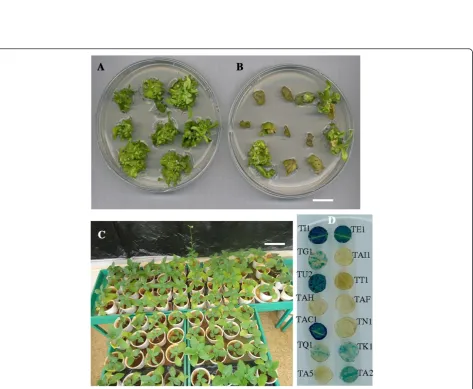
Frequency of regeneration of plants was determined on explants cultured on medium with or without Kana-mycin. Majority of the explants that were transformed with pMarkfree5.0 construct and placed on SM contain-ing 100 mg/l kanamycin died (Figure 2B). On average, 56% of the explants transformed with pMarkfree5.0 sur-vived and produced at least one shoot on kanamycin selection (Table 1). A total of 78 independent kanamycin-resistant plants were obtained from the explants surviving kanamycin selection (Table 1). These T0 plants were main-tained in a greenhouse.
EcoRI BamHI SmaI XbaI HindIII
Bar
RB1
TEV enhancer OD
P35S T35S
RB2 OD
LB
Int-gus NPTII
nos 3’ P35S
nos 3’ P35S
[image:3.595.56.539.90.269.2]pMarkfree3.0
Figure 1Schematic map of the T-DNA region of the binary vector pMarkfree3.0 and insertion of thegusandnptIIexpression cassettes to create pMarkfree5.0.P35S, cauliflower mosaic virus 35S promoter; T35S, cauliflower mosaic virus 35S terminator; int-gus,β-glucuronidase gene with catalase intron; nos 3’, nopaline synthase gene polyadenylation signal; LB, left T-DNA border; RB, right T-DNA border; OD, overdrive sequence.
[image:3.595.65.539.308.697.2]about half of the primary transformants will possess mul-tiple transgenes. Our results fall within this expectation.
Expression of gus gene was assessed in leaf tissues ob-tained from plant establishing in the glasshouse (Figure 2C) to help in rapid identification of transgenic plants. A total of 73 Kanamycin-resistant plants were screened using the histochemical assay. Figure 2D shows the gus staining re-sults for a few of the regenerated T0 plants. Accumulation of the blue stain was observed in 47.95% (35/73) of the tested kanamycin resistant T0 plants. Although nptII/gus transgene was detected in 60 primary transformants by PCR, 35 of the T0 plants was thegusgene activity detect-able. This phenomenon whereby a big proportion of trans-genic plants possessing the gus transgene don’t show any gus activity by Histochemical staining has been reported elsewhere [14]. Truncation of Agrobacterium T-DNA re-gion during integration in the plant genome has been used to explain this observation. We positioned thegusgene ex-pression cassette closest to the T-DNA LB of pMarkfree5.0. This may have exposed it to truncation which occurs mostly at the LB [27].
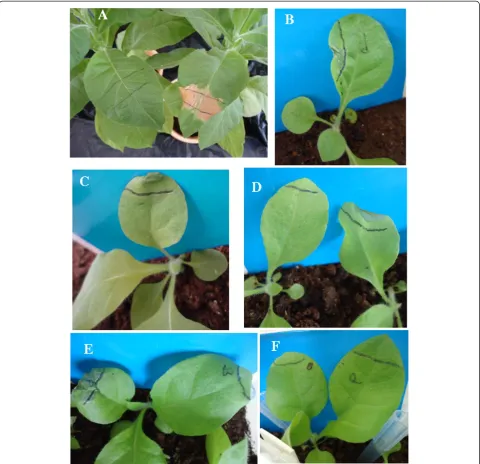
Stable expression of the introduced bar and nptII transgenes was confirmed by performing the Basta and leaf bleach assays on leaves of cotransformed plants. The Basta leaf paint assay on some of the cotransformed plants is shown in Figure 4A. Over 89% of the regenerated T0 plants were resistant to the application of 0.3% Basta herbicide (Table 2). Among the Basta sensitive plants were
two plants confirmed to be cotransformed (event TAY3 and TAC1) by PCR analysis. These plants showed severe leaf damage even after application of relatively lower (0.02%) concentration of Basta®. Thebargene in the plants may have undergone silencing, truncation or rearrange-ment leading to its inactivity.
Using the Kanamycin leaf bleach assay, over 94% of the primary regenerants showed no bleached spots on their leaves and were therefore kanamycin resistant (Table 2). Resistance to Kanamycin is an indication of the presence of an active nptII gene. Two primary trans-formed lines (TV2 and TAA1) had bleached spots on their leaves indicating Kanamycin sensitivity and imply-ing absence of an activenptIIgene. These two lines were confirmed negative for the presence of thenptIIgene by the multiplex PCR analysis. These non-resistant plants were possibly escapes, transgenic-chimeras or could not express enough NPTII protein in their leaves to confer resistance. On the basis of the leaf bleach assay the fre-quency of transformation of tobacco with the nptIIgene using the DRB pMarkfree5.0 vector was found to be 94.12%. Similar frequencies have been reported for trans-formation of tobacco using vectors that contain only one T-DNA region. For example a TF of 85% (Komari et al., 1996) was reported for vector pGA482. This indicates that the DRB vector is efficient in delivering transgenes into the plant genome.
[image:4.595.56.291.123.214.2]Seeds from cotransformed plants were grown in soil for confirmation of out-segregation of the bar gene using the Basta® leaf paint assay. After screening with Basta®, all seedlings were evaluated using paromomycin/ kanamycin leaf bleach assay to identify kanamycin resist-ant plresist-ants. Herbicide sensitive tobacco plresist-ants could be distinguished from the resistant ones three days after painting with 0.02% Basta. Seven days after application, clear effects of the herbicide were observed (Figure 4B). Application of the leaf Kanamycin/paromomycin leaf bleach solution lead to damage effects on leaves of tobacco seedlings that were similar to those of Basta (Figure 4C). Leaf damage resulting from Basta application was ob-served on 9 out of 19 T1 plants derived from the cotrans-formed line TD52. Subsequent leaf bleach test revealed
Table 1 Frequency of regeneration of plants from tobacco explants putatively transformed with pMarkfree5.0 and cultured on medium containing kanamycin (100 mg/L)
Experiment Total number of
explants
Number of regenerating explants
1 37 22
2 36 23
3 36 16
4 31 17
Total 140 78
Regeneration frequency was 55.7%, expressed as total number of regenerating explants per 100 explants infected with LBA4404 (pMarkfree5.0).
[image:4.595.56.541.621.704.2]leaf damage in 10 of the 19 T1 progeny plants assayed. These phenotypic assay results confirmed that thebarand nptII transgenes were segregating in the T1 plants. Leaf damage developed on 4 out of 19 T1 seedlings derived from the cotransformed line TD81 while the rest were com-pletely resistant to the damaging effect of Basta (Table 3). The same cotransformed line TD81 failed to segregate kanamycin resistance to its progenies. This is because all of
Figure 4Evaluation of expression of thebarandnptIIgene in T0 and T1transgenic plants using the Basta and leaf bleach assay. (A)Effect of Basta on T0 plants.BandC: response of wildtype plants to application of leaf bleach and Basta, respectively.D: Effect of Basta on T1progeny plants derived from the cotransformed line TD81.EandF: effect of leaf bleach on Basta resistant T1 plants derived from the
cotransformed line TD81.
Table 2 Functional analysis ofbarandnptIIgenes in transformed T0 plants
Analysis Number of
plants assayed
Number of tolerant plants
Transformation frequency
Basta leaf paint 78 70 89.73%
Kanamycin/ paromomycin Leaf bleach
[image:5.595.56.293.664.734.2]the T1 progeny plants derived from cotransformed line TD81 contained a functionalnptIIgene (Table 3).
Our results indicate that the frequency of removal of marker gene from transgenic T1 plants was between 0 and 40%. Similarly, Hong-Yan et al. (2003), using a DRB system, observed that 19.5% of T1 plants derived from tobacco plants cotransformed with nptII and bar trans-genes were free of the nptII gene. Therefore recovery of SMF T1 plants from T0 plants cotransformed using pmarkfree5.0 is highly efficient.
Absence of the bar gene from progeny plants derived from cotransformants was confirmed by molecular ana-lyses. T1 Progeny plants derived from the cotrans-formed line TD52 exhibited the 700 bp nptII gene in 9 plants. Of these, 6 revealed the presence of a 300 bp bar gene fragment. Therefore in 3 of the progeny plants, the bar gene was absent (Figure 5). This indicates that the bargene was not inherited in these three progenies and were therefore marker-free. PCR conducted on 19 progeny plants of TD81 revealed the presence of a 300 bp fragment of the bar gene in 12 of the plants. However, the 700 bp band diagnostic of the nptIIgene was present in all the 19 progenies assayed. The pres-ence of thenptIIgene in all the T1 plants suggests that it was not segregating. This is because of existence of more than once copy of the nptII gene in the T0 event TD81. However, the bar gene segrated in the T1 plants, indicating its existence as a sigle copy in the parental plant TD81.
PCR analyses also revealed that all T1 progeny plants de-rived from line TD56 were either negative or positive for both the bar and nptII T-DNA insertions. This indicates
absence of genetic separation between the bar and nptII T-DNAs regions. This means that the integration of the two T-DNA regions was in the same genomic location in the cotransformants making the two inserts segregate together. Therefore no marker-free progeny plants were produced by the parental line TD56.
Successful genetic separation of two T-DNA is depen-dent on various factors. One of the most important fac-tor seems to be strain of A. tumefaciensused to deliver the multiple T-DNAs. Nopaline-derived A. tumefaciens strains may favour insertion of multiple T-DNA in linked genomic loci. Initially, when two distinct T-DNAs were separately inserted in two nopaline-derived Agrobacterium, marker-free Arabidopsis thaliana or Brassica napus were produced at a very low frequency [28-30]. Recently, the frequency of generation of maker-free plants increased when the same strain (EHA101) or its derivative (EHA105) was used in combination with a two T-DNA vector [8,12]. This implies that differences in the plant species and strain/vector used could alter genetic linkage relationship.
[image:6.595.59.539.101.179.2]Currently cotransformation systems are mainly based on octopine-derived Agrobacterium strains possibly because they may favour unlinked transfer of independent T-DNAs [11]. Among the octopine-derived Agrobacterium strains, LBA4404 is the most popular. Using this strain high effi-ciencies of marker-free plants have been obtained from dif-ferent species including barley [5,10], maize [9,31], rice [18] and tobacco [11,15,17-19]. Apart from the Agrobacter-ium strain used, the type of the T-DNA borders re-gions on the cotransformation vector may affect unlinked transfer of multiple T-DNAs.
Table 3 Segregation of Basta and kanamycin resistance in T1 plants derived from cotransformed plants
T0 event Number of T1 plants assessed by Basta leaf painting
Number of T1 plants analysed by paromomycin Leaf bleach assay
Number of T1 plants Frequency of generation
of marker-free plants
BR BS KmR KS BRKmR BRKmS BSKmR BSKmS
TD56 15 8 15 8 15 0 0 8 0.00%
TD81 15 4 19 0 15 0 4 0 21.05%
TD52 8 11 9 10 6 4 3 6 15.79%
BR
, Basta resistant; BS
, Basta sensitive; KmR
, kanamycin resistant; KmS
, kanamycin sensitive.
[image:6.595.56.539.624.694.2]Conclusion
We have developed a new DRB binary vector, pMark-free3.0 and inserted thegusandnptIIgenes to create the model vector pMarkfree5.0. Using the model vector we have demonstrated the functionality of the new system in that: 1) we have generated over 70 independent trans-genic tobacco plants. 2) Over 66% of our transtrans-genic plants contained two transgenes (nptIIandbar) originat-ing from different T-DNA regions. Over 89% of these plants co-expressed the two genes. 3) The transgenes in 50% of the plants were inherited as Mendelian traits, making it possible to recover marker-free plants through segregation. This demonstrates that the newly developed DRB system is an effective way to remove undesirable genes from the plant genome. In ongoing research pro-jects at the Plant Transformation Laboratory, Kenyatta University, genes of agronomic interest including those conferring tolerance to drought are being inserted into pMarkfree3.0 for transformation of crops such as maize and sweetpotato. We are also developing and using two T-DNA binary vectors that, in principle and design, are similar to the pMarkfree3.0 to engineer maize for en-hanced tolerance to drought.
Methods
Construction of DRB binary vectors
The DRB vectors were constructed in the backbone of the binary vector pSCV1.6 [32]. The pSCV1.6 plasmid was digested with HindIII to delete the gus and nptII gene cassettes from the T-DNA region. The resultant vector (pSCVΔNPTIIGUS) was then self-ligated using T4 DNA ligase. The T-DNA region of the plasmid pSCVΔNPTIIGUS was amplified and subcloned into the NotI/ClaI sites of pBluescript(SK-) (Stratagene, Cambridge, UK) to produce the new vector pBlu2SK::EmptyTDNA. PTF101.1 [33] was digested byBglII andHindIII to excise the P35SBar fragment. The fragment was then ligated with pBlu2SK::EmptyTDNA vector pre-digested withBglII and HindIII to produce the new vector pBluTDNA::P35SBar. PBluTDNA::P35SBar was digested by BglII and purified. Purified DNA was end-filled using DNA polymerase I, large (klenow) fragment. The blunted DNA was dephos-phorylated with Alkaline phosphatase, calf intestinal (CIP). CIP’d DNA was ligated with a T35S termination se-quence amplified by PCR on pXBb7-SI-UBIL plasmid [34]. Ligation mixture was then used to transform compe-tent E. coli cells. DNA extracted from selected colonies was screened using a vector-specific and an insert-specific primer to ascertain the orientation of the T35S insert. The vector with the correct T35S insertion was named pBlu-BarTDNA. PSCVΔNPTIIGUSvector, digested with XhoI, was end-filled and CIP’d. The bar expression cassette flanked by a copy of the right border sequence was re-moved from pBlubarTDNA as an AscI/HindIII fragment.
The fragment was end-filled and ligated onto the CIP’d and blunted pSCVΔNPTIIGUS vector. Ligation products were transformed into competentE. colicells. DNA from emerging colonies were screened by digesting with KpnI to determine the orientation of the fragment inserted in the pSCVΔNPTIIGUS vector. The correct vector was named pMarkerfree3 and underwent sequencing to confirm the directionality of the T-DNA border se-quences. The SalI/BglI fragment haboring the gus and nptII gene cassettes was removed from pSCV1.6 and end-filled. The fragment was then subcloned into pMarkfree3 predigested with HindIII to produce pMarkfree5.0. PMarkfree5.0 was mobilized into the A. tumefaciens strain LBA4404 [35] using the freeze thaw technique [36]. The new Agrobacteriumstrain was cul-tured on yeast extract-mannitol (YM) medium [37] con-taining rifampicin (1 mg L-1) and kanamycin (50 mg L-1).
Transformation of tobacco with pMarkfree5
Leaf discs ofNicotiana tabacumwere transformed using the cocultivation method [38]. Transformed shoots were regenerated on MS medium [39] containing B5 vitamins [40]. The medium also contained 100 mg/l kanamycin for transgenic plant selection and 200 mg/l timentin for suppression ofA. tumefaciensgrowth. Regenerated shoots were separated from leaf tissues and were rooted on hormone-free MS basal medium containing 3% sucrose and 200 mg/l timentin. Plants were maintained in culture at a 16 h/8 h light/dark photoperiod at 27°C. Rooted shoots were transfered to soil for seed set.
Screening of tobacco cotransformants by multiplex PCR Genomic DNA was extracted from tobacco leaf tissues using the CTAB method [41]. 250–20 ng of the DNA was used in PCR to detect the presence ofbarandnptII genes. Each 50 ul reaction contained 1X PCR reaction buffer containing 3 mM MgSO4, 0.5 μM each primer, 1 mM of dNTP mixture and 2U Taq DNA polymerase. The primers used for amplification of thebargene were Bar-fwd: 5’ gatctcggtgacgggcagga 3’ and Bar-rev: 5’ ggt caacttccgtaccgagc 3’. Primers for amplification of npII gene were NPTII-forward: 5’ggattgcacgcaggttctc 3’, NPTII-reverse: 5’ ctcttcagcaatatcacgggt 3’. The PCR profile involved initial denaturation at 94°C for 10 minutes, followed by 35 cycles of denaturation at 94°C for 3 minute, annealing at 63°C for 1 minute and extension at 72°C for 1 minute with a final extention at 72°C for 8 min. Ampli-cons were visualised in a 1.5% agarose gel and results doc-umented using a digital camera.
Basta leaf paint assay
piece of cotton wool to a small section of a tobacco leaf. The section of leaf to be painted with Basta was first marked using a permanent marker pen. After seven days, putative transgenic tobacco plants were scored for re-sponse to the applied herbicide. Plants that showed no leaf damage were classified as Basta resistant (BR) while those that were damaged were classified as Basta sensitive (BS).
Leaf bleach and histochemical assays
The leaf bleach assay was performed on plants growing in soil to identify those containing a functional nptII gene. The assay was performed by applying assay solution con-taining paromomycin (Duchefa Biochemie B.V., Haarlem, The Netherlands) and kanamycin (Phytotechnology) each at 1,000 mg/l and 0.06% of Silwet L-77 (Lehle Seeds, Texas, USA) on a small section of a leaf using a piece of cotton wool. Results were recorded on the 7th day post applica-tion. Plants that showed no bleaching were categorized as kanamycin resistant (KmR) while those that bleached were categorized as kanamycin sensitive (KmS). Histochemical assay for β-glucuronidase (GUS) activity were performed on leaf tissues as described previously [43].
Phenotypic and molecular assays of T1 seedlings
To identify cotransformed lines that were segregating the bar gene, T1 seedlings were screened for resistance to PPT. About 100 T1 seeds were sown on MS medium containing 10 mg/l PPT. 14 days later, survival of to-bacco seedlings to PPT was examined. Plants that were green and growing vigorously were categorized as PPT-resistant (PPTR) while those that were small and bleached were classified as PPT-sensitive (PPTS).
To identify plant free of the bar gene, T0 events with single-copy ofbargene were selected for T1 segregation analysis. T1 seedlings were germinated on MS medium and transplanted to soil. Once established, the plants were assayed for resistance to Basta (0.02%) as described previously. The leaf bleach assay was performed on T1 seedlings previously assayed for Basta resistance to iden-tify plants expressing the nptII gene. The marker-free plants identified based on phenotypic assays (Basta and kanamycin resistance) were advanced for confirmation through PCR as described previously.
Data analysis
Chi-square goodness-of-fit tests were performed on data from the T1 populations derived from self pollinated cotransformed tobacco plants to determine if the observed segregation ratios of PPT, Basta or NPTII resistant plants to PPT, Basta or NPTII sensitive plants fit the expected mendelian 3:1 or 1:1 phenotypic ratios, respectively.
Availability of supporting data
All the supporting data are included as additional files.
Abbreviations
DRB:Double right border; SMG: Selectable marker gene; GOI: Gene of interest; PPT: Phosphinothricin; PCR: Polymerase chain reaction.
Competing interests
The authors declare that they have no competing interests.
Authors’contributions
JMM designed and carried out all experiments, participated in the interpretation of the results and wrote the first draft of the manuscript. S.A participated in the design of the study, interpretation of the results and drafting of the manuscript. J.G participated in the design of the study, interpretation of the results and drafting of the manuscript. S.R participated in vector development, PCR, interpretation of the results and drafting of the manuscript. R.A.O participated in vector development, DNA extraction and drafting of the manuscript. A.A participated in the design of the study, vector development, interpretation of the results and drafting of the manuscript. J.M conceived the study, participated in the experimental design and coordination, interpretation of the results and drafting of the manuscript. All authors read and approved the final manuscript.
Acknowledgements
This research was funded by Association for strengthening Agricultural Research in Eastern and central Africa (ASARECA). The authors are grateful Prof. Mieke Van Lijsebettens (Ghent University) and all members of the Plant transformation laboratory (Kenyatta University) for their useful contributions.
Author details
1Biochemistry and Biotechnology Department, Kenyatta University, P. O. Box
43844, 00100 Nairobi, Kenya.2Institute for Biotechnology Research, Jomo
Kenyatta University of Agriculture and Technology, P.O. Box 62000–00100, Nairobi, Kenya.3Kenya Agricultural Research Institute, P.O. Box 340–90100,
Machakos, Kenya.4Biosafety and Biotechnology Research Center, Agricultural
Research Corporation, P.O. Box 126, Wad Medani, Sudan.
Received: 6 May 2013 Accepted: 5 November 2013 Published: 8 November 2013
References
1. Rosellini D:Selectable Markers and Reporter Genes: A Well Furnished Toolbox for Plant Science and Genetic Engineering.Crit Rev Plant Sci
2012,31:401–453.
2. AP Mitra DS, Mudge SR, Morris BA:Selectable marker-free transgenic plants without sexual crossing: transient expression of cre recombinase and use of a conditional lethal dominant gene.Plant molecular biology
1999,40:223–235.
3. Cotsaftis O, Sallaud C, Breitler JC, Meynard D, Greco R, Pereira A, Guiderdoni E: Transposon-mediated generation of T-DNA- and marker-free rice plants expressing a Bt endotoxin gene.Mol Breed2002,10:165–180.
4. Wakita Y, Otani M, Iba K, Shimada T:Co-integration, co-expression and co-segregation of an unlinked selectable marker gene and NtFAD3 gene in transgenic rice plants produced by particle bombardment.
Genes & genetic systems1998,73:219–226.
5. Kapusi E, Hensel G, Coronado MJ, Broeders S, Marthe C, Otto I, Kumlehn J: The elimination of a selectable marker gene in the doubled haploid progeny of co-transformed barley plants.Plant molecular biology2013, 81:149–160.
6. Ching-yi L, Ku H, Tan C, Yeh S, Jan F:Construction of the binary vector with bi-selectable markers for generating marker-free transgenic plants.
Bot Stud2011,52:239–248.
7. Chen S, Li X, Liu X, Xu H, Meng K, Xiao G, Wei X, Wang F, Zhu Z:Green fluorescent protein as a vital elimination marker to easily screen marker-free transgenic progeny derived from plants co-transformed with a double T-DNA binary vector system.Plant Cell Rep2005,23:625–631. 8. Breitler JC, Meynard D, Van Boxtel J, Royer M, Bonnot F, Cambillau L,
Guiderdoni E:A novel two T-DNA binary vector allows efficient generation of marker-free transgenic plants in three elite cultivars of rice (Oryza sativa L.).
Transgenic research2004,13:271–287.
9. Miller M, Tagliani L, Wang N, Berka B, Bidney D, Zhao ZY:High efficiency transgene segregation in co-transformed maize plants using an Agrobacterium tumefaciens 2 T-DNA binary system.Transgenic research
10. Matthews PR, Wang MB, Waterhouse PM, Thornton S, Fieg SJ, Gubler F, Jacobsen JV:Marker gene elimination from transgenic barley, using co-transformation with adjacent“twin T-DNAs”on a standard Agro-bacterium transformation vector.Mol Breed2001,7:195–202. 11. McCormac AC, Fowler MR, Chen DF, Elliott MC:Efficient co-transformation
of Nicotiana tabacum by two independent T-DNAs, the effect of T-DNA size and implications for genetic separation.Transgenic research2001, 10:143–155.
12. Xing A, Zhang Z, Sato S, Staswick P, Clemente TOM:The Use Of The Two T-Dna Binary System To Derive Marker-Free Transgenic Soybeans.In Vitro Cell Dev Biol - Plant2000,36:456–463.
13. RamanaRao MV, Veluthambi K:Selectable marker elimination in the T0 generation by Agrobacterium-mediated co-transformation involving Mungbean yellow mosaic virus TrAP as a non-conditional negative selectable marker and bar for transient positive selection.Plant cell reports2010,29:473–483.
14. Parkhi V, Rai M, Tan J, Oliva N, Rehana S, Bandyopadhyay A, Torrizo L, Ghole V, Datta K, Datta SK:Molecular characterization of marker-free transgenic lines of indica rice that accumulate carotenoids in seed endosperm.Mol Genet Genomics2005,274:325–336.
15. Daley M, Knauf VC, Summerfelt KR, Turner JC:Co-transformation with one Agrobacterium tumefaciens strain containing two binary plasmids as a method for producing marker-free transgenic plants.Plant Cell Rep1998, 1998(17):489–496.
16. Sripriya R, Sangeetha M, Parameswari C, Veluthambi B, Veluthambi K: Improved Agrobacterium-mediated co-transformation and selectable marker elimination in transgenic rice by using a high copy number pBin19-derived binary vector.Plant science2011,180:7667–7674. 17. Park J, Lee YK, Kang BK, Chung W:Co-transformation using a negative
selectable marker gene for the production of selectable marker gene-free transgenic plants.Theor Appl Genet2004,109:1562–1567. 18. Komari T, Hiei Y, Saito Y, Murai N, Kumashiro T:Vectors carrying two
separate T-DNAs for co-transformation of higher plants mediated by Agrobacterium tumefaciens and segregation of transformants free from selection markers.Plant J1996,10:165–174.
19. Hong-Yan Z, Song-Biao C, Xu-Gang L, Gui-Fang X, Xiao-Li W, Zhen Z: Generating marker-free transgenic tobacco plants by agrobacterium-mediated transformation with double tdna binary vector.Acta Bot Sin
2003,45:1103–1108.
20. Lu H, Zhou X, Gong Z, Upadhyaya NM:Generation of selectable marker-free transgenic rice using double right-border ( DRB ) binary vectors.
Aust J Plant Physiol2001,28:241–248.
21. Li X, Weng HB, Han SY, Xi Y, Yong KL:A novel binary vector to get marker-free transgenic plant.Chin J Biotechnol2006,22:550–554. 22. Xu MR, Xia ZH, Zhai WX, Xu JL, Zhou YL, Li ZK:Construction of Double
Right-Border Binary Vector Carrying Non-Host Gene Rxo1 Resistant to Bacterial Leaf Streak of Rice.Rice Sci2008,15:243–246.
23. Komari T, Saito Y, Hiei Y:Method for introducing Two T-DNAs into plants and vectors therefor. U.S. Patent No. 5,731,179.Washington, DC: U.S. Patent and Trademark Office; 1998.
24. Baszczynski CL, Bowen BA, Peterson DJ, Tagliani LA:Compositions and methods for the targeted removal of a nucleotide sequence from the genome of a plant. U.S. Patent No. 6,458,594.Washington, DC: U.S. Patent and Trademark Office; 2002.
25. Richael C:Generation of marker-free and backbone-free transgenic plants using a single binary approach. WIPO Patent No.200709230.Geneva, Switzerland: World Intellectual Property Organization; 2011.
26. Ye X,et al:Methods and compositions for obtaining marker-free transgenic plants. WIPO Patent No. 2007134234.Geneva, Switzerland: World Intellectual Property Organization; 2012.
27. Rossi L, Hohn B, Tinland B:Integration of complete transferred DNA units is dependent on the activity of virulence E2 protein of Agrobacterium tumefaciens.Proc Natl Acad Sci U S A1996,93:126–130.
28. De Block M, Debrouwer D:Two T-DNA’s co-transformed intoBrassica napus by a doubleAgrobacterium tumefaciens infection are mainly integrated at the same locus.Theor Appl Genet1991,82:257–263. 29. Poirier Y, Ventre G, Nawrath C:High-frequency linkage of co-expressing
T-DNA in transgenic Arabidopsis thaliana transformed by vacuum-infiltration of Agrobacterium tumefaciens.TAG Theor Appl Genet2000,100:487–493. 30. Radchuk VV, Van DT, Klocke E:Multiple gene co-integration in Arabidopsis
thaliana predominantly occurs in the same genetic locus after
simultaneous in planta transformation with distinct Agrobacterium tumefaciens strains.Plant Sci2005,168:1515–1523.
31. Ishida Y, Murai N, Kuraya Y, Ohta S, Saito H, Hiei Y, Komari T:Improved co-transformation of maize with vectors carrying two separate T-DNAs mediated by Agrobacterium tumefaciens.Plant Biotechnol2004,21:57–63. 32. Vaughan SP, James DJ, Lindsey K, Massiah AJ:Characterization of FaRB7 , a
near root-specific gene from strawberry ( Fragaria3ananassa Duch.) and promoter activity analysis in homologous and heterologous hosts.
Access2006,57:3901–3910.
33. Paz MM, Shou H, Guo Z, Zhang Z, Banerjee AK, Wang K:Assessment of conditions affecting Agrobacterium-mediated soybean transformation using the cotyledonary node explant.Euphytica2004,136:167–179. 34. Anami SE, Mgutu AJ, Taracha C, Coussens G, Karimi M, Hilson P, Lijsebettens M,
Machuka J:Somatic embryogenesis and plant regeneration of tropical maize genotypes.Plant Cell Tiss Org Cult2010,102:285–295.
35. Hoekema A, Hirsch PR, Hooykaas PJJ, Schilperoort RAA:Binary plant vector strategy based on separation of vir- and T-region of theAgrobacterium
tumefaciensTi-plasmid.Nature1983,303:179–180.
36. Raviraja S, Sridhar K:A modified freeze–thaw method for efficient transformation of Agrobacterium tumefaciens.Current science2007, 93:10–12.
37. Lin JJ:Optimization of the transformation efficiency of Agrobacterium tumefaciens cells using electroporation.Plant Sci1994,101:11–15. 38. Horsch RB, Fry JE, Hoffmann NL, Eichholtz D, Rogers SA, Fraley RTA:Simple
and general method for transferring genes into plants.Science1985, 227:1229–1231.
39. Murashige T, Skoog F:A revised medium for rapid growth and bio assays with tobacco tissue cultures.Physiologia plantarum1962,15:473–497. 40. Gamborg OL, Miller RA, Ojima K:Nutrient requirements of suspension
cultures of soybean root cells.Exp Cell Res1968,50:151–158. 41. Saghai-Maroof M, Soliman KM, Jorgensen RA, Allard RW:Ribosomal DNA
spacer-length polymorphisms in barley: mendelian inheritance, chromosomal location, and population dynamics.Proc Natl Acad Sci USA
1984,81:8014–8018.
42. Kutty PC, Parveez GKA, Huyop F:Agrobacterium tumefaciens-infection Strategies for Greater Transgenic Recovery in Nicotiana tabacum cv. TAPM26.Int J Agric Res2011,6:119–133.
43. Jefferson RA, Kavanagh TA, Bevan M:W:β-glucuronidase as a sensitive and versatile gene fusion marker in higher plants.EMBO1987,6:3901–3907.
doi:10.1186/1756-0500-6-448
Cite this article as:Mathekaet al.:A new double right border binary vector for producing marker-free transgenic plants.BMC Research Notes
20136:448.
Submit your next manuscript to BioMed Central and take full advantage of:
• Convenient online submission
• Thorough peer review
• No space constraints or color figure charges
• Immediate publication on acceptance
• Inclusion in PubMed, CAS, Scopus and Google Scholar
• Research which is freely available for redistribution