Selection
.
White Rose Research Online URL for this paper:
http://eprints.whiterose.ac.uk/119509/
Version: Accepted Version
Proceedings Paper:
Han, Bingbing, Zhang, Zhihong, Xu, Chuanyu et al. (5 more authors) (2017) Deep Face
Model Compression Using Entropy-based Filter Selection. In: Proceedings ICIAP
2017:Lecture Notes in Computer Science. Springer Berlin / Heidelberg , pp. 127-136.
https://doi.org/10.1007/978-3-319-68548-9_12
[email protected] https://eprints.whiterose.ac.uk/
Reuse
Items deposited in White Rose Research Online are protected by copyright, with all rights reserved unless indicated otherwise. They may be downloaded and/or printed for private study, or other acts as permitted by national copyright laws. The publisher or other rights holders may allow further reproduction and re-use of the full text version. This is indicated by the licence information on the White Rose Research Online record for the item.
Takedown
If you consider content in White Rose Research Online to be in breach of UK law, please notify us by
Entropy-based Filter Selection
Bingbing Han1, Zhihong Zhang1, Chuanyu Xu1, Beizhan Wang1 ⋆, Guosheng
Hu2, Lu Bai3, Qingqi Hong1, and Edwin R. Hancock4
1
Xiamen University, Xiamen, Fujian, China 2
Anyvision group, Belfast, UK 3
Central University of Finance and Economics, Beijing, China 4
Department of Computer Science, University of York, York, UK
Abstract. The state-of-the-art face recognition systems are built on deep convolutional neural networks (CNNs). However, these CNNs con-tain millions of parameters, leading to the deployment difficulties on mobile and embedded devices. One solution is to reduce the size of the trained CNNs by model compression. In this work, we propose an entropy-based prune metric to reduce the size of intermediate activations so as to accelerate and compress CNN models both in training and infer-ence stages. First the importance of each filter in each layer is evaluated by our entropy-based method. Then some unimportant filters are re-moved according to a predefined compressing rate. Finally, we fine-tune the pruned model to improve its discrimination ability. Experiments con-ducted on LFW face dataset shows the effectiveness of our entropy-based method. We achieve 1.92×compression and 1.88×speed-up on VGG-16
model, 2× compression and 1.74× speed-up on WebFace model, both
with only about 1% accuracy decrease evaluated on LFW.
1
Introduction
In the past few years, as the emergence of big training data, Convolutional Neu-ral Networks (CNNs) have attained great success in the field of computer vision, from image classification [1–4], to other applications such as image caption [5], super resolution [6] and others. To extract massive information from big train-ing data, the researchers typically trained a large CNN or a CNN ensemble, which contains millions of parameters. Nevertheless, due to the need for mobile payment and security, it is very important to apply face recognition to mobile devices, computing large CNNs cost too much memory and running time, which prevents them from being widely used. Thus network compression has attracted great attention from researchers. In this paper, we focus on deep model com-pression in the field of face recognition.
In order to apply large CNNs to mobile devices, a large number of CNN methods have been put forward. The early ideas focused on how to compress
the parameters of fully-connected layers [7], and latter work which compressed convolutional layers [8, 11] for the purpose of accelerating model speed becomes an important research field. However, very little research has been proposed to reduce the size of activation in each layer.
In this work, we apply model compression to face recognition. We propose a framework to remove redundant filters in order to accelerate and compress CNNs at the same time. Our main idea is that, in each layer, we should keep filters that are representative (i.e these filters could extract as much information as original filters) and prune these less representative ones. As a result, we could reduce the number of channels directly without losing the information of feature map, converting a cumbersome network to a much smaller one without or with a little bit performance descend. We propose an entropy-based channel selection metric to evaluate the importance of each filter and prune ’weak’ filters in order to keep some important filters that could capture nearly the same information as all the original filters. Then the pruned network is fine-tuned to regain its discrimination ability.
We evaluate our entropy-based channel selection metric for face recognition using two commonly used models: VGG-16 [2] and WebFace [19]. These two models are both trained and finetuned on the CASIA-WebFace dataset [16]. Our entropy-based prune metric achieve 1.92× compression and 1.88×
speed-up on VGG-16 model, 2×compression and 1.74×speed-up on WebFace model,
both with about 1% accuracy decrease.
Our strategy has the following advantages and contributions:
• We propose a simple yet efficient framework to compress CNN models in
both training and inference stage. Our framework can reduce the number of filters so as to compress the size of activation ineach layer, which catch almost no attention in previous work.
• We use an effective learning strategy to make a balance between training
speed and classification accuracy in our pruning framework.
• Our framework does not rely on any specific libraries to gain the compression
and acceleration performance, thus could be applied to any popular CNN library, such as caffe [15], tensorflow [17].
2
Related Works
Researchers have revealed that large CNNs suffered from over-parameterization, which causes not only the waste of memory and computation, but also serious over-fitting problem. Denil et al. [9] demonstrated that we can use only a small part of its original parameters to reconstruct a network almost without the accuracy dropping. However, very little work aims at optimizing the number of filters. Most previous works mainly focus on two fields: one focused on how to reconstruct the fully-connected layers, the other one focused on how to prune the weights of convolutional layers.
are famous examples which use the global average pooling to replace the dense fully-connected layers in order to reduce memory and computation consumption. Recently, SqueezeNet [10] uses a block called “Fire Module” and other strategies to achieve AlexNet [1] level accuracy with only 4.8MB disk size, almost 50×fewer
parameters than the original AlexNet size.
Focusing on the convolutional layers, different methods have been explored to reduce number of connections and weights in neural networks. Some researchers approximate the dense parameters matrix with several low-rank matrices in or-der to compute the matrix-vector with high-speed [7]. Other researchers focus on network pruning, which has widely been studied to reduce the number of connections and prevent over-fitting [12]. Li et al. [13] use the absolute weight to measure the importance of each filter and remove less useful filters, which has the similar idea with ours, but our method is more efficient.
Though the mentioned methods work well in compressing large CNNs, we look for a framework that has optimal number of filters in each layer for specified networks and given tasks.
3
Entropy-Based Model Compression
In this section, we detail the proposed entropy-based channel selection metric which performs important filter selection. Our main idea is to discard some unimportant filters, and to recover its performance via fine-tuning. Finally we describe our efficient learning strategy.
3.1 Framework
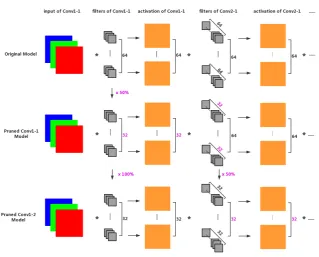
Fig. 1 illustrates the framework of the proposed activation pruning method. For a specific layer that we want to prune (i.e. layerk), we just focus on the activation tensor, we use entropy-based channel selection metric to evaluate the importance of each filter, then some less important filters will be removed from the original model, which makes the architecture more compact. Clearly, the corresponding channels of filters in the next layer are removed too. This strategy not only makes the network with fewer parameters which lead to the decrease of running time and memory consumption, but also reduces the size of activations. In addition, some researchers have proved that each neuron is represented by many neurons, each neuron participates in the representation of many concepts [14], so whatever these filters are, they can extract some features from the feature maps of the former layer. Thus, generalization ability of the pruned model will be affected. We fine-tune the whole network after removing the less important filters in order to recovery the performance.
3.2 Entropy-Based Prune Metric
We use a triplet (Ii, Wi,∗) to denote the convolution in layer i, where Ii ∈
R(c×h×w)means the input tensor,W
∗ means the convolution operation, and d, c , k×k are the number of filters, the number of output channels on the upper layer and the size of the filters respectively. Our goal is to remove some unimportant filters, i.e. reduced.
From the structure of networks, we know that each filter corresponds to a single channel of its activation tensor, so the ability of extracting features of each filter is closely related to its activation channel. In this paper, we propose an entropy-based metric to evaluate the importance of filters. Entropy is a com-monly used metric to measure the disorder or uncertainty in information theory. A large entropy value means the system contains more information. In our filter pruning method, if a channel of activation tensor contains less information, its corresponding filter is less important, thus could be removed.
Specifically, we first calculate the mean value of each channel, converting a c×h×k tensor into a 1×c vector. In this way, each channel of a I(i+1)
(activation of layer iis also the input of layeri+ 1) has a corresponding value for one image. In order to calculate the entropy, more output values need to be collected, which can be obtained using an evaluation set. In practice, the evaluation set can simply be the original training set, or a subset of it. Finally, we get a matrixM ∈R(n×c), wherenis the number of images in the evaluation
set, andc is the channel number. For each channelj, we compute its final score Hj according to the entropy of its outputM(:,j):
Hj =Eplog
1 p(x)=−
X
x∈M(:,j)
p(x)logp(x)
Another important issue is to decide the pruning boundary. One possible method is to denote a specific value, all channels with score below this value are removed from the network. However the specific value is a hyperparameter, which is hard to be specified. Another more practical method is to predefine a compression rate, all the filters are sorted in the descending order corresponding to the entropy score, and only the top k filters are preserved. Of course, the corresponding channels are removed too.
3.3 Network Trimming
4
Experiments
[image:7.595.135.482.322.407.2]We use the standard caffe library [15] to train our deep models. The two CNN architectures we used are VGG-16 [2] model and WebFace model [19]. These two architectures achieve great succuss in the filed of face recognition. Our models are trained using the CASIA-WebFace dataset [16] consisting of 419922 face im-ages of 10575 identities. The training imim-ages are horizontally flipped for data argumentation. The finetuning process during model compression is conducted on CASIA-WebFace dataset as well. The face recognition performance is eval-uated on the famous LFW (Labeled Faces in the Wild) database [21]. LFW contains 5,749 subjects and 13,233 images. We follow the standard unrestricted protocol and conduct 10-fold cross validation. The face recognition rate is eval-uated by mean accuracy. The sample images of LFW are shown in Fig. 2 All the experiments are conducted on a computer equipped with Nvidia Tesla K80 GPU.
Fig. 2.A column in the green box indicates the same person and the red box indicates different people.
4.1 VGG-16 Network
The original VGG-16 model contains 13 convolution layers, 2 fully-connected layers and one softmax layer. As our training data CASIA-WebFace database is much smaller than ImageNet [20] which is used to train the original VGG-16 network, in this work, we remove the two fully-connected layers to avoid over-fitting. At the same time, the last convolutional layer is followed by a global average pooling layer whose kernel size is of 14×14. This type of global pooling
can replace a fully connected layer but has much fewer parameters. It has widely been used to design an efficient network such as google Inception network [4].
Before training, all the training images are aligned and then resized to 224×
We empirically find that the first few convolution layers have much more redun-dant information than the deeper layers which capture the semantic information. Therefore, we only prune the first 10 layers (Conv1-1 to Conv4-3 in Table 1). During finetuning/pruning, we set the original learning rate to 0.01 for each layer. The learning rate is reduced to 0.1 of the previous one when the loss stops decreasing. The number of iterations and the learning rate changing are detailed in Table 2.
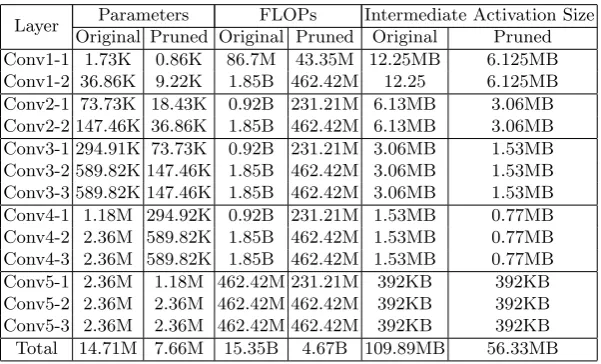
[image:8.595.158.459.325.507.2]In Table 1, the parameters before and after compression of VGG-16 network are detailed. The convolutional kernel weights are greatly reduced, leading to a more efficient inference. The computations measured by FLOPs are also dra-matically reduced. Interestingly, our method halves the intermediate activation size which can greatly save the memory.
Table 1.The performance of our method to reduce Parameters and FLOPs (FLoating-point OPerations) on the VGG-16 model. The activation size is the sum of convolu-tional, relu, pooling layers’ output and the input data when batch size is set to 1.
Layer Parameters FLOPs Intermediate Activation Size Original Pruned Original Pruned Original Pruned Conv1-1 1.73K 0.86K 86.7M 43.35M 12.25MB 6.125MB Conv1-2 36.86K 9.22K 1.85B 462.42M 12.25 6.125MB Conv2-1 73.73K 18.43K 0.92B 231.21M 6.13MB 3.06MB Conv2-2 147.46K 36.86K 1.85B 462.42M 6.13MB 3.06MB Conv3-1 294.91K 73.73K 0.92B 231.21M 3.06MB 1.53MB Conv3-2 589.82K 147.46K 1.85B 462.42M 3.06MB 1.53MB Conv3-3 589.82K 147.46K 1.85B 462.42M 3.06MB 1.53MB Conv4-1 1.18M 294.92K 0.92B 231.21M 1.53MB 0.77MB Conv4-2 2.36M 589.82K 1.85B 462.42M 1.53MB 0.77MB Conv4-3 2.36M 589.82K 1.85B 462.42M 1.53MB 0.77MB Conv5-1 2.36M 1.18M 462.42M 231.21M 392KB 392KB Conv5-2 2.36M 2.36M 462.42M 462.42M 392KB 392KB Conv5-3 2.36M 2.36M 462.42M 462.42M 392KB 392KB Total 14.71M 7.66M 15.35B 4.67B 109.89MB 56.33MB
Table 2. The number of iterations on finetuning/pruning each layer. For {10000, 20000}of Conv1-2, it means the learning rate changes to 0.1 of previous one at 10000th iteration, and the training stops at 20000th iteration.
Layer Conv1-1 Conv1-2 Conv2-1 Conv2-2 Conv3-1
- 10000 - 10000
-Iterations 10000 20000 10000 20000 10000 Layer Conv3-2 Conv3-3 Conv4-1 Conv4-2 Conv4-3
- 10000 - - 40000/80000
In Table 3, we report our compression results. We can see that our model gains 1.88× speed up measured by the averaged running time of 1000 images
during inference. Also, we achieve 1.92×compression results in terms of the
num-ber of model parameters. Compared with original VGG-16 model, our method reduces the FLOPS computations by 3.29×. However, the face recognition rate
[image:9.595.151.473.459.579.2]only drops by around 1%.
Table 3.The summarization of the performance of our compression method.
Model Accuracy (LFW) FLOPS Compression Speed-up Original VGG-16 97.55% 1× 1× 1×
Pruned VGG-16 96.50% 3.29× 1.92× 1.88×
4.2 WebFace Network
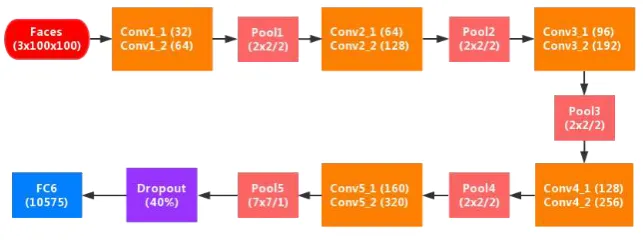
The WebFace [19] is another popular face recognition CNN architecture. Com-pared with VGG-16, WebFace is more compact. We conduct our compression method on WebFace to verify the effectiveness of our method on smaller ar-chitecture. The architecture of WebFace is detailed in Fig. 3. Clearly, WebFace also stackes several Conv-Pool-Relu unites. Before fully-connected layers, a 7×7
global pooling is used. Following the original work [19], the input images are aligned and cropped to the size of 100×100. The training and finetuning
strate-gies are similar to those shown in Section 4.1.
Fig. 3.The framework of Webface.
of face recognition rates (LFW), FLOPS, compression and running time are de-tailed. For the largest compression rate 0.5 (Pruned-50), the accuracy drops only 1.05%, but the FLOPS of Pruned-50 is only 28.07% of the original WebFace, the model size is only half, and the running time is only 57.60% compared with the original model. Another 2 models (Pruned-75, Pruned-90) also achieve great performance. In the real application, it is always a trade-off between accuracy and model size/computation. Therefore, Table 4 is an important reference for researchers and engineers to look for such a trade-off.
Table 4.WebFace compression results on different compression rates.
Model Accuracy (LFW) FLOPS Compression Speed-up Nums Percent Nums Percent Nums Percent Original WebFace 96.92% 770M 100% 1.75M 100% 5.92ms 100%
Pruned-90 97.28% 619M 80.37% 1.53M 87.53% 5.24ms 88.51% Pruned-75 96.62% 448M 58.18% 1.26M 71.71% 4.60ms 77.70% Pruned-50 95.87% 216M 28.07% 0.88M 50% 3.16ms 57.60%
4.3 Effectiveness Analysis
To demonstrate the effectiveness of our entropy-based metric, we compare our method with random selection which prunes the CNN model parameters ran-domly. We prune 3 different layers of WebFace with these two methods. All the experimental setups are kept the same, except for channel selection method.
The results are summarized in Table 5. The 3 layers of WebFace we choose to prune are: Conv1-1, Conv3-1, and Conv4-2 (shown in Fig. 3). Each layer is pruned independently with 0.5 compression rate, and fine-tuned 10000 iterations. As can been seen, our entropy-based method consistently works better than random selection method on all the 3 selected layers, showing the effectiveness of our compression method. The advantage of our method is larger on deeper layers, e.g. 96.48% vs 96.01% (Conv1-1), 95.97% vs 95.02% (Conv4-2). In addition, the finetuing is very important for performance improvement for both our method and random selection.
Table 5.Comparison of entropy-based channel selection metric and random selection. 0 iteration means finetuning is not conducted after pruning.
Model Conv1-1 Conv3-1 Conv4-2
[image:10.595.135.492.594.642.2]5
Conclusion
In this paper, we propose a network pruning strategy to trim redundant filters based on the entropy-based channel selection metric. Our method can remove unimportant filters that provide little contribution to the final performance with-out damaging results of our network. In addition, our strategy does not rely on any dedicated library, thus can widely be used in various applications with cur-rent deep learning libraries.
Acknowledgment
This work is supported by National Natural Science Foundation of China (Grant No.61402389, 61503422 and 61502402), the Fundamental Research Funds for the Central Universities in China (no. 20720160073) and the Natural Science Foundation of Fujian Province of China(Grant No. 2015J05129).
References
1. A. Krizhevsky, I. Sutskever, and G. E. Hinton. Imagenetclassication with deep con-volutional neural networks. In Advances in Neural Information Processing Systems (NIPS),pages 1097C1105, 2012. 1, 3, 4
2. K. Simonyan and A. Zisserman. Very deep convolutional networks for large-scale image recognition. In International Conference on Learning Representations (ICLR) , 2015. 1, 2, 4, 6
3. K. He, X. Zhang, S. Ren, and J. Sun. Deep residual learning for image recognition. In IEEE Conference on Computer Vision and Pattern Recognition (CVPR) , pages 770C778, 2016. 1, 2, 3, 4, 5, 7
4. C. Szegedy, W. Liu, Y. Jia, P. Sermanet, S. Reed, D. Anguelov, D. Erhan, V. Van-houcke, and A. Rabinovich. Going deeper with convolutions. In IEEE Conference on Computer Vision and Pattern Recognition (CVPR) , pages 1C9, 2015. 3, 4, 6 5. Fang H, Gupta S, Iandola F, et al. From Captions to Visual Concepts and Back.
The IEEE Conference on Computer Vision and Pattern Recognition (CVPR), 2015, pp. 1473-1482
6. Chao Dong, Chen Change Loy, Kaiming He, Xiaoou Tang. Learning a Deep volutional Network for Image Super-Resolution. In Proceedings of European Con-ference on Computer Vision (ECCV), 2014
7. V. Sindhwani, T. Sainath, and S. Kumar. Structured transforms for small footprint deep learning. In Advances in Neural Information Processing Systems (NIPS) , pages 3088C3096, 2015. 1, 2
8. J. Wu, C. Leng, Y. Wang, Q. Hu, and J. Cheng. Quantized convolutional neural networks for mobile devices. In IEEE Conference on Computer Vision and Pattern Recognition (CVPR) , pages 4820C4828, 2016. 1, 2, 3, 6
9. M. Denil, B. Shakibi, L. Dinh, and N. de Freitas. Predicting parameters in deep learning. In Advances in Neural Information Processing Systems (NIPS) , pages 2148C2156, 2013. 2
11. Jian-Hao Luo, Jianxin Wu. An Entropy-based Pruning Method for CNN Compres-sion. arXiv:1706.05791, 2017. 6
12. S. Han, J. Pool, J. Tran, and W. Dally. Learning both weights and connections for efcient neural network. In Advances in Neural Information Processing Systems (NIPS) , pages 1135C 1143, 2015. 2, 3, 6
13. H. Li, A. Kadav, I. Durdanovic, H. Samet, and H. P. Graf.Pruning lters for efcient ConvNets. In arXiv preprintarXiv:1608.08710, 2016. 2, 5, 7
14. Y. Bengio, A. Courville, and P. Vincent. Representationlearning: A review and new perspectives. IEEE Transactions on Pattern Analysis and Machine Intelligence (TPAMI),35(8):1798C1828, 2013. 3
15. Y. Jia, E. Shelhamer, J. Donahue, S. Karayev, J. Long, R. Girshick, S. Guadar-rama, and T. Darrell. Learning distributed representations of concepts. In ACM International Conference on Multimedia (ACM MM) , pages 675C678, 2014. 5 16. CASIA-WebFace dataset:
http://www.cbsr.ia.ac.cn/english/CASIA-WebFace-Database.html
17. Abadi M, Agarwal A, Barham P, et al. Tensorflow: Large-scale machine learning on heterogeneous distributed systems[J]. arXiv preprint arXiv:1603.04467, 2016. 18. Min Lin, Qiang Chen, Shuicheng Yan. Network in Network. CoRR, abs/1312.4400,
2013.
19. Dong Yi, Zhen Lei, Shengcai Liao, Stan Z. Li. Learning Face Representation from Scratch. arXiv:1411.7923.
20. J. Deng, W. Dong, R. Socher, L.-J. Li, K. Li, and L. Fei-Fei. ImageNet: A Large-Scale Hierarchical Image Database. In CVPR09, 2009.
21. LFW: