This is a repository copy of Sparse model identification using a forward orthogonal
regression algorithm aided by mutual information.
White Rose Research Online URL for this paper:
http://eprints.whiterose.ac.uk/74559/
Monograph:
Billings, S.A. and Wei, H.L. (2006) Sparse model identification using a forward orthogonal
regression algorithm aided by mutual information. Research Report. ACSE Research
Report no. 919 . Automatic Control and Systems Engineering, University of Sheffield
[email protected] https://eprints.whiterose.ac.uk/
Reuse
Unless indicated otherwise, fulltext items are protected by copyright with all rights reserved. The copyright exception in section 29 of the Copyright, Designs and Patents Act 1988 allows the making of a single copy solely for the purpose of non-commercial research or private study within the limits of fair dealing. The publisher or other rights-holder may allow further reproduction and re-use of this version - refer to the White Rose Research Online record for this item. Where records identify the publisher as the copyright holder, users can verify any specific terms of use on the publisher’s website.
Takedown
If you consider content in White Rose Research Online to be in breach of UK law, please notify us by
S.A. Billings and H.L. Wei
Research Report No. 919
Department of Automatic Control and Systems Engineering
The University of Sheffield
Mappin Street, Sheffield,
S1 3JD, UK
March. 2006
Sparse Model Identification Using A Forward Orthogonal
Regression Algorithm Aided by
2
Abstract—A sparse representations, with satisfactory approximation accuracy, is usually desirable in any nonlinear
system identification and signal processing problem. A new
forward orthogonal regression algorithm, with mutual
information interference, is proposed for sparse model
selection and parameter estimation. The new algorithm can be
used to construct parsimonious linear-in-the-parameters
regression models.
Index Terms—model selection, mutual information, orthogonal least squares, parameter estimation, radial basis
function networks.
I. INTRODUCTION
he central task in learning from data is how to identify a
suitable model from the observational data set. One solution is
to construct nonlinear models using some specific types of
basis functions, aided by various state-of-the-art techniques
[1]-[5]. Among the existing sparse modeling techniques,
linear-in-the-parameters regression models, which will be
considered in the present study, are an important class of
representations for nonlinear function approximation and
signal processing. A general routine for linear-in-the-
parameters modeling often starts by constructing a model term
dictionary
D
, whose elements are the candidate model terms(1)(2) Department of Automatic Control and Systems Engineering, University of Sheffield, Mappin Street, Sheffield, S1 3JD,UK.
(also called bases) that are formed using some given primary
basis functions according to some specified rules. A dictionary
often contains a large or even an infinite number of candidate
model terms (bases). The task of system identification
involves two aspects: the selection of the significant model
terms and the determination of the number of model terms
involved in the final identified model. The objective is to
obtain a satisfactory sparse representation that involves only a
few bases, by making a compromise between the
approximation accuracy and the model complexity (model
size). Notice that the objective of dynamical modeling is not
merely data fitting. In dynamical modeling the resulting sparse
model should fit the observational data accurately, but at the
same time the model should be capable of capturing the
underlying system dynamics carried by the observational data,
so that the resulting model can be used in simulation, analysis,
and control studies.
Many approaches have been proposed to address the
model structure selection problem, most of these focus on
which bases are significant and should be thus included in the
model. The orthogonal least squares (OLS) algorithm
[2][6][7], which was initiated for nonlinear system
identification, has become popular and has been widely used
for sparse data modeling. This type of algorithm is simple to
Sparse Model Identification Using A Forward Orthogonal
Regression Algorithm Aided by
Mutual Information
Stephen A. Billings
1and Hua-Liang Wei
2linear-in-the-parameters models with good generalization
performance [14]. An advantage of the OLS type algorithms is
that commonly used model selection and regularization
techniques, for example the AIC, BIC and cross-validation
(GCV) [8]-[10], can easily be adopted and incorporated into
the model structure selection algorithms to yield compact
linear-in-the- parameters regression models with good
generalization properties [11]-[13].
In the OLS type algorithms, the criterion that is used to
measure the significance of the candidate bases (model terms)
is the error reduction ratio (ERR), which is equivalent to the
squared correlation coefficient and is similar to the commonly
used Pearson correlation function. Experience has shown that
the OLS algorithms interfered by the ERR criterion can
usually produce a satisfactory sparse model with good
generalization performance. The adoption and the domination
of the ERR criterion in the OLS algorithm, however, does not
exclude other criteria. It follows from practical experience that
the selected model subsets are often criterion-dependent
providing that the given model term dictionary is
under-complete (inunder-complete).
In this study, a new criterion, derived from mutual
information, is adopted into the OLS algorithm to measure the
significance of candidate bases and to interfere with the model
subset selection. The motivation of the adoption of a mutual
information criterion is based on the following considerations.
It is known that the task of modeling from data is generally
structure-unknown and the model term dictionary is often
pre-specified and thus fixed. For this case, the selected model
the mutual information criterion and the ERR criterion may or
may not produce exactly the same model structure given the
same modeling problem. The two criteria can be used in
parallel, and the performance of the resultant models can then
be compared. The model with the better performance will be
chosen as the final model. In this manner, the two criteria will
complement each other and thus produce a better model that
may have been achieved using only one signal criterion.
II. The Linear-In-The-Parameters Representation
Consider the identification problem for nonlinear systems
given N pairs of input-output observations,
N t
t
y
t
u
(
),
(
)}
1{
= .Under some mild conditions a discrete- timenonlinear system can be described by the following NARX
model [1]
)
(
))
(
,
),
1
(
),
(
,
),
1
(
(
)
(
t
f
y
t
y
t
n
u
t
u
t
n
e
t
y
=
−
−
y−
−
u+
(1)
where
u
(t
)
,y
(t
)
ande
(t
)
are the system input, output andnoise variables;
n
uandn
y are the maximum lags in the inputand output, respectively; and f is some unknown nonlinear
mapping. It is generally assumed that
e
(t
)
is an independentidentical distributed noise sequence.
The central task of system identification is to find a
suitable approximator
fˆ
for the unknown function f from theobservational data set. One solution is to construct nonlinear
models using some specific types of basis functions including
polynomials, kernel basis functions and multiresolution
wavelets[3]-[6][15]. Among these existing sparse modeling
4
will be considered in the present study, are an important class
of representations for nonlinear function approximation and
signal procession, because compared to nonlinear-in-the-
parameters models, linear-in-the-parameters models are
simpler to analyze mathematically and quicker to compute
numerically.
Let
d
=
n
y+
n
u andx
(
t
)
=
[
x
1(
t
),
,
x
d(
t
)]
Twith
+
≤
≤
+
−
−
≤
≤
−
=
u y y y y kn
n
k
n
n
k
t
u
n
k
k
t
y
t
x
1
))
(
(
1
)
(
)
(
(2)A general form of the linear-in-the-parameter regression
model is given below:
)
(
))
(
(
ˆ
)
(
t
f
t
e
t
y
=
x
+
(
(
))
(
)
1t
e
t
M m m m+
=
∑
=x
φ
θ
)
(
)
(
t
e
t
T
+
=
(3)where M is the total number of candidate regressors,
))
(
( t
m
x
φ
(m=1,2, …, M) are the model regressors andθ
marethe model parameters, and
(
t
)
=
[
φ
1(
x
(
t
)),
,
φ
M(
x
(
t
))]
Tand are the associated regressor vector and parameter
vector, respectively.
III. Mutual Information Interference for Model Structure Selection
In the standard OLS algorithm [2][6][7], the significance
of candidate model terms are measured using the values of
ERR, which is defined as the non-centralized squared
correlation coefficient between two associated vectors. This
coefficient between two given vectors x and y of size N is
defined as
∑
∑
∑
= = ==
=
N i i N i i Ni i i
T T T
y
x
y
x
C
1 2 1 2 1 22
(
)
)
)(
(
)
(
)
,
(
y
y
x
x
y
x
y
x
(4)Similar to the commonly used standard Pearson correlation
coefficient in statistics, the function in (4) reflects the linear
relationship between two vectors x and y. Both the standard
Pearson correlation coefficient and the squared correlation
coefficient in (4) have wide application in various fields.
Another useful criterion, derived from mutual information,
can be used to measure the relationship of two random
variables by calculating the amount of information that the
two variables share with each other. Mutual information based
algorithms have in recent years been widely applied in various
areas including feature selection [16]-[19]. In the present
study, mutual information will be introduced to form a
complementary criterion to the ERR criterion to interfere with
the model structure selection procedure.
A. Mutual Information
Following [20], mutual information is defined as follows.
Consider two random discrete variables x and y with alphabet
X
andY
, respectively, and with a joint probability massfunction p(x, y) and marginal probability mass functions
)
(x
p
andp
( y
)
. The mutual informationI
( y
x
,
)
is therelative entropy between the joint distribution and the product
distribution
p
(
x
)
p
(
y
)
, given as
=
)
(
)
(
)
,
(
log
)
,
(
y
x
y
x
y
x
p
p
p
E
I
=
∑∑
∈ ∈(
)
(
)
)
,
(
log
)
,
(
y
p
x
p
y
x
p
y
x
p
x Xy Y(5)
The mutual information
I
( y
x
,
)
is the reduction in theuncertainty of y due to some knowledge of x, and vice versa.
Mutual information provides a measure of the amount of
regressor in a linear model,
I
( y
x
,
)
can be used to measure thecoherency of x with y in the model.
B. Model Structure Selection with Interference of Mutual Information
Let
y
=
[
y
(
1
),
,
y
(
N
)]
Tbe a vector of measured outputsat N time instants, and m
=
[
φ
m(
1
),
,
φ
m(
N )]
T be a vectorformed by the mth candidate model term, where m=1,2, …, M.
Let
D
=
{
1,
,
M}
be a dictionary composed of the Mcandidate bases. From the viewpoint of practical modeling and
identification, the finite dimensional set
D
is often redundant.The model term selection problem is equivalent to finding a
full dimensional subset
{
,
,
}
{
,
,
}
1
1 n i in
n
=
=
D
of n(
n
≤
M
)
bases, from the libraryD
, wherek i
k
=
,}
,
,
2
,
1
{
M
i
k∈
and k=1,2, …, n, so thaty
can besatisfactorily approximated using a linear combination of
n
,
,
,
21
as belowe
y
=
θ
1 1+
+
θ
n n+
(6)or in a compact matrix form
e
A
y
=
+
(7)where the matrix
A
=
[
1,
,
n]
is assumed to be of fullcolumn rank,
=
[
θ
1,
,
θ
n]
T is a parameter vector, ande
isthe approximation error.
The model structure selection procedure starts from
equation (3). Let
r
0=
y
, and)}
,
(
{
max
arg
0 1 1 j Mj≤
I r
≤
=
(8)(5). The first significant basis can thus be selected as
1
1
=
, and the first associated orthogonal basis can bechosen as
1
1
q
=
. Set1 1 1 1 0 0 1
q
q
q
q
r
r
r
T T−
=
(9)In general, the mth significant model term can be chosen
as follows. Assume that at the (m-1)th step, a subset
D
m−1,consisting of (m-1) significant bases, 1
,
2,
,
m−1, hasbeen determined, and the (m-1) selected bases have been
transformed into a new group of orthogonal bases
1 2
1
,
q
,
,
q
m−q
via some orthogonal transformation. Let∑
− =−
=
1 1 ) ( m k k k T k k T j j m jq
q
q
q
q
(10))}
,
(
{
max
arg
1 ( ) 1 1 , m j m m k j mI
kq
r
− − ≤ ≤ ≠=
(11)where j
∈
D
−
D
m−1, andr
m−1 is the residual vector obtainedin the (m-1)th step. The mth significant basis can then be
chosen as
m
m
=
and the mth associated orthogonal basiscan be chosen as m (m) m
q
q
=
. The residual vectorr
m at themth step is given by
m m T m m T m m m
q
q
q
q
r
r
r
1 1 − −−
=
(12)Subsequent significant bases can be selected in the same way
step by step. From (12), the vectors
r
mandq
m are orthogonal,thus m T m m T m m m
q
q
q
r
r
r
2 1 2 12
(
)
||
||
||
||
=
−−
− (13)By respectively summing (12) and (13) for m from 1 to n,
6
n n m m m T m m Tm
q
r
q
q
q
r
y
∑
= −+
=
11 (14)
∑
= −−
=
n m m T m m T m n 1 2 1 22
(
)
||
||
||
||
q
q
q
r
y
r
(15)Notice that if the function
I
(
⋅
,
⋅
)
in (8) and (11) is replaced bythe squared correlation coefficient defined by (4), the above
algorithm then belongs to the class of orthogonal least squares
type algorithms [2][6][7]. The forward orthogonal regression
algorithm interfered with mutual information will be referred
to as the FOR-MI algorithm.
The residual sum of squares,
||
r
n||
2,which is also knownas the sum-squared-error, or its variants including the
mean-square-error (MSE), can be used to form criteria for model
selection. The model term selection procedure can be
terminated when some specified termination conditions are
met. In the present study, the following GCV criterion
[10][12] is used to determine the model size
)
MSE(
)
GCV(
2k
k
N
N
k
−
=
N
k
N
N
k 2 2||
|| r
−
=
(16)The selection procedure will be terminated at the step where
the index function GCV(k) is minimized.
C. Parameter Estimation
It is easy to verify that the relationship between the
selected original bases 1
,
2,
,
m , and the associatedorthogonal bases
q
1,
q
2,
,
q
m, is given bym m
m
Q
R
A
=
(17)where
R
m is anm
×
m
unit upper triangular matrix whoseentries
u
ij(
1
≤
i
≤
j
≤
m
)
are calculated during theorthogonalization procedure, and
Q
m is anN
×
m
matrixwith orthogonal columns
q
1,
q
2,
,
q
m . The unknownparameter vector, denoted by m
=
[
θ
1,
θ
2,
,
θ
m]
T, for themodel with respect to the original bases (similar to (6)), can be
calculated from the triangular equation Rm m=gm with
T m m
=
[
g
1,
g
2,
,
g
]
g
, where(
1)
/(
k)
T k k T k k
g
=
r
−q
q
q
or)
/(
)
(
k T k k T kg
=
y
q
q
q
.Note that some tricks can be used to avoid selecting
strongly correlated model terms. Assume that at the mth step,
a subset
D
m, consisting of m significant bases, 1,
2,
,
m,has been determined. Also assume that j
∈
D
−
D
m isstrongly correlated with some bases in
D
m, that is, j is alinear combination of 1
,
2,
,
m. Thus,(
)
0
) ( )( m
=
j T m
j
q
q
.In the implementation of the algorithm, the candidate basis
m
j
∈
D
−
D
will be automatically discarded ifδ
<
) ( ) ()
(
q
jm Tq
jm , whereδ
is a positive number that issufficiently small. In this way, any severe mullticolinearity or
ill-conditioning can be avoided.
V. Numerical Example
Example 1. A nonlinear time series was described by the
following model
)
1
(
25
.
0
)
(
t
=
y
t
−
y
) ( )] 2 ( 5 . 0 2 exp[ 20 ) 1 (cos
π
yt − y2 t− +ξ
t
−
+ (18)
where
ξ
(
t
)
~
N
(
0
,
0
.
025
2)
. By setting the initial value to bey(0)=0 and y(1)=0, this model was simulated and 1000 data
points were collected. The first 500 points were used for
network training and the remaining 500 data points were used
Fig. 2 The first return maps generated from the identified RBF network models produced by the FOR-MI algorithm, 1000 data points were used to form the return maps. (a) is for the original noise-free time series, with
ξ
(t
)
=0 in (18) and with initial value y(0)=0 and y(1)=0; (b) is forthe FOR-MI identified model with initial value
ˆy
(
0
)
=0 andˆy
(
1
)
=0. the noisy observations. The RBF network model adopted theGaussian kernel function of the form
−
−
+
−
−
−
=
22 2 , 2
1
,
]
[
(
2
)
]
)
1
(
[
exp
)
(
σ
φ
m mm
c
t
y
c
t
y
t
(19)where the candidate centers
c
m=
[
c
m,1,
c
m,2]
T (m=1,2, …,498) were chosen to be all the 498 training data points
T
t
y
t
y
t
)
[
(
1
),
(
2
)]
(
=
−
−
x
for t from 3 to 500, and the kernelwidth was chosen to be
σ
=
2
.
5
. Both the FOR-MI algorithmand the OLS-ERR algorithm were applied to the 496 candidate
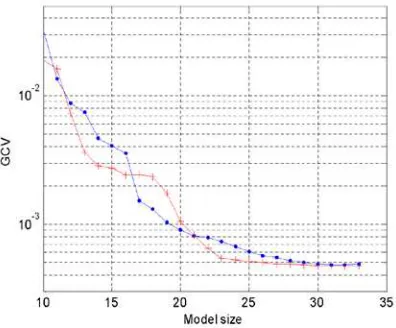
basis functions. The associated criterion GCV given by (16) is
shown in Fig. 1, where the GCV values suggest that the
number of basis functions (model terms) for the FOR-MI and
the OLS-ERR identified network models should be chosen as
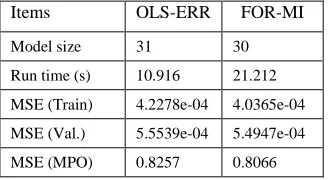
30 and 31, respectively. Comparisons of the identified model
performance on both the training data set and the validation
data set are shown in Table 1.
Starting from
ˆy
(
0
)
=0 andˆy
(
1
)
=0, both the FOR-MI andthe OLS-ERR identified models were simulated, and the
model predicted output of 1000 data points generated from the
two models were compared with the noise-free time series
produced by (18) where
ξ
(t
)
was set to be zero. The modelpredicted output (MPO) is defined as
))
2
(
ˆ
),
1
(
ˆ
(
ˆ
)
(
ˆ
t
=
f
y
t
−
y
t
−
y
. Table 1 shows the accuracy ofthe model predicted output of the two identified network
models. It can be seen from Table 1 that the FOR-MI
identified model is slightly superior to the OLS-ERR
identified model for the noisy time series given by (18). A
comparison of the first return map produced from the FOR-MI
by the noise-free model (18), where
ξ
(t
)
was set to be zero, isshown in Fig. 2.
[image:8.612.325.552.446.617.2]8
Table 1 Comparison of modelling performance for the OLS-ERR and the FOR-MI identified network models. Items OLS-ERR FOR-MI
Model size 31 30
Run time (s) 10.916 21.212
MSE (Train) 4.2278e-04 4.0365e-04
MSE (Val.) 5.5539e-04 5.4947e-04
MSE (MPO) 0.8257 0.8066
V. Conclusion
To construct sparse models for structure-unknown systems
from observational data, one commonly used approach is to
seek some sparse bases (regressors or model terms) from a
specified dictionary, which may consist of a large number of
candidate bases. Any sparse modeling thus involves the
determination of significant bases. An efficient criterion is
thus needed to measure and rank candidate regressors
according to their significance to the system response. The
criterion ERR is an efficient index to measure the significance
of candidate regressors and is widely used in the OLS type
algorithms for nonlinear model structure selection. The
dominant adoption of the ERR criterion in the OLS algorithm,
however, does not exclude other criteria. It is observed that the
selected model subsets are often criterion-dependent, that is,
the OLS algorithms interfered with by different criteria may
select different significant bases and thus produce different
model subsets. Motivated by this observation, the new
FOR-MI algorithm has been introduced as a complementary
approach to the commonly used least squares type algorithms.
Using the two criteria in a modeling problem may or may not
produce exactly the same model structure. But by inspecting
and comparing the performance of the resulting models, a
more accurate sparse representation can often be obtained. In
this way, the accuracy of the identified sparse model will be
improved compared with results based on any one single
criterion.
REFERENCES
[1] I. J. Leontaritis and S. A. Billings, “Input-output
parametric models for non-linear systems—part I:
deterministic linear systems; part II: stochastic
non-linear systems,” Int. J. Control, vol. 41, no. 2,
pp.303-344, 1985.
[2] S. A. Billings, S. Chen, and M. J. Korenberg,
“Identification of MIMO non-linear systems suing a
forward regression orthogonal estimator,” Int. J. Control,
vol. 49, no.6, pp.2157-2189, June 1989.
[3] S. Chen, and S. A. Billings, “Neural networks for
nonlinear system modelling and identification,” Int. J.
Control, vol. 56, no. 2, pp. 319-346, Aug. 1992.
[4] V. Cherkassky and F. Mulier, Learning from Data. New
York: John Wiley & Sons, 1998.
[5] C.J. Harris, X. Hong, and Q. Gan, Adaptive Modelling,
Estimation and Fusion from Data: A Neurofuzzy
Approach. Berlin : Springer-Verlag, 2002.
[6] M. Korenberg, S. A. Billings, Y. P. Liu, and P. J. McIlroy,
“Orthogonal parameter-estimation algorithm for
non-linear stochastic-systems,” Int. J. Control, vol. 48, no. 1,
pp. 193-210, July 1988.
[7] S. A. Billings, M. J. Korenberg, and S. Chen,
“Identification of non-linear output-affine systems using
an orthogonal least-squares algorithm,” Int. J. Systems
identification,” IEEE Trans. Automat. Contr., vol. 19, pp.
716-723, 1974.
[9] G. Schwarz, “Estimating the dimension of a model,” Ann.
Stat., 6, pp. 461-464, 1978.
[10]G. H. Golub, M. Heath, and G. Wahha, “Generalized
cross-validation as a method for choosing a good ridge
parameter,” Technometrics, 21, pp. 215-223, 1979.
[11]I. J. Leontaritis and S. A. Billings, “Model selection and
validation methods for nonlinear-systems,” Int. J. Control,
vol. 45, no. 1, pp. 311-341, Jan. 1987.
[12]M. J. L. Orr, “Regularization in the selection of radial
basis function centers,” Neural Computation, vol. 7, no. 3,
pp. 606-623, May 1995.
[13]S. Chen, E. S. Chng, and K. Alkadhimi, “Regularized
orthogonal least squares algorithm for constructing radial
basis function networks,” Int. J. Control, vol. 64, no. 5,
pp. 829-837, July 1996.
[14]S.Chen, X. Hong, and C. J. Harris, “Sparse kernel
regression modeling using combined locally regularized
orthogonal least squares and D-optimality experimental
design,” IEEE Trans. Automatic Control, vol. 48, no.6, pp.
1029-1036, June 2003.
[15]S. A. Billings and H. L. Wei, “A new class of wavelet
networks for nonlinear system identification,” IEEE
Trans. Neural Networks, vol. 16, no. 4, pp. 862-874, July
2005.
[16]R. Battiti, “Using mutual information for selecting
features in supervised neural-net learning,” IEEE Trans.
Neural Networks, vol. 5, no. 4, pp. 537-550, July 1994.
networks configuration using mutual information and the
orthogonal least squares algorithm,” Neural Networks,
vol. 9, pp.1619-1637, Dec. 1996.
[18]V. Sindhwani, S. Rakshit, D. Deodhare, D. Erdogmus,
and J. C. Principe, “Feature selection in MLPs and SVMs
based on maximum output information,” IEEE Trans.
Neural Networks, vol. 15, no. 4, pp. 937-948, July 2004.
[19]T. W. S. Chow and D. Huang, “Estimating optimal
feature subsets using efficient estimation of high-
dimensional mutual information,” IEEE Trans. Neural
Networks, vol. 16, no. 1, pp. 213-224, Jan. 2005.
[20]T. M. Cover and J. A. Thomas, Elements of Information