w w w . s y n g r e s s . c o m
Syngress is committed to publishing high quality books for IT Professionals and delivering those books in media and formats that fit the demands of our cus-tomers. We are also committed to extending the utility of the book you purchase via additional materials available from our website.
SOLUTIONS WEBSITE
To register your book, visit www.syngress.com/solutions. Once registered, you can access our [email protected] web pages. There you will find an assortment of value added features such as free e-booklets related to the topic of this book, URLs of related website, FAQs from the book, corrections, and any updates from the author(s).
ULTIMATE CDs
Our Ultimate CD product line offers our readers budget-conscious compilations of some of our best-selling backlist titles in Adobe PDF form. These CDs are the perfect way to extend your reference library on key topics pertaining to your area of exper-tise, including Cisco Engineering, Microsoft Windows System Administration, CyberCrime Investigation, Open Source Security, and Firewall Configuration, to name a few.
DOWNLOADABLE EBOOKS
For readers who can’t wait for hard copy, we offer most of our titles in download-able Adobe PDF form. These eBooks are often availdownload-able weeks before hard copies, and are priced affordably.
SYNGRESS OUTLET
Our outlet store at syngress.com features over-stocked, out of print, or slightly hurt books at significant savings.
SITE LICENSING
Syngress has a well established program for site licensing our ebooks onto servers in corporations, educational institutions, and large organizations. Contact us at [email protected] for more information.
CUSTOM PUBLISHING
Many organizations welcome the ability to combine parts of multiple Syngress books, as well as their own content, into a single volume for use withing their organization. Contact us at [email protected] for more information.
Frank Thornton Brad Haines Anand M. Das Hersh Bhargava Anita Campbell
John Kleinschmidt Technical Editor
RFID
Syngress Publishing, Inc., the author(s), and any person or firm involved in the writing, editing, or produc-tion (collectively “Makers”) of this book (“the Work”) do not guarantee or warrant the results to be obtained from the Work.
There is no guarantee of any kind, expressed or implied, regarding the Work or its contents.The Work is sold AS IS and WITHOUT WARRANTY.You may have other legal rights, which vary from state to state.
In no event will Makers be liable to you for damages, including any loss of profits, lost savings, or other incidental or consequential damages arising out from the Work or its contents. Because some states do not allow the exclusion or limitation of liability for consequential or incidental damages, the above limitation may not apply to you.
You should always use reasonable care, including backup and other appropriate precautions, when working with computers, networks, data, and files.
Syngress Media®, Syngress®, “Career Advancement Through Skill Enhancement®,” “Ask the Author UPDATE®,” and “Hack Proofing®,” are registered trademarks of Syngress Publishing, Inc. “Syngress:The Definition of a Serious Security Library”™, “Mission Critical™,” and “The Only Way to Stop a Hacker is to Think Like One™” are trademarks of Syngress Publishing, Inc. Brands and product names mentioned in this book are trademarks or service marks of their respective companies.
KEY SERIAL NUMBER
001 HJIRTCV764 002 PO9873D5FG 003 829KM8NJH2 004 GH925537BQ 005 CVPLQ6WQ23 006 VBP965T5T5 007 HJJJ863WD3E 008 2987GVTWMK 009 629MP5SDJT 010 IMWQ295T6T PUBLISHED BY Syngress Publishing, Inc. 800 Hingham Street Rockland, MA 02370
RFID Security
Copyright © 2006 by Syngress Publishing, Inc. All rights reserved. Printed in Canada. Except as permitted under the Copyright Act of 1976, no part of this publication may be reproduced or distributed in any form or by any means, or stored in a database or retrieval system, without the prior written permission of the publisher, with the exception that the program listings may be entered, stored, and executed in a com-puter system, but they may not be reproduced for publication.
Printed in Canada 1 2 3 4 5 6 7 8 9 0 ISBN: 1-59749-047-4
Publisher: Andrew Williams Page Layout and Art: Patricia Lupien Acquisitions Editor: Jaime Quigley Copy Editor: Judy Eby
Technical Editor: John Kleinschmidt Indexer: Nara Wood Cover Designer: Michael Kavish
Distributed by O’Reilly Media, Inc. in the United States and Canada.
For information on rights, translations, and bulk sales, contact Matt Pedersen, Director of Sales and Rights, at Syngress Publishing; email [email protected] fax to 781-681-3585.
Acknowledgments
v
Syngress would like to acknowledge the following people for their kindness and support in making this book possible.
Syngress books are now distributed in the United States and Canada by
O’Reilly Media, Inc.The enthusiasm and work ethic at O’Reilly are incredible, and we would like to thank everyone there for their time and efforts to bring Syngress books to market:Tim O’Reilly, Laura Baldwin, Mark Brokering, Mike Leonard, Donna Selenko, Bonnie Sheehan, Cindy Davis, Grant Kikkert, Opol Matsutaro, Steve Hazelwood, Mark Wilson, Rick Brown, Leslie Becker, Jill Lothrop,Tim Hinton, Kyle Hart, Sara Winge, C. J. Rayhill, Peter Pardo, Leslie Crandell, Regina Aggio, Pascal Honscher, Preston Paull, Susan Thompson, Bruce Stewart, Laura Schmier, Sue Willing, Mark Jacobsen, Betsy Waliszewski, Dawn Mann, Kathryn Barrett, John Chodacki, Rob Bullington, and Aileen Berg.
The incredibly hardworking team at Elsevier Science, including Jonathan Bunkell, Ian Seager, Duncan Enright, David Burton, Rosanna Ramacciotti, Robert Fairbrother, Miguel Sanchez, Klaus Beran, Emma Wyatt, Chris Hossack, Krista Leppiko, Marcel Koppes, Judy Chappell, Radek Janousek, and Chris Reinders for making certain that our vision remains worldwide in scope. David Buckland, Marie Chieng, Lucy Chong, Leslie Lim, Audrey Gan, Pang Ai Hua, Joseph Chan, and Siti Zuraidah Ahmad of STP Distributors for the enthusiasm with which they receive our books.
vii
Lead Author
Frank Thorntonruns his own technology consulting firm,
Blackthorn Systems, which specializes in wireless networks. His spe-cialties include wireless network architecture, design, and implemen-tation, as well as network troubleshooting and optimization. An interest in amateur radio helped him bridge the gap between com-puters and wireless networks. Having learned at a young age which end of the soldering iron was hot, he has even been known to repair hardware on occasion. In addition to his computer and wireless interests, Frank was a law enforcement officer for many years. As a detective and forensics expert he has investigated approximately one hundred homicides and thousands of other crime scenes.
Combining both professional interests, he was a member of the workgroup that established ANSI Standard “ANSI/NIST-CSL 1-1993 Data Format for the Interchange of Fingerprint Information.” He co-authored WarDriving: Drive, Detect, and Defend: A Guide to
Wireless Security(Syngress Publishing, ISBN: 1-93183-60-3), as well
as contributed to IT Ethics Handbook: Right and Wrong for IT
Professionals(Syngress, ISBN: 1-931836-14-0) and Game Console
Hacking: Xbox, PlayStation, Nintendo, Atari, & Gamepark 32(ISBN:
1-931836-31-0). He resides in Vermont with his wife.
viii
Brad ‘RenderMan’ Haines is one of the more visible and vocal members of the wardriving community, appearing in various media outlets and speaking at conferences several times a year. Render is usually near by on any wardriving and wireless security news, often causing it himself. His skills have been learned in the trenches working for various IT companies as well as his involvement through the years with the hacking community, sometimes to the attention of carious Canadian and American intelligence agencies. A firm believer in the hacker ethos and promoting responsible hacking and sharing of ideas, he wrote the ‘Stumbler ethic’ for beginning wardrivers and greatly enjoys speaking at corporate conferences to dissuade the negative image of hackers and wardrivers.
His work frequently borders on the absurd as his approach is usually one of ignoring conventional logic and just doing it. He can be found in Edmonton, Alberta, Canada, probably taking something apart.
Anita Campbellis a consultant, speaker, and writer who closely follows trends in technology, including the development of the RFID market. She writes for a number of publications, and serves as the Editor for the award-winning RFID Weblog, named to the CNET Blog 100, and syndicated on MoreRFID.com. She is a part-time instructor at the University of Akron and is also the host of her own talk radio program/podcast series on the VoiceAmerica.com Internet radio network.
Anita has held a variety of senior executive positions culmi-nating in the role of CEO of an information technology subsidiary of Bell & Howell. She also has served on a number of Boards, including Vice Chair of the Advisory Board, Center for Information Technology and eBusiness at the University of Akron. Anita holds a B.A. from Duquesne University and a J.D. from the University of Akron Law School.
Contributors
ix
Anand M. Das has seventeen plus years of experience creating and implementing business enterprise architecture for the Department of Defense (DOD) and the commercial sector. He is founder and CTO of Commerce Events, an enterprise software corporation that pioneered the creation of RFID middleware in 2001. Anand is a founding member of EPCglobal and INCITS T20 RTLS com-mittee for global RFID and wireless standards development. He for-mulated the product strategy for AdaptLink™, the pioneer RFID middleware product, and led successful enterprise wide deployments including a multi-site rollout in the Air Force supply chain.
Previously he was Vice President with SAIC where he led the RFID practice across several industry verticals and completed global rollouts of RFID infrastructure across America, Asia, Europe and South Africa. He served as the corporate contact for VeriSign and played a key role in shaping the EPCglobal Network for federal and commercial corporations. Earlier, he was chief architect at BEA sys-tems responsible for conceptualizing and building the Weblogic Integration suite of products. He has been a significant contributor to ebXML and RosettaNet standard committees and was the driving force behind the early adoption of service-oriented archi-tecture. Anand has held senior management positions at Vitria, Tibco, Adept, Autodesk and Intergraph.
Anand has Bachelor of Technology (Honors) from IIT
Kharagpur and Master of Science from Columbia University with specialization in computer integrated manufacturing. He served as the past chairman of NVTC’s ebusiness committee and is a charter member of TIE Washington, DC. Anand and his wife, Annapurna, and their two children live in Mclean, VA.
Anand also contributed to the technical editing of this book.
Hersh Bhargava is the founder and CTO of RafCore Systems, a company that provides RFID Application Development and
x
founded AlbumNet Technologies specializing in online photo sharing and printing. With 15 years of experience in building enter-prise strength application, he has worked in senior technical posi-tions for Fortune 500 companies. He earned a Bachelor of Technology in Computer Science and Engineering from IIT-BHU.
Hersh also contributed to technical editing of this book.
John Kleinschmidtis a self-taught, staunch wireless enthusiast from Oxford, Michigan. John is a security admin for a large ISP in Oakland County, Michigan. He spends much of his time main-taining personalwireless.org and enjoys reading up on IT security. John is also a moderator for netstumbler.org.
Special thanks to John Pineau for allowing me to pick his brain, and of course, my wife for putting up with me when I’m stuck to the computer.
Technical Editor
xi
Contents
Part I: Overview . . . 1
Chapter 1 What Is RFID?. . . 3
Introduction . . . .4
What This Book Is and Is Not . . . .5
RFID Radio Basics . . . .9
Why Use RFID? . . . .11
RFID Architecture . . . .13
Tag/Label . . . .13
Passive vs. Active Tags . . . .14
Reader . . . .16
Middleware . . . .16
Data Communications . . . .17
Tag Data . . . .17
Electronic Product Code . . . .18
Protocols . . . .19
Physical Form Factor (Tag Container) . . . .21
Cards . . . .22
Key Fobs . . . .23
Other Form Factors . . . .24
Summary . . . .27
xii Contents
Chapter 2 RFID Uses . . . 29
Introduction . . . .30
Applied Use . . . .33
Wholesale . . . .35
Retail . . . .37
Standards in the Marketplace . . . .38
Failures in the Marketplace . . . .40
Benetton . . . .41
Metro Group . . . .41
Lessons Learned . . . .41
RFID for the Consumer: Case Studies . . . .44
Wal-Mart . . . .44
Implementation . . . .44
Results . . . .45
US Department of Defense (DoD) . . . .46
Implementation . . . .46
Results . . . .47
E-ZPass . . . .48
Implementation . . . .48
Results . . . .49
SpeedPass and Contactless Payment Systems . . .49
Implementation . . . .50
Results . . . .50
Livestock Tagging . . . .51
Implementation . . . .51
Results . . . .51
Summary . . . .54
References . . . .54
Contents xiii
Part II: Attacking RFID. . . 55
Chapter 3 Threat and Target Identification . . . 57
Introduction . . . .58
Attack Objectives . . . .58
Radio Frequency Manipulation . . . .59
Spoofing . . . .59
Insert . . . .60
Replay . . . .60
DOS . . . .60
Manipulating Tag Data . . . .60
Middleware . . . .62
Backend . . . .64
Blended Attacks . . . .65
Summary . . . .65
Chapter 4 RFID Attacks: Tag Encoding Attacks 67
Introduction . . . .68
Case Study: Johns Hopkins vs. SpeedPass . . . .68
The SpeedPass . . . .69
Breaking the SpeedPass . . . .74
The Johns Hopkins Attack . . . .76
Lessons to Learn . . . .80
Summary . . . .82
Chapter 5 RFID Attacks:
Tag Application Attacks . . . 83
MIM . . . .84
Chip Clones—Fraud and Theft . . . .84
Tracking: Passports/Clothing . . . .90
Passports . . . .93
Chip Cloning > Fraud . . . .96
Disruption . . . .98
xiv Contents
Chapter 6 RFID Attacks: Securing
Communications Using RFID Middleware . . . 101
RFID Middleware Introduction . . . .102
Electronic Product Code System Network
Architecture . . . .102
EPC Network Software
Architecture Components . . . .103
Readers . . . .103
RFID Middleware . . . .104
EPC Information Service . . . .104
Object Name Service . . . .105
ONS Local Cache . . . .105
EPC Network Data Standards . . . .105
EPC . . . .105
PML . . . .106
RFID middleware Overview . . . .106
Reader Layer - Operational Overview . . . .109
Smoothing and Event Generation Stage . . . .112
Event Filter Stage . . . .113
Report Buffer Stage . . . .113
Interactions with Wireless LAN Networks . . . .113
802.11 WLAN . . . .114
Attacking Middleware with the Air Interface . . . .116
Understanding Security
Fundamentals and Principles of Protection . . . .122
Understanding PKIs and Wireless Networking .123
Understanding the Role
of Encryption in RFID Middleware . . . .123
Overview of Cryptography . . . .124
Understanding How a Digital Signature Works 129
Basic Digital Signature
and Authentication Concepts . . . .129
Why a Signature Is Not a MAC . . . .130
Public and Private Keys . . . .130
Contents xv
Why a Signature Binds
Someone to a Document . . . .131
Learning the W3C XML Digital Signature .131
Applying XML Digital
Signatures to Security . . . .135
Using Advanced Encryption Standard
for Encrypting RFID Data Streams . . . .136
Addressing Common Risks and Threats . . . .137
Experiencing Loss of Data . . . .137
Loss of Data Scenario . . . .137
The Weaknesses in WEP . . . .138
Criticisms of the Overall Design . . . .139
Weaknesses in the Encryption Algorithm . . . . .140
Weaknesses in Key Management . . . .141
Securing RFID Data Using Middleware . . . .141
Fields: . . . .142
Using DES in RFID
Middleware for Robust Encryption . . . .143
Using Stateful Inspection in the Application
Layer Gateway For
Monitoring RFID Data Streams . . . .145
Application Layer Gateway . . . .146
Providing Bullet-Proof Security Using Discovery,
Resolution and Trust Services in Commerce Events
AdaptLink™ . . . .148
Discovery Service . . . .148
Resolution, ONS and the EPC Repository . . .149
EPC Trust Service . . . .150
xvi Contents
Chapter 7 RFID Security:
Attacking the Backend . . . 153
Introduction . . . .154
Overview of Backend Systems . . . .154
Data Attacks . . . .157
Data Flooding . . . .157
Problem 1 . . . .157
Solution 1 . . . .158
Problem 2 . . . .158
Solution 2 . . . .158
Purposeful Tag Duplication . . . .158
Problem . . . .158
Solution . . . .158
Spurious Events . . . .159
Problem . . . .159
Solution . . . .159
Readability Rates . . . .159
Problem . . . .159
Solution . . . .160
Virus Attacks . . . .160
Problem 1 (Database Components) . . . .160
Problem 2 (Web-based Components) . . . .160
Problem 3 (Web-based Components) . . . .161
Solution 1 . . . .161
Problem 4 (Buffer Overflow) . . . .161
Solution 4 . . . .162
RFID Data Collection Tool—
Backend Communication Attacks . . . .162
MIM Attack . . . .162
Application Layer Attack . . . .162
Solution . . . .163
TCP Replay Attack . . . .163
Solution . . . .163
Attacks on ONS . . . .163
Contents xvii
Known Threats to DNS/ONS . . . .164
ONS and Confidentiality . . . .164
ONS and Integrity . . . .165
ONS and Authorization . . . .165
ONS and Authentication: . . . .165
Mitigation Attempts . . . .166
Summary . . . .166
Part III: Defending RFID . . . 167
Chapter 8 Management of RFID Security. . . . 169
Introduction . . . .170
Risk and Vulnerability Assessment . . . .170
Risk Management . . . .173
Threat Management . . . .176
Summary . . . .179
Chapter 9 Case Study: Using
Commerce Events AdaptLink™ to
Secure the DOD Supply Network –
Leveraging the DOD RFID Mandate . . . 181
Background on the Use of
RFID in the DOD Supply Chain . . . .182
Why RFID is Essential
to the DoD Supply Chain . . . .182
RFID Policy Scope and Definition . . . .183
History of RFID in DoD . . . .184
RFID in the DoD Supply Chain . . . .185
RFID Standards . . . .186
Improved Asset Tracking for the DoD is Critical .186
The Business Case . . . .186
Reducing Sales Impediments and Stockouts .187
Minimizing Loss and Shrinkage . . . .187
Minimizing Inventory Carrying Costs . . . . .187
Minimizing Waste . . . .188
Minimizing Labor . . . .188
xviii Contents
A Proposed Solution in Silent Commerce . . . .190
Passive RFID Technology . . . .191
Commerce Event’s Enabling Software . . . .192
Implementing UID for the
DOD Supply Chain i . . . .194
Identity Types . . . .194
DoD Identity Type Option . . . .195
DoD-64 Identity Type . . . .196
DoD-96 Identity Type . . . .200
Implementing Business Rules
for the DOD Supply Chain . . . .204
Passive RFID Business Rules . . . .204
Definitions . . . .205
Case, Palletized Unit Load,
UID Item Packaging Tagging . . . .206
2.4.1 Bulk Commodities Not Included . . . .207
Contract/Solicitation Requirements . . . .207
Passive UHF RFID Tag Specifications . . . .208
Passive UHF RFID
Tag Data Structure Requirements . . . .210
Passive UHF RFID Tag Data Structure
Requirements - Suppliers Shipping to
DoD Non-EPCglobal™ Subscribers
Using the DoD Tag Data Construct . . . .211
Passive UHF RFID
Tag Data Structure Requirements - DoD
Receiving Points Shipping Items Down
the Supply Chain to DoD Customers . . . . .214
Electronic Data Interchange Information . . . . .216
DoD Purchase Card Transactions . . . .217
Wireless Encryption Requirements . . . .218
Frequency Spectrum Management . . . .218
References . . . .219
Summary . . . .220
Contents xix
Appendix A Additional RFID
Reference Material . . . 221
Frequently Asked Questions . . . .222
RFID Solutions Fast Track . . . .225
Overview of Backend Systems . . . .226
Data Attacks . . . .226
Virus Attacks . . . .227
Middleware—Backend
Communication Attacks . . . .227
Attacks on ONS . . . .227
Part I:
Overview
What Is RFID?
Solutions in this chapter:
■ What This Book Is and Is Not ■ RFID Radio Basics
■ Why Use RFID? ■ RFID Architecture ■ Data Communications
■ Physical Form Factor (Tag Container)
Chapter 1
Introduction
In a broad context, radio transmissions containing some type of identifying information are considered Radio Frequency Identification (RFID).This can be a cab driver using his unit number over the air, or the call sign of a radio station.This chapter discusses the tools, applications, and security of RFID.
RFID is about devices and technology that use radio signals to exchange identifying data. In the usual context, this implies a small tag or label that identifies a specific object. The action receives a radio signal, interprets it, and then returns a number or other identifying information. (e.g., “What are you?” answered with “I am Inventory Item Number 12345”).
Alternatively, it can be as complex as a series of cryptographically encoded challenges and responses, which are then interpreted through a database, sent to a global satellite communications system, and ultimately influence a backend payment system.
Some of the current uses of RFID technology include:
■ Point of Sale (POS)
■ Automated Vehicle Identification (AVI) systems
■ Restrict access to buildings or rooms within buildings
■ Livestock identification
■ Asset tracking
■ Pet ownership identification
■ Warehouse management and logistics
■ Product tracking in a supply chain
■ Product security
■ Raw material tracking/parts movement within factories
■ Library books check-in/check-out
■ Railroad car tracking
■ Luggage tracking at airports
www.syngress.com
4 Chapter 1 • What Is RFID?
What This Book Is and Is Not
RFID Security is focused on the technical security aspects of using RFID—
specifically the security of the physical and data layers (i.e., Layer 1 and Layer 2).The multitude of questions regarding RFID applications are influ-enced by the policy decisions of implementing certain applications, and by the philosophical and religious outlook of the parties involved. Generally, those matters are not discussed, except where a security decision directly influences a privacy policy. (See “United States Passports” in Chapter xx.)
We often embrace new technology without understanding the security issues. We tend to cast a cynical eye at marketers’ hyperbole concerning per-formance. Even so, sometimes we fail to be cynical regarding security claims (or lack thereof ) surrounding new technology.
Security is often considered secondary to other issues of certain technolo-gies. RFID is being used in multiple areas where little or no consideration was given to security issues.
Although RFID is a young technology, the security of some RFID systems has already been compromised. In January 2005, the encryption of ExxonMobil’s SpeedPass and the RFID POS system was broken by a team of students (as an academic exercise at Johns Hopkins University), because common rules concerning strong encryption were not followed.
In February 2006, Adi Shamir, professor of Computer Science at the Weizmann Institute, reported that he could monitor power levels in RFID tags using a directional antenna and an oscilloscope. He said that patterns in the power levels can be used to determine when password bits are correctly and incorrectly received by an RFID device. Using that information, an attacker can compromise the Secure Hashing Algorithm 1 (SHA-1), which is used to cryptographically secure some RFID tags.
According to Shamir, a common cell phone can conduct an attack on RFID devices in a given area. (Shamir coauthored the Rivest, Shamir, & Adleman (RSA)public-key encryption in 1977.) As this book was nearing completion, a group at Amsterdam’s Free University in the Netherlands created RFID viruses and worms as a “proof of concept.”This group fit a malicious program (malware) onto the memory area of a programmable RFID chip (i.e., a tag). When the chip was queried by the reader, the malware
www.syngress.com
passed from the chip to the backend database, from where the malware could be passed to other tags or used to carry out malevolent actions.The exploits employed, including Structured Query Language (SQL) and buffer overflow attacks, are generally used against servers.
By not understanding the mistakes of the past, people commit the same mistakes again.This book helps people think about preventing those mistakes and executing security measures.
Because RFID is based on radio waves, there is always the potential for unintended listeners. Even with the lowest powered radios, the distance that a signal travels can be many times more than considered the maximum (e.g., at the DefCon 13 security convention in Las Vegas, Nevada, in July 2005, some consultants received a response from an RFID device from 69 feet away, which is a considerable distance for a device designed to talk to its reader at less than 10 feet.
Additionally, radio waves can move in unexpected ways; they can be reflected off of some objects and absorbed by others.This unpredictability can cause information from an RFID tag to be read longer than intended, or it can prevent the information from being received.
The ability to receive RFID data further away than expected opens RFID to sniffing and spoofing attacks.
Being able to trigger a response from a tag beyond the expected distance makes RFID systems susceptible to denial-of-service (DOS) attacks, where radio signals are jammed with excessive amounts of data that overload the RFID reader.
Radio jamming, where the frequency is congested by a noisy signal, is still a destructive force to be considered when using modern RFID systems.
Much of the increased visibility of RFID within the last few years has been influenced by two things:
■ In June 2003, Wal-Mart announced that it would begin using RFID in its supply chain by January 2005. A group of approximately 100 Wal-Mart vendors were selected to use RFID at the company’s dis-tribution centers.Those companies will use RFID-enabled cases and pallets, which will be scanned at the point of reception and departure from a given distribution center.
www.syngress.com
6 Chapter 1 • What Is RFID?
■ The decision by the United States Department of Defense (DoD) to use RFID to improve data quality and management of inventories. In October 2003, the U.S. Acting Under-Secretary of Defense, Michael W. Wynne, issued a memo requiring military suppliers to use RFID tags on shipments to the military by January 2005.The goal is to have a real-time view of all materials.
The DoD has been using RFID to track freight containers since 1995. With a reported inventory of over $80 billion spread over much of the world, the ability to have a real-time view of the location of materials is a
requirement.
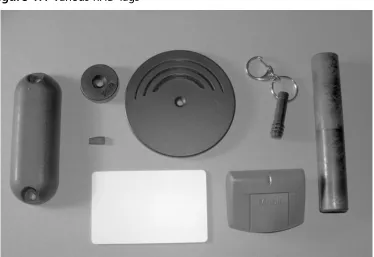
[image:29.504.74.448.311.568.2]The widespread use of RFID by both Wal-Mart and the DoD will make other people, companies, and groups aware of the benefits of using RFID. Also, their combined demand ensures that there will be an increase in RFID research and development, and a lowering of the overall prices of RFID equipment. Figure 1.1 shows various types of RFID tags.
Figure 1.1Various RFID Tags
www.syngress.com
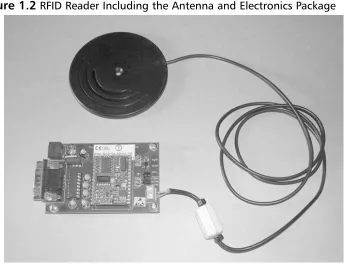
As costs are driven down, other large retailers (e.g., Best Buy and Target) are starting to use RFID at the pallet level, or have RFID systems in the plan-ning stage.The costs are low enough so that smaller RFID units are attainable to hobbyists. Figure 1.2 is a photo of an RFID reader.
Notes from the Underground…
Identification Friend or Foe (IFF)
The concept of automatic identification using a radio transponder origi-nated in World War II as a way to distinguish friendly aircraft from the enemy; hence, the name Identification Friend or Foe (IFF). The “friendly” planes responded with the correct identification, while those that did not respond were considered “foes.”
In principle, IFF operates much the same as RFID. A coded interroga-tion signal is sent out on a particular RF, which the transponder receives and decodes. The transponder then replies with encrypted identification information. Each transponder has a unique identifier; however, some secondary information can be manually set by the pilot.
IFF has expanded since WWII, and now includes several different identification modes for both civilian and military aircraft. These expanded modes add various additional pieces of information, such as the aircraft’s altitude. Even though its modern role now includes civilian aircraft, the system is still commonly known as IFF.
www.syngress.com
8 Chapter 1 • What Is RFID?
Figure 1.2RFID Reader Including the Antenna and Electronics Package
RFID Radio Basics
The following section is a primer on radio waves. If you do not know much about radio, you are encouraged to read it. If you are a radio aficionado, it will seem simplistic; feel free to skip over it.
Radio is a small piece of the “electromagnetic spectrum” that covers all forms of radiation. Other parts of the electromagnetic spectrum that you may be familiar with are cosmic-ray photons, gamma rays, x-rays, and visible light. The Radio Frequency (RF) area is broken down into a number of “bands” (i.e., grouped frequencies) (e.g., the Very High Frequency (VHF) band covers from 30 Megahertz (MHz) to 300 MHz. In the United States, using these bands is governed by the Federal Communications Commission (FCC), including who may use a given band, the power level they may transmit at, and how they modulate the signals. Most other countries have a similar regu-latory body. Many European Union countries are regulated by the European Telecommunications Standards Institute (ETSI).
www.syngress.com
Tools and Traps…
It Hertz So Good
RFs are measured in Hertz (Hz). Most of the measurements of radio waves for RFID occur in thousands of cycles per second (kilohertz [kHz]); millions of cycles per second (MHz); or billions of cycles per second (Gigahertz [GHz]).
The term Hertz is in honor of German physicist Heinrich Rudolf Hertz (1857–1894), who was a pioneer in electromagnetism. Hertz proved that electricity is transmitted in electromagnetic waves, and his discoveries helped lead to the development of radio.
For RFID, most systems utilize one of three general bands: Low Frequency (LF) at 125 kHz to 134 kHz, High Frequency (HF) at 13.56 MHz, and Ultra HF at 860 to 930 MHz. There may be some variation of frequency use, depending on the regulations in a particular locale.
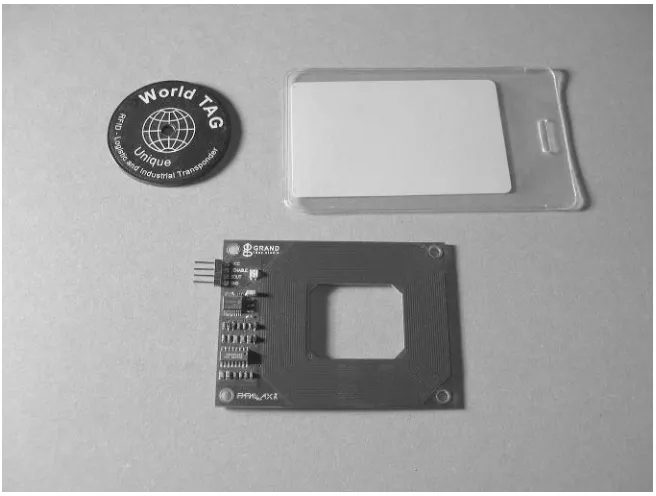
Manufacturers of RFID equipment usually choose a given band based on the physics of the band (e.g., how well the signal propagates in a specific environment). The properties of the band also influence the physical size of the antennas and what power transmission levels can be used. Conversely, physical limitations may influence which frequencies and RF bands are used for a given application. Figure 1.3 shows two different RFID tags and a reader.
www.syngress.com
10 Chapter 1 • What Is RFID?
Figure 1.3 Two Different RFID Tags and Reader with Integral Antenna
Why Use RFID?
In the past few years, RFID has been largely seen as the next technology for pricing at the POS in retail stores. However, it has not replaced bar codes, mainly because the cost of individual tags is expensive. However, with the increased flexibility of being able to perform complete inventory tracking from manufacturer to warehouse to retailer, and with the economic influence of large retail chains, the cost of individual tags will soon become affordable.
www.syngress.com
Tools and Traps…
RFID Microchips for Pets
The act of placing a passive RFID tag under a pets skin, called “chipping” or “microchipping,” has become more prevalent in recent years. A chip the size of a grain of rice is implanted via injection into the skin between the shoulders of the cat or dog. The chip is designed to supplement infor-mation used on traditional dog tags.
If a pet is lost and subsequently picked up by the animal control officer, it can be scanned at the animal shelter. If a chip is detected in the animal, shelter personnel obtain the owner information via a database provided by the microchip manufacturer. The owner is then notified that their pet has been impounded.
While excellent in theory, in practice it is not without its pitfalls. Since there are no industry standards for pet tags and readers, different manu-facturers are using the same frequencies and encoding techniques. As a result, a scanner that reads chips from a given manufacturer cannot read a different brand of chip. Because of a lack of standardization, a pet was euthanized because the shelter could not read the tags. The detection failed because the shelter used a different brand of scanner than that used by the implanted chip.
Due to concerns about this type of event occurring again, “universal” readers that can read several different brands of chips are being devel-oped and implemented. (For more information go to www.npr.org/tem-plates/story/story.php?storyId=4783788.)
www.syngress.com
12 Chapter 1 • What Is RFID?
RFID Architecture
The RFID system architecture consists of a reader and a tag (also known as a
label or chip).The reader queries the tag, obtains information, and then takes
action based on that information.That action may display a number on a hand held device, or it may pass information on to a POS system, an inven-tory database, or relay it to a backend payment system thousands of miles away.
Let’s looks at some of the basic components of a typical RFID system.
Tag/Label
RFID units are in a class of radio devices known as transponders. A transponder is a combination transmitter and receiver, which is designed to receive a spe-cific radio signal and automatically transmit a reply. In its simplest implemen-tation, the transponder listens for a radio beacon, and sends a beacon of its own as a reply. More complicated systems may transmit a single letter or digit back to the source, or send multiple strings of letters and numbers. Finally, advanced systems may do a calculation or verification process and include encrypted radio transmissions to prevent eavesdroppers from obtaining the information being transmitted.
Transponders used in RFID are commonly called tags,chips, or labels, which are fairly interchangeable, although “chip” implies a smaller unit, and “tag” is used for larger devices.The designator label is mainly used for the labels that contain an RFID device. (The term “tag” is used for the purposes of this book.)
As a general rule, an RFID tag contains the following items:
■ Encoding/decoding circuitry
■ Memory
■ Antenna
■ Power supply
■ Communications control
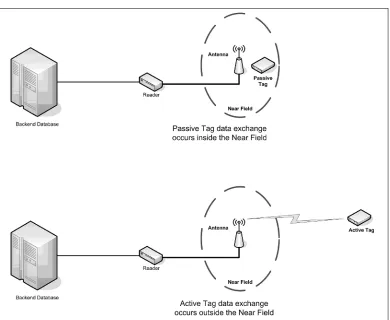
Tags fall into two categories:activeand passive (see Figure 1.4).
www.syngress.com
Passive vs. Active Tags
Passive RFID tags do not contain a battery or other power source; therefore, they must wait for a signal from a reader.The tag contains a resonant circuit capable of absorbing power from the reader’s antenna. Obtaining power from the reader device is done using an electromagnetic property known as the
Near Field. As the name implies, the device must be relatively near the reader
in order to work.The Near Field briefly supplies enough power to the tag so that it can send a response.
In order for passive tags to work, the antenna and the tag must be in close proximity to the reader, because the tags do not have an internal power source, and derive their power to transmit from coupling to the Near Field of the antenna.The Near Field takes advantage of electromagnetic properties and generates a small, short-lived electrical pulse with the passive tag that can power a tag long enough for it to respond.
Tools and Traps…
Near Field
The Near Field is a phenomenon that occurs in a radio transmission, where the magnetic portion of the electromagnetic field is strong enough to induce an electrical field in a coil. As the name implies, the Near Field occurs in an area near to the antenna. Just how big the Near Field is, depends on the wavelength of the radio signal being used.
r = λ/2π
where λis the wavelength.
For example, a common RFID frequency is 13.56 MHz and the wave-length of 13.56 MHz is approximately 22 meters. Therefore:
22/2π= 22/6.28 = 3.5 meters.
The Near Field for an RFID device operating at 13.56 MHz is 3.5 meters or 11.5 feet. Passive tags requiring the Near Field, have to be within that area in order to operate correctly.
www.syngress.com
14 Chapter 1 • What Is RFID?
The alternative to a passive tag is an activetag. Active tags have their own power source, usually an internal battery. Since they contain a battery to power the radio circuitry, they can actively transmit and receive on their own, without having to be powered by the Near Field of the reader’s antenna. Because they do not have to rely on being powered by the reader, they are not limited to operating within the Near Field.They can be interrogated and respond at further distances away from the reader, which means that active tags (at a minimum) are able to transmit and receive over longer distances
Semi-passive tags have a battery to power the memory circuitry, but rely on
[image:37.504.68.458.246.566.2]the Near Field to power the radio circuits during the receiving and sending of data.
Figure 1.4Passive and Active Tag Processes
www.syngress.com
Reader
The second component in a basic RFID system is the interrogator or reader. The term “reader” is a misnomer; technically, reader units are transceivers (i.e., a combination transmitter and receiver). But, because their usual role is to query a tag and receive data from it, they are seen as “reading the tag”; hence, the term “reader.” Readers can have an integrated antenna, or the antenna can be separate.The antenna can be an integral part of the reader, or it can be a sepa-rate device. Handheld units are a combination reader/antenna, while larger systems usually separate the antennas from the reader.
Other parts that a reader typically contains are a system interface such as an RS-232 serial port or Ethernet jack; cryptographic encoding and decoding circuitry; a power supply or battery; and communications control circuits.
The reader retrieves the information from the RFID tag.The reader may be self-contained and record the information internally; however, it may also be part of a localized system such as a POS cash register, a large Local Area Network (LAN), or a Wide Area Network (WAN). Readers that send data to a LAN or other system do so using a data interface such as Ethernet or serial RS-232.
Readers, and in particular their antenna arrays, can be different sizes, from postage stamp-sized to large devices with panels that are several feet wide and high.
Middleware
Middlewaresoftware manages the readers and the data coming from the tags,
and passes it to the backend database system. Middleware sits in the middle of the data flow between the readers and the backend, and manages the flow of information between the readers and the backend. In addition to extracting data from the RFID tags and managing data flow to the backend, middleware performs functions such as basic filtering and reader integration and control.
As RFID matures, middleware will add features such as improved and expanded management capabilities for both readers and devices, and extended data management options.
www.syngress.com
16 Chapter 1 • What Is RFID?
The backend can be a standard commercial database such as SQL, My SQL, Oracle, Postgres, or similar product. Depending on the application, the backend database can run on a single PC in an office, to multiple mainframes networked together via global communications systems.
Data Communications
In the next few sections we’ll look in detail at the data the tags are carrying, and how some of the more popular protocols work when they communicate the data to the reader. We’ll also talk about the physical format of the cards, and how physical form can be adapted to the particular job.
Tag Data
Depending on the type of tag, the amount of data it can carry is anything from a few bytes up to several megabytes.The amount of data carried by a tag depends on the application and the individual tag.
The data carried in a tag can be in most formats, as long as both the tag and the reader agree on it. Many formats are proprietary, but standards are emerging. In the next section, we look at the Electronic Product Code™ (EPC™). The EPC™ is considered the RFID replacement for the Universal Product Code (UPC) barcode and, as such, will have a huge impact on retail sales in the future.
www.syngress.com
The UPC bar code has been the accepted means of conveying pricing at the POS in retail stores since the 1970s (see Figure 1.5).This particular UPC is from Syngress Publishing’s WarDriving: Drive, Detect, Defend. Each UPC bar code contains basic information about the bar coding system, the manufac-turer, the item, and a check digit. Because 5 digits are used for both the man-ufacturer and the item, the total number of manman-ufacturers is limited to
100,000, each limited to 100,000 items. While this allows for 10,000,000,000 products, it is more restrictive than is obvious. As manufacturers add new items and close out old product lines, UPC numbers are quickly being used up.The UPC does not allow serial numbers to be encoded into the bar code.
Figure 1.5Typical UPC Bar Code
Electronic Product Code
The new Electronic Product Code uses the EPCglobal organization’s General Identifier (GID-96) format. GID-96 has 96 bits (12 bytes) of data. Under the GID-96 standard, every EPC™ consists of three separate fields: the 28-bit General Manager Number that identifies the company or organization; the 24-bit Object Class that breaks down products into groups; and the 36-bit serial number that is unique to the individual object. A fourth field consisting
www.syngress.com
18 Chapter 1 • What Is RFID?
of an 8-bit header is used to guarantee the uniqueness of the EPC™ code (see Table 1.1). EPCglobal is a not-for-profit worldwide organization that assigns EPC™ to subscribers.
Each company or manufacturer is assigned a General Manager Number from EPCglobal. EPCglobal is the worldwide organization that manages the general administration of the EPC™ numbers. Each manufacturer assigns an Object Class number to each product line. Each individual item is identified by a Serial Number. Manufacturers can assign the product number and the serial number in any way they deem desirable. Potentially, this allows the manufacturer the ability to uniquely identify every single item.
Table 1.1EPC™ Fields
General Manager
Number Object Class
Header (Company) (Groups) Serial Numbers
Number of Bits: 8 28 24 36
Total numbers: 268,435,455 16,777,215 68,719,476,735
This allows for a total of 30,939,155,745,879,204,468,201,375 unique items under the EPC™ system.
The EPC™ standards for data tags can be downloaded from:
www.epcglobalinc.org/standards_technology/EPC_Tag%20Data%20Specification% 201.1Rev%201.27.pdf.
Protocols
RFID systems work when a reader antenna transmits radio signals.Those sig-nals are picked up by the tag, which answers with a responding radio signal (see Figure 1.6).That signal is then read by the reader’s receiver. Depending on the tag’s computational power (if any), the tag may perform some encryp-tion or decrypencryp-tion funcencryp-tions.
Some tags are “read-only,” while other tags have data “written” to them and “read” from them. Using a process similar to the “read” cycle, the reader can “write” data to the tag if it a data “write” operation is needed.
www.syngress.com
Figure 1.6 Reader and Tag Interaction
Some tag protocols are proprietary, but EPCglobal and the International Organization for Standardization (ISO) have defined several protocols (see Table 1.2).
www.syngress.com
20 Chapter 1 • What Is RFID?
Table 1.2RFID Tag Protocols
Protocol Capabilities
EPC™ Generation 1 “Read Only,” preprogrammed Class 0
EPC™ Generation 1 “Write” Once, “Read” Many Class 1
EPC™ Generation 2.0 “Write” Once, “Read” Many;
Class 1 A more globally accepted version of the
Generation 1, Class 1 protocol.
ISO 18000 Standard “Read-Only” tag identifier; may also contain rewritable memory available for user data. ISO 18000 has different subsections depending on the frequency used and the intended application.
ISO 15963 Unique Tag ID
ISO 15961 Data protocols: data encoding rules and logical memory functions
ISO 15962 Data protocols: application interface
ISO also has standards for supply chain applications, tag and reader perfor-mance and conforperfor-mance, and product packaging tagging standards.
Physical Form Factor (Tag Container)
A tag can take almost any form desired to perform required functions.The design may be influenced by the type of antenna, which in turn may be dependant on the frequency used for the system.The tags may be standalone devices, or integrated into another object such as a car ignition key. Systems parameters, such as whether active or passive tags are required and whether a battery is on a tag, can also influence the design.
Figure 1.1 shows that tags can be put into packages of almost every con-ceivable shape.The rule is:The larger the tag, the further distance it may be “read.”
The following sections discuss some typical tags.
www.syngress.com
Cards
RFID tags in a “credit card” physical format are usually used for purposes such as building access.This type typically involves security. Personnel that are allowed to enter, or restricted from entering, certain areas of the building are a given encoded cards. Readers are typically mounted next to a door where access is controlled.The reader relays the cardholder information to a database and the database determines whether the cardholder has line access to that particular area. If access is allowed, an electronic door lock is disengaged, allowing access to the building or to a particular room.
Some of the first commercial RFID applications were card-controlled entry systems using “proximity cards.” Proximity cards do not carry as much information as newer RFID units and are about double or triple the thickness of a credit card. Newer RFID cards are the same thickness as a credit card.
The white rectangles seen in Figures 1.1 and 1.3 are RFID cards, each containing an electronic microchip with a serial number encoded.
Credit cards are seen as potential RFID tags. In late 2005, television viewers saw new credit card commercials showing the PayPass system and their “Tap ‘N’ Go”Tag line.The credit card becomes a tag, because it has an integral RFID chip. Instead of swiping the card through a traditional mag-netic card reader, the user holds the credit card containing the RFID chip near the reader at the POS.The transaction is completed in a matter of sec-onds. According to the RFID Gazette, the tag conforms to the International Organization for Standardization (ISO)/IEC 14443 standard, uses Triple Data Encryption Standard (DES) and SHA-1 cryptography, and operates at 13.56 MHz.
The RFID technology is being pushed to the extent that the latest “dummy” cards used for American Express advertising show a fake RFID chip and antenna.The newest design calls for the card plastic to be clear. Figure 1.7 depicts a replica card recently received in a credit card application. The fake RFID chip and antenna are pointed out with arrows.
www.syngress.com
22 Chapter 1 • What Is RFID?
Figure 1.7Fake Credit Card Showing the RFID Chip and Antenna
Key Fobs
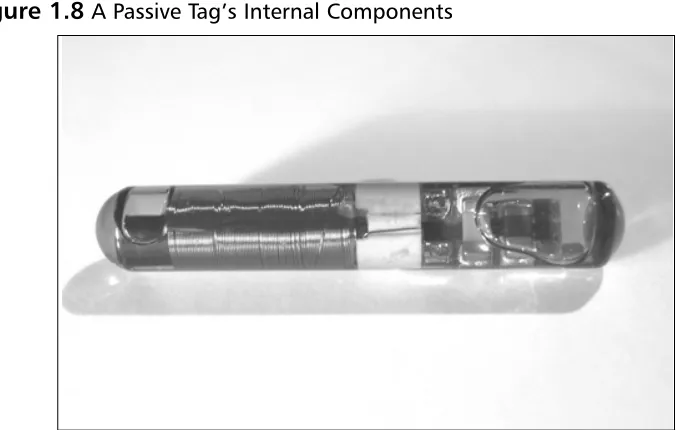
Key fobs are also popular for POS systems.The RFID tip is encapsulated in a small cylinder or other container designed to use on a key ring.This allows the tag to be conveniently located (e.g., the passive key fobs used as part of the ExxonMobil SpeedPass system are approximately 1-1/2” long and 3/8” in diameter).The internal electronics are even smaller; the glass-encased RFID chip and antenna assembly is approximately 7/8” long by 5/32” in diameter. Figure 1.8 shows an example of a passive tag’s internal components.
The ExxonMobil SpeedPass is a passive tag, designed to be held in the user’s hand, and waved within close proximity (> 1”) in front of the gas pump’s integral reader. ExxonMobil also makes active SpeedPass tags designed to be vehicle mounted.
www.syngress.com
Figure 1.8A Passive Tag’s Internal Components
Other Form Factors
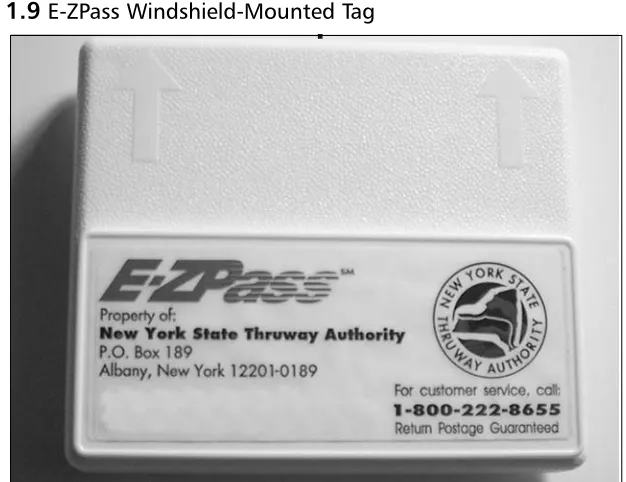
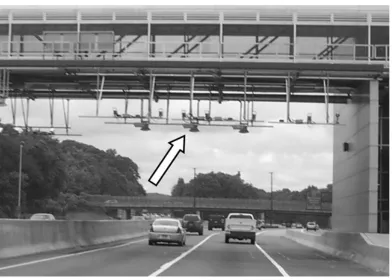
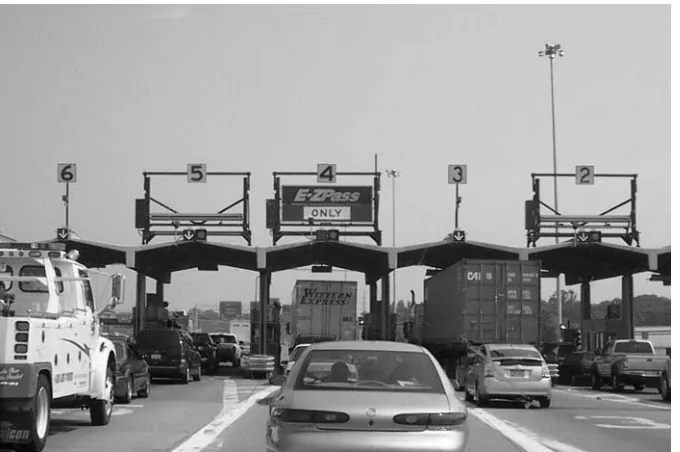
In contrast to key fob tags, other tags may be designed very small to mount onto retail packages, or very large to mount onto vehicles (e.g., the tags used by the E-ZPass system, a toll collection system used in the Northeast US, is a plastic box approximately 3-/2” wide × 3” high × 5/8” thick (see Figure 1.9). The E-ZPass tag is active, and designed to be carried on the windshield of a subscriber’s vehicle.The reader antennas are either mounted on a tollbooth 6 to 10 feet from the vehicle, or on a gantry approximately 20 feet above the roadway (see Figure 1.10).
www.syngress.com
24 Chapter 1 • What Is RFID?
Figure 1.9E-ZPass Windshield-Mounted Tag
Notes from the Underground…
How the ExxonMobil
SpeedPass and E-ZPass Systems Work
The ExxonMobil SpeedPass employs RFID to speed customers through fuel purchases. Here’s how it works:
1. An RFID tag mounted on the vehicle or attached to the sumer’s key chain is activated by the reader. The reader is con-nected to the pump. The reader handshakes with the tag and reads the encrypted serial number.
2. Cables connect the reader and pump to a satellite transceiver in the gas station.
www.syngress.com
What Is RFID? • Chapter 1 25
3. The transceiver sends the serial number from the RFID tag up to a Very Small Aperture Terminal Satellite (VSAT). The VSAT, in turn, relays the serial number to the earth station.
4. The serial number is sent to the ExxonMobil data center from the earth station. The data center verifies the serial number, and checks for authorization on the credit card that is linked to the account.
5. The authorization is sent back to the pump following the above route in reverse.
6. The pump turns once it receives the authorization, and allows the customer to gas up their vehicle.
ExxonMobil has extended the reader inside service stations and con-venience stores. By placing a reader near the cash register, a customer can charge purchases made at an ExxonMobil store on the same charge system as their gasoline purchases.
The E-ZPass toll system works in a similar manner as the SpeedPass:
1. As the car enters the toll plaza, the car-mounted tag is acti-vated by the reader antenna for that lane. Tags can be mounted on the windshield or the license plate.
2. An encoded number is sent from the tag back to the reader. 3. The reader transfers that information to the E-ZPass database. 4. The amount of the toll is deducted from the prepaid account, which is usually a fixed amount. However, on some highways such as the NY Thruway, the toll is based on the distance trav-eled, in which case the database tracks the entry and exit points, and the toll is computed based on those locations. 5. The database time- and date stamps the transaction, assigns a
transaction number, and records the location of the tollbooth. 6. A green light, open gate, or text message (sometimes all three)
tells the driver that they can pass through the toll booth. Other lights or messages may indicate errors or account problems.
www.syngress.com
26 Chapter 1 • What Is RFID?
Figure 1.10E-ZPass High-speed Toll Plaza–Antenna Array
Summary
In this chapter, we discussed how RFID systems work; the various types of RFID tags, data formats, and tag protocols; and some typical applications.
We also discussed some of the potential attacks that RFID systems are sus-ceptible to. We learned that some of the attacks that are well known to IT professionals can also be applied to RFID.
Links to Sites
■ RFID Gazette—www.rfidgazette.org ■ EPCglobal—www.epcglobalus.org
■ ISO—www.iso.org
■ RFID Buzz—www.rfidbuzz.com ■ RFID Viruses—www.rfidvirus.org
www.syngress.com
RFID Uses
Solutions in this chapter:
■ Applied Use
■ Standards in the Marketplace
■ RFID for the Consumer: Case Studies
Chapter 2
Introduction
In the late 1940s, a scientist named Harry Stockman published a paper about Radio Frequency Identification (RFID), which is said to be related to the “Friend or Foe Transponder Identification System” used by the British Royal Air Force during World War II.
In the late 1960s to the early 1970s, RFID developed its first commercial application, the Electronic Article Surveillance (EAS) system, which uses a simple form of RFID with 1-bit tags to prevent shoplifting (i.e., everyone walks through EAS system panels when entering and leaving stores).
Other RFID commercial uses followed in the 1980s and 1990s, including livestock tagging, toll road payment systems, and using RFID on shop floors to direct the assembly of automobiles.
By the end of the 20thcentury, RFID touched the lives of millions of
people in the US and elsewhere. RFID is not a glamorous, sexy, or exciting technology; it tends to be used in warehouses and behind-the-scenes indus-trial settings. When the technology is embedded in a product or a device used by consumers (e.g., the E-ZPass toll system or the Mobil SpeedPass), most consumers are not aware of its inner workings.
Fast forward to the 21st century. RFID is on the radar screens of many consumers, although not always in a positive way. A vocal segment of con-sumers are concerned with the loss of privacy they fear will occur if RFID becomes more widespread. RFID has even been tied to the Biblical concept of the “mark of the beast” (see “Notes from the Underground”).
www.syngress.com
30 Chapter 2 • RFID Uses
Notes from the Underground…
Mark of the Beast
In the context of RFID, the “Mark of the Beast” is a reference to RFID tags (contained in tiny glass capsules) being implanted into people. However, some people associate RFID with a passage in the New Testament’s “Book of Revelation,” that prophesied the Mark of the Beast, “[The Beast] causes all, both great and small, rich and poor, free and slave, to receive a mark on their right hand or on their foreheads.”
Various iterations of the Mark of the Beast theory are discussed on the Web. Snopes.comdebunked the Mark of the Beast in connection with RFID as an urban legend, but the theory hangs on and maintains a fol-lowing among the small segment of the population who believe RFID is harmful.
The practice of implanting RFID tags into people is limited. As of 2006, VeriChip Corporation, the supplier of the only patented Food and Drug Administration (FDA)-approved human implantable chips, estimated that there are a few thousand people worldwide with implanted tags, the majority of which are used for medical purposes (e.g., to alert medical personnel to medical conditions a person has, in the event he or she is unable to communicate.
The “technology” and “trade press” write more frequently about RFID.
The RFID Journal and countless niche Web sites are dedicated to covering
RFID. Some daily newspapers are running obligatory RFID pieces (usually around privacy issues).
Most importantly, for commercial purposes, RFID technology now has the attention of the business world. RFID has a foot in a wide variety of industries with a wide variety of uses. Business executives and managers are learning about RFID and evaluating how it can improve their companies’ operations. Pilots and field trials are increasingly taking place.
What gave RFID this higher profile?
In one sense, the RFID’s time has come. Consider the technology trends happening today.Technology is becoming cheaper and more widespread.The
www.syngress.com
Internet has changed everything, as businesses increasingly adopt it as an enabling and communications platform. With the cost of technology drop-ping, it takes less financial investment to implement information technology, thereby making it easier to establish a business plan and Return on
Investment (ROI).
A 2005 white paper by Thomas Siems, of the Federal Reserve Bank of Dallas, makes the connection between increased productivity in the US economy, improved business supply chains, and advances in information tech-nology. (See www.dallasfed.org/research/indepth/2005/id0501.pdf.)
Simply put, technology is becoming cheaper, more available, and easier to use. Computer hardware and software is becoming less expensive.The pro-cessing capacity is no longer a barrier. Database and storage capacity is plen-tiful and cheap.The Internet allows us to move large amounts of data from computer-to-computer, company-to-company, and location-to-location.
The price of silicon chips used in the manufacture of RFID tags has dropped.The recent development of chipless tags, polymer tags, and advances in printing techniques for RFID tags, hold the promise of even lower tag prices. So, as technology gets cheaper and more widespread, more companies are evaluating and implementing RFID.
The first major commercial boost for RFID came in June 2003, when Wal-Mart, America’s largest corporation, issued a mandate requiring its top 100 suppliers to use RFID on the cases and pallets they shipped to Wal-Mart, by January 1, 2005.
In October 2003, the US Department of Defense (DoD) announced that it was requiring suppliers to adopt RFID.
Given the size of these two entities, and the billions of dollars of buying power they represent, the impact was felt immediately, extending far beyond Wal-Mart’s and the DoD’s suppliers. Wal-Mart has a reputation as a leader in its technology systems, and their competitors and other retailers took notice. Perhaps more than any two single events, the Wal-Mart and DoD man-dates raised the profile of RFID in businesses. Consumer product manufac-turing and distribution companies that did not consider implementing RFID suddenly became interested in learning more.
What’s more, when two such large buyers of goods announce that RFID is required, a domino effect starts among other large wholesale buyers of
www.syngress.com
32 Chapter 2 • RFID Uses
goods. It was not long before other large retailers in the US and Europe (e.g., Metro Group in Germany,Tesco in the UK,Target in the US) and announced their own RFID initiatives.
However, despite the mandates and the supply chain-related visibility, RFID is still not widely adopted in supply chain settings.The market for supply chain-related RFID is in the early stages, with many companies researching and evalu-ating the options. Limited numbers of businesses are deploying RFID in supply chains; however, that number will grow as tag and reader costs fall and the industry collectively gains more expertise in making implementations simpler, more fool-proof, and faster. In the meantime, the largest worldwide market uses RFID in areas other than the supply chain. Contactless payment systems and smart cards are the most widespread uses to date.
The following sections explore these significant uses of RFID.
Applied Use
RFID is a versatile technology, capable of being used by businesses and the government. Mandates for supply chains, while raising the profile of RFID in business, have overshadowed how extensively and successfully RFID is used in other contexts.
In the early part of the 21st century, RFID is growing. Businesses, associa-tions, and government agencies announce new uses weekly.The list of RFID users is a long one:
■ Supply Chains, Including Wholesale and Retail Inventory and Materials Management (e.g., case and pallet level tagging: Wal-Mart, DoD,Target,Tesco, Metro Group)
■ Item-level Tagging of Consumer Goods on Retail Shelves
(e.g., Marks & Spencer testing of consumer apparel in limited number of stores;Tesco’s tagging of DVDs; Prada)
■ Toll Payment Systems (e.g., E-ZPass payment system in Eastern US states; toll payment systems in numerous other states and countries)
www.syngress.com
■ Smart Cards (e.g., transportation fare systems such as SmarTrip in Washington Metro system. Philips MIFARE technology is used in transportation systems around the globe, including the London Metro system.
■ Contactless Payment Systems at the Retail Point of Sale (POS)(e.g., Mobil SpeedPass; swipeless credit cards such as the Mastercard PayPass, Chase Bank’s Blink Mastercard, and American Express’s ExpressPay)
■ Logistics (e.g., Kimberly Clark)
■ Asset Tracking (e.g., Robert Bosch Tool; containerized ocean cargo; Coors UK brewery assets; Goodyear NASCAR leased tire program)
■ Automobile Keyless Start Systems(e.g.,Toyota, Lexus, and Audi).
■ Sports (e.g., using RFID tags to track marathon runners and other sports participants)
■ Ticketing (e.g., RFID-embedded tickets for major sporting events such as the Tennis Master Cup 2005 (Texas Instruments tags) and the upcoming 2008 Olympics; RFID-embedded conference badges for the 2005 Canon Expo in Paris [Zebra Technologies
printers/encoders])
■ Access Control (e.g., RFID-enabled badges to control access to campuses, buildings, and rooms. Major suppliers include Texas Instruments and Idesco Oy.)
■ Pet Microchipping(e.g., inserting glass-encased RFID tags under the skin of pets for ownership identification. Avid and Home Again are major US suppliers.
■ Livestock and Wildlife Tagging (e.g., tagging beef livestock to secure the food supply from Mad Cow Disease and other contami-nants, and tagging wildlife for conservation and tracking purposes. Allflex, Digital Angel, and Aleis International are major suppliers.)
■ People Tagging(e.g., RFID tags used mainly for medical and secu-rity purposes, such as securing infants from kidnapping in hospitals. VeriChip is the primary manufacturer.)
www.syngress.com
34 Chapter 2 • RFID Uses
■ Luggage Tracking (e.g., Hong Kong Airport; Delta Airlines; Globalbagtag)
■ Passports and Border Control (e.g., US; Japan; Holland; Norway; Pakistan; Malaysia)
■ Libraries(e.g., Vatican Library; Berkeley Library; University of Connecticut)
■ File Management (e.g., 3M’s file tracking system for law offices)
■ Pharmaceutical Anti-drug Counterfeiting(e.g., Purdue Pharma’s OxyContin)
Wholesale
Using RFID in the supply chain at the wholesale level involves tracking and identifying parts, components, and materials moving into and out of the man-ufacturing facility.
Inbound shipments involve parts arriving from a supplier’s warehouse, eventually making their way to the manufacturing facility. Pallets and larger shipments, such as railroad cars, are routed using a single RFID identifier.
Outbound shipments involve finished products that are moved out of the manufacturing plant to the manufacturer’s warehouse, and eventually to the manufacturer’s customer (e.g., a retailer).
For this example, assume that RFID tags have been affixed to cases and pallets of parts as they are leaving the vendor’s warehouse. Upon arriving at the manufacturer’s warehouse, the RFID tags provide important information regarding the parts being shipped. Because it is a hand-off from one company to another, the reader equipment at the manufacturer’s facility must be com-patible with the category and type of tag employed by the vendor.
Readers are placed at the warehouse entrances (shipping and receiving docks) to interrogate the tags on the cases and pallets as the shipment arrives.
www.syngress.com
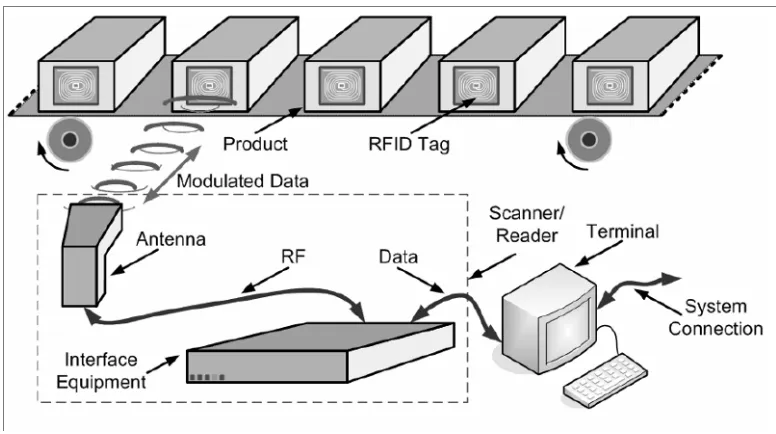
The parts are incorporated into the manufacturing process, resulting in the finished goods (see Figure 2.1). Products are placed on a conveyor belt, and read-write RFID tags are placed on the conveyor belt.The RFID tags then pass in front of the antenna and reader. Simultaneously, the reader inter-face reads and writes information on the tag to identify the products. In the case of the diagram, these are item-level tagging, but it can also apply to cases of product.
Figure 2.1RFID Item-Level Tagging
www.syngress.com
36 Chapter 2 • RFID Uses