White Rose Research Online URL for this paper: http://eprints.whiterose.ac.uk/74042/
Version: Published Version
Monograph:
Golden, Sarah, O'Donnell, Lisa, Rudd, Peter orcid.org/0000-0002-8824-3247 et al. (1 more author) (2005) Evaluation of Increased Flexibility for 14 to 16 Year Olds Programme : Outcomes for the First Cohort - Research Report. Research Report. DfES Research Reports . Department for Education and Skills (DfES) , Nottingham.
[email protected] https://eprints.whiterose.ac.uk/
Reuse
Items deposited in White Rose Research Online are protected by copyright, with all rights reserved unless indicated otherwise. They may be downloaded and/or printed for private study, or other acts as permitted by national copyright laws. The publisher or other rights holders may allow further reproduction and re-use of the full text version. This is indicated by the licence information on the White Rose Research Online record for the item.
Takedown
If you consider content in White Rose Research Online to be in breach of UK law, please notify us by
Evaluation of Increased Flexibility for
14 to 16 Year Olds Programme:
Outcomes for the First Cohort
Evaluation of Increased Flexibility for
14 to 16 Year Olds Programme:
Outcomes for the First Cohort
Sarah Golden, Lisa O’Donnell, Tom Benton and Peter Rudd
National Foundation for Educational Research
Please note that changes have been made to the Departmental analysis
presented on pages 40-41, due to an error in the original report.
The views expressed in this report are the authors’ and do not necessarily reflect those of the Department for Education and Skills.
Contents
page
Acknowledgements i
Executive summary iii
1. Introduction 1
1.1 Background 1
1.2 Aims and objectives 3
1.3 Research methods 3
1.4 Structure of the report 6
2. Achievements of young people who participated in the IFP 9
2.1 Introduction 10
2.2 Overall attainment of IFP students at key stage 4 14 2.3 Main factors which influence attainment at key stage 4 16 2.4 The effect of participation in IFP on students’ attainment at
key stage 4 18
2.5 Attainment of five A* to C grades or equivalent (Level 2) 27
2.6 In summary 29
2.7 Influences on attainment at key stage 4 29
2.8 Conclusion 35
3. Post-16 destinations of young people who participated in the IFP 37
3.1 Introduction 38
3.2 Location and type of destination post-16 38
3.3 Qualifications studied post-16 45
3.4 Factors which appeared to influence post-16 destinations 54 3.5 Future plans of young people who participated in the programme 69
3.6 Conclusion 72
4. Other outcomes for young people who participated in the IFP 73
4.1 Introduction 73
4.2 Changes in skills and attitudes 74
4.3 Students’ attendance 76
5. Conclusion 81
5.1 Achievement of qualifications by IFP participants 81
5.2 Destinations of IFP participants 82
5.3 Attendance of IFP participants 84
5.4 Policy implications 85
Appendix A: Variables included in the multi-level model analysis 87
Appendix B: Point scores for qualifications 91
Acknowledgements
The authors would like to express their thanks to the DfES for commissioning this research and particularly to Maura Lantrua, Project Manager, for her support, guidance and insights throughout the evaluation. We are grateful to members of the project steering group for their helpful comments on the report and for their guidance throughout the research process. Thanks are also due to Ian Thomson, Lisa Moralee and colleagues in DfES for providing data and conducting some analyses.
The research team appreciate the invaluable contribution of the young people who took the time to respond to the surveys. We are indebted to the school staff for their kind assistance in providing details of students’ achievements and destinations after Year 11. We gratefully acknowledge the support of the Lead Partners and the Local Learning and Skills Councils throughout the evaluation of IFP.
Executive summary
Introduction
The Increased Flexibility for 14-16 year olds Programme (IFP) was introduced in 2002 by the Department for Education and Skills (DfES) to provide vocational learning opportunities at key stage 4 for those young people who would benefit most. The programme, which entailed FE colleges and training providers working in partnership with schools to offer GCSEs in vocational subjects, NVQs, other vocational qualifications and GNVQs to students, was subsequently extended to three further cohorts of young people.
The DfES commissioned the National Foundation for Educational Research (NFER) to undertake an evaluation of the first cohort of participants. This summary presents selected key findings relating to the attainment, progression, attendance and attitudes of the first cohort of IFP students (2002-2004).
Key Findings
• The majority of young people who took new GCSEs and GNVQs attained
their qualifications (91 per cent and 80 per cent respectively). In addition, the majority of the sample of young people who had undertaken NVQs and other vocational qualifications had achieved the qualification at the end of Year 11 (66 per cent and 67 per cent respectively).
• In addition, the GNVQs and NVQs achieved by these young people
contributed to them gaining higher total point scores than would have been expected given their prior attainment and background characteristics. However, those who took GCSEs in vocational subjects attained levels commensurate with their prior attainment and those who took other vocational qualifications achieved fewer points than might be expected compared to similar students who did not participate.
• Students who studied GCSEs in vocational subjects and GNVQs, but did
not participate in IFP, also attained better outcomes than might be expected and, indeed, gained higher points still than young people who had taken these qualifications through IFP.
• Overall, the transition target for IFP partnerships had been successfully
• The majority of young people who were undertaking a course post-16
were pursuing a qualification that was at a higher level than the level of the course they had undertaken through IFP.
Background
The Increased Flexibility for 14-16 year olds Programme is delivered by means of partnerships between a Lead Partner, which is usually a college of Further Education, partner schools and sometimes other providers, such as training providers and employers. The partnerships are working towards a number of targets relating to achievement of qualifications, progression after Year 11 and attendance during the programme.
The IFP was introduced in 2002 and subsequently expanded to second, third and fourth cohorts commencing in the autumn term of each of the years of 2003, 2004 and 2005. For each cohort, about 300 partnerships have supported the learning of around 40,000 young people in Years 10 and 11. The IFP was therefore reasonably well established as one of the key means for providing curriculum flexibility by the time of the publication of the Tomlinson Report in 2004 (14-19 Curriculum and Qualifications Reform: Final Report of the Working Group on 14-19 Reform) and the subsequent White Paper: 14-19 Education and Skills (2005).
The DfES commissioned the NFER to undertake an evaluation of the first cohort of IFP using a range of data collection methods. Four previous reports of the evaluation have explored the nature of the cohort and partnerships, the outcomes in terms of development of skills, and changes in attitudes at the end of the second year, and the experience for partnerships and students of implementing and participating in IFP.
This summary presents selected key findings relating to the attainment, progression, attendance and attitudes of the first cohort of IFP students (2002-2004). These findings reflect the outcomes for young people who participated in the development and implementation of a new mechanism for increasing flexibility in the curriculum through working in partnership across education providers which has become increasingly established in successive years.
Outcomes for the First IFP Cohort: Achievement of qualifications
The majority of students who participated in the first cohort achieved the qualifications that they had undertaken. Nearly all (91 per cent) of those who had taken GCSEs in vocational subjects had attained passes at grades A* to G and 36 per cent achieved grades A* to C. Among the students who had taken GNVQs, 80 per cent had achieved the qualification. Within this group of students, 84 per cent of those who took an intermediate GNVQ achieved the qualification and 68 per cent of those who took a GNVQ at foundation level achieved the award. Around two-thirds of those in the sample who had taken NVQs and other vocational qualifications achieved their qualification (66 per cent and 67 per cent respectively). (Section 2.2)
The qualifications achieved by these students contributed to the total points that they achieved at the end of key stage 4. Students who participated in IFP attained slightly higher total points overall at key stage 4 than students who were similar in terms of their prior attainment and other background characteristics who had not participated in the programme. However, for students who had taken GCSEs in vocational subjects and GNVQs, the total numbers of points based on their eight highest achievements were lower than might be expected.1 (Section 2.4.1)
Although overall students who participated in IFP gained more points than similar students who did not participate, the total points scored by students differed in relation to the qualification that they were studying. Students who had taken GNVQs and NVQs through IFP gained more points than might be expected. The total points scores of those who took GCSEs in vocational subjects did not differ significantly from the outcomes that would be expected, and those who had taken other vocational qualifications attained fewer points than might be expected. Moreover, students who had taken GCSEs in vocational subjects and GNVQs, and were similar to IFP participants in terms of their prior attainment and other background characteristics, but had not participated in IFP, gained more points than IFP participants. (Sections 2.4.1 and 2.4.2)
Students with lower attainment at key stage 3 who took GCSEs in vocational subjects, NVQs and other vocational qualifications, gained more in terms of their total points achieved at key stage 4 than those with higher attainment at key stage 3. In addition, male students who undertook NVQs through IFP gained more points than similar students taking these qualifications who were female. (Sections 2.4.2, 2.4.3 and 2.7.2)
Around 15 per cent of the sample of students appeared to have discontinued their involvement in IFP in so far as they had embarked on a GCSE in a vocational subject or a GNVQ but were not entered for these qualifications on
1
DfES’s National Pupil Database (NPD). Further exploration of this group indicated that they gained significantly fewer points at key stage 4 than similar students who had not participated in IFP, or students who had continued their involvement in IFP to the end of Year 11. (Section 2.4.3)
Having a positive attitude was associated with gaining higher total points at key stage 4, while poor punctuality and truancy was associated with gaining lower points. Evidence from the surveys of IFP participants indicated that IFP students’ attitudes improved between Years 10 and 11, and around half said that participation in IFP had made them more aware of the importance of qualifications and learning. This may have contributed to this improved outcome at key stage 4. (Section 2.7.1)
Partnerships where some of the delivery of IFP qualifications was shared between schools and external providers were associated with higher outcomes in the IFP qualifications. Partnerships which were smaller (for example working with five schools or fewer) were associated with higher outcomes in IFP qualifications. Involving employers in the partnership, through using them as visiting speakers, was associated with higher outcomes in qualifications taken through IFP. (Section 2.7.3)
Outcomes for the First IFP Cohort: Post-16 Destinations
The majority (90 per cent) of the sample of young people were reported by their schools to have continued into further education or training after finishing Year 11. Analysis of the cohort as a whole, using matched participation and attainment datasets, indicated a post-16 participation rate of 80 per cent. Most of those in the sample had embarked on a course-based route (in a school sixth form or at an FE college or training provider), while a notable minority were following a work-based route, in an Apprenticeship, or other job with training. Students who had taken their IFP course away from school, and those who had undertaken an NVQ pre-16 were significantly more likely to have continued into further education at an FE college or training provider than elsewhere. (Section 3.2)
Two-thirds (66 per cent) of young people undertaking a course post-16 were pursuing a qualification that was at a higher level than the level of the course they had undertaken through IFP. Some young people appeared to have a continuing commitment to the vocational area they studied through IFP. This is reflected in the finding that around two-fifths (41 per cent) of those taking a qualification post-16 were taking a course that was in the same subject area as their IFP course. (Section 3.3)
suggests that IFP may have encouraged these young people to consider further education, rather than employment, post-16. (Section 3.4)
A range of variables emerged as influencing these young people’s post-16 destination, including their experience pre-16, through IFP. Just over two-fifths (42 per cent) of young people reported that the IFP had been an influence on their choice of post-16 destination and, indeed, eight per cent felt that their IFP course had been the most influential factor on their post-16 choice. Those who had taken an NVQ or GNVQ through IFP, and those with lower levels of attainment at key stage 3, were significantly more likely to have found IFP influential. Young people who had not continued into further learning after Year 11 were less likely to have talked to a school teacher or college tutor about their plans for the future than respondents overall. (Section 3.4)
The majority of young people, particularly those who had continued into further education or training, were positive about what they were doing post-16. However, nearly half of young people would have liked more help and guidance in deciding what to do after Year 11, particularly in relation to exploring which careers might suit their skills, abilities and interests. Just over a third of young people stated that they were considering continuing into higher education. Although students who were taking NVQs, GNVQs and other VQs post-16 were less likely to state that they were intending to continue into higher education, a notable minority were considering this option. (Section 3.4).
Outcomes for the First IFP Cohort: Attitudes and Attendance
The evaluation also aimed to assess the impact of the IFP on participants’ attitudes and attendance. Young people who participated in IFP and were surveyed in Years 10 and 11 were significantly more positive about school and its usefulness for their future in the second year of the programme. A positive change in attitude towards school was associated with having talked to an informed person about their progress towards the qualification that they were studying. (Section 4.2)
There was evidence that students who participated in IFP improved in their confidence in their ability between Years 10 and 11. Improved confidence was associated with discussing progress on the course with an informed adult and finding the course interesting. (Section 4.2)
A comparison of the attendance of students who participated in IFP with their peers in Years 7 to 11 in the same schools suggested that IFP participants had slightly more authorised and unauthorised absences than their peers. Among the IFP cohort, the students had missed two per cent of time due to unauthorised absence while in their schools on average, students missed one per cent of their curriculum time due to unauthorised absences. Within the IFP cohort sample, students who had taken NVQs and other VQs through the programme had significantly more absences that those who had taken GCSE and GNVQ qualifications. (Section 4.3)
Conclusions
Overall, the evaluation of the first cohort of IFP has found that the majority of students who participated had benefited in so far as the majority achieved their qualifications at the end of the programme and nearly all had progressed onto further education and training. Overall, students gained more points at key stage 4 than similar students who did not participate in IFP although, in the case of GCSEs in vocational subjects and GNVQs, students who took these qualifications through the programme gained fewer points than similar students taking these qualifications who did not participate.
These findings, together with the findings reported previously in the evaluation2 which indicated that there was evidence that IFP participants had developed their social skills and confidence in their employability skills, including interpersonal, communication and problem solving skills, and their attitude towards school, suggest that, on the whole, the IFP made a valuable contribution to the education of the first cohort of participants.
The evidence indicates that, where students had benefited from participation in IFP in terms of their key stage 4 attainment, those with certain characteristics appeared to have benefited more than their peers. For example, young people in the first cohort who had lower attainment (level 5 or below) at key stage 3, and who studied GCSEs in vocational subjects, NVQs and other vocational qualifications, benefited more in terms of their total points achieved at the end of key stage 4 than students with higher attainment.
In terms of the achievement of the qualifications that students were undertaking through IFP, students who found the course ‘interesting’ had better outcomes than those who had found it ‘boring’. Students who had a positive attitude towards school gained more in terms of the points they achieved through their IFP qualification than other students. One aspect of IFP delivery that appeared to contribute to the development of a positive
2
attitude towards school was providing the opportunity for students to have discussions with a teacher or tutor about their progress on the programme.
With regard to the delivery approach, it emerged that young people who attended partnerships where the approach to delivery was shared between a school and an external provider, achieved better outcomes in terms of the points achieved through IFP qualifications than those where delivery was through other approaches, such as an external provider only, or a school only, teaching the qualification.
Certain aspects of IFP partnership working also appeared to be related to achievement outcomes for young people. Students in partnerships that were larger (working with more than five schools) achieved less well than similar students in smaller partnerships. Moreover, those where EBPs had been involved in steering groups, and those where employers provided visiting speakers, experienced better student outcomes than those where this was not the case.
The IFP had been an influence on the post-16 choice of two in five IFP participants, and, for eight per cent, the IFP had been the most influential factor on their post-16 destination. There appeared to be some continuity of routes from pre-16 to post-16, as students who had taken NVQs or other VQs through IFP were more likely to be taking these types of qualifications post-16. This suggests that participation in IFP, therefore, may have given young people the opportunity to find out more about the qualification pathways they could follow post-16. There was some indication that this transition into further education and training would be sustained, as most young people planned to remain in education and training for two years or more, and around a third were considering continuing on to higher education.
Policy Implications
The experience of the first cohort of IFP participants may be helpful for informing the future development of the IFP and similar programmes. The findings point to a number of possible implications for policy:
• Targeting students The evidence indicates that there were particular
outcome benefits for students with lower attainment at key stage 3. This suggests that, if such a programme is to be targeted at a sub-group of students within school, it may be worth considering targeting it at lower attaining students who would potentially benefit more from the experience.
• Further guidance Around half of the IFP participants surveyed indicated
enhanced information, advice and guidance relating to their destinations after Year 11, those who intend to pursue a work-based route post-16 would particularly benefit from guidance about that route.
• Engagement of students Higher attainment at key stage 4 was associated
with students having a positive attitude towards school. Finding the course interesting, and having helpful discussions with teachers and tutors about progress on the course, in turn, were associated with having a positive attitude towards school. There would be value, therefore, in ensuring that teachers and tutors are able to incorporate these discussions into their delivery of the programme and to ensure that their delivery is engaging for participants. One mechanism for achieving this might be to encourage opportunities for providers to share experience and good practice.
• Shared delivery approaches The evidence indicated that partnerships
were more effective in terms of higher attainment where they included some element of delivery by school staff, either shared teaching with an external provider, or through delivery in the school. Shared teaching approaches were used in a minority of partnerships, so there may be value in exploring how best to support partnerships in further developing this shared delivery aspect of IFP.
• Partnership organisation and communication The findings from this
report indicated that smaller partnerships were more effective in terms of attainment outcomes than those which worked with larger numbers of schools. This may be related to the time required to liaise with, and coordinate provision with, a large number of schools. While this suggests that encouraging partnerships to work more effectively with a smaller number of schools may be worthwhile, this would need to be balanced by the need to continue to enable as many schools to participate as wish to do so. Identifying creative and more effective approaches to working in partnership with a large number of schools may usefully inform the further development of partnerships.
Summary of research methods
The evaluation of the progress of the first cohort of IFP students drew on a range of research methods, including the following:
• A baseline data collection exercise which identified the schools and
individual students who were participating in the first cohort of IFP. This data was matched to the NFER’s Register of Schools and the DfES’s National Pupil Database (NPD) which contain background information on schools and pupils.
• Baseline and follow-up surveys of a representative sample of around
11,500 students and their associated 450 schools and 130 providers of vocational courses, including Lead Partners.
• A further follow-up survey of a sample of IFP participants in the autumn
• Data on the attendance, achievements and post-16 destinations of the
student sample, collected from their schools.
• A programme of case studies in nine partnerships which entailed
interviews with Lead Partners, tutors, school staff and students, undertaken in spring 2003 and spring 2004.
• Programmes of telephone interviews conducted with 100 parents of IFP
1. Introduction
1.1 Background
Throughout the 1990s, there was a growing recognition in government that the standard educational interventions adopted in schools were not meeting the needs of all young people. The Green Paper: 14-19: extending opportunities, raising standards (2002)3 set out a proposal to further increase curriculum flexibility in order to enable pupils to learn at a pace which is appropriate to them and pursue individually focused programmes to help them meet their potential. The Green Paper also announced the introduction of GCSEs in vocational subjects. These are intended to provide the opportunity for young people, whose needs have not fully been met by the National Curriculum, to achieve vocational qualifications which have parity of esteem with existing ‘academic’ qualifications.
In response to the Green Paper, the Increased Flexibility for 14-16 year olds Programme (IFP) was introduced in 2002. This was a £120 million programme which aimed to ‘create enhanced vocational and work-related learning opportunities for 14-16 year olds of all abilities who can benefit most’ – including provision of the GCSEs in vocational subjects. A total of 269 partnerships were established to achieve this aim. Each of these had a ‘Lead Partner’, the majority of which were Further Education (FE) colleges. The partnerships involved links with schools and, in some instances, other training providers and employers. Funding to support these partnerships was channelled through Local Learning and Skills Councils (LLSCs) who also had responsibility for monitoring the process.
In November 2002, it was announced that further funding would be made available to the IFP in 2003 to 2005 and subsequently for 2004 to 2006 and 2005 to 2007. This funding enabled second, third and fourth cohorts of 14-16 year olds to become involved in the programme from September 2003 onwards.
This expansion of the IFP took place in the context of a continuing focus on improving the curriculum and qualification routes for 14-16 year olds and integrating these into a 14-19 framework. The Tomlinson Report (14-19 Curriculum and Qualifications Reform: Final Report of the Working Group on 14-19 Reform), published in October 2004 recommended a ‘strengthening of the vocational offer’ and called for ‘better vocational programmes’ and
3
‘rationalised vocational pathways’.4 The 2005 White Paper; 14-19 Education and Skills, makes several mentions of the Increased Flexibility Programme, stressing its role in creating greater curriculum choice and offering a different location of study. 5
In order to implement the IFP, the partnerships established links with around 2000 schools and provided courses to meet the needs of about 40,000 Year 10 students in each cohort who then continued into Year 11. The partnerships aimed to fulfill the objectives of the IFP. These were to:
• raise the attainment in national qualifications of participating pupils • increase young people’s skills and knowledge
• improve social learning and development
• increase retention in education and training after 16.
In meeting these objectives, the partnerships are working towards a set of targets that are as follows:
• one-third of the young people involved in IFP should gain at least one
GCSE in a vocational subject at Level 2 (over and above their predicted GCSEs)
• one-third of students should gain at least one NVQ at Level 1 (over and
above their predicted GCSEs)
• three-quarters of IFP participants should progress into further education or
training
• attendance rates of the young people involved should match those of the
average key stage 4 cohort.
The DfES has commissioned the NFER to undertake a national evaluation of the first and second cohorts of IFP students, in order to examine the extent to which the aims and objectives of the IFP are being met. This report focuses on the outcomes for the first cohort of participants who completed the programme in summer 2004.
4
WORKING GROUP ON 14-19 REFORM (2004). 14-19 Curriculum and Qualifications Reform: Report of the Working Group on 14-19 Reform. London: DfES. Chapter 8 and p.8.
5
GREAT BRITAIN. PARLIAMENT. HOUSE OF COMMONS (2005). 14-19 Education and Skills
1.2 Aims and objectives
The evaluation of the first cohort aims to:
• assess the effectiveness and cost effectiveness of the implementation of the
IFP, and identify those delivery models and implementation practices and strategies that appear to be most and least successful
• evaluate the extent to which the IFP has fulfilled its national aims,
objectives and targets
• assess the impact of vocational qualifications and new work-related
learning opportunities on young people’s skills, knowledge, attitudes, attendance, attainment and post-16 progression.
Details of the research methods used for the evaluation are outlined below.
1.3 Research
methods
In order to achieve the aims and objectives detailed above, the evaluation drew on a range of research methods. These included:
• A baseline data collection exercise which identified the schools and
individual students who were participating in the first cohort of IFP. The data collection was undertaken in the autumn term of 2002 when the students were in Year 10 and the data was matched to NFER’s Register of Schools and the DfES’s National Pupil Database (NPD) which contain background information on schools and pupils.
• Surveys of a representative sample of around 11,500 students in Year 10
(2003) followed up in Year 11 (2004) with around 6,000 students who responded to the initial survey. These were supplemented with surveys of their associated 450 schools and 130 providers of vocational courses, including Lead Partners.
• A further follow-up survey of a sample of IFP participants in the autumn
term after leaving Year 11
• Data on the attendance, achievements and post-16 destinations of the
sample of students, collected from their schools
• A programme of case studies in nine partnerships which entailed
interviews with Lead Partners, tutors, school staff and students, undertaken in the spring terms 2003 and 2004.
• Programmes of telephone interviews conducted with 100 parents of IFP
participants, 26 employers who had supported the delivery of IFP and staff in nine Higher Education Institutions (HEIs).
of the sample of students at the end of Year 11. Findings relating to the attendance of this sample throughout Years 10 and 11 are also presented.
In addition, it draws on the findings of the evaluation thus far which include analyses of the baseline data,6 the case-study visits,7 the baseline surveys8 and the follow-up surveys of young people, schools and colleges and training providers.9
1.3.1 Follow-up surveys of students
A sample of 11,438 students was drawn to represent the population of 29,990 Year 10 students who were identified by their schools in autumn 2002 as participating in IFP. These students were sent a questionnaire in spring 2003 and a total of 5,824 student questionnaires were returned. In spring 2004, a follow-up questionnaire was dispatched to the students who had replied to the baseline questionnaire and 2,616 students responded. In autumn 2004, 3,729 students who responded to the survey in Year 10, and were still participating in IFP, were sent a questionnaire to ascertain their post-16 destinations and the influences on these choices. A total of 1,268 responded, representing 34 per cent of the sample. Of these, 92 indicated that they had discontinued their participation in the IFP before the end of Year 11 and these were consequently excluded from the analysis of outcomes for IFP participants. The students who responded to the survey were broadly representative of all participants, as illustrated in Appendix C, but differed in some key respects. More specifically, a greater proportion of the respondents were female than was the case in the sample and fewer were eligible for free schools meals or had been recognised on the register of SEN while at school. In addition, a smaller proportion had attained below level 4 in their key stage 3 assessments than was the case in the sample as a whole.
The survey contained questions that related to:
• the qualifications that students had taken through IFP
• their post-16 destination and the qualifications they were pursuing post-16,
where relevant
• the reasons for their choice of post-16 destination, including the influence
of IFP on that choice
6
GOLDEN, S., NELSON, J., O’DONNELL, L. and RUDD, P. (2004). Evaluation of Increased Flexibilities for 14 to 16 Year Olds Programme: Profile of Partnerships and Students 2002 and 2003 (DfES Research Report 558). London: DfES.
7
GOLDEN, S., NELSON, J., O’DONNELL, L. and RUDD, P. (2004). Implementing the Increased Flexibility for 14 to 16 Year Olds Programme: the Experience of Partnerships and Students (DfES Research Report 562). London: DfES.
8
GOLDEN, S., NELSON, J., O’DONNELL, L. and MORRIS, M. (2004). Evaluation of Increased Flexibilities for 14-16 Year Olds: the First Year (DfES Research Report 511). London: DfES.
9
• their satisfaction with their choice of destination
• their longer-term plans regarding education, employment and training.
Students’ responses to the questionnaire were linked to their responses in Year 10 and 11, the details of the IFP course provided by their schools in autumn 2002, and background details held on the DfES’s National Pupil Database.
1.3.2 Data on students’ achievements, destinations and attendance
Details of students’ achievements in this report are drawn from two sources of data:
• The DfES’s National Pupil Database (NPD) that contains details of all
students’ attainment in their key stage 3 assessments and the achievement of GCSEs, including GCSEs in vocational subjects, and GNVQs at key stage 4.
• Data provided by schools on the achievement of NVQs and other
vocational qualifications for a sample of IFP participants.
As the NPD contains details for all students nationally relating to their GCSE and GNVQ attainment, it is possible to compare the outcomes for IFP participants with the outcomes in the same type of qualifications for students who did not attend schools that participated in IFP.
In order to explore the outcomes for students who had undertaken NVQs and other vocational qualifications through IFP in the autumn term of 2004, a sample of schools were sent a form which listed all the students who participated in the IFP and the qualifications that they were undertaking. School staff were asked to indicate whether each student had achieved, or not achieved, the qualification that school staff had indicated in the autumn of 2002 that the student was undertaking. It is worth noting that the data provided by schools is, therefore, based on the understanding and interpretation of school staff of the qualifications that students were undertaking and whether they had achieved these qualifications.
guidance in relation to the use of the equivalence scores, QCA point out that higher points relate to the size of the qualification being studied and do not necessarily reflect a ‘better’ qualification.10
In addition to indicating the achievements of students, school staff were asked to identify the destinations of students post-16, using a list of pre-coded options which were as follows:
• School sixth form • FE college
• Training provider • Apprenticeship
• Other job with training • Job without training
• Looking after home / family • Not in work
• Something else • Destination unknown.
A total of 197 schools responded, representing 5,147 IFP participants. However, school staff were not always able to provide details of students’ destinations, consequently the destinations analysis is based on details for 3,469 individuals.
In order to explore the attendance of IFP participants throughout Years 10 and 11 of the first cohort of IFP, the sample schools were sent a form each term and asked to provide details of each student’s authorised and unauthorised absences in the previous term. A total of 79 of the sample of schools provided details for all of the six terms for a total of 1,771 students.
1.4 Structure of the report
This introduction has provided an outline of the aims and objectives, research methods and data sources drawn upon for the research. The remainder of the report is structured as follows.
Chapter 2 presents the achievements at the end of the programme for young people who participated in IFP. It presents the proportions of students who had achieved their qualifications at the end of the programme and their overall attainment at key stage 4. Through multi-level model
10
analysis it explores the main influences on their attainment at key stage 4 and investigates the extent to which participation in IFP appears to have contributed to their outcomes through comparisons with similar students who did not participate. The second part of the chapter explores the relationship between the outcomes for young people, in terms of their overall achievement and their achievement of their IFP qualification, and the characteristics and attitudes of the students and the way in which IFP was delivered.
Chapter 3 explores the destinations of the young people post-16. Drawing on information provided by a sample of schools, and through the surveys of a sample of students, it presents the destinations of the young people and the factors that appeared to influence their decisions. The chapter examines the relationship between the courses studied through IFP and participants’ subsequent destinations and concludes by exploring students’ longer-term plans for education, employment and training.
Chapter 4 examines the other outcomes for young people who participated in the IFP in relation to the objectives of the programme. The extent to which students’ attitudes changed in the course of the programme, and the main influences on any change, are examined. The attendance of a sample of students throughout key stage 4 is explored and compared to the attendance of students in their school as a whole.
2. Achievements of young people who
participated in the IFP
Key findings:
• The outcomes for young people who participated in the first cohort of IFP
summarised below are based on statistical analyses of their attainment which take into account the effect of prior attainment and other background characteristics by comparing their outcomes with students who were similar in these respects. (Section 2.1.1)
• The majority of the students who participated in IFP gained the
qualification that they had been working towards through the programme. A total of 91 per cent of those who took GCSEs in vocational subjects achieved a pass at grades A* to G, and 36 per cent gained a pass at grades A* to C. Eighty per cent of those who took GNVQs achieved the qualification. Two-thirds (66 per cent) of the sample of students who worked towards an NVQ, and 67 per cent of those who worked towards an other vocational qualification, achieved the qualification. (Section 2.2)
• The achievement of these qualifications by students contributed to their overall attainment in terms of the total points achieved at key stage 4. Overall, students who participated in IFP gained more points at the end of Year 11 than similar students who did not participate in IFP. (Section 2.4.1)
• Within the first cohort of IFP, young people who had undertaken GNVQs
and NVQs gained significantly more points overall than similar students who had not participated in IFP. (Section 2.4.1)
• While those taking GCSEs in vocational subjects achieved the points that
might be expected at key stage 4, given their ability and other characteristics, those who had undertaken other vocational qualifications through the programme achieved fewer points than would be expected. (Section 2.4.1)
• Students who undertook GNVQs and GCSEs in vocational subjects, but
did not participate in IFP, achieved more points overall than similar students who had not taken these qualifications and did not participate in IFP. However, students who took these qualifications outside of IFP also gained more points than similar students taking these qualifications through IFP. (Section 2.4.2)
• Within the IFP cohort, young people with lower attainment at key stage 3
who took GCSEs in vocational subjects, NVQs and other vocational qualifications benefited more in terms of the points achieved than those with higher attainment. IFP students with higher attainment at key stage 3 who took other vocational qualifications gained fewer points than similar students who did not take these qualifications. (Sections 2.4.2 and 2.4.4)
• Young people who appeared to have discontinued their participation in
than similar students who had not embarked on IFP and those who had continued their involvement in the programme. (Section 2.4.3)
• While in general IFP participants who took NVQs gained more points than
similar students who did not take these qualifications, male students who took NVQs gained even more points than similar students who were female. (Section 2.7.2)
• Whether students had missed lessons to participate in IFP did not appear
to be associated with a decrease in their overall achievement at key stage 4. (Section 2.7.1)
• The amount of curriculum time to deliver GCSEs in vocational subjects
affected outcomes in the achievement of the GCSE and students’ wider attainment. An increase in the amount of curriculum time to undertake GCSEs in vocational subjects led to an increase in the points achieved in that qualification. However, such an increase in curriculum time was associated with a decrease in the overall achievement of students. (Sections 2.7.1 and 2.7.3)
• Shared delivery between schools and external providers was related to improved attainment. Students in partnerships that included an element of shared delivery gained more points in their IFP qualification than similar students in partnerships where this was not the case. (Section 2.7.3)
• The size of the partnership appeared to influence outcomes. Partnerships that were smaller, which typically meant that they comprised five schools or fewer, were associated with higher outcomes for the students in their IFP qualification. (Section 2.7.3)
• Involvement of the employer community emerged an as influential factor.
Students in partnerships that involved Education Business Partnerships (EBPs) on their steering groups, and those that had engaged employers as visiting speakers, gained more points in the qualifications that they were taking through IFP than similar students in partnerships where this was not the case. (Section 2.7.3)
This chapter focuses on the extent to which the IFP met its objectives in relation to the attainment of young people who participated in the programme. It examines their attainment in terms of their total points score at key stage 4, their eight highest grades achieved and their achievement of five A* to C grades. It explores the factors that appear to influence outcomes including students’ background characteristics, school and census level characteristics and, for a sample of students, the influence of their attitudes and experiences of the IFP on their attainment.
2.1 Introduction
2.1.1 Background
and the location of study for undertaking these qualifications. The information on this cohort of students was individually matched to information about their background characteristics and attainment at key stage 3 contained in the DfES’ National Pupil Database (NPD).
The analysis of the initial baseline data provided in autumn 200211 revealed that 58 per cent of the students who participated in the first cohort of IFP were working towards GCSEs in vocational subjects, 16 per cent were undertaking NVQs and 19 per cent were working towards other vocational qualifications. Seven per cent were taking GNVQs. The students who participated in IFP differed from their peers in Year 10 in certain key respects. Compared to all Year 10 students in the schools that were participating in the Programme, a greater proportion of IFP participants:
• were male • were white
• received free school meals
• were recognised for action on the register of Special Educational Needs
(SEN).
In addition, compared with their peers in Year 10, a smaller proportion:
• had attained level 5 or above in their key stage 3 assessments • had English as an additional language.
The extent to which the students achieved the qualifications that they had undertaken through IFP is explored in this chapter in two ways. Firstly, the proportion of students who had achieved their qualifications at the end of Year 11 is explored. This analysis reflects the outcomes for the young people who participated in terms of whether they achieved the qualification that they had embarked on which, in turn, could contribute to their future progression in education and employment at the end of their compulsory education. In this respect, the outcomes for the IFP participants at the end of the programme are represented, regardless of the extent to which this achievement was over and above what might have been expected.
Secondly, the chapter examines the outcomes for young people in relation to the total number of points they achieved at key stage 4. These multi-level model analyses enable an exploration of the extent to which students who had participated in IFP achieved more points at the end of key stage 4 than might have been expected given their prior attainment, other key background
11
characteristics, and a range of factors relating to their school and the area in which they lived, all of which could influence their attainment. The analysis examines their outcomes in terms of their total points achieved at key stage 4, their best eight grades achieved at key stage 4 and their achievement of the qualifications they took through IFP.
Multi-level model analysis enables a range of factors to be controlled for statistically, thereby accounting for their influence. This enables a comparison of outcomes for students who participated in IFP, with the outcomes for similar students (in terms of the characteristics included in the model) who did not participate in IFP. Through such analysis, the relative influence of a variety of factors can be explored and it is possible to identify the factors that influenced the outcomes over and above other factors. For example, an association exists between attainment at key stage 4 and prior attainment at key stage 3 – students with higher attainment at key stage 3 achieve more highly at key stage 4. The analysis controls for this statistically and so, where a statistically significant difference is reported, this difference is over and above what might be expected given the students’ prior attainment. Where any statistically significant differences emerged that related to a specific characteristic or background factor, this is reported.
The factors accounted for in the model are set out in detail in Appendix A and included:
• Pupil level variables – such as participation in IFP, prior attainment at key
stage 3 and background characteristics.
• School-level variables – such as whether the school was involved in IFP,
school type and whether the school participated in Excellence in Cities.
• Census variables – these were derived from census data at pupil-level and
included characteristics of the local area such as levels of employment and ownership of homes.
difference between achieving 124 points instead of 100 points, for a female it may be the difference between achieving 134 points instead of 110.
In exploring the outcomes for young people who participated in IFP, this chapter focuses particularly on variables which had a significant effect on outcomes, and were relevant to the aims and objectives of IFP, as outlined in Chapter 1.
2.1.2 Sources of data
This chapter draws on data from a range of sources as follows:
• Details of students who participated in cohort 1 of IFP, the qualifications
they studied, and their location of study. These students were identified by around 75 per cent of participating schools in the autumn term of 2002, when the students were in Year 10.
• Data for individual pupils held on the DfES’s National Pupil Database
which includes details of students’ background characteristics, their attainment at key stage 3 and their achievements of GCSEs and GNVQs at key stage 4.
• Details of the achievements of NVQs and other vocational qualifications
for a sample of students gathered from schools during the autumn term of 2004 once the students had completed their IFP course.
• Details of approaches to delivery gathered through surveys in the spring
terms of 2003 and 2004 of the sampled students’ associated schools, colleges and training providers.
• Details of students’ attitudes and behaviour gathered through surveys of
students when they were in Year 10 (spring 2003) and Year 11 (spring 2004).
Each of these datasets is used as appropriate in the analysis and, therefore, the datasets differ according to the analysis being conducted. More specifically, the analysis of the outcomes for GCSEs in vocational subjects, and GNVQs, includes all students who had been entered for these types of qualifications and were recorded on the NPD. This analysis includes a comparison with students who attended schools that did not participate in IFP, but who may have taken the same type of qualifications. In addition, students who attended schools that were participating in IFP, but were not identified by these schools as participating in the programme, were included in the comparison group.12 The analysis is based on a total of 16,654 students who participated in IFP, 14,509 of whom entered a new GCSE through IFP and 1,477 of whom entered
12
a GNVQ. The comparison group comprises 453,699 students and represents all Year 10 students in the UK.
Analysis of the outcomes for students taking NVQs and other vocational qualifications draws on the data gathered from schools for a sample of students. No comprehensive national data was available which allowed an analysis of whether an individual pupil was entered for and achieved or did not achieve an NVQ or other vocational qualification. In order to recognise these students’ attainment in their total point scores, NVQ and other vocational qualification achievements were scored using the QCA equivalence scores. Details are provided in Appendix B. This analysis is based on the outcomes for 514 students who were taking NVQs and 374 who were taking other vocational qualifications.
The analysis of the influence on outcomes of IFP delivery approaches, and of the attitudes, behaviour and experience of students, uses data from the surveys of schools, colleges and training providers and students’ responses to surveys in Year 10 or Year 11.
2.2 Overall attainment of IFP students at key stage 4
Overall, the majority of students who participated in IFP appeared to have achieved the qualifications that they had been working towards through IFP at the end of Year 11. More specifically:
• 91 per cent of those who had worked towards a GCSE in a vocational
subject through IFP achieved the qualification, 36 per cent at grades A* to C and 55 per cent at grades D-G
• 80 per cent of those who were engaged in a GNVQ through IFP achieved
the qualification
• 66 per cent of those in the sample of students who were working towards
an NVQ through IFP achieved their qualification
• 67 per cent of those in the sample of students who had undertaken an other
vocational qualification through IFP had achieved their qualification.
Table 2.1 Proportions of students achieving GCSEs in vocational subjects: IFP participants and other students in IFP schools and nationally
Known IFP students
Non-IFP students at IFP schools
All students at IFP schools
All students nationally
Total number of
applied GCSE entries 14,718 53,089 67,807 104,631
% A/A* 5.3% 4.0% 4.3% 4.4%
% A*-C 36.1% 33.1% 33.8% 34.6%
% A*-G 90.9% 90.2% 90.4% 90.5%
Source: NPD and NFER baseline data
The table indicates students’ raw scores and does not take into account prior attainment
The outcomes for IFP students in the GCSEs in vocational subjects broadly reflect the grades they achieved in their other GCSEs. Just over a third (36 per cent) of the IFP cohort had achieved grades A* to C in their GCSEs and 5.6 per cent had achieved grades A* and A. The majority (94.9 per cent) had achieved grades A* to G in their other GCSEs. Whilst IFP students’ performance was therefore relatively consistent, they were nevertheless found to have attained less well than their peers in the same schools (52.7 per cent of whom achieved grades A* to C) and than their peers nationally (58.7 per cent). However, these figures do not take into account the influence of prior attainment at key stage 3 which is taken into account in the analysis of total points achieved at key stage 4 presented later in this chapter. The IFP cohort overall had significantly lower attainment in their key stage 3 assessments than their peers.13
Among students who had taken GNVQs at either foundation and intermediate level, a greater proportion of those who undertook the qualifications through IFP achieved them at the end of Year 11, compared with those who took these qualifications but did not participate in IFP, as illustrated in Table 2.2 below.
13
Table 2.2 Proportions of students achieving GNVQs: IFP participants and other students in IFP schools and nationally
Known IFP
students
Non-IFP students in IFP schools
All students nationally
Total number of Intermediate
level GNVQ entries 1019.5 32523 61938
% pass 83.9% 78.6% 77.7%
Total number of Foundation
level GNVQ entries 226 2703 4952.5
% pass 67.7% 56.4% 55.6%
Source: NPD and NFER baseline data
The table indicates students’ raw scores and does not take into account prior attainment Young people who achieved a Part 1 GNVQ were said to have achieved 0.5 of a GNVQ
While it appears, therefore, that a greater proportion of young people who had undertaken GCSEs in vocational subjects and GNVQs through IFP had achieved their qualifications compared with their peers, as noted above, this analysis does not take into account the prior attainment of the students or other influential factors. Further analysis revealed that the differences indicated in Tables 2.1 and 2.2 are largely explained by the prior attainment and school-level factors. Once these factors are controlled for statistically, no significant difference in the achievement of these qualifications is evident between young people who took GCSEs in vocational subjects and GNVQs through IFP and their peers who did not participate in the programme.
Nevertheless, these achievements indicate that the majority of students had achieved the qualifications that they had taken through their participation in IFP. In addition to the achievement of a qualification at key stage 4 that contributed to the number and range of qualifications that these students achieved, the points assigned to these qualifications, together with their other achievements such as their GCSEs, contributed to students’ total point scores at key stage 4. The analysis presented in the remainder of this chapter details the main factors which appeared to influence attainment at key stage 4, and explores in details the extent to which IFP, and specific elements of IFP, appear to be associated with increased attainment at key stage 4.
2.3 Main factors which influence attainment at key stage 4
A summary of some of the factors which were most significantly associated with students’ attainment in general, including both those who participated in IFP and those who did not, is presented below.
In terms of both the total number of points achieved by students at key stage 4, and in terms of the eight highest grades achieved,14 the following factors were those which were found to have the most effect, either positively or negatively, on the national picture of attainment:
• Key stage 3 attainment – higher attainment at key stage 3 was associated
with higher attainment at key stage 4. For example, an increase in a student’s attainment in their key stage 3 science assessments of one level was significantly associated with an increase of 25 points in the attainment of their eight highest grades at key stage 4.
• Recognition for action on the register of SEN – there was a negative
association between recognition for action on the register of SEN and attainment at key stage 4. For example, a typical student who was recognised for action attained 29 points fewer in their eight highest grades at key stage 4 than similar students who were not recognised for action.
• Student mobility – students who changed schools between key stage 3
and key stage 4 attained significantly fewer points at key stage 4 than similar students who had not changed school. For example, students who changed school attained 33 points fewer in their eight highest grades at key stage 4 than similar students who had not changed school.
• Gender – there was a positive association between being female and
attainment at key stage 4. For example, female students achieved 15 points more in their eight highest grades at key stage 4 than similar students who were male.
• English as an additional language (EAL) – Having a language other than
English as a first language was positively associated with attainment at key stage 4. Students whose first language was not English gained 17 points more in their eight highest grades than similar students with English as their first language.
A range of other school-level variables emerged as being influential. For example, whether a school was a specialist school, a faith school, a City Technology College or in a rural ward were all positively associated with attainment at key stage 4 in terms of total GCSE scores. Whether a school was situated in an EIC area was not significantly associated with higher or lower levels of attainment.
14
The evidence shows that students’ achievement at key stage 4 is significantly influenced by a range of factors. The extent to which attainment appeared to be influenced by involvement in IFP, taking into account these influences, is discussed in the next section.
2.4 The effect of participation in IFP on students’ attainment
at key stage 4
2.4.1 Overall attainment at key stage 4 of students who participated in IFP
When compared with students nationally, students who had participated in IFP differed significantly from similar students who had not participated in the programme in relation to the number of points they gained at key stage 4. Students who participated in IFP achieved slightly more points in total achievement than would be expected given their prior attainment and other background characteristics. For example, a student who did not participate in IFP achieved 334 points whereas a student with the same characteristics who participated in IFP, gained 338 points. However, students who participated in IFP achieved slightly fewer points in their eight highest grades achieved than would be expected given their prior attainment and other background characteristics. For example, a student who did not participate in IFP achieved 286 points whereas a student with the same characteristics who participated in IFP, gained 281 points. This indicates that, whilst IFP students may be achieving a greater number of qualifications, the grades that they achieve are lower than those of students who were not participating in IFP.
The type of qualifications that a young person had pursued through IFP appeared to be related to the extent to which they attained more or fewer points than might be expected. More specifically:
• Students who had engaged in GNVQs through their IFP participation
attained an average of 24 more points than students who were similar in their prior attainment and other background characteristics who had not participated in IFP who may or may not have taken GNVQs.
• Students who had worked towards NVQs through IFP gained an average
of 48 more points than similar students who had not participated in the programme but were similar in terms of their prior attainment and other background characteristics.
• Students who had taken other vocational qualifications gained an
average of nine fewer points than students who had not participated in the programme but were similar in terms of their prior attainment and other background characteristics.
similar students who had not participated in IFP and who may or may not have taken new GCSEs. However, in terms of their eight highest grades, students who had taken new GCSEs through IFP gained fewer points at key stage 4 than similar students who had not participated in IFP.
2.4.2 The effect of qualification type on students’ attainment at key stage 4: new GCSEs and GNVQs
Although IFP emerged as one influential factor on students’ attainment, as noted above, a further significant influence was the type of qualification which they studied. Indeed, further analysis revealed that, students who were entered for a GNVQ (but did not participate in IFP) attained 97 points more in their total points scored than would be expected given their prior attainment and background characteristics and students who were entered for GCSEs in vocational subjects achieved 30 points more than would be expected. When the influence of taking these qualifications is taken into account in the models (in other words IFP participants who were entered for GNVQs are compared with other students who were entered for GNVQs), it emerges that:
• Students who took GCSEs in vocational subjects through IFP achieved
significantly fewer points in their total points than students who were similar in terms of their prior attainment and other background characteristics and who entered GCSEs in vocational subjects but did not participate in the programme. For example, on average students who took GCSEs in vocational subjects gained 21 points fewer than similar students who did not participate in IFP and took these qualifications. Moreover, students who took GNVQs through IFP achieved 30 points fewer in total than similar students who entered GNVQs outside the programme.
• Students who took GCSEs in vocational subjects and GNVQs through IFP
achieved significantly fewer points in their best eight grades than students who entered GCSEs in vocational subjects and GNVQs but did not participate in the programme. For example, students who took GCSEs in vocational subjects through IFP achieved seven points fewer than students who were similar in terms of their prior attainment and other background characteristics who took this type of qualification but did not participate in IFP. Students who took GNVQs through IFP achieved an average of 12 fewer points in their best eight grades than similar students who took GNVQs but did not participate in IFP.
• Non-vocational – Students who did not participate in IFP and did not
undertake the type of qualification identified (either GCSEs in vocational subjects or GNVQ).
• Non-IF – Students who were not known to participate in IFP but who
undertook the type of qualification identified (either GCSEs in vocational subjects or GNVQ)
• IF – Students who participated in IFP and undertook the type of
qualification identified (either GCSEs in vocational subjects or GNVQ).
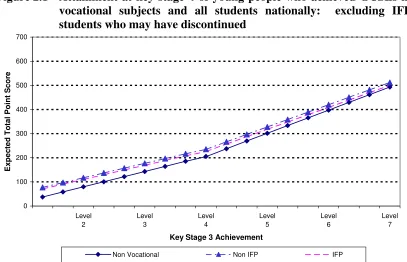
These figures indicate that young people who had taken GCSEs in vocational subjects and GNVQs, and who had participated in IFP had gained significantly higher points at key stage 4 than similar students who had not participated in IFP and not taken these qualifications. However, students who had taken these types of qualifications, but had not participated in IFP, attained slightly but significantly higher levels at key stage 4 than similar students who had taken these qualifications through IFP.
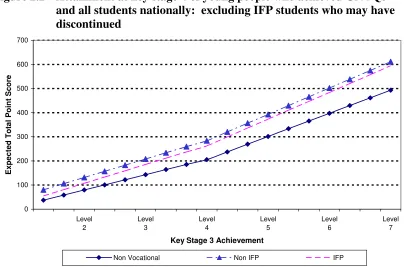
[image:36.595.94.501.445.707.2]Figures 2.1 and 2.2 show that within the IFP cohort higher attainment at key stage 3 is associated with higher attainment at key stage 4 for students who took new GCSEs and GNVQs. Figure 2.1 indicates that students who had lower attainment at key stage 3 and took a new GCSE benefited more in terms of the total points achieved than those with higher attainment. In contrast, Figure 2.2 shows that students with higher attainment at key stage 3 who took a GNVQ benefited more than those with lower attainment.
Figure 2.1 Attainment at key stage 4 of young people who achieved GCSEs in vocational subjects and all students nationally: excluding IFP students who may have discontinued
0 100 200 300 400 500 600 700 Level 2 Level 3 Level 4 Level 5 Level 6 Level 7
Key Stage 3 Achievement
Ex pec ted To tal Po int S c or e
Figure 2.2 Attainment at key stage 4 of young people who achieved GNVQs and all students nationally: excluding IFP students who may have discontinued
Overall, the findings presented in this section suggest that, to a great extent, any higher attainment noted among IFP participants, who undertook GCSEs in vocational subjects and GNVQs, in terms of their total achievement at GCSE, can be explained by the effect of their success in achieving their GCSEs in vocational subjects or GNVQs. In other words, these students attained higher outcomes than they might have achieved had they not participated in IFP, and not taken a vocational qualification, because they had the opportunity to pursue GNVQs and GCSEs in vocational subjects. Although around 90,000 GCSEs in vocational subjects, and 66,000 GNVQs were taken outside of IFP, the programme provides one route for entering these qualifications, and students who took these qualifications through IFP achieved more points overall than would be expected. Nevertheless, as the figures illustrate, students who took these qualifications outside IFP gained even more points (over and above expectations) than IFP students. Reasons for these differences in outcomes (not including the pupil-related and school-related background factors which have been explored through the models) are unclear. However, the influence on these outcomes of some of the attitudes and behaviour of the students who participated in IFP, and of the delivery approaches adopted, will be considered later in the chapter.
2.4.3 Students who discontinued their involvement in IFP
In addition to exploring the outcomes for young people who participated in IFP and continued their involvement throughout the two years of the programme, the analysis examined the outcomes for any students who embarked on the programme, including those who discontinued. These findings, which reflect the potential key stage 4 outcomes for a student who 0 100 200 300 400 500 600 700 Level 2 Level 3 Level 4 Level 5 Level 6 Level 7
Key Stage 3 Achievement
E xpe cte d T o ta l P o in t Sc or e
had embarked on the IFP in Year 10, regardless of whether they continued on the programme to its completion or not, are illustrated in Figures 2.3 and 2.4.
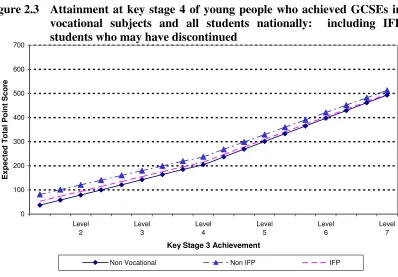
[image:38.595.103.501.175.452.2]Figure 2.3 presents the outcomes at key stage 4 for all students who embarked on IFP and took GCSEs in vocational subjects, including those who subsequently discontinued.
Figure 2.3 Attainment at key stage 4 of young people who achieved GCSEs in vocational subjects and all students nationally: including IFP students who may have discontinued
As can be seen in Figure 2.3, when other background factors were taken into account, young people’s attainment at key stage 4 increased in relation to their prior attainment at key stage 3. As was the case when students who discontinued were excluded from the analysis (Figure 2.1), young people who had studied a GCSE in a vocational subject either through IFP, or not through IFP, attained higher points at key stage 4 than similar students who had not taken such qualifications.
Figure 2.4 presents the outcomes for young people who had embarked on IFP and had taken GNVQs, including those who had not remained on the programme to its completion.
0 100 200 300 400 500 600 700
Level 2
Level 3
Level 4
Level 5
Level 6
Level 7
Key Stage 3 Achievement
E
xpe
cte
d
T
o
ta
l P
o
in
t
Sc
or
e