Consumer Satisfaction with a MUlti-disciplinary Child
Guidance Service
Annabel L. Hanke B.A.(Hons.)
Being a report of an investigation submitted as a partial fulfilment of the requirements for the degree of Master of Psychology at the University of Tasmania.
Statement of Sources
I hereby certify that this thesis contains no· material which has been accepted for the award of any other degree or diploma in any university, and that, to the best· of
my
knowledge and belief, the thesis contains no copy or paraphrase of material previously published or written by another personexcept when due reference is made in the text of the thesis.
Acknowledgements
I would like to thank the following for their assistance and co-operation in the study:
The Mothers, for their participation in the survey;
Mr. I. Montgomery, for his constructive supervision and Dr. J. Davidson for statistical advice;
My colleagues in the Mental Health Services Commission for advice and suggestions in planning the study;
My colleagues at the Ellerslie Combined Childrens Centre, for their support, encouragement and practical help;
Abstract
A structured interview was conducted with a sample of 111 mothers of children who had been discharged from a multi-disciplinary child guidance service in order to obtain information about their
satisfaction with the service, the factors that related to satisfaction, and aspects of the service that might be improved.
The children of the respondents were representative of the total referrals for the period under consideration in terms of age
distribution, sex ratio, and referral source.
Seventy-six per cent of the mothers were satisfied with the help received and statistical analysis found that treatment outcome, the attitude of the husband, and the relationship with the therapist were all significantly correlated with satisfaction. Differences in satisfaction were also found to be related to the source of the referral and to the expectations that the mothers had about the form assistance would take. The findings are consistent with a multi-factorial concept of satisfaction.
The implications of the survey findings fo -: the service, with particular reference to the critical and positive comments of the mothers about various aspects of their contact, were discussed, and areas in need of further investigation proposed.
Contents
Page
Chapter 1. Introduction 1
Chapter 2. Background to the Study - -
The Need for Evaluation of Mental Health Services
Consumer Evaluation and Satisfaction Evaluation of Services for Children Aims of the Study
3
3
5
9
10
Chapter 3. Method 11
Sample 11
Interviewers 13
Questionnaire 13
Procedure 14
Interviewer training 14
Chapter
4.
Results 16Characteristics of the Mothers and 16 - Children in Survey Sample
Mothers Responses: Results and Analysis
Chapter
S.
Discussion 30Return Rate 30
Satisfaction: Return Rateand Sample 31 Characteristics
Satisfaction: Main Variable's
34
Other Findings 36
Treatment outcome 36
Treatment outcome and involvement of 39 fathers
Satisfaction and referral source
Satisfaction and expectations 40.
Socio-economic factors 41
The Attitude of the child 42
Implications of the Survey. Findings for
43
the ServiceReferences
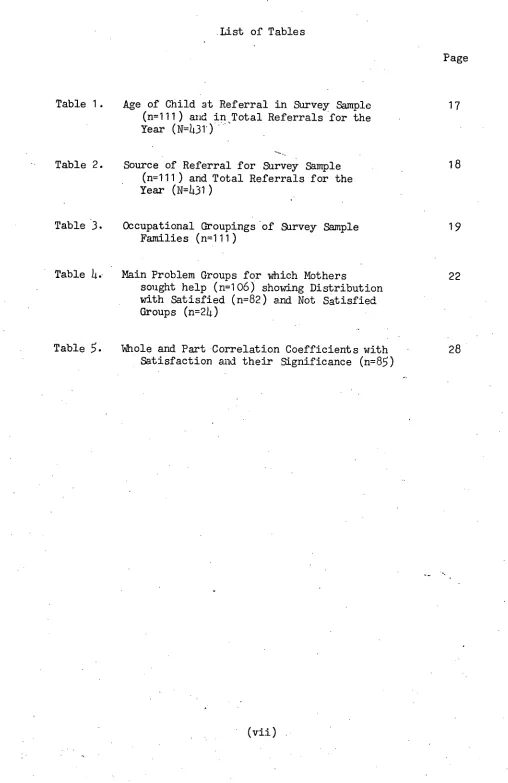
List of Tables
[image:6.559.18.526.41.824.2]Page
Table 1. Age of Child at Referral in Survey Sample 17 (n=111) and in Total Referrals for the
Year (N=430 .
Table 2. Source of Referral for Survey Sample 18 (n=111) and Total Referrals for the
Year (N=431)
Table 3. Occupational Groupings of Survey Sample 19 Families (n=111)
Table
4.
Main Problem Groups for which Mothers 22 sought help (n=106) showing Distributionwith Satisfied (n=82) and Not Satisfied Groups (n=24)
Appendices
Page
Appendix A. Questionnaire Completed by Interviewers 51 During Interview with the Mothers
Appendix B Copy of Letter sent to-Mothers regarding
53
the SurveyAppendix C. Copy of Form all Interviewers signed
54
before Interviews with MothersAppendix D. Registrar General's Classification
55
(Modified Version)Appendix E. Main Problem and Treatment Outcome as 56 Rated by the Mother (n=106)
CHAPTER 1
Introduction
Since its inception 9 years ago, the Ellerslie Combined Childrens Centre has more than trebled its staff and considerably expanded its role as a clinical, consultative and educative service.
So far, the only investigation to examine any aspect of the
service has been a survey of the opinions of a sample of professionals from a wide range of public and private agencies regarding the present and future services for children and adolescents. This was
undertaken by Cardno in 1976 for the Mental Health Services Commission. It is not yet clear what implications the results of the survey may have for the operation of the service.
In light of the literature on consumer evaluation it was decided to investigate the opinions of mothers whose children had been
discharged from the service as it was considered that information gained from the mothers would assist the staff in making decisions about the organization of the service, the type of help offered, the treatment orientations and other relevant issues.
In Chapter 2 the following areas are given consideration as a background to the present investigation:
The need for evaluative research in the area of mental health; the issue of consumer evaluation with particular reference to consumer satisfaction;
, the importance of services for children and parental satisfaction, and finally,
the aims of the study.
The method adopted in the present study will be described in Chapter 3 and the results of the study presented in Chapter
L.
- 9 -
reference to relevant literature and a consideration of the
CHAPTER 2
3
Background to the Study
The Need for Evaluation of Mental Health Services
Within recent years, evaluation and evaluative research have become common terms in government and human-services circles
(Markson, 1975). As the editor of Hospital and Community Psychiatry observed, when introducing a series of papers aimed at informing mental health professionals about important issues in evaluation (November, 1975 issue), the need for evaluation of mental health services is emphasized repeatedly by mental health professionals, administrators, government officials and others concerned with the quality and cost effectiveness of mental health care.
Burleigh and Messick (1975) provided the following definition of evaluation as
'the orderly study of a system or sub-system using quantifiable and appropriate descriptive measures to determine its effectiveness, scope and efficiency, to make visible its strengths and weaknesses and to provide a basis for informed decision making. It is a constructive process whose purpose is to obtain objective and particularly reasonable data useful to decision makers in the evaluation - not the
justification - of a program'.
(p.735).
what population was served at what cost? what patients drcp out of treatment? how is professional time spent? where does the money go? With the present economic climate leading to budget restrictions it is becoming increasingly important to have answers to these sorts of questions so that finances can be directed towards those aspects of services that are most valuable.
The second kind of evaluation is primarily research oriented; that is, it is aimed at determining the impact that specific types of programmes, treatments, administrative organizations or policies have on specified target groups: Its aim is not only descriptive but also to add new knowledge about the delivery of mental health services. This information may then be used to develop or discard ideas, organizational frameworks or treatment modalities.
In the majority of evaluative studies the focus has been on treatment outcome yet the literature is replete with criticism about study design, lack of methodological rigour, criteria for outcome ratings and the like (witness the tone of contributors in Bergin and Garfield (eds.) . Handbook of Psychotherapy and Behaviour Change, 1971). There have been many genuine attempts to develop more useful outcome measures, the contract fulfilment analysis reported by LaMbillo, Kirusek and Sherman (1973) being one example.
Considering the need for studies that have practical implications for improving mental health services, it is surprising that so few studies are reported that have made an effort to elicit the opinions of those on the receiving end of mental health services regarding the treatments, therapists, and other facets of the services.
Consumer Evaluation and Satisfaction
In the literature examining the opinions, attitudes and
satisfaction levels of persons in receipt of some type of service, the terms consumer, client, patient and customer are encountered. The terms consumer, client and patient are virtually interchangeable and seem to reflect the personal preferences of the writers. The term, patient, is found only of reports of investigations of
medically oriented services, whereas the terms, client and consumer, are used in reports of a wide variety of agencies both medical and non-medical. While the term customer has similar connotations to those above, it is used in a different way and will be discussed
separately in reference to customer approaches to evaluation and treatment.
Mayer and Timms (1970) in a chapter entitled 'The neglected client' made a concerted plea for research in which the client perspective was given consideration. It was their contention that
such information would assist professionals in the difficult task of matching up different types of therapists, treatments, clients and problems into therapeutically effective combinations.
The majority of reported studies investigating client opinions, particularly those investigating client satisfaction, have taken place within the last decade. While it cannot be assumed that Mayer and Timms (both from social work backgrounds) are responsible for the increased interest in the client perspective, it is interesting to note that while such studies are widely scattered among social work, psychological, psychiatric and medical journals, with members of all the professional groups being represented in the authorship of the studies, social workers feature frequently as co-authors.
6
• consumer satisfaction in terms of the rise of consumerism, with people becoming more active in expressing their opinions about the quality of goods and services.
It is generally accepted that satisfying patients has always been an important but implicit goal of service providers (McPhee et al., 1975) and most agencies have tended to assume that the
services they render to their patients are the most appropriate ones. An additional, very important reason for finding ways to
determine patient satisfaction and produce practitioner response to patient dissatisfaction is forwarded by McPhee, Zusman and Joss
(1975), .Theyconsider that the free enterprise model of health care is inapplicable to the vast majority of the population and that the tendency to. regionalize mental health services has further restricted the choice that most individuals have in the selection of agency or practitfLoner, particularly the socially and economically disadvantaged. The result is that in many instances.the only way a person can express dissatisfaction. is by failing appointments and going without
treatment. The development of a means of measuring patient
satisfaction would thus enable a service to ensure that it does not reach a point where it is no longer meeting the need of the public.
It is clear that the practice of assessing consumer opinions and consumer satisfaction is not widespread. McPhee, Zusman and Joss
(1975) found that only a small number of mental health centres had ongoing attempts to measure the satisfaction of the patients, and of those that were attempting such measures only a small proportion of patients were being sampled. In general, the subject numbers for the reports in the literature, are small and represent only a tiny fraction of the consumer population for the wide variety of services.
7
treatment programmes (Gould & (flick, 1971), consumers opinions about a social services department (McKay et al., 1973), client evaluation of a mental health clinic service (Powell et al., 1971), clients' likes and dislikes regarding social service department services
(Barber, 1975), satisfaction of mothers with a paediatric service (Korsch et al., 1968), parental satisfaction with an urban mental health centre (Silver et al., 1975), consumer satisfaction with a
• mental health centre (Hart & Bassett, 1975), social service department clients' opinions and satisfaction levels (Mayer & Timms, 1970), and an attempt to develop a personal satisfaction form (Nichols, 1975).
What, then, has been discovered about consumer opinions and satisfaction levels? It is apparent that satisfaction is related to treatment outcome (Hart & Bassett, 1975; McPhee, et al., 1975;
Nichols, 1975). However, it is clear that treatment outcome is not a necessary condition for satisfaction as in many studies consumers have reported high levels of satisfaction when there has been little
or no change in the problem for which they sought help (McPhee et al., 1975; McKay et al., 1973).
The expectations regarding treatment are reported to influence the satisfaction levels of consumers (Hart & Bassett,
1975;
McKay et al., 1973; Silver et al., 1975; Korsch et al., 1968) and therelationship variables are also of importance in consumer satisfaction (McKay et al.,
1973;
Silver et al., 1975).In a study of mothers ofpaediatric patients, Korsch, Gozzi and Francis (1968) showed that patient co-operation and effectiveness of treatment depended upon communication that results in consumer
satisfaction.
a multi-dimensional and heirarchical concept of satisfaction, taking into consideration the satisfaction of the consumer with such
factors as cost, accessibility of service, staff-patient interaction, and professional skillfulness, needs to be employed if the assessment of consumer satisfaction is to be of any real use.
Nichols (1975) and Fontana and Dowds (1975) have commented on the doubts expressed by investigators about the validity of client ratings. McPhee Zusman and Joss (1975) observed that patients are not in a position to evaluate every factor equally well and that satisfaction with outcome hay be the most difficult area for patients to judge. However, Fontana and Dowds (1975) cite some evidence to
suggest that patient judgements about outcome are consistent with those of significant others in respect to the trend rather than the magnitude of improvement.
The majority of investigators have noted the difficulty of accurately estimating satisfaction levels when small samples are involved and particularly when voluntary participation in evaluation studies is employed. The possibility of the more satisfied being more willing to participate in such studies and the role of
- expectations in response patterns is recognized in all the reports. There is evidence to support the contention made by Hart and Bassett (1975) that there has been a shift from the idea that the professional knows what is best for the patient to the patient's greater participation in the process of deciding the direction, quantity and quality of his care (e.g; Lombillo et al., 1973).
walk-in clinic situation with -Ahich they have been associated. They claim that by using the customer approach the clinician has the chance to learn about expectations and desires early in the interview process and thus profit from the patient's ideas, a commonly ignored source of diagnostic data. In evaluating this approach Eisenthal and Lazare
(1975) suggested that the greater source of satisfaction found to result from the customer approach may be a function of its
problem-solving orientation rather than from the emotional quality of the relationship.
Evaluation of Services for Children
In a recent American survey by Norris and Larsen (1976) in which professionals and para-professionals employed in community mental health centres and state hospitals were asked to rate the importance of various issues in mental health at that time and in five years hence, services for children received the top ranking. Yet it was observed by Levitt (1973) that research endeavouring to answer the question posed by Bergin and Strupp in 1969 'What specific
therapeutic interventions produce specific changes in specific patients under specific conditions?' has been notably lacking.
In considering the issue of consumer evaluation, there have been very few attempts reported that consider the satisfaction of parents with services for children and families. This is particularly
surprising as parents usually mothers, have traditionally been the focus of child guidance services (Levitt, 1973).
Attitudinal differences in terms of race (Warren et al., 1973) and in terms of class (Lurie, 1974) have been explored and the findings suggest that black parents and lower class parents both find the
- 10-
The study by Silver and his associates (1975) investigated the satisfaction of parents at follow up of child outpatients frcm several urban mental health clinics. They reported high levels of satisfaction with treatment (70 per cent) and with the relationship and attitude of the therapist (100 per cent). However, they failed to separate satisfaction from other factors and the sample
characteristics make it impossible to generalize from these findings to other parent groups.
Aims of the
sw(tT
The aim of this study was to follow up parents of children who had been referred to the Ellerslie Combined Childrens Centre with a view to obtaining information that would answer the following
questions:
CHAPTER
3
- 11 -
Method
This study is concerned with the opinions of clients who have had contact with the services offered by the Ellerslie Combined Childrens Centre which is a joint venture by two State authorities, the Mental Health Services Commission and the Public Health Division
of the Health Services Department. It serves the Southern District of Tasmania. The main centre is in the Hobart city area but the services of the centre have been extended into the community by having staff members visit regional centres (usually Community Health Centres) on a regular basis.
The centre offers outpatient services and caters for children up to the age of sixteen. The clinical staff is made up of Medical Practitioners, Social Workers, Psychologists and a Nursing Sister who deal with a wide range of problems affecting children and their
families.
Sample
The sample consisted of 166 mothers of children who had been referred to the service during the statistical year July 1st
1 976
to June 30th1977.
The decision to restrict the sample to mothers only was made for the following reason. Mothers generally have more contact with the service than do fathers, though fathers are encouraged to participate and do so in many instances. There were only six cases in which the
- 12 -
It was decided that several other groups should not be included in the sample and the reasons for their exclusion are detailed below.
The first group comprised children in State Or Approved Childrens Homes who had been referred to the service but whose parents had not had any contact with the service. Clearly these parents could not give their opinions about a service they had not encountered. It should be noted that the opinions of agency personnel involved with such children have already been sampled during another investigation. 1
The second group consisted of children who had appeared in the Childrens Court where the Magistrate had directed them to the service as part of the assessment process prior to returning to Court for sentence. It was considered that compulsory attendance made such cases a distinctly separate group.
One of the aims of the survey was to obtain the opinions of mothers about issues such as treatment outcome and their relationship with the therapist, so the third group to be excluded consisted of all cases who were still in current contact with the service.
The fourth group to be excluded consisted of mothers whose last contact with the service was less than six weeks prior to the survey interview. This procedure was adopted by Reith (1975) and had two advantages. Firstly, it minimized the likelihood that the interview would be seen as a formal follow up from the service and secondly, it allowed the respondents some detachment from their experience with the service.
)here more than one child from the same family was referred at
1
- 13 -
the same time, the child whose name appeared first in the referral book was chosen as the one to be discussed with the mother during the interview.
Interviewers
The 14 interviewers were student volunteers who had been
recommended by Faculty staff. All but one were second or third year Psychology students at the University of Tasmania. The remaining
interviewer was a third year Social Work student at the Tasmanian College of Advanced Education. There were
4
male and 10 female interviewers. For all students, involvement in the survey provided the opportunity to widen their experience in field interviewing.Some students were able to use the experience towards a team project. All interviewers were paid a small petrol allowance to cover
travelling costs.
Questionnaire
A
33
item questionnaire was compiled (Example in Appendix A). This followed discussion with service staff, consideration of previous research in the area of client surveys, and particularly, therequirement that the questions should elicit information of practical relevance to the operation of the service and its personnel.
- 1 -
Procedure
Having obtained the sample of mothers who met the criteria outlined in the Sample section, a letter was sent to each of the 166 mothers (Ekample in Appendix B). The letter gave a brief explanation of the reasons for the survey and asked the mothers if they would consent to an interview. Any mother not wanting to be interviewed was asked to contact the Survey .Organizer and no further approach would be made. It was stated clearly that individual responses would not be made available to the staff members of the service.
After a period of two weeks the sample was reduced to 151. The postal service returned 8 letters due to the family no longer living at the address 3 mothers telephoned to say they did not wish to be interviewed, 1 mother telephoned to say that she would be interstate at the time of the interview, and a further 3 families were found to have moved when the postal service was contacted to ask for directions to certain addresses.'
The 151 mothers who remained part of the sample had, to the best of the organizer's knowledge, received the letter and had not informed - the organizer that they did not wish to participate in the survey.
-Interviewer training. All the 14 interviewers took part in
either a group or an individual training session. The group session was conducted by the •Survey Organizer and a Social Worker and all individual sessions were conducted by the Survey Organizer.
- 15 -
refuse to be interviewed though they had not made this kmDwil to the Survey Organizer.
The questionnaires were then allocated to the interviewers so that each one received a number of mothers from both Housing
Department and more affluent areas.. The mother's name, the child's name, the address, and telephone number or directions to the address were recorded at the bottom of the questionnaire to aid the
interviewers. The interviewers were instructed to detach this , section from the completed questionnaire before returning it to the
CHAPTER )4
- i6 -
Result s
Of the 151 questionnaires that were allocated to the interviewers, 111 completed questionnaires were returned. In 11 cases it was
discovered that the family had changed address, including
3
instances when the postal service returned the letters sent to mothers, after the allocation of questionnaires. Though they had not contacted theSurvey Organizer, 6 mothers declined to be interviewed when contacted by the interviewers. The interviewers were unable to contact a
further 23 mothers despite several attempts to do so. It was thought, though this was not confirmed, that some of this group had also
changed address. Of the 166 mothers contacted by letter or interviewer only 9 refused to participate.
Characteristics of the Mothers and Children in Survey Sample
The survey sample was compared with the total number of referrals for the period under consideration to determine how representative it was of the total referrals in respect to age of child at referral, sex distribution and referral source.
The total number of referrals was 431 so the survey, sample of 111 constituted 26 per cent of the total referrals. However, as some referrals did not keep any appointments and up to three children from the one family were referred in several instances, the actual
percentage of mothers who had contact with the service would be higher than the figure of 26 per cent.
- 1 7 -
'.7able 1
Age of Child at Referral in Survey Sample (n=111) and in Total Referrals for the Year (N=431)
Age Group
Study Sample Total Referrals n
_ (Der cent) - N (per cent)
0 - 3
17
(15%)
50 (12%)L- 6 26
(24%)
87 (20%)7 - 9
30
(27%) 116 (27%)10 - 12 18
(1. 6%)
83 (19%)13 - 16
20
(18%)
95 (22%)The percentage of boys in the survey sample (n=75) was 67.6 per cent and was virtually identical to the percentage of boys in the total referrals for the year (1290) or 67.3 per cent. The sex distribution within age groupings reflected this tendency with boys outnumbering girls in all the age groups in both the survey sample and the total referrals for the year.
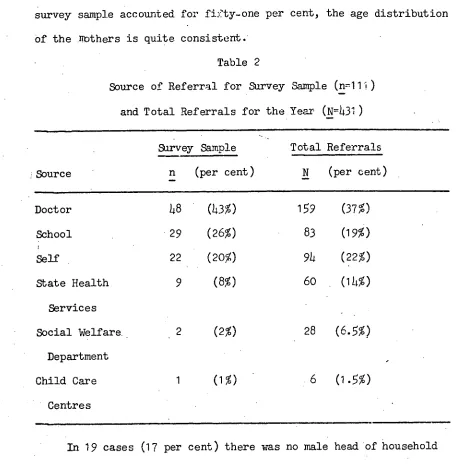
The survey sample reflects the pattern of the total referrals for the year in terms of the source of referrals (see Table 2).
To preserve anonymity, the questionnaire only sought information about the mothers that enabled a description of them to be made in terms of age range marital status at the time of contact with the
service, and socio-economic status of the family.
- 1
8 -
[image:29.557.39.497.57.522.2]survey sample accounted for fifty-one per cent, the age distribution Of the Mothers is quite consistent. -
Table 2
Source of Referral for Survey Sample (n=11J) and Total Referrals for the Year (N=431)
Sarvey Sample Total Referrals
Source n (per cent) N (per cent)
Doctor 48 (43%) 159 (37%)
School 29 (26%) 83 (19%)
Self 22 (20%) 94 (22%)
State Health 9 (8%) 60 (14%)
Services
Social Welfare
(2%)
28
(6.5%)
Department
Child Care 1 (1%) 6 (1.5%)
Centres
In
19 cases (17 per cent) there was no male head of household due to death, divorce or separation. In the remaining 92 cases there was a male head of household living with the family during the period of contact with the service.To determine the socio-economic status of the families, a modified version of the United Kingdom Registrar General's Classification was used (see example in Appendix D). The
- 19 -
in preference to the classification used by the Australian Bureau of Statistics as it had fewer categories which made it more appropriate to the sample size for analytical purposes and as it is already being used in several other Tasmanian research projects involving parents and children comparisions will be possible in the future.
Table
3
shows the distribution of families within the seven , occupational groupings. If the white collar versus blue collardistinction is made then 38 per cent of families were white collar, 42 per cent blue collar and the remaining 20 per cent had no male breadwinner.
Table
3
Occupational Groupings of Survey Sample FamilieS (n=111)
Occupational
Group (per -cent)
1
6
(5%)
11 25 (23%)
111a 11 (10%)
111b 13 (12%)
1V 16 (14%)
V 18 (16%)
V1 22 (20%)
Mothers Responses: Results and Analysis
- 20 -
CT the total 111 mothers, 87 responded 'Yes' to the question 'Were you satisfied with the help that you received?' and 24 gave negative responses. Included in the 24 who were categorized as not satisfied were mothers who responded 'No, not really' and those who stated that they were not satisfied with the help they received though the child had received some assistance since the mothers were seen as the clients rather than the children for the purpose of this investigation.
The responses of the satisfied and the not satisfied groups were examined in an attempt to discover what factors discriminated between the two groups.
Of the 87 mothers who were satisfied 81 responded 'Yes' to the question 'If a friend was having problems with the child would you
suggest that she go to Ellerslie?' compared to 15 of the 24 not satisfied mothers. Using the 'Yes' and 'No or Not Sure' categories a Chi Square analysis showed that the difference was significant, 1:2 = 15.41, df 1, p< .001.
The same 81 mothers in the satisfied group responded 'Yes' to the question 'If you had problems again would you go back?' (to Ellerslie) while only 10 of the not satisfied mothers said 'Yes'. Again this difference was significant according to the Chi Square analysis, = 33.95, df 1,
p<
.001.The possibility that the responses to these two questions might be used to discriminate more finely between satisfied and not
satisfied mothers was considered as previous researchers (Silver et al.,
1975)
suggested that such questions are an indireet way of -- 21 -
reflection of the mothers' opinions. In addition, some mothers qualified their responses to the two questions by saying 'It would depend on the type of problem' so the data was of a less definite nature.
Of the 111 mothers, 106 listed a problem in response to the question What was the main problem for which you wanted help?'. Of the remaining
5
mothers,3
wanted their child psychologically tested, 1 wanted referral to a training centre and only , 1 listed her own anxiety as the main problem. The 106 main problems were categorized and are listed in Table 4. In the 15 instances in which there were less than 5 in any category these were placed in the'others' category but Are listed separately in Appendix E with
mothers' ratings of treatment outcome. 1 The problems are typical of those encountered at child guidance clinics. The only problems which appeared to be over represented in either the satisfied or not satisfied groups were behaviour problems and tension and anxiety symptoms which were both more frequently listed as the main problem by satisfied mothers.
The intention of the question 'How did you think the person you saw might help you?' was to elicit the expectations of the mothers regarding the form of help or treatment. As many mothers listed more than one response the results are given in percentages. Of the total 111 mothers, 38 per cent stated that they had no idea what form the help might take. Some form of talking or counselling was
expected by 34 per cent while constructive advice including management suggestions was expected by 28 per cent. Only
7
per cent expected1
- 22 -
medication. A few mothers ex:)ected a special diet, relaxation training, psychological assessment, or an enuresis conditioning machine. Not satisfied others differed markedly from the
satisfied mothers in the expectations for treatment. Only
5
per cent of the satisfied mothers expected medication whereas 17 per cent of the not satisfied mothers expected that medication would be part of the help given. Of the satisfied mothers 41 per cent expected some talking or counselling, only 8 per, cent of the mat satisfied group had such expectations.Table
4
Main Problem Groups for which Mothers sought help (n=106) showing Distribution with Satisfied (n=82)
and Not Satisfied Groups (n=2)4)
Problem Group
Satisfied Not Satisfied Total
General Behaviour 19
3
22Enuresis 1t
4
18Learning Difficulties 9
3
12Tension/Anxiety 9 10
Aggressive Behaviour 6 2 8
Hyperactivity
5
3 8Relationship Problems
4
15
Others
16
7- 23 -
advice including behavioural management was given compared to 25 per cent of the not satisfied group. For the other categories of help given the percentages for the satisfied and not satisfied groups were closely comparable.
It was noted that of the 38 mothers who had no expectations about -
the form the help might have taken, 76 per cent (n=29) were satisfied compared to 24 per cent (n=9) who were not satisfied.
To the question 'How were the problems affected by your contact with Ellerslie?' the mothers were asked to rate the outcome on a five category scale: much better, somewhat better, no change, somewhat worse, much worse. No mother described the problem as being
somewhat worse or much worse. Of the 106 cases in which a rating of treatment outcome was appropriate, 40 per cent rated the problem as much better, 33 per cent as somewhat better and 23 per cent as no change. Only
4
per cent of the not satisfied mothers rated the main problem as being much better compared to 50 per cent of the satisfied mothers, 33 per cent of both the satisfied and not satisfied groups rated the outcome as somewhat better, and 63 per cent of the notsatisfied mothers rated the outcome as no change compared to 17 per cent of the satisfied mothers. A Chi Square analysis showed a significant difference between satisfied and not satisfied mothers with regard to treatment outcome, X2 = 23.66, df 2, p< .001.
Mothers' ratings of treatment outcome for the main problem (see Appendix E) were examined. When the categories much better and
24
the general behaviour problem group, the aggressive behaviour group and the learning difficulties group and 62 per cent for both the
enuretic group and the hyperactivity group. Though there were only two Stealing and two encopresis problems all were rated as much better.
As tension and anxiety symptoms and general behaviour problems were over-represented in the satisfied group and a significant • correlation was found between satisfaction and treatment outcome it
was to be expected that both these problem groups should evidence bigh improvement ratings.
The possibility that satisfied mothers who had rated the main problem as unchanged by contact with the service might have been satisfied because of additional problems that were improved by
contact was considered. However, an examination of the questionnaires revealed that this was only true for
4 per cent of the satisfied
mothers, the remainder had no other problems or had additional problems which also remained unchanged.
The age of the child at referral was not significant in differentiating satisfied from not satisfied mothers as the proportion of children in each age group was the same.•
The Mothers were asked to rate their relationship with their therapist on a five category scale: very well, quite well,
quite badly, very badly. No mother nominated the category very - .. badly, 3.5 per cent said they got on quite badly with.the therapist, 13.5 per cent said the.relationship was o.k., 29 per cent said they got on quite well, and
54
per cent said they got on very well with the therapist.25
X2 = 12.97, df 3, p< .01.. The biggest difference between the groups was for the very well category as 61 per cent of the satisfied
mothers said they got on very well compared to 25 per cent of the not satisfied group.
There was no significant difference between the satisfied and not satisfied groups in relation to the socio-economic status of the
family as determined by occupational groups.
As previously stated, 19 families had, no male head during the period of contact with the service sosthe . following results are based on the 92 families where the husband was present.
. Just under 50 per cent of the husbands had some contact with the service and there was no significant difference - between the seven
occupational groups in regard to husband contact. There was no significant difference between the satisfied and not satisfied groups in terms of husband contact.
The totherswere asked ' , How did your husband feel about the contact with Ellerslie?' and their responses were divided into three categories: positive for those responses reflecting positive
attitudes in the husbands, for example, "perfectly happy" and "very
.pleased"; negative for responses reflecting a negative attitude, for
example, "he opposed the idea"; and a middle o.k. category consisting of responses such as "he didn't mind" and "he had no objections". A Chi Square analysis found that there was a significant difference .between the satisfied and not satisfied groups according to the
attitude of the husbands. The 1:2 = 35.28, df 2, p< .001.
There was no significant difference between Occupational groups in regard to husbands' attitude, even when the blue collar versus white collar distinction was employed.
- 26 -
contact with Ellerslie staff?'. Some mothers did not respond to this question because they thought the child was too young to have known
"what it was all about" or because the child had not had any contact with service personnel. The responses of the 83 mothers who did comment were categorized into three categories: positive (42%), o.k. (3)4%) and negative (2)4%). The attitude of the child was not
significantly different between the satisfied and not satisfied groups. It has already been noted that the source of referral for the sample surveyed in this investigation was closely comparable to the pattern of referrals for the whole year (see Table 2). When the source of referral was examined in relation to the satisfaction of the • mothers with the help received, it was found that over half of the not
satisfied mothers
(5)4
per cent) were referred by Doctors compared to 40 per cent of the satisfied mothers. An even greater difference was found to exist for those referred by School authorities aS 30 per cent of satisfied mothers were referred by School authorities in comparison with 12.5 per cent of not satisfied mothers. Of the groups ofmothers who had made the contact with the service themselves the percentage of satisfied and not satisfied was virtually the same. (Refer Appendix F).
The three questions 'What particular things did you find
- 2
7 -
a way in which Ellerslie could have been more helpful and there were at least two reasons for this. Firstly, many mothers felt that everything that could have been done, was done and that Ellerslie could not have been more helpful. Secondly, many did not know of anything or were not sure what else could have been done to help. The mothers' responses and their implications for the operation of the centre "will be discussed in the next Chapter.
Having ascertained that there was a significant difference between satisfied and not satisfied mothers in their ratings of treatment
outcome, husbands' attitude, and relationship with the therapist, a Part Correlation was calculated to endeavour to separate the effects
of each of the three factors on satisfaction. There were no ratings available for some factors, due to the absence of the father or
because treatment outcome was not applicable in 26 cases so the results are based on the remaining 85 cases.
The Whole Correlations were calculated and then the Part
Correlations calculated using the formula from McNemar (1969, p.186):
(2.3) = 112 L.13 E23
The significance was tested by the F test (McNemar, 1969, p.322). The Whole Correlation results involving satisfaction and the
Correlation results are shown in Table
5.
The Whole Correlation results not involving satisfaction are listed below the Table for reference.-28-
relationship as there was Still a high correlation beween satisfaction . and treatment outcome when the effect of the relationship was removed.
Similarly the high correltion between satisfaction and husbands' attitude was not attributable to the influence of the relationship with the therapist.
Table 5
. 'Whole . and Part Correlation Coefficients with Satisfaction and their Significance (n=85)
Whole Result Part Result F Test
Correlation Correlation
S (OH)
.32**
11.48
r
.47'-x--*-*r
.36***
15.58—SH — S (H.0)
18.85
—SO — S (0.R)
r
.21* r .19* 4.1—ER — S (R.0)
.47***
•
(H.R) 1558
.21* r
.11
.82—S (R.H)
S = Satisfaction H = Husbands' attitude
0 = Treatment outcome R = Relationship with therapist
.29 -
r
=
.05r
=
.22*—HR
- 29 -
There was a small but significant correlation between satisfaction and relationship with therapist which could not be attributed to treatment outcome but could be partially attributed to •the effect of husbands' attitude since the Part Correlation r(R.H)
—S was not significant.
In summary, the major variables affecting satisfaction were treatment outcome and husbands' attitude.
CHAPTER
5
- 30 -
Discussion
The results will be discussed in the following sequence.
As a preface to the discussion of the main findings, the return rate will be briefly commented upon followed by a discussion of the satisfaction rate with reference to sample characteristics and their possible influence on satisfaction.
The variables that are significantly correlated with satisfaction and their relationship to one another will then be discussed and
constitute the main findings.
• Other findings related to factors such as treatment outcome, expectations, referral source and social class will also be
considered.
The last section will list points that are relevant to the operation of the service with reference to the main findings, subsidiary findings and client opinions.
Return Rate
The return rate for the sample surveyed in this investigation was 67 per cent. The strategy of presuming the mother would
- 31 -
It is considered (Beck & Jones, 1976) that the figure of 70 per cent represents the upper limit for obtaining follow up returns.
Satisfaction: Return Rate and Sample Characteristics
The percentage of mothers who were satisfied was 78 per cent. This is consistent with the findings of other studies specifically tapping the satisfaction of mothers who have sought help with their children (Silver et al., 1975; Korsch et al., 1968).
It has been suggested (McPhee et al., 1975) that those clients who refuse to participate in investigations of this type tend to be the least satisfied. However, the refusal rate was only
5
per cent(9 out of 166 mothers) and there was no evidence to suggest that the mothers who could not be contacted were more likely to be dissatisfied. Even if all the mothers who refused to participate, and therefore were presumed to have been dissatisfied, had in fact participged in the surveythe percentage of satisfied mothers would have dropped, only slightly, to 72.5 per cent.
The possibility that some mothers may have given more positive ratings due to fears that, despite reassurance to the contrary, their responses would somehow filter back to service staff in a way that would identify them, can not be entirely discounted. However, in light of the type of responses made by the mothers plus the
impressions and comments of the interviewers, this did not appear. to be an influential factor. While it was noted that no mother used the somewhat worse or much worse categories when rating the outcome of the main problem or the very badly category when rating her
- 32 -
In view of the stigma attached to contact with mental health agencies (Fischer and Turner (1970) cite a 1963 study of Phillips plus a series of laboratory experiments by Farina and his associates) it was interesting to note that the experience of this investigation was that former clients were usually quite keen to co-operate.
•Approximately 6 per cent of the mothers to whom a letter was sent inviting their participation in the survey, contacted the Survey •Organizer and expressed their willingness to co-operate. In several
instances mothers rang to give directions to the home in case the interviewer had difficulty in finding it. This response was
unexpected as only those mothers who did not wish to participate were asked to contact the Survey Organizer and other investigators have commented on the reticence of mental health service clients in giving their opinions about the quality of care given to them (Hart & Bassett, 1975). The fact that the main centre of the service is situated in a two storey suburban house with gardens and a play area, rather than a very clinical, hospital type setting, may be important and is frequently commented on by clients. The extent of co-operation may also reflect some success on the part of the service in getting away from a formal, heavily psychiatrically oriented child guidance model to a more
flexible multi-disciplinary approach with increasing community involvement.
The sample was entirely female in composition and this may he significant in relation to ratings of satisfaction as it is known that more females than males make contact with mental health agencies
- 33 -
There appears to be no evidende in the literature that suggests that demographic variables such as age, sex, family structure and social class are influential in regard to satisfaction , though these variables are known to be influential in other areas and will be discussed later in the Chapter. In the present survey, such •variables were not found to be significant in differentiating
satisfied mothers from not satisfied mothers. This is consistent •with the previous studies of mothers' satisfaction (Silver et al.,
1975; Korsch et al., 1968).
A tendency for the mothers who had no husband living at home during her contact with the service to be more frequently satisfied was observed. One possible explanation may be that such mothers have less support, both within and outside of the family, in bringing up their children and dealing with problems, so are consequently more readily satisfied with any sort of help-that is forthcoming. The number of families in the survey in which a father was absent appears comparable to the rate in the general population
so even if such mothers did bend to be more easily satisfied they were not over-represented in the sample surveyed.
Long term clients would have been under-represented in the sample due to the fact that the initial sample only included those mothers of children who had been referred and discharged within a 12 months' period. The literature on length of stay in treatment and outcome is conflicting (Beck & Jones, 1976; Luborsky et al., 1971). For
Satisfaction: Main Variables
The findings of this investigation support the contention (McPhee et al.,
1975)
that a number of factors are likely to be irportant in determining satisfaction. For the population sampled in this survey, that is, mothers of children referred to the service, the significant variables were treatment outcome and the attitude of the husband, both of which were highly correlated with satisfaction, and the relationship with the therapist for which a lesser but still significant correlation with satisfaction existed.The high correlation between treatment outcome and satisfaction was consistent with the findings of previous research in the area of client, consumer and patient satisfaction (Hart & Bassett, 1 975; Silver et al., 1975; Powell et al. 1971; Mayer &Timms, 1970; McKay et al,,
1973;
Korsch et al., 1968).The fact that the correlation remained high when the of the relationship with the therapist was removed is of particular
interest in view of the concern expressed by other investigators (e.g.; Nichols, 1975) that patients' self reports may reflect their liking of the therapist more than any real improvement of the problem. The results suggested that the reverse was quite possible, in that clients could get on quite well with their therapist yet rate the problem as unchanged and consequently be dissatisfied.
The lack of a significant correlation between outcome and
-35-
The significant correlation between satisfaction and the relationship with the therapist continued after the removal of outcome effects. Some mothers rated the problem as uLchanged but rated the relationship with the therapist highly. It appears that these mothers are likely to be satisfied suggesting that a very good, as opposed to a quite good, relationship can outweigh the effects of no change in the presenting problems. The explanation may well lie in the expectations that mothers have about treatment. If they desire support, reassurance or just someone to talk things over with, then the provision of a friendly, approachable person with whom they can discuss any worries may satisfy their needs even if the presenting problem is unchanged. This was also found in a
1953
study by Kogan" and associates (reported in McKay et al., 1973).It is also possible that there are critical periods during which one or other of the significant variables is of primary importance. For example, at the initial interview the therapist variable may be of much greater significance than outcome whereas after several sessions outcome may be the most important factor in determining satisfaction.
However, it was clear from the survey that husbands' attitudewas the critical factor with regard to the correlation between
relationship with the therapist and satisfaction. If the husband had a positive attitude about the contact of his wife and child with the service then the mother was usually satisfied, regardless of the fact that the main problem was unchanged.
- 36 -
satisfaction independent of the other but the explanation appears to be in their relationship to one another. There ere at least two possible explanations.
The first possibility is that the more positive the attitude of the husband towards the contact of his wife and child with the service,
-
the more likely it is that treatment will be effective. The argument would be that husbands Who are positive in their attitude would be more likely to support their wife in carrying out any recommendations made by service personnel. As parental consistency in management is more likely. to be effective, treatment outcome should be better and
consequently ratings of outcome higher. The converse would also hold. The second possibility is that treatment outcome in fact precedes attitude formation. In this case it would be argued that the more effective the treatment the more likely that husbands would be to regard the contact in a positive way.
As the survey sampled the opinions of the mothers retrospectively it is difficult to determine which possibility is the more accurate or if in fact. other factors are influential. Nevertheless, the attitude of husbands, or fathers, is worthy of further investigation and by getting ratings of their attitudes prior to the first contact, at discharge and at follow up and comparing them with ratings of treatment outcome it might be possible to unravel the interaction effects.
Other Findings
- 37 -
reported in the literature where a wide variety of treatment modes and evaluation criteria are employed.
It should also be noted that no figures were obtained about the number of sessions the mother and/or the child had sc i;hat for some mothers the ratings would be based on a single contact while for others contact might have been spread over many months. This would have some effect on the ratings. as would the severity of the problem about which no information was obtained.
The study by Silver and his associates (197S) was the only one to report parental ratings of the status of problems at discharge from a children's service. However, their sample was so different from the one surveyed in this investigation and the types of
treatment appeared not characteristic of this service that comparisons of outcome rates are not appropriate.
Silver and his associates had three improved categories, slightly, somewhat and greatly improved and combined the top two to give a
general improvement rate. Examination of their figures, given that the sample and treatment characteristics are quite different to those of this present service, suggests that the somewhat better category used in this survey is equivalent to their 'slightly improved' and
'somewhat improved' categories combined. There appears to be some merit in considering the addition of a slightly improved category in future studies as this might help in clarifying the degree
of-improvement that contributes to clients' ratings of satisfaction. The improvement rates in this survey are comparable to the rates reported in the literature (see the 1973 Review by Levitt) with
several types of problems being more effectively helped, according to the mothers.
- 38 -
anxiety and tension symptoms, with 70 per cent being rated as much better. Aggressive behaviour and learning difficulties showed .improvement in 75 per cent of cases. The area of learring
'difficulties is of particular interest to two of the staff members who are currently doing research in that field so it is possible that . the interest and expertise of the staff account for the fact that the
,outcome of learning difficulty problems is much higher than that reported by Silver and his associates (.33 per cent).
There were only two encopresis, two stealing and two school refusal problems and all were rated as much better except one of the school refusal problems which was rated as somewhat better. Though the severity of the problems is not known, the figures are
nevertheless interesting as all three problems can prove difficult to treat.
Of the enuresis problems, 61 per cent showed some iirprovement. Levitt (1973) has criticized outcome research in child psychotherapy and one of the criticisms is that many of the problems that remit spontaneously are counted as successful treatment. In the enuresis . cases the pattern of treatment outcome reflected the age of the
child, with progressive improvement as the age of the child increased. While there is a developmental factor that partly obscures treatment effectiveness for enuresis, the pattern also reflects the general practice of staff. Staff members usually refuse to treat very young children and generally use the conditioning apparatus for children older than seven. This methodis almost always,combined with reinforcement schedules and general counselling and is usually very effective.
- 39 -
four suggested that expectations that were not fulfilled might have been influential in their lack of satisfaction.
Treatment outcome and involvement of Lathers. No attempt was made in the present survey to obtain information that would allow estimation of the level of involvement of the father during the contact with the service. Estimation by the mothers of the number of contacts the father had with service personnel would have been difficult and unreliable in retrospect; however, it would have been possible to get the mothers' estimation of the degree of involvement. This would be an area worthy of investigation in the future as there is
some evidence to suggest that psychiatric recommendations regarding children are more likely to be carried out when both father and mother attend (Davidson & Schrag, 1969) and that cases are less likely to terminate prematurely where both parents are involved in the treatment process (Cole & Magrussen, 1967 cited in Levitt, 1973). '
In practice, as Levitt (1973) points out, the active involvement of fathers is often dependent on the nature and severity of the
child's symptoms. It has been the experience of this service that for problems such as primary enuresis, sleeping and feeding
.disturbances, fathers tend to be less involved. This is probably a function of therapist practices and the tendency of some fathers to regard the management of such problems as the role of the wife.
Satisfaction and referral source. Vhile the survey sample. reflected the pattern of referrals for the whole year, it was found
• that mothers who were not satisfied were more frequently referred by
who were referred by Doctors. It is possible that expectations for this group were differsnt, though this is not clear from the
responses, and that coming from a Doctor whose approach is more
directive they had expectations for a similarly directive approach to the problems that were not met.
Mothers who had referred themselves were more likely to be satisfied which would be consistent with the argument that mothers who are sufficiently'motivated to refer themselves are also likely to benefit more from the contact. However, the percentage of self-referred mothers in the satisfied and not satisfied groups was the same.
Satisfaction and expectations. The survey findings regarding expectations are very similar to those in other client satisfaction studies (Silver et al., 1975; McKay et al., 1973: Hart & Bassett, 1975) with about a third of the mothers having no expectations about the form the help might take. It has been found (McKay et al., 1973) that lack of expectations is related to lack of knowledge about the agency. However, clients who have no expectations are also more likely to be satisfied and in this survey 76 per cent of those mothers with no expectations were satisfied. This tendency may be due to the clients' lack of experience with agencies of this type which means that they have no yardstick against which to measure the help given and so are less critical.
Of the mothers who had some expectations about the form that help might take only 7 per cent expected medication. However, a higher percentage of not satisfied mothers (17%) expected medication
- 141 -
Medication was listed by three mothers as one of the 'things' they found not helpful but did not appear on any mothers' list of helpful aspects of contact.
The most marked difference between the satisfied and not
satisfied mothers was in regard to the expectation that help would involve some talking and discussion. Only 8 per cent of the not satisfied mothers expected that help would take this form compared to 41 per cent of the satisfied mothers. This was not due to any
social class factors, which are known to affect such expectations (Silver et al., 1975) as the social groups were not proportionally
— --
different between the satisfied and not satisfied groups of mothers. However, when the expectations for help were comparedtothe mothers' perceptions of the form of help given, the data indicated a link between unfulfilled expectations and satisfaction.
Whereas only 8 per cent of the not satisfied mothers -expected some form of talking and discussion, 50 per cent perceived that as the help given. These mothers also perceived themselves as getting less constructive advice, including management programmes, than did the satisfied mothers. Therefore, it could be argued that not
satisfied mothers received less of the treatment that had the best potential for alleviating the problems.
Socio-economic factors. It was difficult to estimate how
representative the sample population was of the class structure for the Southern District of Tasmania which is the catchment area for the
service. The distribution of the sample into socio-economic groups appeared to be fairly evenly divided between white collar and blue collar workers. In most areas blue collar workers tend to outnumber white collar workers but whether this is true for the Southern
42
effective in reaching those client groups who are normally poorly serviced. The close liaison between this service and Social Welfare agencies and the Education Department may well account for such a finding.
The small number of referrals from the highest group may reflect the wider options open to the financially secure in terms of medical
care, child care and educational facilities. Given that Hobart is a relatively small, conservative city, it is possible that people in professional positions such as doctors and lawyers might be more conscious of a stigma associated with the service and obtain their help from private practitioners.
Socio-economic class was not significant in satisfaction ratings. Mothers from the same socio-economic groups as the therapists (I and
II) did not rate their relationship with the therapist significantly higher than mothers from the other groups nor were the treatment
outcome ratings any better. This has not been the general finding in the psychotherapy literature and Fischer and Turner (1970) cite several studies in which being of the same class as the therapist was a facilitatory factor.
The Attitude of the child. It was not surprising to find that the attitude of the child was not significantly related to satisfaction though no reports have been discovered in the literature.
In the case of young children, the main focus of treatment is •the parents, with the mother generally being the most involved.
However, it is an area that merits further investigation. Some •mothers reported instances in which the child objected to attending
Implications of the Survey Findings for the Service
As the sample so closely represented the total referrals for the year in regard to the age of the child at referral, sex ratio, and referral source it is appropriate to consider the findings of the survey in terms of the service as a whole. The only groups for • which such generalizations may not be applicable are court referrals,
.children inChildrensilomes, and children from families where the •mother or mother figure is absent, and very long term cases. The opinions of these clients would provide useful data and should be considered as possible target areas for further research.
While it is reassuring to discover that 76 per cent of the survey sample mothers were satisfied with the help received, one should not be tempted to adopt the view that 'you Can't win them all' as many of the satisfied mothers had comments to make about aspects of the service that they found unsatisfactory in addition -to those made by mothers Who were not satisfied.
On the positive side the mothers noted the friendliness,
understanding, and concern of the staff, both professional and office personnel. On the Whole the mothers found staff members easy to talk to and commented on their ability to relate to both adults and children. Mothers found helpful the reassurance, clarificationl and practical suggestions given in regard to the problems and anxieties that had brought them to the centre.
However, it is the critical comments regarding the non-helpful aspects of the contact that have the greatest potential for
improving the service. The implications of the survey findings are listed below.
- 44
with current research regarding effective treatments for the whole range of problems that are referred to the service. This
can be helped by having regular opportunities for in-service training, continuing the practice of encouraging si;aff members to review relevant literature and holding critical but constructive case discussions.
. Twenty-three per cent of the mothers who responded to the question asking 'How could Ellerslie have been more helpful?' commented that they would have liked more concrete suggestions about their , handling cf the child's behaviour. This ties in with the
previous point and suggests the need for well-planned management programmes that enable progress to be evaluated.
3. Many mothers found talking was not helpful and all therapists need to be keenly tuned to the expectations that their Clients bring to an agency such as this.
4. Greater consideration must be given to the role of fathers in the treatment process. Only half of the fathers of the sample
children had had contact with a staff member during the period their child was attending. Many of them had only had one contact. If the attitude of the father or husband is a prime determinant of satisfaction for client mothers then every effort should be made to encourage any interaction that might foster a more positive attitude. Though medical certificates are sometimes given to fathers to enable them to attend sessions and early morning or lunch-time appointments offered to encourage their participation, service hours are not sufficiently flexible for some fathers to attend regularly without jeopardizing their employment.
-45-
clients to be aware of the range of options available to them in terms of the profession of the therapist, the type of treatment, and the place of session. While the practice of Inusical
therapists' is not always fruitful, there should b some way that clients can change therapists if the relationship is not
harmonious rather than opt out of treatment. Two mothers said that they had been treated most impersonally and that their opinions had not been trusted.
6. Several mothers were critical of the lack of publicity about the service. It is pleasing to note that attempts are already under way to clarify the role of the service for court referrals and it is hoped that this will extend to other areas. There is an obvious need to continue the liaison with other agencies and personnel engaged in helping children and families;
7. The focus of treatment is an important factor. Some -mothers resented the focus of treatment being on themselves rather than their children whereas others felt that the children were too much in focus and they, themselves, were not given much help. This is clearly an issue arising out of the expectations of the mothers which all therapists should be assessing in the early
sessions and keeping in mind when treatment decisions are made. 8. The lack of sufficient male therapists was criticized by several
mothers. Obviously this is a consideration to be borne in mind when staffing decisions are made. The possibility that fathers might be more readily involved with.Male therapists needs more investigation.
9. There were few references to the 'stigma' of attending a
- 146 -
10. Several mothers were disappointed at the lack of influence that the service exerts on the educational system. The possibility that Ellerslie should have a pre-school group for s7.ow children and facilities for very advanced children was raised.
It is clear that studies of this type can provide useful information that has practical relevance for the operation of the service. The eliciting of client feedback should be an ongoing process that helps keep professional staff up to date about the needs of the clients they are endeavouring to assist.
In summary, a high proportion of mothers were satisfied with the help received. The findings are consistent with a multi-factorial concept of satisfaction with treatment outcome, husbandsl attitude, and the relationship with the therapist allnakingsignificent
contributions to satisfaction for this sample. The interactions cf these variables has been discussed and the possibility that