EDUCATING ABOUT DISABILITIES:
AN EVALUATION OF A TEACHING PACKAGE ON EPILEPSY FOR PRIMARY SCHOOL STUDENTS
Dissertation, M. Ed. Studies, University of Tasmania
Ann
CONTENTS
Page List of Tables
List of Appendices Acknowledgements
Chapter 1 Introduction 1
Chapter 2 Attitudes Toward People with Disabilities 4
2.1 Distinguishing attributes of attitudes 2.2 Sources of attitudes toward the disabled 2.3 Techniques for Attitude Change
2.4 Summary
Chapter 3 Rationale and Theory Underlying the Research Project
on Epilepsy 22
3.1 Why epilepsy?
3.2 Theoretical base to atitude change used in the research 3.3 Summary
Chapter 4 Research Design and Methodology 33
4.1 Experimental research design 4.2 Methodology
4.3 Measurement Instruments
4.4 Development of the Teaching Package on Epilepsy
4.5 Follow-up lesson for children in Control, New and Attitude categories 4.6 Summary
Chapter 5 Results of Research and Discussion 43
5.1 Results of the Pre-test and Post-test on information-based questionnaire 5.1.1 Overall results
5.1.2 Results on individual questions by research category 5.2 Interviews with Teachers and Students
5.3 Results of follow-up activities in project schools 5.4 Results of Attitude test
5.5 Teachers Evaluation of the teaching package 5.6 Summary
Chapter 6 Evaluation 71
6.1 The Research Design
6.2 Teaching Package on Epilepsy 6.3 Further Research
6.4 General Comments
Bibliography 76
LIST OF TABLES
Table
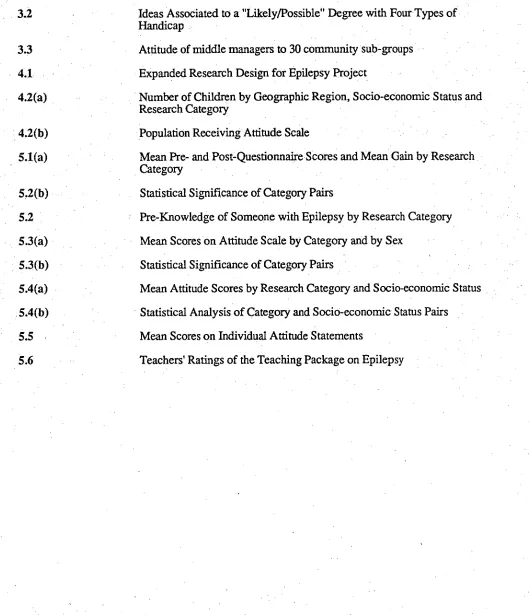
1.1 Research Design used in Epilepsy Project
2.1 Overview of Research Findings: Modification of Attitudes Toward Disabled Persons
3.1 Age group by percentage in which seizures first occur
3.2 Ideas Associated to a "Likely/Possible" Degree with Four Types of Handicap
3.3 Attitude of middle managers to 30 community sub-groups
4.1 Expanded Research Design for Epilepsy Project
4.2(a) Number of Children by Geographic Region, Socio-economic Status and Research Category
4.2(b) Population Receiving Attitude Scale
5.1(a) Mean Pre- and Post-Questionnaire Scores and Mean Gain by Research Category
5.2(b) Statistical Significance of Category Pairs
5.2 Pre-Knowledge of Someone with Epilepsy by Research Category 5.3(a) Mean Scores on Attitude Scale by Category and by Sex
5.3(b) Statistical Significance of Category Pairs
5.4(a) Mean Attitude Scores by Research Category and Socio-economic Status 5.4(b) Statistical Analysis of Category and Socio-economic Status Pairs 5.5 Mean Scores on Individual Attitude Statements
[image:3.559.20.549.207.822.2]LIST OF APPENDICES
Appendix Page
I Epilepsy Questionnaire for Primary School Children 82 II Attitude Towards Disabled Persons Scale 86
III Attitude Towards People with Epilepsy Scale 87
IV Follow-up Activities 89
V Teacher Questionnaire about Epilepsy Teaching Package 90
VI Responses to Individual Questions of Epilepsy Questionnaire
ABSTRACT
This dissertation addressed the problem of changing attitudes towards •those people with disabilities, specifically changing the attitudes
of primary school children towards people with epilepsy. A
literature search was undertaken to assess the current views on the nature of attitudes and attitude change, and to examine the sources of attitudes toward the disabled.
A lack of knowledge about disabilities was seen as one determining
factor influencing attitudes. As a result, a research study was
undertaken which established the level of children's general knowledge of epilepsy using a knowledge-based questionnaire as the measuring
instrument. After the questionnaire, the children were either (a)
presented with a lesson about people with epilepsy (b) exposed to no
further information about epilepsy. After six months, the scores of
the different groups were compared, together with scores from a group of children who had not been exposed to the questionnaire nor been
presented with any information. All children were given an attitude
questionnaire following the final knowledge-based questionnaire. The ,children who had been presented with the lesson about people with
epilepsy had significantly higher scores both on the knowledge-based and attitudinal questionnaires.
ACKNOWLEDGEMENTS
I would like to express my appreciation to the Epilepsy Association of Tasmania for initiating and encouraging the research study documented in this thesis. Valuable support was also given to me by the Curriculum and Evaluation and Executive Support branches of the Education Department of Tasmania, together with staff at the University of Tasmania's Centre for Education and Department of Community Health. • I am also especially grateful to the Curriculum Resource
Section of the Tasmanian Education Department for their assistance in developing and producing the final teaching package on epilepsy for primary school children.
1
CHAPTER 1: INTRODUCTION
In 1984 the Research and Development Grants Advisory Committee of the Commonwealth Department of Health funded a research project to develop teaching materials about epilepsy.for primary school children. The project was based on view that models of health education about disabilities were lacking in the primary curricula, particularly in relation to epilepsy. Epilepsy has been the subject of considerable stigma resulting from both community attitudes and from the view that people with epilepsy have of themselves and their condition (Beran and Read, 1980). Ignorance is often associated with stigma (Goffman, 1963) and evidence suggests that attitudes which may be stigmatising are entrenched by the time people reach the end of adolescence (Klausmeier, 1971, Reimann, 1951). Therefore children of late primary age (ten+) were chosen as the target group for this project.
The role of teachers and school children has been established as a significant contributing factor toward setting people with epilepsy apart and to the possible development of dysfunctional behaviour in later life (Sutton and Beran, 1981). Little work had been done in Australia to survey knowledge and attitudes of children and teachers in regard to epilepsy, nor were there any adequate teaching materials for the primary age group.
between the pre-test and post-test scores of the experimental group and the control group, using
t-tests. The research design is summarised in Table 1.1:
Table 1.1:
Research Design used in Epilepsy Project
School Research Questionnaire Teaching Package Questionnaire Categories on Epilepsy on Epilepsy on Epilepsy
(Term 1) (Term 1) (Term 3)
Project Schools (6) X X
Control Schools (6) X New Schools (6)
All teachers were interviewed informally about their knowledge of epilepsy and children not
involved in any of the research category groups were interviewed about the questionnaire, the
teaching materials and their knowledge of epilepsy and people with epilepsy. Full details of the
implementation of the research project will be found in Chapter 4.
It was my job as Project Officer for this research project to develop the questionnaire to
measure children's knowledge about epilepsy and to develop, trial and produce a teaching package
on epilepsy suitable for primary school children. In addition, I conducted the research in schools:
administering the questionnaires, teaching the set lesson, and interviewing teachers; I also
interviewed children not participating in the experimental part of the project, analysed the data and
wrote much of the research report.
It was not part of the Commonwealth funded research project to try to assess attitude changes
which may have occurred due to the teaching package. However, as the ultimate purpose of the
project was to try to provide knowledge in order to achieve improved attitudes, I thought it would
be of value to try to determine whether , in fact, the children involved in the Project Schools had
changed their attitudes towards people who had epilepsy after being exposed to the teaching
package, in contrast to children in the Project and Control schools, who were not presented with
the teaching material. To do this, I developed and administered a Likert-style attitude scale to the
3
of schools (Attitude Schools) as a new group totally ' uncontaminated' by exposure to the knowledge-based questionnaire or the teaching package. Scores of this fourth group of Attitude Schools were compared with those of the Control and Project schools.
It is the purpose of this thesis to, first, describe in general the nature of attitudes, sources of attitudes toward the disabled and techniques for attitude change. It also outlines the rationale for focussing research on teaching about epilepsy. Finally, the thesis documents the results of the research project and evaluates the subsequent teaching package for its effectiveness, both in educating children about epilepsy and producing a more positive attitude towards people with epilepsy. Some of the results appear in the Research Report (Mudge et al., 1986) in an abbreviated
form, but the research into attitudes and attitude change, and the implementation and results of the
CHAPTER 2:
ATTITUDES TOWARDS PEOPLE WITH DISABILITIES
In this chapter the attributes of attitudes will be discussed in the light of studies which have sought to define and refilie the concept of attitude; sources of attitudes towards the disabled will be reviewed, based mainly on characteristics summarised extensively by Hanoch Livneh (1982); and fuially, techniques for attitude change toward the disabled will be examined.
2.1 Distinguishing Attributes of Attitudes
Numerous investigations have indicated that often people with physical disabilities are viewed less favourably than those who are not disabled (McDaniel, 1976). Others have noted that the stigma attached to having a disability of any kind results in decreased life chances (Goffman,
1963). As a result of society's rejecting attitudes, vocational and social opportunities available to the disabled are restricted (McKerracher, 1982, p.1). During the International Year of the Disabled (1981), the need to improve community attitudes toward the disabled was highlighted, especially for those whose attitudes are based on lack of knowledge and understanding of disabilities themselves. Attitudes can be, and often are, based on misinformation, and this forms the basis for prejudice.
5
Since Allport's study in 1935, attitudes have been the subject of much theoretical and empiricial research. However, until attitudes could be quantified, it was difficult to assess their strength or effects. Departing from simply categorizing attitudes, in 1928, L.L. Thurstone established the first methodological and statistical technique designed to yield a quantitative representation of attitudes. Later in the 1950s Carl Hovland and Leon Festinger directed their attention toward determining how attitudes are changed (Calder and Ross, 1973, p. 2). The work of these early researchers has had a major effect on many disciplines concerned with social issues, from political science to education.
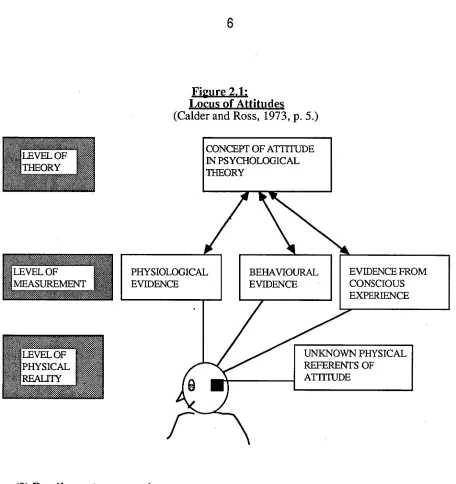
Gordon Allport observed that attitudes are measured more successfully than they are defined (Dawes, 1972, p. 2). As early as 1935 he was able to cite sixteen definitions. However, for some research purposes, it may not always be necessary to pinpoint a definition. If one is interested in attitude change, it is relatively easy to concentrate on the observable level of measurement, where any measured change is assumed to reflect some change in the unspecified concept of attitude (Calder and Ross, 1973, p. 3-4). However, if there is interest in relating attitude to behaviour and implicating causal links, the concept of attitude must be made clear in order to understand the relationship. The following aspects, based on Allport's work, help clarify the concept of attitude and work towards a definition:
(1) Attitude is a theoretical concept
PHYSIOLOGICAL EVIDENCE
CONCEPT OF ATTITUDE IN PSYCHOLOGICAL THEORY
BEHAVIOURAL EVIDENCE
UNKNOWN PHYSICAL REFERENTS OF ATTITUDE
EVIDENCE FROM CONSCIOUS EXPERIENCE
4.041Wa. LEVEL OF MEASUREMENT
[image:12.559.46.502.65.549.2]LEVEL OF PHYSICAL REALITY
Figure 2.1:
Locus of Attitudes
(Calder and Ross, 1973, p. 5.)
(2) Readiness to respond
Readiness to respond or behave towards something is another important characteristic of attitude, according to Allport (Calder and Ross, 1973, p. 5). Whether this readiness is a latent process that occurs prior to behaviour, or is identical to the behaviour itself, is still unresolved. However Calder and Ross argue that the case for readiness as a latent process is more convincing, even if the exact nature of the process is still undetermined, although they do not demonstrate this comprehensively.
(3) Attitudes are organised
7
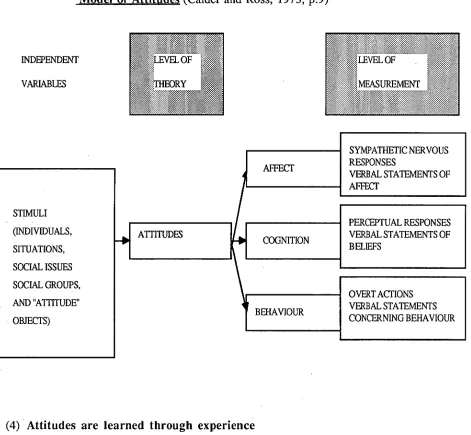
(Calder and Ross, 1973, p.5). One possible schema for this organisation is the cognitive-affective-conative model of attitudes, which structures attitudes in terms of three underlying components. The cognitive component is the rational, informational basis of attitude; the affective component is the feeling of liking or disliking for the attitude object; and the conative component refers to the strength of a person's behavioural tendencies toward the object (Calder and Ross, 1973, pp 5-6). As an example, a person might know that cats eat birds (cognitive component), like birds very much (affective component) and try to keep cats away from birds (conative component).
This cognative-affective-conative approach has a long intellectual history. In the Republic and
in the Phaedrus, Plato conceived of the human soul as made up of three faculties: reason
Figure 2.2:
Schematic Conception of the Cognitive-Affective-Conative Model of Attitudes (Calder and Ross, 1973, p.9)
INDEPENDENT
VARIABLES
SYMPATHETIC NERVOUS RESPONSES
VERBAL STATEMENTS OF AFFECT
AFFECT
STIMULI (INDIVIDUALS, SITUATIONS, SOCIAL ISSUES SOCIAL GROUPS, AND "ATTITUDE" OBJECTS)
PERCEPTUAL RESPONSES VERBAL STATEMENTS OF BELIEFS
ATTITUDES COGNITION
OVERT ACTIONS VERBAL STATEMENTS CONCERNING BEHAVIOUR BEHAVIOUR
(4) Attitudes are learned through experience
9
(5) Attitudes are directive
There is considerable agreement that attitudes exert a directive influence on behaviour (Calder and Ross, 1973, P. 7). It seems probable that attitudes affect the way we view the world as well as
the way we respond to it. Evidence indicates, however, that people may be more aware of the way in which attitudes determine their perceptions than of the way they determine behaviour: in other words, people are more likely to be unaware of the impact of their attitudes on their behaviour than on their perceptions. It was this relationship between attitudes and behaviour that provided the rationale for extending the Commonwealth research project under discussion in this thesis to include a measurement of attitudes at the end of the project. It did not seem sufficient to merely introduce knowledge and expect attitude change without any means of assessment, and without attitude change, there was unlikely to be behaviour change.
Definition
A definition summing up these various points is now possible. Attitude is a theoretical abstraction with no known physical referent. It predisposes a readiness to act in some way, and an internal organisation is generally supposed. An attitude is assumed to be a result of past experience and to exert a directive influence on behaviour (Calder and Ross, 1973, p. 8).
Having looked at the nature of attitudes, it is now pertinent to examine the way in which attitudes toward the disabled are formed.
2.2 Sources of Attitudes Toward the Disabled
the categories he proposes. However, the classification is helpful in sorting out the various sources of influence on the development of attitudes toward the disabled.
(1) Socio-cultural conditioning
The following are social and cultural norms, standards, and expectations which often lead to the creation of negative attitudes toward people with disabilities:
(a) emphasis on the idea of the "body beautiful", youth health, athletic ability, personal appearance and "wholeness". People are urged to conform to these societal standards;
(b) emphasis in Western countries on personal productiveness and achievement, whereby a person is judged on ability to be socially and economically competitive;
(c) the "sick role" attributed to disabled persons by society, exempting such a person from normal societal obligations and responsibilities;
(d) disabled persons are viewed to have marginal status by society; they are different, "outsiders", stigmatised, resulting in the person having a devalued or deviant status.
(2) Childhood influences
Experiences in early childhood are said to influence a child's beliefs and values. As Livneh notes, "Rearing practices which emphasize the importance of health and normalcy and which threaten any infringement of health rules with sickness, illness, and long-term disability, result in aversion towards individuals affected" (1982, p.339).
(3) Psychodynamic mechanisms
Unconscious psychological process, which are also related to childhood experiences, have been advanced in the literature to explain the attitudes of the non-disabled towards the disabled. These unconscious processes include:
11
340);
(b) unresolved conflict over scopophilia and exhibitionism: The importance of vision in early psychosexual and ego development is stressed by psychoanalysts. Sight is significant in terms of pleasure of looking at and being looked upon in the pregenital states and any unresolved conflicts related to these developmental states may be a consequence of the approach/fascination-avoidance/repulsion conflict often associated with the sight of a disabled person (Livneh, 1982, p. 340).
(c) "spread phenomenon" resulting from negative attributes: the generalisation from one perceived characteristic (e.g. a physical disability) to other unrelated characteristics (e.g. emotional or mental maladjustments) is referred to as "spread" . This "spread" or "halo effect" frequently results in attributing certain negative characteristics to those with disabilities;
(d) associating responsibility with etiology ('blame the victim'): In this situation the disabled person is held morally accountable for his or her disability, resulting in negative feelings in the non-disabled;
(e) fear of social ostracism: The non-disabled person fears that an association with disabled persons may imply some psychological maladjustment on his or her part;
(f) guilt of being "able-bodied": Guilt associated with having an intact body together with the possible injustices directed toward people with disabilities (e.g. lack of involvement in charitable activities) may result in a non-disabled person avoiding the presence of a disabled individual.
(4) Disability as a punishment for sin
Sin and punishment and disability are other possible psychodynamic mechanisms operating in negative attitudes towards disability. They are important influences and Livneh gives them special emphasis.
340). This leads to the view that the disabled person is dangerous or evil.
(b) Disability is an unjust punishment: There is also the unconscious belief that a disability is an unjust punishment and the disabled person will commit an evil act to balance the injustice.
(c) The non-disabled person fearing imminent punishment: Non-disabled persons may fear that they have not received retribution for past misdeeds and therefore avoid disabled persons
because of their guilt for not being punished or because they fear imminent punishment by association.
(5) Anxiety-provoking unstructured situations
Another of the major sources of attitudes noted by Livneh is that of anxiety caused by unstructured situations. Unfamiliar situations are known to create anxiety and confusion. In an encounter with a disabled person, a non-disabled person is often faced with a situation in which the socially accepted rules and regulations for proper interaction are not well known, causing withdrawal from the situation or anxiety and strain. Livneh also notes that lack of factual knowledge and information about disabling conditions tends to lead to negative attitudes (1982, p. 341). This supports the contention that non-disabled persons without knowledge of disabilities are likely to have uncomfortable feelings about an encounter with a disabled person. Lack of contact with a disabled person also contributes to a fearful and negative reaction.
(6) Minority group comparability
13
(7) Prejudice-inviting , behaviours
Certain behaviours by disabled persons result in discriminatory practices toward them. (a) Some disabled persons may seek some gain from their disability, act fearful, insecure, inferior or dependent and thereby strengthen certain prejudicial beliefs in the non-disabled.
(b) Stereotypical and negative attitudes may be fostered by lack of interest on the disabled person's part or lack of effective public relations campaigns or efforts by self help groups in combating public ignorance about disabilities.
(8) Influence of disability-related factors
Several variables affecting attitudes toward disabled persons are connected with the disabilities themselves.
(a) Functional versus organic disabilities: Personality traits of persons with disabilities which are functional (e.g. alcoholism) rather than organic (e.g. blindness, cancer) are reacted to more negatively. Employers prefer individuals who are physically disabled (e.g. those with paraplegia) rather than the more functionally impaired persons (such as those with emotional problems).
(b) Level of severity: The more severe a disability, the more negatively it is perceived. (c) Degree of visibility: Usually the more visible a disability is, the more negative the reactions to it.
(d) Contagious vs. non-contagiousness of disability: The more contagious a disability, the more negatively it is reacted to.
(e) Degree of predictability: The more curable and therefore predictable the disability is, the less negatively it is perceived.
(9) Demographic variables associated with attitudes
(a) Sex: Females exhibit more favourable attitudes toward individuals who are physically
disabled than males.
(b) Age: Generally attitudes are more positive in late childhood and adulthood, and less
favourable in early childhood, adolescence, and old age.
(c) Socio-economic status: Higher income groups show more favourable attitudes toward
emotionally and mentally disabled persons than low income groups, but no differences were found in regard to physical disabilities.
(d) Level of Education: Most studies conclude that educational level is positively correlated
with more favourable attitudes toward disabled persons.
(10) Personality variables associated with attitudes
The major findings of researchers looking at the association of several personality traits with attitudes towards the disabled have been categorised by Livneh (1982), who has highlighted the following characteristics:
(a) Ethnocentrism: High ethnocentrism is related to lack of acceptance of disabled people. (b) Authoritarianism: There is a positive correlation between low authoritarianism and
accepting attitudes towards the disabled.
(c) Aggression: Less aggressive people express more positive attitudes toward the disabled. (d) Anxiety: A high level of anxiety is positively correlated with rejection of disabled
individuals.
(e) Self-concept: Persons who are secure and confident in their personality and body
concept also tend to feel more positive and accepting of disabled persons.
(f) Ambiguity tolerance: Ability to tolerate ambiguity is positively correlated with acceptance
of the physically disabled.
(g) Social desirability: The need for social approval and acceptance by others was positively
15
(h) Intelligence: Tentative conclusions have been drawn relating the intellectual capacities of
non-disabled persons and their acceptance of disability.
2.3 Techniques for Attitude Change
There has been extensive research into the existence of negative attitudes towards the disabled and the sources and variables associated with these attitudes, but much less research has been directed at modifying attitudes towards disabled persons (Donaldson, 1980, p.504-5). An early researcher, Lewin (1946), postulated that attitude or opinion modification was a result of either restraining or increasing forces surrounding an opinion or behaviour. To modify attitudes, it is necessary to unfreeze the present attitude by either producing a restraining force or increasing a driving force (Donaldson, 1980, p. 509). This approach aims to reduce the anxiety-provoking unstructured situations mentioned earlier by Livneh.
Following this view, Evans (1976) postulated that strain was caused when non-disabled persons encountered disabled persons and this strain was a strong factor in creating and maintaining negative attitudes toward disabled persons. Evans thought that disabled persons could reduce this strain by making known their feelings about their disability and the curiosity of others, and also by providing some guidelines for interacting during interviews (Donaldson, 1980, p. 509). Langer et al. (1976) also hypothesized, as mentioned by Livneh, that non-disabled persons feel discomfort because they have a conflict over wanting to stare at the disabled person, who is a novel stimulus, and wanting to adhere to the social norm that staring at another person is impolite (cited by Livneh, 1980). They concluded that when staring was allowed, the discomfort was reduced, resulting in less avoidance when coming into contact with a disabled person (Donaldson,
1980, p. 509).
17
non-disabled; or presenting enough information to contradict the stereotyped image so that the current attitude is unfrozen or changed (1980, P. 510).
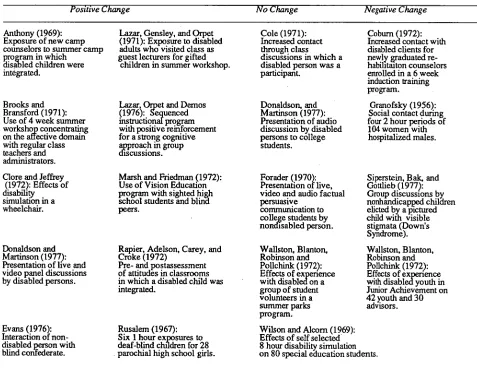
[image:23.558.41.518.401.770.2]Other contributions to more positive attitudes are disabled persons acting in a non-stereotyped ways and empathetic role playing. (Donaldson, 1980, p. 511). Negative shifts in attitudes can occur when the non-disabled person experiences strain or discomfort because of fear of behaving inappropriately and when the non-disabled person receives information that confirms or presents a negative stereotype of helplessness, hopelessness, sickness, separateness, or resentment and anger (Donaldson, 1980, p. 511). Such images should be avoided in initial attempts to restructure attitudes toward the disabled. Table 2.1 reproduced from Donaldson gives an overview of investigations attempting to influence attitude change (Donaldson, 1980, p. 506).
TABLE 2.1
OVERVIEW OF RESEARCH FINDINGS: MODIFICATION OF ATTITUDES TOWARD DISABLED PERSONS (Donaldson, p. 506)
Positive Change No Change Negative Change
Anthony (1969): Exposure of new camp counselors to summer camp program in which
disabled children were integrated.
Brooks and Bransford (1971): Use of 4 week summer workshop concentrating on the affective domain with regular class teachers and administrators. Clore and Jeffrey
(1972): Effects of disability simulation in a wheelchair.
Donaldson and Martinson (1977): Presentation of live and video panel discussions by disabled persons.
Evans (1976): Interaction of non: disabled person with blind confederate.
I azar, Gensley, and Orpet (1971): Exposure to disabled adults who visited class as guest lecturers for gifted
children in summer workshop.
Lazar, Oipet and Demos (1976): Sequenced instructional program with positive reinforcement for a strong cognitive a.pproach in group discussions.
Marsh and Friedman (1972): Use of Vision Education program with sighted high school students and blind peers.
Rapier, Adelson, Carey, and Croke (1972)
Pre- and postassessment of attitudes in classrooms in which a disabled child was integrated.
Rusalem (1967): Six 1 hour exposures to deaf-blind children for 28 parochial high school girls.
Cole (1971): Increased contact through class
discussions in which a disabled person was a participant.
Donaldson, and Martinson (1977): Presentation of audio discussion by disabled persons to college students.
Forader (1970): Presentation of live, video and audio factual persuasive
corrununication to college students by nonthsabled person.
Coburn (1972): Increased contact with disabled clients for newly graduated re-habilitanon counselors enrolled in a6 week induction training program.
Granofslcy (1956): Social contact during four 2 hour periods of 104 women with hospitalized males.
Siperstein, Bak, and Gottlieb (1977): Group discussions by nonhandicapped children elicted by a pictured child with visible stigmata (Down's Syndrome). Wallston, Blanton, Robinson and Pollchink (1972): Effects of expenence with disabled youth in Junior Achievement on 42 youth and 30 advisors. Wallston, Blanton,
Robinson and Pollchink (1972): Effects of expenence with disabled on a group of student volunteers in a summer parks program.
Harasymiw and Home (1975):
Pilot-integration project with continuum of support services.
Sedlick and Penta (1975): Presentation of a videotape of a successfully
rehabilitated person with quadriplegia.
Wyrick (1968):
Effects of lecture course in Rehabilitation Psychology.
Positive Change No Change Negative Change
Langer, Fiske, Taylor and Chanowitz (1976): Reduced avoidance of disabled person in controlled contact by giving opportunity for nonobserved staring.
Yerxa (1971): Information provided through structured dyadic self instructional program, with discussion between two nondisabled participants.
Four studies indicate negative shifts in attitudes, while six produced no significant changes; moreover, some studies lacked rigour in their experimental designs or were not consistently based on theoretical models (Donaldson, 1980, p. 505).
According to Donaldson, techniques used in attempts to produce attitude change toward disabled persons can be summarised into the following categories: (1) direct or indirect (media) contact with or exposure to disabled persons, (2) information about disabilities and persuasive messages, (3) disability simulation, and (4) group discussions. Donaldson notes that some studies have looked at more than one of these types of experiences and in some categories only a few research results have been published. Yet despite the dearth of research, it is possible to present some tentative suggestions for theory and practice in changing attitudes towards the disabled. These points will be re-considered later in this thesis in the discussion of teaching materials developed for primary school children to learn about epilepsy.
(1) Contact or exposure
Assessments have been made on the effects of nonstructured direct experience with disabled persons as well as the effects of carefully controlled, structured presentation of or experience with disabled individuals, such as a live situation or media presentation. Results indicate that structured experiences with, or presentations of, disabled persons consistently resulted in positive attitude change.
However, contact with disabled persons per se does not necessarily produce -positive,
19
that disabled persons have at least equal status with the non-disabled person, whether there is actual interaction or not (Donaldson, 1980, p. 505). Equal status means that the disabled person is approximately the same age as the non-disabled person and/or is approximately equal in social, educational, or vocational status; nonequal status is when the disabled person is significantly younger than the non-disabled person or in a position of receiving help or assistance. Equal status interactions were present in seven of the eight studies that produced positive attitudinal shifts (Donaldson, 1980, p. 505). Successful experiments in attitude change have also been associated with the disabled persons not behaving in a stereotypic manner (Donaldson, 1980, p. 507). These points will be reiterated later in the discussion of the teaching package on epilepsy, where children with epilepsy were shown acting in normal, non-stereotypical ways and were characteristed to maximize equal status with their viewers.
(2) Information and persuasion
Presentation of information with an overt or covert intention to persuade subjects to change their attitudes toward a particular topic has been used extensively in general attitude research (Donaldson, 1980, p. 508). Donaldson's research indicates that there are no direct, causal relationships between the provision of limited information about disabilities and attitude change (p. 508).
(3) Disability simulations
Results of a study conducted by Clore and Jeffrey (1972) indicated that role playing and the vicarious experience of watching someone role play were "effective methods of modifying at least some dimensions of attitudes toward disability (Donaldson, 1980, p. 508). It was also seen as important for the role player to observe the reactions of non-disabled persons and for the person playing the role to be perceived by observers as disabled, rather than having a non-disabled person playing disabled (blind folded, for example) (Donaldson, 1980, p. 508-9).
(4) Group discussions
Studies indicate that unstructured group discussion is likely to strengthen the pre-discussion opinion held by group members. However, one study (Lazar et al.., 1976) successfully used a
cognitive rather than affective approach to discussion (see Figure 2.2 for explanation of these approaches).
Donaldson concludes that stereotypic attitudes and/or strain and discomfort in the presence of the disabled can be modified through planned experiences, "Short, structured presentations of, or experiences with, persons who represent non-stereotypic images of disabilities and are of equally valued status in relation to participants have been predictably effective in short term attitude modification" (1980, p. 511). In order to maximise the effect of brief presentations, she suggests provision of opportunities through live or media presentations for disabled persons to convey information
* about what it is like to be disabled; * what they are like as individuals;
* how they expect non-disabled persons to relate to them.
21
rather than on biased opinions and emotions (Donaldson, 1980, p. 511). These factors contributing to formation of positive attitudes are relevant to many groups of devalued people, not only the disabled. These recommendations presented by Donaldson were taken into consideration when designing classroom materials for primary school children about epilepsy and will be more specifically discussed in Chapter 3.
2.4 Summary
CHAPTER 3:
RATIONALE AND THEORY UNDERLYING THE EPILEPSY RESEARCH PROJECT
Having looked at the general nature, sources and modification of attitudes it is now time to focus on the specific concern of this thesis: informing children of primary school age about epilepsy and assessing changes in attitude. First, it is of interest to briefly review previous investigations of children's attitudes towards the disabled. Jones (1967) found that four years was the age at which children begin to perceive limitations imposed by physical disability; in a study by Billings (1963) attitudes of non-disabled children toward physically disabled children were found to be significantly more unfavourable than their attitudes toward non-disabled children (Rapier et al., 1972, p. 219). The need for non-disabled children to understand disabled children in general education classes has been well documented (Gottlieb, 1975; Levitt and Cohen, 1976; MacMillan and Jones, 1974; Monroe and Howe, 1971, Jones, et al., 1981). Jones et al.. (1981) note several attempts to develop effective programs to change perceptions about disabled persons. However, as mentioned earlier by Donaldson (1980), procedures for accomplishing positive attitude changes have not always been rigoursly researched.
3.1 Why epilepsy?
Epilepsy was the disability selected for research in this research project because of the general lack of understanding about the condition, and because epilepsy can be frightening to those unaware of its causes or effects. Affecting approximately one per cent of the population, epilepsy goes undetected (hence, its being termed a "hidden disability") until a sudden and sometimes dramatic seizure occurs, causing embarrassment to the person with epilepsy and fear on the part of people witnessing the seizure.
23
became known as the sacred disease. About 400 B.C. Hippocrates theorized that epilepsy originated in the brain and was in no way a sacred disease, and in the late nineteenth century, Dr. John Hughlings Jackson defined seizures as a condition produced by violent disorderly discharges of brain cells. Despite the many ideas people have about the word "epilepsy", it means nothing more than a tendency to have seizures. Seizures are often called by other names, such as spells, attacks, fits and convulsion.
Some understanding of epilepsy is necessary in order to appreciate the nature of the difficulties it presents to those who have it and the reasons why the stigma should be removed from it. There is no definite reason why some people contract epilepsy and others do not, but the tendency to have seizures depends on one's inherited 'seizure threshold'; the higher the threshold, the lower the potential for seizures (Human Rights Commission, 1985, p. 13). Seizures are manifestations of a sudden surge in the electrical activity within the brain and the frequent occurrence of these is central to epilepsy; one seizure alone does not indicate a person has epilepsy. Usually epilepsy occurs alone, although prevalence is higher when certain other disabilities occur, such as brain damage, intellectual disadvantage and cerebral palsy, as well as with rarer conditions like tuberous sclerosis (Human Rights Commission, 1985, p. 14). It can begin at any time, but as shown here in Table 3.1, some age groups are at a greater risk than others.
Table 3.1:
Age group by percentage in which seizures first occur
Age groups First seizures occuring (percentage)
0-9 47
10-19 30
20-29 13
30-39 6
40+ 4
(from Human Rights Commission, 1985, p. 15).
In many cases the cause of epilepsy is unknown, but head and birth injuries, brain tumours, hardening of the arteries and fevers in infants are a few. Over twenty types of seizures have been classified, based on clinical observations and readings of electrical activity in the brain but they fall into two main categories, partial and generalised. In partial seizures increased discharges begin in one area of the brain and remain there. Since each area of the brain controls different bodily functions, functions located at the site of increased activity will be impaired (Human Rights Commission, p. 15). Symptoms of the seizures vary from movement which cannot be halted at will, tingling, light flashes, buzzing, visual hallucinations, sweating or, during a complex partial seizure, a person may remain still or engage in incongruous behaviour such as tugging at clothing, smacking the lips, or wandering unconsciously. Generalised seizures involve increased electrical activity in both sides of the brain and consciousness is usually lost. Generalised seizures take many forms: the absence seizures (cessation of activity and staring into space which may be confused with daydreaming); atonic seizures (loss of muscle tone resulting in a slump or fall); and grand mal or tonic-clonic seizures (stiffening of the body followed by jerking), amongst others (Human Rights Commission, p. 17). Seizures are controlled using medication and it is estimated that 85 per cent of people who have epilepsy achieve total or partial control with medication, if diligently taken (Human Rights Commission, p. 17).
25
cases (New Society, 9 May 1986, p. 20).
There is some indication that attitudes towards people with epilepsy may be improving: in the above mentioned survey, of those who decided to be frank about their condition, only a third could remember a hostile episode and of those who disclosed their condition to employers, only a few lost their jobs or were hampered in their careers (New Society, 9 May 1986, p. 20). Caveness et al. (1974) reported that the majority of Americans held positive attitudes towards persons with
epilepsy and figures from the Gallup Poll conducted every five years since 1949 indicate a trend toward increasing public understanding and support of those with epilepsy (Ryan et al., 1980, p.
433-34). Critics of surveys, however, question whether attitude studies can predict actual behaviour (Schuman, 1972); they argue that attitude surveys may reflect more tolerant views than actually exist because respondents feel pressure to voice socially acceptable opinions; moreover, people working with persons who have suffered social rejection due to epilepsy distrust reports of widespread public understanding of the disorder (Ryan et al., 1980, p. 434).
Much of the literature about people with epilepsy indicates that prejudice still remains, fed by superstition and supported by out-dated laws, even after the original social conditions have changed. People with epilepsy have been shunned and sometimes confined to asylums chiefly because people have feared the typical seizure, known as the grand mal, where the person with epilepsy would fall down shaking and jerking. Not realising what caused the seizure, people erroneously believed it was a sign of insanity, possession by evil spirits, or witchcraft; and they • thought it was infectious. Based on the mistaken belief that epilepsy is inherited, some countries prevented people with epilepsy from marrying or having children. The old attitudes of fear and prejudice also bar people with epilepsy from employment in some industries. This prejudice puts the person with epilepsy in a similar category as people from other minority groups who also encounter discrimination.
other factors. The report cites a 1972 survey of 602 Sydney adults undertaken by Vinson. who concluded the following from his analysis:
* 13 per cent of respondents would be worried if their children played 'in the back yard' with children who had epilepsy;
* 9 per cent would be worried about their children associating at school with children who had epilepsy;
* 38 per cent recommended children with epilepsy should attend a 'school for epileptics'; * 14 per cent believed people who had epilepsy should not work in jobs in the community; * 33 per cent believed persons who had epilepsy should not go out unescorted;
* 54 per cent said some limitations in sport should apply (Vinson, 1975, pp. 663-664). Vinson also presented respondents with forced-choice items concerning notions about disabled people and called for affirmation or rejection of these ideas. His results are seen here in Table 3.2.
Table 3.2:
Ideas Associated to a "Likely/Possible Degree with Four Types of Handicap*
Item Proportion of Respondents
Diabetic Crippled Deaf Epileptic Punishment for parent's sin 6.5 13.6 9.6 9.1
God-given sacrifice 12.3 15.4 14.3 12.6
Sexual misbehaviour 10.8 21.1 16.8 19.4
Capable of violent crime 29.7 32.2 34.1 55.5
Cunning 31.2 46.7 45.3 45.5
A mental illness 15.0 38.9 33.5 61.0
Low intelligence 20.4 47.0 38.5 45.0
Drug addiction 32.6 27.4 27.2 33.2
Poverty 19.4 26.4 18.1 14.8
Heredity 79.1 57.1 65.6 74.9
Accident at birth 22.3 91.0 80.5 61.3
Middle-aged parents 22.4 35.9 29.6 28.6
Own alcoholism 36.7 17.3 16.3 25.4
Head injury 14.5 65.4 82.9 68.3
Sugar imbalance 90.7 18.4 13.3 27.2
*Number of respondents = 605 (Vinson, 1975, p. 665).
27
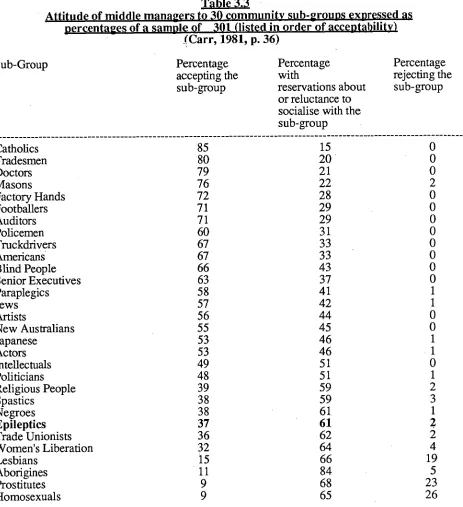
[image:33.559.39.537.498.822.2]physical disability being a divinely ordained sacrifice was still very much alive ten years ago. Another recent study conducted by Wills and More surveyed 301 Australian men born after World War II, who currently occupied middle management positions. These men were asked to rank their acceptance of thirty community sub-groups and the questions were designed to determine quick 'gut' reactions: Would the respondent accept readily, accept but with reservations, accept reluctantly or never accept an Aborigine, for example. The results of the survey shown here in Table 3.3, indicate a high rate of acceptance for Catholics, Masons, footballers, doctors and auditors. Acceptance fades when the respondents come to paraplegics and Jews. The dividing line between acceptance and rejection comes between actors (53 per cent acceptance) and intellectuals (49 per cent acceptance). People with epilepsy have only 36 per cent acceptance, just above trade unionists and are ranked only seventh from the bottom in a list of thirty community sub-groups.
Table 3.3
Attitude of middle managers to 30 community sub-groups expressed as percentages of a sample of 301 (listed in order of acceptability)
_(Carr, 1981, p. 36)
Percentage Percentage Percentage accepting the with rejecting the sub-group reservations about sub-group
or reluctance to socialise with the sub-group
Catholics 85 15 0
Tradesmen 80 20 0
Doctors 79 21 0
Masons 76 22 2
Factory Hands 72 28 0
Footballers 71 29 0
Auditors 71 29 0
Policemen 60 31 0
Truchlrivers 67 33 0
Americans 67 33 0
Blind People 66 43 0
Senior Executives 63 37 0
Paraplegics 58 41 1
Jews 57 42 1
Artists 56 44 0
New Australians 55 45 0
Japanese 53 46 1
Actors 53 46 1
Intellectuals 49 51 0
Politicians 48 51 1
Religious People 39 59 2
Spastics 38 59 3
Negroes 38 61 1
Epileptics 37 61 Z
Trade Unionists 36 62 2
Women's Liberation 32 64 4
Lesbians 15 66 19
Aborigines 11 84 5
Prostitutes 9 68 23
Homosexuals 9 65 26
29
swings' and 'emotional problems' (Beran, 1982, p. 324). Beran notes that there is much data to refute the existence of such a stereotyped personality, particularly because epilepsy represents a variety of seizure disorders, not just a single type. As well as perceived emotional instability, the doctors indicated that people with epilepsy had a decreased 'ability to relate to others' and felt 'people with epilepsy are treated as a minority group' (Beran, 1982, p. 324). Beran argues that doctors hold negative attitudes similar to those prevailing in the community and that there is a need to change doctors' awareness of the many social problems faced by those with epilepsy (1982, p. 324-5).
3.2 Theoretical Base to Attitude Change Used in the Research
As there is a strong tradition of myth and ignorance surrounding epilepsy, it was judged an appropriate disability on which to aim a teaching program for children in late primary school. It was considered that children of approximately 10-12 years of age would not yet have fixed ideas about people with epilepsy and would be able to cope with the level of language necessary to understand the concepts involved in such a program. Accepting Allport's hypothesis that attitudes may be organised into cognitive, affective and conative aspects, it was decided to focus the teaching program on information about epilepsy, while at the same time providing an affective or emotional appeal. It was hoped that such a presentation would result in a behavioural tendency to act positively towards people with epilepsy, thereby producing a conative change.
found that increased knowledge of the physically disabled significantly improved the attitudes of 6th grade children toward the disabled (McKerracher, 1982, p.6).
McKerracher also points out that factual knowledge of disabilities may increase awareness of the differences between the disabled and non-disabled rather than resulting in improved attitudes based on the knowledge that persons with disabilities have most things in common with the non-disabled. Therefore the presentation used in this research study aimed at providing information about epilepsy, while at the same time stressing that children with epilepsy are just like any other children in most ways and they like to be treated like other children, not to be made to feel different or strange.
Following the views of Lewin (1946) and Evans (1976) discussed earlier - that it is possible to modify attitudes by unfreezing a present attitude by producing a restraining force or increasing a driving force - it was hoped to present a positive, realistic view of people with epilepsy while at the same time counteract or restrain false impressions or information that the children might have.
Donaldson has also suggested that improved attitudes can be produced in a relatively short period of time without the opportunity for personal relationships between disabled and non-disabled individuals to develop (1980, p.507). Evidence for this suggestion is found in the significant positive shifts in attitude produced by 45 minute live and videotaped presentations of disabled people (Donaldson and Martinson, 1977); by the structured personal interview between a disabled and non-disabled person (Evans, 1976); and by brief exposures to disabled persons noted in the study by Langer, et al. (McKerracher, 1982, p. 5). Audiovisual media has been effective at
changing attitudes because of its well-proven and powerful ability to influence emotions as well as to convey information (Treiman-Tokunow and Treiman, 1982, p. 467). In addition, audiovisual productions are an obvious means of communicating with children and other people who have low-level reading skills.
31
research project. The development of this audiovisual presentation is discussed more fully in Chapter 4 (Section 4.4). By means of the visual presentation, the children were given a strong positive image to counteract any negative feelings they might have, they were allowed to stare, or look closely at a person with epilepsy without appearing rude, and they were able to identify with children their own age, who had epilepsy. The audiovisual presentation was followed by a structured discussion, in which the children gained more information and were encouraged to ask questions. They were encouraged to express how they thought they might feel if they had epilepsy and what they could do to help a person with epilepsy. It was hypothesized that children would gain knowledge about the condition of epilepsy, what it was like to have epilepsy and how they might be expected to react to someone with epilepsy, thereby relieving them of strain and discomfort should they encounter someone with epilepsy in real life.
In the post-audiovisual discussion, further information was given about first aid procedures for the grand mal type of seizure and children were allowed to role play the procedure. It was decided to use a role play activity, based on studies into the effectiveness of simulation activities. Clore and Jeffrey (1972) found that persons who role played disability and those who observed role playing of disability developed significantly more positive attitudes toward the disabled than did those in a control group (McKerracher, 1982, p. 7). It was considered important that the role play allow the role player to observe reactions of non-disabled persons, and this was allowed for in the present research study by having the role player discuss what s/he felt like when s/he saw the reactions of classmates. Clore and Jeffrey concluded that role playing, both actual and vicarious, resulted in increased mutual understanding and attraction, which they attributed to an empathetic response (McKerracher, 1982, p. 7).
The effectiveness of the teaching package (the audiovisual presentation, follow up activities and questionnaire) developed for this project will be evaluated in Chapter 6.
3.3 Summary:
33
CHAPTER 4:
RESEARCH DESIGN AND METHODOLOGY
The research design and methodology used in the epilepsy project will be discussed here,
elaborating the overview given in Chapter 1. It should be re-called that in addition to the pre- and
post-test design used in the funded project, an additional research component was introduced at the
end of the project: the attitude scale towards people with epilepsy (ATPE). The development of
the teaching package used in the intervention will also be described. A critical evaluation of the
entire reseach design, methodology and teaching package will be found in Chapter 6.
4.1 Experimental Research Design
The most popular experimental design in the field of attitude change has been the before-after
design, involving an experimental and a control group (Insko, 1967, p. 3). The experimental
group receives a pre-test, an experimental intervention, and then a post-test; the control group
receives the pre-test and post-test, without the intervention. Subjects are either randomly assigned
to the two groups or matched on some prearranged basis. The results are typically analysed by
comparing the difference between the pre-test and post-test in the experimental group with
comparable differences in the control group. A more sophisticated analysis is done by using the
analysis of covariance to eliminate that portion of the variance which is attibutable to the pre-test
(Insko, 1967, p. 3).
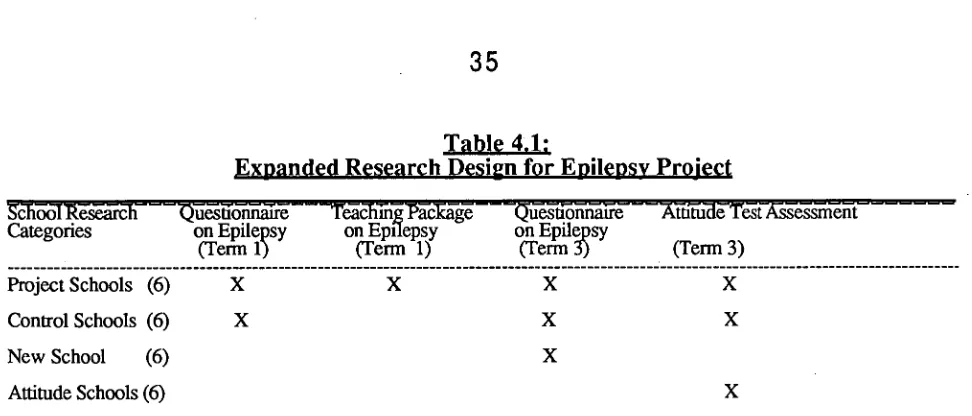
In the research focussed on in this thesis a pre- and post-test design, as seen in Table 4.1, was
used to evaluate children's knowledge of epilepsy, and a post-test only (attitude scale) was used to
assess attitude change. There Was a modification to the typical design, however, based on the
work of Solomon (1949) who noted that the main difficulty with the pre- and post-test design is
the possiblity of an interaction between the pre-test and the experimental manipulation, in other
words, differences between the experimental and control groups may be due to the experimental
manipulation and the pre-test (Insko, 1967, p. 3); the pre-test may commit the subjects to their
initial positions and make the experimental communication less persuasive, it may sensitise subjects
35
Table 4.1:
Expanded Research Design for Epilepsy Project
Rhflsh uestionnaire —TeaCTung, T'aercage Categories on Epilepsy on Epilepsy
(Term 1) (Term 1)
Questionnaire on Epilepsy
(Term 3)
Attitude 'rest iCssessment (Term 3)
Project Schools (6) Control Schools (6) New School (6) Attitude Schools (6)
Project Schools: A questionnaire about epilepsy was administered, together with a teaching package on epilepsy. The same questionnaire was re-administered six months later.
Control Schools: A questionnaire on epilepsy was administered at six month intervals, with no intervening teaching about epilepsy.
New Schools: The questionnaire on epilepsy administered at final stage to determine whether questionnaire given to Control Schools might have influenced the students' scores on the post-test.
Attitude Schools: Students in these schools (in addition to the Project and Control groups) were given the attitude test tt try to assess changes in attitudes.
In order to avoid any interaction between the children in the Project group which might allow them to share false information or transfer negative ideas, the classroom intervention (teaching package on epilepsy) was administered immediately after the pre-test questionnaire, with no intervening discussion. It was noted by McKerracher that in almost all of the experimental studies on changing attitudes towards the disabled, the post-test is given soon after the intervention program is finished and therefore persistence of the attitude over time is not recorded (1982, p. 8). In the epilepsy research study, it was decided to post-test after six months to determine the long-term effect of the teaching package and also to assess attiitudes at that time. There was no post-test immediately following the presentation of the teaching package to determine knowledge acquisition after the intervention.
4.2 Methodology
(1) Population: The population used in the epilepsy research study consisted of Grade 5
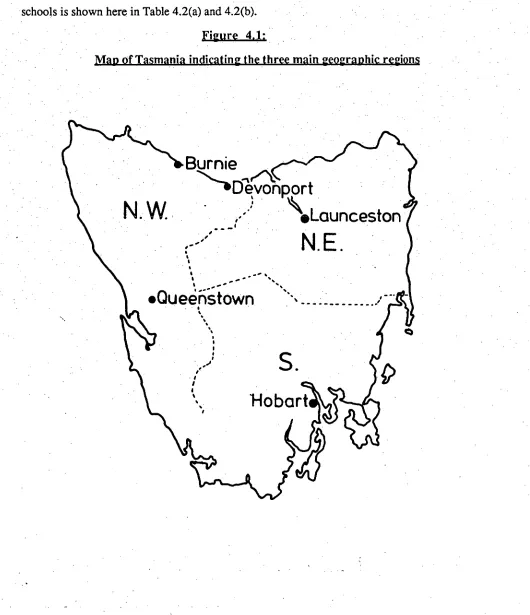
[image:41.559.40.526.56.264.2]main geographic regions of Tasmania (Figure 4.1) and from differing socio-economic groups were
selected. The socio-economic groups were determined by an index devised by the Education
Department of Tasmania, using Collector's Districts and based on over thirty items of information
from the 1981 Census. The sample population for Project, Control, New Schools and Attitude
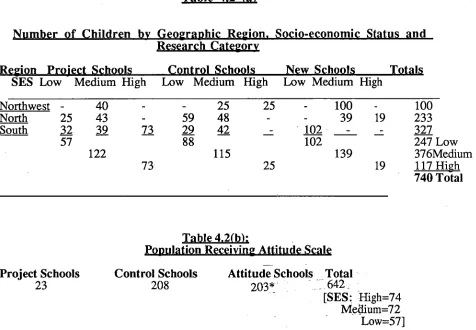
[image:42.558.16.546.209.824.2]schools is shown here in Table 4.2(a) and 4.2(b).
Figure 4.1:
37
Table 4.2 (a)
Number of Children by Geographic Region. Socio-economic Status and Research Category
Region Project Schools Control Schools New Schools Totals SES Low Medium High Low Medium High Low Medium High
Northwest - 40 - 25 25 - 100 - 100
North 25 43 59 48 - - 39 19 233
South 32 39 73 29 42 - 102 - _ - 327
57 88 102 247 Low
122 115 139 376Medium
73 25 19 117 High
740 Total
Table 4.2(b):
Population Receiving Attitude Scale Project Schools Control Schools Attitude Schools Total
23 208 203* i642 _
[SES: Fligh=74 Medium=72 Low=57]
*It was unnecessary to include regions of Tasmania as a variable for Attitude schools, primarily because the main interest was in differences between the various research categories rather than differences within them.
4.3 Measurement Instruments
(a) Knowledge-based Epilepsy Questionnaire
[image:43.562.47.523.155.485.2]This was to check whether those children who knew someone with epilepsy had more knowledge of the condition. After trialling and use in the research project, the questionnaire was later included as part of the teaching package.
A brief standard statement about epilepsy preceded the actual questions on the questionnaire and the children were instructed to answer the questions by ticking the appropriate boxes only after the questions had been read aloud to them one at a time by the presenter, who was the same person on all occasions. Students were placed in test conditions to minimise comparisons between answers. As mentioned previously, the instructional intervention immediately followed the questionnaire in Project schools.
(b) Attitude Measurement Questionnaire:
Instruments for measuring attitudes towards the disabled have included the Attitude Toward Disabled Persons scale or ATDP (Yuker, Block and Younng, 1966), the semantic differential scales (Rapier, et al., 1972), preference rankings for pictures of physically disabled children
(Richardson, 1972) and a variety of behavioural measures (Langer et al., 1976). No measure has
been universally accepted (McKerracher, 1982, p. 3). However, Shaw and Wright (1967) did an extensive study of scales for the measurement of attitudes and indicated that the ATDP, which attempts to measure the extent to which respondents perceive the disabled as different and to some extent inferior and disadvantaged, had better supporting data than most scales and was adequate for research purposes. Using the ATDP for the first time with children, Lazar et al. concluded that
it was effective and valuable for measuring attitudes of young gifted children towards the disabled (1971, p. 602).
39
considered children with epilepsy to be different or in need of special consideration. A high score would indicate a positive attitude, a low score a negative attitude.
The ATDP scale used by McKerracher and the Attitude Toward People with Epilepsy (ATPE) scales are found in Appendices II and III. The ATPE scale contains sixteen questions and these questions focus specifically on epilepsy rather than disabilities in general. The language is suitable for Grade 5 children and the number of choices has been reduced to four, perhaps lacking the refinement of the ATDP scale, but making the respondents' task easier, which was considered worthwhile, given the age of the group being tested (ten years old).
The ATPE was administered after the post-test questionnaire with the Project and Control groups, and Attitude schools were also given the ATPE at this period of time. Children were not required to put their names on the questionnaires so that they might answer more honestly. The presenter (the same person in all cases) explained the procedure, read a sample question, then read the questions one at a time and the children ticked their selected boxes. There was also a box to tick to indicate whether they knew someone with epilepsy or not.
4.4 Development of the Teaching Package on Epilepsy
(a) Audiovisual Presentation:
people might be expected to relate to them.
It was considered necessary to adapt the presentation for Australian children and after consultation with teachers, authorities in special education, and members of the Tasmanian Epilepsy Association, and with the assistance of the University of Tasmania's Centre for Education, changes were made to the University of Minnesota program. Specifically, one of the the young people in the case studies (a mature looking high school student) was replaced by a younger student or more equal status to the children who would be viewing the presentation; one sequence demonstrating how the brain receives messages from electrical impulses from the nerves (depicted by two children throwing a ball) was omitted to avoid an information over-load; and the narration was presented by an Australian reader rather than an American, in order to be more culturally relevant. In addition, the word 'handicap', which occurred frequently in the American version, was replaced by 'disability' to meet the recommendation of disabled group associations who now use the term 'disability' to refer to the reduction or loss of physical (i.e. motor, sensory or mental) structure or function and 'handicap' to include the personal, environmental and social consequences of a disability (Warren, 1986, p.15). Trials were made using the revised material and then, with the assistance of the Education Department of Tasmania, the slide presentation was transferred to videotape for ease of use. Three coloured photographs of the children in the videotape program were made to use in class discussion and a Teacher's Guide was written.
(b) Lesson Plan:
The teaching package (video, discussion, role play) used in the forty-five minute intervention, was presented according to a set plan as follows:
(1) Administration of the pre-intervention questionnaire;
(2) Before being shown the videotape, children were shown photos of the three children in the videotape who are shown with other children, and asked whether they could identify the child with epilepsy? [Various guesses are made, but the children do not really know and it transpires that the children with epilepsy look and act like any other children, their disability is 'hidden'];
41
(4) Discussion covering: epilepsy as a 'hidden disability', its causes, and the word 'seizure'; what people with epilepsy can do to help themselves [take medicine which helps, but does not cure the epilepsy]; what some things people with epilepsy should not do [swim alone, climb high trees, forget their medication]; what the children would do to help in the case of each of those children shown in the videotape; what those children with epilepsy might feel like; and how they might want to be treated by other children.
(5) Structured role play: Children participated in putting one of their classmates into the recovery position necessary after a grand mal seizure and discussion was held stressing that nothing should be put into the person's mouth and that it was impossible for anyone to swallow his/her tongue.
(6) Questions: Children were encouraged to ask questions based on the points covered in the video and discussion and those involved in the role play were asked how they felt.
(7) Follow-up activity: Children were left with a set of activities to complete during the week of the intervention (see Appendix IV).
(c) Teacher and Student Involvement
Teachers were interviewed before presenting the questionnaire and/or the intervention to determine their level of knowledge about epilepsy and first aid procedures. Teachers were also asked to assess the questionnaire and teaching package in a subsequent questionnaire (see Appendix V for Teacher Questionnaire), but were requested not to teach further lessons about epilepsy before the children were post-tested six months after the intervention.
4.5 Follow-Up Lesson for Children in Control. New and Attitude Schools
As mentioned earlier, it was considered important to follow-up the epilepsy post-test questionnaire and attitude questionnaire in non-Project School groups with the teaching package on epilepsy. Otherwise, children would have been left with no knowledge base, having been asked questions about epilepsy and people with epilepsy. Therefore the set lesson was presented to children in Control, New and Attitude schools immediately following the final questionnaires.
4.6 Summary
43
CHAPTER 5:
RESULTS OF RESEARCH AND DISCUSSION
This chapter will detail and discuss results of the knowledge-based pre- and post-tests, the interviews with teachers and children and the follow-up work done by the children; results of the attitude scale will be given, as well as the teachers' evaluation of the teaching package.
5.1 Results of the Pre-test and Post-test Information-based Questionnaires (a) Overall Results:
There are many different ways in which the data from this study could be analysed. For example, the difference between pre and post-test scores could be analysed in detail for differences between socio-economic status, sex, regions, or between individual schools. However, the focus of this thesis is on the relationship between the knowledge and attitude scores and the influence of the teaching package; in other words the emphasis here is on the differences between the groups (research categories) rather than the differences within the groups.
It should be noted in passing, however, that the Health Education on Epilepsy report (Mudge et al., 1986) contains information on these and other control variables. That report noted that there
were no significant differences between socio-economic groups or between males and females in the pre- and post-scores, nor in their increase in score ('gain') between the two tests (Mudge et al.,
p. 14). However, in some cases there were significant differences between regions of Tasmania. For example, the South scored significantly higher in gain from pre to post-score than did the Northwest and North (p=0.004). There were also significant differences in mean pre- and post-scores between individual schools There would have to be further study of the individual schools to explain these differences. One school, for example, in which the students scored particularly high had a child with epilepsy in the class the year previous to the intervention.
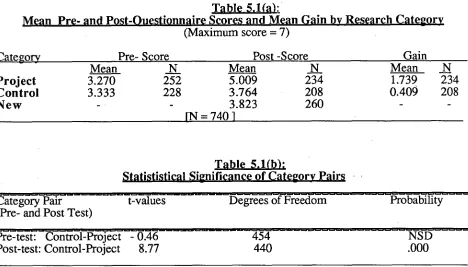
on the post-questionnaire (p=<.001) and Project groups scored significantly higher than did the Control groups with respect to both score on the post-questionnaire (p=<.001) (<0.0005) and on gain (p<.0005). The mean scores of children in the Control Schools were not significantly higher than the post-scores of the New group, indicating that the questionnaire given to the Control group did not significantly affect their post-test scores.
Table 5.1(a):
n P
• •
Jinn ir re n In ICategory Pre- Score
(Maximum score =7)
Post -Score Gain
Mean N Mean N Mean N
Project 3.270 252 5.009 234 1.739 234
Control 3.333 228 3.764 208 0.409 208
New 3.823 260
IN = 740 1
Table 5.1(b):
Statististical Significance of Category Pairs
Category Pair t-values Degrees of Freedom Probability (Pre- and Post Test)
Pre-test: Control-Project - 0.46 454 NSD
Post-test: Control-Project 8.77 440 .000
Table 5.2 indicates the number of children who said they knew someone with epilepsy when asked on the pre-questionnaire and when asked again on the post-questionnaire. Children also nominated who it was they knew, for example, a relative, friend, neighbour. There was an increase in numbers who said they knew someone with epilepsy in the post-questionnaire in both the Project and Control groups, perhaps indicating interaction after the pre-questionnaire was administered.
[image:50.559.48.516.251.518.2]