Dr Paul Smart
Senior Research Fellow
School of Electronics and
Computer Science
University of Southampton
Southampton
SO17 1BJ
United Kingdom
26
thNovember 2007
Rule-Based Intelligence on the Semantic Web
Rule-Based Intelligence on the Semantic Web i
Report Documentation Page
Report Title: Rule-Based Intelligence on the Semantic Web Report Subtitle Implications for Military Capabilities
Project Title: N/A
Number of Pages: 57 Version: 1.2
Date of Issue: 26/11/2007 Due Date: 22/11/2007 Performance
Indicator:
EZ~01~01~17 Number of
References:
95 Reference Number: DT/Report/RuleIntel
Report Availability: APPROVED FOR PUBLIC RELEASE; LIMITED DISTRIBUTION Abstract Availability: APPROVED FOR PUBLIC RELEASE; DISTRIBUTION UNLIMITED Authors: Paul Smart
Keywords: semantic web, ontologies, reasoning, decision support, rule languages, military
Primary Author Details: Client Details:
Dr Paul Smart
Senior Research Fellow
School of Electronics and Computer Science University of Southampton
Southampton, UK SO17 1BJ
tel: +44 (0)23 8059 6669 fax: +44 (0)23 8059 2783 email: [email protected] Abstract:
Rules are a key element of the Semantic Web vision, promising to provide a foundation for reasoning capabilities that underpin the intelligent manipulation and exploitation of information content. Although ontologies provide the basis for some forms of reasoning, it is unlikely that ontologies, by themselves, will support the range of
knowledge-based services that are likely to be required on the Semantic Web. As such, it is important to consider the contribution that rule-based systems can make to the realization of advanced machine intelligence on the Semantic Web. This report aims to review the current state-of-the-art with respect to semantic rule-based technologies. It provides an overview of the rules, rule languages and rule engines that are currently available to support ontology-based reasoning, and it discusses some of the limitations of these technologies in terms of their inability to cope with uncertain or imprecise data and their poor performance in some reasoning contexts. This report also describes the contribution of reasoning systems to military capabilities, and suggests that current technological shortcomings pose a significant barrier to the widespread adoption of reasoning systems within the defence community. Some solutions to these shortcomings are presented and a timescale for technology adoption within the military domain is proposed. It is suggested that application areas such as semantic integration, semantic interoperability, data fusion and situation awareness provide the best opportunities for technology adoption within the 2015 timeframe. Other capabilities, such as decision support and the emulation of human-style reasoning capabilities are seen to depend on the resolution of significant challenges that may hinder attempts at technology adoption and exploitation within the 2020 timeframe.
Classification of Report: Classification of Abstract: Classification of this Page:
Rule-Based Intelligence on the Semantic Web ii
Limited Distribution Notice
Rule-Based Intelligence on the Semantic Web iii
Acknowledgements
Rule-Based Intelligence on the Semantic Web iv
Abstract
Rule-Based Intelligence on the Semantic Web v
Contents
1 INTRODUCTION ... 1
1.1 VISIONS OF THE SEMANTIC WEB ... 1
1.2 REASONING ON THE SEMANTIC WEB ... 2
1.3 THE MILITARY PERSPECTIVE ... 4
2 RULE-BASED TECHNOLOGIES... 6
2.1 RULES ... 6
2.1.1 DEDUCTIVE RULES ... 7
2.1.2 REACTIVE RULES ... 9
2.1.3 NORMATIVE RULES ... 9
2.2 RULE LANGUAGES ... 9
2.2.1 RULEML ... 9
2.2.2 SWRL ... 9
2.2.3 RIF ... 11
2.3 RULE ENGINES ... 12
2.3.1 PELLET,RACER AND FACT++ ... 12
2.3.2 CLIPS ... 12
2.3.3 JESS ... 14
2.3.4 PROLOG ... 15
2.3.5 CWM ... 15
3 MILITARY APPLICATION AREAS ... 16
3.1 SEMANTIC INTEGRATION & INTEROPERABILITY ... 16
3.2 DECISION SUPPORT ... 18
3.3 SITUATION AWARENESS ... 18
3.4 KNOWLEDGE DISCOVERY ... 19
3.5 SEMANTICALLY-MEDIATED DATA/INFORMATION FUSION ... 20
3.6 MACHINE-TO-MACHINE INTERACTION ... 20
3.7 ADAPTIVE INFORMATION FLOWS ... 20
4 BARRIERS TO TECHNOLOGY ADOPTION ... 22
4.1 OPEN WORLD REASONING ... 22
4.2 UNCERTAINTY ... 25
4.3 EFFICIENCY & SCALABILITY ... 28
4.3.1 ONTOLOGY MODULARIZATION ... 29
4.3.2 INCREMENTAL LOADING OF ONTOLOGICAL DATA ... 30
Rule-Based Intelligence on the Semantic Web vi
5 TIMELINE FOR TECHNOLOGY ADOPTION ... 34
5.1 THE EVOLUTIONARY TIMEFRAME OF THE SEMANTIC WEB ... 34
5.2 THE EMERGENCE OF SEMANTICALLY-MEDIATED REASONING CAPABILITIES ... 35
6 CONCLUSION ... 38
7 REFERENCES ... 41
Rule-Based Intelligence on the Semantic Web vii
Figures
Figure 1: The Semantic Web Layer Cake ... 2
Figure 2: Transitivity Inference Rule ... 3
Figure 3: HighPriorityMineHazardArea Class ... 4
Figure 4: Sample Dataset for Mushroom Classification Service ... 6
Figure 5: Example of Variable Binding in a Deductive Rule ... 8
Figure 6: SPARQL CONSTRUCT Query ... 8
Figure 7: SWRL XML Syntax ... 10
Figure 8: Protégé SWRL Editor ... 11
Figure 9: RDF Triples as CLIPS Fact Assertions ... 13
Figure 10: Using JESS and Racer for Combined Deductive and DL Reasoning ... 14
Figure 11: SPARQL Realization of Ontology Mapping Solution ... 17
Figure 12: Contribution of Semantic Technologies to Enhanced Situation Awareness ... 19
Figure 13: Definition of the CivilianTerroristTarget Concept ... 23
Figure 14: TerroristTarget Class ... 25
Figure 15: RDF Triples from the SEMIOTIKS Mine Action Ontology ... 26
Figure 16: ‘P Predicate’ Approach to Representing Certainty Information ... 27
Figure 17: Breakdown of the ‘P Predicate’ Strategy ... 27
Figure 18: Ontology Modularization and Inference Optimization ... 29
Figure 19: Effect of Different Loading Solutions on Reasoning Efficiency ... 31
Figure 20: Timeframe for the Evolution of the Semantic Web ... 35
Figure 21: Evaluation of Semantically-Enabled Capabilities ... 36
1
Introduction
1.1
Visions of the Semantic Web
The Semantic Web (Berners-Lee et al., 2001) is a vision of the future potential of the World Wide Web (WWW) to provide a global infrastructure for the representation, dissemination and exploitation of human knowledge. In some ways the use of the phrase ‘Semantic Web’ is unfortunate: we already have a global repository of meaningful information that covers practically every area of human endeavour and experience - it is the conventional WWW. Why would we want to go beyond this existing capability? The answer to this question lies in the fact that the WWW is designed primarily for human consumption – most of the information available on the Web is meaningful only in the sense that humans are able to interpret it. What makes the Semantic Web different from the conventional Web is the emphasis it places on representational formalisms that make the meaning of information content explicit. Once we have a framework for unambiguously representing the meaning of information, then we have a framework within which intelligent systems are able to manipulate and exchange information content in a semantically-coherent and semantically-sensible fashion. The kinds of capabilities that may be supported by the Semantic Web are still the subject of considerable speculation; however, the following capabilities seem to be at least theoretically plausible:
1. Improved search and retrieval capabilities grounded in the fact that humans can better communicate their interests and intent to machines (the Semantic Web will enable agents to explicitly specify what they want to find in particular information retrieval contexts, something which goes beyond the capability engendered by plain keyword searches).
2. Improved inter-operability between disparate systems, especially in relation to information exchange, knowledge transfer and collaborative problem-solving.
3. Improved aggregation of information content either at the physical or virtual level, i.e. an ability to aggregate distributed information content for the purposes of specialized knowledge portals and services.
4. Improved clustering and organization of information content with respect to dynamically specified categories of interest, e.g. an ability to dynamically reorganize document repositories in ways that reflect the idiosyncratic interests and perspectives of end-user agents.
5. Improved knowledge discovery and creation, including an ability to use a combination of data mining techniques, statistical analysis and reasoning to discover new contingencies and statistical dependencies in large datasets (consider the transformative potential of an ability to publish scientific data on the Web and make that data amenable to automated knowledge processors1).
This is by no means an exhaustive list, but it does serve to convey some of the flavour of the Semantic Web vision.
The first step in the development of the Semantic Web is the availability of a knowledge representation language that can be used to express human knowledge in a form that is amenable
1
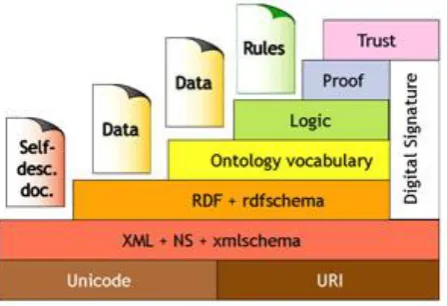
Rule-Based Intelligence on the Semantic Web 2 to machine processing. Recently, efforts to provide such a language have coalesced around the Web Ontology Language (OWL) (Antoniou & van Harmelen, 2004). OWL provides a language for describing the semantic infrastructure of a domain of discourse. As can be seen from Figure 1, which depicts the “Semantic Web Layer Cake” (a popular representation of the architectural components of the Semantic Web), the ontology representation language is built-on top of the Resource Description Framework (RDF) and RDF Schema. Above the ontology layer are the logic and proof layers, each of which provides a foundation for rule-based processing. It is these components of the Semantic Web (and the reasoning capabilities they support) that provides the primary focus of analysis for the current report.
Figure 1: The Semantic Web Layer Cake
1.2
Reasoning on the Semantic Web
Since the first publication of the “Semantic Web Layer Cake”, the role of rules in the Semantic Web has been somewhat controversial. Part of the reason for this controversy concerns the prevailing sense of confusion about the kinds of capabilities that rules are intended to provide, or indeed what types of knowledge they are designed to capture. As Allemang (2006) notes:
“Rules have sometimes been given a central role, at other times a peripheral role, and sometimes left out completely. Why such variation for a technology with thirty years of background? The reason for these differences of opinion stem from different goals for the inclusion of rules in the Semantic Web stack. At one extreme are the Description Logicians who see no need for a general-purpose programming language in the Semantic Web stack. At the other extreme are those who want to build a web infrastructure with the capacity for emergent intelligence.” (Allemang, 2006)
Rule-Based Intelligence on the Semantic Web 3 at the present time regarding how rules should be represented in the Semantic Web, or indeed the kinds of capabilities they should support.
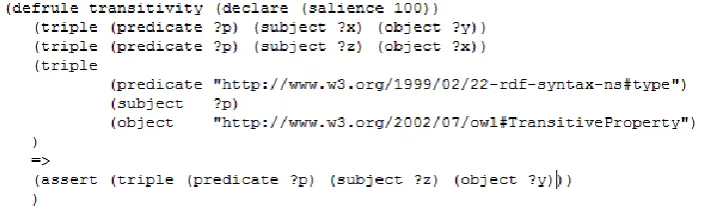
[image:11.595.122.476.217.320.2]The knowledge representation languages of the Semantic Web, RDF and OWL, are based on a subset of predicate logic, called first-order logic. The formal semantics of OWL support a particular type of reasoning, called subsumption reasoning. This essentially allows a system to infer that one class of objects is a subset of (is subsumed by) another set based on the logical characterizations made of the concepts in question. The following is an example of a rule that captures an inference supported by the semantics of the ontology representation language:
Figure 2: Transitivity Inference Rule
This rule exploits the semantics of transitive properties to infer that if x is related to y, and z is related to x, and the property that links these objects is a type of transitive property, then it must be the case that z is related to y by the same property.
Reasoners that provide support for Description Logic (DL) reasoning2 include Pellet (Parsia & Sirin, 2004; Sirin et al., 2007) and Racer (Haarslev & Möller, 2003). These reasoners are typically integrated into knowledge editing environments, such as Protégé (Noy et al., 2001), and they assist with the ontology development process by performing logical consistency checks and semantic validation services. Unfortunately, however, the kind of reasoning these reasoners can perform is limited to the semantics of the knowledge representation language; they cannot be used to compute certain types of relationships. For example, the computation of a hasUncle relationship requires an ability to conditionally assert a new relationship based on the existence of at least two other relationships:
hasParent and hasBrother. In general, description logics are unable to express chains of joins across different predicates (Antoniou & Wagner, 2003), and this limits the kind of inferences that they can participate in.
To complement the reasoning capabilities supported by DL reasoners, a number of attempts have been made to extend the expressivity of OWL with Horn logic rules. SWRL (Horrocks et al., 2004) is one of the best examples of this approach. It allows users to write Horn-like rules that can be expressed in terms of OWL concepts and that can then be used to reason about OWL individuals. In some cases, a reasoning process that initially looks as though it might require the services of Horn-logic rules can be delegated to a DL reasoner by maximally exploiting the semantic axioms of the ontology representation language. As an example of this capability, suppose we want to use an ontology to provide decision support in respect of the relative priorities of mine hazard areas for
2 In the context of this report, I will refer to any form of reasoning that is supported by the semantics of the
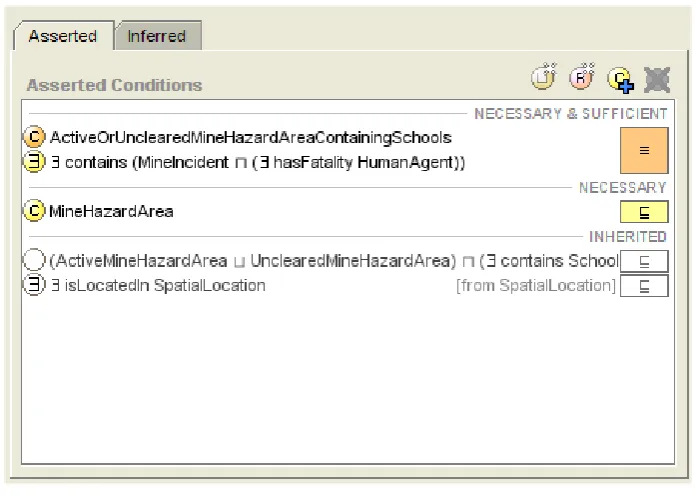
Rule-Based Intelligence on the Semantic Web 4 demining operations3. We can delegate this task to a DL reasoner by creating a new class within the ontology to represent our reasoning goal (in this case the new class is called HighPriorityMineHazardArea). We can then use the logical expressions provided by the ontology representation language to specify what we mean by this concept. The actual definition of the class is depicted in Figure 34. Now that we have communicated what we mean by a high priority mine hazard area, in a form a machine can understand, we can ask a DL reasoner to classify all the mine hazard area instances that fulfil the membership criteria of the target class. This will return a list of mine hazard areas that are of high priority for humanitarian demining.
Figure 3: HighPriorityMineHazardArea Class
1.3
The Military Perspective
The military environment presents a number of challenges for the Semantic Web. Specific challenges include the need to deal with the idiosyncrasies of the military network environment (e.g. its mobile,
ad hoc and wireless nature), the need to engender effective and robust information exchange solutions via ontology alignment/mapping mechanisms, the need to cope effectively with uncertain, incomplete and unreliable information, and the need to deal with the threat posed by malign agencies that may exploit the open nature of the Semantic Web to subvert coalition decision-making processes (see Smart & Shadbolt, 2007). Another notable challenge, and one that is the central focus of this report, is the need to develop robust reasoning capabilities that are able to assist military decision-makers with respect to a variety of tasks, such as situation assessment, sense-making and mission planning. Although the vision of the Semantic Web, and the reasoning capabilities it will eventually support, are largely commensurate with the requirements of military agencies vis-à-vis future defence capabilities, a number of critical challenges still need to be addressed. These include,
3 This example is taken from the Data and Information Fusion Defence Technology Centre (DIF DTC) SEMIOTIKS
initiative. SEMIOTIKS aims to provide semantically-enabled capabilities in support of humanitarian demining and Explosive Ordnance Disposal (EOD) operations.
4 A high priority mine hazard area is defined in this case as an uncleared mine hazard area that contains at
Rule-Based Intelligence on the Semantic Web 5 above all, the need to provide efficient and scalable reasoning technologies that deliver decision outcomes within an operationally-relevant timeframe. This is a significant challenge because extant reasoning systems often show poor scalability and performance with respect to knowledge-intensive tasks, especially synthetic task types, such as planning, design, prediction, simulation, etc. (see Schreiber et al., 2000). Concerns about performance and scalability will no doubt be magnified by the need to operate within military network environments. The time required to dynamically aggregate relevant information across the multiple nodes of a resource constrained network, for example, may contribute to a performance impairment that exceeds the acceptability threshold for time-critical missions.
Rule-Based Intelligence on the Semantic Web 6
2
Rule-Based Technologies
Reasoning systems are comprised of a range of technological components, including rules, rule languages and rule engines. This section provides a brief overview of these technological components, particularly those that have been studied in the context of the Semantic Web.
2.1
Rules
A rule is the basis of inference execution in a knowledge-based system, at least one that operates over semantically-transparent (see Clark, 1989) symbolic atoms. Within the Semantic Web, a rule typically represents a logical entailment between a set of formulas called premises and an assertion called a conclusion. The general form of a rule is as follows:
where Ai and B are atomic formulas.
If a set of rules can be used to infer ANY valid conclusion from the knowledge base, then the inference solution provided by the rules is regarded as complete; if the rule set never permits the assertion of invalid conclusions, then the inference solution is additionally regarded as sound. Knowledge representation systems based on predicate logic and its various specializations, such as OWL and RDF, are committed to monotonicity assumptions. This means that a DL reasoner can never make inferences that are invalidated by the assertion of additional information – if we know that x is an instance of A, then the assertion of more information about x can never cause it NOT to be an instance of A. As such, DL reasoners rely on monotonic rules to compute the entailments implied by the logical axioms of the ontology language – all DL reasoners are, in essence, monotonic reasoning systems.
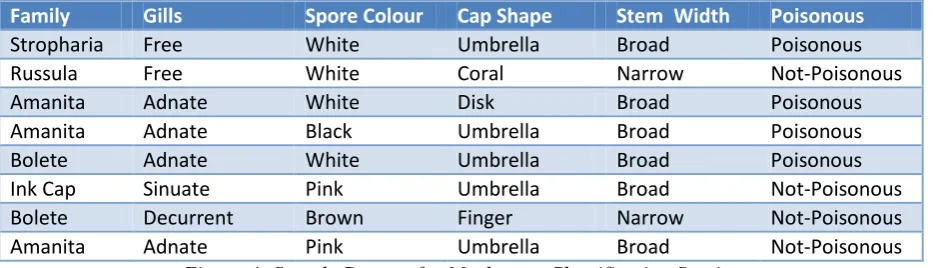
Family Gills Spore Colour Cap Shape Stem Width Poisonous
Stropharia Free White Umbrella Broad Poisonous
Russula Free White Coral Narrow Not-Poisonous
Amanita Adnate White Disk Broad Poisonous
Amanita Adnate Black Umbrella Broad Poisonous
Bolete Adnate White Umbrella Broad Poisonous
Ink Cap Sinuate Pink Umbrella Broad Not-Poisonous
Bolete Decurrent Brown Finger Narrow Not-Poisonous
[image:14.595.67.534.487.621.2]Amanita Adnate Pink Umbrella Broad Not-Poisonous
Figure 4: Sample Dataset for Mushroom Classification Service
Another possible interpretation of rules is that they are representational formalisms that essentially capture the predictive contingencies or statistical regularities within a domain of discourse. According to this view, rules represent a special type of relationship in which an association (largely probabilistic in nature) is established between one or more properties of domain concepts. Take for example, the data presented in Figure 4, which describes the characteristics of various mushroom families. Using this data, we can use a rule induction engine to compute the following rule:
Rule-Based Intelligence on the Semantic Web 7 The value of 0.75 in this case indicates the probability that the consequent (the THEN part of the rule) is correct. This rule can be interpreted in the following terms: “if a mushroom has adnate5 gills, then there is a 75% chance that it is also poisonous”. The knowledge captured by this rule statement is typical of real-world knowledge and it underpins our problem-solving competency in a whole variety of naturalistic decision-making contexts. Unfortunately, many of the rule systems currently seen within the Semantic Web cannot represent probabilistic knowledge of the type captured by this rule. Instead they are largely committed to inferring valid (i.e. true) conclusions from premises that are similarly valid. This is something of a weakness in terms of the ability of semantic rule languages to adequately cope with the vagaries of real-world knowledge (see Section 4.2).
Following the analysis of rule languages in Boley et al (2007), we identify three categories of rules: deductive rules, reactive rules and normative rules. A brief overview of these rule types is presented in subsequent sections.
2.1.1 Deductive Rules
Deductive rules allow a reasoning system to infer new knowledge on the basis of existing knowledge. Deductive rules are sometimes referred to as constructive rules because they are able to exploit knowledge-rich contingencies to create new knowledge; they thereby enrich the epistemic substrate for further reasoning processes (Bry & Marchiori, 2005)6.
Deductive rules are often comprised of two parts: a ‘head’ and a ‘body’. The ’head’ part typically provides a specification of the data to be constructed or inferred, and the ‘body’ part queries the underlying knowledge bases(s). Both parts of the rule usually share variables (commonly prefixed with a question mark, e.g. ‘?entity’. The variables get bound to data items in the ‘body’ and these bindings are then used in the ‘head’ to assert new data (see Figure 57).
5
The term ‘adnate’ refers to a particular morphological associated of mushroom gills with the mushroom stem.
6
Deduction rules are also called derivation rules in the business rules community, constructive rules by logicians, and views in the database community (Boley et al., 2007).
7 This rule is a CLIPS rule taken from the Future Offensive Air System (FOAS) pilot aiding domain (see Shadbolt
Rule-Based Intelligence on the Semantic Web 8
Figure 5: Example of Variable Binding in a Deductive Rule
The semantic query language, SPARQL8, provides a CONSTRUCT clause which can be used to create new RDF triples from RDF datasets (see Figure 69). This type of SPARQL query can be viewed as a deductive rule (Polleres, 2007) because the query is being used to derive new knowledge from previously asserted facts10. Other examples of rule languages based on deductive rules are SQL views, Datalog, Prolog, and most other logical rule languages (Boley et al., 2007). XSLT templates can also be viewed as deductive rules, as can queries that follow the XQuery language (Bry & Marchiori, 2005).
Figure 6: SPARQL CONSTRUCT Query
8 http://www.w3.org/TR/rdf-sparql-query/ 9
This query is taken from the domain of explosive ordnance disposal.
10 This view of SPARQL queries as rules suggests a potential strategy for improved rule processing efficiency. If
Rule-Based Intelligence on the Semantic Web 9 2.1.2 Reactive Rules
Reactive rules are the basis of reactive systems that can respond to the occurrence of specific events. Two types of reactive rule are generally recognized: Event Condition Action (ECA) rules and production rules. ECA rules (Papamarkos et al., 2003) take the form of ON Event IF Condition DO Action, which specifies that the Action should be executed automatically when the Event is detected, (providing the Condition holds, of course). Another category of reactive rules are the production rules. These rules form the basis of production rule systems such as Jess11, CLIPS12, JRules13, JBoss Rules14 and OPS515. In this case, the rule takes the form of WHENEVER Condition DO Action. During the course of inference execution, the conditional statements of a production rule are continuously evaluated, and selected data is then used to execute the actions specified in the Action part of the rule.
Reactive rules are seen as a means of enabling the transition from a largely passive Web, where data sources can only be accessed to obtain information, and a (future) dynamic Web, where data sources are enriched with reactive behaviour (Berstel et al., 2007).
2.1.3 Normative Rules
Normative rules are rules that serve to constrain the data values or logic of an application. The classical example is that of an integrity constraint in traditional relational database systems, e.g. each customer must have a unique name. Data schemas, especially tree grammars in their various disguises, e.g. DTD, XML Schema, RelaxNG, etc., express normative rules (Bry & Marchiori, 2005).
2.2
Rule Languages
There are many rule languages in use today, each with its own syntactic and semantic idiosyncrasies. In this section we provide an overview of the rule languages that have been most extensively studied in the context of the Semantic Web.
2.2.1 RuleML
RuleML (Boley et al., 2001) is a markup language for the Semantic Web that was proposed by the Rule Markup Initiative16. RuleML provides an XML language for rule representation that covers all the rule types described in Section 2.1.
2.2.2 SWRL
Like RuleML, SWRL17 is a candidate rules language for the Semantic Web. It builds on both OWL (specifically, the OWL Lite and OWL DL sub-languages) and the unary/binary datalog sub-languages of RuleML (O'Connor et al., 2005). The SWRL proposal extends the set of OWL axioms to include Horn-like rules, and it thus enables Horn-like rules to be combined with an OWL knowledge base. SWRL rules take the form of an implication between an antecedent (body) and consequent (head). The intended meaning of the rule can be read as: whenever the conditions specified in the antecedent hold, then the conditions specified in the consequent must also hold. Both the 11 http://herzberg.ca.sandia.gov/ 12 http://www.ghg.net/clips/CLIPS.html 13 http://www.ilog.com/products/jrules/ 14 http://www.jboss.com/products/rules
15 http://en.wikipedia.org/wiki/OPS5 16 http://www.ruleml.org/
17
Rule-Based Intelligence on the Semantic Web 10 antecedent (body) and consequent (head) may consist of zero or more atoms. Multiple atoms in either the head or body of a rule are treated as a conjunction of the rule atoms, although rules with conjunctive consequents can always be transformed into multiple rules, each with an atomic consequent.
As previously mentioned, SWRL is built on top of OWL, which allows SWRL rules to be represented as OWL individuals. This is important because it allows SWRL to exploit any technology developed to support the processing of RDF/OWL ontologies. Examples include editors, parsers, knowledge bases, query engines and other rule systems. Like OWL, SWRL has an XML presentation syntax that combines elements from both the ruleml and swrlx namespaces (see Figure 7)
Figure 7: SWRL XML Syntax
Rule-Based Intelligence on the Semantic Web 11
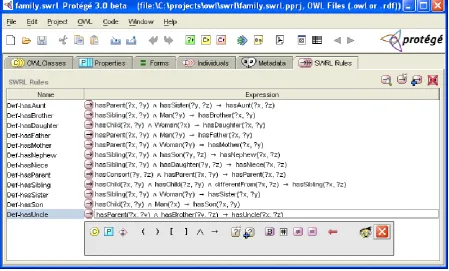
Figure 8: Protégé SWRL Editor
A built-in function library for SWRL allows it to support a variety of function predicates. SWRL rules can also be used to query OWL ontologies using an extended library of SQL-influenced built-in functions (O'Connor et al., 2007). For example, the following rule retrieves all persons in an ontology whose age is less than 5:
Person(?p) ^ hasAge(?p,?a) ^ swrlb:lessThan(?a,5) → query:select(?p,?a)
The SWRL query library provides basic counting, aggregation, ordering, and duplicate elimination operators.
The SWRL specification does not impose any restriction on how a reasoning process is to be performed using the rules. This means that any number of rule engines could be used to implement the reasoning process, although at present most implementations seem to rely on the Jess rule engine (Golbreich & Imai, 2004; O'Connor et al., 2005) (see Section 2.3.3).
2.2.3 RIF
Rule-Based Intelligence on the Semantic Web 12 communities, i.e. they dictate the inter-operability of rule processing systems. Interoperability concerns are of paramount importance here because they enable rules to be exploited across the entire knowledge infrastructure of the Semantic Web. This contributes to the progressive enrichment of knowledge systems throughout the Semantic Web by virtue of their ability to engage in rule exchange and merging operations.
Realizing the importance of rule interoperability, the W3C launched the Rule Interchange Format (RIF) Working Group18 at the end of 2005. This group has a charter to standardize a common format for rule interchange on the Web, but as Boley et al (2007) point out, there are a number of challenges facing the working group. Particular problems relate to the heterogeneity of existing rule languages and the conceptual incompatibilities between existing Semantic Web standards, such as OWL and RDF.
2.3
Rule Engines
This section describes a limited subset of rule engines that have been used to perform semantic reasoning, i.e. reasoning with RDF or OWL ontologies. The most popular reasoners for DL reasoning are Pellet19, Racer20 and FaCT++21; however, DL reasoning capabilities have also been implemented and tested in a variety of other rule engines, most notably the CLIPS and Jess systems. Although these latter systems are not optimized for DL reasoning, their flexibility with respect to rule-based processing makes them an attractive alternative for implementing semantic reasoning capabilities. 2.3.1 Pellet, Racer and FaCT++
Pellet (Parsia & Sirin, 2004; Sirin et al., 2007), Racer (Haarslev & Möller, 2003) and Fact++ (Tsarkov & Horrocks, 2006) are well known DL reasoners that are commonly used to support ontology development in conjunction with the Protégé knowledge editing environment. All three systems implement tableaux algorithms (Baader & Sattler, 2001), and thus capitalize on the extensive research that has been undertaken within the description logics community. The three systems have more or less similar capabilities and limitations, although FaCT and FaCT++ do not directly support ABox reasoning22.
2.3.2 CLIPS
CLIPS23 is an expert system shell that combines a rule-based inference engine with object-oriented and procedural programming facilities (Giarratano & Riley, 1994). These features make CLIPS a highly versatile environment for rule-based programming, and this is borne out by its successful application in a number of problem domains, including mission planning systems for Airborne Early Warning (AEW) (Smart, 2002) and decision support systems in military fighter aircraft (Shadbolt et al., 2000). For the most part, CLIPS has been used to implement classical expert systems, which is not necessarily surprising given that its development predates the Semantic Web24 (and to some extent
18 http://www.w3.org/2005/rules/ 19 http://pellet.owldl.com/ 20 http://www.racer-systems.com/ 21 http://owl.man.ac.uk/factplusplus/
22 A DL knowledge base consists of two components: a TBox and an ABox. The TBox describes the terminology,
while the ABox contains assertions about individuals. Correspondingly, DL reasoning includes TBox reasoning (i.e., reasoning with concepts) and ABox reasoning (i.e., reasoning with individuals).
23 http://www.ghg.net/clips/CLIPS.html 24
Rule-Based Intelligence on the Semantic Web 13 even the conventional World Wide Web!); nevertheless, CLIPS has been used in a number of studies to provide both DL reasoning and conventional inference capabilities with respect to OWL/RDF ontologies (Bassiliades & Vlahavas, 2004; Meditskos & Bassiliades, 2005; Meditskos & Bassiliades, 2006; Meditskos & Bassiliades, in press; Smart et al., 2007b).
The use of CLIPS as a DL reasoner, i.e. a system for computing RDF/OWL entailments, has been most extensively studied by Meditskos and colleagues. They have developed a system called O-DEVICE that imports OWL ontologies into CLIPS by transforming OWL constructs into an object-oriented model. O-DEVICE is an extension of a previous system, called R-DEVICE, which effectively maps RDF Schema constructs and data into CLIPS Object-Oriented Language (COOL) objects and then reasons over the RDF data using the CLIPS rule language (Bassiliades & Vlahavas, 2004).
CLIPS has also been used to provide a semantic reasoning capability with respect to Military Operations Other Than War (MOOTW) (Smart et al., 2007b). In this case, CLIPS was used to provide support for both DL reasoning and domain-specific decision-support. In particular, reasoning was directed towards the provision of decision support in three task areas:
• Needs assessment: an assessment of what needs to be done in terms of humanitarian relief actions in order to minimize further harm and alleviate human suffering.
• Relief planning: the actual planning of a relief effort in terms of the sourcing, delivery and dissemination of aid supplies.
• Future vulnerability assessment: an assessment, or prediction, of the long term implications of the disaster with respect to future humanitarian action.
The approach to ontology representation within this study was somewhat different to that employed by O-DEVICE. Most notably, a transformation process was employed in which the RDF triples of the OWL ontology were asserted into the CLIPS environment as simple fact assertions (see Figure 9). The advantage of this approach is that it avoids the complexity associated with the transformation of ontological statements into object-oriented constructs.
Rule-Based Intelligence on the Semantic Web 14 2.3.3 Jess
The Jess25Java Expert System Shell (Friedman-Hill, 2000) is a popular rule system written in Java. The
core Jess language is compatible with CLIPS; so many Jess scripts are also valid CLIPS scripts and vice-versa. In addition to the functionality supported by CLIPS, Jess incorporates JDBC technologies, which could potentially support a closer integration between the reasoning system and back-end knowledge repositories.
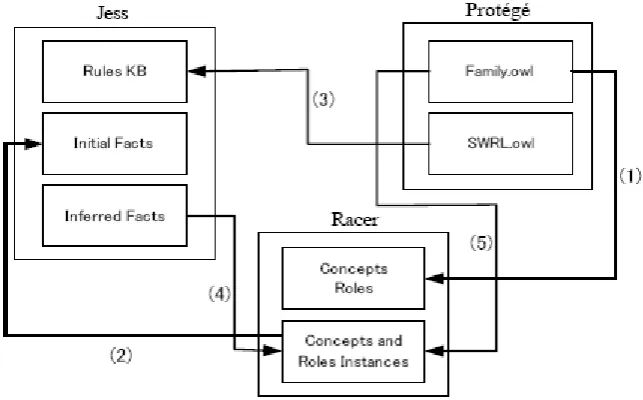
[image:22.595.137.459.367.567.2]A number of studies have investigated the use of Jess as a rule engine for semantic reasoning (Golbreich, 2004; Golbreich & Imai, 2004; Grosof et al., 2002). Golbriech (2004) describes a mechanism for combining rule-based and DL semantic reasoners that utilizes the Jess and Racer reasoning systems respectively. Her strategy is to use Protégé-OWL as an editing environment for both the domain ontology and SWRL rule sets. The OWL ontology is then loaded into Racer, which automatically classifies the OWL classes and individuals using subsumption reasoning. Following this initial reasoning step, OWL instances are translated into Jess facts and SWRL rules are translated into Jess rules. The Jess Rule engine is then launched and any inferred facts are returned to Racer for the computation of additional semantic entailments. A loop is hereby established in which Racer and Jess are invoked in an iterative fashion until an inconsistency is detected (Racer) or no new fact is inferred (Racer and Jess) 26.
Figure 10: Using JESS and Racer for Combined Deductive and DL Reasoning
The combined deductive/DL reasoning capability described by Golbreich (Golbreich, 2004; Golbreich & Imai, 2004) is appealing, but the approach is not without its potential problems. Firstly, it is not clear how scalable the solution is. Benchmarking studies have suggested that the Jess system may not scale very well, and it seems to perform poorly relative to many other reasoning systems (at least when it is used to perform DL reasoning27) (Meditskos & Bassiliades, in press). In addition, any performance issues are likely to be exacerbated by the iterative processing of data between the
25 http://herzberg.ca.sandia.gov/jess/ 26
This loop is established because any new facts asserted by Jess rules may support a series of further DL entailments.
27 In some ways this is not a fair comparison because most DL reasoners are optimized, not surprisingly, for DL
Rule-Based Intelligence on the Semantic Web 15 Racer and Jess sub-components. The time taken to complete any reasoning task within this system is essentially the sum of:
1. the time taken to load the ontology into Racer
2. the total time taken by Racer to perform DL reasoning across successive processing cycles 3. the total time taken to transfer and translate OWL instances from Racer to Jess across
successive processing cycles
4. the time taken to convert SWRL rules into Jess Rules
5. the total time taken by Jess to implement rule invocation and reasoning across successive processing cycles
6. the total time taken to transfer and translate Jess facts to Racer across successive processing cycles
This is a large overhead in terms of data transfer, translation and computation and one would expect performance to degrade significantly in situations where a large number of inferences or processing cycles are encountered. Nevertheless, Golbreich (2004) argues that an approach based on a combination of both DL and deductive reasoning is required for most semantic reasoning applications: inferences are essentially incomplete when either form of reasoning is used independently of the other.
Another system that relies on Jess to provide a semantic reasoning capability is ROWL28. ROWL enables users to create rules in RDF/XML syntax using the ROWL ontology. XSLT stylesheets are then used to transform the RDF/XML rules into forward-chaining rules using the Jess rule syntax. Additional stylesheets are used to transform the domain ontologies and instance data into unordered facts, each one representing an RDF triple (this is equivalent to the strategy described by Smart et al in the previous section).
2.3.4 Prolog
A number of rule engines are built on top of the Prolog programming language. One of these that has been studied in relation to semantic reasoning is SweetProlog (Laera et al., 2004). SweetProlog provides a system for translating OWL ontologies and rules (expressed in the proprietary rules language – OWLRuleML) into a set of Prolog programming constructs, specifically a set of facts and rules.
2.3.5 CWM
The Closed World Machine (CWM29) is an inference engine developed as part of the W3C Semantic Web Application Platform (SWAP30) initiative. It is essentially a forward chaining reasoner written in python that can be used for a number of general data processing tasks within the context of the Semantic Web, e.g. querying, checking, transforming and filtering information. Its core language is RDF, extended to include rules.
28 http://www.cs.cmu.edu/~sadeh/MyCampusMirror/ROWL/ROWL.html 29 http://www.w3.org/2000/10/swap/doc/cwm
30
Rule-Based Intelligence on the Semantic Web 16
3
Military Application Areas
Given the need to maintain information and decision superiority in an era of network-enabled capabilities, it is perhaps not surprising that semantic technologies have been the considerable focus of attention in the military community. Specific applications of Semantic Web technologies can be found in areas such as information fusion (Eichmann, 1998; Kokar et al., 2004; Matheus, 2005; Scherl & Ulery, 2004; Sycara et al., 2003), coalition planning (Mott & Hendler, 2007), sensor selection (Preece et al., 2007) and modelling and simulation (Lacy & Gerber, 2004) to name but a few. In this section we explore a number of additional application areas for semantic technologies. These areas represent a subset of application areas where ontology-based reasoning capabilities could be particularly useful.
3.1
Semantic Integration & Interoperability
The ability to exploit semantically heterogeneous and physically disparate information sources is a key capability in terms of realizing the potential of large-scale networks to contribute to information superiority. As the global information environment becomes increasingly pervasive and spans ideologically, culturally and ethno-linguistically diverse communities, so the information exchange challenge for military agencies becomes ever harder. In future defence-related contexts, strategies for operationally-effective modes of information exchange and exploitation will need to target a variety of disparate information repositories and communication systems, including digital datalinks, military information repositories, and the totality of the information space available via internet-enabled, Network-Enabled Capability (NEC) and peer-to-peer computing environments. In situations such as these, the potential for semantic ambiguity is rife because the meaning of symbolic information often reflects the experiential, epistemic, cultural and task-specific biases of the information provider. Both the semantic referents and semantic significance of information is not invariant with respect to information exchange contexts, rather one sees a degree of semantic specificity - a community specific interpretation of meaning that may not necessarily transcend cultural, organizational and/or national boundaries. The point is that once we encounter distributed network environments that subtend a wide variety of information systems, sources and user communities, we face a critical challenge in terms our ability to integrate and share information in a semantically-sensible manner (one that respects the meaning assigned to information content by the originating agent or agency). Addressing the interoperability challenge is arguably one of the most important areas for semantic technology research in relation to future military capabilities (Smart & Shadbolt, 2007) and this is reflected in the attention given to semantic inter-operability issues by defence and government organizations, e.g. NATO recently established a Semantic Interoperability program specifically to investigate semantic interoperability issues in relation to heterogeneous C2 systems (Peter Houghton, personal communication).
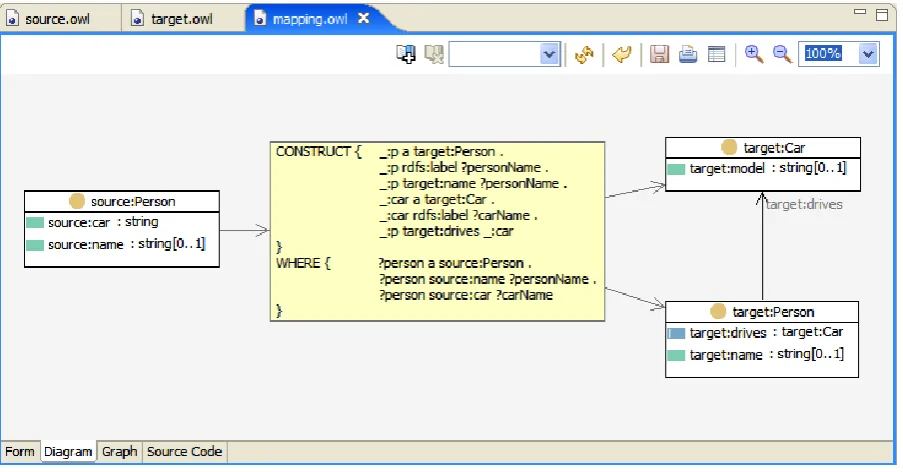
Rule-Based Intelligence on the Semantic Web 17 joint US/UK International Technology Alliance (ITA31) initiative, however, does avail itself of rule processing capabilities. The approach is grounded in the notion that some forms of information exchange can be effected by SPARQL queries, in particular SPARQL queries that utilize a CONSTRUCT clause to translate knowledge statements from one ontology into (semantically-equivalent) statements in a second (related) ontology. As an example of this process, look at Figure 11. The SPARQL query illustrated in this figure converts instances of a ‘Person’ class (source:Person) in one ontology into instances of another ‘Person’ class (target:Person) in a separate ontology. The use of the SPARQL CONSTRUCT clause in this query exploits a mapping between the classes of the source ontologies to create a moderately complex information exchange solution. Note that the execution of the query does more than just instantiate instances of ‘target:Person’, it also transforms the ‘?carName’ variable binding into instances of the ‘target:Car’ class and associates the new ‘target:Person’ and ‘target:Car’ instances with the ‘target:drives’ property.
Figure 11: SPARQL Realization of Ontology Mapping Solution
As was mentioned in Section 2.1.1, SPARQL queries of this form can be viewed as deductive rules (Polleres, 2007) because the query is being used to derive new knowledge – in this case deriving new knowledge relative to a target ontology. Given that SPARQL CONSTRUCT queries are essentially rules, and that such queries can be used to implement semantic integration solutions, it may be worth examining more generic rule-based approaches in order to determine if advanced forms of semantic inter-operability could be supported by ontology-based reasoning. Our approach with respect to this issue, in the context of the ITA, is to examine whether rule-based solutions can be used as a generic mechanism to mediate information exchange between disparate agent communities, legacy applications and data repositories. One particularly interesting strand of research concerns the automatic instantiation of these reasoning solutions (in terms of automatic rule generation) based on the availability of semantically-rich annotation frameworks that are applied to the outcomes of ontology mapping/alignment solutions.
31
Rule-Based Intelligence on the Semantic Web 18
3.2
Decision Support
Conventional reasoning systems (those based on classical rule-based systems) have been used for many years to provide decision support capabilities in military contexts. Examples of such systems include mission planning (Smart, 2001; Smart, 2002), fighter pilot aiding (Shadbolt et al., 2000) and terrain analysis (Richbourg & Olson, 1996) systems. There are also cases where semantic reasoning is being used to provide military decision support. These include the Joint Explosive Ordnance Disposal Decision Support System (JEOD DSS) where OWL ontologies are being used to present relevant procedural information about EOD Tactics, Techniques and procedures (TTP) to warfighters (Lacy et al., 2005). The US Air Force (USAF) is also exploiting semantic capabilities to represent portions of the Foreign Clearance Guide (FCG) in support of automated mission planning capabilities (Lacy et al., 2005). According to Lacy et al (2005), one problem encountered with the FCG planning systems concerns the absence of an effective rule language to capture the kinds of expressions required by the planning system. He cites the following example of an FCG rule, which is difficult to represent using current (Semantic Web) rule languages:
“If a mission aircraft carries hazardous cargo and a country specifies that no mission carrying hazardous cargo can land, then each airbase associated with the country will not allow a mission carrying hazardous cargo to land.” (Lacy et al., 2005)
Clearly, an ability to develop sufficiently expressive rule languages and efficient semantic reasoners is a prerequisite for the successful application and acceptance of semantic technologies by military agencies.
3.3
Situation Awareness
Rule-Based Intelligence on the Semantic Web 19
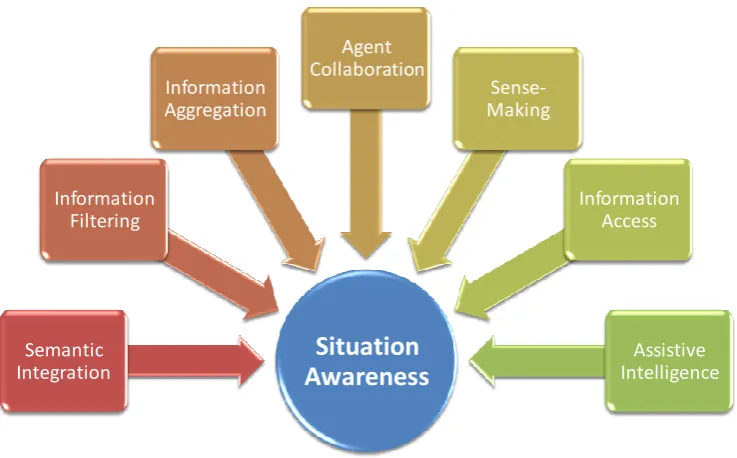
Figure 12: Contribution of Semantic Technologies to Enhanced Situation Awareness
There have been many studies investigating the contribution of semantic technologies to enhanced situation awareness (Matheus, 2005; Matheus et al., 2003a; Matheus et al., 2004; Matheus et al., 2005a; Matheus et al., 2005b; Matheus et al., 2003b; Smart et al., 2007a)32 (see Figure 12). Perhaps most obviously, semantic technologies can improve the retrieval of relevant information from semantically heterogeneous and physically disparate information sources, thereby supporting information acquisition – effectively an increase in level 1 situation awareness (see Endsley, 2000; Endsley, 1995). They can also, however, exploit semantic reasoning capabilities to provide support for information triage, knowledge monitoring and information filtering capabilities (Smart et al., 2007b). For the most part, advanced knowledge monitoring and information filtering capabilities can be realized with a combination of DL reasoning and semantic queries; other types of reasoning, e.g. automated planning aids, may indirectly contribute to enhanced situation awareness by increasing attentional processing and working memory capacity.
3.4
Knowledge Discovery
The availability of a global repository of machine-interpretable information and data has enormous potential in terms of the realization of advanced knowledge discovery capabilities. The idea here is that data mining and rule induction techniques could be used to detect statistically significant patterns, associations and contingencies across large-scale, distributed information repositories. Consider the publication of multiple datasets pertaining to some of domain interest. Imagine for example, that several information providers publish information about the characteristics of various mushroom species. Once this information is represented in a form where a machine is able to correlate properties and interpret data in a semantically-coherent way, the potential for automatically discovering associations and dependencies within the datasets becomes a realistic possibility. It potentially enables automated processors to derive rules from datasets and represent these rules in a form that could be shared with, and exploited by, other agencies.
32
see also http://eprints.ecs.soton.ac.uk/14351/2/B2_3.ppt
Situation
Awareness
SemanticIntegration Information
Filtering
Information Aggregation
Agent Collaboration
Sense-Making
Information Access
Rule-Based Intelligence on the Semantic Web 20
3.5
Semantically-Mediated Data/Information Fusion
The potential contribution of knowledge and semantic technologies to fusion-related problems has been recognized by a number of authors (Boury-Brisset, 2003; Matheus, 2005; Matheus et al., 2005b; Scherl & Ulery, 2004; Smart et al., 2005). While most analyses of semantically-mediated information fusion have concentrated on techniques for improved situation analysis, other analyses (e.g. Smart, 2005) have identified a plethora of opportunities at all levels of the JDL Data Fusion Model (see Llinas et al., 2004; Steinberg & Bowman, 2004).
One particular focus for analysis concerns the use of semantic technologies and reasoning capabilities in order to improve low-level entity recognition and feature extraction processes (Guo et al., 2007). While the ability to make semantic abstractions from low-level sensor data is largely regarded as beyond the current state-of-the-art (cf. Serre et al., 2007), it does appear that the exploitation of a variety of forms of contextual information, perhaps derived from a variety of disparate sources, could be used to improve object recognition. As an example of this process we are currently exploring the impact of contextual information on military vehicle recognition using microphone arrays and canonical acoustic profile datasets. The key research issue is whether information about factors such as the road surface type or meteorological conditions can be used to improve vehicle identification rates in realistic acoustic environments.
3.6
Machine-To-Machine Interaction
Semantic technologies can facilitate the interaction of automated agents and processors in order to yield problem-solving abilities that would be difficult to achieve by any one agent acting in isolation. While knowledge representation is one aspect of this ability, supporting the communication of semantically-coherent information, it is probably the case that reasoning systems will be required to assist Machine-to-Machine (M2M) interaction, if only for the purposes of establishing and coordinating agent collaborations. Stoutenburg et al (2005) additionally suggest that rule standardization is an important element of M2M capabilities:
“A standard rule framework built to operate over ontologies can enable machine to machine interfaces in a number of DoD environments. Dynamic C2 systems could employ M2M interactions for “asset allocation” of battlefield capabilities. For example, Unmanned Aerial Vehicles (UAV) could be dynamically tasked for reconnaissance and surveillance. Requests for backup and troop reallocation could also be automatically triggered during times of distress. Requests for clarifying information between components could be exchanged by applications while monitoring battlefield events, resulting in richer alerts and recommendations to the Warfighter.” (Stoutenburg et al., 2005)
3.7
Adaptive Information Flows
Rule-Based Intelligence on the Semantic Web 21 streams to particular consumers and actively transforming information content in ways that reflect the idiosyncratic processing capabilities of network nodes:
Rule-Based Intelligence on the Semantic Web 22
4
Barriers to Technology Adoption
The core vision of the Semantic Web, as presented in Section 1, is clearly relevant to military capabilities, but what is the likelihood that this vision will actually materialize – are we just a few short steps from a network-enabled nirvana, or will we have to accept a more limited set of semantically-enabled capabilities? Clearly, the scope of this report prohibits a detailed analysis of the issues at stake here, but it is clear that some semantic technologies, at least in their current form, do possess some shortcomings. The extent to which these shortcomings undermine the possibility of early technology adoption by the defence community is the focus of the current section.
4.1
Open World Reasoning
Rule-Based Intelligence on the Semantic Web 23
Figure 13: Definition of the CivilianTerroristTarget Concept33
In the context of the Semantic Web the OWA seems to be a reasonable assumption to make. The distributed nature of information content (in both space and time) means that we can seldom operate in a situation of complete information. In some situations, however, a strict commitment to OWR seems to be overly restrictive and it may depart significantly from much of the flavour of real-world reasoning and decision-making. Firstly, in many cases we are able to exploit background knowledge to make sensible guesses about the properties of things in the World. It is fair to assume, for example, that if B is Bird, then it can fly. This is despite the fact that there are clearly some instances of Birds that cannot fly. Since the OWA prohibits the assertion of statements that could be falsified in the light of additional information, a reasoner committed to the OWA would be unable to infer whether B can in fly or not. This form of ‘decision paralysis’ seems unsuitable in some situations34, particularly those that require some form of immediate action (see also Section 4.2). Ideally, what is required here is some form of default reasoning whereby we can to state the value of missing information based on reasonable assumptions about the current situation and the statistical regularities that inhere in the target problem domain.
A corollary of the notion of default reasoning is the idea that, under certain conditions, if something has not been asserted then we can safely assume that it does not exist. Grimm and Motik (2005), for example, suggest the following:
“Consider a table of train departure times. If the table does not explicitly state that a train leaves at 12:47, then we usually conjecture that there is no such train. In other words, for train time-tables we typically use the closed world assumption (CWA), assuming that our knowledge about that part of the world is complete. Under CWA, we conclude that there is no train at 12:47 unless we can prove the contrary.” (Grimm & Motik, 2005)
33
This example is taken from the Terrorism Ontology developed at the University of Southampton as part of the ITA initiative.
34 Clearly there are some situations when the OWA seems perfectly acceptable and valid, e.g. situations when
Rule-Based Intelligence on the Semantic Web 24 On occasion, a commitment to the OWA makes reasonable sense, especially in regard to the situations of incomplete information that one typically sees in distributed information environments. On the other hand, an overly stringent commitment to the OWA would seem to force us to renege on one of the most compelling features of real-world decision-making: the ability to make sensible assumptions about the nature of the World and coordinate response output accordingly. Inasmuch as OWR represents a significant departure from the form of reasoning that underpins decision-making in naturalistic settings, then it is unlikely that semantic reasoners can realistically expect to emulate the capabilities of a human reasoner. The danger, of course, is that these limitations will escalate to the point where they fall short of supporting the kind of capabilities expected by decision-makers in general, and military decision-makers in particular. What can we do to resolve the situation?
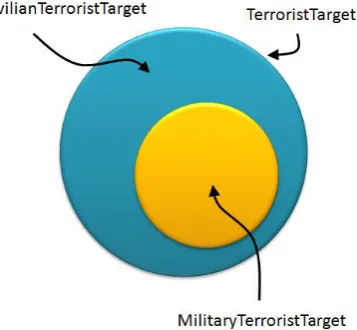
One potential solution strategy is to allow for a limited form of Closed World Reasoning (CWR) (reasoning the embraces CWR assumptions) in situations where the OWA is generally applicable. The Local Closed World Assumption (LCWA) (Doherty et al., 2000; Etzioni et al., 1997), for example, can be thought of as a useful compromise between the OWA and Closed World Assumption (CWA). Reasoning based on the LCWA allows us to augment OWA with the possibility of explicitly ‘closing off’ parts of the world in which the CWA applies. The application of the LCWA means that any query against a knowledge base (e.g. is X a MilitaryTerroristTarget?) will return the value ‘true’, ‘false’ or ‘unknown’. With respect to our previous example in the domain of terrorist incidents, if X is a TerroristTarget, then we know that it must be either a MilitaryTerroristTarget or a CivilianTerroristTarget. This is because the semantics of the application domain dictate that these two classes are disjoint (one is the complement of the other) and they are complete with respect to the TerroristTarget class (see Figure 14). Now, if the OWA is in force, and we know that X is a TerroristTarget, but we cannot assert, for sure, whether X is a MilitaryTerroristTarget, then a reasoner will return the value ‘unknown’ in response to a query of the form ‘is X a MilitaryTerroristTarget?’. This contrasts with the value that will be returned if the CWA is in force. In this case, the reasoner will return ‘false’, because no information about X being a MilitaryTerroristTarget has been asserted in the knowledge base. Suppose we do know that there is only one MilitaryTerroristTarget in the world – MilitaryTerroristTarget(Y) and, therefore we know that X is not a MilitaryTerroristTarget (by implication it must be a CivilianTerroristTarget). How could we guarantee that our query correctly returns ‘false’ in response to the query ‘is X a MilitaryTerroristTarget?’? With the CWA in force this would already be the case as we have seen; however, with the OWA we would still have the value ‘unknown’ – not a particularly intelligent conclusion given what we know about the problem domain. The only way to correct this error would be to state the fact ¬MilitaryTerroristTarget(?) for the (potentially infinite) set of everything else in the world. This is clearly impractical; however, the LCWA overcomes the problem by allowing us to assert that the CWA applies in particular cases. McKenzie et al (2006) provide a practical demonstration of the LCWA in the context of a semantic reasoning system applied to the CS AKTive Space35 (Shadbolt et al., 2004) domain. They demonstrate a LCWA solution based on the existence of two databases. The first database contains known facts describing the world, while the second database contains metadata indicating the categories of objects to which the CWA could be applied. McKenzie et al (2006) go on to demonstrate semantic reasoning capabilities that combine elements of both open and closed word reasoning. Such an approach has much to commend it in terms of
35
Rule-Based Intelligence on the Semantic Web 25 implementing reasoning capabilities that possess more of the flexibility that characterizes human-level problem-solving in real-world environments.
Figure 14: TerroristTarget Class
4.2
Uncertainty
In an uncertain world there are no absolutes! Uncertainty is pervasive when it comes to real-world decision-making. Seldom do we have complete information about a phenomenon of interest, and information gathering processes are seldom immune from inaccuracies or errors. The problem is particularly apparent in the case of the World Wide Web where inaccurate, incomplete and unreliable information is more or less commonplace. In addition to the uncertainty created by unreliable or incomplete information, there is also the uncertainty that derives from the inherent unpredictability of the world. We can seldom predict with absolute confidence the precise nature of future states the world, thus future plans and expectations are always somewhat provisional. This is partly what makes military planning such a difficult enterprise – it is genuinely difficult to anticipate enemy courses of action (in the case of warfighting operations) or the vagaries of the geological and meteorological environments in the case of humanitarian assistance missions. One is clearly reminded here of the old adage: “no plan survives contact with the enemy”.
Rule-Based Intelligence on the Semantic Web 26
Figure 15: RDF Triples from the SEMIOTIKS Mine Action Ontology
Unfortunately, ontology representation languages such as OWL do not easily accommodate uncertainty information, and the logic systems on which they are based are not well-equipped to deal with uncertainty. One problem is that certainty information is notoriously difficult to represent within the representational framework of RDF. RDF, and its extensions, such as RDFS and OWL, is based on a scheme in which knowledge statements are expressed as triples. Figure 15 shows some example triples from one particular ontology that was developed in the context of the DIF DTC SEMIOTIKS36 initiative. Each of these statements is assumed to be true, but what if we wanted to represent uncertainty information in this model, perhaps to reflect our degree of trust in the dataset provider? We cannot include an additional element in the triple to represent certainty information because this would violate one of the modelling assumptions of RDF. We could, however, use a mechanism whereby each subject is associated with additional predicates, each one of which represents the certainty associated with some other predicate/object pair (Jim Hendler, personal communication). For example, Figure 16 shows an approach to accommodating certainty information within RDF graphs that relies on the assertion of a datatype property (predicate) that is named after another property (associated with the same subject node) and distinguished from that property by the addition of a standard identifier (in this case the letter ‘P’). Let us call this the ‘P predicate strategy’. Unfortunately, this approach suffers from problems of application specificity – the interpretation of each ‘P predicate’ is local to the application and cannot be (automatically) understood by other, independent systems. Another problem relates to the ambiguity regarding triples with multiple predicates of the same type (see Figure 17). In this case, there is no way to relate individual ‘P predicates’ with their corresponding triples.
36
Rule-Based Intelligence on the Semantic Web 27
Figure 16: ‘P Predicate’ Approach to Representing Certainty Information
The development of certainty management solutions that enable existing representational formalisms and reasoning capabilities to deal with vague or imprecise knowledge is a key challenge that limits the applicability of semantic solutions to real-world decision-making contexts. If we cannot reliably represent certainty information for knowledge statements within the conventional representational framework of the Semantic Web, then it becomes difficult to assign probabilities or confidence limits to inference outcomes or the information items upon which such outcomes are based. In the absence of this key capability it is difficult to see how military agencies could wholeheartedly embrace semantic technologies as a generic solution for knowledge processing applications.
Figure 17: Breakdown of the ‘P Predicate’ Strategy
A number of strategies have been proposed to extend ontology representation and Semantic Web rules languages with an ability to represent vague or imprecise knowledge. These have largely assumed the form of probabilistic (Ding & Peng, 2004) and fuzzy logic extensions to OWL (Gao & Liu, 2005; Stoilos et al., 2006; Stoilos et al., 2005). Fuzzy logic formalisms are based on fuzzy set theory, which is a mathematical framework for covering vagueness (Klir & Yuan, 1994). Work in this area has given rise to Fuzzy-OWL (or f-OWL) (Stoilos et al., 2006; Stoilos et al., 2005), which can capture vague and imprecise knowledge. A Fuzzy Reasoning Engine37, called FiRE, has also been developed, which lets Fuzzy-OWL capture and reason about uncertain knowledge (Stoilos et al., 2006).
In addition to fuzzy logic extensions to OWL, Pan et al (2005) have also proposed a fuzzy extension to SWRL. Their language, f-SWRL, avails itself of an ability to assign weights (in the range 0 to 1) to the
37
http://www.image.ece.ntua.gr/~nsimou/
0.50 sem:TNT
sem:APERS
sem:usesExplosive
sem:usesExplosiveP
sem:Mine
usesExplosive
usesExplosiveP
0.50 TNT
0.10 Pentolite
usesExplosiveP
[image:35.595.148.452.356.554.2]