promoting access to White Rose research papers
White Rose Research Online [email protected]
Universities of Leeds, Sheffield and York
http://eprints.whiterose.ac.uk/
This is an author produced version of a paper published in British Librarianship
and Information Work 2006-2010.
White Rose Research Online URL for this paper: http://eprints.whiterose.ac.uk/77833
Published paper
Published in: Bowman, J.H. (editor). British Librarianship and Information Work 2006-2010.
pp. 338-359. London: J.H. Bowman, 2012.
Research
Barbara Sen and Peter Willett
Introduction
This chapter provides an overview of the research in librarianship and information science (hereafter LIS) carried out in the UK in the period 2006-10. More specifically, we discuss academic research as (predominantly) published in the peer-reviewed journal literature, complementing and extending the chapters by Nicolas in the volumes of British
Librarianship and Information Work for the periods 1991-2000 and 2001-2005.i We
consider first the current funding environment for LIS research, and then the outcome of the most recent Research Assessment Exercise in 2008 (RAE2008). The next, and largest, section discusses the range of LIS research being conducted in the UK as reflected in a range of types of publications, specifically those indexed in the Web of Science, those published in a series of special issues of the journal Aslib Proceedings, and those published in 2006 and 2007 that were included in submissions for RAE2008. The chapter closes with brief discussions of staffing changes in LIS departments and of the creation of the Library and Information Science Research Colloquium.
The funding environment
Governmental funding for academic research in the UK comes from two major sources. The first of these sources, and arguably the more prestigious given its increasing scarcity, is financial support for specific research projects awarded after competitive peer review by funding agencies, such as the seven major research councils comprising Research Councils UK. The second source is the QR (for quality-related) funding provided by the funding councils on the basis of departmental performance in the RAE (vide infra). These provide the
UK academic research.ii
than on long-term academic research. The current Government announced the abolition of the MLA in June 2010, with its responsibilities transferred to the Arts Council and the National Archives in October 2011. With s demise, the most obvious UK source of funding for LIS research is now the Arts and Humanities Research Council (AHRC) (though it should be noted that research in specialist areas of information science, e.g., in geographic Recipient
(University) Project title
Award (Year) Julie McLeod
(Northumbria)
Accelerating positive change in electronic records.
Understanding issues and developing practical approaches.
£318K (2006) Nigel Ford
(Sheffield)
Developing effective Web-based information seeking for inquiry-based learning: a meta-cognitive approach
£318K (2007) Andrew Flinn
(UCL)
Community archives and identities: documenting and sustaining community heritage
£166K (2007) Charles Oppenheim
(Loughborough)
Using the h index to rank influential UK researchers in information science and librarianship
£67K (2007) Elizabeth Shepherd
(UCL)
The impact of the UK Freedom of Information Act on records management in the public sector
£93K (2007) Ian Ruthven
(Strathclyde)
Decision making in Web searching: what do searchers look at and why?
£146K (2008) Nigel Ford
(Sheffield) Developing deep critical information behaviour
[image:3.595.81.536.91.411.2]£216K (2010)
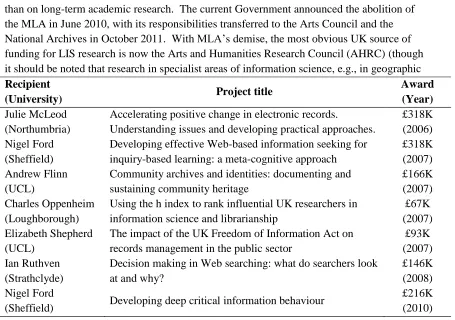
Table 1. AHRC standard research-grant awards 2006-10.
information systems or chemoinformatics, may be able to attract support from other of the research councils). When the AHRC was established in April 2005, it set up a series of specialist panels to review grant applications in specific areas, with one of these focussing on LIS, galleries and museums. However, the AHRC has now abolished its panel structure and there is thus no group with specific responsibility for LIS research; instead, applications in this area have to compete with applications from the full range of disciplines in the arts and humanities, making successful applications even more rare than was previously the case.
In the period 2006-2010, the AHRC made just seven awards for LIS research under their standard research-grant scheme iii as detailed in Table 1, these awards representing a total of
ca. £1.3M. There have been awards to LIS researchers on other schemes, e.g., Jonathan Foster (Sheffield) was awarded
was awarded £23K in 2007 for research leave to facilitate writing the book Books, Buildings and Social
Engineering. Early Public Libraries in Britain from Past to Present. Even so, the figures
Given the limited research council funding, LIS departments have had to look elsewhere. Non-governmental public-sector funding can come from local councils, charities, and the NHS inter alia, all of which can provide a useful source of support for research that is of direct relevance to their respective missions. This is also the case for private-sector funding where science-based companies, in particular, can support leading-edge academic research that is often carried out in close collaboration with their own internal research groups. Research-student tuition fees (which can be considerable for some overseas students) provide another, albeit rather different, way of supporting research, and there may be other sources that are of importance in some circumstances, e.g., an institution may provide seed-corn support to a department with the expectation that this will subsequently result in external funding.
Brophy summarizes some of the funding sources that were being tapped by the LIS sector in late 2006.v He notes in particular the opportunities offered by the many European Union (EU) funding schemes, and these opportunities are clearly being grasped. For example, the submissions to the last RAE (vide infra) show that the EU formed the largest single source of funding for the period 2002-2008 for at least three of the LIS departments (those at Leeds Metropolitan, Manchester Metropolitan and Sheffield), and figured prominently in the funding sources of the other departments. This situation is likely to continue for quite some time given the severe financial pressures that UK-based funding agencies are now
experiencing.
The Research Assessment Exercise (RAE2008)
An extremely important feature of academic research is the regular RAE,vi which is organized by the funding councils and which involves a detailed peer review of the research carried out by university departments throughout the UK higher education sector. These evaluation exercises have now been running since 1986, with that reporting in December 2008 being the sixth; the next, which will be called the Research Excellence Framework (or REF), will report in 2014. The peer review of all the departments working within a specific discipline is carried out by a small panel of experts. Each department in 2008 submitted for review to this panel a list of research publications by each of its members of staff, and two textual
statements: one providing evidence of the esteem in which its research was held by the community; and the other describing its research environment (covering factors such as staff development, research strategy, and future plans).
A total of 21 departments submitted to the RAE2008 panel
Previous RAEs graded each submitting department on a simple ordinal scale containing between four and seven points. RAE2008 used a five-point scale (unclassified and grades 1-4); however, rather than a single overall grade, each
weighted mean grade that was used by the media
discipline. Using the weighted mean grade criterion, Sheffield came top of the rankings, as in the previous RAEs, closely followed by no less than five other institutions; other criteria give slightly different rankings, e.g., Kings College had the largest percentage of grade-4 research (35% as against 30% for Sheffield and for UCL).vii
Institution Profile Weighted mean
University of Brighton 10/30/35/20/5 2.20
Brunel University 20/30/35/15/0 2.55
City University 15/50/30/5/0 2.75
Coventry University 5/35/45/10/5 2.25
Kings College London 35/30/15/15/5 2.75
Leeds Metropolitan University 10/35/45/10/0 2.45 Liverpool John Moores University 5/20/30/45/0 1.85 London South Bank University 0/15/30/45/10 1.50
Loughborough University 15/40/30/10/5 2.50
Manchester Metropolitan University 0/20/45/35/0 1.85
University of Salford 25/20/30/20/5 2.40
University of Sheffield 30/35/25/10/0 2.85
Sheffield Hallam University 5/20/35/40/0 1.90
Staffordshire University 0/25/35/35/5 1.80
University College London 30/25/35/10/0 2.75 University of Wolverhampton 25/40/20/15/0 2.75
University of Glasgow 25/30/35/10/0 2.70
Napier University 10/50/25/10/5 2.50
Robert Gordon University 15/45/40/0/0 2.75
[image:5.595.117.479.169.498.2]University of the West of Scotland 0/20/40/25/15 1.65 University of Wales, Aberystwyth 10/40/35/15/0 2.45
Table 2. Gradings of library and information management departments in RAE2008.
Inspection of Table 2 reveals that many of the departments submitting to the Library and Information Management panel would not normally be considered as carrying out research in LIS. These non-traditional submissions were dominated by departments with a strong information systems focus, reflecting a trend that began with the submissions for RAE1996; there were also two submissions focusing on humanities computing. It will also be seen that several traditional LIS departments are not represented; e.g., the newly merged Computer and Information Sciences department at the University of Strathclyde submitted to the computer science panel.
contribution viii This successful outcome for the sector in RAE2008 should provide a firm basis for
planning for the REF in 2014. This will differ from all previous RAEs in that a significant part of the assessment will relate to the non-academic impact of research, where
Journal Articles 5-year impact
factor
Fraction of UK articles
Aslib Proceedings 112 0.72 0.61
Health Information and Libraries Journal 94 0.94 0.54
Journal of the American Society for Information Science and Technology
94 2.11 0.11
International Journal of Information Management
72 1.78 0.32
Journal of Documentation 67 1.41 0.35
Scientometrics 63 2.42 0.08
European Journal of Information Systems 52 1.77 0.24
Program 52 0.52 0.39
Journal of Librarianship and Information Science
51 0.54 0.60
[image:6.595.83.516.152.380.2]Information Processing & Management 50 1.79 0.12
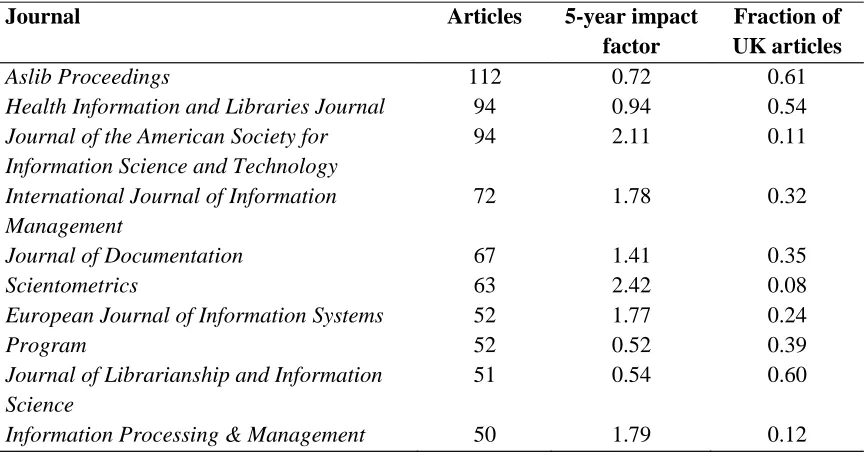
Table 3. The most popular journals for UK LIS research based on WoS data for 2006-10.
WoS subject category Publications
Computer Science, Information Systems 911
Management 264
Computer Science, Theory & Methods 169
Computer Science, Interdisciplinary Applications 117
Social Issues 112
Business 95
Education & Educational Research 84
Communication 63
Computer Science, Artificial Intelligence 44 Engineering, Electrical & Electronic 37
Table 4. Additional WoS subject categories assigned to 1782 LIS publications in the & during 2006-10.
policy or services, health, the environment or quality of life .ix It is to be expected that the sector should perform well in the REF given the real-world focus of much LIS research.
[image:6.595.117.480.422.589.2]An obvious way to obtain an overview of the UK LIS research landscape is to look at the publications of the current generation of researchers to identify their areas of interest. Three different sources were used: data available from the Thomson-Reuters Web of Science (WoS)
Author Publications
Michael Thelwall 68
David Nicolas 44
Hamid Jamali 33
Paul Huntington 27
Charles Oppenheim 24
Ian Rowlands 21
Quentin Burrell 13
Christine Urquhart 13
Martin Meyer 12
David Bawden 11
George Buchanan 11
Jennifer Rowley 11
David Stuart 11
Andrew Booth 10
Forbes Gibb 10
Kayvan Kousha 10
[image:7.595.197.399.153.423.2]Andrew Macfarlane 10
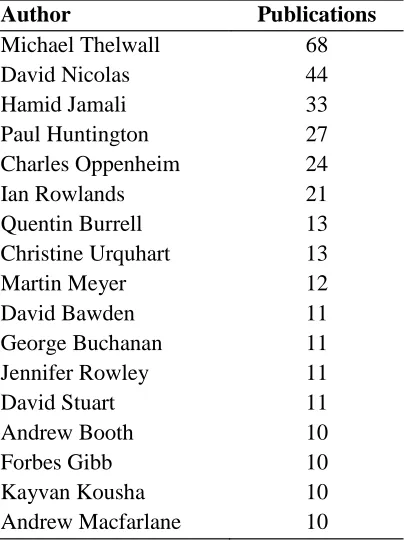
Table 5. The most productive UK LIS authors based on WoS data for 2006/10.
database; issues of the journal Aslib Proceedings that were given over to the research of individual LIS departments; and departmental submissions to RAE2008.x
Web of Science
A WoS search was carried out for items in the subject category Information Science & Library Science that had been published in the period 2006-10 by UK authors. This search identified a total of 1782 such publications after the exclusion of editorial material, book reviews, corrections etc.
The ten most popular journals for LIS academics to publish in are listed in Table 3; other popular journals just outside of the top ten positions include Journal of Information Science,
Interlending and Document Supply, Learned Publishing, and the International Journal for
Geographical Information Science. It will be seen that the table contains at least one journal
2006-10 with UK authors. It is arguably disappointing, although perhaps hardly surprising, that the percentage of UK contributions is highest in the publications with the lowest impact factors. The set of 1782 LIS publications was assigned a total of 40 different WoS subject categories, covering topics as diverse as Art, Ergonomics, Fisheries, and Imaging Science Photographic Technology, and with the ten most frequently assigned categories listed in Table 4. These categories are not unexpected, focussing on computing and management, but they illustrate clearly the range of disciplines to which LIS exports knowledge and research.xi
The most prolific authors, as denoted by those with a minimum of ten publications from 2006 to 2010, are listed in Table 5. The leading author is Mike Thelwall from the University of Wolverhampton, who published no less than 68 articles in the period under review, these covering a wide range of topics in webometrics (i.e., bibliometric studies of the World-Wide Web). Thelwall apart, the table is dominated by members of the Centre for Information Behaviour and the Evaluation of Research (CIBER) at UCL (Paul Huntington, Hamid Jamali, David Nicolas and Ian Rowlands). The CIBER group studies the ways that people behave and consume in the digital environment; as the members of the group publish extensively together that there is some degree of overlap in the counts in Table 5. Of those in the top five positions in Table 5, all but Hamid Jamali also occurred in the top five positions in
corresponding list for 2001-05 UK LIS research.i
It should be noted that the use of the WoS LIS category is slightly misleading, since it is not
other leading research groups (Val Gillet, John Holliday and Peter Willett, who work on chemoinformatics at Sheffield) had 66 articles in WoS for 2006-2010; however, only 12 of these were allocated to the LIS category, with the others appearing in chemical journals such as the Journal of Chemical Information and Modeling). Again, while WoS now covers conference proceedings, the LIS category does not include the most important information retrieval (IR) conferences: these are the annual ACM SIGIR conference on Research and
Development in Information Retrieval, and the European conferences in Information
Retrieval Research, the proceedings of which included over 100 articles published by UK
authors during 2006-10.
The reader may obtain a final, and rather different view (although stretching back far beyond 2006) as to th
Sanderson and colleagues.xii These authors have computed citation-based scores for UK LIS researchers and then compared these with human judgements of research reputation, the latter study including leading researchers from not just the UK but more generally.
Aslib Proceedings special issues
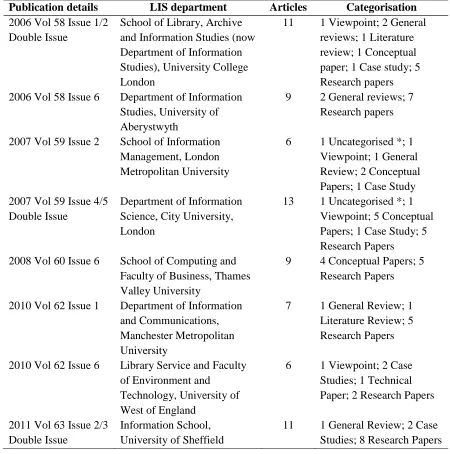
Starting in 2006, Aslib Proceedings has published several special issues (or double issues in some cases) that are given over to publications by the members of an individual LIS
Metropolitan University, and the University of the West of England (as detailed in Table 6). Inspection of these special issues provides a good overview of the range of LIS research that is being conducted. For completeness, we have also included in Table 6 the most recent
Publication details LIS department Articles Categorisation 2006 Vol 58 Issue 1/2
Double Issue
School of Library, Archive and Information Studies (now Department of Information Studies), University College London
11 1 Viewpoint; 2 General reviews; 1 Literature review; 1 Conceptual paper; 1 Case study; 5 Research papers 2006 Vol 58 Issue 6 Department of Information
Studies, University of Aberystwyth
9 2 General reviews; 7 Research papers
2007 Vol 59 Issue 2 School of Information Management, London Metropolitan University
6 1 Uncategorised *; 1 Viewpoint; 1 General Review; 2 Conceptual Papers; 1 Case Study 2007 Vol 59 Issue 4/5
Double Issue
Department of Information Science, City University, London
13 1 Uncategorised *; 1 Viewpoint; 5 Conceptual Papers; 1 Case Study; 5 Research Papers 2008 Vol 60 Issue 6 School of Computing and
Faculty of Business, Thames Valley University
9 4 Conceptual Papers; 5 Research Papers
2010 Vol 62 Issue 1 Department of Information and Communications, Manchester Metropolitan University
7 1 General Review; 1 Literature Review; 5 Research Papers
2010 Vol 62 Issue 6 Library Service and Faculty of Environment and
Technology, University of West of England
6 1 Viewpoint; 2 Case Studies; 1 Technical Paper; 2 Research Papers
2011 Vol 63 Issue 2/3 Double Issue
Information School, University of Sheffield
[image:9.595.77.527.153.607.2]11 1 General Review; 2 Case Studies; 8 Research Papers
Table 6. Research outputs from UK LIS departments published in Aslib Proceedings special issues. *Uncategorised articles were introductions to issues
special issue, that for the University of Sheffield, which appeared in mid-2011 shortly after the end of the time-span for the present review.
and Table 6 shows that LIS departments are publishing across these categories: in all there were 2 Uncategorised, 2 Literature Reviews, 4 Viewpoints, 6 General Reviews, 7 Case Studies, 12 Conceptual Papers, 1 Technical Paper, and 38 Research Papers. The presence of only a single Technical Paper would seem to be misleading as nine of those papers classed as
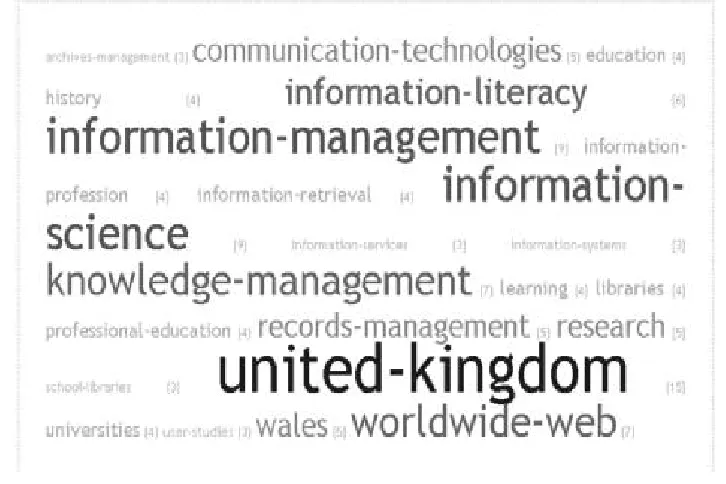
Figure 1. Tag-cloud of key research areas based on Aslib Proceedings special issues.
Research Paper were technical in subject content, as were a selection of those classed as Conceptual Paper or General Review.
We can gain a better idea of the breadth, scope and focus of the published output by an evaluation of the 295 keywords assigned to the papers. The keywords show that departments are engaged in information research ranging from traditional library topics (such as
classification and archives) to emerging areas (such as mobile communication systems, video gaming, and artificial intelligence). The distribution of keyword frequencies is, as one would expect, very skewed with 248 of them occurring only once in the special issues. These singleton keywords cover not only obviously LIS-related topics but also topics as diverse as aerospace engineering, copyright law, change management, entrepreneurialism,
epistemology, food products, gender, image processing, jet engines, Malawi, marine transport, parallel programming measures, secondary education, Somalia, video games and workplace learning inter alia.
education, information literacy, learning, professional education, school libraries, research, and universities. Archives-management, information retrieval, and libraries also appear but are not dominant.
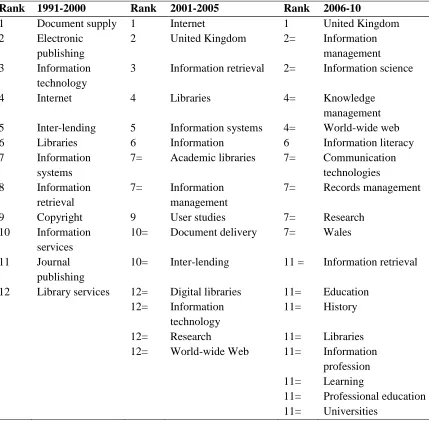
Table 7 compares the top subjects from the Aslib Proceedings special issues with those identified by Nicholas (using data drawn from the Social Sciences Citation Index) in his two previous reviews of UK LIS research.i It will be seen that some traditional topics such as inter-lending, document supply and copyright no longer appear, whilst knowledge
management, and communications technologies enter the list together with a raft of topics around education and learning. Libraries and information retrieval are the only two topics that appear in all three lists.
Although many of the studies are UK based, there is evidence of a wider global reach with research carried out across Europe and further afield in Africa, America, Asia and the Middle East. Just over a third of the papers show collaborative research: working with other
departments within a university such as computer studies departments; working with other colleges and universities in the UK and internationally; working with other external organizations, for example the NHS, small businesses, charities, and key information institutions such as the National Archives, the British Library, and Microsoft Research Ltd. Such collaborations show that LIS research is not purely ivory tower and academically driven but has a more dynamic aspect with local and global reach making a difference in communities. As Feather xiii comments in his review of LIS research in the UK, Cross- and
inter- , giving potential for knowledge transfer and
transition from research into practice.
We have noted previously the importance of research funding, but there is little evidence or acknowledgement of funding sources in the Aslib Proceedings papers. Two examples where this does occur are Cawley and Hynes xiv receiving support from the Research Advisory Panel of Dublin City University for their study on mobile communication, and Robinson and Glosienexv receiving support from the Open Society Institute. Sheffield researchers appear more successful at securing sources of external funding, with studies here xvi including Petrelli et al. being supported by the Department of Trade and Industry and Rolls Royce plc, Beverley et al. by the AHRC, and Bakri and Willett by the Government of Malaysia for work on interface design, health information and bibliometrics, respectively. There may, of course, be other cases where the funding source is not stated.
institutional profiling, diagnostic measures, parallel computing measures, statistical analysis, laboratory-based research, and evaluation. This list shows a great diversity of approaches, possibly benefiting from increased interaction with other disciplines and domains, resulting in an application to LIS research problems of research methods traditionally used elsewhere.
Rank 1991-2000 Rank 2001-2005 Rank 2006-10
1 Document supply 1 Internet 1 United Kingdom
2 Electronic publishing
2 United Kingdom 2= Information
management 3 Information
technology
3 Information retrieval 2= Information science
4 Internet 4 Libraries 4= Knowledge
management 5 Inter-lending 5 Information systems 4= World-wide web
6 Libraries 6 Information 6 Information literacy
7 Information systems
7= Academic libraries 7= Communication technologies 8 Information
retrieval
7= Information management
7= Records management
9 Copyright 9 User studies 7= Research
10 Information services
10= Document delivery 7= Wales
11 Journal publishing
10= Inter-lending 11 = Information retrieval
12 Library services 12= Digital libraries 11= Education 12= Information
technology
11= History
12= Research 11= Libraries
12= World-wide Web 11= Information profession 11= Learning
[image:12.595.87.516.152.573.2]11= Professional education 11= Universities
Table 7. Keywords or subject descriptors identified in Aslib Proceedings special issues compared with previous analyses of UK LIS work by David Nicholas. i
The diversity of the LIS departments is reflected in this brief analysis with each department having its own strengths and specialisms and making research contributions locally through community contacts, nationally with Government institutions, and internationally through links with international businesses and academic institutions in other countries. The domain is benefiting from these expanding research networks, which bring increased scope and opportunities to develop and to apply a broad range of research approaches.
In RAE2008 each member of academic staff put forward for review had to submit (normally) four publications from the period 2001-07 that best illustrated their research achievement. These submissions hence provide a unique overview of what the sector believes to be the highest quality publications in the discipline. We have chosen to focus on the submissions
Type of research output Count
Journal article 162
Chapter in a book 25
Conference contribution 17
Book 12
Internet publication 12
Software 1
[image:13.595.176.420.154.274.2]Research report for an external body 1
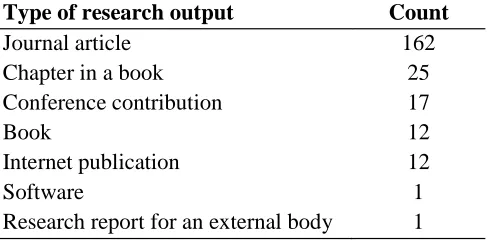
Table 8. Output types for 230 RAE outputs published in 2006-07.
Journal Articles
Journal of Documentation 19
Aslib Proceedings 15
Journal of the American Society for Information Science and Technology 10
Journal of Librarianship and Information Science 8
Information Research 6
Journal of Information Science 5
Health Information and Libraries Journal 4
Library Management 3
Program 3
[image:13.595.96.488.317.476.2]Library History 3
Table 9. The most popular journals for publishing UK LIS research based on RAE outputs published in 2006-07.
from the eleven departments in Table 2 that ran Chartered Institute of Library and
Information Professionals accredited courses at the time. These departments were those at the University of Brighton, City University, Leeds Metropolitan University, Liverpool John Moores University, Loughborough University, Manchester Metropolitan University, the University of Sheffield, University College London, Robert Gordon University, the University of Glasgow, and Aberystwyth University. We examined the research outputs published during 2006-07 from 125 permanent members of the staff from these departments, excluding those items that had been published in the special issues of Aslib Proceedings that have been analysed above. This gave a total of 230 research outputs; these were categorised in the RAE as listed in Table 8, where it will be seen that the journal article was the output-type of choice for the great majority of the researchers.
Engineers. Conference contributions focus mainly on technical topics, such as digital libraries, e-Government, information retrieval, knowledge management, virtual realities and visualisation. In addition there was one example of software development; this was the LandSerf Geographic Information System, which was designed by Jo Wood at the
Department of Information Science at City University for the visualisation and analysis of terrains and landscapes.xviii
Thirty seven research contributions were published in book form, either book chapters in edited collected works or authored monographs. The most popular publisher was Ashgate, followed by Facet, Springer, and Idea Group Inc. The subject coverage in this media format was more varied than that of the conference contributions, which focused on technical topics. In the book contributions, the most frequently covered topics were history, information technologies and libraries, with e-commerce, information management, networked
communities, preservation, publishing, record keeping, and research also represented. Within the list of book titles we see key texts for LIS students and practitioners such as Peter
Measuring Library Performance: Principles
and Practice and The Library in the Twenty-First century, both published by Facet, Helen
Preserving Archives, also from Facet, and Anne
Public Libraries in the 21st Century from Ashgate.xix These titles are exemplars of research impacting on teaching and practice.
There is little evidence of research impacting on policy during the period under study, with only a single contribution being a research report for an external body. This was a report by Sarah Horton and Jacqueline Spence (Aberystwyth University) that was written for the MLA Council Yorkshire and that scoped the economic and social impact of archives.xx As noted
responsibilities have now been transferred to the Arts Council England, which may diminish the impact of such reports since the Arts Council will have its own priorities. The lack of research reports by academics should be considered against a
background of consultancy organizations that compete vigorously to provide such reporting services.
A review of the journal outputs revealed the breadth of journals in which researchers chose to publish, with the 162 articles appearing in no less than 100 different journal titles. The titles most popular with researchers are shown in Table 9, where the count for Aslib Proceedings is after excluding the articles from the special issues of this journal that have been discussed in the previous section, and where the count for Information Research includes papers described in the RAE ournal article Internet publication All but two of the journals in the table appeared in the top ten positions in -05 list of popular journal destinations for UK LIS authors,i with Library Management and Library History replacing
the International Journal of Information Management and Interlending & Document Supply
in the earlier list.
including academic libraries, archives, business, communications, computer science, data management, digital curation, education, electronic environments, geographic information, health information, information, information systems, intelligence, knowledge management,
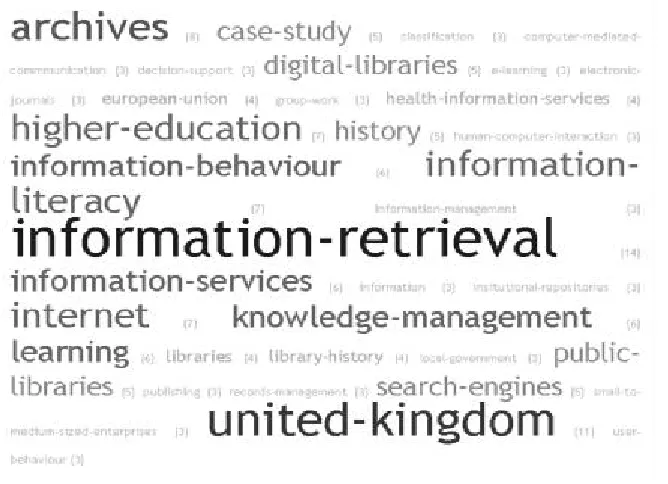
Figure 2. Tag-cloud of keywords extracted from journal articles and Internet publications based on RAE2008 outputs published in 2006-2007
library history, literature, multimedia, networking, performance measurement, public administration, publishing, reference services, research, society, security, and much more.
A keyword analysis was carried out on the 162 journal articles, and the 12 Internet publications. Where keywords were not available they were generated from concepts contained within the title and abstract. A total of 605 keywords and phrases were extracted, of which 367 occurred just once and 204 occurred just twice. The remaining 34 keywords were described by a tag-cloud, again using Tagcrowd. The resulting visualisation in Figure 2 shows the most frequently used keywords across the body of research outputs. Information retrieval (14) is the most frequent keyword followed by United Kingdom (11), with other appearances including archives (8), Internet (7) information literacy (7) and higher education (7). It will be seen that there is a fair degree of commonality with the corresponding word-cloud for the Aslib Proceedings articles in Figure 1.
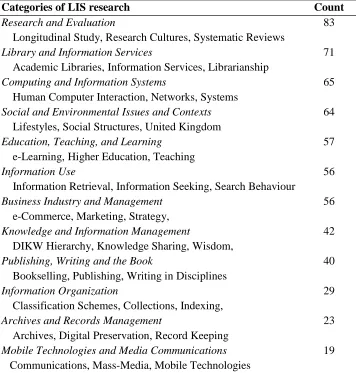
Societywas assigned to Social and Environmental Issues and Contexts. Twelve key research themes or broad categories emerged, as shown in Table 10. An example of a taxonomy of librarianship research that already exists is that described by Crumley and Koufougiannakis; this has been used in evidence-based librarianship, and has been developed further
Categories of LIS research Count
Research and Evaluation
Longitudinal Study, Research Cultures, Systematic Reviews
83
Library and Information Services
Academic Libraries, Information Services, Librarianship
71
Computing and Information Systems
Human Computer Interaction, Networks, Systems
65
Social and Environmental Issues and Contexts
Lifestyles, Social Structures, United Kingdom
64
Education, Teaching, and Learning
e-Learning, Higher Education, Teaching
57
Information Use
Information Retrieval, Information Seeking, Search Behaviour
56
Business Industry and Management
e-Commerce, Marketing, Strategy,
56
Knowledge and Information Management
DIKW Hierarchy, Knowledge Sharing, Wisdom,
42
Publishing, Writing and the Book
Bookselling, Publishing, Writing in Disciplines
40
Information Organization
Classification Schemes, Collections, Indexing,
29
Archives and Records Management
Archives, Digital Preservation, Record Keeping
23
Mobile Technologies and Media Communications
Communications, Mass-Media, Mobile Technologies
[image:16.595.116.477.153.526.2]19
Table 10. Categorization of 605 keywords based on RAE outputs published 2006-07. Each italicized category is accompanied by three typical keywords or phrases in that category
byKoufougiannakis et al. xxi However, neither of these taxonomies adequately covered the breath of research topics apparent in the RAE submissions: the former has six categories (Reference/Enquiries, Education, Collections, Management, Information Access & Retrieval, and Marketing/Promotion); and the latter has Professional Issues added, but with
Marketing/Promotion being merged into Management. There are similarities in our categories to those identified by Koufougiannakis et al., but with additional categories to encompass the broader scope of expertise and research interests in information and
The categorization shows a body of words and phrases related to research and evaluation, as well as traditional areas such as library and information services. There are smaller pockets of interest in information organisation, archives and records management, and emerging topics such as mobile technologies and media communications. The relationships between the categories, and some of their more specialist research sub-themes are mapped in Figure 3,
outreach information services librarians and librarianship library sectors Social and Environmental Context & Issues (64 keywords)
curation and preservation digitisation records history digital libraries wisdom knowledge organisations knowledge sharing organisational learning information science
information management information strategy
teachers and trainers
personal and professional development information literacy students E-learning learners learning disabilities Higher Education schools distance learning group work collaborative learning communication technologies media types computer mediated communications hybrid libraries E-publishing
books and bookselling authors/writers publishing scholarly publishing content Research and Evaluation (83 keywords) Business Industry and Management (56 keywords) Information Organisation (29 keywords)
Information Use and Retrieval (56 keywords) Education, Teaching and Learning (57 keywords) Mobile Technologies and media Communications (19 keywords) Computing and Information Systems (65 keywords) Knowledge and Information Management (42 keywords) Archives and Records
Management (23 keywords) Publishing, Writing,
and the Book (40 keywords)
Library and Information Services
(71 keywords)
research theory
dissemination of research
methods research focus collaboration specialist services geographic location social groups Government policy social issues Information Society SMEs public and private sector
industry economics
marketing
efficiency and effectiveness strategy decision support consumer relations management skills information retrieval search engines cross language retrieval
[image:17.595.91.516.185.488.2]information seeking information behaviour log analysis human computer interaction Internet worldwide web information systems virtual environment information security geographic information systems networks software learning classification catalogues databases repositories indexing libraries health information business information UK Europe USA
Figure 3. The LIS research landscape. Main research areas based on RAE outputs published in 2006-07, and categorised into twelve main themes and their associated sub-themes.
which was created using Microsoft Visio. The figure makes clear the pervasive, inter-disciplinary nature of LIS, with research being carried out across a range of disciplines such as, business and management, communications, computer science, education, and the social sciences more generally.
This analysis reinforces the comments made in the RAE2008 Subject Overview Report on the changing nature of the research agenda, and subsequently discussed by Feather: There was less historical work in the submissions, and more work on information and knowledge management and on the dissemination, retrieval, and publication of information, including work in the field of humanities computing deriving from research in information
Feather stressed the importance of cross and interdisciplinary research, and the need for LIS researchers to take their place in the wider world of academic research , expanding the reach across science and social science disciplines. Key to achieving this is collaborative and inter-disciplinary research practice and to use and adapt methods and approaches that are widely used in other disciplines. Eldridge reported on the past popularity of the case-study approach in LIS research, and identified a growing utilization of other research methods.xvii Our analysis reinforces this finding with the case study still popular (and being one of the frequent keywords in Figure 2) but with a wide range of research methods and approaches identified in the keyword analysis. Thirty three different research methods, both quantitative and qualitative, were identified including action research, case studies, discourse analyses, framework analyses, Grounded Theory, log analyses, longitudinal studies, narrative studies, observation, surveys, and systematic reviews, inter alia. The use of such a wide selection of methods mirrors that seen in the Aslib Proceedings special issues and exemplifies the well developed research cultures in LIS departments that were noted by the RAE2008 panel.viii
Conclusions
-2005. It is sobering to think that Facebook and YouTube were founded at the end of that period, in 2004 and 2005 respectively, and that since then we have seen the emergence of such staples of the modern world as Twitter, the iPhone and the iPad (in 2006, 2007 and 2010, respectively). This continuing, indeed increasing, digitization of society will undoubtedly affect the subjects investigated by LIS researchers, even if there is continuing interest in long-established topics such as bibliometrics, information behaviour, information retrieval and public library
management.
The precise subjects to be studied in the future will depend not just on technological developments and the funding sources that are available (vide supra) but also on the individuals available to carry out the research. In this respect, 2006-10 saw a marked
continue their research for the present in emeritus and/or visiting roles). Thus, City saw the retirement of Jonathan Raper and Stephen Robertson, Loughborough of Charles Oppenheim, Cliff McKnight and Paul Sturges, and Sheffield of Micheline Beaulieu. Other notable departures included Mark Sanderson and Steve Whittaker leaving Sheffield for positions in Australia and the USA, and Fabio Crestani and Monica Landoni leaving Strathclyde for positions in Switzerland. However, departments continue to attract world-class researchers,
from Australia and Elaine Toms coming to Sheffield from Canada. It is also appropriate to note here the deaths (in 2007, 2009 and 2010 respectively) of Kären Sparck Jones, Brian
highlighted the need for a structure (real or virtual) to enable the organisation, co-ordination and implementation of LIS research. This lead to the establishment of the Library and Information Science Research Colloquium in 2009. xxii The Coalition is a membership organization, with the members at the end of 2010 including the British Library, the Chartered Institute of Library and Information Professionals, the Committee on Library Cooperation in Ireland, the Joint Information Systems Committee, the Museums, Libraries and Archives Council, the Research Information Network, and the Strategic Health Authority Library Leads Group. As this list suggests, the Coalition has a strong practitioner focus, with its principal objectives being: to bring together information about LIS research opportunities and results; to encourage dialogue between research funders; to promote LIS practitioner research and the translation of research outcomes into practice; to articulate a strategic approach to LIS research; and to promote the development of research capacity in LIS. This agenda is clearly ambitious, especially given the current financial situation in the UK, but if successful will go some way to bridging the considerable gap that exists between LIS academics and practitioners. It will be interesting to judge the success of the Coalition initiative when the time comes to survey UK LIS research for the period 2011-2016.
i
British librarianship and information
work, 1991-2000. Aldershot: Ashgate; 2006, pp.
369-John Bowman (ed.), British librarianship and information work, 2001-2005. Aldershot: Ashgate; 2007, pp. 360-371.
ii
Research Information Network, Making sense of research funding in UK higher education, at http://www.rin.ac.uk/our-work/research-funding-policy-and-guidance/making-sense-research-funding-uk-higher-education, accessed 6.12.2011
iii
Arts & Humanities Research Council, Browse funded research, at
http://www.ahrc.ac.uk/FundedResearch/BrowseResearch.aspx, accessed 6.12.2011 iv
Journal of the American society for
information science 36, 1985,
275-Library and information research 31(97),
2007, 4-13. v
Library and
information research 31(97), 2007, 14-19.
vi
Journal of educational
administration and history 37(2), 2005, 137-155.
vii Pete
Library and information science trends and research: Europe. Bingley: Emerald, in the
press. viii
RAE2008, Subject overview report. I37 Library and information management, at http://www.rae.ac.uk/pubs/2009/ov/, accessed 6.12.20111
ix
Higher Education Funding Council for England, REF2014. Assessment framework and
guidance on submissions, at http://www.hefce.ac.uk/research/ref/pubs/2011/02_11/,
x RAE 2008 Research Assessment Exercise, RAE2008 submissions. UOA 37 Library and
Information Management at
http://www.rae.ac.uk/submissions/submissions.aspx?id=37&type=uoa, accessed 6.12.2011 xi
Journal of the American society for information science and technology 59(4),
2008, 551-564. xii
-index to rank influential British researchers in
Journal of the American society for information
science and technology 2007, 58(2),
297-Journal of the American society for information science and
technology 59(6), 2008, 1184-1190; Jiang Li, Mark Sanderson, Peter Willett, Michael
comparison of data sources for c Journal of
informetrics 4(4), 2010, 554-563.
xiii
Journal of
librarianship and information science 41(3), 2009, 173-181.
xiv Anth
Aslib proceedings 62(1), 2010, 29-45.
xv
and information science : Case study of Aslib proceedings
59(4/5), 2007, 462-474. xvi
Daniela Petrelli, Vitaveska Lanfranchi, Fabio Ciravegna, Ravish Begdev and Sam Highly focused document retrieval in aerospace engineering: User interaction design and Aslib proceedings 63(2/3), 2011, 148-167; Catherine A. Beverley,
Health and social care information for
ibid, 256- Computer science
ibid, 321-335. xvii
Journal of the medical library association 92(1) 2004, 83 90
New library world107(1222/1223), 116-126;
-profile LIS
Library and information science research30(2) 108-114.
xviii
Jo Wood, LandSerf at http://www.soi.city.ac.uk/~jwo/landserf/ , accessed 6.12.2011 xix
Peter Brophy, Measuring library performance: principles and practice. London: Facet, 2006; Peter Brophy, The library in the twenty first century. 2nd edition. London: Facet, 2007; Helen Forde, Preserving archives. London: Facet, 2007; Anne Goulding, Public libraries in the 21st century. London: Ashgate, 2006.
xx
Sarah Horton, and Jacqueline Spence, Scoping the economic and social impact of archives. Aberystwyth: University of Wales at Aberystwyth/MLA Council Yorkshire, 2006.
xxi
-based librarianship:
Health information and libraries journal 19(2), 2002,
61-70; Denise Koufogiannakis, Linda Slater and Ellen Crumley A content analysis of librarianship research Journal of information science 30(3), 2004, 227-239.
xxii
Library and information research 32(100), 2007, 3- UK Library
Library and information science research