This is a repository copy of
Quantized fusion rules for energy-based distributed detection
in wireless sensor networks
.
White Rose Research Online URL for this paper:
http://eprints.whiterose.ac.uk/84148/
Version: Publishers draft (with formatting)
Proceedings Paper:
Nurellari, E, McLernon, D, Ghogho, M et al. (1 more author) (2014) Quantized fusion rules
for energy-based distributed detection in wireless sensor networks. In: Sensor Signal
Processing for Defence (SSPD), 2014. Sensor Signal Processing for Defence, 08-09 Sep
2014, Edinburgh. Institute of Electrical and Electronics Engineers , 1 - 5. ISBN
978-1-4799-5293-9
https://doi.org/10.1109/SSPD.2014.6943313
[email protected] https://eprints.whiterose.ac.uk/
Reuse
Unless indicated otherwise, fulltext items are protected by copyright with all rights reserved. The copyright exception in section 29 of the Copyright, Designs and Patents Act 1988 allows the making of a single copy solely for the purpose of non-commercial research or private study within the limits of fair dealing. The publisher or other rights-holder may allow further reproduction and re-use of this version - refer to the White Rose Research Online record for this item. Where records identify the publisher as the copyright holder, users can verify any specific terms of use on the publisher’s website.
Takedown
If you consider content in White Rose Research Online to be in breach of UK law, please notify us by
QUANTIZED FUSION RULES FOR
ENERGY-BASED DISTRIBUTED DETECTION IN
WIRELESS SENSOR NETWORKS
Edmond Nurellari
1, Sami Aldalahmeh
2, Mounir Ghogho
1,3and Des McLernon
1 1University of Leeds, UK2Al-Zaytoonah University of Jordan, Jordan 3International University of Rabbat, Morocco
[email protected], [email protected], [email protected], [email protected]
Abstract—We consider the problem of soft decision fusion in
a bandwidth-constrained wireless sensor network (WSN). The WSN is tasked with the detection of an intruder transmitting an unknown signal over a fading channel. A binary hypothesis testing is performed using the soft decision of the sensor nodes (SNs). Using the likelihood ratio test, the optimal soft fusion rule at the fusion center (FC) has been shown to be the weighted distance from the soft decision mean under the null hypothesis. But as the optimal rule requires a-priori knowledge that is difficult to attain in practice, suboptimal fusion rules are proposed that are realizable in practice. We show how the effect of quantizing the test statistic can be mitigated by increasing the number of SN samples, i.e., bandwidth can be traded off against increased latency. The optimal power and bit allocation for the WSN is also derived. Simulation results show that SNs with good channels are allocated more bits, while SNs with poor channels are censored.
I. INTRODUCTION
Distributed detection has been attracting significant interest in the context of WSNs [1] and [3]. This is due to the flexibility of WSNs, which can be seamlessly deployed over a wide geo-graphic area for military monitoring and surveillance purpose [2]. However, WSNs suffer from constrained bandwidth and limited on-board power. This poses challenges in the design of distributed detection algorithms, especially when the intruder’s signature is unknown to the WSN. The main issue is to improve the detection by fusing the measurements provided by various SNs in a manner that efficiently utilizes the scarce bandwidth and overcomes the limitations of a fading wireless channel.
The problem of decentralized detection in bandwidth con-strained sensor networks has been addressed in [4], where the authors investigated the design of sensor messages sent to the FC that minimize the error probability. The problem of detecting a known deterministic parameter is investigated in [5] under restricted channel capacity. The channel fading effect on distributed detection was tackled in [6]. In [7], the authors addressed both issues of limited bandwidth and channel imperfections. They optimized the transmission power, which consequently dictated the number of allocated bits, for the detection of a known signal.
In this paper, we consider the detection of an unknown signal, which is the case in many WSN applications. We find the optimal fusion rule for energy-based soft decision,
through the use of the likelihood ratio test. However, it turns out that this rule is difficult to implement in practice. So we will suggest realizable suboptimal fusion rules that weight the soft decisions of the SNs based on the measurement’s quality. Furthermore, a linear optimal fusion rule is derived that can serve when the probability distributions of the soft decisions are not known a-priori. Similarly, a simpler fusion rule is proposed based on the linear rule. Then, the previous algorithms are revisited under noisy, flat fading channels with limited bandwidth. Finally, the SN’s transmitted powers are optimized to achieve the best probability of detection.
Section II presents the system model. Soft decision fusion rules are proposed in Section III. The quantization effect is discussed in Section IV and the optimal power allocation is derived in Section V. Simulation results are given in Section VI and conclusions are presented in Section VII.
II. SYSTEMMODEL
Consider a WSN with M sensor nodes reporting to a FC tasked with the detection of any intruders. The intruder leaves a signature signal that is unknown to the WSN but it is assumed to be deterministic. The ith SN collects N samples that are corrupted by additive white Gaussian noise (AWGN) with zero mean and known variance σ2
i. So, the measured signal takes one of the following forms, depending on the underlying hypothesis:
H0:xi(n) = wi(n) (1)
H1:xi(n) = si(n) +wi(n) (2) where n = 1,2, . . . , N, i = 1,2. . . , M, xi(n) is the nth sample of the measured signal at the ith sensor, s
i(n) is
the intruder’s signature signal and wi(n)∼ N(0, σi2) is the AWGN. Furthermore, the noise samples are assumed to be identically and independently distributed (iid) across time and space.
Since the intruder’s signal is unknown at the SNs, the optimal detector in this case would be the energy detector, which is implemented at theith SN as follows:
Ti= N
X
n=1
|xi(n)|2. (3)
The local soft test statistic Ti is then quantized with Li bits and transmitted to the FC with power pi over a wireless channel. The channel suffers from zero mean AWGN with a variance ofζi. Moreover, the wireless channel between theith SN and the FC experiences flat fading with a channel gainhi (also assumed to be iid). The number of quantization bits at the ith SN must satisfiy the channel capacity constraint:
Li≤ 1 2log2
1 +pih 2 i ζi
bits, i= 1,2, . . . , M. (4)
We will assume that the maximum channel capacity is utilized by the SNs. So our objective is to find the best soft fusion rule first, and then optimize the allocated power to maximize the detection probability.
III. SOFTDECISIONFUSIONRULES
In this section, the optimal soft decision fusion rule is investigated given infinite bandwidth for each WSN, i.e., no quantization is required. However, it turns out that the optimal rule requires prior information about the signal’s energy, which cannot be known in practice. Hence, suboptimal rules are proposed as an implementable alternative.
A. Optimal Fusion Rule
Given the local soft test statistic defined in (3), the optimal fusion rule follows from the likelihood ratio test:
LRT (T) =p{T1, T2, ..., TM|H1} p{T1, T2, ..., TM|H0} ≥
γ (5)
where p{T1, T2, ..., TM|Hj} is the joint probability distribu-tion of local soft decisions under thejthhypothesis. However, Ti has aχ2distribution underH0 and a non-centralχ2 under
H1, which means evaluation of the LRT in (5) is complicated.
Consequently, we evoke the central limit theorem to simplify the distribution of Ti when N is sufficiently large. So the distribution of any Ti can be adequately approximated by a Gaussian distribution with the following mean and variance:
E{Ti|H0} = N σi2, Var{Ti|H0}= 2N σ4i (6) E{Ti|H1} = N σ2i (1 +ξi),Var{Ti|H1}=2N σ4i(1+2ξi)
(7)
whereξi= N
P
n=1
s2
i(n)/N σ2i is the SNR at the ithSN.
Since the noise at different SNs is independent, it can easily be shown [11] that the log-likelihood ratio test (LLR) takes the form
Tf = M
X
i=1
Ti−N σi2
2
2N σ4 i
− Ti−N σ
2
i(1 +ξi)
2
2N σ4
i (1 + 2ξi)
!
≥γ′
(8)
whereγ′= 2 ln M
Q
i=1
γ
√
2N σ4
i
√
2N σ4
i(1+2ξi)
.
The LLR can be further simplified by completing the square in (8) to yield
Tf = M
X
i=1
ai(Ti−bi)2 (9)
ai =
ξi N σ4
i(1 + 2ξi)
(10)
bi = N σ2
i
2 . (11)
The fusion rule in (9) has an interesting interpretation. It is, in fact, the weighted distance in theM-dimensional space between the local soft test statistic and half of its mean under the null hypothesis (see (6)). It is also clear that SNs with lower noise get more weight in the fusion process. Another interesting note here is that at high SNR (ξi) the weight ai depends only on the noise power at the SN and not on the measured signal energy.
B. Suboptimal Fusion Rules
Now since the optimal fusion rule in (9) requires the exact knowledge of the SNR (ξi), it cannot be realized in practice. However, its structure can be used to formulate implementable suboptimal rules. So now we propose three suboptimal rules: weighted fusion, equal fusion and optimum linear fusion.
1) Weighted and Equal Fusion Rules: The weighted fusion rule takes the same structure as (9). However (for large ξi)ai in (10) is replaced byaw
i = 1/2N σi4and we letbwi =bi. This rule approaches the optimal one when the SNR is large, as discussed earlier.
As for the equal fusion rule, equal weight is given for all the SNs, i.e., ae
i = 1for alli= 1,2,· · · , M. Also, bei =bi.
2) Optimum Linear Fusion Rule: Now we examine the (sub-optimal) linear fusion rule:
Tl
f =
M
X
i=1
αiTi. (12)
and the optimal weights to maximize the probability of detec-tion are
αi=
ξi N σ2
i (1 + 2ξi)
. (13)
Due to the lack of space however, the proof is omitted but a detailed discussion can be founded in [11]. However, the above weights are not realizable due to requiring a-priori knowledge of ξi.
IV. QUANTIZEDSOFTDECISIONFUSION
The previous fusion rules assume the availability of an infinite bandwidth to send the exact Ti. So let the quantized test statistic (Tˆi) at the ith sensor be modeled (with Li bits) as
ˆ
Ti =Ti+vi (14)
where vi1 is the quantization noise with uniform distribution in the interval[−B, B]and variance
σ2vi= B 2
3×22Li. (15) 1v
However, the distribution of Tˆi can be approximated [11] by a Gaussian distribution with mean and variance:
EnTˆi|H0
o
=N σi2, Var
n
ˆ Ti|H1
o
= 2N σi4(1 + 2ξi)+σv2i
EnTˆi|H1
o
=N σ2i(1 +ξi),Var
n
ˆ Ti|H0
o
= 2N σ4i+σv2i.
(16)
A. Quantized Optimal/Suboptimal Fusion Rule
Since theTˆi’s are now Gaussian, then in a similar manner to Section III, the log-likelihood ratio test with quantization can be shown to be
Tfq= M X i=1 ˆ Ti−N σ2i
2
2N σ4
i +σ2vi
−
ˆ
Ti−N σ2i(1 +ξi)
2
2N σ4
i (1 + 2ξi) +σ2vi
≥γ
′′
(17)
where γ′′ = 2 ln QM
i=1
γ
q
2N σ4
i+σ
2
vi
q
2N σ4
i(1+2ξi)+σ2vi
!!
. As before,
(17) can be now written in the following form
Tfq = M
X
i=1
aqi Tˆi−bqi
2
(18)
aqi = ξi
N σ4 i
1 + 2ξi+
σ2
vi 2N σ4
i 1 +
σ2
vi 2N σ4
i
(19)
bqi = N σ 2 i 2 −
σ2
vi
4σ2 i
. (20)
Note that Tfq → Tf as σ2vi → 0 for all i. Consequently, aqi → ai and bqi → bi under the previous condition as well. More interestingly however, is that Tfq → Tf as N → ∞, regardless of σ2
vi. This implies that bandwidth can be saved
but at the expense of increasing both the number of collected measurements and also the detection delay.
As for the suboptimal (quantized) fusion rule, it can be easily shown that
awqi = 1 N σ4
i
1 + σ
2
vi 2N σ4
i
2 (21)
aeq = 1andbeq =bwq =bq
i.
B. Quantized Optimal Linear Fusion Rules
The quantized version of the linear fusion weights in (13) can be shown to be [11]
αqi = ξi 2σ2
i
h
1 + 2ξi+
σ2
vi
N σ2
i
i. (22)
If the SNR is large, i.e., when eitherσ2
vi→0 or N → ∞
then it follows thatαqi →αi.
V. OPTIMUM SENSOR TRANSMIT POWER ALLOCATION
The performance of the proposed quantized fusion rules approach the performance of their unquantized counterparts if the number of (test statistic) bits is sufficiently large. However, this entails a large transmission power as predicted by (4). So, we desire to strike a trade-off between the fusion rule’s performance and transmit power. To this end, we first need to adopt an optimization criterion. A natural one is the probability of detection, which depends on the distribution of the fusion
rule. So lettingUi=
ˆ Ti−bi
2
then the optimum fusion rule can be written as
Tfq = M
X
i=1
aqiUi. (23)
The mean and variance of Ui under H0 and H1 are now
given in (24). Using the central limit theorem, Tfq can be approximated by a Gaussian distribution
Tfq ∼
NEnTfq|H0
o
,VarnTfq|H0
o
under H0
NEnTfq|H1
o
,VarnTfq|H1
o
under H1
(25)
where
EnTfq|H0
o
= M
X
i=1
aqiE{Ui|H0}
EnTfq|H1
o
= M
X
i=1
aqiE{Ui|H1}
VarnTfq|H0
o
= M
X
i=1
(aqi)2Var{Ui|H0}
VarnTfq|H1
o
= M
X
i=1
(aqi)2Var{Ui|H1}.
(26)
It can be readily shown that the detection probability as a function of the false alarm probability has the form
Pd=Q
Q−1(P
f a)
r
VarnTfq|H0
o
−Ψ
r
VarnTfq|H1
o (27)
where Q(·) is the Q-function and Ψ = EnTfq|H1
o
−
EnTfq|H0
o
. The probability of detection implicitly depends on the transmission power through the relationships (24) and (26). Based on this, we can optimize the transmission powers (pi) to maximize Pd under the constraint of a maximum aggregate transmit power budget (Pt):
popt= arg max p
Pd(p)
subject to M
X
i=1
pi≤Ptfor pi≥0, i= 1, . . . , M
E{Ui|H0}= 2N σ 4 i +N
2
σ4i+σ 2
vi−2biN σ
2 i +bi
2
, Var{Ui|H0}= Var
n
ˆ
Ti|H0
o h
4N2σi4+ 2Var
n
ˆ
Ti|H0
o
+ 4b2i −8N biσ 2 i
i
E{Ui|H1}=E
n
ˆ
Ti|H1
o2
+ VarnTˆi|H1
o
−2bi N σ 2 i +N σ
2 iξi
+b2i
Var{Ui|H1}=4E
n
ˆ
Ti|H1
o2
VarnTˆi|H1
o
+ 2VarnTˆi|H1
o2
+ 4b2iVar
n
ˆ
Ti|H1
o −8biE
n
ˆ
Ti|H1
o
VarnTˆi|H1
o
(24)
strategy [8] using the YALMIP optimization tools [9]. In the first step of the algorithm, we start by applying a standard nonlinear solver to obtain a locally optimal solution and then set it as an upper bound on the achievable objective. Secondly, in each node, a convex relaxation of the model is derived, and the resulting convex optimization problem is solved. We then assign this as a lower bound. Bound tightening using [9] is applied iteratively to detect and eliminate redundant constraints and variables, and tighten the bounds where possible. The algorithm outline is summarized in Algorithm1 [11].
The aim of the algorithm is to obtain the global minimum
of the function β(p) = Q −1(Pf a)
q
Var{Tfq|H0}−Ψ q
Var{Tfq|H1}
over the
solution space ℘start wherep ∈℘start. For any ℘⊆℘start we define Flb (the upper bound) and Fub (the lower bound) as functions that satisfy: Flb(℘) ≤ Fmin(℘) ≤ Fub(℘). Then, the global optimum solution β∗ = F
min(℘start) =
infp∈℘startβ(p).
VI. SIMULATIONRESULTS
We simulate a WSN of M SNs detecting an intruder with si(n) = A, where A = 0.1. The communication noise variances are arbitrarily set toζi= 0.1for alli= 1,2,· · · , M (for simplicity). The measurement noise variances are gen-erated randomly and used throughout all the simulations. The average measurement SNR for the network is defined
as ξa = 10 log10
1 M
M
P
i=1
ξi
. In all simulations we assume
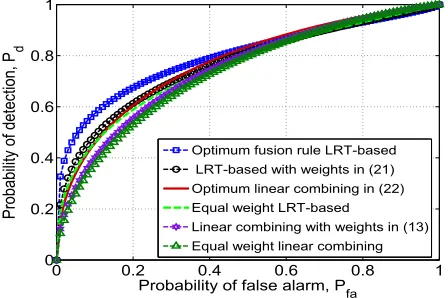
perfect knowledge of ξi. Fig. 1 shows the receiver operating characteristic for six different fusion rules. It is clear that the optimal fusion rule attains the best performance for (ξa=−8.5 dB) whereas the worst performance is that of the equal weight linear combining rule. However, all the rules converge when the Pf a increases. In Fig. 2 the effect of the number of
0 0.2 0.4 0.6 0.8 1
0 0.2 0.4 0.6 0.8 1
Probability of false alarm, P
fa
P
ro
b
a
b
ili
ty
o
f
d
e
te
ct
io
n
,
P d
Optimum fusion rule LRT-based LRT-based with weights in (21) Optimum linear combining in (22) Equal weight LRT-based
[image:5.612.330.558.129.289.2]Linear combining with weights in (13) Equal weight linear combining
Fig. 1. Receiver operating characteristics of six different fusion rules forN= 10,M= 10,ξa=−8.5dB andB= 0.5.
0 10 20 30 40 50
0 0.2 0.4 0.6 0.8 1
number of samples, N
P
ro
b
a
b
ili
ty
o
f
d
e
te
ct
io
n
,
P d
Optimum fusion rule LRT-based LRT-based with weights in (21) Optimum linear combining in (22) Equal weight LRT-based
[image:5.612.334.562.353.504.2]Linear combining with weights in (13) Equal weight linear combining
Fig. 2. Probability of detection (Pd) versus the number of samples (N) withM = 20,Pf a= 0.1,B= 0.5andξa=−8.5dB.
20 40 60 80 100
0.4 0.5 0.6 0.7 0.8 0.9 1
number of sensors, M
P
ro
b
a
b
ili
ty
o
f
d
e
te
ct
io
n
,
P d
Optimum fusion rule LRT-based LRT-based with weights in (21) Optimum linear combining in (22) Equal weight LRT-based
Linear combining with weights in (13) Equal weight linear combining
Fig. 3. Probability of detection (Pd) versus number of sensors (M) forN= 10,Pf a= 0.1,ξa=−8.5dB andB= 0.5.
measurement samples (N) on Pd is shown at a fixed Pf a. Obviously, as N increases Pd improves for all algorithms. Interestingly, the optimal linear fusion rule outperforms the suboptimal LRT-based one. This is explained by the structure of (21) where for large (but finite) N the effect of σ2
vi
[image:5.612.59.283.549.698.2]-14 -12 -10 -8 -6 -4 0
0.2 0.4 0.6 0.8 1
P
ro
b
a
b
ili
ty
o
f
d
e
te
ct
io
n
.
P d
a(dB) Opt LRT-based
[image:6.612.65.288.62.217.2]LRT-based in (21) Opt lin comb in (22) Eq LRT-based Linear combi in (13) Eq lin combining
Fig. 4. Probability of detection (Pd) versus the signal to noise ratio (ξa) forM = 20,N = 10,Pf a= 0.1andB= 0.5.
0 20 40 60 80 100 120
0 0.2 0.4 0.6 0.8 1
number of samples, N
P
ro
b
a
b
ili
ty
o
f
d
e
te
ct
io
n
,
P d
Opt fusion rule, P t=10
2
Opt linear combining, Pt=102
Opt fusion rule, P t=10
-1
Opt linear combining, P t=10
[image:6.612.65.288.280.436.2]-1
Fig. 5. Probability of detection (Pd) versus the number of samples (N) forM = 10sensors,Pf a= 0.1,ξa=−8.5dB andB= 1.
1 2 3 4 5 6 7 8 9 10 11 12 13 14 0
5 10
sensor i
hi
2
1 2 3 4 5 6 7 8 9 10 11 12 13 14 0
5 10
sensor i
pi
1 2 3 4 5 6 7 8 9 10 11 12 13 14 0
0.02 0.04
sensor i
ai
q
1 2 3 4 5 6 7 8 9 10 11 12 13 14 0
5
sensor i
Li
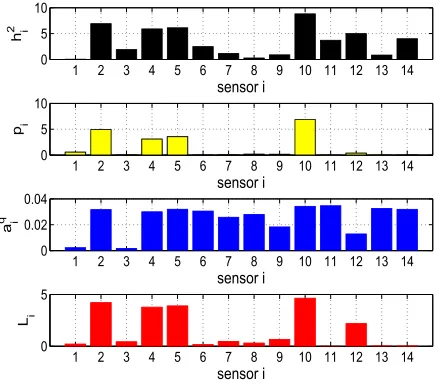
Fig. 6. Optimum sensor transmit power and channel quantization bits allocation forN= 10,Pf a= 0.1,ξa=−8.5dB andPt= 20.
N is increased, since the effect of the quantization noise is mitigated as predicted by (19) and (22). In Fig. 6, we report the optimized sensor transmit power and the corresponding number of bits allocated to quantizeTiby applying the branch and bound algorithm [8]. Clearly we allocate more power and bits to the best channels. However, note that the power and bit allocation is also affected by the weightsaqi in (19) which are a function of the signal to noise ratio ξi. For instance, consider sensor 12 which has a relatively good channel gain, but the corresponding localξi is bad. Hence, it will allocate a relatively small amount of the transmit power. Those SNs with bad channels are allocatedzerobits, i.e., they will be censored or prevented from transmission.
VII. CONCLUSION
We have shown that the optimal fusion (see (9)) for energy-based soft decisions is actually the weighted distance of the decisions from their mean under the null hypothesis. Realizable suboptimal fusion rules derived from the optimal one are proposed as well, in which more weight in the actual fusion are given to decisions with better sensing quality. We show that the effect of quantization on the detection performance can be mitigated by increasing the number of measurements (N), or equivalently incurring more delay in the system. Finally, the SN’s transmission power has been optimally allocated. Intuitively, more power is given to SNs having better channel gains and consequently increased number of bits.
REFERENCES
[1] J. F. Chamberland and V. V. Veeravalli, “Wireless sensors in distributed detection applications,”IEEE Signal Processing Magazine, vol.24, no.3, pp.16-25, May 2007.
[2] P. Chen, et al. “Instrumenting wireless sensor networks for real-time surveillance,”Robotics and Automation, 2006. ICRA 2006. Proceedings 2006 IEEE International Conference on, vol.15, no.19, pp.3128-3133, May 2006.
[3] S. Barbarossa, S. Sardellitti, and P. Di Lorenzo, “Distributed Detection and Estimation in Wireless Sensor Networks,” In Rama Chellappa and Sergios Theodoridis eds., Academic Press Library in Signal Processing, Vol. 2, Communications and Radar Signal Processing, pp. 329-408, 2014.
[4] J. F. Chamberland and V. V. Veeravalli, “Decentralized detection in sensor networks,” Signal Processing, IEEE Transactions on, vol.51, no.2, pp.407,416, Feb 2003.
[5] J. J, Xiao and Z. Q. Luo, “Universal decentralized detection in a bandwidth-constrained sensor network,”Signal Processing, IEEE Trans-actions on, vol.53, no.8, pp.2617-2624, Aug 2005.
[6] B. Chen, L. Tong, and P. K. Varshney. “Channel aware distributed detection in wireless sensor networks,”IEEE Signal Processing Mag, vol.24, no.4, pp.16-26, July 2006.
[7] S. Barbarossa and S. Sardellitti, “Optimal bit and power allocation for rate-constrained decentralized detection and estimation,” Proc. EUSIPCO, Marrakech, Morocco, 9-13 Sept. 2013.
[8] E. L. Lawler and D. E. WoodSource, “Branch-And-Bound Methods: A Survey,”Operations Research, vol. 14, pp. 699-719, no. 4 (Jul. - Aug., 1966).
[9] J. Lofber, “YALMIP : A toolbox for modeling and optimization in MATLAB,”CACSD, IEEE International Symposium on, vol.4, pp.284-289, Sept 2004.
[10] E. Nurellari, D. McLernon, M. Ghogho and S. Aldalahmeh, “Optimal quantization and power allocation for energy-based distributed sensor detection,”Proc. EUSIPCO, Lisbon, Portugal, 1-5 Sept. 2014. [11] E. Nurellari “Optimum fusion rules with optimized sensor transmit
[image:6.612.68.288.497.692.2]