promoting access to White Rose research papers
White Rose Research Online [email protected]
Universities of Leeds, Sheffield and York
http://eprints.whiterose.ac.uk/
This is an author produced version of a paper published in New Library World.
White Rose Research Online URL for this paper: http://eprints.whiterose.ac.uk/78214
Published paper
[Learning over tea! Studying in informal learning spaces]
Author Details (please list these in the order they should appear in the published article)
Author 1 Name: Mr Jonathan Hunter Department: N/A
University/Institution: N/A Town/City:
State (US only):
Country: United Kingdom
Jonathan graduated from the Information School, University of Sheffield in January 2013 with a Distinction in Librarianship (MA).
Author 2 Name: Dr Andrew Cox Department: The Information School
University/Institution: The University of Sheffield Town/City: Sheffield
State (US only):
Country: United Kingdom Email – [email protected]
Andrew is a lecturer at the Information School, University of Sheffield. He is coordinator in the MSc in Digital Library Management and School Director of Learning and Teaching. His research areas are spatial aspects of learning; social media; and research data management.
NOTE: affiliations should appear as the following: Department (if applicable); Institution; City; State (US only); Country.
No further information or detail should be included
Corresponding author: Jonathan Hunter
Corresponding Author’s Email: [email protected]
Please check this box if you do not wish your email address to be published
Acknowledgments (if applicable):
Biographical Details (if applicable):
[Author 1 bio]
[Author 2 bio]
[Author 3 bio]
Structured Abstract:
Purpose - This article is an exploratory investigation of students’ use of informal learning spaces for their studies
at the University of Sheffield. Previous research has mainly focused on formal learning spaces such as libraries
and lecture theatres, but there is an increasing recognition of the value of informal learning spaces such as coffee
bars.
Design/Methodology/ Approach - Questionnaires, observations and interviews were the sources of data for the
study. The research approach particularly looked at how students used informal learning spaces and what their
perceptions of the spaces were.
Findings- Analysis showed that students found that the background atmosphere greatly influenced their choice
of study location and that technological devices were only used sparingly. Students adapted their study habits to
fit the learning spaces that they liked.
Originality/ Value Although, attention is often paid to the furniture and colour schemes in libraries, this article
makes librarians consider the importance of all sensual stimuli in making libraries warm, friendly and homely
spaces. The ‘Model of Zengagement’ was developed to show how stimuli from the background atmosphere
influences students study experience.
Keywords: Academic Libraries, User studies, Students, Informal learning spaces, Universities.
Article Classification: Research paper
1
Learning over tea! Studying in
informal learning spaces
Abstract
Purpose - This article is an exploratory investigation of students’ use of informal learning spaces for
their studies at the University of Sheffield. Previous research has mainly focused on formal learning spaces such as libraries and lecture theatres, but there is an increasing recognition of the value of informal learning spaces such as coffee bars.
Design/Methodology/ Approach - Questionnaires, observations and interviews were the sources of
data for the study. The research approach particularly looked at how students used informal learning
spaces and what their perceptions of the spaces were.
Findings- Analysis showed that students found that the background atmosphere greatly influenced
their choice of study location and that technological devices were only used sparingly. Students
adapted their study habits to fit the learning spaces that they liked.
Originality/ Value Although, attention is often paid to the furniture and colour schemes in libraries,
this article makes librarians consider the importance of all sensual stimuli in making libraries warm, friendly and homely spaces. The ‘Model of Zengagement’ was developed to show how stimuli from the background atmosphere influences students’ study experience.
Keywords - Academic Libraries, User studies, Students, Informal learning spaces, Universities.
Introduction
Introducing the latest technology and offering multiple types of study spaces are
seen as important features of modern academic libraries (Lippincott, 2007). Many
academic libraries have long moved away from being designed around a
stereotypical, solitary, silent space. Beagle (1999) advocates that libraries should
support multiple types of learning, because of there being a greater emphasis on
group work. Libraries being a “one stop shop” (Massis, 2010, p. 160) in which many
other services are available such as “counselling, tutoring and disability support” (p.
160) are becoming increasingly common.
Despite libraries supporting multiple types of work and being technology rich it is
apparent that many students study in informal learning spaces such as coffee bars
rather than libraries (Waxman et al, 2007). This study begins to investigate why this
is the case. Three informal learning spaces at the University of Sheffield were chosen
for the study. These were an open space called the Gallery and a coffee shop both
within the Students’ Union and a cafe within the Information Commons building.
An Information Commons is a modern learning environment which “provides
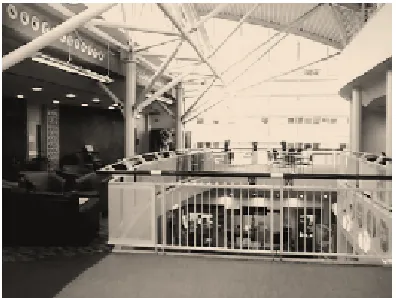
The Gallery
The Gallery is an open space within the Students’ Union. Food outlets are close by,
meaning students can bring refreshments across to the Gallery. There are computers
[image:6.595.71.269.200.349.2]available as well as printing facilities. Wi-Fi access is freely available.
Figure 1: The Gallery
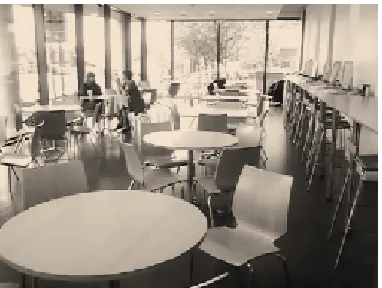
Coffee Revolution
Coffee Revolution is a cafe located within the Students’ Union building which is at
the social hub of the University of Sheffield. It is described as “perfect for enjoying the
cafe society or just sitting and watching the world go by” (Sheffield Students’ Union, 2012). There is free Wi-Fi access.
[image:6.595.73.285.549.708.2]The Information Commons Cafe
The cafe is located within the Information Commons and access is only available to
students and staff. Many students take their refreshments away with them rather
than remain in the cafe. There are some quick use computers available and free
Wi-Fi access. The Information Commons opened in 2007 and is a 24 hour; 365 days a
year modern learning environment, “which combines a variety of different study
[image:7.595.73.264.297.441.2]environments in one light, airy and spacious building” (Sheffield University, 2012).
Figure 3: The Information Commons Cafe
Review of Literature and Background
Changing patterns of studying
It is accepted that different types of study spaces are needed to support multiple
forms of learning in university libraries (Beagle, 1999; Bennett, 2006; Bodnar, 2009).
For example, in the Information Commons at the University of Sheffield, study
spaces include “flexispaces, pods and areas of open seating” (Lewis, 2009, p. 168). It is
contentious whether coffee bars should be regarded as study spaces. Lippincott and
especially in libraries” (p. 15), but Bryant et al (2009) disagreed believing that coffee bars did not promote a “conducive learning atmosphere” (p. 10).
There is more for librarians to consider, however than just providing multiple study
spaces. Laurier (2008) found that increasingly more commuters scheduled in “linger
time” (p. 6) at coffee bars on their route to work to prepare for the day ahead. Similarly, how students plan their time may be changing. Hagerstrand (1973)
claimed that people’s daily activities were planned around being in places at set
times. Little research has examined how students’ study patterns fit around other
activities such as lectures, commuting and having jobs.
Collaborative Learning
Whilst recent literature has focused on universities providing many different types
of study space, researchers such as Bickford and Wright (2007) believe the
importance of students learning together collaboratively is undervalued. They argue
that “less contact with faculty, more commuters and a secularised society have eroded social
interactivity” (p. 4.4), meaning that collaborative study in informal learning spaces is becoming increasingly common. Lefever and Bashir’s (2011) findings at Bradford
University support this with students feeling attached to specific informal learning
spaces, seeing them as somewhere to discuss work without being confined by
regulations.
In studies at Loughborough University, Bryant et al (2009) noted that students
appropriate. This idea of being free from regulations relates to a concept known as
the ‘third place’, proposed by Oldenburg and Brissett (1982) which is “a public setting
accessible to its inhabitants and approached by them as their own” (p. 270). The importance of collaborative study is also supported by Francisco (2007) in research at the Steam
Cafe, at Massachusetts Institute of Technology. He suggested that a magnetism effect
occurred in which “food provides the initial pull, but an equally important attraction is the
people who come for the food…people attract people” (p. 27.5).
In addition to research at universities, wider literature highlights the importance
attributed to being around others in a similar position. Laurier’s (2008) study
highlighted that commuters enjoyed being around likeminded people at coffee bars
on route to work, whilst Waxman (2006) found that it was common for there to be
“campers” (p. 44) in the USA, who got much satisfaction out of visiting coffee bars
alone for long lengths of time, because they enjoyed the company of others.
Environmental factors
Whilst the importance of students studying together collaboratively has been
underestimated, the role that environmental factors play has not. Research such as
that by Chism (2007) has highlighted that the “sensory stimulation of informal spaces
such as the décor, carpeting and lighting” (p. 2.7) greatly influences students’ perceptions of where it is good to study. At the University, of Sheffield, students
found the “temperature being right, spaces not being too noisy and a good use of colour
claimed that “good lighting, comfortable furniture, warm colours and access to food” (p. 1)
were the most important design features of libraries for students.
Wider research suggests that the atmosphere generated in informal learning spaces
is influenced by more than just the physical design. Waxman et al (2007) highlighted
that the “opportunities to socialise and convenience” (p. 427) greatly influenced which
informal learning spaces students used, whilst Lefever and Bashir (2011) found that
“being welcoming, comfortable, safe and friendly” (p. 5) were the most important factors
in students choice of informal learning space at Bradford University. Montgomery
(2008) offers another perspective. His research about the usage of seminar rooms
highlighted that “how people navigated the spaces influenced their perceptions” (p. 129).
This furthers the point that the atmosphere created in informal learning spaces is
influenced by many factors.
Sheltering and territoriality
Having personal space is also seen as greatly important in students’ choice of study
locations. Bennett (2006) and Bodnar (2009) are amongst many researchers who
claim that students appreciate furniture which can be reconfigured to suit their
needs in libraries. Other research at universities such as Cox (2011) at the University
of Sheffield highlights that students feel restricted by the design of lecture theatres,
because they had difficulty spreading out their belongings. At Oregon State
(Vondracek, 2007, p. 287) were seen as the main reasons for using informal learning
spaces rather than libraries.
Wider literature such as Waxman’s (2006) research at coffee bars found that
customers tended to sit in sheltered locations “those with architectural elements that
offered a physical structure on at least one side” (p. 45), to have greater privacy. Brown and O’Hara (2003) noted that commuters would sit against walls and spread their
belongings out to create a boundary between themselves and others when travelling
on trains.
The use of technology in informal learning spaces
Much literature focuses on how technology influences learning at universities. Many
library researchers claim that incorporating modern technology into academic
libraries is essential, with the younger generation known as the “millenials” used to
“embracing technology in their daily lives” (Lippincott, 2010, p. 32). For example,
Bryant et al (2009) observed a commons space known as the ‘Open’ at
Loughborough University and claimed that the ease of Internet access was the main
reason it was popular. Lippincott and Brown (2003) highlighted that students often
“inhabit more than one virtual space at a time” (p. 14) when using social media and it is
vital that libraries support this.
Some theorists such as Martell (2007) have gone as far as saying the growth in
electronic resources will mean that students will not visit libraries anymore. Six
find carrying technological devices such as laptops around on campus inconvenient.
Indeed, in a study at the University of Sheffield, Cox (2011) found that in lectures
most students used paper pads and pens rather than laptops.
Research questions
Based on the literature reviewed, it was evident that most learning in higher
education today is premised both on significant independent study and
unsupervised group work. How this is carried through needs to be better
understood both by support services such as libraries and also tutors. The following
research questions were explored.
1) What is the temporal pattern of student study in informal learning spaces?
2) What are the factors shaping students’ use of informal learning spaces?
Research Method and Design
Questionnaires
All students using the informal learning spaces were asked to complete a
questionnaire (appendix, p. 33). Each site was visited from 9.00 am until 13.30.
Students completed the questionnaires unattended to avoid them feeling pressurised
and all responses remained anonymous. An information letter was provided
explaining the study. The first seven questions were to gain an understanding of
how students use informal learning spaces, whilst question eight and nine examined
questions communicated to the respondents as intended” (De Leeuw, 2008, p. 316). Descriptive statistics were used to analyse the quantitative data (Connaway and
Powell, 2010). When analysing the free text answers, content analysis was used with
the responses being assigned to categories which were created based on the answers
which students gave (Peterson, 2000).
There were limitations with using questionnaires, such as the need to keep questions
simple for a broad audience (Peterson, 2000). Confusion occurred with question four,
with some students circling multiple answers rather than one. This led to 31
students’ answers being withdrawn for this question. Other limitations included
some participants not answering the open ended questions, as well as 20% of the
questionnaires being completed by non-students. As the study was about students’
use of informal learning spaces, these responses were excluded from the findings.
Also, it was not possible to capture the full spectrum of users of each site, because
research was conducted at select times (Bryman, 2012). Students occasionally found
it difficult answering questions, because their study patterns varied throughout the
year. Friends sometimes discussed questions together and gave similar answers to
one another.
Observations
Observations were made at each site so that “actions were identified that people may not
minutes on which study aids were in use and how many students were on each
table. This was so that spatial variations could be examined.
Observational analysis had its limitations. It was difficult to record which study aids
were in use without being intrusive (Bryman, 2012). Observing everything was
sometimes “overloading for the observer” (p. 160), especially at Coffee Revolution
where there were twenty seven tables.
Follow up interviews
After analysing the results, three follow up interviews were conducted with staff
involved in the management of each of the sites. The interviews were
semi-structured to encourage the interviewees to give detailed, personal accounts about
their experiences (Bryman, 2012). These transcripts were used to support findings in
the results and discussion chapters.
Results
Research question one: What is the temporal pattern of
student study in informal learning spaces?
Overall, 174 students completed the questionnaire, with 90 students completing the
questionnaire in Coffee Revolution, 53 in the Gallery and 31 in the Information
Commons Cafe. 38% of students stated that they were studying in the informal
learning spaces, which shows that studying is common outside of formal
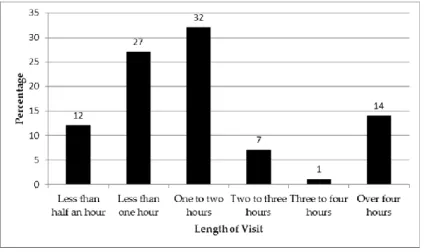
environments such as libraries. It was clear that there were some distinct user groups
transitory. A small cluster of 14% of students stated they were staying for over four
hours. Of those studying 26% of students stayed for over four hours. Unstructured
observations highlighted that some students spent the whole morning studying in
informal learning spaces, especially in the Gallery. Some students appeared to have
a regular table to go to in which they met up with friends and studied
[image:15.595.73.500.265.517.2]collaboratively together.
Figure 4: Average length of time spent in informal learning space
From unstructured observations there were more individuals using informal
learning spaces early in the mornings, often sitting around reading books and
making notes over a coffee. This was reaffirmed by a senior member of staff from
Coffee Revolution, who stated,
“We have very, very regular customers who we see throughout the day. Mainly we see them
There were considerable differences between the sites in how they were used. The
Gallery had the most long term visitors with 23% staying over four hours compared
to 17% in the Information Commons Café and 4% in Coffee Revolution. 70% of
students used the Information Commons Cafe for less than one hour, compared to
56% in Coffee Revolution and 32% in the Gallery. This supports the observation that
in the Information Commons Cafe, many students bought drinks to take away with
them to consume elsewhere.
When students were asked how often they studied at each site, 40% of students in
the Gallery studied there every week, 28% in the Information Commons Cafe and
17% in Coffee Revolution. When a chi square test was conducted to test if these
differences were down to chance, the results were significant with the value of 7.21
higher than the critical value needed of 5.99 (Geography Site, 2006).
The percentage of students mentioning ‘distractions’ as a disadvantage of studying
in the Gallery was 10% lower than the average across the sites. This was possibly
because students respected that it was a workspace and made an effort to keep quiet
or maybe enjoyed working in an environment with background distractions. 27% of
students felt productive working in the Gallery, which was considerably more than
the average of 19% across the sites. This highlights that some informal learning
spaces are percieved as study spaces more than others, despite the technology
Research question two: What are the factors shaping
students’ use of informal learning spaces?
The Environment
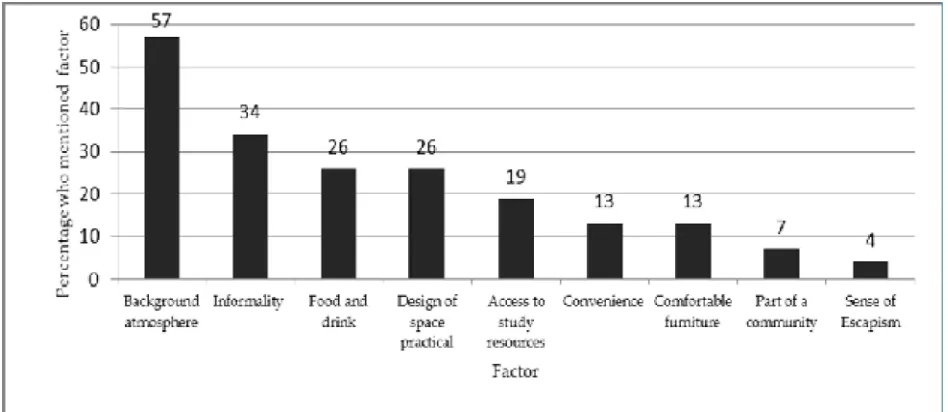
Students found the background atmosphere the best reason for studying in informal
[image:17.595.71.545.245.451.2]learning spaces as well as the worst.
Figure 5: Advantages of studying in informal learning spaces
[image:17.595.76.546.509.701.2]Advantages of studying in the informal learning spaces to do with the background
atmosphere included,
“Calming environment, music with the right mood is played”
“Informal space, relaxed atmosphere”
Negative factors to do with the background atmosphere included,
“Too distracting…light, music, other people”
“Too loud to concentrate”
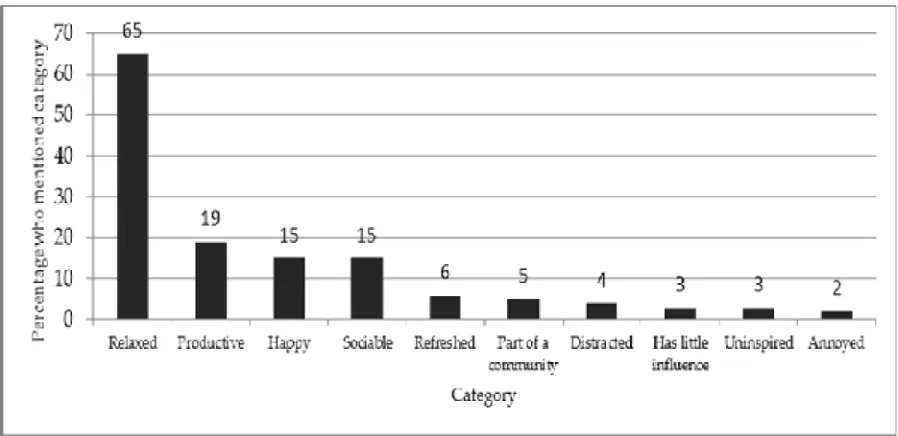
When asked what feelings they associated with the informal learning spaces,
students most commonly mentioned feeling relaxed and productive.
“I enjoy using this space over either of the libraries. It’s quite a calm space but not eerily
quiet like the [main library] or too busy like the [Information Commons]” “It’s less stressful to work than in the libraries”
This in turn highlights that some students feel they work better in a low pressurised,
[image:18.595.72.521.523.741.2]relaxed atmosphere.
The background atmosphere plays a vital role in determining whether students
work well. In informal learning spaces, the background atmosphere energises and
motivates some students to study, whilst others find the background stimuli too
much.
Creating territory and being sheltered
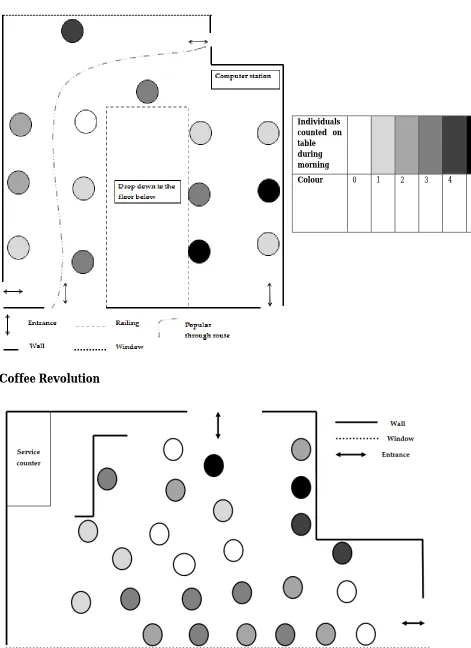
.The observations involved recording how many students used every table at each
site at half an hour intervals. The usage was mapped onto a floor plan of each site to
see if certain locations were used more than others. The analysis showed that tables
in sheltered locations were most popular. Sheltered means “tables with architectural
elements that offered a physical structure on at least one side” (Waxman, 2006, p. 45). Tables in the quietest locations in the Gallery, secluded from students passing
through were most regularly used for studying. These tables were at the opposite
The Gallery
Coffee Revolution
Figure 8: Distribution of individuals in the Gallery and Coffee Revolution
Individuals counted on table during morning
[image:20.595.73.544.93.741.2]In Coffee Revolution, tables in sheltered locations such as against the wall were
most popular with individuals who were studying. Groups generally preferred the
tables in the centre of Coffee Revolution, because furniture could easily be
reconfigured to suit different group sizes.
Technological devices
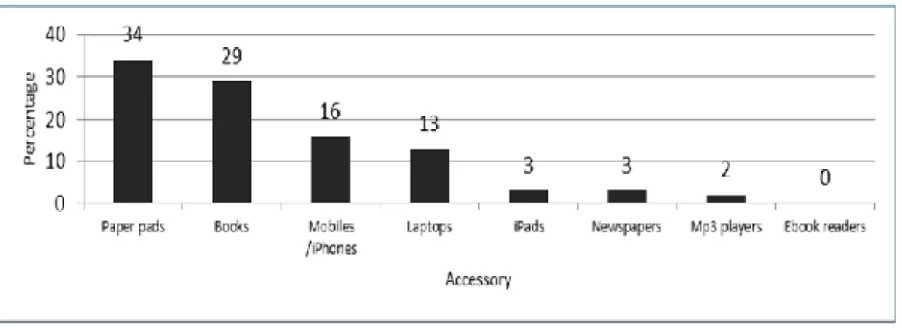
As part of the structured observation the study aids that were in use were recorded.
It was difficult to count how many individuals had each type of study aid. Instead, it
was recorded whether each type of study aid was in use on each table every half an
hour. The percentage spread of each type of study aid across the three sites was then
[image:21.595.76.527.408.572.2]calculated.
Figure 9: Percentage spread of study aids across the sites
Study aids that were not technological devices were most commonly used such as
paper pads and books. These constituted 63% of all the study aids counted. Despite
Wi-Fi being available, students seemed to prefer the tried and tested ways that they
knew best. This suggests that it cannot be better access to technology which makes
Discussion
Research question one: Students’ study patterns
Results showed that students often visit informal learning spaces for under one hour
or for over four hours. Waxman (2006) labelled “patrons who often sit and stay for hours
as campers”, (p. 47). Of those studying, 26% normally stayed for over four hours which indicates the informal learning space is their main study base. In contrast, 39%
of students did not normally visit the informal learning space they were in for more
than one hour. This perhaps supports Hagerstrand’s (1973) time-space prism
concept that people look to fill in gaps between scheduled activities.
Laurier (2008) found that commuters allocated time en route to work to go to a
coffee shop to prepare for the day ahead. Similarly, some students schedule in time
between lectures to prepare for activities later that day. Lefever and Bashir (2011)
included a category of “come here to fill up time between classes etc” (p. 13) when they
conducted a questionnaire about students’ use of space at Bradford University. 44%
chose this category in the Atrium, more so than any other category (p. 13). Similarly,
from observations at Sheffield, it was noticeable that many students came to the
informal learning spaces for a short time to read a book. The term ‘espressos’ is
proposed for these students who use informal learning spaces for a short period of
time.
From the unstructured observations at Sheffield it was clear that many students met
times working collaboratively together, especially in the Gallery. This very much
supports Bickford and Wrights (2007) emphasis on the importance of student study
communities. This is an important aspect of university life which has been neglected
in research.
The questionnaire results highlighted that the Gallery was by far the most popular
study site with 40% of students claiming to study there at least once a week. Lefever
and Bashir (2011) found that at Bradford University, students identified themselves
with particular informal learning spaces, “feeling a social belonging, often through
groups” (p. 1.). Students used informal learning spaces for different purposes such as the top floor of Student Central for studying and the bottom floor for socialising.
There were similarities at Sheffield, with ‘group study’ most commonly selected in
the Gallery, ‘socialising’ most regularly picked in Coffee Revolution and ‘buying
food and drink’ chosen most frequently in the Information Commons Cafe. This
shows that students construct distinct identities for different informal learning
spaces on campus. Francisco (2007) claimed that students were drawn to the Steam
Cafe at MIT, because of the magnetism effect of other students being there. This
effect was evident at the Gallery with friends joining one another throughout the
Research question two: What are the factors shaping
students’ use of informal learning spaces?
The importance of the atmosphere
The background atmosphere was considered the main positive of studying in
informal learning spaces, as well as the main negative. Many previous studies have
highlighted the importance of the background atmosphere in informal learning
spaces such as (Bodnar, 2009; Chism, 2007; Fister, 2009; Montgomery, 2008;
Vondracek, 2007; Waxman et al, 2007). In libraries, Fister (2009) claimed that “good
lighting, comfortable furniture and warm colours” (p. 1) were amongst the most important design features, whilst in cafes Waxman et al (2007) claimed that “the
atmosphere, opportunities to socialise and the convenience” (p. 427) were all of great importance.
Bryant et al (2009) was sceptical about cafes as study spaces, claiming “they do not
always promote an atmosphere which is conducive to learning” (p. 10). However, it was evident in this study that many students were studying in informal learning spaces
whilst also feeling relaxed, with 38% claiming to have such feelings.
Waxman (2006) also looked into the behaviour of customers at coffee bars and found
that “people were content to sit alone yet, despite the lack of verbal interaction, felt that they
had a social outing” (p.50). Indeed, Laurier (2008) claimed that commuters felt energised and motivated by being around others in coffee bars. This was also the
around others and taking in the atmosphere seemed to inspire students to work
effectively. Although other studies have mentioned that students find environmental
factors important in their chose of study location such as (Bennett, 2006; Chism, 2007;
Fister, 2009; Vondracek, 2007) they have not noted that students draw energy and
inspiration from the atmosphere itself.
Sheltering and the creation of territories
Part of the research included making floor plans of each site, showing how regularly
students used each of the tables. By studying the distribution of students at each site,
it was clear that sheltered locations were popular. These are locations “with
architectural elements that offer a physical structure on at least one side” (Waxman, 2006, p. 45). For example, in Coffee Revolution, individuals tended to sit in positions
against the walls and windows to have personal space between themselves and
others. Brown and O’Hara (2003) found that commuters on trains used props such as
bags and coats to create boundaries between themselves and others, whilst Cox
(2011) highlighted that students similarly liked to be able to spread their belongings
out in lecture theatres so that they had a comfortable amount of personal space.
In addition to finding sheltered spaces to study it was apparent that students
preferred being away from tables which were in spaces close to the regular
movement of people. Montgomery (2008) highlighted that how people navigated
is very little research about how the regular movement of students across libraries
influences students’ use of the space.
As well as sheltered locations being important, having furniture which could be
reconfigured to suit different study needs was seen as essential. For example, in the
Gallery students appreciated being able to easily pull tables and chairs together to
accommodate large group sizes. When students were asked what the positives were
of studying in informal learning spaces, ‘informality’ was the second most popular
response. This supports literature such as (Bennett, 2006; Bodnar, 2009; Brown and
O’Hara, 2003 ; Cox, 2011; Lewis, 2009; Lippincott, 2007; Vondracek, 2007), which
highlights that people like to be able to spread their belongings out and reconfigure
furniture to suit their needs and feel at ease.
Technology, a commercial cloud not a reality!
Recent literature such as Bryant et al (2009) and Lippincott (2010) points to a utopian
notion in which all students at universities go around with portable, technological
devices such as laptops and iPads and are constantly alternating between different
virtual communities. However, these findings highlighted that books and paper
pads were the most common study aids, with only 13% of students counted across
the three sites having laptops, compared to 29% having books. Brown and O’Hara
(2003) highlighted how on trains, commuters adapted their activities to do tasks such
with informal learning spaces at the University of Sheffield, with students finding it
easier to take a book with them to read over lunchtime rather than their laptop.
This challenges the view held by some librarians that all students want to use
modern technological devices because many students still prefer traditional methods
of learning such as reading and making notes from textbooks. This finding supports
research such as that by Cox (2011) which highlighted that in lectures at the
University of Sheffield, taking notes down by hand was still much more common
than using electronic devices. Indeed, amongst the current discourse of making
libraries into “one stop shops” Massis (2010, p. 162), with the latest technological
innovations (Lippincott, 2007), it may be important to consider whether many
students do not prefer studying in traditional ways. Indeed, when studying some
students like to escape technology. Others may not be able to afford the latest mobile
gadgets.
The Model of Zengagement
To highlight how essential it is that librarians consider the background atmosphere
more so than other distractions such as technology a new model is proposed. It is
called ‘The Model of Zengagement’, with the ‘Zen’ meaning that the student is in a
relaxed frame of mind for studying, whilst the ‘Gagement’ describes how students
absorb what is going on in the background surroundings, which in turn stimulates
Figure 10: The Model of Zengagement
The personal zone is the space which is the students’ own territory. The size of this
zone can be made larger by students spreading out belongings such as coats and
sitting in sheltered locations. The background atmosphere refers to the space outside
of a students’ personal zone. The different length arrows indicate how students can
focus in and out of different stimuli to the degree that is optimum for stimulating
their studies. For example, if a student liked the views outside they could draw
inspiration from it. If it was the smell of coffee they really liked, they could focus on
However, the bolt shows that sometimes stimuli can get out of a students’ control,
making the atmosphere uncomfortable. Noise, distracting students is an example of
this. The extent to which stimuli impact on students’ studies varies greatly. Whilst
some students find a stimuli engaging, others find the same stimuli overhelming.
Thus there is much variation between what atmospheres students work best in.
Conclusion
The key finding from this study was how important students regarded the
background atmosphere in their choice of informal learning space. Many found
being in a relaxed atmosphere stimulated them to work productively, whilst others
worked best with very little background stimuli. From this the ‘Model of
Zengagement’ was proposed. Another finding was that having access to
technological devices was not regarded as important by students as some theorists
such as Lippincott (2007) and Martell (2007) have suggested. Many students were
content making notes from textbooks, with there being little evidence that students
are constantly occupying multiple virtual spaces.
Other findings included evidence of distinct sub groups of students using informal
learning spaces. Waxman’s (2006) notion of “campers” (p. 47) spending hours in one
space was confirmed, but there are also ‘espressos’ who used informal learning
spaces for short durations of time. This supports the concept of time – space prisms
developed by Hagerstrand (1973) in which people look to fill in gaps between
as students were attracted to informal learning spaces where others were doing
similar activities to them. Being able to study together collaboratively with friends in
an informal setting was an important reason for students using informal learning
spaces, which backs research such as that by Lefever and Bashir (2011) and Bickford
and Wright (2007).
Research such as Brown and O’Hara (2003) and Waxman (2006) was confirmed with
students preferring to sit in sheltered locations. Having the freedom to spread
belongings out and reconfigure furniture was also important. Students avoided
sitting close to where there was the regular movement of people. Little research has
been done about this though apart from Montgomery’s (2008) article about how
people’s perceptions are influenced by how they navigate space.
Implications for library services
University libraries might wish to pay more attention to the atmosphere the library
creates. Many modern libraries have wide open spaces, but it is questionable
whether this is optimal to promote study. Whilst libraries regularly have multiple
study spaces, more can be done to ensure that students have their own personal
space. Creating more original library environments such as having enchanting
corners for students to escape to is beneficial. The research suggests that libraries
need to make sure they offer spaces for students who enjoy studying in a relaxed
most commonly used study accessories shows that students do not always want to
use the latest technology.
The ‘Model of Zengagement’ highlighted that background stimuli can both enhance
and inhibit students’ study performance. One of the inhibitors is often the movement
of students across spaces. Those studying in the Gallery purposely chose tables away
from any doors. When developing library environments that should be taken into
consideration.
Students enjoy self-governing informal learning spaces themselves without
restrictions being imposed. This is why groups of friends often worked
collaboratively together in the Gallery. It is suggestive of the idea that students
govern spaces themselves in university libraries. Oldenburg and Brissett (1982)
highlighted that in ‘third places’ people intuitively knew how to behave. In the same
way if library spaces create the right atmosphere, there would not be the need for
surveillance.
Students enjoy being able to fit their visits to informal learning spaces around their
own lifestyle. As the results of this study showed, there were both many ‘espressos’
using spaces for short bursts of time and “campers” Waxman (2006, p. 47) who
studied for long durations. Although libraries have introduced ideas for ‘espressos’
such as short term use computers, more can be done to make libraries homely. TV
lounges and games consoles have been introduced in some libraries, but it is still a
minority. Also, it is possible that it would be of value that coffee bars are embedded
Furthermore, having kitchen facilities on each floor where students can make their
own drinks would go a long way to making students feel at home.
The pressure to use space efficiently may lead to the creation of generic, soulless,
open commons spaces without character and fall obsessively into the mythical,
technological discourse. It is important that librarians pay attention to the
background atmosphere. Every sensual stimulus has an effect on this, not just the
furniture and colour schemes. Librarians should see the benefit of avoiding creating
soulless, institutionalised academic spaces and instead aspire to make libraries
warm, friendly and homely spaces.
References
Beagle, D. (1999), “Conceptualising an information commons”, The Journal of Academic Librarianship, Vol. 25 No. 2, pp. 82 – 89.
Bennett, S, (2006), “First Questions for Designing Higher Education Learning Spaces”, The Journal of
Academic Librarianship, Vol. 33 No.1, pp. 14 – 26.
Bennett, S, (2009), “Libraries and Learning: A History of Paradigm Change”, Libraries and the Academy, Vol. 9 No.2, pp. 181 – 197.
Bickford, D. and Wright, D. (2007), “Community: The Hidden Context for Learning”, in Oblinger, D. (Ed.), Learning Spaces, EDUCAUSE, Boulder, Co, available at: http://net.educause.edu/ir/library/pdf/PUB7102d.pdf (accessed 14 July 2012).
Bodnar, J. (2009), “Information and learning commons, faculty and student benefits”, New Library
World, Vol. 110 Nos 9/10, pp. 403 – 409.
Brown, B. and O’Hara, H. (2003), “Place as a practical concern for mobile workers”, Environment and
Bryant, J., Matthews, G. and Walton, G. (2009), “Academic libraries and social learning space: a case study of Loughborough University Library, UK”, Journal of Librarianship and Information Science, Vol. 41 No. 1, pp. 7-18.
Bryman, A. (2012), Social Research Methods, (4th Edn.), Oxford University Press, Oxford.
Cox, A. (2011), “Student’s Experience of University Space: An Exploratory Study”, International
Journal of Teaching and Learning in Higher Education, Vol. 23 No. 2, pp. 197 – 207, available at :
http://www.eric.ed.gov/PDFS/EJ946145.pdf (accessed 5 May 2012).
Chism, N. (2007), “Challenging traditional assumptions and rethinking learning spaces”, in Oblinger, D. (Ed.), Learning Spaces, EDUCAUSE, Boulder, CO, available at: http://net.educause.edu/ir/library/pdf/pub7102b.pdf (accessed 16 May 2012).
Connaway, L. and Powell, R. (2004), Basic Research Methods for Librarians, (4th Edn.), Libraries
Unlimited, Westport, Conn.
Connaway, L. and Powell, R. (2010), Basic Research Methods for Librarians, (5th Edn.), Libraries
Unlimited, Santa Barbara, Calif.
De Leeuw, E. (2008), “Self-Administered Questionnaires and Standardized Interviews”, in Alasuutari, P., Bickman, L. and Brannen, J. (Eds.), The SAGE Handbook of Social Research Methods, SAGE, Los Angeles, pp. 313 – 235.
Fister, B. (2009), “The glorious Study Hall: How Libraries Nurture a Life of the Mind”, Library Issues, Vol. 30 No. 2, pp. 1 – 4, available at: www.libraryissues.com/sub/PDF3002Nov2009.pdf (accessed 16 May 2012).
Francisco, S. (2007), “Steam Café”, in Oblinger, D. (Ed.), Learning Spaces, EDUCAUSE, Boulder, CO, available at: http://www.educause.edu/learningspacesch27 (accessed 16 May 2012).
Hagerstrand, T. (1973), “The domain of human geography”, in Chorley, R. J. (Ed.), Directions in
Geography, Methuen, London, pp. 67 – 87.
Laurier, E. (2008), “How breakfast happens in the café”, Time and Society, Vol. 17 No. 1, pp. 119-143, available at: http://www.era.lib.ed.ac.uk/handle/1842/2298 (accessed 6 May 2012).
Lefever, R. and Bashir, H. (2011), “Student Engagement Final Report: Exploring Student Understandings of Belonging on Campus”, working paper, The Higher Education Academy, The University of Bradford, 31 July, available at:
http://www.heacademy.ac.uk/projects/detail/StudentEngagement_ResearchBid2011_Bradford (accessed 14 July 2012).
Lewis, M. (2009), “The University of Sheffield Library Information Commons: A Case study”, Journal
of Library Administration, Vol. 50 No. 2, pp. 162 – 178.
Lippincott, J. (2007), “Linking the Information Commons to Learning”, in Oblinger, D. (Ed.), Learning
Spaces, EDUCAUSE, Boulder, Co, available at: http://www.educause.edu/LearningSpaces (accessed 16
April 2012).
Lippincott, J. (2010), “Information Commons: Meeting Millennials Needs”, Journal of Library
Administration, Vol. 50 No. 1, pp. 27 – 37.
Lippincott, J. and Brown, M. (2003), “Learning Spaces: More than Meets the Eye”, Educause Quarterly, Vol. 26 No. 1, pp. 14 – 16, available at http://net.educause.edu/ir/library/pdf/EQM0312.pdf (accessed 5 May 2012).
Martell, C. (2007), “The Elusive User: Changing Patterns of Libraries from 1995 – 2004”, College and
Research Libraries, Vol. 68 No. 5, pp. 435 – 445.
Massis, B. (2010), “The academic library becomes the academic learning commons”, New Library
Montgomery, T. (2008), “Space matters: experiences of managing static formal learning spaces”,
Active Learning in Higher Education, Vol. 9 No. 2, pp. 122 – 138.
Oldenburg, R. and Brissett, D. (1982), “The Third Place”, Qualitative Sociology, Vol. 5 No. 4, pp. 265 – 284.
Peterson, R. (2000), Constructing effective questionnaires, Sage Publications, London.
Sheffield Students’ Union. (2012), Coffee Revolution, available at: http://www.shef.ac.uk/union/going-out/coffee-revolution/ (accessed 19 June 2012).
University of Sheffield. (2012), The Information Commons, available at: http://www.sheffield.ac.uk/infocommons/students (accessed 19 June 2012).
Vondracek, R. (2007), “Comfort and Convenience? Why Students’ Choose Alternatives to the Library”, Libraries and the Academy, Vol. 7 No. 3, pp. 277 – 293.
Waxman, L. (2006), “The Coffee Shop: Social and Physical Factors Influencing Place Attachment”,
Journal of Interior Design. Vol. 31 No. 3, pp. 35 – 53.
Appendix
Informal Learning Spaces Questionnaire
Hello! I am studying how students’ use informal spaces at Sheffield University for my dissertation in Librarianship. I would greatly appreciate it if you could spare a few minutes. Your participation is voluntary and the data collected will be kept anonymous. By completing this questionnaire you are consenting to participate in this study.
1.) What type of student are you? (please circle) Undergraduate Masters PhD Not a student
2.) Are you British? (please circle) Yes No
3.) Are you currently using this space for your academic studies? (Please circle) Yes No
4.) Which of these would you say best describes the function of this space? (please select one)
A space for…individual study unwinding by myself group study socialising buying food and drink
Other (please specify)………
5.) How regularly do you come to this space?
Everyday At least twice a week Once a week A couple of times a month Monthly Rarely
6.) How regularly do you study in this space?
Everyday At least twice a week Once a week A couple of times a month Monthly Rarely Never
7.) How long do your visits to this space tend to be?
Less than half an hour Less than one hour one to two hours two to three hours three to four hours over four hours
8.) What would you say the pros and cons of studying in this space are?
Pros Cons