City, University of London Institutional Repository
Citation
:
Howe, J. M. and Mereani, F. (2018). Detecting Cross-Site Scripting Attacks
Using Machine Learning. Advances in Intelligent Systems and Computing, 723, doi:
10.1007/978-3-319-74690-6_20
This is the accepted version of the paper.
This version of the publication may differ from the final published
version.
Permanent repository link:
http://openaccess.city.ac.uk/id/eprint/18949/
Link to published version
:
http://dx.doi.org/10.1007/978-3-319-74690-6_20
Copyright and reuse:
City Research Online aims to make research
outputs of City, University of London available to a wider audience.
Copyright and Moral Rights remain with the author(s) and/or copyright
holders. URLs from City Research Online may be freely distributed and
linked to.
Detecting Cross-Site Scripting Attacks using
Machine Learning
Fawaz A. Mereani1,2 and Jacob M. Howe1
1
Department of Computer Science, City, University of London
London, United Kingdom
[email protected], [email protected]
2 Umm Al-Qura University, Makkah, Saudi Arabia
Abstract. Cross-site scripting (XSS) is one of the most frequently
oc-curring types of attacks on web applications, hence is of importance in information security. XSS is where the attacker injects malicious code, typically JavaScript, into the web application in order to be executed in the user’s browser. Identifying that a script is malicious is an im-portant part of the defence of a web application. This paper investigates using SVM, k-NN and Random Forests to detect and limit these attacks, whether known or unknown, by building classifiers for JavaScript code. It demonstrated that using an interesting feature set combining language syntax and behavioural features results in classifiers that give high ac-curacy and precision on large real world data sets without restricting attention only to obfuscation.
Keywords: Cross-Site Scripting, System Security, Supervised learning,
Classifiers, Features selection
1
Introduction
script will be executed on the user’s browser. Such an attack might target blogs, forums, comments or profiles [7, 11, 24].
Work on detecting and protecting against XSS attacks can be broadly cat-egorised into three kinds. Firstly, static analyses which review the source code without execution; whilst such approaches can give formal guarantees that cer-tain vulnerabilities do not occur, they may also be slow or fail to give a result at all. Secondly, dynamic analyses which attempt to determine what the script does at execution time. Modifying the interpreter [16] or checking the syntactic structure [19] are strategies of this analysis. However, it is hard to modify a language’s interpreter; vulnerabilities that are caused by the interaction of mul-tiple modules [3] are, therefore, hard to prevent. Thirdly, machine learning can use knowledge of available scripts to build classifiers to predict aspects of the behaviour of new scripts [4]. The advantages of using machine learning are: first, once a classifier has been built it can quickly predict whether or not a script is malicious; second, it does not need a sandbox to analyse the script; third, the classifier has predictive capabilities to detect new malicious JavaScript. In this work, machine learning is used to detect stored XSS with high accuracy and precision. Scripts may well be obfuscated; importantly, the aim is to classify all scripts, whether obfuscated or not. The design space for such an approach is large, with choices of how to build classifiers, and an even larger choice of how to abstract concrete code into a collection of features that the machine learning algorithms will work on. The contributions of this work are as follows:
– a new selection of program features, drawn from program syntax and pro-gram behaviours, is given for the learning algorithms to work on
– the collection of a balanced dataset of scripts from multiple sources giving good coverage of both malicious and benign scripts
– the use of support vector machines (SVM), k-nearest neighbour (k-NN), and Random Forests as learning algorithms to give classifiers; this is the first evaluation of Random Forests on XSS problems
– the evaluation of the resulting classifiers on training and real world data.
The rest of this paper is organised as follows: Section 2 gives an overview of rele-vant aspects of JavaScript and JavaScript obfuscation. Section 3 discusses related work on machine learning and XSS. Section 4 details the dataset collection and features selection. Section 5 gives the experimental data on the performance of the classifiers, and includes discussion of the results. Further discussion, direction of future work and conclusions are given in section 6.
2
Background
2.1 JavaScript
Detecting Cross-Site Scripting 3
functions to run after loading the web page without the need to communicate with the server, for example, producing an error alert before sending information to the server. Scripts can be inserted within the HTML or can be referenced in a separate .js file. JavaScript is a good choice for attackers to carry out their attacks and to spread them over the Internet, because the majority of websites use JavaScript and it is supported by all web browsers. Hence, it is the target of many XSS, SQL injection and passive download attacks [22].
2.2 Obfuscation
The goal of obfuscation is to modify the code to make it hard to read or un-derstand. For example, by changing the names of variables or functions, or by using operators to compound terms to give program constructs. Both benign and malicious scripts can use obfuscation techniques with different purposes for each one. Benign obfuscation aims to protect privacy or intellectual rights, while malicious obfuscation works on disguising malicious intentions and evading the static inspection checks. Multiple obfuscation methods can be applied by attack-ers to best hide malicious scripts [25]. A simple example of malicious JavaScript obfuscation by using URL Encoded is:
%3Cs c r ipt%3E%0D%0Aal e r t%28document . c o oki e%29%3B%0D%0A %3C%2Fs c r ipt%3E
The original script after deobfuscated is as follows:
< script > alert(document.cookie);< /script >
This paper considers JavaScript that may or may not be obfuscated and aims to classify scripts as either malicious or benign in either case.
3
Related Work
Machine learning techniques have been applied to detecting XSS attacks [10] and are attractive because they can adapt to changes and variations in mali-cious scripts [9]. Likarish et al. [10] evaluated Naive Bayes, ADTree, SVM, and RIPPER classifiers in detecting obfuscation of scripts (as a proxy for malicious), using features that track the number of times symbols appears in benign and malicious scripts. The classifiers were evaluated using 10-fold cross validation giving precision of 0.92. It should be noted that the test set of obfuscated scripts is small. The approach of Likarish et al. was expanded by Nunan et al. [13], where features were categorized into three groups: (1) obfuscation based, (2) suspicious patterns and (3) HTML/JavaScript schemes. Naive Bayes and Sup-port Vector Machine classifiers were used to classify scripts as XSS or non-XSS. Three datasets were used, malicious (obfuscated) scripts from XSSed.com and benign scripts from Dmoz and ClueWeb09. The classifiers were evaluated using accuracy to give 98.58% with Dmoz dataset, and 99.89% with the ClueWeb09 dataset. This approach has high accuracy, but depends on a single source for malicious scripts and again focuses on obfuscated scripts. Another study analyz-ing malicious scripts and feature extraction was conducted by Wang et al. [22] where the main idea of feature extraction is that some functions are of limited use in the benign scripts, but are used much more in malicious scripts, such as the DOM-modifying functions, the eval function, the escape function. This tech-nique gives accuracy of up to 94.38%. However, again the techtech-nique concentrates only on obfuscated scripts and on DOM-modifying functions. The work of [2] also aims to distinguish between obfuscated and non-obfuscated scripts. Their method gives high precision results up to 100% though again the number of ma-licious scripts used was small. Komiya et al. [9] used machine learning techniques to classify user input to detect malicious web code. Feature extraction depended on two methods, blank separation, and tokenizing. The idea of the first method is that input contains many terms separated by spaces, a count of each term is used for calculation of feature weight. It should be noted that in a malicious script terms might be separated by characters other than spaces, which would lead to an incorrect feature weight. The second method is based on the idea that malicious code contains tokens that describe the features of malicious web code, with a count of each term used to calculate feature weights. Using this feature extraction technique with SVM gave accuracy of up to 98.95%.
4
Methodology
4.1 Datasets
Detecting Cross-Site Scripting 5
Table 1.Structural Features
Features Group Terms
Punctuation &,%, /,\, +, ’, ?, !, ;, #, =, [, ],$, (, ),∧
*, , , -,<,>, @, , :,{,},~, ., space,|,¦, ”
Punctuation Combinations ><,0 ”><, [], ==, &#
themselves. The benign scripts were obtained from a number of developer and university sites.
For the training set, malicious scripts were obtained from developer sites [15, 1, 6], a selection from XSSed, the largest online archive of XSS vulnerable websites [5] and additional scripts were collected by crawling sites known to be untrustworthy. The test set was drawn entirely from the XSSed archive. Again there is no overlap between sets. The first (training) dataset contains 2000 of each of malicious and benign scripts. The second (test) dataset contains 13,000 each of malicious and benign scripts. Data was prepared for the classification experiments by removing duplicates to get unique scripts, removing extra blank spaces and unnecessary new lines, and lowercasing all letters.
4.2 Selecting Features
There is a large design space for selecting suitable features of JavaScript in order to start classifying scripts. Features in this work are categorized into two groups, 1) structural, and 2) behavioural. In total, 59 features are considered.
Structural Features The structural features are the complete set of
non-alphanumeric characters that can occur in JavaScript. These may occur in any script, but if the attacker is using techniques to trick the protection on Web applications this can change the range of characters used in a script. This applies whether or not the script is obfuscated. To give a simple example, a malicious script might add spaces or unnecessary symbols between commands or tags, such as <\sc ri pt >. A benign script would not do this. As another example consider a cookie access separated into two parts and the use of the + sign to recombine the entire command again, document+0 .0 +cookie. Also included in the structural features are combinations of characters that might be used in constructing malicious scripts. There are 33 non-alphanumeric characters, and 5 further combinations of these are considered. The features might be measured in a variety of ways. In the current work the measure is a 0/1 value indicating that the feature does not or does occur in the script. As will be demonstrated later this surprisingly simple measure works very well. Table 1 gives the structural features (where space indicates the blank space character).
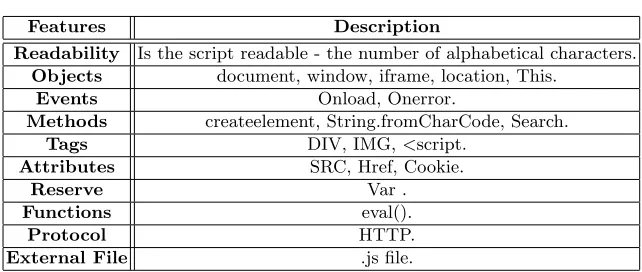
Behavioural Features These are a selection of the commands and functions
Table 2.Behavioural Features
Features Description
Readability Is the script readable - the number of alphabetical characters.
Objects document, window, iframe, location, This.
Events Onload, Onerror.
Methods createelement, String.fromCharCode, Search.
Tags DIV, IMG,<script.
Attributes SRC, Href, Cookie.
Reserve Var .
Functions eval().
Protocol HTTP.
External File .js file.
differently from the benign developer. That is, the benign developer does not need to hide the intent of their code, whilst on the contrary, the attacker will use a range of commands to create the malicious script. For example, using the eval function frequently, using de-obfuscated functions in the script, or includ-ing a malicious script within an image tag. The insight is that combinations of occurrences of commands indicate suspicious activity. There are 21 of these con-sider in this work. As for the structural features, behavioural features might be measured in many ways. The current work again uses a 0/1 value indicating that the feature does not or does occur in the script. Table 2 gives the behavioural features selected for their potential use in malicious scripts.
4.3 Classifiers
The feature data is used as input for supervised learning algorithms. In this work, support vector machines (SVM), k-nearest neighbour (k-NN), and Ran-dom Forests are used, although other classifiers might also be used. Two varia-tions on SVMs are used, with a linear kernal and with a polynomial kernal. A number of parameters used with SVMs were tuned during the training phase: BoxConstraint to control the maximum penalty of misclassification, and Outlier-Fraction to determine the expected proportion of outliers in the training data. For the k-NN classifier parameterk, the number of neighbours was tuned. For the Random Forest classifier the number of trees in the forest was tuned.
5
Results
5.1 Experiments
Detecting Cross-Site Scripting 7
Table 3.SVM (Linear Kernel) Evaluation
[image:8.612.205.411.250.333.2]Folds Accuracy Precision Sensitivity Specificity 1st 94.93% 93.98% 96.37% 93.40% 2nd 94.75% 93.19% 95.69% 93.92% 3rd 95.06% 94.66% 95.03% 95.08% 4th 94.14% 93.14% 96.63% 93.34% 5th 94.81% 93.25% 96.25% 93.45% Average 94.74% 93.64% 95.99% 93.84%
Table 4.SVM (Polynomial Kernel) Evaluation
[image:8.612.206.411.364.445.2]Folds Accuracy Precision Sensitivity Specificity 1st 96.87% 96.10% 97.95% 95.70% 2nd 96.81% 96.20% 97.09% 96.55% 3rd 97.43% 98.04% 96.66% 98.14% 4th 96.87% 96.25% 97.47% 63.25% 5th 97.31% 96.75% 97.85% 96.78% Average 97.06% 96.67% 97.40% 96.68%
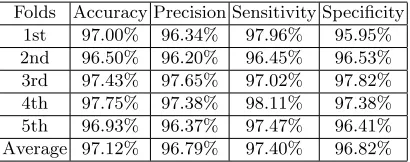
Table 5.k-NN Classifier Evaluation
Folds Accuracy Precision Sensitivity Specificity 1st 97.00% 96.34% 97.96% 95.95% 2nd 96.50% 96.20% 96.45% 96.53% 3rd 97.43% 97.65% 97.02% 97.82% 4th 97.75% 97.38% 98.11% 97.38% 5th 96.93% 96.37% 97.47% 96.41% Average 97.12% 96.79% 97.40% 96.82%
and testing on the remaining fold. This five fold testing then gives five training experiments. The SVM with linear kernel was tuned to set the BoxConstraint parameter to 7. The polynomial kernel was tuned by setting the OutlierFraction parameter to 0.10. k-NN was tuned by setting NumNeighbors parameter to 1 (since some malicious scripts might be singletons). Random Forest was tuned by setting the number of tree to 40. The results are described with Precision (often called Detection Rate in a security context), Accuracy, Sensitivity and Specificity. Table 3 shows results with test data for SVM with linear kernel, Table 4 shows the results for SVM with polynomial kernel, Table 5 shows the results for k-NN, and Table 6 shows the results for Random Forest.
Table 6.Random Forest Classifier Evaluation
Folds Accuracy Precision Sensitivity Specificity 1st 96.43% 95.28% 97.93% 94.83% 2nd 96.75% 95.54% 97.59% 96.00% 3rd 97.81% 97.65% 97.78% 97.83% 4th 97.68% 97.00% 98.35% 97.03% 5th 97.43% 97.00% 97.85% 97.02% Average 97.22% 96.47% 97.90% 96.54%
Table 7.Confusion Matrix with Testing Data
Linear Polynomial k-NN Random Forest Malicious Benign Malicious Benign Malicious Benign Malicious Benign Malicious 12783 217 12960 40 12985 15 12980 20
Benign 739 12261 62 12938 50 12950 110 12890
5.2 Discussion
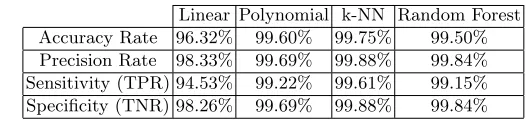
[image:9.612.171.434.520.580.2]The experiments give two sets of data. The first uses a training set of scripts cho-sen to give coverage of a variety of styles of scripts – obfuscated or not, varying length. The five fold evaluation shows good performance for the classifiers, with (as expected) SVM with a polynomial kernal giving stronger results than for SVM with linear kernal. The second set of data is designed to give a real-world evaluation of the classifiers learnt from the entire training set. As can be ob-served in Table 8 the SVM, k-NN, and Random Forest classifiers can distinguish between malicious and benign scripts with high accuracy and detection rate. k-NN performs marginally better than SVM and Random Forest, with accuracy of 99.75% and precision 99.88%. The confusion matrices of Table 7 show the small numbers of false positives and failed detections, 15 of the former and 50 of the latter for the k-NN classifier. These results suggest that classifier based techniques can be a powerful tool for detecting XSS attacks.
Table 8.Evaluation with Testing Data
Linear Polynomial k-NN Random Forest Accuracy Rate 96.32% 99.60% 99.75% 99.50% Precision Rate 98.33% 99.69% 99.88% 99.84% Sensitivity (TPR) 94.53% 99.22% 99.61% 99.15% Specificity (TNR) 98.26% 99.69% 99.88% 99.84%
6
Conclusion
Detecting Cross-Site Scripting 9
99.75%) and precision (up to 99.88%) when applied to a large real world data set. This shows that these classifiers can be added as a security layer either in a browser or (as intended) on a server. The training data was designed to give fair coverage of scripts, including scripts of a variety of lengths and both obfuscated and non-obfuscated scripts. The data is labeled as malicious or benign, rather than using obfuscation as a proxy for maliciousness. Whilst SVM, k-NN, and Random Forest have been used in the experiments, it is expected that other classification methods would also work well.
A systematic direct comparison with previous studies is not possible, how-ever, the new classifiers give performance statistics that stand up well. The current study works with a larger and more diverse suite of scripts than many of these previous studies, and is the first study to use Random Forests as a classifier for XSS. The key to building successful classifiers is the choice of feature set and how the features are measured. With a large design space there is motivation to investigate a wide range of approaches to feature selection. The features chosen in this paper fall into two categories: firstly the complete set of symbols used in the JavaScript language, and secondly aspects of the scripts that are associated with malicious code. This allows the classifiers to find patterns based on the shape of the program (symbols) and the constructs used (behavioural features). One particularly interesting aspect of this work is that, in contrast to other studies, a binary measure has been used for all features. This has given higher accuracy and precision than earlier experiments using weighted measures. This hints that it may be possible to extract rules from the classifiers that describe malicious scripts. Another interesting aspect is the value ofkused in the final ex-periments is 1. This suggests that malicious scripts might well be singletons that stand apart from clusters of benign scripts. Future work is to investigate these aspects, as well as to use the same features with a Neural Network classifier.
References
1. Examples of malicious javascript. https://aw-snap.info/articles/js-examples.php (2014). Accessed: 16/12/2016
2. Aebersold, S., Kryszczuk, K., Paganoni, S., Tellenbach, B., Trowbridge, T.: Detect-ing Obfuscated JavaScripts usDetect-ing Machine LearnDetect-ing. In: International Conference on Internet Monitoring and Protection. IARIA Press (2016)
3. Balzarotti, D., Cova, M., Felmetsger, V., Vigna, G.: Multi-module vulnerability analysis of web-based applications. In: Computer and Communications Security, pp. 25–35. ACM Press (2007)
4. Domingos, P.: A few useful things to know about machine learning. Communica-tions of the ACM55(10), 78–87 (2012)
5. Fernandez, K., Pagkalos, D.: XSS (Cross-Site Scripting) information and vulnerable websites archive. XSSed.com. Accessed 14/06/2017
6. Karnad, K.: XSS payloads you may need as a pen-tester. https://www.linkedin. com/pulse/20140812222156-79939846-xss-vectors-you-may-need-as-a-pen-tester (2014). Accessed: 25/12/2016
8. Kirda, E., Kruegel, C., Vigna, G., Jovanovic, N.: Noxes: a client-side solution for mitigating cross-site scripting attacks. In: Symposium on Applied Computing, pp. 330–337. ACM Press (2006)
9. Komiya, R., Paik, I., Hisada, M.: Classification of malicious web code by machine learning. In: Awareness Science & Technology (iCAST), pp. 406–411. IEEE (2011) 10. Likarish, P., Jung, E., Jo, I.: Obfuscated malicious Javascript detection using clas-sification techniques. In: Malicious and Unwanted Software (MALWARE), pp. 47–54. IEEE (2009)
11. Malviya, V.K., Saurav, S., Gupta, A.: On Security Issues in Web Applications through Cross Site Scripting (XSS). In: Asia-Pacific Software Engineering Confer-ence, vol. 1, pp. 583–588. IEEE (2013)
12. Nadji, Y., Saxena, P., Song, D.: Document Structure Integrity: A Robust Basis for Cross-site Scripting Defense. In: Network and Distributed System Security Symposium. Internet Society (2009)
13. Nunan, A.E., Souto, E., dos Santos, E.M., Feitosa, E.: Automatic classification of cross-site scripting in web pages using document-based and url-based features. In: Computers and Communications, pp. 702–707. IEEE (2012)
14. OWASP Top 10 - 2017 rc1 (2017). https://www.owasp.org. Accessed: 7/6/2017 15. Payloads, X.: XSS payloads you may need as a pen-tester. http://www.
xss-payloads.com/payloads.html. Accessed: 14/10/2016
16. Pietraszek, T., Berghe, C.V.: Defending against injection attacks through context-sensitive string evaluation. In: Recent Advances in Intrusion Detection, Lecture Notes in Computer Science, vol. 3858, pp. 124–145. Springer (2005)
17. Raman, P.: JaSPIn: JavaScript based Anomaly Detection of Cross-site scripting attacks. Ph.D. thesis, Carleton University, Ottawa (2008)
18. Rocha, T.S., Souto, E.: ETSSDetector: a tool to automatically detect Cross-Site Scripting vulnerabilities. In: Network Computing and Applications, pp. 306–309. IEEE (2014)
19. Su, Z., Wassermann, G.: The essence of command injection attacks in web appli-cations. ACM SIGPLAN Notices41(1), 372–382 (2006)
20. Van Gundy, M., Chen, H.: Noncespaces: Using randomization to defeat cross-site scripting attacks. Computers & Security31(4), 612–628 (2012)
21. Vogt, P., Nentwich, F., Jovanovic, N., Kirda, E., Kruegel, C., Vigna, G.: Cross site scripting prevention with dynamic data tainting and static analysis. In: Network and Distributed System Security Symposium, p. 12. Internet Society (2007) 22. Wang, W.H., Yin-Jun, L.V., Chen, H.B., Fang, Z.L.: A Static Malicious Javascript
Detection using SVM. In: International Conference on Computer Science and Electronics Engineering, vol. 40, pp. 21–30. Atlantis Press (2013)
23. Weinberger, J., Saxena, P., Akhawe, D., Finifter, M., Shin, R., Song, D.: A System-atic Analysis of XSS Sanitization in Web Application Frameworks. In: European Symposium on Research in Computer Security,Lecture Notes in Computer Science, vol. 6879, pp. 150–171. Springer (2011)
24. Williams, J., Manico, J., Mattatall, N.: Cross-site Scripting (XSS). https://www. owasp.org/index.php/Cross-site Scripting (XSS). Accessed: 22/7/2016