Fishing for meta-knowledge: A case for
transdisciplinary validation
Viktor Dörfler *
Department of Management Science University of Strathclyde Business School
130 Rottenrow, Glasgow, G4 0GE, United Kingdom
Zoltán Baracskai
Doctoral School of Regional Sciences and Business Administration Széchenyi University
* Corresponding author
Structured Abstract
Purpose – The purpose of this paper is to explore the problem of validating new transdisciplinary knowledge. The problem of validating new knowledge is always hard, but in case of mono-disciplinary knowledge, we at least have the disciplinary knowledge against which to validate. However, when transdisciplinary knowledge is created, two additional problems appear. On the one hand, the new knowledge links to concepts in more than one discipline, which are thus likely to belong to different intellectual traditions. On the other hand, the new knowledge does not belong to any of these disciplines, and thus the usual ways of validating fail us.
Design/methodology/approach – In this paper we choose the electric car (represented by the Tesla), which we look at from the viewpoint of mathematics, physics, psychology, and economics. For each discipline we consider a simplistic approach that we label ‘dogma’ and a more sophisticated approach that we label ‘philosophy’. We speculate about how new knowledge can be created within these disciplines as well as in a multidisciplinary, interdisciplinary and transdisciplinary manner. Then we examine the problem of validating transdisciplinary knowledge. We conceptualise a three-step validation process for the new transdisciplinary knowledge and show how it can be supported using a knowledge-based expert system.
acceptable way. Validating in case of conceptual results is virtually non-existent. The little that exists can be reduced to examining the consistency of new knowledge with the existing disciplinary knowledge. Therefore in this paper we initiate what can be a long journey of developing principles of validation in the case of new transdisciplinary knowledge resulting from a conceptual inquiry. This is what we call validating meta-knowledge.
Practical implications – We believe that the most significant implication of our work in transdisciplinary validation will be education, particularly at the highest doctoral level. However, we also believe that creative problem solvers, academics and practitioners alike will also benefit from a better understanding of transdisciplinary validation.
Keywords – Validation, Transdisciplinarity, Creative problem solving, Meta-knowledge
Paper type – Academic Research Paper
1 Introduction
It is easy to judge the quality of something that we directly experience, such as the taste of an ice cream. It is somewhat more difficult to judge the quality of something we experience indirectly, such as a washing powder, but we can infer it from whether our clothes got clean and how they smell. This is why Pirsig (1974) argued that we need not ask what quality is. But how can we judge the quality of new knowledge? In order to answer this question, we need to enter the realm of philosophy, as Pirsig (1992) did when two decades later he wrote a book on the metaphysics of quality.
2 Study design
In this paper we choose the electric car (represented by the Tesla in Figure 1), as a problem of inquiry on which we illustrate how this problem would be tackled in various disciplinary approaches. First, we look at Tesla from the viewpoint of mathematics, physics, psychology, and economics. For all four disciplines we consider a simplistic approach, representing a closed-minded adoption of a tool with long and successful history in the source discipline without in-depth understanding. This is emphasised by the label of ‘dogma’. Then, for contrast, we also consider, for all four disciplines, a sophisticated approach, representing an open-minded adoption some tentative new knowledge from the mavericks of the source discipline. This is by the label of ‘philosophy’. Subsequently, we provide examples of possible multidisciplinary and interdisciplinary ways of engaging with this problem. Finally, we speculate about how new knowledge can be created beyond the birdcages through transdisciplinary validation at a philosophical level. Having thus conceptualised transdisciplinary knowledge creation we explore how such new knowledge could be validated and how a knowledge-based expert system could help in such validation.
3 Transdisciplinarity
disciplinarity is transcended. However, such new knowledge is highly problematic, particularly from the viewpoint of validation.
When new knowledge is created in the space between the cages it is very difficult to express it in words. In our experience, such knowledge always emerges as tacit (cf Polányi, 1962, 1966). It is the result of intuiting and is often perceived as a picture (Dörfler & Ackermann, 2012; Dörfler et al., 2010). Therefore the only way of communicating such knowledge is by creating a metaphor and describing it indirectly. Of course, in time, when the links to the various concepts in the different disciplinary backgrounds are firmly established, their compatibilities clarified and interrelations examined, there will be a new concept to introduce. However, this is likely to happen months and months later by which time the new knowledge will certainly not be the freshest one around, and it may even be outdated. This means that we need to engage in validation earlier.
4 Different types of inquiries
On Figure 1 we organised 4 disciplines around the problem of the electric car represented by the Tesla. Obviously, we are thinking about a top-end electric car, although we did not consciously make this assumption when we started. The four disciplines we display around this problem are the results of an arbitrary choice, it could have been different disciplines and any number of disciplines. We ended up with mathematics, physics, psychology and economics as these are the disciplines we know enough about to make our case. For each discipline, we have a grey arrow representing a dogmatic application of the dominant approach in that particular discipline. We used the red arrows to represent a more thoughtful application of the disciplinary knowledge from the frontiers of that discipline. We also argue that a dogmatic researcher would not consider anything but mono-disciplinary research, therefore inter- and transdisciplinary research will normally occur in the more philosophical variant. Multidisciplinary work can still happen by bringing together monodisciplinary dogmatists to work together, without understanding much of one another’s work, and there is a possibility for some elementary-level interdisciplinary engagement as well, as we describe below.
is worth if that is your first car, second car, if you have another two Teslas, etc. We want to make it clear that the dogmatic monodisciplinary knowledge is very useful, most of the development of the Tesla likely happened in such dogmatic compartments. But not everything, including the idea of the Tesla, can be done is such rigid ways.
[image:5.595.122.477.440.662.2]The philosophy of chaos could be helpful, in terms of mathematics, in calculating a variety of aerodynamics issues, particularly on the edges where turbulences appear and also considering (rather than precisely calculating) the far-reaching effects of various new developments. The philosophy of emergence in physics will probably get us to a new generation of electric cars, possibly controlled by a quantum computer that could cope with measuring disturbances on a molecular level or even getting to a car ran by a new engine utilising perhaps even cleaner energy than electricity. The philosophy of the curious mind could lead a psychologist questions the worldview represented by the macho cars that are robust, reliable, fast, and consume incredible amounts of fossil fuel, replace it with the gentle elegance of the feminine Tesla. This could mean e.g. lead to a more collaborative picture instead of the individualism of the macho-culture, and we could see people sharing Teslas – not so much for environmental reasons but for social bonding. Finally the philosophy of disequilibrium could lead an economics consider the macro-economic consequences of the electric car phenomenon, form the job losses in the oil industry, disappearing petrol stations, tax implications and even monetary policy impact.
streets of New York, and they work. By work we mean thinking together (Pyrko et al., 2017), and yes, we imagine them as transdisciplinary thinkers.
5 Validating new transdisciplinary knowledge
The first advantage of validating new knowledge within a discipline is that there is an established metaphysics and usually one or a few variants of accepted epistemology. If meta-knowledge is created (cf 'seeing the essence' in Dörfler & Eden, 2014), i.e. new transdisciplinary knowledge, somewhere outside the cages, we need to build metaphysical basis for any traditional approach to validation. The epistemological stance is somewhat easier: it is clear that it has to be an open epistemological framework that accepts subjectivity and intuition and can conceptualise inter-subjective verification (Polányi, 1966; Popper, 1979). This is, however, not so different from some minority epistemological approaches in social disciplines.
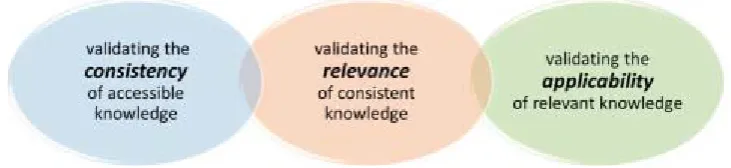
Our approach to validation embraces this epistemological stance, and involves people from the disciplines that were involved in the transdisciplinary knowledge creation process. The metaphysics part, however, takes a leap: we disregard the metaphysics. This true in terms of the technique, even though it is not true in principle. What we mean by this is that those who were involved in the transdisciplinary knowledge creation process will have some metaphysical principles adopted tacitly, so there is an emerging metaphysics underlying the new transdisciplinary knowledge, we only suggest not waiting to start the validation until we have a fully formed explicit metaphysics. The three steps of the validation process that we propose can be seen on Figure 2 (Dörfler et al., 2017; Velencei, Baracskai, et al., 2016).
[image:7.595.115.481.498.582.2]
(Source: Velencei, Baracskai, et al., 2016)
Figure 2: The three phases of validation.
convincing enough; the new knowledge does not need to be fully organized, it is not necessary to understand all the elements of it and all the relationships between all the elements, it can contain some unknowns and even some contradictions, as long as the validators can make sense of it. We have found the above conceptualisation of ‘happiness in the metropolis’ consistent; we have achieved this through many hours of discussion between those who created this concept.
Once the new transdisciplinary knowledge is accepted as consistent by the validators, they need to engage in examining its relevance. Validating relevance is concerned with whether the new transdisciplinary knowledge describes the phenomenon we are interested in. Relevance does not require a complete description of the phenomenon of interest, it will typically help the sensemaking process by highlighting the phenomenon or a detail of it from a particular perspective which is relevant for the validators. In our example, we were interested if the ‘happiness in the metropolis’ describes the coffee shop experience of the future, picturing those young people sitting in front of the coffee shop in the streets of New York, there is little to no noise, as the electric cars are silent, so they can talk, their coffee smells and palates better, as the air is not full of the smoke from cars. We want to emphasise, that this is a generic description of the phenomenon, nearly all the details are missing. We only need as much to distinguish it from e.g. a coffee shop experience in a rural village.
It the validators find the new transdisciplinary knowledge relevant, it is time to look at its applicability. Examining the applicability will focus on the specifics of the particular phenomenon and the involved stakeholders. This means, that we cannot do this on our own, unless we focus on our own coffee shop experience. Otherwise, we need to involve e.g. those young New Yorkers we talked about before. Perhaps they need the smell of the cars or the noise to think better. It is likely that any new meta-knowledge will relate to a plethora of phenomena, so there could be many rounds of applicability validation.
For simplicity we presented our three-step validation process as linear, which is not the case in reality. When examining relevance, we may achieve a clearer sensemaking of the meta-knowledge, and thus may need to go back to examining consistency. When validating applicability we may need to go back to relevance or even consistency. However, if the meta-knowledge is consistent, there will be some phenomena to which it is relevant, and it will certainly be applicable to some particular instances. Following the logic of abduction, often we are looking for cases for which the meta-knowledge is valid.
6 Supporting validation with knowledge-based expert system
(Baracskai et al., 2007; Baracskai et al., 2005; Baracskai et al., 2014; Velencei, Arany, et al., 2016; Velencei & Baracskai, 2017). Here we use Doctus to build a knowledge base that incorporates the new transdisciplinary knowledge and we demonstrate how this knowledge base can be used for validating the consistency, the relevance and the applicability of this meta-knowledge.
Examining consistency by building a knowledge base may appear to lack purpose to the uninitiated eye. What matters is whether this new transdisciplinary knowledge makes sense to the validators representing the disciplines involved in the transdisciplinary knowledge creation process. The phenomenon of interest does not appear in this knowledge base explicitly, although it will affect the mind of the validators, so it is implicitly present. In a sense, we could say that Doctus here is a validation tool, particularly as we introduced various consistency checking functions. By building a knowledge base for validating consistency of the new transdisciplinary knowledge, we create a conceptual model.
The conceptual model will be used as a starting point for examining the relevance. We start by asking the question whether this conceptual model is relevant to the phenomenon of interest. At the beginning of this process, Doctus does not function so much as a modelling tool; it is mainly used as a presentation tool. Those who are interested in the phenomenon (apart from the researchers involved in the creation of the new transdisciplinary knowledge this may also involve others, such as decision makers), look at one or more conceptual models, and they judge whether any of the conceptual models may be relevant to the phenomenon at hand. Sometimes it even works the other way around, when they see a particular conceptual model, they recognize a phenomenon or a decision problem to which it is relevant, or even go back to a particular conceptual model later on, when they face a decision and recall that they have seen a conceptual model that could be relevant. Another important thing happens here: although we have not started to model the particular phenomenon yet, by engaging with the conceptual model(s), the validators often start seeing the phenomenon differently. After the initial recognition, Doctus becomes a modelling tool once again; the validators fine-tune the conceptual model to include aspects of the phenomenon, although at this point this happens at a fairly generic level. By fine-tuning the conceptual model, a descriptive model emerges.
shifting between the big picture and the detail, consider the various stakeholders (who correspond to different dimensions of the context), and look at the phenomenon from various perspectives. This is an iterative learning process, through which the validators often manage to articulate expectations that were deeply buried in their tacit knowledge as, by looking at the picture that is still forming, they become explicitly aware of some tacit components. This phenomenon is called ‘knowledge discovery’, and is perhaps the most valuable contribution of building knowledge bases. The process of validating applicability should result in a useful knowledge base for the phenomenon at hand; we call this an applied model.
7 Concluding remarks
In this paper, we painted an approximate picture of how knowledge creation would happen as a mono-, multi-, inter- or transdisciplinary undertaking. We particularly focused on the transdisciplinary aspect, as the other three are better understood. We propose that the unique contribution of transdisciplinary knowledge creation is new knowledge created beyond the disciplines. New knowledge in this ‘no man’s land’ (or ‘no birds air’ to maintain the metaphor of birds in cages) we call meta-knowledge. Beyond conceptualising meta-knowledge we also discussed what problems we face with meta-knowledge, and we proposed a three-step validation process and illustrated how such validation can be supported using a knowledge-based expert system.
References
Baracskai, Z., Dörfler, V. and Velencei, J., (2007) "The ES Could Probably Know More - But Man Would Not Make Better Business Decisions", VIPSI 2007 Bled, 8-11 October, 2007, Bled, Slovenia.
Baracskai, Z. and Velencei, J., (2002) "Important Characteristics for a Knowledge Engineer", 12th Annual Conference of Business Information Technology, 6-7 November, 2002, Manchester, UK: 1-5.
Baracskai, Z., Velencei, J. and Dörfler, V., (2005) "Reductive Reasoning", Montenegrin Journal of Economics, Vol. 1 No. 1, pp. 59-66.
Baracskai, Z., Velencei, J., Dörfler, V. and Szendrey, J., (2014) "The Tunnel of Doctus KBS: The Deeper You Get the Darker It Is", OFEL 2014: 2nd International OFEL Conference on Governance, Management and Entrepreneurship, 4-5 April, 2014, Dubrovnik, Croatia: 397-407.
Dörfler, V. and Ackermann, F., (2012) "Understanding Intuition: The Case for Two Forms of Intuition", Management Learning, Vol. 43 No. 5, pp. 545–564.
Dörfler, V., Baracskai, Z. and Velencei, J., (2010) "Understanding Creativity", Transactions on Advanced Research, Vol. 6 No. 2, pp. 18-26.
Dörfler, V., Baracskai, Z., Velencei, J. and Stierand, M., (2017) "Personal Decisions: It’s All about Knowledge Validation", INISTA 2017: IEEE International Conference on INnovations in Intelligent SysTems and Applications, 3-5 July 2017, Gdynia, Poland.
Dörfler, V. and Eden, C., (2014) "Understanding ‘Expert’ Scientists: Implications for Management and Organization Research", AoM 2014: The 74th Annual Meeting of the Academy of Management, 1-5 August 2014, Philadelphia, PA.
Handy, C., (1998) The Hungry Spirit: Beyond Capitalism – A Quest for Purpose in the Modern World, Arrow Books, London, UK.
Maslow, A.H., (1971/1993) The Farther Reaches of Human Nature, Penguin Compass, London, UK.
Nicolescu, B., (2002) Manifesto of Transdisciplinarity, State University of New York Press, Albany, NY.
Nicolescu, B., (2010) "Methodology of Transdisciplinarity: Levels of Reality, Logic of the Included Middle and Complexity", Transdisciplinary Journal of Engineering & Science, Vol. 1 No. 1, pp. 19-38.
Nicolescu, B., (2014) "Methodology of Transdisciplinarity", World Futures, Vol. 70 No. 3-4, pp. 186-199.
Pirsig, R.M., (1974/1989) Zen and the Art of Motorcycle Maintenance: An Inquiry into Values, Vintage, London, UK.
Pirsig, R.M., (1992) Lila: An Enquiry into Morals, Bantam Books, New York, NY.
Polányi, M., (1962/2002) Personal Knowledge: Towards a Post-Critical Philosophy, Routledge, London, UK.
Polányi, M., (1966/1983) The Tacit Dimension, Peter Smith, Gloucester, MA.
Popper, K.R., (1979) Objective Knowledge: An Evolutionary Approach (revised ed.), Oxford University Press, New York, NY.
Pyrko, I., Dörfler, V. and Eden, C., (2017) "Thinking Together: What Makes Communities of Practice Work?", Human Relations, Vol. 70 No. 4, pp. 389-409.
Taleb, N.N., (2012) Antifragile: Things that Gain from Disorder, Penguin Books Limited, London, UK.
System), in Vállalkozásfejlesztés a XXI Században (Vol. 6), ed. C.-K. Ágnes, Óbudai Egyetem, Budapest, Hungary, pp. 459-472.
Velencei, J. and Baracskai, Z., (2017) Decision Maker in the Global Village: Thinking Together, in Knowledge Management Initiatives and Strategies in Small and Medium Enterprises, ed. A. Bencsik, IGI Global, Hershey, PA, pp. 25-41.
Velencei, J., Baracskai, Z., Dörfler, V. and Stierand, M., (2016) "Supporting the Competent Practitioner: Transdisciplinary Coaching with a Knowledge-Based Expert System", International Journal of Management Science and Business Administration, Vol. 2 No. 12, pp. 20-27.