City, University of London Institutional Repository
Citation
:
Clare, A., Motson, N., Sapuric, S. and Todorovic, N. (2014). What impact does a change of fund manager have on mutual fund performance?. International Review ofFinancial Analysis, 35, pp. 167-177. doi: 10.1016/j.irfa.2014.08.005
This is the accepted version of the paper.
This version of the publication may differ from the final published
version.
Permanent repository link:
http://openaccess.city.ac.uk/7572/Link to published version
:
http://dx.doi.org/10.1016/j.irfa.2014.08.005Copyright and reuse:
City Research Online aims to make research
outputs of City, University of London available to a wider audience.
Copyright and Moral Rights remain with the author(s) and/or copyright
holders. URLs from City Research Online may be freely distributed and
linked to.
City Research Online: http://openaccess.city.ac.uk/ [email protected]
What impact does a change of fund manager
have on mutual fund performance?
Andrew Clarea,*,
Nick Motsona,
Svetlana Sapuricb,
and
Natasa Todorovica
aThe Centre for Asset Management Research,
The Sir John Cass Business School, City University, 106 Bunhill Row, London EC1Y 8TZ, UK.
bUniversity of Nicosia, 46 Makedonitissas Avenue, Nicosia, Cyprus.
This version: July 2014
___________________________________________________________________________
Abstract
Using a unique database of UK fund manager changes over the period from 1997 to 2011, we examine the impact of such changes on fund performance. We find clear evidence to suggest that a manager change does affect the benchmark-adjusted performance of UK mutual funds. In particular we find a significant deterioration in the benchmark-adjusted returns of funds that were top performers before the manager exit and, conversely, a significant improvement in the average benchmark-adjusted returns of funds that were poor performers before the manager exit. Our use of the Carhart’s (1997) four-factor model reveals that the improvement in average post manager exit performance is accompanied by a reduction in market risk, a slight reduction in exposure to small cap stocks, and an increase in exposure to value and momentum stocks. Overall, our results suggest that UK fund management companies have been relatively successful in replacing bad managers with better managers, but relatively unsuccessful at finding equivalent replacements for their top performing managers. We believe that regulators should therefore try to ensure that all efforts are made by fund management companies to inform all of their investors about a change in management.
ugh individual investors m
JEL classification: G0; G14; G20
Keywords: UK mutual fund performance; fund manager exit
___________________________________________________________________________
*Corresponding author. Tel.: +44 207 040 5169. E-mail addresses: [email protected] (Clare),
[email protected] (Motson), [email protected] (Sapuric), [email protected]
2 1. Introduction
There is a great deal of empirical evidence that suggests that active fund managers cannot produce
alpha1. However, these results are generally based upon fund data, rather than on the performance
of an individual fund manager. In other words, calculating an alpha using ten years of monthly
return data associated with, for example, the ABC North American Equities Mutual fund, often
leads one to the conclusion that the alpha is both economically and statistically indistinguishable
from zero, and often that it is negative. So any investor that had invested in this fund would
probably have been better off investing in a passive North American equities mutual fund. The
related conclusion with regard to this result is that the manager responsible for managing the fund
did not demonstrate any investment skill. But over ten years the fund may have had more than one
manager. Any one of these managers might have had investment skill, but when averaged over
time with one or more managers that did not have skill, the impression is that all fund managers do
not have any active investment skill worth paying for. However, it is possible that there are
managers with skill, but that these managers may move frequently as they are poached by other
fund management groups, taking their skill with them; skill that is lost when viewed at the fund
level.
In this paper we investigate the impact of manager turnover on the performance of UK mutual funds
using event study methodology. We construct a unique sample of 921 UK fund manager changes
over the period January 1997 to December 2011. Fund performance is examined up to 36 months
before and after the fund manager exit. This paper attempts to fill the gap in the literature by
offering the first comprehensive study of the effect of fund manager changes on the performance of
equity and fixed income UK mutual funds.
3 To understand more fully the role that fund managers play in generating returns, there has been an
increasing focus in the academic literature on the fund manager rather than on the fund. A number
of researchers have identified the negative impact that manager turnover has on a mutual fund’s
subsequent performance. Khorana (1996) examines a sample of 339 US mutual funds that
experienced manager turnover in the period 1976-1992 and finds that the replacement of an
incumbent manager on average leads to two years of significant underperformance. The study also
finds that performance nearer to the replacement date has a significant impact on the probability of
a manager replacement. Chevalier and Ellison (1999) corroborate the negative manager
change/performance relationship and find it particularly pronounced among poorly performing
younger managers. More recently, Dangl, Wu and Zechner (2008), develop a theoretical model of
the fund management industry and use it to focus on the reasons for the replacement of portfolio
managers. The model implies that the probability of a manager replacement increases with the
inferiority of past performance (in line with empirical evidence in Khorana, 1996 and Chevalier and
Ellison, 1999) and decreases with manager tenure in the fund. In addition, if the tenure of the fired
manager is short, the model predicts a change in fund flows and risk profile before (outflows and
high risk) and after (inflows and lower risk) the replacement. These predictions are weaker (even
inverse) if the replaced manager has a longer management tenure.
Khorana (2001) finds that the replacement of US fund managers with superior pre-turnover
performance causes a drop in median objective adjusted fund returns from 1.9% one year before the
turnover to only 0.4% three years post-change. Conversely, managers replacing the worst
performers improve the median objective adjusted fund returns by 2.9% in the same period.
Gallagher and Nadarajah (2004) focus on the change in the performance, risk and flow activity of
Australian equity, fixed income and balanced funds pre- and post-top management2 replacement in
the period 1991-2001. They find that following the replacement of a top performing manager that
4 there is a reversal in performance for both outperformers and underperformers; the idiosyncratic
risk increases prior to the turnover; and that funds exhibiting poor pre-turnover performance are
penalised by lower flows. More recently Bessler et al (2012) show that both fund flows and
manager turnover (in combination and independently) explain the mean reverting nature of mutual
fund performance. In the sample of 3,946 active US equity mutual funds spanning the period from
1992 to 2007, they find that for winners, high inflows have a stronger negative impact on long-term
performance than the manager change, while jointly these two mechanisms reduce Carhart’s (1997)
four factor alphas by 3.6% per year compared to winner funds with neither of the two effects
present. For loser funds, the impact of the joint manager turnover and fund flows mechanism is
more pronounced. When both manager replacement and outflow occurs in the loser funds, their
risk-adjusted performance improves by 2.4% per year relative to a subgroup of loser funds where
neither of the mechanisms operates.
The findings of the studies on changes in fund performance before and after manager replacement
suggest that ‘star’ fund managers may often be replaced by less competent ones leading to
deterioration in performance; conversely, those managers replacing poorly performing managers
tend to improve the performance of the fund. These results support the hypothesis that manager
turnover is one of the reasons for the absence of long-term mutual fund performance persistence. It
has been found that performance does persist over horizons of up to three years, particularly for
poor performing funds, as documented for US mutual funds by Brown and Goetsmann (1995) and
Blake and Morey (2000). In the context of manager replacements, one possible explanation for
short-term performance persistence is suggested by Dangl, Wu and Zechner (2008). Specifically,
the studies on manager replacement do not, indeed cannot, separate the contribution of the manager
and the contribution of the management company to a fund’s performance. Therefore, even though
5 immediately because it may be partly driven by the company’s know-how. The converse might be
true when a poorly performing manager leaves.
Overall, the evidence from previous studies of mutual fund manager turnover tends to suggest that it
has a detrimental impact on subsequent performance, at least a short-term term. However, to our
knowledge all of the existing studies of this phenomenon have so far been conducted using US
equity mutual fund data.
The main result in our paper is the finding of very strong evidence to suggest that a manager change
does have a significant positive impact on benchmark-adjusted fund returns. Our use of the
four-factor Carhart model reveals that the improvement in average post manager exit performance is
accompanied by a reduction in market risk, a slight reduction in exposure to small cap stocks, and
an increase in exposure to value and momentum stocks. We also find evidence of a significant
deterioration in the benchmark-adjusted returns of funds that were top performers before the
manager exit and, conversely a significant improvement in the average benchmark-adjusted returns
of funds that were poor performers before the manager exit. These results suggest that UK fund
management companies have been relatively successful in replacing bad managers with better
managers, but relatively unsuccessful at finding equivalent replacements for their top-performing
managers. The rest of this paper is organised as follows: in section 2 we describe our data and
methodology; in sections 3 and 4 we present our results; and finally in section 5 we summarise the
results in the paper.
2. Data and Methodology
To determine the impact of a manger change on the subsequent performance of a fund we use the
event study methodology to examine the relationship between mutual fund performance in the pre
6 2.1 Event definition
The definition of event in this paper is a change (replacement/resignation/retirement/other) of a
fund manager. Although a standard event study would employ daily data, we believe that it is
reasonable to assume that the effect of manager change would not be observed over days, but rather
over a longer period. The performance of the fund is gauged three years before the event date and
three years after the event date, which constitutes the event window of 36 months prior to the event
and 36 months after the event. Such a pre-event time period is chosen following Khorana (2001),
who advocates that funds which experience a management turnover have at least two years of
performance history before the management replacement month. Furthermore, Hendricks et al
(1993), Goetzmann and Ibbotson (1994) and Brown and Goetzmann (1995) all find evidence of
performance persistence in mutual funds over a horizon of one to three years.
2.2 Selection criteria for managers and data sources
The sample of managers and funds they manage was identified using Morningstar, Citywire3 and
the Financial Express Database. These databases cover UK mutual funds and provide information
on fund management structures, investment objectives, fund benchmarks, fund managers’
characteristics and other fund characteristics. Furthermore, the Morningstar and Standard & Poor’s
data sources provide us with information of manager replacements from January 1997 to December
2011. Choosing 2011 as the end year in our sample allows us to analyse the manager change
impact over a three year period following any change. A breakdown of the manager exit sample is
presented in Table 1.
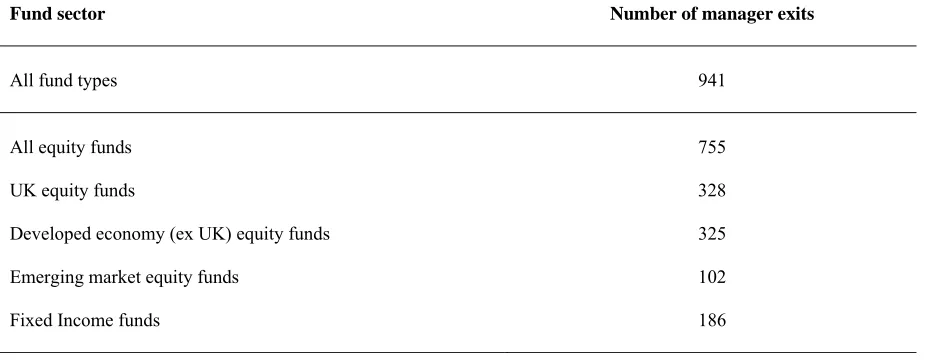
7 Table 1: Fund manager exits
This table contains a breakdown of the manager exits in our sample of funds over the period January 1997 to December 2011. These manager exits identified using predominantly Morningstar and Standard & Poor’s data, augmented by data from Citywire and Financial Express. These databases all cover UK mutual funds and provide information on fund management structures, investment objectives, fund benchmarks, fund managers’ characteristics and other fund characteristics.
Fund sector Number of manager exits
All fund types 941
All equity funds 755
UK equity funds 328
Developed economy (ex UK) equity funds 325 Emerging market equity funds 102 Fixed Income funds 186
The full sample includes both surviving and non-surviving funds and consists of 941fund manager
changes in total. 755 of the managers that leave their funds manage equity funds. Of this total 328
managed UK equity funds, 325 managed developed economy (ex UK) equity funds and 102
managed emerging market equity funds. Of the total 941 manager changes in our database 186
managed fixed income funds.
The price data for the funds and for their respective benchmarks was obtained from Morningstar
and covers the period from January 1994 (36 months prior to the first manager change in our
sample) to June 2014 (36 months after the last manager change in our sample). All of the funds in
which the change occurred were managed by a single manager, rather than by a team4. The
Morningstar database identifies single manager and team managed funds. Our focus on single
manager managed funds should give a more precise idea of the impact of any manager change.
4 We excluded team managed funds as we would expect the effect of a change of the composition of a team to be less
8 2.3 Normal and abnormal performance
The performance of the funds before and after the event date is measured using the
benchmark-adjusted model. We provide results for: all equity fund manager exits (Table 2); UK equity
managed fund manager exits (Table 3); developed economy (ex UK) fund manager changes (Table
4); emerging market equity fund manager changes (Table 5); and fixed income fund manager
changes (Table 6). For all manager exits and for each sample of these changes, we also
sub-divide the pre-exit performance of all funds and each sub-sample into either performance deciles or
into quintiles (depending upon the size of the sub-sample). By subdividing the data in this way we
hope to see whether the exit of, for example, a top performing manager had a different impact on
the subsequent performance of that fund compared with the exit of relatively poorly performing
manager from another fund.
The traditional event study methodology based on the market model requires that α’s and β’s are
estimated in a preliminary stage of the process. However, we concur with the views of Cremers et
al (2012), Argon and Ferson (2006) or Angelidis et al (2013), who all argue that it is more
informative and useful for investors and researchers if the performance of mutual fund managers is
measured against a passive benchmark which is closely aligned to a fund’s objectives and its risk
return parameters. A dedicated passive benchmark should provide a more accurate and more
appropriate estimate of a manager’s value-added skill. Given this, for our analysis we use the
benchmark-adjusted return model. This model can be thought of as a restricted market model
where α is equal to zero and where β is equal to one. We calculate benchmark-adjusted abnormal
returns as follows:
bt it
it R R
9 whereARitis the Abnormal Return of fund i in period t, Ritis the actual return of fund i in period t
and Rbt is the actual return of the benchmark for fund i in period t. We use the benchmark index
defined by the investment objectives of a fund to calculateRbt. The information on fund
benchmarks is obtained from Morningstar, Citywire, S&P database or from fund fact sheets. t in
equation 1 represents event time, the manager exit occurs at t=0. In our analysis we define 36 to
t-1 (inclusive) as the pre-event window and t+t-1 to t+36 as the post event window.
We then use these ARs to eliminate any fund-specific bias by calculating Average Abnormal
Returns (AARs hereafter) for the whole sample and for any sub-sample of the funds, j:
n
i it
jt AR
n AAR
1 1
(2)
where n is the number of funds for which the change of a fund manager has occurred. Additionally,
we also calculate Cumulative Average Abnormal Returns (CAARs) for various event windows of
size k, and for different groups of funds (j) as follows:
1
11
k
t
jt
jt AR
CAAR (3)
We present the CAARs in graphical form.
2.4 Test statistics
Our tests focus on the average AARs produced by the funds over pre- and post-exit periods, where
10 quartiles, depending upon the size of the sample of funds5. The statistical significance of the
various AARs that we calculate are based upon the test proposed in Brown and Warner (1985):
j j
σ
0 AAR
t (4)
where AARj is the average AAR produced by the jth group of funds over either a pre-event
window from t-k to t-1, or the post event window from t+1 to t+k, where k is the event window; and
where jis the standard deviation of the AARs produced by the same set of j funds estimated over
a comparable, pre-event period of k months:
1 )
( 2
1
k
AAR
AAR j
t
k t
jt
j
(5)Equation (4) can tell us whether the average abnormal returns produced by a set of funds is
statistically different from zero or not, over any event window so that we can establish, for example,
whether funds that experience a fund manager exit then go on to produce significant, above
benchmark returns in subsequent periods.
We also employ another test which addresses a different, but related question. By comparing the
pre- and post-exit average AARs of any set of j funds we can establish whether manager exits
change the performance of the funds relative to their pre-exit performance. To do this we use the
standard t-test for the comparison of two means as follows:
5 In preliminary work we also calculated similar test statistics focussing on the CAARs of the funds, but the results were
11
Var AAR Var AAR k
AAR AAR t -1 t to k t j, k t to 1 t j, -1 t to k t j, k t to 1 t j, / ) ( ) (
(6)
Effectively we subtract the average pre-event AARj, t1 to tk from the equivalent post event
k t to 1 t j,
AAR sing the same event window k in both cases and then by calculating the variances of
these two sets of average returns we construct a t-test to establish whether the two means are
insignificantly different from one another. A positive and significant t-value indicates that average
returns were higher in the post-exit period than in the comparable pre-exit period.
2.5 Regression Analysis
It is well-documented in the literature that investing in small-capitalisation stocks (see for instance
Banz, 1981), value stocks (see Fama and French, 1992, among others) and winners (as in Jegadeesh
and Titman, 1993) earns higher risk-adjusted returns. It is possible then that a change in manager is
accompanied by a change in factor exposures. To add more insight into the factors that might be
playing a part in any change in performance following a manager exit we estimate a panel version
of Carhart’s (1997) four-factor model6 for all of the equity funds in our sample. In order to
determine the impact of a manager change, we enhance the basic model with both intercept and
slope dummy variables, as shown in equation (7):
t i jt j D j jt j j D i i ft t
i R F F
R 4 ,
1 4 1 , ) (
(7)where Ri,tis the return on fund i in period t; t represents event time spanning 36 months before and
after the manager change, where the manager change occurs at t=0; Rftis the risk free rate in period
t;
iis an intercept; Fjt represents the four factors of the Carhart model; j is an OLS coefficientand in a panel setting represents the average sensitivity of the funds in the panel to the jth Carhart
6Hausman test is used to confirm the choice of a fixed compared with a random effects panel model. The chi-squared
12 factor. The four factors are: the excess return on the market (Rm,t Rf,t), where Rm,tis the return
on a proxy for the market portfolio; Fama and French’s (1993) size (SMB) and style (HML) factors;
and Carhart’s (1997) momentum factor (MOM) factor. We then define a dummy variable, D,
which takes the value of 0 for the period t-36 to t=0 and the value of 1 for the period t=1 to t=36.
D i
is a step dummy variable constructed as (i D)and D j
is an OLS coefficient on the
transformed factors, where the factors have been transformed as follows (DFjt). The intercept
dummy D i
provides a test for whether there is a significant improvement (or deterioration) in the
performance of funds following a manager change. The D j
coefficients allow us to examine
whether a new manager changes a fund’s exposure to the market, size, value or momentum risk
factors. Since 427 out of 755 of the equity funds in our sample have an international focus (either
developed markets (ex UK) or emerging markets), we use global Fama-French-Carhart factors7 in
the above model for these funds. For the 328 UK Equity Funds we apply Fama-French-Carhart UK
equivalent factors calculated by Gregory, Tharayan and Christides (2013)8. Since these factors are
only relevant for equity funds only, we limit this regression analysis to the 755 equity funds in our
sample.
3. Results
We apply the methodology described in section 2 to the returns of funds that have experienced a
manager exit. Table 1 shows the decomposition of fund manager exits by both broad asset category
(equity and fixed income funds) and by equity fund sub-categories (UK equity, Global developed
equity (ex UK) and Emerging equity market funds).
7 Downloadable from http://mba.tuck.dartmouth.edu/pages/faculty/ken.french/data_library.html
13 3.1 All equity fund manager exits
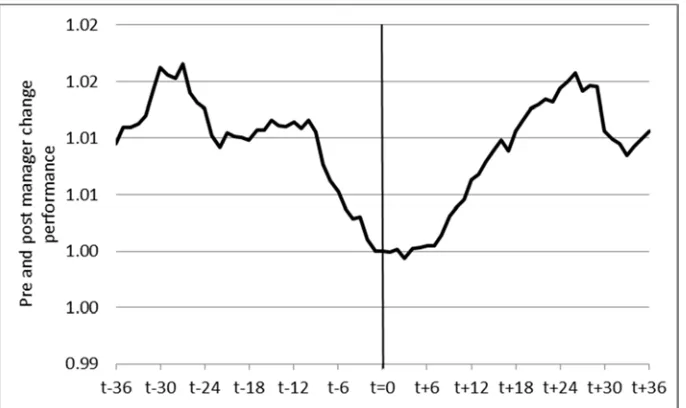
Figure 1 provides a simple, graphical summary of the cumulative 36 month, pre- and post-exit
performance of all equity funds that have suffered a manager exit over the sample period. The
graph is rebased to 1 at t=0; t-36 to t=0 shows the cumulative performance over this pre-manager
[image:14.612.137.480.255.459.2]exit period, while t=0 to t+36 shows the cumulative performance after the manager change.
Figure 1: All equity funds
This figure shows the cummulative abnormal performance of all UK equity mutual funds that have experienced a manager exit over the period from January 1997 to December 2011. The horizontal axis represents event time; the manager exit occurs at t=0. The index of cumulative performance (vertical axis) is set equal to 1 at t=0.
The chart shows that the CAAR of this set of funds up to the manager exit was around -1.0%, which
means that on average this set of managers underperformed their benchmarks in the lead up to a
manager change. This is perhaps unsurprising and suggests that the predominant reason for a
manager exit is poor performance. However, perhaps surprisingly the chart also shows that, on
average, investors in these funds benefited from benchmark outperformance of up to 2.0% over the
24 months following the exit; but only around 1.0% after 36 months. These results are also
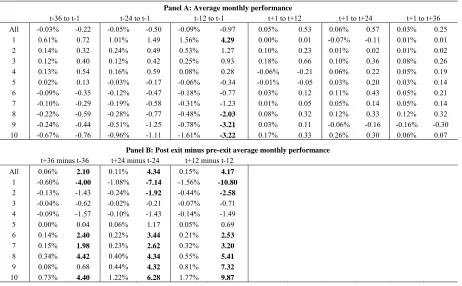
presented in Panel A of the first row of Table 2. In this row we present the AARs for all equity
mutual funds in our sample over six sample periods, three pre-exit and three post-exit. The
associated t-statistics test the hypothesis that the performance of these funds is significantly
14 sample periods is found to be insignificantly different from zero. For example, the average monthly
performance of the funds between t=1 and t=12 (inclusive) is 0.05%, but the associated t-statistic of
[image:15.612.78.540.284.570.2]0.53, indicates that this is insignificantly different from zero.
Table 2: All equity funds
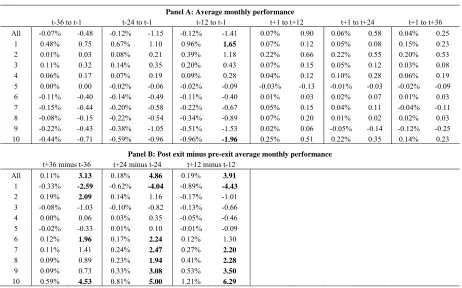
This table presents the pre- and post-exit average monthly performance of all those equity mutual funds in the sample that experienced a manager exit between January 1997 and December 2011. The month of the manager exit is set to t=0. In Panel A the column headings refer to the event window used to calculate the average monthly returns and the associated statistic to establish whether the average is significantly different from zero (see equation 4). Those t-statistics that indicate significance at at least the 90% level of confidence are highlighted in bold for ease of reference. Each row in Panel A presents the results for all equity funds, and the results for the pre-exit performance deciles. These deciles were formed by calculating the pre-exit performance of each fund over the 12 months prior to the manager exit. The top ten per cent of funds comprise the decile 1, the next ten per cent decile 2, etc. The final three columns in the panel present the average returns of these same performance-ranked deciles of funds after the manager exit. Panel B in the Table presents the average monthly performance difference between all funds and the deciles, over three event windows. The associated t-statistics test for a significant difference between the post-exit and pre-exit average monthly performance (see equation 6).
Panel A: Average monthly performance
t-36 to t-1 t-24 to t-1 t-12 to t-1 t+1 to t+12 t+1 to t+24 t+1 to t+36 All -0.03% -0.22 -0.05% -0.50 -0.09% -0.97 0.05% 0.53 0.06% 0.57 0.03% 0.25
1 0.61% 0.72 1.01% 1.49 1.56% 4.29 0.00% 0.01 -0.07% -0.11 0.01% 0.01
2 0.14% 0.32 0.24% 0.49 0.53% 1.27 0.10% 0.23 0.01% 0.02 0.01% 0.02 3 0.12% 0.40 0.12% 0.42 0.25% 0.93 0.18% 0.66 0.10% 0.36 0.08% 0.26 4 0.13% 0.54 0.16% 0.59 0.08% 0.28 -0.06% -0.21 0.06% 0.22 0.05% 0.19 5 0.02% 0.13 -0.03% -0.17 -0.06% -0.34 -0.01% -0.05 0.03% 0.20 0.03% 0.14 6 -0.09% -0.35 -0.12% -0.47 -0.18% -0.77 0.03% 0.12 0.11% 0.43 0.05% 0.21 7 -0.10% -0.29 -0.19% -0.58 -0.31% -1.23 0.01% 0.05 0.05% 0.14 0.05% 0.14 8 -0.22% -0.59 -0.28% -0.77 -0.48% -2.03 0.08% 0.32 0.12% 0.33 0.12% 0.32 9 -0.24% -0.44 -0.51% -1.25 -0.78% -3.21 0.03% 0.11 -0.06% -0.16 -0.16% -0.30
10 -0.67% -0.76 -0.96% -1.11 -1.61% -3.22 0.17% 0.33 0.26% 0.30 0.06% 0.07
Panel B: Post exit minus pre-exit average monthly performance
t+36 minus t-36 t+24 minus t-24 t+12 minus t-12 All 0.06% 2.10 0.11% 4.34 0.15% 4.17
1 -0.60% -4.00 -1.08% -7.14 -1.56% -10.80
2 -0.13% -1.43 -0.24% -1.92 -0.44% -2.58
3 -0.04% -0.62 -0.02% -0.21 -0.07% -0.71 4 -0.09% -1.57 -0.10% -1.43 -0.14% -1.49 5 0.00% 0.04 0.06% 1.17 0.05% 0.69 6 0.14% 2.40 0.22% 3.44 0.21% 2.53
7 0.15% 1.98 0.23% 2.62 0.32% 3.20
8 0.34% 4.42 0.40% 4.34 0.55% 5.41
9 0.08% 0.68 0.44% 4.32 0.81% 7.32
10 0.73% 4.40 1.22% 6.28 1.77% 9.87
It is very possible of course that the performance of a fund after a manager has left will be heavily
influenced by the quality of the manager that left. It was not possible to discern the reason for a
manager exit from our databases mainly because fund management groups have a tendency to paint
any manager exit in as positive a light as possible! Most of the related press statements gave no
15 exit of a ‘good’ manager might have a different impact on the post-exit performance of a fund than
the exit of a ‘bad’ manager. To explore this possibility we split the sample of equity funds into
performance deciles. We created a top performing decile of funds that comprised the 10% of the
sample with the highest average pre-exit performance (from t-12 to t-1); the next decile comprised
the 10% of funds with the next best average performance over this period, etc. In Panel A of Table
2, we have presented the pre and post exit performance of each of these deciles. By construction
the table shows that decile 1 outperformed their benchmarks before the exit and that this
outperformance gradually declines as we move from decile 1 to 10. For example, we find that the
average monthly return of deciles 1 and ten over the 36 months prior to the exit event, is 0.61% and
-0.67% respectively. For both the 36 month and 24 month pre-exit periods, the t-statistics lead us to
conclude that this average, pre-exit benchmark-adjusted performance is nearly always
indistinguishable from zero. However, this is not the case when we consider the 12 month period
before the exit. First the average outperformance of those managers that comprise decile 1 is found
to be highly statistically significant. Second, the average underperformance of managers that
comprise deciles, 8, 9 and 10 is found to be statistically significant.
Of more interest, however, is the post-exit performance of these funds. The columns in Panel A of
Table 2 headed t+12, t+24 and t+36 present the post-exit, average performance of the deciles
respectively, along with the statistical significance of this performance in the respective, adjacent
columns. Over the first 12 months decile 1, produces an average underperformance of 0.00%.
Indeed most of the other deciles either produce an economically small outperformance over this
period, or underperform. But overall, the average outperformance for all equities is 0.05% over
this period. It is clear where this comes from when we focus on decile 10. The average
benchmark-adjusted performance of decile ten is estimated to be 0.17% over the first twelve
months; however, the associated t-statistic of 0.33 indicates that this result is not statistically
16 also not found to be statistically significant. These results suggest that over the first 12 months
following a manager exit, fund performance tends to deteriorate for most funds, but tends to
improve in those instances where the manager was a bottom decile performer prior to the exit.
Panel B of Table 2 presents answers to a different question. Using equation 6 we test for a
significant change in the pre- and post-exit performance of all funds and each decile of funds. The
column headed “t+36–t-36”, compares 36 month post-exit performance with 36 month pre-exit
performance. The columns headed “t+24–t-24” and “t+12–t-12” compare performance over
equivalent 24 and 12 month periods. The associated t-statistics are based on equation 6, and
essentially test whether the average pre- and post-exit performances are significantly different from
one another. Essentially we are asking whether there has been a change in the benchmark-adjusted
performance of the funds following a manager exit. The t-statistics in the first row of Panel B
shows that there is indeed a positive structural change in the benchmark-adjusted performance of
UK mutual funds following a manager exit over all three event sample periods. For example over
the 12 months following a manager exit, on average, investors are 0.15% per month than they were
over the 12 months prior to the exit. However, when we consider the performance deciles we find
that those investors in deciles 1 to 4 experience a decline in performance over all three sample
periods. When comparing the 12 months before and after the manager exit, those investors in decile
1 experience an average deterioration of 1.56% per month over the 12 post-exit months; a result that
is found to be highly statistically significant. At the other end of the scale investors in decile 6 to 10
all experience a statistically significant improvement in monthly performance over the 12 post exit
months, ranging from 0.21% per month to 1.77% per month for decile 10. The positive relative
improvement in all funds shown in the first row of Panel B of Table 2, indicates that on average the
post-exit deterioration in performance of funds that were performing well before the manager exit is
more than offset by the post-exit improvement in the performance of managers that were
17 The results in this section apply to all of the equity funds in our sample, but it is possible that the
results presented here were influenced by the equity sectors in which the managers operated. In
sections 3.2 to 3.4, we apply the same manager exit analysis to UK equity, Developed Economy
equity (ex UK) and emerging market funds.
3.2 UK equity fund manager exits
In Figure 2 we present the post exit performance of all 328 UK equity funds, the performance and
[image:18.612.137.477.359.568.2]statistics of this set of funds is presented in Table 3.
Figure 2: UK equity funds
This figure shows the cummulative abnormal performance of all those UK mutual funds comprising UK equities that have experienced a manager exit over the period from January 1997 to December 2011. The horizontal axis represents event time; the manager exit occurs at t=0. The index of cumulative performance (vertical axis) is set equal to 1 at t=0.
The figure shows that over the 36 months prior to the manager exit the average,
benchmark-adjusted cumulative performance was -2.80% so, on average these managers were underperforming
their benchmarks before they left their funds. The average post-exit performance is very similar to
that for all equity funds shown in Figure 1. Over the 36 post-exit months the average,
benchmark-adjusted performance is just over 1.5%. This result suggests that on average, investors in UK
18 Table 3 indicates that both the pre- and post-exit performance over all three event windows, is never
[image:19.612.76.538.267.555.2]significantly different from zero at conventional confidence levels.
Table 3: UK equity funds
This table presents the pre- and post-exit average monthly performance of all those equity mutual funds in the sample that experienced a manager exit between January 1997 and December 2011. The month of the manager exit is set to t=0. In Panel A the column headings refer to the event window used to calculate the average monthly returns and the associated statistic to establish whether the average is significantly different from zero (see equation 4). Those t-statistics that indicate significance at at least the 90% level of confidence are highlighted in bold for ease of reference. Each row in Panel A presents the results for all UK equity funds, and the results for the pre-exit performance deciles. These deciles were formed by calculating the pre-exit performance of each fund over the 12 months prior to the manager exit. The top ten per cent of funds comprise the decile 1, the next ten per cent decile 2, etc. The final three columns in the panel present the average returns of these same performance-ranked deciles of funds after the manager exit. Panel B in the Table presents the average monthly performance difference between all funds and the deciles, over three event windows. The associated t-statistics test for a significant difference between the post-exit and pre-exit average monthly performance (see equation 6).
Panel A: Average monthly performance
t-36 to t-1 t-24 to t-1 t-12 to t-1 t+1 to t+12 t+1 to t+24 t+1 to t+36 All -0.07% -0.48 -0.12% -1.15 -0.12% -1.41 0.07% 0.90 0.06% 0.58 0.04% 0.25
1 0.48% 0.75 0.67% 1.10 0.96% 1.65 0.07% 0.12 0.05% 0.08 0.15% 0.23
2 0.01% 0.03 0.08% 0.21 0.39% 1.18 0.22% 0.66 0.22% 0.55 0.20% 0.53 3 0.11% 0.32 0.14% 0.35 0.20% 0.43 0.07% 0.15 0.05% 0.12 0.03% 0.08 4 0.06% 0.17 0.07% 0.19 0.09% 0.28 0.04% 0.12 0.10% 0.28 0.06% 0.19 5 0.00% 0.00 -0.02% -0.06 -0.02% -0.09 -0.03% -0.13 -0.01% -0.03 -0.02% -0.09 6 -0.11% -0.40 -0.14% -0.49 -0.11% -0.40 0.01% 0.03 0.02% 0.07 0.01% 0.03 7 -0.15% -0.44 -0.20% -0.58 -0.22% -0.67 0.05% 0.15 0.04% 0.11 -0.04% -0.11 8 -0.08% -0.15 -0.22% -0.54 -0.34% -0.89 0.07% 0.20 0.01% 0.02 0.02% 0.03 9 -0.22% -0.43 -0.38% -1.05 -0.51% -1.53 0.02% 0.06 -0.05% -0.14 -0.12% -0.25 10 -0.44% -0.71 -0.59% -0.96 -0.96% -1.96 0.25% 0.51 0.22% 0.35 0.14% 0.23
Panel B: Post exit minus pre-exit average monthly performance
t+36 minus t-36 t+24 minus t-24 t+12 minus t-12 All 0.11% 3.13 0.18% 4.86 0.19% 3.91
1 -0.33% -2.59 -0.62% -4.04 -0.89% -4.43
2 0.19% 2.09 0.14% 1.16 -0.17% -1.01
3 -0.08% -1.03 -0.10% -0.82 -0.13% -0.66 4 0.00% 0.06 0.03% 0.35 -0.05% -0.46
5 -0.02% -0.33 0.01% 0.10 -0.01% -0.09
6 0.12% 1.96 0.17% 2.24 0.12% 1.30
7 0.11% 1.41 0.24% 2.47 0.27% 2.20
8 0.09% 0.89 0.23% 1.94 0.41% 2.28
9 0.09% 0.73 0.33% 3.08 0.53% 3.50
10 0.59% 4.53 0.81% 5.00 1.21% 6.29
However, once again the first row of Panel B in Table 3 shows that there was a highly statistically
significant positive improvement in 12, 24 and 36 month post exit performance. For example, the
average performance of the UK equity funds over the 12 months following the manager exit was
0.19% per month higher than the average over the 12 months prior to the exits; the t-test of 3.91,
19 Panels A and B of Table 3 also present the performance statistics for the UK equity fund pre- and
post-exit performance deciles. The positive performance for all funds from t+1 to t+12 is again
heavily dominated by decile 10’s performance. The average benchmark outperformance of the
worst pre-exit performers between t+1 and t+12 is 0.25%. However, the performances pre- and
post-exit, over all event periods, are rarely found to be statistically different from zero. However,
Panel B of the table indicates again that post-exit performance is significantly different from the
pre-exit performance for all funds, over all three event window comparisons. The results for decile
1 indicate a significant deterioration in the performance of the funds that were top performers
before the manager exit of -0.89% per month, while at the other extreme we find that deciles 7 to 10
(particular for the 12 month comparator) produce improved performance which is statistically
significant following the manager exits over all three monitoring periods. The results for the mutual
funds consisting of UK equities are therefore qualitatively similar to those results presented for all
equity funds in Table 2.
3.3 Developed economy equity fund manager exits (ex UK)
In Figure 3 we present the average pre- and post-exit performance for the subset of funds comprised
of developed economy equities (ex UK). Over the 36 month period prior to the manager exits the
funds produce an average, cumulative benchmark-adjusted performance of around -1.0%. The
pre-exit performance is also less stable, perhaps reflecting the mix of equity funds represented in the
sample. The figure also shows that the average post-exit performance is again positive; after 20
20 Figure 3: Global developed equity funds (ex UK)
This figure shows the cummulative abnormal performance of all those UK mutual funds comprising developed economy equities (ex UK) that have experienced a manager exit over the period from January 1997 to December 2011. The horizontal axis represents event time; the manager exit occurs at t=0. The index of cumulative performance (vertical axis) is set equal to 1 at t=0.
The first row in Panel A of the Table 4 shows that the post-exit performance is not statistically
significantly different from the performance of the benchmarks. However, row 1 of Panel B in the
Table 4 indicates that the post-exit performance is an improvement on the equivalent pre-exit
performance though only significantly so for the 24 and 12 month comparators. For example, the
average 12 month outperformance of the funds after the exits compared with before the exits is
0.16%, where the associated t-ratio for the test of the difference in the two means is 2.53.
Table 4 also contains the performance of the fund deciles. The post-exit performance of decile 10 is
the largest contributor to the positive average presented in row 1 of Panel A. Panel B shows that
there is a significant post-exit improvement in the performance of managers that managed funds in
the bottom two pre-exit performance deciles. This improvement is also evident for the funds that
comprise deciles 6 to 8 too, over 12 and 24 months after the manager exit. These results again
indicate that the manager exit is a significant event for a mutual fund, with top performing funds 0.99
1.00 1.00 1.01 1.01 1.02 1.02
t‐36 t‐30 t‐24 t‐18 t‐12 t‐6 t=0 t+6 t+12 t+18 t+24 t+30 t+36
Pr
e
and
Pos
t
ma
n
ager
ch
an
ge
pe
rf
or
m
an
21 suffering from poorer performance after the manager leaves and the bottom performers enjoying an
improvement in performance.
Table 4: Developed economy equity funds (ex UK)
This table presents the pre- and post-exit average monthly performance of all those developed economy equity mutual funds (ex UK) in the sample that experienced a manager exit between January 1997 and December 2011. The month of the manager exit is set to t=0. In Panel A the column headings refer to the event window used to calculate the average monthly returns and the associated t-statistic to establish whether the average is significantly different from zero (see equation 4). Those t-statistics that indicate significance at at least the 90% level of confidence are highlighted in bold for ease of reference. Each row in Panel A presents the results for all developed economy equity funds (ex UK), and the results for the pre-exit performance deciles. These deciles were formed by calculating the pre-exit performance of each fund over the 12 months prior to the manager exit. The top ten per cent of funds comprise the decile 1, the next ten per cent decile 2, etc. The final three columns in the panel present the average returns of these same performance-ranked deciles of funds after the manager exit. Panel B in the Table presents the average monthly performance difference between all funds and the deciles, over three event windows. The associated t-statistics test for a significant difference between the post-exit and pre-exit average monthly performance (see equation 6).
Panel A: Average monthly performance
t-36 to t-1 t-24 to t-1 t-12 to t-1 t+1 to t+12 t+1 to t+24 t+1 to t+36 All -0.03% -0.14 -0.04% -0.22 -0.10% -0.67 0.05% 0.36 0.05% 0.25 0.02% 0.09
1 0.72% 0.62 1.23% 1.32 1.96% 3.35 0.01% 0.01 -0.16% -0.17 -0.14% -0.12
2 0.26% 0.51 0.40% 0.78 0.71% 1.92 0.20% 0.54 0.03% 0.05 0.05% 0.10
3 0.04% 0.07 0.11% 0.19 0.30% 0.65 0.11% 0.23 0.01% 0.01 0.02% 0.03 4 0.19% 0.32 0.21% 0.33 0.06% 0.12 -0.09% -0.18 -0.02% -0.03 0.04% 0.06 5 0.09% 0.20 -0.07% -0.16 -0.09% -0.20 0.12% 0.26 0.08% 0.17 0.10% 0.22 6 -0.17% -0.39 -0.15% -0.39 -0.21% -0.47 0.02% 0.04 0.12% 0.32 0.07% 0.15 7 -0.19% -0.33 -0.22% -0.35 -0.36% -0.92 0.03% 0.07 0.15% 0.23 0.09% 0.15 8 -0.35% -0.68 -0.40% -0.75 -0.53% -1.89 0.06% 0.21 0.14% 0.26 0.12% 0.23 9 -0.29% -0.42 -0.54% -0.80 -0.87% -1.49 0.04% 0.07 -0.18% -0.27 -0.27% -0.38 10 -0.39% -0.36 -0.62% -0.52 -1.50% -1.79 -0.09% -0.11 0.31% 0.26 0.11% 0.10
Panel B: Post exit minus pre-exit average monthly performance
t+36 minus t-36 t+24 minus t-24 t+12 minus t-12 All 0.04% 1.08 0.09% 1.89 0.16% 2.53
1 -0.86% -3.98 -1.39% -6.18 -1.95% -8.30
2 -0.21% -1.54 -0.37% -2.06 -0.51% -1.90
3 -0.02% -0.17 -0.10% -0.70 -0.20% -1.05 4 -0.16% -1.35 -0.23% -1.59 -0.15% -0.93 5 0.01% 0.10 0.15% 1.26 0.21% 1.21
6 0.24% 2.22 0.27% 2.22 0.23% 1.46
7 0.28% 2.22 0.37% 2.30 0.39% 2.41
8 0.47% 3.89 0.54% 3.85 0.59% 3.96
9 0.02% 0.16 0.36% 2.00 0.91% 4.09
10 0.50% 2.21 0.93% 3.10 1.40% 4.75
3.4 Emerging market equity fund manager exits
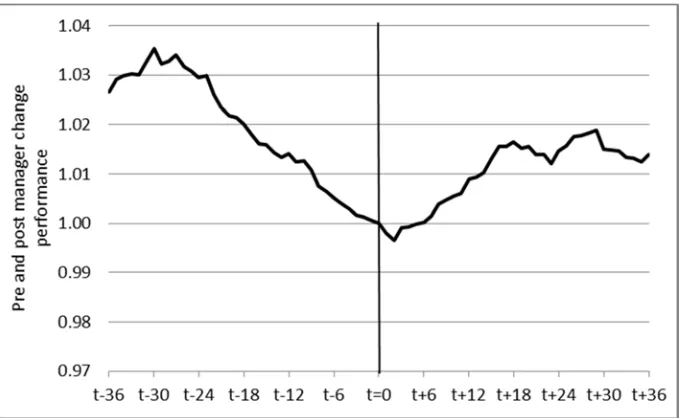
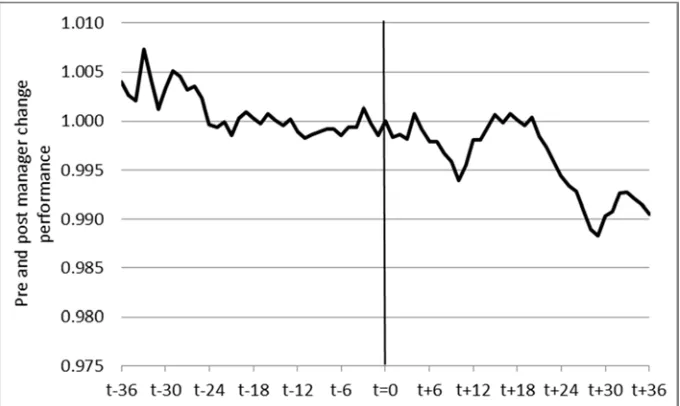
Figure 4 and Table 5 presents the results for the emerging market funds in our data set. Figure 4
appears to be quite different from figures 1, 2 and 3. As Figure 4 shows, the average pre-exit
performance is positive over the 36, 24 and 12 month periods leading up to a manager exit. In other
words the average manager of emerging market equities was ahead of benchmark before their exit.
This result possibly explains why the average post-exit performance is approximately 0.00% over
22 or post-exit managers do not produce a benchmark-adjusted performance that is significantly
different from zero over any timeframe. However, in contrast to the results in tables 2, 3 and 4, the
first row of panel B in the table indicate that on average, there is no significant structural break that
[image:23.612.137.478.243.444.2]occurs following an emerging equity manager exit.
Figure 4: Emerging market equity funds
This figure shows the cummulative abnormal performance of all those UK mutual funds comprising emerging market equities that have experienced a manager exit over the period from January 1997 to December 2011. The horizontal axis represents event time; the manager exit occurs at t=0. The index of cumulative performance (vertical axis) is set equal to 1 at t=0.
Because the sample of funds is relatively small, rather than splitting their pre- and post-exit
performance into pre-exit performance deciles, instead we split the performance into pre-exit
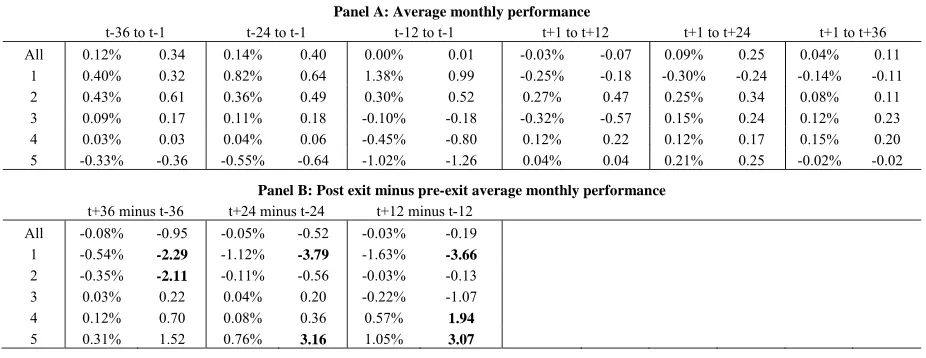
performance quintiles. Although Panel A of Table 5 shows that generally the performance of
outperforming funds prior to a manager exit deteriorates after the exit and that the converse is true
for underperforming funds, the results in this Panel show that these average performance statistics
are never statistically significant from zero over any performance sample.
The t-statistics in Panel B of the table indicate that there is a significant structural break in the
performance of quintile 1 over all three periods analysed. For example, on average investors in
quintile 1 suffer a deterioration in performance of -0.54% per month over the 36 post-manager exit
months, compared to the 36 months prior to the exit. At the other end of the scale we find that 0.92
0.94 0.96 0.98 1.00 1.02 1.04
t‐36 t‐30 t‐24 t‐18 t‐12 t‐6 t=0 t+6 t+12 t+18 t+24 t+30 t+36
Pr
e
and
pos
t
ma
na
ge
r
ch
ange
pe
rf
o
rm
an
23 investors in quintile 1 would have experienced an average improvement in performance of 1.05%,
0.76% and 0.31% over the 12, 24 and 36 month post exit months compared to the equivalent
pre-exit months; although we only find these averages to be statistically different from one another over
[image:24.612.75.538.312.491.2]the 12 and 24 month periods.
Table 5: Emerging market equity funds
This table presents the pre- and post-exit average monthly performance of all those emerging market equity mutual funds in the sample that experienced a manager exit between January 1997 and December 2011. The month of the manager exit is set to t=0. In Panel A the column headings refer to the event window used to calculate the average monthly returns and the associated t-statistic to establish whether the average is significantly different from zero (see equation 4). Those t-statistics that indicate significance at at least the 90% level of confidence are highlighted in bold for ease of reference. Each row in Panel A presents the results for all emerging market equity funds, and the results for the pre-exit performance quintiles. These quintiles were formed by calculating the pre-exit performance of each fund over the 12 months prior to the manager exit. The twenty per cent of funds comprise quintile 1, the next twenty per cent quintile 2, etc. The final three columns in the panel present the average returns of these same performance-ranked quintiles of funds after the manager exit. Panel B in the Table presents the average monthly performance difference between all funds and the quintiles, over three event windows. The associated t-statistics test for a significant difference between the post-exit and pre-exit average monthly performance (see equation 6).
Panel A: Average monthly performance
t-36 to t-1 t-24 to t-1 t-12 to t-1 t+1 to t+12 t+1 to t+24 t+1 to t+36 All 0.12% 0.34 0.14% 0.40 0.00% 0.01 -0.03% -0.07 0.09% 0.25 0.04% 0.11
1 0.40% 0.32 0.82% 0.64 1.38% 0.99 -0.25% -0.18 -0.30% -0.24 -0.14% -0.11 2 0.43% 0.61 0.36% 0.49 0.30% 0.52 0.27% 0.47 0.25% 0.34 0.08% 0.11 3 0.09% 0.17 0.11% 0.18 -0.10% -0.18 -0.32% -0.57 0.15% 0.24 0.12% 0.23 4 0.03% 0.03 0.04% 0.06 -0.45% -0.80 0.12% 0.22 0.12% 0.17 0.15% 0.20 5 -0.33% -0.36 -0.55% -0.64 -1.02% -1.26 0.04% 0.04 0.21% 0.25 -0.02% -0.02
Panel B: Post exit minus pre-exit average monthly performance
t+36 minus t-36 t+24 minus t-24 t+12 minus t-12 All -0.08% -0.95 -0.05% -0.52 -0.03% -0.19
1 -0.54% -2.29 -1.12% -3.79 -1.63% -3.66
2 -0.35% -2.11 -0.11% -0.56 -0.03% -0.13
3 0.03% 0.22 0.04% 0.20 -0.22% -1.07
4 0.12% 0.70 0.08% 0.36 0.57% 1.94
5 0.31% 1.52 0.76% 3.16 1.05% 3.07
3.5 Fixed income fund manager exits
The performance of fixed income mutual funds is much neglected in the academic literature,
although there are some notable exceptions. Given that one would expect the performance of fixed
income and equity funds to be of a different scale we have separated the 186 fixed income funds
that experienced a manager exit over the sample period from the equity funds. Figure 5 shows the
average pre- and post-exit performance of the fixed income funds in our sample. The profile and
scale is very different from the one identified for developed economy equities. On average the
24 post-exit assessment period the abnormal performance was very flat; after 36 post-event months the
[image:25.612.137.477.178.381.2]average cumulative underperformance is -0.10%.
Figure 5: Fixed income funds
This figure shows the cummulative abnormal performance of all those UK mutual funds comprising fixed income securities (bonds) that have experienced a manager exit over the period from January 1997 to December 2011. The horizontal axis represents event time; the manager exit occurs at t=0. The index of cumulative performance (vertical axis) is set equal to 1 at t=0.
Row 1 in Panel A of Table 6 shows that the average pre and post-exit performance is both
economically small and is insignificant different from zero. The first row of Panel B in Table 6 also
suggests that on average there is no significant change in pre- and post-exit performance; a result
that is in contrast to the results for the equity funds in our sample.
Panel A shows that the average returns of the deciles across all of the event window periods are
almost never significantly different from zero (the one exception being the 12 month pre-manager
exit average for decile 10). However, when we consider the post-exit performance with the pre-exit
performance we again find that the manager exit has had a significant impact on the performance
extremes. However, Panel B shows that there is a significant deterioration in the performance of
decile 1 over all three sample periods. For example, the average return for this decile of funds is
0.46% lower in the 36 months after the manager exits than it was in the 36 months before the exits.
25 other end of the scale, over all three sample periods, we find that there is an average improvement
in performance after the manager exit for deciles 8 to 10. For example, for decile 10 the average
performance improvement during the first 12 months following the manager exit compared to the
[image:26.612.75.538.334.619.2]12 months prior to the exit is 1.04% per month, a result that has an associated t-value of 3.70.
Table 6: Fixed income funds
This table presents the pre- and post-exit average monthly performance of all those fixed income mutual funds in the sample that experienced a manager exit between January 1997 and December 2011. The month of the manager exit is set to t=0. In Panel A the column headings refer to the event window used to calculate the average monthly returns and the associated statistic to establish whether the average is significantly different from zero (see equation 4). Those t-statistics that indicate significance at at least the 90% level of confidence are highlighted in bold for ease of reference. Each row in Panel A presents the results for all fixed income funds, and the results for the pre-exit performance quintiles. These quintiles were formed by calculating the pre-exit performance of each fund over the 12 months prior to the manager exit. The twenty per cent of funds comprise quintile 1, the next twenty per cent quintile 2, etc. The final three columns in the panel present the average returns of these same performance-ranked quintiles of funds after the manager exit. Panel B in the Table presents the average monthly performance difference between all funds and the quintiles, over three event windows. The associated t-statistics test for a significant difference between the post-exit and pre-exit average monthly performance (see equation 6).
Panel A: Average monthly performance
t-36 to t-1 t-24 to t-1 t-12 to t-1 t+1 to t+12 t+1 to t+24 t+1 to t+36 All -0.01% -0.07 0.00% 0.01 0.01% 0.08 -0.02% -0.15 -0.02% -0.24 -0.03% -0.17
1 0.44% 0.47 0.79% 0.90 1.14% 1.58 -0.30% -0.41 -0.22% -0.26 -0.02% -0.02 2 0.26% 0.38 0.32% 0.48 0.40% 0.65 0.24% 0.38 0.08% 0.11 0.09% 0.13 3 0.04% 0.09 0.13% 0.31 0.14% 0.29 0.13% 0.27 0.11% 0.28 0.04% 0.10 4 -0.07% -0.23 -0.06% -0.16 0.00% 0.01 0.03% 0.07 0.00% 0.00 0.01% 0.03 5 0.01% 0.02 -0.03% -0.05 -0.06% -0.21 0.05% 0.17 0.01% 0.01 0.00% 0.01 6 -0.11% -0.40 -0.03% -0.15 -0.11% -0.53 -0.23% -1.10 -0.12% -0.62 -0.12% -0.44 7 0.02% 0.01 -0.29% -0.37 -0.17% -0.31 -0.10% -0.17 -0.14% -0.18 -0.12% -0.11 8 -0.35% -0.68 -0.26% -1.05 -0.33% -1.38 -0.12% -0.49 -0.10% -0.41 -0.06% -0.12 9 -0.28% -0.53 -0.42% -0.85 -0.60% -1.31 0.01% 0.03 0.03% 0.05 -0.07% -0.13 10 -0.17% -0.22 -0.43% -0.61 -0.92% -2.06 0.11% 0.26 0.23% 0.32 0.08% 0.10
Panel B: Post exit minus pre-exit average monthly performance
t+36 minus t-36 t+24 minus t-24 t+12 minus t-12 All -0.02% -0.45 -0.02% -0.72 -0.02% -0.44
1 -0.46% -2.35 -1.01% -4.42 -1.44% -4.93
2 -0.17% -1.04 -0.25% -1.20 -0.16% -0.50
3 0.00% 0.04 -0.01% -0.11 -0.01% -0.06
4 0.08% 1.19 0.06% 0.59 0.03% 0.18
5 -0.01% -0.06 0.03% 0.22 0.11% 0.85
6 -0.01% -0.14 -0.09% -1.27 -0.12% -1.07
7 -0.14% -0.65 0.14% 0.70 0.08% 0.32
8 0.29% 2.97 0.16% 2.50 0.21% 2.26
9 0.21% 1.90 0.45% 3.78 0.61% 3.79
10 0.25% 1.43 0.66% 3.19 1.04% 3.70
4. Changing factor exposures
The results from our event study presented in section 3 of this paper show that a manager change,
26 regressions based on equation (7) for each set of equity funds in our sample: All equity funds, UK
equities, Global Developed (ex UK) and Emerging Markets. The second column in Table 7
presents the regression results for all of the equity funds in our sample. The positive and highly
statically significant value estimated for the coefficient on D indicates that even in the presence of
the four risk factors that there is an average improvement in post manager exit alpha of 0.15% per
month over the three years following an exit. The coefficients on the transformed risk factors
(superscript D) indicate a significant decline in exposure to the market and a significant increase
exposure to the value (HML) and momentum (MOM) factors. The negative value for the
coefficient on SMBD indicates a reduction in exposure to small stocks, but the coefficient is found
to be both economically small (-0.02) and insignificantly different from zero. The changes in the
exposures to alpha and the risk factors for UK equities shown in column 3 are almost identical to
those found for all equity funds. However, the coefficients on the transformed variables are
smaller. For example, we find a significant improvement in post manager exit alpha of 0.10% per
month as opposed to the 0.15% per month for all equity funds. Furthermore, although the
coefficient on SMBD is still economically small (-0.03) it is now statistically significant. In column
4 in the Table we present the results for the Global Developed (ex UK) equity funds. The results
for these funds are broadly consistent with those of the UK equities fund sample, but we find a
more economically significant shift to the value and Momentum factors. This is most notable in the
former where the coefficient on HMLD is found to be 0.24%. The results for the Emerging market
equities funds are different from the results for the other funds. First we estimate that the change in
manager had, on average, a negative impact on subsequent fund alpha, although this result is not
significant at conventional confidence levels. Second, there is a slight, but again insignificant,
increase in exposure to the market factor. Finally, there is an increase in exposure to the small stock
27 Table 7: Impact of manager change on fund risk factors
This table reports the results of the estimation of equation (7) in the text:
t i jt j j jt j j i i ft t
i R F F
R 4 ,
1 * 4 1 * , ) (
For an explanation of the equation please see the related text in section 2.5. The first column in the table presents the variables in equation (7). The rows in the table Market, SMB, HML and MOM refer to the Carhart factors; the superscript D refers to the transformed version of the variable, where the transformation is achieved by multiplying the variable by a dummy variable D, which takes the value of 0 between t=-36 to t=0 and 1 from t=1 to t=36. Columns 2 to 5 present the coefficient values on the variables listed in column 1 for: All equity funds; UK equity funds; Global Developed (ex UK) funds; and Emerging Market funds respectively. We used global FF-Carhart risk factors for all samples (see footnote 7 in the text), except for the UK equities fund sample where we used UK equivalents (see footnote 8 in the text). The superscripts *, ** and *** denote the statistical significance of each coefficient at the 1%, 5% and 10% level respectively. The number of funds that made up the regression in each case is shown in the penultimate row of the table, while the R2 of each regression is presented in the last row of the table.
Variable All funds UK
Global Developed (ex UK)
Emerging Markets
)
(
-0.04*** -0.13* -0.15* 0.72* )(
D0.15* 0.10* 0.10*** -0.08
Market 0.87* 0.98* 0.85* 0.81* MarketD -0.06* -0.02* -0.07* 0.03
SMB 0.24* 0.30* 0.18* 0.24* SMBD -0.02 -0.03* -0.02 0.14**
HML -0.11* -0.06* -0.16* -0.40* HMLD 0.10* 0.09* 0.24* 0.13**
MOM -0.03* 0.04* -0.03* 0.02
MOMD 0.06* 0.03* 0.08* 0.02
Number of funds 755 328 325 102 R-squared 0.58 0.78 0.52 0.43
5. Summary and conclusions
This paper examines how the performance of UK mutual funds is affected when the incumbent fund
manager leaves the fund. When we focus on all equity mutual fund manager exits in the UK, we
find a significant impact on the post-exit performance of funds. Over the first 12 months following
an exit the average fund outperforms its benchmark. These results therefore suggest that a manager
exit is good for a fund’s performance on average. However, closer inspection of the funds by
pre-manager exit performance decile/quintile reveals that a fund that is a top performer prior to an exit
tends to suffer significant performance deterioration as a result of the exit, while the performance of
28 performance of the pre-exit poor performers that drives the average result. Our disaggregated
results indicate that a manager exit tends to have a negative impact on funds that were performing
well before the exit, but a positive effect on those that were previously underperforming.
When we separated the funds by sector we found that the results for those funds comprising UK
equities and, separately, those funds containing developed economy equities (ex UK) were
qualitatively similar to the aggregated results. However, the results for the emerging market equity
funds are different from those of the developed equity equivalents. Monthly abnormal performance
was generally positive before the manager exits and, on average, was virtually zero over the 36
post-event months. In addition, the top performing quintile produces a significant negative
performance over the post event months, in contrast to the positive post-exit performance of the top
deciles of developed economy equity funds. Although the quintile results are based on a relatively
small sample, the results for all emerging equity funds are still produced by a large enough sample
(63) to draw meaningful conclusions. It is possible that the emerging market and developed
economy equity market exits had, on average, different roots. Developed economy managers
generally underperformed before an exit, emerging market managers generally outperformed. It is
possible that over the period studied here, when more and more investors were becoming interested
in investing in emerging markets, that there was a bidding war between fund management firms for
the best emerging market managers, while developed economy manager exits were largely driven
by underperformance.
We also examined the impact of a manager exit on the performance of UK mutual funds comprising
fixed income securities. The overall results for the bond funds are similar to those for the emerging
equity market funds: average pre-exit performance is positive (more so for the fixed income funds
than for the emerging equity market funds) and the post exit performance is flat, although this
29 a significant impact on the performance of funds that were performing well and those that were
performing relatively badly; the formers’ performance deteriorates while the latters’ improves
significantly.
Finally, our regression analysis supports and reinforces the event study analysis in this paper,
showing that on average the fund manager replacements in our sample benefited investors. Our
regression results show that the improvement in performance is accompanied by a reduction in
market risk, a slight reduction in exposure to small cap risk, and an increase in exposure to value
stocks (via the HML risk factor) and momentum stocks (via the MOM risk factor). These results
are consistent with those of other researchers, such as Asness, Moskowitz and Pedersen (2013),
who find that combining value and momentum strategies leads to higher risk-adjusted returns. The
main exception to these findings is the decline in manager alpha documented for emerging market
equity funds.
Overall, our results suggest that UK fund management companies have been relatively successful in
replacing bad managers with better managers, but relatively unsuccessful at finding equivalent
replacements for their top performing managers. As such, we believe that regulators should ensure
that all efforts are made by fund management companies to inform all of their investors about a
30
References
Angelidis, T., Giamouridis, D., Tessaromatis, N., (2013), Revisiting mutual fund performance evaluation. Journal of Banking and Finance, 37(5), 1759–1776.
Asness, C.J., Moskowitz T.J and L.H Pedersen, (2013), Value and Momentum Everywhere, Journal of Finance, 68, 929-985.
Banz, R.W., (1981), The Relationship between Return and Market Value of Common Stocks, Journal of Financial Economics, 9, 3-18.
Blake, C.R. and Morey M.R., (2000), Morningstar ratings and mutual fund performance, Journal of Quantitative and Financial Analysis, 35(03), 451-483.
Bessler, W., Blake, D., Lückoff, P. and Tonks, I., (2010). Why does mutual fund performance not persist? The Impact and Interaction of Fund Flows and Manager Changes, Pensions Institute discussion paper, PI-1009
Brown, S.J. and Goetzmann, W.N., (1995), Performance Persistence, Journal of Finance, 2, 679-699.
Brown, S.J., and Warner, J., (1985), Using daily stock returns: The case of event studies, Journal of Financial Economics,14, 3-31.
Carhart, M.M., (1997), On Persistence in Mutual Fund Performance, Journal of Finance, 1, 57-83.
Chevalier, J. and Ellison, G., (1999), Are Some Mutual Fund Managers Better Than Others? Cross-Sectional Patterns in Behavior and Performance, Journal of Finance, 3, 875-899.
Cremers, M., Petajisto, A., Zitzewtz, E., (2012). Should benchmark indices have alpha? Revisiting performance evaluation. Critical Finance Review, 2, 1-48.