City, University of London Institutional Repository
Citation:
Poirier, L. and Robinson, L. (2014). Informational balance: slow principles in the theory and practice of information behaviour. Journal of Documentation, 70(4), pp. 687-707. doi: 10.1108/JD-08-2013-0111This is the accepted version of the paper.
This version of the publication may differ from the final published
version.
Permanent repository link:
http://openaccess.city.ac.uk/6871/Link to published version:
http://dx.doi.org/10.1108/JD-08-2013-0111Copyright and reuse: City Research Online aims to make research
outputs of City, University of London available to a wider audience.
Copyright and Moral Rights remain with the author(s) and/or copyright
holders. URLs from City Research Online may be freely distributed and
linked to.
Informational balance: Slow principles in the theory and practice of information behaviour
Abstract
Purpose
The study investigates whether the principles of the Slow Movement may be applied to information behaviour.
Design / methodology / approach
The study uses three methods: a literature analysis and synthesis; a Delphi study; and a focus group. All are carried out in accordance with Slow principles, to assess the value of Slow in the conduct of the research itself.
Findings
Slow principles are applicable to both the theory and practice of information behaviour. They allow theory to be more realistic by encompassing a broader range of behaviours than those included in most models of information behaviour and information literacy,
particularly those involving temporal and experiential factors. The use of Slow principles in information practice may help to overcome problems relating to personal information management. The notion of ‘informational balance’ stems from Slow ideas and is a useful concept for theory and practice.
Research limitations / implications
The empirical parts of the study use small groups of participants, and the emphasis of the focus group in particular was on everyday information, rather than on professional or academic information. The results of the study show that research and theory in information behaviour would benefit form more explicit attention to time factors.
Practical implications
The findings may be used in the design of information literacy instruction, and in encouraging a more reflective approach to personal information management.
Originality / value
This is the first study to examine the applicability of Slow principles in an information context. It is also original in explicitly applying Slow principles to the research design.
Keywords
information behaviour; information seeking; time factors; Slow Movement; information literacy
Introduction
The rate at which information is accessed and used has accelerated alongside the increasing pace of life. There have been several analyses of the problems resulting from the rapid consumption of information, in relation to both the increased speed of provision and the increased scale of available resources: for example, Gleick (1999), Eriksen (2001), Tomlinson (2007) and Bawden and Robinson (2009, 2011a).
One response to the general increased pace of life has been the Slow Movement which has been described as “organized signs of dissatisfaction with the pace of life in developed industrial societies” (Tomlinson, 2007, p. 146). ‘Slow’ (with a capital S) can be traced to 1980s Italy, and specifically to the publication of the Slow Food Manifesto in 1989 (Petrini and Padovani, 2006). It has since grown beyond its core focus on food to become a generic term embracing a range of interests and ideas (Honoré, 2005). More than 100,000 members worldwide apply Slow principles to any area of life over which they feel they have lost control, engaging in purposeful reflection about choice. A variety of explicit applications of Slow ideas in various contexts, including Slow Cities, Slow Money, Slow Gardening, Slow Fashion, Slow Parenting, Slow Art, Slow Design, Slow Schools, Slow Science and Slow Travel have appeared. Since changes in communication and information dissemination are often considered to be a major part of the environment to which Slow is a reaction, it seems reasonable to consider explicitly the further extension of Slow principles to information.
However, consideration of the possible relationship between Slow principles and information research and practice has been limited, as set out below, and the study reported here is the first systematic and explicit examination of the topic. The aim of the study was to investigate how a Slow perspective can relate to, and impact upon, research and theorising about information behaviour. It was also intended to explore how a Slow approach may affect everyday information practices, and have the potential to alleviate problems relating to contemporary information environments. Given that the Slow Movement has been applied to all facets of everyday life, this study focused on everyday and ongoing information behaviour although its findings may also have relevance to information behaviour research in areas such as education, academia and the professions.
The research questions were:
• What is a Slow perspective in the context of information?
• What, if any, are the implications of a Slow perspective for the study and theory of
information behaviour?
• What, if any, are the implications of a Slow perspective for everyday information
practices?
There is no single body controlling the Slow Movement, and no canonical set of Slow principles. On the contrary, different Slow principles emerge in the different contexts to which the concept may be applied. To give three examples: Slow Food emphasises local, small-‐scale and ethical production, support for biodiversity, and priority to regional and traditional recipes; Slow Travel recommends methods of travel which promote a connection with the landscape being traversed, enjoying the journey for its own sake and even
resources, and support for classic products with a long lifetime, rather than following rapidly changing trends. It is therefore not possible to state a priori a detailed set of Slow principles applicable to information behaviour. However, we may take the following generic Slow principles, which seem to be applicable in all contexts where Slow has been applied, as a basis for investigation:
• Taking control of, and enjoyment in, any and all activities through mindful
experience and reflection, and the making of conscious choices
• Establishing a balance in all activities; often through re-‐establishing a balance that
has been lost or sidelined by pressures to act and consume quickly
• Acting as a rational consumer; dealing with the increasing number of ‘things’ (of very
diverse nature) available in greater number, and accessible more rapidly, by creating time and space to engage in consumer behaviour appropriate to the situation.
In short, these principles amount to guidelines for control of time and for control of consumer choice. There is some resonance here with Savolainen’s (1995) concept of
‘mastery of life’ in the context of everyday life information seeking; this reminds us that not all aspects of Slow are unique, and elements of the approach may be seen elsewhere, including in information contexts.
The very name makes clear that Slow principles are concerned with time, but by no means exclusively so. There is a constant theme in the Slow literature that the pace of life has accelerated, that this causes a pressure to act quickly in all situations, and that this in turn interrupts personal choice to the extent that critical thought is diminished, leaving little room for reflection and connection. But Slow is most certainly not just anti-‐speed: being Slow (i.e applying the principles of the Slow Movement) is not at all the same as being slow (i.e. doing what one was doing anyway, but less rapidly). Rather it is concerned with control: with how people can best “negotiate the different temporalities that they daily experience” (Parkins and Craig 2006, ix): that is to say with judging the right speed and tempo for the activity and the context, and with the contemplative attitude to consumption that this demands and promotes (Honoré, Parkins and Craig 2006). Therefore a study of Slow principles in any context will need to include time factors as a major issue, but will not be limited to them.
Study methods and summary findings
The study used three methods: a literature analysis and synthesis; a Delphi study of
information behaviour experts, using a novel Delphi variant developed for the purpose; and a focus group investigation of Slow practitioners. The methods are described below,
together with a brief summary of the results for each. The results and their significance are discussed more fully in the Discussion sections. Methods and results are described and discussed in full in Poirier (2012).
constructivist argument that “we are part of the world we study and the data we collect” (Charmaz 2006, p. 10); this paralleling the Slow principle of connection, encapsulated. The study methods allowed more critical reflection on the part of both research and research participants than would be norm for a study of this sort. This was achieved by, for example, building generous response windows in to the Delphi study, by providing thinking and writing breaks during the focus group, and by the researcher writing memos and using constant comparison techniques. Although such devices are not unique to a Slow perspective, taken together they amount to a Slow approach to research.
The study was intended to explore opinion rather than define consensus about fact, and so relied on substantial qualitative interpretation and synthesis by the researcher in order to construct meaning. In both the Delphi and the focus group, the researcher assumed an active moderating role. Some elements of constructivist grounded theory were used throughout the study as a means of structuring the process and verifying the qualitative interpretation (Charmaz, 2006). These included memo writing, thematic analysis and re-‐ analysis, and the constant comparison of data with those emerging themes. These elements were not, however, utilised with any intention of producing grounded theory per se.
1. Literature analysis and synthesis
A review of published material was undertaken, analysing literature with relevance to Slow perspectives. This encompassed a range of subjects beyond library and information science, and a range of formats beyond books and articles to include newspapers and web
resources. Materials were identified using subject databases, library catalogues and general web search engines, and by snowballing references and citations. Only a small proportion of relevant material made direct reference to time factors or other Slow points in the context of information behaviour. Although authors such as Gleick (1999) and Honoré (2005) exemplify increasing amounts of rapidly accessible information, they do not analyse the attendant issues or propose even tentative solutions. The remaining material for analysis was appraised qualitatively and conceptually so as to identify and synthesise themes and issues (Bawden, 2012), as discussed in due course.
A small number of pieces identified in the review do propose Slow solutions to information problems. Slow reading has received some attention (Miedema, 2009; Mikics 2013; Slow Movement, 2013b) as more than simple opposition to speed reading. Rather, it is described as the purposeful choice of appropriate reading tempo and an extension of close or critical reading. More generally, the Slow Media movement aims at sustainable media production and focused and attentive media consumption (Slow Media 2013). It is associated with controlled reduction of media intake, though various ‘slow media diets’, ‘information diets’ and ‘digital diets’ (Johnson 2012, Brabazon 2013). At the production end of the specifically academic information cycle, Cronin (2006, p. ix) suggests that “perhaps what academia needs now is a Slow Writing movement akin to the Slow Food, Slow Cities movement”, and later develops the idea that the pace of academic output must necessarily affect its quality (Cronin, 2013). Grafton (2010) writes in a similar vein that “Slow scholarship – like Slow Food – is deeper and more nourishing than the fast stuff”.
Slow searching has also been mentioned as a relevant concept. Dörk, Bennett and Davies (2013) suggests that an explicit treatment of time in the design and study of search interfaces can improve the understanding, and practice, of information seeking. They propose that the current understanding of search, as the rapid retrieval of facts, is at odds with higher-‐level exploratory search and with learning. It fails to capture the idea of investigating something over several separate search sessions and, by implication, the notion of an extended timeframe. Such an activity is purposeful, mindful and reflective. The authors recommend that ‘slow search spaces’ might support such behaviours, encouraging a steady browse through related items, and also that ‘journals of journeys’ might then allow an individual to track their searches more coherently than is currently possible through bookmarking and search history facilities.
Three Slow themes were identified from the literature which would inform the design and execution of the Delphi and the focus group: time as a factor in information behaviour; the conscious consumption of information; and problems or pathologies relating to
contemporary information environments.
1a. Time as a factor in information behaviour
Although, as noted above, Slow is not at all a matter of just not being fast, Slow principles are rooted in notions of time. Any consideration of Slow information behaviour must therefore must include, and should sensible begin with, temporal factors of information seeking and use.
Until recent years, time has been largely neglected in studies and theories of information behaviour, and arguably in the information sciences generally. Time naturally features in studies of information history; for example, Rayward’s (1996) consideration of Braudel’s historical rhythms for the history of information science. However, such studies do not generally address information behaviour per se. Time is also an intrinsic aspect of studies which investigate memory in relation to personal information management systems; for example, Elsweiler, Ruthven and Jones (2007). Tennis (2013) discusses metaphors for time factors in knowledge organization systems and indexing.
Case (2012, pp. 39-‐41) notes that time pressure, or the speed at which some information gathering processes must be completed, is one of the two most variable factors in different information seeking contexts. The other factor, the degree of thoroughness required, is related to the first since time constraints dictate the comprehensiveness of search, as well as the number and nature of sources consulted (Prabha, Connaway, Olszewski and Jenkins, 2007). A study of emergency response workers showed that their information foraging behaviour altered considerably over time as an incident unfolded and as time constraints varied (Osatuyi and Mendonca, 2013).
Information behaviour studies of decision making under time pressure have similarly and naturally regarded optimum speed as key, as in Allen’s (2011) study of police officers. The same may be said for many, particularly younger, library users for whom speed of access is of primary importance. In these contexts, this perceived primacy of speed results in library and information services being judged on their rate of information provision as a central aspect of convenience. Such judgments are discussed in, for example, Connaway, Dickey and Radford (2011) and Bawden and Vilar (2006).
Despite the relevance of time factors, they are mostly neglected in theories and models relating to information behaviour. As Allen (2011, p. 2168) states, “although the temporal aspects of information seeking are implicit within most models of information behaviour, they are rarely conceptualized and explicitly discussed”. More generally, “even though temporal factors occupy a prominent position among the contextual qualifiers of
information seeking, their conceptual nature has not so far been reflected in greater detail” (Savolainen, 2006a, p. 122). Only a quarter of the numerous models and theories in the compilation edited by Fisher, Erdelez and McKechnie (2005) mention time in any sense.
Though limited, there are some examples of time factors being considered in theories of information behaviour:
• A framework for information behavior research which, following Ranganathan,
identifies time as one of its facets (Sonnenwald and Livonen, 1999). Time periods are categorised as: a short period or ‘episode’; a longer period with a start and end point or ‘interval’; a long continuous period of time or ‘eon’. Hartel (2010) uses a similar structure in an information practice study of gourmet cooks, where ‘eon’ refers to the cook’s whole career, ‘interval’ to a subject within cookery, and ‘episode’ to the preparation of a specific dish
• A general theoretical framework for information seeking, including time as a factor
(Spink, Wilson, Ford, Foster and Ellis, 2002). The authors state explicitly that
information seeking may occur in discrete episodes over an extended period of time
• A theory of everyday life information practices, overtly situated in the temporal
context (Savolainen, 2008). Here, information activities may exist in a particular chronological sequence, they may be repeated regularly at particular times, and they also be governed by the time available
The only detailed conceptual analysis of temporal factors in information seeking published to date is that of Savolainen (2006a), who argues that although information needs and information seeking behaviour are tied to a particular moment in time, they both have past and future dimensions. He identifies three aspects:
• Time factors as contextual to information behaviour, with temporal aspects
integrated in the social and cultural backdrop
• Time factors as qualifiers of access to information, typically how rapidly information
is needed and the extent to which effective information seeking is hindered by time pressure
• Time factors as qualifiers of the information seeking process, typically as expressed
With respect to the last point, established models of information behaviour (such as Wilson, Ellis, and Kuhlthau) include time implicitly since one stage precedes another, but there is no specific acknowledgement of speed or duration (Savolainen, 2006a). Furthermore, this can be said of those models which describe cyclical, non-‐linear and feedback processes, and may also be true of the popular process models for information literacy (Bawden and Robinson, 2012, chapter 13).
1b. Consumption of information
Slow principles stem from a sense that the speed of contemporary culture diminishes the opportunity to make conscious, deliberate choices about what to consume. This can be seen as a consequence of bewildering variety or the ‘paradox of choice’ (Schwartz, 2004). In information terms, this can relate to the number of potential sources, in addition to the volume of information accessible through them and the speed of its communication. Regaining control and achieving rational consumption is a Slow ideal, and one which can be seen to relate to information as much as to food.
It has only recently been normal to consider information as a substance to be consumed, and to consider library and information service users as consumers of some kind. Indeed, the notion is still contested, as in Nicholas, Dobrowolski, Withey, Russell, Huntington and Williams (2003), Nicholas, Huntington, Williams and Dobrowolski (2006) and Jones (1998). The more established and related idea of media consumption has been quantified as the mark of an information society (Skogerbø and Syvertsen, 2004).
Even whilst it is realistic to speak of information being consumed, it is a particularly complex and dynamic form of consumption, as shown by studies such as that of Knorr Cetina (2010). Information consumers can, for example, simultaneously be seen as information producers, and information itself can therefore be seen as an example participatory consumption, or ‘prosumption’ (Beer and Burrows 2010, Ritzer and Jurgenson 2010). Information can be created and disseminated in ways unimaginable in even the recent past. Blogs, microblogs, forums, wikis, social media sites, comment functions in news media and public information sources make quick-‐fire dissemination possible. As with its consumption, the creation of information can be rapid, thoughtless, and aimless, as seen most obviously in concerns about the repercussions of hastily posted remarks on social media. Information creation may also therefore benefit from Slow principles, as suggested by the notions of Slow writing and Slow scholarship above.
A basic Slow approach to information consumption, and prosumption, would mean a careful, mindful and rational choice of sources. This overlaps with ideas of ‘craft consumption’, the modification of commercially available goods (Campbell, 2005), and ‘critical consumption’, a concern for the environmental consequences of choices made (Sassatelli and Davolio, 2010). This does not dictate that the Slow consumption of
information must proceed slowly since Slow, as noted above, relates more closely to choice and control than to speed per se. It may be, as shown above, appropriate and vital to spend short bursts of time on a particular episode of information use given that some
information seeking, and so too may be shallow, surface browsing. A ponderous, deliberative Slow approach may not always be appropriate, particularly at times when satisficing is a rational and purposeful information choice (Connaway, Olszewski and Jenkins, 2007).
1c. Problems or pathologies of information
There are problems associated with contemporary information environments for which Slow principles may provide or suggest solutions. These particular problems are rooted in ideas of overload, and encompass related ideas of anxiety, infobesity, and continuous partial attention (Bawden and Robinson, 2009; Case, 2012, chapter 5.4).
To some extent, these are contested concepts. Both participants and researchers have questioned the degree to which overload in particular is a real problem in, for example, Tidline (1999); Eppler and Mengis (2004); Savolainen (2008); and Bawden and Robinson (2009). However, there is also considerable evidence to suggest that such problems affect many people in very real and experienced ways, and numerous coping strategies have been devised to manage them (Savolainen, 2007; Bawden and Robinson, 2009; Koltay, 2011; Johnson, 2012). A distinction can be made between information which is ‘pushed’ at an individual (e.g. emails, social media updates) and that which is ‘pulled’ (e.g. database searches, browsing the web). Both forms of information can cause problems relating to overload and most broadly, the problems can be seen as symptoms of the loss of control of information. As with a Slow approach to more traditional forms of consumption, the coping strategies described in the above studies often entail regaining control over both push and pull elements of the information environment.
Developing better information and digital literacies have been suggested as further effective counters to such problems (Bawden and Robinson, 2009, 2011a; Johnson and Webber, 2006). Nevertheless, however beneficial these literacies may be, they do not in themselves necessarily encourage a reflective approach; indeed, it could be said that the more limited conceptions of information literacy which emphasise a stock of skills and competencies (Bawden 2001) may simply promote a more efficient fast information behaviour. This is not a bad thing in itself, but it seems to fall short of offering the wider understanding which may offer optimal control of information (see, for example, Lloyd 2010 and Limberg, Sundin and Talja 2012). The broader concept of digital literacy, which includes attitudes, perspectives and an understanding of information processes and sources, may be more relevant (Bawden 2008).
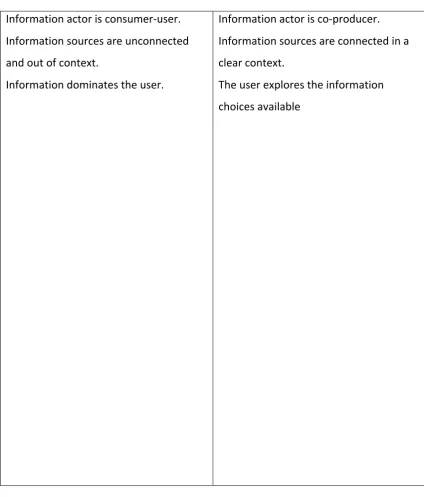
Finally, and considering all three themes, the analysis of the concepts presented in the set of literature analysed enabled the construction of a definition, and summary explanation, for two contrasting states which were used in the subsequent empirical studies, and termed ‘infomania’ and ‘infodiversity’. The former encompasses aspects of the multiple choices and emphasis on speed in the current information world. The latter outlines a set of the
negatively and infodiversity positively, ion order to generate the initial provocative position required by the Delphi process. They are set out in Table 1 below.
Take in Table 1 around here
Infomania Infodiversity
Definition
An imposed situation within the
Information Society, both individual and collective, where accelerated speed and abundant choice lead to anxiety and overload: practices and behaviour which support this situation
Genesis
Hyper-‐speed and hyper-‐choice are encouraged by information providers, sought by users and perpetuated by the academy: rooted in consumerism
Positive aspects
Breadth of sources Instant (remote) access Tangential connections
Negative aspects
Overload
Lack of (time for) quality control Unclear provenance
Other key points
Definition
A purposive situation, both individual and collective, where recognition of the natural tempo and subjective connection of information leads to reflexive,
sustainable and enjoyable seeking and use: practices which support this situation
Genesis
The individual is responsible for critically appraising the appropriateness of each information choice: rooted in
sustainability
Positive aspects
Provenance is central Personal connections
Flexible: fast can still be ‘good’
Negative aspects
Effort intensive
Idealistic / unrealistic / impractical Too subjective to easily formalise
Information actor is consumer-‐user. Information sources are unconnected and out of context.
Information dominates the user.
Information actor is co-‐producer. Information sources are connected in a clear context.
The user explores the information choices available
Table 1: Informania and Infodiversity
[image:12.595.66.491.62.560.2]
2. The Delphi study
This element of the larger study has been reported in detail elsewhere (Poirier and
Robinson, 2013), so a brief account is presented here. The Delphi was used to explore the implications of a Slow perspective for the study and theory of information behaviour, through the structured analysis of expert opinion.
Delphi study is a now general term for a set of methods which facilitate structured and controlled interaction between a group of people to provide a summary of opinion on a given issue, or to obtain consensus where feasible (Linstone and Turoff, 1975; Packard, 2013a). The individuals involved are usually expert, or representative of stakeholders, in the given issue. Interaction is facilitated through an iterative process of ascertaining opinions from the individuals involved, circulating these, and allowing each participant to revise their views in light of others’ points. The process continues to a state of stability, and usually two or three rounds of circulation and feedback are necessary to gain a stable and useful result. There is considerable variation in practice, with numerous variants designed for different purposes. Delphi studies have been used to investigate several issues in library and information science (Packard, 2013a; Poirier and Robinson, 2013).
A novel variant of the Delphi study, termed the ‘Slow Delphi’ was devised for this study. This variant is intended to elicit qualitative understanding of complex conceptual topics where there are a variety of perspectives and positions to be considered. Its distinctive features are its open-‐ended nature, and the encouragement of creative and thoughtful responses. The Slow Delphi offers an extended timescale for participants to complete their feedback and, unlike other variants, the process differs for each round.
In the first round, the participants are provided with an initial position paper, written by the moderator and outlining the issues. The paper avoids specific established conceptions, theories, or solutions, and is written in a deliberately controversial way in order to engage the panel in thinking critically about the issues without leading them to a particular focus or perspective. The participants then respond in whatever format, and at whatever length, they feel appropriate. From these initial responses, the moderator identifies broad themes and isolates a series of key statements in negotiation with panel members.
In the second round, the participants rate these statements according to their level of agreement with them, and the moderator then draws out a smaller set of themes and a single representative statement.
In the third round, the entire panel response is fed back anonymously to individuals who are then invited to consider the statements in light of general panel opinion. They may
reconsider their response, or provide an elaboration on their thinking, thus allowing for revision and explanation of their position.
first round. The themes, number of statements in each, and two example statements for each, were:
1. Nature of information, its use and users [19]
• information cannot itself be fast or slow • information is always useful
2. Information seeking process [13]
• information seeking is a creative process of discovery
• information seeking only occurs when a decision needs to be made
3. Information overload [23]
• overload is related to both speed and volume of incoming information • information overload does not cause pathological reactions
4. Convenience and ease of access [8]
• users are likely to choose ease of access over quality • the convenience of an information choice is relative
5. Consumption, consumerism and commercialism [20]
• to frame the information user as a consumer is a contradiction in terms • information consumes the attention of the user
6. Speed and scale of information delivery and access [9]
• the desire for speed of access is less stoppable than the desire for unlimited choice • users desire as much information as quickly as possible
7. Time, speed and tempo generally [23]
• the information society treats time as if it were inversely scalable (less=better) • life is getting faster
8. Quantity and variety [8]
• “more is better” derives from “information is power” • users desire quantity over quality of information
9. Space and place [5]
• place remains an important part of what a library can provide
• the reduction in spatial distance made possible by digital information is exciting
10.Internet and social media [10]
• social tagging co-‐opts users as unpaid labour
• the internet has made a broader range of perspectives available from individuals and
groups previously without a platform
11.Models and theories of information behaviour [12]
• theories of information behaviour largely assume a linear process
12.Information science research and practice [21]
• both information research and information practice tend to focus on the present
moment
• there is an assumption that persists in LIS that more is better
13.Slow principles [25]
• Slow principles simply reflect a further option to choose from
• Slow principles have the potential to be used as a framework for information literacy
The second round consisted of five key themes, each with a statement selected as representative of both the original research issues and the emerging themes, and either giving a contrasting perspective to Slow, or being a source of disagreement in Round Two. The themes and statements were:
1. Differences of perspectives with the information science, and between the information sciences and practice
• “Information professionals and researchers have a different view of what
information is, compared to that of the people engaged in its seeking and use, who constitute the object of our services and research”
2. Information literacy
• “Information literacy is about being selective and critical”
3. Speed and scale
• “An increased speed and scale of information delivery may lead us to information
choices which we would not otherwise make”
4. Information overload
• “Overload is a societal phenomenon rather than a specifically informational one”
5. Consumerism
• “To call information users ‘consumers’ simply denotes that they consume
information; it is neither positive nor negative”
These were fed back to the panel with details of each respondent’s anonymised opinion, with the participants invited reconsider the statements in the light of the total responses, reflect upon their own response and interpretation of the statement, and then elaborate on their views. The researcher analyses these final responses in producing the conclusions.
The results of this Delphi study cast light on potential points of relevance between Slow principles and information behaviour research, and between Slow principles and
• Context-‐dependency of the issues: hat is problematic, or beneficial, for one
person in one situation may not be so in general. Both speed and scale of information delivery will have repercussions, but these may be positive or negative according to the context.
• LIS as a discipline is likely to take a different perspective from the world at large;
those studying information behaviour, for example, will have different concerns than those of the people studied.
• Slow is a user-‐centric concept, and hence problematic as a generally useful
research lens. It is more likely to be located in personal information styles, and in individual information seeking strategies, then in any overarching disciplinary or metatheoretical sense.
• There are difficulties in applying Slow principles to the communication of
information, as the inherent speed of current and emerging technologies is likely to prevent, or even make redundant, the general adoption of a Slow perspective.
• Widespread application of Slow principles in society generally, particularly in
information terms, would require a fundamental, and unlikely, change in emphasis away from speed and choice, notably in the working environment.
The study suggested that for the LIS disciplines and professions there was a need for:
• more explicit inclusion of the temporal dimension in models and frameworks for
information behaviour and information literacy
• greater recognition of the importance of the tempo of information seeking • a more critical consideration of speed and scale as factors in the information
environment
• an awareness of the potential for individuals to exercise greater control over
their information environment
These findings were integrated with the results of other study methods as discussed further below.
3. The focus group
A focus group was used to explore how the key areas emerging from the Delphi study might manifest themselves in everyday information practices. A focus group is a structured
discussion amongst a group of participants, where a series of individual interviews, or a single group interview, would not provide the same extent of peer discussion and interaction. This method elicits common and contested viewpoints and interpretations which may not be possible by other means (Krueger, 1994; Bloor, Frankland, Thomson and Robson, 2001). This process places value on the construction of meaning amongst
participants, encouraging them to spark ideas off each other, and to think critically about their perspectives together with others. Focus groups have been used to investigate a variety of issues in library and information science (Walden, 2006; Packard, 2013b).
with Slow activities in the London area who responded to an invitation to participate. The original group of three were not involved in this main session.
The researcher took an active role in moderating the group, to keep control of the session’s structure by focusing the discussion around the main themed areas. Multiple records were kept: an audio recording of the discussions; group recording sheets contributed to en
masse; individual participants’ recording sheets; and the researcher’s notes. The variety of
records allowed repeated comparison from multiple angles, so as to corroborate identified themes and conclusions both at the time and in subsequent analysis.
The session was structured into five phases:
1. Administration: introduction to the project and the overall process
2. Focusing: a discussion of everyday situations where Slow principles may apply 3. Transitional: a discussion of everyday pressure situations, and how participants cope
with them
4. Probing: discussion of information use in everyday life, and its relationship to the pressures discussed above
5. Closing: summing up and final contributions
The results showed a consistent pattern of understanding and opinion across the group: for example, two definitions of Slow were discussed, negotiated and ultimately offered for the record. In the first case, being Slow is – perhaps somewhat trivially -‐ not being fast, and in the second -‐ and arguably more interesting -‐ being Slow is being aware. This reflects the point made earlier, that Slow is inevitably about time, but not restricted to it. Some
participants suggested that a Slow perspective often began with simple time management, and expanded to wider issues of control of things other than time.
Both definitions assume that there is the opportunity to choose appropriately and to be mindful of that choice, meaning that both definitions relate closely to the Slow principle of mindfulness. There are times, it was discussed, when being Slow in either sense is
unnecessary and even unhelpful; for instance, when there was an urgent task to be done, when the situation was dictated from outside, or when one was dealing with an
unenjoyable issue. A conscious choice not to be Slow was of equal importance to the group. No list emerged of activities or attitudes which constituted a Slow perspective; rather the common theme was what may best be described as a ‘mindful balance’. All participants agreed that Slow, in all contexts included those involved with information, involved at least of these ideas: present, conscious, reflective, mindful, balanced, aware, connected, or appreciative.
Being Slow was most often cited as a reaction to an overwhelming situation, or as an antidote to some particular pressure in everyday life, rather than as a fundamental lifestyle choice; information-‐related examples given were creating time to read, indulging in leisurely web-‐browsing, and going deeper into web sources rather than reading snippets and moving on. Interestingly, although many issues unrelated to information were discussed, no
information contexts there is some resonance here with considerations of the
environmental impact of digital information (see, for example, Chowdhury 2010, 2012, 2013).
Pressure itself was not always seen negatively, and could provide the energy to motivate and concentrate. But where negativity did emerge, choosing a Slow approach was felt to alleviate pressure by increasing a sense of individual and personal control. This applied to the creation of information as much as to its consumption.
The group perceived information as a cause of everyday pressure through its ubiquity. This pressure was, however, largely tolerated as a necessary evil of contemporary information environments. The convenience of information technologies was simply too addictive for a number of participants to set aside, although other informational pressures could be avoided. Examples of this ‘addiction’ included web search engines and Internet news sites. Notably, this purposeful avoidance was discussed particularly in reference to the production of information in online social environments. The group were able to conceive of a Slow attitude to information, which comprised both literal and metaphorical ‘unplugging’ behaviours. Further, the group believed that going beyond the brief disconnected snippets delivered via social media and delving to more comprehensive levels of information could be termed Slow, and so too could becoming immersed in one single, rich information source. This can be conceived as contrasting with the rapid movement between multiple sources of the ‘bouncers’ identified in several web log studies (Nicholas, Huntington, Williams and Dobrowolski, 2004; Nicholas, Huntington, Jamali and Dobrowolski, 2007).
Discussion
Seven general findings emerge from the three aspects of this study.
The first is that Slow principles provide a framework for what might be termed
‘informational balance’. The root of a Slow approach in any context is making balanced choices appropriate to the situation. When faced with informational pressures, creating the time and space to make those choices can be termed Slow and can be of benefit. This approach involves mindfulness, reflection and the act of stepping back from pressure in order to make appropriate choices. There is a similarity to Anderson’s informational ‘pause’, for reflection and to think about our thinking (Anderson 2013).
There is no specifically definable single ‘Slow information behaviour’, but Slow principles are applicable to and expressed within information contexts. The idea of informational balance, achieved via the conscious application of certain information behaviours and management strategies, is below illustrated further.
total deceleration is not a central premise of a Slow approach. Instead, the purposive withdrawal from some informational activities might be termed Slow, such as declining to publish Twitter updates whilst maintaining an account.
Another reported form of Slow withdrawal is the engagement with information behaviours which provide breathing spaces outside the dominant social tempo. For example, this could involve reading deeply and exclusively from one source, or conversely, browsing web
material without a pre-‐defined direction or need. Information overload may be alleviated or avoided by engaging in a different form of information behaviour. Such behaviours may be seen as contributing to a ‘Slow buffer zone’ discussed in the Slow model below. These breathing space behaviours emphasise that Slow principles are as much to do with critical awareness as they are to do with speed.
The third finding is that Slow principles are likely to be rejected during some information practices, even by those who accept the general benefits of a Slow approach. This may be for a variety of reasons. Information activities which have an inherent Slowness, such as bookshop browsing or deep reading, will not benefit from a focus on Slow principles. Sometimes a practical need will dictate that a Slow approach is similarly undesirable: checking trivial facts; routine online purchasing. And there are also occasions when fast is absolutely good, when even the strongest advocate of Slow would acknowledge the benefits of speed, ease and convenience.
Turning to more theoretical aspects, the fourth finding is that time needs to be recognised more fully and more explicitly as a factor in theories of information behaviour. Although it is understood implicitly as the background for all information activities, a more explicit
consideration could render such theories more realistic and more useful. It is interesting to note that Savolainen, in addition to his study of time in information behaviour, has carried out a similar analysis for space, another under-‐studied and most likely related factor (Savolainen, 2006b).
Fifthly, a Slow perspective highlights the experiential nature of information and the non-‐task aspect of much information behaviour. Most models of information behaviour, and of information literacy, treat information as something which must be acquired, to meet a perceived need, or as necessary for some task. Once acquired, it is used, stored or
communicated, and that episode of information activity is concluded. In a Slow perspective, information is viewed more experientially, as something which surrounds us in daily life, rather than as something to be acquired or avoided in a finite process with a distinct beginning and end. It is this experiential nature which permits the emotional reaction of being overloaded or overwhelmed which the Slow perspective seeks to redress. Slow information behaviour is not initiated by an information need, but by the pressure of the surrounding information environment; nor does it conclude with use, but assumes that use is on-‐going and potentially without end.
The sixth finding is that a Slow perspective highlights the temporal fluidity of some
models are non-‐linear, or incorporate feedback loops so that the sequence of stages is not fixed, there is no indication of the time involved in each, nor the rapidity with which each succeeds the previous, other than a presumption that it is roughly equivalent for each detailed step. A Slow perspective is more likely to focus on these factors, and therefore to reflect the nature of information practices more accurately and fully.
The seventh, and final, general finding is that a Slow perspective disrupts some received notions of information literacy. Awareness, reflection and an ability to make appropriate choices are central elements of the broader definitions of information literacy, and particularly digital literacy, as noted above. These are close to the idea of information balance introduced, so that we may say that applying Slow principles to information behaviour necessarily develops such literacies. However, the more limited competency models of information literacy, particularly when expressed as process models of sequential stages, are too narrow and prescriptive to capture the reality of information behaviour with any reference to Slow principles. Purposive withdrawal, for example, could not be
accommodated within such models, although it is clearly a valid means of copying with overload, one of the most commonly quoted aims of information literacy. Furthermore, critical thinking, often strongly associated with information literacy (see, for example, Bruce 1999), is possibly only by paying due attention to the time it takes to implement strategies and evaluate their appropriateness; in effect, involving an awareness and selection of tempo. Therefore we may say that a Slow perspective is closely associated with the
development of the literacies of information, but only when these are understood in a way which respects the realities of much information practice.
It is clear that the lens of a Slow perspective identifies aspects of the ways in which people deal with information which are largely missing from the most familiar models of
information behaviour and information literacy: in particular temporal and experiential factors, and mindful withdrawing.
The Slow Information model
The findings above indicate that Slow principles are indeed applicable to information behaviour. The recommendations for practice have some elements in common with the idea of digital literacy, and with some strategies for personal information management aimed at alleviating overload. The unique feature stemming from adoption of Slow ideas is the concept of information balance, which is illustrated diagrammatically in Figure 1. This model was constructed by fitting the behaviours identified in the three phases of this study within a conceptual model of a kind widely used to represent aspects of information behaviour.
Take in Figure 1 around here