
Epistemic Quantified Boolean Logic: Expressiveness and Completeness Results
Francesco Belardinelli
Laboratoire IBISC,
Universit´e d’Evry, France
[email protected]
Wiebe van der Hoek
Department of Computer Science
University of Liverpool, UK
[email protected]
Abstract
We introduce epistemic quantified boolean logic (EQBL), an extension of propositional epistemic logic with quantification over propositions. We show that EQBL can express relevant properties about agents’ knowledge in multi-agent contexts, such as “agent a knows as much as agent b”. We analyse the expressiveness of EQBL through a translation into monadic second-order logic, and provide completeness results w.r.t. various classes of Kripke frames. Finally, we prove that model checking EQBL is PSPACE-complete. Thus, the complexity of model checking EQBL is no harder than for (non-modal) quantified boolean logic.
1 Introduction
The inspiration for the present contribution comes from a se-ries of papers [van Ditmarschet al., 2009; 2011; 2012] in-troducing the language of Local Properties in Modal Logic. LPML extends propositional modal logic with operators to express local properties of Kripke frames. Indeed, it is well-known that there is a tight correspondence between modal formulas and properties of Kripke frames as expressed in first-order logic [van Benthem, 1976; Blackburn et al., 2001]. As an example, let✓(a, b, p)be the modal principle
Kap! Kbpand let⇥(a, b, x)represent the first-order for-mula8y(Rb(x, y) ! Ra(x, y)). Then✓ corresponds with
⇥in the following sense: ✓(a, b, p)holds at a statew in a Kripke frameF iff⇥(a, b, x/w)is true inF, that is, every Rb-accessible world fromwis alsoRa-accessible. Loosely speaking, given an epistemic interpretation of modal opera-tors, to model a situation in which agentbknows everything that agentaknows, simply add✓to the axiom system, and assume⇥on the class of frames.
However, adding ✓ as an axiom to a modal logic would automatically enforce the property expressed by⇥to hold in
anystate of a frame for the logic, i.e., ✓ becomes globally true. It is impossible in ‘standard’ modal logic, to express something like: in statew, agentb knows everything thata knows, and agentcknowsthat, butddoes not.
Moreover, truth in a model (as opposed to validity in a frame) of✓is a necessary but not sufficient condition for⇥
to hold. That is, if⇥holds in a Kripke frameF, then✓ is
true on any pointed model(M, w)built onF. However, the converse does not hold in general: it may be that✓holds in
(M, w), without⇥being true. In other words,✓ may hold atwbecause of some specifically well-chosen assignmentV that is part ofM.
To address the issues above, LPML considers, for every first-order property⇥of interest, a new modal operator ⇥, whose interpretation is such that the modal formula ⇥(~a) holds at statewfor some tuple~aof agents iff⇥(~a, x/w)is true inF. Formally, this connection is made through models of the formhF, I, Vi, whereV is an assignment of propo-sitional atoms, andI is an interpretation relating ⇥(~a)to
⇥(~a, x). Indeed, now structural properties are no longer
de-termined by validities on frames, but by truths in the model. In this paper we introduce a modal extension of quantified boolean logic to express formulas such as ⇥(~a). Specifi-cally, for⇥(a, b, x) = 8y(Rb(x, y) ! Ra(x, y)), the
for-mula ⇥(a, b)is shown to be equivalent to the universal clo-sure8p(Kap ! Kbp) of ✓(a, b, p), which is a formula of epistemic quantified boolean logic (EQBL). Modal quanti-fied boolean logic originates from the seminal work by Fine and Bull in the late 60’s [Bull, 1969; Fine, 1970], which es-tablished axiomatisability and complexity results for mono-modal languages. However, given the high complexity and some non-axiomatisability results of the formalism, modal quantified boolean logic is comparatively much less explored than its non-modal and non-quantified counterparts. Our main aim in this paper is to show that (multi-modal) EQBL provides us with the expressive power to represent and reason about epistemic properties of agents – such as those consid-ered in [van Ditmarschet al., 2012] – at a reasonable compu-tational cost.
2 Syntax and Semantics
The Formal Language We first introduce the syntax of EQBL. In what follows we fix a setAP of atomic proposi-tions and a finite setAgof indexes for agents.
Definition 1 (EQBL) Forp2APanda2Ag, the formulas in EQBL are defined by the following BNF:
::= p| ¬ | ! |8p |Ka |C
Our language contains epistemic formulasKa , for every agent namea2Ag, that are read as “agentaknows that ”, as well as formulasC that intuitively mean “ is common knowledge” in the setAgof agents [Meyer and van der Hoek, 1995]. We consider the standard abbreviations for^,_,9, while]andQare placeholders for any unary operator¬,Ka, Cand any quantifier8,9respectively. Also,Ma is a short-hand for¬Ka¬ . The setfr( )of free atomic propositions in a formula is recursively defined as follows:
fr(p) = {p} fr(] ) = fr( )
fr( ! 0) = fr( )[fr( 0)
fr(Qp ) = fr( )\ {p}
Sentences in EQBL are formulas with an empty set of free propositions, i.e.,fr( ) = ;. The setbnd( )of bound
propositions in is defined as standard as the set of all propo-sitionsqappearing in the scope of any quantifierQq. Here-after we assume w.l.o.g. that for each formula ,fr( )and
bnd( )are disjoint.
Definition 2 (Substitution) Given an atom p 2 fr( ), an EQBL formula isfreefor pin iffpdoes not appear in
within the scope of any quantifierQqforqfree in . If is free forp 2 fr( ), then we inductively define the substitution [p/ ]as follows:
q[p/ ] =
⇢
q forqdifferent fromp otherwise
(] )[p/ ] = ]( [p/ ])
( ! 0)[p/ ] = ( [p/ ])!( 0[p/ ])
(8r )[p/ ] = 8r( [p/ ]), forrdifferent fromp Intuitively, being free forpin means that a substitution ofpby in does not create any new binding. For instance,
¬qis free forpin9t(t!p)but not in =9q(p$q).
Example 1 As an example of the expressive power of EQBL, consider the specification put forward in the introduction: agent bknows everything thataknows, and agentc knows this fact, butddoes not. This can be recast in EQBL as the following formula:
8p(Kap!Kbp)^Kc8p(Kap!Kbp)^¬Kd8p(Kap!Kbp) In particular, we can reason further about agentd’s knowl-edge. Indeed, agentdmight know that aknows something ignored byb, without being able to explicitly point out the content ofa’s extra knowledge. This can be recast in EQBL by the followingde dictoformula:
Kd9p(Kap^¬Kbp) (1)
However,dcould actually know some fact, also known by abut ignored byb, as expressed in thede reformula:
9pKd(Kap^¬Kbp) (2)
We remark intuitively that (2) is strictly stronger than and entails (1). EQBL allows us to distinguish the two readings – de reandde dicto– of individual knowledge. ⌅
Kripke Frames and Models To interpret formulas in EQBL we consider multi-modal Kripke frames and models, defined as follows.
Definition 3 A Kripke frame is a tupleF =hW, D, Riwhere
• W is a set ofpossible worlds;
• D✓2W is thedomain of propositions;
• R :Ag!2W⇥W assigns abinary relationonW to each agent index inAg.
As standard, for a 2 Ag, Ra is the accessibility rela-tion between worlds in W. In the rest of the paper we assume that eachRa is an equivalence relation (i.e., sym-metric, transitive and reflexive), consistently with the epis-temic reading of modal operators [Meyer and van der Hoek, 1995]. We will state explicitly when this is not the case. Also, for each agent index a 2 Ag and w 2 W, we de-fineRa(w) ={w0 |Ra(w, w0)}. Moreover, differently from standard Kripke frames [Blackburnet al., 2001], we have a setD ✓2W of “admissible” propositions for the interpreta-tion of atoms and quantifiers.
To evaluate EQBL formulas we introduce assignmentsas functionsV : AP ! D. Also, for U 2 D, the assign-mentVUp assigns U topand coincides withV on all other atomic propositions. Hence, atoms can only be assigned propositions inD ✓ 2W. A Kripke model is then a pair
M=hF, Vi. In what follows we consider particular classes of Kripke frames and models. Specifically, we say that a frame isfull whenever D = 2W; while it is boolean ifD is closed under intersection, union and complementation, i.e., it is a boolean algebra. The interest of these classes of frames, which have already appeared in the literature [Fine, 1970; Mares and Goldblatt, 2006], will become apparent later on. Finally, a model isfull(resp.boolean) whenever the underly-ing frame is.
Definition 4 (Semantics of EQBL) We define whether a Kripke modelM=hF, Visatisfiesan EQBL formula'at worldw, or (M, w) |= ', as follows, where R+ denotes the transitive closure ofSa2AgRa(clauses for propositional connectives are trivial and thus omitted).
(M, w)|=p iff w2V(p)
(M, w)|=Ka iff for allw02Ra(w),(M, w0)|= (M, w)|=C iff for allw02R+(w),(M, w0)|= (M, w)|=8p iff for allU 2D,(hF, VUpi, w)|=
Hence, a quantified formula 8p (resp. 9p ) is true at worldw iff for every (resp. some) assignment of proposi-tions inD top, is true. Further, as standard in epistemic logic [Meyer and van der Hoek, 1995],(M, w) |= C iff
(M, w0)|= for every worldw0reachablefromw, i.e., for
and(i) w0 = w,(ii) wk = w0, and (iii) for everyi < k, Ra(wi, wi+1)for somea2Ag.
We now define various notions of truth and validity. First, we write(F, V, w) |= as a shorthand for(hF, Vi, w) |=
. Then, we say that istrue atw, or (F, w) |= , iff (F, V, w)|= for every assignmentV; isvalidin a frame
F, orF |= , iff(F, w) |= for every world winF; isvalid in a classK of frames, or K |= , iffF |= for
everyF 2K. Also, istruein a modelM, orM |= , iff
(M, w)|= for every worldw. Finally, issatisfiableiff
there exists a modelMs.t.(M, w)|= for some worldw. Hereafter we consider the classKall of all Kripke frames, the classKboolof all boolean frames, and the classKf ullof all full frames. If we letTh(K) ={ 2EQBL| K |= }, then clearlyTh(Kall) ✓ Th(Kbool) ✓ Th(Kf ull). We will show that these inclusions are indeed strict.
Further classes of frames could be introduced, for instance the class where every EQBL (resp. modal) formula defines a proposition. However, neither class is directly relevant for the results below and their introduction requires a non-trivial generalisation of Kripke frames [Mares and Goldblatt, 2006]. Thus, such extensions are beyond the scope of the present paper. Also, notice that the Kripke frames in Def. 3 are related togeneral frames[Blackburn et al., 2001], as both assume some sort of algebraic structure on the setDof proposition. Nonetheless, the use of quantification makes EQBL strictly more expressive than the theory of general frames.
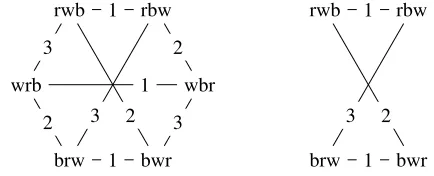
Example 2 We revisit the example of [van Ditmarschet al., 2012, Section 4.3], and consider a simple card game with three players 1, 2, and 3. The cards are identified by their colour: red (r), white (w), and blue (b). We assume to have 9 propositional atoms{ri, wi, bi |1i3}, where for in-stancew1denotes that agent 1 holds the white card. Also, all agents know the cards of the game, and that each agent can see his own card, but not that of the other players. The situa-tion after which each player is dealt a card can be modeled by modelMin Fig. 1. The staterwbinMdenotes the situation where player 1 holds the red card, 2 holds white and 3 holds blue. In this state, we have for instance that
(M,rwb)|=r1^K1r1^¬K2r1^K1¬K2r1
i.e., if the deal isrwb, then1holds the red card, he knows
this, but2does not know it, and, finally,1knows that2does
not know that1holds the red card. In particular, we have
(M,rwb) |= 9r1(K1r1^¬K2r1^¬K3r1)^ 9w2(¬K1w2^K2w2^¬K3w2)^ 9b3(¬K1b3^¬K2b3^K3b3) (3) i.e., for every player, there is a fact that the others don’t know. Now let us assume thatMis full. Note that we also have
(M,rwb)|=9w1((K1w1$K2w1)^(K2w1$K3w1))
i.e., there exists an assignment forw1so that all players have the same information: in fact, there exists an assignment to atomic propositions such that all agents know the same (as-signW to each propositional atom)! However, the intended
rwb rbw
wbr
bwr brw
wrb
1
2 3
1
1 2
2 3 3
rwb rbw
bwr brw
1
2
[image:3.612.319.536.56.144.2]1 3
Figure 1: Two epistemic modelsMandN
interpretation of atomic propositions should not consider such assignments. Any assignment should satisfy
deal=C 0
@^
i3
(ri wi bi)^ ^
i6=j,p2{r,w,b}
¬(pi^pj)
1 A
That is, we only consider deals where each player holds a card, and no player holds two. Note that this still al-lows for ‘un-intended’ assignments, allowing for example for 9w1(w1^¬K1w1)to hold. Our assignments should also sat-isfy the property that every player knows its own card (koc)
koc=C ^ i3,p2{r,w,b}
(pi$Kipi)
Now, (3) can be made stronger by replacing each occurrence of9pi(. . .)by9pi(deal^koc^. . .). Note that each agent
is also aware that the others know something that they don’t know: which is for instance expressed by the followingde dictoproperty:
(M,rwb)|=K29w1(K1w1^¬K2w1) (4) Let us know bring some dynamics to our story (for de-tails on Dynamic Epistemic Logic, see [van Ditmarschet al., 2007]). Suppose player 1 truthfully announces publicly that he does not own the white card. Such an announcement leads to the updated modelN of Fig. 1, which is obtained fromM
by simply removing all states in whichw1holds. Indeed, we have
(N,rwb)|=8r1(K1r1!K3r1)
That is, 3 knows at least what 1 knows. In fact, 3 knows strictly more than 1, since we have(N,rwb) |= K3b3 ^
¬K1b3. Moreover, not only does player 3 know more than player 1, but player 2 knowsthatas well:
(N,rwb) |= K28r1(K1r1!K3r1)^ K29b3(K3b3^¬K1b3)^
9b3K3(K3b3^¬K1b3) (5) Note how (5) not only expresses that player 2 knows that 3 knows everything that 1 knows, but also that 2 knowsde dicto that 3 knows more than 1, while 3 knowsde rethat this is the
case. ⌅
We now show a preliminary result used in the complete-ness proof: an EQBL formula is valid iff it is valid in the class of frames where the operatorCis theuniversal modal-ity, defined in every such frame F as (F, V, w) |= C iff for allw0 2 W,(F, V, w0)|= . First of all, we define the
Definition 5 (Submodel) Given a model M =
hW, D, R, Vi and a world w 2 W, the submodel gen-erated by w is the model Mw = hWw, Dw, Rw, Vwi s.t.
• Wwis the set of worlds reachable fromw, i.e.,Ww = (Sa2AgRa)+(w);
• Dw={Uw✓Ww|Uw=U\Wwfor someU 2D};
• for everya2Ag,Rw,a=Ra\W2 w;
• for everyp2AP,Vw(p) =V(p)\Ww.
If the frameF =hW, D, Ribelongs toKall(resp.Kbool,
Kf ull), then alsoFw =hWw, Dw, Rwi 2Kall(resp.Kbool,
Kf ull). We can now prove the following lemma on the preser-vation of EQBL formulas on generated submodels.
Lemma 1 LetM= (F, V)be a Kripke model andw2W. For everyw02Wwand 2EQBL,
(F, V, w0)|= iff (Fw, Vw, w0)|=
Now letKunivbe the class ofuniversalKripke frames, that is, every world is reachable from any other world according to(Sa2AgRa)+.
Corollary 2 For every class K 2 {Kall,Kbool,Kf ull}, Th(K) =Th(K\Kuniv)
By Corollary 2 we can assume w.l.o.g. that, as long as we are interested in validity, the common knowledge operatorC acts as a universal modality on the setW of possible worlds. This fact will be used later in the completeness proof.
In what follows we analyse the formal properties of EQBL starting with its expressiveness.
3 Expressiveness
In this section we analyse the expressiveness of (multi-modal) epistemic quantified boolean logic and define a cor-respondence between EQBL and monadic second-order logic (MSO), which is a language suitable to describe properties of frames. First of all, given a Kripke frameF = hW, D, Ri on a setAPof atomic propositions, we consider an MSO al-phabet containing binary predicate constantsRCandRafor every agent indexa2Ag, and a unary predicate variableP for every atomp2AP. We use the same symbols for seman-tical and syntacseman-tical elements, as context will disambiguate. Then, MSO formulas are defined in BNF as follows:
::= P(x)|Ra(x, y)|RC(x, y)| ¬ | ! |8x |8P Anassignment is a function associating a worldw2W to every individual variablexand a setU 2Dto every predicate variableP. Forw2W andU 2D, the variants x
wand UP are defined similarly to EQBL.
Definition 6 (Semantics of MSO) We define whether a frame F satisfies an MSO formula ' for an assignment , or (F, ) |= ', as follows (clauses for propositional connectives are omitted):
(F, )|=P(x) iff (x)2 (P) (F, )|=Ra(x, y) iff Ra( (x), (y))
(F, )|=RC(x, y) iff (Sa2AgRa)+( (x), (y))
(F, )|=8x iff for allw2W,(F, x w)|=
(F, )|=8P iff for allU 2D,(F, P U)|=
We briefly remark that equality (modulo D) is defin-able in MSO as x = y ::= 8P(P(x) $ P(y)) ^
V
i2Ag[{C}8z(Ri(x, z) $ Ri(y, z)). Having introduced the formal machinery, we move on to define the extension to EQBL of the standard translation between modal and first-order logic. Then,ST is the translation between EQBL and MSO defined as follows:
STx(p) = P(x) STx(¬ ) = ¬STx( )
STx( ! 0) = STx( )!STx( 0) STx(Ka ) = 8y(Ra(x, y)!STy( )) STx(C ) = 8y(RC(x, y)!STy( )) STx(8p ) = 8P(STx( ))
Clearly, for every EQBL formula , STx( ) is an MSO
formula wherexis the only free individual variable. If is a purely propositional modal formula, thenSTx( )is a first-order formula, as obtained via the standard translation.
The following results show that structural properties of frames can be expressed locally through EQBL formulas. Lemma 3 For every modelM=hF, Vi, worldw, and for-mula in EQBL,(M, w)|= iff(F, )|=STx( ),
when-ever (x) =wand (Pi) =V(pi).
As a consequence of Lemma 3 there is a one-to-one corre-spondence between EQBL formulas and their standard trans-lations in MSO in the following sense: a Kripke frame F
validates the universal closure8~p of an EQBL formula iff the MSO property8x8P STx~ ( )holds inF, whereP~ are all the unary predicates appearing inSTx( ). We observe
that this is not the case in propositional modal logic. For in-stance, for the McKinsey formulaKaMap!MaKapthere is no first-order principle↵such that↵holds in all and only frames validating the McKinsey formula.
We now compare the expressiveness of EQBL to the ex-tended modal logic LPML introduced in [van Ditmarschet al., 2012] to formulate local properties of models. Table 1 corresponds to Table 1 in [van Ditmarschet al., 2012]. For-mulas✓(~a,~p)belong to propositional epistemic logic, while
⇥(~a, x)are first-order formulas with at most one free
vari-able x. The formulas (~a) appear in [van Ditmarsch et al., 2012] precisely to describe local properties of models. The satisfaction of -formulas in Kripke models is given as:
(F, V, w) |= (~a)iff(F, )|=⇥(~a, x)for (x) =w, that
is, property⇥holds of worldw. By the following corollary we obtain that, as regards full Kripke models, EQBL is as expressive as LPML.
Corollary 4 For every full modelM, worldw, and formu-las ✓(~a,~p) and (~a) in Table 1, (M, w) |= 8~p✓(~a,~p) iff
(M, w)|= (~a).
From Corollary 4 we conclude that EQBL can deal with all the examples of [van Ditmarschet al., 2012, Table 1] that LPML deals with. Furthermore, LPML provides a complete-ness proof for a language in which and✓ are connected through some specific axiom and inference rule, and more-over✓ is locally good for⇥[van Ditmarschet al., 2012, Definition 11]. In other words, for first-order properties⇥for
✓(~a,~p) ⇥(~a, x) (~a)
Kap!Kbp 8y(Rb(x, y)!Ra(x, y)) Sup(a, b)
Kcp!KaKbp 8y, z(Ra(x, y)^Rb(y, z)!Rc(x, z)) T rans(a, b, c)
Ka(p_¬p) 9yRa(x, y) Ser(a)
Kap!p Ra(x, x) Ref l(a)
¬Kap!Kb¬Kcp 8y, z(Ra(x, y)^Rb(x, z)!Rc(y, z)) Eucl(a, b, c)
[image:5.612.90.525.52.144.2]¬Kap!¬KbKcp 8z(Ra(x, z)! 9yRb(x, y)^Rc(y, z)) Dens(a, b, c) (¬Kap^¬Kbq)!¬Kc(p_q) 8y, z((Ra(x, y)^Rb(x, z))!(y=z^Rc(x, y)) F unc(a, b, c)
Table 1: as in [12, Table 1]⇥(~a, x)is a property of statex, and (~a)is a name in the object language such that (~a)holds at wiff⇥(~a, x)holds ofMfor (x) =w.
issometimes able to express such⇥. Consider the following EQBL formula:
9p(Map^Ma¬p) (6) It is not difficult to see that (6) holds on frames where states have at least two successors: a first-order property that is not modally definable [Blackburnet al., 2001], and hence some-thing that cannot be expressed in LPML.
Moreover, there are instances of modal properties express-ible in EQBL that are not first-order definable, and hence can-not again be dealt with in LPMLlocally. Consider the follow-ing EQBL formula⌧ = 8p(Kap ! Kbp)^ 8q(KbKaq ! Kbq). Then we can prove the following result.
Lemma 5 LetF be a full frame andR+
a the transitive clo-sure ofRa. Then,(F, w)|=⌧iffR+
a(w)✓Rb(w).
Since being the transitive closure is not first-order definable (even though it is modally definable), this shows that EQBL is strictly more expressive than the language of [van Ditmarsch et al., 2012], as the latter cannot express⌧locally.
To conclude our comparison between EQBL and LPML, we observe that the operators act in fact like linguistic black boxes, bringing the metatheory language of first-order logic into the object language of modal logic. On the other hand, EQBL is more transparent, as everything is done in the object language. In addition, for the first-order conditions in [van Ditmarschet al., 2012] there must always be a suitable modal counterpart. Indeed, the axiomsAx : (~a)!✓ (~a,p~)in [van Ditmarschet al., 2012] make sense only as long as there is a propositional modal formula✓ locally good for , and this is not always the case. In what follows we will show that none of the above has to be assumed to axiomatise EQBL.
Finally, we briefly state one more result showing that EQBL is strictly more expressive than propositional modal logic. In the following lemma we consider Kripke frames and models where eachRais simply a binary relation. Lemma 6 LetF be a full Kripke frame, F |= 9p(Kap^
¬p)iffFis irreflexive.
Since irreflexivity is not expressible in standard modal logic [Blackburnet al., 2001], Lemma 6 illustrates the well-known fact that EQBL is more expressive than modal logic.
4 Completeness
In this section we present axiomatisations for the sets of va-lidities on the classesKall,Kbool, andKf ullof Kripke frames
built on setsAgof agent indexes andAP of atomic proposi-tions. We first present a logic forKall, where2is a place-holder for any modal operatorsCandKafora2Ag. Definition 7 Axioms and inference rules of logicKall Prop all instances of propositional tautologies K 2( ! )!(2 !2 )
T 2 !
4 2 !22
5 ¬2 !2¬2 C1 C !Ka( ^C )
C2 from !Va2AgKa( ^ )infer !C Exall 8p ! [p/q]
BF 8p2 !28p
MP from ! and infer
Nec from infer2
Gen from ! infer ! 8p , forpnot free in The logicKallextends the standard multi-modal epistemic logicS5C
n, including common knowledge, with axioms for quantification. It also includes the Barcan formulaBF. The logicKboolextendsKallthrough axiom
Exbool: 8p ! [p/ ]
where is any boolean formula. Finally,Kf ull extends
Kboolthrough axiom Exf ull: 8p ! [p/ ]
where is any EQBL formula, as well as axiomAt:
9p(p^ 8q(q!C(p!q))^ ^
a2Ag
8r(Kar!C(p!Kar)))
Intuitively, the first two conjuncts of axiomAtexpress that the interpretation ofpis an atom inD(i.e., a minimal, non-empty element according to order✓onD). Moreover, by the third conjunct, for everya2Ag, the worlds in the interpreta-tion ofpare all connected by eachRa, i.e, the interpretation ofpis acliquefor everyRa. This means that all worlds in the interpretation ofpare actually indistinguishable. The notions ofproofandtheoremhood`are defined as standard.
Mono-modal versions ofExboolandExf ull(without com-mon knowledge) were considered in [Fine, 1970]. Hereafter, we extend these results to a multi-agent epistemic setting, including common knowledge, and prove generalised com-pleteness in Section 4.1.
Theorem 7 (Soundness) For everyl2{all, bool, f ull}, for every EQBL formula ,`Kl impliesKl|= .
As regards completeness, we show that if a formula is con-sistent, then we can construct a relevant model that satisfies it. For logicsKallandKboolwe need models whose under-lying frame is any frame and a boolean algebra respectively. As regardsKf ullwe need to introduce some more definitions. First of all, a frameF isatomiciff for everyw 2 W there is an atomU 2 D (i.e., a minimal, non-emptyU 2 D, ac-cording to order✓) such thatw 2 U. Moreover, the atom U has to be a clique according to every Ra, i.e., for every w, w0 2 U,Ra(w, w0). Further, F iscomplete iff the
do-mainDis closed under infinite unions and intersections. No-tice that we use ‘complete’ with two different meanings: (i) semantical completeness of a logic, and(ii) algebraic com-pleteness. The context will disambiguate. We useatandcom as subscripts to designate the respective classes of frames. Clearly, every full frame is boolean, atomic and complete. Hence, Th(Kbool,at,com) ✓ Th(Kf ull). The converse fol-lows from the next well-known algebraic result, which is a consequence of Stone’s representation theorem.
Theorem 8 ([Givant and Halmos, 2009]) Every complete atomic Boolean algebra is isomorphic to the powerset of some set.
By Theorem 8 we can prove the following lemma. Lemma 9 Th(Kf ull)✓Th(Kbool,at,com).
In [Fine, 1970] Fine remarks that the language of modal quantified boolean logic is not rich enough to express com-pleteness. We prove that this is the case for EQBL as well. Lemma 10 Th(Kbool,at,com) =Th(Kbool,at)
By combining Lemma 9 and 10 we obtain that Th(Kf ull) =Th(Kbool,at). Thus, for our purposes it is suffi-cient to prove completeness ofKf ullw.r.t.Kbool,at.
Theorem 11 (Completeness) For every l 2 {all, bool, f ull}, for every EQBL formula ,Kl|= implies`Kl .
If0Kl then we construct a Kripke modelM=hF, Vi,
the canonical modelfor , that satisfies¬ . Moreover, F is shown to belong to the relevant class of Kripke frames. This implies thatKl 6|= . Hereafter we discuss the case for l = f ull. We omit the subscript l whenever clear by the context.
As regards the logicKf ull we remarked above that it is sufficient to prove completeness w.r.t.Kbool,at. To do so, we observe that axiomAtensures that the canonical model con-tains an atomUwfor every statew2W, and that all worlds in these atoms are related by eachRa, provided that the acces-sibility relationRC = {(w0, w00)| { | C 2 w0} ✓w00}
is the universal relation onW. To enforce the latter fact, we restrictW to the set of states reachable from statev◆{¬ }, for a consistent , through the relation(Sa2AgRa)+. By doing so, we guarantee thatDis indeed an atomic boolean algebra, that is,F2Kbool,at.
We summarise the soundness and completeness results for our logics w.r.t. the relevant classes of frames.
Theorem 12 (Soundness and Completeness) For everyl 2
{all, bool, f ull}, the logicKlis sound and complete w.r.t. the classKlof Kripke frames.
4.1 Generalised Completeness
One nice feature of EQBL is that we can extend the com-pleteness results in the previous section by considering extra axioms expressing properties of frames. Specifically, letKl be any of the axiomatisations above, forl2{all, bool, f ull}. Then, if we extendKlwith the universal closure8p ~ of an EQBL formula , the resulting calculusKl+8~p is sound and complete w.r.t. the class of frames satisfying the MSO condition8x8P STx~ ( ).
Theorem 13 Let be an EQBL formula, then the logic
Kl+8~p is sound and complete w.r.t. the class ofKlframes satisfying8x8P STx~ ( ).
By the result above we immediately obtain that for ev-ery formula ✓(~a,~p) in Table 1, Kl +8p✓(~a,~p) is sound and complete w.r.t. the class of Kripke frames satisfying 8x8P~⇥(~a, x). More generally, there is a one-to-one
corre-spondence between an EQBL axiom8~p✓and the MSO con-dition8x8P STx~ (✓)on the corresponding class of sound and
complete frames. Notice that this is not the case in proposi-tional modal logic.
5 Model Checking EQBL
This section hinges on the model checking problem for EQBL, defined as follows.
Definition 8 (Model Checking) Given an EQBL formula and a finite modelM, determine whetherM |= .
Then, we are able to prove the following complexity result. Theorem 14 (Model Checking) The model checking prob-lem for EQBL is PSPACE-complete.
Algorithm 1Computation of the satisfaction set[[ ]]M
switch( ): case?:
return ;; casep:
return V(p); case¬ :
return W\[[ ]]M; case ^ 0:
return [[ ]]M\[[ 0]]
M;
caseKa :
return {w2W|Ra(w)✓[[ ]]M}; caseC :
return {w2W|(Sa2AgRa)⇤(w)✓[[ ]]M}; case8p :
return TU2D{[[ ]]M0)| M0=hF, VUpi};
In particular, we can prove that model checking EQBL is in PSPACE by using Algorithm 1 to compute the satisfaction set
[[ ]]M={w2W |(M, w)|= }, and then check whether
compared with quantified boolean logic. With respect to propositional epistemic logic, the complexity increases from PTIME. However, this is expected given the expressive power of propositional quantification.
6 Conclusions
We analysed the formal properties of multi-modal EQBL. Specifically, we provided soundness and completeness re-sults for several classes of multi-agent Kripke frames, ac-cording to various assumptions on the domainD of propo-sitions. In particular, we showed that there is a one-to-one correspondence between an EQBL axiom 8~p✓ and the MSO condition 8x8P STx~ (✓) satisfied by the
correspond-ing class of sound and complete frames. None of this is available in propositional modal logic. Further, we dis-cussed the model checking problem for EQBL and showed that computationally it is no harder than the corresponding question for quantified boolean logic. In future work we plan to investigate precisely the expressive power of EQBL by exploring standard model-theoretic techniques, includ-ing (bi)simulation and unravellinclud-ing. Even though some tech-nical results are available [Kaminski and Tiomkin, 1996; ten Cate, 2006], the area is much less developed in compari-son to plain propositional modal logic.
Related Work. The main inspiration for the present con-tribution comes from a series of papers on LPML, an exten-sion of propositional modal logics to express local proper-ties [van Ditmarsch et al., 2009; 2011; 2012]. Differently from these works we do not considerad hoclanguages, in-stead we adopt the framework of modal quantified boolean logic (MQBL). MQBL has been first considered in the sem-inal works by Bull and Fine [Bull, 1969; Fine, 1970]. The latter proved completeness and (un)decidability results for various classes of Kripke frames. Here we extended such re-sults by explictly considering the multi-agent, epistemic inter-pretation of modalities. In particular, differently from [Fine, 1970], the introduction of common knowledge is essential to mimick an universal modality that, together with axiomAt, enforces canonical models that are atomic. More recently, MQBL and its formal properties have been considered in the literature on modal logic, even though its conceptual com-plexity has hindered its development. The logic is also known as second-order propositional modal logic (SOPML) for the relation with second-order logic detailed in Section 3. In [Kaminski and Tiomkin, 1996] the authors proved that the ex-pressive power of SOPML (for modalities weaker than 4.2) is the same as MSO. While [ten Cate, 2006] provides SOPML with analogues of the van Benthem-Rosen theorem and the Goldblatt-Thomason theorem. We remark that both works hinge only on the specific class offullKripke frames.
Further, there is also a rich literature on combinations of quantification and epistemic logic [Belardinelli and Lomus-cio, 2009; 2012; Corsi and Orlandelli, 2013]. However, the works in this area typically consider first-order quantification and knowledge of relational facts; which is not the case in the present setting.
The present contribution is also related to general Kripke frames [Blackburnet al., 2001; Mares and Goldblatt, 2006],
as we also assume some algebraic structure on the set D of propositions, notably for the classes of boolean and full frames. However, propositional quantification makes our framework strictly more expressive than general frames. Also, differently from the contributions above, the main mo-tivation for the present paper comes from the application to artificial intelligence, specifically the representation of agent knowledge in multi-agent contexts. In this respect, there has not been any previous work on EQBL to our knowledge.
References
[Belardinelli and Lomuscio, 2009] F. Belardinelli and A. Lomus-cio. Quantified Epistemic Logics for Reasoning About Knowl-edge in Multi-Agent Systems. Artificial Intelligence, 173(9-10):982–1013, 2009.
[Belardinelli and Lomuscio, 2012] F. Belardinelli and A. Lomus-cio. Interactions between Knowledge and Time in a First-Order Logic for Multi-Agent Systems: Completeness Results.Journal of Artificial Intelligence Research, 45:1–45, 2012.
[Blackburnet al., 2001] P. Blackburn, M. de Rijke, and Y. Venema.
Modal Logic. Cambridge University Press, 2001.
[Bull, 1969] R. A. Bull. On Modal Logic with Propositional Quan-tifiers.The Journal of Symbolic Logic, 34:257–263, 1969. [Corsi and Orlandelli, 2013] G. Corsi and E. Orlandelli. Free
Quan-tified Epistemic Logics.Studia Logica, 101(6):1159–1183, 2013. [Fine, 1970] K. Fine. Propositional Quantifiers in Modal Logic.
Theoria, 36(3):336–346, 1970.
[Givant and Halmos, 2009] S. Givant and P. Halmos. Introduction to Boolean Algebras. Springer, 2009.
[Kaminski and Tiomkin, 1996] M. Kaminski and M. Tiomkin. The Expressive Power of Second-Order Propositional Modal Logic.
Notre Dame Journal of Formal Logic, 37(1):35–43, 1996. [Mares and Goldblatt, 2006] E. Mares and R. Goldblatt. An
Alter-native Semantics for Quantified Relevant Logic. The Journal of Symbolic Logic, 71(1):163–187, 2006.
[Meyer and van der Hoek, 1995] J.-J. Ch. Meyer and W. van der Hoek.Epistemic Logic for AI and Computer Science. Cambridge University Press, 1995.
[ten Cate, 2006] B. ten Cate. Expressivity of Second Order Proposi-tional Modal Logic.Journal of Philosophical Logic, 35(2):209– 223, 2006.
[van Benthem, 1976] J. van Benthem.Modal Correspondence The-ory. PhD thesis, University of Amsterdam, 1976.
[van Ditmarschet al., 2007] H. van Ditmarsch, W. van der Hoek, and B. Kooi.Dynamic Epistemic Logic. Springer, Berlin, 2007. [van Ditmarschet al., 2009] H. van Ditmarsch, W. van der Hoek,
and B. Kooi. Knowing More - From Global to Local Correspon-dence. InIJCAI 2009, Proceedings of the 21st International Joint Conference on Artificial Intelligence, pages 955–960, 2009. [van Ditmarschet al., 2011] H. van Ditmarsch, W. van der Hoek,
and B. Kooi. Reasoning about Local Properties in Modal Logic. In 10th International Conference on Autonomous Agents and Multiagent Systems (AAMAS 2011), pages 711–718, 2011. [van Ditmarschet al., 2012] H. van Ditmarsch, W. van der Hoek,
![Table 1: as in [12, Table 1] ⇥(~a, x) is a property of state x, and �(~a) is a name in the object language such that �(~a) holds atw iff ⇥(~a, x) holds of M for �(x) = w.](https://thumb-us.123doks.com/thumbv2/123dok_us/8048164.222758/5.612.90.525.52.144/table-table-property-state-object-language-holds-holds.webp)
