Did quantitative easing affect
interest rates outside the US?
New evidence based on interest rate
differentials
Ansgar Belke, Daniel Gros and Thomas Osowski
No. 416 / January 2016
Abstract
This paper explores the effects of non-standard monetary policies on international yield relationships. Based on a descriptive analysis of international long-term yields, we find evidence that long-term rates followed a global downward trend prior to as well as during the financial crisis. Comparing interest rate developments in the US and the eurozone, it is difficult to detect a distinct impact of the first round of the Fed’s quantitative easing programme (QE1) on US interest rates for which the global environment – the global downward trend in interest rates – does not account. Motivated by these findings, we analyse the impact of the Fed’s QE1 programme on the stability of the US-euro long-term interest rate relationship by using a CVAR (cointegrated vector autoregressive model) and, in particular, recursive estimation methods. Using data gathered between 2002 and 2014, we find limited evidence that QE1 caused the break-up or destabilised the transatlantic interest rate relationship. Taking global interest rate developments into account, we thus find no significant evidence that QE had any independent, distinct impact on US interest rates.
JEL codes: C32, E43, E44, E58, F31, G01, G15
Keywords: quantitative easing, unconventional monetary policies, time series econometrics, Cointegrated VAR (CVAR), recursive methods
CEPS Working Documents are intended to give an indication of work being conducted within CEPS’ research programmes and to stimulate reactions from other experts in the field. The opinions expressed in this document are the sole responsibility of the authors and do not necessarily represent the official position of CEPS.
ISBN 978-94-6138-496-6
Available for free downloading from the CEPS website (www.ceps.eu)
Contents
1. Introduction ... 1
2. Quantitative easing and global financial markets ... 4
2.1 Purchase programmes in the US ... 4
2.2 Literature review ... 6
2.3 Effects of the Fed’s QE on interest rates and exchange rates and inflation ... 8
2.4 Global financial markets and national QE ...12
2.5 Fiscal policy, debt management and the portfolio balance channel...14
3. Data and empirical approach ...16
4. Empirical Results ...18
4.1 Unit Root Tests...18
4.2 Cointegrated VAR estimations ...20
4.2.1 Estimation of the long-run relationship ...20
4.2.2 Did QE1 cause a structural break? ...22
5. Conclusions ...27
References ...29
List of Figures and Tables Figure 1. Federal Reserve Balance Sheet ($ mil.) ... 5
Figure 2. CBOE Volatility Index (VIX) ... 6
Figure 3. US: Central bank balance sheet, exchange rate and inflation ... 9
Figure 4. Euro area: Central bank balance sheet, exchange rate and inflation ...10
Figure 5. Long-term interest rates in major currency areas since 1990 ...12
Figure 6. Transatlantic long-term interest rate differential from 2007 ...14
Figure 7. Nominal exchange rate ($/€) ...16
Figure 8. Treasury bond yields – US and Germany ...17
Figure 9. Test for constancy of the log-likelihood, 10 ...23
Figure 10. Recursively estimated Trace Test statistics, 10 ...24
Figure 11. Fluctuations of the Eigenvalue, 10 ...25
Figure 12. Test of Beta Constancy, 10 ...26
Figure 13. Test of known beta, 10 ...26
Figure 14. One step-ahead predictions of the full system, 10 ...27
Table 1. Impact of quantitative easing programmes on interest rates...11
Table 2. Impact of quantitative easing programmes on exchange rates ...11
Table 3. Counterfactual impact of quantitative easing programmes on long-term interest rates ...13
Table 4. Unit root tests ...19
Table 5. Unit root test allowing for structural breaks - Zivot-Andrews tests ...19
Table 6. Residual analysis – diagnostic testing on the unrestricted VAR (3)-Model; 10 ...20
Table 7. LR Trace Test for the unrestricted VAR (3)-model, 10 ...21
Table 8. The just-identified long-run cointegration relations for = 1, 10 ...21
1
Did quantitative easing affect
interest rates outside the US?
New evidence based on interest rate differentials
Ansgar Belke, Daniel Gros and Thomas Osowski
*CEPS Working Document No. 416 / January 2016
1.
Introduction
Huge adverse shocks generated by the financial crisis caused economic decline and turmoil on the financial markets in 2008. Even after sharp reductions in (short-term) interest rates, central banks worldwide could not reduce the effects of the financial crisis substantially. With interest rates near zero, central banks lost their main policy tool because the zero lower bound proved to be a larger constraint than previously assumed by a large share of economists.1 In
response, central banks around the globe undertook unprecedented policy interventions, the so-called ‘nonstandard measures’.
Regarding the pure size of measures undertaken, the Fed was the most active central bank by implementing several non-standard measures – most notably several rounds of quantitative easing (QE). The first round of QE was announced and launched in November 2008, mainly aiming to calm the turmoil on financial markets and stabilise the US economy. After the termination of QE1 in March 2010, QE 2 started in November 2010, followed by Operation Twist in September 2012 and an additional round of QE (QE3) in September 2012. Apart from the Fed, the Bank of England (BoE, 2009-2014) and the Bank of Japan (BoJ, since 2010) also made use of large-scale asset purchase programmes in order to generate additional monetary stimulus at the lower zero bound.
While there have been noticeable differences2 between the QE rounds conducted by the Fed
and the central banks of other leading industrialised countries, a common aim of QE has been to put pressure on long-term yields. 3 By reducing long-term yields, the Fed expected to further
stimulate economic activity and prevent significant declines in inflation rates.4 Furthermore,
another QE mechanism runs via the exchange rate. However, long-term assets (and thereby interest rates) as well as exchange rates are often more affected by expectations about the future than by current economic conditions. The announcement of a programme can therefore have a stronger impact than its actual implementation. With respect to the impact of QE on
* Corresponding author: Ansgar Belke, ad Personam Jean Monnet Chair for Macroeconomics and
Director of the Institute of Business and Economics, University of Duisburg-Essen, Campus Essen, Universitätsstr. 12, 45117 Essen, Germany, e-mail: [email protected]. Daniel Gros is Director of CEPS and Thomas Osowski is a Research Assistant at the University of Duisburg-Essen.
1 See Chung et al. (2012).
2 For a comparison of QE designs in the US, see Rosengren (2015) and Fawley & Neely (2013).
3 Apart from Operation Twist in the 1960s, the BoJ launched a purchase programme in March 2001.
Even the BoJ claimed that the policy has been largely ineffective, however.
4 The impact on yields is not a priori clear, however. If QE strongly increased expectations about future
2BELKE,GROS &OSOWSKI
the nominal exchange rate, it is important to note that not each country can benefit from a nominal depreciation of their local currency, if several central banks start large-scale asset purchase programmes at the same time.
To measure the longer-term impact of QE on interest rates, interest rate relationships and exchange rates is inherently difficult, because one has to make many assumptions about how asset prices such as the exchange rate and the interest rate would have evolved in the absence of QE.5 Furthermore, there is evidence that the impact of QE depends on the design of the
programme, the economic environment and a country’s economic structure.6 For example, in
the case of Japan (long-term) interest rates had been very low for a long period and seemed little affected by the increasingly aggressive asset purchases of the BoJ. However, the yen started to depreciate strongly once the asset purchase programme was greatly increased in size and scope. By contrast, the effective dollar exchange rate moved little at the time of the announcement and implementation dates of the different asset purchase programmes operated over the last seven years by the Federal Reserve. In the case of the UK, one actually observed a trend-wise appreciation of the pound over the period during which the BoE bought large amounts of gilts, and there was apparently some impact, albeit only temporary, on long-term interest rates (Gros, Aldici & De Groen, 2015).
The real difficulties go even deeper, however. The majority of available studies just look at developments within the country undertaking QE and neglect the global environment. Global financial markets are highly integrated and (long-term) rates have been highly correlated across advanced economies, not only along a downward trend, but also during cyclical ups and downs. Over most periods, rates have declined as much, sometimes more, in areas where QE was not undertaken. There is no sign that the fact that the ECB did not undertake bond purchases when they were undertaken by the US and the UK in any way prevented interest rates in the euro area from following US rates downwards when only the US implemented QE (Gros, Aldici & De Groen, 2015).
According to the literature on the national (but also international) transmission of QE shocks, authors generally pronounce two main transmission channels: the signalling channel and the portfolio-balance channel. Although both channels might explain a certain number of the movements of financial variables in response to QE, we believe that the global comparative evidence is also, and probably even more compatible, with the view that QE did not ‘move’ interest rates, but appeared to be important because major central banks undertook purchases when they realised that the recession caused by the financial crisis would be longer and more severe than anticipated. In this regard, it is also possible to explain the decline in interest rates before announcements of QE have been made by central banks. This observation might indicate that markets were quicker to revise their expectations and rates had thus come down before central banks started to buy assets. Therefore, market participants and central banks with their announcements of QE reacted to the same driving force; namely stronger adverse effects of the financial crisis than previously expected. In this regard, the prolonged weakness affected most of the developed world. Interest rates thus fell trend-wise in most advanced
5 For the counterfactual analysis in macroeconometrics with an empirical application to QE, see Pesaran
& Smith (2012).
6 See Rosengren (2015) for an assessment of how the design of the Fed’s QE programmes have affected
DID QUAN TITATIVE EASING AFFECT IN TEREST RATES OUTSIDE THE US?3
economies, independently of whether QE was implemented by the national central bank (Gros, Aldici & De Groen, 2015).
Our view that the central banks programme – as well as reductions in interest rates – had a common underlying source is somehow compatible with implications of the signalling channel, if one assumes that QE generated new information about the (future) state of the (global) economy for market participants. Following this argument, QE was a sign that the crisis would be longer and more severe. Market participants reduced their expectation about future growth putting downward pressure on interest rates. However, if one follows this interpretation the fall in interest rates might have occurred anyway – at the latest when market participants would have revised their expectations about the severity of the crisis.7
Although several empirical studies credit QE with strong falls in US interest rates, rates fell as much in the euro area, where QE was not undertaken (until recently). This finding might imply that several studies that neglect the global downward trend might give QE too much credit. The absence of a clear, distinct impact of QE episodes on interest rates and the exchange rate (e.g. the US), where QE was undertaken, should be puzzling. Although some (event) studies demonstrate the very strong impact of QE on interest rates in the country where QE was implemented, international long-term interest rates continued to be highly correlated. QE therefore had little impact on interest rate differentials (USD versus euro). This aspect also explains why asset purchases had little impact on exchange rates. If QE had had such a strong impact on interest rates, as often asserted (i.e. in the order of 100 basis points according to several event studies),8 one would have expected a strong impact on the exchange rate.
One way to test the hypothesis that large-scale asset purchases had a separate, identifiable impact on long-term interest rates (in the currency area where they are undertaken) for which the global downward trend in interest rates does not account is to estimate the cointegrated relationship between US and euro area interest rates and to test whether one finds a structural break in this relationship around the time that QE was undertaken in the US.
Apart from the hypothesis stated above, one has to note that the overall effects of large asset purchase programmes are still not well understood – even based on a domestic perspective. In this regard, QE shocks might differ from conventional interest rate shocks in normal times, not only with regard to their relative magnitude, but also by changing relationships between economic variables.9 It is well-recognised in theoretical and empirical literature that
extraordinary and sustained macroeconomic policy actions can affect economic relationships and cause structural changes. When the federal funds rate reached the zero lower bound and the Fed announced QE in November 2008, it effectively changed its monetary policy variable from the federal funds rate to its balance sheet size (Belke & Klose, 2013). In contrast to the pre-crisis era, it is now no longer possible to measure monetary policy simply by looking at one interest rate.10 Motivated by this circumstance, several authors have argued in favour of
7 See Glick & Leduc (2011) for a similar interpretation.
8 See, for instance, Gagnon et al. (2011).
9 Analysing the link between the monetary base and the money supply (defined as M1, M2 or M3) from
a national perspective, it appears that the relationship has been completely broken since 2008 (Gros, Alcidi & De Groen (2015). See also McLeay et al. (2014).
10 See the growing empirical literature, which tries to measure the monetary policy stance by using
4BELKE,GROS &OSOWSKI
econometric models that incorporate possible structural changes.11 This aspect is further
pronounced by Chen et al. (2013), who highlight that pre-crisis models could have become obsolete, as unconventional monetary policy might be transmitted in different ways compared to monetary policy actions in normal times. 12 To our knowledge, this paper is one of the first
that tries to test empirically whether QE has changed economic relations on international financial markets.
The paper uses a cointegration approach to analyse whether the Fed’s QE1 has caused a structural change in the US-European interest rate relationship. As an empirical approach, we use the Johansen procedure (CVAR) in order to estimate the long-run relationship between US and European interest rates, also taking developments of the nominal exchange rate into account. We use monthly data from 2002 to 2014. After estimating the potential long-run relationship, we use recursive methods proposed by Johansen & Juselius (2006) in order to check for structural changes with respect to parameter constancy. Our focus on QE1 can be explained by two main reasons. First, the general impression and empirical evidence on QE in the US indicate that QE1 has been the programme with the highest impact on financial variables. Therefore, if one set out an independent effect on US interest rates relative to euro interest rates, QE1 might appear to be the natural choice. The second reason is related to the statistical approach of this paper. As recursive tests lose the power to detect structural breaks at the end of the data sample, it would be difficult to reject the assumption of parameter constancy / structural constancy for Operation Twist, QE3 and partly QE2, even if a structural break were present.
The paper proceeds as follows: section 2 contains a brief summary of the QE programmes of the Fed and a descriptive analysis of their effects on domestic and global interest rates, as well as on exchange rates. Furthermore, a short review of empirical results of international QE transmission is provided. The data used and the estimation approach is described in section 3. The estimation process and the results are presented in section 4. Section 5 sums up our results and provides an outlook for further research.
2.
Quantitative easing and global financial markets
2.1 Purchase programmes in the US
In November 2008, the Federal Reserve announced the first round of QE (QE1). These purchases included debt of government-sponsored enterprises (GSEs) and agency mortgage-backed securities (MBS) of up to $600 billion. After announcing the willingness to extend the programme in January 2009, the FOMC decided to purchase an additional $750 billion in (agency) MBS, $100 billion in agency debt and also started to purchase long-term treasury securities worth $300 billion in March 2009. In total, the Fed purchased assets worth $1.75 trillion between November 2008 and March 2010; an amount twice the magnitude of total Federal Reserve assets prior to 2008.
In October 2010, the FOMC announced the second round of QE (QE2). It contained purchases of $600 billion worth of treasuries and was finished in June 2011. A few months later, the implementation of a maturity extension programme, the so-called ‘Operation Twist’ (OT), was launched. By purchasing $400 billion worth of treasury bonds with maturities of 6 to 30 years
11 See Kapetanios et al. (2012) and Baumeister & Benati (2012).
DID QUAN TITATIVE EASING AFFECT IN TEREST RATES OUTSIDE THE US?5
[image:7.612.96.518.198.414.2]and selling bonds with maturities of less than 3 years, the FOMC intended to extend the average maturity of the Fed’s portfolio. Eventually, the third round of QE (QE3) started in September 2012. It targeted a monthly purchase of $85 billion through the purchase of mortgage-backed securities ($40 billion) and longer-term Treasury securities ($45 billion). In contrast to the other programmes, the continuation of QE3 was tied to the improvement in the labour market. Overall, the Fed balance sheet increased by about $3.5 trillion (roughly 20% of GDP).
Figure 1. Federal Reserve Balance Sheet ($ mil.)
Note: Percentage refers to 2014 GDP.
Source: Federal Reserve.
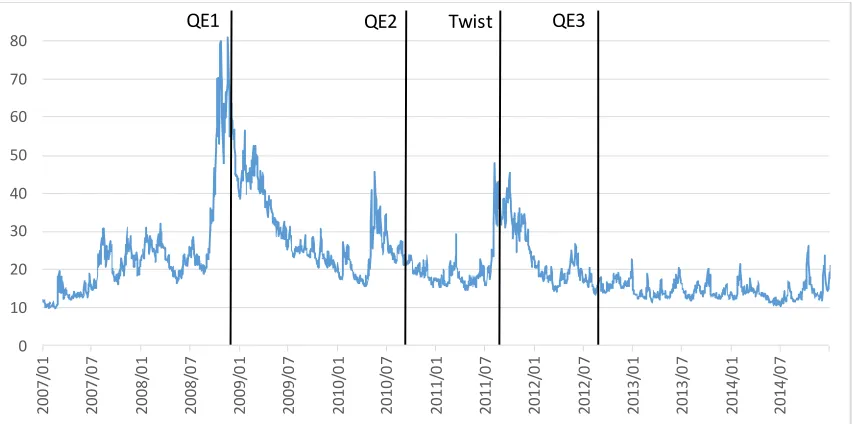
As shown in Figure 1, the balance sheet of the Federal Reserve has now reached over $4 trillion, or close to 25% of GDP. Two assets clearly dominate on the asset side: treasury securities and federal agency securities. The latter are all guaranteed by the Federal government of the United States. It is thus formally true that the Federal Reserve has intervened in the market for securitised mortgages, but it has bought only securities guaranteed by the government. In terms of the evolution of the balance sheet, one can clearly see the impact of QE 1, 2 and 3. The Fed’s QE programmes not only differed in terms of their concrete design, but also with regard to the underlying economic environment during the time of their implementation. In this regard, Figure 2 presents the CBOE Volatility Index (Chicago Board Options Exchange), which is one of the most common measurements of sentiment and systemic risk of the US stock market. Apparently, the perception of systemic risk differed strongly over time and therefore also between the starting points of the QE programmes.
As expected, the highest amount of market uncertainty arose after the beginning of the financial crisis marked by the bankruptcy of Lehman in September 2008. While markets stabilised in 2009 and the perception of systematic risk remained at an overall low level in the following years, two peaks of uncertainty are observable in May 2010 and August 2011. While the increased perception of systematic risk in May 2010 corresponds to the beginning of the European debt crisis, the second peak can be linked to Standard & Poor’s downgrade of the US credit rating. Comparing levels of uncertainty around the starting points of the QE
0 1,000,000 2,000,000 3,000,000 4,000,000 5,000,000
2003 2004 2005 2006 2007 2008 2009 2010 2011 2012 2013 2014 2015 Gold Special drawing rights U.S. Treasury Securities Federal agency debt securities Mortgage-backed securities Repurchase agreement Foreign currency denominated assets Other assets
6BELKE,GROS &OSOWSKI
[image:8.612.94.520.192.404.2]programmes, one can conclude that QE1 was implemented in a completely different environment from QE2 and QE3. While QE1 was implemented during the height of the crisis and therefore in an environment of huge uncertainty, QE2 and QE3 were introduced by the Fed when financial markets had already stabilised. This aspect should be kept in mind when QE programmes are compared and might also relate to the general assessment of several empirical papers that QE1 has been the most effective programme of the Fed.
Figure 2. CBOE Volatility Index (VIX)
Source: Chicago Board Options Exchange (CBOE).
2.2 Literature review
While numerous empirical papers focus on the domestic effects of QE, the empirical evidence on international effects is still growing. In this section, we provide a survey of the literature that has attempted to quantify the effects of the Fed’s QE programmes. As our paper focuses on the effects of QE on interest rate relationships, the following literature review primarily focuses on the impacts on financial markets – namely interest rates and exchange rates. According to current empirical studies, the general impact of large-scale asset purchase programmes seems to vary considerably across countries or regions and also depends on the time and circumstances of their implementation. For the US, it looks like QE1 was the most effective in influencing financial markets, unemployment and inflation, while QE2 was far less effective. As of today, the overall effects and the magnitude of such shocks are highly uncertain. Two main sources of uncertainty might explain large differences in the results of empirical estimations that try to estimate the impact of QE. Implemented as a direct response to the financial crisis, it appears to be extremely difficult to distinguish the effects of large-scale purchase programmes, financial markets, and macroeconomic conditions. Secondly, the majority of estimation methods and models rely on strong assumptions (for instance, about the transmission mechanisms of QE). Changing assumptions might strongly influence the results. In relation to this point, Rudebusch et al. (2007) show that although there is no structural relationship between the term premium and GDP, a reduced-form empirical analysis supports the existence of an inverse relationship between the term premium and real economic activity. 0 10 20 30 40 50 60 70 80 2 0 0 7 /0 1 2 0 0 7 /0 7 2 0 0 8 /0 1 2 0 0 8 /0 7 2 0 0 9 /0 1 2 0 0 9 /0 7 2 0 1 0 /0 1 2 0 1 0 /0 7 2 0 1 1 /0 1 2 0 1 1 /0 7 2 0 1 2 /0 1 2 0 1 2 /0 7 2 0 1 3 /0 1 2 0 1 3 /0 7 2 0 1 4 /0 1 2 0 1 4 /0 7 Twist
DID QUAN TITATIVE EASING AFFECT INTEREST RATES OUTSIDE THE US?7
The aspects mentioned appear to be especially relevant for several event studies, which tend to find very large effects of QE compared to studies using different empirical frameworks. The two main drawbacks of event studies are heavy assumptions about the identification of monetary policy shocks and the focus on a very short period of time. In this regard, the standard event study methodology does not provide an estimate of the persistence of a monetary policy shock (Wright, 2011).13
Although the aim of QE was to support the economic development and performance of the labour market in general, a large number of studies focus on its effect on long-term yields (especially Treasury bond yields). Regarding the effects of QE on domestic interest rates, the general consensus is that QE (especially QE1) had a reducing effect on US medium and long-term yields. Gagnon et al. (2011) investigate the effects of QE1 by using event study as well as time series methods. They find that the cumulative effect of LSAP (Large-Scale Asset Purchase) announcements on yields of US Treasury bonds as well as US agency fell by up to 150 basis points. By scaling the Fed purchases to ’10-year equivalents’, the authors measure the duration that the Fed removed from the market. Across the three asset classes that were purchased during QE1, the purchases account for more than 20% of the total outstanding 10-year equivalents. Gagnon et al. (2011) argue that by reducing the net supply of assets with long duration, the programme was successful in reducing the term premium by 30 to 100 basis points. In accordance with their results, the authors highlight the importance of the portfolio balance channel relative to the signalling channel.
While Christensen & Rudebusch (2012) find similar cumulative reductions using an event study, their empirical results stress the importance of the signalling channel, however.14
Wright (2011) generates interesting insights using a structural VAR with daily data to identify monetary policy shocks. While he finds significant effects on long-term yields, these effects fall away quite fast, with an estimated half-life of two months. These results might somehow put the very large effects of event studies into perspective.
Apart from event study methodology, further evidence is presented by Hamilton & Wu (2012) who use a term-structure model to predict the effect of a change in the central bank’s asset structure (short-for-long-term debt swap) and also indirectly the effect of buying $400 billion in long-term Treasuries.15 Their results are much lower compared to the event studies
mentioned, as they find that such a policy would cause a reduction of the 10-year rate of (only) 13 basis points. Similar results have been obtained by Neely (2014) and Meyer & Bomfim (2010).16
Chung et al. (2011) find effects that are not negligible. Based on counterfactual model simulations, they find that the past and projected expansion of the Federal Reserve’s securities holdings since late 2008 are roughly equivalent to a 300 basis point reduction in policy interest rates (from 2009 until 2012). Model simulations suggest that the additional stimulus provided by the purchases has kept the unemployment rate at a lower level (1½ percentage points by 2012) than what it would have been in the absence of the purchases and also argued that the asset purchases have probably prevented the US economy from falling into deflation.
13 See Hamilton (2011) for several critical remarks on measuring the effects of QE by using event studies.
14 Further studies using event study methodology: Krishnamurthy & Vissing-Jorgensen (2011), D’Amico
& King (2013).
15 The purchase amount roughly corresponds to the amount of Treasury bonds bought during QE1.
8BELKE,GRO S &OSOWSKI
Liu et al. (2014) find smaller effects. By using a change-point VAR model, they estimated that the Fed’s asset purchase programme reduced 10-year spreads by an average of 90 basis points over the crisis period. Without the asset purchase programme, the unemployment rate was estimated to have been 0.7 percentage points higher and inflation, on average, 1 percentage point lower in 2010.
Regarding the effects on international financial markets, most papers find cross-border effects, as well as effects on exchange rates. Fratzscher et al. (2013) examine the international effects of QE1 and QE2. They find that QE1 was effective in lowering sovereign yields and raising equity markets in the US and abroad. According to their results, QE1 might have generated a safe haven effect causing a strong global rebalancing of portfolios out of emerging markets and into US equity and funds, thereby putting upward pressure on the US dollar (USD). However, regarding the effects of QE2, the authors find that this programme has generally been ineffective in lowering yields worldwide and has caused sizeable capital outflows, mainly into emerging economies, and thereby marked a USD depreciation.
Neely (2013) puts more weight on the effects of QE on Treasury yields of developed countries.17 Using an event study as well as a portfolio-balance model, Neely (2013) finds
substantial evidence that QE1 announcements have reduced sovereign yields in the US and abroad. Furthermore, Neely (2013) finds significant evidence that QE has generated a general depreciation of the USD. Bauer & Neely (2015) use dynamic term structure models to uncover whether international yields have declined as a result of signalling or portfolio-balance effects. They find that the relative importance of the signalling channel increases with an economy’s sensitivity to signals from conventional US monetary policy. Consistent with the notion that Canada is highly sensitive to US monetary policy, the authors find large signalling effects for Canadian Treasury yields. For Australian and German Treasury bonds, the others find especially large portfolio balance effects.
2.3 Effects of the Fed’s QE on interest rates and exchange rates and inflation
The aim of large-scale asset purchases is to lower long-term interest rates. Given that short-term rates are already at the zero lower bound, this amounts to a flattening of the yield curve. Furthermore, QE might also work by increasing inflation expectations and thereby decreasing real interest rates.
Keeping the aims of QE in mind, this section focuses on the short- and more medium-term evolution of interest, exchange and inflation rates around major QE operations. This descriptive approach is thus somehow in contrast to the summarised findings of the academic literature presented in the previous chapter, which usually adopts a shorter-term view and state of the art econometric methods. We take this approach to check whether large-scale asset purchases had an observable impact on key variables.
Figures 3 and 4 show the evolution of the central bank balance sheets and the evolution of the nominal effective exchange rate and that of inflation for the US and the euro area. Shaded areas indicate the QE episodes considered here. In addition, two tables show the short-term impact of the announcement and the conduct of the quantitative easing programmes on the long-term interest rates, as well as the nominal and inflation-adjusted real exchange rates.
DID QUANTITATIVE EASING AFFECT IN TEREST RATES OUTSIDE THE US?9 0 0.5 1 1.5 2 2.5 3 0 500,000 1,000,000 1,500,000 2,000,000 2,500,000 3,000,000 3,500,000 4,000,000 4,500,000 5,000,000 2 0 0 7 /0 1 2 0 0 7 /0 7 2 0 0 8 /0 1 2 0 0 8 /0 7 2 0 0 9 /0 1 2 0 0 9 /0 7 2 0 1 0 /0 1 2 0 1 0 /0 7 2 0 1 1 /0 1 2 0 1 1 /0 7 2 0 1 2 /0 1 2 0 1 2 /0 7 2 0 1 3 /0 1 2 0 1 3 /0 7 2 0 1 4 /0 1 2 0 1 4 /0 7
[image:11.612.92.518.107.335.2]Fed balance sheet CPI (excl. Energy & food) Figure 3. US: Central bank balance sheet, exchange rate and inflation
Source: Federal Reserve.
For the US, it is difficult to detect any observable impact of the QE programmes on either the exchange rate or inflation. The two panels of Figure 3 show that both the exchange rate and inflation underwent large swings, which are seemingly unrelated to the various rounds of asset purchases by the Federal Reserve. The USD had been depreciating sharply before the onset of the financial crisis. Starting in April 2008, the USD started to appreciate strongly and continued to do so, even after QE1 was implemented in November 2008. The peak was reached in March 2009 (after a rough doubling of the monetary base under QE1). A phase of USD weakness followed, which only partially coincided with QE2 until 2011. Since then the USD has appreciated trend-wise, despite further tremendous increases in the balance sheet of the Federal Reserve under QE3. With regard to the relationship between QE and inflation, it is difficult to find a clear impact of QE on inflation. Inflation continued to fall for about two years after the start of QE1, then reversed in coincidence with QE2, but then again trended downwards, despite QE3 being implemented.
85.00 90.00 95.00 100.00 105.00 110.00 115.00 500,000 1,000,000 1,500,000 2,000,000 2,500,000 3,000,000 3,500,000 4,000,000 4,500,000 5,000,000 2 0 0 8 /0 1 2 0 0 8 /0 7 2 0 0 9 /0 1 2 0 0 9 /0 7 2 0 1 0 /0 1 2 0 1 0 /0 7 2 0 1 1 /0 1 2 0 1 1 /0 7 2 0 1 2 /0 1 2 0 1 2 /0 7 2 0 1 3 /0 1 2 0 1 3 /0 7 2 0 1 4 /0 1 2 0 1 4 /0 7
10BELKE,GROS &OSOWSKI
Figure 4. Euro area: Central bank balance sheet, exchange rate and inflation
Source: European Central Bank and Eurostat.
For the euro area, the link between the central bank’s balance sheet and both the exchange rate and inflation appears to be stronger and more persistent (see the two panels of Figure 4). This is surprising since there has been no QE in the euro area (until now), and the ECB could influence the size of its balance sheet only indirectly via its offers of long-term lending to banks at favourable rates.
Next, we focus on the impact of QE on long-term interest rates. We adopt an approach that focuses on the overall effects of the QE programmes. Table 1 provides an overview of the impact of QE on long-term interest rates. The column entitled ‘change’ shows the difference between the long-term interest rate one-quarter before the start of the actual asset purchases and the rate one-quarter after the start of the asset purchase. This variable should thus capture both the announcement effect and the impact of the initial implementation.18 As three of the
four entries in this column are negative, one can conclude that overall QE had the intended impact of reducing long-term interest rates. QE2 is the only exception as the long-term interest rates actually increased.
Table 1 also provides in the last column tThe evolution of the interest rate differential, i.e. the difference between US and core eEuro area interest rates also appears in the last column. This column shows entries that are mostly close to zero indicating no change of the interest rate differential around the announcement and introduction of QE programmes.
18 We assume that the market had learned enough about the actual impact of the asset purchases after
one quarter to correctly anticipate the rest. 90 95 100 105 110 115 120 125 0 500,000 1,000,000 1,500,000 2,000,000 2,500,000 3,000,000 3,500,000 20 08 /0 1 20 08 /0 7 20 09 /0 1 20 09 /0 7 20 10 /0 1 20 10 /0 7 20 11 /0 1 20 11 /0 7 20 12 /0 1 20 12 /0 7 20 13 /0 1 20 13 /0 7 20 14 /0 1 20 14 /0 7
ECB balance sheet NEER
0 0.5 1 1.5 2 2.5 0 500,000 1,000,000 1,500,000 2,000,000 2,500,000 3,000,000 3,500,000 20 08 /0 1 20 08 /0 7 20 09 /0 1 20 09 /0 7 20 10 /0 1 20 10 /0 7 20 11 /0 1 20 11 /0 7 20 12 /0 1 20 12 /0 7 20 13 /0 1 20 13 /0 7 20 14 /0 1 20 14 /0 7
DID QUANTITATIVE EASING AFFECT INTEREST RATES OUTSIDE THE US?11
Table 1. Impact of quantitative easing programmes on interest rates
Long-term interest rate (%)
Before At start After Change Compared to
euro area (core)
Euro area
PSPP (March 2015) 1.6 … … … …
United States
QE1 (Nov. 2008) 3.9 3.3 2.7 -1.1 0.1
QE2 (Nov. 2010) 2.8 2.9 3.5 0.7 0.0
Twist (Sept. 2011 3.2 2.4 2.0 -1.2 0.0
QE3 (Sept. 2012) 1.8 1.6 1.7 -0.1 -0.1
Note: The data before, at the start and after the start of the quantitative easing programmes refer, respectively, to the quarterly averages for the quarter before the start of the programmes, the quarter in which the programmes started and the quarter after the start of the programmes. Note that long-term interest rates refer to average government bonds maturing in about ten years published by the OECD. The euro area core is proxied by the long-term interest rates for Germany.
Source: OECD.
[image:13.612.94.534.467.618.2]Table 2 provides similar information on the reaction of the (effective nominal) exchange rate around major QE episodes. The column change again shows the (percentage) difference between the nominal effective exchange rate one-quarter before and one-quarter after the start of the asset purchases to illustrate the combined announcement and implementation effect. As a negative sign indicates a depreciation of the exchange rate, QE1 enters with the wrong sign, in the sense that the exchange rate appreciated (although one would expect QE to result in a depreciation).
Table 2. Impact of quantitative easing programmes on exchange rates
Nominal effective exchange rate (index 2010=100)
Before At start After Change
Euro area
PSPP (March 2015 100.3 … … …
United States
QE1 (Nov. 2008) 95.8 106.0 108.8 13.0
QE2 (Nov. 2010) 100.7 97.4 96.1 -4.6
Twist (Sept. 2011 93.6 94.2 97.8 4.3
QE3 (Sept. 2012) 99.0 98.9 97.5 -1.5
Note: The data before, at the start and after the start of the quantitative easing programmes refer, respectively, to the quarterly averages for the quarter before the start of the programmes, the quarter in which the programmes started and the quarter after the start of the programmes. The nominal effective exchange rates (NEER) are the three-month averages of the BIS effective exchange rate indices. An increase in the NEER means that the currency has appreciated in nominal terms.
12BELKE,GROS &OSOWSKI
2.4 Global financial markets and national QE
[image:14.612.94.520.210.454.2]So far our analysis has followed the usual approach of looking for a link between asset purchases and financial market variables at the national level. In reality, however, financial markets in advanced countries are very open and highly integrated. This implies that one should not just look at US financial variables when trying to measure the impact of QE. However, disentangling the impact of QE in globally integrated financial markets is much more difficult, as one needs to adopt a comparative approach.
Figure 5. Long-term interest rates in major currency areas since 1990
Source: OECD.
The first key observation is that in reality (long-term) interest rates have followed a common long-term trend across major currency areas. Global financial markets are highly integrated and (long-term) rates have been highly correlated across advanced economies, not only along a downward trend, but also during cyclical ups and downs, as illustrated in Figure 5. The correlation is too tight and has lasted too long to be just a coincidence (Gros, Aldici & De Groen, 2015). The most obvious interpretation is that there is a global capital market that is integrated across currency boundaries. Short-term interest rates are determined by central banks directly and can thus deviate strongly whenever the policy stance is different. Since 2009 short-term interest rates have basically been equal to zero in both the US and the euro area, but long-term (here 10-year) rates have fluctuated, albeit around a clear common downward trend.
The effectiveness of large asset purchases by the Federal Reserve should thus not be measured simply by the associated fall in US interest rates, but a fall in the interest rate differential between the US and the euro area (or other major markets). However, if one uses this metric, one must conclude that large asset purchases by the Fed have failed to have a differential impact on the US. Table 3 shows that over most QE periods rates have declined as much, and sometimes more than they have in areas where QE was not undertaken. The small size of the changes in
0 2 4 6 8 10 12 14 1 9 9 0 1 9 9 1 1 9 9 2 1 9 9 3 1 9 9 4 1 9 9 5 1 9 9 6 1 9 9 7 1 9 9 8 1 9 9 9 2 0 0 0 2 0 0 1 2 0 0 2 2 0 0 3 2 0 0 4 2 0 0 5 2 0 0 6 2 0 0 7 2 0 0 8 2 0 0 9 2 0 1 0 2 0 1 1 2 0 1 2 2 0 1 3 2 0 1 4
DID QUANTITATIVE EASING AFFECT INTEREST RATES OUTSIDE THE US?13
[image:15.612.93.527.159.274.2]the interest-rate differentials is striking. For the US, no QE episode is associated with a change in the interest rate differential of more than 0.1%.
Table 3. Counterfactual impact of quantitative easing programmes on long-term interest rates Long-Term interest rate (%)
Change ( − ) Compared to euro area (core)
United States
QE1 (Nov. 2008) -1.13 0.06
QE2 (Nov. 2010) 0.67 -0.05
Twist (Sept. 2011) -1.16 0.00
QE3 (Sept. 2012) -0.12 -0.07
Note: The figures represent the decline/increase in the long-term interest rates in the period around the start of the quantitative easing programmes. The changes are calibrated deducting the average interest rate in the quarter after the start minus the average of the quarter before the start. Long-term interest rates refer to average government bonds maturing in about 10 years published by the OECD. The euro area core is proxied by the long-term interest rates for Germany.
Source: Own elaboration based on data from OECD.
14BELKE,GROS &OSOWSKI
Figure 6. Transatlantic long-term interest rate differential from 2007
Note: The difference between the German and US long-term interest rates is calculated by deducting the US rate from the German rate. Long-term interest rates refer to the monthly average government bonds maturing in about ten years. The vertical lines indicate the announcements by the Fed of the different quantitative-easing measures. Source: Own elaboration based on data from OECD.
This finding has important policy implications. The ECB has been criticised for not having undertaken asset purchases earlier, and it was even argued that one reason the absence of a common fiscal agent for the euro area is so important is that it has much delayed the decision of the ECB to undertake large purchases of public sector bonds. However, there is no indication that the fact that the ECB did not undertake bond purchases when they were undertaken by the US (and the UK) in any way led to higher interest rates in the euro area. The ECB did of course undertake other ‘unconventional’ monetary policy operations, but these were confined to providing more liquidity to the banking system, with the longest maturity being (until recently) three-year operations. It is thus difficult to explain the co-movement of US and euro area rates with similar monetary policy operations.
As we stated in the introduction, we believe that the severity of the crisis and economic recession in developed economies led to (further) reductions in long-term interest rates across countries along the downward trend. In this regard, QE has only been a reaction to the crisis, but did not in itself reduce interest rates. The small and non-persistent impact of US QE on the interest rate differential, as well as the limited impact on exchange rates and inflation, point in that direction as well. As we find no independent, separate effect of the US QE on the US economy that cannot be related to the global downward trend, the global comparative evidence suggests that several studies might overestimate the impact of QE. However, as analysis so far has solely focused on descriptive methods, we will analyse the relationship between US interest rates, European interest rates and the nominal exchange rate in a more sophisticated econometric approach in chapters 3 and 4.
2.5 Fiscal policy, debt management and the portfolio balance channel
Before we turn to the main analysis of this paper, we would like to discuss one additional aspect that is closely related to the effectiveness of QE: fiscal debt management. Regarding the main channel of transmission, several academics and officials have highlighted the importance
-2 -1.5 -1 -0.5 0 0.5 1 2 00 7 /0 1 2 00 7 /0 7 2 00 8 /0 1 2 00 8 /0 7 2 00 9 /0 1 2 00 9 /0 7 2 01 0 /0 1 2 01 0 /0 7 2 01 1 /0 1 2 01 1 /0 7 2 01 2 /0 1 2 01 2 /0 7 2 01 3 /0 1 2 01 3 /0 7 2 01 4 /0 1 2 01 4 /0 7
QE2 Twist QE3
DID QUANTITATIVE EASING AFFECT INTEREST RATES OUTSIDE THE US?15
of the portfolio-balance channel.19 This transmission channel is based on the preferred habitat
and imperfect asset substitutability theory and predicts that a reduction in the net supply of a given asset should in fact reduce its term premia and thereby its yield (D’Amico & King, 2012). In this regard, if the central bank buys large amounts of long-term (Treasury) assets, the central bank shortens the maturity structure of debt instruments that private investors have to hold, changing the relative net supplies and thereby reducing long-term interest rates. Both empirical and theoretical papers mainly find evidence that the portfolio balance channel works.
The theoretical approach assumes, however, that the (fiscal) debt management is exogenous and that it does not respond to measures taken by the central bank and therefore does not change its behaviour. Greenwood et al. (2014) analyse the debt management of the US Treasury during the QE rounds and highlights that the fiscal side tended to supply the markets with longer maturity than during normal times / before the crisis. Regarding the supply of long-term government debt, the authors show that the amount of government debt with a maturity over 5 years held by the public (excluding the Fed’s holding) has actually risen from 8% of GDP in 2007 to 15% in 2014. Focusing on the volume of 10-year duration equivalent debt, the stock has actually doubled from 13% of GDP to 26% over the same interval. Despite massive asset-purchase programmes by the Fed, the pressure to absorb (long-term) government debt has increased rather than decreased since the beginning of the crisis. In this regard, the central bank and the fiscal side have been pushing in opposite directions, with debt management policies at least partly offsetting the impact of monetary policy. Analysing the reasons, Greenwood et al. (2014) find that roughly two-thirds of the increased supply of long-term Treasury debt can be related to the tremendous increase in outstanding debt due to large deficits in recent years, while the remaining one-third is due to the Treasury’s active policy of extending the average maturity of government debt. The net result of these two opposing policies has still been a substantial increase in the longer-term securities held overall by the public: the fiscal deficits combined with the lengthening of maturity by the debt management office have increased the supply (measured in the equivalent of 10-year bonds) by close to 30% of GDP. But the various rounds of asset purchases by the Federal Reserve took about 15% of GDP from the market. Therefore, about one-half of this increase in longer-dated US federal securities has been undone by the various rounds of asset purchases of the Federal Reserve.
Greenwood et al. (2014) also document that the weighted-average duration of federal debt securities issued by the Treasury increased from about 4 years in 2008 to 4.6 years in late 2014. However, if one aggregates the Treasury and the Federal Reserve, the (weighted-average) duration has actually fallen to 2.9 years (Greenwood et al., 2014, p. 11) – a reduction of 1.7 years. This lower effective average maturity of the US public (federal) debt might now become relevant as the Federal Reserve is about to start increasing rates. The increase in rates will lead to a higher cost of debt service more quickly than if the duration of the public debt had been at the 4.6 years, which has apparently been the target of the Treasury since 2008.
Greenwood et al. (2014) conclude that the common impression that the Fed asset purchases reduce long-term interest rates through the portfolio-balance effect might be wrong, as “the totality of policy has increased rather than decreased the quantity of long-term government debt held by private investors.” In this regard, it is argued that the fiscal sector’s policy reaction
16BELKE,GROS &OSOWSKI
has crowded out the portfolio-balance effects of QE, which should theoretically have been the case.
We now turn to our econometric tests of QE impact.
3.
Data and empirical approach
With regard to our research objective, interest rate measures have to be chosen for the US as well as for the euro area. The choice for the US is straightforward, as Treasury bond yields to be the most common choice. Since interest rates measure for the euro area, German Treasury bond yields are used. We argue that German Treasury bonds are considered to be the least risky bonds in the euro area. In this regard, we hope to avoid distortions of the cointegration relationships that might be generated by rising risk-premia of other sovereign bonds in the euro area at the time of the European debt crisis. Furthermore, the use of Treasury bond yields is also motivated by the fact that they are often regarded as a benchmark for domestic interest rates. As measures of interest rates, we use 10-year Treasury bonds yields. This implies that we focus on long-term interest rate measures.20 We further include the nominal exchange rate
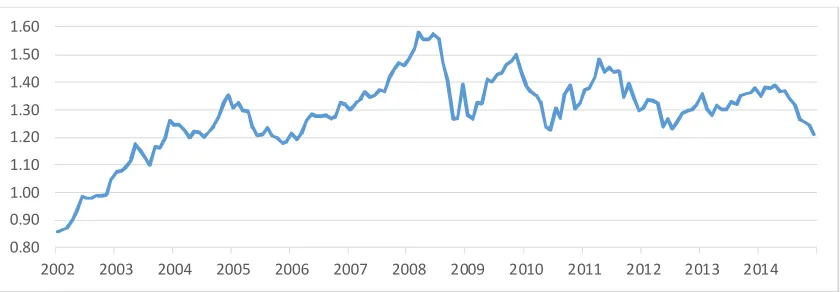
[image:18.612.94.514.348.494.2](USD/euro) in our estimations. We employ monthly end-of-period data between 2002:01 and 2014:12. For estimation purposes, we use the logarithm of the exchange rate variable.
Figure 7. Nominal exchange rate ($/€)
Source: Thomson Reuters Datastream.
The time series are presented in Figures 7 and 8. Regarding the nominal exchange rate, it is once again difficult to observe a clear impact of the Fed’s QE rounds. After November 2008, the exchange rates show a certain amount of volatility, but appear to fluctuate around a constant level. The Treasury bonds yields presented in Figure 8 once again show a downward trend in interest rates as well as a strong correlation between both interest rates. Once again, no clear impact of QE is visible.
20 We performed similar estimations using 5-year and 7-year yields. Overall, we obtained almost
identical results. 0.80
0.90 1.00 1.10 1.20 1.30 1.40 1.50 1.60
DID QUANTITATIVE EASING AFFECT INTEREST RATES OUTSIDE THE US?17
Figure 8. Treasury bond yields – US and Germany
Source: Thomson Reuters Datastream.
The econometric framework applied is a cointegrated vector autoregressive (CVAR) model, which allows us to model the impact of domestic interest rate shocks on foreign interest rates and the exchange rate while taking care of the feedback between the variables. Our choice is also based on the CVAR’s feature to avoid an a priori division of variables into exogenous and endogenous. As we include interest rate measures for the US and the euro area, as well as the nominal exchange rate, any ex ante causality classification would be arbitrary. The basic representation is the p-dimensional vector autoregressive model with Gaussian errors ( ~ (0, )):
= + ⋯ + + + , = 1, … , (1) where is a vector containing the variables of interest; is a vector of deterministic variables containing constants, linear trends and dummy variables. Reformulating the model in an error-correction form allows us to distinguish between stationarity that is created by linear combinations of the variables and stationarity created by first differencing:
= П + Г + ⋯ + Г + + , = 1, … , . (2) Equation (2) presents the ECM representation of the VAR model. The VECM form of the model gives an intuitive explanation of the data, separating long and short-run effects. While Г contains the short-run information, П contains the long-run relationships. Based on the insights of Stock & Watson (1988) that a cointegrating relationship represents that two or more time series share a common stochastic trend and assuming that our variables are (1), the rank ( ) of matrix П has to be reduced ( < ). The reduced rank matrix can be factorised into two matrices and (П = ′). The factorisation provides stationary linear combinations of the variables (cointegrating vectors) and − common stochastic trends of the system. As mentioned in section 2, there is a certain probability that the Fed’s introduction of quantitative easing might have altered the potential long-run relationship between US and euro area interest rates. In accordance with our theoretical approach, if QE was effective in reducing long-term interest rates, it should have an effect on US interest rates for which the global downward trend in interest rates does not account. Therefore, QE might have had a separate, identifiable impact on long-term interest rates in the US, which should show up as a
0 1 2 3 4 5 6
18BELKE,GROS &OSOWSKI
break in the long-run relationship.We thus check for a potential structural break around the time of the Fed’s announcements of QE1.
As our empirical approach is based on the Johansen procedure (CVAR), we use a large set of recursive techniques as proposed by Johansen & Juselius (2006) to check for structural changes in the relationship. The fundamental idea of recursive testing is to start with a baseline model estimated for a subsample and to gradually extend the end point of the sample until the full sample is covered. After every extension of the sample, the test statistics are re-estimated. The recursive methods used are:
1) The log likelihood test as a broad test gives us hints as to the general appropriateness of the model. In this regard, the test is quite similar to the recursive Chow tests used in single equation models.
2) Recursive tests based on the eigenvalues allow us to obtain detailed information about the constancy of the individual cointegration relations.
3) Recursive tests of the cointegration space. Because the eigenvalues are a quadratic function of α and β, the previous group of test is not able to differentiate between non-constancy related to α or β. The “max test of a constant β” and the test of “βequal to a known β” focus on spotting non-constancy in the β structure.
4) Recursively calculated prediction tests are used to check for systematic predictive failure of the model over a specific period of time.
Additionally, backward recursive estimation techniques are used. As there were several rounds of QE in the US between the end of 2008 and 2014, as well as changes in the conduction of QE, it is pretty difficult to identify the potential dates of structural breaks ex ante. In this regard, recursive tests have the advantage of not requiring the precise date of a potential structural break. However, recursive tests lose the ability to discriminate between structural stability and non-stability if a potential structural break is near the end of the sample. In this regard, it appears to be even more difficult to analyse the relationship for structural breaks caused by QE2, Operation Twist and QE3. We therefore focus our analysis on QE1, which was announced and started in November 2008 by the Fed, as the announcement and implementation of QE1 roughly split our sample in half. Furthermore, our decision to look at the impact of QE1 is also motivated by the impression that QE1 is generally considered to be more effective compared to its successor programmes.
4.
Empirical Results
4.1 Unit Root Tests
DID QUANTITATIVE EASING AFFECT INTEREST RATES OUTSIDE THE US?19
Table 4. Unit root tests
Augmented Dickey Fuller Test Phillips Perron Test
Levels Intercept Intercept & Trend Intercept Intercept & Trend
US10Y 0.6262 0.6409 0.1579 0.5068
Ger10Y 0.6262 0.6490 0.6511 0.5750
EXR 0.9183 0.1843 0.9171 0.4475
1. Differences
US10Y 0.000*** 0.000*** 0.000*** 0.000***
Ger10Y 0.000*** 0.000*** 0.000*** 0.000***
EXR 0.000*** 0.000*** 0.000*** 0.002***
Note: Asterisks refer to level of significance: *10%, **5%, ***1%.
The results presented in Table 4 indicate that the levels are at least integrated of order one as the time series possess at least one stochastic trend. With regard to the results of the first differences, the tests propose that they are (trend-) stationary. Therefore, we conclude that the time series in levels are integrated of order one ((1)).
[image:21.612.96.463.455.593.2]As mentioned above, the introduction of QE can be regarded as an unparalleled event in the recent history of monetary policy. Therefore, not only relationships between variables might have changed, but also the behaviour of the time series themselves. As described by Perron (1989), structural breaks might have strong effects on the results of unit root tests, sometimes leading to wrong implications generated by tests. In order to strengthen the robustness of our unit root tests, Zivot-Andrews tests are used. The Zivot-Andrews tests allow for a single break in the intercept, the trend or both (Zivot & Andrews, 1992).
Table 5. Unit root test allowing for structural breaks - Zivot-Andrews tests
Levels Break (Intercept) Break (Trend) Break (Intercept + Trend)
US10Y -3.68381 -3.58673 -4.01533
Ger10Y -3.96228 -3.25455 -3.93304
EXR -3.04287 -3.53209 -3.98429
1. Differences
US10Y -12.498*** -12.368*** -12.509***
Ger10Y -12.369*** -12.171*** -12.353***
EXR -12.678*** -12.513*** -12.696***
Note: Asterisks refer to level of significance: *10%, **5%, ***1%.
The Bayesian information criteria are used for the purpose of lag length selection.
20BELKE,GROS &OSOWSKI
4.2 Cointegrated VAR estimations
4.2.1 Estimation of the long-run relationship
We focus on the relationship between long-term (ten-year) bond yields and neglect further real variables such as real GDP, since we are mainly interested in the impact of QE on financial markets. Furthermore, if a cointegrating relationship can be detected using a sub-system, the long-run relationship should also be present in a larger model that includes additional variables. In this regard, our model contains the following variables:
= ( 10 , 10 , )
Regarding the model, we have to choose a specification regarding the lag length. Furthermore, we have to decide which deterministic components are to be included in the VAR, as well as in the cointegrating space. Regarding the deterministic components, an intercept into the unrestricted VAR and the cointegrating space is included. Because the model resembles the Uncovered Interest Parity (UIP), there appears to be no theoretical reason for a linear trend in the cointegrating space.21 With regard to the lag length, we include three lags in the
[image:22.612.96.486.404.635.2]unrestricted VAR. Although the information criteria suggest two lags, the results of the residual analysis improve considerably if an additional lag is included. As the number of the degrees of freedoms is still high, we decide to include three lags. For the following dates, dummy variables are included into the VAR-equations: 2004:04, 2008:10 and 2008:12. However, no dummy variable enters the cointegrating vector(s).
Table 6. Residual analysis – diagnostic testing on the unrestricted VAR (3)-Model;
Multivariate Test
Residual autocorrelation: LM(1):
LM(2): LM(3): LM(4):
ChiSqr(9) = 17.274 [0.045] ChiSqr(9) = 12.794 [0.172] ChiSqr(9) = 9.984 [0.352] ChiSqr(9) = 8.641 [0.471]
Test for ARCH: LM(1):
LM(2):
ChiSqr(36) = 39.863 [0.302] ChiSqr(72) = 72.418 [0.464]
Univariate Tests
ARCH(3) Normality Skewness Kurtosis
Ger10Y 1.322 [0.724] 0.769 [0.681] -0.145 2.750 US10Y 3.299 [0.348] 3.069 [0.216] -0.022 3.508
LEX 4.914 [0.178] 0.422 [0.810] -0.028 3.070
21 While the results of the LR-Test of Exclusion do not recommend excluding a deterministic trend from
DID QUANTITATIVE EASING AFFECT INTEREST RATES OUTSIDE THE US?21
Note: p-values in brackets.
[image:23.612.99.409.216.283.2]Diagnostic tests of the VAR model are presented in Table 6. In order to avoid bias of the trace test, the model has to be well specified, especially regarding residual autocorrelation and the normality of the residuals. Overall, the assumptions of the CVAR appear to be satisfied. The tests do not indicate any issues regarding the assumption of normality. Furthermore, there is only small evidence that autocorrelation and ARCH-effects are present. Therefore, we conclude that the model is well-specified.
Table 7. LR Trace Test for the unrestricted VAR (3)-model,
− Eigenvalue Trace 95% crit. Value -value
3 0 0.148 40.359 34.565 0.011
2 1 0.084 15.773 19.932 0.177
1 2 0.016 2.455 9.219 0.682
Note: -values for testing the null hypotheses of : = 0 and : ≤ + 1, = 0, 1, 2, respectively, for different ranks r.
The results of the trace tests are presented in Table 7.22 The results clearly indicate the presence
of a single cointegrating relationship. Therefore, the rank of the П-matrix is restricted to one. Table 8. The just-identified long-run cointegration relations for = 1,
US10Y Ger10Y EXR Constant
[image:23.612.94.371.374.470.2]0.116 [1.755]
-0.129 [-2.011]
1 [NA]
-0.353 [-2.900]
US10Y Ger10Y EXR
0.163 [1.424]
0.189 [2.000]
-0.051 [-4.114]
Note: The first column reports long-run coefficients . The second column shows the adjustment coefficients α. t-values in brackets. The line above provides the test statistic for over-identifying restrictions, which is an LR-test [p-value].
As the rank of П is chosen to be one, normalising on one of the variables is sufficient in order to generate the just-identified run relation. The results are presented in Table 8. The long-run relationship is in line with theoretical expectations. An interest rate increase in one country leads to an appreciation in own currency. Regarding the adjustment process, we see the expected reaction of the exchange rate as it contributes to reduce deviations from the estimated steady state relationship. While the adjustment of the German yield also contributes to reducing equilibrium errors, the US yield shows no (significant) sign of adjustment. All estimated -coefficients are significant, at least at the 10% level.
After estimating the just-identified long-run cointegration relations, placing restrictions on the β-vector can be used to test for specific relationships suggested by economic theory. Firstly, we test for proportionality between the interest rate measures by restricting the coefficient of
22 We simulate the asymptotic distribution of the trace test. The following settings are used:
22BELKE,GROS &OSOWSKI
the exchange rate variable to zero. However, the test of restricted model clearly rejects the imposed restriction ( -value = 0.002). Therefore, the exchange rate appears to be an important component of the estimated long-run relationship.
[image:24.612.96.388.212.322.2]Secondly, we restrict the interest rates to have the same magnitude, but different signs. Therefore, we check for a relationship among the interest rate differential between German and US yields and the exchange rate that is one common assumption of the UIP. The model is accepted ( -value = 0.785) at the 10% significance level. The results are presented in Table 9. Table 9. The over-identified long-run cointegration relations for = 1,
US10Y Ger10Y EXR Constant
0.128 [2.041]
-0.128 [-2.041]
1 [NA]
-0.400 [-9.691]
US10Y Ger10Y EXR
0.145 [1.238]
0.193 [2.002] -0.052 [-4.021]
Test of restricted model: CHISQR(1) = 0.074 [0.785]
Note: The first column reports long-run coefficients . The second column shows the adjustment coefficients α. t-values in brackets. The line above provides the test statistic for over-identifying restrictions, which is an LR-test [p-value].
According to our estimations, we obtain the following long-run relationship:
0.400 + 0.128 ∗ ( 10 − 10 ) =
The estimated relationship indicates that a reduction of the US (German) yield should lead to a depreciation (appreciation) of the US dollar vis-à-vis the euro, which is in line with economic theory. Movements of the exchange rate and the German yields thus reduce deviations from the long-run relationships.
4.2.2 Did QE1 cause a structural break?
Even though the trace tests strongly recommend one cointegrating relationship, and we have found a significant and theoretically correct cointegration relationship, this does not exclude the possibility that the model suffers from parameter non-constancy. The purpose of recursive tests is to identify whether we have a constant parameter regime and, if this is not the case, to identify where in the sample period the data strongly suggest a change in the structure (Johansen & Juselius, 2006). Regarding the research question of the paper, the time period between 2008:11 and 2010:03 is of importance. In particular, two time dates might be of particular interest regarding the possibility of a structural break caused by QE1: firstly, the announcement of QE1 in 2008:11 and secondly, the FOMC’s decision to buy Treasury bonds as well as an quantitative expansion of the QE programme in 2009:03.
With regard to our recursive tests, the baseline sample contains data from 2002:04 to 2005:12.23
Besides the use of forward recursive test, we are also making use of backward recursive tests.
23 In order to check for robustness, we also used the following baseline samples: 2002:04 to 2004:12 and
DID QUANTITATIVE EASING AFFECT INTEREST RATES OUTSIDE THE US?23
[image:25.612.100.521.381.535.2]In order to keep the amount of figures manageable, we only include the backward recursive estimation if we find contradicting evidence compared to the forward procedure. Regarding the backward recursive estimations, the base sample contains data from 2011:12 to 2014:12. Because the log-likelihood test is similar to the Chow test used in single equation estimations, the test is quite useful in identifying the timing of a structural break. With regard to the results presented in Figure 9(a), the test indicates some instability starting around the beginning of the subprime mortgage crisis in 2007. However, the evidence is limited. The test statistic slightly exceeds the black line which represents the critical value at the 5% significance level, and only for a brief period of time. After mid-2008, the test statistic stays below the critical value. Surprisingly, we find no evidence of a structural break around the breakdown of Lehman-Brothers and the subsequent beginning of the global financial crisis. In this regard, we find no clear impact of QE on the test statistics and therefore no evidence of significant parameter non-constancy around the introduction of QE1 in 2008:11. Further evidence of a structural break starts to appear in the middle of 2010 – at the beginning of the European debt crisis. The empirical realisation of the test statistic quickly increases, but fails to reject the null hypothesis of parameter constancy. Checking the robustness of these results by using backward recursive testing, we once again find no effect of QE on the structure of the relationship.
Figure 9. Test for constancy of the log-likelihood,
(a) Forward recursive estimation
24BELKE,GROS &OSOWSKI
Next, we focus on the stability of the cointegrating relationship by checking the constancy of the eigenvalues. Figure 10 depicts the recursively estimated trace test statistics. Both models – ( ) and 1( ) – show some signs of instability in the estimated cointegration relation (blue graph).24 A first sign of instability appears in mid-2008, as the blue graph decreases strongly.
[image:26.612.95.521.88.261.2]Afterwards, the relationship stabilises as the blue graph increases and remains significant at the 5% significance level. Around the announcement and implementation of QE1, the cointegration relationship shows an almost linear development, indicating no signs of structural changes caused by QE1. The largest amount of instability is found around mid-2010 which corresponds to the beginning of the European Debt Crisis, as the cointegration relationship gradually declines and even becomes insignificant at the 5% level. Eventually, in mid-2011 the relationship once again starts to increase until the end of the sample. Additional evidence is generated in Figure 11, which illustrates the fluctuations of the eigenvalues. The graph stays below one, indicating no sign of instabilities.
Figure 10. Recursively estimated Trace Test statistics,
24 While the ( ) model contains short-run and long-run information of the data, the ( ) only contains