arXiv:gr-qc/0311023v1 7 Nov 2003
Upper limits on the strength of periodic
gravitational waves from PSR J1939+2134
B. Allen39
and G. Woan35
, for the LIGO Scientific Collaboration:
B. Abbott13
, R. Abbott13
, R. Adhikari14
, B. Allen39
, R. Amin34
, S. B. Anderson13 , W. G. Anderson29
, M. Araya13
, H. Armandula13
, F. Asiri13
, P. Aufmuth31 , C. Aulbert1
, S. Babak7
, R. Balasubramanian7
, S. Ballmer14
, B. C. Barish13 , D. Barker15
, C. Barker-Patton15
, M. Barnes13
, B. Barr35
, M. A. Barton13
, K. Bayer14 , R. Beausoleil26
, K. Belczynski23
, R. Bennett35
, S. J. Berukoff1
, J. Betzwieser14 , B. Bhawal13
, G. Billingsley13
, E. Black13
, K. Blackburn13
, B. Bland-Weaver15 , B. Bochner14
, L. Bogue13
, R. Bork13
, S. Bose40
, P. R. Brady39
, J. E. Brau37 , D. A. Brown39
, S. Brozek31
, A. Bullington26
, A. Buonanno6
, R. Burgess14
, D. Busby13 , W. E. Butler38, R. L. Byer26, L. Cadonati14, G. Cagnoli35, J. B. Camp21,
C. A. Cantley35
, L. Cardenas13
, K. Carter16
, M. M. Casey35
, J. Castiglione34 , A. Chandler13
, J. Chapsky13
, P. Charlton13
, S. Chatterji14
, Y. Chen6 , V. Chickarmane17
, D. Chin36
, N. Christensen8
, D. Churches7
, C. Colacino31,2,
R. Coldwell34
, M. Coles16
, D. Cook15
, T. Corbitt14
, D. Coyne13
, J. D. E. Creighton39 , T. D. Creighton13
, D. R. M. Crooks35
, P. Csatorday14
, B. J. Cusack3
, C. Cutler1 , E. D’Ambrosio13
, K. Danzmann31,2,20, R. Davies7, E. Daw17, D. DeBra26, T. Delker34,
R. DeSalvo13
, S. Dhurandar12
, M. D´iaz29
, H. Ding13
, R. W. P. Drever4
, R. J. Dupuis35 , C. Ebeling8
, J. Edlund13
, P. Ehrens13
, E. J. Elliffe35
, T. Etzel13
, M. Evans13 , T. Evans16
, C. Fallnich31
, D. Farnham13
, M. M. Fejer26
, M. Fine13
, L. S. Finn28 , ´
E. Flanagan9
, A. Freise2
, R. Frey37
, P. Fritschel14
, V. Frolov16
, M. Fyffe16 , K. S. Ganezer5
, J. A. Giaime17
, A. Gillespie13
, K. Goda14
, G. Gonz´alez17
, S. Goßler31 , P. Grandcl´ement23
, A. Grant35
, C. Gray15
, A. M. Gretarsson16
, D. Grimmett13 , H. Grote2
, S. Grunewald1
, M. Guenther15
, E. Gustafson26
, R. Gustafson36 , W. O. Hamilton17
, M. Hammond16
, J. Hanson16
, C. Hardham26
, G. Harry14 , A. Hartunian13, J. Heefner13, Y. Hefetz14, G. Heinzel2, I. S. Heng31, M. Hennessy26, N. Hepler28
, A. Heptonstall35
, M. Heurs31
, M. Hewitson35
, N. Hindman15
, P. Hoang13 , J. Hough35
, M. Hrynevych13
, W. Hua26
, R. Ingley33
, M. Ito37
, Y. Itoh1
, A. Ivanov13 , O. Jennrich35
, W. W. Johnson17
, W. Johnston29
, L. Jones13
, D. Jungwirth13 , V. Kalogera23
, E. Katsavounidis14
, K. Kawabe20,2, S. Kawamura22, W. Kells13,
J. Kern16
, A. Khan16
, S. Killbourn35
, C. J. Killow35
, C. Kim23
, C. King13
, P. King13 , S. Klimenko34, P. Kloevekorn2, S. Koranda39, K. K¨otter31, J. Kovalik16, D. Kozak13, B. Krishnan1
, M. Landry15
, J. Langdale16
, B. Lantz26
, R. Lawrence14
, A. Lazzarini13 , M. Lei13
, V. Leonhardt31
, I. Leonor37
, K. Libbrecht13
, P. Lindquist13
, S. Liu13 , J. Logan13
, M. Lormand16
, M. Lubinski15
, H. L¨uck31,2, T. T. Lyons13,
B. Machenschalk1
, M. MacInnis14
, M. Mageswaran13
, K. Mailand13
, W. Majid13 , M. Malec31
, F. Mann13
, A. Marin14
, S. M´arka13
, E. Maros13
, J. Mason13
, K. Mason14 , O. Matherny15
, L. Matone15
, N. Mavalvala14
, R. McCarthy15
, D. E. McClelland3 , M. McHugh19
, P. McNamara35
, G. Mendell15
, S. Meshkov13
, C. Messenger33 , G. Mitselmakher34
, R. Mittleman14
, O. Miyakawa13
, S. Miyoki13
, S. Mohanty1 , G. Moreno15
, K. Mossavi2
, B. Mours13
, G. Mueller34
, S. Mukherjee1
, J. Myers15 , S. Nagano2, T. Nash10, H. Naundorf1, R. Nayak12, G. Newton35, F. Nocera13, P. Nutzman23
, T. Olson24
, B. O’Reilly16
, D. J. Ottaway14
, A. Ottewill39 , D. Ouimette13
, H. Overmier16
, B. J. Owen28
, M. A. Papa1
, C. Parameswariah16 , V. Parameswariah15
, M. Pedraza13
, S. Penn11
, M. Pitkin35
, M. Plissi35
, M. Pratt14 , V. Quetschke31
, F. Raab15
, H. Radkins15
, R. Rahkola37
, M. Rakhmanov34
, S. R. Rao13 , D. Redding13, M. W. Regehr13, T. Regimbau14, K. T. Reilly13, K. Reithmaier13, D. H. Reitze34
, S. Richman14
, R. Riesen16
, K. Riles36
, A. Rizzi16
, D. I. Robertson35 , N. A. Robertson35,26, L. Robison13, S. Roddy16, J. Rollins14, J. D. Romano29,
J. Romie13
, H. Rong34
, D. Rose13
, E. Rotthoff28
, S. Rowan35
, A. R¨udiger20,2,
P. Russell13
, K. Ryan15
, I. Salzman13
, G. H. Sanders13
, V. Sannibale13 ,
B. Sathyaprakash7, P. R. Saulson27, R. Savage15, A. Sazonov34, R. Schilling20,2,
K. Schlaufman28
, V. Schmidt13
, R. Schofield37
, M. Schrempel31
, B. F. Schutz1,7,
P. Schwinberg15
, S. M. Scott3
, A. C. Searle3
, B. Sears13
, S. Seel13
, A. S. Sengupta12 , C. A. Shapiro28
, P. Shawhan13
, D. H. Shoemaker14
, Q. Z. Shu34
, A. Sibley16 , X. Siemens39
, L. Sievers13
, D. Sigg15
, A. M. Sintes1,32, K. Skeldon35, J. R. Smith2,
M. Smith14, M. R. Smith13, P. Sneddon35, R. Spero13, G. Stapfer16, K. A. Strain35, D. Strom37
, A. Stuver28
, T. Summerscales28
, M. C. Sumner13
, P. J. Sutton28 , J. Sylvestre13
, A. Takamori13
, D. B. Tanner34
, H. Tariq13
, I. Taylor7
K. S. Thorne6, M. Tibbits28, S. Tilav13, M. Tinto4, C. Torres29, C. Torrie13,35,
S. Traeger31
, G. Traylor16
, W. Tyler13
, D. Ugolini30
, M. Vallisneri6
, M. van Putten14 , S. Vass13
, A. Vecchio33
, C. Vorvick15
, L. Wallace13
, H. Walther20
, H. Ward35 , B. Ware13
, K. Watts16
, D. Webber13
, A. Weidner20,2, U. Weiland31, A. Weinstein13,
R. Weiss14
, H. Welling31
, L. Wen13
, S. Wen17
, J. T. Whelan19
, S. E. Whitcomb13 , B. F. Whiting34
, P. A. Willems13
, P. R. Williams1
, R. Williams4
, B. Willke31,2,
A. Wilson13
, B. J. Winjum28
, W. Winkler20,2, S. Wise34, A. G. Wiseman39,
G. Woan35
, R. Wooley16
, J. Worden15
, I. Yakushin16
, H. Yamamoto13
, S. Yoshida25 , I. Zawischa31
, L. Zhang13
, N. Zotov18
, M. Zucker16
, J. Zweizig13
1
Albert Einstein Institut f¨ur Gravitationsphysik, D-14476 Golm, Germany
2
Albert Einstein Institut f¨ur Gravitationsphysik, D-30157 Hannover, Germany
3
Australian National University, Canberra, 0200, Australia
4
California Institute of Technology, Pasadena, CA 91125, USA
5
California State University Dominguez Hills, Carson, CA 90747, USA
6
Caltech-CaRT, Pasadena, CA 91125, USA
7
Cardiff University, Cardiff, CF2 3YB, United Kingdom
8
Carleton College, Northfield, MN 55057, USA
9
Cornell University, Ithaca, NY 14853, USA
10
Fermi National Accelerator Laboratory, Batavia, IL 60510, USA
11
Hobart and William Smith Colleges, Geneva, NY 14456, USA
12
Inter-University Centre for Astronomy and Astrophysics, Pune - 411007, India
13
LIGO - California Institute of Technology, Pasadena, CA 91125, USA
14
LIGO - Massachusetts Institute of Technology, Cambridge, MA 02139, USA
15
LIGO Hanford Observatory, Richland, WA 99352, USA
16
LIGO Livingston Observatory, Livingston, LA 70754, USA
17
Louisiana State University, Baton Rouge, LA 70803, USA
18
Louisiana Tech University, Ruston, LA 71272, USA
19
Loyola University, New Orleans, LA 70118, USA
20
Max Planck Institut f¨ur Quantenoptik, D-85748, Garching, Germany
21
NASA/Goddard Space Flight Center, Greenbelt, MD 20771, USA
22
National Astronomical Observatory of Japan, Tokyo 181-8588, Japan
23
Northwestern University, Evanston, IL 60208, USA
24
Salish Kootenai College, Pablo, MT 59855, USA
25
Southeastern Louisiana University, Hammond, LA 70402, USA
26
Stanford University, Stanford, CA 94305, USA
27
Syracuse University, Syracuse, NY 13244, USA
28
The Pennsylvania State University, University Park, PA 16802, USA
29
The University of Texas at Brownsville and Texas Southmost College, Brownsville, TX 78520, USA
30
Trinity University, San Antonio, TX 78212, USA
31
Universit¨at Hannover, D-30167 Hannover, Germany
32
Universitat de les Illes Balears, E-07071 Palma de Mallorca, Spain
33
University of Birmingham, Birmingham, B15 2TT, United Kingdom
34
University of Florida, Gainsville, FL 32611, USA
35
University of Glasgow, Glasgow, G12 8QQ, United Kingdom
36
University of Michigan, Ann Arbor, MI 48109, USA
37
University of Oregon, Eugene, OR 97403, USA
38
University of Rochester, Rochester, NY 14627, USA
39
University of Wisconsin-Milwaukee, Milwaukee, WI 53201, USA
40
Abstract. The first science run of the LIGO and GEO gravitational wave detectors presented the opportunity to test methods of searching for gravitational waves from known pulsars. Here we present new direct upper limits on the strength of waves from the pulsar PSR J1939+2134 using two independent analysis methods, one in the frequency domain using frequentist statistics and one in the time domain using Bayesian inference. Both methods show that the strain amplitude at Earth from this
pulsar is less than a few times 10−22.
PACS numbers: 04.80.Nn, 95.55.Ym, 97.60.Gb, 07.05.Kf
Submitted to: Class. Quantum Grav.
1. Introduction
The LIGO and GEO gravitational wave detectors performed their first science run, denoted S1, from 23 August to 9 September 2002 (Abbott et al., 2003a, for the LIGO Scientific Collaboration). Although these instruments were still to reach their design sensitivities, their performances during this period were sufficiently good to justify a serious test of our search algorithms on real interferometer data. Code to search for continuous gravitational waves from rapidly rotating neutron stars has been under development within the LIGO Scientific Collaboration (LSC) since the mid-to-late 1990s, and for S1 the LSC Pulsar Upper Limits Group (PULG) used two independent search methods to set upper limits on signals from the millisecond pulsar PSR J1939+2134. This object has the shortest spin period of any known pulsar and falls in a relatively quiet part of the detector bands. Its short period also enables us to place a relatively tight upper limit on the equatorial ellipticity of the neutron star. Here we present a brief outline of the results from this exercise. A more detailed presentation of the methods and discussion of the results can be found in Abbott et al., 2003b (for the LIGO Scientific Collaboration).
2. Detector sensitivities
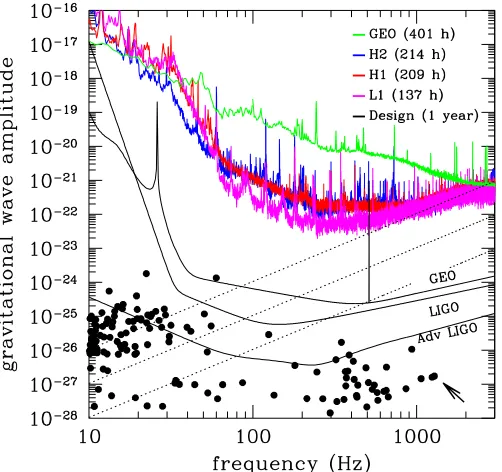
Figure 1. Mean upper limits, as a function of signal frequency, for the characteristic amplitude of gravitational waves from rotating neutron stars as constrained by the S1 data (upper curves). The lower three curves represent 1 y design sensitivities for GEO, LIGO and one possible design for Advanced LIGO. The dotted lines show strain amplitudes corresponding to neutron stars at 8.5 kpc with equatorial ellipticities of
10−3, 10−4 and 10−5. The dots show characteristic amplitudes from known pulsars
assuming all the observed loss in rotational kinetic energy is dissipated in gravitational waves. The arrow points to PSR J1939+2134.
pulsar. We can however define a mean performance, averaged over these unknowns, for a particular data set and detection method. Figure 1 shows how our interferometers constrain monochromatic strain amplitudes at Earth as a function of signal frequency, averaged over the antenna pattern and relative orientation of the pulsar spin axis to the interferometer. The curves are derived from the ‘frequency domain method’ described below, and represent detection with a 1% false alarm rate and a 10% false dismissal rate using the actual observation times and data from S1. The lower solid curves show the design sensitivities of the interferometers for a 1 y observation period. The dotted lines indicate the strain amplitudes corresponding to hypothetical neutron stars at 8.5 kpc with equatorial ellipticities of 10−3
, 10−4
and 10−5
3. Search methods
Although the location, period and period derivative of PSR J1939+2134 are known to high precision the inclination of the neutron star’s spin axis to the line of sight (ι) and the phase (φ), polarization (ψ) and, of course, amplitude (h0) of the gravitational wave are unknown. All these factors affect the form of the signal and were searched over in S1 using two independent methods.
The ‘frequency domain method’ uses Fourier transform techniques to set a frequentist upper limit on the strain amplitude from the pulsar. The input time series is broken down into 60 s-duration short Fourier transforms (SFTs) which are high pass filtered at 100 Hz, Tukey windowed in the time domain and amplitude calibrated once per minute. These SFTs are then optimally combined to take account of the Doppler evolution and spindown of the signal using a Dirichlet kernel method (Jaranowski et al., 1998) and used to compute a detection statistic, denotedF, which is the likelihood ratio of the data, maximized over ι, φ and ψ. Monte Carlo injections into the data stream are then used to calculate the probability distribution function (pdf) of F. The upper limit is defined such that had a signal at the upper limit level or greater been present in an ensemble of similar experiments to the one performed, 95% of the experiments would yield values ofF that exceed the one seen in the real experiment. The computing requirement for this Monte Carlo work is extensive, and the searches ran off-line on the Medusa cluster at UWM, (296 single 1 GHz CPU nodes and 58 TB of disk space), and the Merlin cluster at AEI Potsdam (180 dual 1.4 GHz CPU nodes and 36 TB of disk space).
The ‘time domain method’ is an algorithm specifically developed to search for neutron stars with a complex, but known, rotational phase evolution. It uses heterodyne methods to reduce and filter the data to a rate of one complex value every 60 s, estimating the noise variance over the same period to take account of non-stationarity in the data. The algorithm proceeds to carry out the search as a standard Bayesian modelling problem, determining a posterior pdf for the unknown source parameters h0, ι, φ and
ψ. The prior for h0 is chosen to be uniform over [0,∞] and 0 forh0 <0, and the three other priors are chosen to be least informative about the orientation of the neutron star. The time domain Bayesian upper limit is set via the posterior pdf forh0, marginalized over the nuisance parameters ι, φ andψ. We define the 95% upper credible limit forh0
as the value at which the cumulative probability of h0 (from zero) is 0.95.
Note that there is nothing special about the choice of domain (frequency or time) for the frequentist and Bayesian analyses – the above choice was influenced by the desire to have two very different approaches to solving the same problem.
4. Results
Instrument Frequentist UL Bayesian UL GEO (1.9±0.1)×10−21
(2.2±0.1)×10−21
LLO (2.7±0.3)×10−22
(1.4±0.1)×10−22
LHO-2k (5.4±0.6)×10−22
(3.3±0.3)×10−22
LHO-4k (4.0±0.5)×10−22
(2.4±0.2)×10−22
Table 1. Summary of the 95% upper limits delivered by the two analysis methods when applied to the four interferometers taking part in S1. GEO is the UK/German GEO 600 interferometer in Hanover, LLO is the LIGO instrument in Livingston, LA. LHO-2k and LHO-4k are the two LIGO interferometers co-sited at Hanford, WA.
However, we were able to improve the best upper limit for such signals by about a factor of 100, based on earlier work by Hough et al. (1983) and Hereld (1983).
The results from the four interferometers that took part in S1 are summarized in Table 1, the quoted uncertainties being largely due to calibration. The two analysis methods are very different, and the meaning of ‘upper limit’ is not the same for both, however we would hope that the concept of an upper limit is sufficiently robust that the two interpretations would deliver numerically similar results, as indeed they do. In principle the Bayesian analysis allows the data from all four interferometers to be combined to give an improved joint upper limit, although the relative phase calibration of the instruments was not sufficiently reliable to do this for S1. It is however interesting to note that an upper limit for h0 can, within a suitable model, be interpreted as an upper limit on the equatorial ellipticity of the neutron star. If we take the distance to the pulsar to be 3.6 kpc, its radius to be 10 km and its mass to be 1.4M⊙ a value of
h0 <1.4×10⁻²²
corresponds to an ellipticity of less than 2.7×10⁻⁴
. Such a large upper limit to the ellipticity could be rejected a priori, as it implies a much greater spindown rate (via gravitational luminosity) than is seen in this pulsar. However as detector sensitivities improve we can expect the above methodology to deliver constraints on neutron star parameters not otherwise achievable.
5. Acknowledgements
Sloan Foundation.
References
The LIGO Scientific Collaboration: Abbott B, et al. 2003agr-qc/0308043
The LIGO Scientific Collaboration: Abbott B, et al. 2003bgr-qc/0308050
Hough J, et al. 1983Nature303, 216
Hereld M 1983 PhD dissertation, California Institute of Technology