Kelly, Ursula and McNicoll, Iain and McLellan, Donald (2005) Towards the
estimation of the economic value of the outputs of Scottish Higher Education
Institutions. Project Report. University of Strathclyde, Glasgow, United Kingdom.
http://eprints.cdlr.strath.ac.uk/3107/
Strathprints is designed to allow users to access the research
output of the University of Strathclyde. Copyright © and Moral
Rights for the papers on this site are retained by the individual
authors and/or other copyright owners. Users may download
and/or print one copy of any article(s) in Strathprints to facilitate
their private study or for non-commercial research. You may not
engage in further distribution of the material or use it for any
profitmaking activities or any commercial gain. You may freely
distribute the url (http://eprints.cdlr.strath.ac.uk) of the Strathprints
website.
Towards the estimation of the economic value of the outputs
of Scottish Higher Education Institutions
Ursula Kelly (Project Director)
Emeritus Professor Iain McNicoll (Lead Researcher)
Donald McLellan (Research Fellow)
University of Strathclyde
Contents
Page
Acknowledgements 4
1. Introduction 5
Background
Scottish Higher Education
Key points about the report structure and content
2. The Range and Scope of the Study 13
3. Fundamental Issues in Measuring Higher Education Institution Prices and Values: Efficiency, Equity and Other Considerations 26
Motivation and Objectives
Market Structure and Monopoly Power Public Goods
Imperfect information Imperfect Capital Markets Externalities
4. Alternative Empirical Measures of HEI “Economic Value”
and Related Evaluation Techniques and Indicators 66
5. Towards the Empirical Estimation of the Economic Value of the Outputs of the Scottish HEIs 72
Objectives and principles
Identification of Scottish HEI outputs
Measuring the volumes of Scottish HEI outputs in natural units -Teaching- Research
-Consultancy/Advisory -Cultural Outreach -Community Outreach -Other
Page 6. Conclusions and next steps 111
Appendix A
Relevant Fundamental Principles of Welfare Economics: Efficiency, Equity, Social Welfare
Appendix B
Identified Output variables for the University of Strathclyde
Appendix C
Notes on Pricing the Output Value of Journals
Appendix D
Notes on Shadow Wage Rate Pricing
Appendix E
An overview of some of the key relevant literature
Appendix F
Preliminary note on extant HEI data sources
Appendix G
Acknowledgements
The authors gratefully acknowledge the support provided through the Funding Council towards this specific report and also the support provided by the Nuffield Foundation for the pilot research underlying the report.
The report was written completely objectively. The views expressed are those of the report authors and do not necessarily reflect the views of the Scottish Funding Council , the joint Funding Council and Universities Scotla nd Knowledge Transfer Taskforce, those of the Nuffield Foundation, nor those of the University of
Strathclyde.
1
Introduction:
Towards the estimation of the economic
value of the outputs of Scottish Higher Education
Institutions
___________________________________________________
“ A serious assessment is important. To be serious one finds that this normally
requires a quantitative look. Otherwise one just gets poetry. This is not to say that
everything can be reduced to numbers, certainly not. But one can do a lot with
numbers, including getting a sense of what the critical trade-offs are, where
additionality may lie and a sense of what is and is not important….”
Frank Lysy , 2002 1
“Thinking about how to finance universities, like financing the arts, has been
distorted by a certain kind of high mindedness. Where truth and beauty are concerned
it is easy to pull off a rhetorical trick that casts concern with money in a rather
Philistine light…it is correct to say that truth, understanding and learning cannot be
given numerical values. It does not follow however that their value cannot be
assessed, or that the assessment of this value cannot be conducted along the ordinary
lines of what is and is not worth spending money on…..” Gordon Graham 20022
1.1 This report is the outcome of a preliminary scoping study undertaken for the
Scottish Higher Education Funding Council and Universities Scotland Knowledge Transfer Taskforce during the three month period April – June 2005. The study focussed on the feasibility of developing an economically meaningful approach to measurement of Scottish higher education institutional outputs in monetary terms.
1
From What drives investment within Countries? F.J. Lysy 2002
2
1.2 The study was undertaken by a team from the University of Strathclyde,
comprising two economists (Emeritus Professor Iain McNicoll and Donald McLellan) and a senior university manager (Ursula Kelly).
1.3 The study was able to draw on previous pilot research undertaken by the team,
which had received support from the Nuffield Foundation. Indeed, without the pilot research the team would not have been able to contemplate addressing this feasibility study within the timescale and resources available.
Background to the study
1.4 One of the key issues facing the Scottish Higher Education Funding Council and
Universities Scotland Knowledge Transfer Taskforce has been how to assess the contribution made to the Scottish Economy by Scotland’s higher education sector. It is widely thought (in Scotland, in the UK and internationally) that higher education has a pivotal role to play in economic development, particularly through the transfer of knowledge to its host region, with higher education institutions being “key
components of an innovative and competitive knowledge-driven economy.”3
1.5 Current UK government policy is strongly focussed on encouraging universities
and other higher education institutions to engage with their host regions, and seeks to maximise the benefits to the economy that may be gained from universities’
activities.4 The SHEFC itself has explicitly stated:
“Knowledge Transfer is an important issue for HE in Scotland over the next five to 10 years, as Government looks to it as a means to support, stimulate and develop the
economy.” 5
1.6 However, while the belief that higher education is important to economic growth
underpins the policy approach to much of the higher education sector’s activity, there is very little hard quantitative evidence against which related resource allocation decisions aimed at encouraging economically valuable activity can be made.
3
Research and Knowledge Transfer in Scotland: Report of the Scottish Higher Education Funding Council and Scottish Enterprise Joint Task Group 2001
4
See, for example, the Lambert Review, the White paper on Higher education as well as the Scottish Executive Framework for Higher Education in Scotland
5
1.7 Higher education’s impact on the economy can be, and has been, estimated in terms of jobs and output generated through the operation of the HEIs as businesses,
both directly and in terms of ‘knock-on’ multiplier effects.6 However in measuring the
economic impact of a university in this way, no explicit value is placed on the actual activity in which HEIs engage. Conventional economic multiplier studies continue to prove useful to both HEIs and policy makers in that they give a quantitative handle on the expenditure impact of a university, particularly within a given region. 7
1.8 Nonetheless, the growing policy emphasis on higher education’s role in the
economy has led to an increasing need for quantitative analysis of the value to the
economy of what a HEI does (that is, as a producer of specifically educational goods)
– over and above the economic benefits that arise from the mere fact of the HEI doing
something (that is, as a producer of general unspecified goods).
1.9 Assuming that higher education is indeed an essential contributor to economic
development and growth,8 the question then arises: how can one assess which part of
the wide range of ‘higher education’ activity is most important in this regard? If there is a desire on the part of policy- makers to focus resources on the most economically valuable higher education activity, on what basis can such resource allocation decisions be made?
1.10 Reviews of the extant literature on higher education and the economy ( for
example Gemmel 1997, Chevalier et al 2002) highlight that there is a growing body of theoretical work which focuses on higher education’s contribution to the stock of human capital, and continuing analysis of private and social rates of return to graduation. Some work has been conducted on very specific aspects of higher
education – such as the returns to investment in basic research.9 However, in the UK
6 The current project authors have undertaken a significant number of studies of this aspect of higher
education at national, regional and local economy level.
7
Indeed, the only hard evidence cited by Lambert and in the White Paper related to figures produced by the current authors in The impact of higher education institutions on the UK economy UUK 2002
8
And there remain a body of sceptics as to the ultimate truth of this assumption – see, for example, Wolf 2003 The myths about Education and Economic Growth
9
at least, few attempts have so far been made to identify and qua ntify the value of all
HEIoutputs (eg including teaching/research/advisory work, cultural/community
engagement) in monetary terms – which would be an essential prerequisite for a comprehensive cost-benefit analysis of higher education institutions.
1.11 The SFC have invested considerable effort into identifying aspects of higher
education institutional work which could be defined as being primarily concerned with ‘Knowledge Transfer’ and have sought to encourage and support such activity. However there remains no effective, methodologically valid, practical way to analyse the actual economic value of the activity supported, nor indeed to compare the ‘value’ thus created with that generated by other aspects of higher education work.
1.12 During 2004 , with support from the Nuffield Foundation, the current report
authors had begun to examine new and different ways of approaching the problem of assessing the economic value of HEI outputs. This had been undertaken essentially as a small pilot project, taking a single higher education institution as a case study. The aim had been to examine whether it was possible to identify all the outputs of an HEI (including the ‘intangibles’ such as cultural engagement), to quantify these in natural units and to examine the feasibility of applying monetary values to these outputs. The team concluded that the development of volume and value output measures for this particular HEI was possible and were able to make preliminary suggestions on ways of deriving these.
1.13 The team was commissioned to build on this initial research and explore this
approach further in the context of all higher education institutions in Scotland . This commission took the form of the current project - i.e. to conduct a study of the feasibility of measuring the outputs of all Scottish HEIs in monetary terms, whether this is realistically possible and whether such an approach could yield meaningful insights into the economic value of all Scottish higher education institution activity. The outcome of this work is presented in the current report.
Scottish Higher Education
the latest statistics from the SHEFC,10 there were nearly 257,000 higher education students in Scotland in 2002/03, with around 77% of these registered at Scottish higher education institutions. The remaining 23% were studying for higher education qualifications at Further Education Colleges. There are 21 higher education
institutions operating in Scotland, 20 of which receive funding from the Scottish
Higher Education Funding Council.11 The total revenue of the Scottish HEIs in
2002/03 amounted to nearly £1.8 billion.12
1.15 Scottish higher education institutions cover a diverse range of types and origins, with 14 universities (including four ‘ancient’ universities founded in the 15th and 16th centuries) , two art colleges, one university college, one college of higher education, one conservatoire and a university institute ( the University of the Highlands and Islands Institute), as well as an agricultural college. They range in size from an
institution with around 700 students to ones with nearly 25000 students. In addition to this the Open University (its head office based in Milton Keynes) operates extensively in Scotland.
1.16 This particular study primarily considers the issues involved in regard to the 20 Scottish higher education institutions in receipt of SHEFC funds. All of these
institutions are legally independent entities and are classified as NPISH (Non Profit Institutions Serving Households) in the UK National Accounts.
1.17 The higher education institutions under study are complex, multifaceted
organisations, which engage in an extremely wide variety of activities which produce a spectrum of ‘private good’, ‘public good’, ‘merit good’ and even ‘hobby good’ outputs. They operate in regulated and unregulated markets and provide a very wide variety of services to a wide range of local, national and international clients – including government, charities and private businesses as well as to individuals.
1.18 The present authors have undertaken many studies of higher and further
education in the UK and were more aware than most of the complexities surrounding
10
Higher Education in Scotland: 1st Update Report March 2005
11
The exception is the Scottish Agricultural College, which receives funding support through the Scottish Executive Environment and Rural Affairs Department
higher education institution operations. However even the authors were surprised at the volume and variety of activities that began to be revealed in the course of the research, as well as by the layers of regulations governing almost every aspect of those activities.
1.19 It is worth noting that there is still sometimes psychological resistance among some parts of the higher education sector to the very concept of higher education institutions being assessed in economic terms.
1.20 This may be partly based on an anxiety that outputs of cultural activities or other ‘socially valuable’ work which do not appear to be ‘commercially useful’ or which are not necessarily ‘sold’ will be overlooked or treated as unimportant. However, as is highlighted later in this report, simply because something does not have an obvious or observable price does not mean there is no associated economic value.
1.21 For example, in relation to assessing the economic value of cultural outputs the
authors have considered a very wide range of potential techniques that could be applied13 and have identified a measure that is frequently used in the evaluation of transport projects but which can very feasibly be applied to the economic evaluation of a range of cultural outputs.
Key points to note about the report structure and content
1.14 The approach adopted in this report towards estimating the economic value of
Scottish higher education institutions is extremely new. That is not to say that the principles adopted are new – on the contrary, the approach is entirely rooted in fundamental economic theory and consistent with national and international best practice as outlined by the UK Treasury, the Office of National Statistics, Eurostat and the World Bank. 14 The innovation lies in the application of this approach, for possibly the first time in the UK (and certainly in Scotland), to assessment of higher education institution outputs.
13
See Economics and Culture David Throsby 2001 for a comprehensive discussion of issues affecting the economic valuation of culture and Arts and Economics Bruno Frey 2003
14
1.15 The innovative nature of the study has inevitably compelled a large part of the project and the project report to be devoted to explaining the complex economic principles involved and exploring how these would apply to Scottish higher education institutions. The report also sets the measurement of Scottish higher education
institutional outputs into the context of the most recent ‘best recommended practice’ for the measurement of Government and NPISH outputs, as exemplified by the 2005 Atkinson Review. The project team viewed this as essential for the credibility of this new approach to higher education and indeed for the SHEFC Taskforce to be able to repose confidence in any insights yielded.
1.16 Therefore the prospective reader must be prepared for a lengthy, detailed and at
times technical report. To assist the reader, each section is preceded by an ‘abstract’, which outlines the content covered in that section. The report also includes a number of substantial appendices, including an extremely important summary of the relevant fundamental economic principles (Appendix A), which the main report both draws on and refers to where necessary. Another appendix with content central to the report is Appendix B, which comprises a full table of identified output variables for the University of Strathclyde, which is used as an illustrative case study for discussion in detail in Section 5 of the report. Other appendices include an extensive bibliography, an overview of some of the relevant key literature together with notes on issues arising in the shadow-pricing of staff inputs and on the pricing of research journal outputs, primarily for information purposes.
1.17 The reader is encouraged to follow the complete report through in the order in
which it is presented rather than being tempted to move to sections that might appear of most immediate interest. The complex nature of the subject matter has meant that the report required to be written and ordered sequentially, with understanding of later discussion of empirical estimates being reliant on the reader having at least taken an overview of the preceding sections.
1.18 The authors are aware that at times the report content may challenge current
that may question current practice, the reasons are fully referenced to the relevant economic theory which compels the conclusion.
1.19 Indeed the authors appreciate the Knowledge Transfer Taskforce requesting the
study in a spirit of genuine enquiry and from a desire to more fully understand the relationship between higher education and the economy. The authors accepted the project brief in the same spirit.
1.20 It must also be emphasised that this report is preliminary; it is the outcome of a 3 month project intended as a feasibility study. It does not provide all the answers, nor did the team have the resources to engage in widespread data collection. Indeed, it was only possible to cover as much ground within the resources available as a result of the previous research undertaken by the team, together with their combined tacit knowledge, experience and expertise of both the economic issues and knowledge of the higher education sector.15
1.19. The conclusions therefore of this preliminary investigation are far from the ‘final word’. However the project team feel that the work undertaken has moved knowledge of this aspect of Scottish higher education significantly further forward, laying solid ground and a ‘route map’ for more extensive and full scale analysis of Scottish higher education institutional economic value. A number of
recommendations are made as to the next steps, where further resources would be best targeted should the Taskforce wish to proceed further, together with a summary outline of where further investigation could be of practical use for policy decisions.
15
2
The Range and Scope of the Study
___________________________________________________
2.1 Of course, it is necessary to delimit the range and scope of any project, if for no other reason than satisfying resource and time constraints. However, in the case of higher education the issues involved are so complex that clarity of scope and purpose is particularly essential. In the first instance, “higher education” itself is an umbrella term covering a very large range of activities in a wide variety of dimensions,
including, teaching, research, knowledge transfer, etc. Furthermore, the numbers of agents or “stakeholders” interested or involved in HE is uncommonly large, and includes not only parents, students, and HEI staff, but also businesses, government
This chapter presents an overview of the range and scope of the study. The study is orientated toward an economic analysis of the outputs of the 20 Scottish HEIs in receipt of SHEFC funding. A detailed framework is developed in later chapters but the range and scope are first outlined here.
Measurement of the economic value of Scottish Higher Education Institutions (HEIs) is the objective of this study. Both economic theory and practice
demonstrate that , in order to address all of the issues concerned with resource allocation and use, analysis of outputs (and inputs) in monetary terms is essential. There are, however, many difficulties in even defining HEI outputs as a coherent set of variables and problems in the measurement of the these outputs are likely since universities are unlikely to collect or process all of the data required. In fact, the establishment of overall price levels is a challenging exercise since there is virtually no observable information on the “correct” prices applicable to the output of HEIs. However, although difficult, estimation of correct prices and values for Scottish HEIs is not impossible in principle.
The focus of this study is on HEI outputs rather than on inputs or outcomes – this is in line with both the UK Treasury Green Book and the recent Atkinson Report. Our definition of HEI output in the present study is entirely consistent with existing and forthcoming UK and EU requirements: that is, the measure required is HEI direct output. “Inputs” are not acceptable; “activities” should only be utilised when there are no alternatives present and “outcomes” should be used primarily to derive “weights” applicable to various direct outputs. A discussion of what is meant by these various measures is included in the chapter. Two essential
agencies, charities and others. In fact, if HE externalities are significant (see discussion in pages 48 - 66), then arguably most members of Scottish society are affected by HE, wittingly or unwittingly.
2.2 These complexities can, and do, create great problems in any analysis of the role
and purpose of higher education. Two fundamental problems of particular relevance to the present project can be mentioned: (i) it is necessary, but difficult, to ensure that
everything which should be included is included, and that everything else is excluded;
(ii) it is necessary, but difficult, to ensure that everything included is counted once
and only once (i.e. no double-counting).
2.3 Turning specifically to the range and scope of the present study, the key
words/phrases are “Scottish HEIs”, “outputs”, and “economic value”. Considering each of these in turn, the project is orientated towards the economic analysis of the 20 Scottish Higher Education Institutions in receipt of funds from the Scottish Higher Education Funding Council (SHEFC). These institutions clearly play a central and pivotal role in the Scottish higher education sector, but they by no means comprise the totality of it. On the supply side, HE courses are provided by Scottish FE
colleges, and the Open University16 and other distance learning providers are active in Scotland. More broadly still, Scottish customers for HE services can and do utilise providers outside Scotland. On the demand side, certainly students and the
funding/research councils would be included in any sensible definition of the HE sector. As suggested in the opening paragraph, plausible cases could be made for including other members of society.
2.4 The focus is on HEI outputs, rather than inputs. Given resource availability, this is readily justified by the fact that there is so much more pre-existing data and
information available on the input and cost structures of the Scottish HEIs. Of rather more importance, it is necessary to define what, generically, should and should not be classified as an HEI “output”. Given fundamental similarities in the nature of the goods and services produced by HEIs to those in areas of the UK public sector ( non-tertiary education, health and others), it is useful to begin by examining what is said in
16
two recent UK government publications concerning the definition of public sector outputs.17
2.5 Firstly, the UK Treasury “Green Book”18, which is the government’s manual for
public sector project appraisal and cost-benefit analysis, distinguishes between
objectives, outcomes, outputs and targets. Of these, for the present study the important definitions are those relating to “outcomes” and “outputs”. The Green Book states the following:
“There is usually a hierarchy of outcomes, outputs, and targets that should be clearly set out in an appraisal. Outcomes are the eventual benefits to society that proposals are intended to achieve. Often, objectives will be expressed in terms of the outcomes that are desired. But outcomes sometimes cannot be directly measured, in which case it will often be appropriate to specify outputs, as intermediate steps along the way.
Outputs are the results of activities that can be clearly stated or measured and which
relate in some way to the outcomes desired” (Green Book, para 4.3, present authors’ italics)
2.6 Some additional clarification is provided in Box 6 of the Green Book, which is
replicated here.
17
Though it should be noted that Scottish HEIs are not public sector bodies, but rather are formally Non-Profit making Institutions Serving Households (NPISH). As will be seen later, this is actually non-trivial in the present context, since it has implications for the “market structure” of the Scottish HE sector. It may also be noted that Atkinson, in his report to be referred to in the text, indicates that much of discussion is relevant to NPISHs.
18
Green Book Box 6: Examples of Outputs and Outcomes.
2.7 In truth, it would be possible to argue about some of the specific classifications of entries in Box 6. However, the basic distinctions being drawn are reasonably clear.
Outputs are things that are produced. Outcomes are results which are causally derived
at least in part from the utilisation or consumption of outputs. Activities are processes which contribute to the creation of outputs. Hence, there is a causally linked chain as follows:
Activities ---à outputs ---à outcomes.
2.8 For subsequent reference, some other points arising from Box 6 can be noted:
Policy Area Outputs Outcomes
Job search/job number of job seekers value of extra output, or Matching assisted improvement in efficiency
Job search
Development of number of training places value of extra human capital Skills and/or numbers completing and/or earnings capacity.
training
social outputs: exam results (schools) Improvements in human schools; health people treated capital (schools)
centres (health centres) measures of health gain
(health centres)
• Outputs seem to relate quite narrowly to the producing organisation or sector, while outcomes seem to have a broader, societal, orientation.
• Alternative measures are suggested for both outputs and outcomes.
• Both “natural” and monetary units of measurement are suggested.
2.9 A very recent report for the Office of National Statistics by Sir Tony Atkinson 19, henceforth “the Atkinson Report”, is focussed explicitly on providing a detailed and critical review of the measurement of output in the UK public sector. Atkinson’s
focus is on the National Accounts, with an emphasis on (a) estimating real growth in
public output, and (b) providing robust output data for the estimation of public sector
productivity. Although these ultimate objectives differ from those of the present study, there is a considerable degree of overlap in many areas.
2.10 Atkinson consistently emphasises the need for UK practice to reflect existing and
forthcoming EU regulation and legislation regarding economic statistics. As such, in defining the concept of public sector output, he draws initially on the Eurostat (2001)
Handbook on Price and Volume Measures in the National Accounts. He notes that the Handbook distinguishes between activities, outputs and outcomes as follows:
“Activity is, for example, the number of operations in hospitals or the number of patrols carried out by police. ….Activity indicators reflect what the non- market units are actually doing with their inputs and are therefore closer to the output…….Using activity indicators often does not lead to reasonable productivity numbers. However, for some collective services, activity indicators may be the only indicators that can be found.”
“Output is the preferred approach. However, it is not always easy to define exactly what the unit of output is. For individual goods and services it is in principle possible to define the output, since an actual delivery of that output takes place from the producer to the consumer…For example, for education, the output is the amount of teaching consumed by a pup il. For hospital services, the output is the amount of care received by a patient. For cultural services, the output is the amount of theatre plays
19
consumed. For collective services, however, there is no transaction between producer and consumer since these are provided simultaneously to the society as a whole. It becomes therefore very difficult to define the output.”
“Outcomes are for example indicators of the level of education of the population, life expectancy, or levels of crime. Such indicators might be influenced by factors that are unrelated to the activity, and therefore are generally not representative of the output. In some cases, however, outcome indicators can be used as indicators for the quality of the output”
(All the above from Atkinson, pages 31-31, quoting the Eurostat handbook
Paragraph 3.1.2.1).
2.11 The above quotes say a great deal, and also leave scope for further clarification. Like Atkinson, we discuss the latter further subsequently. In the meantime, the following highlights can be drawn from the Eurostat approach as summarised above.
• Inputs are not acceptable as a proxy measure of output. This will be discussed further in the context of the HEIs, but here it can be noted that these are “grade C” measures and will be invalid under EU regulations from 2006. Thus, numbers of lecturers, doctors, policemen, etc cannot be used as proxies for their sectoral outputs.
• Activities (essentially as in the Green Book) are the processes which lead to
the creation of outputs. We could say that they represent the production
functions by which inputs are transformed into outputs. Thus, “number of lecturers” is an input, but “number of teaching hours delivered” is an activity. Again, only in particular circumstances would activity measures be acceptable as proxies for outputs.
• The Eurostat output measure can at least be read as being somewhat different
“lecture hours delivered times students attending”( Green Book?). However, if the Eurostat unit was “lecture hours attended and took notes” then this would involve more active consumption behaviour which would definitely seem to stray into Green Book outcomes.
• Wherever possible, direct measures of public sector outputs are what are
required to conform to EU requirements.
• The Eurostat outcome examples again seem to overlap what the Green Book
describes as objectives. However, more importantly, both agree (a) that outcomes have a broader, societal, dimension than outputs; and (b) that a particular outcome may only be partly attributable to a specific output. The latter point in particular means that, in general, outcome measures are not acceptable as proxies for outputs.
• A distinction is drawn between “individual” and “collective” goods. This
seems to be essentially the same distinction as that between private and
public goods made in the welfare economics literature. The significance of this distinction in the HEI context is discussed subsequently. Here, the important point to note is the recognition that the measurement of output for collective (public) goods may be very difficult.
2.12 In chapter 4 of his report, Atkinson discusses issues relating to the concept of public output in more detail and further reference will be made to points in this chapter subsequently. The relevance here is that he attempts to clarify some of the ambiguities created by the Eurostat definitions of activities, outputs and outcomes. Interestingly, he refers a great deal to education (albeit non-tertiary) in this chapter.
2.13 Fundamentally , Atkinson would like to distinguish outcomes from outputs by
defining the latter in terms of the incremental effect on the former. Thus:
“…One answer can be given in terms of the degree of attribution. If we are confident
“…What it does suggest is that what we want to measure is the incremental impact on outcomes arising from the activities of the public sector. In the case of Education, the objective should be to measure the improvement in individual education outcomes attributable to the schools.” (para 4.22)
“If we see the output of Education in terms of the acquisition of skills and
qualifications, then their value increases with real earnings. If a University degree adds, say, 20 per cent to earnings…….” (para 4.36)
“It may be argued that education provided by schools is only partly responsible for the increased skills and qualifications……..If 60 per cent, say, of earnings gain is
attributable to school education……” (para 4.37)
2.14 However, it is important to note that Atkinson is not suggesting that it will be feasible to actually measure the first partial derivates of a myriad of societal outcomes with respect to numerous public sector activities. Rather, he is indicating that simple
volume measures of public output need to be quality-adjusted, and that examining the relevant outcome/output relationships may help in deriving the quality weights.
2.15 This concept of “quality-adjusted volumes” does seem to cause some difficulties
in distinguishing outputs from activities, at least if paragraph 4.23 in Atkinson is anything to go by. Here he states:
“…….contrasted with the Eurostat Handbook reference to output as ‘the quantity of teaching (that is, the transfer of knowledge, successfully or not)’ (Eurostat Handbook, paragraph 4.12). This latter definition sounds more like an activity measure….”
2.16 While it is a moot point whether knowledge can be unsuccessfully transferred as opposed to transmitted, this definition does seem consistent with the output concepts
in the Green Book and is consistent with a passive consumption interpretation of
Eurostat paragraph 3.1.2.1.
“Certainly, it does not seem reasonable to treat time wasted in the classroom as an output….”
2.17 However, largely through quotes from another author, Atkinson seems to suggest
that “time wasted” is all time in which the pupil does not actually benefit
incrementally (i.e. learn something). This, of course, requires an active interpretation of consumption and seems to lead straight back into problems of distinguishing outputs from outcomes!
2.18 Two points of relevance can be extracted from the preceding discussion:
• To the extent that methodological, almost philosophical, problems arise in
Atkinson, these primarily stem from working almost exclusively in
natural/volume units. There comes a point in discussion of any economic
activity where it is necessary to work in value units. Atkinson is, of course, entirely aware of this (see e.g. paras 4.19, 4.35 and in particular 6.17-6.21) but clearly feels it infeasible, or perhaps simply premature, to introduce price weights for valuing the majority of public sector outputs20. The theoretical Appendix A proves that discussions of “economic value” or “economic efficiency” ultimately require output prices, even if these have to be estimated or inferred (shadow pricing).
Thus, Atkinson’s “unsuccessfully transferred teaching lesson” is an output, but
one of low economic value which would be reflected in its low revealed
economic efficiency price. It is not that a poor lecturer does not produce any output, it is rather that the output is not worth very much 21
• It may be inevitable that a universally accepted allocation of items as
activities, outputs or outcomes is unattainable. In any specific case study, what is essential is to avoid double-counting the volume or value of any item.
20
In fact, the lack of public sector prices is not quite such a problem for Atkinson since his primary goal of obtaining real output indices can be reasonably well met using quality-adjusted quantity measures.
21
Thus if a measure of final teaching output of a university is, say, “degrees awarded”, then “teaching hours” cannot be included as a separate, additive, measure, since it is clearly an activity contributing to the production of the output “degree award”.
In fact, this suggests a helpful generalisation: the defining of an item as a final output helps to define others related to it as activities or outcomes.
Thus, in the present case study, the definition of a set of HEI final outputs will in and of itself help to assign other items as activities or outcomes.22
2.19 In any event, the key point to be noted at present is that the fundamental definition of HEI output in the present study is entirely consistent with existing and
forthcoming UK and EU requirements: that is, the measure required is HEI direct
output. “Inputs” are not acceptable; “activities” should only be used where there is no alternative, and “outcomes” should be employed primarily to derive “weights” to be applied to the various direct outputs.
2.20 The third key aspect of the present study is that it is concerned with measuring the economic value of the Scottish HEIs. As suggested above both economic theory and practice demonstrate that, if one wishes to address all the issues concerned with resource allocation and use, then analysis of the outputs ( and inputs ) in monetary
units is essential. The value of an HEI’s production of any commodity is:
Volume of output X Price per unit Produced of output
2.21 Clearly, therefore, the most direct way to estimate the value of production of an HEI is to quantify the volumes of all the designated direct final outputs and multiply (or weight) these by the appropriate output prices. In fact, apart from being obvious, this direct approach has two major advantages:
(a) Depending on whether a financial, economic, or social evaluation is contemplated 23, then application of the “correct” prices to the “correct” quantities will guarantee to give the correct value for incorporation in the subsequent analysis.
(b) Even if the attempt to estimate correct prices fails (see immediately below), then the accumulated information on the direct output volumes, particularly if quality-weighted, will provide an extremely useful dataset for certain analyses of aspects of the performance of HEIs.
2.22 As indicated above, there will be difficulties in even defining the set of HEI outputs, and there will certainly be difficulties in measuring the volumes of these outputs, since it is very unlikely that the universities collect and process all the data required. In absolute terms these difficulties may be large ( Atkinson spends over 200 pages considering the technical issues involved ), but they are relatively small
compared to the difficulties involved in estimating the “correct” prices. This is because, as discussed furthering more detail subsequently, certain characteristics of the Scottish HEIs and the economic environment in which they operate create a situation in which most of the available price data ( which is in any event limited) refers to the “wrong” prices. In fact, as soon as one wishes to move beyond simple financial appraisal towards economic or social evaluation, one is confronted with fact
that there is virtually no observable information at all on the “correct” prices to
be applied to the outputs of the HEIs.
2.23 Note the crucial difference: by the appropriate application of statistical resources, the HEIs themselves can collect, process, and provide the required volume data on direct outputs. However, the maximum data on prices which the HEIs could provide relates to the “actual” prices they receive for their products, and these are rarely the correct prices for assessing the economic value of the institutions to Scottish society. In fact some of the correct prices derive from interactions between the HEIs and the rest of society which neither party is necessarily aware of (in particular, externalities). Thus there is not a “data fix” on the price side: estimation through modelling of the type envisaged in the present study is required.
2.24 Though very difficult, estimation of correct prices and values for Scottish HEIs is not necessarily impossible in principle. The fact that this information would so greatly enhance the HE policy debate in Scotland is the main reason that this project assesses the feasibility of measuring the “economic value” of the HEIs.
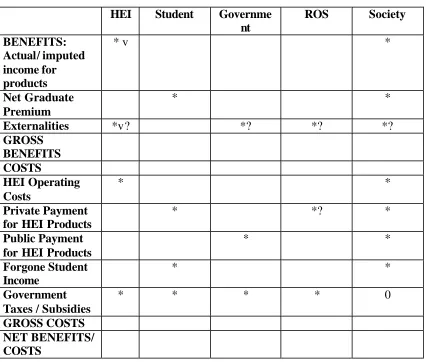
[image:25.596.87.513.293.655.2]2.25 To round off this section, Table 2.1 is a stylised schematic of what a complete cost-benefit analysis of “the Higher Education Sector in Scottish society” might encompass. This indicates the likely domain of a large-scale research project, and puts the range and scope of the present study in the broader context.
Table 2.1 Schematic for HE CBA
HEI Student Governme nt
ROS Society BENEFITS:
Actual/ imputed income for products
* v *
Net Graduate Premium
* *
Externalities *v? *? *? *?
GROSS BENEFITS COSTS HEI Operating Costs * * Private Payment for HEI Products
* *? *
Public Payment for HEI Products
* *
Forgone Student Income
* *
Government Taxes / Subsidies
* * * * 0
GROSS COSTS NET BENEFITS/ COSTS
* likely to be important within Scotland
? might be in Scotland but will not be revealed by current study v what we are looking at
focus. Further subdivision of the Rest of Society (ROS) would be possible; for example, separating out “business”.
Down the left of the table are the benefits and costs associated with higher education activities….those identified are known to be important in the context of HE, but it is not claimed the list is comprehensive.
Each cell of the table, therefore, shows in value terms the benefit or cost accruing to that group in society arising from higher education activities. Based on the pre-existing research literature and the authors’ tacit knowledge, symbols in cells indicate cost or benefit flows of possible importance in the Scottish context.
3
Fundamental Issues in Measuring HEI P rices and
Values: Efficiency, Equity and Other Considerations
___________________________________________________
This chapter covers the necessary welfare economic background in order to understand the issues relevant to the rest of the study, its methodology and conclusions. As such it addresses a diverse and complex array of issues. Discussed are the distinctions between public and private goods, market failure and externalities, the value of imperfect information and the presence or absence of perfect capital markets. Clearly illustrated is that much of Higher Education can be shown to be a private rather than a public good since it does not satisfy the conditions of non-rivalry or non –excludability. The study illustrates the key economic arguments both in the form of equations and graphs.
Starting with the conditions and outcomes for a perfectly competitive environment for Scottish HEIs the study then moves to an analysis which more accurately describes the current situation, that of an administered market with unequal players. As we discuss, in a perfectly competitive market the second fundamental law of economics describes how government may address equity considerations without affecting efficiency. Perfect competition within Scottish HEIs is an idealised concept, based on a number of simplifying conditions. To the extent that these are not in fact valid then there is said to exist market failure –the definitions and scope of market failure in HEIs can then be derived.
It is necessary to identify and explain in detail market failure, that is the conditions under which the Scottish HEI sector may fail to operate /efficiently. On this basis it is necessary to explore market structure and potential for monopoly power within the Scottish HEI sector – monopolies are less efficient than competitive markets and so it is necessary to identify where and when this might occur. One of the most important issue addressed is the presence of externalities, defined as “the effect of an activity on an individual who is not directly involved in undertaking that activity”. Many externalities can be identified and the treatment of them is of importance regarding the final outcomes of any study. We list socio-cultural and economic externalities occurring within Scottish HE and set this in context, for example in terms of agglomeration effects discussed in the less formal literature and in the formal approach firmly rooted in economic growth theory.
This chapter also seeks to examine the motivations and objectives of the Scottish HEIs –universities are usually described as non –profit making organisations but it can be shown that the objectives of universities are often multi-faceted and complex. A further extension to this seeks to address exactly who the “owners” and “shareholders” are in a HEI and who the “managers” run the institution for. Broadly, it can be accepted that universities are not profit maximisers in the strict sense but the key is the extent to which this market failure does or does not impinge on economic efficiency issues – the most important discussion here is one outlining the difference between allocative and technical efficiency as it applies in this context, concluding that it is possible that many HEIs are doing the wrong things very proficiently.
Much financial data necessary for the operations described within this chapter are collected, processed and utilised within the HEIs themselves and a considerable volume is actually available to interested third parties through university accounts and publications of HESA and others. Therefore the real scope of this chapter is not the availability of revenue data but whether these revenue values accurately measure “economic value” or “social values”.
3.1 As indicated in the previous section, in principle the “value” of an HEI’s production of any commodity is obtained from the simple formula:
Value = quantity of output X price per unit produced of output
3.2 In fact, if actual prices received are used in the formula, then the “value” obtained
is the revenue earned by the HEI from the production of that commodity. Marrying
this revenue data with equivalent cost data (also derived from actual prices) provides the basic information requirements for a variety of financial analyses. Typically undertaken by finance offices or accounts departments and validated by auditors, such analyses provide essential information on the financial viability of individual courses, departments and even institutions. This financial data is also used to derive numerous “accounts-based” performance indicators and business ratios.
3.3 A great deal of financial data of this type is collected, processed and utilised within the HEIs themselves and a considerable volume is available to third parties
through university accounts and the publications of HESA and others.24 Therefore,
the issue for this study is not the availability of revenue data, but whether these “revenue values” accurately measure “economic values” or “social values”.
3.4 To give an initial example of where differences might arise, consider the case of a
well-attended public lecture given by an academic. The actual price of entry is zero
and hence the revenue value is zero. However, at least the social value must have
been greater than zero, otherwise citizens would not have voluntarily attended. In the language of chapter 2, for a social evaluation of this output the “actual” price is not the “correct” price.
3.5 For a more rigorous analysis of these different concepts of “prices” and “values”, and the importance of each in evaluating the Scottish HEIs, it is necessary in the first instance to draw on the fundamental economic theory and principles elaborated in Appendix A.
24
3.6 In Appendix A, four different, but not mutually-exclusive, types of economic efficiency are rigorously defined. All everyday concepts of “value for money”, etc. relate to one or more of these types of efficiency. An economic system embodying all of these types of efficiency is termed Pareto efficient. In such an economy, it is not possible through any change in production, trade or consumption to make some agents better off without making others worse off.
3.7 Appendix A then describes an idealised market structure known as Perfect
Competition. This is an abstract construct derived from a number of stringent assumptions. The crucial point here is that The First Fundamental Theorem of
Welfare Economics provesthat every perfectly competitive economy is also a
Pareto efficient one. What guidance does this give us in assessing the value of HEIs?
3.8 Suppose that, in fact, the Scottish HEIs were operating in a “perfectly competitive
environment.” In this case, the HEIs would behave as profit- maximising enterprises able to buy and sell what they wish in product and factor markets, but unable to influence the market prices (i.e. they are “price takers”). The First Fundamental
Theorem tells us that the actual or market prices received by the HEIs would be
exactly the economic efficiency prices. Hence the observed revenue values would be
equal to the economic values.25 In this special case, the financial information also
provides the required economic information.
3.9 In reality, neither the HEIs nor anyone else operates in a perfectly competitive environment. However, the HEIs service many different markets, at least some of which may be sufficiently competitive to allow the observed market prices to be
regarded as close approximations to the economic efficiency prices. 26
25
Also as discussed in Appendix A and Chapter 4, unless we wish to impose distributional social weights, then economic value is also equal to social value.
3.10 Hence, in seeking to value the outputs of the HEIs, economic theory tells us to examine the competitive conditions in the markets in which they operate. If these are “workably competitive”, then the actual market price will be close to the “correct” economic price, and the revenue received for the outputs will be a good
approximation to the true economic value of those outputs. In these cases, there is no need for further imputations or “shadow pricing”.
3.11 In the “perfectly competitive HEI” scenario, what implications are there for
government policy? In terms of the market environment, each institution will be cost-efficient, technically efficient and allocatively efficient. Individually and as a whole sector, the HEIs will be producing the best possible basket of goods to meet consumer demands at the lowest possible cost. In this situation, the only requirement of
government with respect to the market would be to establish a regulatory framework to ensure the HEIs continued to operate competitively ( contract laws, competition laws, etc).
3.12 However, as discussed in Appendix A, even in this scenario, there is a possible role for government intervention with regard to distributional issues, since the actual competitive outcome achieved may not be regarded as “fair”, depending as it does on the initial allocation of resources. The Second Fundamental Theorem of Welfare
Economics indicates how, in theory, the government may address equity
considerations without adversely affecting efficiency. Specifically, the government should make “lump sum” redistributions from the “better off” to the “worse off” and allow the competitive markets to operate unhindered.
3.13 In the Scottish Higher Education sector, the most important policy-relevant distributional issues are those concerned with equality of student access to HE. Specifically, government wishes that academically qualified students should be able to undertake higher education studies irrespective of background social and economic characteristics (such as gender, race, religion, or income (ability to pay). The
3.14 The key issues for the present study are in what ways such “student equity”
considerations invite government intervention in the operations of the HEIs
themselves. In the first instance, it may be noted that many of the reasons given for groups of individuals consistently not entering HE (myopia, risk aversion, asymmetric information, etc) appear to relate more to market failure than distribution per se. Where relevant, these are discussed in more detail subsequently. Here, it can be noted that economic theory tells us that market failures should be addressed directly rather than indirectly through redistribution, since only the former can increase efficiency as well as equity and hence represent an actual Pareto improvement.
3.15 To the extent that there are distributional issues, especially with regard to ability to pay, then as noted above, theory tells us that these should be addressed by direct transfers among the relevant groups of economic agents, in this case from the rest of Scottish society to capable potential Scottish students. In fact, there are two distinct aspects to the “ability to pay” issue:
(a) the requirement for the student to find the means to sustain him/herself during
his time at university, since there is no wage paid for studying. This is generally described as a “maintenance ” requirement.
(b) The requirement for the student to pay the HEI for teaching outputs and other
services. The se are generally referred to as “tuition costs”.
3.16 Regarding maintenance issues, the fundamental theorems indicate these should
be treated entirely separately from the operations of the HEIs themselves. If society wishes to give maintenance support to students, this should be done through the general tax/transfer system, not through the HEIs. Generally speaking, this is the approach adopted in Scotland.
students “deals”; others may seek higher prices, in which case prospective students are free to supplement the voucher value from other resources. In all cases, the
outcome prices and quantities will be determined by the free market interaction of supply and demand, thereby ensuring efficiency. Interventions in the form of “fixing” the prices the HEIs can set or in the form of setting targets/quotas for the HEIs for students with specified socio-economic characteristics are not desirable: theory proves that the distortions created will inevitably be to the detriment of efficiency.27
3.18 The “student shopper with voucher” is not the approach adopted in Scotland,
where (a) government, not students, purchases products from the HEIs , and (b) HEI tuition prices are fixed within relatively small margins. The former, agent-principal approach, could be argued to be in response to informational market failures (see below), though it is not the only way to deal with this. The latter, price or quantity fixing, seems more difficult to justify from economic principles. Perhaps it results from equating “equity” with “sameness”; i.e. a view that all the HEIs should offer the “same” product at the “same” price. This is, however, destructive to the static and dynamic efficiency gains of competitive market forces, which in order to be realised require freedom of choice among a diversity of alternatives: the fast-food outlet plays as important a role as the five-star restaurant.
3.19 Thus, economic theory indicates that student “equity” issues should be dealt with
through direct transfers to the students from the rest of society. The role of the HEIs is to efficiently supply the products which satisfy the revealed student demands.
Two final points on equity may be noted:
1. No efficiency problems arise if HEIs voluntarily choose to offer student scholarships; indeed competitive market forces will almost certainly lead to many HEIs choosing to do this.
2. If there was evidence that the Scottish HEIs were actively discriminating
against students from certain backgrounds through irrational prejudice, then
27
the government could quite properly deal with this through appropriate anti-discrimination legislation. 28
3.20 Returning now to the main focus of the study, it is clear that much of the theoretical, applied and policy-related argument to this point is premised on the supposition that the HEIs operate in an approximation to a perfectly competitive environment. However, as summarised in appendix A, perfect competition is an idealised concept, based on a number of simplifying assumptions. To the extent that any of these assumptions are not in fact valid, then there is said to be market failure. It is extremely important to give consideration to “market failures” in the context of the HEI economy, since, depending on the nature and prevalence of such failures, any or all of the following may be true:
(a) the HEIs may not be Pareto efficient; that is they may be
cost/technically inefficient and/or allocatively inefficient.
(b) Following from (a), the observed prices for HEI outputs ma y not be
good approximations of the economic efficiency prices, in which case the revenue value of output will not be a good approximation for the economic efficiency value.
(c) Direct intervention by government in the operations of the HEIs may
be justified on the grounds of improving efficiency (i.e. a completely different justification from the “equity” considerations discussed above).
3.21 In short, the existence of significant market failures can modify, or even invalidate, the “strong” arguments and conc lusions drawn from the Fundamental Theorems, insofar as they are dependent on the assumption of perfect competition.
28 Thankfully, this appears not to be the case in Scotland. Specifically, the only discrimination-related variable
The economics literature distinguishes certain generic types of market failures, and this classification scheme is used to organise the fo llowing discussion of market failure in the specific context of the Scottish HEI sector.
Motivation and objectives
3.22 As demonstrated in Appendix A, one of the assumptions of perfect competition
(and one which is necessary to ensure the econo my attains Pareto efficiency) is that
all producing organisations are profit-maximisers.
3.23 It may seem immediately obvious that, since Scottish HEIs are legally
established as non-profit making organisations, they are almost automatically not profit-maximisers. However, this is an over-simplification. HEIs can, and do, on occasion earn “surpluses” (a sector-specific euphemism for profits); indeed, it could
be fairly said that many HEIs do “seek to maximise disposable surpluses” on at least
some of their activities.29
3.24 Rather, the key points arising from the status of Scottish HEIs as NPISH relate to
the implications this has for ownership and control, which in turn determines the plausibility or otherwise of assuming profit- maximisation is the fundamental organisational objective. From the one person owner/manager firm through to the largest PLC, the owners of the organisation gain their income from it in the form of actual or deferred (in the case of capital gains) distributed profits. Since it is rational for the owners to wish to maximise their own incomes, they will seek to ensure that the organisation maximises its profit, which is the source of their incomes.
3.25 In truth, in many Scottish companies, the managers are salaried employees while
the owners are un-salaried shareholders. This undoubtedly gives management a certain degree of discretion in setting its own objectives on a day-to-day basis. However, owners are ultimately able to compel, or discipline, managers to satisfy
their objectives through hiring and firing policies and even company take-overs. Hence, in any private for-profit business, the earning and increasing of profits will
29
always be the core strategic objective, and this will frequently be reflected operationally in profit-related targets and reward structures.
3.26 In the case of the Scottish HEIs, it is actually very difficult to identify who, if anyone, the owners actually are. However, the important point is that the legal instruments by which the institutions were established exclude the distribution of profits to “owners” as a return on their investments and/or entrepreneurial inputs. Any surpluses earned have to re-spent on recognised proper activities of the HEIs
themselves. 30 Hence the managers of HEIs, which includes academics in managerial
functions, are not constrained to a core objective of maximising profits for a cadre of external or internal owners. Rather, applying Williamson’s managerial discretion
model 31 to the analysis of NPISH behaviour (see, for example, Pauly and Redisch
1973)32 suggests that HEIs will maximise their own utility functions subject to a financial viability constraint. Typically, such utility functions will include elements relating to size, prestige, job satisfaction, and others. Furthermore, the utility function formulations for non-profit institutions generally incorporate the idea that the relevant decision makers take cognisance of social outcomes and objectives as well as strictly
private ones.
Accepting that Scottish HEIs are not profit- maximisers in the strict classical sense, the key is the extent to which this particular “market failure” does, or does not, impinge on economic efficiency.
3.27 Firstly, and crucially, non-profit maximisation does not preclude an organisation
from being cost/technical efficient. As shown formally in Appendix A,
cost-minimisation depends only on input-prices and the technology available to produce a given commodity. In fact, because of internal and external pressures, it can
30
This legal framework of the HEIs may itself be a source of market failure, since it may make it difficult or impossible for the institutions to raise investment funds from the financial sector, the Stock Market or individual venture capitalists. This will be particularly true of “risky” projects, since the would-be investor has to see an upside potential as well as a down-side risk. For an overview of the extent to which HEIs can or cannot borrow, see HEFCE 2004/13 Private investment in higher education
31
Williamson O.E (1970) Corporate Control and Business Behaviour
32
reasonably be argued that Scottish HEIs are cost-minimisers, or perhaps better, seek to be cost-minimisers. Internally, separate power groups in an HEI seek to maximise their own sub-utility functions (increase departmental staff, obtain more laboratory equipment, etc). Part of the bargaining process involves each group demonstrating that the improvements it seeks for itself will be undertaken at the lowest possible cost; that is, at minimum sacrifice on the part of the other groups. Externally, HEI clients exert ever-increasing pressure on the HEIs to offer “value for money”, with the value targets and performance indicators frequently (usually?) being expressed in terms of
cost criteria.
3.28 Secondly however, the fact that the Scottish HEIs are non-profit maximisers does
mean that they may not be allocatively efficient; that is they may not produce the “correct quantities of the correct goods”. As shown in Appendix A, profit- maximisation is the motivation by which the signals provided by external output
prices are translated into the efficient production of the goods demandedby the
market. This is not to say that the HEIs are able to ignore the market (ultimately there is the financial viability constraint), but they do have a certain discretion in how they respond to market signals, being able to address internal as well as external objectives, and “social” as well as econo mic goals. Furthermore, if other market failures mean that the market signals provided to the HEIs are not economic
efficiency prices (see below), then they will not be allocatively efficient even if they tried to be by mimicking profit- maximising behaviour.
Market Structure and Monopoly power
3.30 The market structure underlying The Fundamental Theorems is that of perfect
competition. Among other things, this structure assumes that individual buyers and sellers are all price takers i.e. their individual actions do not affect the market price, though the y can buy or sell as much as they want at the given market price. The
extreme opposite form of market structure to perfect competition is monopoly, which
is a market in which there is a single buyer or seller. In this case, the monopolist does
have market power. Specifically, the monopolist can determine the price at which he
wants to buy or sell and let the market determine the quantity, or he can determine the quantity he wishes to buy/sell and let the market determine the price: typically the monopolist will select the price/quantity combination which maximises his own utility.
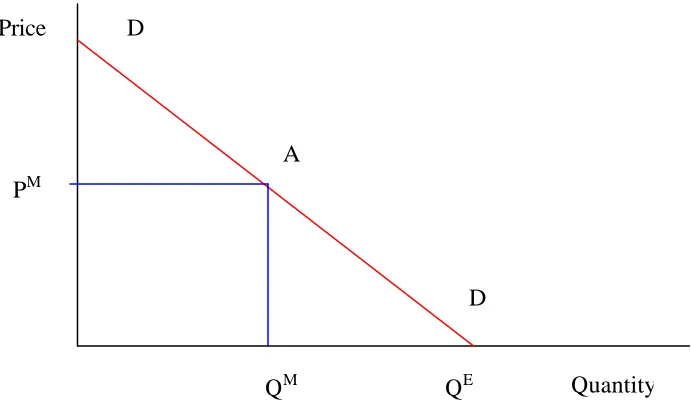
3.31 The important point here is that, as demonstrated in any intermediate textbook33, on a comparative static ceteris paribus comparison a monopoly market is less socially efficient than the equivalent perfectly competitive market. There is a reduction in
social welfare which is called the deadweight loss of monopoly. Dropping some of the
“other things equal” assumptions makes the situation more complicated, but that is not the issue here: theory tells us that the existence of monopoly power creates a strong presumption that there is market failure.
3.32 Given this, it is necessary to examine whether or not there are elements of monopoly power in the Scottish HEI market. As in any market, there are both suppliers and customers. On either side of the market, if there are “many”
buyers/sellers, then competition among them will mean that the degree of monopoly power is insignificant; if there are “few” buyers or sellers, then agents on that side of the market may indeed exercise a degree of monopoly control.
3.33 Considering firstly the supply of Higher education products in Scotland, a
significant fraction of production is supplied by the Higher Education Institutions. At
33