Rochester Institute of Technology
RIT Scholar Works
Theses Thesis/Dissertation Collections
2008
Experimental investigation on the effects of surface
roughness on microscale liquid flow
Tim Brackbill
Follow this and additional works at:http://scholarworks.rit.edu/theses
This Thesis is brought to you for free and open access by the Thesis/Dissertation Collections at RIT Scholar Works. It has been accepted for inclusion in Theses by an authorized administrator of RIT Scholar Works. For more information, please [email protected].
Recommended Citation
Experimental investigation on the effects of surface
roughness on microscale liquid flow
by
Timothy Brackbill
A thesis submitted in
partial fulfillment of the
requirement for the
B.S./M.S.
in
Mechanical Engineering
Approved by:Dr. Satish G. Kandlikar
Thesis Advisor
Department of Mechanical Engineering
Dr. Steven Weinstein
Department of Mechanical Engineering
Dr. Jeffery Kozak
Department of Mechanical Engineering
Dr. Edward Hensel
Department of Mechanical Engineering
Department of Mechanical Engineering
Rochester Institute of Technology
I. Abstract
Microfluidics has become of interest recently with shrinking device sizes.
Roughness structures left from machining processes on the inside of
tubes and channels that were once not a concern may now create relative
roughness that exceeds 5%. Confusion still exists in the literature as to
the extent of the effects of roughness on laminar flow. This work aims to
experimentally examine the effects of different roughness structures on
internal flows in high aspect ratio rectangular microchannels. A total of
four test sections were fabricated to test samples with different patterned
rough surfaces, and to also vary the two opposite surfaces forming the
long faces of the channel. These test sections allowed the same
roughness samples to be tested at varying relative roughnesses and
allowed a systematic study on their effects on pressure drop. The first
test section looked at sawtooth effects on laminar flow. The second
looked at uniform roughness on laminar flow. The third looked at
sawtooth roughness in turbulent flow, and the fourth looked at varying
pitch sawtooth roughness in laminar flow. Rough surfaces were formed in
one of two ways. The first involved making structured repeating sawtooth
ridges with a ball end mill on a CNC machine. The second was using
sandpaper in a crosshatch pattern to make a more unpatterned
roughened surface. In this study, the Reynolds number was varied from
experimental uncertainty in the experimental data is at worst 7.58% for
friction factor and 2.67% for Reynolds number. Roughness structures
varied from a lapped smooth surface with 0.2 μm roughness height to sawtooth ridges of height 117 μm. Hydraulic diameters from 198 μm to 2,349 μm were tested. The highest relative roughness tested was 24.8%.
As a result of the first and second experiments, it was shown that using
constricted parameters, sawtooth and uniform roughness performance
could be predicted in the laminar regime. In the third experiment, it was
shown that certain sawtooth roughness samples cause the results to
converge to a single line for friction factor. In the fourth experiment, the
pitch of sawtooth elements was shown to be a key parameter in showing
when each parameter is applicable. It was found that roughness has an
effect even at relative roughness values less than 5%. Lapped smooth
samples showed no departure from macroscale theory at all channel
diameters tested, which implies that no departure from continuum
mechanics occurred at the length scales tested. This fit with what was
expected. Early transitions to turbulence were seen however, showing
decreasing transition Reynolds number with increasing relative
roughness. The lowest turbulent transition occurred at a Reynolds
number of 210, with a relative roughness of 24.8%. Most all of the
roughness structures studied were found to have experimental results
that were well predicted with the use of constricted parameters.
seen to have experimental results approaching theory calculated with
II.Table of Contents
I. Abstract...2
II. Table of Contents...5
III. Index of Tables and Figures...7
i. Figures...7
ii. Tables...8
IV. Nomenclature...9
1 Introduction...10
1.1 Previous Experimental Studies...10
1.1.1 Laminar and transition studies...10
1.1.2 Turbulent Flow...21
1.2 Numerical/Theoretical Work...23
1.3 Roughness Characterization...27
2 Theoretical Work...30
2.1 Current Roughness and Nikuradse...30
2.2 Derivation of Constricted Parameters...33
2.3 Application of Lubrication Theory...37
3 Experimental Work...44
3.1 Summary of experimental work...44
3.2 Initial Experimental Work – Sawtooth High...46
3.2.1 Experimental Loop Description for initial work...46
3.2.2 Experimental Schematics and Drawings...47
3.2.3 Samples used in First Experimentation...49
3.2.4 Experimental Procedure for the First setup...52
3.3 Second Setup – Low uniform RR testing...52
3.3.1 Experimental Setup for Low RR uniform elements...53
3.3.2 Samples used for low uniform roughness...55
3.4 Third Experiment – Fully Turbulent Flow...57
3.4.1 Experimental Schematics...57
3.4.2 Samples...58
3.4.3 Experimental Procedure...58
3.5 Fourth Experiment – Differing pitches of sawtooth roughness...59
3.5.1 Experimental Schematics...59
3.5.2 Samples...59
3.5.3 Experimental Procedure...62
3.6 LabVIEW...62
3.7 Experimental Uncertainties...67
4 Results...71
4.1 Summary and Major Findings...71
4.2 Results of first Experimentation...72
4.3 Results of second Experimentation...76
4.3.1 Experimental Results...76
4.3.2 Results of applying lubrication theory...78
4.4 Results of Third Experiment – Turbulent experiments...82
4.5 Results of fourth experimentation – varying pitch...84
4.6 Transition to turbulence...86
5 Conclusions...90
6 References...92
7 Appendices...96
7.1 Appendix A – First setup drawings...96
7.2 Second Experimental Setup...109
III.Index of Tables and Figures
i. Figures
Figure 1.1: Modified Moody Diagram by Kandlikar [28]...25
Figure 1.2: Pressure drop v. pitch of sawtooth obstructions for Re = 40, h = 0.1, from Rawool [30]...26
Figure 1.3: Generic roughness surface with parameters marked...29
Figure 2.1: Illustration of Idealized roughness surface from Nikuradse [2]...32
Figure 2.2: Generic ribbed roughness with parameters illustrated...35
Figure 2.3: Illustration of Lubrication Problem...38
Figure 3.1: Schematic of the first test loop designed...49
Figure 3.2: Left: Exploded view of the setup Right: Assembled setup without cover piece...49
Figure 3.3: 405um pitch profile, taken with a stylus profilometer. The parameters are marked...51
Figure 3.4: 815um pitch profile, taken with stylus profilometer...51
Figure 3.5: Ground smooth sample surface, taken with a stylus Profilometer...52
Figure 3.6: Isometric Schematics of New Test section...54
Figure 3.7: Schematic of test loop used for low Relative roughness testing...56
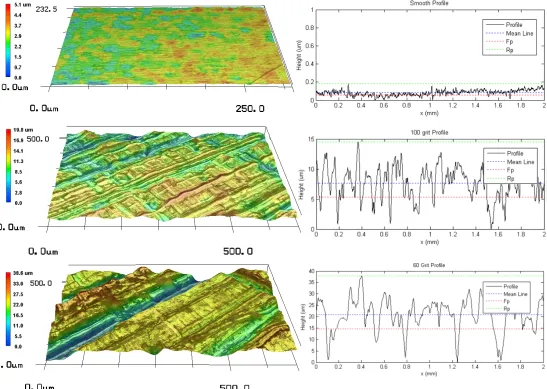
Figure 3.8: 3D microscope images and stylus profilometer scans of the three roughnesses tested...58
Figure 3.9: Test loop for third experimentation...59
Figure 3.10: 3D Microscope compilations and 2D stylus profilometer scans of the samples...60
Figure 3.11: Interferometer scans (left) and apparent 2D profile scans (right) for the three samples tested...63
Figure 4.1: Smooth channel verification with Dh = 565um...74
Figure 4.2: Uncorrected - aligned sawtooth roughness p=405μm, Dh=1240μm, b = 653μm...75
Figure 4.3: Corrected - aligned sawtooth p=405μm, Dhcf=847μm...76
Figure 4.4: Comparison of the two different pitches with the same constricted hydraulic diameter...76
Figure 4.5: Representative samples from the low uniform roughness testing plotted with (a) root parameters (b) constricted parameters...78
Figure 4.6: Illustration of all parameters used in experimentation applied to the
60 grit channel profile...79
Figure 4.7: Variation of beff,exp with Reynolds Number...80
Figure 4.8: Parameters for separation normalized with experimental results...81
Figure 4.9: Results of turbulent testing with 405um samples (a) a single test plotted with a prediction of friction factor (b) all the samples...83
Figure 4.10: Comparing the two different sawtooth pitches...85
Figure 4.11: Constricted friction factor vs Reynolds number for 3 varying pitches ...86
Figure 4.12: Constricted friction factor vs Reynolds number for the largest pitch, plotted with both root and constricted parameters...87
Figure 4.13: f*Re vs Beta for the samples with varying pitch...88
Figure 4.14: Transition Reynolds number vs Relative Roughness...90
ii.Tables
Table 1.1: Summary of Experimental works on the effects of roughness on flow ...21Table 3.1: Summary of Roughness in First Experimentation...50
Table 3.2: Description of roughness surfaces used in low RR testing...57
Table 3.3: Summary of machining for the fourth set of samples...61
Table 3.4: State points to reference density...66
Table 3.5: Summary of max errors used in uncertainty analysis for the pressure and flow sensors...71
Table 4.1: Summary of all experimental work. Each row represents an individual test...72
Table 4.2: Repeatability...73
Table 4.3: Summary of experimental results from lubrication theory...80
IV.Nomenclature
α = aspect ratio
αcf = constricted aspect ratio
A = cross sectional area of channel
Acf = constricted cross sectional area of channel
a = channel base
b = channel height
bcf = constricted channel height
beff = separation from lubrication theory
accounting for roughness effects
beff,exp = effective separation from experiments
beff,theory = effective separation from theory
ε = roughness element height
εFP = roughness height - new parameters
δ = used to show uncertainty in trailing variable
Dh = hydraulic diameter
Dh,cf = constricted hydraulic diameter
Dt = root diameter of circular tube
f = friction factor
fMoody = turbulent friction factor from Moody
diagram
Fp = floor profile line
G = mass flow rate
g = gravity vector
h = height of silicon channels
L = a length along the channel in the flow
direction
˙
m = mass flow rate
n = number of points in a roughness profile
sample
p = pitch of roughness elements
P = perimeter or pressure in derivations
Pcf = constricted perimeter
ρ = density of the water
Ra = average roughness
Re = Reynolds number
Rec = critical Reynolds number
Recf or Recf = Reynolds number, calculated from
Dh,cf
Q = volumetric flow rate
Reo = Smooth channel turbulent transition
Rp = maximum peak height
RSm = mean spacing of irregularities
Tmean = mean fluid temperature in test section
ux = fluid velocity component in the x direction
uy = fluid velocity component in the y direction
uz = fluid velocity component in the z direction
V = flow velocity
˙
V = Volumetric flow rate
w = width of silicon channels
x = distance from channel beginning
Z = height at any given point along a roughness
profile (μm)
1 Introduction
Work in the area of roughness effects on friction factors in internal flows
was pioneered by Colebrook [1], Nikuradse [2], and Moody. Their work
was limited to relative roughness values of less than 5%, a value which
may be exceeded in microfluidics application where smaller hydraulic
diameters are encountered. Many previous works have been performed
through the 1990s with inconclusive and often contradictory results. No
studies have been performed that systematically varied the roughness
structures and relative roughness while collecting enough data necessary
for any valid conclusions to be drawn. This study aims to conduct
systematic experiments to evaluate the effects of these roughness
elements on flow.
1.1 Previous Experimental Studies
1.1.1 Laminar and transition studies
Wu and Little [3] noticed an early transition to turbulent flow in
microminiature refrigerators. Their channels were etched on glass and
silicon with Dh from 45.46 to 83.07μm. Wu and Little [4] fabricated
microchannels with the same process, but varied Dh from 134μm to
164μm, and found unusually high frictional factors. They found these to
contribute to low critical Reynolds numbers from ~400-900.
Peng et al. [5] machined five different microchannels in stainless steel,
with Dh ranging from 133μm to 343μm and aspect ratio varying from
0.333 to 1. The error was ±10% on friction calculations and ±8% on
Reynolds number. The fluid used was water, with Reynolds numbers
varying from 50 to 4000. Critical Reynolds numbers were found to be
between 200 and 700, or much lower than conventional macroscale
theory. In this study, Peng stresses the effect of the aspect ratio and
hydraulic diameter on ReC and f. He found that the lowest friction factor,
lower than macroscale theory, occurs at aspect ratios nearest to 0.5. The
ReC value was related to Dh, but no relationship was given. Also noted is a
deviation from classical theory and suggestion that different laminar and
turbulent flow mechanisms are occurring, along with a decrease in the
transition region with decreasing Dh. As such, an empirical relationship
for friction factor is proposed in equation 1.1, where Cf and Cf,t are
empirical constants that are depended on channel aspect ratio and fluid
species.
flaminar= Cf
Re1.98
fturbulent= Cf ,t
Re1.72
(1.1)
Pfund et al. [6] used a variable depth microchannel along with pressure
drop sensors and flow visualization to study the same phenomena.
Overall the setup is similar in nature to the setup in use for this thesis.
The samples used to construct the channel were characterized with an
optical profilometer, however for the rough channel only one side of the
rectangular channel’s 128 μm – 1,050 μm by 10 mm dimensions were
roughened. Uncertainties as found with a Monte-Carlo simulation were
stated to be between ±5.4% and ±11.1%, although it is stated that RMS
calculations yield 1% higher uncertainties. Uncertainties in Reynolds
number were between ±1.6% and ±3.4%. It was found that every
channel used in the study exhibited higher than theoretical predictions in
the laminar region, even for the smooth channels. For the roughened
channels, the discrepancy was even more pronounced. ReC was again
observed to be lower than theory, but not as extreme as those reported
by Peng et al. [5]. Again, a dependence of Rec on hydraulic diameter was
observed. Utilizing flow visualization, eddy currents around surface
features are proposed to be the mechanism for transition, and also for the
shorter but continuous transitions reported elsewhere.
Tu et al. [7] performed tests on five microchannels with hydraulic
diameters from 69.5 μm to 304.7 μm and aspect ratio from 0.09 to 0.24.
Working fluid was R134a liquid or vapor depending on the test. The test
sections were manufactured such that the surfaces were as smooth as
possible. Errors were reported as ±6.3% max for f and ±2% max for Re.
It was found that for the four channels with relative roughness less than
0.3%, no deviation occurred from conventional f or ReC macroscale theory
(ReC 2150 to 2290 was reported). For the one channel with a relative
roughness of 0.35%, the friction factor was observed to be 9% higher than
predicted, accompanied by a significantly lower ReC of 1570.
Wu et al. [8] used thirteen fabricated trapezoidal silicon channels with
pairs of geometrically similar channels with varying surface roughness
and hydrophobicity (through use of SiO2). An increased friction factor was
observed in the laminar flow regime due to surface roughness when
compared to the smooth channel. Increasing discrepancies were noted
with increasing Re for the smooth versus roughened channels. The
coating of SiO2 also slightly increased friction factor values from the
smooth channel. The oxide also increased the convective heat transfer.
Wu also describes empirical correlations for Nu and fappRe for the
geometric ratios relating to trapezoidal channels.
Celata et al. [9] used capillary glass tubes with hydraulic diameter ranging
from 70 μm to 326 μm with water as the working fluid. The inside of the
capillaries were roughened by flowing particulates through the channels.
It was observed that even the low relative roughness values seemed to
increase friction factor in the laminar region in comparison to the smooth
channel results. Additionally, earlier transitions were seen with the
roughened channels.
Mala et al. [10] conducted a study on 13 capillary tubes with hydraulic
diameter ranging from 50μm to 254μm. This study has a reported
roughness height values of 1.75μm. These channels are considered
smooth in this study, which is interesting when it is noticed these are
rougher than the “rough” capillaries used by Celata et al. [9]. Mala
explains the discrepancy with a modified roughness-viscosity theory. This
model varies the viscosity of the fluid going around the roughness
elements and increases the pressure drop prediction. This modified
model is based on an older aerodynamic model by Merkle et al. [11] and
Tani [12]. The model relies on the results of CFD experimentation, and is
not applicable to any surface.
Kandlikar et al. [13] studied heat transfer and pressure drop in stainless
steel capillary tubing of diameters 620μm and 1067μm. Three different
surface types for each diameter were created using varying acid etching
techniques on the inside of the capillaries. For the larger diameter, little
effect on friction factor or heat transfer performance was discernible from
even the largest relative roughness value of 0.23%. It was suggested that
this diameter is not truly microscale, and thus macroscale theories are
more applicable. For the smaller diameter, the highest relative roughness
value of 0.36% yielded the highest friction factors and highest heat
transfer performance. The capillaries with successively smoother walls
showed less extreme friction factor and heat transfer.
Baviere et al. [14] studied both the effect of roughness and the effect of
the electrical double layer on internal flows. The study used silicon
etched channels for hydraulic diameters less than 100μm and a bronze
block setup for hydraulic diameters greater than 100μm. Roughness elements were created by embedding SiC particles in a thin nickel wall
coating. They found no deviation from conventional theory for smooth
channels. In roughened channels, higher friction factors were observed.
However, in contrast to other studies, the addition of roughness elements
in this setup stabilized flow, and created higher values for the transition to
turbulence.
Hao et al. [15] performed an experimental study with etched silicon
rectangular microchannels which had three artificially created roughness
elements on one side of the channel, measuring 50μm square and spaced
between 7 and 8 mm from each other. Hydraulic diameters ranged from
153μm -191μm, and Reynolds numbers were tested with values less than
2400. Flow visualization was also included to observe the flow as it
traversed the artificially created roughness. Smooth channels were
observed to follow conventional theory for friction and transition. The
artificially roughened channels, however, followed conventional theory to
Re = 900, then departed into transition. This study showed that these
elements are able to trigger early transition from laminar by imparting
additional disturbances to the flow. The friction factor remained constant,
which can be explained by the few and sparsely spaced roughness
elements. These did not have a significant effect on the friction factor.
Finally, Hao also concludes that similar features of macroscale turbulence
are also visible in microscale fluid turbulence.
Weilin et al. [16] fabricated trapezoidal channels using micromachining
techniques on silicon substrates. Due to the silicon’s surface finish,
relative roughness values varied from 2.4% to 3.5%. Experimentation
was limited to a 1,723 kPa maximum pressure drop, beyond the silicon
substrate failed. The resulting Reynolds numbers were less than 1500.
They found friction factors that were higher than theory would predict,
and also found linear relationships between pressure drop over length and
Reynolds number to possess higher than theoretical slopes. Using this
data, they applied the modified roughness-viscosity model of Mala and Li
[10] and obtained good correlation with experimental data. A
complicated formulation for a coefficient inherent to the model is
determined using variables such as channel geometry, roughness
distribution, and shape of roughness elements. The coefficients obtained
have limited applicability past the channels used in this study.
Shen et al. [17] machined 26 parallel microchannels of 300μm width and
800μm depth in a copper block. They studied the effects of 4% relative
roughness on friction factor and Nusselt number. No effect on the
transition to turbulence was found, however Reynolds numbers were
tested only to 1257, which severely restricts any conclusions of this
nature. It was also found that for low Reynolds numbers no departure
from macroscale theory was observed. With increasing Re, the Poiseuille
number increased along with Re rather than remaining constant. They
proposed the correlation given in equation 1.2 for roughened rectangular
microchannels and laminar flow.
f Re0.4743=4.0922 (1.2)
Celata et al. [18] used a parallel microtube setup (Dh=130μm) with steam
condensation heating to study the effects of roughness on heat transfer
and fluid flow. It was found that below Re = 583 the roughness did not
play a major role, and friction factor agreed with macroscale theory. The
critical Reynolds number was found to range from 1881-2479 for laminar
to turbulent transition. They also observed poor fit of experimental heat
transfer performance with established correlations.
Li et al. [19] used a variety of stainless steel, glass, and fused silica
capillary tubes to study the effects of roughened tubes. Hydraulic
diameters ranged from 79.9-449μm. The fused silica and glass tubes
were considered to be smooth tubes for this experimentation, as the
roughness was negligible. The stainless steel tubes had relative
roughness ranging from 3-4%. No deviation from macroscale theory was
found in the smooth microtubes. For the rough stainless steel tubes, f*Re
was found to be much higher. As the relative roughness increased, larger
discrepancies were opserved. The parameter f*Re was again shown to
vary with Reynolds number in this work instead of remaining constantas
macroscale theory would predict.
Bucci et al. [20] tested stainless steel capillaries with hydraulic
diameters from 172μm to 520μm. The study used vapor condensation
heating for the heating source. It was shown that for low relative
roughness, the tubes behaved as macroscale theory predicts, with both
experimental friction factor and laminar-turbulent transition agreement.
For rougher tubes with smaller diameters, the laminar-turbulent transition
was observed at higher Reynolds numbers and very abrupt rather than
smooth.
Schmitt and Kandlikar [21] performed work in this area using
rectangular minichannels of hydraulic diameters ranging from 325μm to
1819μm with air and water as the working fluids. They found early
turbulent transition and higher pressure drops when compared to
conventional values. They also found that the laminar friction factor could
be calculated by using the constricted hydraulic diameter, Dh,cf. Use of
this constricted area takes into account only the area of the channel that
has no roughened protrusions into the flow. They also found a
relationship between the critical Reynolds number and the relative
roughness.
Wibel et al. [22] performed experimentation on varying aspect ratio
microchannels, fabricated with an end mill in metal. The hydraulic
diameters were intended to be a constant 133μm, but manufacturing
inaccuracies led to minor variations. Three aspect ratios were
investigated, unity, 1:2 and 1:5. An increasing critical Reynolds number
was found with decreasing aspect ratio, with Rec=1800-2000 for a unity
aspect ratio and Rec=2300-2800 for 1:5. It was also found that
decreasing aspect ratio increased the length of the laminar turbulent
transition. Good correlation was found with conventional macroscale
theory for friction factors, however the channels were relatively smooth.
Campbell et al. [23] showed that the type of entrance to the mini- or
micro-channel has little effect on pressure drop or laminar turbulent
transition. This result verifies that the above studies can indeed be
compared as they all implement differing test setups and entry
conditions.
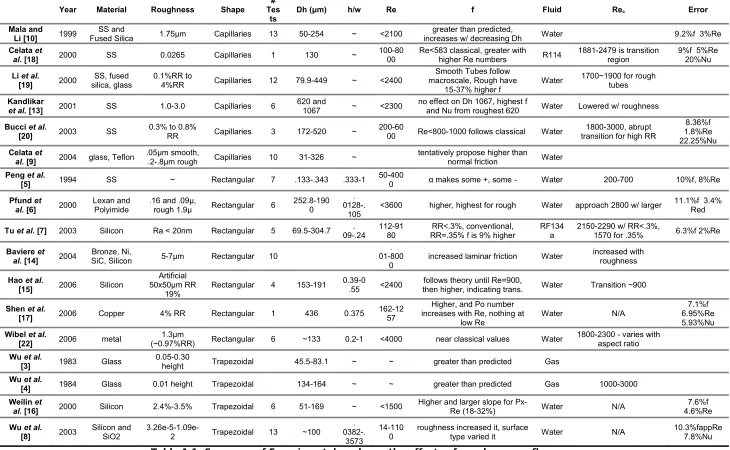
A summary of experimental works is presented in Table 1.1.
Year Material Roughness Shape # Tes
ts
Dh (μm) h/w Re f Fluid Rec Error
Mala and Li [10] 1999
SS and
Fused Silica 1.75μm Capillaries 13 50-254 ~ <2100
greater than predicted,
increases w/ decreasing Dh Water 9.2%f 3%Re
Celata et
al. [18] 2000 SS 0.0265 Capillaries 1 130 ~
100-80 00
Re<583 classical, greater with higher Re numbers R114
1881-2479 is transition region
9%f 5%Re 20%Nu
Li et al.
[19] 2000
SS, fused silica, glass
0.1%RR to
4%RR Capillaries 12 79.9-449 ~ <2400
Smooth Tubes follow macroscale, Rough have
15-37% higher f
Water 1700~1900 for rough tubes
Kandlikar
et al. [13] 2001 SS 1.0-3.0 Capillaries 6
620 and
1067 ~ <2300
no effect on Dh 1067, highest f
and Nu from roughest 620 Water Lowered w/ roughness
Bucci et al.
[20] 2003 SS
0.3% to 0.8%
RR Capillaries 3 172-520 ~
200-60
00 Re<800-1000 follows classical Water
1800-3000, abrupt transition for high RR
8.36%f 1.8%Re 22.25%Nu
Celata et
al. [9] 2004 glass, Teflon
.05μm smooth,
.2-.8μm rough Capillaries 10 31-326 ~
tentatively propose higher than normal friction Water
Peng et al.
[5] 1994 SS ~ Rectangular 7 .133-.343 .333-1
50-400
0 α makes some +, some - Water 200-700 10%f, 8%Re
Pfund et al. [6] 2000
Lexan and Polyimide
.16 and .09μ,
rough 1.9μ Rectangular 6
252.8-190 0
. 0128-.
105
<3600 higher, highest for rough Water approach 2800 w/ larger 11.1%f 3.4% Red
Tu et al. [7] 2003 Silicon Ra < 20nm Rectangular 5 69.5-304.7 09-.24. 112-9180 RR=.35% f is 9% higherRR<.3%, conventional, RF134a 2150-2290 w/ RR<.3%, 1570 for .35% 6.3%f 2%Re
Baviere et al. [14] 2004
Bronze, Ni,
SiC, Silicon 5-7μm Rectangular 10
. 01-800
0
increased laminar friction Water increased with roughness
Hao et al.
[15] 2006 Silicon
Artificial 50x50μm RR
19%
Rectangular 4 153-191 0.39-0.55 <2400 then higher, indicating trans.follows theory until Re=900, Water Transition ~900
Shen et al.
[17] 2006 Copper 4% RR Rectangular 1 436 0.375
162-12 57
Higher, and Po number increases with Re, nothing at
low Re
Water N/A
7.1%f 6.95%Re 5.93%Nu
Wibel et al.
[22] 2006 metal
1.3μm
(~0.97%RR) Rectangular 6 ~133 0.2-1 <4000 near classical values Water
1800-2300 - varies with aspect ratio
Wu et al.
[3] 1983 Glass
0.05-0.30
height Trapezoidal 45.5-83.1 ~ ~ greater than predicted Gas
Wu et al.
[4] 1984 Glass 0.01 height Trapezoidal 134-164 ~ ~ greater than predicted Gas 1000-3000 Weilin et
al. [16] 2000 Silicon 2.4%-3.5% Trapezoidal 6 51-169 ~ <1500 Higher and larger slope for Px-Re (18-32%) Water N/A 4.6%Re7.6%f
Wu et al.
[8] 2003
Silicon and SiO2
3.26e-5-1.09e-2 Trapezoidal 13 ~100
. 0382-.
3573
14-110 0
roughness increased it, surface
type varied it Water N/A
[image:21.792.44.774.63.513.2]10.3%fappRe 7.8%Nu
Table 1.1: Summary of Experimental works on the effects of roughness on flow
1.1.2 Turbulent Flow
The effects of roughness in turbulent flow in microchannels is rarely
studied, due to the high pressure drops that this regime requires in small
channels. In addition, most processes of interest in microfluidics work
with laminar flow. Because of this, few studies ever cover this range and
those will be outlined below.
Celata et al. [24] studied the heat transfer on 6 capillary tubes of
diameter 130 μm. The roughness element height in these channels was
3.45 μm, leading to a relative roughness of 2.65%. In the laminar regime,
the experimental results follow closely with theory, however nearly all the
data points collected fall above this line, in agreement with the author's
past work on the laminar regime. In the turbulent regime, the
experimental data fall between the Blasius correlation (smooth tubes) and
Colebrook (for the roughened parameters) predictions. They found that
the Colebrook equation over predicted the results in the turbulent regime.
Bucci et al. [25] used stainless steel capillary tube ranging from 172 μm
to 520 μm with water Reynolds numbers up to 6000. The roughness in
these capillaries varied from 1.49 μm to 2.17 μm. For the largest two
capillary tubes where the turbulent flow regime could be easily reached,
the results matched results that were obtained using the Colebrook
equation.
Tu and Hrnjak [26] tested RF134a in 5 different rectangular channels with
differing aspect ratios. Their relative roughnesses varied from 0.14% to
0.35%. They found excellent agreement with macroscale theory in all
regimes of flow. The turbulent data was found to fit the Colebrook
equation at all roughnesses tested.
Bavier et al. [27] examined friction factor in channels varying from 7 μm to 500 μm. Based on plots presented in the work, it appears that their experimental results in the turbulent region correlate well to macroscale
theory, however it was never explicitly summarized.
Most all previous work on roughness, even in macroscale focuses on
channels with less than 5% relative roughness. Most fluidic devices fall
within this region, however surpassing this limitation is possible and likely
as fluid devices' channel size decreases. Kandlikar et al. [28] proposed
using a constricted parameter, εFP to model roughness in channels. First,
the use of a new roughness element height is proposed by the parameter
εFP. By changing the base dimension of the channel and recalculating
parameters, one can obtain a set of constricted parameters. Using this
method, they proposed a modified Moody diagram to account for the
effect of roughness essentially decreasing the free flow area of a circular
channel. They propose replacing the friction term in the Colebrook
turbulent friction factor equation with the following relation. In this
equation, Dt is the root diameter of the tube
fMoody, cf=fMoody
[
Dt−2FP
Dt
]
5
(1.3) When this is used to replot the Moody diagram, all values of relative
roughness between 3-5% plateau to a friction factor of f=0.042 for high
Reynolds numbers. It is difficult to find a work that tests relative
roughness up to or over 3%, part of this thesis aims to test past this
region.
1.2 Numerical/Theoretical Work
Kandlikar, et al [29] report laminar-to-turbulent transitions at far lower
values than the accepted value of Re=2300. It was shown, citing work by
Schmitt and Kandlikar [21] that increasing relative roughness values
resulted in decreasing critical Reynolds numbers. They give the relation
governing the critical Reynolds number in equation 1.4. Also resulting
from this work is a modified Moody Diagram, based on constricted
hydraulic diameter determining the friction factor. This is shown in Figure
1.1.
0
Dh,cf0.08 Recrit , cf=2300−18,750
Dh ,cf
0.08
Dh , cf0.15 Recrit ,cf=800−3,270
Dh, cf−0.08
(1.4)
Figure 1.1: Modified Moody Diagram by Kandlikar [28]
Rawool et al. [30] performed a numerical simulation of sawtooth
roughness elements, similar in nature to those used in this experiment. In
the simulation, serpentine channels were examined. They found that
differing pitches of identical triangular roughness elements led to
variations in pressure drop, and velocity profiles. Pressure drop
decreases with an increase in the pitch of the elements. A diagram of this
discrepancy can be found in Figure 1.2.
Figure 1.2: Pressure drop v. pitch of sawtooth obstructions for Re = 40, h = 0.1, from Rawool [30]
Kandlikar [29] performed a review of available literature and commented
on past and current work in roughness and pressure drop. He concluded
that work much older than the 1990s on microscale pressure drop
included uncertainties that prevented accurate conclusions from being
drawn. It also reaffirmed the effect of surface roughness on friction factor
and early turbulent transition, while calling for more low relative
roughness experimentation.
Chen and Cheng [31] created a fractal and an empirically based model to
determine the pressure drop in roughened microchannels. They
determined a parameter D, that is based on the number of boxes (N) in a
1 Introduction - 1.2 Numerical/Theoretical Work Page 25
uniform square mesh which contains a piece of a superimposed
roughness profile. They systematically decreased the mesh spacing and
plotted the results to obtain an empirical constant. Two additional
empirical constants are then derived from experimental data by Pfund [6].
Bahrami et al. [32] modeled a randomly roughened surface on the walls of
circular microtubes using a Gaussian distribution in both the angular and
longitudinal directions. The total surface shape was represented by a
superposition of these distributions. After solving the NS equations for
this geometry, they arrived at a modification factor that is based on
simply the constantly changing radius. It is then manipulated to an easily
applied form when the roughness height and some additional modification
correlations are given. Using this model Bahrami found agreement with
data published by Celata [18], Jiang [33], Kandlikar [13], Li [19], and Mala
and Li [10]. Although error from the model is never presented in
numerical fashion, average error from the model’s results is about 7%
judging from the 10% error bars used. The error range is from 0-20%.
Zou and Peng [34] used constricted flow parameters with an additional
factor to predict the frictional behavior of flows. To represent the
roughness, they used Rz roughness, or mean peak height. Using just this
constriction in the flow area they described friction factor as a
modification of the standard friction factor, f0. They further modified this
constricted flow parameter by adding empirical correction factors for the
separation between the roughness elements. The separation correction
effectively decreases the original modification factor by adding another
coefficient. Using the height of the roughness elements, the distance
between elements, and the distance to reattachment behind the elements
from backwards facing step results, they then further modified the model.
Mala and Li [10] proposed a roughness viscosity model based on work by
Merkle [11]. The goal of this model is to treat the roughness effects as a
higher apparent viscosity in the fluid near the rough walls. Using this
modified viscosity they rewrote the momentum equation to account for
the roughness effect. The resulting equation is difficult to solve
analytically and as such Mala and Li developed a numerical scheme to
solve it. Using experimental data and CFD results, some empirical
constants are introduced to account for the observed effects.
Some of the models described above account for geometric shape,
however none account for flow effects with anything other than empirical
correction factors. The work presented here is a continuation of our
efforts to develop a model that will account for the fluid flow intricacies,
beginning with lubrication theory.
1.3 Roughness Characterization
Recently, Kandlikar et al. [28] proposed new roughness parameters of
interest to roughness effects in microfluidics. These parameters are
illustrated graphically in Figure 1.3. The parameters are listed below, as
well as how all were calculated. These values are established to correct
for the assumption that different roughness profiles with equal values of
Ra, average roughness, may have different effects on flows with variations
in other profile characteristics. For example, a roughness surface with
twice the pitch but the same Ra may have different pressure drops.
Figure 1.3: Generic roughness surface with parameters marked
• The Mean Line is the arithmetic average of all the points from the raw profile, which physically relate to the height of each point on the surface. It is calculated by equation 1.5. Note that Z is the height of the scan at each point, i.
Mean Line=1
n
∑
i=1n
Zi (1.5)
● Rp is the maximum peak height from the mean line, which translates to
the highest point in the profile sample minus the mean line. It is calculated by equation 1.6.
Rp=maxZi−Mean Line (1.6)
● RSm is defined as the mean separation of profile irregularities, or the
distance along the surface between peaks. This is also defined in this
paper as the pitch of the roughness elements. It can be seen in Figure 1.3.
• Fp is defined as the floor profile. It is the arithmetic average of all the points that fall below the mean line value. As such, it is a good descriptor of the baseline of the roughness profile. It can be calculated from equation 1.7. This value defines the unconstricted parameters.
Let z⊆Z s.t. all zi=Zi iff ZiMean Line
Fp= 1
nz
∑
i=1n
zi (1.7)
● FdRa is defined as the distance of the floor profile (Fp) from the mean line.
It is found with equation 1.8.
FdRa=Mean Line−Fp (1.8)
● εFP, or the value of the roughness height, is determined by equation 1.9.
FP=RpFdRa (1.9)
2 Theoretical Work
2.1 Current Roughness and Nikuradse
A brief look will be taken at the method used by Nikuradse [2] to
generate the original data on roughness in 1933. Nikuradse collected
pressure drop data on roughened pipes, using sand grains as roughness
elements in commercially available smooth tubes. He defined roughness
height to be the diameter of the grains of sand coating the walls of the
pipe. Unfortunately, relating a real life roughness profile to a sand grain
diameter for calculations is nearly impossible. Therefore, a parameter to
relate roughness encountered in microchannels and minichannels to the
data collected by Nikuradse needs to be determined. To begin, the
method Nikuradse used to create his roughness must be examined.
Nikuradse [2] first sifted grains from ordinary building sand to
obtain grains that were 800μm in diameter using an 820μm and a 780μm
sieve. These grains were then put under a micrometer to verify the
desired size. Pipes used in the experiments were filled with a lacquer,
drained, and allowed to become tacky. When the lacquer became tacky,
the pipes were filled with the sieved sand, and then emptied again. He
then again filled the tubes with lacquer and emptied them, in the interest
of achieving better adhesion of sand grains to the walls of the tubes. To
allow the lacquer to properly dry, heat lamps were applied over an
extended amount of time. These pipes were then tested in the
experimental apparatus. The resulting surface of the pipes looks
[image:32.612.157.469.136.448.2]something like the ideal surface given in Figure 2.1 (b).
Figure 2.1: Illustration of Idealized roughness surface from Nikuradse [2]
A question this process brings to mind is whether a coating of
lacquer over the sand grains would appreciably change their diameter.
To alleviate this worry, Nikuradse applied this same procedure to a flat
plate, and measured the height of the resulting roughness formations
post-lacquering with a micrometer. Confirmation of the height of
roughness was expressed in his work. A microscope picture of these
grains was taken, and it showed that small gaps were present in between
the sand grains, however this illustration was included only to show that
the hydrodynamic influence of these grains was indeed the diameter.
Thus the gap size between the grains is of definite variability from grain to
grain, but from the microscope photo shown in Nikuradse’s work it
appears to be at most 400μm and at least 100μm as a rough estimate.
A model is made, assuming the sand grains are perfect spheres, of
an ideal representation what a 2D stylus profilometer scan of this surface
would look like. This model is implemented in a spreadsheet. Using this
ideal example profile, just as one would use the results of a stylus
profilometer, parameters of the surface can be determined. Since the
average gap distance between grains is not noted in the paper, the
exercise was performed for many gap sizes. With a reasonable
assumption that the average distance between grains is taken to be
300μm; the resulting Ra is 291μm and the proposed parameter εFP is
756μm. The value that Nikuradse would have used for this profile is
800μm, and thus that is what the currently compiled body of data for
friction factor relies on. This alone shows the inadequacy of using the Ra
parameter as roughness height. Both the profile of roughness (at 300μm
gaps between sand grains) and the plot of the parameters versus the gap
size can be seen in Fig. 2. In addition, Figure 2.1 (a) shows clearly that
using εFP the roughness height asymptotically approaches 800μm, which
would be the value that the modern Moody Diagram is based on. Using Ra
as the roughness parameter will give a smaller value of roughness than
intended, and will introduce large errors in the Moody diagram
representation.
Note that with increasing gap size, εFP approaches the actual sand
grain size. One could observe that use of the peak-to-valley roughness
parameter, which is simply the maximum point in the profile subtracted
by the minimum point, would yield the correct size of 800μm. However
practical applications with non-ideal roughness require a parameter that
is easy to calculate with simple algorithms, and peak-to-valley would be
wrong in any case where a profile contained errant peaks or valleys. This
simple exercise shows that εFP can characterize roughness height well on
a theoretical level, wheras the use of Ra is a poor choice.
2.2 Derivation of Constricted Parameters
The derivation of constricted parameters is paramount to determining
important predictors for the friction factor in high roughness channels.
First, we have to define the constricted channel height. An ordinary
channel has a cross section of height b, and width a. However, with
roughness on 2 sides of the channel we will introduce the parameter bcf,
to be the new constricted channel height. These parameters are
illustrated with generic ribbed roughness in Figure 2.2.
Now, to recalculate new constricted parameters, we will use bcf in place of b.
The constricted height, bcf is simply b minus 2εFP. Where area is given by
equation 2.1, constricted area, Acf, will be defined by equation 2.2.
A=ab (2.1)
Acf=a bcf (2.2)
Perimeter of the rectangular channels is found using equation 2.3. The
constricted perimeter is found using bcf again instead of b in equation 2.4.
P=2a2b (2.3)
Pcf=2a2bcf (2.4)
Hydraulic diameter is calculated using equation 2.5. The constricted
hydraulic diameter is found by using the constricted area given in
equation 2.6.
Dh=4A
P (2.5)
Dh, cf=4Acf
Pcf (2.6)
Using these constricted parameters, we can now find the theoretical
experimental friction factors. In the laminar regime, friction factor for
rectangular channels is predicted by Kakac, et al [35] by equation 2.7.
2 Theoretical Work - 2.2 Derivation of Constricted Parameters Page 34
The aspect ratio α is defined by equation 2.8. Again, the constricted
aspect ratio, αcf, is defined with the constricted channel height in equation
2.9.
f=24
Re
1−1.35531.94672
−1.701230.95644−0.25375
(2.7)=b
a (2.8)
cf=
bcf
a (2.9)
The theoretical friction factor is calculated using equation 2.10 from
Colebrook [1].
1
fMoody0.5 =−2.0log
FP
Dh
3.7
2.51
Re f0.5Moody
(2.10)
To relate the turbulent friction factor we have to look at the governing
equation determining friction factor. From the pressure drop equation, we
perform the following derivation for equation 2.11 with channel dimension
based parameters of the terms pulled outside the parentheses.
P=2fmoodyLv
2
Dh
fMoody=P
x
Dh
2
QA
2
fMoody=P
x
DhA2
2Q2 fMoody=
Px
1
2Q2
DhA 2(2.11)
fMoody, cf=
P x1
2Q2
Dh , cf Acf2
(2.12) To compare the friction factor of the constricted channel, we will
substitute Dh,cf for Dh and Acf for A. Then, equation 2.11 for fMoody will be
divided by equation 2.12 for fMoody,cf to obtain a correlation for the
constricted friction factor. This is given in equation 2.13.
fMoody , cf
fMoody =
P x1
2Q2
Dh ,cf Acf 2
Px
1
2Q2
DhA2
fMoody , cf=fMoody
4abcf 2a2bcf a
2b
cf
2
4ab 2a2ba
2b2
fMoody, cf=fMoody
ab
abcf
bcf3
b3=fMoody
P Pcf
bcf3
b3
(2.13)
Now we calculate the constricted Reynolds number. It is given by
equation 2.14. To calculate the constricted Reynolds number, simply
substitute the constricted perimeter in for perimeter. This is given in
equation 2.15.
Re=4m˙
P (2.14)
Recf=
4m˙ Pcf
(2.15)
2.3 Application of Lubrication Theory
The application of the constricted parameter set is based on theory, in
addition to being a practical method for predicting channel performance.
A simple derivation from the Navier-Stokes equation with lubrication
approximations yields a very similar concept. Originally intended for
looking at hydrodynamic effects in fluid bearings, lubrication theory allows
one to account for slight wall geometry variances while keeping the
solution analytical. The structure of the problem is as follows. A
rectangular duct is formed in two dimensions using unknown functions
f(x) for the bottom face and h(x) for the top face. The simple diagram for
analysis can be seen in Figure 2.3.
Figure 2.3: Illustration of Lubrication Problem
To analyze the system, we begin by stating the appropriate
assumptions. Since the separation of the system is much smaller than
the length and the slope of the roughness is small, we can assume the
lubrication assumption. We will also assume the slope of roughness
elements is small and also that gravity effects are negligible compared to
pressure drop in the x direction. The flow is assumed to be
incompressible and steady, with entry and exit regions ignored. Ignoring
the entrance and exit regions is valid, since these regions are purposely
not tested in the experimental results. It is also assumed that there is no
velocity in the y direction, and also that the flow does not vary in the x
direction.
1. (h-f)<<L for all x
2. uy = 0 – No flow into/out of page
3. Lubrication approximation – neglect uz in NS equations
4. Incompressible Flow
5. Ignore gravity – (h-f) is small for all x
6. ∂ux
∂x =0
7. Flow doesn’t vary in y direction 8. Steady Flow
9. Ignore Entry and Exit regions, flow is unidirectional
Next, we start with the continuity equation in 2.16. Using the assumption
of incompressibility and no flow in y direction the continuity equation
simplifies to 2.17.
∂ux
∂x
∂uy
∂y
∂uz
∂z =0 (2.16)
∂ux
∂x
∂uz
∂z =0 (2.17)
Now the Navier-Stokes equations are written and simplified in each
direction. The simplified forms are given in equations 2.18 to 2.20.
x-direction 1 ∂P
∂x=
∂2ux
∂z2 (2.18)
y-direction ∂P
∂y=0 (2.19)
z-direction ∂P
∂z=gz=0 (2.20)
Next, the boundary conditions of the problem must be set. We require a
no slip boundary condition at both the top and bottom surfaces, f(x) and
h(x) respectively. The pressure at each end of the channel is also
defined. Since the pressure variation in the y direction is negligible
compared to variation in the x direction, gravity is neglected, and the
form of the pressure boundary conditions is simply defining a single static
pressure of both entrance and exit. The boundary conditions are listed in
enumerated form below.
1. ux = uz = 0 @ z=f(x)
2. ux = uz = 0 @ z=h(x)
3. P = P1 @ x = 0
4. P = P2 @ x = L
With the NS equations, continuity equation, and boundary conditions, we
have enough information to analytically solve this problem. First, the
velocity in the x direction is found. After integrating the x direction, two
constants arise, which are found with BCs 1 and 2. The resulting form of
flow in the x direction is given by equation 2.21.
ux= 1
2
∂P
∂x
[
z−f
2
−
h−f
z−f
]
(2.21) Now to account for the velocity in the z direction, we integrate thecontinuity equation over the gap spacing. The formation of this is given in
equation 2.22.
∫
f h ∂u
x
∂x dz
∫
fh ∂u z
∂z dz=0
∫
f h ∂u
x
∂x dzuz|f h
=0
(2.22)
From BC 1 and 2, we see that uz evaluated at both f and h is 0, which
removes that term. To integrate the remaining term, we apply Liebnitz’
Rule to rewrite the first term as is shown in equation 2.23.
d dx
∫
fh
uxdz=
∫
f h
∂ux ∂x dz
dh
dx ux|h
df
dxux|f (2.23)
At this point, we again use boundary conditions 1 and 2 to eliminate the
last two terms in equation 2.23. We can now rewrite equation 2.22 in a
form that is easy to integrate, given in equation 2.24.
d
dx
∫
fh
uxdz=0 (2.24)
This equation is integrated once to get the form shown in equation 2.25.
It can be intuitively seen that integrating x velocity across the gap will
give volumetric flow rate (Q) per width of the channel (a). As such, the
constant of integration is expressed as Q/a.
∫
f h
uxdz=constant=Q
a (2.25)
The expression derived in equation 2.25 is substituted in for ux from
equation 2.21 and then integrated. The result of this integration gives the
relation in equation 2.26.
Q
a=
−
h−f
312
dP
dx (2.26)
This equation is very similar to the equation encountered when simple
solving the unidirectional problem of flow through a narrow gap, while
neglecting end effects. Now to have a more useful form of this expression,
equation 2.26 is solved for the partial derivative of pressure in the x
direction. In actuality, this partial derivative is in fact a normal derivative,
since the NS equations cancel the pressure terms in the y and z
directions. Since the problem is steady, pressure is only a function of the
x direction. This allows us to integrate to obtain equation 2.27.
P2−P1=−12Q
a
∫
0L
1
h−f
3dx (2.27) For analysis purposes, we can now define a channel height, beff that willable to predict what friction factor will be present when two samples of
known roughness profiles are placed into the test apparatus. If we look
back to equation 2.27 and use beff defined as beff = h – f, we can rewrite it
as shown in equation 2.28.
Q
a=
−beff3
12
dP
dx (2.28)
Integrating this function as we did before, we can obtain a function for
change in pressure using the effective height, given in equation 2.29.
P2−P1=−12L Q
a
beff
3 (2.29)To obtain a relationship to determine the effective height, we can equate
the right sides of equations 2.27 and 2.29. When simplified, we are left
with the expression in equation 2.30.
beff , theory=
[
L∫
0L
1
h−f
3dx]
13
(2.30)
To derive an heff value from experimentation, all that is needed is a
rearrangement of equation 2.29 into the form of equation 2.31. Since P1,
P2, Q, a, L, and μ are known in the experiment, it is easy to find beff in
equation 2.31.
beff ,exp=
[
−12LQa
P2−P1
]
1
3 (2.31)
This theory should be able to predict the effects of small roughness
elements of low slope. Once we surpass the assumptions of this theory,
that is have roughness heights that are not much less than the channel
gap, irreversible effects will cause the uniform flow assumption to break
down. To further this theory to apply to truly two dimentional flows, a
model needs to be added to account for for these added effects on flow.
3 Experimental Work
3.1 Summary of experimental work
The testing has been performed over a three year period, and because of
that multiple tests have been run to test different aspects of the
roughness. A brief summary of these four different experiments will be
given here, then the full length explanations of the different experiments
will be given in the following sections.
The first test that was run was similar to work performed by Derek
Schmitt in this same lab. He experimented on the effects of having
aligned and offset sawtooth roughness structures in a similar two sample
test apparatus. He experimented with water and air as the working fluid.
The initial work performed is very similar in nature, and obtained very
similar results in both the modification to friction factor, and early
transition to turbulence. The relative roughness studied in this thesis
varied up to 24% relative roughness, with roughness element heights on
the order of 100um. The work was mainly in the laminar regime.
The second work aimed to establish whether the correlation established
with the patterned sawtooth roughness of the previous work still applied
to a uniform field of random roughness, or something more like you might
find in a channel. The samples were created with two different grits of
sandpaper, and the roughness element heights were 9.17μm and
23.19μm for the two grits. It was found that the correlations that were obtained from the sawtooth work still applied to these roughness
structures in the laminar and transition regimes. The relative roughness
in this work were all below 6%.
The third work used samples from the two previous tests, and tested
them further into the turbulent flow regime to observe the effects. A
larger pump was added, and some of the pressure restrictions in the
setup were removed to get to higher Reynolds numbers. In this work, one
pressure sensor in a differential configuration was used rather than
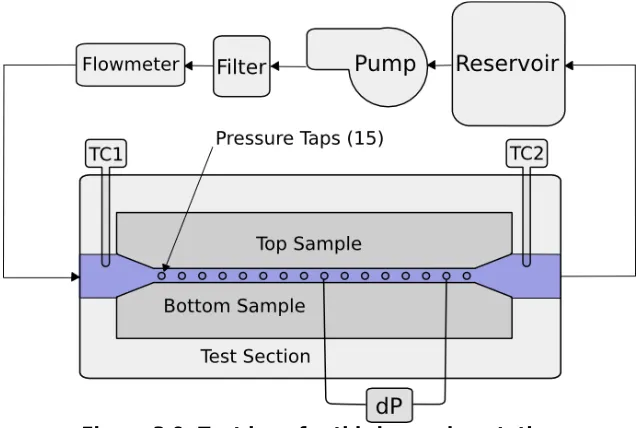
having 2 gage pressure measurements and a subtraction operation.
Reynolds numbers as high as 15,000 were obtained with a high
differential pressure pump and a ½ horsepower electric drive.
Finally, a set of sawtooth samples with the same element height (about
50μm) but differing pitches were machined. There were 4 sets of samples in this testing, with pitches varying from 503μm to 2,032μm. These
samples were also tested with a differential pressure sensor, only in the
laminar regime. Relative roughness for this experimentation was under
10% relative roughness. This work was performed in the laminar and
transition regime.
3.2 Initial Experimental Work – Sawtooth High
3.2.1 Experimental Loop Description for initial work
The initial test setup was designed and machined three years ago. The
system was designed to allow for easy interchange of samples, but had a
few operational difficulties. These difficulties arose from the time
required to test each sample and the manual nature of controlling the
flow with rotameters. All the data had to be manually recorded, which
made data collection time consuming.
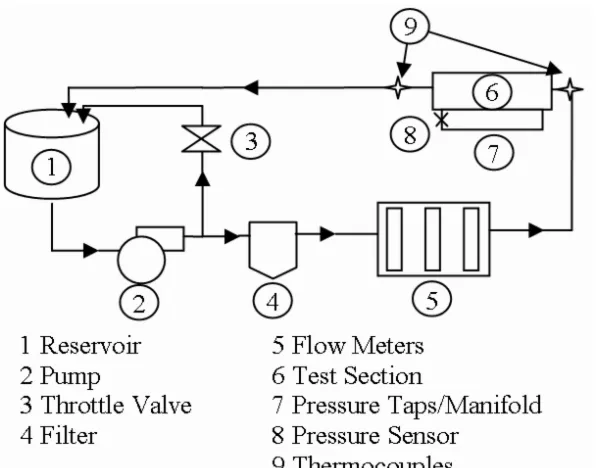
A schematic of the setup is shown in Figure 3.1. Distilled water is used as
the experimental fluid and is stored in a stainless steel reservoir. From
the reservoir, it is delivered to a bronze gear pump, Oberdorfer
N991RM-FO1 which is driven by a Dayton 5K918C electric motor. It then branches
through a 1μm woven filter (Shelco OSBN-384DUB) or goes through the
pass-through back to the reservoir. From here, it is delivered to a bank of
3 rotameter flow meters, parts Omega FL-5551C. The distilled water then
enters the test section. It then exits the test section and is released back
into the reservoir.
The test section is rectangular in shape, with a fixed width of 12.2 mm
(0.48in) and a variable height, fixed by four set screws. The test section is
88.9 mm (3.5 in) long and has static pressure taps along the length of the
channel. These taps are spaced 6.35 mm (0.25 in) apart for a total of 16
taps along the channel length, and are formed with a #60 drill (diameter
= 1.016 mm) in the wall of aluminum. Care was taken to leave no burrs
protruding into the flow. The taps are all connected to a pressure
manifold, with a separate valve for each tap. At the end of the pressure
manifold is a Honeywell 0-690 kPa (0-100 psi) differential pressure sensor
powered by an Electro Industries Laboratory DC power supply. At the
inlet and outlet, two K type thermocouples measure the temperature of
the water. To control the separation, two Mitutoyo Digimatic Micrometer
heads with ±2.54 μm accuracy are used to set the separation, which is
then fixed in place with screws.
The pressure sensor is connected to one channel of a simple LM324
operational amplifier circuit, with the gain set at 67. The design used is a
basic non-inverting amplifier circuit. The op-amp circuit is powered by an
Electro Industries Laboratory DC power supply (at +31VDC). The amplified
voltage reading is calibrated to a pressure using an OMEGA DPS-610
Pressure calibrator. Pressure readings are then obtained using the
voltage recorded by a Craftsman 82040 Multimeter.
3.2.2 Experimental Schematics and Drawings
A simple schematic of the setup can be seen in Figure 3.1.
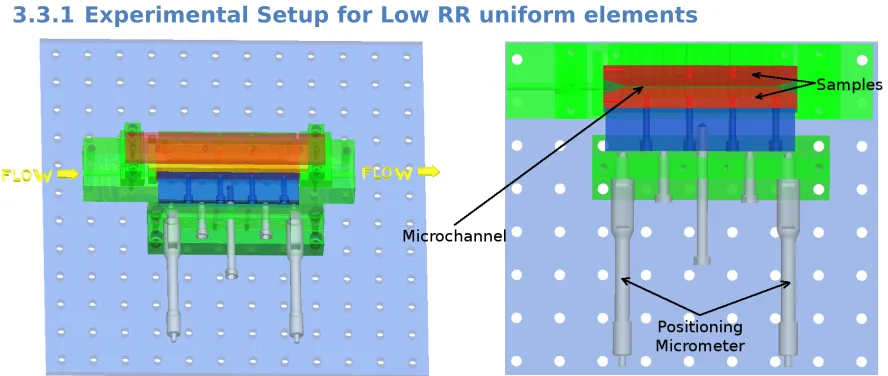
The test section itself was machined from 6061 aluminum stock. An
exploded view of the test section makeup is given in Figure 3.2.
In Figure 3.2 the two red blocks are the samples that form the
microchannel. The yellow block on the top holds the top sample fixed.
The yellow block on the bottom holds 2 screws and 2 micrometer
positioning heads that allow the separation of the setup to be varied. This
allows the same samples to be used in channels of varying diameters,
essentially varying the relative roughness. The blue piece comprises one
[image:49.612.166.464.70.304.2]3 Experimental Work - 3.2 Initial Experimental Work – Sawtooth High Page 48
Figure 3.2: Left: Exploded view of the setup Right: Assembled setup without cover piece
wall of the channel and features pressure taps for measuring static
pressure along the channel. The end of the channel is made up of the
light blue piece. Finally, the green cover comprises another wall, and
holds the inlet and outlet of the channel.
3.2.3 Samples used in First Experimentation
With this setup, the effects of sawtooth roughness with high relative
roughness was examined. Two sample sets were used for the roughened
channels. They had similar roughness heights, but differed in the pitch of
the roughness elements. First however, the experimental setup is
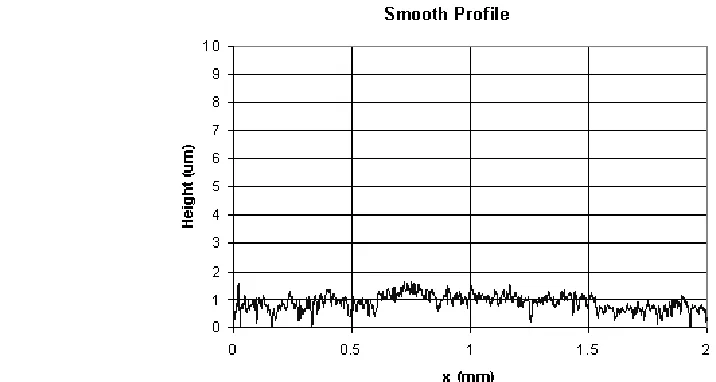
validated using samples that were ground to be flat and smooth. The
smooth channel profile as obtained by a stylus profilometer can be seen
in Figure 3.5. The height of roughness from the grinding process is
around ε=2 μm. The values obtained from these smooth channel tests
are expected to match theoretical values for smooth rectangular
channels.
Two different sample sets were machined using a ball end mill of
appropriate diameter. The ball end mill was run perpendicular to the test
samples to machine grooves at a shallow depth. The ball end mill
diameter was 762 μm.
3 Experimental Work - 3.2 Initial Experimental Work – Sawtooth High Page 49
Table 3.1: Summary of Roughness in First Experimentation
Pitch Ra Fp
μm μm μm μm
Smooth N/A 2 0.31 N/A
405 99.71 27.43 23.34
815 105.55 24.19 21.52
εFP
For this experiment, two pitches of 415 μm and 815 µm were employed.
The profile of the p=415 μm sample is shown in Figure 3.3, and was
obtained with a Mitutoyo stylus profilometer. It can be seen from
measuring eight different parts of the sample in 2 mm samples that the
height of the roughness elements are ε = 99.71 μm. The 815 μm pitch
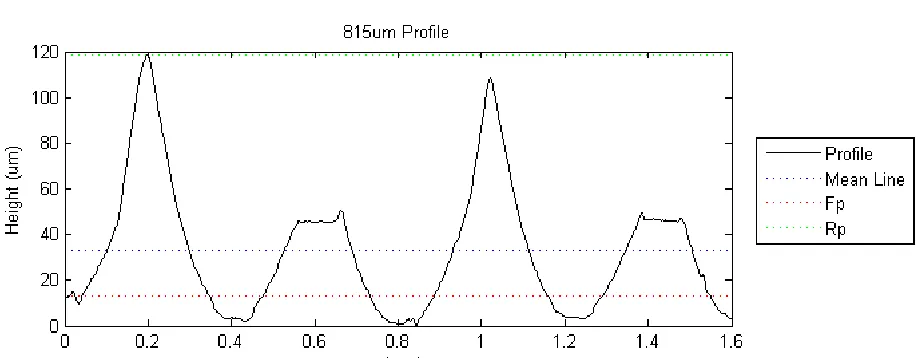
sample had a roughness profile that is shown in Figure 3.4. Every other
roughness element on these samples was machined somewhat
3 Experimental Work - 3.2 Initial Experimental Work – Sawtooth High Page 50
[image:51.612.94.553.441.620.2]Figure 3.4: 815um pitch profile, taken with stylus profilometer
differently. Only the tops of every other element were removed, rather
than the entire element. On these samples the height of the roughness
elements is ε=105.55 μm.
The geometries of the samples are summarized in Table 3.1. The value of
Ra is calculated from the raw profilometer data by averaging the heights
according to ASME standards. The value of Fp was then obtained with a
simple program that ignored all data above Ra and found the average of
the rest of the data. Fp is then the distance from the average roughness
to the floor profile line.
[image:52.612.93.451.353.544.2]3 Experimental Work - 3.2 Initial Experimenta
![Figure 1.1: Modified Moody Diagram by Kandlikar [28]](https://thumb-us.123doks.com/thumbv2/123dok_us/57801.5354/25.612.95.526.74.335/figure-modified-moody-diagram-by-kandlikar.webp)
![Figure 1.2: Pressure drop v. pitch of sawtooth obstructions for Re = 40, h = 0.1, from Rawool [30]](https://thumb-us.123doks.com/thumbv2/123dok_us/57801.5354/26.612.150.468.73.350/figure-pressure-drop-v-pitch-sawtooth-obstructions-rawool.webp)
![Figure 2.1: Illustration of Idealized roughness surface from Nikuradse [2]](https://thumb-us.123doks.com/thumbv2/123dok_us/57801.5354/32.612.157.469.136.448/figure-illustration-idealized-roughness-surface-nikuradse.webp)