AAEE2012CONFERENCE Melbourne, Australia www.aaee.com.au/conferences/2012/
Engaging distance students through online tutorials
Jo Devine and Weena Lokuge
University of Southern Queensland Corresponding Author Email: [email protected]
BACKGROUND
This paper explores the use of an online tutorial system by distance students in a large first year engineering statics course. Student feedback suggests that this course is often perceived as a hurdle course for students, so the course team is constantly searching for new ways to support distance students and enhance their course experience. Most distance students have time constraints and multiple commitments other than their study, they do not have the face to face interaction with course staff that on-campus students do. Consequently they have fewer opportunities to access content specific assistance as they work through course materials and to receive immediate feedback on their own performance.
In 2011 we implemented an assessable online tutorial system, known as Mastering Engineering®, as a platform for providing targeted, ongoing tutorial assistance and timely feedback to distance students. This form of learning assessment was implemented for the entire cohort but the needs of the 60% who were studying by distance was the primary motivation.
PURPOSE
This study investigates the way that the system was used by the students to identify whether
differentiated usage patterns could be discerned for students at differing levels of achievement in the course. It explores the hypothesis that high achieving students would use the assessable online tutorials as an aid to their study and so would access and complete the tutorials regularly throughout the semester, while poorly performing students would tend to only access them towards the end of semester (as the exam period neared).
DESIGN/METHOD
A stratified sampling of students from different grade bands was taken and their interaction with the system was investigated through the collection of data pertaining to their access patterns and time on task throughout the semester. This data will be analysed for statistical correlations between tutorial usage patterns and course achievement.
RESULTS
It was found that regular and consistent engagement with the system was practiced by students achieving high course marks while, conversely, students with lower course outcomes exhibited inconsistent and bundled usage patterns. There is also a strong statistical association between the marks achieved for the tutorial series and final course results.
CONCLUSIONS
Clear differentiation between usage patterns of high and low achieving students, coupled with correlation between tutorial results and exam results, suggests that the online tutorial usage patterns of high achieving students are more effective in terms of overall course achievement. In 2012 an increased frequency of assessment will be implemented to test whether a more consistent engagement with the system can be encouraged in low performing students.
KEYWORDS
Introduction
Many countries around the world have stated goals of increasing both access to and participation in higher education (OECD, 2012). Commencing students tend to have widely varying backgrounds as a result of the ‘massification of the sector’ (Krause, 2005). They also have a range of entry points to their programs and so tend to have diverse cultural and educational backgrounds and motivations for learning. The articulation of engineering programs allows for students who have poor high school maths and no physics background to enrol in an Associate Diploma program and then articulate through to a full Bachelor of Engineering.
Many non-traditional students who utilise these alternate pathways study engineering through distance education. In most distance learning environments a large proportion of distance learners are mature-aged students returning to study after a significant study hiatus. Anecdotal evidence suggests that the majority of them have family commitments and work full time while studying part-time. In addition, many distance learners are geographically dispersed and lack contemporary student experience. The evidence, based on the authors’ experience, suggests that they have limited exposure to on-line participation and
engagement with the social media. Thus, the interaction of this cohort of students with their peers and/or teaching staff is limited. Krause (2005) also states that mature students tend to make less use of web-based resources and to collaborate less with their peers.
This study is situated in the context of a core first year engineering mechanics course,
Engineering Statics, and considers a diverse cohort of students studying during the latter part of 2011. Students from this cohort include 60% distance students, represent a range of engineering disciplines and are enrolled in two, three and four year engineering programs.
The problems experienced by students in first year engineering mechanics courses are widespread and comprehensively discussed in the literature (Goldfinch et al 2008). Many issues have been identified as contributing to poor student performance in engineering mechanics courses including prior knowledge, student motivation, diverse cognitive styles and teaching methods. Goldfinch et al (2008) conclude that “of all the causes and all the possible solutions to each of them, no single approach can cure all”.
For many students this course is the first time that they are required to independently learn difficult material. A study of students in the School of Computer and Information Science at the University of South Australia (Duff et al, (2007)), revealed that approximately one-third of students reported difficulty in meeting the academic demands of their courses and struggled with the independent learning style required at university. They find that the study habits that had previously worked for them are no longer adequate as a new set of study skills is
needed. To succeed in this particular course the individual must not only master the theory presented but also develop a skill in applying it to a range of engineering problems.
Increasingly, electronic resources are being provided to support the learning of distance students. With this objective an online tutorial system known as Mastering Engineering was integrated into this engineering statics course. This package has been developed by the publishers of the course text and so can be integrated with the course in a cohesive manner. Given the perceived difficulty of this particular course and the authors’ interest in supporting a diverse student cohort, this system provided a mechanism for investigating the study patterns exhibited by distance students. Engagement with this system is proposed as a model for the engagement of students with the course and in particular with the electronic resources provided for students.
Implementation of online tutorials
In 2011 the statics course team implemented an assessable online tutorial system, known as MasteringEngineering®, as a platform for providing targeted, ongoing tutorial assistance and timely feedback to distance students.
The online tutorials were set up to mirror the structure of the course with seven (7) tutorials corresponding to modules two (2) through eight (8) of the course. Students were given a recommended study schedule at the beginning of semester and a series of recommended due dates for completion of the tutorials. These recommended due dates reflected the recommended study pattern. However student flexibility is a stated university priority, in recognition of the many competing priorities and time commitments that distance students must juggle. To allow students to manage their own study schedule there were no penalties or enforcement of the recommended completion dates and there was only one final due date for the entire tutorial series at the end of semester.
Although the tutorials were assessable they were worth only a total of 14% of the course marks and students were able to pass the course without completing the tutorials. Their purpose was primarily formative. Other assessment tasks for the course included a maths revision quiz (2%) at the beginning of semester, a traditional written assignment (14%) midway through semester and an end of semester two hour exam (70%).
The online tutorial system was hosted outside the university’s learning management system and students accessed it via the web. Technical (IT) assistance was provided for students via the host system.
The tutorials include hints and help functions that scaffold student learning. The system presents a completion task to the student which includes a given state, a goal state and partial solutions (via the hints/help). Such completion tasks encourage active learning while decreasing cognitive load for the novice learner (van Merrienboer, Kirschner, & Kester, 2003).
As well as individualised student feedback, based on answer submission, general feedback is provided at the completion of a task, linking the solution back to the original stated goal. If an incorrect answer was entered the student was encouraged to try again through targeted feedback and given the opportunity to re-enter their answer. The student was given three opportunities to answer the problem, with only a minor loss of marks, before the problem was marked as incorrect and the answer displayed. If an answer was incorrect due to formatting error, the student was advised of this and given an additional opportunity to answer. This grading system was intended to encourage persistence with the tutorial (time on task) rather than to penalise incorrect answers.
Although the purpose of the system is to encourage learning, variable results have been reported with regard to its possible effect on final exam performance (Rayner, 2008). It is the authors’ contention that there are too many variables that contribute to a student’s exam performance to make a definitive study of the relationship between any given learning instrument and the exam performance of an individual or cohort. For this reason this study focuses on the way in which the system was used by students, as a measure of their engagement with the course resources, and the patterns of student usage.
Engagement of distance students through assessable
tutorials
Rapidly increasing technology advances, accessibility of computers and online material has meant that the way in which assessment tasks are incorporated into courses is slowly evolving. In particular, the use of computer based assessment to support student learning is receiving increasing attention. Boyle and Hutchison (2009) state that “e-assessment
near future” but that the assessment tasks used will be significantly different from traditional paper based assessments mainly used today. E-assessment will move from multiple choice tests to assessment tasks and strategies which “test a wider range of knowledge, skills and understanding than what is possible at present” (Skills, 2004). Computers will make it easier to present new tasks, engage students in a greater variety of media and give a greater flexibility in presentation (Ridgway & McCusker, 2003).
With a greater variety of media and flexibility it is possible to offer a greater sophistication in assessable student tasks. Five dimensions to categorise sophistication have been proposed by Parshall, Davey, & Pashley (2000). These are item format (select and answer, as in multiple choice or construct an answer); response action (click mouse or enter text); media (inclusion of graphics, video etc); level of interactivity and scoring algorithm (Boyle & Hutchison, 2009).
Gibbs and Simpson, as cited by Nicol (2009), identify 11 conditions under which assessment supports student learning. The underpinning conceptual framework for these conditions is based on two inter-related concepts – the structure of assessment tasks (conditions 1 – 4) and the effective provision of feedback (conditions 5 – 11) (Gibbs & Simpson, 2004; Nicol, 2009). Nicol (2009) summarises these concepts as follows.
Assessment tasks must be structured so that they:
encourage ‘time on task’
lead to an even distribution of study effort over the semester and over learning topics support deep learning rather than surface learning
have clear, but high, expectations and guidelines
Further, good feedback should:
have appropriate quantity and be timely focus on learning and not marks
be communicated in a form which is clear and understandable be linked to clear criteria and learning objectives
be used by students to make improvements in future work.
It is therefore necessary to consider these two concepts when designing or evaluating any assessment framework or tool. When considering the Mastering Engineering online tutorials as a learning support tool almost all of these conditions are clearly evident. Anecdotal evidence suggests that the one aspect that could be improved is the clarity of feedback from the student’s perspective. Otherwise one of the strengths of the system appears to be the ability to give immediate and targeted feedback. This is especially important to distance students who are relatively isolated in their studies.
Methodology
This study investigates the way that the Mastering Engineering system was used by students in order to identify whether differentiated usage patterns, in terms of the distribution of effort over the semester, could be discerned for students at differing levels of achievement in the course.
differing achievement levels. Data was required on how often and when individual students used the tutorials. This data could then be analysed to determine whether any patterns emerged by aggregating the data for students within a particular final grade band.
To determine whether use of the tutorials was linked to overall course results, aggregated tutorial scores and final course results for the whole class were analysed statistically.
Methods
Raw data was retrieved from the tutorial system records at the end of semester. Data on total tutorial scores was retrieved from the Mastering Engineering tutorial system and matched to overall course marks from the Learning Management System. This enabled a statistical verification of correlations between performance in the online tutorials and overall course performance.
Data pertaining to individual students’ use of the system could only be retrieved manually. For this reason stratified random sampling of student records was undertaken. Ten students from each grade band (HD, A, B, C and F) were randomly chosen from class lists and their usage data retrieved from the tutorial system. Data retrieved included access and completion dates for each tutorial and time spent on each tutorial. The date within semester at which students completed each tutorial and the variation from the recommend completion pattern was then assessed for each student and compared to others within the same grade band and outside the band. The sample of students who failed was selected from amongst the group that attempted all of the assessment items and still did not achieve an aggregate of 50% for the course.
By comparing the time spent on each tutorial and at what point during semester that time was spent for individual students, a more detailed picture of the spread of effort over semester emerged. Again this was compared across different grade bands.
Results
Engagement throughout semester
Students were given recommended completion dates through the semester, based on the expected rate of progression through the course material. To test our hypothesis that stronger students (as measured by final grade results for the course) would engage in a more methodical manner with the learning tools, in the form of online tutorials, a sample of students from each grade band was taken and the date of completion of each of tutorials 2-8 was plotted against the 15 weeks of semester. The results for a random sample of ten students from different grade bands are shown below in Figure 2. Note that the different coloured points in Figure 2 represent different individual students.
Figure 1: Completion of online tutorials 2 - 8 by students from different final grade bands (note that completions of some students are hidden behind others)
Time on task
In order to compare the time spent on the tutorials by different categories of student, the actual time spent completing the tutorials was gathered and compared. Note that this is a measure of time spent online doing the tutorials and does not account for any time spent by the student completing calculations etc offline. It was possible for students to begin a problem, log off to complete the calculations manually and then return to submit their answers. However it was not possible to measure this total time spent.
Table 1: Average time (minutes) spent completing the online tutorials by students from different grade bands (standard deviation shown in brackets)
HD n= 10 A n=10 B n=10 C n=10 F n=10
Tutorial 2 219 (79) 201(76) 354 (159) 293 (106) 217 (144)
Tutorial 3 163 (55) 158 (85) 266 (86) 229 (140) 125 (127)
Tutorial 4 201 (47) 149 (103) 259 (101) 251 (132) 127 (104)
Tutorial 5 85 (23) 62 (32) 108 (47) 112 (58) 58 (55)
Tutorial 6 72 (25) 56 (43) 131 (48) 93 (59) 50 (55)
Tutorial 7 111 (40) 87 (58) 129 (90) 146 (86) 81 (75)
Tutorial 8 152 (61) 92 (88) 199 (146) 237 (153) 54 (90)
Total time (minutes)
1003 805 1446 1361 712
Online tutorials and final exam performance
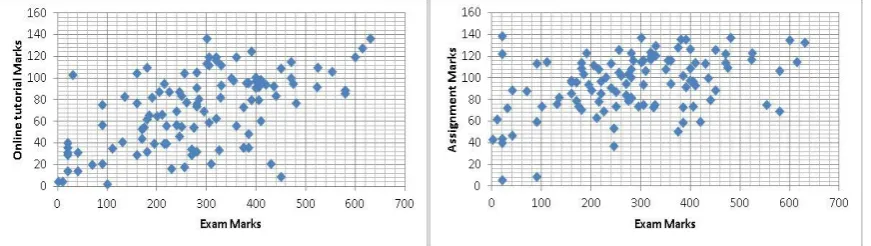
The relationship between online tutorial performance and final exam performance was investigated. A stronger relationship was found between the performance of students in the tutorials and their performance in the exam than between the more traditional assignment and exam. As the intent of the tutorials was that they should provide learning support, whereas the assignment was intended as a measure of learning and was more open to collaborative effort, this is not surprising. The assessed performance of students in the tutorials was directly related to their engagement with the tutorials since the low penalties applied for incorrect answers and ability to access help and support while completing the questions meant that students who engaged with the system were able to gain good marks even if they initially struggled with the material. The exam questions were a series of short questions that were very similar in terms of concepts evaluated and presentation to a selection of the online tutorial questions.
Figure 2: Online tutorial and Assignment marks vs final exam results
(note that both tutorials and assignment were worth 140 marks or 14% of final grade)
A statistical analysis was performed using the performance of students in these three different summative assessments. SPSS was used to generate Pearson correlations for the exam marks against: on line tutorial marks and assignment marks. The data contained in the output was flagged if the correlation is significant at the 0.01 level (2- tailed). The result of these correlations is shown in Table 1. Although variables, on line tutorial marks and
[image:7.595.83.519.508.631.2]Table 2: Correlation of exam marks versus quiz marks and assignment marks
Exam marks
Pearson correlation N
On line tutorial marks 0.563** 110
Assignment marks 0.479** 110
** Correlation is significant at the 0.01 level (2-tailed)
Discussion
The data presented above does seem to indicate a differentiated study pattern between students in differing grade bands. As expected the highest achieving students tended to follow the recommended study pattern when completing tutorials, allowing time to master the material. There were a few exceptions to this pattern; students who completed the material later than recommended and still achieved a high grade. This was possibly because they were able to absorb the material on ability alone and so achieve a high grade with a later study of the material.
The pattern which emerged for the B-grade students was unexpected, and thus interesting, in that they tended to adhere to the recommended study pattern, albeit with a lag in
completion dates. This group spent the greatest amount of time on the tutorials, which suggests that they were diligent students who possibly needed more time to absorb the material than the ‘high achievers’. C-grade students tended to show a greater lag in their completions than the higher grade students.
As expected some of the F-grade students tended to leave the completion of tutorials until relatively late in semester, indicating that they were either behind in their study or
undertaking the tutorials in isolation from the other off-line study materials. However the lag was not as pronounced as we might have expected. There were clearly a few student who kept reasonably to the schedule and yet still did not achieve a passing grade.
Further Work
A differentiation between usage patterns of high and low achieving students coupled with the strong correlation of tutorial results and final course grade provides additional support to the findings of Chickering and Gamson’s research (as cited by Nicol, 2009) that suggests that time on task and an even distribution of study effort over semester are essential to academic success. The concept that a more even distribution of study effort, supported by assessable online tutorials, is beneficial to student academic outcomes will be tested in 2012 when the assessment associated with the online tutorials will be adjusted to include more intermediate due dates through the semester in an effort to encourage a more consistent engagement with the online tutorials by all students.
The motivation for differentiated usage patterns between students could only be investigated through a more qualitative study. Weaker students may be divorcing the use of online
tutorials from their other study during semester or simply leaving the bulk of their study too late in semester, resulting in a cognitive overload. A larger data sample and more extensive analysis would also be illuminating as to the true trends occurring within the cohort.
Conclusion
not been addressed in this study. It would be interesting to investigate whether if weaker students could be encouraged to more evenly distribute their study efforts, through use of the online tutorials, their learning outcomes could be enhanced.
References
Boyle, A., & Hutchison, D. (2009). Sophisticated tasks in e‐assessment: what are they and what are their benefits? Assessment & Evaluation in Higher Education, 34(3), 305-319. doi:
10.1080/02602930801956034
Duff, A., Quinn, D., Johnston, H., & Lock, P. (2007). A clue a quest and a blog. Paper presented at the First Year in Higher Education conference, Brisbane.
http://www.fyhe.com.au/past_papers/papers07/final_papers/pdfs/1b.pdf
Gibbs, G., & Simpson, C. (2004). Conditions under which assessment supports students' learning. Learning and Teaching in Higher Education, 1, 3-31.
Goldfinch, T., Carew, A., & McCarthy, T. (2008). Improving Learning in Engineering Mechanics: The Significance of Understanding. Paper presented at the Australasian Association of Engineering Education, Yeppoon.
Krause, K.-L. (2005). The Changing Face of the First Year: Challenges for Policy and Practice in Research-Led Universities. Paper presented at the First Year Experience Workshop 2005, University of Queensland
http://www.uq.edu.au/teaching-learning/docs/FYEUQKeynote2005.doc
Nicol, D. (2009). Assessment for learner self-regulation: enhancing achievement in the first year using learning technologies. Assessment & Evaluation in Higher Education, 34(3), 335-352. doi: 10.1080/02602930802255139
Organisation for Economic Co-operation and Development (OECD). (2012). Education indicators in focus series Working Papers Series: OECD Publishing.
Parshall, C. G., Davey, T., & Pashley, P. J. (2000). Innovative item types for computerized testing. In W. J. v. d. Linden & C. A. W. Glas (Eds.), Computerized adaptive testing theory and practice (pp. 129–148). Dordrecht: Kluwer Academic. Retrieved from
http://ezproxy.usq.edu.au/login?url=http://site.ebrary.com/lib/unisouthernqld/Doc?id=1005 2661.
Rayner, G. (2008). Evaluation and student perception of ‘MasteringBiology’ as a learning and formative assessment tool in a first year Biology subject. Paper presented at the ATN Assessment Conference 2008 – Engaging Students in Assessment, Adelaide.
http://www.unisa.edu.au/ATNAssessment08/
Ridgway, J., & McCusker, S. (2003). Using Computers to Assess New Educational Goals. Assessment in Education: Principles, Policy & Practice, 10(3), 309-328. doi:
10.1080/0969594032000148163
Skills, G. B. D. f. E. (2004). 14-19 curriculum and qualifications reform: final report of the Working Group on 14-19 Reform. Nottingham: Department for Education and Skills.
van Merrienboer, J. J. G., Kirschner, P. A., & Kester, L. (2003). Taking the Load Off a Learner's Mind: Instructional Design for Complex Learning. Educational Psychologist, 38(1), 5-13. doi: 10.1207/s15326985ep3801_2