International Journal of Innovative Technology and Exploring Engineering (IJITEE) ISSN: 2278-3075, Volume-8 Issue-9, July, 2019
Abstract: This paper aims to build a generic roadmap for implementing Lean in different domains in order to improve the business processes. The customization of this roadmap makes it possible to adapt the steps to be followed for Lean implementation, the process manager’s requirements and available resources. An application has been developed in order to facilitate the customization of this roadmap. An analysis of methods from a literature review for Lean implementation was conducted in order to identify the steps to be included in the roadmap. A rigorous approach based on set theory, was therefore proposed and followed to build the roadmap. This roadmap is defined as a set of phases associated with principles, and each phase is defined as a set of steps associated with tools. This roadmap shows to the process manager, the objectives to aim for, the Lean principles to satisfy, and the Lean tools to use.
Index Terms: Business Process, Continuous Improvement, Lean Method, Lean Roadmap.
I. INTRODUCTION
Lean is originated from the Japanese automotive industry [1]. It is about a business process improvement approach, which arouses the interest of numerous researchers; however, these researchers don’t share the same vision and their opinions diverge. [2] underline that eliminate all forms of waste to reduce expenses and maximize the use of worker capacity are the basic concepts of the Lean approach. [3] defined Lean approach as a set of tools for identifying and eliminating waste. The Lean principles tools should not be dissociated to allow process flow improvement and waste elimination according to [4]. [5] considered that Lean is an operational strategy whose primary aim is to reduce wastes.
Implementing Lean in an organization isn’t an easy task. [6] underline that few organizations obtain significant improvements. [7] stated that industrial manufacturers strive to adopt lean philosophy but they find it difficult to achieve. They also noted that failure to implement Lean results in wasting resources and reducing employees’ confidence in Lean practice. [8] considered that the primary reasons behind Implementing failures of the lean approach: trying to solve a problem using an in appropriate tools or using a single tool, or using specific tools in order to solve any problems.
Revised Manuscript Received on July 11, 2019.
Younes Tiamaz, SIWEB Team, Mohammadia School of Engineering, Mohammed V University, Rabat, Morocco
Nissrine Souissi, Computer Science Department Rabat School of Mines, Rabat, Morocco & SIWEB Team, Mohammadia School of Engineering, Mohammed V University, Rabat, Morocco
In addition, [9] indicated that the selection of appropriate tools for process improvement, as well as their applicability
and integration into operations, is a major problem for many organizations. However, [10] stated that the implementation of Lean requires besides tools, the involvement of managers and employees that depends on the culture of the country and that of the company.
[11], [12] stated that failure to implement Lean is due to a lack of understanding of this approach. [13] also pointed out that there are various definitions for the Lean adopted by the researchers, therefore there is no common terminology. In addition, [3] concluded that there are no standard methods for implementing Lean. [14] classified the problems that Lean implementation encounters, in eight categories namely: Terminology, organizational momentum, functional and professional silos, data collection and performance measurement, resistance to change, hierarchy and management roles, personal and professional skills and perception. [15] pointed out that there are four main reasons why companies fail to achieve the desired objectives from Lean implementation. The first reason is that the managers do not understand the real impact of the Lean approach, the second is that they are not able to accept that cultural change is indispensable, the third is that companies do not have the right people in the appropriate positions, and the fourth one is that companies choose Lean as a business process improvement approach without any prior study.
To sum up, Lean is a continuous improvement approach of business process, which enables organizations to achieve their business objectives. However, [16] mentioned that the objectives achieved by the organizations is only a small part of the desired objectives. In fact, it is necessary to provide a Lean roadmap that will allow the business process manager to overcome the problems that prevent a successful Lean implementation. This roadmap needs to highlight Lean principles in order to involve managers and employees and encourage them to accept change. In this paper, we build a roadmap that proposes steps to follow, tools to use and principles to satisfy. In addition, the generic aspect of the roadmap, allows the manager to customize it, making it adapted to the resources of the company.
Section 2 presents our building process of the roadmap. In section 3, we give the proposed roadmap. Section 4 discusses the related works. In section 5, we focus on the application that allows the business process manager to customize the roadmap. Finally, we present conclusion and perspectives.
II. ROADMAP
BUILDINGPROCESS
Lean Roadmap: A Step by Step Guide for a
Process Manager
Published By: This section presents the process followed in order to
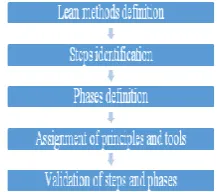
[image:2.595.122.231.78.174.2]build the Roadmap. This process is illustrated in Fig. 1.
Fig. 1 The Roadmap building process
Lean methods definition
We consider that each Lean method consists of several phases and that each phase consists of several steps. A semantic and syntactic analysis is necessary here in order to redefine all the methods of Lean in the form of steps that are grouped into phases.
Let be the set of all the lean methods resulting from articles found in literature:
such that : Number of lean methods,
such that
: Phase number in method
): Number of phases in Lean method and
such that
: Step of phase in lean method
: Number of steps of phase and
As a result:
Steps identificationFrom the set , we will identify the steps mentioned in lean methods.
Let be the number of steps identified for all the methods:
Since Lean methods are independent but aim for the same objective, which is implementing Lean, there may be steps that have the same semantics but have different names. In order to remove this ambiguity, we conducted both a semantic and syntactic analysis. These analyses made it possible to avoid any eventual redundancy of the steps.
Let be the set of steps remained after the semantic and syntactic analysis of the steps.
Such that
Phases definition
In order to ensure that our process of building the Roadmap is compliant with the definition we have proposed
in , we will group the steps of into phases. To do this, we linked the steps that meet the same objective to the same phase.
Let be the number of phases defined: . Let
be the number of phases defined be a partition .
,
,
The definition of a phase consists first in linking steps to it and then in assigning a name to it. Since we have grouped steps that have the same objective into one phase, this phase bears then the name of this objective.
Let be the set that contains all the labels, which designate the objectives of the phases:
such that : label of the phase
We make an assignment of the set to the set via
the function .
Assignment of principles and tools
Let be the set of principles that must be verified by the phases such us:
such that : Number of principles
Let be the set of tools associated to the steps of such us:
such that : Number of available steps.
Let g be the function assigning the tools to the steps:
such that : Number of tools available for a step and
Let be the function affecting the principles of the phases:
International Journal of Innovative Technology and Exploring Engineering (IJITEE) ISSN: 2278-3075, Volume-8 Issue-9, July, 2019
such that Number of principles in a phase and
Validation of steps and phases
The validation of the steps and phases concerns the supervision of the implementation of Lean and not the construction of the Roadmap. To go from one phase to another, we must satisfy principles and in order to achieve a step, we must use at least one tool--if it exists-- among the tools associated with the step.
Let be the function indicating whether a step is validated or not:
Let C indicating whether a phase is validated or not:
Therefore,
=> Principles of phase are verified.
=> Phase remains non-validated
III. THEPROPOSEDROADMAP
After the presentation of building process of our roadmap, we follow up with its application to determine the roadmap components, namely: phases, principles, steps and tools.
A. Application of the Roadmap Building Process
1) Lean Methods Definition
In order to conduct our literature review of lean methods, we formulated the following research questions (RQ):
RQ1: What are the Lean methods proposed in literature?
RQ2: How can we associate the steps mentioned in the lean methods with their tools, their principles and their objectives in a single Roadmap?
To answer these questions, we used combinations of the following keywords in our research: «Lean approach», «Lean model», «Lean method», «Lean transformation », «Lean philosophy», «Lean principles», «Lean thinking», «Lean management», «Lean methodology», «Lean production», «Toyota management system», «Lean modeling», «Lean roadmap», «Lean Framework», «Lean Work instruction». The articles found contain these words in title, abstract or in the list of keywords. Only articles published between 2010 and 2017 have been chosen to work with.
The selected articles that answer our research questions
are grouped together as and have been studied in [17].
M= {[5], [12], [18]–[39]}
Using formula (1), we move on to identifying steps, tools and phases.
2) Lean Steps identification
From the set , we have used the formulas (2) and (3). So, the steps have been identified and grouped together in the
set .
= {Define the target objectives , determine and
measure the performance indicators , build lean expert
team , teach lean's philosophy and principles , review
lessons learned training , organize lean's multidisciplinary
team , make observations , select processes , build a
team dedicated to the process , organize the work space
, establish a process mapping , measure the processes
, identify added and non-added values activities ,
identify waste , classify waste , prioritize waste ,
identify root causes of identified waste , classify root
cause of identified waste , prioritize root cause of
identified waste , organize meetings , prioritize and
develop solutions , apply the proposed improvements
, evaluate the progress , evaluate the indicators
selected , promote a culture of continuous improvement
, update procedures , expand lean practices }
3) Phases definition
From the set , phases have been defined to group the steps that meet the same objectives such as q=9. Using the formula (4), we have obtained the following result:
Define the goals = { , }, Provide Training =
{ , , , }, Understand the environment = { ,
}, Prepare the environment = { , }, Understand
the process = { , , }, Manage wastes =
{ , , , , , }, Implement = { ,
, }, Revise = { , },Sustain the results =
{ , , }
4) Assignment of principles and tools
The principles and tools are collected from the articles
presented in the set . Using the formulas (5) and (6),
represents the set of principles and represents the set of tools.
= {Involve
Published By: change , manager should coach not fix , respect
every individual , go and see for yourself , employee
empowerment , self-directed word teams ,
cross-functional work force , involve employees ,
focus on process , quality at the source ,create
value for the customer , stop to fix problems ,
self-directed work teams , continuous improvement
culture , pursue perfection }
= {Project charter , benchmarking , voice of
customer , survey , kano model , 5S , Kanban
, Poka Yoke , cellular manufacturing , VSM ,
Spaghetti diagram , gemba, Swim lanes , calculate
takt time , critical to quality flowdown , data
collection plan , multiple activity chart ,
brainstorming , 5 whys / ishikawa , pareto chart
, SMED , heijunka , cellular manufacturing
, TPM, line balancing , Standardization ,
Kaizen }
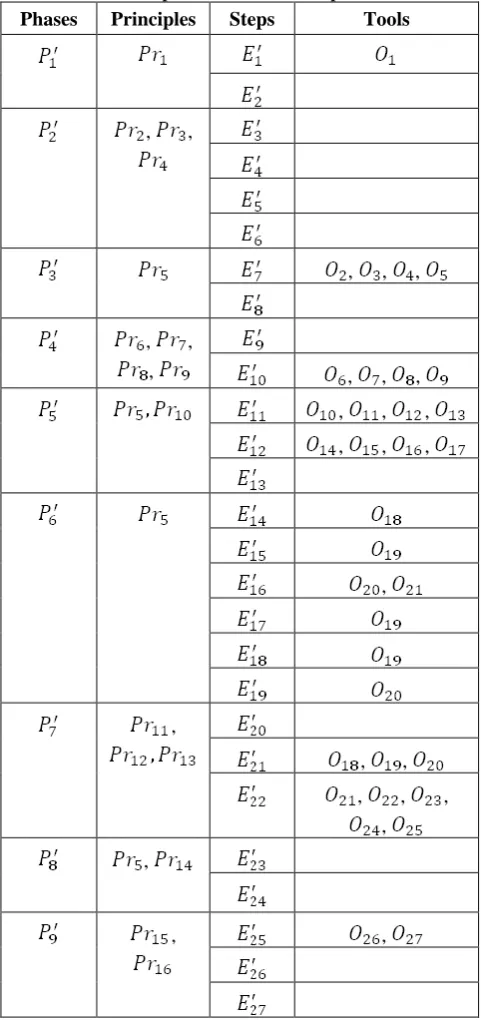
The result of the functions (7) and (8) used to assign the principles to phases and tools to steps are illustrated in Table I
B. The Roadmap
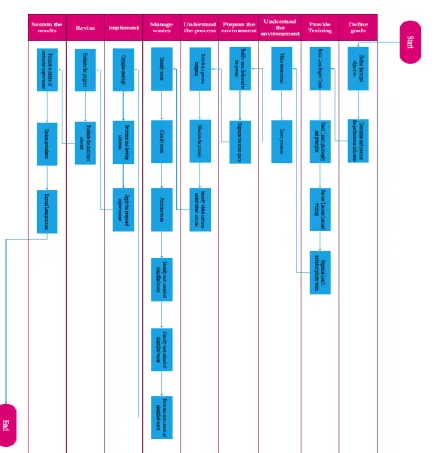
The phases and the steps defined above require execution in a specific order to help managers to achieve their objectives. Error! Reference source not found. shows a sequence of the phases and the steps.
IV. RELATEDWORKS
This paper proposed a roadmap based on a set of Lean methods from literature. We compare in this section our roadmap to other Lean methods. The majority of Lean methods [5], [8], [18], [20]–[22], [24]–[27], [29], [31]–[33], [36], [39] considered that the Lean approach is a set of tools to apply. [19], [37] emphasized on the principles to satisfy. [35] focused on the objectives to achieve, unlike our roadmap that takes into account the objectives to be achieved, the principles to be satisfied as well as the tools to be used. The other methods [12], [23], [30], [34], [35], [38] considered at least two elements among the objectives, principles and tools. But we noticed that [34], [38] did not present an operating mode to follow.
[23] incorporated Lean approach into the requirements of ISO 9001:2008. So, according to [23], in order to implement Lean approach, it is necessary to also integrate ISO 9001: 2008. Thus, if ISO 9001: 2008 is already implemented or migration to a new version such as ISO 9001: 2015 this method is then needless. Similarly, [35] incorporated Lean and Six Sigma approach into the requirements of ISO 9001: 2015. [12] presented a method with four phases and in each of
[image:4.595.299.540.188.699.2]these phases, they presented a set of steps, but they linked the tools to the phases. It will then be difficult to determine which tools to use in a particular step. [30] used the 12 principles of [1]. For each principle, they added sub-principles with guidelines for its implementation. Afterwards, they described the sub-principles and mentioned the tools in their descriptions. However, the absence of steps and phases makes the application of this method as well as the evaluation of the progress of Lean implementation difficult.
Table I The result of the assignment functions of principles to phases and tools to steps
Phases Principles Steps Tools
, ,
, , ,
, ,
, , , ,
, , ,
, , ,
,
,
, ,
, , ,
,
,
, ,
V. APPLICATIONFORTHEPROCESSMANAGER:
CUSTOMIZATIONOFTHEROADMAP
International Journal of Innovative Technology and Exploring Engineering (IJITEE) ISSN: 2278-3075, Volume-8 Issue-9, July, 2019
indicating the phases and steps to follow; the principles to be satisfied in each phase; the tools to be used in each step, will facilitate the implementation of Lean. In this sense, we have developed an ergonomic application that is easy to use by
business process managers. It offers two main services: generation of the roadmap and supervision of the
[image:5.595.71.508.105.559.2]implementation of Lean (Fig. 3).
Published By: Fig. 3 Home page
When selecting the "Roadmap", the page illustrated in Fig. 4 is displayed and allows either to display the default roadmap, or to customize the Roadmap.
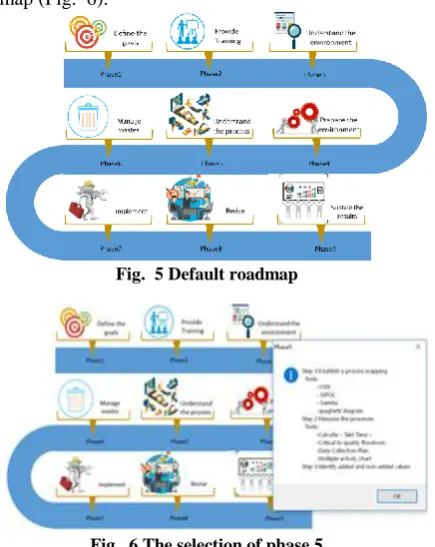
[image:6.595.319.475.50.220.2]The choice of default parameters gives an overview of all the phases that build the roadmap, which are illustrated in Fig. 5. In this case, the manager considers that each of these phases is essential to sustaining the improvements.
Fig. 4 Roadmap Options page
[image:6.595.128.209.216.291.2]To display the steps of a phase as well as the tools associated with each step, the manager selects a phase in the roadmap (Fig. 6).
Fig. 5 Default roadmap
Fig. 6 The selection of phase 5
This option helps to present the roadmap in a simple way despite the amount of information it provides. The manager can intervene and change the default settings. To do this, he/she chooses the phases that he/she considers appropriate for the context, the steps of each phase and the tools used in each step (Fig. 7). This operation consists of unchecking the unwanted phases and / or steps and / or tools. In this example, the manager does not want to apply the training phase. Even though the related steps and tools are checked in the "Training" phase, the application will not take them into consideration because the "Training" phase is unchecked.
Fig. 7 Customization of the road map
[image:6.595.319.533.298.416.2]This option makes it easier for the manager to disable a phase as well as the steps. When unchecking a step, the application ignores the tools associated with it. The roadmap adapts to the changes made by the manager as shown in Fig. 8.
Fig. 8 Customized roadmap
In this example, the manager removed the "Training" phase. As a result, the color of its zone in the application changed and the numbering of the phases was updated accordingly. When the manager disables a phase, its zone will no longer display the steps and the tools it contains because the application only displays the phases, steps and tools selected.
VI. CONCLUSION
This paper has proposed a generic roadmap with the possibility to customize it to meet the requirements of process managers, while taking into consideration the available resources of the company. A literature review was conducted to determine the key steps of Lean implementation. A definition of a Lean method has been proposed in this sense; it is a set of phases where each phase designates a set of steps. Tools have been associated to the steps, and principles have been associated to the phases. In order to identify the phases, steps and tools, a rigorous approach has been proposed and applied. Additionally, an application that offers intuitive interfaces for easy manipulation by non-expert users to generate roadmap has been developed. We began implementing our roadmap to improve a process of the hospital system of Moulay Ismail Hospital in Meknes, Morocco and the preliminary results are satisfactory.
REFERENCES
[image:6.595.65.283.344.618.2]International Journal of Innovative Technology and Exploring Engineering (IJITEE) ISSN: 2278-3075, Volume-8 Issue-9, July, 2019 principles from the world’s greatest manufacturer," New York:
McGraw-Hill.
2. Sugimori Y, KUSUNOKI K, CHO F, and UCHIKAWA S (1977), “Toyota production system and Kanban system Materialization of just-in-time and respect-for-human system,” International Journal of Production Research, vol. 15, issue: 6, pp. 553–564.
3. Anvari A. R, Norzima Z, Rosnay M. Y, Hojjati M. S. H, and Ismail Y (2010), “A comparative study on journey of lean manufacturing implementation,” AIJSTPME, vol. 3, issue: 2, pp. 77–85.
4. E. D. Arnheiter and J. Maleyeff (2005), “The integration of lean management and Six Sigma,” The TQM Magazine, vol. 17, issue: 1, pp. 5–18.
5. Banawi A and Bilec M. M (2014), “A framework to improve construction processes: Integrating Lean, Green and Six Sigma,” International Journal of Construction Management, vol. 14, issue: 1, pp. 45–55.
6. Marvel J. H and Standridge C. R (2009), “Simulation-enhanced lean design process,” Journal of Industrial Engineering and Management, vol. 2, issue: 1, pp. 90–113.
7. Mahmoud H and Bizhan J (2004), “A LEAN MANUFACTURING ROADMAP FOR AN AUTOMOTIVE BODY ASSEMBLY LINE WITHIN AXIOMATIC DESIGN FRAMEWORK,” vol. 17, issue: 1, pp. 51–72.
8. Pavnaskar S. J, Gershenson J. K, and Jambekar A. B (2003), “Classification scheme for lean manufacturing tools,” International Journal of Production Research, vol. 41, issue: 13, pp. 3075–3090. 9. Herron C and Braiden P. M (2006), “A methodology for developing
sustainable quantifiable productivity improvement in manufacturing companies,” International Journal of Production Economics, vol. 104, issue: 1, pp. 143–153.
10. Kull T. J, Yan T, Liu Z, and Wacker J. G (2014), “The moderation of lean manufacturing effectiveness by dimensions of national culture: Testing practice-culture congruence hypotheses,” International Journal of Production Economics, vol. 153, pp. 1–12.
11. Tiamaz, Y. and Souissi, N. (2019), “A domain model for capturing knowledge of the Lean approach,” Journal of Industrial Engineering and Management, vol. 12, issue:1, pp.83-96.
12. Mostafa S, Dumrak J, and Soltan H (2013), “A framework for lean manufacturing implementation,” Production & Manufacturing Research, vol. 1, issue: 1, pp. 44–64.
13. Hines P, Holweg M, and Rich N (2004), “Learning to evolve: A review of contemporary lean thinking,” International Journal of Operations & Production Management, vol. 24, issue: 10, pp. 994–1011.
14. de Souza L. B and Pidd M (2011), “Exploring the barriers to lean health care implementation,” Public Money & Management, vol. 31, issue: 1, pp. 59–66.
15. Pay R (2008), “Everybody’s jumping on the lean bandwagon, but many are being taken for a ride,” Industry Week, vol. 5.
16. Tiamaz Y and Souissi N (2016), “Meta-analysis of Lean case studies for the business process improvement,” International Colloquium on Information Science and Technology, vol. 4.
17. Tiamaz Y and Souissi N (2018), “Classification of the lean implementation procedures for improving the business processes,” International Conference on Intelligent Systems and Computer Vision, pp. 1–6.
18. Andrés-López E, González-Requena I, and Sanz-Lobera A (2015), “Lean Service: Reassessment of Lean Manufacturing for Service Activities,” Procedia Engineering, vol. 132, pp. 23–30.
19. Atkinson P and Mukaetova-Ladinska E. B (2012), “Nurse-led liaison mental health service for older adults: Service development using lean thinking methodology,” Journal of Psychosomatic Research, vol. 72, issue: 4, pp. 328–331.
20. Belhadi A, F. E Touriki, and El fezazi S (2016), “Road Map for the Implementation of Lean production tools in SMEs,” Proceedings of the International Conference on Industrial Engineering and Operations Management Kuala Lumpur, Malaysia.
21. Bhamu J, Khandelwal A, and Sangwan K. S (2013), “Lean manufacturing implementation in an automated production line: a case study,” International Journal of Services and Operations Management, vol. 15, issue: 4, pp. 411–429.
22. Chiarini A (2012), “Risk management and cost reduction of cancer drugs using Lean Six Sigma tools,” Leadership in Health Services, vol. 25, issue: 4, pp. 318–330.
23. Chiarini A (2011), “Integrating lean thinking into ISO 9001: a first guideline,” International Journal of Lean Six Sigma, vol. 2, issue: 2, pp. 96–117.
24. Choomlucksana J, Ongsaranakorn M, and Suksabai P (2015), “Improving the Productivity of Sheet Metal Stamping Subassembly Area Using the Application of Lean Manufacturing Principles,” Procedia Manufacturing, vol. 2, pp. 102–107.
25. R. R. Cima et al. (2011), “Use of lean and six sigma methodology to improve operating room efficiency in a high-volume tertiary-care academic medical center,” Journal of the American College of Surgeons, vol. 213, issue: 1, pp. 83–94.
26. R. M. Collar et al (2012), “Lean Management in Academic Surgery,” Journal of the American College of Surgeons, vol. 214, issue: 6, pp. 928–936.
27. Duska L. R, Mueller J, Lothamer H, Pelkofski E. B, and Novicoff W. M (2015), “Lean methodology improves efficiency in outpatient academic Gynecologic Oncology clinics,” Gynecologic Oncology, vol. 138, issue: 3, pp. 707–711.
28. Ebeid A. A, El-Khouly I. A, and El-Sayed A. E (2016), “Lean maintenance excellence in the container handling industry: A case study,” IEEE International Conference on Industrial Engineering and Engineering Management, pp. 1646–1650.
29. Esa M. M, Rahman N. A. A, and Jamaludin M (2015), “Reducing High Setup Time in Assembly Line: A Case Study of Automotive Manufacturing Company in Malaysia,” Procedia - Social and Behavioral Sciences, vol. 211, pp. 215–220.
30. Gao S and Low S. P (2014), “The Toyota Way model: an alternative framework for lean construction,” Total Quality Management & Business Excellence, vol. 25, issue: 5–6, pp. 664–682.
31. J. T. Gutsche et al. (2014), “Advancing Extubation Time for Cardiac Surgery Patients Using Lean Work Design,” Journal of Cardiothoracic and Vascular Anesthesia, vol. 28, issue: 6, pp. 1490–1496.
32. Khlie K and Abouabdellah A (2017), “Identification of the Patient Requirements Using Lean Six Sigma and Data Mining,” vol. 30, issue: 5, p. 9.
33. Lam N. T, Toi L. M., Tuyen V. T. T., and Hien D. N (2016), “Lean Line Balancing for an Electronics Assembly Line,” Procedia CIRP, vol. 40, pp. 437–442.
34. Lingaratnam S, Murray D, Carle A, Kirsa S. W, Paterson R, and Rischin D (2013), “Developing a performance data suite to facilitate lean improvement in a chemotherapy day unit,” Journal of Oncology Practice, vol. 9, issue: 4, e115–e121.
35. Marques P. A, Meyrelles P. M, Saraiva P. M, and Frazão-Guerreiro F. J (2016), “Integrating Lean Six Sigma with ISO 9001:2015,” IEEE International Conference on Industrial Engineering and Engineering Management, pp. 894–898.
36. Matt D. T and Rauch E (2013), “Implementation of Lean Production in Small Sized Enterprises,” Procedia CIRP, vol. 12, pp. 420–425. 37. Mostafa S, Dumrak J, and Soltan H (2015), “Lean Maintenance
Roadmap,” Procedia Manufacturing, vol. 2, pp. 434–444. 38. Nguyen M. N and Do N. H (2016), “Re-engineering Assembly Line
with Lean Techniques,” Procedia CIRP, vol. 40, pp. 591–596. 39. Rahani A. R and al-Ashraf M (2012), “Production Flow Analysis
through Value Stream Mapping: A Lean Manufacturing Process Case Study,” Procedia Engineering, vol. 41, pp. 1727–1734.
AUTHORSPROFILE
Younes tiamazis a Phd Student at Mohammed V University, Rabat, Morocco and member of Information System and WEB (SIWEB) in EMI School. he obtained his engineering degree from MINES-RABAT School, Morocco in 2015. His research interests include process engineering, business process management and continuous improvement approach.
Nissrine SOUISSI is a fulltime professor at the MINES-RABAT School, Morocco. She obtained a Ph.D. in computer science from the UPEC University in 2006, France and an Engineer degree from Mohammadia School of Engineers in 2001, Morocco. Her research interests include process engineering,