Abstract: A vitalcrucial pre-processing phase in image processing, computer vision and machine learning applications is Edge Detection which detects boundaries of foreground and background objects in an image. Discrimination between significant edges and not so important spurious edges highly affects the accuracy of edge detection process. This paper introduces an approach for extraction of significant edges present in images based on cellular automata. Cellular automata is a finite state machine where every cell has a state. Existing edge detection methods are complex to implement so they have large processing time. These methods tend to produce non-satisfactory results for noisy images which have cluttered background. Some methods are so trivial that they miss part of true edges and some methods are so complex that they tend to give spurious edges which are not required. The advantage of using cellular computing approach is to enhance edge detection process by reducing complexity and processing time. Parallel processing makes this method fast and computationally imple. MATLAB results of proposed method performed on images from Mendeley Dataset are compared with results obtained from existing edge detection techniques by evaluation of MSE and PSNR values Results indicate promising performance of the proposed algorithm. Visually compared, the proposed method produces better results to identify edges more clearly and is intelligent enough to discard spurious edges even for cluttered and complex images.
Index Terms: Cellular automata, Edge detection, Finite state machine, Linear rules, Parallel processing.
I. INTRODUCTION
Edge extraction is a procedure to detect contour of objects by finding the discontinuities or change in brightness within an image. Several digital image processing and computer vision applications preserve important structural features of an image through crucial step of edge detection. There are several mathematical methods for edge detection [1]-[3]. These techniques mainly compute gradient of image in both the axis and uses some smoothing filters. Two broad categories of edge detection techniques are Gradient based and Laplacian based. In gradient based method, it computes edge strength by finding gradient magnitude and gradient direction. In Laplacian method, edges are traced by locating zero crossings in the second derivative of the image. The possibility of false edge detection and missing true edges can significantly affect the result of object recognition, pattern recognition and feature extraction processes. Due to these
Revised Manuscript Received on July 05, 2019.
Jyoti Swarup, Department of Information Technology, Delhi Technological University, Delhi, India.
Indu S, Department of Electronics & Communication Engineering, Delhi Technological University, Delhi, India.
limitations of kernel-based methods like sobel, prewitt, canny etc., several soft computing methods also evolved.
Cellular Automata finds its wide applications in the area of Image processing and computer vision [14]. Theory of self-reproducing Automata (CA) was initiated by J. Von Neumann and Stan Ulam [4]-[5] in 1950’s. Stephen Wolfram extended the concept of automata by developing CA Theory [6]-[8]. Digital image is represented by a matrix of intensities for a grayscale image and a collection of three matrices for each color channel in color image. Two dimensional Cellular Automata [10] can be implemented on an image with an ease. Various possible applications of CA in image processing ranges from edge detection algorithms, translation of images, rotation through an angle, scaling operations like thinning and zooming, finding contour and edges for image segmentation and other NP-complete problems, such as graph coloring or satisfiability, designing a controlled random number generator with smaller aliasing rate than a linear counter based on shift register and XOR gates and pattern generation [12].
II. CONCEPTOFCELLULARAUTOMATA A. Structure of Cellular Automata
Cellular Automata (CA) is a mathematical model having multiple cells and several rules to construct self-organizing behaviour. One dimensional CA is represented as a vector of cells and two-dimensional CA [10] is an array where each cell is influenced by its neighboring cells. There is a finite range of possible states of a cell which is updated simultaneously depending upon previous states of its neighboring cells. Cellular Automata can be represented as
Fig 1: (a) Von-neumann neighborhood (b) Moore neighborhood (c) Extended Moore neighborhood
There are two basic neighborhood structures in Cellular Automata, namely, von-neumann neighborhood and Moore neighborhood.as shown in Fig 1.
.
MSB based Cellular Automata for Edge
Detection
[image:1.595.311.547.575.677.2]Von-neumann neighborhood has four neighbors surrounding a cell and in Moore neighborhood, there are eight neighbors. The radius of neighborhood is 1. In extended Moore neighborhood, radius is increased to 2 having 24 neighbors and one center cell [15].
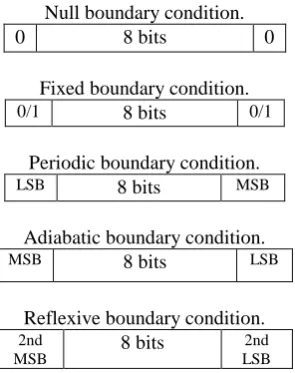
Four boundary conditions in cellular automata are:
Null boundary condition.
0 8 bits 0
Fixed boundary condition.
0/1 8 bits 0/1
Periodic boundary condition.
LSB 8 bits MSB
Adiabatic boundary condition.
MSB 8 bits LSB
Reflexive boundary condition. 2nd
MSB 8 bits
2nd LSB
B. Rule formation
Elementary CA has two states, 0 and 1, for every cell. For a combination of three neighbors there can be 8(=23) possible combinations i.e. 000,001,…,111. There are total of 28 rules, each rule is represented by an 8-bit binary number denoted as Rule 0, Rule 1 and so on till Rule 255. For a two state nine
neighborhood CA, there exist possible rules. Among these, 29 rules are linear and can be determined by fig. 2.
Remaining are non-linear rules [16],[17].
64 128 256
32 1 2
[image:2.595.96.244.148.335.2]16 8 4
Fig 2: 2-Dimensional CA rule convention
Cellular automata have several advantages over other methods of computation. Simplicity of implementation makes it appropriate for solving complex problem in less computational time complexity. CA is comparatively faster than other methods [13].
III. RELATEDWORK
A tremendous work is done for edge detection in an image. Sobel, prewitt and robert are some techniques based on gradient value. Generally, threshold value is decided empirically which might result in loss of edge details. An adaptive edge detection method was introduced by Li Er-sen et al. [26] based on analysing conventional canny operator in which both the thresholds were calculated self-adaptively making the algorithm consume more computational time.
According to literature so far, CA roots itself for more than two decades in image processing [19].
In [16], Choudhury et al. employed eight basic rules for 2-Dimensional Cellular Automata (Rule 2, 4, 8, 16, 32, 64, 128 and 256) to an image for its translation in all directions. Various rules were applied to obtain various operations on images like scaling and thinning horizontally as well as vertically, zooming of symmetric images. Qadir et al. [20] extended the concept of translation of the image by using twenty-five neighborhoods instead of nine neighborhoods. This method for translation was used in gaming applications. In [21], khan proposed that hybrid CA is the possible solution for rotation of images through an arbitrary angle. According to him, 2-D CA rules are applied which rotates an image about x and y axis by an angle π.
Determination of rule set is a crucial step in CA. Specifying and selecting rules manually is a slow and laborious process, also it may not scale well to larger problems. The Fuzzy Cellular Automata (FCA) is employed with fuzzy logic, having fuzzy states of a cell and fuzzy functions for transition rules. FCA is a special class of CA which is applied to design the pattern classifier [22]. Wang Hong et al. [23] suggested a new method for segmentation of an image based on fuzzy cellular automata. In [24], More and Patel used the property of Cellular Learning Automata to enhance the edges detected by fuzzy logic. In [15], Nayak, Sahu and Mohammed compared the performance of existing edge detection techniques with their proposed method based on extended neighborhood CA and null boundary conditions.
IV. PROPOSEDALGORITHM
In the proposed algorithm, all input images are grayscale. This method highlights the contribution made to overall appearance of an image by significant bits. Considering the fact, that each pixel is represented by 8 bits. Higher-order bits i.e. first four most significant bits of binary representation of intensity depict maximum image information.
Each cell represents an image pixel with certain intensity or pixel value. According to Moore neighborhood, four linear rules are identified which can efficiently result in identification of boundary of a region. These composite rules are as given below and are calculated with some basic rules and XOR function. These rules are computed as follow:
Rule 29 = Rule16 ⊕ Rule8 ⊕ Rule4 ⊕ Rule1
Rule 113 = Rule64 ⊕ Rule32 ⊕ Rule16 ⊕ Rule1
Rule 263 = Rule256 ⊕ Rule4 ⊕ Rule2 ⊕ Rule1
Rule 449 = Rule256 ⊕ Rule128 ⊕ Rule64 ⊕ Rule1
Integration of these rules result in edges present in the image.
Rule29 || Rule113 || Rule263 || Rule449
Finally, morphological operations are performed to enhance the results by removing noise and obtain true edges in the given input image.
[image:3.595.308.545.58.438.2]The cell state in the next generation is found dependent upon the previous state of its neighboring cells and all cells are updated synchronously resulting in unit time complexity. Every cell can have two states, 0 or 1. In a 1x3 neighborhood structure, state of d pixel is updated by considering previous states of pixel a, b and c. Fig. 3 illustrates the method to apply identified composite rules by taking different set of 1x3 neighbors to update value of pixel d. These four rules can be represented as four borders which result in edge detection when applied by sliding a window of 3x3 pixels over an image of size mxn.
Fig 3: Conceptual representation for identification of four rules.
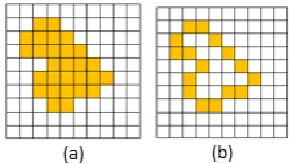
Fig 4: Illustration (a) region in an image (b) Contour identified by applying these four rules.
V. EXPERIMENTALRESULTS
A comparison of proposed method is carried out against the commonly deployed kernel-based methods. These techniques experience the problems of imprecise edge detection such as missing true edges or producing extra edges due to noise etc. Also, selection of optimal threshold value in these techniques influences accuracy of edge extraction.
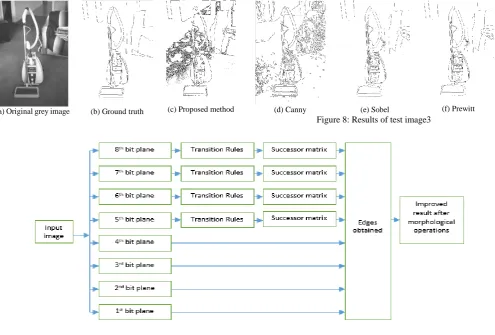
[image:3.595.311.543.71.665.2]The results of Mendeley Dataset [25] as shown in Fig. 6-8, are compared with existing edge detection methods and indicate promising performance of the proposed algorithm by evaluating Mean square error (MSE) and Peak signal to noise ratio (PSNR) values as given by Table 1. MSE and PSNR are mainly used to compare quality of reconstructed image with its ground truth image. High MSE and less PSNR values of a resultant image indicates that operator used for edge detection has high performance capabilities.
Table 1: Experimental results for test images Origin
al image
Proposed method
Canny Sobel Prewit
t
Image 1
MSE 0.8810 0.9172 0.9741 0.9745
PSNR 0.5500 0.3754 0.1138 0.1122
Image 2
MSE 0.9156 0.9201 0.9720 0.9718
PSNR 0.3831 0.3616 0.1232 0.1242
Image 3
MSE 0.8855 0.9258 0.9740 0.9741
PSNR 0.5283 0.3346 0.1146 0.1142
Image 4
MSE 0.8738 0.9046 0.9586 0.9585
PSNR 0.5858 0.4355 0.1837 0.1840
Image 5
MSE 0.8825 0.9313 0.9671 0.9670
PSNR 0.5427 0.3092 0.1453 0.1459
(a) Original grey image
(b) Ground truth (c) Proposed method
(d) Canny (e) Sobel (f) Prewitt
Fig 6: Results of test image1
(a) Original grey image
(b) Ground truth (c) Proposed method
[image:3.595.100.237.239.365.2](d) Canny (e) Sobel (f) Prewitt
[image:3.595.99.244.402.484.2] [image:3.595.318.549.441.672.2](a) Original grey image (b) Ground truth (c) Proposed method (d) Canny (e) Sobel (f) Prewitt Figure 8: Results of test image3
Figure 5: Flowchart of proposed method
1 2 3 4 5 6 7 8 9 10 11 12 13 14
0 0.2 0.4 0.6 0.8 1
Images
P
S
N
R
v
a
lu
e
Sobel Prewitt Canny
Proposed method
Figure 9: Bar chart of PSNR values of results of different edge detectors and proposed method.
VI. CONCLUSION
Evaluation of test images show that proposed method exhibit better performance even for noisy and cluttered images. Visually, finite state machine based method produced promising results of edge detection when compared with canny, sobel and prewitt edge detectors. Canny consist of several spurious edges whereas sobel and prewitt lack some of the strong edges.
REFERENCES
1. John Canny, “A Computational Approach to Edge Detection,” IEEE Transactions on Pattern Analysis and Machine Intelligence, Vol. Pami-8, No. 6, November 1986.
[image:4.595.119.485.427.614.2]or-1 Photo
3. Pinaki Pratim Acharjya, Ritaban Das and Dibyendu Ghoshal, “Study and Comparison of Different Edge Detectors for Image Segmentation,” Global Journal of Computer Science and Technology Graphics & Vision, Vol. 12, no. 13, pp. 28-32, 2012.
4. S Ulam, “Some Ideas and Prospects in Biomathematics,” Annual Review of Biophysics and Bioengineering, pp. 277-292, 1963. 5. J V Neumann, “Theory of Self-Reproducing Automata,” University of
Illinois Press, 1966.
6. S Wolfram, “Computation Theory of Cellular Automata,” Communications in Mathematical Physics, vol. 96, pp. 15-57, 1984. 7. S Wolfram, “A new kind of science,” Wolfram Media, Inc., 2002. 8. S Wolfram, “Cellular Automata and Complexity,” Collected Papers
Reading, MA: Addison-Wesley, 1994.
9. S Vijayarani, A Sakila, “A Performance Comparison of Edge Detection Techniques for Printed and Handwritten Document Images,” International Journal of Innovative Research in Computer and Communication Engineering, Vol. 4, Issue 5, May 2016.
10. Norman H Packard, “Two-Dimensional Cellular Automata,” Journal of Statistical Physics, vol. 38, pp. 901-946, March 1985.
11. Abdel Latif Abu Dalhoum, et al., “Digital Image Scrambling Using 2D Cellular Automata,” IEEE Computer Society, October- December 2012.
12. Radu V. Craiu and Thomas C. M. Lee, “Pattern Generation Using Likelihood Inference for Cellular Automata,” IEEE Transactions on Image Processing, Vol. 15, No. 7, July 2006.
13. Ingo Kusch and Mario Markus, “Mollusc Shell Pigmentation: Cellular Automaton Simulations and Evidence for Undecidability,” Journal of Theoretical Biology, Vol. 178, Issue 3, Pages 333-340, 7 February 1996.
14. R C Gonzalez and R E Woods, “Digital Image Processing. Second Edition,” Prentice- Hall, 2002.
15. D R Nayak, S K Sahu, J Mohammed, “A Cellular Automata Based Optimal Edge Detection Technique using Twenty-Five Neighborhood Model,” IJCA, vol. 84, no. 10, pp. 27-33, 2013.
16. P P Choudhury, B K Nayak, S Sahoo, S P Rath, “Theory and Applications of Two-dimensional, Null boundary, Nine neighborhood, Cellular Automata Linear rules,” IJCA, 2008.
17. A M Odlyzko, O Martin, S Wolfram, “Algebraic properties of cellular automata,” Communications in Mathematical Physics, vol. 93, pp. 219–258, 1984.
18. M Sipper, “The evolution of parallel cellular machines toward evol-ware,” BioSystems, vol. 42, pp. 29 –43, 1997.
19. Deepak Ranjan Nayak, Prashanta Kumar Patra and Amitav Mahapatra, “A Survey on Two Dimensional Cellular Automata and Its Application in Image Processing,” IJCA Proceedings on International Conference on Emergent Trends in Computing and Communication, 2014.
20. F Qadir, J Shah, M A Peer, K A Khan, “Replacement of graphics translations with two dimensional cellular automata, twenty-five neighborhood model,” International Journal of Computational Engineering and Management, Vol. 15, Issue 4, pp. 33-39, 2012. 21. A R Khan, “Replacement of some Graphics Routines with the help of
2D Cellular Automata Algorithms for Faster Graphics Operations,” PhD thesis, University of Kashmir, 1998.
22. M Mraz, N Zimic, I Lapanja, I Bajec, “Fuzzy Cellular Automata: From Theory to Applications,” IEEE, 2000.
23. W Hong, Z Hong-jie and W Hua, “Image Segmentation Arithmetic Based on Fuzzy Cellular Automata,” Fuzzy Systems and Mathematics, no. 18, pp. 309-313, 2004.
24. D K Patel and S A More, “Edge Detection technique by Fuzzy logic and Cellular Learning Automata using fuzzy image processing,” IEEE Conf. (ICCCI), pp. 1-6, 2013.
25. http://dx.doi.org/10.17632/hvtmfvbxtj.1#file-7dd2224d-0376-40ca-9 a0d-27455a10e503
26. Li Er-sen, Zhu Shu-long, Zhu Bao-shan, Zhao Yong, Xia Chao-gui and Song Li-hua, “An Adaptive Edge-Detection Method Based on the Canny Operator,” IEEE conf. (ICESIAT), 2009.
AUTHORSPROFILE
Jyoti Swarup is a research scholar pursuing PhD from Delhi Technological University(DTU), New Delhi. Her areas of research interest include image processing and computer vision. She received her B Tech degree in Information Technology from Guru Gobind Singh Indraprastha University, New Delhi and M Tech Degrees in Information Systems from Delhi Technological University, New Delhi.